Dell Tech 1visit us at www.delltech.com or email Dell Tech
FlashPointTest
Methods
ASTM D56 and ASTM D93
• When and why the testing is
needed ?
• What the do the results
mean?
• What does the test involve?
• How Dell Tech can help?
AboutUs
Helping global clients buy, sell,
manufacture and distribute
chemicals safely since 1980
Dell Tech 2visit us at www.delltech.com or email Dell Tech
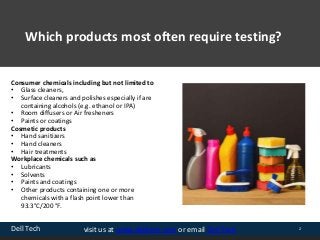
Which products most often require testing?
Consumer chemicals including but not limited to
• Glass cleaners,
• Surface cleaners and polishes especially if are
containing alcohols (e.g. ethanol or IPA)
• Room diffusers or Air fresheners
• Paints or coatings
Cosmetic products
• Hand sanitizers
• Hand cleaners
• Hair treatments
Workplace chemicals such as
• Lubricants
• Solvents
• Paints and coatings
• Other products containing one or more
chemicals with a flash point lower than
93.3°C/200 °F.
Dell Tech 3visit us at www.delltech.com or email Dell Tech
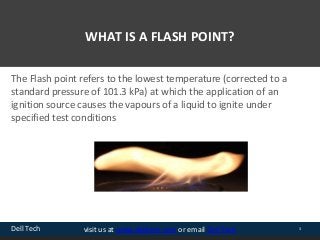
WHAT IS A FLASH POINT?
The Flash point refers to the lowest temperature (corrected to a
standard pressure of 101.3 kPa) at which the application of an
ignition source causes the vapours of a liquid to ignite under
specified test conditions
Dell Tech 4visit us at www.delltech.com or email Dell Tech
WHY DO YOU NEED THE FLASH POINT OF A
PRODUCT?
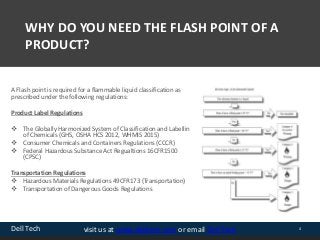
A Flash point is required for a flammable liquid classification as
prescribed under the following regulations:
Product Label Regulations
 The Globally Harmonized System of Classification and Labelling
of Chemicals (GHS, OSHA HCS 2012, WHMIS 2015)
 Consumer Chemicals and Containers Regulations (CCCR)
 Federal Hazardous Substance Act Regualtions 16CFR1500
(CPSC)
Transportation Regulations
 Hazardous Materials Regulations 49CFR173 (Transportation)
 Transportation of Dangerous Goods Regulations
Dell Tech 5visit us at www.delltech.com or email Dell Tech
WHY USE ASTM D56 AND ASTM D93?
 Chemical Workplace Products Labels
The Globally Harmonized System of Classification and
Labelling of Chemicals (GHS) requires that the Flash
point to be determined by using closed-cup test
method. The document lists 15 different test methods
that can be used. Two of the methods listed are
• ASTM D56 - Standard Test Method for Flash Point
by Tag Closed Cup Tester and
• ASTM D93 - Standard Test Methods for Flash Point
by Pensky-Martens Closed Cup Tester
 Chemical Retail Products Labels
• Consumer Chemicals and Containers Regulations
(CCCR) Sections 50 to 52 prescribe ASTM D56 and
ASTM D93
Dell Tech 6visit us at www.delltech.com or email Dell Tech
HOW TO CHOOSE WHICH METHOD TO USE?
• ASTM D56 is recommended for liquids
with a viscosity lower than 5.8 mm2/s at
37.8 °C.
• ASTM D93 is recommended for liquids
with a viscosity higher than 5.8 mm2/s at
37.8 °C or liquids with tendency to form a
surface film under the test conditions.
Dell Tech 7visit us at www.delltech.com or email Dell Tech
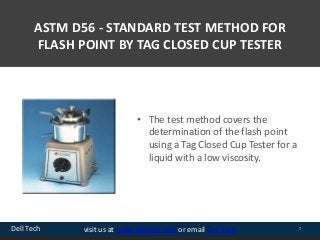
ASTM D56 - STANDARD TEST METHOD FOR
FLASH POINT BY TAG CLOSED CUP TESTER
• The test method covers the
determination of the flash point
using a Tag Closed Cup Tester for a
liquid with a low viscosity.
Dell Tech 8visit us at www.delltech.com or email Dell Tech
ASTM D56 - STANDARD TEST METHOD STEP BY STEP
 Using a graduated cylinder, 50 mL of the liquid sample is placed in the cup
of the tester
 Both cylinder and sample being precooled, if necessary, making sure that
the sample temperature at the start of the testing is 27 ± 5°C or at least
10°C below the expected flash point, whichever is the lowest.
 For example: a product that contains 70% IPA will have an estimated
Flash point of 18 °C. The starting temperature shall be below 8 °C
 The sample is heated at a slow constant rate.
 The ignition source is applied at specified intervals. The flash point is the
lowest temperature at which application of the ignitions source causes the
vapour above the specimen to ignite.
 The sample is deemed to have flashed when a large flame appears and
instantaneously propagates itself over the entire surface of the test
specimen. The observed flash point shall be corrected for barometric
pressure.
Dell Tech 9visit us at www.delltech.com or email Dell Tech
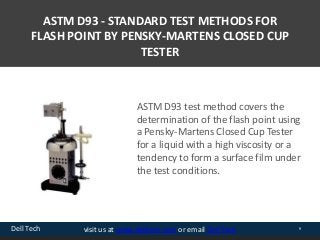
ASTM D93 - STANDARD TEST METHODS FOR
FLASH POINT BY PENSKY-MARTENS CLOSED CUP
TESTER
ASTM D93 test method covers the
determination of the flash point using
a Pensky-Martens Closed Cup Tester
for a liquid with a high viscosity or a
tendency to form a surface film under
the test conditions.
Dell Tech 10visit us at www.delltech.com or email Dell Tech
ASTM D93 - STANDARD TEST METHOD STEP BY STEP
 Using a graduated cylinder or using the line on the cup add 75 mL of the liquid
sample in the cup of the tester
 Both cup and sample are precooled, if necessary, making sure that the sample
temperature at the start of the testing is at least 18°C below the expected flash
point, whichever is the lowest.
 Also samples of very viscous materials can be warmed until they are reasonably
fluid before they are tested. However, no sample should be heated more than is
absolutely necessary.
 The sample is heated at a slow constant rate while being constantly stirred at 90 –
120 rpm for method A and 250 ± 10 rpm for method B.
 The ignition source is applied at specified intervals until the flash point is observed
 The flash point is the lowest temperature at which application of the ignition source
causes the vapour above the specimen to ignite.
 The sample is deemed to have flashed when a large flame appears and
instantaneously propagates itself over the entire surface of the test specimen. The
observed flash point shall be corrected for barometric pressure.
Dell Tech 11visit us at www.delltech.com or email Dell Tech
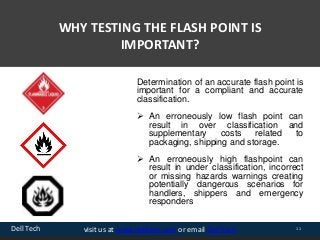
WHY TESTING THE FLASH POINT IS
IMPORTANT?
Determination of an accurate flash point is
important for a compliant and accurate
classification.
 An erroneously low flash point can
result in over classification and
supplementary costs related to
packaging, shipping and storage.
 An erroneously high flashpoint can
result in under classification, incorrect
or missing hazards warnings creating
potentially dangerous scenarios for
handlers, shippers and emergency
responders
Dell Tech 12visit us at www.delltech.com or email Dell Tech
HOW CAN DELL TECH HELP YOU?
• Determine the appropriate Flash point test
method to classify your product
• Perform the testing to determinate your
product Flash point in our ISO 17025
accredited lab
• Classify your product according to the current
GHS, TDG/DOT requirements in Canada and
the USA
• Classify your product according CCCR and
CPSC flammability requirements
• SDS authoring
• Consumer labelling
Dell Tech 13visit us at www.delltech.com or email Dell Tech
ISO 17025 Accredited Laboratory
Dell Tech Laboratories Ltd. is accredited by A2LA under
the ISO/IEC 17025 Testing and Calibration Laboratories.
Certificate # 4305.01
Dell Tech 14visit us at www.delltech.com or email Dell Tech
Testing Capabilities Following Approved Standards
• American Society for Testing and Materials
• Household & Commercial Products
Association
• Organization for Economic Co-operation and
Development (OECD)
• Canadian General Standards Board
• UN Recommendations on the Transport of
Dangerous Goods
Dell Tech 15visit us at www.delltech.com or email Dell Tech
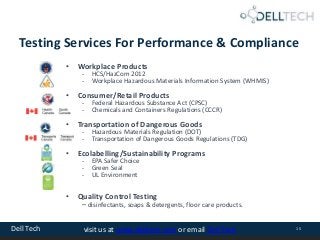
Testing Services For Performance & Compliance
• Workplace Products
- HCS/HazCom 2012
- Workplace Hazardous Materials Information System (WHMIS)
• Consumer/Retail Products
- Federal Hazardous Substance Act (CPSC)
- Chemicals and Containers Regulations (CCCR)
• Transportation of Dangerous Goods
- Hazardous Materials Regulation (DOT)
- Transportation of Dangerous Goods Regulations (TDG)
• Ecolabelling/Sustainability Programs
- EPA Safer Choice
- Green Seal
- UL Environment
• Quality Control Testing
– disinfectants, soaps & detergents, floor care products.
Dell Tech 16visit us at www.delltech.com or email Dell Tech
CompanyOverview
Providing expert compliance and
testing services since 1980, Dell
Tech is an industry leader in
assisting companies with North
American regulatory compliance.
Our team has over 100 years of
combined experience and
specializes in custom testing and
consulting. We are proud to offer
our global clients personalized
service that is flexible to meet the
needs of their business.
AboutUs
Helping global clients buy, sell,
manufacture and distribute
chemicals safely since 1980
Dell Tech 17visit us at www.delltech.com or email Dell Tech
FOR FURTHER INFORMATION AND QUESTIONS
Please contact
Dell Tech Laboratories
Joe McCarthy, Lab Services Manager
519-858-5024
jmccarthy@delltech.com
Dana Mladin, Sr. Laboratory Technician &
Regulatory Affairs Specialist
dmladin@delltech.com
Katherine Hatherley, Junior Lab Technician
katherine@delltech.com
http://delltech.com/laboratory-services-group/

Flash Point Test Methods ASTM D56 and ASTM D93

  • 1.
    Dell Tech 1visitus at www.delltech.com or email Dell Tech FlashPointTest Methods ASTM D56 and ASTM D93 • When and why the testing is needed ? • What the do the results mean? • What does the test involve? • How Dell Tech can help? AboutUs Helping global clients buy, sell, manufacture and distribute chemicals safely since 1980
  • 2.
    Dell Tech 2visitus at www.delltech.com or email Dell Tech Which products most often require testing? Consumer chemicals including but not limited to • Glass cleaners, • Surface cleaners and polishes especially if are containing alcohols (e.g. ethanol or IPA) • Room diffusers or Air fresheners • Paints or coatings Cosmetic products • Hand sanitizers • Hand cleaners • Hair treatments Workplace chemicals such as • Lubricants • Solvents • Paints and coatings • Other products containing one or more chemicals with a flash point lower than 93.3°C/200 °F.
  • 3.
    Dell Tech 3visitus at www.delltech.com or email Dell Tech WHAT IS A FLASH POINT? The Flash point refers to the lowest temperature (corrected to a standard pressure of 101.3 kPa) at which the application of an ignition source causes the vapours of a liquid to ignite under specified test conditions
  • 4.
    Dell Tech 4visitus at www.delltech.com or email Dell Tech WHY DO YOU NEED THE FLASH POINT OF A PRODUCT? A Flash point is required for a flammable liquid classification as prescribed under the following regulations: Product Label Regulations  The Globally Harmonized System of Classification and Labelling of Chemicals (GHS, OSHA HCS 2012, WHMIS 2015)  Consumer Chemicals and Containers Regulations (CCCR)  Federal Hazardous Substance Act Regualtions 16CFR1500 (CPSC) Transportation Regulations  Hazardous Materials Regulations 49CFR173 (Transportation)  Transportation of Dangerous Goods Regulations
  • 5.
    Dell Tech 5visitus at www.delltech.com or email Dell Tech WHY USE ASTM D56 AND ASTM D93?  Chemical Workplace Products Labels The Globally Harmonized System of Classification and Labelling of Chemicals (GHS) requires that the Flash point to be determined by using closed-cup test method. The document lists 15 different test methods that can be used. Two of the methods listed are • ASTM D56 - Standard Test Method for Flash Point by Tag Closed Cup Tester and • ASTM D93 - Standard Test Methods for Flash Point by Pensky-Martens Closed Cup Tester  Chemical Retail Products Labels • Consumer Chemicals and Containers Regulations (CCCR) Sections 50 to 52 prescribe ASTM D56 and ASTM D93
  • 6.
    Dell Tech 6visitus at www.delltech.com or email Dell Tech HOW TO CHOOSE WHICH METHOD TO USE? • ASTM D56 is recommended for liquids with a viscosity lower than 5.8 mm2/s at 37.8 °C. • ASTM D93 is recommended for liquids with a viscosity higher than 5.8 mm2/s at 37.8 °C or liquids with tendency to form a surface film under the test conditions.
  • 7.
    Dell Tech 7visitus at www.delltech.com or email Dell Tech ASTM D56 - STANDARD TEST METHOD FOR FLASH POINT BY TAG CLOSED CUP TESTER • The test method covers the determination of the flash point using a Tag Closed Cup Tester for a liquid with a low viscosity.
  • 8.
    Dell Tech 8visitus at www.delltech.com or email Dell Tech ASTM D56 - STANDARD TEST METHOD STEP BY STEP  Using a graduated cylinder, 50 mL of the liquid sample is placed in the cup of the tester  Both cylinder and sample being precooled, if necessary, making sure that the sample temperature at the start of the testing is 27 ± 5°C or at least 10°C below the expected flash point, whichever is the lowest.  For example: a product that contains 70% IPA will have an estimated Flash point of 18 °C. The starting temperature shall be below 8 °C  The sample is heated at a slow constant rate.  The ignition source is applied at specified intervals. The flash point is the lowest temperature at which application of the ignitions source causes the vapour above the specimen to ignite.  The sample is deemed to have flashed when a large flame appears and instantaneously propagates itself over the entire surface of the test specimen. The observed flash point shall be corrected for barometric pressure.
  • 9.
    Dell Tech 9visitus at www.delltech.com or email Dell Tech ASTM D93 - STANDARD TEST METHODS FOR FLASH POINT BY PENSKY-MARTENS CLOSED CUP TESTER ASTM D93 test method covers the determination of the flash point using a Pensky-Martens Closed Cup Tester for a liquid with a high viscosity or a tendency to form a surface film under the test conditions.
  • 10.
    Dell Tech 10visitus at www.delltech.com or email Dell Tech ASTM D93 - STANDARD TEST METHOD STEP BY STEP  Using a graduated cylinder or using the line on the cup add 75 mL of the liquid sample in the cup of the tester  Both cup and sample are precooled, if necessary, making sure that the sample temperature at the start of the testing is at least 18°C below the expected flash point, whichever is the lowest.  Also samples of very viscous materials can be warmed until they are reasonably fluid before they are tested. However, no sample should be heated more than is absolutely necessary.  The sample is heated at a slow constant rate while being constantly stirred at 90 – 120 rpm for method A and 250 ± 10 rpm for method B.  The ignition source is applied at specified intervals until the flash point is observed  The flash point is the lowest temperature at which application of the ignition source causes the vapour above the specimen to ignite.  The sample is deemed to have flashed when a large flame appears and instantaneously propagates itself over the entire surface of the test specimen. The observed flash point shall be corrected for barometric pressure.
  • 11.
    Dell Tech 11visitus at www.delltech.com or email Dell Tech WHY TESTING THE FLASH POINT IS IMPORTANT? Determination of an accurate flash point is important for a compliant and accurate classification.  An erroneously low flash point can result in over classification and supplementary costs related to packaging, shipping and storage.  An erroneously high flashpoint can result in under classification, incorrect or missing hazards warnings creating potentially dangerous scenarios for handlers, shippers and emergency responders
  • 12.
    Dell Tech 12visitus at www.delltech.com or email Dell Tech HOW CAN DELL TECH HELP YOU? • Determine the appropriate Flash point test method to classify your product • Perform the testing to determinate your product Flash point in our ISO 17025 accredited lab • Classify your product according to the current GHS, TDG/DOT requirements in Canada and the USA • Classify your product according CCCR and CPSC flammability requirements • SDS authoring • Consumer labelling
  • 13.
    Dell Tech 13visitus at www.delltech.com or email Dell Tech ISO 17025 Accredited Laboratory Dell Tech Laboratories Ltd. is accredited by A2LA under the ISO/IEC 17025 Testing and Calibration Laboratories. Certificate # 4305.01
  • 14.
    Dell Tech 14visitus at www.delltech.com or email Dell Tech Testing Capabilities Following Approved Standards • American Society for Testing and Materials • Household & Commercial Products Association • Organization for Economic Co-operation and Development (OECD) • Canadian General Standards Board • UN Recommendations on the Transport of Dangerous Goods
  • 15.
    Dell Tech 15visitus at www.delltech.com or email Dell Tech Testing Services For Performance & Compliance • Workplace Products - HCS/HazCom 2012 - Workplace Hazardous Materials Information System (WHMIS) • Consumer/Retail Products - Federal Hazardous Substance Act (CPSC) - Chemicals and Containers Regulations (CCCR) • Transportation of Dangerous Goods - Hazardous Materials Regulation (DOT) - Transportation of Dangerous Goods Regulations (TDG) • Ecolabelling/Sustainability Programs - EPA Safer Choice - Green Seal - UL Environment • Quality Control Testing – disinfectants, soaps & detergents, floor care products.
  • 16.
    Dell Tech 16visitus at www.delltech.com or email Dell Tech CompanyOverview Providing expert compliance and testing services since 1980, Dell Tech is an industry leader in assisting companies with North American regulatory compliance. Our team has over 100 years of combined experience and specializes in custom testing and consulting. We are proud to offer our global clients personalized service that is flexible to meet the needs of their business. AboutUs Helping global clients buy, sell, manufacture and distribute chemicals safely since 1980
  • 17.
    Dell Tech 17visitus at www.delltech.com or email Dell Tech FOR FURTHER INFORMATION AND QUESTIONS Please contact Dell Tech Laboratories Joe McCarthy, Lab Services Manager 519-858-5024 jmccarthy@delltech.com Dana Mladin, Sr. Laboratory Technician & Regulatory Affairs Specialist dmladin@delltech.com Katherine Hatherley, Junior Lab Technician katherine@delltech.com http://delltech.com/laboratory-services-group/