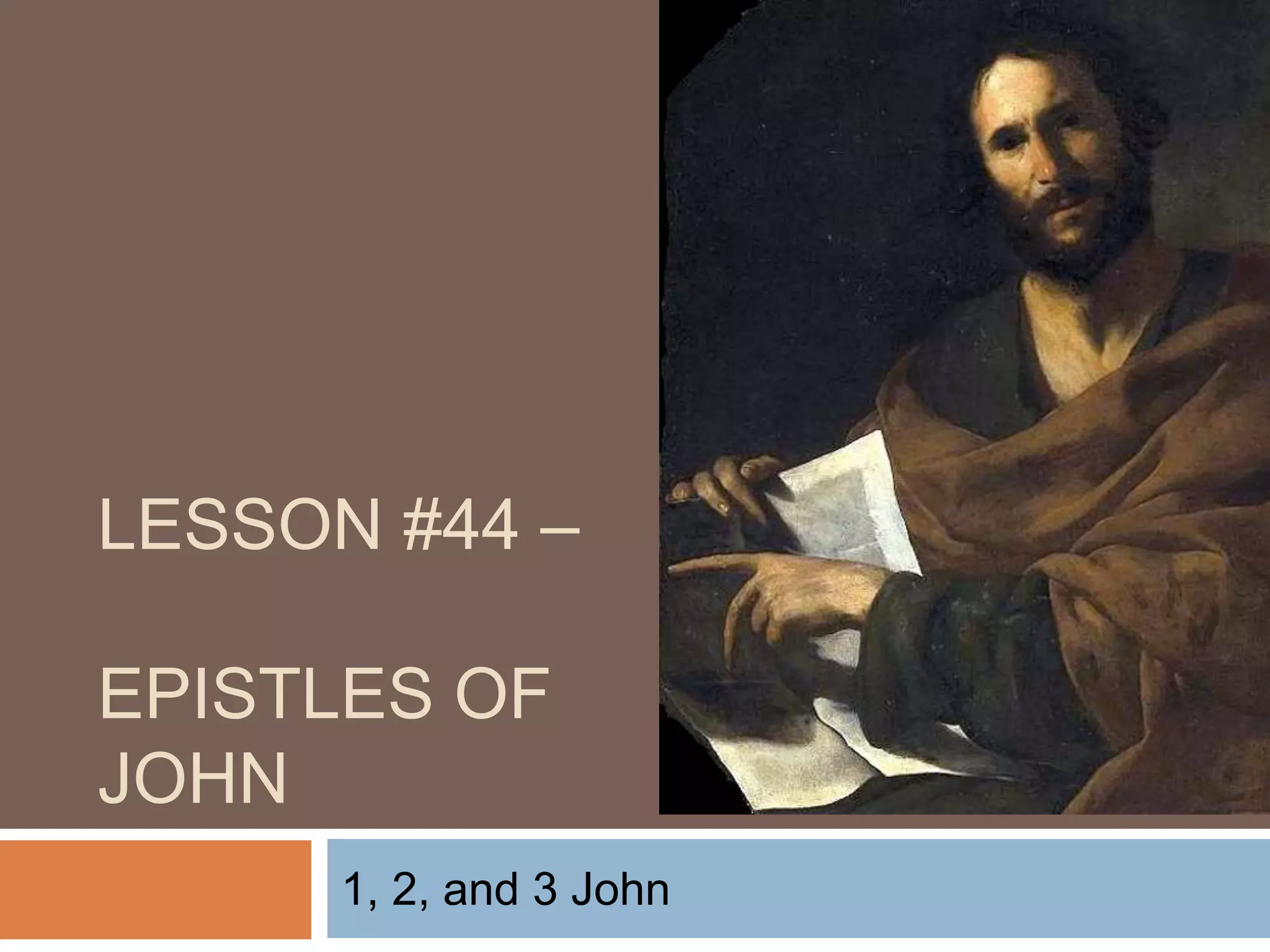
LESSON #44 –
EPISTLES OF
JOHN
1, 2, and 3 John
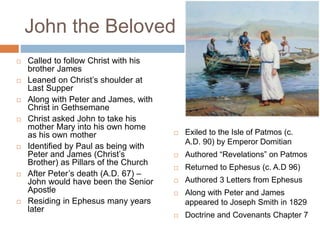
John the Beloved
 Called to follow Christ with his
brother James
 Leaned on Christ’s shoulder at
Last Supper
 Along with Peter and James, with
Christ in Gethsemane
 Christ asked John to take his
mother Mary into his own home
as his own mother
 Identified by Paul as being with
Peter and James (Christ’s
Brother) as Pillars of the Church
 After Peter’s death (A.D. 67) –
John would have been the Senior
Apostle
 Residing in Ephesus many years
later
 Exiled to the Isle of Patmos (c.
A.D. 90) by Emperor Domitian
 Authored “Revelations” on Patmos
 Returned to Ephesus (c. A.D 96)
 Authored 3 Letters from Ephesus
 Along with Peter and James
appeared to Joseph Smith in 1829
 Doctrine and Covenants Chapter 7
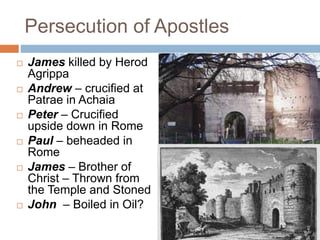
Persecution of Apostles
 James killed by Herod
Agrippa
 Andrew – crucified at
Patrae in Achaia
 Peter – Crucified
upside down in Rome
 Paul – beheaded in
Rome
 James – Brother of
Christ – Thrown from
the Temple and Stoned
 John – Boiled in Oil?
John’s Testimony
 1 John 1:1-4
 "Brethren, this is the testimony which we give that that
which was from the beginning, which we have heard,
which we have seen with our eyes, which we have looked
upon, and our hands have handled, of the Word of life;
"(For the life was manifested, and we have seen it, and
bear witness, and shew unto you that eternal life, which
was with the Father, and was manifested unto us;)
"That which we have seen and heard declare we unto you,
that ye also may have fellowship with us; and truly our
fellowship is with the Father, and with his Son Jesus Christ.
"And these things write we unto you, that your joy may be
full"
John’s “style”
 Imagery
 John focuses on painting literary or verbal pictures
 Brevity
 2 of John’s 3 Epistles are among the smallest books
in the New Testaments
 Compression and concentration of language
 Poetry
 With well-written poetry, it is not the literal meaning of
the words that matters, but what kinds of
intangible feelings those words provoke.
 Poetry is a “speaking picture”
 Sir Phillip Sidney
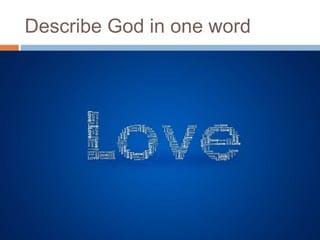
Describe God in one word
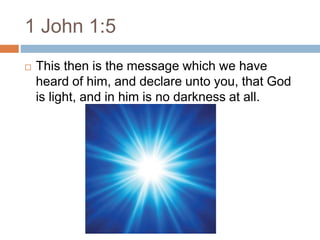
1 John 1:5
 This then is the message which we have
heard of him, and declare unto you, that God
is light, and in him is no darkness at all.
Imagery of Light…1 John 1:6-10
 Darkness: "If we say that we have fellowship with [God], and walk
in darkness, we lie, and do not the truth: (1:6)
Light: "But if we walk in the light, as he is in the light, we have
fellowship one with another, and the blood of Jesus Christ his Son
cleanseth us from all sin." (1:7)
Darkness: "If we say that we have no sin, we deceive ourselves,
and the truth is not in us." (1:8)
Light: "If we confess our sins, he is faithful and just to forgive us
our sins, and to cleanse us from all unrighteousness." (1:9)
Darkness: "If we say that we have not sinned, we make him a liar,
and his word is not in us." (1:10)
1 John 4:8,16
 8 He that loveth not knoweth not God; for
God is love.
 16 And we have known and believed the love
that God hath to us. God is love; and he that
dwelleth in love dwelleth in God, and God in
him.
Does this imagery of God Surprise
you?
 The word “Love” and it’s variations are used 46
times in the first epistle
 When Christ was asked which were the greatest
of all the commandments, what was his answer?
 The central feature in Lehi’s dream is the tree of
life—a representation of “the love of God” (see 1
Nephi 11:21–22).
 “For God so loved the world, that he gave his only
begotten Son, that whosoever believeth in him
should not perish, but have everlasting life” (John
3:16)
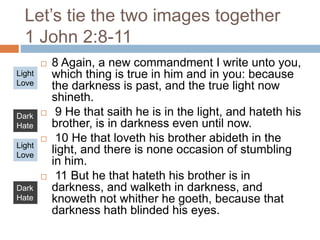
Let’s tie the two images together
1 John 2:8-11
 8 Again, a new commandment I write unto you,
which thing is true in him and in you: because
the darkness is past, and the true light now
shineth.
 9 He that saith he is in the light, and hateth his
brother, is in darkness even until now.
 10 He that loveth his brother abideth in the
light, and there is none occasion of stumbling
in him.
 11 But he that hateth his brother is in
darkness, and walketh in darkness, and
knoweth not whither he goeth, because that
darkness hath blinded his eyes.
Light
Love
Light
Love
Dark
Hate
Dark
Hate
Sons of God
 1 John 3:2
 Beloved, now are we the sons of God, and it doth
not yet appear what we shall be: but we know
that, when he shall appear, we shall be like him;
for we shall see him as he is.
Keep the commandments
 2 John 6
 And this is love, that we walk after his
commandments. This is the commandment, That,
as ye have heard from the beginning, ye should
walk in it.
 3 John 4
 I have no greater joy than to hear that my children
walk in truth.
An interesting “Postscript”
 3 John 9-11
 9 I wrote unto the church: but Diotrephes, who loveth
to have the preeminence among them, receiveth us
not.
 10 Wherefore, if I come, I will remember his deeds
which he doeth, prating against us with malicious
words: and not content therewith, neither doth he
himself receive the brethren, and forbiddeth them that
would, and casteth them out of the church.
 11 Beloved, follow not that which is evil, but that
which is good. He that doeth good is of God: but he
that doeth evil hath not seen God.

Lesson 44 1, 2, and 3 john

  • 1.
    LESSON #44 – EPISTLESOF JOHN 1, 2, and 3 John
  • 2.
    John the Beloved Called to follow Christ with his brother James  Leaned on Christ’s shoulder at Last Supper  Along with Peter and James, with Christ in Gethsemane  Christ asked John to take his mother Mary into his own home as his own mother  Identified by Paul as being with Peter and James (Christ’s Brother) as Pillars of the Church  After Peter’s death (A.D. 67) – John would have been the Senior Apostle  Residing in Ephesus many years later  Exiled to the Isle of Patmos (c. A.D. 90) by Emperor Domitian  Authored “Revelations” on Patmos  Returned to Ephesus (c. A.D 96)  Authored 3 Letters from Ephesus  Along with Peter and James appeared to Joseph Smith in 1829  Doctrine and Covenants Chapter 7
  • 3.
    Persecution of Apostles James killed by Herod Agrippa  Andrew – crucified at Patrae in Achaia  Peter – Crucified upside down in Rome  Paul – beheaded in Rome  James – Brother of Christ – Thrown from the Temple and Stoned  John – Boiled in Oil?
  • 4.
    John’s Testimony  1John 1:1-4  "Brethren, this is the testimony which we give that that which was from the beginning, which we have heard, which we have seen with our eyes, which we have looked upon, and our hands have handled, of the Word of life; "(For the life was manifested, and we have seen it, and bear witness, and shew unto you that eternal life, which was with the Father, and was manifested unto us;) "That which we have seen and heard declare we unto you, that ye also may have fellowship with us; and truly our fellowship is with the Father, and with his Son Jesus Christ. "And these things write we unto you, that your joy may be full"
  • 5.
    John’s “style”  Imagery John focuses on painting literary or verbal pictures  Brevity  2 of John’s 3 Epistles are among the smallest books in the New Testaments  Compression and concentration of language  Poetry  With well-written poetry, it is not the literal meaning of the words that matters, but what kinds of intangible feelings those words provoke.  Poetry is a “speaking picture”  Sir Phillip Sidney
  • 6.
  • 7.
    1 John 1:5 This then is the message which we have heard of him, and declare unto you, that God is light, and in him is no darkness at all.
  • 8.
    Imagery of Light…1John 1:6-10  Darkness: "If we say that we have fellowship with [God], and walk in darkness, we lie, and do not the truth: (1:6) Light: "But if we walk in the light, as he is in the light, we have fellowship one with another, and the blood of Jesus Christ his Son cleanseth us from all sin." (1:7) Darkness: "If we say that we have no sin, we deceive ourselves, and the truth is not in us." (1:8) Light: "If we confess our sins, he is faithful and just to forgive us our sins, and to cleanse us from all unrighteousness." (1:9) Darkness: "If we say that we have not sinned, we make him a liar, and his word is not in us." (1:10)
  • 9.
    1 John 4:8,16 8 He that loveth not knoweth not God; for God is love.  16 And we have known and believed the love that God hath to us. God is love; and he that dwelleth in love dwelleth in God, and God in him.
  • 10.
    Does this imageryof God Surprise you?  The word “Love” and it’s variations are used 46 times in the first epistle  When Christ was asked which were the greatest of all the commandments, what was his answer?  The central feature in Lehi’s dream is the tree of life—a representation of “the love of God” (see 1 Nephi 11:21–22).  “For God so loved the world, that he gave his only begotten Son, that whosoever believeth in him should not perish, but have everlasting life” (John 3:16)
  • 11.
    Let’s tie thetwo images together 1 John 2:8-11  8 Again, a new commandment I write unto you, which thing is true in him and in you: because the darkness is past, and the true light now shineth.  9 He that saith he is in the light, and hateth his brother, is in darkness even until now.  10 He that loveth his brother abideth in the light, and there is none occasion of stumbling in him.  11 But he that hateth his brother is in darkness, and walketh in darkness, and knoweth not whither he goeth, because that darkness hath blinded his eyes. Light Love Light Love Dark Hate Dark Hate
  • 12.
    Sons of God 1 John 3:2  Beloved, now are we the sons of God, and it doth not yet appear what we shall be: but we know that, when he shall appear, we shall be like him; for we shall see him as he is.
  • 13.
    Keep the commandments 2 John 6  And this is love, that we walk after his commandments. This is the commandment, That, as ye have heard from the beginning, ye should walk in it.  3 John 4  I have no greater joy than to hear that my children walk in truth.
  • 14.
    An interesting “Postscript” 3 John 9-11  9 I wrote unto the church: but Diotrephes, who loveth to have the preeminence among them, receiveth us not.  10 Wherefore, if I come, I will remember his deeds which he doeth, prating against us with malicious words: and not content therewith, neither doth he himself receive the brethren, and forbiddeth them that would, and casteth them out of the church.  11 Beloved, follow not that which is evil, but that which is good. He that doeth good is of God: but he that doeth evil hath not seen God.

Editor's Notes

  • #5 This is the purpose of testifying: to bring joy to others--not just a bit of joy, but complete joy.
  • #6 As a poet, he uses words with concentrated meaning and imagery to instill in us more deeply the truths he wants to teach.
  • #15 In addition to being ambitious, proud, disrespectful of apostolic authority, rebellious, and inhospitable, the author of the letter says that Diotrephes tried to hinder those desiring to show hospitality to the brothers and to expel these from the congregation. Not even the location of Diotrephes' church can be determined from the letter. It is debatable whether the antipathy expressed in 3 John is based on "a theological dispute, a clash of competing ecclesiastical authorities, a disagreement about financial responsibilities for the mission, or personal dislike".[2]