Case presentation
Dr. Roni Rozen
Wolfson medical center, Gastroenterological institute
 22 Y.O. male was admitted to Wolfson emergency room, in a state of
coma and shock – low BP, tachycardia and respiratory distress.
 The patient was transferred to ER from Abarbanel Hospital, where he
was admitted 2 days before with an acute psychotic episode
secondary to illicit drug abuse.
 During the hospitalization the patient was treated with high dose
antipsychotics like Clozapine, Seroquel and Entumin.
 Prior to deterioration the patient complained about abdominal pain.
Case review
Work up at admission
 Clinical examination : altered mental status , BP 80/50 , Pulse 150 ,
RR 22, O2 Saturation 94%, Fever 38° C.
 Abdomen: peritoneal signs, marked distention, absent bowel sounds.
 Lab. tests : PH 6.9, Lactate 9, WBC 19000, NEUT 85%, Creatinine 2, Urea
96, Potassium 6, Sodium 135, normal LFT’s, INR 1.12.
 Abdominal X ray : severe colonic dilatation without evidence of fecal
impaction or free air.
 CT scan : severe small and large bowel loops dilatation,
no evidence of free air, obstruction or volvulus, mild ascites.
CT scan
Any ideas?
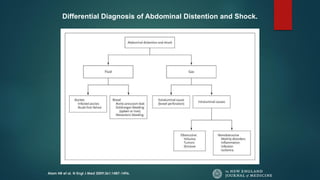
Alam HB et al. N Engl J Med 2009;361:1487-1496.
Differential Diagnosis of Abdominal Distention and Shock.
Possible etiologies
 Acute megacolon (Ogilvie’s syndrome) : acute dilatation of the colon in the
absence of mechanical obstruction
- abnormal intestinal motility due to antipsychotic/ illicit drugs/electrolytes
 Toxic megacolon : colonic distention (>6 cm), inflammation and septic shock
- IBD
- Clostridium difficile colitis
 Abdominal compartment syndrome : colonic distention, shock and organ
failure with sustained intraabdominal pressure above 20 mmHg
- Critically ill patients (including with septic shock)
 The patient was stabilized with vasopressors, fluid resuscitation and
taken to urgent explorative laparotomy.
 On laparotomy massive ischemia of right colon including hepatic
flexure was noted, patient underwent subtotal colectomy and
protective ileostomy with mucous fistula.
 After laparotomy patient was transferred to ICU .
Management
Pathology report
 Large bowel with ischemic changes , hemorrhagic necrosis of the
mucosa (predominantly) and submucosa (focally), unremarkable
appendix.
 No clear evidence of colitis, granulomas or evidence of IBD.
 No obstructive condition was detected.
Diagnosis
In the absence of colonic inflammation or obstruction -
the diagnosis is acute megacolon, also known as
Ogilvie’s syndrome
Follow up
 One month after admission including recurrent septic episodes,
tracheostomy and prolonged rehabilitation the patient was
discharged with Zyprexa (olanzapine) treatment.
 Remained under gastroenterological and surgical follow up
 3 months after discharge the patient was well, underwent normal
colonoscopy before ileostomy closure was performed.
Clozapine induced gastrointestinal
hypomotility (CIGH)
Literature review
Literature review
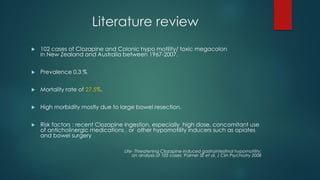
 102 cases of Clozapine and Colonic hypo motility/ toxic megacolon
in New Zealand and Australia between 1967-2007.
 Prevalence 0.3 %
 Mortality rate of 27.5%.
 High morbidity mostly due to large bowel resection.
 Risk factors : recent Clozapine ingestion, especially high dose, concomitant use
of anticholinergic medications , or other hypomotility inducers such as opiates
and bowel surgery
Life- Threatening Clozapine-induced gastrointestinal hypomotility:
an analysis of 102 cases Palmer SE et al. J Clin Psychiatry 2008
Literature review - continued
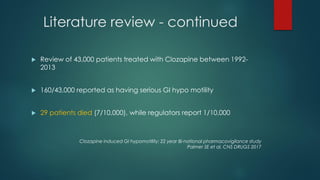
 Review of 43,000 patients treated with Clozapine between 1992-
2013
 160/43,000 reported as having serious GI hypo motility
 29 patients died (7/10,000), while regulators report 1/10,000
Clozapine induced GI hypomotility: 22 year Bi-national pharmacovigilance study
Palmer SE et al. CNS DRUGS 2017
Literature review - continued
 Review of three large case series with 104 cases
 38% mortality
 Mean daily Clozapine dose 453 mg, Median age 40, 79% male
 Four patients were re-challenged with Clozapine, two developed
recurrency
Clozapine induced GI hypomotility: A potentially life threatening adverse event, literature review
West S. et al. Gen Hosp Psychiatry 2017
Literature review - continued
 Comparison of colonic transit time between patients treated and not
treated with antipsychotics using radiopaque marker.
 Control patients had 23h. of median colonic transit time vs. Clozapine
treated patients, which had median transit time of 104h.
 80% of Clozapine treated patients had colonic hypomotility,
compared with none of other antipsychotics.
 Pre-emptive laxative treatment is recommended with Clozapine.
Clozapine-treated patients have marked GI hypomotility, A cross sectional study
Every-Palmer S. et al. Ebiomedicine 2016
Take home message
 Consider Clozapine (or high dose antipsychotic medications) as a
possible etiology for acute megacolon
 Consider treatment for preexisting constipation before
administration of Clozapine/antipsychotic medications
 Consider complaints like constipation and abdominal distention in
patients taking high dose antipsychotic as alarm sign for life
threatening complications
 Early aggressive intervention is warranted in acute megacolon
Thank you!

megacolon.pdf

  • 1.
    Case presentation Dr. RoniRozen Wolfson medical center, Gastroenterological institute
  • 2.
     22 Y.O.male was admitted to Wolfson emergency room, in a state of coma and shock – low BP, tachycardia and respiratory distress.  The patient was transferred to ER from Abarbanel Hospital, where he was admitted 2 days before with an acute psychotic episode secondary to illicit drug abuse.  During the hospitalization the patient was treated with high dose antipsychotics like Clozapine, Seroquel and Entumin.  Prior to deterioration the patient complained about abdominal pain. Case review
  • 3.
    Work up atadmission  Clinical examination : altered mental status , BP 80/50 , Pulse 150 , RR 22, O2 Saturation 94%, Fever 38° C.  Abdomen: peritoneal signs, marked distention, absent bowel sounds.  Lab. tests : PH 6.9, Lactate 9, WBC 19000, NEUT 85%, Creatinine 2, Urea 96, Potassium 6, Sodium 135, normal LFT’s, INR 1.12.  Abdominal X ray : severe colonic dilatation without evidence of fecal impaction or free air.  CT scan : severe small and large bowel loops dilatation, no evidence of free air, obstruction or volvulus, mild ascites.
  • 4.
  • 5.
  • 6.
    Alam HB etal. N Engl J Med 2009;361:1487-1496. Differential Diagnosis of Abdominal Distention and Shock.
  • 7.
    Possible etiologies  Acutemegacolon (Ogilvie’s syndrome) : acute dilatation of the colon in the absence of mechanical obstruction - abnormal intestinal motility due to antipsychotic/ illicit drugs/electrolytes  Toxic megacolon : colonic distention (>6 cm), inflammation and septic shock - IBD - Clostridium difficile colitis  Abdominal compartment syndrome : colonic distention, shock and organ failure with sustained intraabdominal pressure above 20 mmHg - Critically ill patients (including with septic shock)
  • 8.
     The patientwas stabilized with vasopressors, fluid resuscitation and taken to urgent explorative laparotomy.  On laparotomy massive ischemia of right colon including hepatic flexure was noted, patient underwent subtotal colectomy and protective ileostomy with mucous fistula.  After laparotomy patient was transferred to ICU . Management
  • 9.
    Pathology report  Largebowel with ischemic changes , hemorrhagic necrosis of the mucosa (predominantly) and submucosa (focally), unremarkable appendix.  No clear evidence of colitis, granulomas or evidence of IBD.  No obstructive condition was detected.
  • 10.
    Diagnosis In the absenceof colonic inflammation or obstruction - the diagnosis is acute megacolon, also known as Ogilvie’s syndrome
  • 11.
    Follow up  Onemonth after admission including recurrent septic episodes, tracheostomy and prolonged rehabilitation the patient was discharged with Zyprexa (olanzapine) treatment.  Remained under gastroenterological and surgical follow up  3 months after discharge the patient was well, underwent normal colonoscopy before ileostomy closure was performed.
  • 12.
  • 13.
    Literature review  102cases of Clozapine and Colonic hypo motility/ toxic megacolon in New Zealand and Australia between 1967-2007.  Prevalence 0.3 %  Mortality rate of 27.5%.  High morbidity mostly due to large bowel resection.  Risk factors : recent Clozapine ingestion, especially high dose, concomitant use of anticholinergic medications , or other hypomotility inducers such as opiates and bowel surgery Life- Threatening Clozapine-induced gastrointestinal hypomotility: an analysis of 102 cases Palmer SE et al. J Clin Psychiatry 2008
  • 14.
    Literature review -continued  Review of 43,000 patients treated with Clozapine between 1992- 2013  160/43,000 reported as having serious GI hypo motility  29 patients died (7/10,000), while regulators report 1/10,000 Clozapine induced GI hypomotility: 22 year Bi-national pharmacovigilance study Palmer SE et al. CNS DRUGS 2017
  • 15.
    Literature review -continued  Review of three large case series with 104 cases  38% mortality  Mean daily Clozapine dose 453 mg, Median age 40, 79% male  Four patients were re-challenged with Clozapine, two developed recurrency Clozapine induced GI hypomotility: A potentially life threatening adverse event, literature review West S. et al. Gen Hosp Psychiatry 2017
  • 16.
    Literature review -continued  Comparison of colonic transit time between patients treated and not treated with antipsychotics using radiopaque marker.  Control patients had 23h. of median colonic transit time vs. Clozapine treated patients, which had median transit time of 104h.  80% of Clozapine treated patients had colonic hypomotility, compared with none of other antipsychotics.  Pre-emptive laxative treatment is recommended with Clozapine. Clozapine-treated patients have marked GI hypomotility, A cross sectional study Every-Palmer S. et al. Ebiomedicine 2016
  • 17.
    Take home message Consider Clozapine (or high dose antipsychotic medications) as a possible etiology for acute megacolon  Consider treatment for preexisting constipation before administration of Clozapine/antipsychotic medications  Consider complaints like constipation and abdominal distention in patients taking high dose antipsychotic as alarm sign for life threatening complications  Early aggressive intervention is warranted in acute megacolon
  • 18.