In a Data lake, one can store their structured and
unstructured data at any scale. You can store your data asis,
without having a structure of the data and without
performing any type of analytics.
In a Datalake, one can store their structured and
unstructured data at any scale. You can store your data as-
is, without having a structure of the data and without
performing any type of analytics—from dashboards and
visualizations to significant data processing, real-time
analytics, and machine learning to achieve better decisions.
4.
Those organizations whichsuccessfully generates business values from their data usually
outperform their peers. These leaders can do new types of analytics like machine learning over new
sources like log files, data from click-streams, social media, and internet-connected devices stored in
the data lake. This thing helped them identify the fact that business may grow faster and attract
customers and also help to retain them. It also boosts productivity, proactively maintaining devices,
and making informed decisions.
Why we need a Data Lake
5.
A data warehouseis a database optimized to analyze
relational data coming from transactional systems and line
of business applications. The data structure and schema are
defined in advance to optimize for fast SQL queries, where
results are being used for operational reporting and analysis.
Data is cleaned, enriched, and transformed so it can act as
the “single source of truth” that users can trust.
Data lake Vs. Data Warehouse
Data Warehouse:01
6.
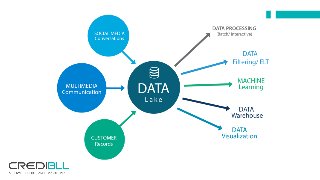
A Data lakeStores relational data from lines of business applications, and non-relational data
from mobile apps, IoT devices, and social media. The structure of the data or schema is not
defined when data is captured. This means you can store all of your data without careful design
or the need to know what questions you might need answers for in the future. Different types
of analytics on your data like SQL queries, big data analytics, full-text search, real-time analytics,
and machine learning can be used to uncover insights.
Data Lake:02
7.
Data Lakes allowsyou to import any data that can come in
real-time. Data is collected from different sources and
moved to the data lake in its original format. This process
allows you to scale data of any size while saving the time
of defining data structures, schema, and transformations.
Some Important aspects of Data Lakes
Movement of Data:01
8.
Data Lakes allowsstorage of relational data like operational databases and data from a line of
business applications, and non-relational data like mobile apps, IoT devices, and social media. They
also give you the ability to understand what data is in the lake through crawling, cataloging, and
indexing of data. Finally, data must be secured to ensure your data assets are protected.
Secure the Data and Catalog:02
With help of data lakes various roles like data scientists, business analysts, data developers, can access
data with their choice of tools and frameworks. There are open source frameworks like Hadoop, Presto
and Apache Spark. Data lakes allow a user to run analytics without the need to move the data to a
different analytics system.
Analysis of Data:03
9.
Benefits of UsingData Lakes
01 Flexibility
The Biggest advantage of using data lakes is its's flexibility. It allows the data to remain in its
native format, hence data can be accessed in a far better way in shorter time spans. It has the
ability to derive values from unlimited types of data.
10.
A Data Lakecombines customer data from a CRM platform with social media analytics. This
data may include buying history, and incident tickets to strengthen the business to understand
the most profitable customer cohort. In this way, brand loyalty may increase.
Better Customer Interaction 02
A data lake can help your research and development teams to test their hypothesis and assess
results—such as choosing the right materials in your product design which results in faster
performance or understanding the willingness of customers to pay for different aspects.
Improved Research and Development Opportunities:03