B Y : C H A R L E S D WE C K
MATH IN HOCKEY
This Year we constantly talked about how
geometry surrounds us, and makes the world we live
in. I decided to find its connection to something I love,
Hockey(ice and NOT yeshiva league). I’ve been
playing this sport for over 4 years now and until today,
never saw its connection to Geometry.
MEASUREMENTS OF THE RINK
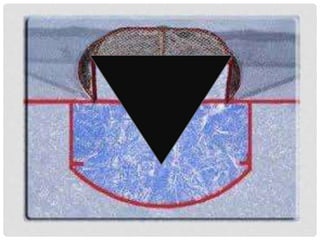
THE GOALIE
• When the opposing team is in the goalies zone, the
goalie stays in the back of his crease protecting the
puck from getting behind him. Since there are
players surrounding him waiting for the puck to get
to the crease to sneak it behind him, the goalie
stays by the goal line. However when the goalie is
faced with a breakaway he comes to the top of
the crease. Why?
EXAMPLE:
WHY?
• As you can see when the goalie comes out it gives
the player less targets to hit. It’s the same goalie
and same angles the only thing that’s happening is
he is coming out of the net. This gives the attacker
less angles to shoot from since the goalie is right in
front of him.
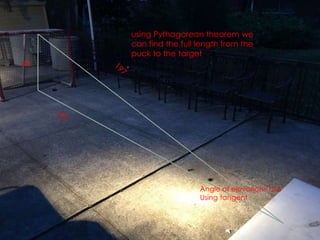
TOP SHELFER- ITS MEASUREMENTS
Some are good at hockey and
others are good at math. Now
those good at one can be good
at the other. Using a measuring
tape and formulas(sohcahtoa) I
was able to calculate all angles
and distances needed to hit this
shot.
43
using Pythagorean theorem we
can find the full length from the
puck to the target
Angle of elevation=12.6
Using tangent
USING THE BOARDS
• The angle that the puck hits the boards will be the
angle that the puck bounces off the boards
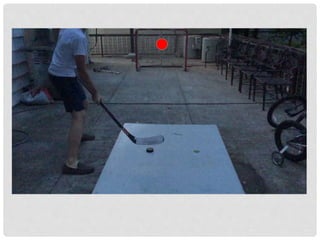
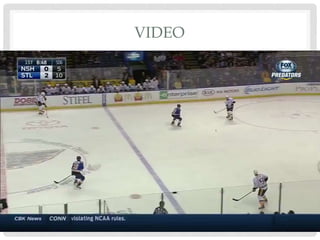
VIDEO
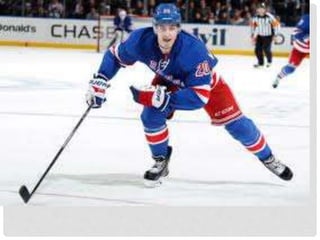
A BETTER STANCE
• The leg that isn't in stride should be 90
degrees, keeping your momentum
forward and preparing you for the next
stride. Nose knees and toes should always
be collinear. For a perfect stride, your leg
that’s in stride should be on a 164 degree
angle. Your body should make a 45
degree angle with your legs in order to
keep momentum forward.
GOOD DEFENSE
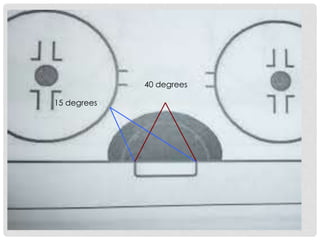
• Keeping the attacker to the outside makes it harder
for him to score, Why?. From the slot (the middle of
the net) the shooting angle is about 40 degrees,
which is an easy goal. The further the defenseman
pushes the attacker out the smaller the shooting
angle gets, making it harder for him to get the shot
on net.
40 degrees
15 degrees
HOCKEY STICKS
• Hockey sticks are much much more complex than
we think they are. Back in the day sticks were made
out of wood and were cracking left and right. Now,
sticks are made from composite and fiber-glass
allowing them to flex. Sticks are commonly found
with flex rating 45,50,75,100, and 110. flex ratings
indicate the about of pounds of force it takes to
flex the stick one inch. I use a stick with flex rate 75
so if I get 100 pounds of force into my shot the stick
would flex 1 inch and 4/12 of an inch. Sticks also
have different flex points- where the shaft flexes.
Hockey and Math

Hockey and Math

  • 1.
    B Y :C H A R L E S D WE C K MATH IN HOCKEY
  • 2.
    This Year weconstantly talked about how geometry surrounds us, and makes the world we live in. I decided to find its connection to something I love, Hockey(ice and NOT yeshiva league). I’ve been playing this sport for over 4 years now and until today, never saw its connection to Geometry.
  • 3.
  • 4.
    THE GOALIE • Whenthe opposing team is in the goalies zone, the goalie stays in the back of his crease protecting the puck from getting behind him. Since there are players surrounding him waiting for the puck to get to the crease to sneak it behind him, the goalie stays by the goal line. However when the goalie is faced with a breakaway he comes to the top of the crease. Why?
  • 6.
  • 7.
    WHY? • As youcan see when the goalie comes out it gives the player less targets to hit. It’s the same goalie and same angles the only thing that’s happening is he is coming out of the net. This gives the attacker less angles to shoot from since the goalie is right in front of him.
  • 8.
    TOP SHELFER- ITSMEASUREMENTS Some are good at hockey and others are good at math. Now those good at one can be good at the other. Using a measuring tape and formulas(sohcahtoa) I was able to calculate all angles and distances needed to hit this shot.
  • 9.
    43 using Pythagorean theoremwe can find the full length from the puck to the target Angle of elevation=12.6 Using tangent
  • 11.
    USING THE BOARDS •The angle that the puck hits the boards will be the angle that the puck bounces off the boards
  • 12.
  • 13.
    A BETTER STANCE •The leg that isn't in stride should be 90 degrees, keeping your momentum forward and preparing you for the next stride. Nose knees and toes should always be collinear. For a perfect stride, your leg that’s in stride should be on a 164 degree angle. Your body should make a 45 degree angle with your legs in order to keep momentum forward.
  • 15.
    GOOD DEFENSE • Keepingthe attacker to the outside makes it harder for him to score, Why?. From the slot (the middle of the net) the shooting angle is about 40 degrees, which is an easy goal. The further the defenseman pushes the attacker out the smaller the shooting angle gets, making it harder for him to get the shot on net.
  • 16.
  • 17.
    HOCKEY STICKS • Hockeysticks are much much more complex than we think they are. Back in the day sticks were made out of wood and were cracking left and right. Now, sticks are made from composite and fiber-glass allowing them to flex. Sticks are commonly found with flex rating 45,50,75,100, and 110. flex ratings indicate the about of pounds of force it takes to flex the stick one inch. I use a stick with flex rate 75 so if I get 100 pounds of force into my shot the stick would flex 1 inch and 4/12 of an inch. Sticks also have different flex points- where the shaft flexes.

Editor's Notes