THE INVENTIONS
INDEX
• 0-INTRODUCCIÓN
• 1-EL RELOJ MECÁNICO
• 2-LA IMPRENTA
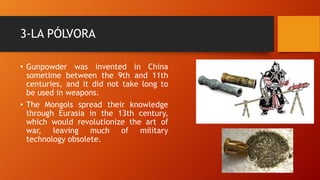
• 3-LA PÓLVORA
• 4-LOS MOLINOS DE AGUA Y VIENTO
• 5-EL BILLETE
• 6-LAS CAFETERÍAS
• 7-LAS GAFAS
INTRODUCTION
• The Middle Ages were not a dark period. Yes, there were very
complicated periods, wars, diseases, pests and weather
calamities. But, in those years, a lot of inventions that helped the
evolution of humanity were discovered. Of all those here we have
the 10 medieval inventions that changed the world.
1-EL RELOJ MECÁNICO
• Time measuring devices were known from
antiquity but it wasn't until the Middle Ages
that technology allowed mechanical
watches to accurately measure time.
• The knowledge of minute and second would
change the way people organized their days
and their work schedules, especially in
urban areas.
•
2-LA IMPRENTA
• The technology was developed in China to
be able to print on materials such as paper,
but it was in the fifteenth century, on
horseback between the Middle Ages and the
Modern Ages, that the German Johannes
Gutenberg and his printing press began a
new era of the mass production of books.
3-LA PÓLVORA
• Gunpowder was invented in China
sometime between the 9th and 11th
centuries, and it did not take long to
be used in weapons.
• The Mongols spread their knowledge
through Eurasia in the 13th century,
which would revolutionize the art of
war, leaving much of military
technology obsolete.
4-LOS MOLINOS DE AGUA Y VIENTO
• The mills were used by man from the
time of the Neolithic but it was in the
Middle Ages that they became very
popular.
• In this medieval period new and
ingenious forms of mills were invented,
allowing the population to use the
energy of elements of nature such as
river water or wind.
•
5-EL BILLETE
• The first time the banknote is used is in the 7th
century. It was much easier to transport with the
consequent benefit to merchants.
• However, the concept of giving value to a marked
sheet of paper did not become popular. A tribe of
Africa in the 13th century tried to introduce currency
paper to the Middle East but it was a failure.
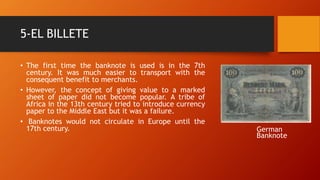
• Banknotes would not circulate in Europe until the
17th century. German
Banknote
6- LAS CAFETERÍAS
• The habit of drinking coffee arose around
the 15th century in the Arabian Peninsula.
• Cafés became very popular there and on
Ottoman lands.
• These establishments would not reach
Europe until the Modern Ages, changing not
only the way people ate and drank, but
creating new ways of social interaction.
Tallinn cafeteria (Capital of Estonia)
7-LAS GAFAS
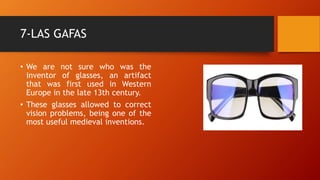
• We are not sure who was the
inventor of glasses, an artifact
that was first used in Western
Europe in the late 13th century.
• These glasses allowed to correct
vision problems, being one of the
most useful medieval inventions.
By Víctor González Amieva

5

  • 1.
  • 2.
    INDEX • 0-INTRODUCCIÓN • 1-ELRELOJ MECÁNICO • 2-LA IMPRENTA • 3-LA PÓLVORA • 4-LOS MOLINOS DE AGUA Y VIENTO • 5-EL BILLETE • 6-LAS CAFETERÍAS • 7-LAS GAFAS
  • 3.
    INTRODUCTION • The MiddleAges were not a dark period. Yes, there were very complicated periods, wars, diseases, pests and weather calamities. But, in those years, a lot of inventions that helped the evolution of humanity were discovered. Of all those here we have the 10 medieval inventions that changed the world.
  • 4.
    1-EL RELOJ MECÁNICO •Time measuring devices were known from antiquity but it wasn't until the Middle Ages that technology allowed mechanical watches to accurately measure time. • The knowledge of minute and second would change the way people organized their days and their work schedules, especially in urban areas. •
  • 5.
    2-LA IMPRENTA • Thetechnology was developed in China to be able to print on materials such as paper, but it was in the fifteenth century, on horseback between the Middle Ages and the Modern Ages, that the German Johannes Gutenberg and his printing press began a new era of the mass production of books.
  • 6.
    3-LA PÓLVORA • Gunpowderwas invented in China sometime between the 9th and 11th centuries, and it did not take long to be used in weapons. • The Mongols spread their knowledge through Eurasia in the 13th century, which would revolutionize the art of war, leaving much of military technology obsolete.
  • 7.
    4-LOS MOLINOS DEAGUA Y VIENTO • The mills were used by man from the time of the Neolithic but it was in the Middle Ages that they became very popular. • In this medieval period new and ingenious forms of mills were invented, allowing the population to use the energy of elements of nature such as river water or wind. •
  • 8.
    5-EL BILLETE • Thefirst time the banknote is used is in the 7th century. It was much easier to transport with the consequent benefit to merchants. • However, the concept of giving value to a marked sheet of paper did not become popular. A tribe of Africa in the 13th century tried to introduce currency paper to the Middle East but it was a failure. • Banknotes would not circulate in Europe until the 17th century. German Banknote
  • 9.
    6- LAS CAFETERÍAS •The habit of drinking coffee arose around the 15th century in the Arabian Peninsula. • Cafés became very popular there and on Ottoman lands. • These establishments would not reach Europe until the Modern Ages, changing not only the way people ate and drank, but creating new ways of social interaction. Tallinn cafeteria (Capital of Estonia)
  • 10.
    7-LAS GAFAS • Weare not sure who was the inventor of glasses, an artifact that was first used in Western Europe in the late 13th century. • These glasses allowed to correct vision problems, being one of the most useful medieval inventions.
  • 11.