Automated transcription
for qualitative research
Caitlin Hafferty, Countryside and Community Research Institute (CCRI)
@CaitlinHafferty
caitlinhafferty@connect.glos.ac.uk
https://caitlinhafferty.blogspot.com/
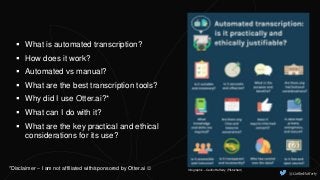
 What is automated transcription?
 How does it work?
 Automated vs manual?
 What are the best transcription tools?
 Why did I use Otter.ai?*
 What can I do with it?
 What are the key practical and ethical
considerations for its use?
@CaitlinHafferty
*Disclaimer – I am not affiliated with/sponsored by Otter.ai  Infographic – Caitlin Hafferty (Piktochart)
 Many benefits to manual transcription - e.g. for interpretation of meaning and emotion.
 But can be very time consuming and/or costly for individuals and institutions (e.g. outsourcing).
 Automated transcription software is rapidly developing and offers huge potential to transform
essential research tasks.
 It offers an entirely automatic solution which helps human transcribers convert audio
recordings to written text.
 Not a replacement for human input but an augmentation of existing practice – the task of
automated transcription cannot be performed independently of people!
 Practical and ethical considerations which change depending on area of research, participants,
nature of the research encounter, institutional barriers, etc.
Introduction
@CaitlinHafferty
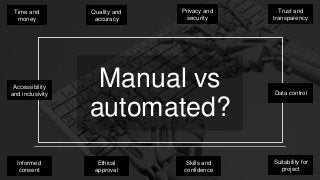
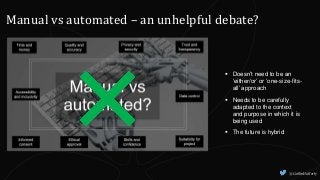
Manual vs
automated?
Time and
money
Quality and
accuracy
Privacy and
security
Trust and
transparency
Skills and
confidence
Accessibility
and inclusivity Data control
Suitability for
project
Ethical
approval
Informed
consent
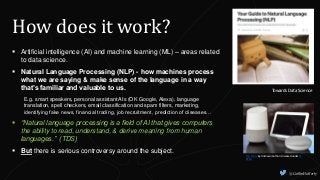
How does it work?
 Artificial intelligence (AI) and machine learning (ML) – areas related
to data science.
 Natural Language Processing (NLP) - how machines process
what we are saying & make sense of the language in a way
that’s familiar and valuable to us.
E.g. smart speakers, personal assistant AIs (OK Google, Alexa), language
translation, spell checkers, email classification and spam filters, marketing,
identifying fake news, financial trading, job recruitment, prediction of diseases…
 “Natural language processing is a field of AI that gives computers
the ability to read, understand, & derive meaning from human
languages.” (TDS)
 But there is serious controversy around the subject.
This Photo by Unknown Author is licensed under CC
BY-SA
Towards Data Science
@CaitlinHafferty
What are the best available tools?
 There are lots of helpful websites & articles which provide an
overview of top free (and paid) transcription tools (look up ‘best
speech-to-text software/app’ or ‘best dictation software’.
 No ‘perfect’ app & some services are expensive.
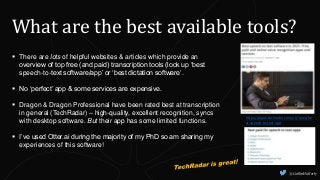
 Dragon & Dragon Professional have been rated best at transcription
in general (TechRadar) – high-quality, excellent recognition, syncs
with desktop software. But their app has some limited functions.
 I’ve used Otter.ai during the majority of my PhD so am sharing my
experiences of this software!
https://www.techradar.com/uk/news/be
st-speech-to-text-app
@CaitlinHafferty
Why Otter.ai?
 Specifically designed for mobile use, live and on-the-
go transcription.
 It’s marketed specifically for meetings, interviews,
taking notes in lectures & seminars.
 Accessible interface.
 Real-time transcription OR from pre-recorded.
audio/video
 Timestamped transcript.
 Easy editing in real time or when listening back to
recording (with highlighting, notes, annotation).
 Key words and word cloud summary.
 Integrate photos in the transcript.
 Can export to multiple different formats (.txt, .mp3, etc.)
for further analysis.
 Promotes collaborative working, e.g. speaker IDs (and %
time).
 Basic package = free. Higher Education discount.
 Pro / business plan and teams plan with more features.
 Otter assistant?
Photo – Otter.ai
@CaitlinHafferty
What can I do with it?
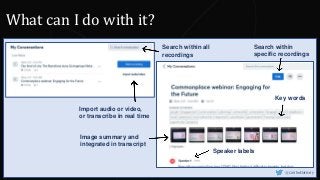
Search within all
recordings
Import audio or video,
or transcribe in real time
Search within
specific recordings
Key words
Image summary and
integrated in transcript
Speaker labels
@CaitlinHafferty
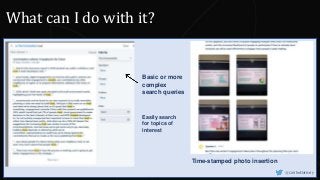
Time-stamped photo insertion
Basic or more
complex
search queries
Easily search
for topics of
interest
@CaitlinHafferty
What can I do with it?
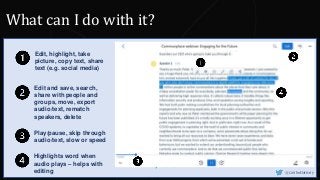
Key words
Edit, highlight, take
picture, copy text, share
text (e.g. social media)
Edit and save, search,
share with people and
groups, move, export
audio/text, rematch
speakers, delete
Play/pause, skip through
audio/text, slow or speed
Highlights word when
audio plays – helps with
editing @CaitlinHafferty
What can I do with it?
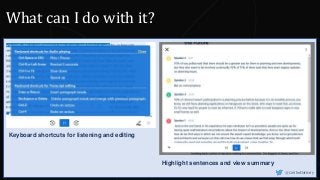
Highlight sentences and view summary
Keyboard shortcuts for listening and editing
@CaitlinHafferty
What can I do with it?
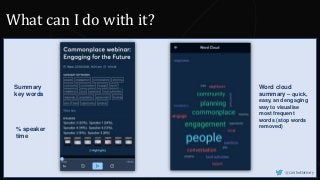
Word cloud
summary – quick,
easy, and engaging
way to visualise
most frequent
words (stop words
removed)
Summary
key words
% speaker
time
@CaitlinHafferty
What can I do with it?
@CaitlinHafferty
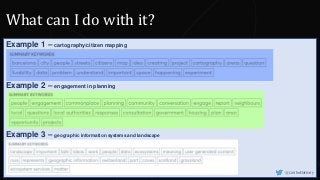
Example 1 – cartography/citizen mapping
Example 2 – engagement in planning
Example 3 – geographic information systems and landscape
What can I do with it?
@CaitlinHafferty
Human input is key
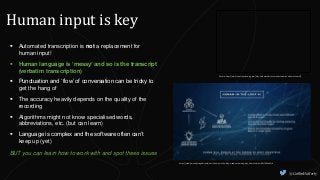
Picture: https://www.transcriptionwing.com/why-automated-transcription-requires-a-human-touch/
https://medium.com/vsinghbisen/what-is-human-in-the-loop-machine-learning-why-how-used-in-ai-60c7b44eb2c0
 Automated transcription is not a replacement for
human input!
 Human language is ‘messy’ and so is the transcript
(verbatim transcription)
 Punctuation and ‘flow’ of conversation can be tricky to
get the hang of
 The accuracy heavily depends on the quality of the
recording
 Algorithms might not know specialised words,
abbreviations, etc. (but can learn)
 Language is complex and the software often can’t
keep up (yet)
BUT you can learn how to work with and spot these issues
@CaitlinHafferty
Privacy, security, and ethics
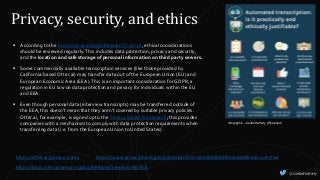
Infographic – Caitlin Hafferty (Piktochart)
 According to the Economic and Social Research Council, ethical considerations
should be reviewed regularly.This includes data protection, privacy and security,
and the location and safe storage of personal information on third party servers.
 Some commercially available transcription services (like those provided by
California-based Otter.ai) may transfer data out of the European Union (EU) and
European Economic Area (EEA).This is an important consideration for GDPR, a
regulation in EU law on data protection and privacy for individuals within the EU
and EEA.
 Even though personal data (interview transcripts) may be transferred outside of
the EEA, this doesn't mean that they aren't covered by suitable privacy policies.
Otter.ai, for example, is signed up to the Privacy Shield Framework; this provides
companies with a mechanism to comply with data protection requirements when
transferring data (i.e. from the European Union to United States).
https://otter.ai/privacy-policy https://www.privacyshield.gov/participant?id=a2zt00000008VJwAAM&status=Active
https://blog.otter.ai/privacy-policy/#PRIVACY-SHIELD-NOTICE
@CaitlinHafferty
Privacy, security, and ethics
Otter.ai Privacy Notice:
“If you provide an Audio Recording, this may contain the Personal Information of
third parties. Before you do so, please make sure you have the necessary
permissions from your co-workers, friends or other third parties before sharing
Personal Information or referring them to us.”
“To facilitate our global operations, Otter.ai may transfer, store and process your
operations with our partners and service providers based outside of the country
in which you are based. Laws in those countries may differ from the laws
applicable to your country of residence. Where we transfer, store and process
your Personal Information outside of the EEA or the UK we will ensure that the
appropriate safeguards are in place to ensure an adequate level of protection
such as through acceding to the Standard Contractual Clauses. Further details
regarding the relevant safeguards can be obtained from us on request.”
https://otter.ai/privacy
https://otter.ai/terms#data-processing-attachment https://blog.otter.ai/terms-of-service/
@CaitlinHafferty
Privacy, security, and ethics
Otter.ai Privacy Notice:
“When you use the Services, you may provide us with your audio recordings (“Audio
Recordings”) and any text, images or videos that you upload or provide to us in the
context of the Services.”
“We use your audio recordings, usage information and platform information in order
to provide you with the Services. In addition, we use your communication information
to facilitate support (e.g. retrieval of a forgotten password). We do so in accordance
with our contractual obligations to you in order to provide you with the Services.”
“We use information we automatically collect or generate about you when you use
the Services, as well as non-personal information about your device such as device
manufacturer, model and operating system, and the amount of free space on your
device, to analyze the use of and improve our Services. We train our proprietary
artificial intelligence technology on aggregated, de-identified audio recordings. Only
with your explicit permission will we manually review certain audio recordings to
further refine our model training data.”
“If you contact us, we will use your contact information to communicate with you and,
if applicable, your usage information to support your use of the Services.”
https://otter.ai/privacy
https://otter.ai/terms#data-processing-attachment
https://blog.otter.ai/terms-of-service/
@CaitlinHafferty
Privacy, security, and ethics (UK and Brexit)
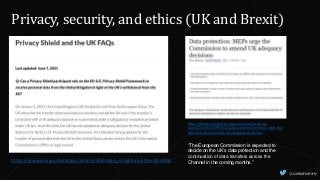
https://www.privacyshield.gov/article?id=Privacy-Shield-and-the-UK-FAQs
https://www.europarl.europa.eu/news/en/press-
room/20210517IPR04124/data-protection-meps-urge-the-
commission-to-amend-uk-adequacy-decisions
“The European Commission is expected to
decide on the UK’s data protection and the
continuation of data transfers across the
Channel in the coming months.”
@CaitlinHafferty
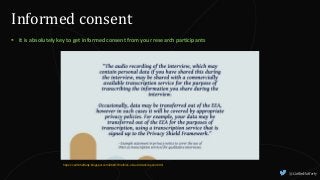
Informed consent
https://caitlinhafferty.blogspot.com/2020/10/ethics-of-auto-transcription.html
 It is absolutely key to get informed consent from your research participants
@CaitlinHafferty
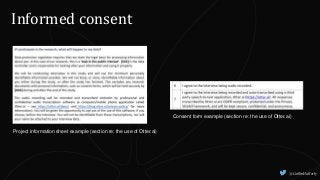
Informed consent
Project information sheet example (section re: the use of Otter.ai)
Consent form example (section re: the use of Otter.ai)
@CaitlinHafferty
Technology is never ‘neutral’
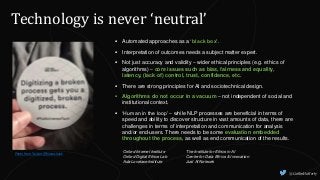
Photo from Twitter @hanaschank
 Automated approaches as a ‘black box’.
 Interpretation of outcomes needs a subject matter expert.
 Not just accuracy and validity – wider ethical principles (e.g. ethics of
algorithms) – core issues such as bias, fairness and equality,
latency, (lack of) control, trust, confidence, etc.
 There are strong principles for AI and sociotechnical design.
 Algorithms do not occur in a vacuum – not independent of social and
institutional context.
 ‘Human in the loop’ – while NLP processes are beneficial in terms of
speed and ability to discover structure in vast amounts of data, there are
challenges in terms of interpretation and communication for analysis
and/or end-users. There needs to be some evaluation embedded
throughout the process, as well as end communication of the results.
Oxford Internet Institute
Oxford Digital Ethics Lab
Ada Lovelace Institute
The Institute for Ethics in AI
Centre for Data Ethics & Innovation
Just AI Network
@CaitlinHafferty
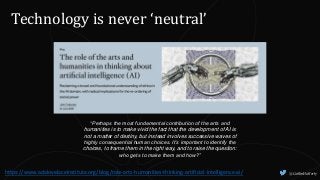
Technology is never ‘neutral’
https://www.adalovelaceinstitute.org/blog/role-arts-humanities-thinking-artificial-intelligence-ai/
“Perhaps the most fundamental contribution of the arts and
humanities is to make vivid the fact that the development of AI is
not a matter of destiny, but instead involves successive waves of
highly consequential human choices. It’s important to identify the
choices, to frame them in the right way, and to raise the question:
who gets to make them and how?”
@CaitlinHafferty
Technology is never ‘neutral’
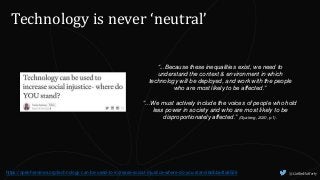
“...Because these inequalities exist, we need to
understand the context & environment in which
technology will be deployed, and work with the people
who are most likely to be affected.”
“...We must actively include the voices of people who hold
less power in society and who are most likely to be
disproportionately affected.” (Gyateng, 2020, p.1).
https://openheroines.org/technology-can-be-used-to-increase-social-injustice-where-do-you-stand-8dbba4fa8526
@CaitlinHafferty
Manual vs automated – an unhelpful debate?
 Doesn’t need to be an
‘either/or’ or ‘one-size-fits-
all’ approach
 Needs to be carefully
adapted to the context
and purpose in which it is
being used
 The future is hybrid
Thank you!  Any questions?
@CaitlinHafferty
caitlinhafferty@connect.glos.ac.uk
https://caitlinhafferty.blogspot.com
Useful stuff
@CaitlinHafferty
Abel et al. (2002). ‘Automating the Ineffable: Qualitative Software and the Meaning of Qualitative Research’ (no date) in Qualitative Research in
Action. 6 Bonhill Street, London England EC2A 4PU United Kingdom: SAGE Publications Ltd, pp. 162–178. doi: 10.4135/9781849209656.n7.
10.4135/9781849209656.n7.
Archibald, M. M. et al. (2019) ‘Using Zoom Videoconferencing for Qualitative Data Collection: Perceptions and Experiences of Researchers and
Participants’, International Journal of Qualitative Methods, 18, pp. 1–8. doi: 10.1177/1609406919874596.
Bolden, G. B. (2015) ‘Transcribing as Research: “Manual” Transcription and Conversation Analysis’, Research on Language and Social Interaction.
Routledge, 48(3), pp. 276–280. doi: 10.1080/08351813.2015.1058603.
Bokhove, C. and Downey, C. (2018) ‘Automated generation of “good enough” transcripts as a first step to transcription of audio-recorded data’,
Methodological Innovations, 11(2), p. 205979911879074. doi: 10.1177/2059799118790743.
Cope, M. (2017) ‘Transcripts: Coding and Analysis’, International Encyclopedia of Geography: People, the Earth, Environment and Technology, pp.
1–7. doi: 10.1002/9781118786352.wbieg0772.
Evers, J. C. (2011) ‘From the past into the future. How technological developments change our ways of data collection, transcription and
analysis’, Forum Qualitative Sozialforschung, 12(1). doi: 10.17169/fqs-12.1.1636.
Hoy, M. B. (2018) ‘Deep Learning and Online Video: Advances in Transcription, Automated Indexing, and Manipulation’, Medical Reference
Services Quarterly. Routledge, 37(3), pp. 300–305. doi: 10.1080/02763869.2018.1477718.
Kovanovíc, V. et al. (2016) ‘Towards automated content analysis of discussion transcripts: A cognitive presence case’, ACM International
Conference Proceeding Series, 25-29-Apri, pp. 15–24. doi: 10.1145/2883851.2883950.
Lobe, B., Morgan, D. and Hoffman, K. A. (2020) ‘Qualitative Data Collection in an Era of Social Distancing’, International Journal of
Qualitative Methods, 19, pp. 1–8. doi: 10.1177/1609406920937875.
Matheson, J. L. (2007) ‘The Voice Transcription Technique : Use of Voice Recognition Software to Transcribe Digital Interview Data in
Qualitative’, The Qualitative Report, 12(4), pp. 547–560.
Moore, R. J. (2015) ‘Automated Transcription and Conversation Analysis’, Research on Language and Social Interaction. Routledge, 48(3), pp. 253–
270. doi: 10.1080/08351813.2015.1058600.
Palys, T. and Atchison, C. (2012) ‘Qualitative research in the digital era: Obstacles and opportunities’, International Journal of Qualitative Methods,
11(4), pp. 352–367. doi: 10.1177/160940691201100404.
Wardell, V. et al. (2020) ‘Semi-automated transcription and scoring of autobiographical memory narratives’, Behavior Research Methods.
Behavior Research Methods. doi: 10.3758/s13428-020-01437-w.
Automated transcription for qualitative research

  • 1.
    Automated transcription for qualitativeresearch Caitlin Hafferty, Countryside and Community Research Institute (CCRI) @CaitlinHafferty caitlinhafferty@connect.glos.ac.uk https://caitlinhafferty.blogspot.com/
  • 2.
     What isautomated transcription?  How does it work?  Automated vs manual?  What are the best transcription tools?  Why did I use Otter.ai?*  What can I do with it?  What are the key practical and ethical considerations for its use? @CaitlinHafferty *Disclaimer – I am not affiliated with/sponsored by Otter.ai  Infographic – Caitlin Hafferty (Piktochart)
  • 3.
     Many benefitsto manual transcription - e.g. for interpretation of meaning and emotion.  But can be very time consuming and/or costly for individuals and institutions (e.g. outsourcing).  Automated transcription software is rapidly developing and offers huge potential to transform essential research tasks.  It offers an entirely automatic solution which helps human transcribers convert audio recordings to written text.  Not a replacement for human input but an augmentation of existing practice – the task of automated transcription cannot be performed independently of people!  Practical and ethical considerations which change depending on area of research, participants, nature of the research encounter, institutional barriers, etc. Introduction @CaitlinHafferty
  • 4.
    Manual vs automated? Time and money Qualityand accuracy Privacy and security Trust and transparency Skills and confidence Accessibility and inclusivity Data control Suitability for project Ethical approval Informed consent
  • 5.
    How does itwork?  Artificial intelligence (AI) and machine learning (ML) – areas related to data science.  Natural Language Processing (NLP) - how machines process what we are saying & make sense of the language in a way that’s familiar and valuable to us. E.g. smart speakers, personal assistant AIs (OK Google, Alexa), language translation, spell checkers, email classification and spam filters, marketing, identifying fake news, financial trading, job recruitment, prediction of diseases…  “Natural language processing is a field of AI that gives computers the ability to read, understand, & derive meaning from human languages.” (TDS)  But there is serious controversy around the subject. This Photo by Unknown Author is licensed under CC BY-SA Towards Data Science @CaitlinHafferty
  • 6.
    What are thebest available tools?  There are lots of helpful websites & articles which provide an overview of top free (and paid) transcription tools (look up ‘best speech-to-text software/app’ or ‘best dictation software’.  No ‘perfect’ app & some services are expensive.  Dragon & Dragon Professional have been rated best at transcription in general (TechRadar) – high-quality, excellent recognition, syncs with desktop software. But their app has some limited functions.  I’ve used Otter.ai during the majority of my PhD so am sharing my experiences of this software! https://www.techradar.com/uk/news/be st-speech-to-text-app @CaitlinHafferty
  • 7.
    Why Otter.ai?  Specificallydesigned for mobile use, live and on-the- go transcription.  It’s marketed specifically for meetings, interviews, taking notes in lectures & seminars.  Accessible interface.  Real-time transcription OR from pre-recorded. audio/video  Timestamped transcript.  Easy editing in real time or when listening back to recording (with highlighting, notes, annotation).  Key words and word cloud summary.  Integrate photos in the transcript.  Can export to multiple different formats (.txt, .mp3, etc.) for further analysis.  Promotes collaborative working, e.g. speaker IDs (and % time).  Basic package = free. Higher Education discount.  Pro / business plan and teams plan with more features.  Otter assistant? Photo – Otter.ai @CaitlinHafferty
  • 8.
    What can Ido with it? Search within all recordings Import audio or video, or transcribe in real time Search within specific recordings Key words Image summary and integrated in transcript Speaker labels @CaitlinHafferty
  • 9.
    Time-stamped photo insertion Basicor more complex search queries Easily search for topics of interest @CaitlinHafferty What can I do with it?
  • 10.
    Key words Edit, highlight,take picture, copy text, share text (e.g. social media) Edit and save, search, share with people and groups, move, export audio/text, rematch speakers, delete Play/pause, skip through audio/text, slow or speed Highlights word when audio plays – helps with editing @CaitlinHafferty What can I do with it?
  • 11.
    Highlight sentences andview summary Keyboard shortcuts for listening and editing @CaitlinHafferty What can I do with it?
  • 12.
    Word cloud summary –quick, easy, and engaging way to visualise most frequent words (stop words removed) Summary key words % speaker time @CaitlinHafferty What can I do with it?
  • 13.
    @CaitlinHafferty Example 1 –cartography/citizen mapping Example 2 – engagement in planning Example 3 – geographic information systems and landscape What can I do with it?
  • 14.
    @CaitlinHafferty Human input iskey Picture: https://www.transcriptionwing.com/why-automated-transcription-requires-a-human-touch/ https://medium.com/vsinghbisen/what-is-human-in-the-loop-machine-learning-why-how-used-in-ai-60c7b44eb2c0  Automated transcription is not a replacement for human input!  Human language is ‘messy’ and so is the transcript (verbatim transcription)  Punctuation and ‘flow’ of conversation can be tricky to get the hang of  The accuracy heavily depends on the quality of the recording  Algorithms might not know specialised words, abbreviations, etc. (but can learn)  Language is complex and the software often can’t keep up (yet) BUT you can learn how to work with and spot these issues
  • 15.
    @CaitlinHafferty Privacy, security, andethics Infographic – Caitlin Hafferty (Piktochart)  According to the Economic and Social Research Council, ethical considerations should be reviewed regularly.This includes data protection, privacy and security, and the location and safe storage of personal information on third party servers.  Some commercially available transcription services (like those provided by California-based Otter.ai) may transfer data out of the European Union (EU) and European Economic Area (EEA).This is an important consideration for GDPR, a regulation in EU law on data protection and privacy for individuals within the EU and EEA.  Even though personal data (interview transcripts) may be transferred outside of the EEA, this doesn't mean that they aren't covered by suitable privacy policies. Otter.ai, for example, is signed up to the Privacy Shield Framework; this provides companies with a mechanism to comply with data protection requirements when transferring data (i.e. from the European Union to United States). https://otter.ai/privacy-policy https://www.privacyshield.gov/participant?id=a2zt00000008VJwAAM&status=Active https://blog.otter.ai/privacy-policy/#PRIVACY-SHIELD-NOTICE
  • 16.
    @CaitlinHafferty Privacy, security, andethics Otter.ai Privacy Notice: “If you provide an Audio Recording, this may contain the Personal Information of third parties. Before you do so, please make sure you have the necessary permissions from your co-workers, friends or other third parties before sharing Personal Information or referring them to us.” “To facilitate our global operations, Otter.ai may transfer, store and process your operations with our partners and service providers based outside of the country in which you are based. Laws in those countries may differ from the laws applicable to your country of residence. Where we transfer, store and process your Personal Information outside of the EEA or the UK we will ensure that the appropriate safeguards are in place to ensure an adequate level of protection such as through acceding to the Standard Contractual Clauses. Further details regarding the relevant safeguards can be obtained from us on request.” https://otter.ai/privacy https://otter.ai/terms#data-processing-attachment https://blog.otter.ai/terms-of-service/
  • 17.
    @CaitlinHafferty Privacy, security, andethics Otter.ai Privacy Notice: “When you use the Services, you may provide us with your audio recordings (“Audio Recordings”) and any text, images or videos that you upload or provide to us in the context of the Services.” “We use your audio recordings, usage information and platform information in order to provide you with the Services. In addition, we use your communication information to facilitate support (e.g. retrieval of a forgotten password). We do so in accordance with our contractual obligations to you in order to provide you with the Services.” “We use information we automatically collect or generate about you when you use the Services, as well as non-personal information about your device such as device manufacturer, model and operating system, and the amount of free space on your device, to analyze the use of and improve our Services. We train our proprietary artificial intelligence technology on aggregated, de-identified audio recordings. Only with your explicit permission will we manually review certain audio recordings to further refine our model training data.” “If you contact us, we will use your contact information to communicate with you and, if applicable, your usage information to support your use of the Services.” https://otter.ai/privacy https://otter.ai/terms#data-processing-attachment https://blog.otter.ai/terms-of-service/
  • 18.
    @CaitlinHafferty Privacy, security, andethics (UK and Brexit) https://www.privacyshield.gov/article?id=Privacy-Shield-and-the-UK-FAQs https://www.europarl.europa.eu/news/en/press- room/20210517IPR04124/data-protection-meps-urge-the- commission-to-amend-uk-adequacy-decisions “The European Commission is expected to decide on the UK’s data protection and the continuation of data transfers across the Channel in the coming months.”
  • 19.
  • 20.
    @CaitlinHafferty Informed consent Project informationsheet example (section re: the use of Otter.ai) Consent form example (section re: the use of Otter.ai)
  • 21.
    @CaitlinHafferty Technology is never‘neutral’ Photo from Twitter @hanaschank  Automated approaches as a ‘black box’.  Interpretation of outcomes needs a subject matter expert.  Not just accuracy and validity – wider ethical principles (e.g. ethics of algorithms) – core issues such as bias, fairness and equality, latency, (lack of) control, trust, confidence, etc.  There are strong principles for AI and sociotechnical design.  Algorithms do not occur in a vacuum – not independent of social and institutional context.  ‘Human in the loop’ – while NLP processes are beneficial in terms of speed and ability to discover structure in vast amounts of data, there are challenges in terms of interpretation and communication for analysis and/or end-users. There needs to be some evaluation embedded throughout the process, as well as end communication of the results. Oxford Internet Institute Oxford Digital Ethics Lab Ada Lovelace Institute The Institute for Ethics in AI Centre for Data Ethics & Innovation Just AI Network
  • 22.
    @CaitlinHafferty Technology is never‘neutral’ https://www.adalovelaceinstitute.org/blog/role-arts-humanities-thinking-artificial-intelligence-ai/ “Perhaps the most fundamental contribution of the arts and humanities is to make vivid the fact that the development of AI is not a matter of destiny, but instead involves successive waves of highly consequential human choices. It’s important to identify the choices, to frame them in the right way, and to raise the question: who gets to make them and how?”
  • 23.
    @CaitlinHafferty Technology is never‘neutral’ “...Because these inequalities exist, we need to understand the context & environment in which technology will be deployed, and work with the people who are most likely to be affected.” “...We must actively include the voices of people who hold less power in society and who are most likely to be disproportionately affected.” (Gyateng, 2020, p.1). https://openheroines.org/technology-can-be-used-to-increase-social-injustice-where-do-you-stand-8dbba4fa8526
  • 24.
    @CaitlinHafferty Manual vs automated– an unhelpful debate?  Doesn’t need to be an ‘either/or’ or ‘one-size-fits- all’ approach  Needs to be carefully adapted to the context and purpose in which it is being used  The future is hybrid
  • 25.
    Thank you! Any questions? @CaitlinHafferty caitlinhafferty@connect.glos.ac.uk https://caitlinhafferty.blogspot.com
  • 26.
    Useful stuff @CaitlinHafferty Abel etal. (2002). ‘Automating the Ineffable: Qualitative Software and the Meaning of Qualitative Research’ (no date) in Qualitative Research in Action. 6 Bonhill Street, London England EC2A 4PU United Kingdom: SAGE Publications Ltd, pp. 162–178. doi: 10.4135/9781849209656.n7. 10.4135/9781849209656.n7. Archibald, M. M. et al. (2019) ‘Using Zoom Videoconferencing for Qualitative Data Collection: Perceptions and Experiences of Researchers and Participants’, International Journal of Qualitative Methods, 18, pp. 1–8. doi: 10.1177/1609406919874596. Bolden, G. B. (2015) ‘Transcribing as Research: “Manual” Transcription and Conversation Analysis’, Research on Language and Social Interaction. Routledge, 48(3), pp. 276–280. doi: 10.1080/08351813.2015.1058603. Bokhove, C. and Downey, C. (2018) ‘Automated generation of “good enough” transcripts as a first step to transcription of audio-recorded data’, Methodological Innovations, 11(2), p. 205979911879074. doi: 10.1177/2059799118790743. Cope, M. (2017) ‘Transcripts: Coding and Analysis’, International Encyclopedia of Geography: People, the Earth, Environment and Technology, pp. 1–7. doi: 10.1002/9781118786352.wbieg0772. Evers, J. C. (2011) ‘From the past into the future. How technological developments change our ways of data collection, transcription and analysis’, Forum Qualitative Sozialforschung, 12(1). doi: 10.17169/fqs-12.1.1636. Hoy, M. B. (2018) ‘Deep Learning and Online Video: Advances in Transcription, Automated Indexing, and Manipulation’, Medical Reference Services Quarterly. Routledge, 37(3), pp. 300–305. doi: 10.1080/02763869.2018.1477718. Kovanovíc, V. et al. (2016) ‘Towards automated content analysis of discussion transcripts: A cognitive presence case’, ACM International Conference Proceeding Series, 25-29-Apri, pp. 15–24. doi: 10.1145/2883851.2883950. Lobe, B., Morgan, D. and Hoffman, K. A. (2020) ‘Qualitative Data Collection in an Era of Social Distancing’, International Journal of Qualitative Methods, 19, pp. 1–8. doi: 10.1177/1609406920937875. Matheson, J. L. (2007) ‘The Voice Transcription Technique : Use of Voice Recognition Software to Transcribe Digital Interview Data in Qualitative’, The Qualitative Report, 12(4), pp. 547–560. Moore, R. J. (2015) ‘Automated Transcription and Conversation Analysis’, Research on Language and Social Interaction. Routledge, 48(3), pp. 253– 270. doi: 10.1080/08351813.2015.1058600. Palys, T. and Atchison, C. (2012) ‘Qualitative research in the digital era: Obstacles and opportunities’, International Journal of Qualitative Methods, 11(4), pp. 352–367. doi: 10.1177/160940691201100404. Wardell, V. et al. (2020) ‘Semi-automated transcription and scoring of autobiographical memory narratives’, Behavior Research Methods. Behavior Research Methods. doi: 10.3758/s13428-020-01437-w.