The strategic planning process explores essential questions about the purpose of being in business.
To help you succeed, we have put together the key components of a Strategic Plan.
Your Strategic Planis a critical
document in determining the
success of your business.
It is a guide to help achieve
your business goals and
objectives. It also serves as a
tool for problem solving, market
planning and product
development.
3.
The strategic planningprocess explores essential
questions about the purpose of being in business.
To help you succeed, we have put together the key
components of a Strategic Plan.
Executive Summary
Your ExecutiveSummary should sum up your entire
strategic plan and includes:
1. An overview of what your company does and
why it will be successful
2. A brief synopsis of all the other sections of the
plan
3. MUST answer why you business is unique
6.
Elevator Pitch
An elevatorpitch is a brief
description of your business.
A quality elevator pitch gives a
concise and consistent
explanation of your business. It
provides a precise understanding
of what your business is and its
key objectives.
7.
Mission Statement
A missionstatement explains what
your business is trying to
achieve. The critical thing is to
figure out the one thing you are
trying to do better than anyone
else.
Key decisions should be made with
regards to how well they help the
company progress in achieving its
mission.
8.
SWOT
Successful entrepreneurs judgenew
ideas by determining their feasibility
and market potential.
They conduct either formal or
informal SWOT analyses, looking at
the idea in the context of the
company’s strengths and
weaknesses, and in the context of
market opportunities and threats.
9.
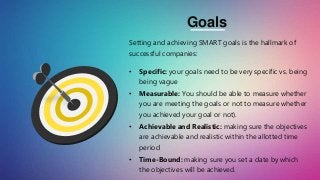
Setting and achievingSMART goals is the hallmark of
successful companies:
• Specific: your goals need to be very specific vs. being
being vague
• Measurable: You should be able to measure whether
you are meeting the goals or not to measure whether
you achieved your goal or not).
• Achievable and Realistic: making sure the objectives
are achievable and realistic within the allotted time
period
• Time-Bound: making sure you set a date by which
the objectives will be achieved.
Goals
10.
Key Performance
Indicators
KPIs arethe metrics that judge your
business’ performance based on the
success you would like to succeed.
They include a series of numbers that
judge the financial health and the
performance of your business AND to keep
you focused towards achieving your
goals.
11.
Target Customers
Successful businessessolve the problems of their customers.
You need to identify:
• Target Customers
• Customer Needs
• Your solution
• Competitive Advantage
12.
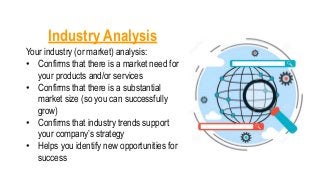
Industry Analysis
Your industry(or market) analysis:
• Confirms that there is a market need for
your products and/or services
• Confirms that there is a substantial
market size (so you can successfully
grow)
• Confirms that industry trends support
your company’s strategy
• Helps you identify new opportunities for
success
13.
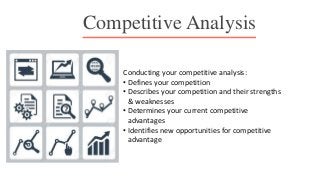
Competitive Analysis
Conducting yourcompetitive analysis:
• Defines your competition
• Describes your competition and their strengths
& weaknesses
• Determines your current competitive
advantages
• Identifies new opportunities for competitive
advantage
14.
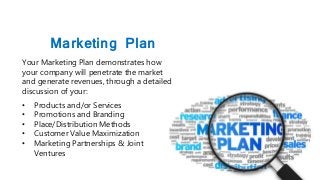
Marketing Plan
Your MarketingPlan demonstrates how
your company will penetrate the market
and generate revenues, through a detailed
discussion of your:
• Products and/or Services
• Promotions and Branding
• Place/Distribution Methods
• Customer Value Maximization
• Marketing Partnerships & Joint
Ventures
15.
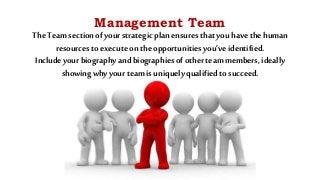
Management Team
TheTeam sectionofyourstrategicplan ensuresthat you have thehuman
resourcesto executeon theopportunities you’veidentified.
Include yourbiography and biographies ofother team members, ideally
showingwhy yourteam is uniquely qualified to succeed.
16.
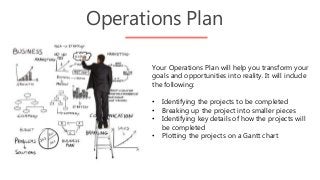
Your Operations Planwill help you transform your
goals and opportunities into reality. It will include
the following:
• Identifying the projects to be completed
• Breaking up the project into smaller pieces
• Identifying key details of how the projects will
be completed
• Plotting the projects on a Gantt chart
Operations Plan
17.
Discuss key resultsfrom your P&L model,
answering the following questions:
• Which products/services added the most to total
revenue? Gross margins?
• What are the key marketing expenses?
• How will your HR costs rise over time?
• How will your G&A expenses rise, and what
line items most impact G&A costs?
• What will your gross profit percentages be and
how will they change over the next five years?
Financial Plan
#14 There are several specific steps we can take to maximize the benefits of our diverse workforce.
First, learn the names of your co-workers and others with whom you conduct business. Use them frequently when you work together to give a personal touch that shows you recognize everyone’s individuality.
When time permits, show interest in your co-workers beyond the job at hand. Ask them about their cultural celebrations or traditions.
Never assume stereotypes about specific groups of people. You wouldn’t appreciate co-workers assuming something about you.
When you’re in meetings, use discussion guidelines to keep on topic and avoid potentially exclusive behavior that keeps minorities out of the discussion.
And, avoid personal comments of a derogatory nature. Supervisors need to deal with any personal attacks they witness or have reported to them immediately.
Take advantage of the variety of experience among your co-workers.
Respect differences—any differences.
Look at co-workers’ abilities, not their disabilities.
Never go along with insensitive comments. Speak up.
Finally, think inclusive—never exclusive.