1
PRESENTED BY:
Using home equity to close the
retirement income gap
Bruce E. Simmons, CRMP
Reverse Mortgage Manager, NMLS ID License #409914
22
“I want to retire and
stay in my home, but I
need a new roof, new
windows and an
updated kitchen.”
“I have several
high interest
credit cards and
an auto loan. I
wish I could
reduce my
monthly bills.”
“Making that
monthly
mortgage
payment is tough
sometimes.”
“I’m looking to
move but am not
sure if I will qualify
for a mortgage
now that I’m
retired.”
“I would love a
safety net – a
line of credit to
use in case of
emergencies.”
3
The Importance of Home Equity: An Often-
overlooked Retirement Asset
3
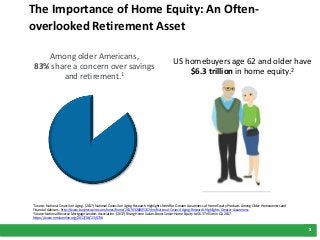
Among older Americans,
83% share a concern over savings
and retirement.1
1Source: National Council on Aging. (2017) National Council on Aging Research Highlights Need for Greater Awareness of Home Equity Products Among Older Homeowners and
Financial Advisors. http://www.businesswire.com/news/home/20170328005317/en/National-Council-Aging-Research-Highlights-Greater-Awareness
2Source: National Reverse Mortgage Lenders Association. (2017) Rising Home Values Boost Senior Home Equity to $6.3 Trillion in Q1 2017.
https://www.nrmlaonline.org/2017/06/23/4716
US homebuyers age 62 and older have
$6.3 trillion in home equity.2
4
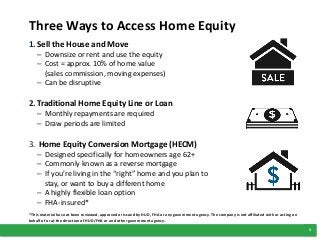
Three Ways to Access Home Equity
1.Sell the House and Move
– Downsize or rent and use the equity
– Cost = approx. 10% of home value
(sales commission, moving expenses)
– Can be disruptive
2.Traditional Home Equity Line or Loan
– Monthly repayments are required
– Draw periods are limited
3. Home Equity Conversion Mortgage (HECM)
– Designed specifically for homeowners age 62+
– Commonly known as a reverse mortgage
– If you’re living in the “right” home and you plan to
stay, or want to buy a different home
– A highly flexible loan option
– FHA-insured*
*This material has not been reviewed, approved or issued by HUD, FHA or any government agency. The company is not affiliated with or acting on
behalf of or at the direction of HUD/FHA or and other government agency.
5
Using a Home Equity Conversion Mortgage
Proceeds from a HECM can be used in a variety of ways. For example:
 Refinance existing mortgage(s) to reduce monthly loan payments
 Consolidate auto loans and high-interest credit card debt to reduce
monthly bills
 Fund major home renovation projects
 Create a “rainy day fund”
 Pay for medical expenses or in-home care
 Supplement monthly income
 Buy a home that better suits you
 Gain greater financial flexibility and peace of mind
As with any mortgage, borrower must meet their loan obligations, keeping current with property taxes,
insurance, maintenance and any homeowners association (HOA) fees.
6
Who is Eligible?
At a minimum, to qualify for an FHA-insured* HECM you must:
 Be 62 years or older
 Live in the home as your primary residence and plan on
continuing to live in the home
 Be able to pay property taxes, homeowners insurance, any
homeowners association fees, and maintain the property
*This material has not been reviewed, approved or issued by HUD, FHA or any government agency. The company is not
affiliated with or acting on behalf of or at the direction of HUD/FHA or and other government agency.
7
What Types of Homes Are Eligible?
 Single-family homes
 FHA-approved* condominiums
 Townhouses or Planned Unit Developments (PUDs)
 Two- to four-family homes
 Manufactured homes meeting HUD guidelines
*This material has not been reviewed, approved or issued by HUD, FHA or any government agency. The company is not
affiliated with or acting on behalf of or at the direction of HUD/FHA or and other government agency.
8
Options for Receiving Your Funds
 Lump Sum - Draw all the available funds at closing. The only
option available on fixed-rate loans.
 Line of Credit - Allows you to draw funds at your discretion
when you want or need them
 Tenure - Equal monthly installments for as long as you live in
the home.
 Term - Equal monthly installments over a fixed period of time.
 Or a combination of the above
 You can also change how you receive any remaining funds in
the future
Borrowers who elect a fixed rate loan will receive a single disbursement lump sum payment. Other payment
options are available only for adjustable rate mortgages.
9
Case Study 1: Dramatically Reduce
Mortgage Payments
 Mary, age 67
 Burdened by monthly mortgage payments
 Refinances with a HECM
 Benefits:
 Payment flexibility: No minimum monthly mortgage payment
 This frees up funds for other things
 As with any mortgage, she must meet her loan obligations,
keeping current with property taxes, insurance, maintenance and
any homeowners association (HOA) fees
 Loan does not have to repaid until she sells the home, passes
away or moves out
10
Case Study 2: Consolidate Debt to Reduce
Monthly Bills
 Jenny, age 63
 Has an existing mortgage, plus $50,000 in credit card and auto loan debts
 Consolidates her debts by refinancing them into a HECM
 Benefits:
 Eliminates credit card and auto loan payments
 Greatly improves monthly cash flow
 Monthly principal and interest payments are optional — greater
financial flexibility
 As with any mortgage, she must meet her loan obligations: keeping
current with property taxes, insurance, maintenance, and any
homeowners association fees
 After paying off her existing debts, has enough left to create a line of
credit that will grow over time* and will be there as a source of future
funds
*If part of the loan is held in a line of credit upon which the borrower may draw, then the unused portion of the line of credit will grow in size
each month. The growth rate is equal to the sum of the interest rate plus the annual mortgage insurance premium rate being charged on the
loan.
11
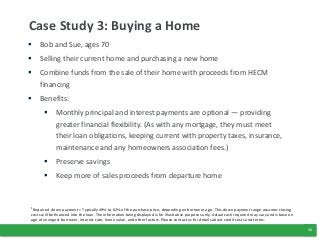
Case Study 3: Buying a Home
 Bob and Sue, ages 70
 Selling their current home and purchasing a new home
 Combine funds from the sale of their home with proceeds from HECM
financing
 Benefits:
 Monthly principal and interest payments are optional — providing
greater financial flexibility. (As with any mortgage, they must meet
their loan obligations, keeping current with property taxes, insurance,
maintenance and any homeowners association fees.)
 Preserve savings
 Keep more of sales proceeds from departure home
1Required down payment = Typically 49% to 62% of the purchase price, depending on borrower age.. This down payment range assumes closing
costs will be financed into the loan. The information being displayed is for illustrative purposes only. Actual cash required may vary and is base on
age of youngest borrower, interest rate, home value, and other factors. Please contact us for details about credit costs and terms.
12
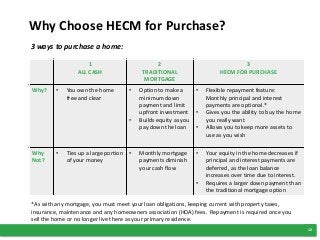
1
ALL CASH
2
TRADITIONAL
MORTGAGE
3
HECM FOR PURCHASE
Why? • You own the home
free and clear
• Option to make a
minimum down
payment and limit
upfront investment
• Builds equity as you
pay down the loan
• Flexible repayment feature:
Monthly principal and interest
payments are optional.*
• Gives you the ability to buy the home
you really want
• Allows you to keep more assets to
use as you wish
Why
Not?
• Ties up a large portion
of your money
• Monthly mortgage
payments diminish
your cash flow
• Your equity in the home decreases if
principal and interest payments are
deferred, as the loan balance
increases over time due to interest.
• Requires a larger down payment than
the traditional mortgage option
*As with any mortgage, you must meet your loan obligations, keeping current with property taxes,
insurance, maintenance and any homeowners association (HOA) fees. Repayment is required once you
sell the home or no longer live there as your primary residence.
3 ways to purchase a home:
Why Choose HECM for Purchase?
13
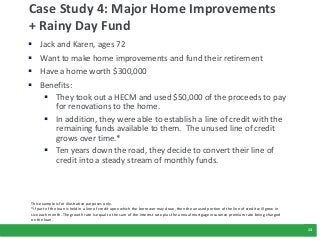
Case Study 4: Major Home Improvements
+ Rainy Day Fund
 Jack and Karen, ages 72
 Want to make home improvements and fund their retirement
 Have a home worth $300,000
 Benefits:
 They took out a HECM and used $50,000 of the proceeds to pay
for renovations to the home.
 In addition, they were able to establish a line of credit with the
remaining funds available to them. The unused line of credit
grows over time.*
 Ten years down the road, they decide to convert their line of
credit into a steady stream of monthly funds.
This example is for illustrative purposes only.
*If part of the loan is held in a line of credit upon which the borrower may draw, then the unused portion of the line of credit will grow in
size each month. The growth rate is equal to the sum of the interest rate plus the annual mortgage insurance premium rate being charged
on the loan.
14
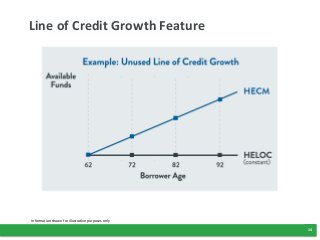
Line of Credit Growth Feature
Information shown for illustrative purposes only
15
Contact me at anytime to learn more:
Bruce E. Simmons, CRMP
Reverse Mortgage Manager,
NMLS #409914
American Liberty Mortgage, Inc.
1932 W 33rd Ave.
Denver, CO 80211
Branch NMLS #1462
303-467-7821
bruce@almortgageinc.com
Questions?
This material has not been reviewed, approved or issued by HUD, FHA or any government agency. The company is not affiliated with or acting on behalf of or at the direction of
HUD/FHA or any other government agency.
American Liberty Mortgage, Inc., 1932 W. 33rd Ave., Denver, CO 80211, NMLS #1462. Regulated by the Colorado Division of Real Estate..
L1526-Exp122018

Using Home Equity To Close The Retirement Gap

  • 1.
    1 PRESENTED BY: Using homeequity to close the retirement income gap Bruce E. Simmons, CRMP Reverse Mortgage Manager, NMLS ID License #409914
  • 2.
    22 “I want toretire and stay in my home, but I need a new roof, new windows and an updated kitchen.” “I have several high interest credit cards and an auto loan. I wish I could reduce my monthly bills.” “Making that monthly mortgage payment is tough sometimes.” “I’m looking to move but am not sure if I will qualify for a mortgage now that I’m retired.” “I would love a safety net – a line of credit to use in case of emergencies.”
  • 3.
    3 The Importance ofHome Equity: An Often- overlooked Retirement Asset 3 Among older Americans, 83% share a concern over savings and retirement.1 1Source: National Council on Aging. (2017) National Council on Aging Research Highlights Need for Greater Awareness of Home Equity Products Among Older Homeowners and Financial Advisors. http://www.businesswire.com/news/home/20170328005317/en/National-Council-Aging-Research-Highlights-Greater-Awareness 2Source: National Reverse Mortgage Lenders Association. (2017) Rising Home Values Boost Senior Home Equity to $6.3 Trillion in Q1 2017. https://www.nrmlaonline.org/2017/06/23/4716 US homebuyers age 62 and older have $6.3 trillion in home equity.2
  • 4.
    4 Three Ways toAccess Home Equity 1.Sell the House and Move – Downsize or rent and use the equity – Cost = approx. 10% of home value (sales commission, moving expenses) – Can be disruptive 2.Traditional Home Equity Line or Loan – Monthly repayments are required – Draw periods are limited 3. Home Equity Conversion Mortgage (HECM) – Designed specifically for homeowners age 62+ – Commonly known as a reverse mortgage – If you’re living in the “right” home and you plan to stay, or want to buy a different home – A highly flexible loan option – FHA-insured* *This material has not been reviewed, approved or issued by HUD, FHA or any government agency. The company is not affiliated with or acting on behalf of or at the direction of HUD/FHA or and other government agency.
  • 5.
    5 Using a HomeEquity Conversion Mortgage Proceeds from a HECM can be used in a variety of ways. For example:  Refinance existing mortgage(s) to reduce monthly loan payments  Consolidate auto loans and high-interest credit card debt to reduce monthly bills  Fund major home renovation projects  Create a “rainy day fund”  Pay for medical expenses or in-home care  Supplement monthly income  Buy a home that better suits you  Gain greater financial flexibility and peace of mind As with any mortgage, borrower must meet their loan obligations, keeping current with property taxes, insurance, maintenance and any homeowners association (HOA) fees.
  • 6.
    6 Who is Eligible? Ata minimum, to qualify for an FHA-insured* HECM you must:  Be 62 years or older  Live in the home as your primary residence and plan on continuing to live in the home  Be able to pay property taxes, homeowners insurance, any homeowners association fees, and maintain the property *This material has not been reviewed, approved or issued by HUD, FHA or any government agency. The company is not affiliated with or acting on behalf of or at the direction of HUD/FHA or and other government agency.
  • 7.
    7 What Types ofHomes Are Eligible?  Single-family homes  FHA-approved* condominiums  Townhouses or Planned Unit Developments (PUDs)  Two- to four-family homes  Manufactured homes meeting HUD guidelines *This material has not been reviewed, approved or issued by HUD, FHA or any government agency. The company is not affiliated with or acting on behalf of or at the direction of HUD/FHA or and other government agency.
  • 8.
    8 Options for ReceivingYour Funds  Lump Sum - Draw all the available funds at closing. The only option available on fixed-rate loans.  Line of Credit - Allows you to draw funds at your discretion when you want or need them  Tenure - Equal monthly installments for as long as you live in the home.  Term - Equal monthly installments over a fixed period of time.  Or a combination of the above  You can also change how you receive any remaining funds in the future Borrowers who elect a fixed rate loan will receive a single disbursement lump sum payment. Other payment options are available only for adjustable rate mortgages.
  • 9.
    9 Case Study 1:Dramatically Reduce Mortgage Payments  Mary, age 67  Burdened by monthly mortgage payments  Refinances with a HECM  Benefits:  Payment flexibility: No minimum monthly mortgage payment  This frees up funds for other things  As with any mortgage, she must meet her loan obligations, keeping current with property taxes, insurance, maintenance and any homeowners association (HOA) fees  Loan does not have to repaid until she sells the home, passes away or moves out
  • 10.
    10 Case Study 2:Consolidate Debt to Reduce Monthly Bills  Jenny, age 63  Has an existing mortgage, plus $50,000 in credit card and auto loan debts  Consolidates her debts by refinancing them into a HECM  Benefits:  Eliminates credit card and auto loan payments  Greatly improves monthly cash flow  Monthly principal and interest payments are optional — greater financial flexibility  As with any mortgage, she must meet her loan obligations: keeping current with property taxes, insurance, maintenance, and any homeowners association fees  After paying off her existing debts, has enough left to create a line of credit that will grow over time* and will be there as a source of future funds *If part of the loan is held in a line of credit upon which the borrower may draw, then the unused portion of the line of credit will grow in size each month. The growth rate is equal to the sum of the interest rate plus the annual mortgage insurance premium rate being charged on the loan.
  • 11.
    11 Case Study 3:Buying a Home  Bob and Sue, ages 70  Selling their current home and purchasing a new home  Combine funds from the sale of their home with proceeds from HECM financing  Benefits:  Monthly principal and interest payments are optional — providing greater financial flexibility. (As with any mortgage, they must meet their loan obligations, keeping current with property taxes, insurance, maintenance and any homeowners association fees.)  Preserve savings  Keep more of sales proceeds from departure home 1Required down payment = Typically 49% to 62% of the purchase price, depending on borrower age.. This down payment range assumes closing costs will be financed into the loan. The information being displayed is for illustrative purposes only. Actual cash required may vary and is base on age of youngest borrower, interest rate, home value, and other factors. Please contact us for details about credit costs and terms.
  • 12.
    12 1 ALL CASH 2 TRADITIONAL MORTGAGE 3 HECM FORPURCHASE Why? • You own the home free and clear • Option to make a minimum down payment and limit upfront investment • Builds equity as you pay down the loan • Flexible repayment feature: Monthly principal and interest payments are optional.* • Gives you the ability to buy the home you really want • Allows you to keep more assets to use as you wish Why Not? • Ties up a large portion of your money • Monthly mortgage payments diminish your cash flow • Your equity in the home decreases if principal and interest payments are deferred, as the loan balance increases over time due to interest. • Requires a larger down payment than the traditional mortgage option *As with any mortgage, you must meet your loan obligations, keeping current with property taxes, insurance, maintenance and any homeowners association (HOA) fees. Repayment is required once you sell the home or no longer live there as your primary residence. 3 ways to purchase a home: Why Choose HECM for Purchase?
  • 13.
    13 Case Study 4:Major Home Improvements + Rainy Day Fund  Jack and Karen, ages 72  Want to make home improvements and fund their retirement  Have a home worth $300,000  Benefits:  They took out a HECM and used $50,000 of the proceeds to pay for renovations to the home.  In addition, they were able to establish a line of credit with the remaining funds available to them. The unused line of credit grows over time.*  Ten years down the road, they decide to convert their line of credit into a steady stream of monthly funds. This example is for illustrative purposes only. *If part of the loan is held in a line of credit upon which the borrower may draw, then the unused portion of the line of credit will grow in size each month. The growth rate is equal to the sum of the interest rate plus the annual mortgage insurance premium rate being charged on the loan.
  • 14.
    14 Line of CreditGrowth Feature Information shown for illustrative purposes only
  • 15.
    15 Contact me atanytime to learn more: Bruce E. Simmons, CRMP Reverse Mortgage Manager, NMLS #409914 American Liberty Mortgage, Inc. 1932 W 33rd Ave. Denver, CO 80211 Branch NMLS #1462 303-467-7821 bruce@almortgageinc.com Questions? This material has not been reviewed, approved or issued by HUD, FHA or any government agency. The company is not affiliated with or acting on behalf of or at the direction of HUD/FHA or any other government agency. American Liberty Mortgage, Inc., 1932 W. 33rd Ave., Denver, CO 80211, NMLS #1462. Regulated by the Colorado Division of Real Estate.. L1526-Exp122018