Data Collection and Privacy
Library and Learning Management Systems
Emily Lynema
Acting Head, IT, NCSU Libraries
NISO Virtual Conference: Information Freedom, Ethics and Longevity
April 18, 2018
Overview
● Why bother?
● Data types and sensitivity
● Approaches to data collection
● Developing policies
● Case studies
Why bother?
● Your data collection is likely outpacing your policy development
● Data has value
○ Making wise decisions
○ Building and sustaining support
● In higher ed, student success is the new buzzword
○ Programs need to demonstrate how they contribute to student success
○ Services should evolve so that they DO contribute to student success
What is learning analytics?
“The use of data, analysis, and predictive modeling [about learners
and their contexts] to improve teaching and learning.”
EDUCAUSE Learning Initiative, 2017. 7 Things You Should Know about Developments in Learning Analytics.
https://library.educause.edu/resources/2017/7/7-things-you-should-know-about-developments-in-learning-analytics
Why learning analytics?
“Learning analytics can help students become better learners, help
faculty be better instructors, and help the institution meet its
goals…
...helping students understand which habits and behaviors tend to
contribute to academic success.”
EDUCAUSE Learning Initiative, 2017. 7 Things You Should Know about Developments in Learning Analytics.
https://library.educause.edu/resources/2017/7/7-things-you-should-know-about-developments-in-learning-analytics
What are the challenges with learning analytics?
● Correlation != causation
● The data we have (GPA) is only a proxy for learning
● Distributed data is difficult to obtain and integrate
● Learning data privacy is a wicked problem
EDUCAUSE Learning Initiative, 2017. 7 Things You Should Know about Developments in Learning Analytics.
https://library.educause.edu/resources/2017/7/7-things-you-should-know-about-developments-in-learning-analytics
Why bother, again?
● Libraries need to be prepared to demonstrate value on campus.
● Supporting student success is a growing priority amongst
academic libraries.
● We can use data to evolve our services
Data collection: library systems
● Circulation
● Electronic resource usage
● Interlibrary loan
● Entrance / exit swipes
● Study room reservations
● Computer workstation
logins
● Workshop attendance
● Library instruction sessions
/ courses
● Online / in-person
reference transactions
● Peer research consultation
Potentially sensitive library data
Personally identifiable information
● Campus ID
● Name
● Birthdate
● Marital status
● Identification numbers (esp. SSN)
● Physical address
● Phone number
● IP address
Activity that can be tied back to a user
Pretty much every data type I just listed.
NIST Guide to Protecting the Confidentiality of Personally Identifiable Information
https://nvlpubs.nist.gov/nistpubs/legacy/sp/nistspecialpublication800-122.pdf
Credit to Becky Yoose,
code4lib 2018 for inspiring this
slide. https://osf.io/xb4mf/
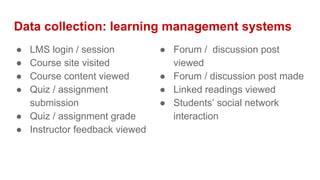
Data collection: learning management systems
● LMS login / session
● Course site visited
● Course content viewed
● Quiz / assignment
submission
● Quiz / assignment grade
● Instructor feedback viewed
● Forum / discussion post
viewed
● Forum / discussion post made
● Linked readings viewed
● Students’ social network
interaction
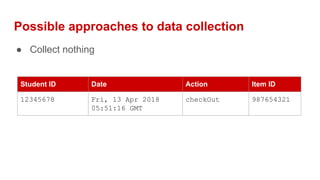
Possible approaches to data collection
● Collect nothing
Student ID Date Action Item ID
12345678 Fri, 13 Apr 2018
05:51:16 GMT
checkOut 987654321
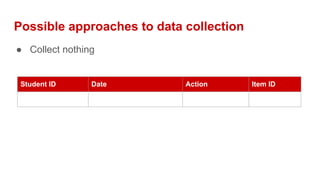
Possible approaches to data collection
● Collect nothing
Student ID Date Action Item ID
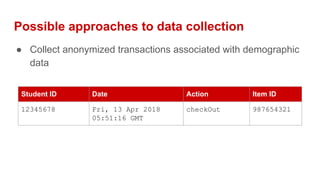
Possible approaches to data collection
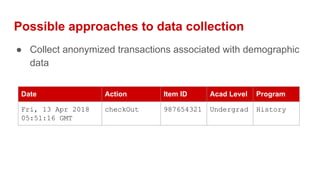
● Collect anonymized transactions associated with demographic
data
Student ID Date Action Item ID
12345678 Fri, 13 Apr 2018
05:51:16 GMT
checkOut 987654321
Possible approaches to data collection
● Collect anonymized transactions associated with demographic
data
Date Action Item ID Acad Level Program
Fri, 13 Apr 2018
05:51:16 GMT
checkOut 987654321 Undergrad History
Possible approaches to data collection
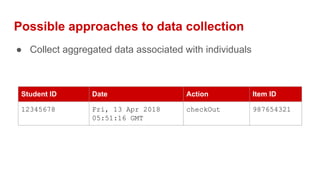
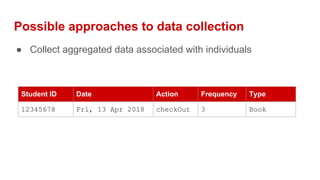
● Collect aggregated data associated with individuals
Student ID Date Action Item ID
12345678 Fri, 13 Apr 2018
05:51:16 GMT
checkOut 987654321
Possible approaches to data collection
● Collect aggregated data associated with individuals
Student ID Date Action Frequency Type
12345678 Fri, 13 Apr 2018 checkOut 3 Book
Possible approaches to data collection
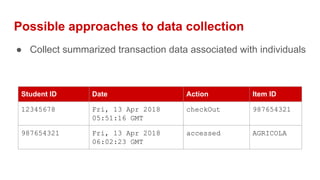
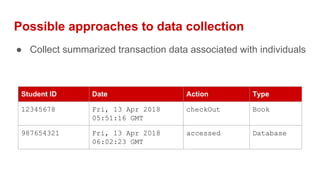
● Collect summarized transaction data associated with individuals
Student ID Date Action Item ID
12345678 Fri, 13 Apr 2018
05:51:16 GMT
checkOut 987654321
987654321 Fri, 13 Apr 2018
06:02:23 GMT
accessed AGRICOLA
Possible approaches to data collection
● Collect summarized transaction data associated with individuals
Student ID Date Action Type
12345678 Fri, 13 Apr 2018
05:51:16 GMT
checkOut Book
987654321 Fri, 13 Apr 2018
06:02:23 GMT
accessed Database
Possible approaches to data collection
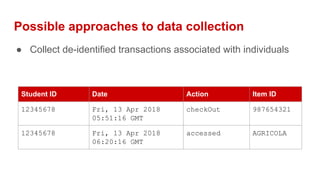
● Collect de-identified transactions associated with individuals
Student ID Date Action Item ID
12345678 Fri, 13 Apr 2018
05:51:16 GMT
checkOut 987654321
12345678 Fri, 13 Apr 2018
06:20:16 GMT
accessed AGRICOLA
Possible approaches to data collection
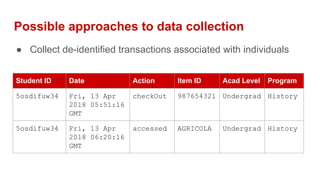
● Collect de-identified transactions associated with individuals
Student ID Date Action Item ID Acad Level Program
5osdifuw34 Fri, 13 Apr
2018 05:51:16
GMT
checkOut 987654321 Undergrad History
5osdifuw34 Fri, 13 Apr
2018 06:20:16
GMT
accessed AGRICOLA Undergrad History
Possible approaches to data collection
● Collect everything
Policy decisions for data analytics projects
● What data will we collect?
● How will the data be stored?
● How will it be retained?
● Who will have access to the data?
● How can we inform users?
● Data governance
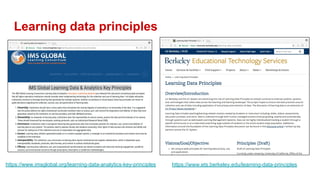
https://www.imsglobal.org/learning-data-analytics-key-principles https://www.ets.berkeley.edu/learning-data-principles
Learning data principles
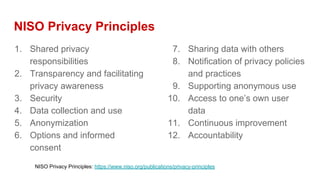
NISO Privacy Principles
1. Shared privacy
responsibilities
2. Transparency and facilitating
privacy awareness
3. Security
4. Data collection and use
5. Anonymization
6. Options and informed
consent
7. Sharing data with others
8. Notification of privacy policies
and practices
9. Supporting anonymous use
10. Access to one’s own user
data
11. Continuous improvement
12. Accountability
NISO Privacy Principles: https://www.niso.org/publications/privacy-principles
Case Studies
Seattle Public Library
● Data warehouse with library data across multiple systems
● Data collection approach
○ collect de-identified, high level transactions associated with individuals;
truncate data for privacy
Flickr gelund CC BY-NC 2.0
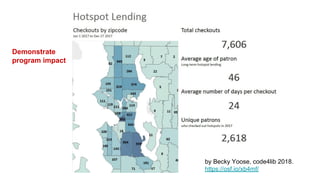
by Becky Yoose, code4lib 2018.
https://osf.io/xb4mf/
Demonstrate
program impact
University of Texas Arlington
● Combine library data and campus demographic data
● Data collection approach
○ Store high level transactions associated with individuals
○ De-identify data provided for reporting
Image source
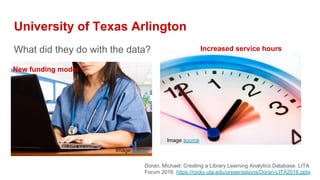
What did they do with the data?
University of Texas Arlington
Image source
Image source
Increased service hours
New funding model
Doran, Michael. Creating a Library Learning Analytics Database. LITA
Forum 2016. https://rocky.uta.edu/presentations/Doran-LITA2016.pptx
University of Minnesota
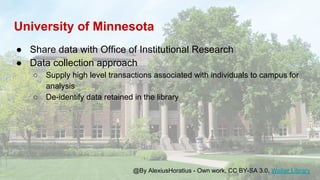
@By AlexiusHoratius - Own work, CC BY-SA 3.0, Walter Library
● Share data with Office of Institutional Research
● Data collection approach
○ Supply high level transactions associated with individuals to campus for
analysis
○ De-identify data retained in the library
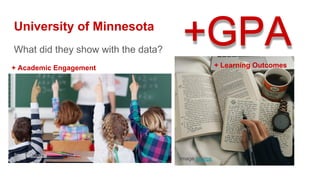
University of Minnesota
What did they show with the data?
Image source
Image source
+ Academic Engagement + Learning Outcomes
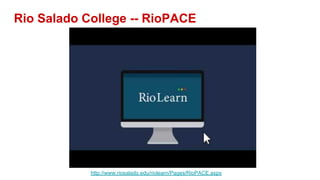
Rio Salado College -- RioPACE
http://www.riosalado.edu/riolearn/Pages/RioPACE.aspx
[Seattle Public Library] Yoose, Becky. Data Analytics and Privacy in Libraries: A balancing
act. Code4Lib 2018. https://osf.io/xb4mf/
[University of Texas at Arlington] Doran, Michael. Creating a Library Learning Analytics
Database. LITA Forum 2016. https://rocky.uta.edu/presentations/Doran-LITA2016.pptx
[University of Minnesota] Oakleaf, Megan, Shane Nackerud, & Margie Jantti. Closing the
Data Gap: Integrating Library Data into Institutional Learning Analytics. EDUCAUSE 2017.
https://events.educause.edu/~/media/files/events/user-uploads-folder/e17/sesso21/closing-th
e-data-gap--presentation-part-1.pdf
[University of Wollongong] Jantti, Margie and Jennifer Heath. (2016). What Role for
Libraries in Learning Analytics? Performance Measurement and Metrics, 17(2), 203-210.
[Purdue University] Arnold, Kim and Matthew Pistilli. (2012). Course signals at Purdue:
Using learning analytics to increase students success. Proceedings of the 2nd International
Conference on Learning Analytics and Knowledge, 267-270.

Lynema Data Collection and Privacy: Library and Learning Management Systems

  • 1.
    Data Collection andPrivacy Library and Learning Management Systems Emily Lynema Acting Head, IT, NCSU Libraries NISO Virtual Conference: Information Freedom, Ethics and Longevity April 18, 2018
  • 2.
    Overview ● Why bother? ●Data types and sensitivity ● Approaches to data collection ● Developing policies ● Case studies
  • 3.
    Why bother? ● Yourdata collection is likely outpacing your policy development ● Data has value ○ Making wise decisions ○ Building and sustaining support ● In higher ed, student success is the new buzzword ○ Programs need to demonstrate how they contribute to student success ○ Services should evolve so that they DO contribute to student success
  • 4.
    What is learninganalytics? “The use of data, analysis, and predictive modeling [about learners and their contexts] to improve teaching and learning.” EDUCAUSE Learning Initiative, 2017. 7 Things You Should Know about Developments in Learning Analytics. https://library.educause.edu/resources/2017/7/7-things-you-should-know-about-developments-in-learning-analytics
  • 5.
    Why learning analytics? “Learninganalytics can help students become better learners, help faculty be better instructors, and help the institution meet its goals… ...helping students understand which habits and behaviors tend to contribute to academic success.” EDUCAUSE Learning Initiative, 2017. 7 Things You Should Know about Developments in Learning Analytics. https://library.educause.edu/resources/2017/7/7-things-you-should-know-about-developments-in-learning-analytics
  • 6.
    What are thechallenges with learning analytics? ● Correlation != causation ● The data we have (GPA) is only a proxy for learning ● Distributed data is difficult to obtain and integrate ● Learning data privacy is a wicked problem EDUCAUSE Learning Initiative, 2017. 7 Things You Should Know about Developments in Learning Analytics. https://library.educause.edu/resources/2017/7/7-things-you-should-know-about-developments-in-learning-analytics
  • 7.
    Why bother, again? ●Libraries need to be prepared to demonstrate value on campus. ● Supporting student success is a growing priority amongst academic libraries. ● We can use data to evolve our services
  • 8.
    Data collection: librarysystems ● Circulation ● Electronic resource usage ● Interlibrary loan ● Entrance / exit swipes ● Study room reservations ● Computer workstation logins ● Workshop attendance ● Library instruction sessions / courses ● Online / in-person reference transactions ● Peer research consultation
  • 9.
    Potentially sensitive librarydata Personally identifiable information ● Campus ID ● Name ● Birthdate ● Marital status ● Identification numbers (esp. SSN) ● Physical address ● Phone number ● IP address Activity that can be tied back to a user Pretty much every data type I just listed. NIST Guide to Protecting the Confidentiality of Personally Identifiable Information https://nvlpubs.nist.gov/nistpubs/legacy/sp/nistspecialpublication800-122.pdf Credit to Becky Yoose, code4lib 2018 for inspiring this slide. https://osf.io/xb4mf/
  • 10.
    Data collection: learningmanagement systems ● LMS login / session ● Course site visited ● Course content viewed ● Quiz / assignment submission ● Quiz / assignment grade ● Instructor feedback viewed ● Forum / discussion post viewed ● Forum / discussion post made ● Linked readings viewed ● Students’ social network interaction
  • 11.
    Possible approaches todata collection ● Collect nothing Student ID Date Action Item ID 12345678 Fri, 13 Apr 2018 05:51:16 GMT checkOut 987654321
  • 12.
    Possible approaches todata collection ● Collect nothing Student ID Date Action Item ID
  • 13.
    Possible approaches todata collection ● Collect anonymized transactions associated with demographic data Student ID Date Action Item ID 12345678 Fri, 13 Apr 2018 05:51:16 GMT checkOut 987654321
  • 14.
    Possible approaches todata collection ● Collect anonymized transactions associated with demographic data Date Action Item ID Acad Level Program Fri, 13 Apr 2018 05:51:16 GMT checkOut 987654321 Undergrad History
  • 15.
    Possible approaches todata collection ● Collect aggregated data associated with individuals Student ID Date Action Item ID 12345678 Fri, 13 Apr 2018 05:51:16 GMT checkOut 987654321
  • 16.
    Possible approaches todata collection ● Collect aggregated data associated with individuals Student ID Date Action Frequency Type 12345678 Fri, 13 Apr 2018 checkOut 3 Book
  • 17.
    Possible approaches todata collection ● Collect summarized transaction data associated with individuals Student ID Date Action Item ID 12345678 Fri, 13 Apr 2018 05:51:16 GMT checkOut 987654321 987654321 Fri, 13 Apr 2018 06:02:23 GMT accessed AGRICOLA
  • 18.
    Possible approaches todata collection ● Collect summarized transaction data associated with individuals Student ID Date Action Type 12345678 Fri, 13 Apr 2018 05:51:16 GMT checkOut Book 987654321 Fri, 13 Apr 2018 06:02:23 GMT accessed Database
  • 19.
    Possible approaches todata collection ● Collect de-identified transactions associated with individuals Student ID Date Action Item ID 12345678 Fri, 13 Apr 2018 05:51:16 GMT checkOut 987654321 12345678 Fri, 13 Apr 2018 06:20:16 GMT accessed AGRICOLA
  • 20.
    Possible approaches todata collection ● Collect de-identified transactions associated with individuals Student ID Date Action Item ID Acad Level Program 5osdifuw34 Fri, 13 Apr 2018 05:51:16 GMT checkOut 987654321 Undergrad History 5osdifuw34 Fri, 13 Apr 2018 06:20:16 GMT accessed AGRICOLA Undergrad History
  • 21.
    Possible approaches todata collection ● Collect everything
  • 22.
    Policy decisions fordata analytics projects ● What data will we collect? ● How will the data be stored? ● How will it be retained? ● Who will have access to the data? ● How can we inform users? ● Data governance
  • 23.
  • 24.
    NISO Privacy Principles 1.Shared privacy responsibilities 2. Transparency and facilitating privacy awareness 3. Security 4. Data collection and use 5. Anonymization 6. Options and informed consent 7. Sharing data with others 8. Notification of privacy policies and practices 9. Supporting anonymous use 10. Access to one’s own user data 11. Continuous improvement 12. Accountability NISO Privacy Principles: https://www.niso.org/publications/privacy-principles
  • 25.
  • 26.
    Seattle Public Library ●Data warehouse with library data across multiple systems ● Data collection approach ○ collect de-identified, high level transactions associated with individuals; truncate data for privacy Flickr gelund CC BY-NC 2.0
  • 27.
    by Becky Yoose,code4lib 2018. https://osf.io/xb4mf/ Demonstrate program impact
  • 28.
    University of TexasArlington ● Combine library data and campus demographic data ● Data collection approach ○ Store high level transactions associated with individuals ○ De-identify data provided for reporting Image source
  • 29.
    What did theydo with the data? University of Texas Arlington Image source Image source Increased service hours New funding model Doran, Michael. Creating a Library Learning Analytics Database. LITA Forum 2016. https://rocky.uta.edu/presentations/Doran-LITA2016.pptx
  • 30.
    University of Minnesota @ByAlexiusHoratius - Own work, CC BY-SA 3.0, Walter Library ● Share data with Office of Institutional Research ● Data collection approach ○ Supply high level transactions associated with individuals to campus for analysis ○ De-identify data retained in the library
  • 31.
    University of Minnesota Whatdid they show with the data? Image source Image source + Academic Engagement + Learning Outcomes
  • 32.
    Rio Salado College-- RioPACE http://www.riosalado.edu/riolearn/Pages/RioPACE.aspx
  • 33.
    [Seattle Public Library]Yoose, Becky. Data Analytics and Privacy in Libraries: A balancing act. Code4Lib 2018. https://osf.io/xb4mf/ [University of Texas at Arlington] Doran, Michael. Creating a Library Learning Analytics Database. LITA Forum 2016. https://rocky.uta.edu/presentations/Doran-LITA2016.pptx [University of Minnesota] Oakleaf, Megan, Shane Nackerud, & Margie Jantti. Closing the Data Gap: Integrating Library Data into Institutional Learning Analytics. EDUCAUSE 2017. https://events.educause.edu/~/media/files/events/user-uploads-folder/e17/sesso21/closing-th e-data-gap--presentation-part-1.pdf [University of Wollongong] Jantti, Margie and Jennifer Heath. (2016). What Role for Libraries in Learning Analytics? Performance Measurement and Metrics, 17(2), 203-210. [Purdue University] Arnold, Kim and Matthew Pistilli. (2012). Course signals at Purdue: Using learning analytics to increase students success. Proceedings of the 2nd International Conference on Learning Analytics and Knowledge, 267-270.