





















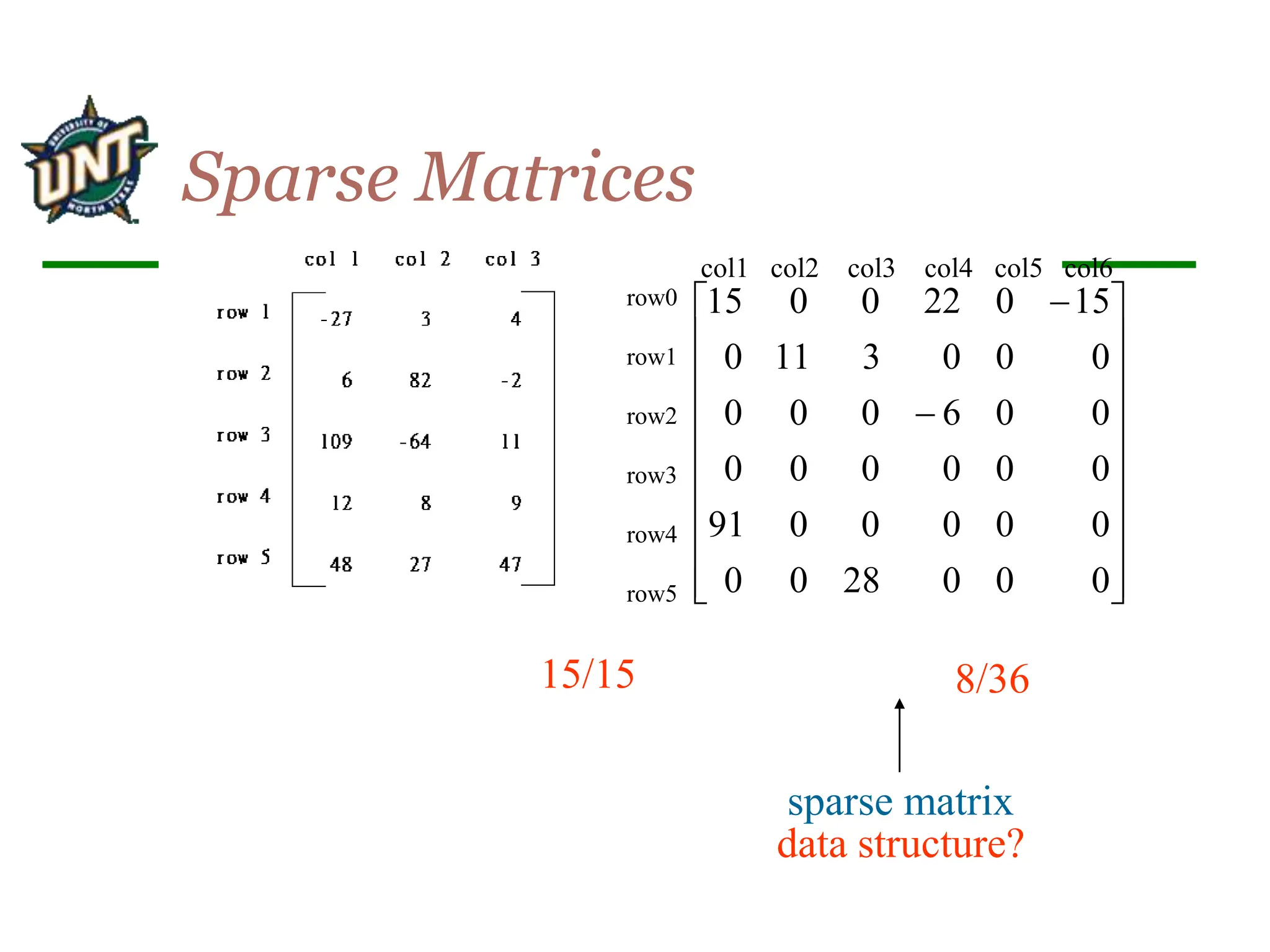
0
0
0
28
0
0
0
0
0
0
0
91
0
0
0
0
0
0
0
0
6
0
0
0
0
0
0
3
11
0
15
0
22
0
0
15
col1 col2 col3 col4 col5 col6
row0
row1
row2
row3
row4
row5
8/36
6*6
5*3
15/15
sparse matrix
data structure?
Sparse Matrices
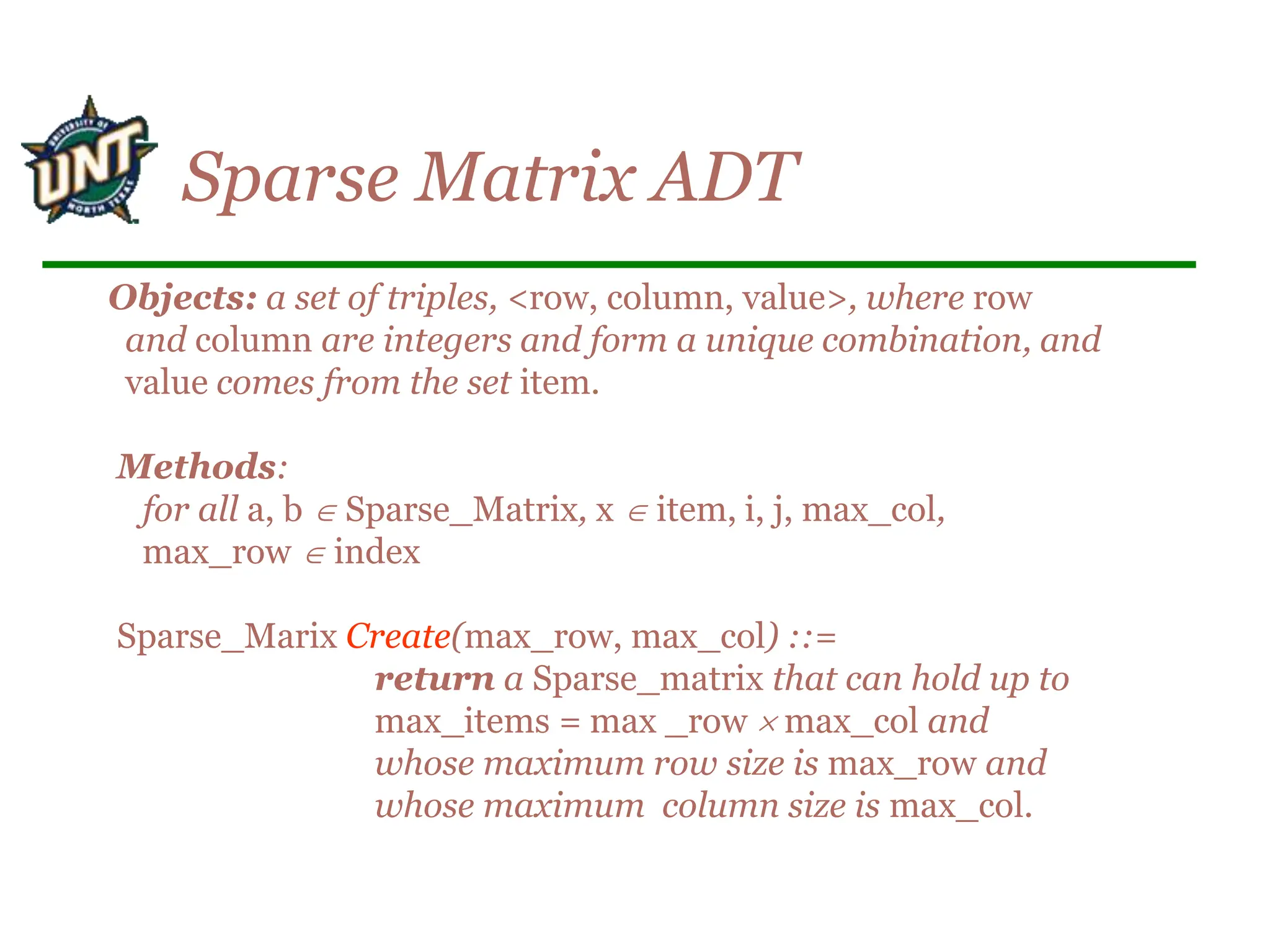
Sparse Matrix ADT
Objects: a set of triples, <row, column, value>, where row
and column are integers and form a unique combination, and
value comes from the set item.
Methods:
for all a, b  Sparse_Matrix, x  item, i, j, max_col,
max_row  index
Sparse_Marix Create(max_row, max_col) ::=
return a Sparse_matrix that can hold up to
max_items = max _row  max_col and
whose maximum row size is max_row and
whose maximum column size is max_col.
Sparse Matrix ADT (cont’d)
Sparse_Matrix Transpose(a) ::=
return the matrix produced by interchanging
the row and column value of every triple.
Sparse_Matrix Add(a, b) ::=
if the dimensions of a and b are the same
return the matrix produced by adding
corresponding items, namely those with
identical row and column values.
else return error
Sparse_Matrix Multiply(a, b) ::=
if number of columns in a equals number of rows in b
return the matrix d produced by multiplying
a by b according to the formula: d [i] [j] =
(a[i][k]•b[k][j]) where d (i, j) is the (i,j)th
element
else return error.
(1) Represented by a two-dimensional array.
Sparse matrix wastes space.
(2) Each element is characterized by <row, col, value>.
Sparse Matrix Representation
Sparse_matrix Create(max_row, max_col) ::=
#define MAX_TERMS 101 /* maximum number of terms +1*/
typedef struct {
int col;
int row;
int value;
} term;
term A[MAX_TERMS]
The terms in A should be ordered
based on <row, col>
Sparse Matrix Operations
Transpose of a sparse matrix.
What is the transpose of a matrix?
row col value row col value
a[0] 6 6 8 b[0] 6 6 8
[1] 0 0 15 [1] 0 0 15
[2] 0 3 22 [2] 0 4 91
[3] 0 5 -15 [3] 1 1 11
[4] 1 1 11 [4] 2 1 3
[5] 1 2 3 [5] 2 5 28
[6] 2 3 -6 [6] 3 0 22
[7] 4 0 91 [7] 3 2 -6
[8] 5 2 28 [8] 5 0 -15
transpose
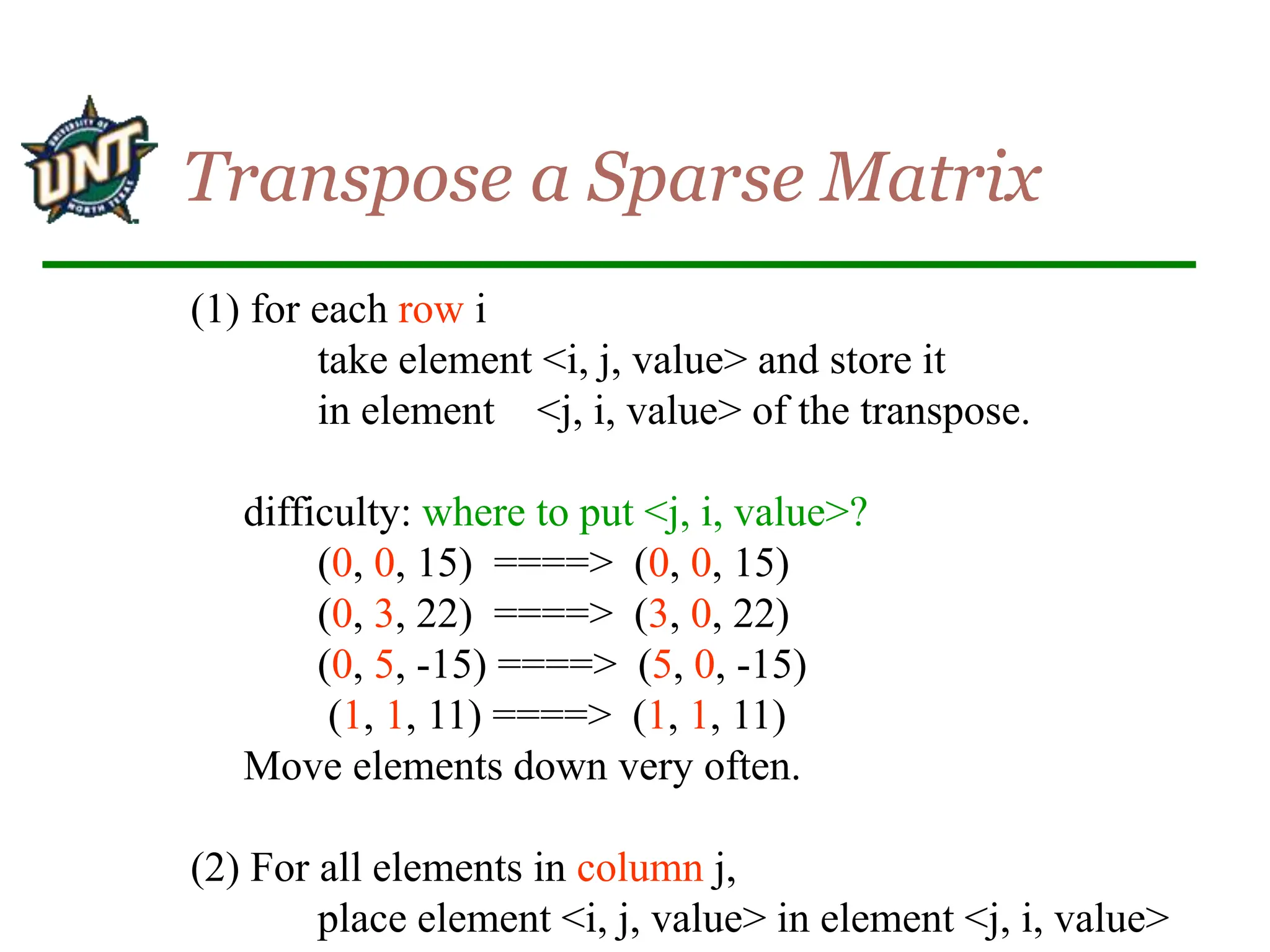
(1) for each row i
take element <i, j, value> and store it
in element <j, i, value> of the transpose.
difficulty: where to put <j, i, value>?
(0, 0, 15) ====> (0, 0, 15)
(0, 3, 22) ====> (3, 0, 22)
(0, 5, -15) ====> (5, 0, -15)
(1, 1, 11) ====> (1, 1, 11)
Move elements down very often.
(2) For all elements in column j,
place element <i, j, value> in element <j, i, value>
Transpose a Sparse Matrix
Transpose of a Sparse Matrix
(cont’d)
void transpose (term a[], term b[])
/* b is set to the transpose of a */
{
int n, i, j, currentb;
n = a[0].value; /* total number of elements */
b[0].row = a[0].col; /* rows in b = columns in a */
b[0].col = a[0].row; /*columns in b = rows in a */
b[0].value = n;
if (n > 0) { /*non zero matrix */
currentb = 1;
for (i = 0; i < a[0].col; i++)
/* transpose by columns in a */
for( j = 1; j <= n; j++)
/* find elements from the current column */
if (a[j].col == i) {
/* element is in current column, add it to b */

sparse-matrix.ppt

  • 1.
  • 2.
    Sparse Matrix ADT Objects:a set of triples, <row, column, value>, where row and column are integers and form a unique combination, and value comes from the set item. Methods: for all a, b  Sparse_Matrix, x  item, i, j, max_col, max_row  index Sparse_Marix Create(max_row, max_col) ::= return a Sparse_matrix that can hold up to max_items = max _row  max_col and whose maximum row size is max_row and whose maximum column size is max_col.
  • 3.
    Sparse Matrix ADT(cont’d) Sparse_Matrix Transpose(a) ::= return the matrix produced by interchanging the row and column value of every triple. Sparse_Matrix Add(a, b) ::= if the dimensions of a and b are the same return the matrix produced by adding corresponding items, namely those with identical row and column values. else return error Sparse_Matrix Multiply(a, b) ::= if number of columns in a equals number of rows in b return the matrix d produced by multiplying a by b according to the formula: d [i] [j] = (a[i][k]•b[k][j]) where d (i, j) is the (i,j)th element else return error.
  • 4.
    (1) Represented bya two-dimensional array. Sparse matrix wastes space. (2) Each element is characterized by <row, col, value>. Sparse Matrix Representation Sparse_matrix Create(max_row, max_col) ::= #define MAX_TERMS 101 /* maximum number of terms +1*/ typedef struct { int col; int row; int value; } term; term A[MAX_TERMS] The terms in A should be ordered based on <row, col>
  • 5.
    Sparse Matrix Operations Transposeof a sparse matrix. What is the transpose of a matrix? row col value row col value a[0] 6 6 8 b[0] 6 6 8 [1] 0 0 15 [1] 0 0 15 [2] 0 3 22 [2] 0 4 91 [3] 0 5 -15 [3] 1 1 11 [4] 1 1 11 [4] 2 1 3 [5] 1 2 3 [5] 2 5 28 [6] 2 3 -6 [6] 3 0 22 [7] 4 0 91 [7] 3 2 -6 [8] 5 2 28 [8] 5 0 -15 transpose
  • 6.
    (1) for eachrow i take element <i, j, value> and store it in element <j, i, value> of the transpose. difficulty: where to put <j, i, value>? (0, 0, 15) ====> (0, 0, 15) (0, 3, 22) ====> (3, 0, 22) (0, 5, -15) ====> (5, 0, -15) (1, 1, 11) ====> (1, 1, 11) Move elements down very often. (2) For all elements in column j, place element <i, j, value> in element <j, i, value> Transpose a Sparse Matrix
  • 7.
    Transpose of aSparse Matrix (cont’d) void transpose (term a[], term b[]) /* b is set to the transpose of a */ { int n, i, j, currentb; n = a[0].value; /* total number of elements */ b[0].row = a[0].col; /* rows in b = columns in a */ b[0].col = a[0].row; /*columns in b = rows in a */ b[0].value = n; if (n > 0) { /*non zero matrix */ currentb = 1; for (i = 0; i < a[0].col; i++) /* transpose by columns in a */ for( j = 1; j <= n; j++) /* find elements from the current column */ if (a[j].col == i) { /* element is in current column, add it to b */