Who cares about ambulance
performance measures?!
Dan Fall
Sheffield Emergency Care Forum (SECF)
Andy Irving
University of Sheffield
The role of PPI in developing an animation for
dissemination of the PhOEBE programme
@irvingad82
@PhOEBE_PPI
Share the animation
#phoebeproject
Introduction
Outline
1. Background
2. Animation
3. You have a go!
4. Feedback
Maggie Andrea Dan
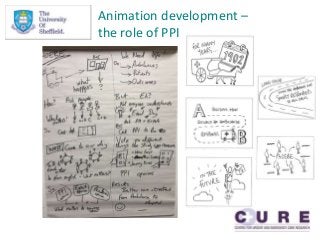
Animation development
Set the brief – What, why, who, when and how?
 What? Whiteboard sketch animation video
 Why? Public money/research, educate public
about PhOEBE and the ambulance services.
 Who? General public (anyone is a user of
ambulance services)
 When?: Today! (other dissemination activities)
 How?: Graphic designers, meetings, timeline
The making of the animation
https://vimeo.com/242717702/bfefeee9e2
Animation development –
the role of PPI
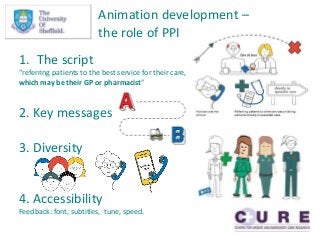
Animation development –
the role of PPI
1. The script
“referring patients to the best service for their care,
which may be their GP or pharmacist”
2. Key messages
3. Diversity
4. Accessibility
Feedback: font, subtitles, tune, speed.
PhOEBE animation
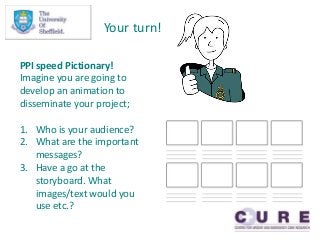
Your turn!
PPI speed Pictionary!
Imagine you are going to
develop an animation to
disseminate your project;
1. Who is your audience?
2. What are the important
messages?
3. Have a go at the
storyboard. What
images/text would you
use etc.?
Two minutes left
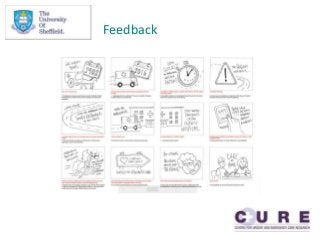
Feedback
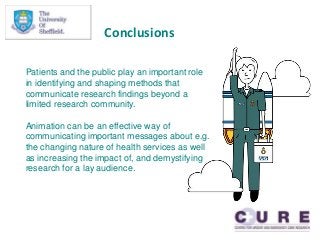
Conclusions
Patients and the public play an important role
in identifying and shaping methods that
communicate research findings beyond a
limited research community.
Animation can be an effective way of
communicating important messages about e.g.
the changing nature of health services as well
as increasing the impact of, and demystifying
research for a lay audience.
Any questions?
@irvingad82
@PhOEBE_PPI
Andy Irving a.d.irving@sheffield.ac.uk
Share the animation
#phoebeproject

"Who cares about ambulance performance measures?! The role of PPI in developing an animation for dissemination of the PhOEBE progamme"

  • 1.
    Who cares aboutambulance performance measures?! Dan Fall Sheffield Emergency Care Forum (SECF) Andy Irving University of Sheffield The role of PPI in developing an animation for dissemination of the PhOEBE programme @irvingad82 @PhOEBE_PPI Share the animation #phoebeproject
  • 2.
    Introduction Outline 1. Background 2. Animation 3.You have a go! 4. Feedback Maggie Andrea Dan
  • 3.
    Animation development Set thebrief – What, why, who, when and how?  What? Whiteboard sketch animation video  Why? Public money/research, educate public about PhOEBE and the ambulance services.  Who? General public (anyone is a user of ambulance services)  When?: Today! (other dissemination activities)  How?: Graphic designers, meetings, timeline
  • 4.
    The making ofthe animation https://vimeo.com/242717702/bfefeee9e2
  • 5.
  • 6.
    Animation development – therole of PPI 1. The script “referring patients to the best service for their care, which may be their GP or pharmacist” 2. Key messages 3. Diversity 4. Accessibility Feedback: font, subtitles, tune, speed.
  • 7.
  • 8.
    Your turn! PPI speedPictionary! Imagine you are going to develop an animation to disseminate your project; 1. Who is your audience? 2. What are the important messages? 3. Have a go at the storyboard. What images/text would you use etc.?
  • 9.
  • 10.
  • 11.
    Conclusions Patients and thepublic play an important role in identifying and shaping methods that communicate research findings beyond a limited research community. Animation can be an effective way of communicating important messages about e.g. the changing nature of health services as well as increasing the impact of, and demystifying research for a lay audience.
  • 12.
  • 13.

Editor's Notes

  • #2 AI to present and introduce Dan
  • #3 AI to present We aimed to maximise PPI input in this five-year research programme and identify optimal and innovative ways to involve patients and the public. Maggie, Andrea and Dan formed our PPI reference group and have met regularly throughout the 5 /6 year programme. Maggie is an ex Primary school teacher. Now member of the Sheffield Emergency Care Forum (SECF) Interested in emergency care and research. Andrea has a range of experiences using health services as a wheelchair user. She is involved in local and regional patient quality and experience focussed work. Dan is also a member of the SECF and feels he gives a regular middle aged working mans perspective on things. I’m going to talk a little more about 1, setting the context and background of the PhOEBE animation but balanced with a good portion of the workshop giving you the opportunity to think about using animation as a dissemination activity yourself.
  • #4 AI to present FOCUS on the role of PPI in each. The first thing you need to do is set the brief outlining the what, why, who, when and how. WHAT: In our case it was Andrea’s idea – Kings fund, A&E brand etc. RS Animate videos. Knowledge visualisation. WHY: The ‘why’ is underlined by the ‘moral’ imperative, that ALL members of the public have a right to be fully involved in and know about publicly-funded research. The onus is on researchers to try to ensure ALL members of the public have a fair chance to see and understand research. (pretty sure the general public are unlikely to read huge project reports or academic outputs from PhOEBE) WHO: The general public. Beyond limited academic and clinical audience. As anyone is both a potential user of ambulance service and therefore a beneficiary of the potential impact and improvements driven by PhOEBE, the team felt the animation would be relevant and informative for a general public audience. The public have a right to know about research that may impact on their health status or the services that they receive. WHEN: As a non-perishable digital output, the concept of ‘when’ in terms of traditional outputs does not apply e.g. a timed and dated journal article or presentation. Today and forevermore! HOW? Scoping, commissioning and bids with companies… We’ll show you!
  • #5 DF present the making of the animation video Use hyperlink if embedded video doesn’t work or is slow. https://vimeo.com/242717702/bfefeee9e2
  • #6 Dan over to you… I just copied and pasted some notes and bits. Feel free to edit. OK. I think the point to make the most of is for me the difficulty in getting lay people to take the right information away from research or services. In the way that people go to A&E instead of the GP, it tends to relate to people not being informed enough about things that service providers or academics think is obvious. The open event day we did was an eye opener for everyone there as it allowed people to get a feel for the kind of things which have to be assessed in order to make the service more effective. Then there is the layer of which measures mattered to the PPI people rather than the service people. That’s the background of trying to get a viable message which doesn’t require reading of the academic report. (no one will). Ideas 2014 Kings Fund animation explaining problems in the urgent and emergency care system. Sept 2015 RCEM A&E brand video. Rationale Everyone is a potential recipient of ambulance service care and expects a good quality service, but measurement of care and performance are difficult and complex concepts to describe. The PhOEBE programme’s patient and public advisors felt important messages from the study could be better presented to the general public using an animation to describe the findings and the changing nature of ambulance services in England. Concept (March 2016 – May 2016) The PhOEBE PPI reference group and PhOEBE research team held a series of meetings to discuss the concept of using a white board sketch animation alongside traditional journal article publishing as part of the wider PhOEBE dissemination strategy. PPI reference group members reviewed existing examples of animations and the organisations that create these.   Commissioning (June 2016) A project brief outlining the objectives for the animation and initial storyboard was designed by the PPI reference group and circulated to organisations to scope out the time/resources required and estimated costs. Based on quotes and feedback from the organisations approached VividCreative were commissioned to create the PhOEBE animation.   Development (June 2016 – April 2017) An initial brand identity workshop was held with Vivid, the PPI group and research team to explore typography, colour palettes and iconography. A suite of logo assets were created and the PhOEBE character agreed (figure 1). The animation design phase began with a scoping workshop to outline the key factors of the animation, to further develop the initial storyboard and initiate the script writing process. An ambulance service staff member involved in the PhOEBE project recorded the animation voiceover from an agreed script.   Patient and Public (PPI) feedback (December 2016) A 15 second sample animation clip was shown to a lay audience (n=15) in order to gather feedback on the speed of the animation, fonts used, colour/ contrast, voiceover and clarity of the message. On the basis of this feedback the font was changed to a simpler more accessible form, the voiceover slowed down (pauses added) and the volume of the background tune changed. Impact Many people still hold a fairly traditional view of the ambulance service simply transporting patients to hospital. Current ambulance performance measures, such as response times, do not reflect the wider scope of care services now provide. Telling the story of the PhOEBE programme through animation could be a powerful way of changing public perceptions of the ambulance service and introducing new performance measures that are more focused on care and patient outcomes. Learning points Patients and the public play an important role in identifying and shaping methods that communicate research findings beyond a limited research community.
  • #7 Dan to present – 4 key areas PPI advocated strongly for the use of plain English and avoidance of any jargon. Several iterations of the script “This means taking some patients directly to specialist care for example, a heart attack patient to a specialist cardiac care center” BOLD added by PPI. Giving concrete examples. Also endorsed the idea to use a regional accent for the voiceover: conferred credibility and friendliness for a lay audience. What it was seen as = a emergency transport service. How it has evolved, not just about A to B. History of performance measures (time etc.) not ‘fit for purpose’ (not kept pace with changing nature of AS) EDUCATE element. PPI highlighted importance to keep messages clear and simple. Other key considerations: Diversity: Hairstyle, headdress and use of different technologies give subtle yet clear indications of a range of age, gender and ethnic backgrounds. Rather than often somewhat obvious and patronising use of a range of skins colours etc. SECF feedback on use of clearer font, avoid using capitols, reduced tune volume, slowed the pace of the animation by introducing short pauses, text and image synchrony re-enforces the main messages and subtitles if required for hearing impaired.
  • #8 Need hyperlink to share. QR code Tell people to google PhOEBE project
  • #9 Just a taster to get people thinking of how they could use this medium. How could PPI be involved in your animation development? To explain to those present what this is about (glad you posted my doodles) we have to hope that there is a working idea for them to try. And stress that we need to explain they are not supposed to animate this themselves. The intention is that they put some basic Pictionary doodles that would start this off. You don’t record a song by telling the producer what to play. You have to play it yourself. Even if its with one finger – that’s fine. I think in the above notes you have already mentioned stuff like accents and the jargon busting plus – and its vital, the whole accessibility scenario. We need to cover that in the build up too and if any one dares say that the internet is not accessible then I will have to take them outside for a chat. It might transpire that some of this process is harder for attendees than we thought it was at the time. We should point out that our process was carried out by PPI, Janette, you and the team and was not just done by a bunch of animators. In case anyone thinks that. Everyone had a stake in what needed saying and how to say it. And NONE of us had any experience in doing this so there was only what came to mind during the process. If any attendees feel after seeing the animation that it is lacking anything then we are more than happy to accept comments. We are not claiming that we did a perfect job but it might give people in the room the idea that they could use this method if it suits their project.
  • #11 Calculate remaining time and go round tables for feedback and comments.