BUILDING A HEALTHIER,
SAFER, THRIVING SAN DIEGO
Analysis and perspective from MBA students at
the UCSD Rady School of Management
YOUR EXPERT TEAM
WHO WE ARE
ALLISON
NOEL
SAPNA
HEGDE
FENG
JIANG
SABRINA
QUTB
JASMINE
REZAI
We’re a diverse team of analytics-focused MBA students from the UCSD Rady School of
Management, united with a common purpose of delivering actionable insights that
accelerate the growth of healthy, safe, and thriving communities in San Diego.
OUTLINE
 Follow-up
ideas
 Important
questions to
ask next
 Data
limitations
and
assumptions
INTRO
 Predictive
model,
estimating
disease rates
through the
lens of
race/ethnicity
 10-yr
projections
 A look at the 3
factors:
smoking, diet,
and exercise
 Additional
factors
 Reducing
chronic
disease
 Where we
see the
highest rates
of medical
encounters
 Who has the
highest rates
 Trends
THE
SITUATION
slides 4 − 20
THE
NEXT
STEPS
slides 21 − 26
PREDICTING
WHAT WILL
HAPPEN
slides 27 − 41
REVIEW AND
FOLLOW UP
IDEAS
slides 42 − 44slides 1 − 3
Q1 Q2 Q3 +4
Q1: THE SITUATION
An analysis of trends across disease,
economics, and behavior data
Q1: THE SITUATION
EXECUTIVE SUMMARY: THE STRONGEST TRENDS
 The incidence of disease varies significantly by city and health equity lens.
 Certain sub-regional areas have higher rates of medical encounters than others.
 Certain groups, as viewed through the five lenses of health equity, have higher rates
of medical encounters than others.
 The concept of “underserved,” as it relates to populations, can be viewed in different
ways. We look at it from the perspective of sub-regional area as well as health equity
group, looking at disparities in rates of medical encounters.
 Underserved groups exhibit different behaviors and have different economic qualities,
compared to well-served groups.
WHERE WE SEE THE HIGHEST RATES
MEDICAL ENCOUNTERS BY SUB-REGIONAL AREA (SRA): CANCER
Notes: Medical encounters includes hospitalizations, deaths, and emergency department discharges. Total rate is the average
number of annual encounters per sub-regional area (SRA) per 100,000 population from 2010-2013.
Highest-rate SRAs:
Anza-Borrego Springs
& Mountain Empire
Chula Vista
La Mesa
Under or equal to 100
101 to 200
201 to 300
301 to 400
401 to 500
501 to 600
601 to 700
Over or equal to 700
WHERE WE SEE THE HIGHEST RATES
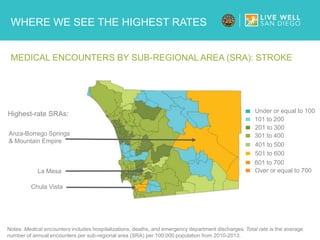
MEDICAL ENCOUNTERS BY SUB-REGIONAL AREA (SRA): STROKE
Notes: Medical encounters includes hospitalizations, deaths, and emergency department discharges. Total rate is the average
number of annual encounters per sub-regional area (SRA) per 100,000 population from 2010-2013.
Highest-rate SRAs:
Anza-Borrego Springs
& Mountain Empire
Chula Vista
La Mesa
Under or equal to 100
101 to 200
201 to 300
301 to 400
401 to 500
501 to 600
601 to 700
Over or equal to 700
WHERE WE SEE THE HIGHEST RATES
MEDICAL ENCOUNTERS BY SUB-REGIONAL AREA (SRA): HEART DISEASE
Notes: Medical encounters includes hospitalizations, deaths, and emergency department discharges. Total rate is the average
number of annual encounters per sub-regional area (SRA) per 100,000 population from 2010-2013.
Highest-rate SRAs:
Anza-Borrego Springs
& Mountain Empire
Chula Vista
National City
Under or equal to 100
101 to 200
201 to 300
301 to 400
401 to 500
501 to 600
601 to 700
Over or equal to 700
WHERE WE SEE THE HIGHEST RATES
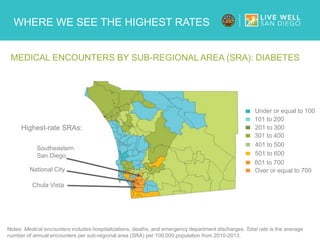
MEDICAL ENCOUNTERS BY SUB-REGIONAL AREA (SRA): DIABETES
Notes: Medical encounters includes hospitalizations, deaths, and emergency department discharges. Total rate is the average
number of annual encounters per sub-regional area (SRA) per 100,000 population from 2010-2013.
Highest-rate SRAs:
National City
Chula Vista
Southeastern
San Diego
Under or equal to 100
101 to 200
201 to 300
301 to 400
401 to 500
501 to 600
601 to 700
Over or equal to 700
WHERE WE SEE THE HIGHEST RATES
MEDICAL ENCOUNTERS BY SUB-REGIONAL AREA (SRA): LUNG DISEASE
Notes: Medical encounters includes hospitalizations, deaths, and emergency department discharges. Total rate is the average
number of annual encounters per sub-regional area (SRA) per 100,000 population from 2010-2013.
Highest-rate SRAs:
Chula Vista
Harbison Crest/
El Cajon
National City
Under or equal to 100
101 to 200
201 to 300
301 to 400
401 to 500
501 to 600
601 to 700
Over or equal to 700
WHERE WE SEE THE HIGHEST RATES
MEDICAL ENCOUNTERS BY SUB-REGIONAL AREA (SRA): ASTHMA
Notes: Medical encounters includes hospitalizations, deaths, and emergency department discharges. Total rate is the average
number of annual encounters per sub-regional area (SRA) per 100,000 population from 2010-2013.
Highest-rate SRAs:
National City
Chula Vista
Southeastern San Diego
Under or equal to 100
101 to 200
201 to 300
301 to 400
401 to 500
501 to 600
601 to 700
Over or equal to 700
Unlike for other
diseases, East County
is now among the
lowest-rate areas
WHO HAS THE HIGHEST RATES
RISK OF MEDICAL ENCOUNTERS BY GENDER IS BALANCED
Notes: Medical encounters includes hospitalizations, deaths, and emergency department discharges. Risk is measured as
likelihood, relative to San Diego County as a whole, of having a medical encounter in 2012.
0.6
0.7
0.8
0.9
1
1.1
1.2
1.3
Male Female
Riskofmedicalencounter
Cancer CHD Stroke COPD Diabetes Asthma
WHO HAS THE HIGHEST RATES
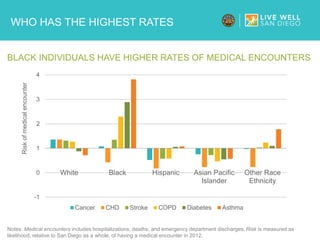
BLACK INDIVIDUALS HAVE HIGHER RATES OF MEDICAL ENCOUNTERS
Notes: Medical encounters includes hospitalizations, deaths, and emergency department discharges. Risk is measured as
likelihood, relative to San Diego as a whole, of having a medical encounter in 2012.
-1
0
1
2
3
4
White Black Hispanic Asian Pacific
Islander
Other Race
Ethnicity
Riskofmedicalencounter
Cancer CHD Stroke COPD Diabetes Asthma
WHO HAS THE HIGHEST RATES
VERY URBAN AREAS HAVE HIGHER RATES OF MEDICAL ENCOUNTERS
Notes: Medical encounters includes hospitalizations, deaths, and emergency department discharges. Risk is measured as
likelihood, relative to San Diego as a whole, of having a medical encounter in 2012.
0.4
0.8
1.2
1.6
2
Rural Exurban Suburban Urban Very Urban
Riskofmedicalencounter
Cancer CHD Stroke COPD Diabetes Asthma
WHO HAS THE HIGHEST RATES
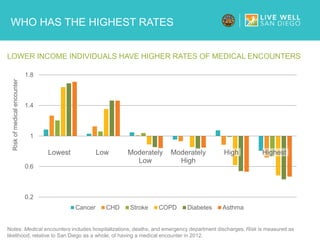
LOWER INCOME INDIVIDUALS HAVE HIGHER RATES OF MEDICAL ENCOUNTERS
Notes: Medical encounters includes hospitalizations, deaths, and emergency department discharges. Risk is measured as
likelihood, relative to San Diego as a whole, of having a medical encounter in 2012.
0.2
0.6
1
1.4
1.8
Lowest Low Moderately
Low
Moderately
High
High Highest
Riskofmedicalencounter
Cancer CHD Stroke COPD Diabetes Asthma
WHO HAS THE HIGHEST RATES
INDIVIDUALS AGES 65+ HAVE HIGHER RATES OF MEDICAL ENCOUNTERS
Notes: Medical encounters includes hospitalizations, deaths, and emergency department discharges. Risk is measured as
likelihood, relative to San Diego as a whole, of having a medical encounter in 2012.
-1
0
1
2
3
4
5
6
7
Age 0-14 Age 15-24 Age 25-44 Age 45-64 Age 65+
Riskofmedicalencounter
Cancer CHD Stroke COPD Diabetes Asthma
TRENDS WE SEE
WHO ARE THE UNDERSERVED? TWO WAYS OF LOOKING AT IT:
• Chula Vista
• Harbison/El Cajon
• La Mesa
• National City
• South Bay
• Fallbrook
• Southeastern San Diego
• Anza-Borrego Springs
 Individuals ages 65+
 Those living in very urban areas
 The lowest-to-low income earners
 Black individuals
SRAs with highest disease rates Groups with disparities, as seen
through the 5 health equity lenses
*See slide notes for more detailed description of how SRAs with highest disease rates were determined
TRENDS WE SEE
THE TWO METHODS OF DEFINING UNDERSERVED ARE SIMILAR
6%
black
12.2%
age 65+
$55,000
median
income
38%
very urban
underserved
geographies
well-served
geographies
4%
black
12.3%
age 65+
$74,000
median
income
9%
very urban
Underserved geographies, defined by rates of medical encounters, are also more
likely home to underserved groups, as defined through the 5 lenses. For example:
TRENDS WE SEE:
BEHAVIORS OF THE UNDERSERVED
COMPARED TO THE WELL-SERVED, UNDERSERVED GEOGRAPHIES ARE…
18% more likely to have smoked in the last 12 months
13% more likely to not exercise during a typical week
7% less likely to be presently controlling their diet and
22% less likely to buy foods labeled as natural/organic
11% less likely to have a savings account
21% less likely to have volunteered for a charitable
organization in the last 12 months
17% less likely to have voted in a federal/state/local
election in the last 12 months
TRENDS WE SEE: DEMOGRAPHICS &
ECONOMICS OF THE UNDERSERVED
COMPARED TO THE WELL-SERVED, UNDERSERVED GEOGRAPHIES ARE…
79% less likely to have a bachelor's degree
19% more likely to have a disability
32% more likely to live below the federal poverty level
35% more likely to be unemployed
43% more likely to have the marital status “separated”
19% more likely to be widowed
Q2: THE NEXT STEPS
Identifying protective behaviors that may
reduce the risk of disease
Q2: THE NEXT STEPS
EXECUTIVE SUMMARY: POTENTIALLY PROTECTIVE BEHAVIORS & FACTORS
 The three behaviors identified by the Live Well program—smoking, lack of exercise,
and poor diet– are correlated with total (combined) rates of medical encounters across
chronic diseases, as well as with rates broken out by disease.
 Additional factors are correlated with rates of medical encounters
 A college education: Bachelors degrees are associated with lower rates of disease
 Unemployment: More unemployment is associated with higher rates of disease
 Household income: Higher incomes are associated with lower rates of disease
 Sinus and headache medication: Higher rates of sinus and headache medication
use are associated with higher rates of disease. This could be a proxy for stress.
 Depression medication: Higher rates of depression medication use are associated
with higher rates of disease. This could be a proxy for mental health.
 Separation (as a marital status): Higher rates of separated people is associated with
higher rates of disease; marriage tends to reduce rates of some diseases.
Q2: RELATED BEHAVIORS
SMOKING, INACTIVITY, AND POOR DIET ARE POSITIVELY
CORRELATED WITH TOTAL RATE OF MEDICAL ENCOUNTERS
Smoking Lack of exercise Fast food spending
($50-100/week)
0
500
1000
1500
2000
2500
3000
3500
4000
4500
5000
0 10000 20000 30000
RateofEncounters
Rates of Smoking
Correlation: .22
0
500
1000
1500
2000
2500
3000
3500
4000
4500
5000
0 20000 40000 60000
RateofEncounters
Rates of No Exercise
Correlation: .19
0
500
1000
1500
2000
2500
3000
3500
4000
4500
5000
0 10000 20000 30000
RatesofEncounters Rates of Spending in Range
Correlation: .16
Q2: THE NEXT STEPS
EXAMPLE: DEPRESSION MEDICATIONS ARE CORRELATED WITH
STROKE, HEART DISEASE, AND LUNG DISEASE
Correlation: .17
0
100
200
300
400
500
600
0 5000 10000
RateofStroke
Use of Medication
Rate of Stroke
Correlation: .18
0
100
200
300
400
500
600
700
800
0 2000 4000 6000 8000
RateofCHD
Use of Medication
Rate of CHD
0
100
200
300
400
500
600
700
800
900
1000
0 2000 4000 6000 8000
RateofCOPD
Use of Medication
Rate of COPD
Correlation: .14
Q2: THE NEXT STEPS
EXAMPLE: SINUS/HEADACHE MEDICATIONS (A PROXY FOR STRESS)
ARE CORRELATED WITH STROKE, HEART DISEASE, AND LUNG DISEASE
0
100
200
300
400
500
600
0 5000 10000
Rateofstroke
Use of Medication
Rate of Stroke
0
100
200
300
400
500
600
700
800
0 2000 4000 6000 8000
RateofCHD
Use of Medication
Rate of CHD
0
200
400
600
800
1000
1200
0 2000 4000 6000 8000
RateofCancer
Use of Medication
Rate of Cancer
Correlation: .24 Correlation: .22 Correlation: .19
Q2: REDUCING RATES OF DISEASE
REDUCING RATES OF MEDICAL ENCOUNTERS
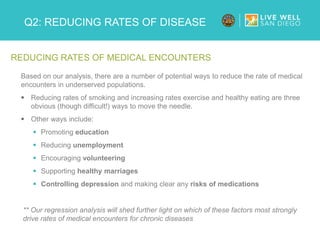
Based on our analysis, there are a number of potential ways to reduce the rate of medical
encounters in underserved populations.
 Reducing rates of smoking and increasing rates exercise and healthy eating are three
obvious (though difficult!) ways to move the needle.
 Other ways include:
 Promoting education
 Reducing unemployment
 Encouraging volunteering
 Supporting healthy marriages
 Controlling depression and making clear any risks of medications
** Our regression analysis will shed further light on which of these factors most strongly
drive rates of medical encounters for chronic diseases
Q3: PREDICTIONS
Projecting disease rates in under-served
communities for the next ten years through the
health equity lens of race/ethnicity
Q3: PREDICTING WHAT WILL HAPPEN
EXECUTIVE SUMMARY: PREDICTING AND PROJECTING MEDICAL
ENCOUNTERS FOR THE UNDERSERVED
As detailed on the following slides, a number of key factors emerged as important in
determining medical encounters for chronic diseases for the underserved. They are:
 Exercise—exercise decreases risk of disease
 Diet–less fast food decreases risk of disease
 Smoking—increases risk of disease
 Being married—decreases risk of disease
 Being educated (having a Bachelor’s degree)—decreases risk of disease
 Volunteering—decreases risk of disease
 Race/ethnicity—impacts risk of disease
*Note: in the following slides, underserved is defined by SRA, as discussed in Q1
Q3: PREDICTING WHAT WILL HAPPEN
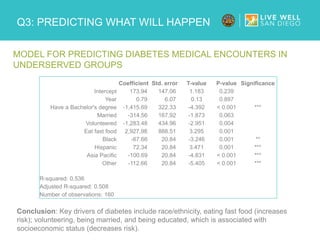
MODEL FOR PREDICTING DIABETES MEDICAL ENCOUNTERS IN
UNDERSERVED GROUPS
Coefficient Std. error T-value P-value Significance
Intercept 173.94 147.06 1.183 0.239
Year 0.79 6.07 0.13 0.897
Have a Bachelor's degree -1,415.69 322.33 -4.392 < 0.001 ***
Married -314.56 167.92 -1.873 0.063
Volunteered -1,283.48 434.96 -2.951 0.004
Eat fast food 2,927.98 888.51 3.295 0.001
Black -67.66 20.84 -3.246 0.001 **
Hispanic 72.34 20.84 3.471 0.001 ***
Asia Pacific -100.69 20.84 -4.831 < 0.001 ***
Other -112.66 20.84 -5.405 < 0.001 ***
R-squared: 0.536
Adjusted R-squared: 0.508
Number of observations: 160
Conclusion: Key drivers of diabetes include race/ethnicity, eating fast food (increases
risk); volunteering, being married, and being educated, which is associated with
socioeconomic status (decreases risk).
Q3: PREDICTING WHAT WILL HAPPEN
PREDICTING RATES OF DIABETES THROUGH THE RACE/ETHNICITY
LENS: ILLUSTRATION OF OUTPUT FROM MODEL FOR CHULA VISTA
*Due to the positive (though insignificant) coefficient on Year, rates are increasing. Also, due to the
insignificance of other predictors, we are unable to predict with confidence what would happen if protective
behaviors that reduce risks of disease are adopted.
0
50
100
150
200
250
300
2014 2015 2016 2017 2018 2019 2020 2021 2022 2023
Projected diabetes rates for Chula Vista
White Black Hispanic Asian Other
Q3: PREDICTING WHAT WILL HAPPEN
MODEL FOR PREDICTING HEART DISEASE MEDICAL ENCOUNTERS IN
UNDERSERVED GROUPS
Coefficient Std. error T-value P-value Significance
Intercept 1.457 0.116 12.542 < 0.001 ***
Year -0.025 0.052 -0.485 0.629
Have a bachelor's degree -0.601 0.163 -3.692 < 0.001 ***
Volunteered -0.177 0.147 -1.202 0.231
Saved -0.029 0.114 -0.256 0.798
Exercises -0.549 0.226 -2.428 0.016 *
Eats fast food 1.126 0.365 3.082 0.002 **
Black -1.86 0.164 -11.324 < 0.001 ***
Hispanic -1.631 0.164 -9.928 < 0.001 ***
Asia Pacific -1.854 0.164 -11.288 < 0.001 ***
Other -1.938 0.164 -11.801 < 0.001 ***
R-squared: .595
Adjusted R-squared: .568
Number of observations: 160
Conclusion: Key drivers of heart disease include race/ethnicity, eating fast food
(increases risk); volunteering, exercising, saving, and being educated, which is associated
with socioeconomic status (decreases risk).
Q3: PREDICTING WHAT WILL HAPPEN
PREDICTING RATES OF HEART DISEASE THROUGH THE RACE/ETHNICITY
LENS: ILLUSTRATION OF OUTPUT FROM MODEL FOR CHULA VISTA
0
10
20
30
40
50
60
70
2014 2015 2016 2017 2018 2019 2020 2021 2022 2023
Projected heart disease rates for Chula Vista
Black Hispanic Asian Other
*Due to the negative (though insignificant) coefficient on Year, rates are falling. Also, due to the insignificance
of other predictors, we are unable to predict with confidence what would happen if protective behaviors that
reduce risks of disease are adopted.
Q3: PREDICTING WHAT WILL HAPPEN
MODEL FOR PREDICTING LUNG DISEASE MEDICAL ENCOUNTERS IN
UNDERSERVED GROUPS
Coefficient Std. error T-value P-value Significance
Intercept 534.786 169.997 3.146 0.002 **
Year -2.617 8.594 -0.304 0.761
Have a bachelor's degree -981.402 344.78 -2.846 0.005 **
Married -383.063 289.367 -1.324 0.188
Volunteered -516.472 779.143 -0.663 0.508
Smoked in last year 680.947 642.199 1.06 0.291
Black -197.844 29.171 -6.782 < 0.001 ***
Hispanic -85.719 29.171 -2.939 0.004 **
Asia Pacific -227.656 29.171 -7.804 0.001 ***
Other -240.156 29.171 -8.233 0.001 ***
R-squared: 0.479
Adjusted R-squared: .448 R-squared: 0.448
Number of observations: 160
Conclusion: Key drivers of lung disease include race/ethnicity, smoking (increases risk);
volunteering, being married, and being educated, which is associated with socioeconomic
status (decreases risk).
Q3: PREDICTING WHAT WILL HAPPEN
PREDICTING RATES OF LUNG DISEASE THROUGH THE RACE/ETHNICITY
LENS: ILLUSTRATION OF OUTPUT FROM MODEL FOR CHULA VISTA
*Due to the negative (though insignificant) coefficient on Year, rates are falling. Also, due to the insignificance
of other predictors, we are unable to predict with confidence what would happen if protective behaviors that
reduce risks of disease are adopted.
0
50
100
150
200
250
300
350
2014 2015 2016 2017 2018 2019 2020 2021 2022 2023
Projected lung disease rates for Chula Vista
White Black Hispanic Asian Other
Q3: PREDICTING WHAT WILL HAPPEN
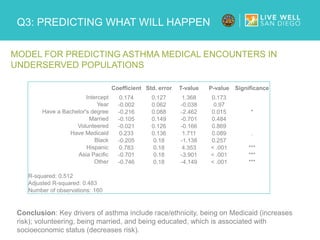
MODEL FOR PREDICTING ASTHMA MEDICAL ENCOUNTERS IN
UNDERSERVED POPULATIONS
Conclusion: Key drivers of asthma include race/ethnicity, being on Medicaid (increases
risk); volunteering, being married, and being educated, which is associated with
socioeconomic status (decreases risk).
Coefficient Std. error T-value P-value Significance
Intercept 0.174 0.127 1.368 0.173
Year -0.002 0.062 -0.038 0.97
Have a Bachelor's degree -0.216 0.088 -2.462 0.015 *
Married -0.105 0.149 -0.701 0.484
Volunteered -0.021 0.126 -0.166 0.869
Have Medicaid 0.233 0.136 1.711 0.089 .
Black -0.205 0.18 -1.138 0.257
Hispanic 0.783 0.18 4.353 < .001 ***
Asia Pacific -0.701 0.18 -3.901 < .001 ***
Other -0.746 0.18 -4.149 < .001 ***
R-squared: 0.512
Adjusted R-squared: 0.483
Number of observations: 160
Q3: PREDICTING WHAT WILL HAPPEN
PREDICTING RATES OF ASTHMA THROUGH THE RACE/ETHNICITY LENS:
ILLUSTRATION OF OUTPUT FROM MODEL FOR CHULA VISTA
*Due to the negative (though insignificant) coefficient on Year, rates are falling slightly. Also, due to the
insignificance of other predictors, we are unable to predict with confidence what would happen if protective
behaviors that reduce risks of disease are adopted.
0
50
100
150
200
250
300
350
2014 2015 2016 2017 2018 2019 2020 2021 2022 2023
Projected asthma rates for Chula Vista
White Black Hispanic Asian Other
Q3: PREDICTING WHAT WILL HAPPEN
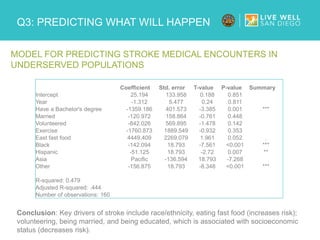
MODEL FOR PREDICTING STROKE MEDICAL ENCOUNTERS IN
UNDERSERVED POPULATIONS
Conclusion: Key drivers of stroke include race/ethnicity, eating fast food (increases risk);
volunteering, being married, and being educated, which is associated with socioeconomic
status (decreases risk).
Coefficient Std. error T-value P-value Summary
Intercept 25.194 133.958 0.188 0.851
Year -1.312 5.477 0.24 0.811
Have a Bachelor's degree -1359.186 401.573 -3.385 0.001 ***
Married -120.972 158.864 -0.761 0.448
Volunteered -842.026 569.895 -1.478 0.142
Exercise -1760.873 1889.549 -0.932 0.353
East fast food 4449.409 2269.079 1.961 0.052 .
Black -142.094 18.793 -7.561 <0.001 ***
Hispanic -51.125 18.793 -2.72 0.007 **
Asia Pacific -136.594 18.793 -7.268
Other -156.875 18.793 -8.348 <0.001 ***
R-squared: 0.479
Adjusted R-squared: .444
Number of observations: 160
Q3: PREDICTING WHAT WILL HAPPEN
PREDICTING RATES OF STROKE THROUGH THE RACE/ETHNICITY LENS:
ILLUSTRATION OF OUTPUT FROM MODEL FOR CHULA VISTA
* Due to the negative (though insignificant) coefficient on Year, rates are falling. Also, due to the insignificance
of many predictors, we are unable to predict with confidence what would happen if protective behaviors that
reduce risks of disease are adopted.
0
50
100
150
200
250
2014 2015 2016 2017 2018 2019 2020 2021 2022 2023
Projected stroke rates for Chula Vista
White Black Hispanic Asian Other
Q3: PREDICTING WHAT WILL HAPPEN
MODEL FOR PREDICTING CANCER ENCOUNTERS IN UNDERSERVED
POPULATIONS
Conclusion: Key drivers of cancer include race/ethnicity, eating fast food (increases risk);
volunteering, being married, exercising, and being educated, which is associated with
socioeconomic status (decreases risk).
Coefficient Std. error T-value P-value Significance
Intercept -3.251 186.99 -0.017 0.986
Year -1.884 7.645 -0.246 0.806
Have Bachelor's degree -2026.8 560.551 -3.616 < .001 ***
Married -145.702 221.757 -0.657 0.512
Volunteered -1221.33 795.509 -1.535 0.127
Exercise -2670.471 2637.597 -1.012 0.313
Eat fast food 6802.637 3167.379 2.148 0.033 *
Black -210.562 26.233 -8.027 < .001
Hispanic -84.094 26.233 -3.206 0.002 **
Asia Pacific -204.719 26.233 -7.804 < .001 ***
Other -229.281 26.233 -8.74 < .001
R-squared: 0.5
Adjusted R-squared: .467
Number of observations: 160
Q3: PREDICTING WHAT WILL HAPPEN
PREDICTING RATES OF CANCER THROUGH THE RACE/ETHNICITY
LENS: ILLUSTRATION OF OUTPUT FROM MODEL FOR CHULA VISTA
*Due to the negative (though insignificant) coefficient on Year, rates are falling. Also, due to the insignificance
of other predictors, we are unable to predict with confidence what would happen if protective behaviors that
reduce risks of disease are adopted.
0
50
100
150
200
250
300
350
2014 2015 2016 2017 2018 2019 2020 2021 2022 2023
Projected cancer rates for Chula Vista
White Black Hispanic Asian Other
+4: SUMMARY & LIMITATIONS
Recommendations, next steps, and an outline
of limitations and assumptions
+4: FOLLOW UP IDEAS
KEY FINDINGS & RECOMMENDATIONS
BEHAVIORS
are notoriously
difficult to change
Study outcome of past
initiatives to shed light
on key factors for
success in changing
behavior
Potential partners:
businesses, including
healthcare companies,
and academia
PREVENTION
Is key in building a
healthier San Diego
Study impact of family
member secondhand
smoke on children (within
urbanicity and
socioeconomic
frameworks)
Potential partners:
schools. Identify and
analyze P.E., arts, and
extracurricular
programs
ADDITIONAL
ANALYSIS
to identify stress
correlations
Study correlation
between stress, the
four diseases, and the
five lenses
Potential partners:
cities. Does
community
involvement impact
stress levels?
+4: LIMITATIONS & ASSUMPTIONS
ANALYSES WERE LIMITED IN THE FOLLOWING WAYS:
 The data are aggregated to the SRA level. This limits the types of analyses we can
undertake. Having individual-level data would provide stronger results.
 Due to the level of aggregation, the dataset became relatively small as it was cut
different ways. This made it difficult to get statistical significance.
 Data points with fewer than 5 components were dropped. We treated such
observations as 0s. This lowered some of our numbers, relative to others.
 Behavioral data were only available for 2013. We assumed these rates were constant
from 2010-2013 for our analysis.
 Some zip codes in San Diego (and therefore in the shape file downloaded to create
the maps) were not present in the data; we assigned SRAs to these zip codes based
on what similar cities were nearest the missing values. See notes for details.
THANK YOU
Special thanks to BIOCOM, livegoode, the County of San Diego, Live Well San Diego, the San Diego Regional
Library, and all other partner organizations and volunteers for their generous support of this event

Rady MBAs hackathon presentation

  • 1.
    BUILDING A HEALTHIER, SAFER,THRIVING SAN DIEGO Analysis and perspective from MBA students at the UCSD Rady School of Management
  • 2.
    YOUR EXPERT TEAM WHOWE ARE ALLISON NOEL SAPNA HEGDE FENG JIANG SABRINA QUTB JASMINE REZAI We’re a diverse team of analytics-focused MBA students from the UCSD Rady School of Management, united with a common purpose of delivering actionable insights that accelerate the growth of healthy, safe, and thriving communities in San Diego.
  • 3.
    OUTLINE  Follow-up ideas  Important questionsto ask next  Data limitations and assumptions INTRO  Predictive model, estimating disease rates through the lens of race/ethnicity  10-yr projections  A look at the 3 factors: smoking, diet, and exercise  Additional factors  Reducing chronic disease  Where we see the highest rates of medical encounters  Who has the highest rates  Trends THE SITUATION slides 4 − 20 THE NEXT STEPS slides 21 − 26 PREDICTING WHAT WILL HAPPEN slides 27 − 41 REVIEW AND FOLLOW UP IDEAS slides 42 − 44slides 1 − 3 Q1 Q2 Q3 +4
  • 4.
    Q1: THE SITUATION Ananalysis of trends across disease, economics, and behavior data
  • 5.
    Q1: THE SITUATION EXECUTIVESUMMARY: THE STRONGEST TRENDS  The incidence of disease varies significantly by city and health equity lens.  Certain sub-regional areas have higher rates of medical encounters than others.  Certain groups, as viewed through the five lenses of health equity, have higher rates of medical encounters than others.  The concept of “underserved,” as it relates to populations, can be viewed in different ways. We look at it from the perspective of sub-regional area as well as health equity group, looking at disparities in rates of medical encounters.  Underserved groups exhibit different behaviors and have different economic qualities, compared to well-served groups.
  • 6.
    WHERE WE SEETHE HIGHEST RATES MEDICAL ENCOUNTERS BY SUB-REGIONAL AREA (SRA): CANCER Notes: Medical encounters includes hospitalizations, deaths, and emergency department discharges. Total rate is the average number of annual encounters per sub-regional area (SRA) per 100,000 population from 2010-2013. Highest-rate SRAs: Anza-Borrego Springs & Mountain Empire Chula Vista La Mesa Under or equal to 100 101 to 200 201 to 300 301 to 400 401 to 500 501 to 600 601 to 700 Over or equal to 700
  • 7.
    WHERE WE SEETHE HIGHEST RATES MEDICAL ENCOUNTERS BY SUB-REGIONAL AREA (SRA): STROKE Notes: Medical encounters includes hospitalizations, deaths, and emergency department discharges. Total rate is the average number of annual encounters per sub-regional area (SRA) per 100,000 population from 2010-2013. Highest-rate SRAs: Anza-Borrego Springs & Mountain Empire Chula Vista La Mesa Under or equal to 100 101 to 200 201 to 300 301 to 400 401 to 500 501 to 600 601 to 700 Over or equal to 700
  • 8.
    WHERE WE SEETHE HIGHEST RATES MEDICAL ENCOUNTERS BY SUB-REGIONAL AREA (SRA): HEART DISEASE Notes: Medical encounters includes hospitalizations, deaths, and emergency department discharges. Total rate is the average number of annual encounters per sub-regional area (SRA) per 100,000 population from 2010-2013. Highest-rate SRAs: Anza-Borrego Springs & Mountain Empire Chula Vista National City Under or equal to 100 101 to 200 201 to 300 301 to 400 401 to 500 501 to 600 601 to 700 Over or equal to 700
  • 9.
    WHERE WE SEETHE HIGHEST RATES MEDICAL ENCOUNTERS BY SUB-REGIONAL AREA (SRA): DIABETES Notes: Medical encounters includes hospitalizations, deaths, and emergency department discharges. Total rate is the average number of annual encounters per sub-regional area (SRA) per 100,000 population from 2010-2013. Highest-rate SRAs: National City Chula Vista Southeastern San Diego Under or equal to 100 101 to 200 201 to 300 301 to 400 401 to 500 501 to 600 601 to 700 Over or equal to 700
  • 10.
    WHERE WE SEETHE HIGHEST RATES MEDICAL ENCOUNTERS BY SUB-REGIONAL AREA (SRA): LUNG DISEASE Notes: Medical encounters includes hospitalizations, deaths, and emergency department discharges. Total rate is the average number of annual encounters per sub-regional area (SRA) per 100,000 population from 2010-2013. Highest-rate SRAs: Chula Vista Harbison Crest/ El Cajon National City Under or equal to 100 101 to 200 201 to 300 301 to 400 401 to 500 501 to 600 601 to 700 Over or equal to 700
  • 11.
    WHERE WE SEETHE HIGHEST RATES MEDICAL ENCOUNTERS BY SUB-REGIONAL AREA (SRA): ASTHMA Notes: Medical encounters includes hospitalizations, deaths, and emergency department discharges. Total rate is the average number of annual encounters per sub-regional area (SRA) per 100,000 population from 2010-2013. Highest-rate SRAs: National City Chula Vista Southeastern San Diego Under or equal to 100 101 to 200 201 to 300 301 to 400 401 to 500 501 to 600 601 to 700 Over or equal to 700 Unlike for other diseases, East County is now among the lowest-rate areas
  • 12.
    WHO HAS THEHIGHEST RATES RISK OF MEDICAL ENCOUNTERS BY GENDER IS BALANCED Notes: Medical encounters includes hospitalizations, deaths, and emergency department discharges. Risk is measured as likelihood, relative to San Diego County as a whole, of having a medical encounter in 2012. 0.6 0.7 0.8 0.9 1 1.1 1.2 1.3 Male Female Riskofmedicalencounter Cancer CHD Stroke COPD Diabetes Asthma
  • 13.
    WHO HAS THEHIGHEST RATES BLACK INDIVIDUALS HAVE HIGHER RATES OF MEDICAL ENCOUNTERS Notes: Medical encounters includes hospitalizations, deaths, and emergency department discharges. Risk is measured as likelihood, relative to San Diego as a whole, of having a medical encounter in 2012. -1 0 1 2 3 4 White Black Hispanic Asian Pacific Islander Other Race Ethnicity Riskofmedicalencounter Cancer CHD Stroke COPD Diabetes Asthma
  • 14.
    WHO HAS THEHIGHEST RATES VERY URBAN AREAS HAVE HIGHER RATES OF MEDICAL ENCOUNTERS Notes: Medical encounters includes hospitalizations, deaths, and emergency department discharges. Risk is measured as likelihood, relative to San Diego as a whole, of having a medical encounter in 2012. 0.4 0.8 1.2 1.6 2 Rural Exurban Suburban Urban Very Urban Riskofmedicalencounter Cancer CHD Stroke COPD Diabetes Asthma
  • 15.
    WHO HAS THEHIGHEST RATES LOWER INCOME INDIVIDUALS HAVE HIGHER RATES OF MEDICAL ENCOUNTERS Notes: Medical encounters includes hospitalizations, deaths, and emergency department discharges. Risk is measured as likelihood, relative to San Diego as a whole, of having a medical encounter in 2012. 0.2 0.6 1 1.4 1.8 Lowest Low Moderately Low Moderately High High Highest Riskofmedicalencounter Cancer CHD Stroke COPD Diabetes Asthma
  • 16.
    WHO HAS THEHIGHEST RATES INDIVIDUALS AGES 65+ HAVE HIGHER RATES OF MEDICAL ENCOUNTERS Notes: Medical encounters includes hospitalizations, deaths, and emergency department discharges. Risk is measured as likelihood, relative to San Diego as a whole, of having a medical encounter in 2012. -1 0 1 2 3 4 5 6 7 Age 0-14 Age 15-24 Age 25-44 Age 45-64 Age 65+ Riskofmedicalencounter Cancer CHD Stroke COPD Diabetes Asthma
  • 17.
    TRENDS WE SEE WHOARE THE UNDERSERVED? TWO WAYS OF LOOKING AT IT: • Chula Vista • Harbison/El Cajon • La Mesa • National City • South Bay • Fallbrook • Southeastern San Diego • Anza-Borrego Springs  Individuals ages 65+  Those living in very urban areas  The lowest-to-low income earners  Black individuals SRAs with highest disease rates Groups with disparities, as seen through the 5 health equity lenses *See slide notes for more detailed description of how SRAs with highest disease rates were determined
  • 18.
    TRENDS WE SEE THETWO METHODS OF DEFINING UNDERSERVED ARE SIMILAR 6% black 12.2% age 65+ $55,000 median income 38% very urban underserved geographies well-served geographies 4% black 12.3% age 65+ $74,000 median income 9% very urban Underserved geographies, defined by rates of medical encounters, are also more likely home to underserved groups, as defined through the 5 lenses. For example:
  • 19.
    TRENDS WE SEE: BEHAVIORSOF THE UNDERSERVED COMPARED TO THE WELL-SERVED, UNDERSERVED GEOGRAPHIES ARE… 18% more likely to have smoked in the last 12 months 13% more likely to not exercise during a typical week 7% less likely to be presently controlling their diet and 22% less likely to buy foods labeled as natural/organic 11% less likely to have a savings account 21% less likely to have volunteered for a charitable organization in the last 12 months 17% less likely to have voted in a federal/state/local election in the last 12 months
  • 20.
    TRENDS WE SEE:DEMOGRAPHICS & ECONOMICS OF THE UNDERSERVED COMPARED TO THE WELL-SERVED, UNDERSERVED GEOGRAPHIES ARE… 79% less likely to have a bachelor's degree 19% more likely to have a disability 32% more likely to live below the federal poverty level 35% more likely to be unemployed 43% more likely to have the marital status “separated” 19% more likely to be widowed
  • 21.
    Q2: THE NEXTSTEPS Identifying protective behaviors that may reduce the risk of disease
  • 22.
    Q2: THE NEXTSTEPS EXECUTIVE SUMMARY: POTENTIALLY PROTECTIVE BEHAVIORS & FACTORS  The three behaviors identified by the Live Well program—smoking, lack of exercise, and poor diet– are correlated with total (combined) rates of medical encounters across chronic diseases, as well as with rates broken out by disease.  Additional factors are correlated with rates of medical encounters  A college education: Bachelors degrees are associated with lower rates of disease  Unemployment: More unemployment is associated with higher rates of disease  Household income: Higher incomes are associated with lower rates of disease  Sinus and headache medication: Higher rates of sinus and headache medication use are associated with higher rates of disease. This could be a proxy for stress.  Depression medication: Higher rates of depression medication use are associated with higher rates of disease. This could be a proxy for mental health.  Separation (as a marital status): Higher rates of separated people is associated with higher rates of disease; marriage tends to reduce rates of some diseases.
  • 23.
    Q2: RELATED BEHAVIORS SMOKING,INACTIVITY, AND POOR DIET ARE POSITIVELY CORRELATED WITH TOTAL RATE OF MEDICAL ENCOUNTERS Smoking Lack of exercise Fast food spending ($50-100/week) 0 500 1000 1500 2000 2500 3000 3500 4000 4500 5000 0 10000 20000 30000 RateofEncounters Rates of Smoking Correlation: .22 0 500 1000 1500 2000 2500 3000 3500 4000 4500 5000 0 20000 40000 60000 RateofEncounters Rates of No Exercise Correlation: .19 0 500 1000 1500 2000 2500 3000 3500 4000 4500 5000 0 10000 20000 30000 RatesofEncounters Rates of Spending in Range Correlation: .16
  • 24.
    Q2: THE NEXTSTEPS EXAMPLE: DEPRESSION MEDICATIONS ARE CORRELATED WITH STROKE, HEART DISEASE, AND LUNG DISEASE Correlation: .17 0 100 200 300 400 500 600 0 5000 10000 RateofStroke Use of Medication Rate of Stroke Correlation: .18 0 100 200 300 400 500 600 700 800 0 2000 4000 6000 8000 RateofCHD Use of Medication Rate of CHD 0 100 200 300 400 500 600 700 800 900 1000 0 2000 4000 6000 8000 RateofCOPD Use of Medication Rate of COPD Correlation: .14
  • 25.
    Q2: THE NEXTSTEPS EXAMPLE: SINUS/HEADACHE MEDICATIONS (A PROXY FOR STRESS) ARE CORRELATED WITH STROKE, HEART DISEASE, AND LUNG DISEASE 0 100 200 300 400 500 600 0 5000 10000 Rateofstroke Use of Medication Rate of Stroke 0 100 200 300 400 500 600 700 800 0 2000 4000 6000 8000 RateofCHD Use of Medication Rate of CHD 0 200 400 600 800 1000 1200 0 2000 4000 6000 8000 RateofCancer Use of Medication Rate of Cancer Correlation: .24 Correlation: .22 Correlation: .19
  • 26.
    Q2: REDUCING RATESOF DISEASE REDUCING RATES OF MEDICAL ENCOUNTERS Based on our analysis, there are a number of potential ways to reduce the rate of medical encounters in underserved populations.  Reducing rates of smoking and increasing rates exercise and healthy eating are three obvious (though difficult!) ways to move the needle.  Other ways include:  Promoting education  Reducing unemployment  Encouraging volunteering  Supporting healthy marriages  Controlling depression and making clear any risks of medications ** Our regression analysis will shed further light on which of these factors most strongly drive rates of medical encounters for chronic diseases
  • 27.
    Q3: PREDICTIONS Projecting diseaserates in under-served communities for the next ten years through the health equity lens of race/ethnicity
  • 28.
    Q3: PREDICTING WHATWILL HAPPEN EXECUTIVE SUMMARY: PREDICTING AND PROJECTING MEDICAL ENCOUNTERS FOR THE UNDERSERVED As detailed on the following slides, a number of key factors emerged as important in determining medical encounters for chronic diseases for the underserved. They are:  Exercise—exercise decreases risk of disease  Diet–less fast food decreases risk of disease  Smoking—increases risk of disease  Being married—decreases risk of disease  Being educated (having a Bachelor’s degree)—decreases risk of disease  Volunteering—decreases risk of disease  Race/ethnicity—impacts risk of disease *Note: in the following slides, underserved is defined by SRA, as discussed in Q1
  • 29.
    Q3: PREDICTING WHATWILL HAPPEN MODEL FOR PREDICTING DIABETES MEDICAL ENCOUNTERS IN UNDERSERVED GROUPS Coefficient Std. error T-value P-value Significance Intercept 173.94 147.06 1.183 0.239 Year 0.79 6.07 0.13 0.897 Have a Bachelor's degree -1,415.69 322.33 -4.392 < 0.001 *** Married -314.56 167.92 -1.873 0.063 Volunteered -1,283.48 434.96 -2.951 0.004 Eat fast food 2,927.98 888.51 3.295 0.001 Black -67.66 20.84 -3.246 0.001 ** Hispanic 72.34 20.84 3.471 0.001 *** Asia Pacific -100.69 20.84 -4.831 < 0.001 *** Other -112.66 20.84 -5.405 < 0.001 *** R-squared: 0.536 Adjusted R-squared: 0.508 Number of observations: 160 Conclusion: Key drivers of diabetes include race/ethnicity, eating fast food (increases risk); volunteering, being married, and being educated, which is associated with socioeconomic status (decreases risk).
  • 30.
    Q3: PREDICTING WHATWILL HAPPEN PREDICTING RATES OF DIABETES THROUGH THE RACE/ETHNICITY LENS: ILLUSTRATION OF OUTPUT FROM MODEL FOR CHULA VISTA *Due to the positive (though insignificant) coefficient on Year, rates are increasing. Also, due to the insignificance of other predictors, we are unable to predict with confidence what would happen if protective behaviors that reduce risks of disease are adopted. 0 50 100 150 200 250 300 2014 2015 2016 2017 2018 2019 2020 2021 2022 2023 Projected diabetes rates for Chula Vista White Black Hispanic Asian Other
  • 31.
    Q3: PREDICTING WHATWILL HAPPEN MODEL FOR PREDICTING HEART DISEASE MEDICAL ENCOUNTERS IN UNDERSERVED GROUPS Coefficient Std. error T-value P-value Significance Intercept 1.457 0.116 12.542 < 0.001 *** Year -0.025 0.052 -0.485 0.629 Have a bachelor's degree -0.601 0.163 -3.692 < 0.001 *** Volunteered -0.177 0.147 -1.202 0.231 Saved -0.029 0.114 -0.256 0.798 Exercises -0.549 0.226 -2.428 0.016 * Eats fast food 1.126 0.365 3.082 0.002 ** Black -1.86 0.164 -11.324 < 0.001 *** Hispanic -1.631 0.164 -9.928 < 0.001 *** Asia Pacific -1.854 0.164 -11.288 < 0.001 *** Other -1.938 0.164 -11.801 < 0.001 *** R-squared: .595 Adjusted R-squared: .568 Number of observations: 160 Conclusion: Key drivers of heart disease include race/ethnicity, eating fast food (increases risk); volunteering, exercising, saving, and being educated, which is associated with socioeconomic status (decreases risk).
  • 32.
    Q3: PREDICTING WHATWILL HAPPEN PREDICTING RATES OF HEART DISEASE THROUGH THE RACE/ETHNICITY LENS: ILLUSTRATION OF OUTPUT FROM MODEL FOR CHULA VISTA 0 10 20 30 40 50 60 70 2014 2015 2016 2017 2018 2019 2020 2021 2022 2023 Projected heart disease rates for Chula Vista Black Hispanic Asian Other *Due to the negative (though insignificant) coefficient on Year, rates are falling. Also, due to the insignificance of other predictors, we are unable to predict with confidence what would happen if protective behaviors that reduce risks of disease are adopted.
  • 33.
    Q3: PREDICTING WHATWILL HAPPEN MODEL FOR PREDICTING LUNG DISEASE MEDICAL ENCOUNTERS IN UNDERSERVED GROUPS Coefficient Std. error T-value P-value Significance Intercept 534.786 169.997 3.146 0.002 ** Year -2.617 8.594 -0.304 0.761 Have a bachelor's degree -981.402 344.78 -2.846 0.005 ** Married -383.063 289.367 -1.324 0.188 Volunteered -516.472 779.143 -0.663 0.508 Smoked in last year 680.947 642.199 1.06 0.291 Black -197.844 29.171 -6.782 < 0.001 *** Hispanic -85.719 29.171 -2.939 0.004 ** Asia Pacific -227.656 29.171 -7.804 0.001 *** Other -240.156 29.171 -8.233 0.001 *** R-squared: 0.479 Adjusted R-squared: .448 R-squared: 0.448 Number of observations: 160 Conclusion: Key drivers of lung disease include race/ethnicity, smoking (increases risk); volunteering, being married, and being educated, which is associated with socioeconomic status (decreases risk).
  • 34.
    Q3: PREDICTING WHATWILL HAPPEN PREDICTING RATES OF LUNG DISEASE THROUGH THE RACE/ETHNICITY LENS: ILLUSTRATION OF OUTPUT FROM MODEL FOR CHULA VISTA *Due to the negative (though insignificant) coefficient on Year, rates are falling. Also, due to the insignificance of other predictors, we are unable to predict with confidence what would happen if protective behaviors that reduce risks of disease are adopted. 0 50 100 150 200 250 300 350 2014 2015 2016 2017 2018 2019 2020 2021 2022 2023 Projected lung disease rates for Chula Vista White Black Hispanic Asian Other
  • 35.
    Q3: PREDICTING WHATWILL HAPPEN MODEL FOR PREDICTING ASTHMA MEDICAL ENCOUNTERS IN UNDERSERVED POPULATIONS Conclusion: Key drivers of asthma include race/ethnicity, being on Medicaid (increases risk); volunteering, being married, and being educated, which is associated with socioeconomic status (decreases risk). Coefficient Std. error T-value P-value Significance Intercept 0.174 0.127 1.368 0.173 Year -0.002 0.062 -0.038 0.97 Have a Bachelor's degree -0.216 0.088 -2.462 0.015 * Married -0.105 0.149 -0.701 0.484 Volunteered -0.021 0.126 -0.166 0.869 Have Medicaid 0.233 0.136 1.711 0.089 . Black -0.205 0.18 -1.138 0.257 Hispanic 0.783 0.18 4.353 < .001 *** Asia Pacific -0.701 0.18 -3.901 < .001 *** Other -0.746 0.18 -4.149 < .001 *** R-squared: 0.512 Adjusted R-squared: 0.483 Number of observations: 160
  • 36.
    Q3: PREDICTING WHATWILL HAPPEN PREDICTING RATES OF ASTHMA THROUGH THE RACE/ETHNICITY LENS: ILLUSTRATION OF OUTPUT FROM MODEL FOR CHULA VISTA *Due to the negative (though insignificant) coefficient on Year, rates are falling slightly. Also, due to the insignificance of other predictors, we are unable to predict with confidence what would happen if protective behaviors that reduce risks of disease are adopted. 0 50 100 150 200 250 300 350 2014 2015 2016 2017 2018 2019 2020 2021 2022 2023 Projected asthma rates for Chula Vista White Black Hispanic Asian Other
  • 37.
    Q3: PREDICTING WHATWILL HAPPEN MODEL FOR PREDICTING STROKE MEDICAL ENCOUNTERS IN UNDERSERVED POPULATIONS Conclusion: Key drivers of stroke include race/ethnicity, eating fast food (increases risk); volunteering, being married, and being educated, which is associated with socioeconomic status (decreases risk). Coefficient Std. error T-value P-value Summary Intercept 25.194 133.958 0.188 0.851 Year -1.312 5.477 0.24 0.811 Have a Bachelor's degree -1359.186 401.573 -3.385 0.001 *** Married -120.972 158.864 -0.761 0.448 Volunteered -842.026 569.895 -1.478 0.142 Exercise -1760.873 1889.549 -0.932 0.353 East fast food 4449.409 2269.079 1.961 0.052 . Black -142.094 18.793 -7.561 <0.001 *** Hispanic -51.125 18.793 -2.72 0.007 ** Asia Pacific -136.594 18.793 -7.268 Other -156.875 18.793 -8.348 <0.001 *** R-squared: 0.479 Adjusted R-squared: .444 Number of observations: 160
  • 38.
    Q3: PREDICTING WHATWILL HAPPEN PREDICTING RATES OF STROKE THROUGH THE RACE/ETHNICITY LENS: ILLUSTRATION OF OUTPUT FROM MODEL FOR CHULA VISTA * Due to the negative (though insignificant) coefficient on Year, rates are falling. Also, due to the insignificance of many predictors, we are unable to predict with confidence what would happen if protective behaviors that reduce risks of disease are adopted. 0 50 100 150 200 250 2014 2015 2016 2017 2018 2019 2020 2021 2022 2023 Projected stroke rates for Chula Vista White Black Hispanic Asian Other
  • 39.
    Q3: PREDICTING WHATWILL HAPPEN MODEL FOR PREDICTING CANCER ENCOUNTERS IN UNDERSERVED POPULATIONS Conclusion: Key drivers of cancer include race/ethnicity, eating fast food (increases risk); volunteering, being married, exercising, and being educated, which is associated with socioeconomic status (decreases risk). Coefficient Std. error T-value P-value Significance Intercept -3.251 186.99 -0.017 0.986 Year -1.884 7.645 -0.246 0.806 Have Bachelor's degree -2026.8 560.551 -3.616 < .001 *** Married -145.702 221.757 -0.657 0.512 Volunteered -1221.33 795.509 -1.535 0.127 Exercise -2670.471 2637.597 -1.012 0.313 Eat fast food 6802.637 3167.379 2.148 0.033 * Black -210.562 26.233 -8.027 < .001 Hispanic -84.094 26.233 -3.206 0.002 ** Asia Pacific -204.719 26.233 -7.804 < .001 *** Other -229.281 26.233 -8.74 < .001 R-squared: 0.5 Adjusted R-squared: .467 Number of observations: 160
  • 40.
    Q3: PREDICTING WHATWILL HAPPEN PREDICTING RATES OF CANCER THROUGH THE RACE/ETHNICITY LENS: ILLUSTRATION OF OUTPUT FROM MODEL FOR CHULA VISTA *Due to the negative (though insignificant) coefficient on Year, rates are falling. Also, due to the insignificance of other predictors, we are unable to predict with confidence what would happen if protective behaviors that reduce risks of disease are adopted. 0 50 100 150 200 250 300 350 2014 2015 2016 2017 2018 2019 2020 2021 2022 2023 Projected cancer rates for Chula Vista White Black Hispanic Asian Other
  • 41.
    +4: SUMMARY &LIMITATIONS Recommendations, next steps, and an outline of limitations and assumptions
  • 42.
    +4: FOLLOW UPIDEAS KEY FINDINGS & RECOMMENDATIONS BEHAVIORS are notoriously difficult to change Study outcome of past initiatives to shed light on key factors for success in changing behavior Potential partners: businesses, including healthcare companies, and academia PREVENTION Is key in building a healthier San Diego Study impact of family member secondhand smoke on children (within urbanicity and socioeconomic frameworks) Potential partners: schools. Identify and analyze P.E., arts, and extracurricular programs ADDITIONAL ANALYSIS to identify stress correlations Study correlation between stress, the four diseases, and the five lenses Potential partners: cities. Does community involvement impact stress levels?
  • 43.
    +4: LIMITATIONS &ASSUMPTIONS ANALYSES WERE LIMITED IN THE FOLLOWING WAYS:  The data are aggregated to the SRA level. This limits the types of analyses we can undertake. Having individual-level data would provide stronger results.  Due to the level of aggregation, the dataset became relatively small as it was cut different ways. This made it difficult to get statistical significance.  Data points with fewer than 5 components were dropped. We treated such observations as 0s. This lowered some of our numbers, relative to others.  Behavioral data were only available for 2013. We assumed these rates were constant from 2010-2013 for our analysis.  Some zip codes in San Diego (and therefore in the shape file downloaded to create the maps) were not present in the data; we assigned SRAs to these zip codes based on what similar cities were nearest the missing values. See notes for details.
  • 44.
    THANK YOU Special thanksto BIOCOM, livegoode, the County of San Diego, Live Well San Diego, the San Diego Regional Library, and all other partner organizations and volunteers for their generous support of this event

Editor's Notes

  • #7 Sources: Death Statistical Master Files (CA DPH), Patient Discharge Data (CA OSHPD), and Emergency Department Data (CA OSHPD) from County of San Diego, Health & Human Services Agency, Epidemiology & Immunization Services Branch; SANDAG Current Population Estimates, 10/2013 – prepared by County of San Diego (CoSD), Health & Human Services Agency (HHSA), Community Health Statistics, 2015SRA to Zipcode Crosswalk from San Diego County Community Health Profiles: Data Guide 2015 San Diego zip codes shapefile from SANDAG Regional GIS Data Warehouse
  • #8 Sources: Death Statistical Master Files (CA DPH), Patient Discharge Data (CA OSHPD), and Emergency Department Data (CA OSHPD) from County of San Diego, Health & Human Services Agency, Epidemiology & Immunization Services Branch; SANDAG Current Population Estimates, 10/2013 – prepared by County of San Diego (CoSD), Health & Human Services Agency (HHSA), Community Health Statistics, 2015SRA to Zipcode Crosswalk from San Diego County Community Health Profiles: Data Guide 2015 San Diego zip codes shapefile from SANDAG Regional GIS Data Warehouse
  • #9 Sources: Death Statistical Master Files (CA DPH), Patient Discharge Data (CA OSHPD), and Emergency Department Data (CA OSHPD) from County of San Diego, Health & Human Services Agency, Epidemiology & Immunization Services Branch; SANDAG Current Population Estimates, 10/2013 – prepared by County of San Diego (CoSD), Health & Human Services Agency (HHSA), Community Health Statistics, 2015SRA to Zipcode Crosswalk from San Diego County Community Health Profiles: Data Guide 2015 San Diego zip codes shapefile from SANDAG Regional GIS Data Warehouse
  • #10 Note: There were no medical encounters for diabetes in the Pine Valley – Mt Laguna SRA. Assumed that this SRA falls into the same rate band as similar SRAs nearby (e.g., Jamul and others). Sources: Death Statistical Master Files (CA DPH), Patient Discharge Data (CA OSHPD), and Emergency Department Data (CA OSHPD) from County of San Diego, Health & Human Services Agency, Epidemiology & Immunization Services Branch; SANDAG Current Population Estimates, 10/2013 – prepared by County of San Diego (CoSD), Health & Human Services Agency (HHSA), Community Health Statistics, 2015SRA to Zipcode Crosswalk from San Diego County Community Health Profiles: Data Guide 2015 San Diego zip codes shapefile from SANDAG Regional GIS Data Warehouse
  • #11 Sources: Death Statistical Master Files (CA DPH), Patient Discharge Data (CA OSHPD), and Emergency Department Data (CA OSHPD) from County of San Diego, Health & Human Services Agency, Epidemiology & Immunization Services Branch; SANDAG Current Population Estimates, 10/2013 – prepared by County of San Diego (CoSD), Health & Human Services Agency (HHSA), Community Health Statistics, 2015SRA to Zipcode Crosswalk from San Diego County Community Health Profiles: Data Guide 2015 San Diego zip codes shapefile from SANDAG Regional GIS Data Warehouse
  • #12 Note: There were no medical encounters for asthma in the Pine Valley – Mt Laguna SRA. Assumed that this SRA falls into the same rate band as similar SRAs nearby (e.g., Jamul and others). Sources: Death Statistical Master Files (CA DPH), Patient Discharge Data (CA OSHPD), and Emergency Department Data (CA OSHPD) from County of San Diego, Health & Human Services Agency, Epidemiology & Immunization Services Branch; SANDAG Current Population Estimates, 10/2013 – prepared by County of San Diego (CoSD), Health & Human Services Agency (HHSA), Community Health Statistics, 2015SRA to Zipcode Crosswalk from San Diego County Community Health Profiles: Data Guide 2015 San Diego zip codes shapefile from SANDAG Regional GIS Data Warehouse
  • #18 The “underserved” geographies were determined as follows: SRAs were ranked from highest to lowest (in terms of total rate) across each disease category The sum of rankings for each SRA was calculated, and those with the lowest 10 sums were kept Of these, eight SRAs appeared in the top 5 (highest total rate) of a particular disease category: these eight SRAs were defined as “underserved” The likelihoods were calculated by comparing the weighted average behavior percentages between the underserved and served groups. Weights were determined by population size compared to that of the total group (underserved and served). For example, the underserved group, on (weighted) average, was 20.1% likely to have smoked in the last 12 months, compared to 16.4% for the non-underserved group. (20.1-16.4)/20.1 = 18%
  • #19 % black, % 65+, and income are for 2013
  • #21 The likelihoods were calculated by comparing the weighted average behavior percentages between the underserved and served groups. Weights were determined by population size compared to that of the total group (underserved and served). For example, the underserved group, on (weighted) average, was 20.1% likely to have smoked in the last 12 months, compared to 16.4% for the non-underserved group. (20.1-16.4)/20.1 = 18%
  • #24 Rates of medical encounters for all diseases combined, and represent number of encounters per 100,000 population.
  • #44 Assignment of zip codes on map not found in data: 91962 (Pine Valley)  Laguna – Pine Valley; 92145 (Miramar)  Del Mar – Mira Mesa; 91902 (Bonita)  Sweetwater; 92055 (Pendleton)  Pendleton; 92672 (San Clemente)  Oceanside (note: San Clemente is technically closest to Pendleton, but given Pendleton’s unique population, we felt Oceanside was a closer match)