Communication Style Questionnaire 
Your name ………………………………… 
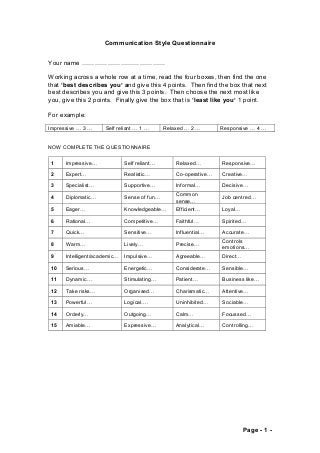
Working across a whole row at a time, read the four boxes, then find the one 
that ‘best describes you’ and give this 4 points. Then find the box that next 
best describes you and give this 3 points. Then choose the next most like 
you, give this 2 points. Finally give the box that is ‘least like you’ 1 point. 
For example: 
Impressive … 3 … Self reliant … 1 … Relaxed … 2 … Responsive … 4 … 
NOW COMPLETE THE QUESTIONNAIRE 
1 Impressive… Self reliant… Relaxed… Responsive… 
2 Expert… Realistic… Co-operative… Creative… 
3 Specialist… Supportive… Informal… Decisive… 
4 Diplomatic… Sense of fun… Common 
sense… Job centred… 
5 Eager… Knowledgeable… Efficient… Loyal… 
6 Rational… Competitive… Faithful… Spirited… 
7 Quick… Sensitive… Influential… Accurate… 
8 Warm… Lively… Precise… Controls 
emotions… 
9 Intelligent/academic… Impulsive… Agreeable… Direct… 
10 Serious… Energetic… Considerate… Sensible… 
11 Dynamic… Stimulating… Patient… Business like… 
12 Take risks… Organised… Charismatic… Attentive… 
13 Powerful… Logical…. Uninhibited… Sociable… 
14 Orderly… Outgoing… Calm… Focussed… 
15 Amiable… Expressive… Analytical… Controlling… 
Page - 1 -
This page is intentionally blank 
Page - 2 -
SCORING INSTRUCTIONS 
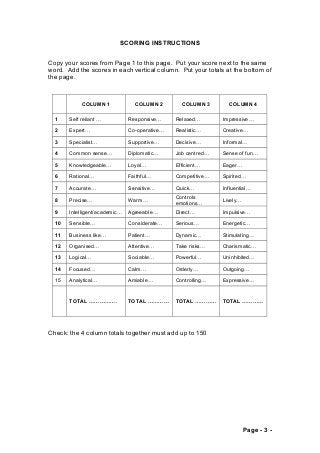
Copy your scores from Page 1 to this page. Put your score next to the same 
word. Add the scores in each vertical column. Put your totals at the bottom of 
the page. 
COLUMN 1 COLUMN 2 COLUMN 3 COLUMN 4 
1 Self reliant … Responsive… Relaxed… Impressive… 
2 Expert… Co-operative… Realistic… Creative… 
3 Specialist… Supportive… Decisive… Informal… 
4 Common sense… Diplomatic… Job centred… Sense of fun… 
5 Knowledgeable… Loyal… Efficient… Eager… 
6 Rational… Faithful… Competitive… Spirited… 
7 Accurate… Sensitive… Quick… Influential… 
8 Precise… Warm… Controls 
emotions… Lively… 
9 Intelligent/academic… Agreeable… Direct… Impulsive… 
10 Sensible… Considerate… Serious… Energetic… 
11 Business like… Patient… Dynamic… Stimulating… 
12 Organised… Attentive… Take risks… Charismatic… 
13 Logical… Sociable… Powerful… Uninhibited… 
14 Focused… Calm… Orderly… Outgoing… 
15 Analytical… Amiable… Controlling… Expressive… 
TOTAL ……………. TOTAL ………… TOTAL ………… TOTAL ………… 
Check: the 4 column totals together must add up to 150 
Page - 3 -
FINDING YOUR PRIMARY STYLE 
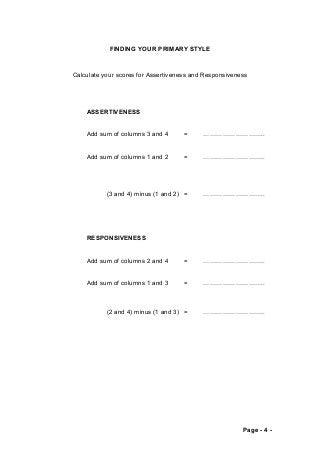
Calculate your scores for Assertiveness and Responsiveness 
ASSERTIVENESS 
Add sum of columns 3 and 4 = ……………………….. 
Add sum of columns 1 and 2 = ……………………….. 
(3 and 4) minus (1 and 2) = ……………………….. 
RESPONSIVENESS 
Add sum of columns 2 and 4 = ……………………….. 
Add sum of columns 1 and 3 = ……………………….. 
(2 and 4) minus (1 and 3) = ……………………….. 
Page - 4 -
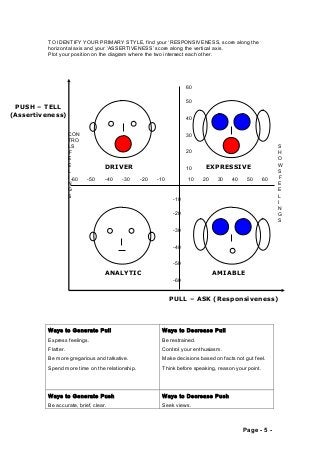
TO IDENTIFY YOUR PRIMARY STYLE, find your ‘RESPONSIVENESS, score along the 
horizontal axis and your ‘ASSERTIVENESS’ score along the vertical axis. 
Plot your position on the diagram where the two intersect each other. 
Ways to Generate Pull 
Express feelings. 
Flatter. 
Be more gregarious and talkative. 
Spend more time on the relationship. 
Ways to Decrease Pull 
Be restrained. 
Control your enthusiasm. 
Make decisions based on facts not gut feel. 
Think before speaking, reason your point. 
Ways to Generate Push 
Be accurate, brief, clear. 
Ways to Decrease Push 
Seek views. 
Page - 5 - 
60 
50 
40 
30 
20 
10 
10 20 30 40 -60 -50 -40 -30 -20 -10 50 60 
-10 
-20 
-30 
-40 
-50 
-60 
PULL – ASK (Responsiveness) 
PUSH – TELL 
(Assertiveness) 
DRIVER EXPRESSIVE 
ANALYTIC AMIABLE 
CON 
TRO 
LS 
F 
EELI 
N 
GS 
S 
H 
O 
WS F 
EELI 
N 
GS
Argue your point. 
Be prepared to disagree. 
Start conversations. 
Be moderate. 
Listen without jumping in. 
Be flexible. 
Let others dominate. 
DRIVER 
STYLE 
¨ Persistent 
¨ Direct 
¨ Competitive 
¨ Takes initiative and control 
¨ Control feelings and emotions 
¨ Strongly persuasive 
¨ Business-like and straight forward 
¨ Detached 
¨ Values results 
¨ Enjoys challenges 
¨ Committed to getting things done 
¨ Will confront and correct others 
¨ Dominant and focused 
THINGS TO AVOID HOW TO TREAT A DRIVER 
Page - 6 -
DOING TO A DRIVER 
¨ Taking an interest in their personal affairs 
¨ Being chaotic or disorganised 
¨ Being vague or unsure 
¨ Rambling on or wasting their time 
¨ If you disagree, do not let it reflect on them 
personally 
¨ Using personal relationships to get an 
advantage 
¨ Staying for personal chats after business 
¨ Give clear, brief, accurate data 
¨ Prepare a well-organised package 
¨ Focus on business, ask specific “what” 
questions 
¨ Present facts efficiently and concisely 
¨ Provide options on which they decide 
¨ Ensure key facts and figures to focus on 
the probability of success 
¨ Focus on objectives, results and the 
bottom line 
¨ Support their conclusions 
¨ Finish the business and leave quickly 
EXPRESSIVE 
STYLE 
¨ Friendly 
¨ Good social style 
¨ Uninhibited 
¨ Puts people at ease 
Page - 7 -
¨ Generates enthusiasm in others 
¨ Shares dreams and ambitions 
¨ Excitable and talkative 
¨ Use praise and favours 
¨ Motivational 
¨ High energy and vitality 
¨ Flamboyant 
¨ Intuitive and emotional 
¨ Mood swings 
THINGS TO AVOID 
DOING TO AN EXPRESSIVE 
HOW TO TREAT AN 
EXPRESSIVE 
¨ Crushing their views 
¨ Being curt or formal 
¨ Concentrating on facts and figures, 
alternatives, abstractions or going into detail 
¨ Wasting time trying to be highly controlled 
and business-like 
¨ Messing around too much; sticking too rigidly 
to the agenda either 
¨ Talking down to them; do not patronise 
¨ Being longwinded 
¨ Support their visions and intuitions 
¨ Socialise and talk about their objectives 
and opinions 
¨ Ask for their ideas and opinions 
¨ Get commitment to action 
¨ Provide solid ideas for making decisions 
¨ Allow time to be stimulating, creative, fast 
moving 
¨ Give incentives for quick action 
¨ Be enthusiastic 
¨ Control ‘dreaming’ with them or you will 
lose time 
Page - 8 -
AMIABLE 
STYLE 
¨ Warm and friendly 
¨ Good personal relationships 
¨ Service oriented 
¨ Makes unobtrusive suggestions 
¨ Offers understanding and friendship 
¨ Co-operative and supportive 
¨ Displays empathy 
¨ Easy to work with 
¨ Patient and dependable 
¨ Accommodating 
¨ Good listener 
¨ Logical 
¨ Good in teams 
¨ Good at disarming conflict 
THINGS TO AVOID 
DOING TO AN AMIABLE 
HOW TO TREAT AN 
AMIABLE 
¨ Pushing straight into business or the agenda 
¨ Sticking solely to business; on the other 
hand, don’t lose sight of goals by being too 
personal 
¨ Forcing them to respond quickly to your 
objectives; don’t say “This is how I see the 
¨ Start with a personal comment 
¨ Show real interest in them 
¨ Come across as honest, open, sincere 
¨ Identify patiently their personal objectives 
¨ Present the case gently and with no 
Page - 9 -
situation” 
¨ Being domineering or demanding, 
threatening them with position and power 
¨ Debating facts and figures 
¨ Bullying them into agreeing - they will resist 
¨ Patronising them by using subtlety or 
invective 
¨ Offering assurances you cannot fulfil 
threats or pressure 
¨ Ask ‘how’ questions to find out their 
opinions 
¨ Demonstrate how their decision will 
reduce risks 
¨ Provide benefits 
¨ Provide personal guarantees 
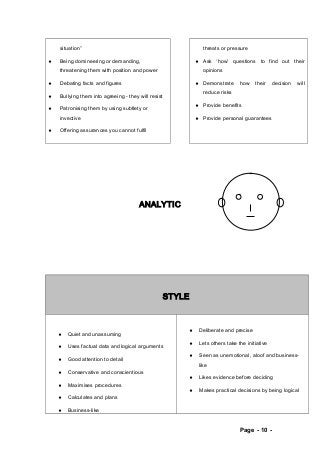
ANALYTIC 
STYLE 
¨ Quiet and unassuming 
¨ Uses factual data and logical arguments 
¨ Good attention to detail 
¨ Conservative and conscientious 
¨ Maximises procedures 
¨ Calculates and plans 
¨ Business-like 
¨ Deliberate and precise 
¨ Lets others take the initiative 
¨ Seen as unemotional, aloof and business-like 
¨ Likes evidence before deciding 
¨ Makes practical decisions by being logical 
Page - 10 -
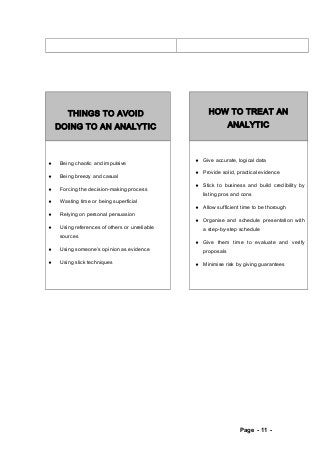
THINGS TO AVOID 
DOING TO AN ANALYTIC 
HOW TO TREAT AN 
ANALYTIC 
¨ Being chaotic and impulsive 
¨ Being breezy and casual 
¨ Forcing the decision-making process 
¨ Wasting time or being superficial 
¨ Relying on personal persuasion 
¨ Using references of others or unreliable 
sources 
¨ Using someone’s opinion as evidence 
¨ Using slick techniques 
¨ Give accurate, logical data 
¨ Provide solid, practical evidence 
¨ Stick to business and build credibility by 
listing pros and cons 
¨ Allow sufficient time to be thorough 
¨ Organise and schedule presentation with 
a step-by-step schedule 
¨ Give them time to evaluate and verify 
proposals 
¨ Minimise risk by giving guarantees 
Page - 11 -
Flexibility in Communicating with Others 
It is important to be versatile when dealing with managers, team members, 
colleagues and customers, not just by providing a variety of products and/or 
services, but by being able to modify your communication style. 
Before you can do that you need to know what your default style is and the 
default style(s) of the person/people you are communicating with. Only then 
will you be able to modify effectively. 
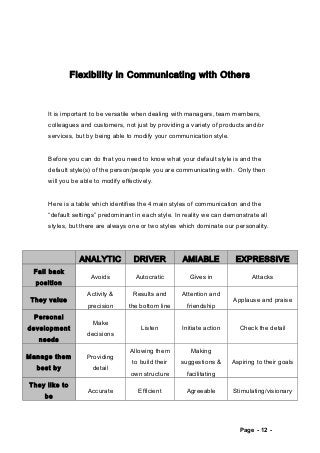
Here is a table which identifies the 4 main styles of communication and the 
“default settings” predominant in each style. In reality we can demonstrate all 
styles, but there are always one or two styles which dominate our personality. 
ANALYTIC DRIVER AMIABLE EXPRESSIVE 
Fall back 
position 
Avoids Autocratic Gives in Attacks 
They value 
Activity & 
precision 
Results and 
the bottom line 
Attention and 
friendship 
Applause and praise 
Personal 
development 
needs 
Make 
decisions 
Listen Initiate action Check the detail 
Manage them 
best by 
Providing 
detail 
Allowing them 
to build their 
own structure 
Making 
suggestions & 
facilitating 
Aspiring to their goals 
They like to 
be 
Accurate Efficient Agreeable Stimulating/visionary 
Page - 12 -
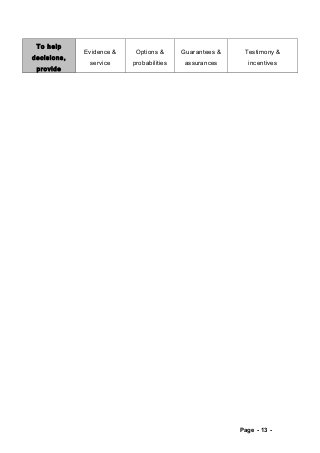
To help 
decisions, 
provide 
Evidence & 
service 
Options & 
probabilities 
Guarantees & 
assurances 
Testimony & 
incentives 
Page - 13 -

Communication styles questionnaire plus analysis

  • 1.
    Communication Style Questionnaire Your name ………………………………… Working across a whole row at a time, read the four boxes, then find the one that ‘best describes you’ and give this 4 points. Then find the box that next best describes you and give this 3 points. Then choose the next most like you, give this 2 points. Finally give the box that is ‘least like you’ 1 point. For example: Impressive … 3 … Self reliant … 1 … Relaxed … 2 … Responsive … 4 … NOW COMPLETE THE QUESTIONNAIRE 1 Impressive… Self reliant… Relaxed… Responsive… 2 Expert… Realistic… Co-operative… Creative… 3 Specialist… Supportive… Informal… Decisive… 4 Diplomatic… Sense of fun… Common sense… Job centred… 5 Eager… Knowledgeable… Efficient… Loyal… 6 Rational… Competitive… Faithful… Spirited… 7 Quick… Sensitive… Influential… Accurate… 8 Warm… Lively… Precise… Controls emotions… 9 Intelligent/academic… Impulsive… Agreeable… Direct… 10 Serious… Energetic… Considerate… Sensible… 11 Dynamic… Stimulating… Patient… Business like… 12 Take risks… Organised… Charismatic… Attentive… 13 Powerful… Logical…. Uninhibited… Sociable… 14 Orderly… Outgoing… Calm… Focussed… 15 Amiable… Expressive… Analytical… Controlling… Page - 1 -
  • 2.
    This page isintentionally blank Page - 2 -
  • 3.
    SCORING INSTRUCTIONS Copyyour scores from Page 1 to this page. Put your score next to the same word. Add the scores in each vertical column. Put your totals at the bottom of the page. COLUMN 1 COLUMN 2 COLUMN 3 COLUMN 4 1 Self reliant … Responsive… Relaxed… Impressive… 2 Expert… Co-operative… Realistic… Creative… 3 Specialist… Supportive… Decisive… Informal… 4 Common sense… Diplomatic… Job centred… Sense of fun… 5 Knowledgeable… Loyal… Efficient… Eager… 6 Rational… Faithful… Competitive… Spirited… 7 Accurate… Sensitive… Quick… Influential… 8 Precise… Warm… Controls emotions… Lively… 9 Intelligent/academic… Agreeable… Direct… Impulsive… 10 Sensible… Considerate… Serious… Energetic… 11 Business like… Patient… Dynamic… Stimulating… 12 Organised… Attentive… Take risks… Charismatic… 13 Logical… Sociable… Powerful… Uninhibited… 14 Focused… Calm… Orderly… Outgoing… 15 Analytical… Amiable… Controlling… Expressive… TOTAL ……………. TOTAL ………… TOTAL ………… TOTAL ………… Check: the 4 column totals together must add up to 150 Page - 3 -
  • 4.
    FINDING YOUR PRIMARYSTYLE Calculate your scores for Assertiveness and Responsiveness ASSERTIVENESS Add sum of columns 3 and 4 = ……………………….. Add sum of columns 1 and 2 = ……………………….. (3 and 4) minus (1 and 2) = ……………………….. RESPONSIVENESS Add sum of columns 2 and 4 = ……………………….. Add sum of columns 1 and 3 = ……………………….. (2 and 4) minus (1 and 3) = ……………………….. Page - 4 -
  • 5.
    TO IDENTIFY YOURPRIMARY STYLE, find your ‘RESPONSIVENESS, score along the horizontal axis and your ‘ASSERTIVENESS’ score along the vertical axis. Plot your position on the diagram where the two intersect each other. Ways to Generate Pull Express feelings. Flatter. Be more gregarious and talkative. Spend more time on the relationship. Ways to Decrease Pull Be restrained. Control your enthusiasm. Make decisions based on facts not gut feel. Think before speaking, reason your point. Ways to Generate Push Be accurate, brief, clear. Ways to Decrease Push Seek views. Page - 5 - 60 50 40 30 20 10 10 20 30 40 -60 -50 -40 -30 -20 -10 50 60 -10 -20 -30 -40 -50 -60 PULL – ASK (Responsiveness) PUSH – TELL (Assertiveness) DRIVER EXPRESSIVE ANALYTIC AMIABLE CON TRO LS F EELI N GS S H O WS F EELI N GS
  • 6.
    Argue your point. Be prepared to disagree. Start conversations. Be moderate. Listen without jumping in. Be flexible. Let others dominate. DRIVER STYLE ¨ Persistent ¨ Direct ¨ Competitive ¨ Takes initiative and control ¨ Control feelings and emotions ¨ Strongly persuasive ¨ Business-like and straight forward ¨ Detached ¨ Values results ¨ Enjoys challenges ¨ Committed to getting things done ¨ Will confront and correct others ¨ Dominant and focused THINGS TO AVOID HOW TO TREAT A DRIVER Page - 6 -
  • 7.
    DOING TO ADRIVER ¨ Taking an interest in their personal affairs ¨ Being chaotic or disorganised ¨ Being vague or unsure ¨ Rambling on or wasting their time ¨ If you disagree, do not let it reflect on them personally ¨ Using personal relationships to get an advantage ¨ Staying for personal chats after business ¨ Give clear, brief, accurate data ¨ Prepare a well-organised package ¨ Focus on business, ask specific “what” questions ¨ Present facts efficiently and concisely ¨ Provide options on which they decide ¨ Ensure key facts and figures to focus on the probability of success ¨ Focus on objectives, results and the bottom line ¨ Support their conclusions ¨ Finish the business and leave quickly EXPRESSIVE STYLE ¨ Friendly ¨ Good social style ¨ Uninhibited ¨ Puts people at ease Page - 7 -
  • 8.
    ¨ Generates enthusiasmin others ¨ Shares dreams and ambitions ¨ Excitable and talkative ¨ Use praise and favours ¨ Motivational ¨ High energy and vitality ¨ Flamboyant ¨ Intuitive and emotional ¨ Mood swings THINGS TO AVOID DOING TO AN EXPRESSIVE HOW TO TREAT AN EXPRESSIVE ¨ Crushing their views ¨ Being curt or formal ¨ Concentrating on facts and figures, alternatives, abstractions or going into detail ¨ Wasting time trying to be highly controlled and business-like ¨ Messing around too much; sticking too rigidly to the agenda either ¨ Talking down to them; do not patronise ¨ Being longwinded ¨ Support their visions and intuitions ¨ Socialise and talk about their objectives and opinions ¨ Ask for their ideas and opinions ¨ Get commitment to action ¨ Provide solid ideas for making decisions ¨ Allow time to be stimulating, creative, fast moving ¨ Give incentives for quick action ¨ Be enthusiastic ¨ Control ‘dreaming’ with them or you will lose time Page - 8 -
  • 9.
    AMIABLE STYLE ¨Warm and friendly ¨ Good personal relationships ¨ Service oriented ¨ Makes unobtrusive suggestions ¨ Offers understanding and friendship ¨ Co-operative and supportive ¨ Displays empathy ¨ Easy to work with ¨ Patient and dependable ¨ Accommodating ¨ Good listener ¨ Logical ¨ Good in teams ¨ Good at disarming conflict THINGS TO AVOID DOING TO AN AMIABLE HOW TO TREAT AN AMIABLE ¨ Pushing straight into business or the agenda ¨ Sticking solely to business; on the other hand, don’t lose sight of goals by being too personal ¨ Forcing them to respond quickly to your objectives; don’t say “This is how I see the ¨ Start with a personal comment ¨ Show real interest in them ¨ Come across as honest, open, sincere ¨ Identify patiently their personal objectives ¨ Present the case gently and with no Page - 9 -
  • 10.
    situation” ¨ Beingdomineering or demanding, threatening them with position and power ¨ Debating facts and figures ¨ Bullying them into agreeing - they will resist ¨ Patronising them by using subtlety or invective ¨ Offering assurances you cannot fulfil threats or pressure ¨ Ask ‘how’ questions to find out their opinions ¨ Demonstrate how their decision will reduce risks ¨ Provide benefits ¨ Provide personal guarantees ANALYTIC STYLE ¨ Quiet and unassuming ¨ Uses factual data and logical arguments ¨ Good attention to detail ¨ Conservative and conscientious ¨ Maximises procedures ¨ Calculates and plans ¨ Business-like ¨ Deliberate and precise ¨ Lets others take the initiative ¨ Seen as unemotional, aloof and business-like ¨ Likes evidence before deciding ¨ Makes practical decisions by being logical Page - 10 -
  • 11.
    THINGS TO AVOID DOING TO AN ANALYTIC HOW TO TREAT AN ANALYTIC ¨ Being chaotic and impulsive ¨ Being breezy and casual ¨ Forcing the decision-making process ¨ Wasting time or being superficial ¨ Relying on personal persuasion ¨ Using references of others or unreliable sources ¨ Using someone’s opinion as evidence ¨ Using slick techniques ¨ Give accurate, logical data ¨ Provide solid, practical evidence ¨ Stick to business and build credibility by listing pros and cons ¨ Allow sufficient time to be thorough ¨ Organise and schedule presentation with a step-by-step schedule ¨ Give them time to evaluate and verify proposals ¨ Minimise risk by giving guarantees Page - 11 -
  • 12.
    Flexibility in Communicatingwith Others It is important to be versatile when dealing with managers, team members, colleagues and customers, not just by providing a variety of products and/or services, but by being able to modify your communication style. Before you can do that you need to know what your default style is and the default style(s) of the person/people you are communicating with. Only then will you be able to modify effectively. Here is a table which identifies the 4 main styles of communication and the “default settings” predominant in each style. In reality we can demonstrate all styles, but there are always one or two styles which dominate our personality. ANALYTIC DRIVER AMIABLE EXPRESSIVE Fall back position Avoids Autocratic Gives in Attacks They value Activity & precision Results and the bottom line Attention and friendship Applause and praise Personal development needs Make decisions Listen Initiate action Check the detail Manage them best by Providing detail Allowing them to build their own structure Making suggestions & facilitating Aspiring to their goals They like to be Accurate Efficient Agreeable Stimulating/visionary Page - 12 -
  • 13.
    To help decisions, provide Evidence & service Options & probabilities Guarantees & assurances Testimony & incentives Page - 13 -