Ajit A Kaliya
M.A. Sem 1
Roll No 3
Enrollment No. 2069108420170013
Batch 2016-18
Department of English, MKBU





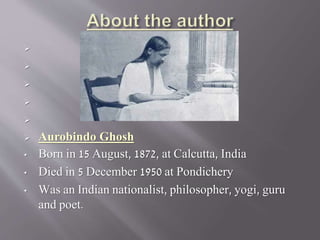
 Aurobindo Ghosh
• Born in 15 August, 1872, at Calcutta, India
• Died in 5 December 1950 at Pondichery
• Was an Indian nationalist, philosopher, yogi, guru
and poet.
• Literary Works
The life divine
The synthesis of yoga
Savitri
Agenda
Renaissance in India
Perseus the deliverer
Vasavdutta
Rodogune
The vaziers of Bassora
Eric
• Aurobindo’s article of the day of Indian
independence was published in August 15, 1947 in
edition of ‘The Hindu’
• It is a defense of Indian civilization and culture with
essays on Indian spirituality, religion, art, literature
and polity.
• I can observe on this day either approaching fruition or
initiated and an achievement.
• For I have always held and said that India was arising,
not to serve her own material interests only to achieve
expansion, greatness, power and prosperity though these
too she must not neglect and certainly not like others to
acquire domination of other people, but to live also for
God and the world as a helper and leader of the whole
human race.
• India is free, but she has not achieved unity, only a
fissured and broken freedom.
• Old communal division into Hindu and Muslim
seems to have hardened into the figure of a
permanent political division in the country.
• By whatever means, the division must and will go,
for without it the destiny of India might be
seriously impaired and even frustrated.
• The unification of mankind is under way, though only
in an imperfect initiative, organised but struggling
against tremendous difficulties.
• The unification is a necessity in the course of nature,
an inevitable movement and it’s achievement can be
safely foretold.
• Without it the freedom of small people can never be
safe and large and powerful nations cannot really be
secure.
• A new spirit of oneness will take held of the human
race.
“Immortality, unity and freedom
are in ourselves and await there our
discovery, but for the joy of love God , in
us will still remain the many.”
These were Aurobindo’s last words on the
nature of freedom.
Source
TheHindu.com
The Renaissance in India

Aurobindo’s vision on free india

  • 1.
    Ajit A Kaliya M.A.Sem 1 Roll No 3 Enrollment No. 2069108420170013 Batch 2016-18 Department of English, MKBU
  • 2.
          Aurobindo Ghosh •Born in 15 August, 1872, at Calcutta, India • Died in 5 December 1950 at Pondichery • Was an Indian nationalist, philosopher, yogi, guru and poet.
  • 3.
    • Literary Works Thelife divine The synthesis of yoga Savitri Agenda Renaissance in India Perseus the deliverer Vasavdutta Rodogune The vaziers of Bassora Eric
  • 4.
    • Aurobindo’s articleof the day of Indian independence was published in August 15, 1947 in edition of ‘The Hindu’ • It is a defense of Indian civilization and culture with essays on Indian spirituality, religion, art, literature and polity.
  • 5.
    • I canobserve on this day either approaching fruition or initiated and an achievement. • For I have always held and said that India was arising, not to serve her own material interests only to achieve expansion, greatness, power and prosperity though these too she must not neglect and certainly not like others to acquire domination of other people, but to live also for God and the world as a helper and leader of the whole human race.
  • 6.
    • India isfree, but she has not achieved unity, only a fissured and broken freedom. • Old communal division into Hindu and Muslim seems to have hardened into the figure of a permanent political division in the country. • By whatever means, the division must and will go, for without it the destiny of India might be seriously impaired and even frustrated.
  • 7.
    • The unificationof mankind is under way, though only in an imperfect initiative, organised but struggling against tremendous difficulties. • The unification is a necessity in the course of nature, an inevitable movement and it’s achievement can be safely foretold. • Without it the freedom of small people can never be safe and large and powerful nations cannot really be secure. • A new spirit of oneness will take held of the human race.
  • 8.
    “Immortality, unity andfreedom are in ourselves and await there our discovery, but for the joy of love God , in us will still remain the many.” These were Aurobindo’s last words on the nature of freedom.
  • 9.