Practical solutions to implementing
"Born Connected" data systems
Adam Leadbetter, Marine Institute
(adam.leadbetter@marine.ie)
Justin Buck, British Oceanographic Data Centre
Paul Stacey, Institute of Technology Blanchardstown
http://blog.caspio.com/paas-in-action/
need-structured-data-in-your-cms-embed-caspios-cloud-database/
http://lod-cloud.net/
http://argo.ucsd.edu
“Repositioning data management
near data acquisition”
Diviacco, Sorribas, Casas Munoz, de Cauwer, Busato, & Scory (2016)
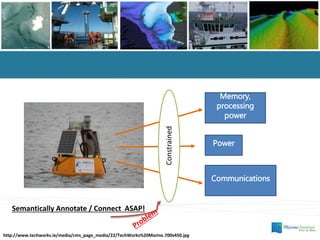
Semantically Annotate / Connect ASAP!
Memory,
processing
power
Power
Communications
Constrained
http://www.techworks.ie/media/cms_page_media/22/TechWorks%20Marine.700x450.jpg
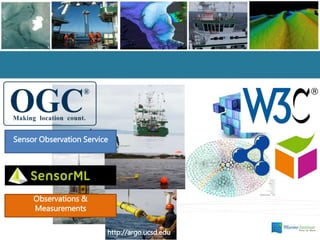
http://argo.ucsd.edu
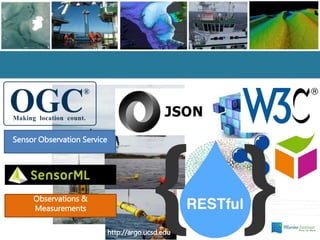
Sensor Observation Service
Observations &
Measurements
http://argo.ucsd.edu
Sensor Observation Service
Observations &
Measurements
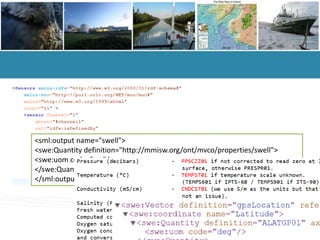
<sml:output name="swell">
<swe:Quantity definition="http://mmisw.org/ont/mvco/properties/swell">
<swe:uom code="cm"/>
</swe:Quantity>
</sml:output>
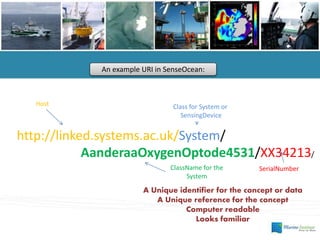
An example URI in SenseOcean:
http://linked.systems.ac.uk/System/
AanderaaOxygenOptode4531/XX34213/
ClassName for the
System
SerialNumber
Class for System or
SensingDevice
Host
A Unique identifier for the concept or data
A Unique reference for the concept
Computer readable
Looks familiar
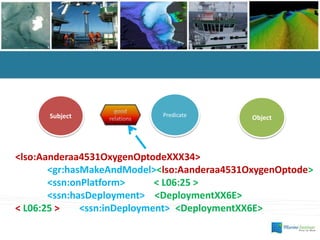
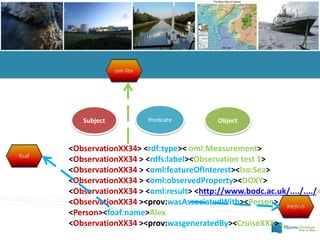
Subject Predicate Object
<lso:Aanderaa4531OxygenOptodeXXX34>
<gr:hasMakeAndModel><lso:Aanderaa4531OxygenOptode>
<ssn:onPlatform> < L06:25 >
<ssn:hasDeployment> <DeploymentXX6E>
< L06:25 > <ssn:inDeployment> <DeploymentXX6E>
Subject Predicate Object
<ObservationXX34> <rdf:type>< oml:Measurement>
<ObservationXX34 > <rdfs:label><Observation test 1>
<ObservationXX34 > <oml:featureOfInterest><lso:Sea>
<ObservationXX34 > <oml:observedProperty><DOXY>
<ObservationXX34 > <oml:result> <http://www.bodc.ac.uk/..../..../>
<ObservationXX34 ><prov:wasAssociatedWith><Person>
<Person><foaf:name>Alex
<ObservationXX34 ><prov:wasgeneratedBy><CruiseXXX>
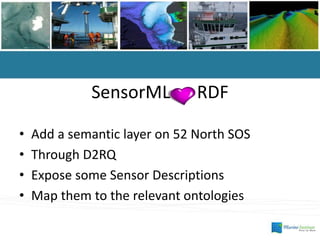
SensorML RDF
• Add a semantic layer on 52 North SOS
• Through D2RQ
• Expose some Sensor Descriptions
• Map them to the relevant ontologies
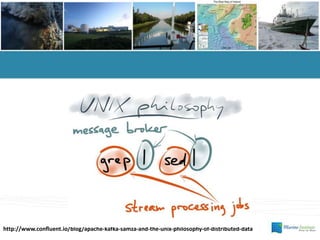
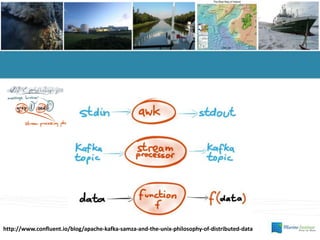
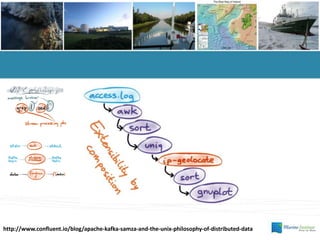
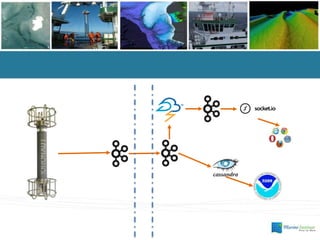
http://www.confluent.io/blog/apache-kafka-samza-and-the-unix-philosophy-of-distributed-data
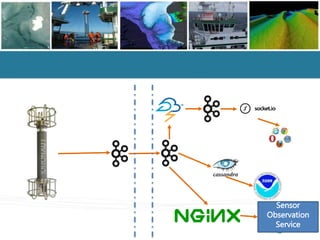
Sensor
Observation
Service
Adam Leadbetter, Marine Institute, Ireland
adam.leadbetter@marine.ie
@AdamLeadbetter
https://github.com/IrishMarineInstitute/
sensor-observation-service
https://github.com/peterataylor/om-json

Practical solutions to implementing "Born Connected" data systems

Editor's Notes

  • #2 Acknowledge: Janet Fredericks @ WHOI Damian Smyth & Rob Fuller @ MI Alexandra Kokinakki @ BODC Born Digital -> Born Semantic -> Born Connected
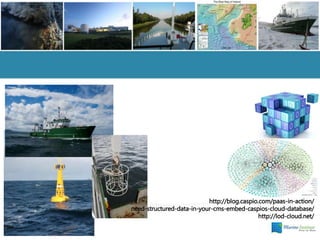
  • #3 Why? Traditionally – ocean data has been structured, and particularly, linked post fact
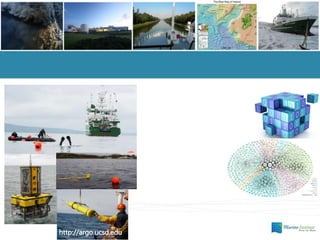
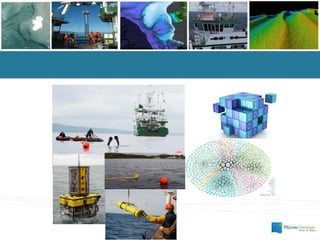
  • #4 Why? Traditionally – ocean data has been structured, and particularly, linked post fact Gliders, Argo floats, ROVs, seafloor observatories break the sustainability of that model
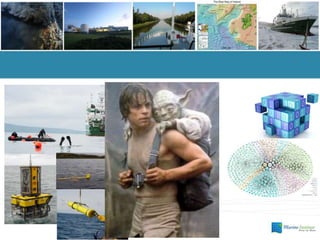
  • #5 Why? Traditionally – ocean data has been structured, and particularly, linked post fact Gliders, Argo floats, ROVs, seafloor observatories break the sustainability of that model Shepherd’s metaphor Do you have the time to go to Dagobah and take the training with the “Big Data” age Lesley Wyborn “Data needs to be ‘Born Connected’ to enable Transdisciplinary Science” – and beginning at conceived connected! So…
  • #8 Extending the “Born Semantic” to ultra-constrained observation environments Achieving “Born Semantic” data in an ultra-constrained environment presents more difficulties. Communications may be intermittent, very low bandwidth, data-logger must be highly power efficient etc.. Extending the “Born Semantic” to ultra-resource constrained environments There has been a recently flurry of development activity around Internet of Things (IoT) technologies. This has lead to a drive for IoT enabling technologies that presents opportunities to further realise the concept of Born Semantic data, pushing the semantic annotation closer to the data capture point. These technologies are all about “squeezing the bits” reducing storage, processing and communication overhead. Low-power, highly efficient operating systems such as TinyOS and Contiki (among others) provide “powerful enough” capabilities to leverage semantic annotation efforts. Fernandez et al. have recently addressed compression of RDF, with the Header-Dictionary-Triples approach that compresses tuple elements into a dictionary, followed by a compressed representation of triples of dictionary keys. This approach is only applicable to large data sets, which is not an option in a constrained environment. Wiselib TupleStore and RDF provider, provides a suitable solution here as it is a light weight flexible data storage solution. The Constrained Application Protocol (CoAP) is a specialised web  transfer protocol for use with constrained embedded systems and networks. CoAP is designed to easily interface with HTTP for integration with the Web with very low overhead, and simplicity for constrained environments. Although HTTP is the defacto standard for RESTful architectures CoAP. CoAP specifies a minimal subset of REST requests (GET, POST, PUT, and DELETE) it also relies on UDP as a transport protocol while providing reliability with a simple built-in retransmission mechanism and so the communications overhead is small compared to HTTP.
  • #10 Ocean Data Interoperability Platform 52N plus others Different encodings for SOS results RESTful URLs for SOS access
  • #11 EGU 2014 – prototypes in RDFa (CTD); SensorML 1.0 (Qartod 2 OGC – now re-funded as X-DOMES; Direct embedding concept ids in file headers (Lake Ellswort Drilling Project) or SWE XML definitions (Q2O). Funding from EU SenseOCEAN, BRIDGES, OpenGovIntelligence Funding from SEAI Onto SenseOCEAN – slides from BODC
  • #12 First step is a sensor / instrument register Built on Fuseki – with custom Java API Live in next few months
  • #13 SSN = has some issues with alignment later with O&M, which will be introduced in the next slide– Simon Cox will go into details…
  • #14 Ideally associated with something like an ORCiD not just the person’s name
  • #15 We have created the models. But we are still gathering metadata from the manufacturers. So will be able to publish some example sensor descriptions soon enough (couple of months).
  • #19 Single machine Distributed processing One-to-one communication Publish-subscribe pattern No fault tolerance Replication, auto-recovery Fixed schema, encoding Schema management, evolvable encoding
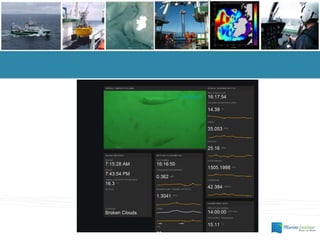
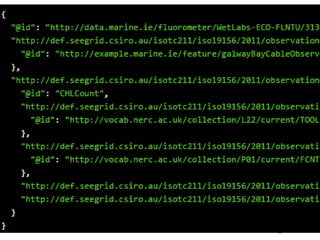
  • #22 Simon Cox & Peter Taylor presentation at OGC TC in September 2015 Work ongoing in Ocean Acidification community to use the proposed O&M JSON schema Here is a snapshot from a SOS call to the Galway Bay Cable Observatory
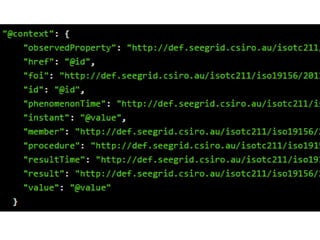
  • #24 Adding a JSON-LD context to the output allows us to generate a triple-ified model of the SOS output…