THE FLAG AND
HERALDIC CODE
OF THE PHILIPPINES
illustrated
RULES AND REGULATIONS
IMPLEMENTING REPUBLIC ACT NO. 8491
(Revised Edition)
THE FLAG AND
HERALDIC CODE
OF THE PHILIPPINES
illustrated
RULES AND REGULATIONS
IMPLEMENTING REPUBLIC ACT NO. 8491
(Revised Edition)
Published by:
NATIONAL HISTORICAL COMMISSION OF THE PHILIPPINES
T.M. Kalaw St., Ermita, Manila, Philippines
Tel.: 335-1212 www.nhcp.gov.ph
Copyright © 2018 NATIONAL HISTORICAL COMMISSION OF THE PHILIPPINES
All rights reserved. No part of the book may be reprinted or reproduced in any means
whatsoever without the permission of the copyright owner and publisher.
Recommended entry:
The flag and heraldic code of the Philippines, illustrated:
	 Rules and regulations implementing Republic Act No. 8491. -- Manila:
	 National Historical Commission of the Philippines, c2018.
	 pp. ; cm
	 1. Flags - Philippines. 2. Heraldry - Law and legislation - Philippines.
3. Republic Act No.8491. I. Title.
ISBN: 978-971-538-323-3
CONTENTS
RENE R. ESCALANTE
Preface
xiii
TEODORO S. ATIENZA
Introduction
xv Republic Act No. 8491
71
The Code of the National Flag,
Anthem, Motto, Coat-of-Arms,
and Other Heraldic Items and
Devices of the Philippines
An Act Prescribing the Code
of the National Flag, Anthem,
Motto, Coat-of-Arms, and Other
Heraldic Items and Devices
of the Philippines
1
Rules and Regulations
Implementing Republic Act No. 8491
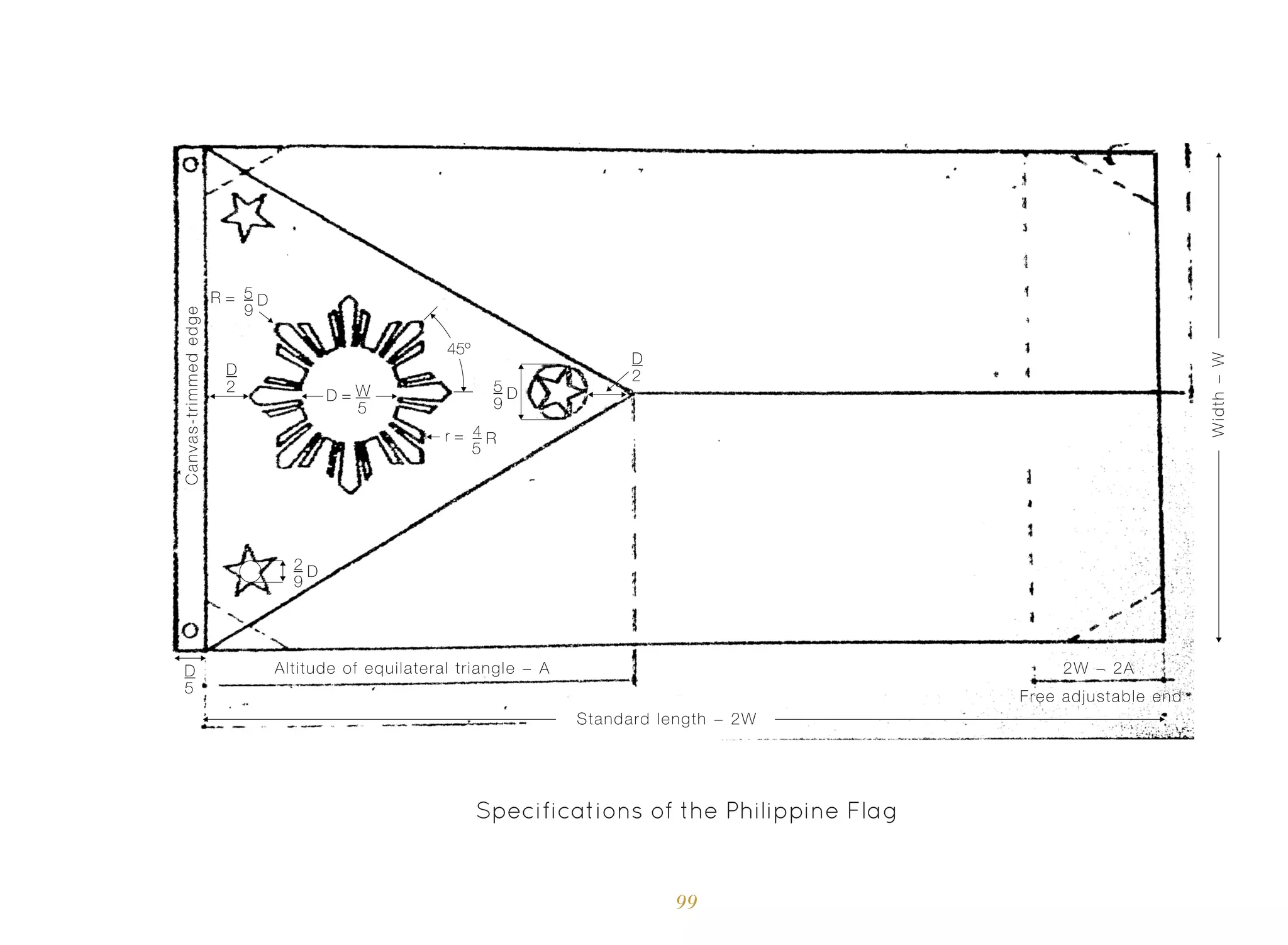
Description and Specifications
of the Filipino Flag
(March 25, 1936)
Appendix No. 1
Executive Order No. 23, S. 1936
97
Creating the Philippine Heraldry
Committee to Make a Study of
and Recommend Ways and
Means for the Adoption of Coat-
Of-Arms of the Different Political
Subdivisions, Provinces, Cities, and
Semi-Governmental Institutions
(December 4, 1940)
Appendix No. 2
Executive Order No. 310, S. 1940
101
Revised Filipino Language Version
of the Philippine National Anthem
(May 26, 1956)
Appendix No. 3
Department Order No. 5, S. 1956
(Department of Education)
104
APPENDICES
Other Relevant Laws and Rules Affecting
Philippine Heraldry and Vexillary
118
Reorganizing the Executive Branch of
the Government. The National Historical
Institute was created under Article XV
Chapter I of Department of Education
and Culture under Education on Part XII.
(September 24, 1972)
Appendix No. 4
Kautusang Tagapagpaganap Blg. 60
109
Amending Executive Order No.
23 Dated March 25, 1936 Entitled,
“Description and Specifications
of the Filipino Flag”
(February 25, 1985)
Appendix No. 7
Executive Order No. 1010
111
Appendix No. 6
Presidential Decree No. 1
113
Nagpapahayag na ang Pambansang
Awit ng Pilipinas ay Dapat Awitin
lamang sa Titik nitong Pilipino
(Disyembre 19, 1963)
Declaring the Twenty-Eighth Day of
May each Year as National Flag Day.
(March 6, 1965)
Appendix No. 5
Proclamation No. 374
Appendix No. 8
The Philippine National Flag
Description and Specifications
120
Covered by Executive Order No. 1010
(February 25, 1985)
124
Instituting the
“Administrative Code of 1987”
(July 25, 1987)
Appendix No. 9
Executive Order No. 292
127
Prohibition Against the Use of the
Presidential Seal, “Sagisag ng
Pangulo,” in Office Stationeries
and Uniforms
(November 25, 1988)
Appendix No. 10
Memorandum Order No. 205
Adopting the “Panunumpa ng
Katapatan sa Watawat” as the
Official Pledge of Allegiance
for All Filipinos
(June 12, 1996)
Appendix No. 13
Executive Order No. 343
144
Prominent Display of the National
Flag in All Buildings, Establishments,
and Homes from 28 May 1994
to 12 June 1994 and Every Year
Thereafter, and for other Purposes
(May 24, 1994)
Appendix No. 12
Executive Order No. 179
141
128
Policy Guidelines on the Creation,
Modification, Change, and
Registration of Corporate Seals of
Local Government Units
(June 8, 1992)
Appendix No. 11
Memorandum Circular No. 92-30
156
A Resolution Amending Some
Provisions of the Implementing Rules
and Regulations (IRR)
of R.A. No. 8491 known as “The Flag
and Heraldic Code of the Philippines”
(April 16, 2004)
Appendix No. 17
NHI Board Resolution No. 2, S. 2004
154
A Resolution Amending the
4th
Paragraph of Section 27 of
the Implementing Rules and
Regulations (IRR) of R.A. No. 8491
(March 31, 2003)
Appendix No. 16
NHI Board Resolution No. 2, 2003
150
Regulating the Manufacture,
Sale, Distribution, and Use of the
Philippine National Police Uniforms,
Insignias, and other Accoutrements
(October 4, 2000)
Appendix No. 15
Executive Order No. 297, S. 2000
146
Creation of a Committee on
Presidential Awards
(September 30, 1997)
Appendix No. 14
Administrative Order No. 362
An Act Strengthening Peoples’
Nationalism through Philippine History
by Changing the Nomenclature of the
National Historical Institute into the
National Historical Commission
of the Philippines, Strengthening
its Powers and Functions,
and for other Purposes
(May 12, 2010)
Appendix No. 18
Republic Act No. 10086
161
Memorandum Circular on
Observance of Flag Ceremonies
(November 12, 2012)
Appendix No. 19
Memorandum Circular No. 19, S. 2012
(Civil Service Commission)
178
A Resolution to Include Three
Additional Sites under Section 10
of the Implementing Rules and
Regulations (IRR) of R.A. 8491, Known
as the “The Flag and Heraldic Code of
the Philippines,” Where the Philippine
Flag shall be Permanently Hoisted
(October 5, 2015)
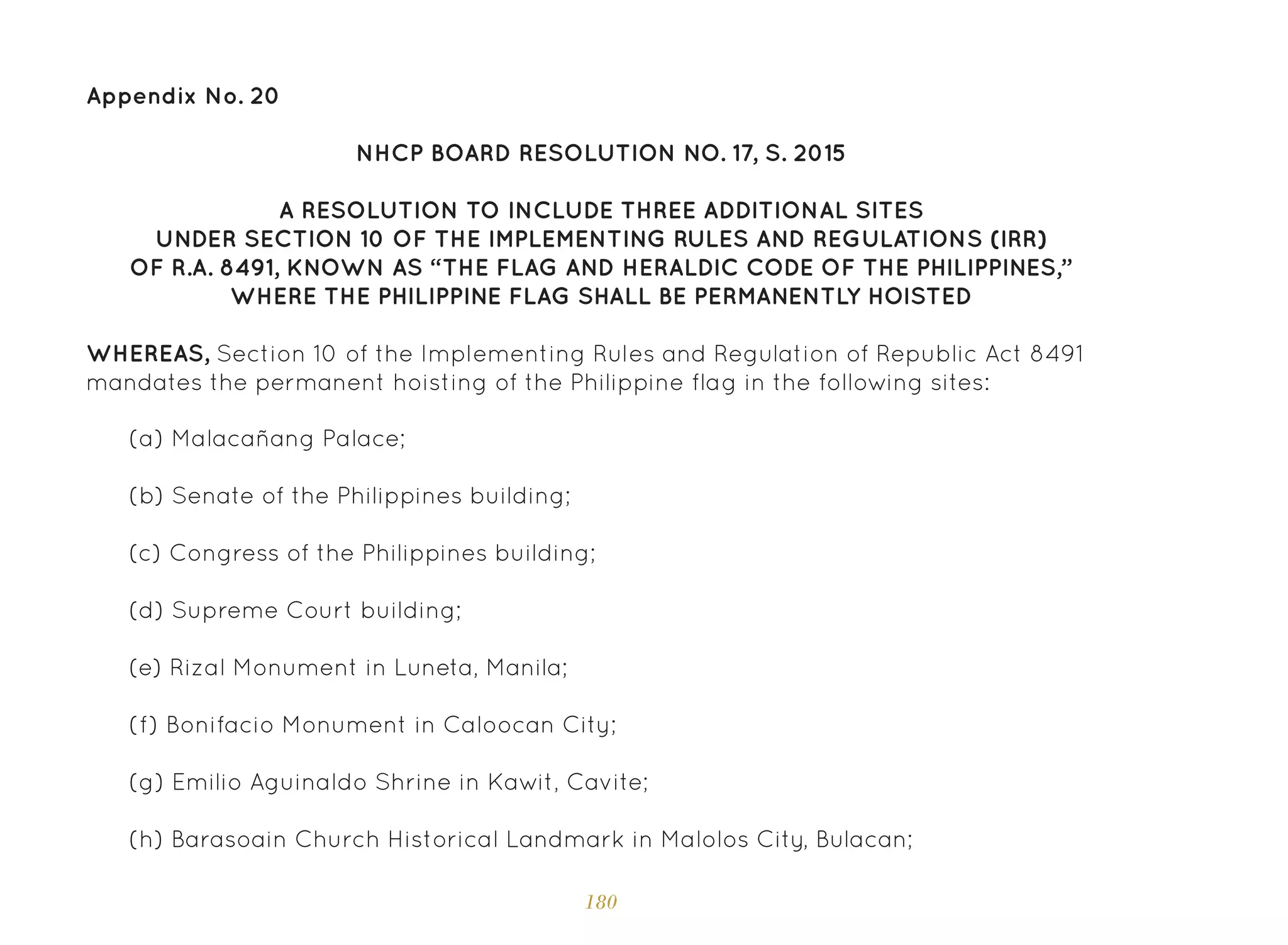
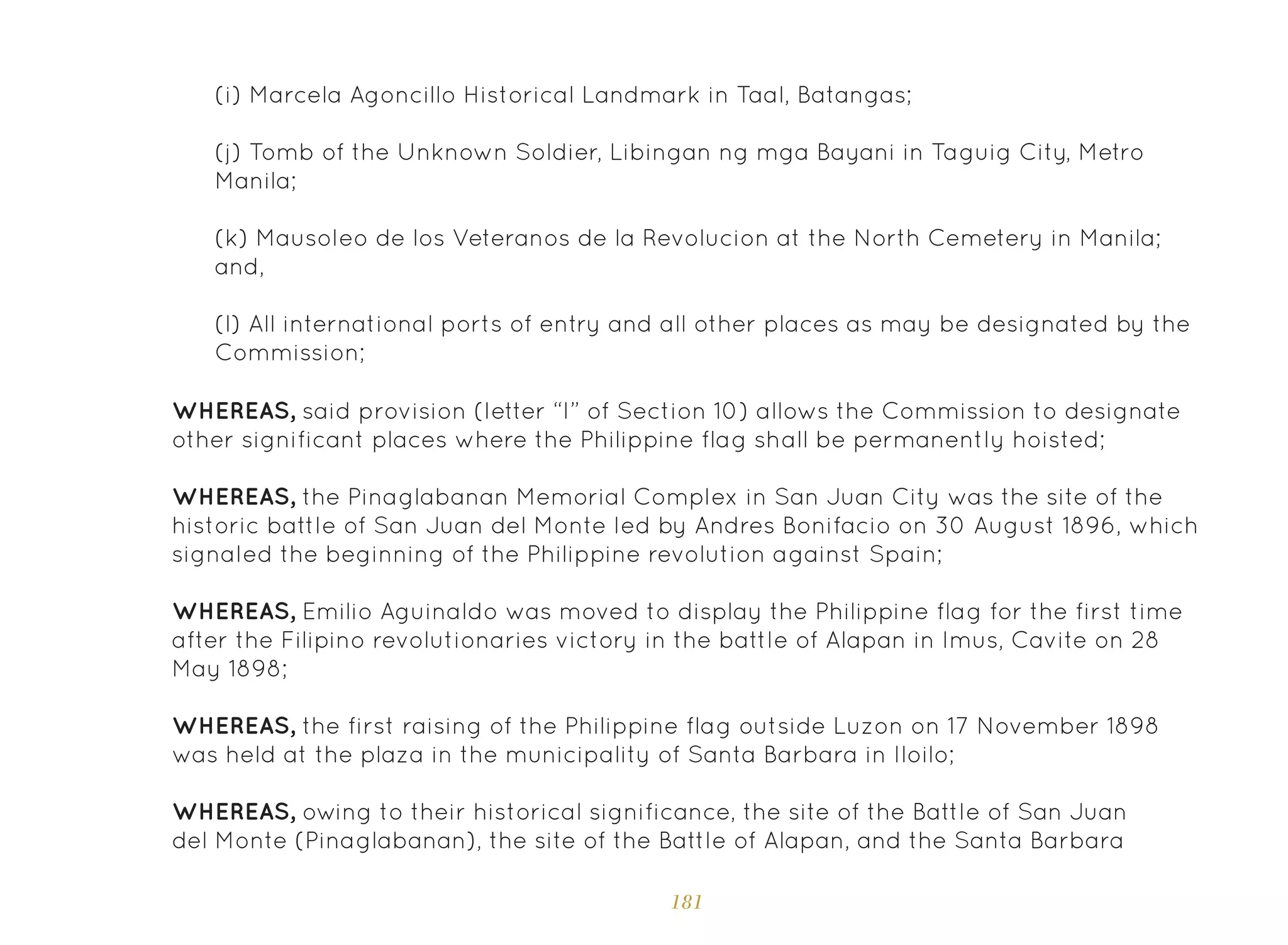
Appendix No. 20
NHCP Board Resolution No. 17, S. 2015
180
A Resolution to Include Additional
Sites under Section 10 of the
Implementing Rules and Regulations
(IRR) of R.A. 8491 Known as
“The Flag and Heraldic Code of the
Philippines,” Where the Philippine
Flag shall be Permanently Hoisted
(September 29, 2017)
Appendix No. 21
NHCP Board Resolution No. 8, S. 2017
183
A Resolution Prohibiting the
Manufacture and Use of
Heraldic Items and Devices Without
the Approval of the Office of the
President, to be Included in Section
49 of the Implementing Rules and
Regulations (IRR) of R.A. 8491 Known
as “The Flag and Heraldic Code
of the Philippines,”
(September 29, 2017)
Appendix No. 22
NHCP Board Resolution No. 9, S. 2017
186
A Resolution to Include the Custom of
Singing the National Anthem First Before
an Invocation under Section 43 of the
Implementing Rules and Regulations
(IRR) of R.A. 8491 Known as “The Flag and
Heraldic Code of the Philippines,”
(September 29, 2017)
Appendix No. 23
NHCP Board Resolution No. 10, S. 2017
188
xiii
PREFACE
National symbols like flags and heraldic items embody the identity of a nation. The
country’s history, culture and political aspirations command the respect of its citizens
and those of other nations. In the Philippines, national symbols are prescribed by
Republic Act No. 8491 entitled, “An Act Prescribing the Code of the National Flag,
Anthem, Motto, Coat of Arms and other Heraldic Items and Devices of the Philippines,”
which became effective on 12 February 1998. The National Historical Commission of
the Philippines is the government agency tasked to implement Republic Act No. 8491.
In order to disseminate the code, deepen public awareness and provide guidance on
the proper use of the Philippine flag and heraldic items, the Commission first published
in 2002 the illustrated book of the Implementing Rules and Regulations.
There have been several amendments in the implementing Rules and Regulations of
Republic Act No. 8491, which compelled the Commission to publish this revised edition
in print and its ebook interactive version. The electronic version is meant to serve
Filipino digital readers here and abroad and foster within them the love for country.
DR. RENE R. ESCALANTE
Chairman
National Historical Commission
of the Philippines
xiv
xv
INTRODUCTION
Heraldry is the language and science of arts and symbols pertaining to arms, rank,
and protocol. It is always subject to innovations, and at the same time it reflects the
historical transformations of a government or a society. Heraldry was originally used in
ancient times to distinguish warriors of different factions. As an important means of
identification, heraldry these days is used as a sign of ownership, a pledge, or a mark
of authority.
Philippine heraldry as a source of protocol is a combination of, on the one hand, local
customs and traditions, and, on the other hand, internationally accepted practice.
It has undergone major changes in the past,—whether in the introduction of a new
symbol or the revision of an existing one—coinciding with political upheavals. In
the middle of the sixteenth century, the Spaniards found that our ancestors were
already familiar with the universal meaning of the red and white flags. A few years
after establishing their colony in the islands, they granted, by royal decree, the
“Distinguished and Ever Loyal” City of Manila its first coat-of-arms on March 20, 1596.
From the late nineteenth century to the end of colonialism, each historical era made
an impact on Philippine heraldry: the fight for independence and the Philippine–
American War from 1896 to 1902; from the establishment of the American colonial
civil government to the Philippine Commonwealth, 1902 to 1941; from the Japanese
occupation until the end of the Japanese-sponsored government, 1942 to 1945; from
the American reoccupation to the inauguration of the Third Philippine Republic, 1944 to
xvi
1946. Likewise, our heraldry practice was affected during the postwar Republic, 1946
to 1972, during the Martial Law era, and after the EDSA People Power revolt.
On November 15, 1935, the Philippine Commonwealth was inaugurated. Elected into
office were Manuel L. Quezon as President and Sergio Osmeña as Vice President. One
of the directives the President issued was Executive Order No. 23, dated March 25,
1936, giving the official description and specifications of the Philippine flag. Other
directives concerning the types of cloth to be used in the manufacture of the Philippine
flag followed. Several years later, on December 4, 1940, President Manuel L. Quezon
issued Executive Order No. 310, creating the Philippine Heraldry Committee to make a
study of and recommend ways and means for the adoption of the coat-of-arms of the
different political subdivisions, provinces, cities and semi-government institutions of
the Commonwealth. The committee was under the Office of the Executive Secretary,
which was then headed by Secretary Jorge Vargas.
At the outbreak of the Second World War, one of the first decrees issued by the
Japanese occupation forces that affected Philippine heraldry was Military Ordinance
No. 3, dated April 22, 1942. It prohibited the use of the Philippine flag “for the time
being.” As a consequence, the work of the Philippine Heraldry Committee was
suspended. However, on the inauguration of the Japanese-sponsored Philippine
Republic under President Jose P. Laurel on October 14, 1943, the Philippine national flag
was hoisted and allowed to be displayed.
On January 7, 1946, President Sergio Osmeña reactivated the Philippine Heraldry
Committee with Dr. Jose Bantug and Prof. Galo B. Ocampo as appointed chairman
and secretary, respectively. The preparation of the designs and specifications, as
well as the supervision in the manufacture of heraldic items, which include citations,
xvii
stars, badges, medals and ribbons, sash, collar, or bars, known as Medals, Orders
and Decorations, have become more sophisticated. Also, the scope of activities and
technical duties of the Committee was expanded as mandated by several presidential
directives.
The change in the country’s political status from colony to independent nation-state
resulted in an increase in the heraldic needs in terms of medals, orders and
decorations, insignia, badges, flags and other coat-of-arms. The continuous
administrative demands for protocol, heraldic tradition, and technical needs in various
government agencies have established heraldry works as part and parcel of the
government’s operations. In 1953 President Elpidio R. Quirino assigned the Philippine
Heraldry Committee under the Division of General Services of the Office of the
President with the arrangement that it will function independently. In 1958 President
Carlos P. Garcia issued Administrative Order No. 1 assigning the Committee to the
Division of Presidential Protocol. Unfortunately, on November 30, 1961, due to the lack
of funds, President Diosdado P. Macapagal suspended the works of the Committee.
When President Ferdinand E. Marcos issued Presidential Decree No. 1 known as the
Reorganization Act of 1972, the function of the Philippine Heraldry Committee was
transferred to the National Historical Institute, as a section under the Monuments and
Heraldry Division. In 1973 it was formally implemented with Dr. Galo B. Ocampo as
consultant on heraldry. The Institute tried to amend its mandates on heraldry including
the national flag, anthem, motto, coat-of-arms and great seal through presidential
directives, but it failed. During the Ninth Congress in 1988, Senator Laurel introduced a
Senate bill entitled “An Act Prescribing the Code of the National Flag of the Republic of
the Philippines,” but it suffered the same fate.
xviii
TEODORO S. ATIENZA
Head, Heraldry Section
National Historical Commission
of the Philippines
In the Tenth Congress, Senators Blas F. Ople and Anna Dominique M. L. Coseteng
introduced Senate Bill No. 630, entitled “An Act Prescribing the Code of the Philippine
National Flag and Anthem,” while in the Lower House, Representatives Salvador H.
Escudero III and Rosenda Ann M. Ocampo filed House Bill No. 436, entitled “Prescribing
the Code of the National Flag, Anthem, Motto, Coat-of-Arms and the Great Seal of the
Philippines in 1995.” Through the intervention of the Heraldry and Display Section of
the National Historical Institute, House Bill No. 436 was substituted by House Bill No.
2586, entitled “An Act Prescribing the Code of the Philippine Heraldry and Vexillary.”
When the Tenth Congress of the Philippines convened its third regular session on
July 28, 1997, the bill was retitled “An Act Prescribing the Code of the National Flag,
Anthem, Motto, Coat-of-Arms and other Heraldic Items and Devices of the Philippines.”
The bill was passed and approved by the Senate and the House of Representatives on
February 3, 1998, and February 6, 1998, respectively. President Fidel V. Ramos signed it
into law on February 12, 1998, as Republic Act No. 8491.
This book, the Flag and Heraldic Code of the Philippines, Illustrated (Rules and
Regulations Implementing Republic Act 8491), contains graphics and photos to help
readers understand every provision of the code. Illustrations made are opinions and
views of the undersigned to help convey the message of this important law.
1
RULES and REGULATIONS
implementing
REPUBLIC ACT
No. 8491, S. 1998
“The Code of the National Flag, Anthem, Motto, Coat-Of-Arms and other Heraldic Items
and Devices of the Philippines”
2
3
rule 1 GENERAL PROVISIONS
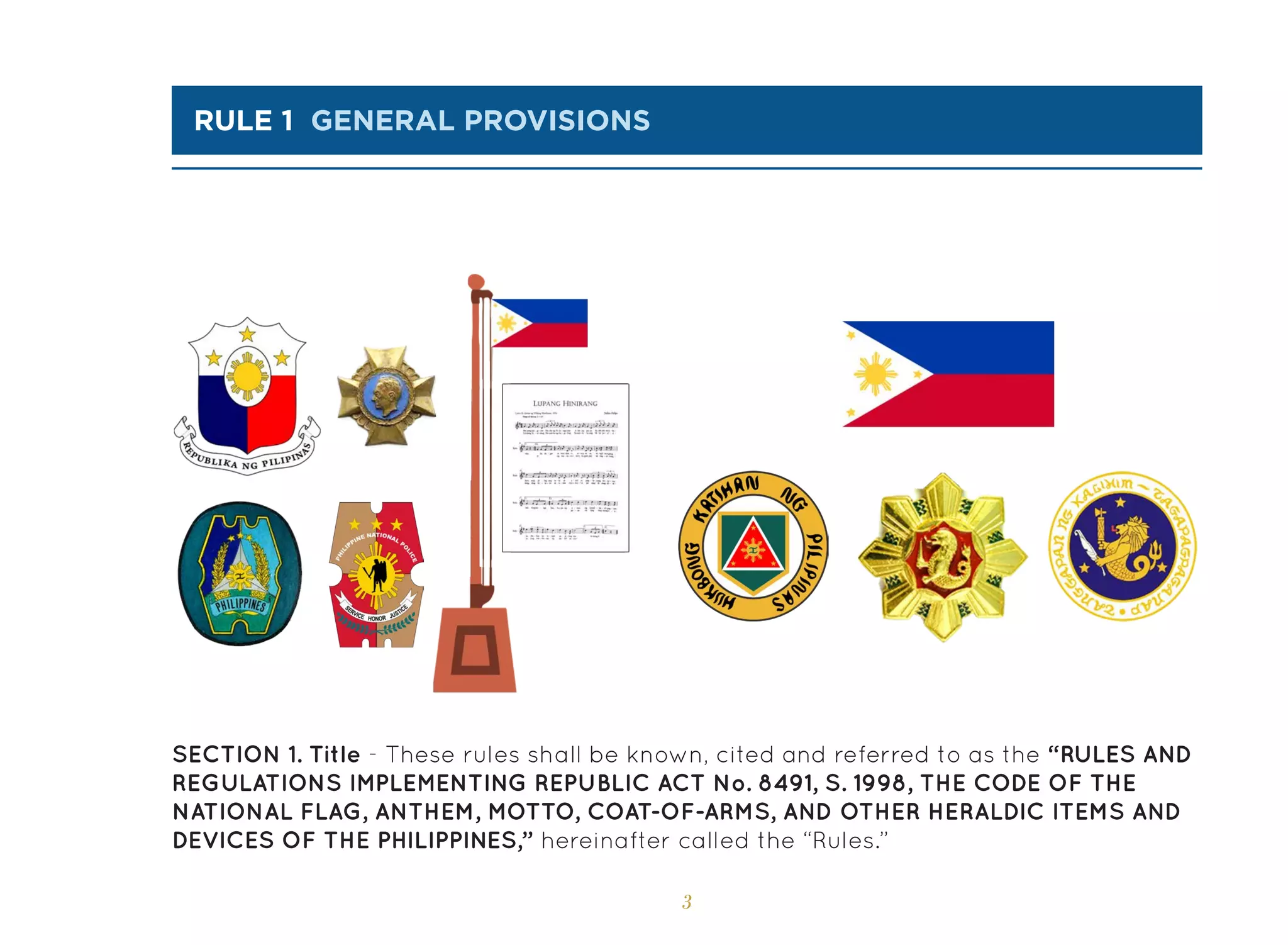
SECTION 1. Title - These rules shall be known, cited and referred to as the “RULES AND
REGULATIONS IMPLEMENTING REPUBLIC ACT No. 8491, S. 1998, THE CODE OF THE
NATIONAL FLAG, ANTHEM, MOTTO, COAT-OF-ARMS, AND OTHER HERALDIC ITEMS AND
DEVICES OF THE PHILIPPINES,” hereinafter called the “Rules.”
4
SECTION 3. Scope of Application - These
rules shall apply to individuals, public
and private entities, military and police
agencies, and other branches and/or
instrumentalities of the national and
local government including government-
SECTION 4. Interpretation - In the
interpretation of the provisions of
Republic Act No. 8491, S. 1998, the Flag
and Heraldic Code of the Philippines,
hereinafter called R.A. No. 8491, and of
these rules, that interpretation which
will promote or sustain reverence and
respect for the flag, the anthem, and
other national symbols, all of which
embody national ideals and traditions,
shall be given paramount consideration.
SECTION 2. Declaration of Policy and
Objectives - It is the policy of the state to
herein prescribe the Code of the National
Flag, Anthem, Motto, Coat-of-Arms, and
other Heraldic Items and Devices of the
Philippines, ensure the promotion and
implementation of its corresponding
rules and regulations, and adopt effective
administrative, regulatory, coordinative
and supervisory programs and activities,
where appropriate, in conformity with
national government laws and policies.
Further, reverence and respect shall
at all times be accorded to the flag,
anthem, and other national symbols
which embody the national ideals
and traditions, and which express the
principles of sovereignty and national
solidarity.
owned and/or controlled corporations,
and shall also be observed in and within
the entire territory of the Philippines as
such is defined in the constitution and
laws of the Republic of the Philippines.
5
rule 2 implementing agency
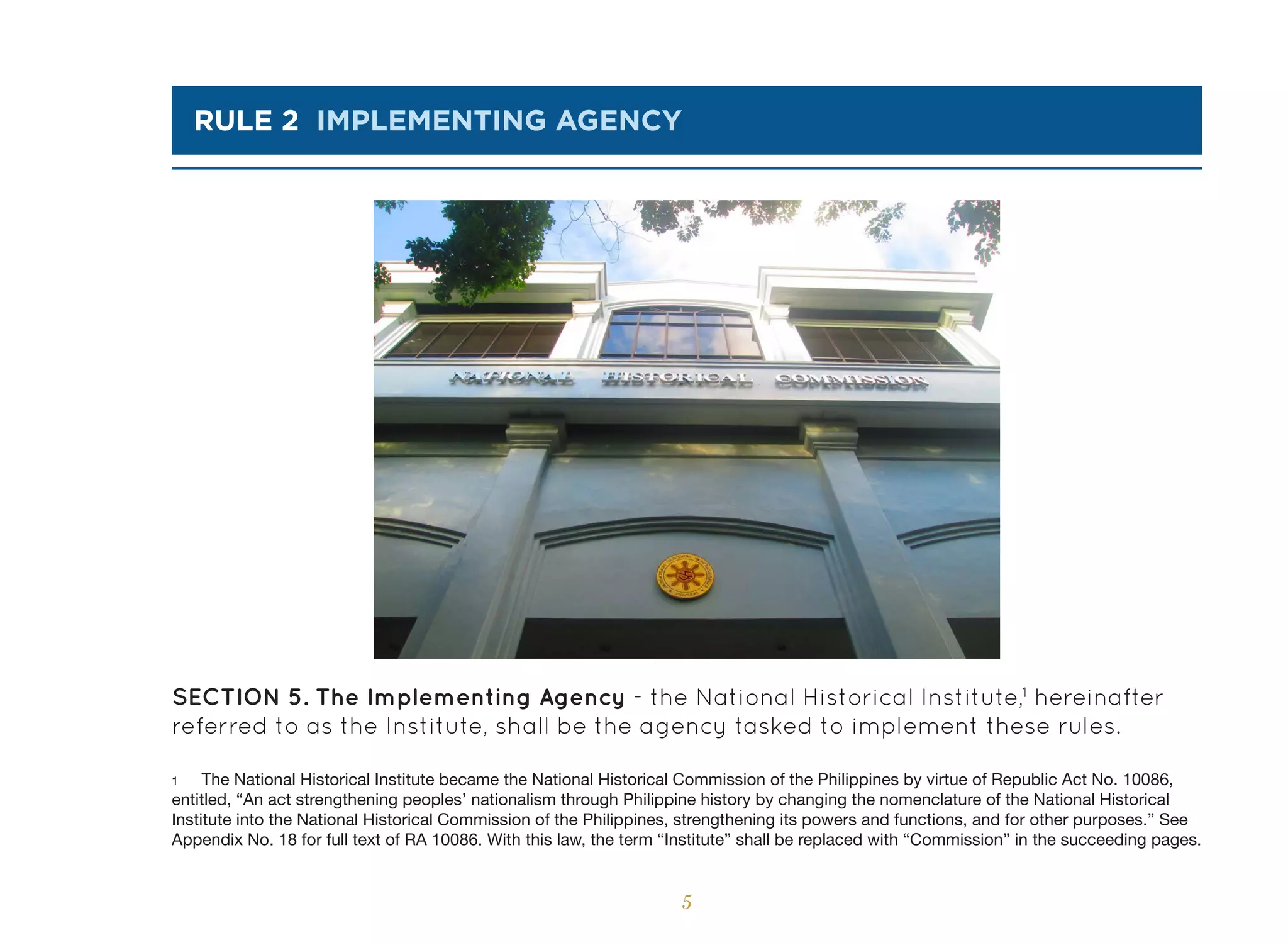
SECTION 5. The Implementing Agency - the National Historical Institute,1
hereinafter
referred to as the Institute, shall be the agency tasked to implement these rules.
1 The National Historical Institute became the National Historical Commission of the Philippines by virtue of Republic Act No. 10086,
entitled, “An act strengthening peoples’ nationalism through Philippine history by changing the nomenclature of the National Historical
Institute into the National Historical Commission of the Philippines, strengthening its powers and functions, and for other purposes.” See
Appendix No. 18 for full text of RA 10086. With this law, the term “Institute” shall be replaced with “Commission” in the succeeding pages.
6
SECTION 6. Scope of Powers and
Functions - the Commission shall perform
planning, monitoring, coordinating,
implementing, and policy-formulating
functions, wherever and whenever
appropriate, and, in the process,
exercise administrative, regulatory,
and supervisory authority over the
implementation of the provisions of R.A.
No. 8491 within the Philippine territorial
limits, and in conformity with national
government laws and policies. Such
powers and functions shall include the
following:
a. Formulate, coordinate, and regulate
the implementation of the Code of
the National Flag, Anthem, Motto,
Coat-of-Arms, and other Heraldic
Items and Devices of the Philippines,
consistent with the purposes and
objectives of R.A. No. 8491;
b. Plan, prepare, and coordinate
effective educational and information
dissemination strategies which
shall increase the level of national
awareness of these Rules and other
implementing details that may
subsequently be formulated;
c. Coordinate and monitor the
implementation of these Rules and
ensure the compliance of all the
provisions stipulated under R.A. No.
8491; and deputize, assign, and/or
designate government agencies,
non-government organizations, major
branches and units of the Armed
Forces of the Philippines and the
Philippine National Police, and other
groups or individuals for the purpose
of implementing, monitoring, and
coordinating tasks;
d. Set policies and procedures
concerning the concept and design/
visual interpretation of the national
motto, coat-of-arms, seals of various
local government units (town/city/
province) and other government
instrumentalities, medallions, awards,
and other forms and devices of
national recognition, and strict
enforcement thereof;
7
e. Formulate and devise appropriate legal procedures, assistance and coordinating
systems for cases arising from the violations of R.A. No. 8491, including appropriate
integration of this law into the Sharia Courts; and
f. Perform other related functions required to achieve the objectives of R.A. No. 8491
and these Rules.
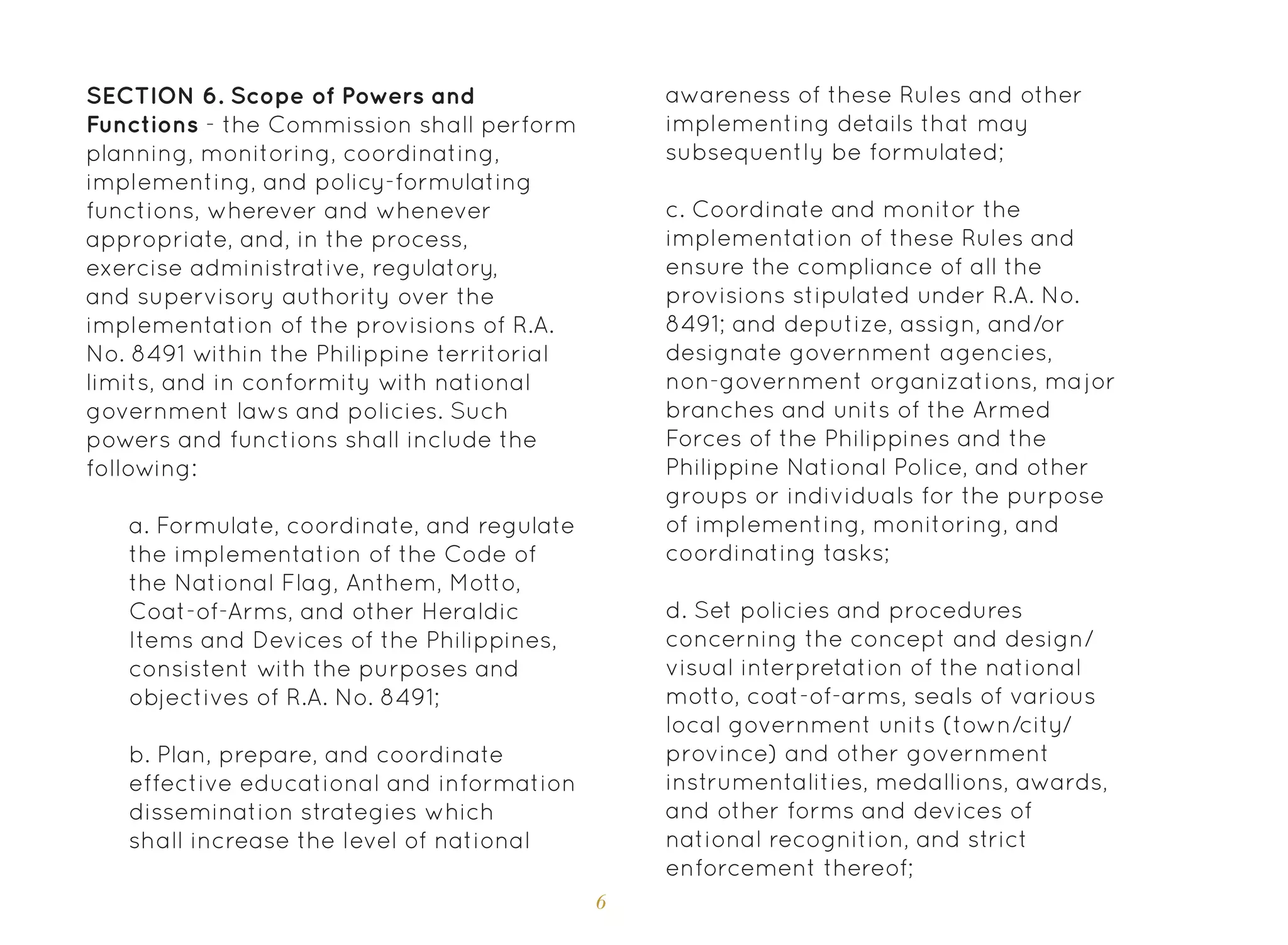
SECTION 7. Definition of Terms - Whenever used in these Rules, the term:
a. “Military” shall mean all branches of the Armed Forces of the Philippines,
including the Philippine National Police, the Bureau of Jail Management and
Penology, Bureau of Fire Protection;
8
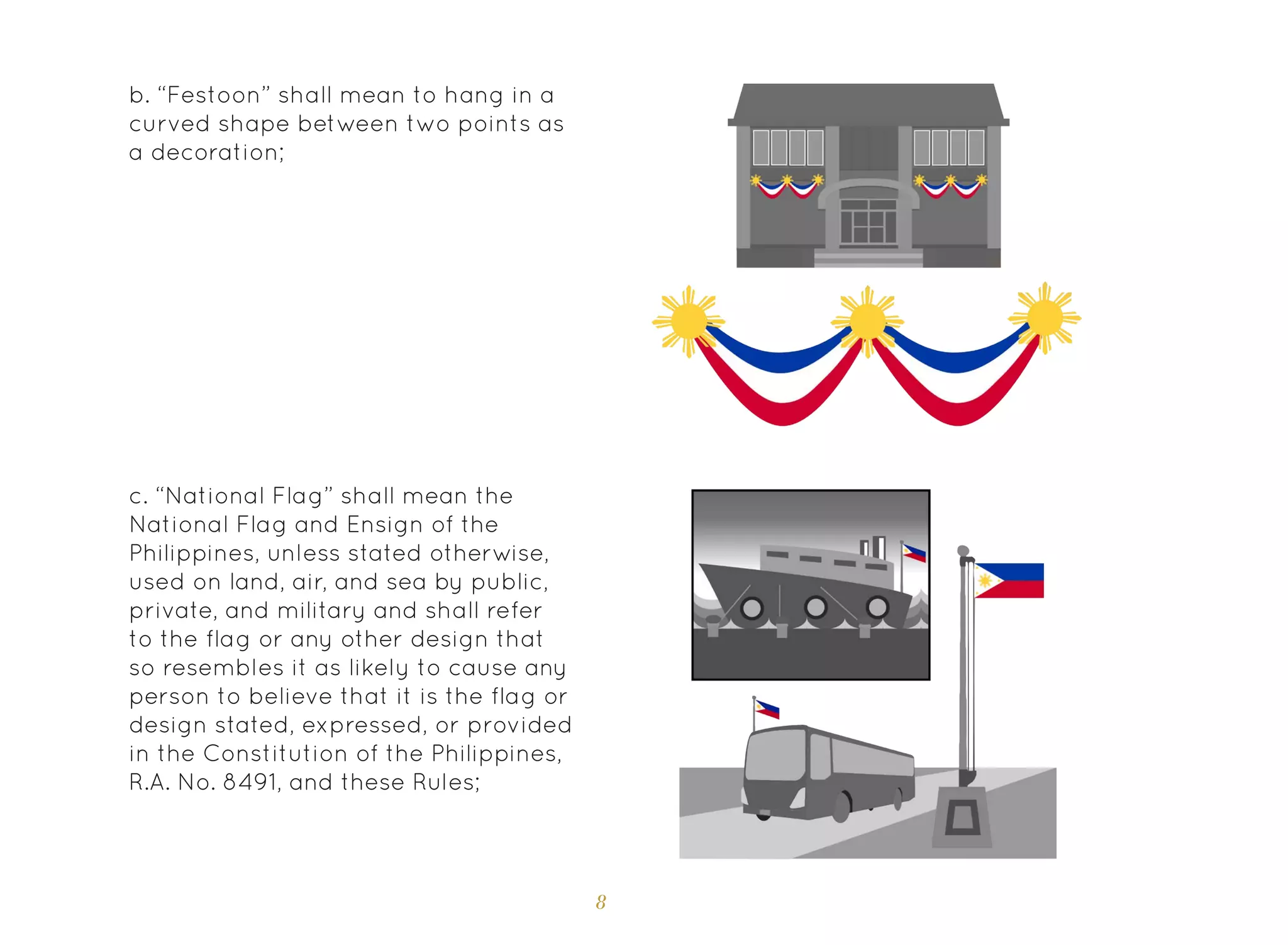
c. “National Flag” shall mean the
National Flag and Ensign of the
Philippines, unless stated otherwise,
used on land, air, and sea by public,
private, and military and shall refer
to the flag or any other design that
so resembles it as likely to cause any
person to believe that it is the flag or
design stated, expressed, or provided
in the Constitution of the Philippines,
R.A. No. 8491, and these Rules;
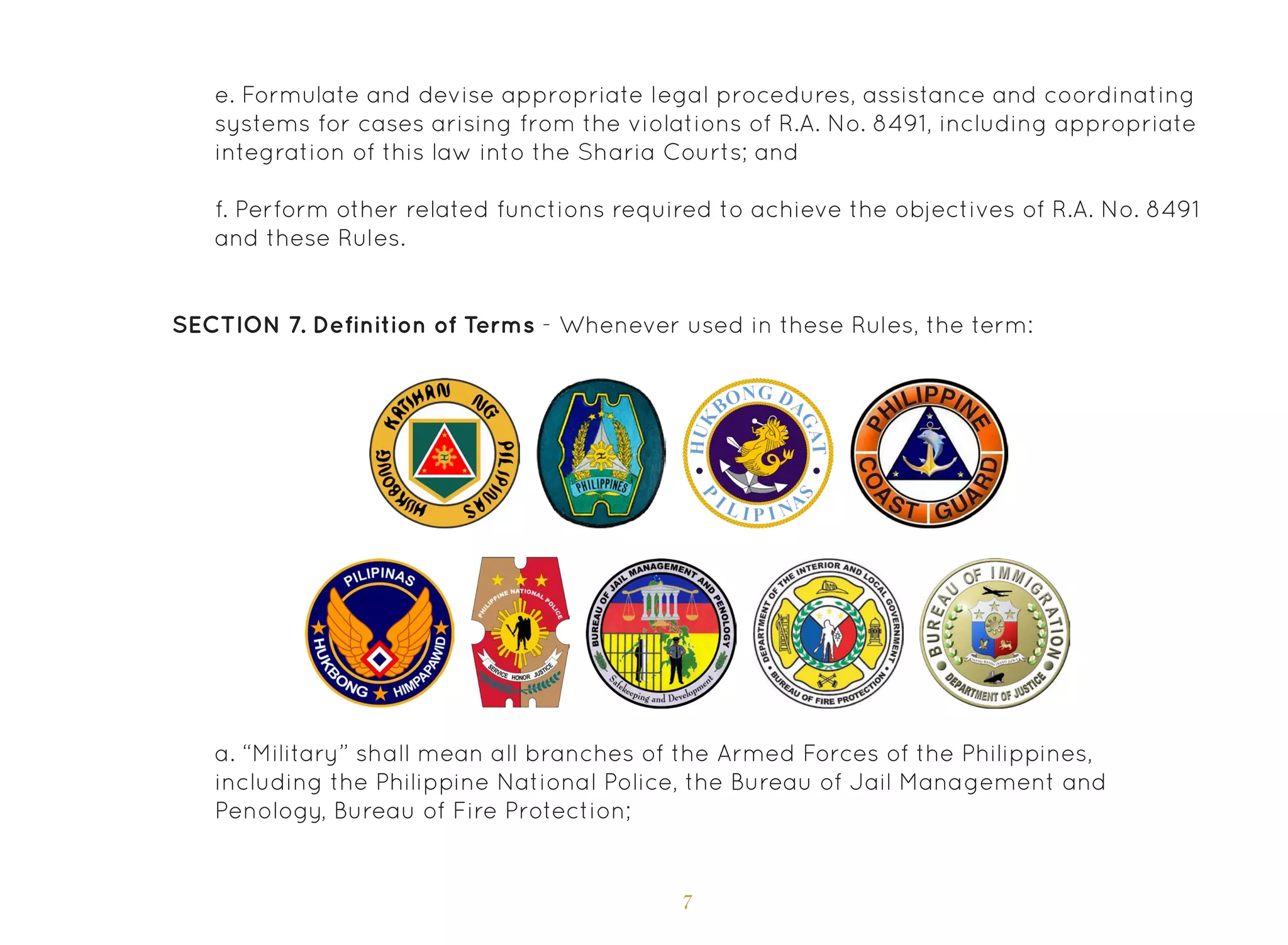
b. “Festoon” shall mean to hang in a
curved shape between two points as
a decoration;
9
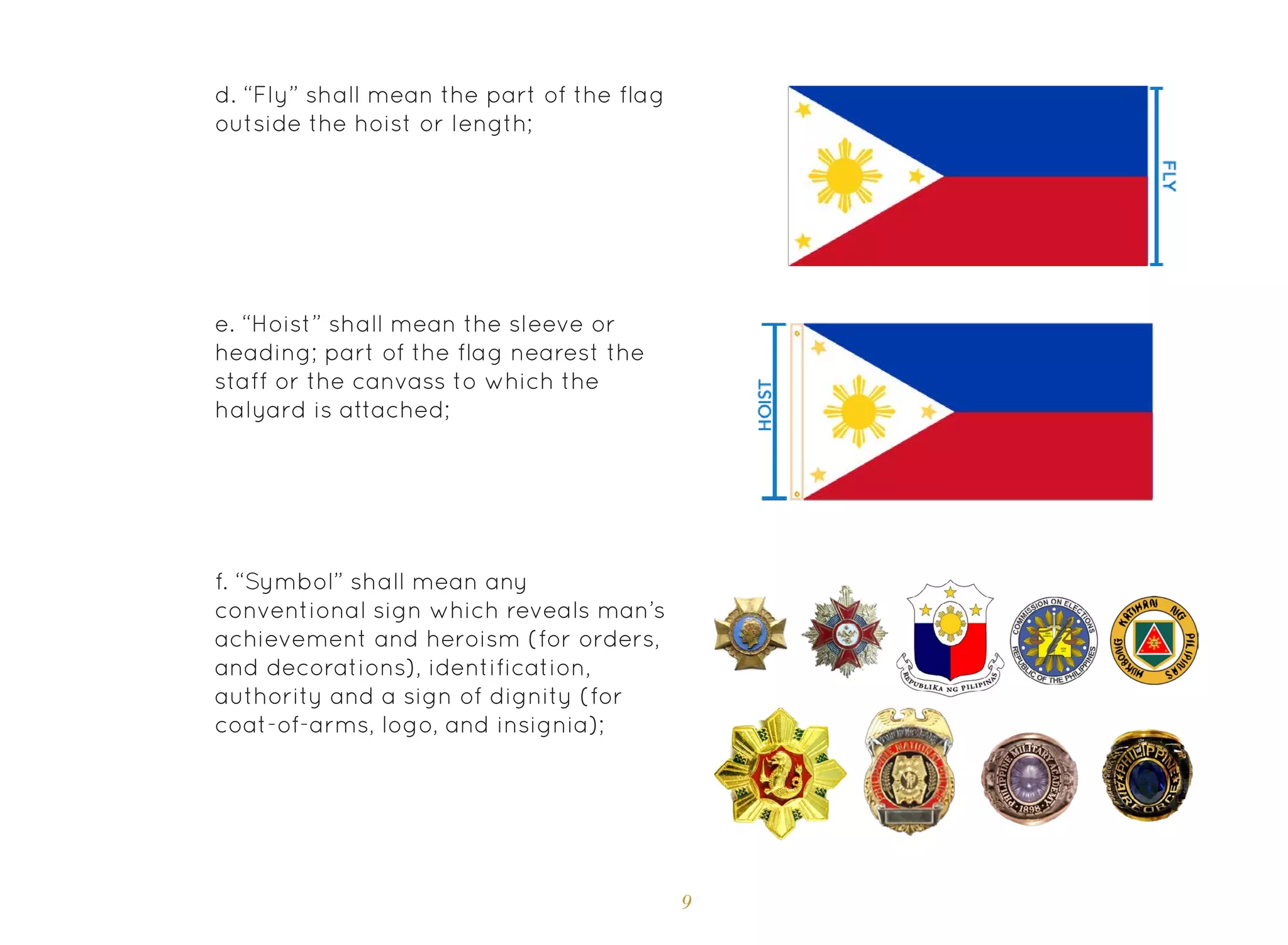
d. “Fly” shall mean the part of the flag
outside the hoist or length;
e. “Hoist” shall mean the sleeve or
heading; part of the flag nearest the
staff or the canvass to which the
halyard is attached;
f. “Symbol” shall mean any
conventional sign which reveals man’s
achievement and heroism (for orders,
and decorations), identification,
authority and a sign of dignity (for
coat-of-arms, logo, and insignia);
10
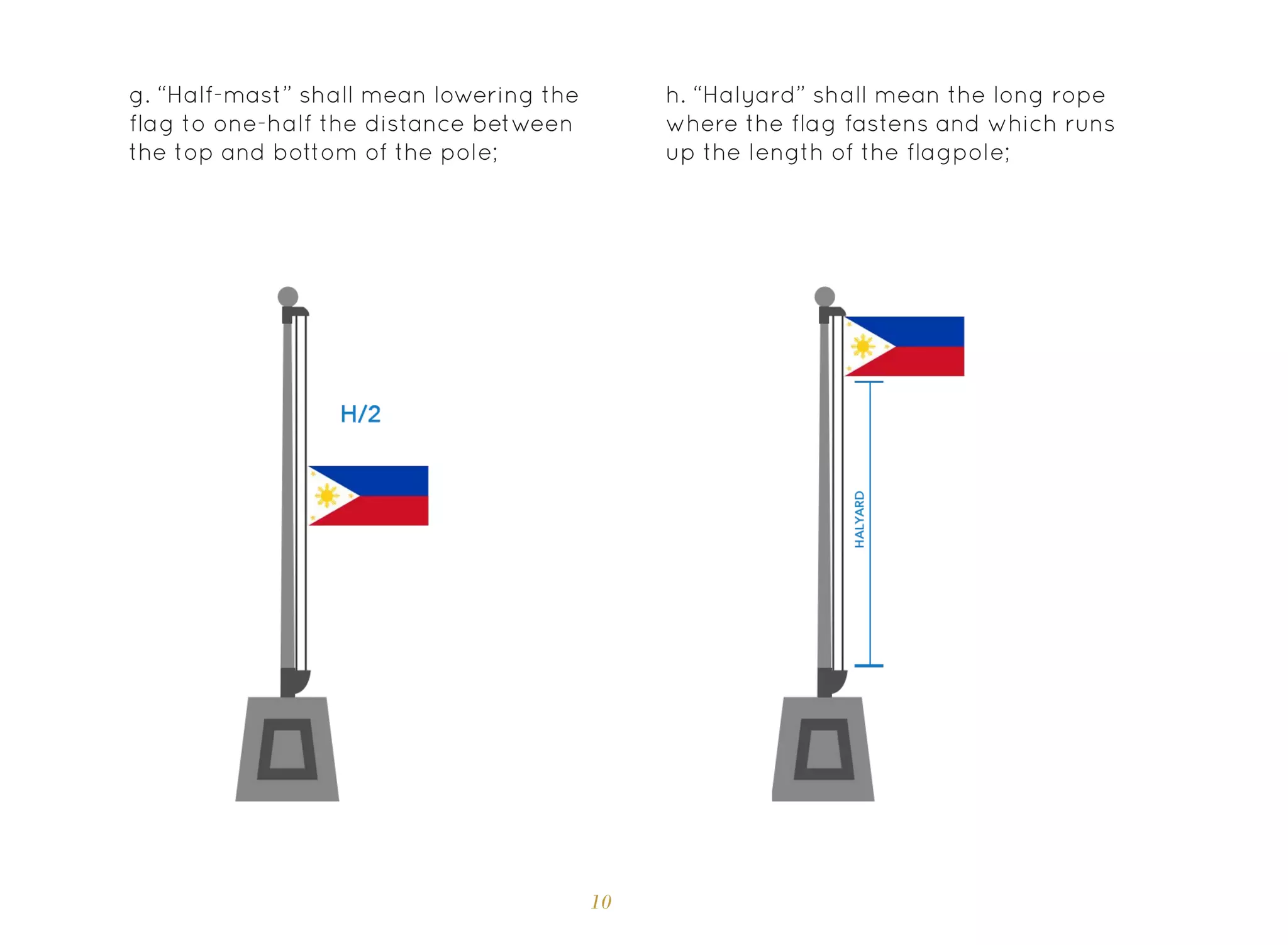
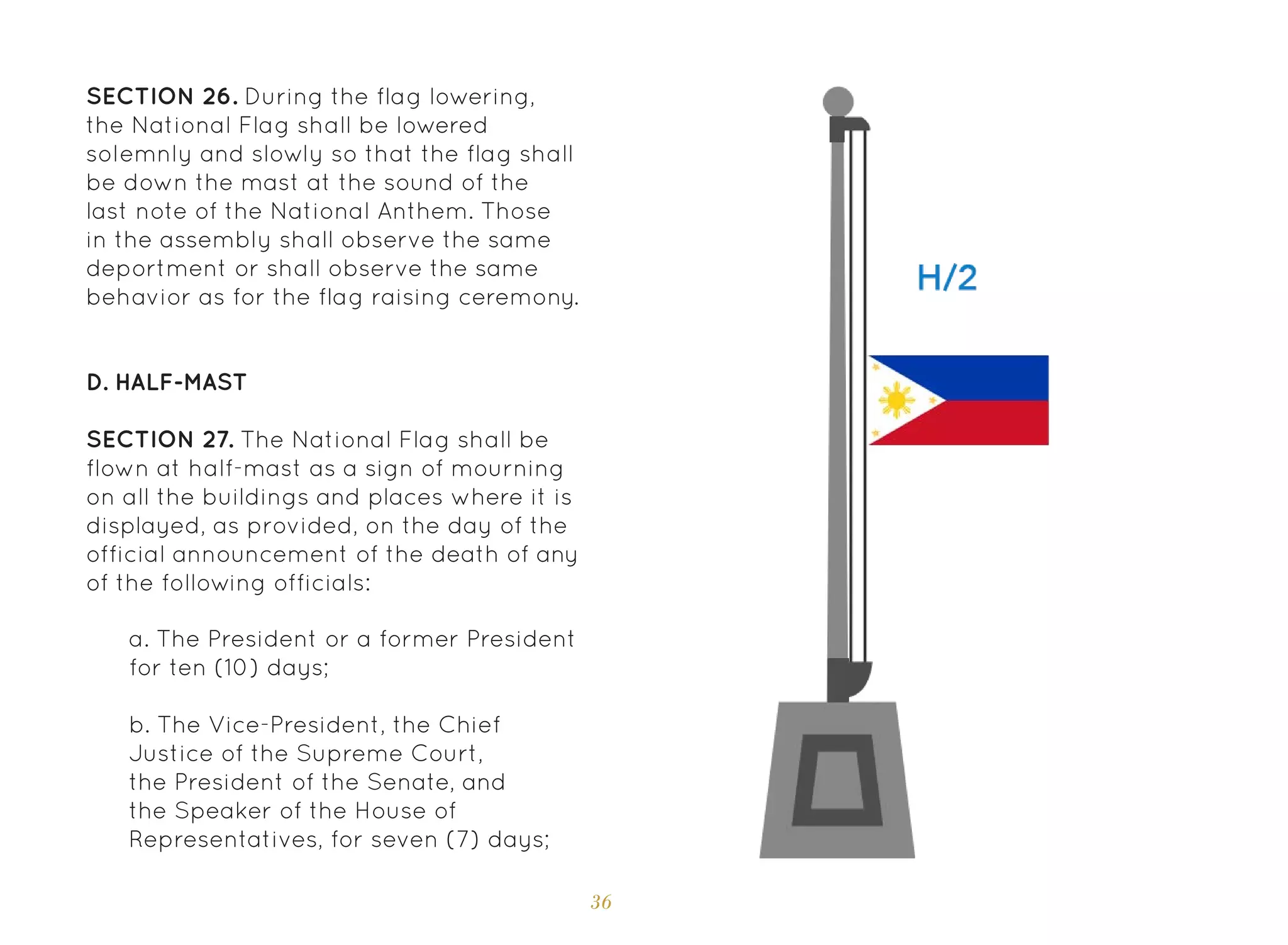
g. “Half-mast” shall mean lowering the
flag to one-half the distance between
the top and bottom of the pole;
h. “Halyard” shall mean the long rope
where the flag fastens and which runs
up the length of the flagpole;
11
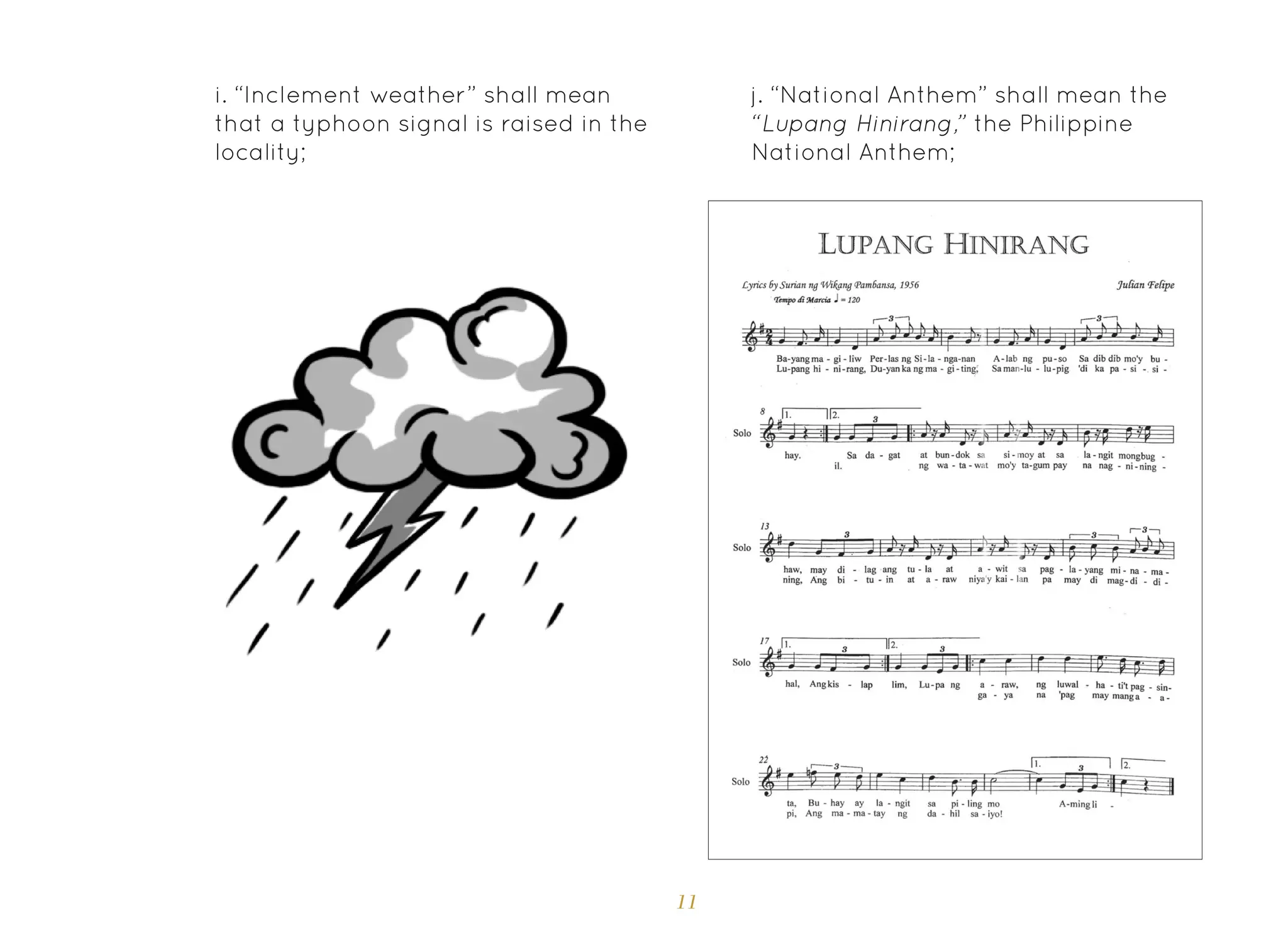
i. “Inclement weather” shall mean
that a typhoon signal is raised in the
locality;
j. “National Anthem” shall mean the
“Lupang Hinirang,” the Philippine
National Anthem;
12
l. “Places of frivolity” shall mean
places of hilarity marked by or
providing boisterous merriment or
recreation;
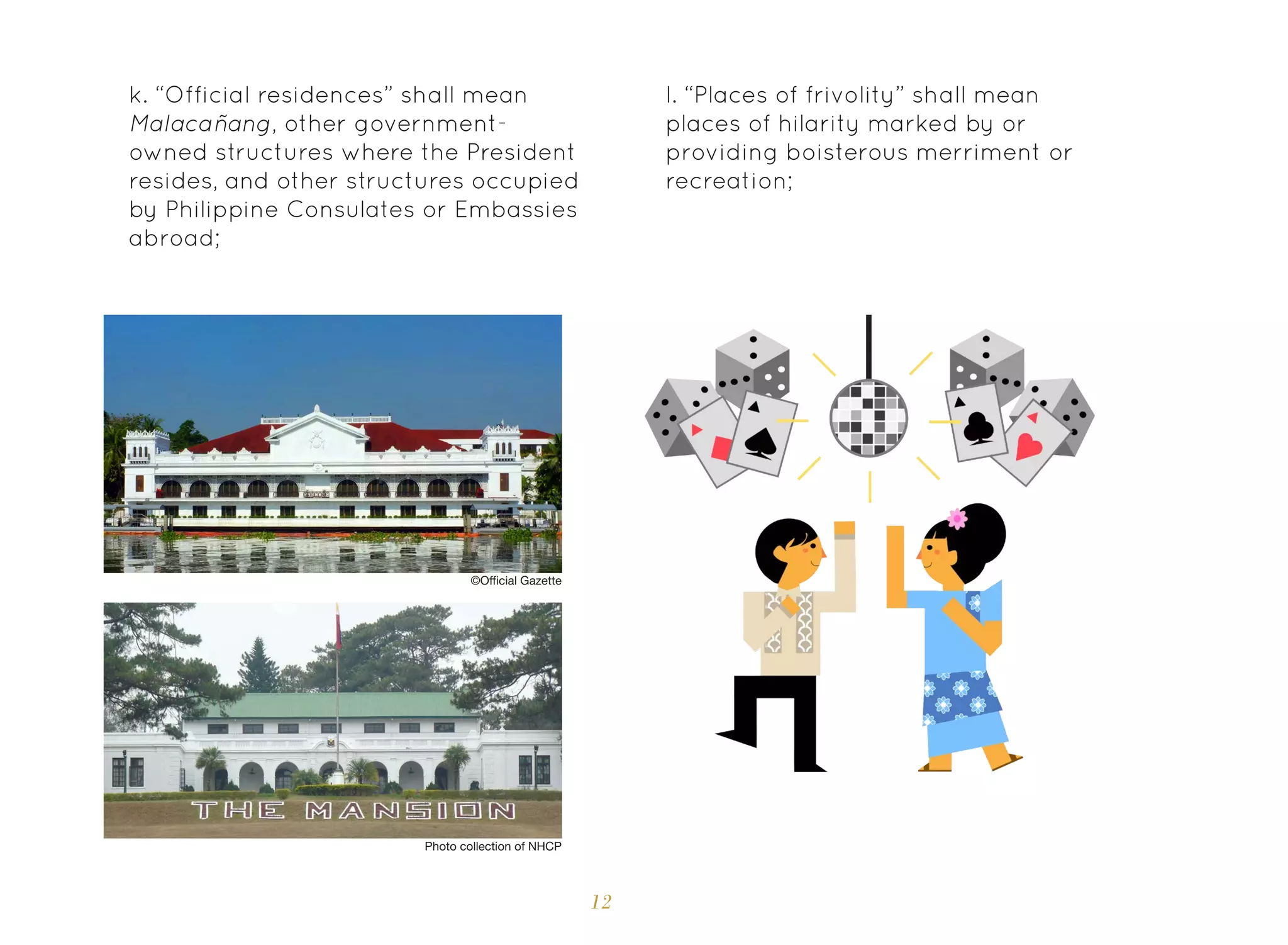
k. “Official residences” shall mean
Malacañang, other government-
owned structures where the President
resides, and other structures occupied
by Philippine Consulates or Embassies
abroad;
©Official Gazette
Photo collection of NHCP
13
m. “Advertisement or infomercial”
shall mean advertisements or any
information material in print, radio,
television, cinema, video, and the
like, outdoor and electronic media,
seeking to promote individuals,
entities, products or services for
commercial, political purposes or
information campaigns;
n. “Heraldic items and devices” shall
mean coat-of-arms, seals, logos,
insignia, badges, flashes, patches,
orders and decorations, medals,
stars, citations, lapel pins, trophies,
dry wax or wet seals, and imprints on
letterheads, envelopes, and cards;
14
o. “Government entities” shall mean
all branches of government, its
bureaus and attached agencies,
constitutional offices, local
government offices, government-
owned and/or controlled
corporations, government financial
institutions, state universities and
colleges, the Armed Forces of
the Philippines including its basic
component units; and
p. “Vexillary items” shall mean
national, local, house flags, or
administrative, institutional,
corporate, unit, and other
organizational banners.
15
rule 3 chapter i the national flag
A. DESIGN OF THE NATIONAL FLAG B. HOISTING AND DISPLAY OF THE
NATIONAL FLAG
SECTION 8. The National Flag shall be
blue, white, and red with an eight-rayed
golden-yellow sun, and three stars that
are five-pointed, as consecrated and
honored by the people.
SECTION 9. The National Flag shall be
displayed in all public buildings, official
residences, public plazas, and institutions
of learning everyday throughout the year.
16
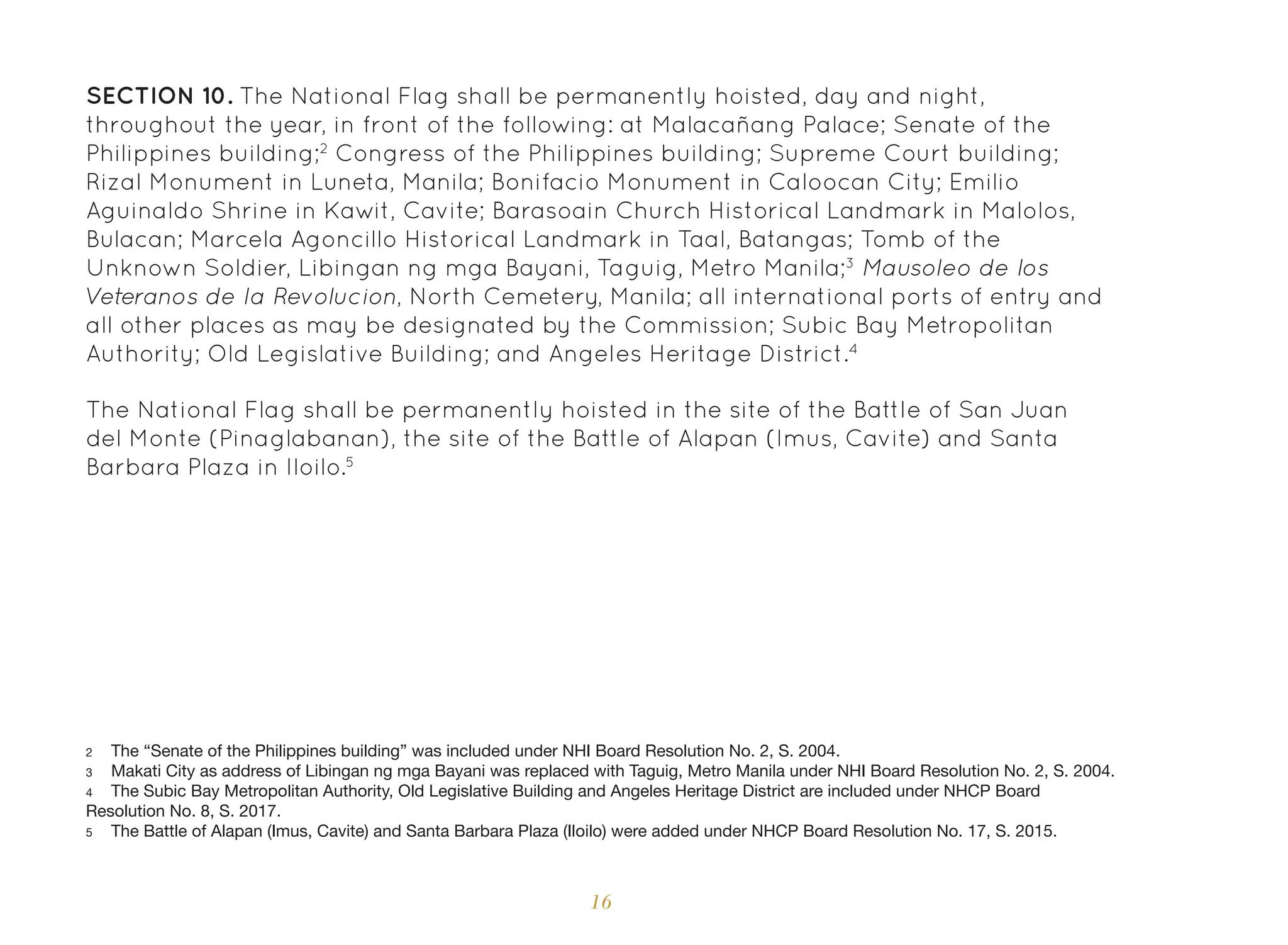
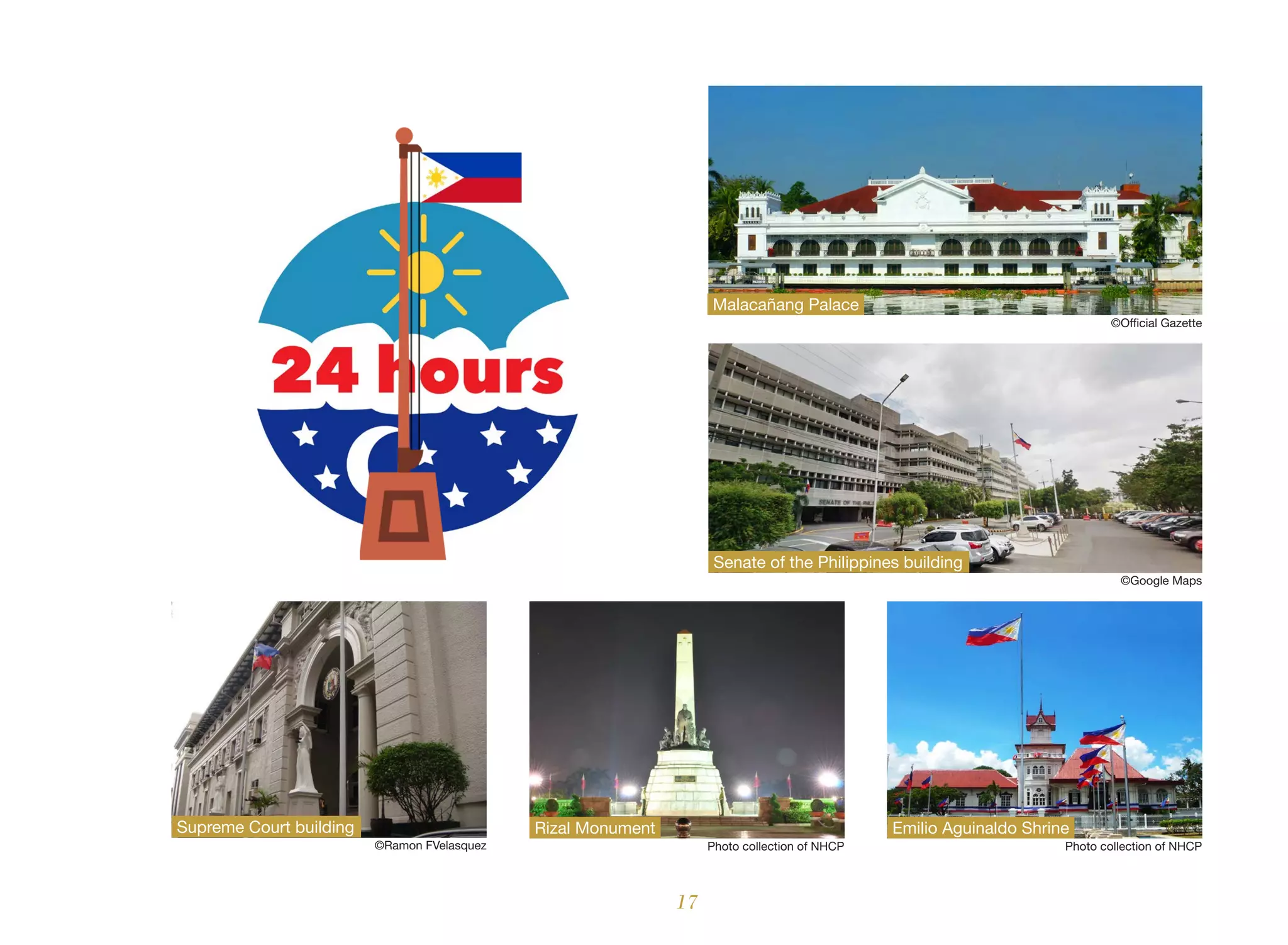
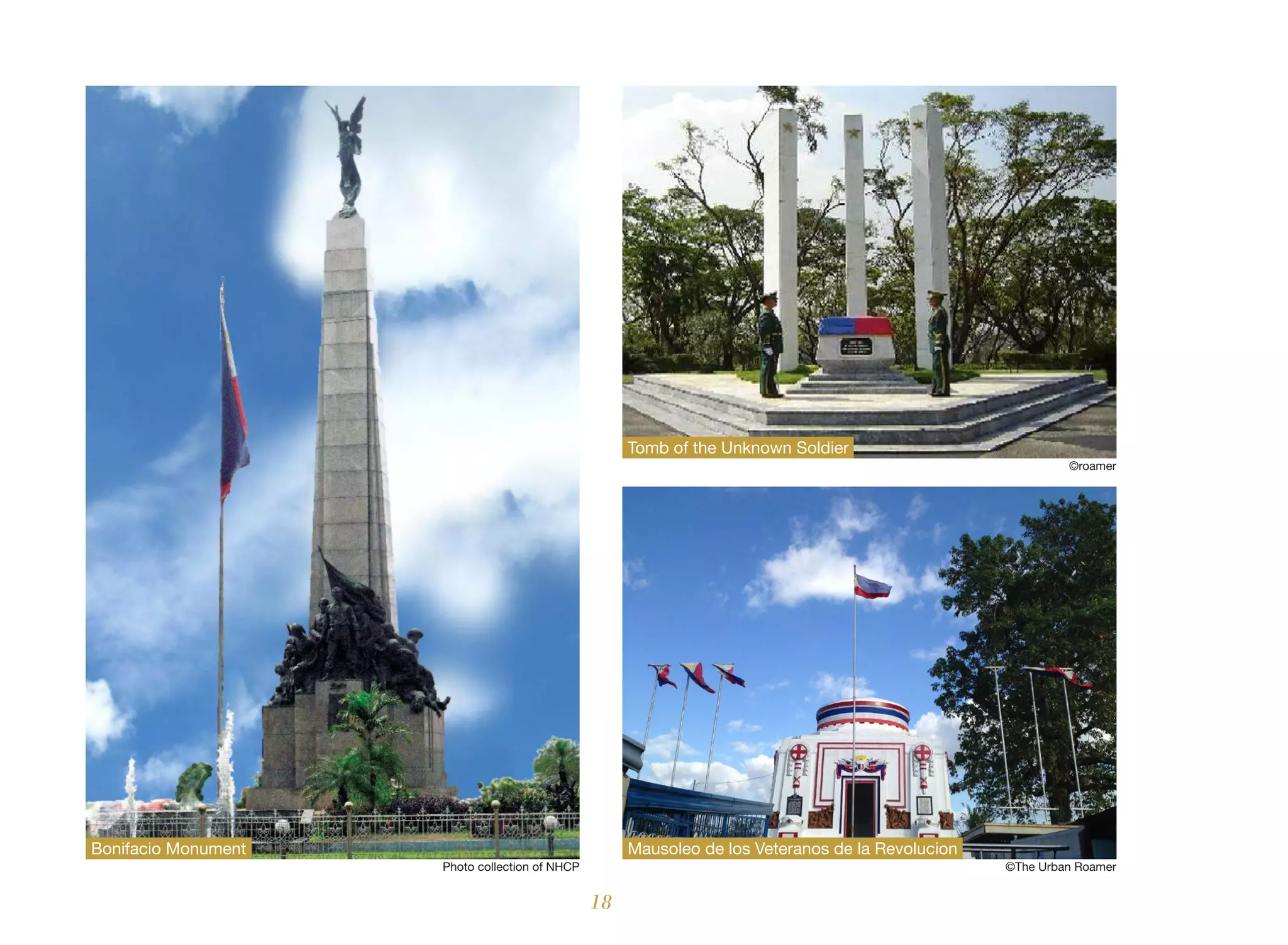
SECTION 10. The National Flag shall be permanently hoisted, day and night,
throughout the year, in front of the following: at Malacañang Palace; Senate of the
Philippines building;2
Congress of the Philippines building; Supreme Court building;
Rizal Monument in Luneta, Manila; Bonifacio Monument in Caloocan City; Emilio
Aguinaldo Shrine in Kawit, Cavite; Barasoain Church Historical Landmark in Malolos,
Bulacan; Marcela Agoncillo Historical Landmark in Taal, Batangas; Tomb of the
Unknown Soldier, Libingan ng mga Bayani, Taguig, Metro Manila;3
Mausoleo de los
Veteranos de la Revolucion, North Cemetery, Manila; all international ports of entry and
all other places as may be designated by the Commission; Subic Bay Metropolitan
Authority; Old Legislative Building; and Angeles Heritage District.4
The National Flag shall be permanently hoisted in the site of the Battle of San Juan
del Monte (Pinaglabanan), the site of the Battle of Alapan (Imus, Cavite) and Santa
Barbara Plaza in Iloilo.5
2 The “Senate of the Philippines building” was included under NHI Board Resolution No. 2, S. 2004.
3 Makati City as address of Libingan ng mga Bayani was replaced with Taguig, Metro Manila under NHI Board Resolution No. 2, S. 2004.
4 The Subic Bay Metropolitan Authority, Old Legislative Building and Angeles Heritage District are included under NHCP Board
Resolution No. 8, S. 2017.
5 The Battle of Alapan (Imus, Cavite) and Santa Barbara Plaza (Iloilo) were added under NHCP Board Resolution No. 17, S. 2015.
17
Malacañang Palace
Senate of the Philippines building
Emilio Aguinaldo Shrine
Rizal Monument
Supreme Court building
©Official Gazette
©Google Maps
©Ramon FVelasquez Photo collection of NHCP Photo collection of NHCP
18
Bonifacio Monument
Tomb of the Unknown Soldier
Mausoleo de los Veteranos de la Revolucion
©roamer
©The Urban Roamer
Photo collection of NHCP
19
Battle of San Juan del Monte (Pinaglabanan)
Ninoy Aquino International Airport
Subic Bay Metropolitan Authority
Marcela Agoncillo Historical Landmark Barasoain Church Historical Landmark Batasang Pambansa Complex
Photo collection of NHCP
©Google Maps
©Subic Bay Metropolitan Authority
Photo collection of NHCP Photo collection of NHCP ©House of Representatives of the Philippines
20
Santa Barbara Plaza
Pamintuan Mansion (Angeles Heritage District)
Battle of Alapan
Old Legislative Building
©Dadi Yrec
Photo collection of NHCP
©Judgefloro
©Santa Barbara
21
SECTION 11. The National Flag shall also be displayed in private buildings and
residences or raised in the open flagstaffs in front of said buildings every April 9
(Araw ng Kagitingan); May 1 (Labor Day); National Flag Days from May 28 to June
12 (Independence Day); last Sunday of August (National Heroes Day); November 30
(Bonifacio Day); and December 30 (Rizal Day); and on such other days as may be
declared or approved by the President and/or local chief executives.
The National Flag may also be raised and displayed at sunrise and lowered at sunset
and throughout the year in the open flagstaff in front of private buildings: Provided,
that proper flag ceremonies be observed in accordance with these Rules.
SECTION 12. All government entities should observe flag days with appropriate
ceremonies. Socio-civic groups, non-government organizations, and the private sector
are enjoined to observe and cooperate in making the celebration a success.
22
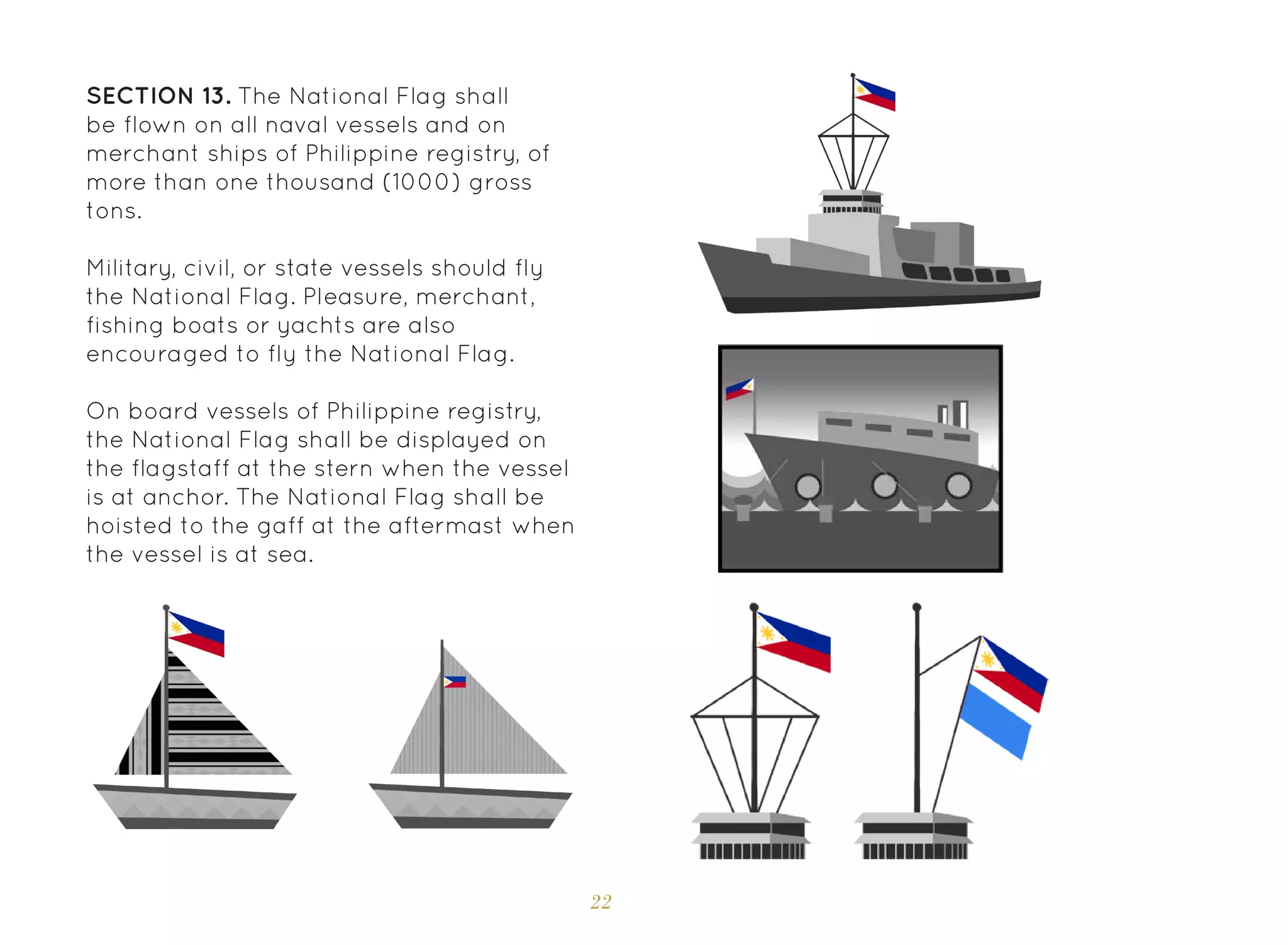
SECTION 13. The National Flag shall
be flown on all naval vessels and on
merchant ships of Philippine registry, of
more than one thousand (1000) gross
tons.
Military, civil, or state vessels should fly
the National Flag. Pleasure, merchant,
fishing boats or yachts are also
encouraged to fly the National Flag.
On board vessels of Philippine registry,
the National Flag shall be displayed on
the flagstaff at the stern when the vessel
is at anchor. The National Flag shall be
hoisted to the gaff at the aftermast when
the vessel is at sea.
23
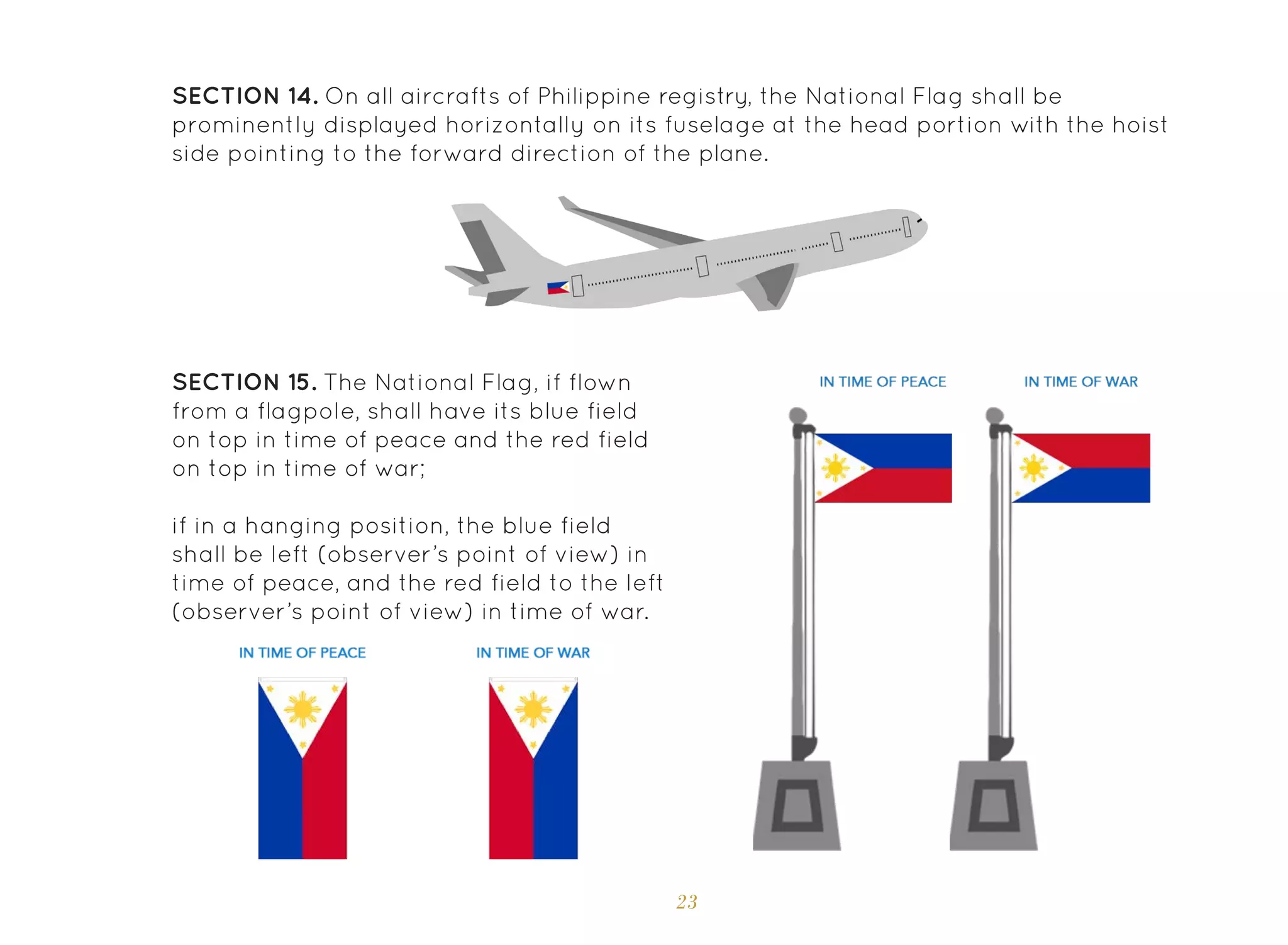
SECTION 14. On all aircrafts of Philippine registry, the National Flag shall be
prominently displayed horizontally on its fuselage at the head portion with the hoist
side pointing to the forward direction of the plane.
SECTION 15. The National Flag, if flown
from a flagpole, shall have its blue field
on top in time of peace and the red field
on top in time of war;
if in a hanging position, the blue field
shall be left (observer’s point of view) in
time of peace, and the red field to the left
(observer’s point of view) in time of war.
24
SECTION 16. If planted on the ground, the
flagpole shall be at a prominent place
and shall be of such height as would give
the National Flag commanding position
in relation to the buildings in the vicinity.
The flagpole must not be of equal
height or higher than the Independence
Flagpole at the Rizal Park, Manila.6
6 The flag pole, measuring 107 ft., was replaced with a 150 ft. pole with a mechanized pulley in 2013.
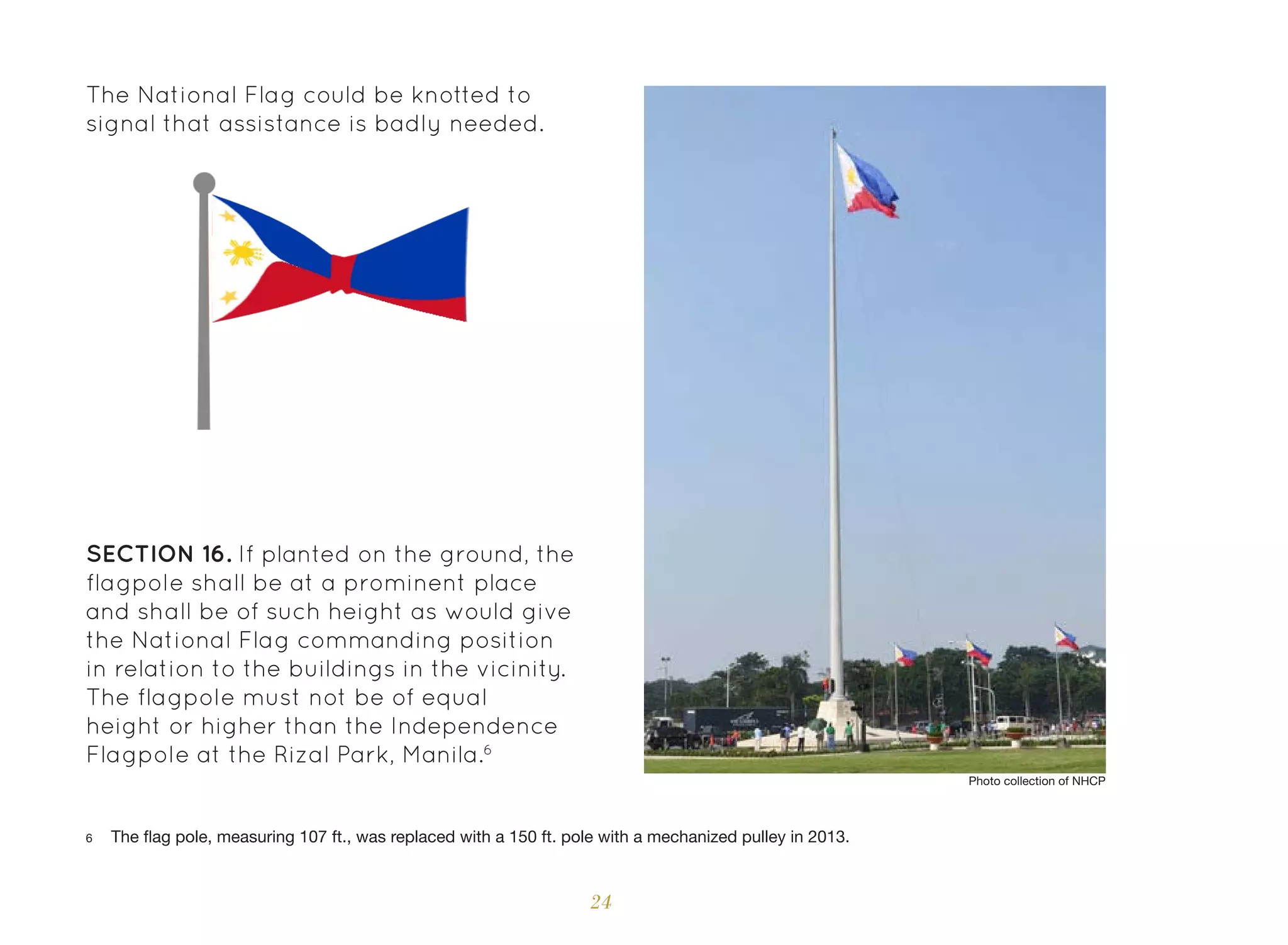
The National Flag could be knotted to
signal that assistance is badly needed.
Photo collection of NHCP
25
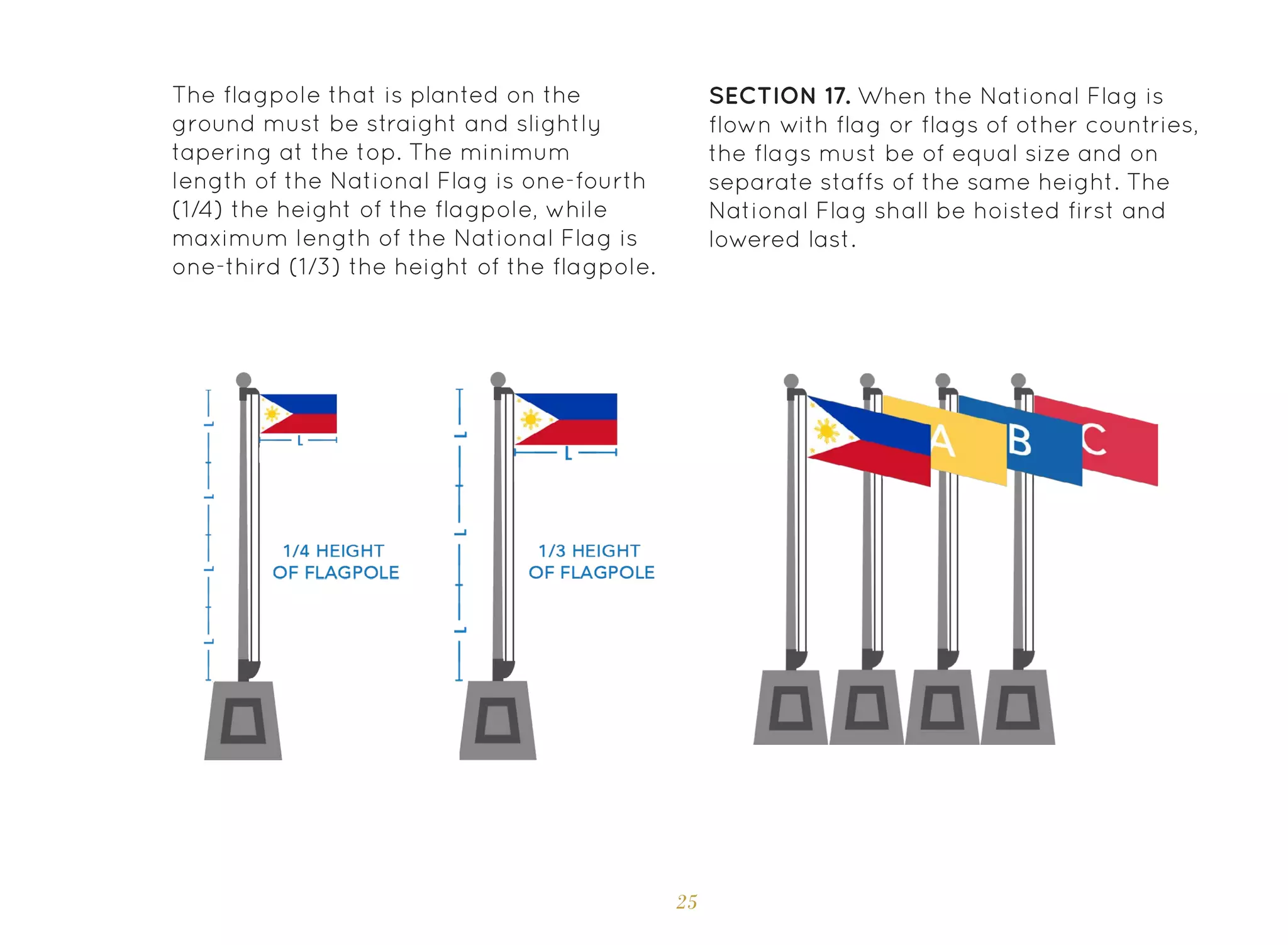
The flagpole that is planted on the
ground must be straight and slightly
tapering at the top. The minimum
length of the National Flag is one-fourth
(1/4) the height of the flagpole, while
maximum length of the National Flag is
one-third (1/3) the height of the flagpole.
SECTION 17. When the National Flag is
flown with flag or flags of other countries,
the flags must be of equal size and on
separate staffs of the same height. The
National Flag shall be hoisted first and
lowered last.
26
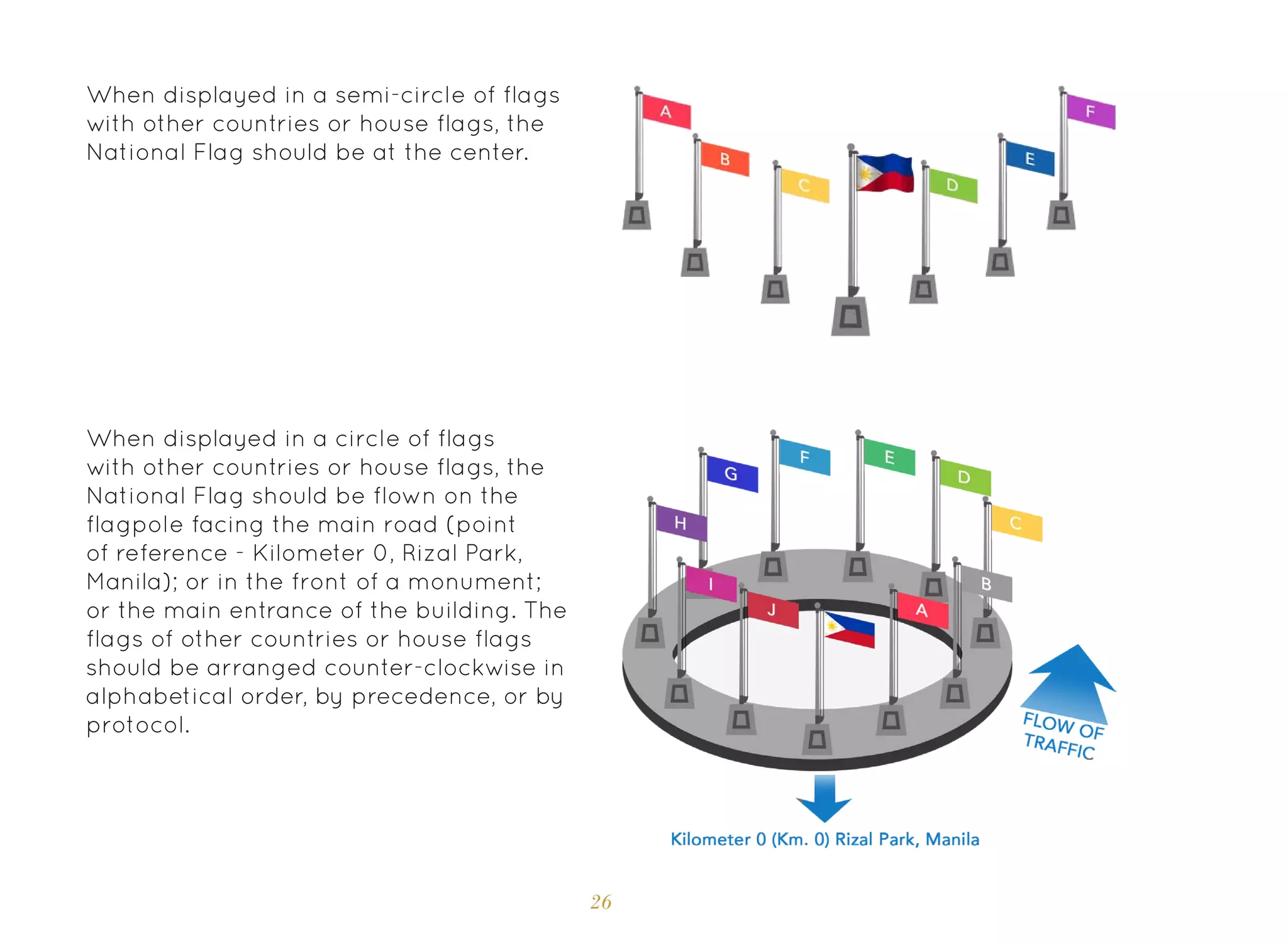
When displayed in a semi-circle of flags
with other countries or house flags, the
National Flag should be at the center.
When displayed in a circle of flags
with other countries or house flags, the
National Flag should be flown on the
flagpole facing the main road (point
of reference - Kilometer 0, Rizal Park,
Manila); or in the front of a monument;
or the main entrance of the building. The
flags of other countries or house flags
should be arranged counter-clockwise in
alphabetical order, by precedence, or by
protocol.
27
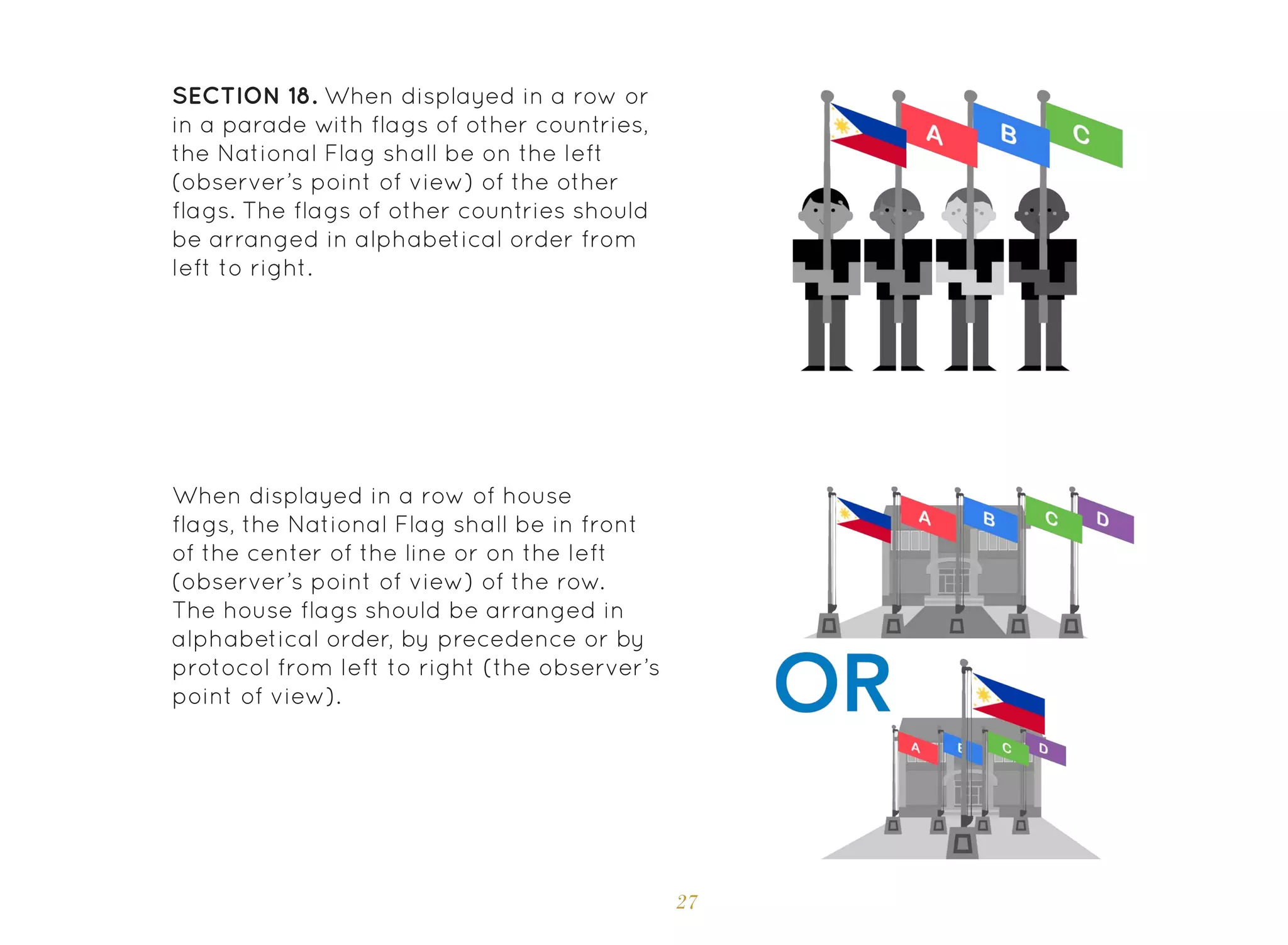
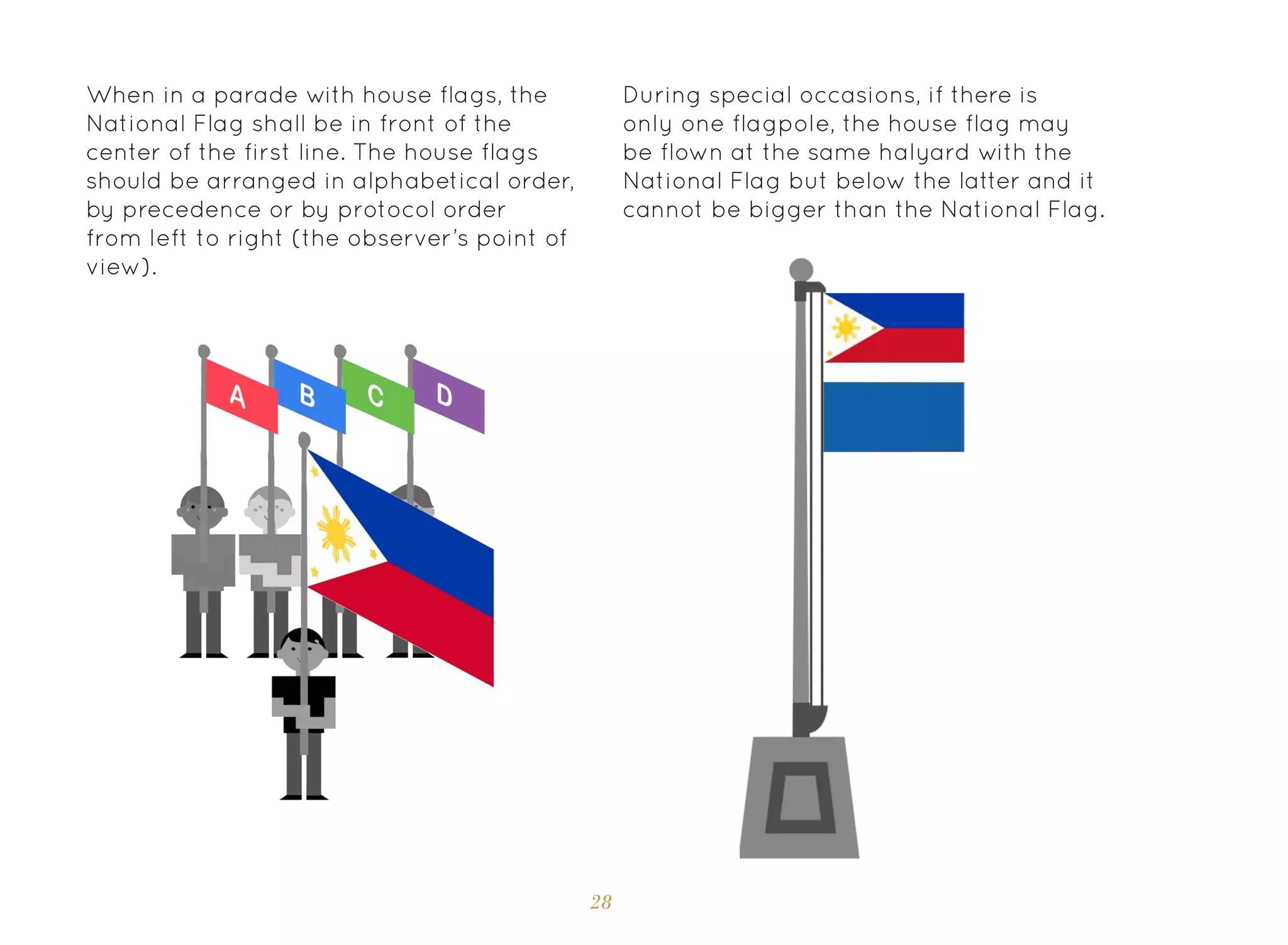
SECTION 18. When displayed in a row or
in a parade with flags of other countries,
the National Flag shall be on the left
(observer’s point of view) of the other
flags. The flags of other countries should
be arranged in alphabetical order from
left to right.
When displayed in a row of house
flags, the National Flag shall be in front
of the center of the line or on the left
(observer’s point of view) of the row.
The house flags should be arranged in
alphabetical order, by precedence or by
protocol from left to right (the observer’s
point of view).
28
When in a parade with house flags, the
National Flag shall be in front of the
center of the first line. The house flags
should be arranged in alphabetical order,
by precedence or by protocol order
from left to right (the observer’s point of
view).
During special occasions, if there is
only one flagpole, the house flag may
be flown at the same halyard with the
National Flag but below the latter and it
cannot be bigger than the National Flag.
29
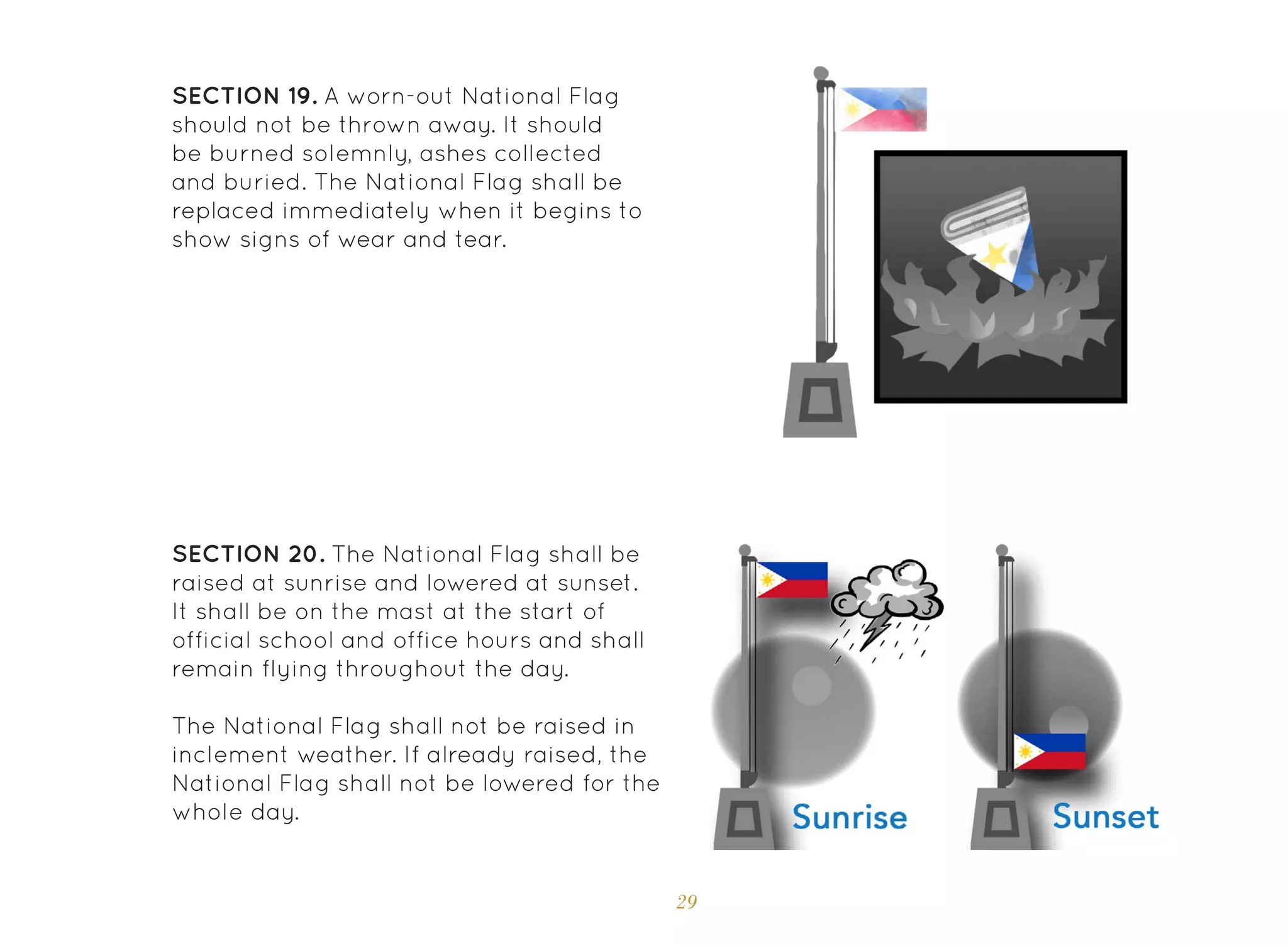
SECTION 19. A worn-out National Flag
should not be thrown away. It should
be burned solemnly, ashes collected
and buried. The National Flag shall be
replaced immediately when it begins to
show signs of wear and tear.
SECTION 20. The National Flag shall be
raised at sunrise and lowered at sunset.
It shall be on the mast at the start of
official school and office hours and shall
remain flying throughout the day.
The National Flag shall not be raised in
inclement weather. If already raised, the
National Flag shall not be lowered for the
whole day.
30
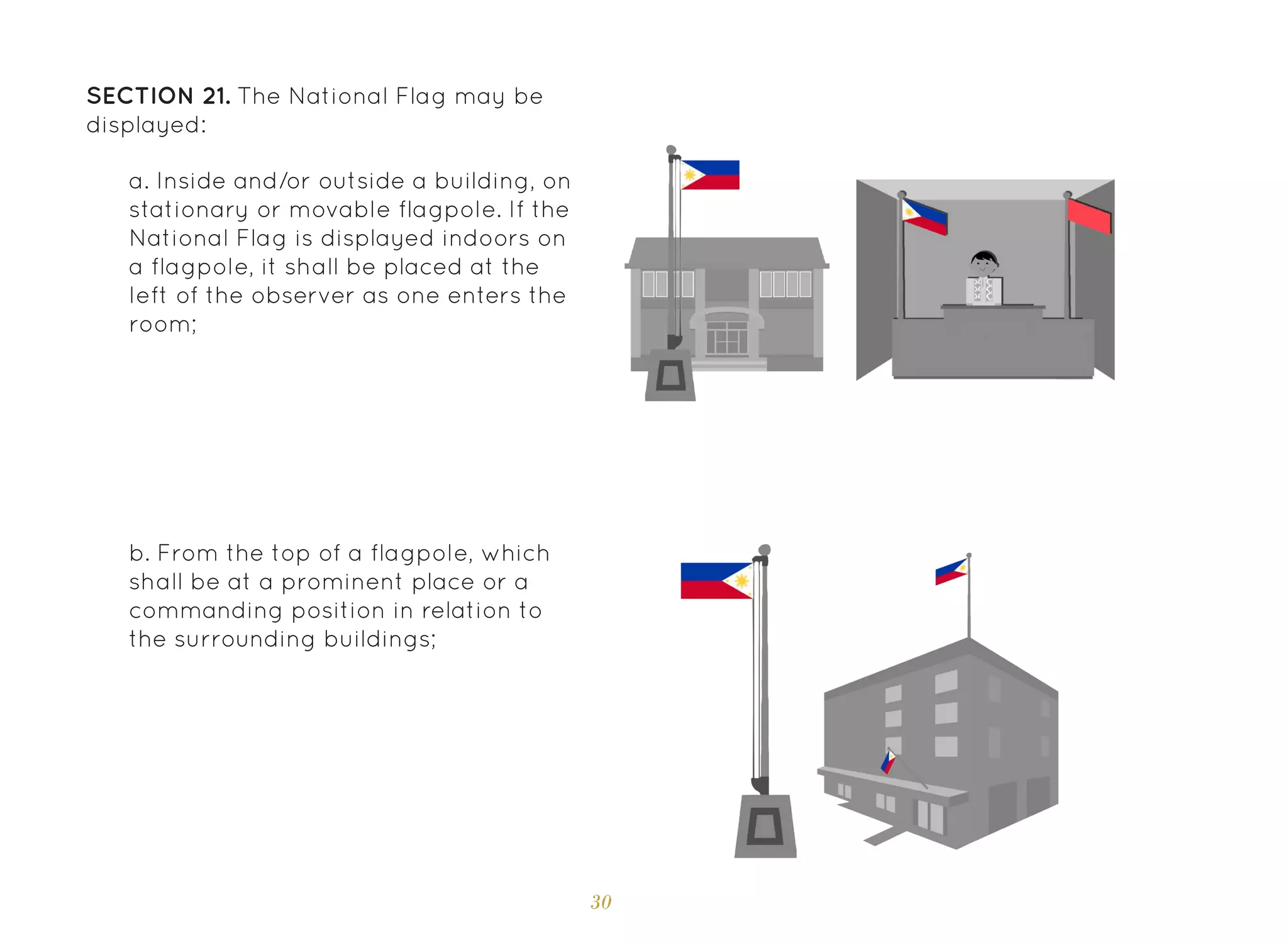
SECTION 21. The National Flag may be
displayed:
a. Inside and/or outside a building, on
stationary or movable flagpole. If the
National Flag is displayed indoors on
a flagpole, it shall be placed at the
left of the observer as one enters the
room;
b. From the top of a flagpole, which
shall be at a prominent place or a
commanding position in relation to
the surrounding buildings;
31
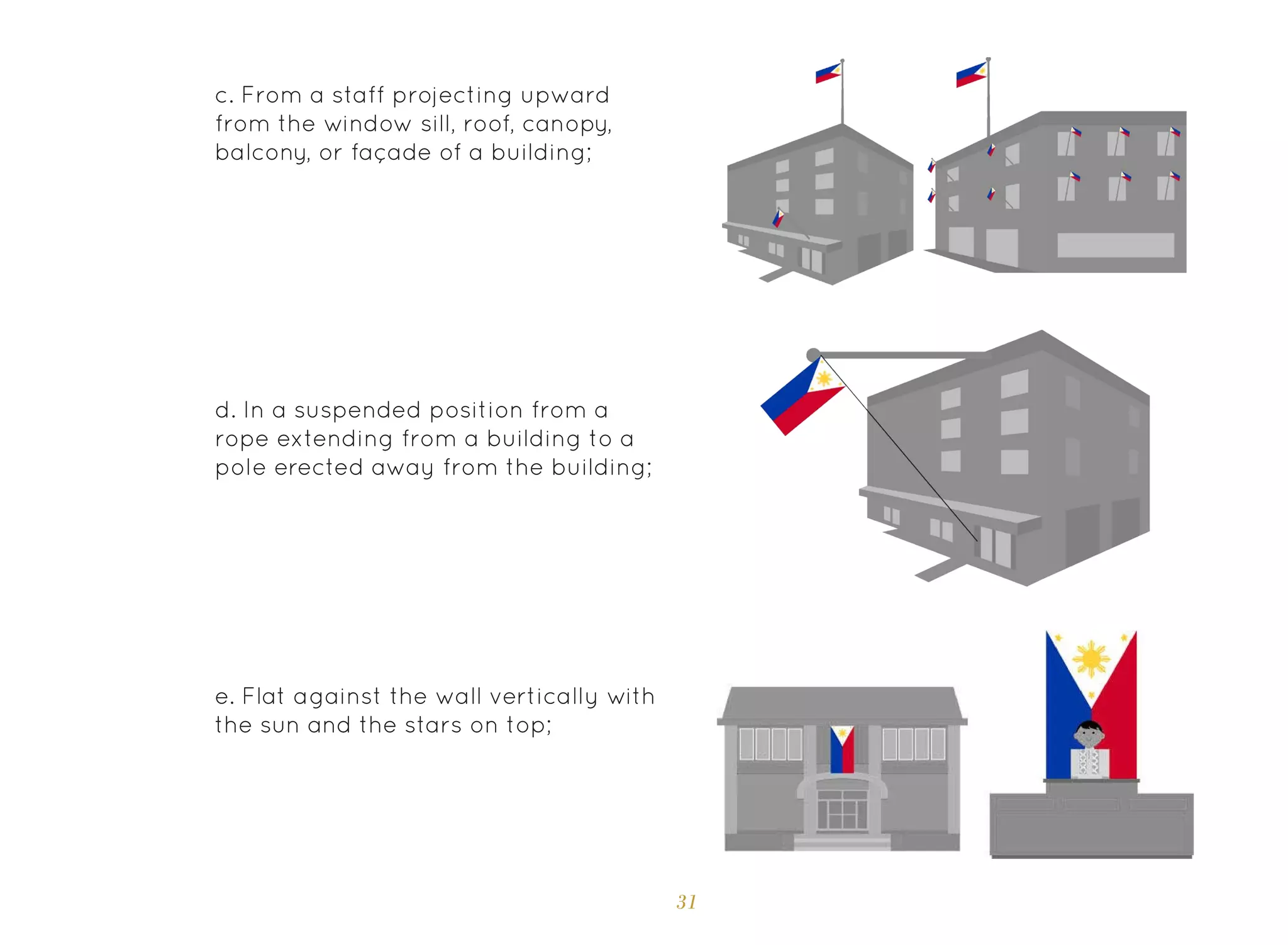
c. From a staff projecting upward
from the window sill, roof, canopy,
balcony, or façade of a building;
d. In a suspended position from a
rope extending from a building to a
pole erected away from the building;
e. Flat against the wall vertically with
the sun and the stars on top;
32
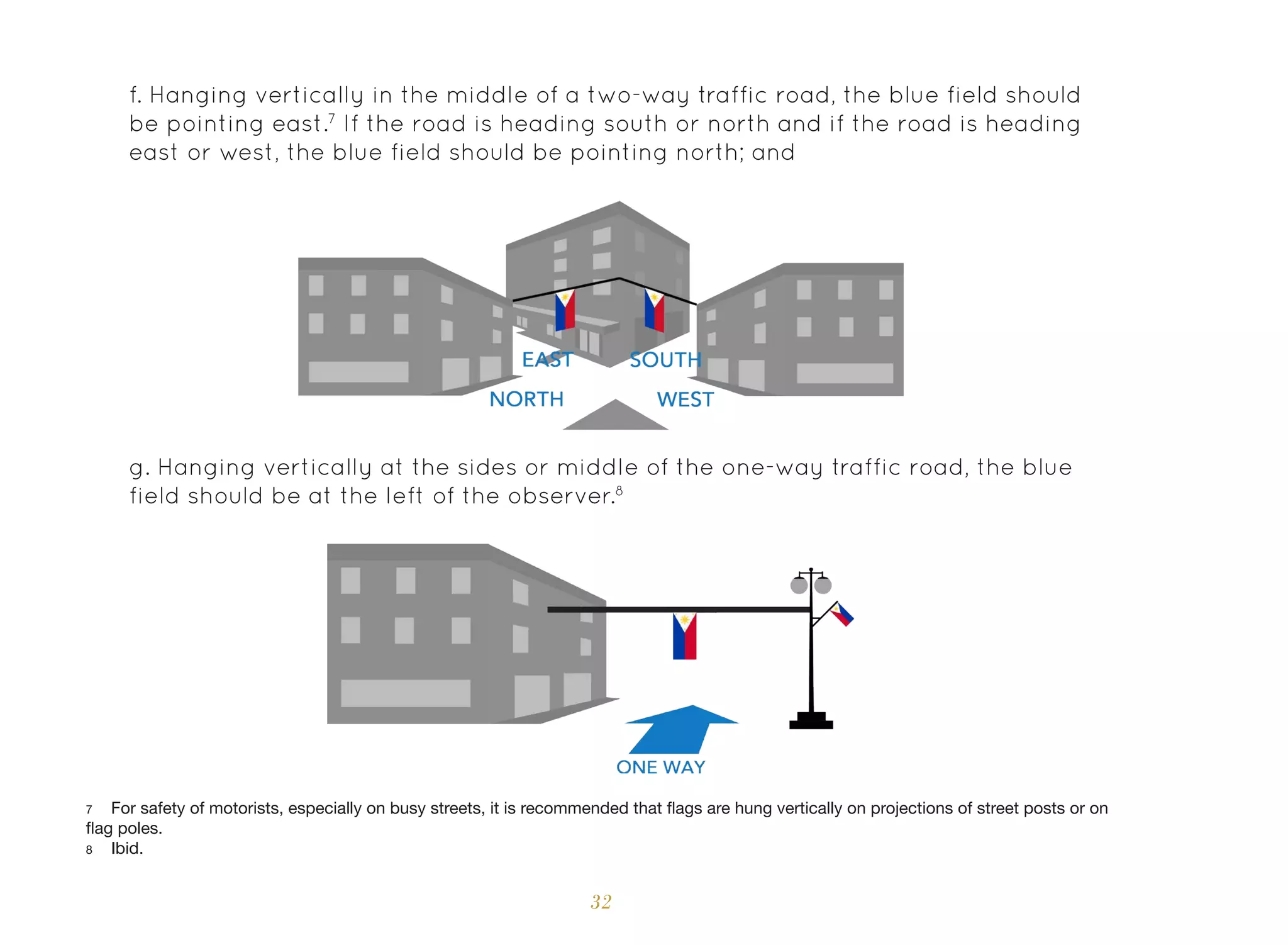
f. Hanging vertically in the middle of a two-way traffic road, the blue field should
be pointing east.7
If the road is heading south or north and if the road is heading
east or west, the blue field should be pointing north; and
g. Hanging vertically at the sides or middle of the one-way traffic road, the blue
field should be at the left of the observer.8
7 For safety of motorists, especially on busy streets, it is recommended that flags are hung vertically on projections of street posts or on
flag poles.
8 Ibid.
33
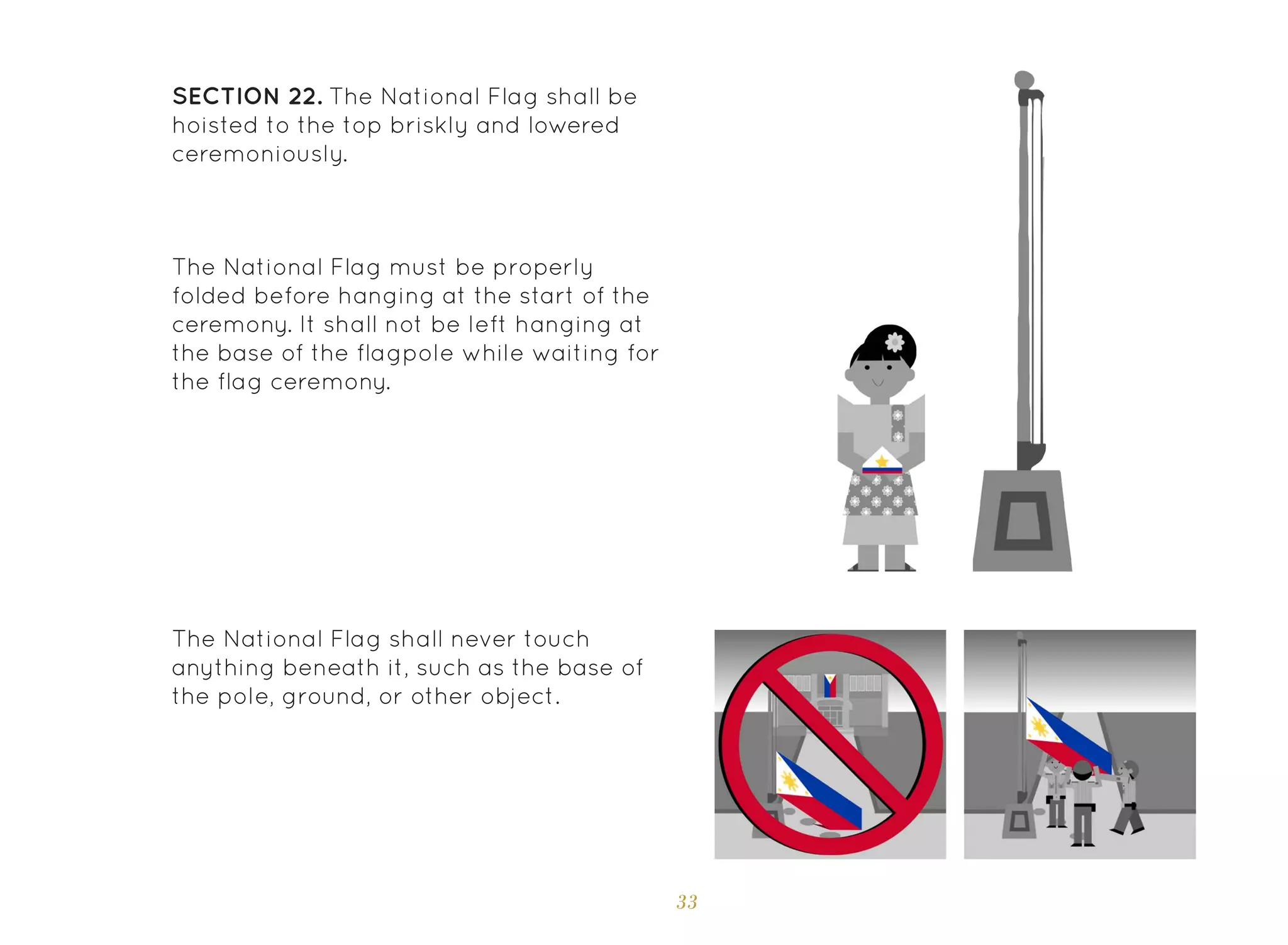
SECTION 22. The National Flag shall be
hoisted to the top briskly and lowered
ceremoniously.
The National Flag shall never touch
anything beneath it, such as the base of
the pole, ground, or other object.
The National Flag must be properly
folded before hanging at the start of the
ceremony. It shall not be left hanging at
the base of the flagpole while waiting for
the flag ceremony.
34
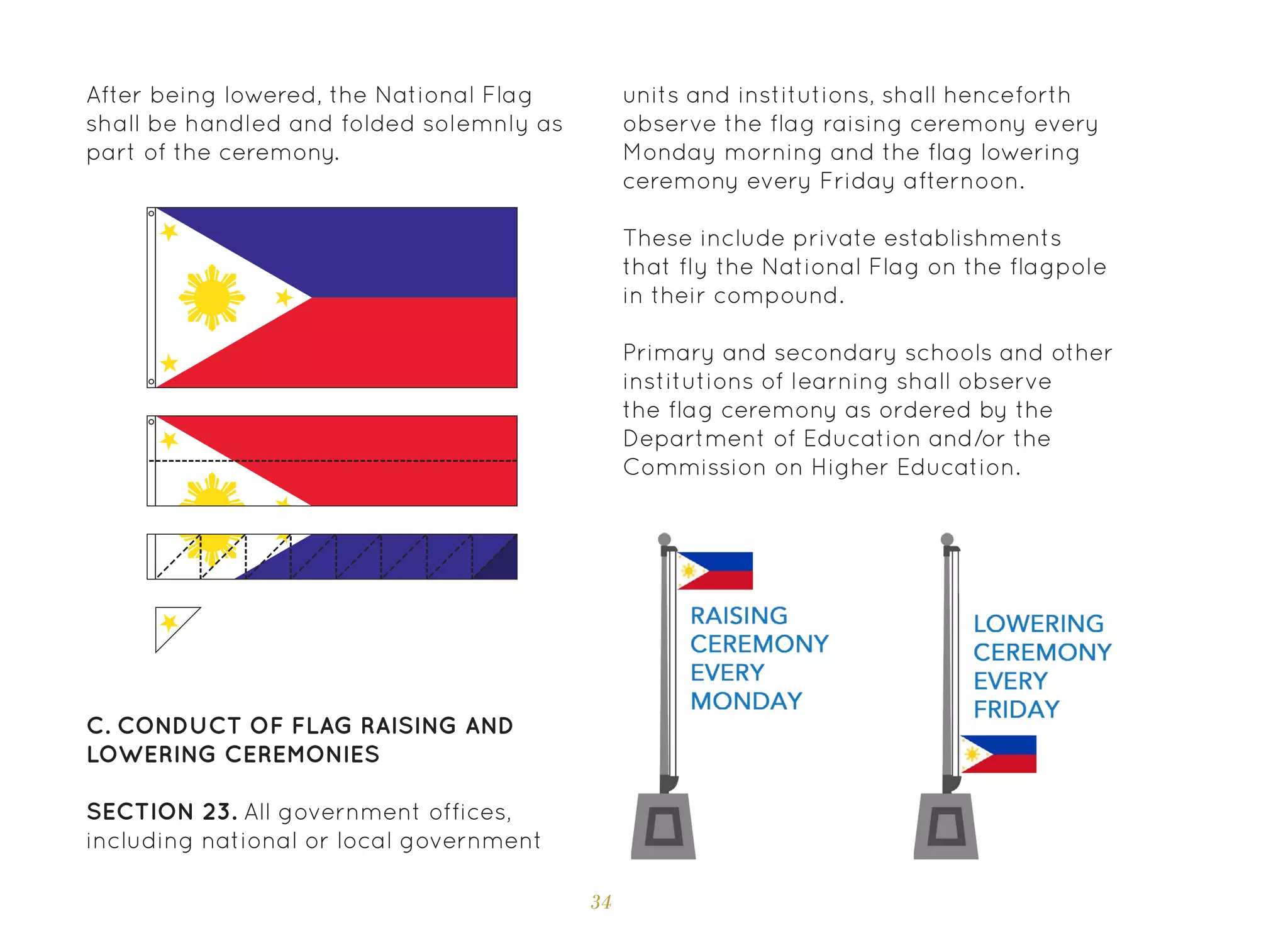
C. Conduct of Flag Raising and
Lowering Ceremonies
SECTION 23. All government offices,
including national or local government
units and institutions, shall henceforth
observe the flag raising ceremony every
Monday morning and the flag lowering
ceremony every Friday afternoon.
These include private establishments
that fly the National Flag on the flagpole
in their compound.
Primary and secondary schools and other
institutions of learning shall observe
the flag ceremony as ordered by the
Department of Education and/or the
Commission on Higher Education.
After being lowered, the National Flag
shall be handled and folded solemnly as
part of the ceremony.
35
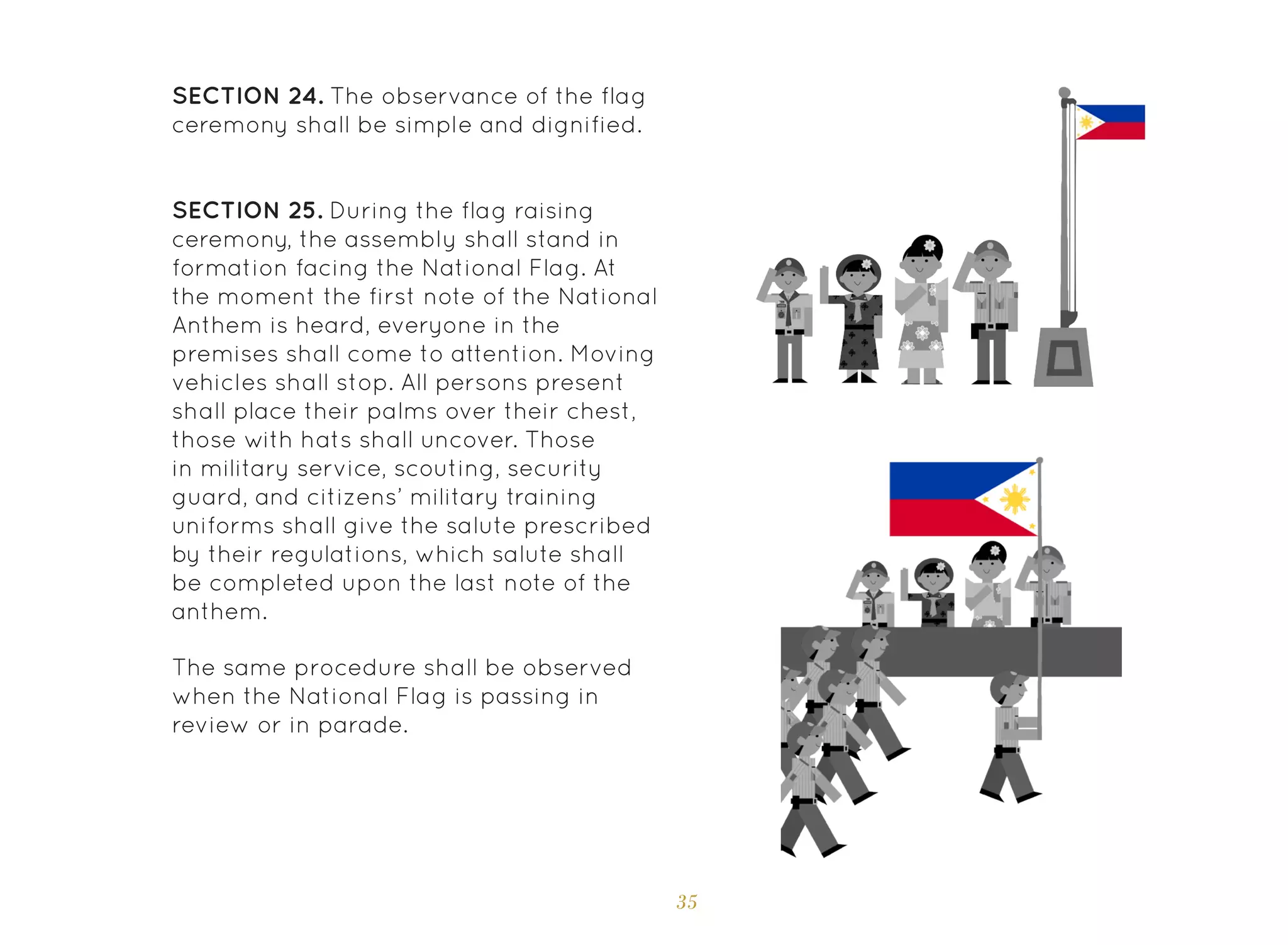
SECTION 24. The observance of the flag
ceremony shall be simple and dignified.
SECTION 25. During the flag raising
ceremony, the assembly shall stand in
formation facing the National Flag. At
the moment the first note of the National
Anthem is heard, everyone in the
premises shall come to attention. Moving
vehicles shall stop. All persons present
shall place their palms over their chest,
those with hats shall uncover. Those
in military service, scouting, security
guard, and citizens’ military training
uniforms shall give the salute prescribed
by their regulations, which salute shall
be completed upon the last note of the
anthem.
The same procedure shall be observed
when the National Flag is passing in
review or in parade.
36
SECTION 26. During the flag lowering,
the National Flag shall be lowered
solemnly and slowly so that the flag shall
be down the mast at the sound of the
last note of the National Anthem. Those
in the assembly shall observe the same
deportment or shall observe the same
behavior as for the flag raising ceremony.
D. Half-Mast
SECTION 27. The National Flag shall be
flown at half-mast as a sign of mourning
on all the buildings and places where it is
displayed, as provided, on the day of the
official announcement of the death of any
of the following officials:
a. The President or a former President
for ten (10) days;
b. The Vice-President, the Chief
Justice of the Supreme Court,
the President of the Senate, and
the Speaker of the House of
Representatives, for seven (7) days;
37
c. Cabinet Secretaries, Associate
Justices of the Supreme Court,
Members of the Senate and House
of Representatives, the Chief of
Staff of the Armed Forces of the
Philippines, and the Director-General
of the Philippine National Police, or
equivalent in rank,9
for five (5) days;
d. Heads of National Government
Agencies, including Government-
Owned and Controlled Corporations
and Government Financial
Institutions, or equivalent in rank,10
for
three (3) days;
e. The Commanding Generals of the
Philippine Air Force and the Philippine
Army, the Flag Officer in Command of
the Philippine Navy, or equivalent in
rank,11
for three (3) days;
f. Governors, vice-governors, city and
municipal mayors, city and municipal
vice mayors, for three (3) days;
g. Members of the Sangguniang
Panlalawigan, Sangguniang
Panglungsod, and Sangguniang
Bayan, on the day of interment;
h. Veterans of the previous wars,12
barangay chairmen, and the
barangay councilmen on the day of
interment;
i. Former national or local
government officials, appointed or
elected, other than those specified
above, on the day of interment, within
their former respective territorial
jurisdictions and by resolution of their
respective Sanggunians;
9 The phrase “or equivalent in rank,” was added under NHI Board Resolution No. 2, S. 2004. See Appendix No. 17.
10 Ibid.
11 Ibid.
12 The phrase “Veterans of the previous wars” was added under NHI Board Resolution No. 2, S. 2004. See Appendix No. 17.
38
j. Regional directors, superintendents,
supervisors, principals, teachers, and
other school officials, on the day of
interment and by order of the proper
school authorities concerned;
k. Recipients of national orders and
decorations, on the day of interment
and by order of the President or
Congress; and
l. Other persons to be determined by
the Commission, including the former
Vice-President, the Chief Justice of
the Supreme Court, the President
of the Senate, and the Speaker of
the House of Representatives13
for a
period of less than seven (7) days.
In cases “c” to “e”, the National Flag
shall be flown at half-mast in front of
the building where the deceased official
held office and in cases “f” to “h”, through
Sanggunian Resolution or by order of the
Local Chief Executive.
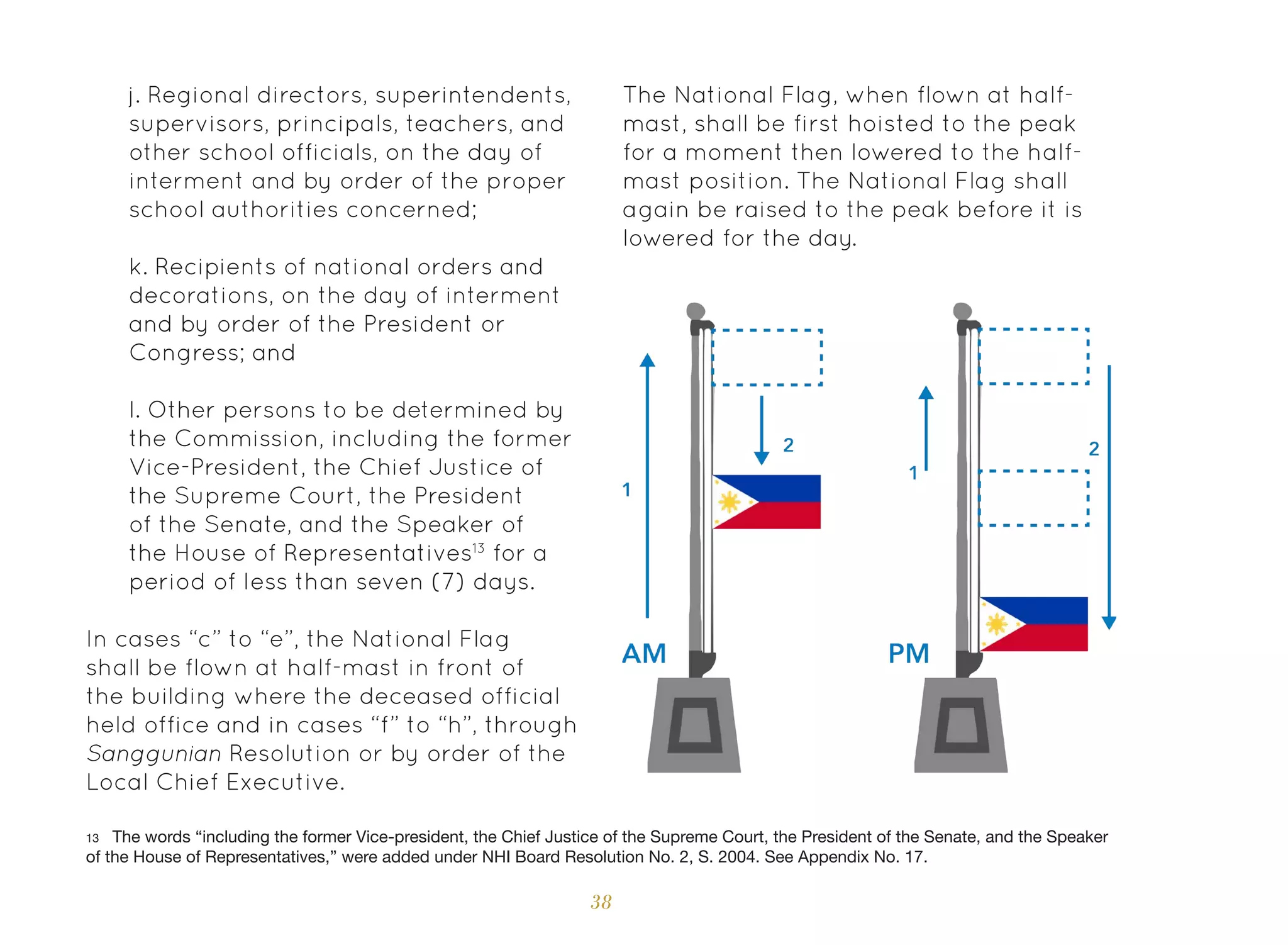
The National Flag, when flown at half-
mast, shall be first hoisted to the peak
for a moment then lowered to the half-
mast position. The National Flag shall
again be raised to the peak before it is
lowered for the day.
13 The words “including the former Vice-president, the Chief Justice of the Supreme Court, the President of the Senate, and the Speaker
of the House of Representatives,” were added under NHI Board Resolution No. 2, S. 2004. See Appendix No. 17.
39
The National Flag shall also be flown at
half-mast during the death anniversary
of heroes and heroines, calamities
or grave adversity of national or
international solemnity as ordered by
the Office of the President, as may be
recommended by the Commission.14
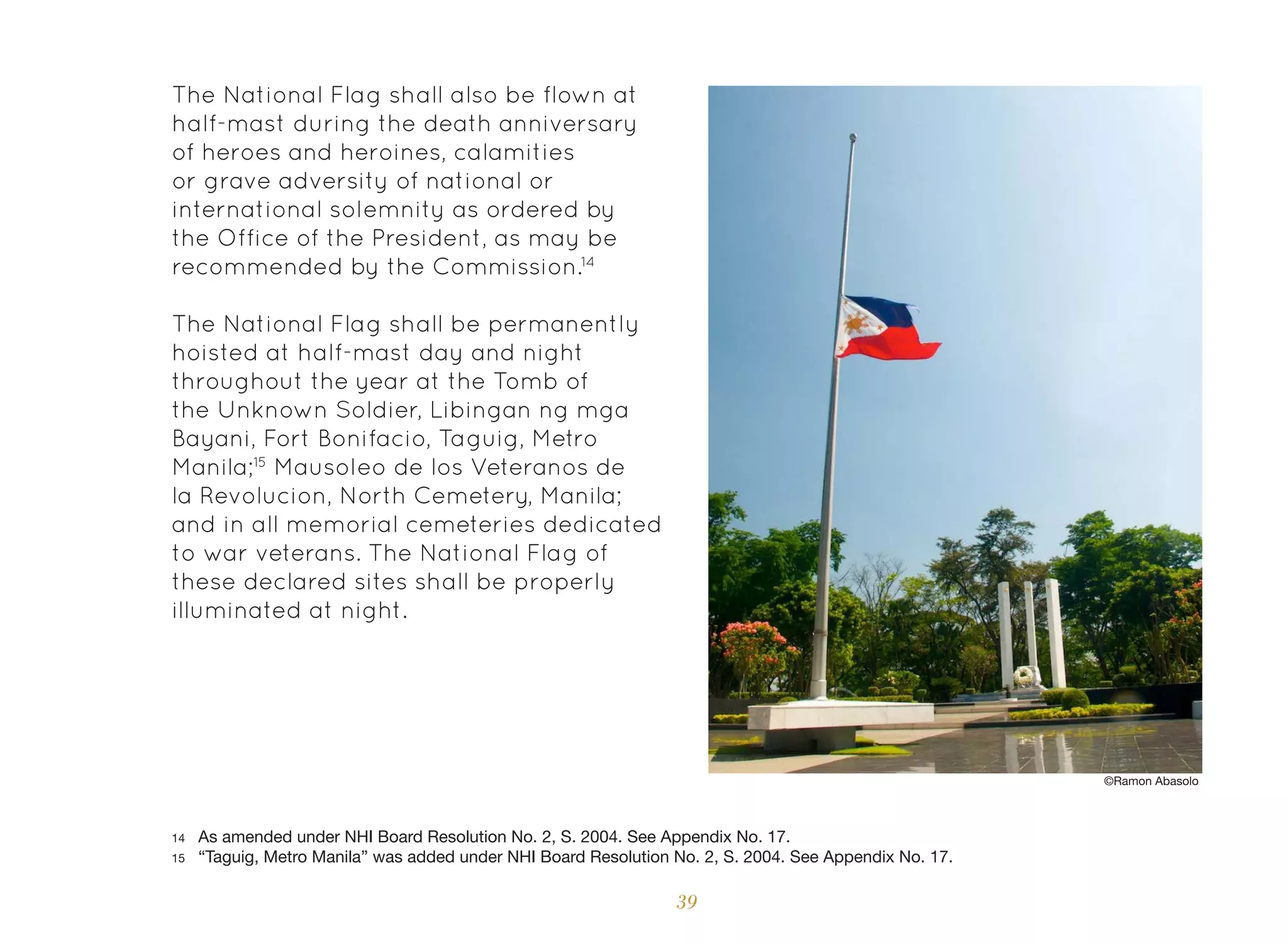
The National Flag shall be permanently
hoisted at half-mast day and night
throughout the year at the Tomb of
the Unknown Soldier, Libingan ng mga
Bayani, Fort Bonifacio, Taguig, Metro
Manila;15
Mausoleo de los Veteranos de
la Revolucion, North Cemetery, Manila;
and in all memorial cemeteries dedicated
to war veterans. The National Flag of
these declared sites shall be properly
illuminated at night.
14 As amended under NHI Board Resolution No. 2, S. 2004. See Appendix No. 17.
15 “Taguig, Metro Manila” was added under NHI Board Resolution No. 2, S. 2004. See Appendix No. 17.
©Ramon Abasolo
40
16 New provision under NHI Board Resolution No. 2, S. 2004. See Appendix No. 17.
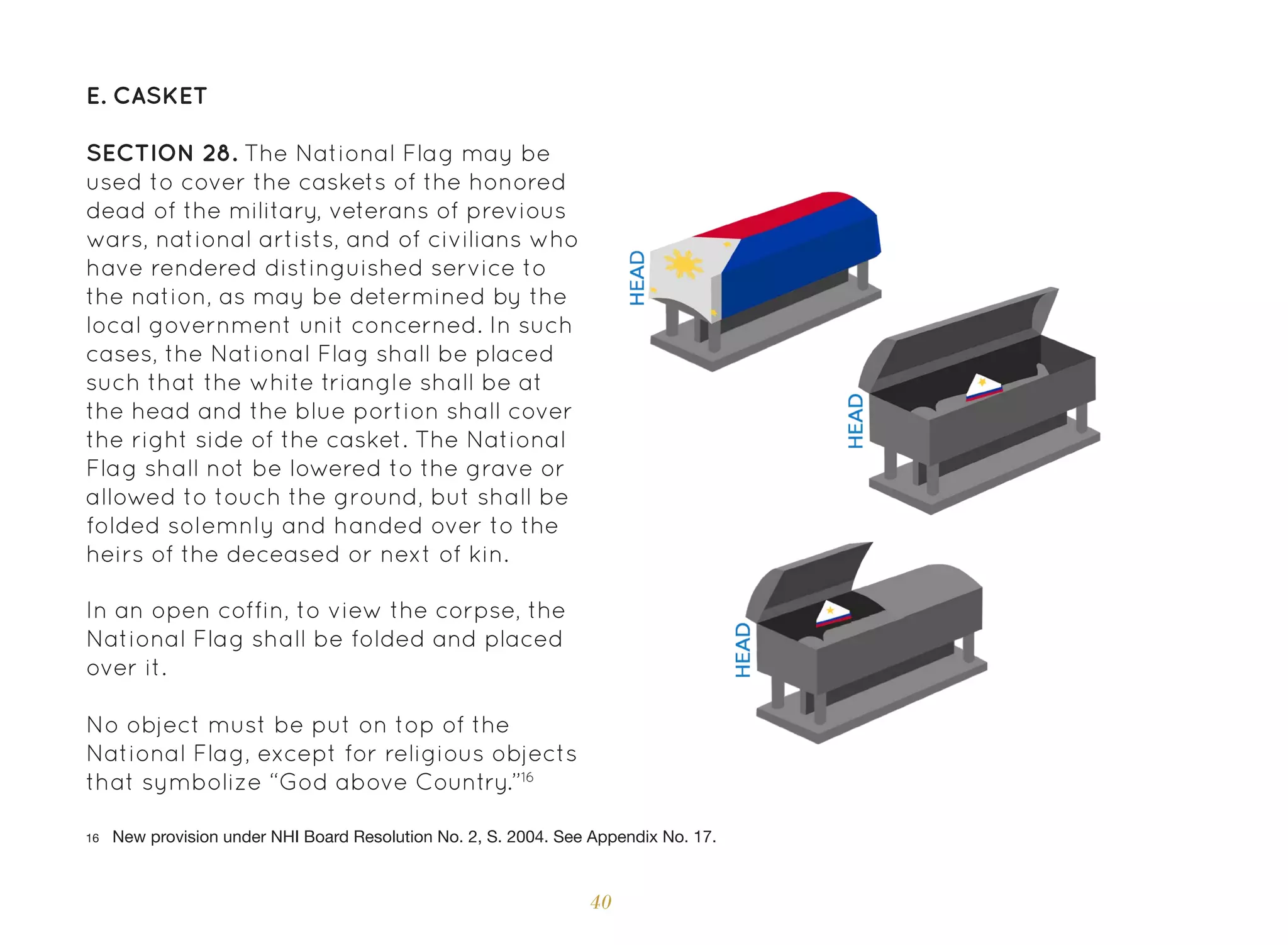
In an open coffin, to view the corpse, the
National Flag shall be folded and placed
over it.
No object must be put on top of the
National Flag, except for religious objects
that symbolize “God above Country.”16
E. Casket
SECTION 28. The National Flag may be
used to cover the caskets of the honored
dead of the military, veterans of previous
wars, national artists, and of civilians who
have rendered distinguished service to
the nation, as may be determined by the
local government unit concerned. In such
cases, the National Flag shall be placed
such that the white triangle shall be at
the head and the blue portion shall cover
the right side of the casket. The National
Flag shall not be lowered to the grave or
allowed to touch the ground, but shall be
folded solemnly and handed over to the
heirs of the deceased or next of kin.
41
F. Pledge to the National Flag
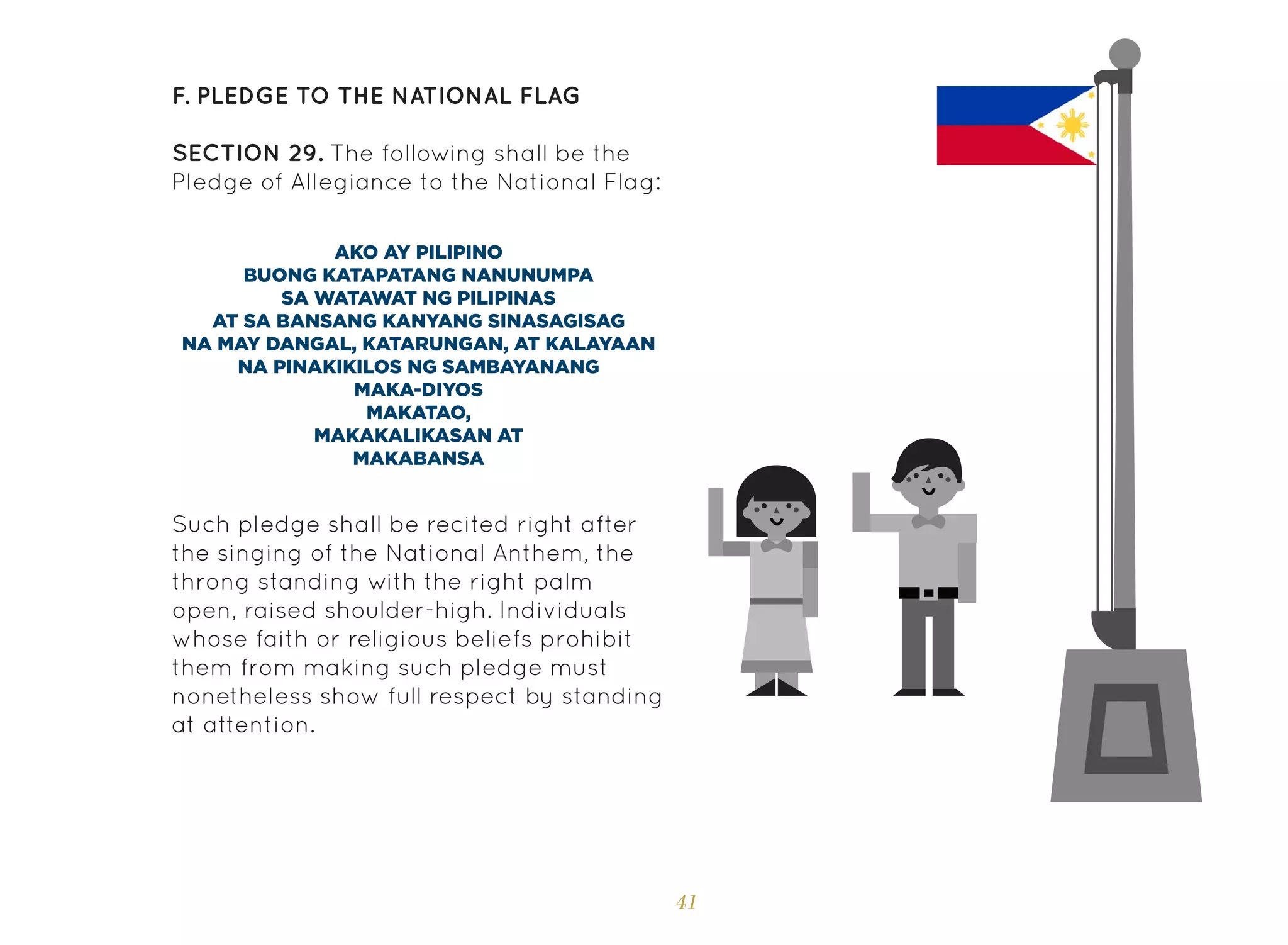
SECTION 29. The following shall be the
Pledge of Allegiance to the National Flag:
AKO AY PILIPINO
BUONG KATAPATANG NANUNUMPA
SA WATAWAT NG PILIPINAS
AT SA BANSANG KANYANG SINASAGISAG
NA MAY DANGAL, KATARUNGAN, AT KALAYAAN
NA PINAKIKILOS NG SAMBAYANANG
MAKA-DIYOS
MAKATAO,
MAKAKALIKASAN AT
MAKABANSA
Such pledge shall be recited right after
the singing of the National Anthem, the
throng standing with the right palm
open, raised shoulder-high. Individuals
whose faith or religious beliefs prohibit
them from making such pledge must
nonetheless show full respect by standing
at attention.
42
G. National Flag Days
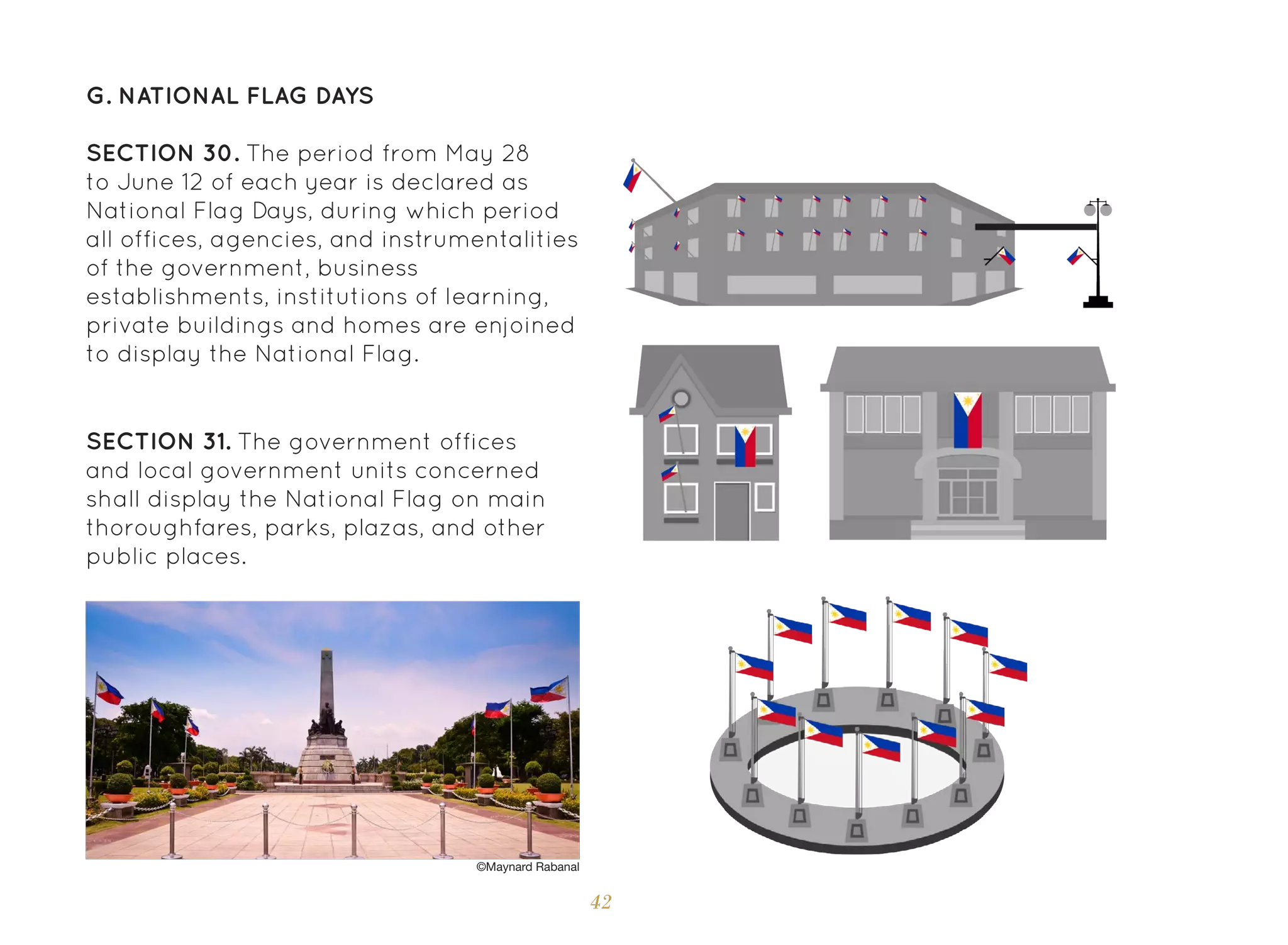
SECTION 30. The period from May 28
to June 12 of each year is declared as
National Flag Days, during which period
all offices, agencies, and instrumentalities
of the government, business
establishments, institutions of learning,
private buildings and homes are enjoined
to display the National Flag.
SECTION 31. The government offices
and local government units concerned
shall display the National Flag on main
thoroughfares, parks, plazas, and other
public places.
©Maynard Rabanal
43
H. Specifications of the National Flag
WIDTH
(W)
W
2
W
2
W
W
LENGTH (L) = 2W
DIAMETER (D) = W
5
DIAMETER (D) =
L OF MAJOR RAY
D
2
D
2
D
2
D
2
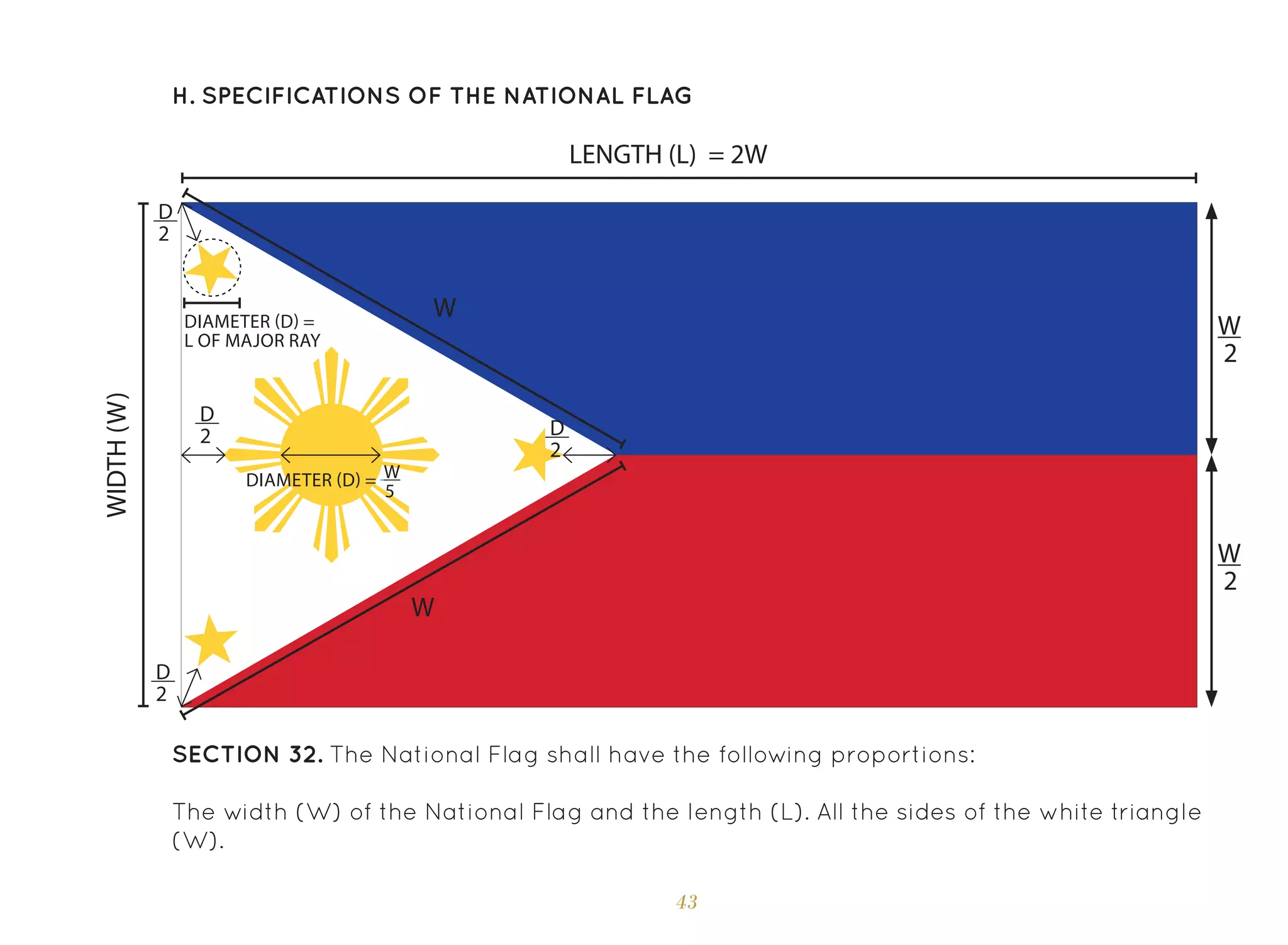
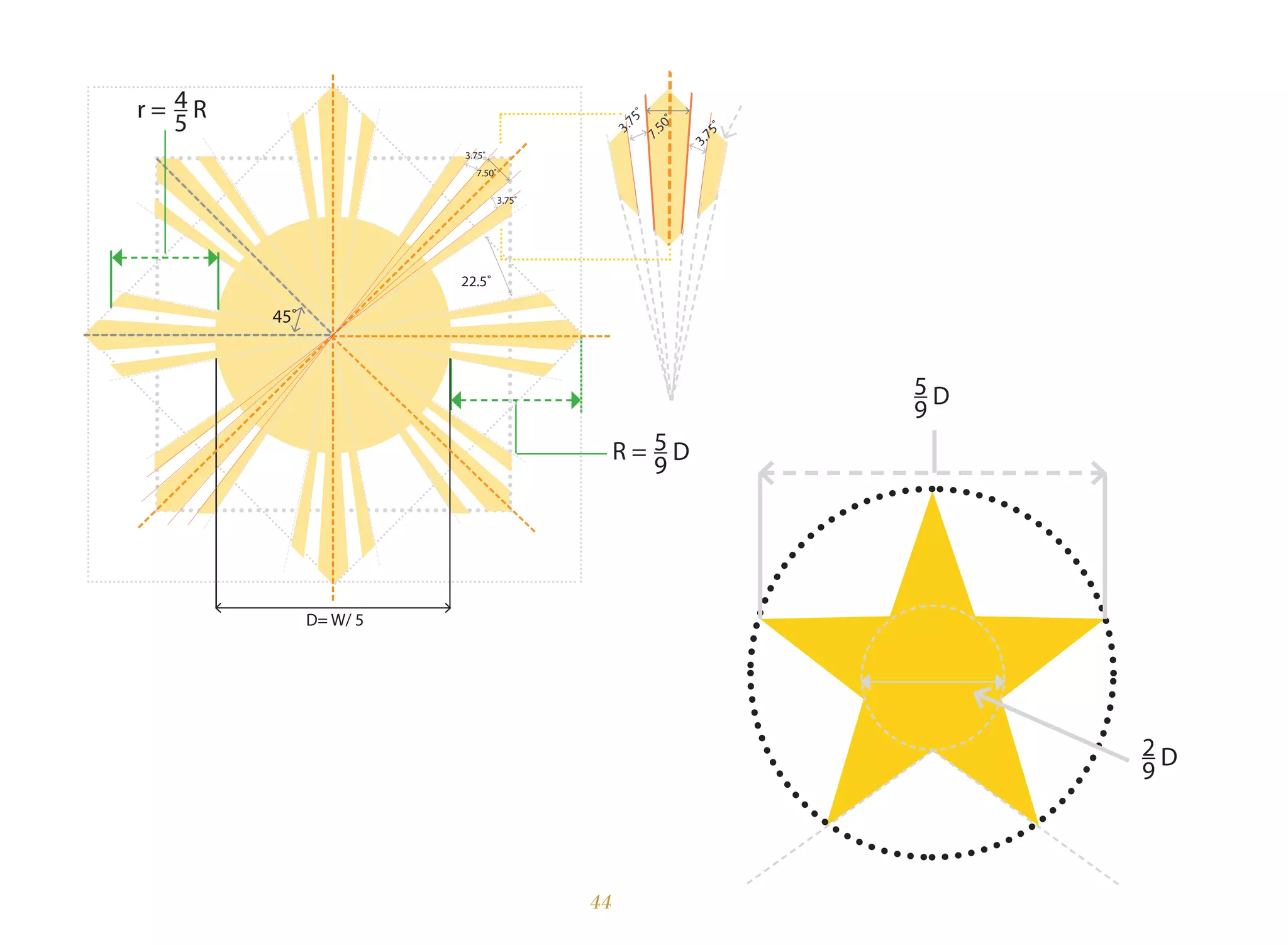
SECTION 32. The National Flag shall have the following proportions:
The width (W) of the National Flag and the length (L). All the sides of the white triangle
(W).
44
D= W/ 5
45˚
22.5˚
7.50˚
3.75˚
3.75˚
2 D
9
5 D
9
5 D
9
R =
4 R
5
r =
45
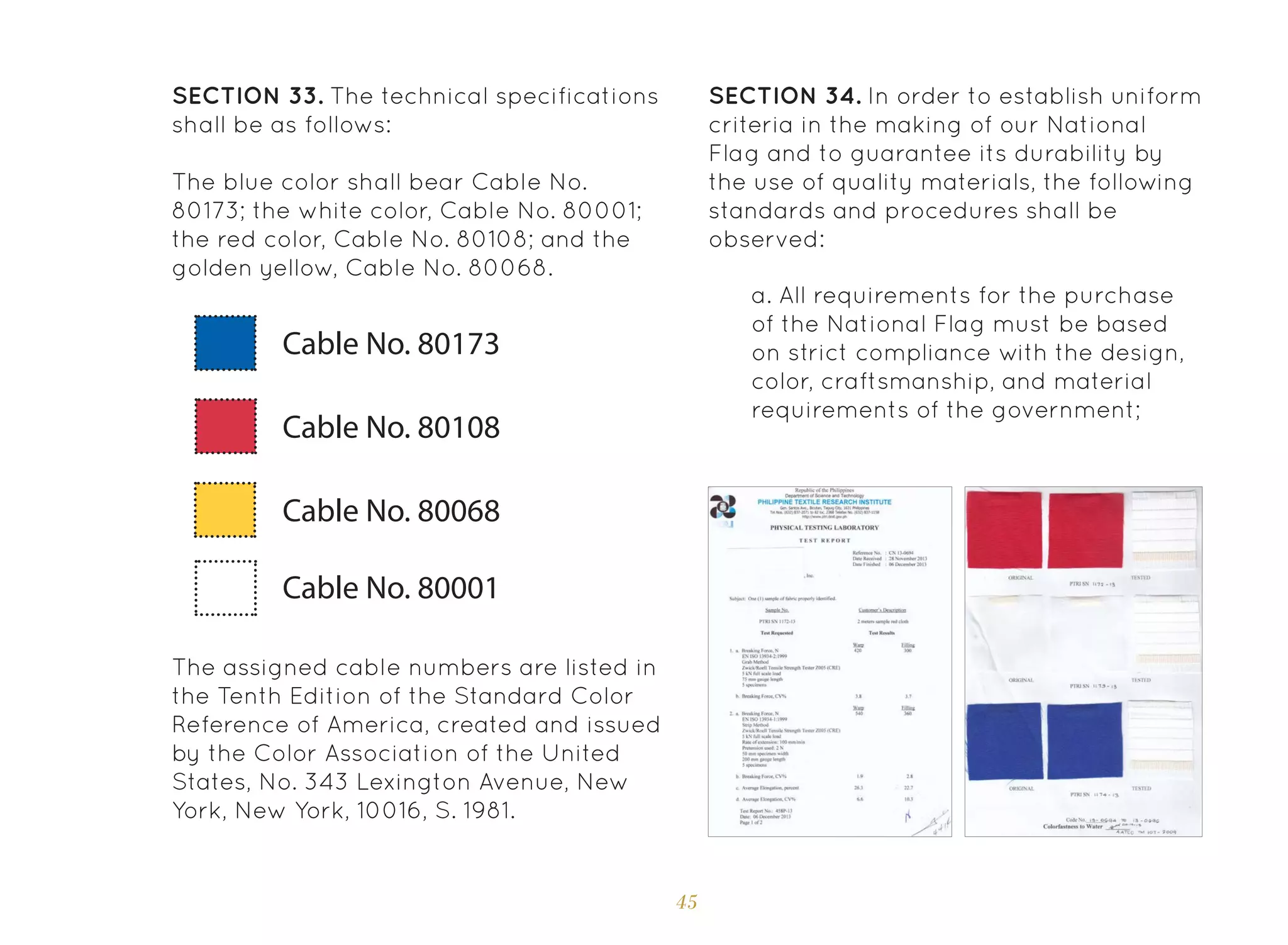
SECTION 33. The technical specifications
shall be as follows:
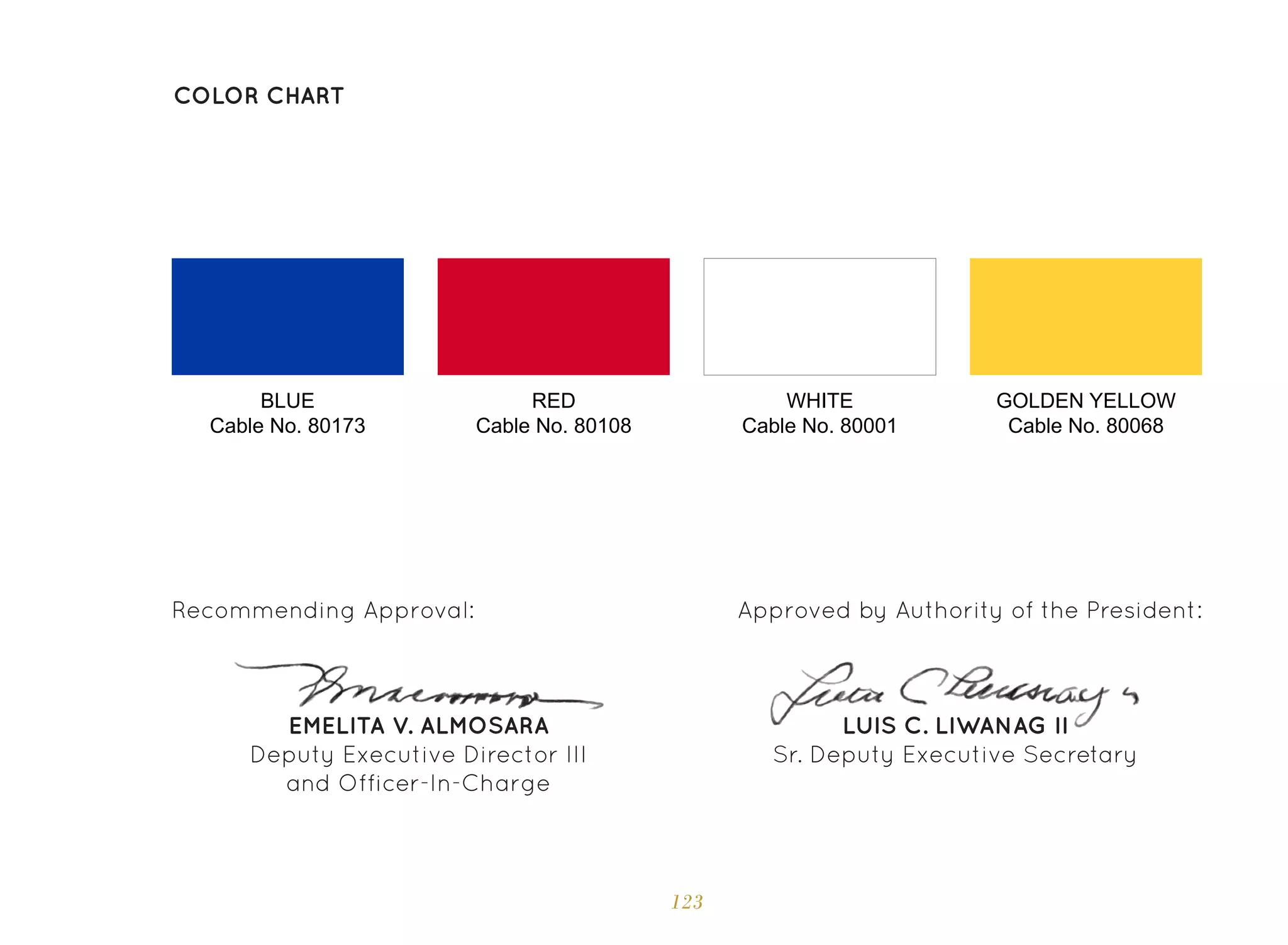
The blue color shall bear Cable No.
80173; the white color, Cable No. 80001;
the red color, Cable No. 80108; and the
golden yellow, Cable No. 80068.
The assigned cable numbers are listed in
the Tenth Edition of the Standard Color
Reference of America, created and issued
by the Color Association of the United
States, No. 343 Lexington Avenue, New
York, New York, 10016, S. 1981.
Cable No. 80173
Cable No. 80108
Cable No. 80068
Cable No. 80001
SECTION 34. In order to establish uniform
criteria in the making of our National
Flag and to guarantee its durability by
the use of quality materials, the following
standards and procedures shall be
observed:
a. All requirements for the purchase
of the National Flag must be based
on strict compliance with the design,
color, craftsmanship, and material
requirements of the government;
46
b. The manufacturer shall send
annually one meter for each color
(blue, red, white, and golden
yellow including canvas) of textile
material to the Industrial Technology
Development Institute (ITDI) or
the Philippine Textile Research
Institute (PTRI) of the Department
of Science and Technology (DOST)
for evaluation. The PTRI/ITDI shall
evaluate the quality and serviceability
of said textile material;
c. Flag manufacturers shall apply
for annual accreditation at the
Commission. Together with their
application, they will submit the
PTRI/ITDI laboratory test results,
copy of business license, permit,
company profile and other pertinent
documents; and
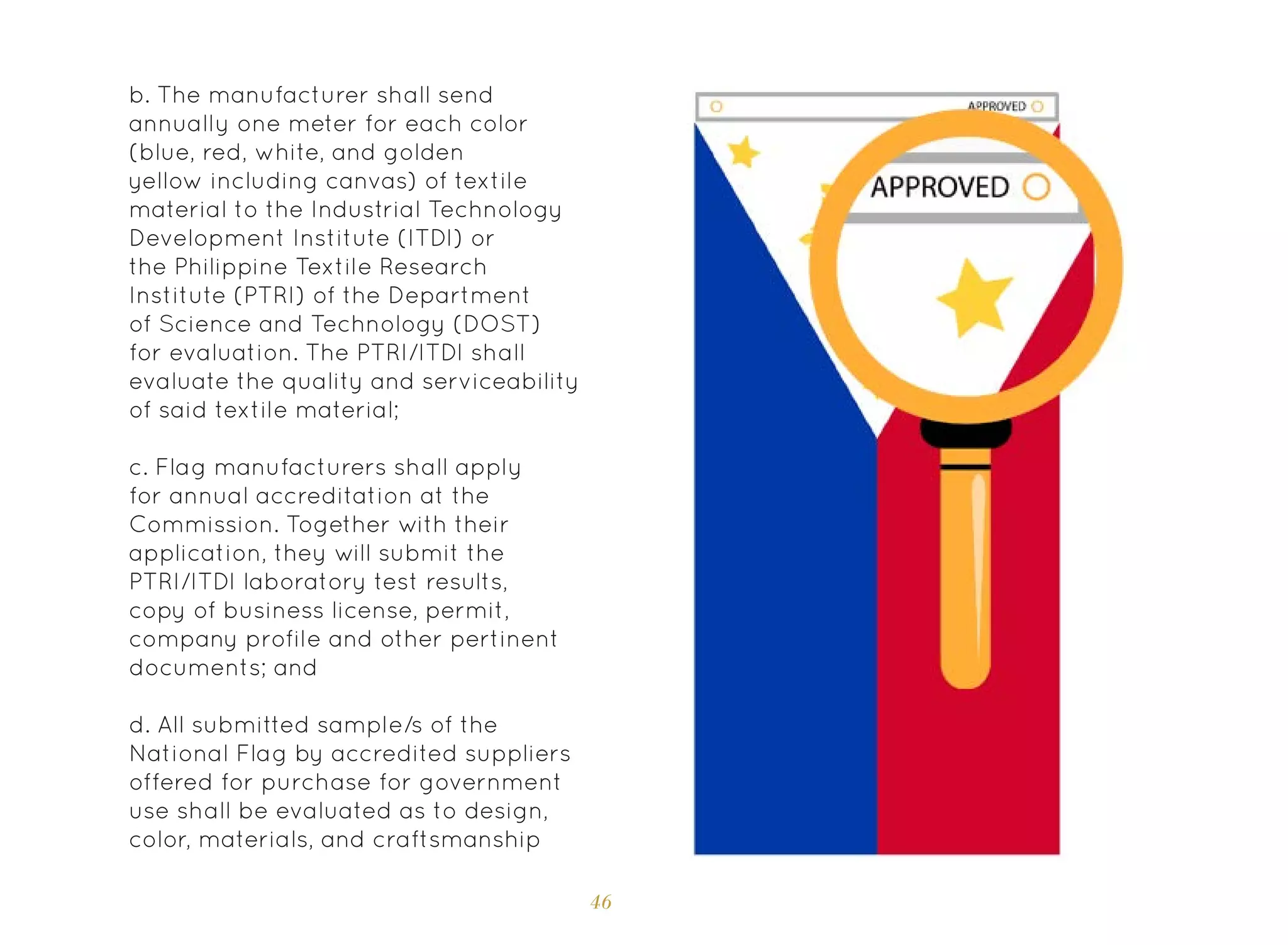
d. All submitted sample/s of the
National Flag by accredited suppliers
offered for purchase for government
use shall be evaluated as to design,
color, materials, and craftsmanship
47
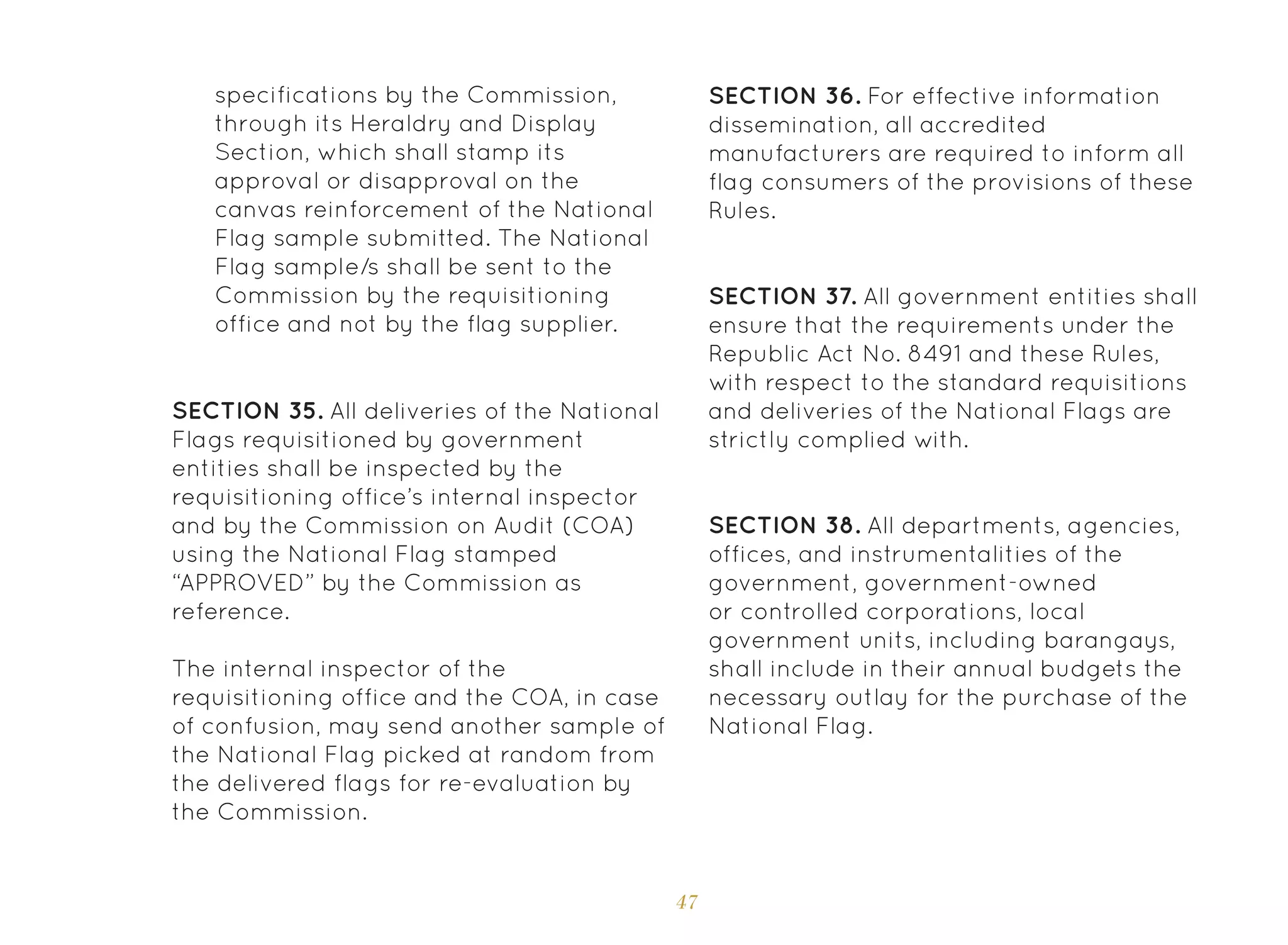
SECTION 35. All deliveries of the National
Flags requisitioned by government
entities shall be inspected by the
requisitioning office’s internal inspector
and by the Commission on Audit (COA)
using the National Flag stamped
“APPROVED” by the Commission as
reference.
The internal inspector of the
requisitioning office and the COA, in case
of confusion, may send another sample of
the National Flag picked at random from
the delivered flags for re-evaluation by
the Commission.
SECTION 36. For effective information
dissemination, all accredited
manufacturers are required to inform all
flag consumers of the provisions of these
Rules.
SECTION 37. All government entities shall
ensure that the requirements under the
Republic Act No. 8491 and these Rules,
with respect to the standard requisitions
and deliveries of the National Flags are
strictly complied with.
SECTION 38. All departments, agencies,
offices, and instrumentalities of the
government, government-owned
or controlled corporations, local
government units, including barangays,
shall include in their annual budgets the
necessary outlay for the purchase of the
National Flag.
specifications by the Commission,
through its Heraldry and Display
Section, which shall stamp its
approval or disapproval on the
canvas reinforcement of the National
Flag sample submitted. The National
Flag sample/s shall be sent to the
Commission by the requisitioning
office and not by the flag supplier.
48
I. Prohibited Acts
SECTION 39. It shall be prohibited:
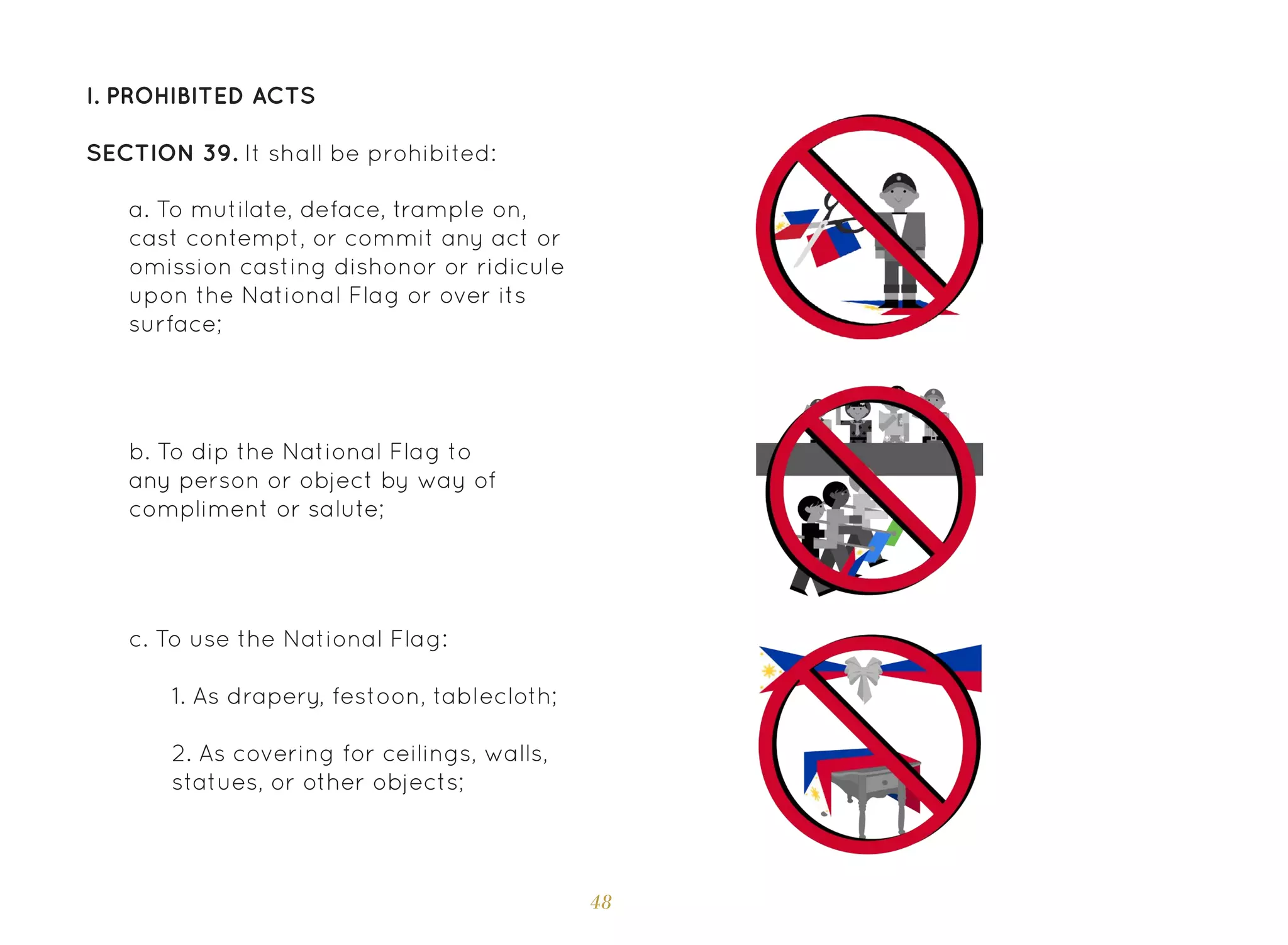
a. To mutilate, deface, trample on,
cast contempt, or commit any act or
omission casting dishonor or ridicule
upon the National Flag or over its
surface;
b. To dip the National Flag to
any person or object by way of
compliment or salute;
c. To use the National Flag:
1. As drapery, festoon, tablecloth;
2. As covering for ceilings, walls,
statues, or other objects;
49
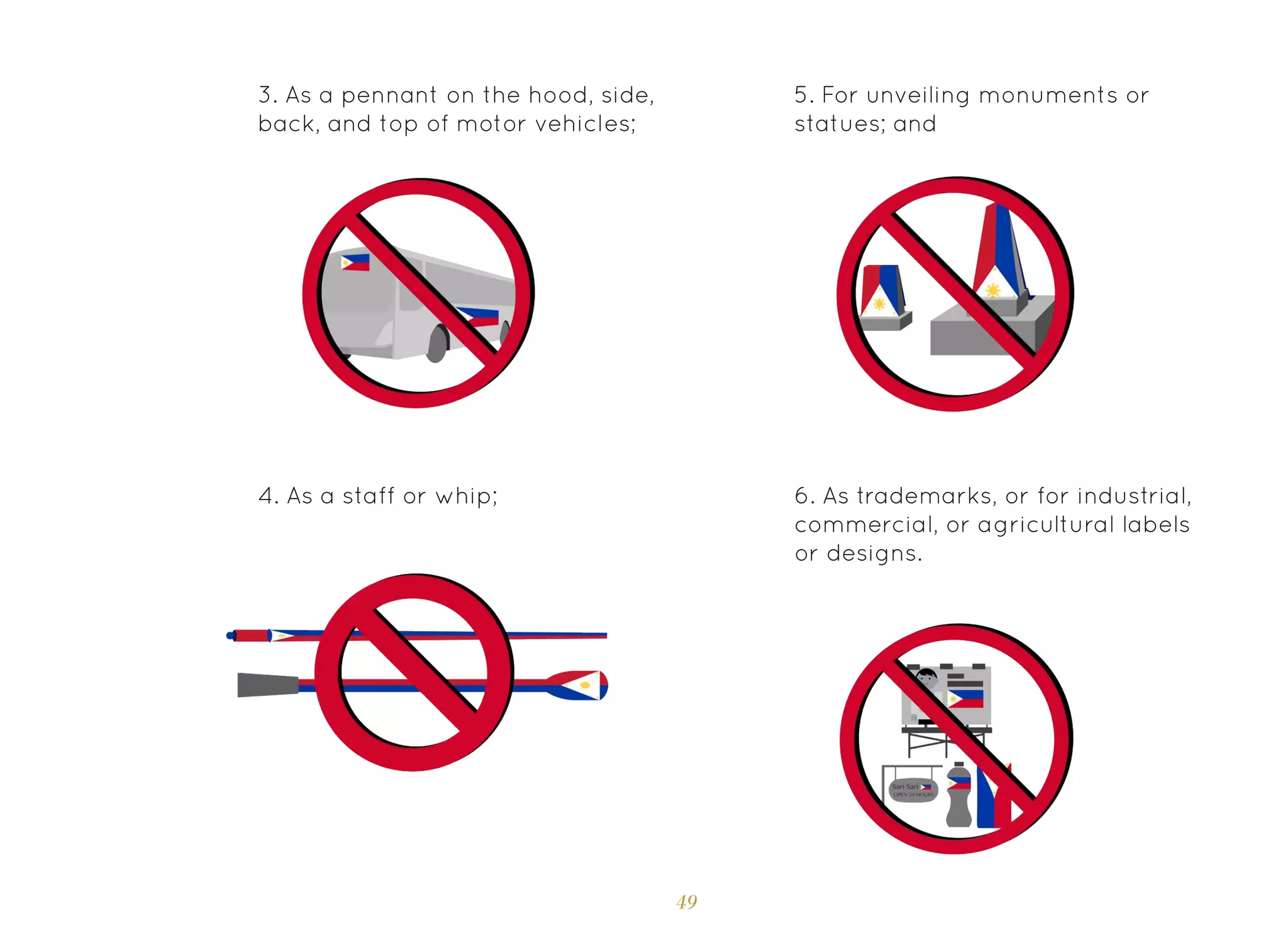
3. As a pennant on the hood, side,
back, and top of motor vehicles;
4. As a staff or whip;
5. For unveiling monuments or
statues; and
6. As trademarks, or for industrial,
commercial, or agricultural labels
or designs.
50
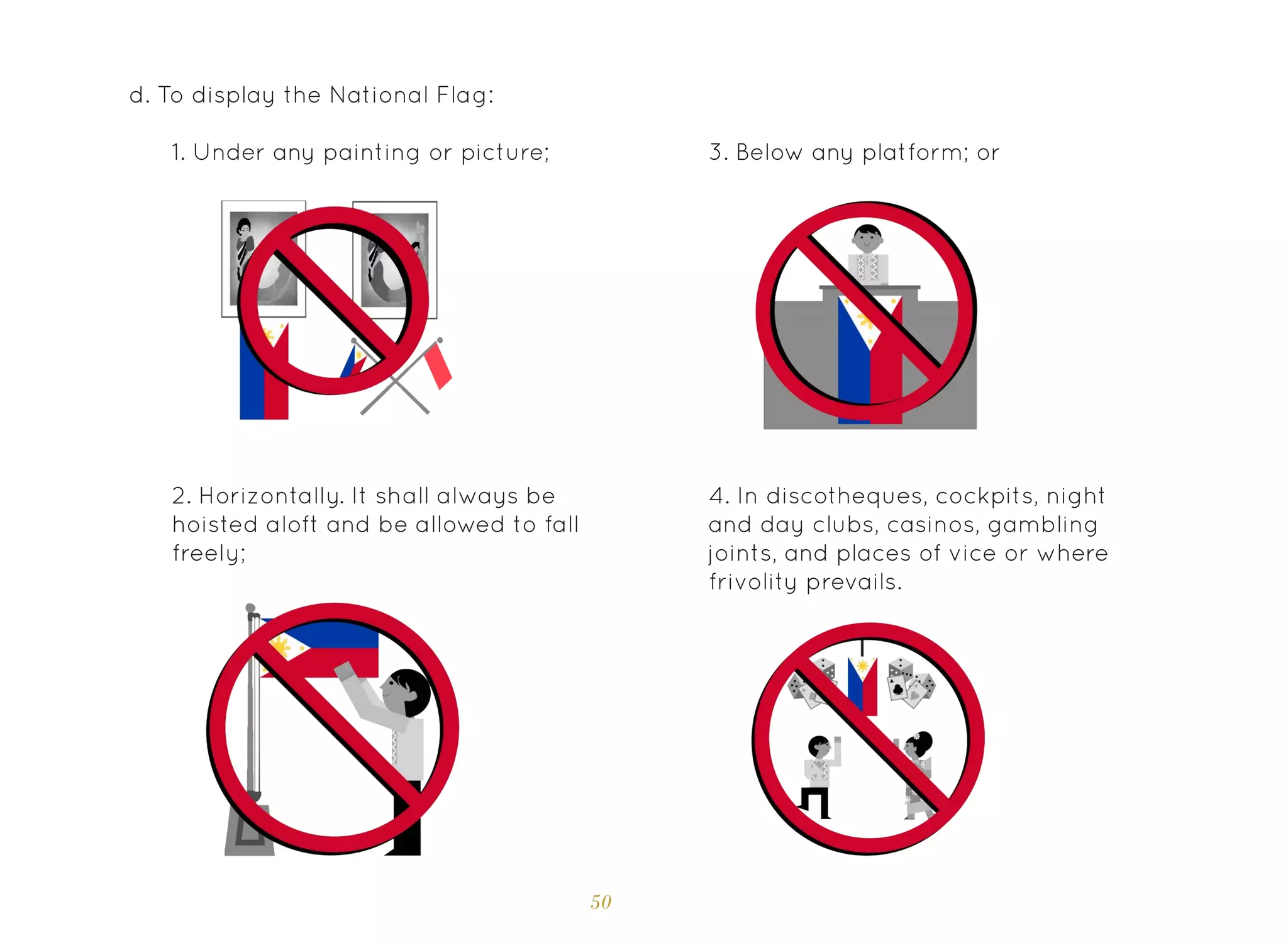
d. To display the National Flag:
1. Under any painting or picture;
2. Horizontally. It shall always be
hoisted aloft and be allowed to fall
freely;
4. In discotheques, cockpits, night
and day clubs, casinos, gambling
joints, and places of vice or where
frivolity prevails.
3. Below any platform; or
51
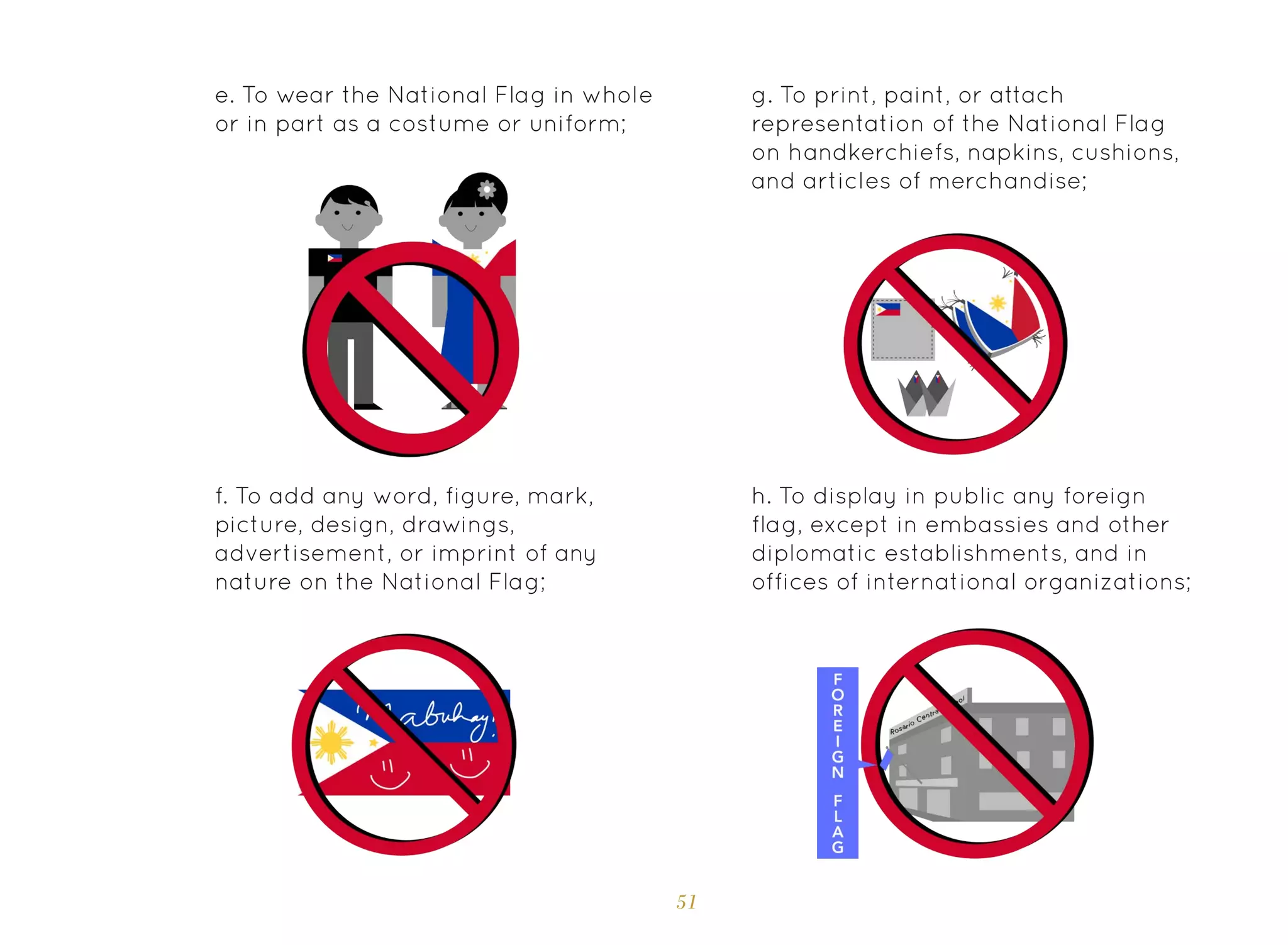
e. To wear the National Flag in whole
or in part as a costume or uniform;
f. To add any word, figure, mark,
picture, design, drawings,
advertisement, or imprint of any
nature on the National Flag;
g. To print, paint, or attach
representation of the National Flag
on handkerchiefs, napkins, cushions,
and articles of merchandise;
h. To display in public any foreign
flag, except in embassies and other
diplomatic establishments, and in
offices of international organizations;
52
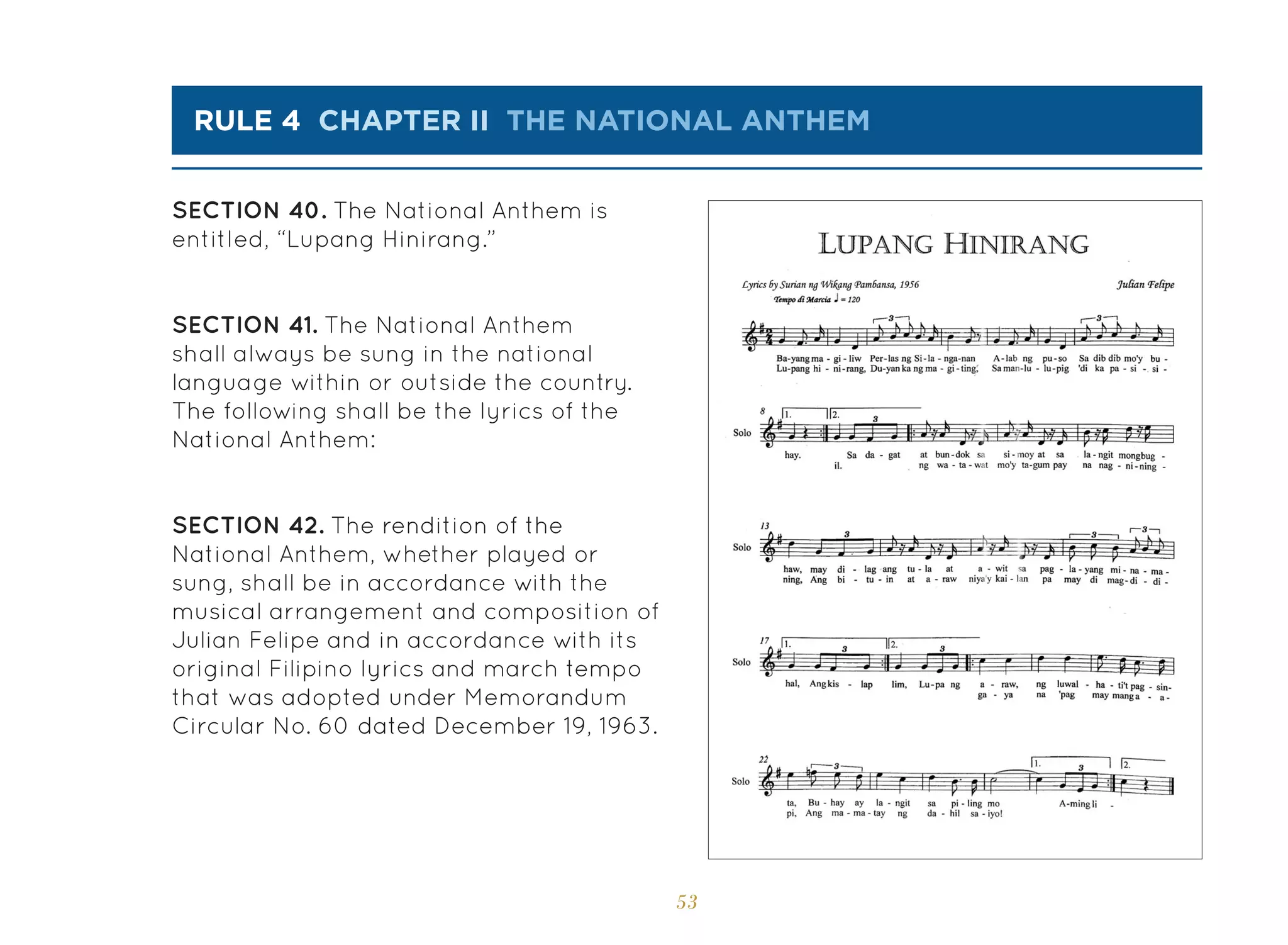
j. To display the National Flag in front
of buildings or offices occupied by
aliens.
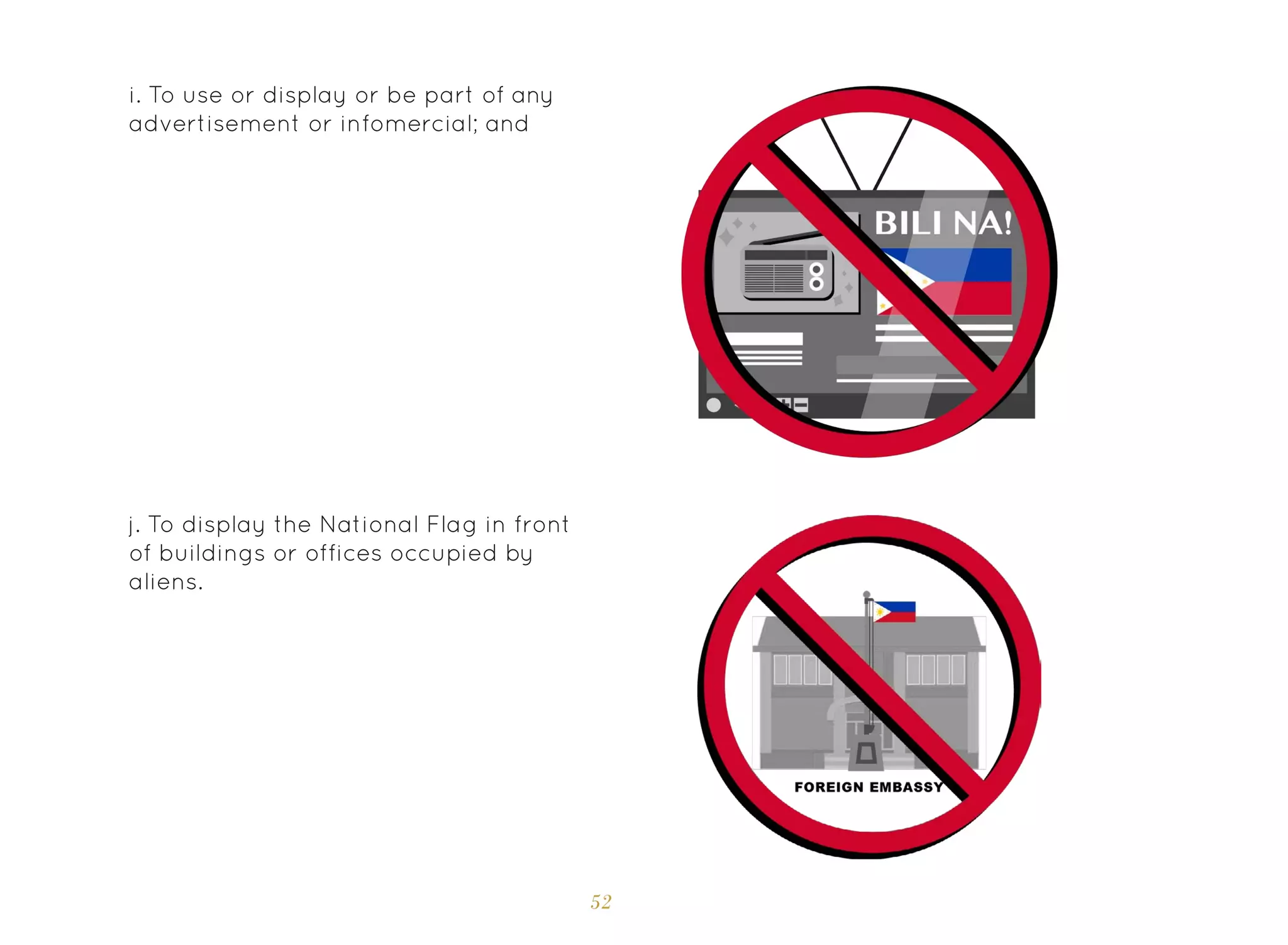
i. To use or display or be part of any
advertisement or infomercial; and
53
rule 4 chapter Ii the national ANTHEM
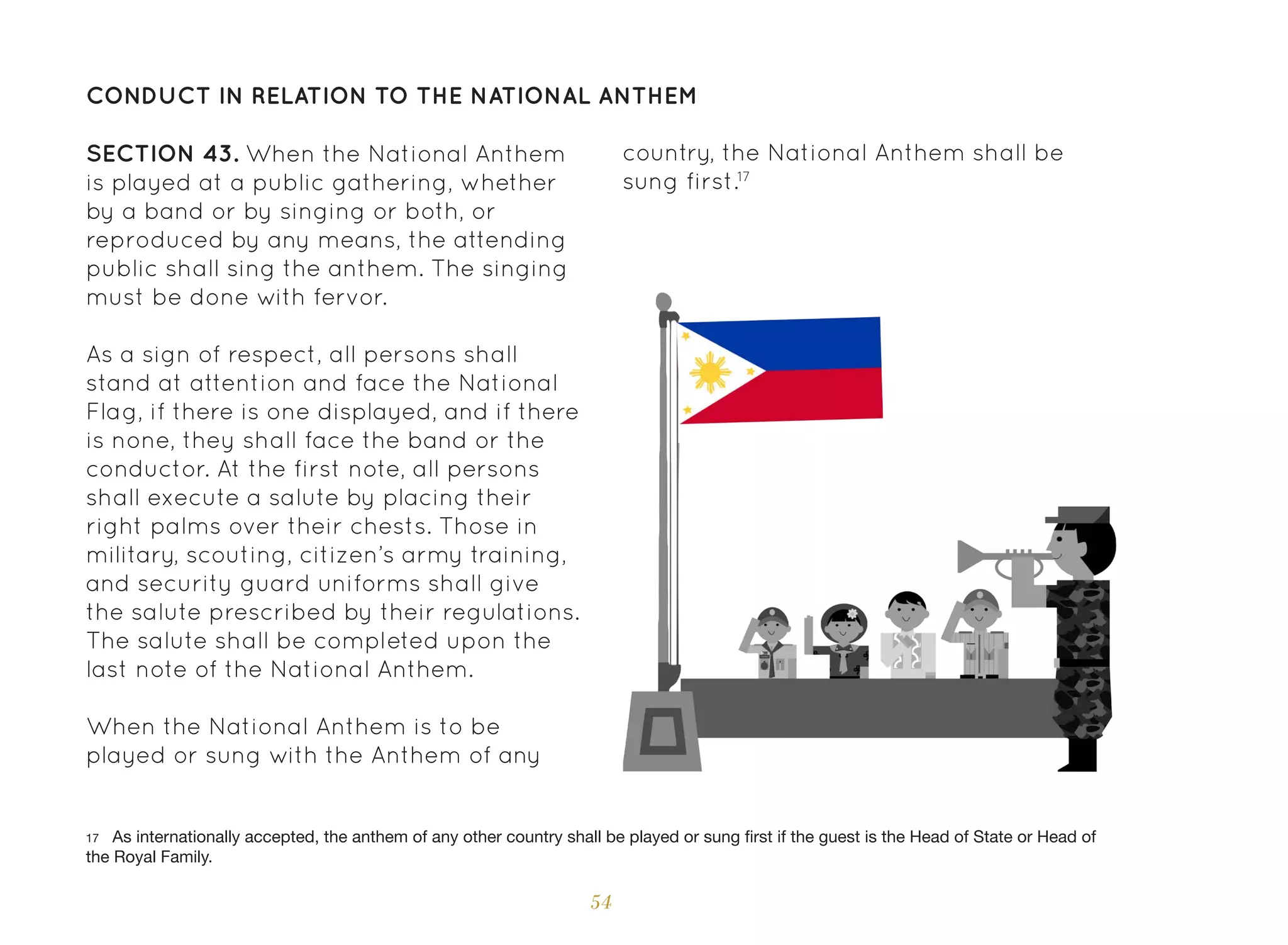
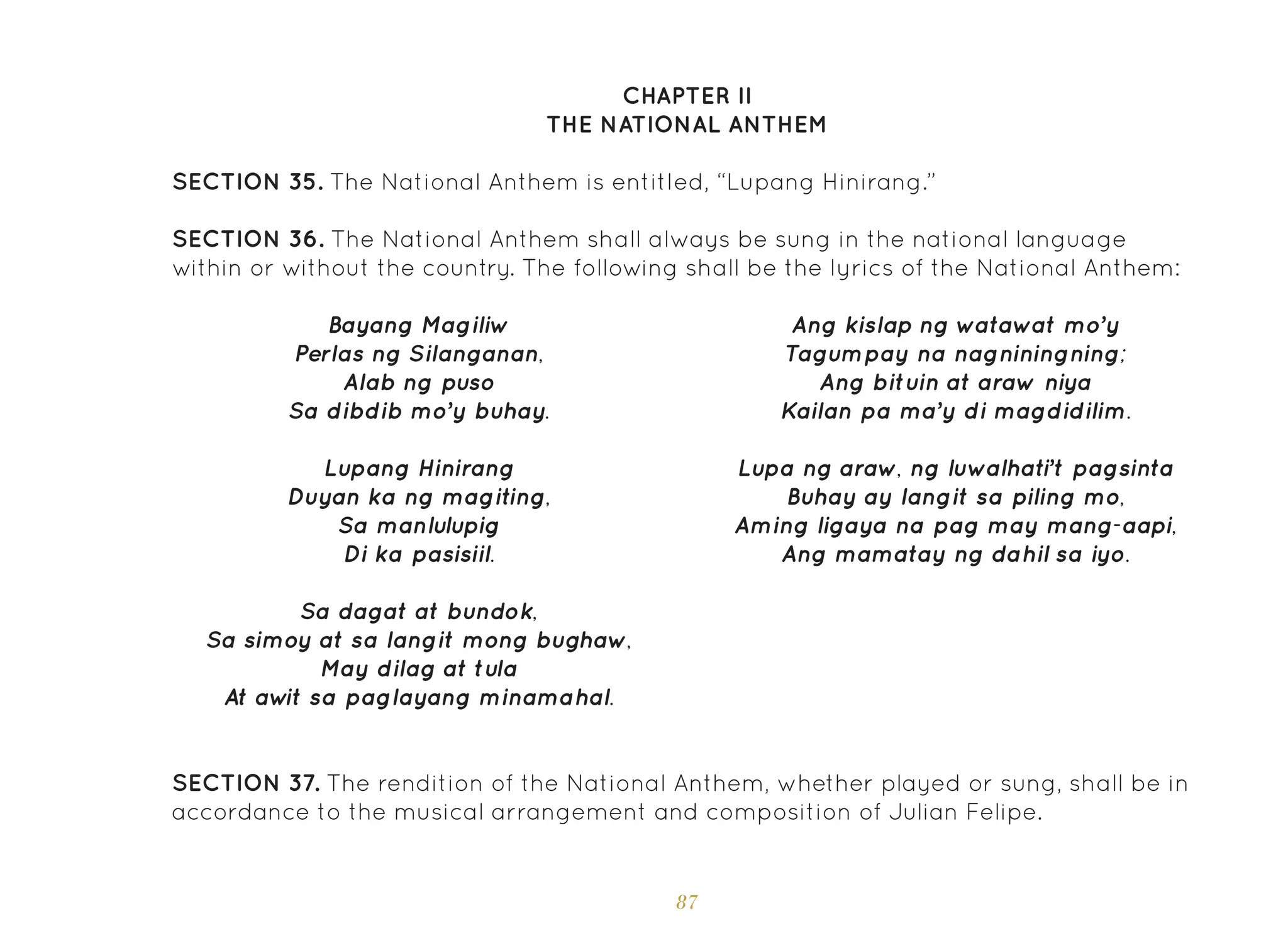
SECTION 40. The National Anthem is
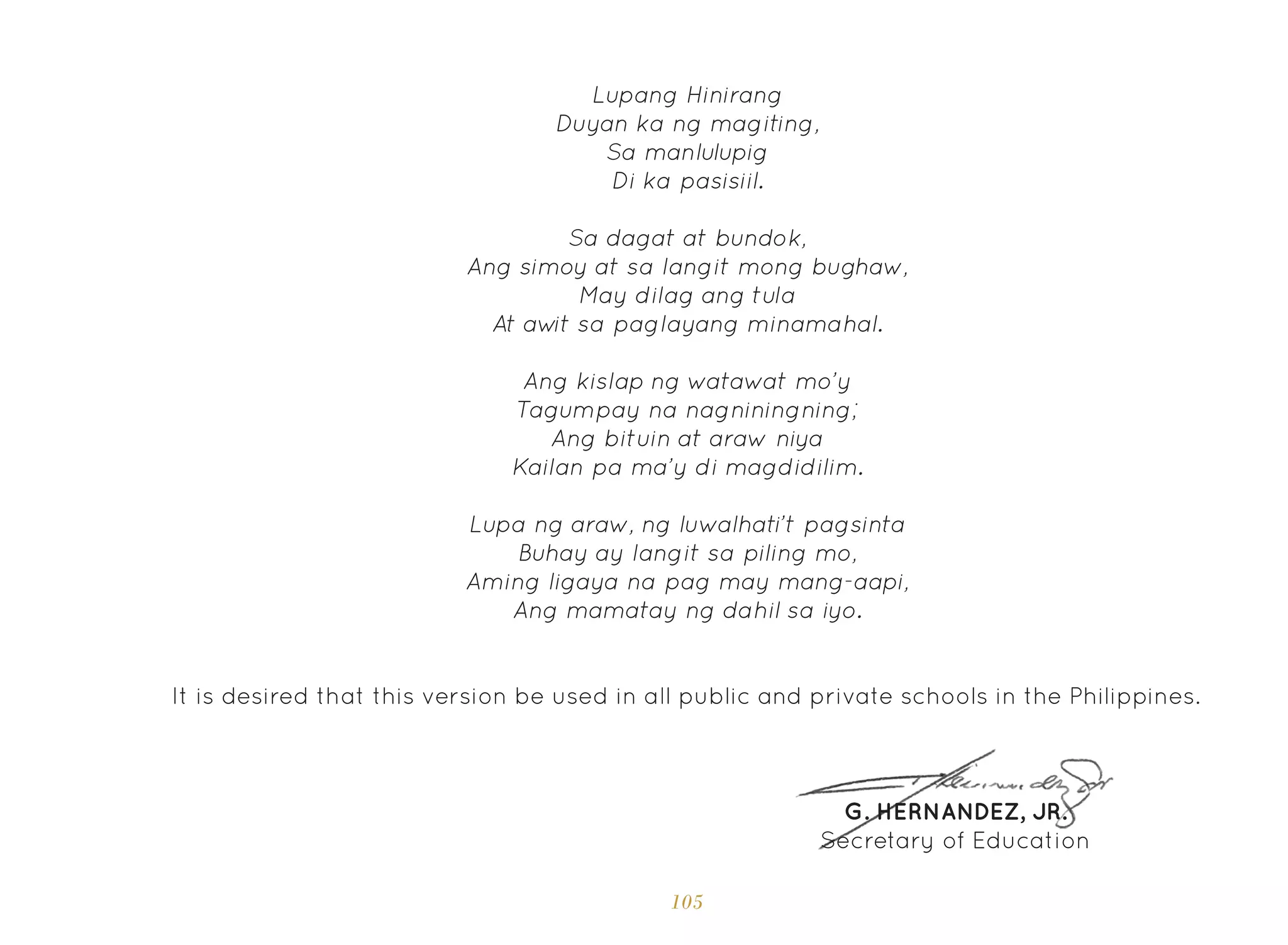
entitled, “Lupang Hinirang.”
SECTION 41. The National Anthem
shall always be sung in the national
language within or outside the country.
The following shall be the lyrics of the
National Anthem:
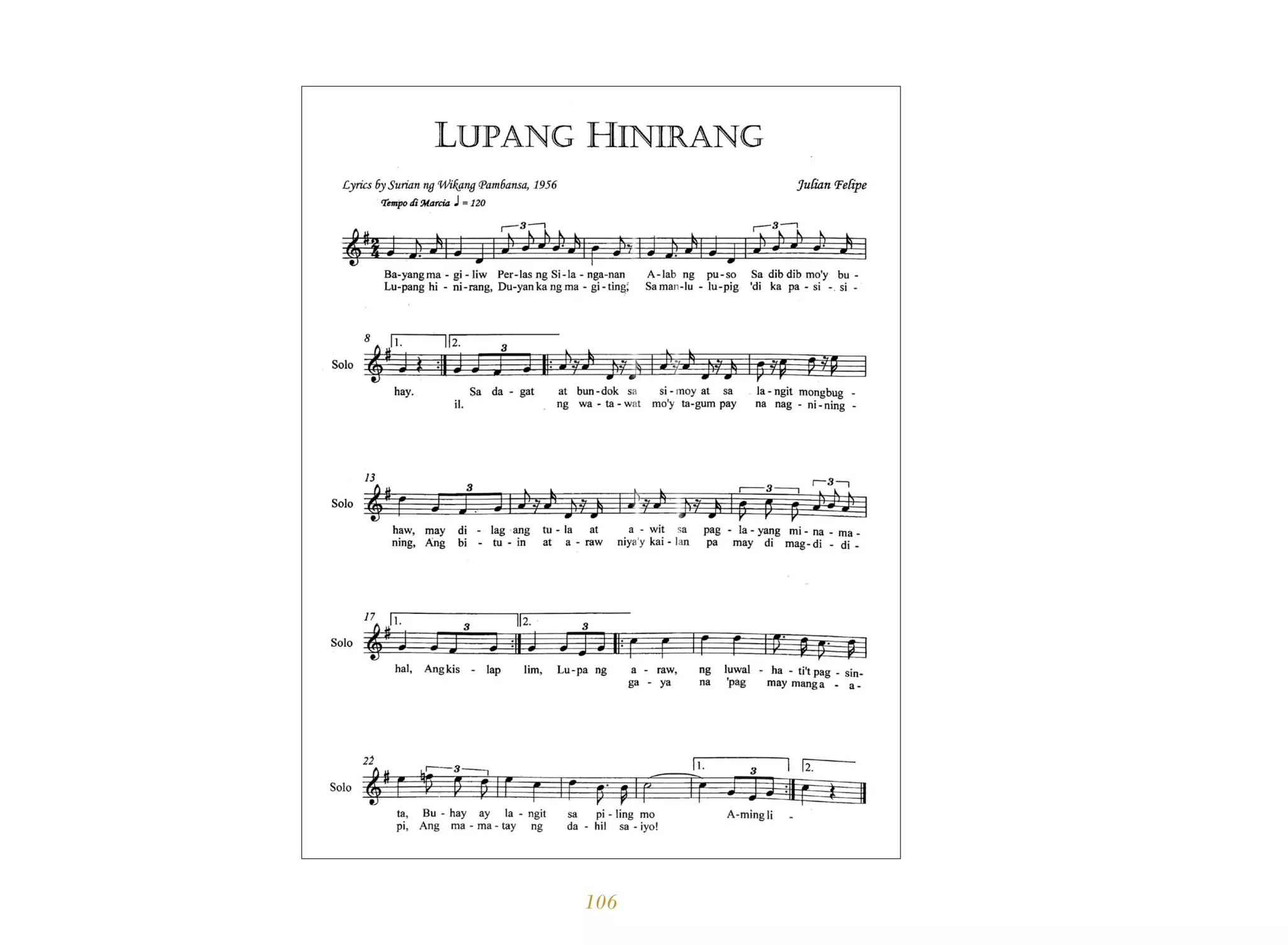
SECTION 42. The rendition of the
National Anthem, whether played or
sung, shall be in accordance with the
musical arrangement and composition of
Julian Felipe and in accordance with its
original Filipino lyrics and march tempo
that was adopted under Memorandum
Circular No. 60 dated December 19, 1963.
54
CONDUCT IN RELATION TO THE NATIONAL ANTHEM
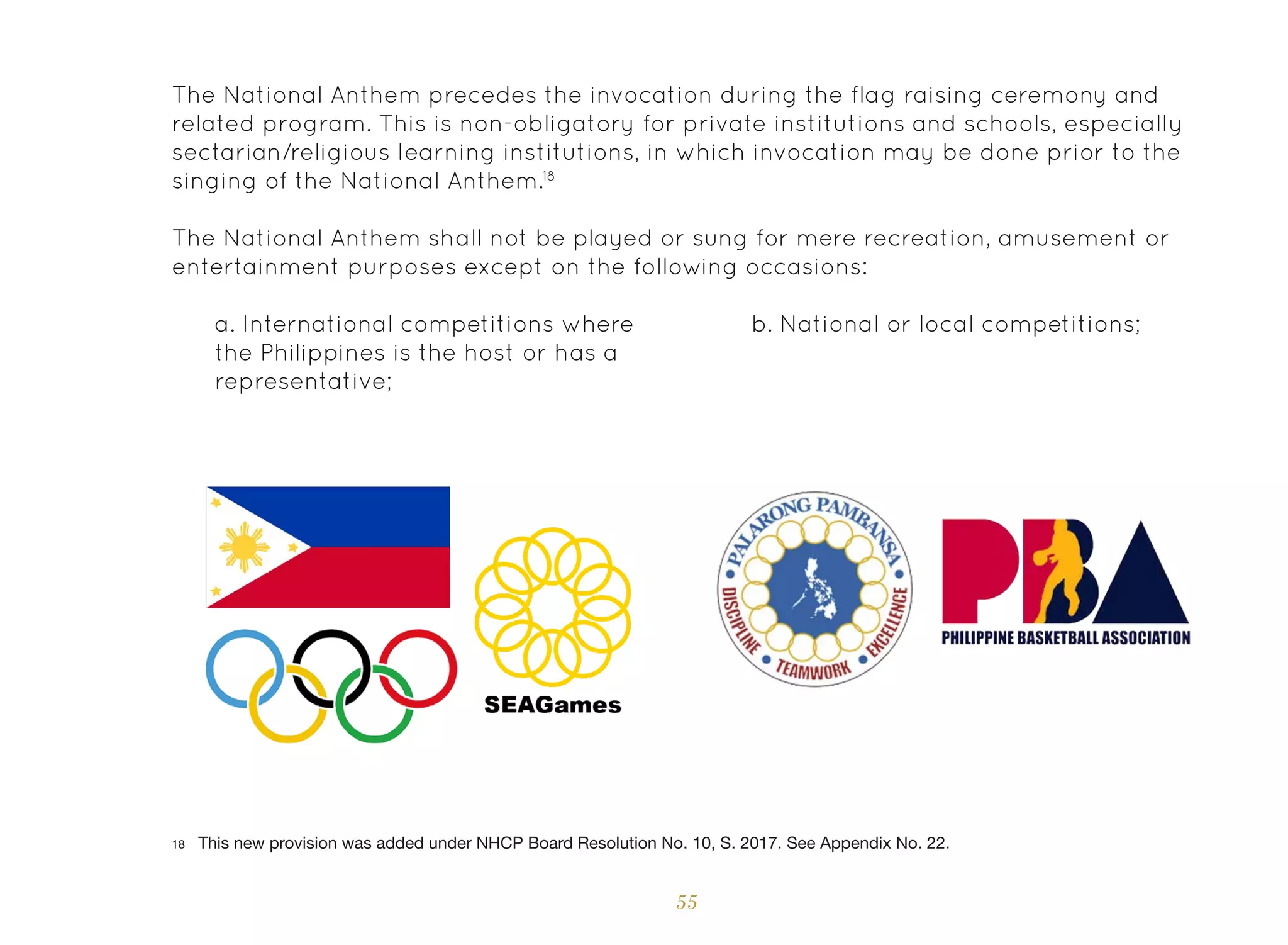
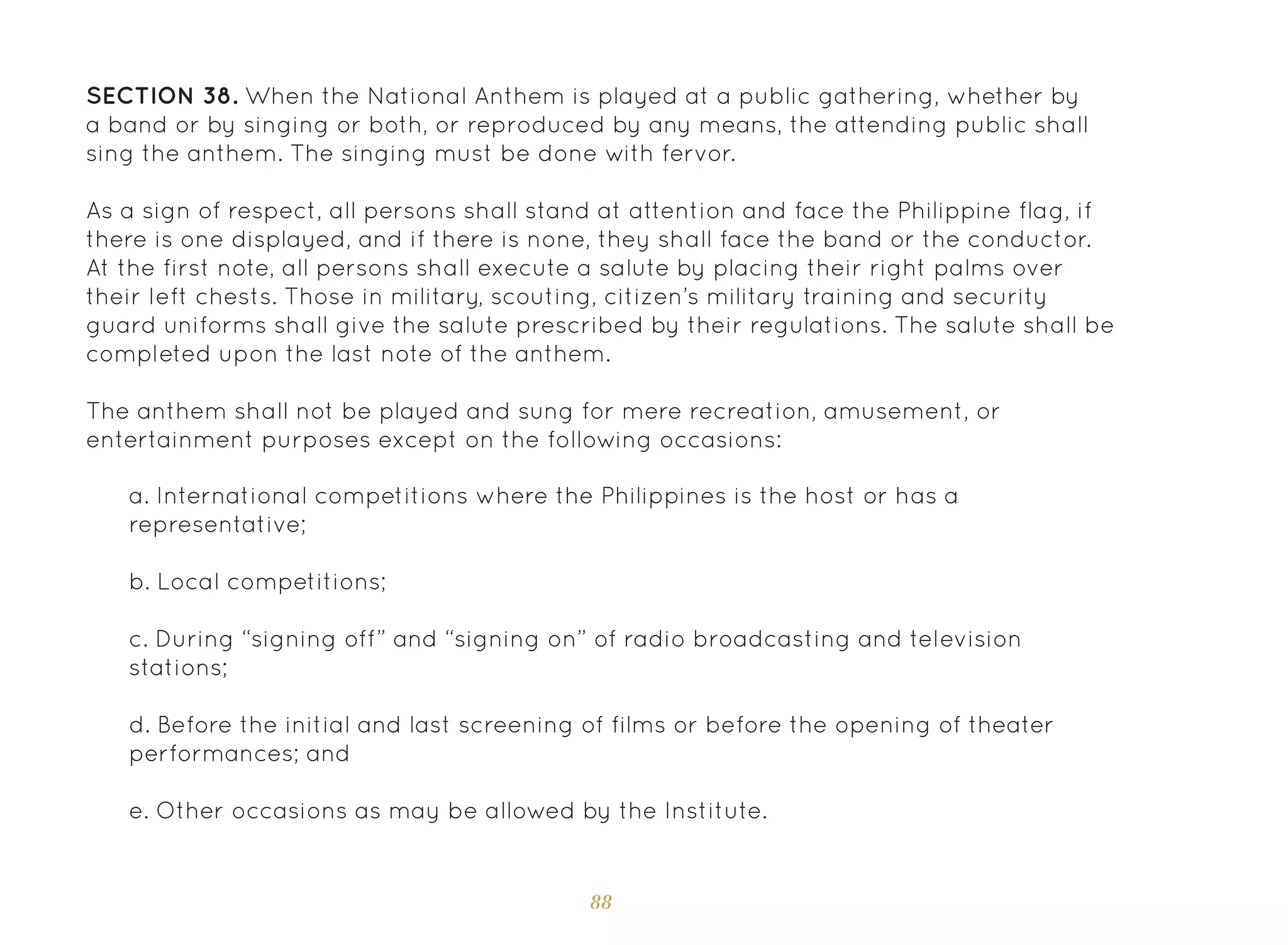
SECTION 43. When the National Anthem
is played at a public gathering, whether
by a band or by singing or both, or
reproduced by any means, the attending
public shall sing the anthem. The singing
must be done with fervor.
As a sign of respect, all persons shall
stand at attention and face the National
Flag, if there is one displayed, and if there
is none, they shall face the band or the
conductor. At the first note, all persons
shall execute a salute by placing their
right palms over their chests. Those in
military, scouting, citizen’s army training,
and security guard uniforms shall give
the salute prescribed by their regulations.
The salute shall be completed upon the
last note of the National Anthem.
When the National Anthem is to be
played or sung with the Anthem of any
17 As internationally accepted, the anthem of any other country shall be played or sung first if the guest is the Head of State or Head of
the Royal Family.
country, the National Anthem shall be
sung first.17
55
The National Anthem precedes the invocation during the flag raising ceremony and
related program. This is non-obligatory for private institutions and schools, especially
sectarian/religious learning institutions, in which invocation may be done prior to the
singing of the National Anthem.18
The National Anthem shall not be played or sung for mere recreation, amusement or
entertainment purposes except on the following occasions:
a. International competitions where
the Philippines is the host or has a
representative;
b. National or local competitions;
18 This new provision was added under NHCP Board Resolution No. 10, S. 2017. See Appendix No. 22.
56
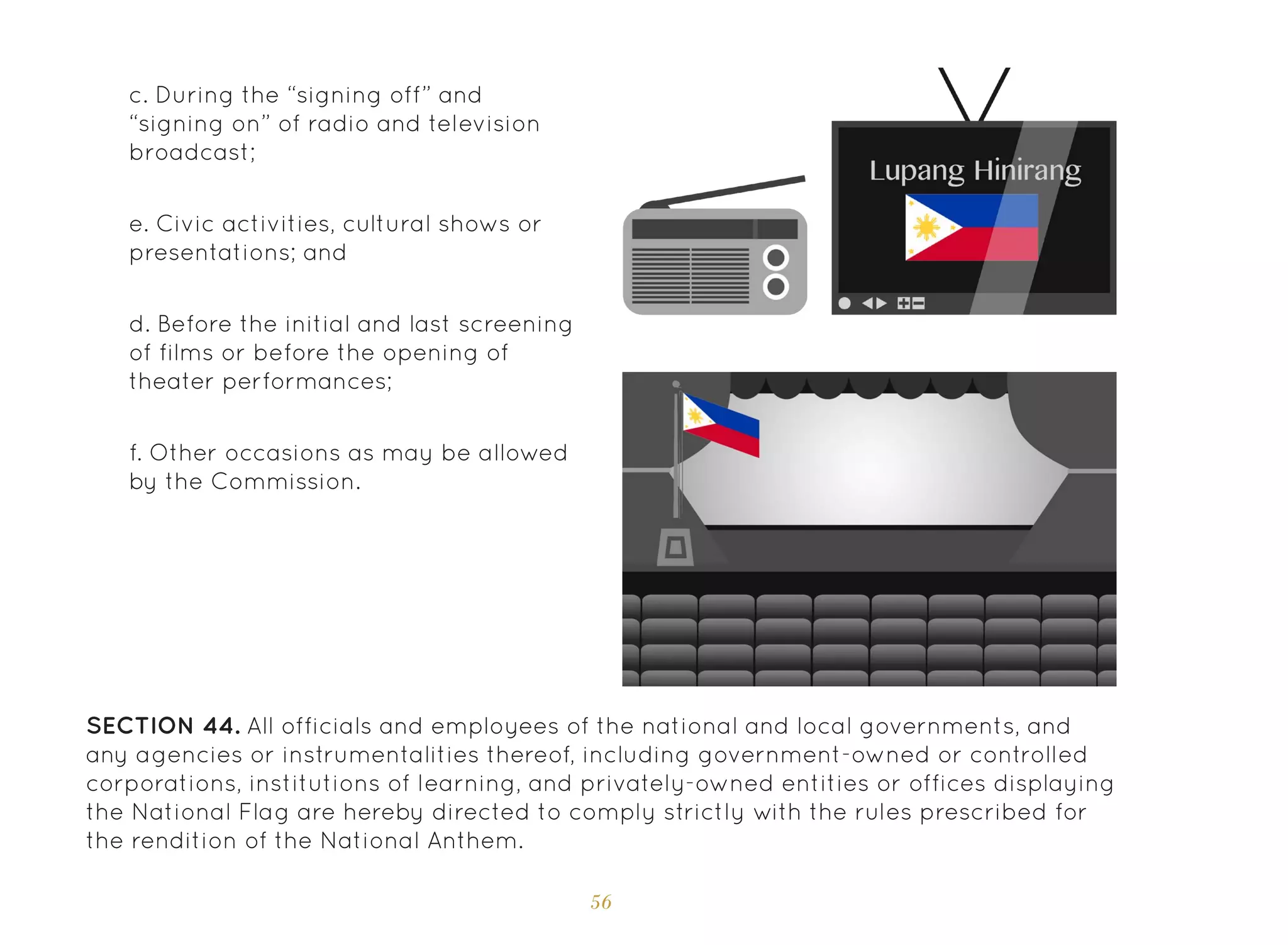
d. Before the initial and last screening
of films or before the opening of
theater performances;
e. Civic activities, cultural shows or
presentations; and
f. Other occasions as may be allowed
by the Commission.
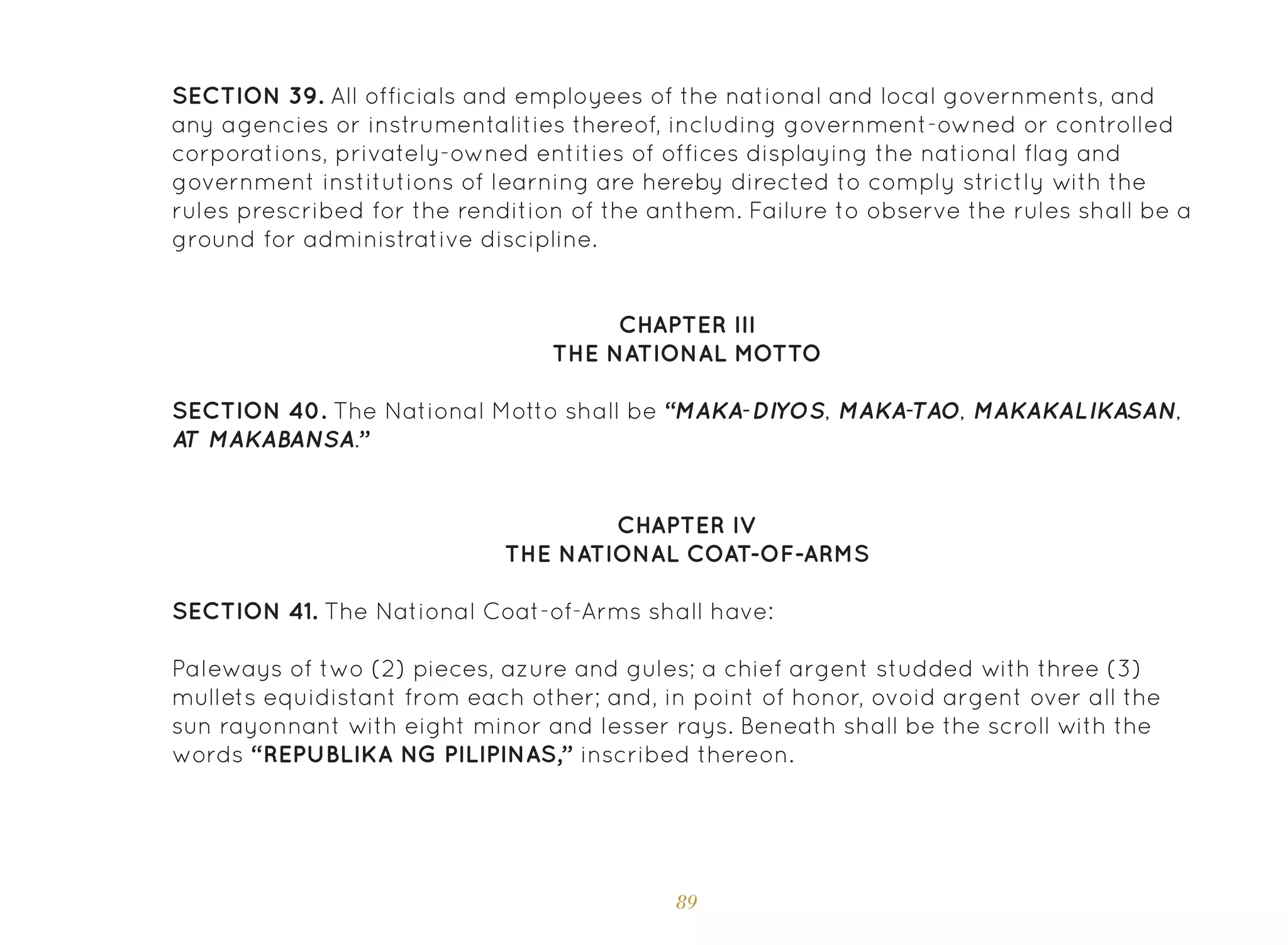
SECTION 44. All officials and employees of the national and local governments, and
any agencies or instrumentalities thereof, including government-owned or controlled
corporations, institutions of learning, and privately-owned entities or offices displaying
the National Flag are hereby directed to comply strictly with the rules prescribed for
the rendition of the National Anthem.
c. During the “signing off” and
“signing on” of radio and television
broadcast;
57
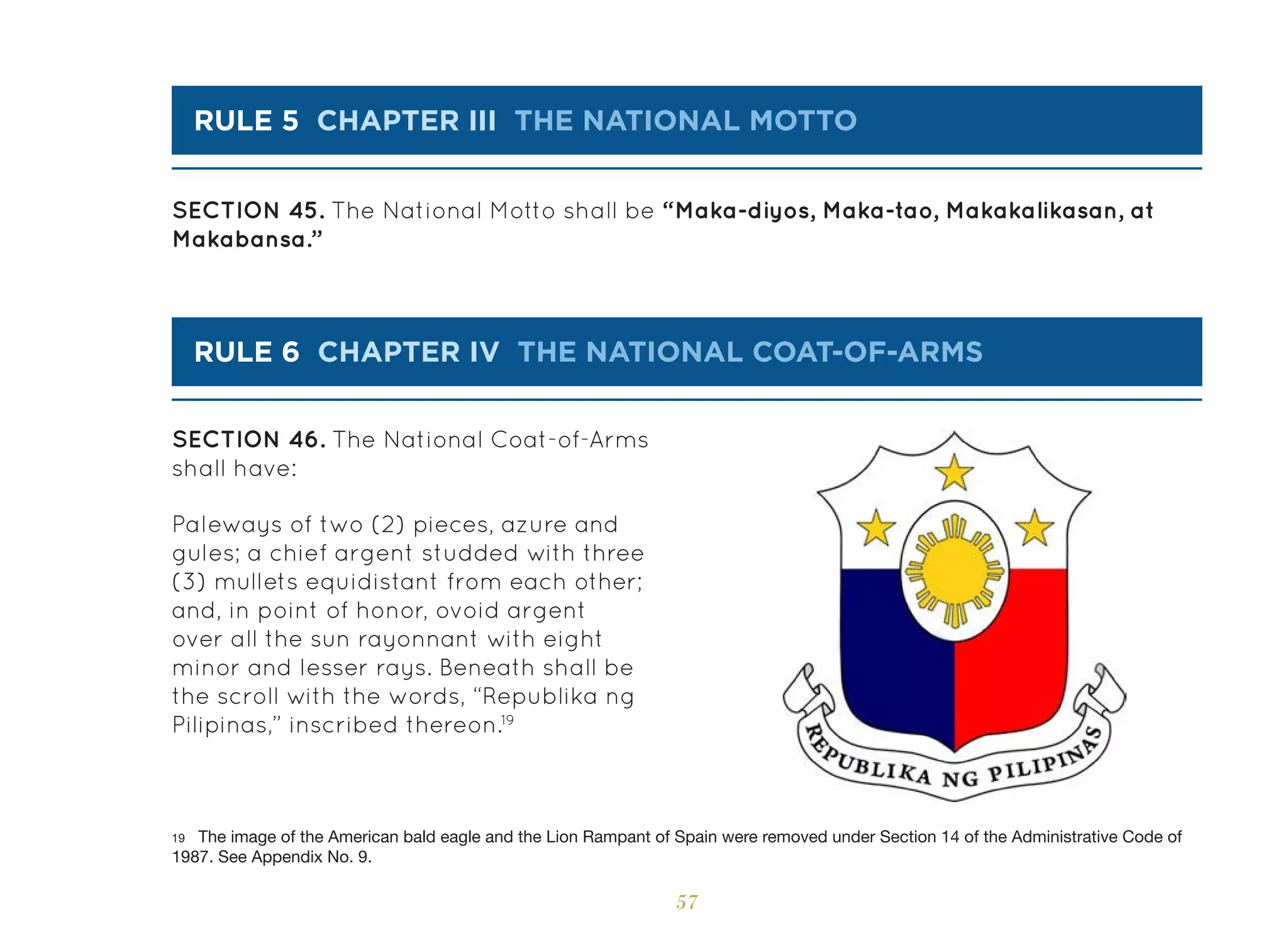
Paleways of two (2) pieces, azure and
gules; a chief argent studded with three
(3) mullets equidistant from each other;
and, in point of honor, ovoid argent
over all the sun rayonnant with eight
minor and lesser rays. Beneath shall be
the scroll with the words, “Republika ng
Pilipinas,” inscribed thereon.19
SECTION 46. The National Coat-of-Arms
shall have:
SECTION 45. The National Motto shall be “Maka-diyos, Maka-tao, Makakalikasan, at
Makabansa.”
rule 5 chapter Iii THE NATIONAL MOTTO
rule 6 chapter Iv THE NATIONAL COAT-OF-ARMS
19 The image of the American bald eagle and the Lion Rampant of Spain were removed under Section 14 of the Administrative Code of
1987. See Appendix No. 9.
58
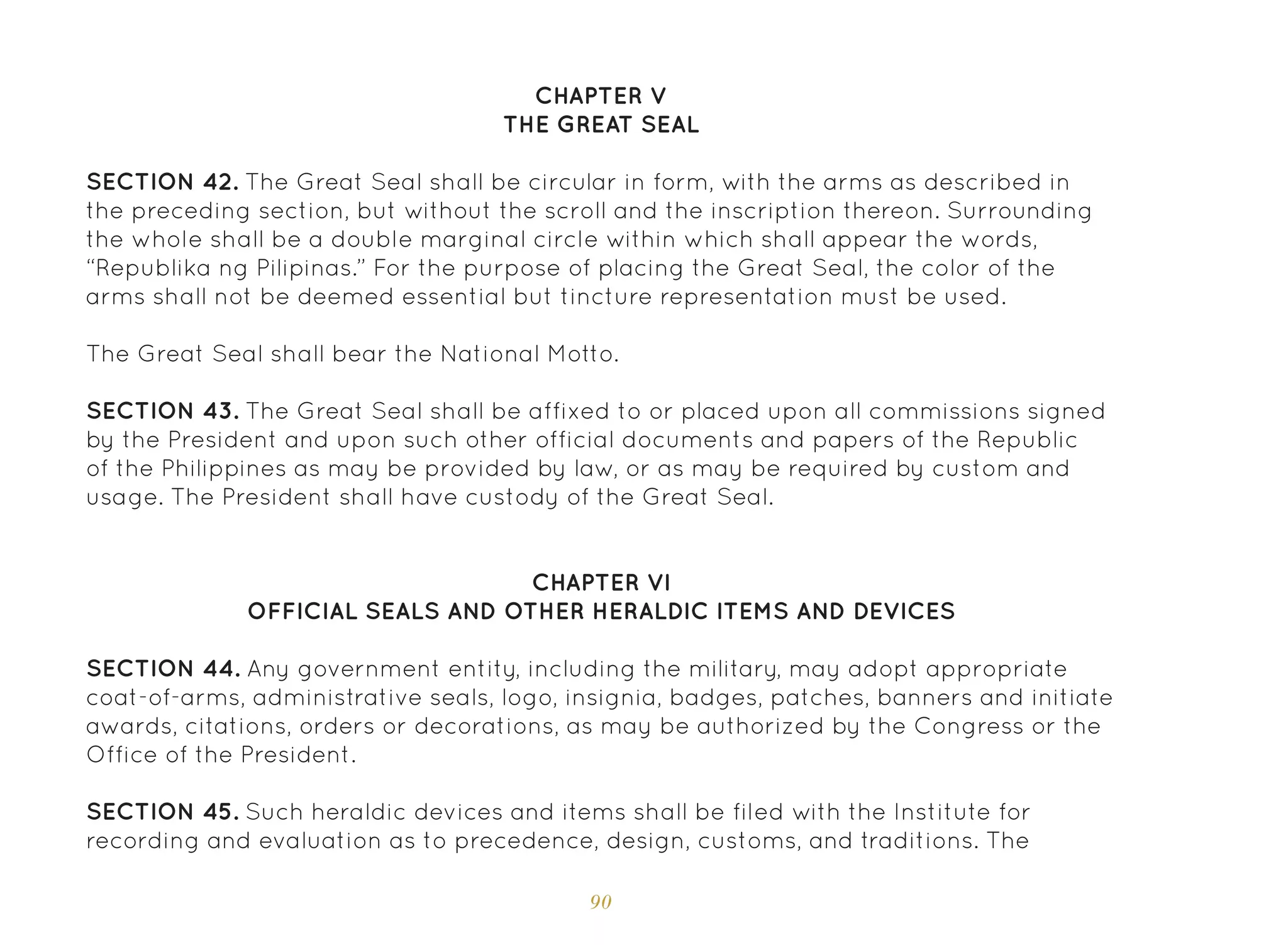
rule 7 chapter v THE great seal
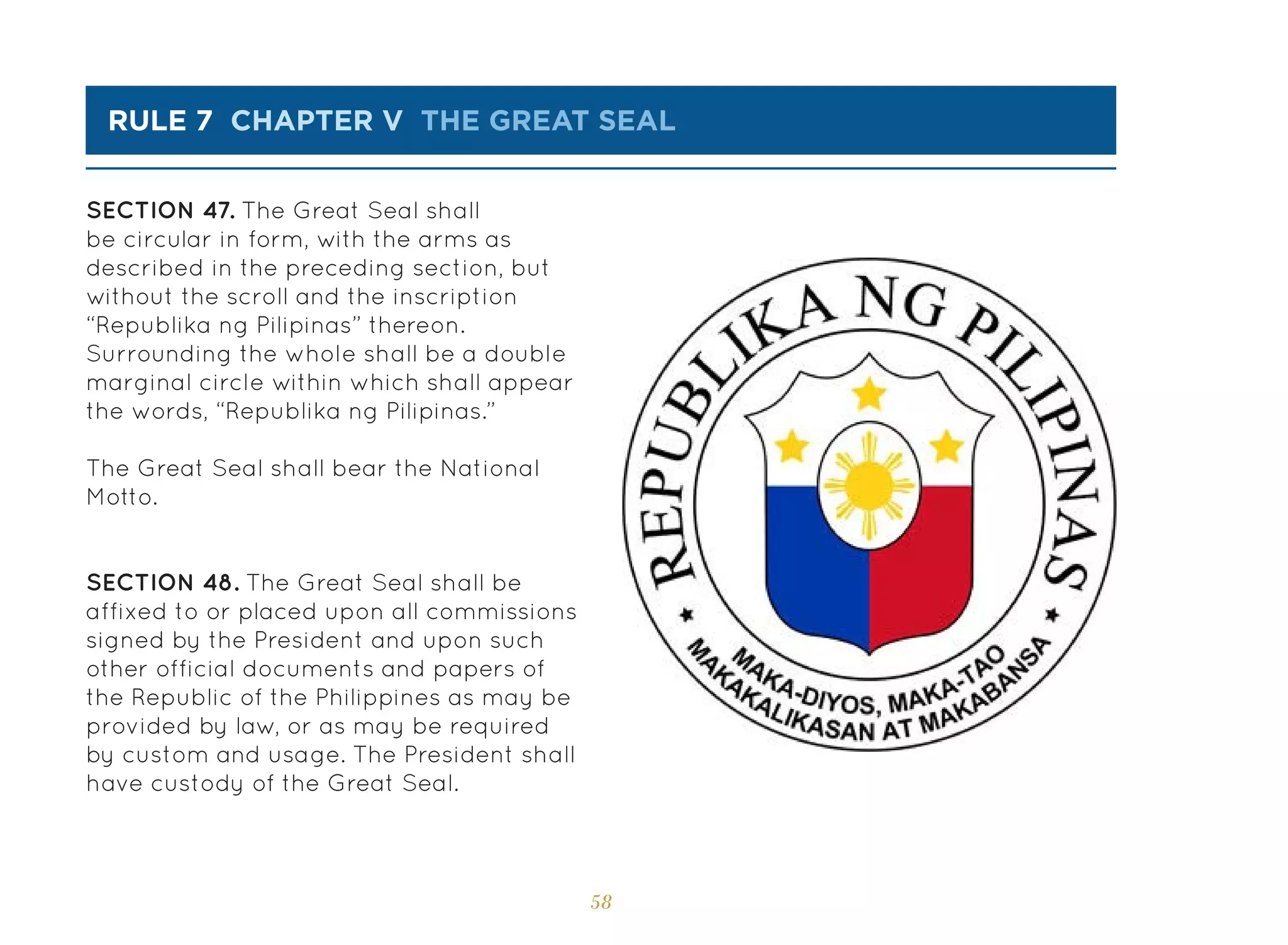
SECTION 47. The Great Seal shall
be circular in form, with the arms as
described in the preceding section, but
without the scroll and the inscription
“Republika ng Pilipinas” thereon.
Surrounding the whole shall be a double
marginal circle within which shall appear
the words, “Republika ng Pilipinas.”
The Great Seal shall bear the National
Motto.
SECTION 48. The Great Seal shall be
affixed to or placed upon all commissions
signed by the President and upon such
other official documents and papers of
the Republic of the Philippines as may be
provided by law, or as may be required
by custom and usage. The President shall
have custody of the Great Seal.
59
rule 8 chapter vi
OFFICIAL SEALS AND OTHER HERALDIC ITEMS AND DEVICES
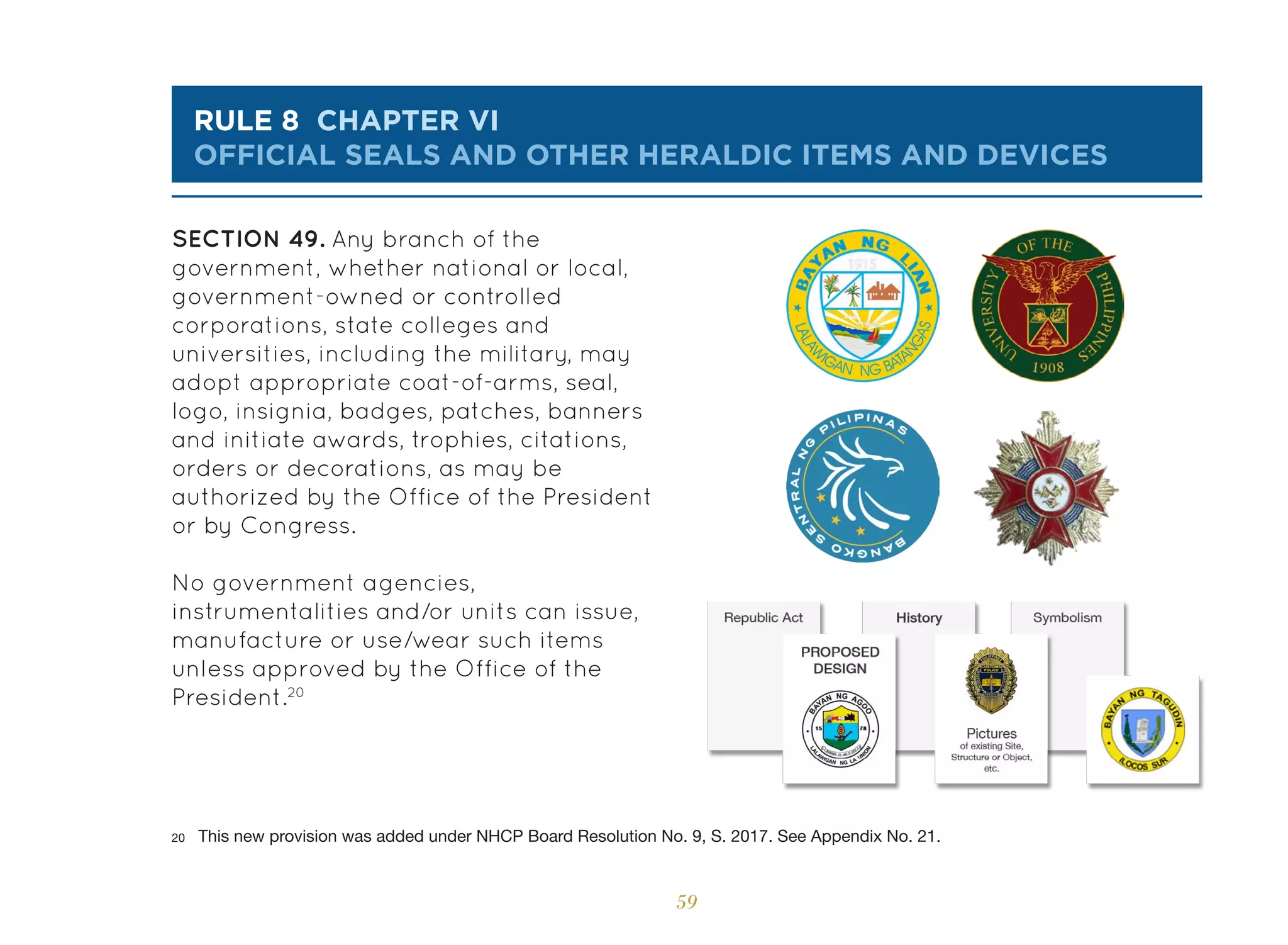
SECTION 49. Any branch of the
government, whether national or local,
government-owned or controlled
corporations, state colleges and
universities, including the military, may
adopt appropriate coat-of-arms, seal,
logo, insignia, badges, patches, banners
and initiate awards, trophies, citations,
orders or decorations, as may be
authorized by the Office of the President
or by Congress.
No government agencies,
instrumentalities and/or units can issue,
manufacture or use/wear such items
unless approved by the Office of the
President.20
20 This new provision was added under NHCP Board Resolution No. 9, S. 2017. See Appendix No. 21.
60
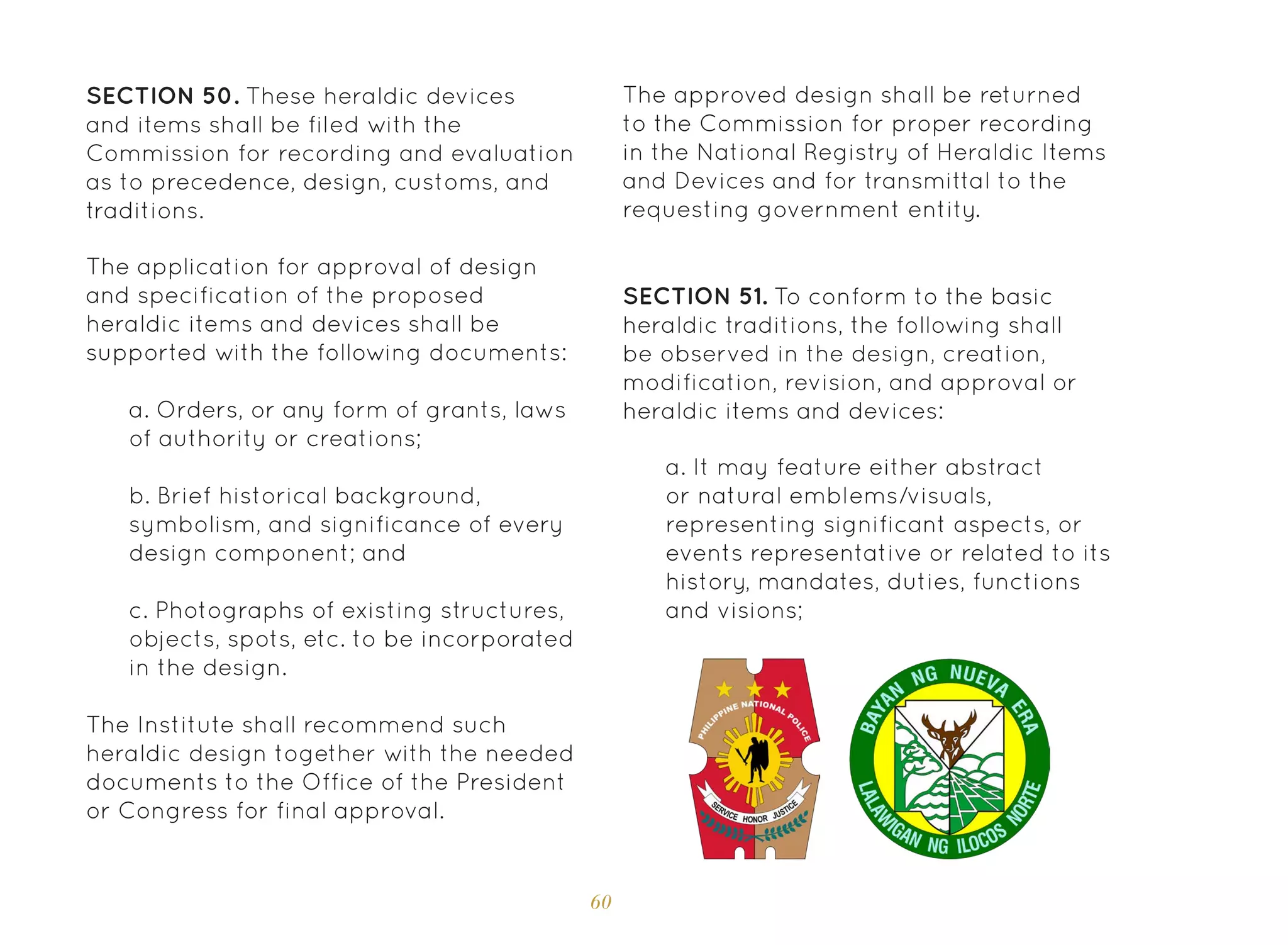
The application for approval of design
and specification of the proposed
heraldic items and devices shall be
supported with the following documents:
SECTION 51. To conform to the basic
heraldic traditions, the following shall
be observed in the design, creation,
modification, revision, and approval or
heraldic items and devices:
The Institute shall recommend such
heraldic design together with the needed
documents to the Office of the President
or Congress for final approval.
a. Orders, or any form of grants, laws
of authority or creations;
b. Brief historical background,
symbolism, and significance of every
design component; and
c. Photographs of existing structures,
objects, spots, etc. to be incorporated
in the design.
a. It may feature either abstract
or natural emblems/visuals,
representing significant aspects, or
events representative or related to its
history, mandates, duties, functions
and visions;
SECTION 50. These heraldic devices
and items shall be filed with the
Commission for recording and evaluation
as to precedence, design, customs, and
traditions.
The approved design shall be returned
to the Commission for proper recording
in the National Registry of Heraldic Items
and Devices and for transmittal to the
requesting government entity.
61
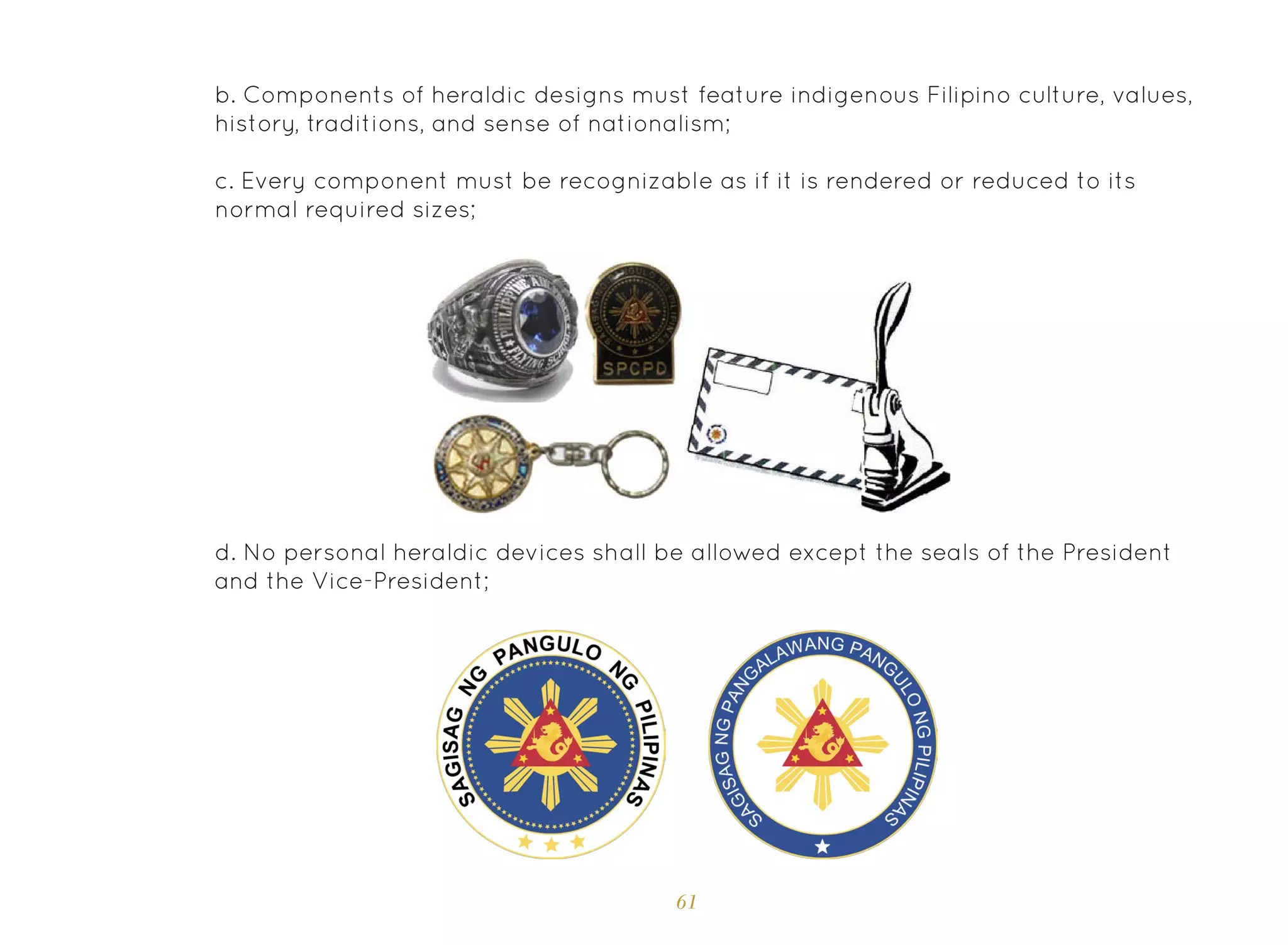
b. Components of heraldic designs must feature indigenous Filipino culture, values,
history, traditions, and sense of nationalism;
c. Every component must be recognizable as if it is rendered or reduced to its
normal required sizes;
d. No personal heraldic devices shall be allowed except the seals of the President
and the Vice-President;
62
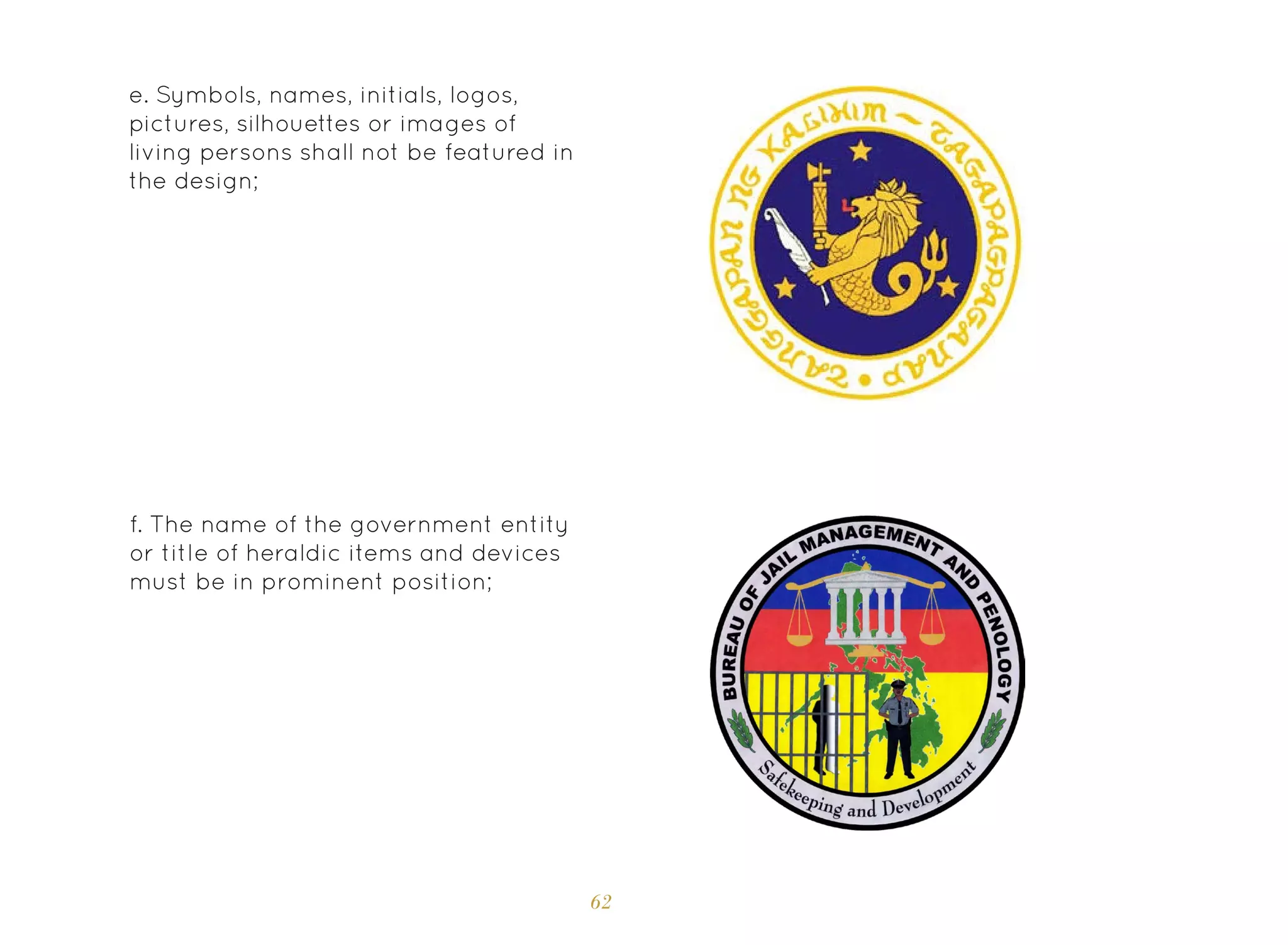
e. Symbols, names, initials, logos,
pictures, silhouettes or images of
living persons shall not be featured in
the design;
f. The name of the government entity
or title of heraldic items and devices
must be in prominent position;
63
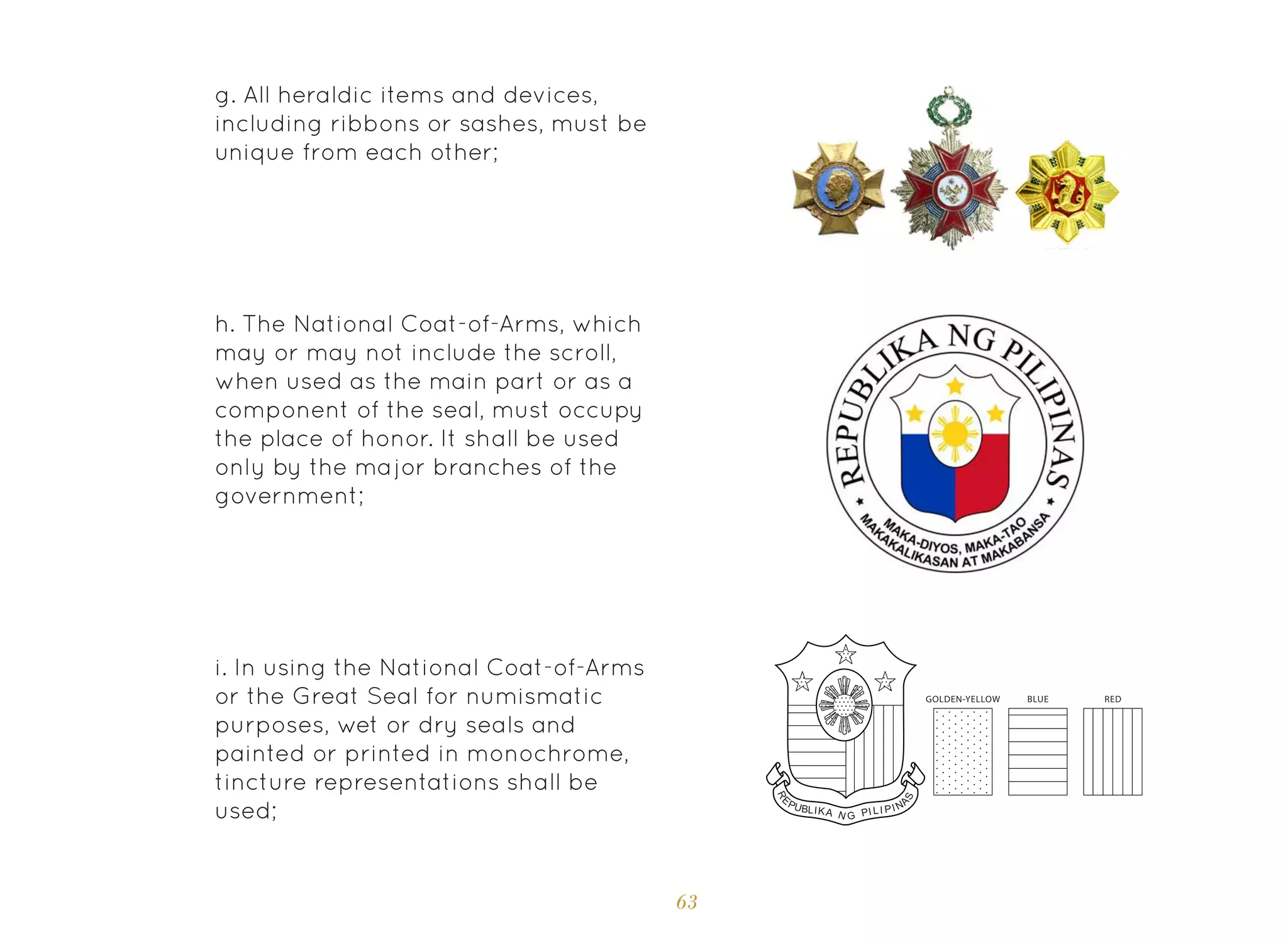
g. All heraldic items and devices,
including ribbons or sashes, must be
unique from each other;
i. In using the National Coat-of-Arms
or the Great Seal for numismatic
purposes, wet or dry seals and
painted or printed in monochrome,
tincture representations shall be
used;
h. The National Coat-of-Arms, which
may or may not include the scroll,
when used as the main part or as a
component of the seal, must occupy
the place of honor. It shall be used
only by the major branches of the
government;
64
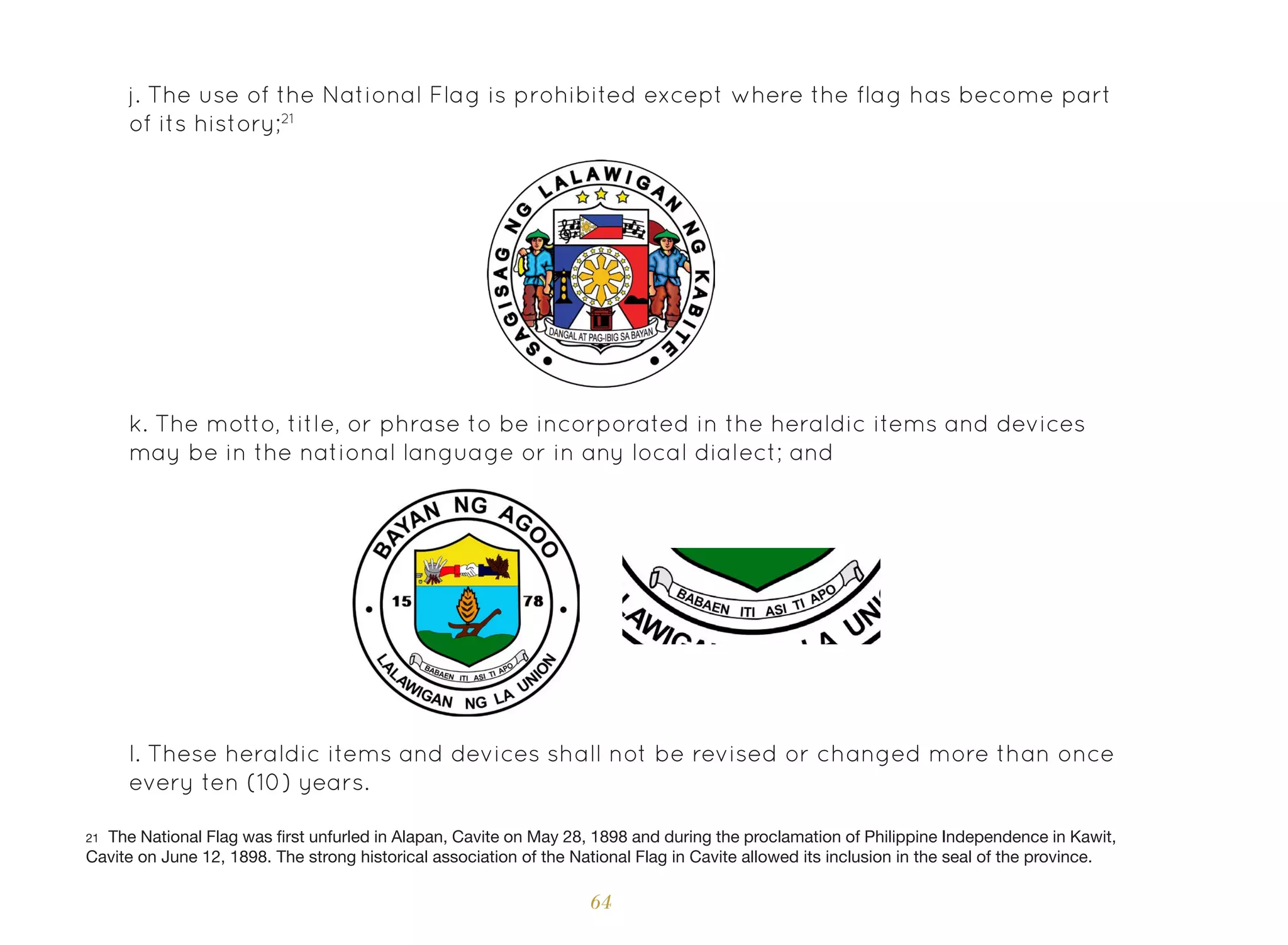
k. The motto, title, or phrase to be incorporated in the heraldic items and devices
may be in the national language or in any local dialect; and
l. These heraldic items and devices shall not be revised or changed more than once
every ten (10) years.
j. The use of the National Flag is prohibited except where the flag has become part
of its history;21
21 The National Flag was first unfurled in Alapan, Cavite on May 28, 1898 and during the proclamation of Philippine Independence in Kawit,
Cavite on June 12, 1898. The strong historical association of the National Flag in Cavite allowed its inclusion in the seal of the province.
65
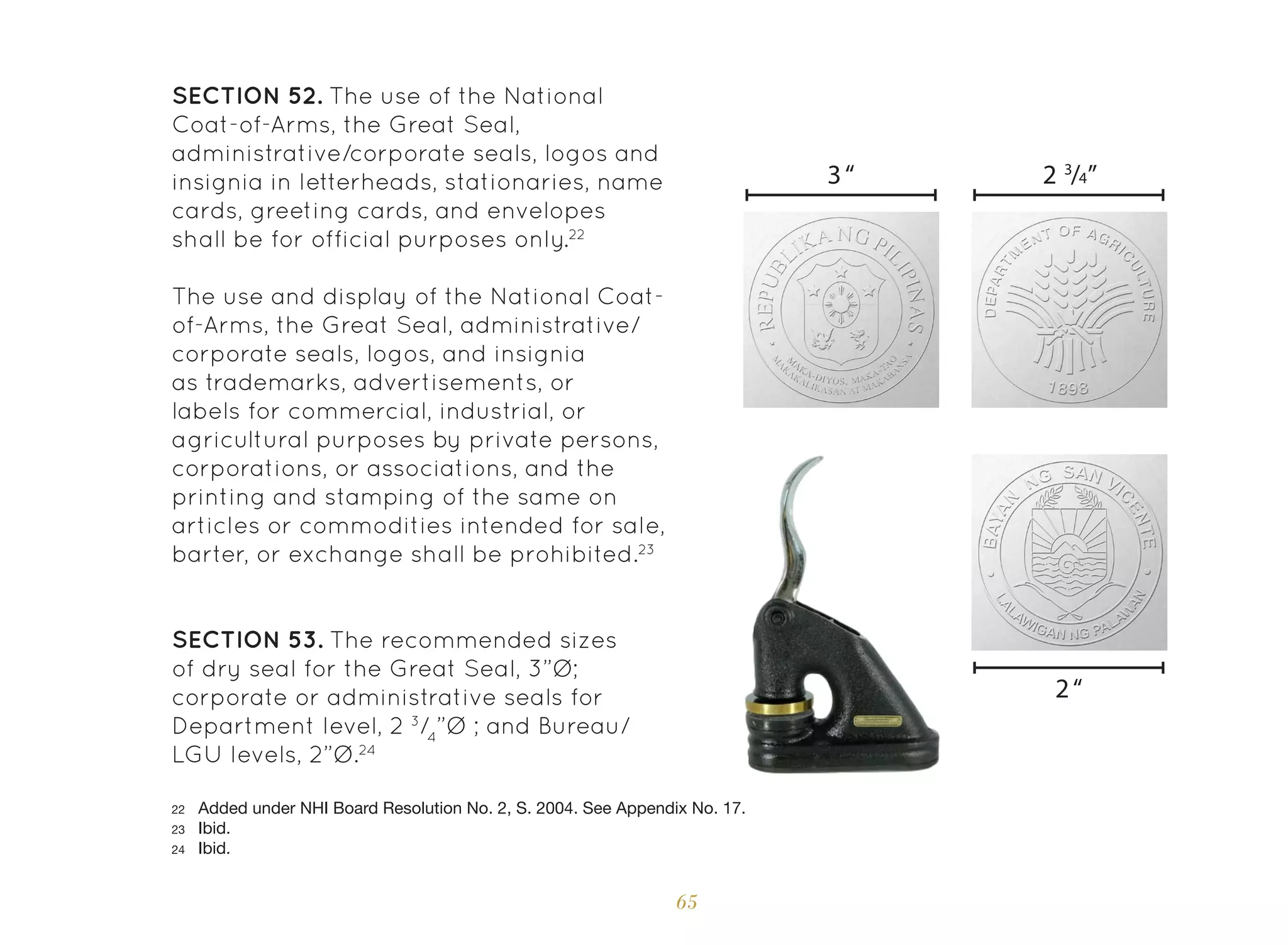
SECTION 52. The use of the National
Coat-of-Arms, the Great Seal,
administrative/corporate seals, logos and
insignia in letterheads, stationaries, name
cards, greeting cards, and envelopes
shall be for official purposes only.22
The use and display of the National Coat-
of-Arms, the Great Seal, administrative/
corporate seals, logos, and insignia
as trademarks, advertisements, or
labels for commercial, industrial, or
agricultural purposes by private persons,
corporations, or associations, and the
printing and stamping of the same on
articles or commodities intended for sale,
barter, or exchange shall be prohibited.23
SECTION 53. The recommended sizes
of dry seal for the Great Seal, 3ӯ;
corporate or administrative seals for
Department level, 2 3
/4
ӯ ; and Bureau/
LGU levels, 2ӯ.24
22 Added under NHI Board Resolution No. 2, S. 2004. See Appendix No. 17.
23 Ibid.
24 Ibid.
2“
3“ 2 3
/4”
66
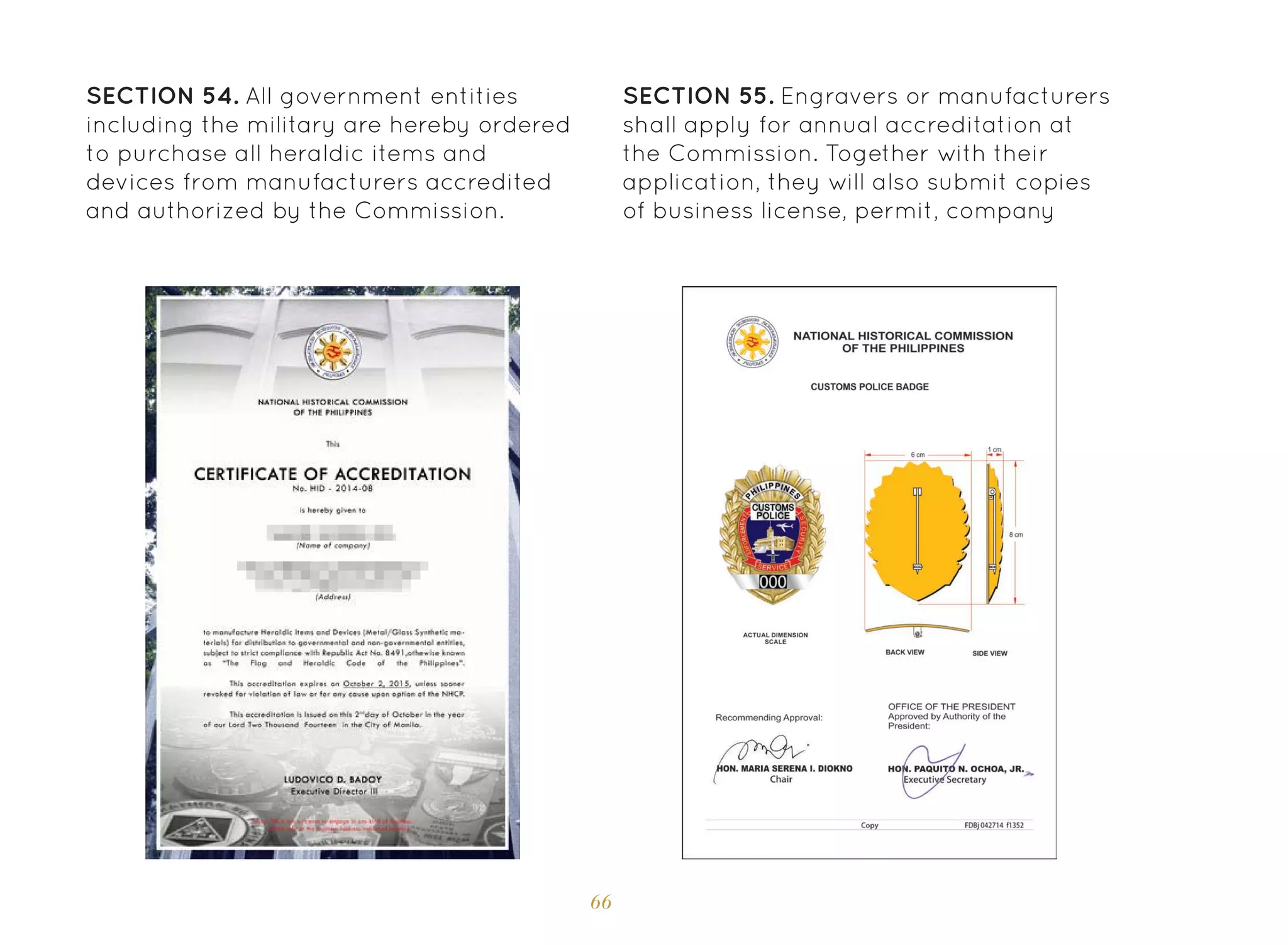
SECTION 54. All government entities
including the military are hereby ordered
to purchase all heraldic items and
devices from manufacturers accredited
and authorized by the Commission.
SECTION 55. Engravers or manufacturers
shall apply for annual accreditation at
the Commission. Together with their
application, they will also submit copies
of business license, permit, company
67
Such items and devices shall be
subject to inspection by the purchasing
agency’s internal inspector and the COA
representative using the design and
specifications approved by the Office of
the President or by Congress, through the
Commission.
Any violation of R.A. No. 8491 or
these Rules shall be a ground for
suspension, revocation or non-renewal of
accreditation.
SECTION 56. No government official or
employee shall accept any orders or
decorations from any foreign government
without the consent of Congress,
and without the prior evaluation
and documentation of such order or
decoration by the Commission.
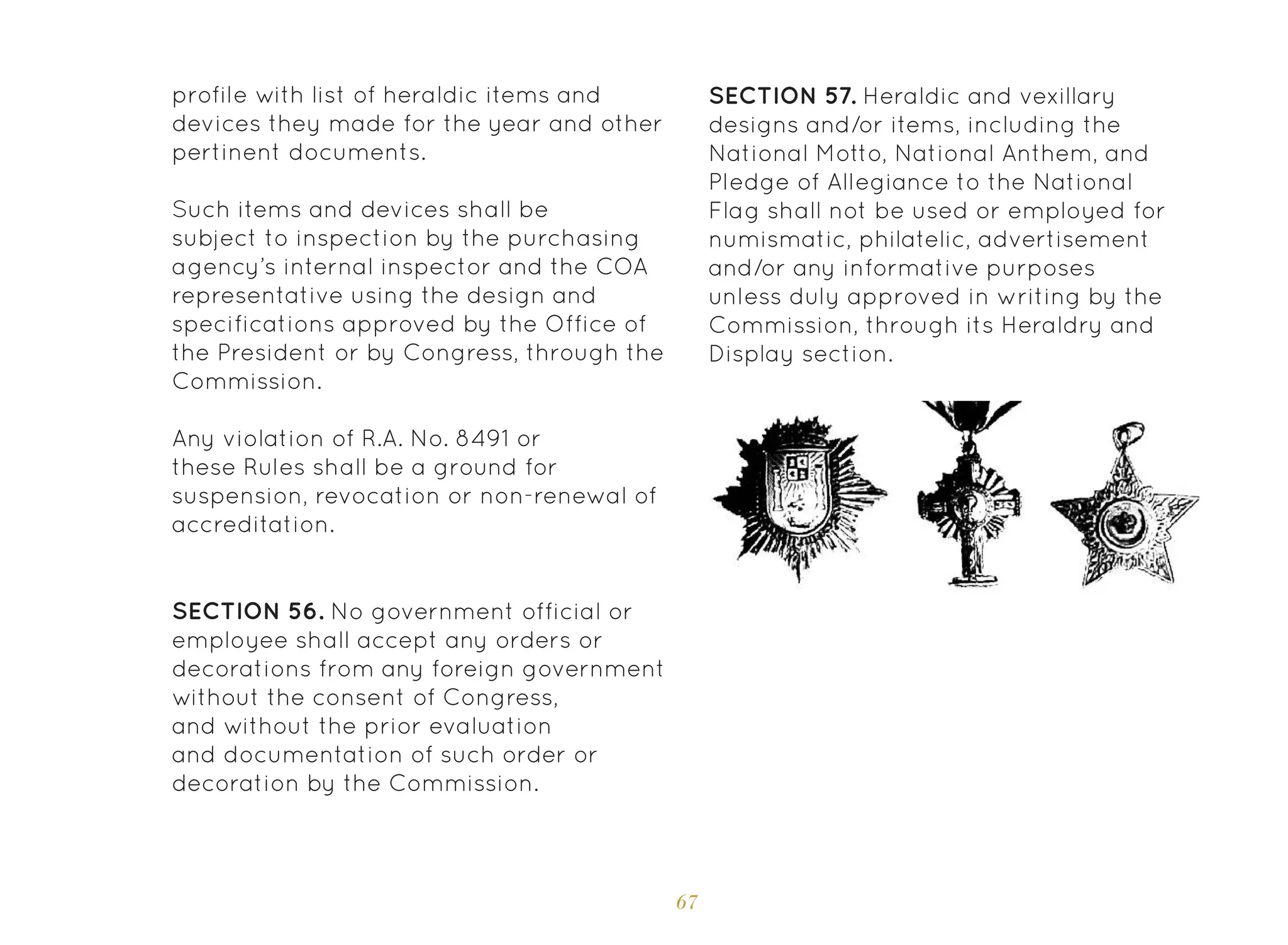
SECTION 57. Heraldic and vexillary
designs and/or items, including the
National Motto, National Anthem, and
Pledge of Allegiance to the National
Flag shall not be used or employed for
numismatic, philatelic, advertisement
and/or any informative purposes
unless duly approved in writing by the
Commission, through its Heraldry and
Display section.
profile with list of heraldic items and
devices they made for the year and other
pertinent documents.
68
rule 9 chapter vii penalties
rule 10 chapter viii effectivity
rule 11 chapter ix AMENDMENT OF RULES
SECTION 58. Failure or refusal to observe the provisions of R.A. No. 8491, and/or
any violation of these Rules shall, after proper notice and hearing, be penalized as
stipulated in R.A. No. 8491.
SECTION 59. Effectivity - These Rules shall be effective fifteen (15) days after the
approval of the Office of the President and filing with Congress of the Philippines and
the University of the Philippines Law Center.
SECTION 60. Amendments - The Chairman and Executive Director shall have the
authority to amend, revise, repeal, or otherwise modify these Rules or any provision
thereof, as may be deemed necessary to achieve the objectives of the R.A. No. 8491
and these Rules.
69
ISSUED this 30th
day of January, two thousand and two,
in the City of Manila, the Philippines.
OFFICE OF THE PRESIDENT
Approved by Authority of the President:
PABLO S. TRILLANA III
Chairman
and Executive Director
ALBERTO G. ROMULO
Executive Secretary
Recommending Approval:
71
REPUBLIC ACT
No. 8491
72
73
S. No. 630
H. No. 2586
Republic of the Philippines
Congress of the Philippines
Metro Manila
Tenth Congress
Third Regular Session
Begun and held in Metro Manila, on Monday the twenty-eighth day of July, nineteen
hundred and ninety-seven.
[REPUBLIC ACT NO. 8491]
AN ACT PRESCRIBING THE CODE OF THE NATIONAL FLAG, ANTHEM, MOTTO, COAT-OF-
ARMS AND OTHER HERALDIC ITEMS AND DEVICES OF THE PHILIPPINES.
Be it enacted by the Senate and the House of Representatives of the Philippines in
Congress assembled:
SECTION 1. Short Title - This act shall be known as the “Flag and Heraldic Code of the
Philippines.”
SECTION 2. Declaration of Policy - Reverence and respect shall at all times be accorded
the flag, the anthem and other national symbols which embody the national ideals and
traditions and which express the principles of sovereignty and national solidarity. The
74
heraldic items and devices shall seek to manifest the national virtues and to inculcate
in the minds and hearts of our people a just pride in their native land, fitting respect
and affection for the national flag and anthem, and the proper use of the national
motto, coat-of-arms, and other heraldic items and devices.
SECTION 3. Definition of Terms - Whenever used in this Act, the term:
a. “Military” shall mean all branches of the Armed Forces of the Philippines including
the Philippine National Police, the Bureau of Jail Management and Penology, and
the Bureau of Fire Protection;
b. “Festoon” shall mean to hang in a curved shape between two points as a
decoration;
c. “Flag” shall mean the Philippine National Flag, unless stated otherwise;
d. “Fly” shall mean the part of the flag outside the hoist or length;
e. “Symbol” shall mean any conventional sign which reveals man’s achievement
and heroism (for orders and decorations), identification, authority and a sign of
dignity (for coat-of-arms, logo, and insignia);
f. “Half-Mast” shall mean lowering the flag to one-half the distance between the top
and bottom of the staff;
g. “Hoist” shall mean the part of the flag nearest the staff or the canvass to which
the halyard is attached;
75
h. “Inclement Weather” shall mean that a typhoon signal is raised in the locality;
i. “National Anthem” shall mean the Philippine National Anthem;
j. “Official Residences” shall mean Malacañang, and other government-owned
structures where the President resides, and other structures occupied by the
Philippine Consulate or Embassies abroad;
k. “Places of Frivolity” shall mean places of hilarity marked by or providing
boisterous merriment or recreation; and
l. “Institute” shall mean the National Historical Institute.
CHAPTER I
THE NATIONAL FLAG
A. Design of the National Flag
SECTION 4. The flag of the Philippines shall be blue, white, and red with an eight-rayed
golden-yellow sun and three five-pointed stars, as consecrated and honored by the
people.
B. Hoisting and Display of the National Flag
SECTION 5. The Flag shall be displayed in all public buildings, official residences,
public plazas, and institutions of learning everyday throughout the year.
76
SECTION 6. The flag shall be permanently hoisted, day and night throughout the year,
in front of the following: at Malacañang Palace; the Congress of the Philippines building;
Supreme Court building; the Rizal Monument in Luneta, Manila; Aguinaldo Shrine in
Kawit, Cavite; Barasoain Shrine in Malolos, Bulacan; the Tomb of the Unknown Soldier,
Libingan ng mga Bayani; Mausoleo de los Veteranos dela Revolucion; all International
Ports of Entry and all other places as may be designated by the Institute.
The flag shall be illuminated at night.
SECTION 7. The flag shall also be displayed in private buildings and residences
or raised in the open flagstaffs in front of said buildings every April 9 (Araw ng
Kagitingan); May 1 (Labor Day); May 28 (National Flag Day) to June 12 (Independence
Day); last Sunday of August (National Heroes Day); November 30 (Bonifacio Day); and
December 30 (Rizal Day); and on such other days as may be declared by the President
and/or local chief executives.
The flag may also be displayed throughout the year in private buildings or offices
or raised in the open on flagstaffs in front of private buildings: Provided, that they
observe flag-raising ceremonies in accordance with the rules and regulations to be
issued by the Office of the President.
SECTION 8. All government agencies and instrumentalities, and local government
offices, government-owned corporations and local government units are enjoined to
observe flag day with appropriate ceremonies. Socio-civic groups, non-government
organizations and the private sector are exhorted to cooperate in making the
celebrations a success.
77
SECTION 9. The flag shall be flown on merchant ships of Philippine registry of more
than one thousand (1000) gross tons and on all naval vessels.
On board naval vessels, the flag shall be displayed on the flagstaff at the stern when
the ship is at anchor. The flag shall be hoisted to the gaff at the aftermast when the
ship is at sea.
SECTION 10. The flag, if flown from a flagpole, shall have its blue field on top in time
of peace and the red field on top in time of war; if in a hanging position, the blue field
shall be to the right (left of the observer) in time of peace, and the red field to the
right (left of observer) in time of war.
The flagpole staff must be straight and slightly tapering at the top.
SECTION 11. If planted on the ground, the flagpole shall be at a prominent place and
shall be of such height as would give the flag commanding position in relation to the
buildings in the vicinity.
If attached to a building, the flagpole shall be on top of its roof or anchored on a sill
projecting on an angle upward.
If on stage or platform or government office, the flag shall be at the left (facing the
stage) or the left of the office upon entering.
SECTION 12. When the Philippine flag is flown with another flag, the flags, if both are
national flags, must be flown on separate staffs of the same height and shall be of
equal size. The Philippine flag shall be hoisted first and lowered last.
78
If the other flag is not a national flag, it may be flown in the same lineyard as the
Philippine flag but below the latter and it cannot be of greater size than the Philippine
flag.
SECTION 13. When displayed with another flag, the Philippine flag shall be on the right
side of the other flag. If there is a line of other flags, the Philippine flag shall be in the
middle of the line.
When carried in a parade with flags, which are not national flags, the Philippine flag
shall be in front of the center of the line.
SECTION 14. A flag worn out through wear and tear shall not be thrown away. It
shall be solemnly burned to avoid misuse or desecration. The flag shall be replaced
immediately when it begins to show signs of wear and tear.
SECTION 15. The flag shall be raised at sunrise and lowered at sunset. It shall be on the
mast at the start of official office hours, shall remain flying throughout the day.
SECTION 16. The flag may be displayed:
a. Inside or outside a building or on a stationary flagpole. If the flag is displayed
indoors on a flagpole, it shall be placed at the left of the observer as one enters
the room;
b. From the top of a flagpole, which shall be at a prominent place or a
commanding position in relation to the surrounding building;
79
c. From a staff projecting upward from the window sill, canopy, balcony, or façade
of a building;
d. In a suspended position from a rope extending from a building to a pole erected
away from the building;
e. Flat against the wall vertically with the sun and stars on top; and
f. Hanging in a vertical position across a street, with the blue field pointing east, if
the road is heading south or north, or pointing north if the road is heading east or
west.
The flag shall not be raised when the weather is inclement. If already raised, the flag
shall not be lowered.
SECTION 17. The flag shall be hoisted to the top briskly and lowered ceremoniously.
The flag shall never touch anything beneath it, such as the ground, flood, water or
other objects.
After being lowered, the flag shall be handled and folded solemnly as part of the
ceremony.
80
C. Conduct of Flag Raising Ceremony
SECTION 18. All government offices and educational institutions shall henceforth
observe the flag-raising ceremony every Monday morning and the flag lowering
ceremony every Friday afternoon. The ceremony shall be simple and dignified and
shall include the playing or singing of the Philippine National Anthem.
SECTION 19. The office of the President, upon the recommendation of the Institute,
shall issue rules and regulations for the proper conduct of the flag ceremony.
SECTION 20. The observance of the flag ceremony in official or civic gatherings shall
be simple and dignified and shall include the playing or singing of the anthem in its
original Filipino lyrics and march tempo.
SECTION 21. During the flag-raising ceremony, the assembly shall stand in formation
facing the flag. At the moment the first note of the anthem is heard, everyone in the
premises shall come to attention; moving vehicles shall stop. All persons present shall
place their right palms over their chests, those with hats shall uncover, while those in
military, scouting, security guard, and citizens’ military training uniforms shall give the
salute prescribed by their regulations, which salute shall be completed upon the last
note of the anthem.
The assembly shall sing the Philippine National Anthem, accompanied by a band, if
available, and at the first note, the flag shall be raised briskly.
The same procedure shall be observed when the flag is passing in review or in parade.
81
SECTION 22. During the flag lowering, the flag shall be lowered solemnly and slowly
so that the flag shall be down the mast at the sound of the last note of the anthem.
Those in the assembly shall observe the same deportment or shall observe the same
behavior as for the flag-raising ceremony.
D. Half-Mast
SECTION 23. The flag shall be flown at half-mast as a sign of mourning on all buildings
and places where it is displayed, as provided for in this Act, on the day of official
announcement of the death of any of the following officials:
a. The President or a former President, for ten (10) days;
b. The Vice-President, the Chief Justice, the President of the Senate, and the
Speaker of the House of Representatives, for seven (7) days; and
c. Other persons to be determined by the institute, for any period less than seven
(7) days.
The flag shall be flown at half-mast on all the buildings and places where the
deceased was holding office, on the day of death until the day of interment of an
incumbent member of the Supreme Court, the Cabinet, the Senate or the House of
Representatives, and such other persons as determined by the Institute.
The flag, when flown at half-mast, shall be first hoisted to the peak for a moment then
lowered to the half-mast position. The flag shall again be raised briskly to the peak
before it is lowered for the day.
82
E. Casket
SECTION 24. The flag may be used to cover the caskets of the honored dead of the
military, veterans of previous wars, national artists, and of civilians who have rendered
distinguished service to the nation, as maybe determined by the local government unit
concerned. In such cases, the flag shall be placed such that the white triangle shall be
at the head and the blue shall cover the right side of the casket. The flag shall not be
lowered to the grave or allowed to touch the ground but shall be folded solemnly and
handed over to the heirs of the deceased.
F. Pledge to the Flag
SECTION 25. The following shall be the Pledge of Allegiance to the Philippine Flag:
Ako ay Pilipino
Buong katapatang nanunumpa
Sa watawat ng Pilipinas
At sa bansang kanyang sinasagisag
Na may dangal, katarungan, at kalayaan
Na pinakikilos ng sambayanang
Maka-Diyos
Maka-tao
Makakalikasan at
Makabansa
Such pledge shall be recited while standing with the right hand palm open, raised
shoulder-high. Individuals whose faith or religious beliefs prohibit them from making
83
such pledge must nonetheless show full respect when the pledge is being rendered by
standing at attention.
G. Flag Days
SECTION 26. The period from May 28 to June 12 of each year is declared as Flag Days,
during which period all offices, agencies and instrumentalities of the government,
business establishments, institutions of learning and private homes are enjoined to
display the flag.
H. Specifications of the National Flag
SECTION 27. The flag shall have the following proportions. The width of the flag, 1; the
length of the flag, 2; and the sides of the white triangle, 1.
SECTION 28. The technical specifications shall be as follows:
The blue color shall bear Cable No. 80173; the white color, Cable No. 80001; the red
color, Cable No. 80108; and the golden yellow, Cable No. 80068.
SECTION 29. In order to establish uniform criteria in the making of our national flag
and to guarantee its durability by the use of quality materials, the following standards
and procedures shall be observed:
a. All requisitions for the purchase of the Philippine National Flag must be based on
strict compliance with the design, color, craftsmanship and material requirements
of the Government.
84
b. All submitted samples of flags by accredited suppliers offered for purchase
for government use shall be evaluated as to design, color, and craftsmanship
specifications by the Institute, through its Heraldry and Display Section, which shall
stamp its approval or disapproval on the canvass reinforcement of the flag sample
submitted. The samples shall be sent to the Institute by the requisitioning office,
not by the flag supplier; and
c. The Industrial Technology Development Institute (ITDI) or the Philippine Textile
Research Institute (PTRI) of the Department of Science and Technology (DOST)
shall evaluate the quality of material of all flag samples and certify whether the
fabric for the blue, white, red, and golden yellow colors, including the canvass
submitted, conforms to government requirement as to quality of the material. The
samples shall be submitted by the said office to the Institute.
SECTION 30. All deliveries of the flags requisitioned by the government shall be
inspected by the requisitioning agency’s internal inspector and by the Commission on
Audit (COA) using the flag stamped approved by the Institute as reference.
SECTION 31. In carrying out its responsibilities under SECTION 4 hereof, the Institute,
COA, the ITDI/PTRI shall prepare guidelines to be approved by the Office of the
President.
SECTION 32. All government agencies and instrumentalities shall ensure that the
requirements under this Act, with respect to the standards, requisitions, and delivery of
the national flag are strictly complied with.
SECTION 33. All departments, agencies, offices, and instrumentalities of the
85
government, government-owned or controlled corporations, local government units
including barangays, shall include in their annual budgets the necessary outlay for the
purchase of the national flag.
I. Prohibited Acts
SECTION 34. It shall be prohibited:
a. To mutilate, deface, defile, trample on, or cast contempt, any act or omission
casting dishonor or ridicule upon the flag over its surface;
b. To dip the flag to any person or object by way of compliment or salute;
c. To use the flag:
1. As drapery, festoon, tablecloth;
2. As covering for ceilings, walls, statues, or other objects;
3. As pennant in the hood, side, back, and top of motor vehicles;
4. As a staff or whip;
5. For unveiling monuments or statues; and
6. As trademarks or for industrial, commercial, or agricultural labels or designs.
86
d. Display the flag:
1. Under any painting or picture;
2. Horizontally face-up. It shall always be hoisted aloft and be allowed to fall
freely;
3. Below any platform; or
4. In discotheques, cockpits, night and day clubs, casinos, gambling joints and
places of vice or where frivolity prevails.
e. To wear the flag in whole or in parts as a costume or uniform;
f. To add any word, figure, mark, picture, design, drawings, advertisements, or
imprint of any nature on the flag;
g. To print, paint or attach representation of the flag on handkerchiefs, napkins,
cushions, and other articles of merchandise;
h. To display in public any foreign flag, except in embassies and other diplomatic
establishments, and in offices of international organizations.
i. To use, display, or be part of any advertisement or infomercial; and
j. To display the flag in front of buildings or offices occupied by aliens.
87
SECTION 35. The National Anthem is entitled, “Lupang Hinirang.”
SECTION 36. The National Anthem shall always be sung in the national language
within or without the country. The following shall be the lyrics of the National Anthem:
CHAPTER II
THE NATIONAL ANTHEM
Bayang Magiliw
Perlas ng Silanganan,
Alab ng puso
Sa dibdib mo’y buhay.
Lupang Hinirang
Duyan ka ng magiting,
Sa manlulupig
Di ka pasisiil.
Sa dagat at bundok,
Sa simoy at sa langit mong bughaw,
May dilag at tula
At aw
it sa paglayang minamahal.
Ang kislap ng watawat mo’y
Tagumpay na nagniningning;
Ang bituin at araw niya
Kailan pa ma’y di magdidilim.
Lupa ng araw, ng luwalhati’t pagsinta
Buhay ay langit sa piling mo,
Aming ligaya na pag may mang-aapi,
Ang mamatay ng dahil sa iyo.
SECTION 37. The rendition of the National Anthem, whether played or sung, shall be in
accordance to the musical arrangement and composition of Julian Felipe.
88
SECTION 38. When the National Anthem is played at a public gathering, whether by
a band or by singing or both, or reproduced by any means, the attending public shall
sing the anthem. The singing must be done with fervor.
As a sign of respect, all persons shall stand at attention and face the Philippine flag, if
there is one displayed, and if there is none, they shall face the band or the conductor.
At the first note, all persons shall execute a salute by placing their right palms over
their left chests. Those in military, scouting, citizen’s military training and security
guard uniforms shall give the salute prescribed by their regulations. The salute shall be
completed upon the last note of the anthem.
The anthem shall not be played and sung for mere recreation, amusement, or
entertainment purposes except on the following occasions:
a. International competitions where the Philippines is the host or has a
representative;
b. Local competitions;
c. During “signing off” and “signing on” of radio broadcasting and television
stations;
d. Before the initial and last screening of films or before the opening of theater
performances; and
e. Other occasions as may be allowed by the Institute.
89
SECTION 39. All officials and employees of the national and local governments, and
any agencies or instrumentalities thereof, including government-owned or controlled
corporations, privately-owned entities of offices displaying the national flag and
government institutions of learning are hereby directed to comply strictly with the
rules prescribed for the rendition of the anthem. Failure to observe the rules shall be a
ground for administrative discipline.
CHAPTER III
THE NATIONAL MOTTO
CHAPTER IV
THE NATIONAL COAT-OF-ARMS
SECTION 40. The National Motto shall be “MAKA-DIYOS, MAKA-TAO, MAKAKALIKASAN,
AT MAKABANSA.”
SECTION 41. The National Coat-of-Arms shall have:
Paleways of two (2) pieces, azure and gules; a chief argent studded with three (3)
mullets equidistant from each other; and, in point of honor, ovoid argent over all the
sun rayonnant with eight minor and lesser rays. Beneath shall be the scroll with the
words “REPUBLIKA NG PILIPINAS,” inscribed thereon.
90
SECTION 42. The Great Seal shall be circular in form, with the arms as described in
the preceding section, but without the scroll and the inscription thereon. Surrounding
the whole shall be a double marginal circle within which shall appear the words,
“Republika ng Pilipinas.” For the purpose of placing the Great Seal, the color of the
arms shall not be deemed essential but tincture representation must be used.
The Great Seal shall bear the National Motto.
SECTION 43. The Great Seal shall be affixed to or placed upon all commissions signed
by the President and upon such other official documents and papers of the Republic
of the Philippines as may be provided by law, or as may be required by custom and
usage. The President shall have custody of the Great Seal.
CHAPTER V
THE GREAT SEAL
CHAPTER VI
OFFICIAL SEALS AND OTHER HERALDIC ITEMS AND DEVICES
SECTION 44. Any government entity, including the military, may adopt appropriate
coat-of-arms, administrative seals, logo, insignia, badges, patches, banners and initiate
awards, citations, orders or decorations, as may be authorized by the Congress or the
Office of the President.
SECTION 45. Such heraldic devices and items shall be filed with the Institute for
recording and evaluation as to precedence, design, customs, and traditions. The
91
CHAPTER VII
PENALTIES
Institute shall promulgate the corresponding rules and regulations which shall be
submitted for approval to the Office of the President or Congress.
SECTION 46. All government offices including the military are hereby ordered to
purchase all heraldic items and devices from manufacturers accredited and authorized
by the Institute. Such items and devices shall be subject to inspection by the
purchasing agency’s internal inspector and the COA representative using the design
and specifications approved by the Office of the President or by the Congress, through
the Institute.
SECTION 47. No government official or employee shall accept any orders or
decorations from any foreign government without the consent of Congress, and
without the prior evaluation and documentation of such order or decoration by the
Institute.
SECTION 48. Failure or refusal to observe the provisions of this Act; and any violation
of the corresponding rules and regulations issued by the Office of the President
shall, after proper notice and hearing, be penalized by public censure which shall be
published at least once in a newspaper of general circulation.
The Department of Education, Culture, and Sports and the Commission on Higher
Education, upon the recommendation of the Institute and after the proper notice
and hearing, shall cause the cancellation of the recognition of permit of any private
92
educational institution which fails or refuses to observe the provisions of this Act for
the second time.
SECTION 49. The Department of Education, Culture, and Sports (DECS) and the
Commission on Higher Education shall ensure that the National Anthem, as adopted
by law, shall be committed to memory by all students of both public and private
educational institutions, and performed during the flag ceremony conducted in
accordance with the rules and regulations issued by the Office of the President. In
addition, they shall make available the vocal, piano, or band scores of the National
Anthem, as adopted by law, to all private and public schools, as well as the general
public.
SECTION 50. Any person or judicial entity which violates any of the provisions of
this Act shall, upon conviction, be punished by a fine of not less than Five thousand
pesos (P5,000.00) not more than Twenty thousand pesos (P20,000.00), or by
imprisonment for not more than one (1) year, or both such fine and imprisonment, at
the discretion of the court: Provided, that for any second and additional offenses, both
fine and imprisonment shall always be imposed: Provided, that in case the violation is
committed by a juridical person, its President or Chief Executive Officer thereof shall
be liable.
93
CHAPTER VIII
COMMON PROVISION
SECTION 51. The Institute shall issue the necessary rules and regulations to implement
the provisions of this Act within ninety (90) days after effectivity. The Institute shall
submit its rules and regulations to the Office of the President and the Congress of the
Philippines.
SECTION 52. The Institute shall also be responsible for the strict enforcement of the
provision of this Act. It may call upon any government department, agency, office, or
government instrumentality, including government corporations and local government
units, for such assistance as it may deem necessary for the effective discharge of its
functions under this Act.
SECTION 53. Separability Clause - If any provision, or part hereof, is held invalid or
unconstitutional, the remainder of this Act not otherwise affected shall be valid and
subsisting.
SECTION 54. Repealing Clause - Any law, presidential decree or issuance, executive
order, letter of instruction, administrative order, rule and regulation contrary to or
inconsistent with the provisions of this Act is hereby repealed, modified, or amended
accordingly.
SECTION 55. Effectivity - This Act shall be effective fifteen (15) days from the date of its
publication in Official Gazette or in at least two (2) newspapers of general circulation.
94
Approved:
FEB 12, 1998
JOSE DE VENECIA, JR.
Speaker of the House
of Representatives
ROBERTO P. NAZARENO
Secretary General
House of Representatives
HEZEL P. GACUTAN
Secretary of the Senate
FIDEL V. RAMOS
President of the Philippines
NEPTALI A. GONZALES
President of the Senate
Approved:
This Act, which is a consolidation of Senate Bill No. 630 and House Bill No. 2586 was
finally passed by the Senate and the House of Representatives on February 3, 1998
respectively.
95
APPENDICES
other RELEVANT LAWS and RULES
affecting PHILIPPINE
HERALDRY & VEXILLARY
96
97
Appendix No. 1
MALACAÑANG
Manila
BY THE PRESIDENT OF THE PHILIPPINES
EXECUTIVE ORDER NO. 23, S. 1936
DESCRIPTION AND SPECIFICATIONS OF THE FILIPINO FLAG
WHEREAS, SECTION I, Article XIII of the Constitution prescribes what the Philippine
National Flag should be without giving descriptions;
WHEREAS, Act Numbered Two Thousand Nine Hundred and Twenty-Eight describes the
construction of the Filipino Flag without the necessary specification of the different
elements of the flag;
WHEREAS, compliance with this act has not been uniformly carried out and has caused
the making of Filipino flags in disproportionate sizes with incorrect proportions of the
different allegorical symbols of the flag; and
WHEREAS, to avoid irregularities and discrepancies, it is necessary to follow the
Constitutional provisions and Act Numbered Two Thousand Nine Hundred and Twenty-
Eight with uniformity;
98
1. The maximum length of the flag is twice its width; the minimum length is twice
the altitude of the equilateral triangle;
2. Any side of the equilateral triangle is as long as the width of the flag.
3. Solid golden sunburst without any markings - Sun with eight rays, in equally
spaced; Arc x with Sun ray - Free arc y; two opposite rays in horizontal axis; sun’s
diameter D = W/5; each ray has one major beam, twice as broad as the minor
beam on either side; length of major beam R = 5/9D; length of minor beam r =
4/5R.
4. Three five-pointed golden stars of equal size, each star with one point directed
to the vertex of the angle enclosing it; diameter of circumscribed circle of each
star = 5/9D; diameter of circumscribed circle of each star = 2/9D; distance from
each corner = D/2.
5. Canvas - trimmed edge to the left of the triangle is approximately D/5 wide = not
counted in measuring length of the flag.
6. Flags made of silk will be trimmed on three edges with a knotted fringe of yellow
silk D/5 wide.
NOW, THEREFORE, I, MANUEL L. QUEZON, President of the Philippines, do hereby
promulgate and order that the following specifications for the Philippine National Flag
be strictly observed by all civil and military branches of the government.
99
Specifications of the Philippine Flag
D = W
5
r = 4 R
5
R = 5 D
9
5 D
9
2 D
9
45º
D
2
D
2
D
5
Altitude of equilateral triangle − A
Standard length − 2W
2W − 2A
Free adjustable end
W
idth
−
W
Canvas-trimmed
edg
e
100
MANUEL L. QUEZON
President of the Philippines
ELPIDIO QUIRINO
Secretary of the Interior
By the President
Done in the City of Manila, this twenty-fifth day of March, in the year of Our Lord,
nineteen hundred and thirty-six, and of the Commonwealth of the Philippines the first.
101
Appendix No. 2
MALACAÑANG
Manila
By virtue of the powers vested in me by law, I, MANUEL L. QUEZON, President of the
Philippines, do hereby create the Philippines Heraldry Committee, the chairman and
members, of which shall be appointed by the President from time to time, to make a
study of, and recommend ways and means for, the adoption of the coat-of-arms of the
different political subdivisions, provinces, cities, and semi-governmental institutions.
The Committee shall have a secretary who shall be designated by the chairman from
among its members.
Political subdivisions, provinces, cities, and semi-governmental institutions desiring to
adopt their own local coat-of-arms shall submit an application therefore in triplicate to
the committee, which application shall contain the following:
BY THE PRESIDENT OF THE PHILIPPINES
EXECUTIVE ORDER NO. 310, S. 1940
CREATING THE PHILIPPINES HERALDRY COMMITTEE TO MAKE A STUDY OF,
AND RECOMMEND WAYS AND MEANS FOR, THE ADOPTION OF THE
COAT-OF-ARMS OF THE DIFFERENT POLITICAL SUBDIVISIONS, PROVINCES,
CITIES, AND SEMI-GOVERNMENTAL INSTITUTIONS.
102
1. Sketch
2. Physical description
3. Statement of significance of the emblazonry, allegorical ideas—political,
historical, social or economic representations
4. Supporting documents, orders or any form of grants.
Municipalities, except independently organized by the National Assembly, shall adopt
the coat-of-arms of their respective provinces and need not submit an application
under the provisions of this Executive Order.
The Committee shall meet at such times and places as may be designated by the
chairman and shall submit its recommendations to the President.
The members of the Committee who are government employees shall serve without
additional compensation, but they shall be entitled to such necessary transportation
expenses as may be authorized by the President.
103
JORGE B. VARGAS
Secretary of the Philippines
By the President
Source: 	 Executive Orders Nos. 248–399 S. 1940–1941, Nos. 246–333, p. 1–2
MANUEL L. QUEZON
President of the Philippines
Done at the City of Manila, this fourth day of December, in the year of Our Lord,
nineteen hundred and forty, and of the Commonwealth of the Philippines, the sixth.
104
Appendix No. 3
Republic of the Philippines
Department of Education
OFFICE OF THE SECRETARY
Manila
May 26, 1956
DEPARTMENT ORDER NO. 5, S. 1956
REVISED FILIPINO LANGUAGE VERSION OF THE PHILIPPINE NATIONAL ANTHEM
In order to effect a final revision of the Filipino Language version of the Philippine
National Anthem with respect to linguistic correctness and fitness to music, a
committee with the Director of the Institute of National Language as Chairman and
representatives from the Department of Education, the Bureau of Public Schools, the
Bureau of Private Schools, the University of the Philippines, literary organizations, and
the Philippine Constabulary Band, as members, was formed. The following version,
entitled “Lupang Hinirang” has finally been adopted.
Bayang Magiliw
Perlas ng Silanganan,
Alab ng puso
Sa dibdib mo’y buhay.
105
Ang kislap ng watawat mo’y
Tagumpay na nagniningning;
Ang bituin at araw niya
Kailan pa ma’y di magdidilim.
Lupa ng araw, ng luwalhati’t pagsinta
Buhay ay langit sa piling mo,
Aming ligaya na pag may mang-aapi,
Ang mamatay ng dahil sa iyo.
It is desired that this version be used in all public and private schools in the Philippines.
G. HERNANDEZ, JR.
Secretary of Education
Lupang Hinirang
Duyan ka ng magiting,
Sa manlulupig
Di ka pasisiil.
Sa dagat at bundok,
Ang simoy at sa langit mong bughaw,
May dilag ang tula
At aw
it sa paglayang minamahal.
106
107
Republic of the Philippines
Department of Education
BUREAU OF PUBLIC SCHOOLS
Manila
June 22, 1956
CIRCULAR No. 21, S. 1956
To Superintendents:
REVISED FILIPINO LANGUAGE VERSION OF THE PHILIPPINE NATIONAL ANTHEM
1. Attention is invited to the enclosed copy of Department Order No. 5, S. 1956, issued
by the Honorable, the Secretary of Education, containing the final revision of the
Filipino Language version of the Philippine National Anthem. This revised version shall
henceforth be taught and sung in all schools in lieu of the version in Circular No. 4, S.
1948.
2. Also enclosed is a copy of the new lyrics with musical rearrangement by Lt. Col.
Antonio Buenaventura of the Philippine Constabulary Band.
3. The Philippine National Anthem should be played only on appropriate occasions and
preferably sung in the Filipino Language instead of English.
4. The meaning and patriotic message of the lyrics in the Filipino Language should
be carefully explained to the pupils so that the song can be sung with the fervor a
108
national anthem deserves. All pupils, teachers, and school officials should as soon as
possible, learn and be able to sing from memory this revised Filipino Language version
of the Philippine National Anthem.
5. Efforts should be made to acquaint the community with this version by having it
printed in programs or by distributing mimeographed copies whenever the Philippine
National Anthem is to be sung during school and community assemblies.
6. This Circular supersedes Circular No. 4, S. 1948.
Director of Public Schools
References:
Department Order: (No. 5, S. 1956)
Circular: (No. 4, S. 1948)
Allotment: 1-2-3-4-5-- (C. 35-38)
To be indicated in the Perpetual Index under the following subject:
CELEBRATIONS & FESTIVALS
Course of Study, CHARACTER EDUCATION
Course of Study, FILIPINO LANGUAGE
LANGUAGE FILIPINO
MUSIC
109
Appendix No. 4
KAUTUSANG TAGAPAGPAGANAP BLG. 60
NAGPAPAHAYAG NA ANG PAMBANSANG AWIT NG PILIPINAS
AY DAPAT AWITIN LAMANG SA TITIK NITONG PILIPINO
MALACAÑANG
Manila
SAPAGKA’T ang pagpapaunlad at pagpapalaganap ng Wikang Pambansang Pilipino
ay isa sa mga pangarap ng mga bayani ng lahi bukod pa sa ito’y itinatadhana sa
Saligang Batas ng ating Republika;
SAPAGKA’T ang ilang pangyayaring nagaganap dito sa ating kapuluan, lalung-lalo na
sa ibang bansa bagay sa pag-awit sa wikang banyaga ng ating Pambansang Awit ay
lubhang kapansin-pansin at hindi naayon sa diwa ng ating pagkabansa; at
SAPAGKA’T ang Wikang Pilipino ay isa sa ating mga wikang pampamahalaan.
DAHIL DITO, akong si DIOSDADO MACAPAGAL, Pangulo ng Republika ng Pilipinas, sa
bisang kapangyarihang ipinagkakaloob sa akin ng batas at bilang pagbibigay-buhay
sa layunin ng Saligang Batas at ng Batas Komonwelt Bilang 570, ay nagpapahayag at
nag-utos sa pamamagitan nito na ang Pambansang Awit ng Pilipinas ay awitin sa mga
titik lamang nito sa Wikang Pilipino sa alin mang pagkakataon, maging dito o sa ibang
bansa man.
110
Inilagda sa Lungsod ng Maynila, ngayong ika-labinsiyam ng Disyembre, sa taon ng
Ating Panginoon, labinsiyam na raan at animnapu’t tatlo.
DIOSDADO MACAPAGAL
Pangulo ng Pilipinas
Atas ng Pangulo
RUFINO G. HECHANOVA
Kalihim Tagapagpaganap
Source: Official Gazette Vol. 59 No. 51 December 2, 1963 p. 8732 Manila
111
Appendix No. 5
PROCLAMATION NO. 374
DECLARING THE TWENTY-EIGHTH DAY OF MAY EACH YEAR AS FLAG DAY
MALACAÑANG
Manila
WHEREAS, our flag is the consecrated repository of our ideals and the traditional and
historic symbol of our nation as a sovereign people;
WHEREAS, there is a need of instilling and perpetuating in the minds and hearts of the
citizenry greater honor, respect, and reverence for our flag; and
WHEREAS, our flag was first raised and received its baptism of fire and victory in the
battle of Alapan, Imus, Cavite on May 28, 1898;
NOW, THEREFORE, I, DIOSDADO MACAPAGAL, President of the Philippines, by virtue of
the powers vested in me by law, do hereby declare the twenty-eighth day of May of
each year as Flag Day and enjoin all government officials and employees as well as
private citizens of the Philippines to observe the day with appropriate ceremonies.
Proclamation No. 146 dated September 30, 1949, is hereby revoked.
IN WITNESS WHEREOF, I have hereunto set my hand and caused the seal of the
Republic of the Philippines to be affixed.
112
Done in the City of Manila, this 6th
day of March, in the year of Our Lord, nineteen
hundred and sixty-five.
By the President
RAMON A. DIAZ
Executive Secretary
DIOSDADO MACAPAGAL
President of the Philippines
Source: Official Gazette April 5, 1965 Vol. 61 No. 14
113
Appendix No. 6
MALACAÑANG
Manila
PRESIDENTIAL DECREE NO. 1
REORGANIZING THE EXECUTIVE BRANCH OF THE NATIONAL GOVERNMENT
WHEREAS, there were pending before Congress prior to the promulgation of the
Proclamation No. 1081, dated September 21, 1972, certain priority measures vital to the
national development program of the government, and which were duly certified by
the President as urgent measures;
WHEREAS, one of these priority measures is the Integrated Reorganization Plan
reorganizing the entire Executive Branch of the National Government, prepared by the
Commission on Reorganization;
WHEREAS, the Integrated Reorganization Plan is necessary to the realization of the
Government’s program to effect administrative reforms in the government machinery;
NOW, THEREFORE, I, FERDINAND E. MARCOS, Commander-in-Chief of all the Armed
Forces of the Philippines, and pursuant to Proclamation No. 1081, dated September
21, 1972, and General Order No. 1 dated September 22, 1972, as amended, in order to
effect the desired changes and reforms in the social, economic and political structure
of the country, do hereby order and decree that the Integrated Reorganization Plan as
prepared, completed, and submitted by the Commission on Reorganization shall be, as
114
it is hereby adopted, approved, and made as part of the law of the land: Provided, that
there shall be created and organized, in lieu of the Public Information Office within the
Office of the President as recommended in the Reorganization Plan, a Department of
Public Information, the composition of which shall be indicated in future implementing
orders.
Changes and modification in the Integrated Reorganization Plan shall be made from
time to time, as necessity requires, to be correspondingly announced by me or by my
duly authorized representative.
Implementation of the Integrated Reorganization Plan as herein adopted approved
and decreed shall be carried out by Letters of Implementation which will be issued by
me from time to time, or by my duly authorized representative.
All concerned, especially heads of departments, chiefs of bureaus, and offices,
agencies and instrumentalities of the Government, including government-owned or
controlled Corporations, shall act accordingly, pursuant to the contents of this Decree.
Done in the City of Manila, this 24th
day of September, in the year of Our Lord, nineteen
hundred and seventy-two.
FERDINAND E. MARCOS
President of the Philippines
By the President:
ALEJANDRO MELCHOR
Executive Secretary
115
PART XII - EDUCATION
CHAPTER I - DEPARTMENT OF EDUCATION AND CULTURE
ARTICLE XV - NATIONAL HISTORICAL INSTITUTE
1. There is created a National Historical Institute in the Department, hereinafter
referred to in this Article as the Institute, which shall be responsible for promoting
and preserving the Philippine cultural heritage by undertaking, among others, studies
on Philippine history and national heroes and maintaining national shrines and
monuments.
2. The institute shall be composed of a Chairman, the directors of the National Library
and the National Museum as ex-officio members, and four other members who shall
serve part time. The Chairman shall also serve as the full-time executive officer of the
Institute. The four members shall hold office for a period of six years; provided that in
the first appointments, one member shall be for three years, the second member for
four years, the third member for five years, and the fourth member for six years. The
Chairman and members may receive per diem for actual attendance at meetings.
3. The Chairman and the four members shall have distinguished themselves in
historical research and writing.
4. The following divisions are created:
a. Administrative Division which shall be responsible for providing administrative,
personnel, and financial services;
116
b. Research and Publication Division which shall be responsible for conducting
studies of the various aspects of Philippine history and the publication of results of
such studies;
c. Monuments and Heraldry Division which shall be responsible for identifying,
designating, and appropriately marking historical places, causing the construction
or reconstruction and maintenance of national monuments, shrines, and historical
markers and preparing heraldic designs and blazoning of the Government,
including its political subdivisions and semi-government institutions;
d. Special and Commemorative Events Division which shall be responsible for
preparing and implementing a program of activities to honor selected heroes and
significant historical events; and
e. Archives Division which shall be responsible for storing, preserving, and
rehabilitating documents and records for permanent and historical value.
5. The National Historical Commission; the Intramuros Restoration Committee; Roxas
Memorial Commission; Quezon Memorial Committee; General Emilio Aguinaldo
Centennial Commission; Gomes, Burgos, and Zamora Centennial Commission, and the
Pinaglabanan Commemorative Commission in the Department are abolished, and their
functions together with applicable appropriations, records, equipment, property and
such personnel as may be necessary are transferred to the Institute.
6. The Philippine Heraldry Committee and Osmeña Memorial Commission under the
Office of the President are abolished, and their functions together with applicable
117
appropriations, records, equipment, property and such personnel as may be necessary
are transferred to the Institute.
7. The National Shrines Commission in the Department of National Defense is
abolished, and its functions together with applicable appropriations, records,
equipment, property and such personnel as may be necessary are transferred to the
Institute.
8. The Archives Division of the Bureau of Records Management is abolished, and its
functions together with applicable appropriations, records, equipment, property and
such personnel as may be necessary are transferred to the Institute.
118
Appendix No. 7
MALACAÑANG
Manila
EXECUTIVE ORDER NO. 1010
AMENDING EXECUTIVE ORDER NO. 23, DATED MARCH 25, 1936,
ENTITLED “DESCRIPTION AND SPECIFICATIONS OF THE FILIPINO FLAG”
WHEREAS, SECTION 1, Article XV of the 1973 Constitution of the Republic of the
Philippines prescribes the colors of the national flag of the Philippines as red, white,
and blue with a sun and three stars, but silent as to the shade of the color blue;
WHEREAS, in the original flag designed by General Emilio Aguinaldo that was unfurled
during the declaration of Philippine Independence in Kawit, Cavite on June 12, 1898,
the shade of the color blue was lighter than the present dark blue being used in the
making of the Philippine flag;
WHEREAS, there is a need to correct historical inaccuracy as regards the true shade
of the colors of the Philippine flag as evidenced by the historical findings made by the
National Historical Institute, the government agency which absorbed the functions of
the defunct Philippine Heraldry Committee;
NOW, THEREFORE, I, FERDINAND E. MARCOS, President of the Philippines, by virtue
of the powers vested in me by law, do hereby promulgate and order the national
119
Historical Institute to take the necessary steps to restore the original color of the First
Philippine Flag.
The NHI shall issue guidelines concerning the implementation of this Executive Order;
Done in the City of Manila, this 25th
day of February, in the year of our Lord, nineteen
hundred and eighty five.
FERDINAND E. MARCOS
President of the Philippines
JUAN C. TUVERA
Presidential Executive Assistant
By the President:
120
Appendix No. 8
NATIONAL HISTORICAL INSTITUTE
MONUMENTS AND HERALDRY DIVISION
THE PHILIPPINE NATIONAL FLAG
SCOPE– This specification is covered by Executive Order No. 1010, dated February 25,
1985, amending Executive Order No. 23, dated March 25, 1936, entitled “Description
and Specifications of the Filipino Flag.”
CLASSIFICATION – The Philippine Flag shall be of the following types:
CLASSES
National (Civil and Military)
Emblazoning by appliqué (for formal use)
Ensign (Naval)
Emblazoning by printing (for ordinary use)
Merchant Marine
Emblazoning by silk screen process (for ordinary use)
Emblazoning by combination of B and C (for ordinary use)
Type I
Class A
Type II
Class B
Type III
Class C
Class D
—
—
—
—
—
—
—
COLORS – In stitching, the color of the stitch shall match the color of the cloth. Stitches
shall be approximately five (5) stitches per centimeter with No. 20, 3-ply thread.
121
MATERIAL
Characteristics 100% Cotton 100% Wool
Nylon/Wool
75% / 25%
100% Nylon Test Methods
Fabric Mass
g/m min.
150 135 140 65 PTRI 1 -1971
Fabric Count/cm
Warp
Filling
13 + 1
12 + 1
13 + 1
13 + 1
13 + 1
13 + 1
44 + 2
34 + 2
PTRI 1 - 1971
Number of Ply
Warp
Filling
2
2
2
2
2
2
1
1
PTRI 11 -1972
Yarn Number, Tex*
Warp
Filling
35
35
30
30
25
25
8.0
8.0
PTRI 11 -1972
Breaking Strength Strip
Method, N. min
Warp
Filling
330
260
PTRI 5 - 1971
Breaking Strength Grab
Method, N. min
Warp
Filling
330
300
180
200
490
440
PTRI 1 - 1971
Weave Plain Plain Plain Plain
Color Fastness to Light Class 4-5 Class 4-5 Class 4-5 Class 4-5
SILK - For ceremonial purpose only
* Tolerance - 5%
Note: The National Historical Commission of the Philippines, in coordination with the Bureau of Product Standards of the Department of
Trade and Industry, may prescribe materials for the manufacturer of Philippine Flag other than those specified under PNS 234: 1989.
CORNERS – All corners of the Flag shall be reinforced with the same materials as the
body.
PHYSICAL REQUIREMENTS – Philippine National Standard 234: 1989
122
DESIGN
The Philippine Flag showing different elements and specifications
D = W
5
r = 4 R
5
R = 5 D
9
5 D
9
2 D
9
45º
D
2
D
2
D
5
Altitude of equilateral triangle − A
Standard length − 2W
2W − 2A
Free adjustable end
W
idth
−
W
Canvas-trimmed
edg
e
123
COLOR CHART
LUIS C. LIWANAG II
Sr. Deputy Executive Secretary
EMELITA V. ALMOSARA
Deputy Executive Director III
and Officer-In-Charge
Approved by Authority of the President:
Recommending Approval:
BLUE
Cable No. 80173
RED
Cable No. 80108
GOLDEN YELLOW
Cable No. 80068
WHITE
Cable No. 80001
124
Appendix No. 9
BY THE PRESIDENT OF THE PHILIPPINES
EXECUTIVE ORDER NO. 292
INSTITUTING THE “ADMINISTRATIVE CODE OF 1987”
MALACAÑANG
Manila
WHEREAS, the Administrative Code currently in force was first forged in 1917 when
the relationship between the people and the government was defined by the colonial
order then prevailing;
WHEREAS, efforts to achieve an integrative and overall recodification of its provisions
resulted in the Administrative Code of 1978 which, however, was never published and
later expressly repealed;
WHEREAS, the effectiveness of the Government will be enhanced by a new
Administrative Code which incorporates in a unified document the major structural,
functional and procedural principles and rules of governance; and
WHEREAS, a new Administrative Code will be of optimum benefit to the people
and Government officers and employees as it embodies changes in administrative
structures and procedures designed to serve the people;
NOW, THEREFORE, I, CORAZON C. AQUINO, President of the Philippines, by virtue of
the powers vested in me by the Constitution, do hereby promulgate the Administrative
Code of 1987, as follows:
. . .
125
(1) The Arms shall have paleways of two (2) pieces, azure and gules; a chief argent
studded with three mullets equidistant from each other; and, in point of honor,
ovoid argent over all the sun rayonnant with eight minor and lesser rays. Beneath
shall be a scroll with the words “Republic of the Philippines,” or its equivalent in the
national language, inscribed thereon.
(2) The Great Seal shall be circular in form, with the arms as described in the
preceding paragraph but without the scroll and the inscription thereon, and
SECTION 13. National Anthem. – Until otherwise provided by law, the musical
arrangement and composition of Julian Felipe is adopted as the national anthem.
It shall be sung or played upon the opening or start of all state celebrations or
gatherings and on such other occasion as may be prescribed by appropriate rules and
regulations.
SECTION 14. Arms and Great Seal of the Republic of the Philippines. –
SECTION 12. National Flag. –
(1) The flag of the Philippines shall be red, white, and blue, with a sun and three
stars, as consecrated and honored by the people and recognized by law.
(2) The custody, ceremonial use, occasion and manner of display, and the proper
care and disposition of the flag shall be governed by appropriate rules and
regulations.
BOOK I. Chapter 4 – NATIONAL SYMBOLS AND OFFICIAL LANGUAGES
126
SECTION 15. Use and Custody of the Great Seal. – The Great Seal shall be affixed to
or placed upon all commissions signed by the President and upon such other official
documents and papers of the Republic of the Philippines as may be provided by law,
or as may be required by custom and usage. The President shall have custody of the
Great Seal.
SECTION 16. Arms, Seals and Banners of Government Offices. – The various offices of
government may adopt appropriate coat-of-arms, seals and banners.
SECTION 17. Official Languages. – Until otherwise provided by law, Pilipino and English
shall be the official languages.
DONE in the City of Manila, this 25th
day of July, in the year of Our Lord, nineteen
hundred and eighty-seven.
CORAZON C. AQUINO
President of the Philippines
JOKER P. ARROYO
Executive Secretary
By the President:
. . .
surrounding the whole, a double marginal circle within which shall appear the
words “Republic of the Philippines,” or its equivalent in the national language. For
the purpose of placing the Great Seal, the color of the arms shall not be deemed
essential.
127
Appendix No. 10
Office of the President
of the Philippines
Malacañang
MEMORANDUM ORDER NO. 205
PROHIBITION AGAINST THE USE OF THE PRESIDENTIAL SEAL
“SAGISAG NG PANGULO” IN OFFICE STATIONERIES AND UNIFORMS
It has come to our attention that some offices under the Office of the President,
are using the Presidential Seal “Sagisag ng Pangulo” in their stationaries and office
uniforms.
Considering that the Presidential Seal is personal to the President of the Republic of
the Philippines, it should only be for the exclusive use of the President. Accordingly,
all offices under the Office of the President are henceforth prohibited to use the
Presidential Seal in their office stationaries and uniforms.
Manila,
November 25, 1988
MAGDANGAL B. ELMA
Deputy Executive Secretary
128
Appendix No. 11
ALL PROVINCIAL GOVERNORS, CITY AND MUNICIPAL MAYORS,
PUNONG BARANGAYS, MEMBERS OF THE SANGGUNIANG
PANLALAWIGAN, SANGGUNIANG PANLUNSOD, SANGGUNIANG
BAYAN, SANGGUNIANG BARANGAY, REGIONAL DIRECTORS AND
OTHERS CONCERNED.
POLICY GUIDELINES ON THE CREATION, MODIFICATION, CHANGE
AND REGISTRATION OF CORPORATE SEALS OF LOCAL GOVERNMENT
UNITS.
Republic of the Philippines
Department of the Interior and Local Government
EDSA Corner Reliance St. Mandaluyong,
Metro Manila
June 8, 1992
MEMORANDUM CIRCULAR NO. 92 – 30
TO :
SUBJECT :
Pursuant to Section 22(b), Chapter 2, Title One, Book I of the Local Government
Code of 1991, as implemented by Article 48, Rule IX, of its Implementing Rules and
Regulations, local government units (LGUs) may continue using, modify, or change
their existing corporate seals provided that the newly-established LGUs or those
without corporate seal may create their own corporate seals which shall be registered
129
with the Department of Interior and Local Government (DILG) and provided further
that any change of corporate seal shall also be registered with the DILG.
In view, thereof, the following procedural guidelines are hereby issued for the proper
guidance of the LGUs.
Any creation, modification, or change of corporate seal shall undergo four (4) phases,
namely: Designing, Review, Approval, and Registration before such seal becomes an
official instrument for public use or purpose.
Designing
1. The corporate seal depicts the sentiments and aspirations of the people and by its
nature, designing thereof shall, as much as possible, involve a broad Section of the
LGU concerned. The LGU may sponsor a corporate seal designing contest which is
open to any interested party within the LGU.
2. To guide the contestant or designer, as the case may be, the following designs and
specifications prescribed by the National Historical Institute (NHI) shall be strictly
observed.
a. The corporate seal of the LGU shall feature either visual, abstract, or natural
emblems representing significant characteristics or aspects of its geography,
tourist spots, or historical landmarks, economic or cultural aspects or events
related to its history, i.e. Mayon Volcano of the Province of Albay, pine trees of
the City of Baguio, rice terraces of the Municipality of Banaue, Province of Ifugao,
Barasoain Church of the Municipality of Malolos, Province of Bulacan.
130
3. To meet the dimension of the standard design as prescribed by the NHI, the details
of the design must be recognizable even when the seal is reduced to its normal
required sizes as engraved in metal for dry seal and as printed for letterheads, i.e. 2.54
centimeters for stationeries, 1 centimeter for envelopes, 3.08 centimeters for dry seal.
4. The following limitations in designing the seal shall likewise be observed:
a. The use of the foreign heraldic object is discouraged. The component of the seal
must feature the Filipino sense of nationalism, e.g. sampaguita or narra leaves in
lieu of laurels, Philippine eagle instead of American bald-headed eagle;
b. The use of the seal or coat-of-arms of the Republic of the Philippines as
component of the LGU seal is prohibited. The use of the Philippine national flag
b. Pictorial suggestions shall conform with basic heraldic tradition such that
heraldry is the basic language and science of arts, signs and symbols. The LGU
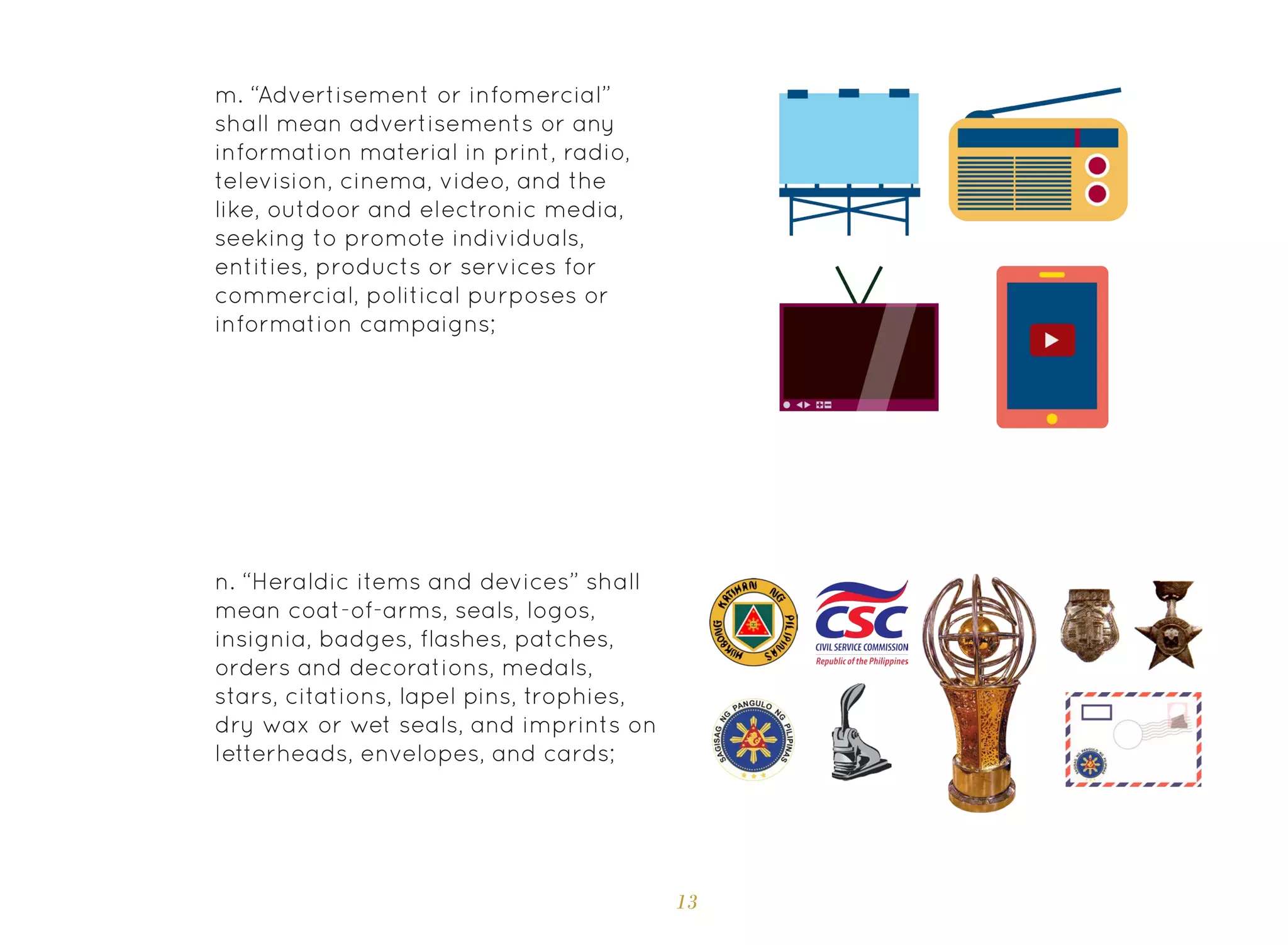
may select one significant aspect to be incorporated in the seal that will serve the
purpose, e.g. fish or crustacean stands for aquatic resources, rattan or bamboo for
cottage industry. Refer to Annex “A” for the Signs and Symbols.
c. Since the shield is the most important part of the corporate seal, the seal of
all component municipalities shall adopt the shape of the shield of the provincial
seal. In the case of barangay, the city or municipal seal shall be adopted in toto.
However, the name of the barangay shall occupy the top portion of the ring
border while the bottom shall indicate the name of the city or the municipality and
province where the barangay belongs. See Annexes “B” and “B-1,” “C” and “C-1” for
samples.
131
5. The winning or selected entry shall thereafter be submitted for reaction to a
consultative meeting participated in by representatives of various interest groups or
non-government organizations within the LGU. The winning or selected entry may be
modified as a result of the said participative meeting.
1. The LGU shall submit its proposed corporate seal to the Bureau of Local Government
Supervision (BLGS), DILG, through the DILG Regional Office concerned. The DILG
Regional Office shall review as to completeness of documentation. The proposed
corporate seal shall be supported by the following documents:
Review
a. Transmittal letter of the local chief executive addressed to the Chairman of the
NHI requesting review of the proposed corporate seal;
is also discouraged except where the flag has become part of the LGU’s history
like the Municipality of Kawit, Province of Cavite as the site of the declaration of
Philippine Independence and the Municipality of Samal, Province of Bataan as the
defender against foreign aggression; and
c. The corporate seal of the LGU is a sign of authority and therefore, it shall not
be used as personal seal of the local chief executive, e.g. the text Municipal Mayor,
City Mayor, or Provincial Governor indicated within the ring border of the seal is
not allowed. For municipalities, the name of the municipality shall be emblazoned
on top and the name of the province at the bottom.
132
b. Sanggunian resolution endorsing the proposed corporate seal to the NHI for
appropriate action.
c. Brief historical background of the LGU; and
d. Photographs of existing structure, objects, or scenic spots incorporated in the
proposed seal, together with narrative description for proper visual representation,
i.e. terrain, building, bridge, bell, etc.
2. The LGU shall see to it that a copy of the proposed seal, together with the
supporting documents, is properly kept in the office of the secretary to the
sanggunian.
3. The DILG Regional Office shall transmit to the BLGS a complete set of the proposed
corporate seal within three (3) working days from receipt. Otherwise, the LGU
concerned shall be informed promptly of any lacking document(s).
4. Immediately upon receipt of the proposed seal, the BLGS shall conduct an initial
technical review of the documents submitted and thereafter transmit the same to the
NHI.
5. The NHI shall review the proposed seal to determine whether it conforms with
basic heraldic standards and specifications. When necessary, the NHI shall modify
the proposed seal in accordance with its prescribed designs and specifications but
retaining in the process the distinctive signs and symbols incorporated in the said seal.
133
Approval
Registration
1. After the review process and the necessary modifications, the NHI shall forward
to the Chairman of the National Commission on Culture and the Arts (NCCA) the
modified corporate seal recommending approval thereof.
2. Immediately after the approval by the Chairman of the NCCA, the approved
corporate seal shall be returned to the Chairman of the NHI, who shall transmit the
approved seal to the local chief executive concerned, copy furnished the BLGS.
3. The local chief executive shall recommend to the sanggunian formal adoption of
the corporate seal through a resolution.
1. The local chief executive shall register the approved seal with the DILG after the
approved seal is formally adopted by the sanggunian.
2. For registration purposes, the LGU shall submit the following documents:
a. Transmittal letter of the local chief executive;
b. Copy of the sanggunian resolution adopting the seal duly approved by the
Chairman of the NCCA; and
c. Certified photocopy of the corporate seal as approved by the NCCA.
134
3. A Certificate of Registration shall be issued by the Secretary to the local chief
executive concerned, coursed through the DILG Regional Office, and copy furnished
the NHI.
4. The DILG, through the BLGS, shall register the corporate seal and accordingly enter
the same in a Registry Book indicating among other things, the name of the LGU,
number and date of the sanggunian resolution adopting the approved seal, and actual
date of registration as shown in the date of the certificate of registration signed by the
Secretary.
5. The BLGS shall be the official custodian of all documents pertinent to the
registration of corporate seal of the LGUs which shall form part of its Management
Information System.
Please be guided accordingly.
CESAR N. SARINO
Secretary
Attachments:
Annex “A”
Annex “B”
Annex “B-1”
Annex “C”
Annex “C-1”
135
Annex “A”
SIGNS AND SYMBOLS TO BE
INCORPORATED IN THE CORPORATE SEAL
Geographical:
Historical/Tourist Spots:
Economic:
Natural aspects/features
Man-made
Natural
Events
Agricultural
Industrial
Aquatic Resources
Homemade Products
location; boundaries; terrain
towers; parks; monuments; landmarks
mountains; springs; caves; beaches
battles; uprisings
rice fields; main or secondary products
factories; mills; fabricators
crustaceans; fish; gastropod; anemone
amenities; necessities; contingencies
—
—
—
—
—
—
—
—
136
Cultural:
Traditions
Personages
festivals; rituals; rites; ceremonies;
superstitions
legendary; eminent
Ethnological:
Origin races; characters; influences ethnic
groups
Biological:
Flora and fauna
Natural Resources Forests; quarries; minerals
—
—
—
—
137
Annex “B”
SEAL SYMBOLISM
BAYAN NG MEYCAUAYAN, LALAWIGAN NG BULACAN
(Municipality of Meycauayan, Province of Bulacan)
Derived from the provincial seal of Bulacan where the town is
located.
Stand for the first eight (8) provinces that first revolted against
Spain with Bulacan as one of the provinces.
Shield :
Eight (8) rays :
Other components depict the major industries for which Meycauayan has been noted
for, to wit: ring for jewelry, hide for tanning, wooden shoe for footwear, manufacturing
and bolo for blacksmithing.
Inscribed at the center of the hide is the year 1578 signifying the establishment of the
town as a settlement by Franciscan Missionaries.
138
Annex “B-1”
139
Annex “C”
SEAL SYMBOLISM
BAYAN NG TAGUDIN, LALAWIGAN NG ILOCOS SUR
(MUNICIPALITY OF TAGUDIN, PROVINCE OF ILOCOS SUR)
Derived from the provincial seal of Ilocos Sur where the town is
located.
Depicts the one and a half century old historic sundial of the
municipality. It also represents the march for progress of the
town through its hardworking local officials.
Stand for major staple crop which is rice and its major cash crop
which is Virginia tobacco.
Shield :
Eight (8) rays :
Tobacco and Palay :
140
Annex “C-1”
141
Appendix No. 12
MALACAÑANG
Manila
BY THE PRESIDENT OF THE PHILIPPINES
EXECUTIVE ORDER NO. 179
PROMINENT DISPLAY OF THE NATIONAL FLAG IN ALL BUILDINGS,
ESTABLISHMENTS, AND HOMES FROM 28 MAY 1994 TO 12 JUNE 1994
AND EVERY YEAR THEREAFTER, AND FOR OTHER PURPOSES
WHEREAS, Section 1, Article XVI of the 1987 Constitution provides that the National
Flag should be consecrated and honored by the people and recognized by law;
WHEREAS, the National Flag, which symbolizes patriotism, love of country, and sense of
nationhood and embodies the aspirations and sentiments of the Filipino People in their
unceasing quest for freedom and independence, can be instrumental in raising the
level of socio-civic, consciousness of the Filipinos, especially among the youth;
WHEREAS, Proclamation No. 374 dated 06 March 1965 declared 28 May of each year as
Flag Day, to commemorate the first unfurling of the Philippine Flag on Philippine soil at
Alapan, Imus, Cavite on 28 May 1898;
WHEREAS, Section 8 of Executive Order 137 dated 07 January 1965, mandates the
display of the National Flag on national holidays, or special holidays as the President
may proclaim not only in all public buildings, official residences, public squares and
142
schools but whenever practicable, in all private buildings and homes, from sunrise to
sunset; and
WHEREAS, the period spanning the commemoration of the historic Flag Day on
May 28 and the Independence Day on June 12, are opportune time for all Filipinos
to collectively reflect on the significance of the National Flag, in the light of the
forthcoming centennial celebration of the Philippine Independence in 1998.
NOW, THEREFORE, I, FIDEL V. RAMOS, President of the Republic of the Philippines, by
virtue of the powers vested in me by the laws of the land, do hereby order:
SECTION 1. Display of the National Flag. All government departments, agencies,
offices, government owned and controlled corporations, instrumentalities and the local
government units, shall prominently display the National Flag from 28 May 1994 to 12
June 1994 and every year thereafter, in all public buildings, government institutions
and official residences.
The Department of Education, Culture and Sports, in coordination with the private
sector, non-government organizations, and socio-civic groups shall enjoin the
prominent display of the National Flag in all public squares and, wherever practicable,
in all private buildings and homes.
SECTION 2. Allocation of Funds. In support of the 1994 Independence Day Celebration,
all concerned agencies may allocate such amount as may be necessary to defray
expenditures that may be incurred from participation in the said activity, subject to
the usual accounting and auditing rules and regulations.
143
SECTION 3. Effectivity. This Executive Order shall take effect immediately.
DONE in the City of Manila, this 24th
day of May, in the year of Our Lord, nineteen
hundred and ninety four.
FIDEL V. RAMOS
President of the Philippines
TEOFISTO T. GUINGONA, JR.
Executive Secretary
By the President
144
Appendix No. 13
MALACAÑANG
Manila
BY THE PRESIDENT OF THE PHILIPPINES
EXECUTIVE ORDER NO. 343
ADOPTING THE “PANUNUMPA NG KATAPATAN SA WATAWAT”
AS THE OFFICIAL PLEDGE OF ALLEGIANCE FOR ALL FILIPINOS
WHEREAS, we, as a nation will commemorate the centennial of the proclamation of
Philippine Independece on 12 June 1998 which celebration becomes more meaningful
to the citizenry if their sense of history and nationhood is properly evoked;
WHEREAS, the “Panunumpa ng Katapatan sa Watawat” finalized by the National
Commission for Culture and the Arts from a draft prepared by the Commission on the
Filipino Language is a soul stirring pledge that we can call truly ours, evincing as it
does, a sense of nationhood and the values that every freedom-loving and nationalistic
Filipino ought to possess;
NOW, THEREFORE, I, FIDEL V. RAMOS, President of the Republic of the Philippines, by
the powers vested in me by law, do hereby adopt and institutionalize the “Panunumpa
ng Katapatan sa Watawat” as the official oath of allegiance for all Filipinos. I hereby
direct each and every citizen to learn the “Panunumpa ng Katapatan sa Watawat,”
reflect upon its words and take to heart the dedication to nationhood that the pledge
contains:
145
Ako ay Pilipino
Buong katapatang nanunumpa
Sa watawat ng Pilipinas
At sa bansang kanyang sinasagisag
Na may dangal, katarungan, at kalayaan
Na pinakikilos ng sambayanang
Maka-Diyos
Makakalikasan
Maka-tao at
Makabansa
This Executive Order takes effect immediately.
DONE in the City of Manila, this 12th
day of June in the year of Our Lord, Nineteen
Hundred and Ninety-Six.
FIDEL V. RAMOS
President of the Philippines
By the President
RUBEN D. TORRES
Executive Secretary
146
Appendix No. 14
BY THE PRESIDENT OF THE PHILIPPINES
ADMINISTRATIVE ORDER NO. 362
CREATION OF A COMMITTEE ON PRESIDENTIAL AWARDS
WHEREAS, it is benefiting to give recognition to public servants, government retirees,
distinguished citizens and organizations for their exemplary service and invaluable
contribution to the achievement of the programs of the government through the
conferment of Presidential Citations and Awards;
WHEREAS, appropriate procedures and criteria must be formulated for the processing
of nominations for certain Presidential Awards promulgated by laws or presidential
issuances;
WHEREAS, there is a need for a Committee which shall formulate the procedures and
ensure that criteria are observed as well as process nominations for the conferment of
these Presidential Citations and Awards;
NOW THEREFORE, I, FIDEL V. RAMOS, President of the Republic of the Philippines, by
virtue of the powers vested in me by law, do hereby order the following:
MALACAÑANG
Manila
147
SECTION 1. Creation of a Committee on Presidential Awards. There is hereby created
a Committee On Presidential Awards (hereinafter referred to as “Committee”) which
shall be tasked to process the nominations for the conferment of Presidential Citations
and Awards.
SECTION 2. Composition of the Committee. The Committee shall be composed of
the Executive Secretary as Chairman, Presidential Management Staff Head as Vice-
Chairman, and the following members: PA for Political Affairs, Appointments Secretary,
and Chief of Presidential Protocol.
The Committee may create such sub-committees as may be necessary to assist it in
the performance of its functions.
SECTION 3. Functions of the Committee. The Committee shall have the following
functions and responsibilities:
a. Formulate the procedures and ensure that the criteria for the conferment
of Presidential Awards and Citations as promulgated by law and Presidential
issuances, including the following, are observed:
1. Order of Sikatuna
2. Order of Kalantiao
3. Presidential Citation for Outstanding Humanitarian Services
4. Rizal Pro Patria Award
148
5. Golden Heart Presidentail Award
6. Order of Gabriela Silang
7. Philippine Legion of Honor
8. Rizal Collegiate Palm and the Mabini Teachers’ Award
9. Presidential Merit Award
b. Process the nominations from the various government agencies and private
groups and individuals for the said award categories;
c. Convene quarterly or as often as deemed necessary to consider and process
nominations for the Presidential Awards;
d. Invite representatives from other government departments and agencies
including the DFA, DND, and the DILG, when deliberating on nominations which
emanate from or otherwise pertain to the functions and responsibilities of the said
departments or agencies; and
e. Submit recommendations to the President.
SECTION 4. Secretariat. The Presidential Protocol shall provide the technical and
administrative support to the Committee.
SECTION 5. Effectivity. The Administrative Order shall take effect immediately.
149
FIDEL V. RAMOS
President of the Philippines
DONE in the City of Manila, this 30th
day of September in the year of Our Lord,
Nineteen Hundred and Ninety-Seven.
By the President
RUBEN D. TORRES
Executive Secretary
150
Appendix No. 15
BY THE PRESIDENT OF THE PHILIPPINES
EXECUTIVE ORDER NO. 297, S. 2000
REGULATING THE MANUFACTURE, SALE, DISTRIBUTION,
AND USE OF PNP UNIFORMS, INSIGNIAS, AND OTHER ACCOUTREMENTS
WHEREAS, the PNP uniforms, insignias and other accoutrements are symbolic of a
discipline and an image which portray the character and being of every policeman
most representative of a professional Philippine National Police;
WHEREAS, the use or wearing of PNP uniforms, insignias, and other accoutrements
projects at the very first instance any identity that establishes a distinctive recognition
exclusive to every policeman and the Philippine National Police;
WHEREAS, the PNP uniforms, insignias, and other accoutrements are easily available
and/or procured from any manufacturer, seller, distributor, or supplier by any person,
including unscrupulous and lawless individuals who make a mockery of their use for
personal gain, unlawful purposes and/or other designs to degrade the policemen and
the Philippine National Police;
WHEREAS, while article 179, “Illegal use of uniforms or insignia” of Republic Act 3815,
otherwise known as the Revised Penal Code of the Philippines penalizes any person
MALACAÑANG
Manila
151
who shall publicly and improperly make use of insignia, uniforms, or dress pertaining
to an office not held by such person or to a class of persons of which he is not a
member, it does not include the illegal manufacture, sale, and distribution of the same;
WHEREAS, while Republic Act No. 493 was also enacted prohibiting, among others
the wearing, use, manufacture, and sale of insignias, decorations and medals, badges,
patches, and identification cards prescribed for the “Armed Forces” or “Constabulary,”
it does not apply to the Philippine National Police;
WHEREAS, there is no law that governs and regulates the manufacture, sale
distribution and use of uniforms, insignias and other accoutrements of the Philippine
National Police;
WHEREAS, to ensure that PNP uniforms, insignias, and other requirements are
manufactured, sold, distributed or supplied only by authorized manufacturer
distributor, supplier and/or seller and used exclusively by uniformed personnel of the
PNP, there is a need for regulation.
NOW, THEREFORE, I, JOSEPH EJERCITO ESTRADA, President of the Republic of the
Philippines, by virtue of the powers vested in me by law, do hereby order:
SECTION 1. The unauthorized manufacture and distribution of PNP uniforms, insignias,
and other accoutrements is hereby prohibited. Any violation of this rule shall, after
due notice and hearing, result in the immediate closure of the establishment, plant
and/or office where the uniforms and other items are manufactured, stored, sold and/
or distributed, the cancellation of its business license or permit, the condemnation,
seizure and forfeiture of all paraphernalia used or intended to be used in the
152
manufacture, sale, and/or distribution and the imposition of reasonable administrative
fines, without prejudice to the filing of administrative, civil, and/or criminal actions.
SECTION 2. The use of PNP uniforms, insignias, and other accoutrements by any person
who is not a member of the uniformed Philippine National Police personnel is also
prohibited. Any violation of this rule shall, after due notice and hearing, be penalized
by public censure which shall be published at least once in a newspaper of general
circulation without prejudice to the filing of administrative, civil and/or criminal actions.
SECTION 3. The Philippine National Police shall adopt its own uniforms, insignias, and
other accoutrements for the exclusive use of its uniformed personnel. The uniforms and
other items shall be subject to inspection and acceptance procedures of the Philippine
National Police with each design and specification approved by the PNP Uniform and
Equipment Standardization Board (UESB). As such, only those accredited by the PNP
and the National Historical Institute are authorized to manufacture, sell or distribute
the same.
SECTION 4. The Chief, Philippine National Police shall issue rules and regulations for
the effective implementation of this Executive Order.
SECTION 5. All orders, issuances, rules and regulations or parts thereof inconsistent
with this Executive Order are hereby repealed or modified accordingly.
153
DONE in the City of Manila, this 4th
day of October in the year of Our Lord, two
thousand.
JOSEPH EJERCITO ESTRADA
President of the Philippines
By the President
RONALDO B. ZAMORA
Executive Secretary
154
NHI BOARD RESOLUTION NO. 2, 2003
AUTHORIZING THE CHAIRMAN TO IMPLEMENT SECTION 58, RULE II,
CHAPTER IX OF THE RULES AND REGULATIONS IMPLEMENTING
REPUBLIC ACT No. 8491, S. 1998
A RESOLUTION AMENDING THE 4TH
PARAGRAPH OF SECTION 27 OF THE
IMPLEMENTING RULES AND REGULATION (IRR) OR R.A. NO. 8491
WHEREAS, it is fitting and proper to commemorate the noble deeds of our heroes and
heroines by way of half-masting the Philippine National Flag during the celebration of
their death anniversary;
WHEREAS, Section 23 of R.A. No. 8491 and Section 27 of its Implementing Rules and
Regulations (IRR) respectively, have no specific provision on the conduct of half-mast
of Philippine National Flag during the observance of death anniversary of our heroes
and heroines;
WHEREAS, Section 58, Amendments of the IRR, states that:
“The Chairman and Executive Director shall have the authority to amend, revise,
repeal, or otherwise modify these Rules or any provision thereof, as may be
deemed necessary to achieve the objectives of R.A. No. 8491 and these Rules.”
Appendix No. 16
155
NOW THEREFORE, in consideration of the foregoing, be it RESOLVED, as it is hereby
RESOLVED that the 4th
paragraph of Section 27 of the IRR or R.A. No. 8491, be amended
and to read as follows:
“The National Flag shall also be flown at half-masting during the death anniversary
of heroes or heroines, calamities or grave adversity of national or international
solemnity as ordered by the Office of the President, as may be recommended by
the Institute.”
APPROVED: 31 March 2003
SERAFIN D. QUIASON
Member
AMBETH R. OCAMPO
Chairman
JOSE M. CRUZ, S.J.
Member
HEIDI K. GLORIA
Member
CORAZON S. ALVINA
Ex-Officio Member
PRUDENCIANA C. CRUZ
Ex-Officio Member
156
Appendix No. 17
NHI BOARD RESOLUTION NO. 2, S. 2004
A RESOLUTION AMENDING SOME PROVISIONS OF THE
IMPLEMENTING RULES AND REGULATIONS (IRR) OF R.A. No. 8491,
KNOWN AS “THE FLAG AND HERALDIC CODE OF THE PHILIPPINES”
WHEREAS, Executive Director Ludovico D. Badoy issued a Memorandum Order No. 556
dated October 20, 2003 creating a Review Team to conduct a general review on the
provisions of the IRR of R.A. 8491 otherwise known as the Flag and Heraldic Code of
the Philippines in connection with the reprinting of the Manual entitled “The Flag and
Heraldic Code of the Philippines, Illustrated”;
WHEREAS, the Review Team held four (4) meetings and came up with certain
recommendations/corrections to be incorporated in the IRR and adopted as follows:
• With the inclusion of the Senate of the Philippines building and the change of
location of the Libingan ng mga Bayani in Taguig, Metro Manila instead of Makati
City, Section 10 shall now read as follows:
“The National Flag shall be permanently hoisted, day and night, throughout the
year, in front of the following: at Malacañang Palace; Senate of the Philippines
building; Congress of the Philippines building; Supreme Court building; Rizal
Monument in Luneta, Manila; Bonifacio Monument in Caloocan City; Emilio
Aguinaldo Shrine in Kawit, Cavite; Barasoain Church Historical Landmark in
Malolos, Bulacan; Marcela Agoncillo Historical Landmark in Taal, Batangas;
157
Tomb of the Unknown Soldier, Libingan ng mga Bayani, Taguig, Metro Manila;
Mausoleo de los Veteranos de la Revolucion, North Cemetery, Manila; all
international ports of entry and all other places as may be designated by the
Institute.”
• In Section 27, letters c, d, and e, it would be more appropriate to add the words
“or equivalent in rank,” to read as follows:
• Also, in Section 27, letter h, the phrase “Veterans of previous wars,” was added to
read as follows:
c. Cabinet Secretaries, Associate Justices of the Supreme Court, Members of
the Senate and House of Representatives, the Chief of Staff of the Armed Forces
of the Philippines, and the Director-General of the Philippine National Police, or
equivalent in rank, for five (5) days;
d. Heads of National Government Agencies, including Government Owned and
Controlled Corporations and Government Financial Institutions, or equivalent in
rank, for three (3) days;
e. The Commanding Generals of the Philippine Air Force and the Philippine
Army and the Flag Officer in Command of the Philippine Navy, or equivalent in
rank, for three (3) days;
h. Veterans of previous wars, Barangay Chairmen and the Barangay
Councilmen on the day of interment.
158
• Section 27, letter l, now includes former Vice-President, the Chief Justice of the
Supreme Court, the President of the Senate, and the Speaker of the House of
Representatives, and reads as follows:
• In the last paragraph of Section 27, Libingan ng mga Bayani, Fort Bonifacio,
Makati City was changed to Libingan ng mga Bayani, Taguig, Metro Manila to read
as follows:
• In Section 28, another paragraph is added to read as follows:
l. Other persons to be determined by the Institute, including the former Vice-
President, the Chief Justice of the Supreme Court, the President of the Senate,
and the Speaker of the House of Representatives, for a period of less than
seven (7) days.
“The National Flag shall be permanently hoisted at half-mast, day and night,
throughout the year at the Tomb of the Unknown Soldier, Libingan ng mga
Bayani, Fort Bonifacio, Taguig, Metro Manila; Mausoleo de los Veteranos de la
Revolucion, North Cemetery, Manila; and in all memorial cemeteries dedicated
to war veterans. The National Flag of these declared sites shall be properly
illuminated at night.”
“In an open coffin, to view the corpse, the National Flag shall be folded and
placed over it.”
159
Section 52. The use of the National Coat-of-Arms, the Great Seal,
administrative/corporate seals, logos, insignia in letterheads, stationeries, name
cards, greeting cards, and envelopes shall be for official purposes only.
Section 53. The recommended size of dry seal for the Great Seal, 3ӯ;
corporate/administrative seals for Department level 2 3
/4
” Ø and Bureau/LGU
levels 2ӯ.
The use and display of the National Coat-of-Arms, the Great Seal,
administrative/corporate seals, logos, and insignia as trademarks,
advertisements, or labels for commercial, industrial or agricultural purposes
by private persons, corporations or associations, and the printing and
stamping of the same on articles or commodities intended for sale, barter
or exchange, shall be prohibited.
NOW THEREFORE, in consideration of the foregoing, the NHI Board by virtue of the
power vested in it by law, hereby resolves that recommendations/corrections made
• Addition of two (2) sections on the proper use and recommended size of dry seal
for the National Coat-of-Arms, the Great Seal, administrative/corporate seals, logos
and insignias to read as follows:
160
by the Review Team on the IRR of R.A. No. 8491 be incorporated on the IRR in the re-
printing of the Manual.
APPROVED: 16 April 2004
SERAFIN D. QUIASON
Member
BENITO J. LEGARDA, JR.
Member
AMBETH R. OCAMPO
Chairman
JOSE M. CRUZ, S.J.
Member
HEIDI K. GLORIA
Member
CORAZON S. ALVINA
Director, National Museum
Ex-Officio Member
PRUDENCIANA C. CRUZ
Director, National Library
Ex-Officio Member
161
Appendix No. 18
REPUBLIC ACT No. 10086
AN ACT STRENGTHENING PEOPLES’ NATIONALISM THROUGH
PHILIPPINE HISTORY BY CHANGING THE NOMENCLATURE OF THE
NATIONAL HISTORICAL INSTITUTE INTO THE
NATIONAL HISTORICAL COMMISSION OF THE PHILIPPINES,
STRENGTHENING ITS POWERS AND FUNCTIONS, AND FOR OTHER PURPOSES
Be it enacted by the Senate and House of Representatives of the Philippines in Congress
assembled:
SECTION 1. Short Title. – This Act shall be known as the “Strengthening Peoples’
Nationalism Through Philippine History Act”.
SECTION 2. Declaration of Policy. – It is hereby declared to be the policy of the State
to conserve, promote and popularize the nation’s historical and cultural heritage and
resources. Pursuant to the Constitution, all the country’s artistic and historic wealth
constitutes the cultural treasure of the nation and shall be under the protection of the
State which may regulate its disposition.
Towards this end, the State shall provide the means to strengthen people’s nationalism,
love of country, respect for its heroes and pride for the people’s accomplishments by
reinforcing the importance of Philippine national and local history in daily life with
the end in view of raising social consciousness; reinvigorating government support
for historical research; and sustaining and enhancing programs for the protection,
162
preservation and conservation of historical relics and memorabilia, monuments, sites
and other historical resources.
The State shall likewise give utmost priority not only to the research on history but
also to the popularization of history. In this way, the State will be able to build a
Philippine national identity based on unity and pride in diversity held together by a
common history.
SECTION 3. Definition of Terms. – For purposes of this Act, the following terms shall be
defined as follows:
(a) “Built heritage” refers to architectural and engineering structures such as, but
not limited to, bridges, government buildings, houses of ancestry and worship,
traditional dwellings, technological and industrial complexes and their settings, and
landscapes with notable historical and cultural significance.
(b) “Classified” refers to structures and sites marked and listed as such and
recorded in the National Historical Commission of the Philippines’s National
Registry of Historic Sites and Structures, and not falling under any of the five (5)
categories of historic sites and structures, namely: National Shrines, National
Monuments, National Landmarks, Heritage Houses and Historic Sites.
(c) “Conservation” refers to all processes and measures of maintaining the cultural
significance of a cultural property including, but not limited to, physical, social
or legal preservation, restoration, reconstruction, protection, adaptation or any
combination thereof.
163
(d) “Documentation” refers to the recording in a permanent format of information
derived from research, conservation and other activities of the National Historical
Commission of the Philippines (NHCP).
(e) “Heritage houses” refers to houses of ancestry with notable historical, cultural,
social, architectural and artistic value and significance as declared by the NHCP.
(f) “Historic site” refers to a place recogmzed to have an important historical
SIgnificance as declared by the NHCP.
(g) “Historical street name” refers to a street name which has been in existence for
at least fifty (50) years.
(h) “History” refers to the record of people, places and events in the past; it can
also mean the discipline involving the study of people, places and events in the
past.
(i) “History museum” refers to a place where relics and memorabilia and other
resources pertainmg to important people, places and events in the past are
thematically presented and systematically preserved, catalogued or displayed for
public appreciation and education.
(j) “Historical research” refers to the scholarly investigation of people, places and
events in the past.
(k) “Historical writing” refers to the coherent, narrative and scholarly
documentation of people, places and events in the past.
164
(I) “National historical landmarks” refers to sites or structures which are associated
with events or achievements significant to Philippine history declared as such by
the NCHP.
(m) “National historical monuments” refers to structures erected as a memorial to
great heroes or events in Philippine history declared as such by the NHCP .
(n) “National historical shrines” refers to sites or structures hallowed and revered
for their history or association declared as such by the NHCP.
(o) “National registry of historic sites and structures” refers to the records of all
historic sites and structures of the country as found in the documentation of the
NHCP.
(p) “Philippine history” is the study of people, events and places from the dawn of
the recorded past of the Philippines to contemporary period.
(q) “Preservation” refers to all activities that employ means to control, minimize or
prevent damage or deterioration to cultural property.
(r) “Restoration” refers to the action taken or the technical intervention to correct
deterioration and alterations and return cultural property to its original state or
condition.
SECTION 4. Renaming of the National Historical Institute. – The nomenclature of the
National Historical Institute (NHI), established pursuant to Presidential Decree No. 1,
165
(a) conduct and support all kinds of research relating to Philippine national and
local history;
(b) develop educational materials in various media, implement historical
educational activities for the popularization of Philippine history, and disseminate
information regarding Philippine historical events, dates, places and personages;
(c) undertake and prescribe the manner of restoration, conservation and protection
of the country’s historical movable and immovable objects;
(d) manage, maintain and administer national shrines, monuments, historical sites,
edifices and landmarks of significant historico-cultural value; and
(e) actively engage in the settlement or resolution of controversies or issues
relative to historical personages, places, dates and events.
S. 1972, is hereby changed to National Historical Commission of the Philippines (NHCP).
The NHCP shall be an independent agency attached to the National Commission for
Culture and the Arts (NCAA).
SECTION 5. General Mandate. – The NHCP is the primary government agency
responsible for history and has the authority to determine all factual matters relating
to official Philippine history.
In this regard, the NHCP shall:
166
SECTION 6. The Board. – The NHCP shall be governed by a nine (9)-member Board,
which shall be created to formulate and implement NHCP policies relating to the
agency’s mandate.
SECTION 7. Powers and Functions of the Board. – The Board of the NHCP shall exercise
the following powers and functions:
(a) Conduct and encourage all manner of research pertaining to Philippine national
and local history;
(b) Acquire important historical documents, collections, memorabilia and other
objects that have significant historical value;
(c) Acquire real property, buildings and other structures for the purpose of
preserving, restoring and conserving their significant historical value;
(d) Determine the manner of identification, maintenance, restoration, conservation
and preservation of historical sites, shrines, structures and monuments;
(e) Approve the declaration of historic structures and edifices such as national
shrines, monuments and landmarks or heritage houses;
(f) Prescribe the manner of celebration or commemoration of significant events
pertaining to Philippine history;
(g) Initiate and, in cooperation with the appropriate government or private entity,
promote programs for the popularization of Philippine history such as, but not
167
limited to, the integration of the subject of history into the school curriculum,
among others;
(h) Discuss and resolve, with finality, issues or conflicts on Philippine history;
(i) Implement and enforce Republic Act No. 8491, otherwise known as the Flag Law,
and other special laws where the NHCP has been designated as the implementing
body;
(j) Secure and receive local, bilateral and international donations, grants and
endowments in support of its programs and projects;
(k) Develop and implement consortium agreements to link other government
agencies and/or private individuals and organizations engaged in or in support of
the mandate of the NHCP;
(l) Regulate activities pertaining to the preservation, restoration and conservation
of historical property or resources;
(m) Generate funds from government or private sources, local or international for
its programs and projects;
(n) Collect reasonable fees for the use, sale or rent of its resources as well as
entrance fees to shrines and landmarks under the jurisdiction of the NHCP;
(o) Approve grants, create committees or deputize individuals for NHCP projects;
168
(p) Conduct public hearings and ocular inspections or initiate factual
investigations with respect to disputed historical issues for the purpose of
declaring official historical dates, places, personages and events;
(q) Approve the annual budget of the NHCP before its presentation to the
Department of Budget and Management (DBM) and Congress;
(r) Appoint the Deputy Executive Directors of the NHCP; and
(s) Exercise oversight functions over the administrative operations of the NHCP.
SECTION 8. Composition of the Board. – The Board shall be headed by a Chairperson
and shall be composed of five (5) distinguished historians representing the private
sector who shall serve as regular members of the Board and who shall be appointed
by the President of the Republic of the Philippines. Only the regular members can vote
on matters relating to historical research and similar academic concerns.
The following shall serve as ex officio members:
(a) The Director of the National Library of the Philippines;
(b) The Director of the National Museum;
(c) The Executive Director of the National Archives of the Philippines; and
(d) The Executive Director of the NHCP.
169
SECTION 9. Qualifications of Regular Members of the Board. – No person shall be
appointed or elected to the Board unless he/she possesses the following minimum
qualifications:
(a) A natural-born citizen of the Republic of the Philippines;
(b) At least thirty-five (35) years of age;
(c) With good moral character;
(d) Has distinguished himself/herself in the field of Philippine history; and
(e) Has published works in Philippine history and other academic· fields recognized
by scholars and the reading public.
SECTION 10. Regular Members; Term of Office. – The regular members of the Board
shall serve for a term of four (4) years: Provided, That the first five (5) appointees
pursuant to this law shall hold office under the following staggered terms, namely:
two (2) appointees will have a full term of four (4) years; two (2) appointees will have
a term of three (3) years; and the remaining appointee shall have a term of two (2)
years: Provided, further, That the regular members shall not serve for more than two
(2) consecutive terms. Appointment to any vacancy shall only be for the unexpired
portion of the term of the predecessor. In no case shall a member be appointed or
designated in a temporary or acting capacity.
170
SECTION 11. Election of the Chairman. – The Board shall be headed by a Chairman who
shall be elected from among the regular members in an election to be participated in
by all the members of the Board.
SECTION 12. Term of Office of the Chairman. – The Chairman shall have a term of three
(3) years and shall not serve more than two (2) consecutive terms.
SECTION 13. Functions of the Chairman. – The Chairman is the head of the agency
and shall represent and act for the Board in all matters pertaining to the NHCP. The
Chairman, being the public face of the NHCP, shall:
(a) provide leadership in the realization of the vision and mission of the NHCP;
(b) advise the President and Congress on matters relating to Philippine history;
(c) preside over meetings of the Board;
(d) propose the agenda for meetings of the Board;
(e) exercise oversight over the Executive Director and Deputy Executive Directors
to ensure the implementation of policies, decisions and resolutions of the Board;
(f) represent the NHCP on official matters;
(g) represent the NHCP in the Board of the NCCA and, other agencies where the
NHCP head of agency sits; and
171
(h) perform such other authority, functions or duties which the President of the
Philippines or the Board may delegate.
SECTION 14. The Executive Director. – The Executive Director shall be appointed by the
President of the Republic of the Philippines. He/She shall have a rank equivalent to a
bureau director.
SECTION 15. Functions of the Executive Director. – The Executive Director shall have the
following functions:
(a) Implement the policies and programs approved and promulgated by the NHCP
Board;
(b) Administer the day-to-day operations of the NHCP;
(c) Represent the NHCP in meetings when authorized or delegated by the Board;
and
(d) Perform such other functions assigned by the NHCP Board.
SECTION 16. The Deputy Executive Directors. – The Executive Director shall be assisted
by a Deputy Executive Director for Administration and a Deputy Executive Director for
Programs and Projects.
The Deputy Executive Directors shall be appointed by the Board.
172
SECTION 17. Qualifications of the Executive Director and Deputy Executive Directors. – No
person shall be appointed or designated as Executive Director and Deputy Executive
Directors of the NHCP unless he/she possesses the following minimum qualifications:
(a) A natural-born citizen of the Republic of the Philippines;
(b) Has good moral character;
(c) Holder of any four (4)-year college degree;
(d) Has at least five (5) years of actual and relevant experience in managing a
government agency in the case of the Executive Director and three (3) years
experience in the case of the Deputy Executive Directors; and
(e) Has Career Executive Service Officer (CESO) eligibility only with respect to the
Deputy Executive Director position.
SECTION 18. Delegation of Authority. – The Executive Director shall have authority over
and responsibility for the day-to-day operations of the NHCP. He/She may delegate
such authority to the Deputy Executive Directors to implement plans and programs.
The delegation shall be in writing; shall indicate the name of specific officer to which
the delegation is made; shall indicate the duties and responsibilities delegated; shall
indicate the length of period of delegated authority; and shall vest sufficient authority
to enable the delegate to discharge his/her assigned responsibility.
SECTION 19. Reorganization. – Within one hundred twenty(120) days from the
effectivity of this Act, the Board shall have the authority to reorganize the structure of
173
the NHI, including its staffing pattern in order to carry out its functions pursuant to its
expanded mandate as the NHCP.
Employees of the NHI shall be subsumed in the NHCP and, whenever qualified,
be upgraded to their analogous positions. Employees opting to avail of an early
retirement scheme shall be granted under the existing DBM guidelines.
SECTION 20. Historic Sites and Structures Documentation Center. – A Historic Sites
and Structures Documentation Center (HSSDC) shall be established within the NHCP,
replacing the existing Survey and Documentation Section, which shall be tasked
with undertaking the survey, identification, documentation and recommendation for
declaration of historic structures and edifices such as national shrines, monuments
and landmarks or heritage houses by the NHCP Board and maintaining the National
Registry of Historic Sites and Structures.
SECTION 21. Local Historical Committees Network. – The existing work of the agency
on historical society affiliations shall constitute the Local Historical Committees
Network (LHCN). The LHCN shall monitor, coordinate, support and, upon approval
of the Board, affiliate various local historical bodies engaged in the collection,
documentation, popularization, conservation, restoration and preservation of extant
historical materials found in different parts of the Philippines. It shall also record the
oral histories of towns, cities, provinces, regions and peoples.
SECTION 22. Materials Research Conservation Division. – The Materials Research
Conservation Center of the agency shall be renamed as Materials Research
Conservation Division (MRCD). Aside from its regular functions, it shall provide
consultancy services to collectors of historical objects that are considered valuable
174
(a) The NHCP shall be exempt from all taxes on its income;
(b) All donations in any form to the NHCP shall be exempt from the donor’s tax and
the same shall be considered as allowable deduction from the gross income in the
computation of the income tax of the donor, in accordance with the provisions of
Republic Act No. 8424, otherwise known as the National Internal Revenue Code of
1997, as amended; and
(c) Importation of scientific, philosophical, historical and cultural books, supplies
and materials for the use in the conservation or preservation work of the NHCP and
duly certified by the Board, shall be exempt from customs duties.
SECTION 24. Revolving Fund. – The income of the NHCP not exceeding the amount of
One million pesos (Php 1,000,000.00) derived from the proceeds of publications, park
entrance fees and donations, the rendering of technical services, conferences and
workshops and similar income shall be constituted as a revolving fund to augment
components of Filipino heritage to ensure that preservation, restoration and
conservation techniques and procedures are in accordance with the accepted
international standards set in protecting historical objects and materials. The MRCD
shall enrich and update knowledge on restoration and preservation techniques
through scientific research. It shall likewise establish linkages between the Philippines
and various international bodies engaged in the scientific preservation of historical
and cultural objects.
SECTION 23. Tax Exemption on Donations. – The provisions of any general or special
law to the contrary notwithstanding:
175
the projects where the income was derived subject to government auditing rules and
regulations: Provided, That proceeds in excess of the aforementioned amount shall be
remitted to the National Treasury and accrue to the General Fund.
SECTION 25. Funding Provision. – The amount necessary for the effective
implementation of this Act shall be included in the annual General Appropriations Act.
SECTION 26. T
ransitory Provisions. – The incumbent Chairman, Executive Director
and Deputy Executive Directors of the NHI shall continue to serve in their respective
capacities as the Chairman, Executive Director and Deputy Executive Directors of the
herein established NHCP for one (1) year after the effectivity of this Act or until a new
Chairman and Executive Director shall have been appointed by the President and the
two (2) new Deputy Executive Directors shall have been appointed by the Board.
All assets, fixed and movable, and all contracts, records and documents relative to the
operations of the NHI are hereby transferred to the NHCP.
All agreements and contracts entered into by the NHI shall remain in full force and
effect unless otherwise terminated, modified or amended by the NHCP.
Officials and employees of the NHI shall be absorbed by the NHCP on the basis of
merit and fitness: Provided, That officers and employees who shall be separated from
the service as a result of the abolition of any of the divisions therein shall be entitled to
retirement and other separation benefits provided under existing laws.
SECTION 27. Implementing Rules and Regulations. – The NHCP, in consultation with the
other government agencies mentioned in this Act, shall promulgate the implementing
176
rules and regulations within ninety (90) days after the effectivity of this Act.
SECTION 28. Separability Clause. – If any provision of this Act is held invalid or
unconstitutional, the same shall not affect the validity apd effectivity of the other
provisions hereof.
SECTION 29. Repealing Clause. – The pertinent provisions of Presidential Decree No. 1,
S. 1972 and all other laws, decrees, executive orders and rules and regulations contrary
to or inconsistent with the provisions of this Act are hereby repealed or modified
accordingly.
SECTION 30. Effectivity Clause. – This Act shall take effect fifteen (15) days after its
publication in at least two (2) newspapers of general circulation.
Approved,
JUAN PONCE ENRILE
President of the Senate
PROSPERO C. NOGRALES
Speaker of the House
of Representatives
177
Approved: May 12, 2010
GLORIA MACAPAGAL-ARROYO
President of the Philippines
This Act which is a consolidation of Senate Bill No. 3472 and House Bill No. 6378 was
finally passed by the Senate and the House of Representatives on January 26, 2010
and January 27, 2010, respectively.
EMMA LIRIO-REYES
Secretary of the Senate
MARILYN B. BARUA YAP
Secretary General
House of Representative
178
Appendix No. 19
TO ALL HEADS OF CONSTITUTIONAL BODIES; DEPARTMENT,
BUREAUS, AND AGENCIES OF THE NATIONAL GOVERNMENT; LOCAL
GOVERNMENT UNITS; GOVERNMENT-OWNED AND/OR CONTROLLED
CORPORATIONS WITH ORIGINAL CHARTERS; STATE UNIVERSITIES
AND COLLEGES; AND ALL OTHERS CONCERNED
Observance of Flag Ceremonies
MEMORANDUM CIRCULAR (MC) No. 19, S. 2012
TO :
SUBJECT :
Republic Act No. 8491, otherwise known as the “Flag and Heraldic Code of the
Philippines” requires all government offices and educational institutions to observe the
flag-raising ceremony every Monday morning and the flag-lowering ceremony every
Friday afternoon.
It has been observed that if the regular or special holidays fall on Mondays and
Fridays, some government offices do not hold flag-raising and flag-lowering
ceremonies.
To ensure that government employees regularly accord respect to the Philippine
Flag and to provide a venue where they will be constantly reminded of how they
must conduct themselves as public servants, all heads of government agencies are
enjoined to schedule a flag raising ceremony every Monday, or the next working day
Civil Service Commission
179
if Monday is declared a holiday, and a flag-lowering ceremony every Friday or on the
last working day of each week. Agencies are advised to conduct the flag-raising and
flag-lowering ceremonies at 8 o’clock in the morning and 5 o’clock in the afternoon,
respectively.
Agency heads are, likewise, enjoined to establish internal guidelines to strictly monitor
the attendance of their personnel in the flag ceremonies and ensure strict compliance.
This Memorandum Circular shall take effect immediately.
Please be guided accordingly.
PPSO/PSSD/APE/JLT/PBC/nedy
MC-Flag ceremonies
FRANCISCO T. DUQUE III, MD, MSc
Chairman
180
Appendix No. 20
NHCP BOARD RESOLUTION NO. 17, S. 2015
A RESOLUTION TO INCLUDE THREE ADDITIONAL SITES
UNDER SECTION 10 OF THE IMPLEMENTING RULES AND REGULATIONS (IRR)
OF R.A. 8491, KNOWN AS “THE FLAG AND HERALDIC CODE OF THE PHILIPPINES,”
WHERE THE PHILIPPINE FLAG SHALL BE PERMANENTLY HOISTED
WHEREAS, Section 10 of the Implementing Rules and Regulation of Republic Act 8491
mandates the permanent hoisting of the Philippine flag in the following sites:
(a) Malacañang Palace;
(b) Senate of the Philippines building;
(c) Congress of the Philippines building;
(d) Supreme Court building;
(e) Rizal Monument in Luneta, Manila;
(f) Bonifacio Monument in Caloocan City;
(g) Emilio Aguinaldo Shrine in Kawit, Cavite;
(h) Barasoain Church Historical Landmark in Malolos City, Bulacan;
181
(i) Marcela Agoncillo Historical Landmark in Taal, Batangas;
(j) Tomb of the Unknown Soldier, Libingan ng mga Bayani in Taguig City, Metro
Manila;
(k) Mausoleo de los Veteranos de la Revolucion at the North Cemetery in Manila;
and,
(l) All international ports of entry and all other places as may be designated by the
Commission;
WHEREAS, said provision (letter “I” of Section 10) allows the Commission to designate
other significant places where the Philippine flag shall be permanently hoisted;
WHEREAS, the Pinaglabanan Memorial Complex in San Juan City was the site of the
historic battle of San Juan del Monte led by Andres Bonifacio on 30 August 1896, which
signaled the beginning of the Philippine revolution against Spain;
WHEREAS, Emilio Aguinaldo was moved to display the Philippine flag for the first time
after the Filipino revolutionaries victory in the battle of Alapan in Imus, Cavite on 28
May 1898;
WHEREAS, the first raising of the Philippine flag outside Luzon on 17 November 1898
was held at the plaza in the municipality of Santa Barbara in Iloilo;
WHEREAS, owing to their historical significance, the site of the Battle of San Juan
del Monte (Pinaglabanan), the site of the Battle of Alapan, and the Santa Barbara
182
plaza in Iloilo, deserve to be designated as places where the Philippine flag should be
permanently hoisted;
NOW THEREFORE, the Board of the National Historical Commission of the Philippines
hereby includes the sites of the Battle of San Juan del Monte, the Battle of Alapan,
and the Santa Barbara plaza in Iloilo in Section 10 of the Implementing Rules and
Regulation of Republic Act 8491, where the Philippine flag shall be permanently
hoisted.
Approved in the NHCP Board Meeting dated 5 October 2015
MARIA SERENA I. DIOKNO
Chair
RENE R. ESCALANTE
Member
FRANCIS A. GEALOGO
Member
FILOMENO V. AGUILAR
Member
ABRAHAM P. SAKILI
Member
VICTORINO MAPA MANALO
Ex-Officio Member
JEREMY BARNS
Ex-Officio Member
LUDOVICO D. BADOY
Ex-Officio Member
ANTONIO M. SANTOS
Ex-Officio Member
183
Appendix No. 21
NHCP BOARD RESOLUTION NO. 8, S. 2017
A RESOLUTION TO INCLUDE ADDITIONAL SITES UNDER SECTION 10 OF
THE IMPLEMENTING RULES AND REGULATION (IRR) OF R.A. 8491
KNOWN AS “THE FLAG AND HERALDIC CODE OF THE PHILIPPINES,”
WHERE THE PHILIPPINE FLAG SHALL BE PERMANENTLY HOISTED
WHEREAS, Section 10 of the Implementing Rules and Regulations of Republic Act 8491
mandates the permanent hosting of the Philippine flag in the following sites:
(a) Malacañang Palace;
(b) Senate of the Philippines building;
(c) Congress of the Philippines building;
(d) Supreme Court building;
(e) Rizal Monument in Luneta, Manila;
(f) Bonifacio Monument in Caloocan City;
(g) Emilio Aguinaldo Shrine in Kawit, Cavite;
(h) Barasoain Church Historical Landmark in Malolos City, Bulacan;
184
(i) Marcela Agoncillo Historical Landmark in Taal, Batangas;
(j) Tomb of the Unknown Soldier, Libingan ng mga Bayani in Taguig City, Metro
Manila;
(k) Mausoleo de los Veteranos de la Revolucion at the North Cemetery in Manila;
and,
(l) All international ports of entry and all other places as may be designated by the
Commission;
WHEREAS, said provision (letter “l” of Section 10) allows the Commission to designate
other significant places where the Philippine flag shall be permanently hoisted;
WHEREAS, falling under the category of international port of entry, the Subic Bay
Metropolitan Authority, Subic Bay Freeport deserves to be designated as place where
the Philippine flag should be permanently hoisted;
WHEREAS, being witness to the grand celebration of the first anniversary of Philippine
independence in 1899, the Angeles Heritage District, particularly the sites along Santo
Entierro Street namely the Holy Rosary Parish Church atrium (where the main program
was held) and Pamintuan Mansion (that served as the Presidential Palace), is deserving
as well to be designated as place where the Philippine flag should be permanently
hoisted;
WHEREAS, being witness to the inauguration of the Philippine Commonwealth
and Manuel L. Quezon as president and Sergio Osmeña as vice president, the Old
185
CESAR GILBERTO Q. ADRIANO
Ex-Officio Member
Legislative Building is deserving as well to be designated as place where the Philippine
flag should be permanently hoisted;
NOW THEREFORE, the Board of the National Historical Commission of the Philippines
hereby includes the sites of the Subic Bay Metropolitan Authority, Old Legislative
Building and Angeles Heritage District in Section 10 of the IRR where the Philippine flag
shall be permanently hoisted.
Approved in the NHCP Board Meeting dated 29 September 2017
LUDOVICO D. BADOY
Ex-Officio Member and
Acting Executive Director
RENE R. ESCALANTE
Chairman
ABRAHAM P. SAKILI
Member
JEREMY BARNS
Ex-Officio Member
VICTORINO MAPA MANALO
Ex-Officio Member
186
Appendix No. 22
NHCP BOARD RESOLUTION NO. 9, S. 2017
A RESOLUTION PROHIBITING THE MANUFACTURE AND USE OF
HERALDIC ITEMS AND DEVICES WITHOUT THE APPROVAL OF THE
OFFICE OF THE PRESIDENT, TO BE INCLUDED IN SECTION 49 OF THE
IMPLEMENTING RULES AND REGULATION (IRR) OF R.A. 8491 KNOWN AS
“THE FLAG AND HERALDIC CODE OF THE PHILIPPINES”
WHEREAS, Rule 8, Chapter VI of the Implementing Rules and Regulations of Republic
Act 8491 mandates the regulation of the official seals and of the heraldic items and
devices.
WHEREAS, to ensure the quality of heraldic items or devices, as these represent
the ideals, principles, tradition, and history of the nation, government agencies,
instrumentalities and/or units are prohibited from issuing, manufacturing or using/
wearing such items, unless approved by the Office of the President.
NOW THEREFORE, the Board of the National Historical Commission of the Philippines
hereby includes the provision under Section 49 of the IRR that “no government
agencies, instrumentalities and/or units can issue, manufacture or use/wear such items
unless approved by the Office of the President.”
187
Approved in the NHCP Board Meeting dated 29 September 2017
CESAR GILBERTO Q. ADRIANO
Ex-Officio Member
LUDOVICO D. BADOY
Ex-Officio Member and
Acting Executive Director
RENE R. ESCALANTE
Chairman
ABRAHAM P. SAKILI
Member
JEREMY BARNS
Ex-Officio Member
VICTORINO MAPA MANALO
Ex-Officio Member
188
Appendix No. 23
NHCP BOARD RESOLUTION NO. 10, S. 2017
A RESOLUTION TO INCLUDE THE CUSTOM OF SINGING THE
NATIONAL ANTHEM FIRST BEFORE AN INVOCATION UNDER SECTION 43 OF
THE IMPLEMENTING RULES AND REGULATION (IRR) OF R.A. 8491 KNOWN AS
“THE FLAG AND HERALDIC CODE OF THE PHILIPPINES”
WHEREAS, Rule 4, Chapter 2 of the Implementing Rules and Regulations of Republic
Act 8491 mandates the etiquette in singing the National Anthem
WHEREAS, a national anthem preceding the invocation has been a custom elsewhere
in the world.
WHEREAS, the state guarantees the exercise of freedom of faith under its sovereignty
by upholding the principle that citizens who gather together lawfully in/for a public
program identify their belongingness to a nation by saluting the flag and singing the
national anthem.
NOW THEREFORE, the Board of the National Historical Commission of the Philippines
hereby includes the following provision under Section 43 of the IRR that “the National
Anthem precedes the invocation during the flag raising ceremony and related
program. This is non-obligatory for private institutions and schools, especially
sectarian/religious learning institutions, in which case invocation may be done prior to
the singing of the National Anthem.”
189
Approved in the NHCP Board Meeting dated 29 September 2017
CESAR GILBERTO Q. ADRIANO
Ex-Officio Member
LUDOVICO D. BADOY
Ex-Officio Member and
Acting Executive Director
RENE R. ESCALANTE
Chairman
ABRAHAM P. SAKILI
Member
JEREMY BARNS
Ex-Officio Member
VICTORINO MAPA MANALO
Ex-Officio Member
The Flag and Heraldic Code(FINAL).pdf

The Flag and Heraldic Code(FINAL).pdf

  • 1.
    THE FLAG AND HERALDICCODE OF THE PHILIPPINES illustrated RULES AND REGULATIONS IMPLEMENTING REPUBLIC ACT NO. 8491 (Revised Edition)
  • 3.
    THE FLAG AND HERALDICCODE OF THE PHILIPPINES illustrated RULES AND REGULATIONS IMPLEMENTING REPUBLIC ACT NO. 8491 (Revised Edition)
  • 4.
    Published by: NATIONAL HISTORICALCOMMISSION OF THE PHILIPPINES T.M. Kalaw St., Ermita, Manila, Philippines Tel.: 335-1212 www.nhcp.gov.ph Copyright © 2018 NATIONAL HISTORICAL COMMISSION OF THE PHILIPPINES All rights reserved. No part of the book may be reprinted or reproduced in any means whatsoever without the permission of the copyright owner and publisher. Recommended entry: The flag and heraldic code of the Philippines, illustrated: Rules and regulations implementing Republic Act No. 8491. -- Manila: National Historical Commission of the Philippines, c2018. pp. ; cm 1. Flags - Philippines. 2. Heraldry - Law and legislation - Philippines. 3. Republic Act No.8491. I. Title. ISBN: 978-971-538-323-3
  • 5.
    CONTENTS RENE R. ESCALANTE Preface xiii TEODOROS. ATIENZA Introduction xv Republic Act No. 8491 71 The Code of the National Flag, Anthem, Motto, Coat-of-Arms, and Other Heraldic Items and Devices of the Philippines An Act Prescribing the Code of the National Flag, Anthem, Motto, Coat-of-Arms, and Other Heraldic Items and Devices of the Philippines 1 Rules and Regulations Implementing Republic Act No. 8491
  • 6.
    Description and Specifications ofthe Filipino Flag (March 25, 1936) Appendix No. 1 Executive Order No. 23, S. 1936 97 Creating the Philippine Heraldry Committee to Make a Study of and Recommend Ways and Means for the Adoption of Coat- Of-Arms of the Different Political Subdivisions, Provinces, Cities, and Semi-Governmental Institutions (December 4, 1940) Appendix No. 2 Executive Order No. 310, S. 1940 101 Revised Filipino Language Version of the Philippine National Anthem (May 26, 1956) Appendix No. 3 Department Order No. 5, S. 1956 (Department of Education) 104 APPENDICES Other Relevant Laws and Rules Affecting Philippine Heraldry and Vexillary
  • 7.
    118 Reorganizing the ExecutiveBranch of the Government. The National Historical Institute was created under Article XV Chapter I of Department of Education and Culture under Education on Part XII. (September 24, 1972) Appendix No. 4 Kautusang Tagapagpaganap Blg. 60 109 Amending Executive Order No. 23 Dated March 25, 1936 Entitled, “Description and Specifications of the Filipino Flag” (February 25, 1985) Appendix No. 7 Executive Order No. 1010 111 Appendix No. 6 Presidential Decree No. 1 113 Nagpapahayag na ang Pambansang Awit ng Pilipinas ay Dapat Awitin lamang sa Titik nitong Pilipino (Disyembre 19, 1963) Declaring the Twenty-Eighth Day of May each Year as National Flag Day. (March 6, 1965) Appendix No. 5 Proclamation No. 374
  • 8.
    Appendix No. 8 ThePhilippine National Flag Description and Specifications 120 Covered by Executive Order No. 1010 (February 25, 1985) 124 Instituting the “Administrative Code of 1987” (July 25, 1987) Appendix No. 9 Executive Order No. 292 127 Prohibition Against the Use of the Presidential Seal, “Sagisag ng Pangulo,” in Office Stationeries and Uniforms (November 25, 1988) Appendix No. 10 Memorandum Order No. 205
  • 9.
    Adopting the “Panunumpang Katapatan sa Watawat” as the Official Pledge of Allegiance for All Filipinos (June 12, 1996) Appendix No. 13 Executive Order No. 343 144 Prominent Display of the National Flag in All Buildings, Establishments, and Homes from 28 May 1994 to 12 June 1994 and Every Year Thereafter, and for other Purposes (May 24, 1994) Appendix No. 12 Executive Order No. 179 141 128 Policy Guidelines on the Creation, Modification, Change, and Registration of Corporate Seals of Local Government Units (June 8, 1992) Appendix No. 11 Memorandum Circular No. 92-30
  • 10.
    156 A Resolution AmendingSome Provisions of the Implementing Rules and Regulations (IRR) of R.A. No. 8491 known as “The Flag and Heraldic Code of the Philippines” (April 16, 2004) Appendix No. 17 NHI Board Resolution No. 2, S. 2004 154 A Resolution Amending the 4th Paragraph of Section 27 of the Implementing Rules and Regulations (IRR) of R.A. No. 8491 (March 31, 2003) Appendix No. 16 NHI Board Resolution No. 2, 2003 150 Regulating the Manufacture, Sale, Distribution, and Use of the Philippine National Police Uniforms, Insignias, and other Accoutrements (October 4, 2000) Appendix No. 15 Executive Order No. 297, S. 2000 146 Creation of a Committee on Presidential Awards (September 30, 1997) Appendix No. 14 Administrative Order No. 362
  • 11.
    An Act StrengtheningPeoples’ Nationalism through Philippine History by Changing the Nomenclature of the National Historical Institute into the National Historical Commission of the Philippines, Strengthening its Powers and Functions, and for other Purposes (May 12, 2010) Appendix No. 18 Republic Act No. 10086 161 Memorandum Circular on Observance of Flag Ceremonies (November 12, 2012) Appendix No. 19 Memorandum Circular No. 19, S. 2012 (Civil Service Commission) 178 A Resolution to Include Three Additional Sites under Section 10 of the Implementing Rules and Regulations (IRR) of R.A. 8491, Known as the “The Flag and Heraldic Code of the Philippines,” Where the Philippine Flag shall be Permanently Hoisted (October 5, 2015) Appendix No. 20 NHCP Board Resolution No. 17, S. 2015 180
  • 12.
    A Resolution toInclude Additional Sites under Section 10 of the Implementing Rules and Regulations (IRR) of R.A. 8491 Known as “The Flag and Heraldic Code of the Philippines,” Where the Philippine Flag shall be Permanently Hoisted (September 29, 2017) Appendix No. 21 NHCP Board Resolution No. 8, S. 2017 183 A Resolution Prohibiting the Manufacture and Use of Heraldic Items and Devices Without the Approval of the Office of the President, to be Included in Section 49 of the Implementing Rules and Regulations (IRR) of R.A. 8491 Known as “The Flag and Heraldic Code of the Philippines,” (September 29, 2017) Appendix No. 22 NHCP Board Resolution No. 9, S. 2017 186 A Resolution to Include the Custom of Singing the National Anthem First Before an Invocation under Section 43 of the Implementing Rules and Regulations (IRR) of R.A. 8491 Known as “The Flag and Heraldic Code of the Philippines,” (September 29, 2017) Appendix No. 23 NHCP Board Resolution No. 10, S. 2017 188
  • 13.
    xiii PREFACE National symbols likeflags and heraldic items embody the identity of a nation. The country’s history, culture and political aspirations command the respect of its citizens and those of other nations. In the Philippines, national symbols are prescribed by Republic Act No. 8491 entitled, “An Act Prescribing the Code of the National Flag, Anthem, Motto, Coat of Arms and other Heraldic Items and Devices of the Philippines,” which became effective on 12 February 1998. The National Historical Commission of the Philippines is the government agency tasked to implement Republic Act No. 8491. In order to disseminate the code, deepen public awareness and provide guidance on the proper use of the Philippine flag and heraldic items, the Commission first published in 2002 the illustrated book of the Implementing Rules and Regulations. There have been several amendments in the implementing Rules and Regulations of Republic Act No. 8491, which compelled the Commission to publish this revised edition in print and its ebook interactive version. The electronic version is meant to serve Filipino digital readers here and abroad and foster within them the love for country. DR. RENE R. ESCALANTE Chairman National Historical Commission of the Philippines
  • 14.
  • 15.
    xv INTRODUCTION Heraldry is thelanguage and science of arts and symbols pertaining to arms, rank, and protocol. It is always subject to innovations, and at the same time it reflects the historical transformations of a government or a society. Heraldry was originally used in ancient times to distinguish warriors of different factions. As an important means of identification, heraldry these days is used as a sign of ownership, a pledge, or a mark of authority. Philippine heraldry as a source of protocol is a combination of, on the one hand, local customs and traditions, and, on the other hand, internationally accepted practice. It has undergone major changes in the past,—whether in the introduction of a new symbol or the revision of an existing one—coinciding with political upheavals. In the middle of the sixteenth century, the Spaniards found that our ancestors were already familiar with the universal meaning of the red and white flags. A few years after establishing their colony in the islands, they granted, by royal decree, the “Distinguished and Ever Loyal” City of Manila its first coat-of-arms on March 20, 1596. From the late nineteenth century to the end of colonialism, each historical era made an impact on Philippine heraldry: the fight for independence and the Philippine– American War from 1896 to 1902; from the establishment of the American colonial civil government to the Philippine Commonwealth, 1902 to 1941; from the Japanese occupation until the end of the Japanese-sponsored government, 1942 to 1945; from the American reoccupation to the inauguration of the Third Philippine Republic, 1944 to
  • 16.
    xvi 1946. Likewise, ourheraldry practice was affected during the postwar Republic, 1946 to 1972, during the Martial Law era, and after the EDSA People Power revolt. On November 15, 1935, the Philippine Commonwealth was inaugurated. Elected into office were Manuel L. Quezon as President and Sergio Osmeña as Vice President. One of the directives the President issued was Executive Order No. 23, dated March 25, 1936, giving the official description and specifications of the Philippine flag. Other directives concerning the types of cloth to be used in the manufacture of the Philippine flag followed. Several years later, on December 4, 1940, President Manuel L. Quezon issued Executive Order No. 310, creating the Philippine Heraldry Committee to make a study of and recommend ways and means for the adoption of the coat-of-arms of the different political subdivisions, provinces, cities and semi-government institutions of the Commonwealth. The committee was under the Office of the Executive Secretary, which was then headed by Secretary Jorge Vargas. At the outbreak of the Second World War, one of the first decrees issued by the Japanese occupation forces that affected Philippine heraldry was Military Ordinance No. 3, dated April 22, 1942. It prohibited the use of the Philippine flag “for the time being.” As a consequence, the work of the Philippine Heraldry Committee was suspended. However, on the inauguration of the Japanese-sponsored Philippine Republic under President Jose P. Laurel on October 14, 1943, the Philippine national flag was hoisted and allowed to be displayed. On January 7, 1946, President Sergio Osmeña reactivated the Philippine Heraldry Committee with Dr. Jose Bantug and Prof. Galo B. Ocampo as appointed chairman and secretary, respectively. The preparation of the designs and specifications, as well as the supervision in the manufacture of heraldic items, which include citations,
  • 17.
    xvii stars, badges, medalsand ribbons, sash, collar, or bars, known as Medals, Orders and Decorations, have become more sophisticated. Also, the scope of activities and technical duties of the Committee was expanded as mandated by several presidential directives. The change in the country’s political status from colony to independent nation-state resulted in an increase in the heraldic needs in terms of medals, orders and decorations, insignia, badges, flags and other coat-of-arms. The continuous administrative demands for protocol, heraldic tradition, and technical needs in various government agencies have established heraldry works as part and parcel of the government’s operations. In 1953 President Elpidio R. Quirino assigned the Philippine Heraldry Committee under the Division of General Services of the Office of the President with the arrangement that it will function independently. In 1958 President Carlos P. Garcia issued Administrative Order No. 1 assigning the Committee to the Division of Presidential Protocol. Unfortunately, on November 30, 1961, due to the lack of funds, President Diosdado P. Macapagal suspended the works of the Committee. When President Ferdinand E. Marcos issued Presidential Decree No. 1 known as the Reorganization Act of 1972, the function of the Philippine Heraldry Committee was transferred to the National Historical Institute, as a section under the Monuments and Heraldry Division. In 1973 it was formally implemented with Dr. Galo B. Ocampo as consultant on heraldry. The Institute tried to amend its mandates on heraldry including the national flag, anthem, motto, coat-of-arms and great seal through presidential directives, but it failed. During the Ninth Congress in 1988, Senator Laurel introduced a Senate bill entitled “An Act Prescribing the Code of the National Flag of the Republic of the Philippines,” but it suffered the same fate.
  • 18.
    xviii TEODORO S. ATIENZA Head,Heraldry Section National Historical Commission of the Philippines In the Tenth Congress, Senators Blas F. Ople and Anna Dominique M. L. Coseteng introduced Senate Bill No. 630, entitled “An Act Prescribing the Code of the Philippine National Flag and Anthem,” while in the Lower House, Representatives Salvador H. Escudero III and Rosenda Ann M. Ocampo filed House Bill No. 436, entitled “Prescribing the Code of the National Flag, Anthem, Motto, Coat-of-Arms and the Great Seal of the Philippines in 1995.” Through the intervention of the Heraldry and Display Section of the National Historical Institute, House Bill No. 436 was substituted by House Bill No. 2586, entitled “An Act Prescribing the Code of the Philippine Heraldry and Vexillary.” When the Tenth Congress of the Philippines convened its third regular session on July 28, 1997, the bill was retitled “An Act Prescribing the Code of the National Flag, Anthem, Motto, Coat-of-Arms and other Heraldic Items and Devices of the Philippines.” The bill was passed and approved by the Senate and the House of Representatives on February 3, 1998, and February 6, 1998, respectively. President Fidel V. Ramos signed it into law on February 12, 1998, as Republic Act No. 8491. This book, the Flag and Heraldic Code of the Philippines, Illustrated (Rules and Regulations Implementing Republic Act 8491), contains graphics and photos to help readers understand every provision of the code. Illustrations made are opinions and views of the undersigned to help convey the message of this important law.
  • 19.
    1 RULES and REGULATIONS implementing REPUBLICACT No. 8491, S. 1998 “The Code of the National Flag, Anthem, Motto, Coat-Of-Arms and other Heraldic Items and Devices of the Philippines”
  • 20.
  • 21.
    3 rule 1 GENERALPROVISIONS SECTION 1. Title - These rules shall be known, cited and referred to as the “RULES AND REGULATIONS IMPLEMENTING REPUBLIC ACT No. 8491, S. 1998, THE CODE OF THE NATIONAL FLAG, ANTHEM, MOTTO, COAT-OF-ARMS, AND OTHER HERALDIC ITEMS AND DEVICES OF THE PHILIPPINES,” hereinafter called the “Rules.”
  • 22.
    4 SECTION 3. Scopeof Application - These rules shall apply to individuals, public and private entities, military and police agencies, and other branches and/or instrumentalities of the national and local government including government- SECTION 4. Interpretation - In the interpretation of the provisions of Republic Act No. 8491, S. 1998, the Flag and Heraldic Code of the Philippines, hereinafter called R.A. No. 8491, and of these rules, that interpretation which will promote or sustain reverence and respect for the flag, the anthem, and other national symbols, all of which embody national ideals and traditions, shall be given paramount consideration. SECTION 2. Declaration of Policy and Objectives - It is the policy of the state to herein prescribe the Code of the National Flag, Anthem, Motto, Coat-of-Arms, and other Heraldic Items and Devices of the Philippines, ensure the promotion and implementation of its corresponding rules and regulations, and adopt effective administrative, regulatory, coordinative and supervisory programs and activities, where appropriate, in conformity with national government laws and policies. Further, reverence and respect shall at all times be accorded to the flag, anthem, and other national symbols which embody the national ideals and traditions, and which express the principles of sovereignty and national solidarity. owned and/or controlled corporations, and shall also be observed in and within the entire territory of the Philippines as such is defined in the constitution and laws of the Republic of the Philippines.
  • 23.
    5 rule 2 implementingagency SECTION 5. The Implementing Agency - the National Historical Institute,1 hereinafter referred to as the Institute, shall be the agency tasked to implement these rules. 1 The National Historical Institute became the National Historical Commission of the Philippines by virtue of Republic Act No. 10086, entitled, “An act strengthening peoples’ nationalism through Philippine history by changing the nomenclature of the National Historical Institute into the National Historical Commission of the Philippines, strengthening its powers and functions, and for other purposes.” See Appendix No. 18 for full text of RA 10086. With this law, the term “Institute” shall be replaced with “Commission” in the succeeding pages.
  • 24.
    6 SECTION 6. Scopeof Powers and Functions - the Commission shall perform planning, monitoring, coordinating, implementing, and policy-formulating functions, wherever and whenever appropriate, and, in the process, exercise administrative, regulatory, and supervisory authority over the implementation of the provisions of R.A. No. 8491 within the Philippine territorial limits, and in conformity with national government laws and policies. Such powers and functions shall include the following: a. Formulate, coordinate, and regulate the implementation of the Code of the National Flag, Anthem, Motto, Coat-of-Arms, and other Heraldic Items and Devices of the Philippines, consistent with the purposes and objectives of R.A. No. 8491; b. Plan, prepare, and coordinate effective educational and information dissemination strategies which shall increase the level of national awareness of these Rules and other implementing details that may subsequently be formulated; c. Coordinate and monitor the implementation of these Rules and ensure the compliance of all the provisions stipulated under R.A. No. 8491; and deputize, assign, and/or designate government agencies, non-government organizations, major branches and units of the Armed Forces of the Philippines and the Philippine National Police, and other groups or individuals for the purpose of implementing, monitoring, and coordinating tasks; d. Set policies and procedures concerning the concept and design/ visual interpretation of the national motto, coat-of-arms, seals of various local government units (town/city/ province) and other government instrumentalities, medallions, awards, and other forms and devices of national recognition, and strict enforcement thereof;
  • 25.
    7 e. Formulate anddevise appropriate legal procedures, assistance and coordinating systems for cases arising from the violations of R.A. No. 8491, including appropriate integration of this law into the Sharia Courts; and f. Perform other related functions required to achieve the objectives of R.A. No. 8491 and these Rules. SECTION 7. Definition of Terms - Whenever used in these Rules, the term: a. “Military” shall mean all branches of the Armed Forces of the Philippines, including the Philippine National Police, the Bureau of Jail Management and Penology, Bureau of Fire Protection;
  • 26.
    8 c. “National Flag”shall mean the National Flag and Ensign of the Philippines, unless stated otherwise, used on land, air, and sea by public, private, and military and shall refer to the flag or any other design that so resembles it as likely to cause any person to believe that it is the flag or design stated, expressed, or provided in the Constitution of the Philippines, R.A. No. 8491, and these Rules; b. “Festoon” shall mean to hang in a curved shape between two points as a decoration;
  • 27.
    9 d. “Fly” shallmean the part of the flag outside the hoist or length; e. “Hoist” shall mean the sleeve or heading; part of the flag nearest the staff or the canvass to which the halyard is attached; f. “Symbol” shall mean any conventional sign which reveals man’s achievement and heroism (for orders, and decorations), identification, authority and a sign of dignity (for coat-of-arms, logo, and insignia);
  • 28.
    10 g. “Half-mast” shallmean lowering the flag to one-half the distance between the top and bottom of the pole; h. “Halyard” shall mean the long rope where the flag fastens and which runs up the length of the flagpole;
  • 29.
    11 i. “Inclement weather”shall mean that a typhoon signal is raised in the locality; j. “National Anthem” shall mean the “Lupang Hinirang,” the Philippine National Anthem;
  • 30.
    12 l. “Places offrivolity” shall mean places of hilarity marked by or providing boisterous merriment or recreation; k. “Official residences” shall mean Malacañang, other government- owned structures where the President resides, and other structures occupied by Philippine Consulates or Embassies abroad; ©Official Gazette Photo collection of NHCP
  • 31.
    13 m. “Advertisement orinfomercial” shall mean advertisements or any information material in print, radio, television, cinema, video, and the like, outdoor and electronic media, seeking to promote individuals, entities, products or services for commercial, political purposes or information campaigns; n. “Heraldic items and devices” shall mean coat-of-arms, seals, logos, insignia, badges, flashes, patches, orders and decorations, medals, stars, citations, lapel pins, trophies, dry wax or wet seals, and imprints on letterheads, envelopes, and cards;
  • 32.
    14 o. “Government entities”shall mean all branches of government, its bureaus and attached agencies, constitutional offices, local government offices, government- owned and/or controlled corporations, government financial institutions, state universities and colleges, the Armed Forces of the Philippines including its basic component units; and p. “Vexillary items” shall mean national, local, house flags, or administrative, institutional, corporate, unit, and other organizational banners.
  • 33.
    15 rule 3 chapteri the national flag A. DESIGN OF THE NATIONAL FLAG B. HOISTING AND DISPLAY OF THE NATIONAL FLAG SECTION 8. The National Flag shall be blue, white, and red with an eight-rayed golden-yellow sun, and three stars that are five-pointed, as consecrated and honored by the people. SECTION 9. The National Flag shall be displayed in all public buildings, official residences, public plazas, and institutions of learning everyday throughout the year.
  • 34.
    16 SECTION 10. TheNational Flag shall be permanently hoisted, day and night, throughout the year, in front of the following: at Malacañang Palace; Senate of the Philippines building;2 Congress of the Philippines building; Supreme Court building; Rizal Monument in Luneta, Manila; Bonifacio Monument in Caloocan City; Emilio Aguinaldo Shrine in Kawit, Cavite; Barasoain Church Historical Landmark in Malolos, Bulacan; Marcela Agoncillo Historical Landmark in Taal, Batangas; Tomb of the Unknown Soldier, Libingan ng mga Bayani, Taguig, Metro Manila;3 Mausoleo de los Veteranos de la Revolucion, North Cemetery, Manila; all international ports of entry and all other places as may be designated by the Commission; Subic Bay Metropolitan Authority; Old Legislative Building; and Angeles Heritage District.4 The National Flag shall be permanently hoisted in the site of the Battle of San Juan del Monte (Pinaglabanan), the site of the Battle of Alapan (Imus, Cavite) and Santa Barbara Plaza in Iloilo.5 2 The “Senate of the Philippines building” was included under NHI Board Resolution No. 2, S. 2004. 3 Makati City as address of Libingan ng mga Bayani was replaced with Taguig, Metro Manila under NHI Board Resolution No. 2, S. 2004. 4 The Subic Bay Metropolitan Authority, Old Legislative Building and Angeles Heritage District are included under NHCP Board Resolution No. 8, S. 2017. 5 The Battle of Alapan (Imus, Cavite) and Santa Barbara Plaza (Iloilo) were added under NHCP Board Resolution No. 17, S. 2015.
  • 35.
    17 Malacañang Palace Senate ofthe Philippines building Emilio Aguinaldo Shrine Rizal Monument Supreme Court building ©Official Gazette ©Google Maps ©Ramon FVelasquez Photo collection of NHCP Photo collection of NHCP
  • 36.
    18 Bonifacio Monument Tomb ofthe Unknown Soldier Mausoleo de los Veteranos de la Revolucion ©roamer ©The Urban Roamer Photo collection of NHCP
  • 37.
    19 Battle of SanJuan del Monte (Pinaglabanan) Ninoy Aquino International Airport Subic Bay Metropolitan Authority Marcela Agoncillo Historical Landmark Barasoain Church Historical Landmark Batasang Pambansa Complex Photo collection of NHCP ©Google Maps ©Subic Bay Metropolitan Authority Photo collection of NHCP Photo collection of NHCP ©House of Representatives of the Philippines
  • 38.
    20 Santa Barbara Plaza PamintuanMansion (Angeles Heritage District) Battle of Alapan Old Legislative Building ©Dadi Yrec Photo collection of NHCP ©Judgefloro ©Santa Barbara
  • 39.
    21 SECTION 11. TheNational Flag shall also be displayed in private buildings and residences or raised in the open flagstaffs in front of said buildings every April 9 (Araw ng Kagitingan); May 1 (Labor Day); National Flag Days from May 28 to June 12 (Independence Day); last Sunday of August (National Heroes Day); November 30 (Bonifacio Day); and December 30 (Rizal Day); and on such other days as may be declared or approved by the President and/or local chief executives. The National Flag may also be raised and displayed at sunrise and lowered at sunset and throughout the year in the open flagstaff in front of private buildings: Provided, that proper flag ceremonies be observed in accordance with these Rules. SECTION 12. All government entities should observe flag days with appropriate ceremonies. Socio-civic groups, non-government organizations, and the private sector are enjoined to observe and cooperate in making the celebration a success.
  • 40.
    22 SECTION 13. TheNational Flag shall be flown on all naval vessels and on merchant ships of Philippine registry, of more than one thousand (1000) gross tons. Military, civil, or state vessels should fly the National Flag. Pleasure, merchant, fishing boats or yachts are also encouraged to fly the National Flag. On board vessels of Philippine registry, the National Flag shall be displayed on the flagstaff at the stern when the vessel is at anchor. The National Flag shall be hoisted to the gaff at the aftermast when the vessel is at sea.
  • 41.
    23 SECTION 14. Onall aircrafts of Philippine registry, the National Flag shall be prominently displayed horizontally on its fuselage at the head portion with the hoist side pointing to the forward direction of the plane. SECTION 15. The National Flag, if flown from a flagpole, shall have its blue field on top in time of peace and the red field on top in time of war; if in a hanging position, the blue field shall be left (observer’s point of view) in time of peace, and the red field to the left (observer’s point of view) in time of war.
  • 42.
    24 SECTION 16. Ifplanted on the ground, the flagpole shall be at a prominent place and shall be of such height as would give the National Flag commanding position in relation to the buildings in the vicinity. The flagpole must not be of equal height or higher than the Independence Flagpole at the Rizal Park, Manila.6 6 The flag pole, measuring 107 ft., was replaced with a 150 ft. pole with a mechanized pulley in 2013. The National Flag could be knotted to signal that assistance is badly needed. Photo collection of NHCP
  • 43.
    25 The flagpole thatis planted on the ground must be straight and slightly tapering at the top. The minimum length of the National Flag is one-fourth (1/4) the height of the flagpole, while maximum length of the National Flag is one-third (1/3) the height of the flagpole. SECTION 17. When the National Flag is flown with flag or flags of other countries, the flags must be of equal size and on separate staffs of the same height. The National Flag shall be hoisted first and lowered last.
  • 44.
    26 When displayed ina semi-circle of flags with other countries or house flags, the National Flag should be at the center. When displayed in a circle of flags with other countries or house flags, the National Flag should be flown on the flagpole facing the main road (point of reference - Kilometer 0, Rizal Park, Manila); or in the front of a monument; or the main entrance of the building. The flags of other countries or house flags should be arranged counter-clockwise in alphabetical order, by precedence, or by protocol.
  • 45.
    27 SECTION 18. Whendisplayed in a row or in a parade with flags of other countries, the National Flag shall be on the left (observer’s point of view) of the other flags. The flags of other countries should be arranged in alphabetical order from left to right. When displayed in a row of house flags, the National Flag shall be in front of the center of the line or on the left (observer’s point of view) of the row. The house flags should be arranged in alphabetical order, by precedence or by protocol from left to right (the observer’s point of view).
  • 46.
    28 When in aparade with house flags, the National Flag shall be in front of the center of the first line. The house flags should be arranged in alphabetical order, by precedence or by protocol order from left to right (the observer’s point of view). During special occasions, if there is only one flagpole, the house flag may be flown at the same halyard with the National Flag but below the latter and it cannot be bigger than the National Flag.
  • 47.
    29 SECTION 19. Aworn-out National Flag should not be thrown away. It should be burned solemnly, ashes collected and buried. The National Flag shall be replaced immediately when it begins to show signs of wear and tear. SECTION 20. The National Flag shall be raised at sunrise and lowered at sunset. It shall be on the mast at the start of official school and office hours and shall remain flying throughout the day. The National Flag shall not be raised in inclement weather. If already raised, the National Flag shall not be lowered for the whole day.
  • 48.
    30 SECTION 21. TheNational Flag may be displayed: a. Inside and/or outside a building, on stationary or movable flagpole. If the National Flag is displayed indoors on a flagpole, it shall be placed at the left of the observer as one enters the room; b. From the top of a flagpole, which shall be at a prominent place or a commanding position in relation to the surrounding buildings;
  • 49.
    31 c. From astaff projecting upward from the window sill, roof, canopy, balcony, or façade of a building; d. In a suspended position from a rope extending from a building to a pole erected away from the building; e. Flat against the wall vertically with the sun and the stars on top;
  • 50.
    32 f. Hanging verticallyin the middle of a two-way traffic road, the blue field should be pointing east.7 If the road is heading south or north and if the road is heading east or west, the blue field should be pointing north; and g. Hanging vertically at the sides or middle of the one-way traffic road, the blue field should be at the left of the observer.8 7 For safety of motorists, especially on busy streets, it is recommended that flags are hung vertically on projections of street posts or on flag poles. 8 Ibid.
  • 51.
    33 SECTION 22. TheNational Flag shall be hoisted to the top briskly and lowered ceremoniously. The National Flag shall never touch anything beneath it, such as the base of the pole, ground, or other object. The National Flag must be properly folded before hanging at the start of the ceremony. It shall not be left hanging at the base of the flagpole while waiting for the flag ceremony.
  • 52.
    34 C. Conduct ofFlag Raising and Lowering Ceremonies SECTION 23. All government offices, including national or local government units and institutions, shall henceforth observe the flag raising ceremony every Monday morning and the flag lowering ceremony every Friday afternoon. These include private establishments that fly the National Flag on the flagpole in their compound. Primary and secondary schools and other institutions of learning shall observe the flag ceremony as ordered by the Department of Education and/or the Commission on Higher Education. After being lowered, the National Flag shall be handled and folded solemnly as part of the ceremony.
  • 53.
    35 SECTION 24. Theobservance of the flag ceremony shall be simple and dignified. SECTION 25. During the flag raising ceremony, the assembly shall stand in formation facing the National Flag. At the moment the first note of the National Anthem is heard, everyone in the premises shall come to attention. Moving vehicles shall stop. All persons present shall place their palms over their chest, those with hats shall uncover. Those in military service, scouting, security guard, and citizens’ military training uniforms shall give the salute prescribed by their regulations, which salute shall be completed upon the last note of the anthem. The same procedure shall be observed when the National Flag is passing in review or in parade.
  • 54.
    36 SECTION 26. Duringthe flag lowering, the National Flag shall be lowered solemnly and slowly so that the flag shall be down the mast at the sound of the last note of the National Anthem. Those in the assembly shall observe the same deportment or shall observe the same behavior as for the flag raising ceremony. D. Half-Mast SECTION 27. The National Flag shall be flown at half-mast as a sign of mourning on all the buildings and places where it is displayed, as provided, on the day of the official announcement of the death of any of the following officials: a. The President or a former President for ten (10) days; b. The Vice-President, the Chief Justice of the Supreme Court, the President of the Senate, and the Speaker of the House of Representatives, for seven (7) days;
  • 55.
    37 c. Cabinet Secretaries,Associate Justices of the Supreme Court, Members of the Senate and House of Representatives, the Chief of Staff of the Armed Forces of the Philippines, and the Director-General of the Philippine National Police, or equivalent in rank,9 for five (5) days; d. Heads of National Government Agencies, including Government- Owned and Controlled Corporations and Government Financial Institutions, or equivalent in rank,10 for three (3) days; e. The Commanding Generals of the Philippine Air Force and the Philippine Army, the Flag Officer in Command of the Philippine Navy, or equivalent in rank,11 for three (3) days; f. Governors, vice-governors, city and municipal mayors, city and municipal vice mayors, for three (3) days; g. Members of the Sangguniang Panlalawigan, Sangguniang Panglungsod, and Sangguniang Bayan, on the day of interment; h. Veterans of the previous wars,12 barangay chairmen, and the barangay councilmen on the day of interment; i. Former national or local government officials, appointed or elected, other than those specified above, on the day of interment, within their former respective territorial jurisdictions and by resolution of their respective Sanggunians; 9 The phrase “or equivalent in rank,” was added under NHI Board Resolution No. 2, S. 2004. See Appendix No. 17. 10 Ibid. 11 Ibid. 12 The phrase “Veterans of the previous wars” was added under NHI Board Resolution No. 2, S. 2004. See Appendix No. 17.
  • 56.
    38 j. Regional directors,superintendents, supervisors, principals, teachers, and other school officials, on the day of interment and by order of the proper school authorities concerned; k. Recipients of national orders and decorations, on the day of interment and by order of the President or Congress; and l. Other persons to be determined by the Commission, including the former Vice-President, the Chief Justice of the Supreme Court, the President of the Senate, and the Speaker of the House of Representatives13 for a period of less than seven (7) days. In cases “c” to “e”, the National Flag shall be flown at half-mast in front of the building where the deceased official held office and in cases “f” to “h”, through Sanggunian Resolution or by order of the Local Chief Executive. The National Flag, when flown at half- mast, shall be first hoisted to the peak for a moment then lowered to the half- mast position. The National Flag shall again be raised to the peak before it is lowered for the day. 13 The words “including the former Vice-president, the Chief Justice of the Supreme Court, the President of the Senate, and the Speaker of the House of Representatives,” were added under NHI Board Resolution No. 2, S. 2004. See Appendix No. 17.
  • 57.
    39 The National Flagshall also be flown at half-mast during the death anniversary of heroes and heroines, calamities or grave adversity of national or international solemnity as ordered by the Office of the President, as may be recommended by the Commission.14 The National Flag shall be permanently hoisted at half-mast day and night throughout the year at the Tomb of the Unknown Soldier, Libingan ng mga Bayani, Fort Bonifacio, Taguig, Metro Manila;15 Mausoleo de los Veteranos de la Revolucion, North Cemetery, Manila; and in all memorial cemeteries dedicated to war veterans. The National Flag of these declared sites shall be properly illuminated at night. 14 As amended under NHI Board Resolution No. 2, S. 2004. See Appendix No. 17. 15 “Taguig, Metro Manila” was added under NHI Board Resolution No. 2, S. 2004. See Appendix No. 17. ©Ramon Abasolo
  • 58.
    40 16 New provisionunder NHI Board Resolution No. 2, S. 2004. See Appendix No. 17. In an open coffin, to view the corpse, the National Flag shall be folded and placed over it. No object must be put on top of the National Flag, except for religious objects that symbolize “God above Country.”16 E. Casket SECTION 28. The National Flag may be used to cover the caskets of the honored dead of the military, veterans of previous wars, national artists, and of civilians who have rendered distinguished service to the nation, as may be determined by the local government unit concerned. In such cases, the National Flag shall be placed such that the white triangle shall be at the head and the blue portion shall cover the right side of the casket. The National Flag shall not be lowered to the grave or allowed to touch the ground, but shall be folded solemnly and handed over to the heirs of the deceased or next of kin.
  • 59.
    41 F. Pledge tothe National Flag SECTION 29. The following shall be the Pledge of Allegiance to the National Flag: AKO AY PILIPINO BUONG KATAPATANG NANUNUMPA SA WATAWAT NG PILIPINAS AT SA BANSANG KANYANG SINASAGISAG NA MAY DANGAL, KATARUNGAN, AT KALAYAAN NA PINAKIKILOS NG SAMBAYANANG MAKA-DIYOS MAKATAO, MAKAKALIKASAN AT MAKABANSA Such pledge shall be recited right after the singing of the National Anthem, the throng standing with the right palm open, raised shoulder-high. Individuals whose faith or religious beliefs prohibit them from making such pledge must nonetheless show full respect by standing at attention.
  • 60.
    42 G. National FlagDays SECTION 30. The period from May 28 to June 12 of each year is declared as National Flag Days, during which period all offices, agencies, and instrumentalities of the government, business establishments, institutions of learning, private buildings and homes are enjoined to display the National Flag. SECTION 31. The government offices and local government units concerned shall display the National Flag on main thoroughfares, parks, plazas, and other public places. ©Maynard Rabanal
  • 61.
    43 H. Specifications ofthe National Flag WIDTH (W) W 2 W 2 W W LENGTH (L) = 2W DIAMETER (D) = W 5 DIAMETER (D) = L OF MAJOR RAY D 2 D 2 D 2 D 2 SECTION 32. The National Flag shall have the following proportions: The width (W) of the National Flag and the length (L). All the sides of the white triangle (W).
  • 62.
    44 D= W/ 5 45˚ 22.5˚ 7.50˚ 3.75˚ 3.75˚ 2D 9 5 D 9 5 D 9 R = 4 R 5 r =
  • 63.
    45 SECTION 33. Thetechnical specifications shall be as follows: The blue color shall bear Cable No. 80173; the white color, Cable No. 80001; the red color, Cable No. 80108; and the golden yellow, Cable No. 80068. The assigned cable numbers are listed in the Tenth Edition of the Standard Color Reference of America, created and issued by the Color Association of the United States, No. 343 Lexington Avenue, New York, New York, 10016, S. 1981. Cable No. 80173 Cable No. 80108 Cable No. 80068 Cable No. 80001 SECTION 34. In order to establish uniform criteria in the making of our National Flag and to guarantee its durability by the use of quality materials, the following standards and procedures shall be observed: a. All requirements for the purchase of the National Flag must be based on strict compliance with the design, color, craftsmanship, and material requirements of the government;
  • 64.
    46 b. The manufacturershall send annually one meter for each color (blue, red, white, and golden yellow including canvas) of textile material to the Industrial Technology Development Institute (ITDI) or the Philippine Textile Research Institute (PTRI) of the Department of Science and Technology (DOST) for evaluation. The PTRI/ITDI shall evaluate the quality and serviceability of said textile material; c. Flag manufacturers shall apply for annual accreditation at the Commission. Together with their application, they will submit the PTRI/ITDI laboratory test results, copy of business license, permit, company profile and other pertinent documents; and d. All submitted sample/s of the National Flag by accredited suppliers offered for purchase for government use shall be evaluated as to design, color, materials, and craftsmanship
  • 65.
    47 SECTION 35. Alldeliveries of the National Flags requisitioned by government entities shall be inspected by the requisitioning office’s internal inspector and by the Commission on Audit (COA) using the National Flag stamped “APPROVED” by the Commission as reference. The internal inspector of the requisitioning office and the COA, in case of confusion, may send another sample of the National Flag picked at random from the delivered flags for re-evaluation by the Commission. SECTION 36. For effective information dissemination, all accredited manufacturers are required to inform all flag consumers of the provisions of these Rules. SECTION 37. All government entities shall ensure that the requirements under the Republic Act No. 8491 and these Rules, with respect to the standard requisitions and deliveries of the National Flags are strictly complied with. SECTION 38. All departments, agencies, offices, and instrumentalities of the government, government-owned or controlled corporations, local government units, including barangays, shall include in their annual budgets the necessary outlay for the purchase of the National Flag. specifications by the Commission, through its Heraldry and Display Section, which shall stamp its approval or disapproval on the canvas reinforcement of the National Flag sample submitted. The National Flag sample/s shall be sent to the Commission by the requisitioning office and not by the flag supplier.
  • 66.
    48 I. Prohibited Acts SECTION39. It shall be prohibited: a. To mutilate, deface, trample on, cast contempt, or commit any act or omission casting dishonor or ridicule upon the National Flag or over its surface; b. To dip the National Flag to any person or object by way of compliment or salute; c. To use the National Flag: 1. As drapery, festoon, tablecloth; 2. As covering for ceilings, walls, statues, or other objects;
  • 67.
    49 3. As apennant on the hood, side, back, and top of motor vehicles; 4. As a staff or whip; 5. For unveiling monuments or statues; and 6. As trademarks, or for industrial, commercial, or agricultural labels or designs.
  • 68.
    50 d. To displaythe National Flag: 1. Under any painting or picture; 2. Horizontally. It shall always be hoisted aloft and be allowed to fall freely; 4. In discotheques, cockpits, night and day clubs, casinos, gambling joints, and places of vice or where frivolity prevails. 3. Below any platform; or
  • 69.
    51 e. To wearthe National Flag in whole or in part as a costume or uniform; f. To add any word, figure, mark, picture, design, drawings, advertisement, or imprint of any nature on the National Flag; g. To print, paint, or attach representation of the National Flag on handkerchiefs, napkins, cushions, and articles of merchandise; h. To display in public any foreign flag, except in embassies and other diplomatic establishments, and in offices of international organizations;
  • 70.
    52 j. To displaythe National Flag in front of buildings or offices occupied by aliens. i. To use or display or be part of any advertisement or infomercial; and
  • 71.
    53 rule 4 chapterIi the national ANTHEM SECTION 40. The National Anthem is entitled, “Lupang Hinirang.” SECTION 41. The National Anthem shall always be sung in the national language within or outside the country. The following shall be the lyrics of the National Anthem: SECTION 42. The rendition of the National Anthem, whether played or sung, shall be in accordance with the musical arrangement and composition of Julian Felipe and in accordance with its original Filipino lyrics and march tempo that was adopted under Memorandum Circular No. 60 dated December 19, 1963.
  • 72.
    54 CONDUCT IN RELATIONTO THE NATIONAL ANTHEM SECTION 43. When the National Anthem is played at a public gathering, whether by a band or by singing or both, or reproduced by any means, the attending public shall sing the anthem. The singing must be done with fervor. As a sign of respect, all persons shall stand at attention and face the National Flag, if there is one displayed, and if there is none, they shall face the band or the conductor. At the first note, all persons shall execute a salute by placing their right palms over their chests. Those in military, scouting, citizen’s army training, and security guard uniforms shall give the salute prescribed by their regulations. The salute shall be completed upon the last note of the National Anthem. When the National Anthem is to be played or sung with the Anthem of any 17 As internationally accepted, the anthem of any other country shall be played or sung first if the guest is the Head of State or Head of the Royal Family. country, the National Anthem shall be sung first.17
  • 73.
    55 The National Anthemprecedes the invocation during the flag raising ceremony and related program. This is non-obligatory for private institutions and schools, especially sectarian/religious learning institutions, in which invocation may be done prior to the singing of the National Anthem.18 The National Anthem shall not be played or sung for mere recreation, amusement or entertainment purposes except on the following occasions: a. International competitions where the Philippines is the host or has a representative; b. National or local competitions; 18 This new provision was added under NHCP Board Resolution No. 10, S. 2017. See Appendix No. 22.
  • 74.
    56 d. Before theinitial and last screening of films or before the opening of theater performances; e. Civic activities, cultural shows or presentations; and f. Other occasions as may be allowed by the Commission. SECTION 44. All officials and employees of the national and local governments, and any agencies or instrumentalities thereof, including government-owned or controlled corporations, institutions of learning, and privately-owned entities or offices displaying the National Flag are hereby directed to comply strictly with the rules prescribed for the rendition of the National Anthem. c. During the “signing off” and “signing on” of radio and television broadcast;
  • 75.
    57 Paleways of two(2) pieces, azure and gules; a chief argent studded with three (3) mullets equidistant from each other; and, in point of honor, ovoid argent over all the sun rayonnant with eight minor and lesser rays. Beneath shall be the scroll with the words, “Republika ng Pilipinas,” inscribed thereon.19 SECTION 46. The National Coat-of-Arms shall have: SECTION 45. The National Motto shall be “Maka-diyos, Maka-tao, Makakalikasan, at Makabansa.” rule 5 chapter Iii THE NATIONAL MOTTO rule 6 chapter Iv THE NATIONAL COAT-OF-ARMS 19 The image of the American bald eagle and the Lion Rampant of Spain were removed under Section 14 of the Administrative Code of 1987. See Appendix No. 9.
  • 76.
    58 rule 7 chapterv THE great seal SECTION 47. The Great Seal shall be circular in form, with the arms as described in the preceding section, but without the scroll and the inscription “Republika ng Pilipinas” thereon. Surrounding the whole shall be a double marginal circle within which shall appear the words, “Republika ng Pilipinas.” The Great Seal shall bear the National Motto. SECTION 48. The Great Seal shall be affixed to or placed upon all commissions signed by the President and upon such other official documents and papers of the Republic of the Philippines as may be provided by law, or as may be required by custom and usage. The President shall have custody of the Great Seal.
  • 77.
    59 rule 8 chaptervi OFFICIAL SEALS AND OTHER HERALDIC ITEMS AND DEVICES SECTION 49. Any branch of the government, whether national or local, government-owned or controlled corporations, state colleges and universities, including the military, may adopt appropriate coat-of-arms, seal, logo, insignia, badges, patches, banners and initiate awards, trophies, citations, orders or decorations, as may be authorized by the Office of the President or by Congress. No government agencies, instrumentalities and/or units can issue, manufacture or use/wear such items unless approved by the Office of the President.20 20 This new provision was added under NHCP Board Resolution No. 9, S. 2017. See Appendix No. 21.
  • 78.
    60 The application forapproval of design and specification of the proposed heraldic items and devices shall be supported with the following documents: SECTION 51. To conform to the basic heraldic traditions, the following shall be observed in the design, creation, modification, revision, and approval or heraldic items and devices: The Institute shall recommend such heraldic design together with the needed documents to the Office of the President or Congress for final approval. a. Orders, or any form of grants, laws of authority or creations; b. Brief historical background, symbolism, and significance of every design component; and c. Photographs of existing structures, objects, spots, etc. to be incorporated in the design. a. It may feature either abstract or natural emblems/visuals, representing significant aspects, or events representative or related to its history, mandates, duties, functions and visions; SECTION 50. These heraldic devices and items shall be filed with the Commission for recording and evaluation as to precedence, design, customs, and traditions. The approved design shall be returned to the Commission for proper recording in the National Registry of Heraldic Items and Devices and for transmittal to the requesting government entity.
  • 79.
    61 b. Components ofheraldic designs must feature indigenous Filipino culture, values, history, traditions, and sense of nationalism; c. Every component must be recognizable as if it is rendered or reduced to its normal required sizes; d. No personal heraldic devices shall be allowed except the seals of the President and the Vice-President;
  • 80.
    62 e. Symbols, names,initials, logos, pictures, silhouettes or images of living persons shall not be featured in the design; f. The name of the government entity or title of heraldic items and devices must be in prominent position;
  • 81.
    63 g. All heraldicitems and devices, including ribbons or sashes, must be unique from each other; i. In using the National Coat-of-Arms or the Great Seal for numismatic purposes, wet or dry seals and painted or printed in monochrome, tincture representations shall be used; h. The National Coat-of-Arms, which may or may not include the scroll, when used as the main part or as a component of the seal, must occupy the place of honor. It shall be used only by the major branches of the government;
  • 82.
    64 k. The motto,title, or phrase to be incorporated in the heraldic items and devices may be in the national language or in any local dialect; and l. These heraldic items and devices shall not be revised or changed more than once every ten (10) years. j. The use of the National Flag is prohibited except where the flag has become part of its history;21 21 The National Flag was first unfurled in Alapan, Cavite on May 28, 1898 and during the proclamation of Philippine Independence in Kawit, Cavite on June 12, 1898. The strong historical association of the National Flag in Cavite allowed its inclusion in the seal of the province.
  • 83.
    65 SECTION 52. Theuse of the National Coat-of-Arms, the Great Seal, administrative/corporate seals, logos and insignia in letterheads, stationaries, name cards, greeting cards, and envelopes shall be for official purposes only.22 The use and display of the National Coat- of-Arms, the Great Seal, administrative/ corporate seals, logos, and insignia as trademarks, advertisements, or labels for commercial, industrial, or agricultural purposes by private persons, corporations, or associations, and the printing and stamping of the same on articles or commodities intended for sale, barter, or exchange shall be prohibited.23 SECTION 53. The recommended sizes of dry seal for the Great Seal, 3”Ø; corporate or administrative seals for Department level, 2 3 /4 ”Ø ; and Bureau/ LGU levels, 2”Ø.24 22 Added under NHI Board Resolution No. 2, S. 2004. See Appendix No. 17. 23 Ibid. 24 Ibid. 2“ 3“ 2 3 /4”
  • 84.
    66 SECTION 54. Allgovernment entities including the military are hereby ordered to purchase all heraldic items and devices from manufacturers accredited and authorized by the Commission. SECTION 55. Engravers or manufacturers shall apply for annual accreditation at the Commission. Together with their application, they will also submit copies of business license, permit, company
  • 85.
    67 Such items anddevices shall be subject to inspection by the purchasing agency’s internal inspector and the COA representative using the design and specifications approved by the Office of the President or by Congress, through the Commission. Any violation of R.A. No. 8491 or these Rules shall be a ground for suspension, revocation or non-renewal of accreditation. SECTION 56. No government official or employee shall accept any orders or decorations from any foreign government without the consent of Congress, and without the prior evaluation and documentation of such order or decoration by the Commission. SECTION 57. Heraldic and vexillary designs and/or items, including the National Motto, National Anthem, and Pledge of Allegiance to the National Flag shall not be used or employed for numismatic, philatelic, advertisement and/or any informative purposes unless duly approved in writing by the Commission, through its Heraldry and Display section. profile with list of heraldic items and devices they made for the year and other pertinent documents.
  • 86.
    68 rule 9 chaptervii penalties rule 10 chapter viii effectivity rule 11 chapter ix AMENDMENT OF RULES SECTION 58. Failure or refusal to observe the provisions of R.A. No. 8491, and/or any violation of these Rules shall, after proper notice and hearing, be penalized as stipulated in R.A. No. 8491. SECTION 59. Effectivity - These Rules shall be effective fifteen (15) days after the approval of the Office of the President and filing with Congress of the Philippines and the University of the Philippines Law Center. SECTION 60. Amendments - The Chairman and Executive Director shall have the authority to amend, revise, repeal, or otherwise modify these Rules or any provision thereof, as may be deemed necessary to achieve the objectives of the R.A. No. 8491 and these Rules.
  • 87.
    69 ISSUED this 30th dayof January, two thousand and two, in the City of Manila, the Philippines. OFFICE OF THE PRESIDENT Approved by Authority of the President: PABLO S. TRILLANA III Chairman and Executive Director ALBERTO G. ROMULO Executive Secretary Recommending Approval:
  • 89.
  • 90.
  • 91.
    73 S. No. 630 H.No. 2586 Republic of the Philippines Congress of the Philippines Metro Manila Tenth Congress Third Regular Session Begun and held in Metro Manila, on Monday the twenty-eighth day of July, nineteen hundred and ninety-seven. [REPUBLIC ACT NO. 8491] AN ACT PRESCRIBING THE CODE OF THE NATIONAL FLAG, ANTHEM, MOTTO, COAT-OF- ARMS AND OTHER HERALDIC ITEMS AND DEVICES OF THE PHILIPPINES. Be it enacted by the Senate and the House of Representatives of the Philippines in Congress assembled: SECTION 1. Short Title - This act shall be known as the “Flag and Heraldic Code of the Philippines.” SECTION 2. Declaration of Policy - Reverence and respect shall at all times be accorded the flag, the anthem and other national symbols which embody the national ideals and traditions and which express the principles of sovereignty and national solidarity. The
  • 92.
    74 heraldic items anddevices shall seek to manifest the national virtues and to inculcate in the minds and hearts of our people a just pride in their native land, fitting respect and affection for the national flag and anthem, and the proper use of the national motto, coat-of-arms, and other heraldic items and devices. SECTION 3. Definition of Terms - Whenever used in this Act, the term: a. “Military” shall mean all branches of the Armed Forces of the Philippines including the Philippine National Police, the Bureau of Jail Management and Penology, and the Bureau of Fire Protection; b. “Festoon” shall mean to hang in a curved shape between two points as a decoration; c. “Flag” shall mean the Philippine National Flag, unless stated otherwise; d. “Fly” shall mean the part of the flag outside the hoist or length; e. “Symbol” shall mean any conventional sign which reveals man’s achievement and heroism (for orders and decorations), identification, authority and a sign of dignity (for coat-of-arms, logo, and insignia); f. “Half-Mast” shall mean lowering the flag to one-half the distance between the top and bottom of the staff; g. “Hoist” shall mean the part of the flag nearest the staff or the canvass to which the halyard is attached;
  • 93.
    75 h. “Inclement Weather”shall mean that a typhoon signal is raised in the locality; i. “National Anthem” shall mean the Philippine National Anthem; j. “Official Residences” shall mean Malacañang, and other government-owned structures where the President resides, and other structures occupied by the Philippine Consulate or Embassies abroad; k. “Places of Frivolity” shall mean places of hilarity marked by or providing boisterous merriment or recreation; and l. “Institute” shall mean the National Historical Institute. CHAPTER I THE NATIONAL FLAG A. Design of the National Flag SECTION 4. The flag of the Philippines shall be blue, white, and red with an eight-rayed golden-yellow sun and three five-pointed stars, as consecrated and honored by the people. B. Hoisting and Display of the National Flag SECTION 5. The Flag shall be displayed in all public buildings, official residences, public plazas, and institutions of learning everyday throughout the year.
  • 94.
    76 SECTION 6. Theflag shall be permanently hoisted, day and night throughout the year, in front of the following: at Malacañang Palace; the Congress of the Philippines building; Supreme Court building; the Rizal Monument in Luneta, Manila; Aguinaldo Shrine in Kawit, Cavite; Barasoain Shrine in Malolos, Bulacan; the Tomb of the Unknown Soldier, Libingan ng mga Bayani; Mausoleo de los Veteranos dela Revolucion; all International Ports of Entry and all other places as may be designated by the Institute. The flag shall be illuminated at night. SECTION 7. The flag shall also be displayed in private buildings and residences or raised in the open flagstaffs in front of said buildings every April 9 (Araw ng Kagitingan); May 1 (Labor Day); May 28 (National Flag Day) to June 12 (Independence Day); last Sunday of August (National Heroes Day); November 30 (Bonifacio Day); and December 30 (Rizal Day); and on such other days as may be declared by the President and/or local chief executives. The flag may also be displayed throughout the year in private buildings or offices or raised in the open on flagstaffs in front of private buildings: Provided, that they observe flag-raising ceremonies in accordance with the rules and regulations to be issued by the Office of the President. SECTION 8. All government agencies and instrumentalities, and local government offices, government-owned corporations and local government units are enjoined to observe flag day with appropriate ceremonies. Socio-civic groups, non-government organizations and the private sector are exhorted to cooperate in making the celebrations a success.
  • 95.
    77 SECTION 9. Theflag shall be flown on merchant ships of Philippine registry of more than one thousand (1000) gross tons and on all naval vessels. On board naval vessels, the flag shall be displayed on the flagstaff at the stern when the ship is at anchor. The flag shall be hoisted to the gaff at the aftermast when the ship is at sea. SECTION 10. The flag, if flown from a flagpole, shall have its blue field on top in time of peace and the red field on top in time of war; if in a hanging position, the blue field shall be to the right (left of the observer) in time of peace, and the red field to the right (left of observer) in time of war. The flagpole staff must be straight and slightly tapering at the top. SECTION 11. If planted on the ground, the flagpole shall be at a prominent place and shall be of such height as would give the flag commanding position in relation to the buildings in the vicinity. If attached to a building, the flagpole shall be on top of its roof or anchored on a sill projecting on an angle upward. If on stage or platform or government office, the flag shall be at the left (facing the stage) or the left of the office upon entering. SECTION 12. When the Philippine flag is flown with another flag, the flags, if both are national flags, must be flown on separate staffs of the same height and shall be of equal size. The Philippine flag shall be hoisted first and lowered last.
  • 96.
    78 If the otherflag is not a national flag, it may be flown in the same lineyard as the Philippine flag but below the latter and it cannot be of greater size than the Philippine flag. SECTION 13. When displayed with another flag, the Philippine flag shall be on the right side of the other flag. If there is a line of other flags, the Philippine flag shall be in the middle of the line. When carried in a parade with flags, which are not national flags, the Philippine flag shall be in front of the center of the line. SECTION 14. A flag worn out through wear and tear shall not be thrown away. It shall be solemnly burned to avoid misuse or desecration. The flag shall be replaced immediately when it begins to show signs of wear and tear. SECTION 15. The flag shall be raised at sunrise and lowered at sunset. It shall be on the mast at the start of official office hours, shall remain flying throughout the day. SECTION 16. The flag may be displayed: a. Inside or outside a building or on a stationary flagpole. If the flag is displayed indoors on a flagpole, it shall be placed at the left of the observer as one enters the room; b. From the top of a flagpole, which shall be at a prominent place or a commanding position in relation to the surrounding building;
  • 97.
    79 c. From astaff projecting upward from the window sill, canopy, balcony, or façade of a building; d. In a suspended position from a rope extending from a building to a pole erected away from the building; e. Flat against the wall vertically with the sun and stars on top; and f. Hanging in a vertical position across a street, with the blue field pointing east, if the road is heading south or north, or pointing north if the road is heading east or west. The flag shall not be raised when the weather is inclement. If already raised, the flag shall not be lowered. SECTION 17. The flag shall be hoisted to the top briskly and lowered ceremoniously. The flag shall never touch anything beneath it, such as the ground, flood, water or other objects. After being lowered, the flag shall be handled and folded solemnly as part of the ceremony.
  • 98.
    80 C. Conduct ofFlag Raising Ceremony SECTION 18. All government offices and educational institutions shall henceforth observe the flag-raising ceremony every Monday morning and the flag lowering ceremony every Friday afternoon. The ceremony shall be simple and dignified and shall include the playing or singing of the Philippine National Anthem. SECTION 19. The office of the President, upon the recommendation of the Institute, shall issue rules and regulations for the proper conduct of the flag ceremony. SECTION 20. The observance of the flag ceremony in official or civic gatherings shall be simple and dignified and shall include the playing or singing of the anthem in its original Filipino lyrics and march tempo. SECTION 21. During the flag-raising ceremony, the assembly shall stand in formation facing the flag. At the moment the first note of the anthem is heard, everyone in the premises shall come to attention; moving vehicles shall stop. All persons present shall place their right palms over their chests, those with hats shall uncover, while those in military, scouting, security guard, and citizens’ military training uniforms shall give the salute prescribed by their regulations, which salute shall be completed upon the last note of the anthem. The assembly shall sing the Philippine National Anthem, accompanied by a band, if available, and at the first note, the flag shall be raised briskly. The same procedure shall be observed when the flag is passing in review or in parade.
  • 99.
    81 SECTION 22. Duringthe flag lowering, the flag shall be lowered solemnly and slowly so that the flag shall be down the mast at the sound of the last note of the anthem. Those in the assembly shall observe the same deportment or shall observe the same behavior as for the flag-raising ceremony. D. Half-Mast SECTION 23. The flag shall be flown at half-mast as a sign of mourning on all buildings and places where it is displayed, as provided for in this Act, on the day of official announcement of the death of any of the following officials: a. The President or a former President, for ten (10) days; b. The Vice-President, the Chief Justice, the President of the Senate, and the Speaker of the House of Representatives, for seven (7) days; and c. Other persons to be determined by the institute, for any period less than seven (7) days. The flag shall be flown at half-mast on all the buildings and places where the deceased was holding office, on the day of death until the day of interment of an incumbent member of the Supreme Court, the Cabinet, the Senate or the House of Representatives, and such other persons as determined by the Institute. The flag, when flown at half-mast, shall be first hoisted to the peak for a moment then lowered to the half-mast position. The flag shall again be raised briskly to the peak before it is lowered for the day.
  • 100.
    82 E. Casket SECTION 24.The flag may be used to cover the caskets of the honored dead of the military, veterans of previous wars, national artists, and of civilians who have rendered distinguished service to the nation, as maybe determined by the local government unit concerned. In such cases, the flag shall be placed such that the white triangle shall be at the head and the blue shall cover the right side of the casket. The flag shall not be lowered to the grave or allowed to touch the ground but shall be folded solemnly and handed over to the heirs of the deceased. F. Pledge to the Flag SECTION 25. The following shall be the Pledge of Allegiance to the Philippine Flag: Ako ay Pilipino Buong katapatang nanunumpa Sa watawat ng Pilipinas At sa bansang kanyang sinasagisag Na may dangal, katarungan, at kalayaan Na pinakikilos ng sambayanang Maka-Diyos Maka-tao Makakalikasan at Makabansa Such pledge shall be recited while standing with the right hand palm open, raised shoulder-high. Individuals whose faith or religious beliefs prohibit them from making
  • 101.
    83 such pledge mustnonetheless show full respect when the pledge is being rendered by standing at attention. G. Flag Days SECTION 26. The period from May 28 to June 12 of each year is declared as Flag Days, during which period all offices, agencies and instrumentalities of the government, business establishments, institutions of learning and private homes are enjoined to display the flag. H. Specifications of the National Flag SECTION 27. The flag shall have the following proportions. The width of the flag, 1; the length of the flag, 2; and the sides of the white triangle, 1. SECTION 28. The technical specifications shall be as follows: The blue color shall bear Cable No. 80173; the white color, Cable No. 80001; the red color, Cable No. 80108; and the golden yellow, Cable No. 80068. SECTION 29. In order to establish uniform criteria in the making of our national flag and to guarantee its durability by the use of quality materials, the following standards and procedures shall be observed: a. All requisitions for the purchase of the Philippine National Flag must be based on strict compliance with the design, color, craftsmanship and material requirements of the Government.
  • 102.
    84 b. All submittedsamples of flags by accredited suppliers offered for purchase for government use shall be evaluated as to design, color, and craftsmanship specifications by the Institute, through its Heraldry and Display Section, which shall stamp its approval or disapproval on the canvass reinforcement of the flag sample submitted. The samples shall be sent to the Institute by the requisitioning office, not by the flag supplier; and c. The Industrial Technology Development Institute (ITDI) or the Philippine Textile Research Institute (PTRI) of the Department of Science and Technology (DOST) shall evaluate the quality of material of all flag samples and certify whether the fabric for the blue, white, red, and golden yellow colors, including the canvass submitted, conforms to government requirement as to quality of the material. The samples shall be submitted by the said office to the Institute. SECTION 30. All deliveries of the flags requisitioned by the government shall be inspected by the requisitioning agency’s internal inspector and by the Commission on Audit (COA) using the flag stamped approved by the Institute as reference. SECTION 31. In carrying out its responsibilities under SECTION 4 hereof, the Institute, COA, the ITDI/PTRI shall prepare guidelines to be approved by the Office of the President. SECTION 32. All government agencies and instrumentalities shall ensure that the requirements under this Act, with respect to the standards, requisitions, and delivery of the national flag are strictly complied with. SECTION 33. All departments, agencies, offices, and instrumentalities of the
  • 103.
    85 government, government-owned orcontrolled corporations, local government units including barangays, shall include in their annual budgets the necessary outlay for the purchase of the national flag. I. Prohibited Acts SECTION 34. It shall be prohibited: a. To mutilate, deface, defile, trample on, or cast contempt, any act or omission casting dishonor or ridicule upon the flag over its surface; b. To dip the flag to any person or object by way of compliment or salute; c. To use the flag: 1. As drapery, festoon, tablecloth; 2. As covering for ceilings, walls, statues, or other objects; 3. As pennant in the hood, side, back, and top of motor vehicles; 4. As a staff or whip; 5. For unveiling monuments or statues; and 6. As trademarks or for industrial, commercial, or agricultural labels or designs.
  • 104.
    86 d. Display theflag: 1. Under any painting or picture; 2. Horizontally face-up. It shall always be hoisted aloft and be allowed to fall freely; 3. Below any platform; or 4. In discotheques, cockpits, night and day clubs, casinos, gambling joints and places of vice or where frivolity prevails. e. To wear the flag in whole or in parts as a costume or uniform; f. To add any word, figure, mark, picture, design, drawings, advertisements, or imprint of any nature on the flag; g. To print, paint or attach representation of the flag on handkerchiefs, napkins, cushions, and other articles of merchandise; h. To display in public any foreign flag, except in embassies and other diplomatic establishments, and in offices of international organizations. i. To use, display, or be part of any advertisement or infomercial; and j. To display the flag in front of buildings or offices occupied by aliens.
  • 105.
    87 SECTION 35. TheNational Anthem is entitled, “Lupang Hinirang.” SECTION 36. The National Anthem shall always be sung in the national language within or without the country. The following shall be the lyrics of the National Anthem: CHAPTER II THE NATIONAL ANTHEM Bayang Magiliw Perlas ng Silanganan, Alab ng puso Sa dibdib mo’y buhay. Lupang Hinirang Duyan ka ng magiting, Sa manlulupig Di ka pasisiil. Sa dagat at bundok, Sa simoy at sa langit mong bughaw, May dilag at tula At aw it sa paglayang minamahal. Ang kislap ng watawat mo’y Tagumpay na nagniningning; Ang bituin at araw niya Kailan pa ma’y di magdidilim. Lupa ng araw, ng luwalhati’t pagsinta Buhay ay langit sa piling mo, Aming ligaya na pag may mang-aapi, Ang mamatay ng dahil sa iyo. SECTION 37. The rendition of the National Anthem, whether played or sung, shall be in accordance to the musical arrangement and composition of Julian Felipe.
  • 106.
    88 SECTION 38. Whenthe National Anthem is played at a public gathering, whether by a band or by singing or both, or reproduced by any means, the attending public shall sing the anthem. The singing must be done with fervor. As a sign of respect, all persons shall stand at attention and face the Philippine flag, if there is one displayed, and if there is none, they shall face the band or the conductor. At the first note, all persons shall execute a salute by placing their right palms over their left chests. Those in military, scouting, citizen’s military training and security guard uniforms shall give the salute prescribed by their regulations. The salute shall be completed upon the last note of the anthem. The anthem shall not be played and sung for mere recreation, amusement, or entertainment purposes except on the following occasions: a. International competitions where the Philippines is the host or has a representative; b. Local competitions; c. During “signing off” and “signing on” of radio broadcasting and television stations; d. Before the initial and last screening of films or before the opening of theater performances; and e. Other occasions as may be allowed by the Institute.
  • 107.
    89 SECTION 39. Allofficials and employees of the national and local governments, and any agencies or instrumentalities thereof, including government-owned or controlled corporations, privately-owned entities of offices displaying the national flag and government institutions of learning are hereby directed to comply strictly with the rules prescribed for the rendition of the anthem. Failure to observe the rules shall be a ground for administrative discipline. CHAPTER III THE NATIONAL MOTTO CHAPTER IV THE NATIONAL COAT-OF-ARMS SECTION 40. The National Motto shall be “MAKA-DIYOS, MAKA-TAO, MAKAKALIKASAN, AT MAKABANSA.” SECTION 41. The National Coat-of-Arms shall have: Paleways of two (2) pieces, azure and gules; a chief argent studded with three (3) mullets equidistant from each other; and, in point of honor, ovoid argent over all the sun rayonnant with eight minor and lesser rays. Beneath shall be the scroll with the words “REPUBLIKA NG PILIPINAS,” inscribed thereon.
  • 108.
    90 SECTION 42. TheGreat Seal shall be circular in form, with the arms as described in the preceding section, but without the scroll and the inscription thereon. Surrounding the whole shall be a double marginal circle within which shall appear the words, “Republika ng Pilipinas.” For the purpose of placing the Great Seal, the color of the arms shall not be deemed essential but tincture representation must be used. The Great Seal shall bear the National Motto. SECTION 43. The Great Seal shall be affixed to or placed upon all commissions signed by the President and upon such other official documents and papers of the Republic of the Philippines as may be provided by law, or as may be required by custom and usage. The President shall have custody of the Great Seal. CHAPTER V THE GREAT SEAL CHAPTER VI OFFICIAL SEALS AND OTHER HERALDIC ITEMS AND DEVICES SECTION 44. Any government entity, including the military, may adopt appropriate coat-of-arms, administrative seals, logo, insignia, badges, patches, banners and initiate awards, citations, orders or decorations, as may be authorized by the Congress or the Office of the President. SECTION 45. Such heraldic devices and items shall be filed with the Institute for recording and evaluation as to precedence, design, customs, and traditions. The
  • 109.
    91 CHAPTER VII PENALTIES Institute shallpromulgate the corresponding rules and regulations which shall be submitted for approval to the Office of the President or Congress. SECTION 46. All government offices including the military are hereby ordered to purchase all heraldic items and devices from manufacturers accredited and authorized by the Institute. Such items and devices shall be subject to inspection by the purchasing agency’s internal inspector and the COA representative using the design and specifications approved by the Office of the President or by the Congress, through the Institute. SECTION 47. No government official or employee shall accept any orders or decorations from any foreign government without the consent of Congress, and without the prior evaluation and documentation of such order or decoration by the Institute. SECTION 48. Failure or refusal to observe the provisions of this Act; and any violation of the corresponding rules and regulations issued by the Office of the President shall, after proper notice and hearing, be penalized by public censure which shall be published at least once in a newspaper of general circulation. The Department of Education, Culture, and Sports and the Commission on Higher Education, upon the recommendation of the Institute and after the proper notice and hearing, shall cause the cancellation of the recognition of permit of any private
  • 110.
    92 educational institution whichfails or refuses to observe the provisions of this Act for the second time. SECTION 49. The Department of Education, Culture, and Sports (DECS) and the Commission on Higher Education shall ensure that the National Anthem, as adopted by law, shall be committed to memory by all students of both public and private educational institutions, and performed during the flag ceremony conducted in accordance with the rules and regulations issued by the Office of the President. In addition, they shall make available the vocal, piano, or band scores of the National Anthem, as adopted by law, to all private and public schools, as well as the general public. SECTION 50. Any person or judicial entity which violates any of the provisions of this Act shall, upon conviction, be punished by a fine of not less than Five thousand pesos (P5,000.00) not more than Twenty thousand pesos (P20,000.00), or by imprisonment for not more than one (1) year, or both such fine and imprisonment, at the discretion of the court: Provided, that for any second and additional offenses, both fine and imprisonment shall always be imposed: Provided, that in case the violation is committed by a juridical person, its President or Chief Executive Officer thereof shall be liable.
  • 111.
    93 CHAPTER VIII COMMON PROVISION SECTION51. The Institute shall issue the necessary rules and regulations to implement the provisions of this Act within ninety (90) days after effectivity. The Institute shall submit its rules and regulations to the Office of the President and the Congress of the Philippines. SECTION 52. The Institute shall also be responsible for the strict enforcement of the provision of this Act. It may call upon any government department, agency, office, or government instrumentality, including government corporations and local government units, for such assistance as it may deem necessary for the effective discharge of its functions under this Act. SECTION 53. Separability Clause - If any provision, or part hereof, is held invalid or unconstitutional, the remainder of this Act not otherwise affected shall be valid and subsisting. SECTION 54. Repealing Clause - Any law, presidential decree or issuance, executive order, letter of instruction, administrative order, rule and regulation contrary to or inconsistent with the provisions of this Act is hereby repealed, modified, or amended accordingly. SECTION 55. Effectivity - This Act shall be effective fifteen (15) days from the date of its publication in Official Gazette or in at least two (2) newspapers of general circulation.
  • 112.
    94 Approved: FEB 12, 1998 JOSEDE VENECIA, JR. Speaker of the House of Representatives ROBERTO P. NAZARENO Secretary General House of Representatives HEZEL P. GACUTAN Secretary of the Senate FIDEL V. RAMOS President of the Philippines NEPTALI A. GONZALES President of the Senate Approved: This Act, which is a consolidation of Senate Bill No. 630 and House Bill No. 2586 was finally passed by the Senate and the House of Representatives on February 3, 1998 respectively.
  • 113.
    95 APPENDICES other RELEVANT LAWSand RULES affecting PHILIPPINE HERALDRY & VEXILLARY
  • 114.
  • 115.
    97 Appendix No. 1 MALACAÑANG Manila BYTHE PRESIDENT OF THE PHILIPPINES EXECUTIVE ORDER NO. 23, S. 1936 DESCRIPTION AND SPECIFICATIONS OF THE FILIPINO FLAG WHEREAS, SECTION I, Article XIII of the Constitution prescribes what the Philippine National Flag should be without giving descriptions; WHEREAS, Act Numbered Two Thousand Nine Hundred and Twenty-Eight describes the construction of the Filipino Flag without the necessary specification of the different elements of the flag; WHEREAS, compliance with this act has not been uniformly carried out and has caused the making of Filipino flags in disproportionate sizes with incorrect proportions of the different allegorical symbols of the flag; and WHEREAS, to avoid irregularities and discrepancies, it is necessary to follow the Constitutional provisions and Act Numbered Two Thousand Nine Hundred and Twenty- Eight with uniformity;
  • 116.
    98 1. The maximumlength of the flag is twice its width; the minimum length is twice the altitude of the equilateral triangle; 2. Any side of the equilateral triangle is as long as the width of the flag. 3. Solid golden sunburst without any markings - Sun with eight rays, in equally spaced; Arc x with Sun ray - Free arc y; two opposite rays in horizontal axis; sun’s diameter D = W/5; each ray has one major beam, twice as broad as the minor beam on either side; length of major beam R = 5/9D; length of minor beam r = 4/5R. 4. Three five-pointed golden stars of equal size, each star with one point directed to the vertex of the angle enclosing it; diameter of circumscribed circle of each star = 5/9D; diameter of circumscribed circle of each star = 2/9D; distance from each corner = D/2. 5. Canvas - trimmed edge to the left of the triangle is approximately D/5 wide = not counted in measuring length of the flag. 6. Flags made of silk will be trimmed on three edges with a knotted fringe of yellow silk D/5 wide. NOW, THEREFORE, I, MANUEL L. QUEZON, President of the Philippines, do hereby promulgate and order that the following specifications for the Philippine National Flag be strictly observed by all civil and military branches of the government.
  • 117.
    99 Specifications of thePhilippine Flag D = W 5 r = 4 R 5 R = 5 D 9 5 D 9 2 D 9 45º D 2 D 2 D 5 Altitude of equilateral triangle − A Standard length − 2W 2W − 2A Free adjustable end W idth − W Canvas-trimmed edg e
  • 118.
    100 MANUEL L. QUEZON Presidentof the Philippines ELPIDIO QUIRINO Secretary of the Interior By the President Done in the City of Manila, this twenty-fifth day of March, in the year of Our Lord, nineteen hundred and thirty-six, and of the Commonwealth of the Philippines the first.
  • 119.
    101 Appendix No. 2 MALACAÑANG Manila Byvirtue of the powers vested in me by law, I, MANUEL L. QUEZON, President of the Philippines, do hereby create the Philippines Heraldry Committee, the chairman and members, of which shall be appointed by the President from time to time, to make a study of, and recommend ways and means for, the adoption of the coat-of-arms of the different political subdivisions, provinces, cities, and semi-governmental institutions. The Committee shall have a secretary who shall be designated by the chairman from among its members. Political subdivisions, provinces, cities, and semi-governmental institutions desiring to adopt their own local coat-of-arms shall submit an application therefore in triplicate to the committee, which application shall contain the following: BY THE PRESIDENT OF THE PHILIPPINES EXECUTIVE ORDER NO. 310, S. 1940 CREATING THE PHILIPPINES HERALDRY COMMITTEE TO MAKE A STUDY OF, AND RECOMMEND WAYS AND MEANS FOR, THE ADOPTION OF THE COAT-OF-ARMS OF THE DIFFERENT POLITICAL SUBDIVISIONS, PROVINCES, CITIES, AND SEMI-GOVERNMENTAL INSTITUTIONS.
  • 120.
    102 1. Sketch 2. Physicaldescription 3. Statement of significance of the emblazonry, allegorical ideas—political, historical, social or economic representations 4. Supporting documents, orders or any form of grants. Municipalities, except independently organized by the National Assembly, shall adopt the coat-of-arms of their respective provinces and need not submit an application under the provisions of this Executive Order. The Committee shall meet at such times and places as may be designated by the chairman and shall submit its recommendations to the President. The members of the Committee who are government employees shall serve without additional compensation, but they shall be entitled to such necessary transportation expenses as may be authorized by the President.
  • 121.
    103 JORGE B. VARGAS Secretaryof the Philippines By the President Source: Executive Orders Nos. 248–399 S. 1940–1941, Nos. 246–333, p. 1–2 MANUEL L. QUEZON President of the Philippines Done at the City of Manila, this fourth day of December, in the year of Our Lord, nineteen hundred and forty, and of the Commonwealth of the Philippines, the sixth.
  • 122.
    104 Appendix No. 3 Republicof the Philippines Department of Education OFFICE OF THE SECRETARY Manila May 26, 1956 DEPARTMENT ORDER NO. 5, S. 1956 REVISED FILIPINO LANGUAGE VERSION OF THE PHILIPPINE NATIONAL ANTHEM In order to effect a final revision of the Filipino Language version of the Philippine National Anthem with respect to linguistic correctness and fitness to music, a committee with the Director of the Institute of National Language as Chairman and representatives from the Department of Education, the Bureau of Public Schools, the Bureau of Private Schools, the University of the Philippines, literary organizations, and the Philippine Constabulary Band, as members, was formed. The following version, entitled “Lupang Hinirang” has finally been adopted. Bayang Magiliw Perlas ng Silanganan, Alab ng puso Sa dibdib mo’y buhay.
  • 123.
    105 Ang kislap ngwatawat mo’y Tagumpay na nagniningning; Ang bituin at araw niya Kailan pa ma’y di magdidilim. Lupa ng araw, ng luwalhati’t pagsinta Buhay ay langit sa piling mo, Aming ligaya na pag may mang-aapi, Ang mamatay ng dahil sa iyo. It is desired that this version be used in all public and private schools in the Philippines. G. HERNANDEZ, JR. Secretary of Education Lupang Hinirang Duyan ka ng magiting, Sa manlulupig Di ka pasisiil. Sa dagat at bundok, Ang simoy at sa langit mong bughaw, May dilag ang tula At aw it sa paglayang minamahal.
  • 124.
  • 125.
    107 Republic of thePhilippines Department of Education BUREAU OF PUBLIC SCHOOLS Manila June 22, 1956 CIRCULAR No. 21, S. 1956 To Superintendents: REVISED FILIPINO LANGUAGE VERSION OF THE PHILIPPINE NATIONAL ANTHEM 1. Attention is invited to the enclosed copy of Department Order No. 5, S. 1956, issued by the Honorable, the Secretary of Education, containing the final revision of the Filipino Language version of the Philippine National Anthem. This revised version shall henceforth be taught and sung in all schools in lieu of the version in Circular No. 4, S. 1948. 2. Also enclosed is a copy of the new lyrics with musical rearrangement by Lt. Col. Antonio Buenaventura of the Philippine Constabulary Band. 3. The Philippine National Anthem should be played only on appropriate occasions and preferably sung in the Filipino Language instead of English. 4. The meaning and patriotic message of the lyrics in the Filipino Language should be carefully explained to the pupils so that the song can be sung with the fervor a
  • 126.
    108 national anthem deserves.All pupils, teachers, and school officials should as soon as possible, learn and be able to sing from memory this revised Filipino Language version of the Philippine National Anthem. 5. Efforts should be made to acquaint the community with this version by having it printed in programs or by distributing mimeographed copies whenever the Philippine National Anthem is to be sung during school and community assemblies. 6. This Circular supersedes Circular No. 4, S. 1948. Director of Public Schools References: Department Order: (No. 5, S. 1956) Circular: (No. 4, S. 1948) Allotment: 1-2-3-4-5-- (C. 35-38) To be indicated in the Perpetual Index under the following subject: CELEBRATIONS & FESTIVALS Course of Study, CHARACTER EDUCATION Course of Study, FILIPINO LANGUAGE LANGUAGE FILIPINO MUSIC
  • 127.
    109 Appendix No. 4 KAUTUSANGTAGAPAGPAGANAP BLG. 60 NAGPAPAHAYAG NA ANG PAMBANSANG AWIT NG PILIPINAS AY DAPAT AWITIN LAMANG SA TITIK NITONG PILIPINO MALACAÑANG Manila SAPAGKA’T ang pagpapaunlad at pagpapalaganap ng Wikang Pambansang Pilipino ay isa sa mga pangarap ng mga bayani ng lahi bukod pa sa ito’y itinatadhana sa Saligang Batas ng ating Republika; SAPAGKA’T ang ilang pangyayaring nagaganap dito sa ating kapuluan, lalung-lalo na sa ibang bansa bagay sa pag-awit sa wikang banyaga ng ating Pambansang Awit ay lubhang kapansin-pansin at hindi naayon sa diwa ng ating pagkabansa; at SAPAGKA’T ang Wikang Pilipino ay isa sa ating mga wikang pampamahalaan. DAHIL DITO, akong si DIOSDADO MACAPAGAL, Pangulo ng Republika ng Pilipinas, sa bisang kapangyarihang ipinagkakaloob sa akin ng batas at bilang pagbibigay-buhay sa layunin ng Saligang Batas at ng Batas Komonwelt Bilang 570, ay nagpapahayag at nag-utos sa pamamagitan nito na ang Pambansang Awit ng Pilipinas ay awitin sa mga titik lamang nito sa Wikang Pilipino sa alin mang pagkakataon, maging dito o sa ibang bansa man.
  • 128.
    110 Inilagda sa Lungsodng Maynila, ngayong ika-labinsiyam ng Disyembre, sa taon ng Ating Panginoon, labinsiyam na raan at animnapu’t tatlo. DIOSDADO MACAPAGAL Pangulo ng Pilipinas Atas ng Pangulo RUFINO G. HECHANOVA Kalihim Tagapagpaganap Source: Official Gazette Vol. 59 No. 51 December 2, 1963 p. 8732 Manila
  • 129.
    111 Appendix No. 5 PROCLAMATIONNO. 374 DECLARING THE TWENTY-EIGHTH DAY OF MAY EACH YEAR AS FLAG DAY MALACAÑANG Manila WHEREAS, our flag is the consecrated repository of our ideals and the traditional and historic symbol of our nation as a sovereign people; WHEREAS, there is a need of instilling and perpetuating in the minds and hearts of the citizenry greater honor, respect, and reverence for our flag; and WHEREAS, our flag was first raised and received its baptism of fire and victory in the battle of Alapan, Imus, Cavite on May 28, 1898; NOW, THEREFORE, I, DIOSDADO MACAPAGAL, President of the Philippines, by virtue of the powers vested in me by law, do hereby declare the twenty-eighth day of May of each year as Flag Day and enjoin all government officials and employees as well as private citizens of the Philippines to observe the day with appropriate ceremonies. Proclamation No. 146 dated September 30, 1949, is hereby revoked. IN WITNESS WHEREOF, I have hereunto set my hand and caused the seal of the Republic of the Philippines to be affixed.
  • 130.
    112 Done in theCity of Manila, this 6th day of March, in the year of Our Lord, nineteen hundred and sixty-five. By the President RAMON A. DIAZ Executive Secretary DIOSDADO MACAPAGAL President of the Philippines Source: Official Gazette April 5, 1965 Vol. 61 No. 14
  • 131.
    113 Appendix No. 6 MALACAÑANG Manila PRESIDENTIALDECREE NO. 1 REORGANIZING THE EXECUTIVE BRANCH OF THE NATIONAL GOVERNMENT WHEREAS, there were pending before Congress prior to the promulgation of the Proclamation No. 1081, dated September 21, 1972, certain priority measures vital to the national development program of the government, and which were duly certified by the President as urgent measures; WHEREAS, one of these priority measures is the Integrated Reorganization Plan reorganizing the entire Executive Branch of the National Government, prepared by the Commission on Reorganization; WHEREAS, the Integrated Reorganization Plan is necessary to the realization of the Government’s program to effect administrative reforms in the government machinery; NOW, THEREFORE, I, FERDINAND E. MARCOS, Commander-in-Chief of all the Armed Forces of the Philippines, and pursuant to Proclamation No. 1081, dated September 21, 1972, and General Order No. 1 dated September 22, 1972, as amended, in order to effect the desired changes and reforms in the social, economic and political structure of the country, do hereby order and decree that the Integrated Reorganization Plan as prepared, completed, and submitted by the Commission on Reorganization shall be, as
  • 132.
    114 it is herebyadopted, approved, and made as part of the law of the land: Provided, that there shall be created and organized, in lieu of the Public Information Office within the Office of the President as recommended in the Reorganization Plan, a Department of Public Information, the composition of which shall be indicated in future implementing orders. Changes and modification in the Integrated Reorganization Plan shall be made from time to time, as necessity requires, to be correspondingly announced by me or by my duly authorized representative. Implementation of the Integrated Reorganization Plan as herein adopted approved and decreed shall be carried out by Letters of Implementation which will be issued by me from time to time, or by my duly authorized representative. All concerned, especially heads of departments, chiefs of bureaus, and offices, agencies and instrumentalities of the Government, including government-owned or controlled Corporations, shall act accordingly, pursuant to the contents of this Decree. Done in the City of Manila, this 24th day of September, in the year of Our Lord, nineteen hundred and seventy-two. FERDINAND E. MARCOS President of the Philippines By the President: ALEJANDRO MELCHOR Executive Secretary
  • 133.
    115 PART XII -EDUCATION CHAPTER I - DEPARTMENT OF EDUCATION AND CULTURE ARTICLE XV - NATIONAL HISTORICAL INSTITUTE 1. There is created a National Historical Institute in the Department, hereinafter referred to in this Article as the Institute, which shall be responsible for promoting and preserving the Philippine cultural heritage by undertaking, among others, studies on Philippine history and national heroes and maintaining national shrines and monuments. 2. The institute shall be composed of a Chairman, the directors of the National Library and the National Museum as ex-officio members, and four other members who shall serve part time. The Chairman shall also serve as the full-time executive officer of the Institute. The four members shall hold office for a period of six years; provided that in the first appointments, one member shall be for three years, the second member for four years, the third member for five years, and the fourth member for six years. The Chairman and members may receive per diem for actual attendance at meetings. 3. The Chairman and the four members shall have distinguished themselves in historical research and writing. 4. The following divisions are created: a. Administrative Division which shall be responsible for providing administrative, personnel, and financial services;
  • 134.
    116 b. Research andPublication Division which shall be responsible for conducting studies of the various aspects of Philippine history and the publication of results of such studies; c. Monuments and Heraldry Division which shall be responsible for identifying, designating, and appropriately marking historical places, causing the construction or reconstruction and maintenance of national monuments, shrines, and historical markers and preparing heraldic designs and blazoning of the Government, including its political subdivisions and semi-government institutions; d. Special and Commemorative Events Division which shall be responsible for preparing and implementing a program of activities to honor selected heroes and significant historical events; and e. Archives Division which shall be responsible for storing, preserving, and rehabilitating documents and records for permanent and historical value. 5. The National Historical Commission; the Intramuros Restoration Committee; Roxas Memorial Commission; Quezon Memorial Committee; General Emilio Aguinaldo Centennial Commission; Gomes, Burgos, and Zamora Centennial Commission, and the Pinaglabanan Commemorative Commission in the Department are abolished, and their functions together with applicable appropriations, records, equipment, property and such personnel as may be necessary are transferred to the Institute. 6. The Philippine Heraldry Committee and Osmeña Memorial Commission under the Office of the President are abolished, and their functions together with applicable
  • 135.
    117 appropriations, records, equipment,property and such personnel as may be necessary are transferred to the Institute. 7. The National Shrines Commission in the Department of National Defense is abolished, and its functions together with applicable appropriations, records, equipment, property and such personnel as may be necessary are transferred to the Institute. 8. The Archives Division of the Bureau of Records Management is abolished, and its functions together with applicable appropriations, records, equipment, property and such personnel as may be necessary are transferred to the Institute.
  • 136.
    118 Appendix No. 7 MALACAÑANG Manila EXECUTIVEORDER NO. 1010 AMENDING EXECUTIVE ORDER NO. 23, DATED MARCH 25, 1936, ENTITLED “DESCRIPTION AND SPECIFICATIONS OF THE FILIPINO FLAG” WHEREAS, SECTION 1, Article XV of the 1973 Constitution of the Republic of the Philippines prescribes the colors of the national flag of the Philippines as red, white, and blue with a sun and three stars, but silent as to the shade of the color blue; WHEREAS, in the original flag designed by General Emilio Aguinaldo that was unfurled during the declaration of Philippine Independence in Kawit, Cavite on June 12, 1898, the shade of the color blue was lighter than the present dark blue being used in the making of the Philippine flag; WHEREAS, there is a need to correct historical inaccuracy as regards the true shade of the colors of the Philippine flag as evidenced by the historical findings made by the National Historical Institute, the government agency which absorbed the functions of the defunct Philippine Heraldry Committee; NOW, THEREFORE, I, FERDINAND E. MARCOS, President of the Philippines, by virtue of the powers vested in me by law, do hereby promulgate and order the national
  • 137.
    119 Historical Institute totake the necessary steps to restore the original color of the First Philippine Flag. The NHI shall issue guidelines concerning the implementation of this Executive Order; Done in the City of Manila, this 25th day of February, in the year of our Lord, nineteen hundred and eighty five. FERDINAND E. MARCOS President of the Philippines JUAN C. TUVERA Presidential Executive Assistant By the President:
  • 138.
    120 Appendix No. 8 NATIONALHISTORICAL INSTITUTE MONUMENTS AND HERALDRY DIVISION THE PHILIPPINE NATIONAL FLAG SCOPE– This specification is covered by Executive Order No. 1010, dated February 25, 1985, amending Executive Order No. 23, dated March 25, 1936, entitled “Description and Specifications of the Filipino Flag.” CLASSIFICATION – The Philippine Flag shall be of the following types: CLASSES National (Civil and Military) Emblazoning by appliqué (for formal use) Ensign (Naval) Emblazoning by printing (for ordinary use) Merchant Marine Emblazoning by silk screen process (for ordinary use) Emblazoning by combination of B and C (for ordinary use) Type I Class A Type II Class B Type III Class C Class D — — — — — — — COLORS – In stitching, the color of the stitch shall match the color of the cloth. Stitches shall be approximately five (5) stitches per centimeter with No. 20, 3-ply thread.
  • 139.
    121 MATERIAL Characteristics 100% Cotton100% Wool Nylon/Wool 75% / 25% 100% Nylon Test Methods Fabric Mass g/m min. 150 135 140 65 PTRI 1 -1971 Fabric Count/cm Warp Filling 13 + 1 12 + 1 13 + 1 13 + 1 13 + 1 13 + 1 44 + 2 34 + 2 PTRI 1 - 1971 Number of Ply Warp Filling 2 2 2 2 2 2 1 1 PTRI 11 -1972 Yarn Number, Tex* Warp Filling 35 35 30 30 25 25 8.0 8.0 PTRI 11 -1972 Breaking Strength Strip Method, N. min Warp Filling 330 260 PTRI 5 - 1971 Breaking Strength Grab Method, N. min Warp Filling 330 300 180 200 490 440 PTRI 1 - 1971 Weave Plain Plain Plain Plain Color Fastness to Light Class 4-5 Class 4-5 Class 4-5 Class 4-5 SILK - For ceremonial purpose only * Tolerance - 5% Note: The National Historical Commission of the Philippines, in coordination with the Bureau of Product Standards of the Department of Trade and Industry, may prescribe materials for the manufacturer of Philippine Flag other than those specified under PNS 234: 1989. CORNERS – All corners of the Flag shall be reinforced with the same materials as the body. PHYSICAL REQUIREMENTS – Philippine National Standard 234: 1989
  • 140.
    122 DESIGN The Philippine Flagshowing different elements and specifications D = W 5 r = 4 R 5 R = 5 D 9 5 D 9 2 D 9 45º D 2 D 2 D 5 Altitude of equilateral triangle − A Standard length − 2W 2W − 2A Free adjustable end W idth − W Canvas-trimmed edg e
  • 141.
    123 COLOR CHART LUIS C.LIWANAG II Sr. Deputy Executive Secretary EMELITA V. ALMOSARA Deputy Executive Director III and Officer-In-Charge Approved by Authority of the President: Recommending Approval: BLUE Cable No. 80173 RED Cable No. 80108 GOLDEN YELLOW Cable No. 80068 WHITE Cable No. 80001
  • 142.
    124 Appendix No. 9 BYTHE PRESIDENT OF THE PHILIPPINES EXECUTIVE ORDER NO. 292 INSTITUTING THE “ADMINISTRATIVE CODE OF 1987” MALACAÑANG Manila WHEREAS, the Administrative Code currently in force was first forged in 1917 when the relationship between the people and the government was defined by the colonial order then prevailing; WHEREAS, efforts to achieve an integrative and overall recodification of its provisions resulted in the Administrative Code of 1978 which, however, was never published and later expressly repealed; WHEREAS, the effectiveness of the Government will be enhanced by a new Administrative Code which incorporates in a unified document the major structural, functional and procedural principles and rules of governance; and WHEREAS, a new Administrative Code will be of optimum benefit to the people and Government officers and employees as it embodies changes in administrative structures and procedures designed to serve the people; NOW, THEREFORE, I, CORAZON C. AQUINO, President of the Philippines, by virtue of the powers vested in me by the Constitution, do hereby promulgate the Administrative Code of 1987, as follows: . . .
  • 143.
    125 (1) The Armsshall have paleways of two (2) pieces, azure and gules; a chief argent studded with three mullets equidistant from each other; and, in point of honor, ovoid argent over all the sun rayonnant with eight minor and lesser rays. Beneath shall be a scroll with the words “Republic of the Philippines,” or its equivalent in the national language, inscribed thereon. (2) The Great Seal shall be circular in form, with the arms as described in the preceding paragraph but without the scroll and the inscription thereon, and SECTION 13. National Anthem. – Until otherwise provided by law, the musical arrangement and composition of Julian Felipe is adopted as the national anthem. It shall be sung or played upon the opening or start of all state celebrations or gatherings and on such other occasion as may be prescribed by appropriate rules and regulations. SECTION 14. Arms and Great Seal of the Republic of the Philippines. – SECTION 12. National Flag. – (1) The flag of the Philippines shall be red, white, and blue, with a sun and three stars, as consecrated and honored by the people and recognized by law. (2) The custody, ceremonial use, occasion and manner of display, and the proper care and disposition of the flag shall be governed by appropriate rules and regulations. BOOK I. Chapter 4 – NATIONAL SYMBOLS AND OFFICIAL LANGUAGES
  • 144.
    126 SECTION 15. Useand Custody of the Great Seal. – The Great Seal shall be affixed to or placed upon all commissions signed by the President and upon such other official documents and papers of the Republic of the Philippines as may be provided by law, or as may be required by custom and usage. The President shall have custody of the Great Seal. SECTION 16. Arms, Seals and Banners of Government Offices. – The various offices of government may adopt appropriate coat-of-arms, seals and banners. SECTION 17. Official Languages. – Until otherwise provided by law, Pilipino and English shall be the official languages. DONE in the City of Manila, this 25th day of July, in the year of Our Lord, nineteen hundred and eighty-seven. CORAZON C. AQUINO President of the Philippines JOKER P. ARROYO Executive Secretary By the President: . . . surrounding the whole, a double marginal circle within which shall appear the words “Republic of the Philippines,” or its equivalent in the national language. For the purpose of placing the Great Seal, the color of the arms shall not be deemed essential.
  • 145.
    127 Appendix No. 10 Officeof the President of the Philippines Malacañang MEMORANDUM ORDER NO. 205 PROHIBITION AGAINST THE USE OF THE PRESIDENTIAL SEAL “SAGISAG NG PANGULO” IN OFFICE STATIONERIES AND UNIFORMS It has come to our attention that some offices under the Office of the President, are using the Presidential Seal “Sagisag ng Pangulo” in their stationaries and office uniforms. Considering that the Presidential Seal is personal to the President of the Republic of the Philippines, it should only be for the exclusive use of the President. Accordingly, all offices under the Office of the President are henceforth prohibited to use the Presidential Seal in their office stationaries and uniforms. Manila, November 25, 1988 MAGDANGAL B. ELMA Deputy Executive Secretary
  • 146.
    128 Appendix No. 11 ALLPROVINCIAL GOVERNORS, CITY AND MUNICIPAL MAYORS, PUNONG BARANGAYS, MEMBERS OF THE SANGGUNIANG PANLALAWIGAN, SANGGUNIANG PANLUNSOD, SANGGUNIANG BAYAN, SANGGUNIANG BARANGAY, REGIONAL DIRECTORS AND OTHERS CONCERNED. POLICY GUIDELINES ON THE CREATION, MODIFICATION, CHANGE AND REGISTRATION OF CORPORATE SEALS OF LOCAL GOVERNMENT UNITS. Republic of the Philippines Department of the Interior and Local Government EDSA Corner Reliance St. Mandaluyong, Metro Manila June 8, 1992 MEMORANDUM CIRCULAR NO. 92 – 30 TO : SUBJECT : Pursuant to Section 22(b), Chapter 2, Title One, Book I of the Local Government Code of 1991, as implemented by Article 48, Rule IX, of its Implementing Rules and Regulations, local government units (LGUs) may continue using, modify, or change their existing corporate seals provided that the newly-established LGUs or those without corporate seal may create their own corporate seals which shall be registered
  • 147.
    129 with the Departmentof Interior and Local Government (DILG) and provided further that any change of corporate seal shall also be registered with the DILG. In view, thereof, the following procedural guidelines are hereby issued for the proper guidance of the LGUs. Any creation, modification, or change of corporate seal shall undergo four (4) phases, namely: Designing, Review, Approval, and Registration before such seal becomes an official instrument for public use or purpose. Designing 1. The corporate seal depicts the sentiments and aspirations of the people and by its nature, designing thereof shall, as much as possible, involve a broad Section of the LGU concerned. The LGU may sponsor a corporate seal designing contest which is open to any interested party within the LGU. 2. To guide the contestant or designer, as the case may be, the following designs and specifications prescribed by the National Historical Institute (NHI) shall be strictly observed. a. The corporate seal of the LGU shall feature either visual, abstract, or natural emblems representing significant characteristics or aspects of its geography, tourist spots, or historical landmarks, economic or cultural aspects or events related to its history, i.e. Mayon Volcano of the Province of Albay, pine trees of the City of Baguio, rice terraces of the Municipality of Banaue, Province of Ifugao, Barasoain Church of the Municipality of Malolos, Province of Bulacan.
  • 148.
    130 3. To meetthe dimension of the standard design as prescribed by the NHI, the details of the design must be recognizable even when the seal is reduced to its normal required sizes as engraved in metal for dry seal and as printed for letterheads, i.e. 2.54 centimeters for stationeries, 1 centimeter for envelopes, 3.08 centimeters for dry seal. 4. The following limitations in designing the seal shall likewise be observed: a. The use of the foreign heraldic object is discouraged. The component of the seal must feature the Filipino sense of nationalism, e.g. sampaguita or narra leaves in lieu of laurels, Philippine eagle instead of American bald-headed eagle; b. The use of the seal or coat-of-arms of the Republic of the Philippines as component of the LGU seal is prohibited. The use of the Philippine national flag b. Pictorial suggestions shall conform with basic heraldic tradition such that heraldry is the basic language and science of arts, signs and symbols. The LGU may select one significant aspect to be incorporated in the seal that will serve the purpose, e.g. fish or crustacean stands for aquatic resources, rattan or bamboo for cottage industry. Refer to Annex “A” for the Signs and Symbols. c. Since the shield is the most important part of the corporate seal, the seal of all component municipalities shall adopt the shape of the shield of the provincial seal. In the case of barangay, the city or municipal seal shall be adopted in toto. However, the name of the barangay shall occupy the top portion of the ring border while the bottom shall indicate the name of the city or the municipality and province where the barangay belongs. See Annexes “B” and “B-1,” “C” and “C-1” for samples.
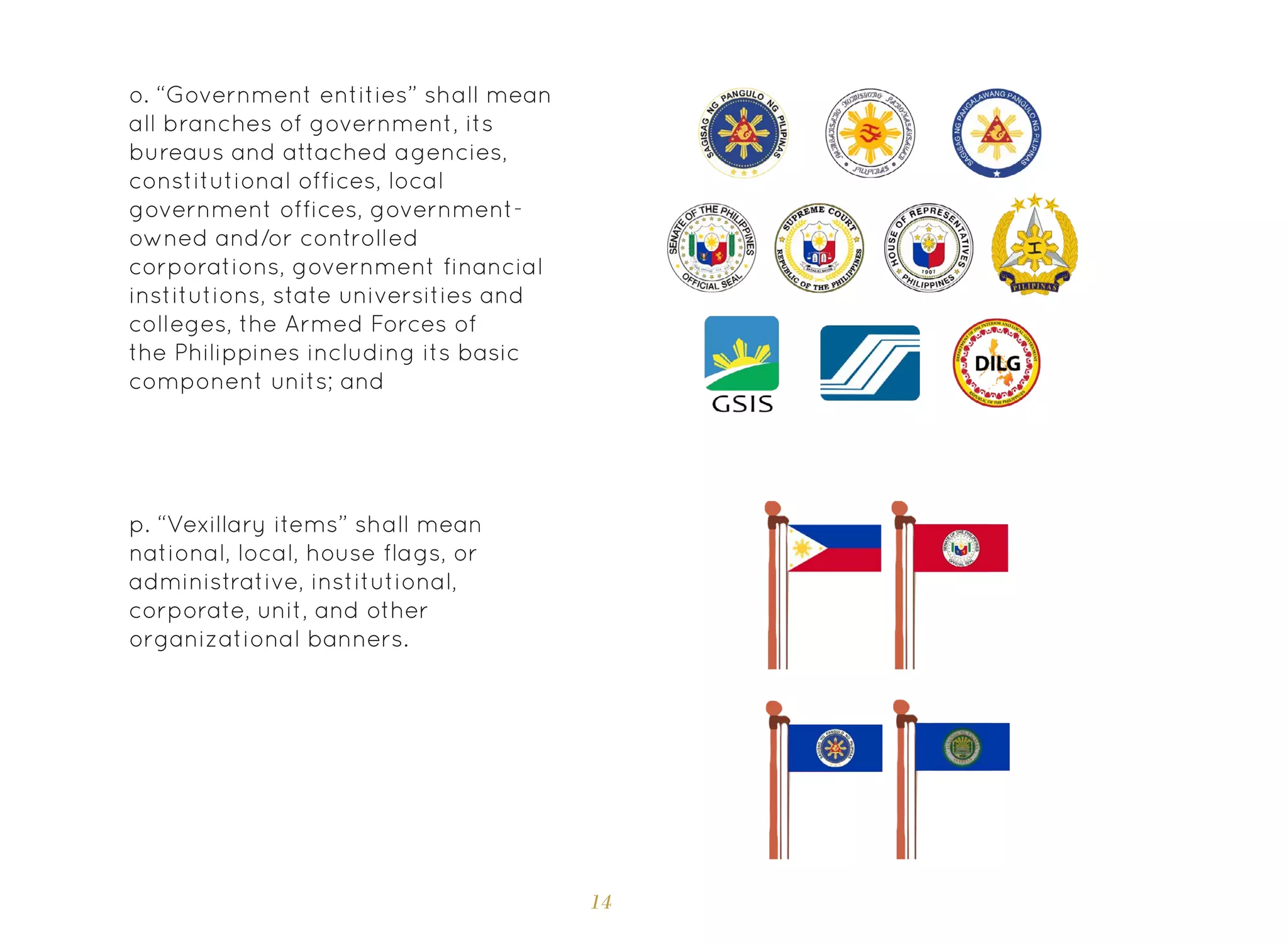
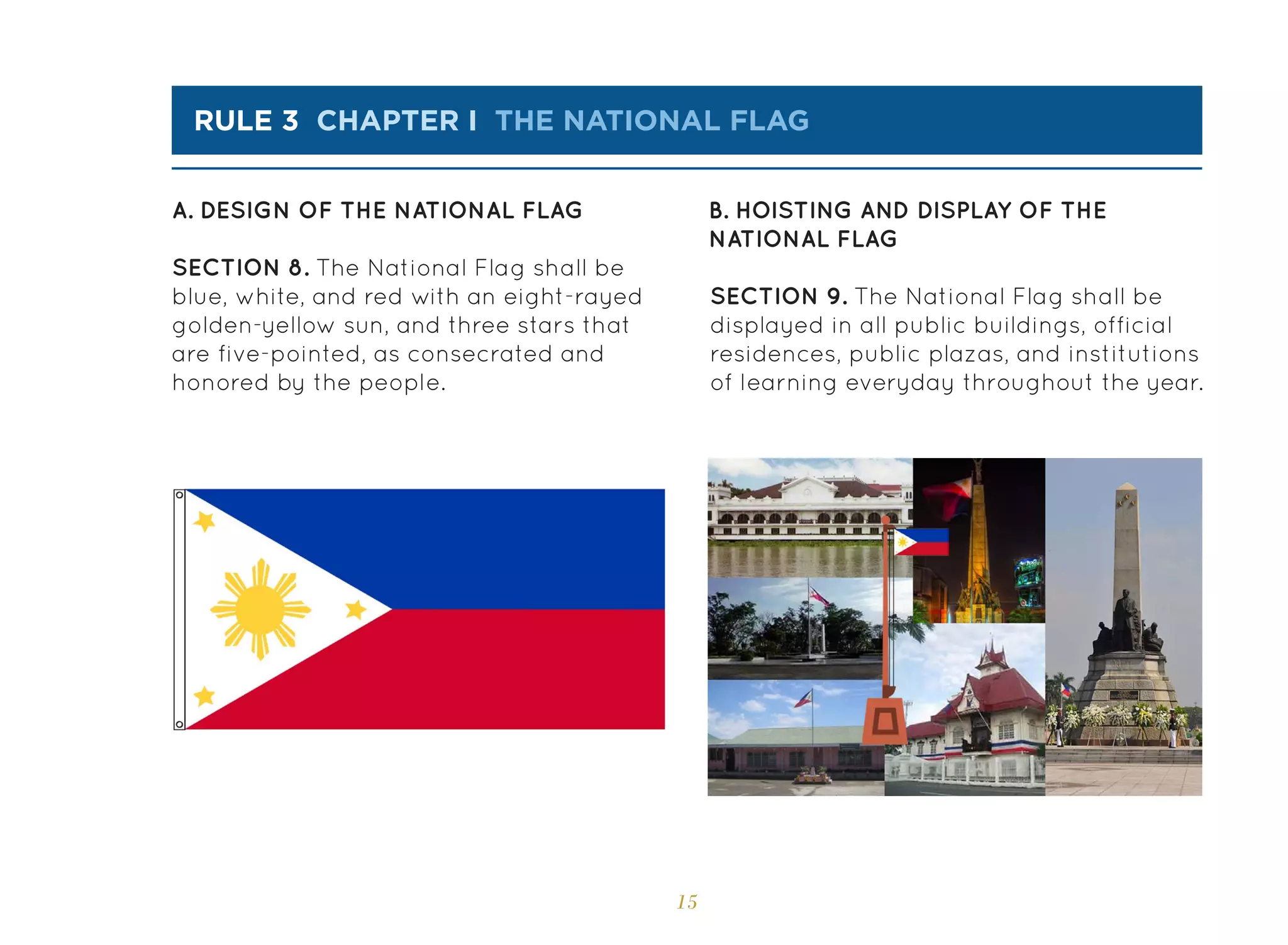
  • 149.
    131 5. The winningor selected entry shall thereafter be submitted for reaction to a consultative meeting participated in by representatives of various interest groups or non-government organizations within the LGU. The winning or selected entry may be modified as a result of the said participative meeting. 1. The LGU shall submit its proposed corporate seal to the Bureau of Local Government Supervision (BLGS), DILG, through the DILG Regional Office concerned. The DILG Regional Office shall review as to completeness of documentation. The proposed corporate seal shall be supported by the following documents: Review a. Transmittal letter of the local chief executive addressed to the Chairman of the NHI requesting review of the proposed corporate seal; is also discouraged except where the flag has become part of the LGU’s history like the Municipality of Kawit, Province of Cavite as the site of the declaration of Philippine Independence and the Municipality of Samal, Province of Bataan as the defender against foreign aggression; and c. The corporate seal of the LGU is a sign of authority and therefore, it shall not be used as personal seal of the local chief executive, e.g. the text Municipal Mayor, City Mayor, or Provincial Governor indicated within the ring border of the seal is not allowed. For municipalities, the name of the municipality shall be emblazoned on top and the name of the province at the bottom.
  • 150.
    132 b. Sanggunian resolutionendorsing the proposed corporate seal to the NHI for appropriate action. c. Brief historical background of the LGU; and d. Photographs of existing structure, objects, or scenic spots incorporated in the proposed seal, together with narrative description for proper visual representation, i.e. terrain, building, bridge, bell, etc. 2. The LGU shall see to it that a copy of the proposed seal, together with the supporting documents, is properly kept in the office of the secretary to the sanggunian. 3. The DILG Regional Office shall transmit to the BLGS a complete set of the proposed corporate seal within three (3) working days from receipt. Otherwise, the LGU concerned shall be informed promptly of any lacking document(s). 4. Immediately upon receipt of the proposed seal, the BLGS shall conduct an initial technical review of the documents submitted and thereafter transmit the same to the NHI. 5. The NHI shall review the proposed seal to determine whether it conforms with basic heraldic standards and specifications. When necessary, the NHI shall modify the proposed seal in accordance with its prescribed designs and specifications but retaining in the process the distinctive signs and symbols incorporated in the said seal.
  • 151.
    133 Approval Registration 1. After thereview process and the necessary modifications, the NHI shall forward to the Chairman of the National Commission on Culture and the Arts (NCCA) the modified corporate seal recommending approval thereof. 2. Immediately after the approval by the Chairman of the NCCA, the approved corporate seal shall be returned to the Chairman of the NHI, who shall transmit the approved seal to the local chief executive concerned, copy furnished the BLGS. 3. The local chief executive shall recommend to the sanggunian formal adoption of the corporate seal through a resolution. 1. The local chief executive shall register the approved seal with the DILG after the approved seal is formally adopted by the sanggunian. 2. For registration purposes, the LGU shall submit the following documents: a. Transmittal letter of the local chief executive; b. Copy of the sanggunian resolution adopting the seal duly approved by the Chairman of the NCCA; and c. Certified photocopy of the corporate seal as approved by the NCCA.
  • 152.
    134 3. A Certificateof Registration shall be issued by the Secretary to the local chief executive concerned, coursed through the DILG Regional Office, and copy furnished the NHI. 4. The DILG, through the BLGS, shall register the corporate seal and accordingly enter the same in a Registry Book indicating among other things, the name of the LGU, number and date of the sanggunian resolution adopting the approved seal, and actual date of registration as shown in the date of the certificate of registration signed by the Secretary. 5. The BLGS shall be the official custodian of all documents pertinent to the registration of corporate seal of the LGUs which shall form part of its Management Information System. Please be guided accordingly. CESAR N. SARINO Secretary Attachments: Annex “A” Annex “B” Annex “B-1” Annex “C” Annex “C-1”
  • 153.
    135 Annex “A” SIGNS ANDSYMBOLS TO BE INCORPORATED IN THE CORPORATE SEAL Geographical: Historical/Tourist Spots: Economic: Natural aspects/features Man-made Natural Events Agricultural Industrial Aquatic Resources Homemade Products location; boundaries; terrain towers; parks; monuments; landmarks mountains; springs; caves; beaches battles; uprisings rice fields; main or secondary products factories; mills; fabricators crustaceans; fish; gastropod; anemone amenities; necessities; contingencies — — — — — — — —
  • 154.
    136 Cultural: Traditions Personages festivals; rituals; rites;ceremonies; superstitions legendary; eminent Ethnological: Origin races; characters; influences ethnic groups Biological: Flora and fauna Natural Resources Forests; quarries; minerals — — — —
  • 155.
    137 Annex “B” SEAL SYMBOLISM BAYANNG MEYCAUAYAN, LALAWIGAN NG BULACAN (Municipality of Meycauayan, Province of Bulacan) Derived from the provincial seal of Bulacan where the town is located. Stand for the first eight (8) provinces that first revolted against Spain with Bulacan as one of the provinces. Shield : Eight (8) rays : Other components depict the major industries for which Meycauayan has been noted for, to wit: ring for jewelry, hide for tanning, wooden shoe for footwear, manufacturing and bolo for blacksmithing. Inscribed at the center of the hide is the year 1578 signifying the establishment of the town as a settlement by Franciscan Missionaries.
  • 156.
  • 157.
    139 Annex “C” SEAL SYMBOLISM BAYANNG TAGUDIN, LALAWIGAN NG ILOCOS SUR (MUNICIPALITY OF TAGUDIN, PROVINCE OF ILOCOS SUR) Derived from the provincial seal of Ilocos Sur where the town is located. Depicts the one and a half century old historic sundial of the municipality. It also represents the march for progress of the town through its hardworking local officials. Stand for major staple crop which is rice and its major cash crop which is Virginia tobacco. Shield : Eight (8) rays : Tobacco and Palay :
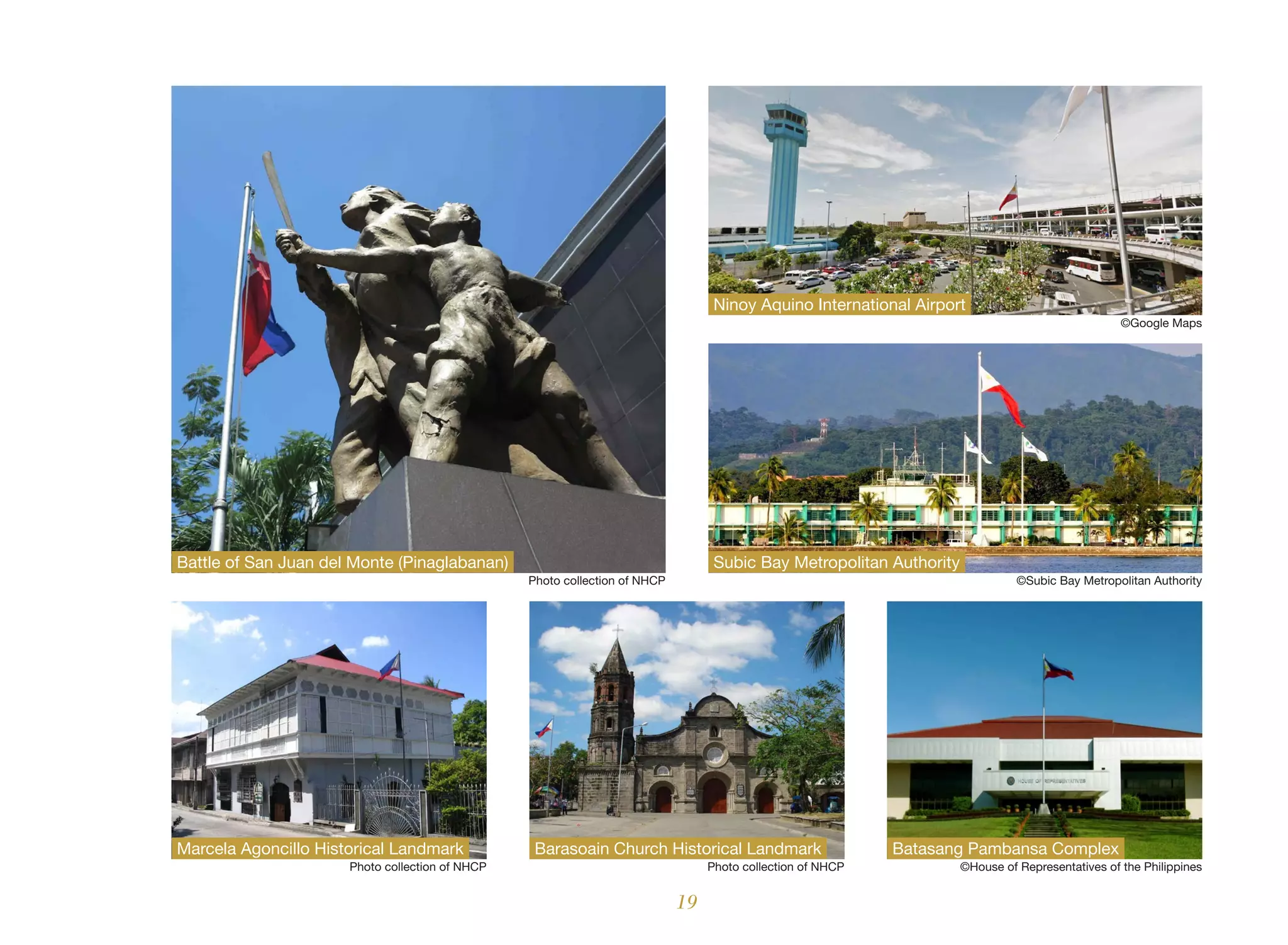
  • 158.
  • 159.
    141 Appendix No. 12 MALACAÑANG Manila BYTHE PRESIDENT OF THE PHILIPPINES EXECUTIVE ORDER NO. 179 PROMINENT DISPLAY OF THE NATIONAL FLAG IN ALL BUILDINGS, ESTABLISHMENTS, AND HOMES FROM 28 MAY 1994 TO 12 JUNE 1994 AND EVERY YEAR THEREAFTER, AND FOR OTHER PURPOSES WHEREAS, Section 1, Article XVI of the 1987 Constitution provides that the National Flag should be consecrated and honored by the people and recognized by law; WHEREAS, the National Flag, which symbolizes patriotism, love of country, and sense of nationhood and embodies the aspirations and sentiments of the Filipino People in their unceasing quest for freedom and independence, can be instrumental in raising the level of socio-civic, consciousness of the Filipinos, especially among the youth; WHEREAS, Proclamation No. 374 dated 06 March 1965 declared 28 May of each year as Flag Day, to commemorate the first unfurling of the Philippine Flag on Philippine soil at Alapan, Imus, Cavite on 28 May 1898; WHEREAS, Section 8 of Executive Order 137 dated 07 January 1965, mandates the display of the National Flag on national holidays, or special holidays as the President may proclaim not only in all public buildings, official residences, public squares and
  • 160.
    142 schools but wheneverpracticable, in all private buildings and homes, from sunrise to sunset; and WHEREAS, the period spanning the commemoration of the historic Flag Day on May 28 and the Independence Day on June 12, are opportune time for all Filipinos to collectively reflect on the significance of the National Flag, in the light of the forthcoming centennial celebration of the Philippine Independence in 1998. NOW, THEREFORE, I, FIDEL V. RAMOS, President of the Republic of the Philippines, by virtue of the powers vested in me by the laws of the land, do hereby order: SECTION 1. Display of the National Flag. All government departments, agencies, offices, government owned and controlled corporations, instrumentalities and the local government units, shall prominently display the National Flag from 28 May 1994 to 12 June 1994 and every year thereafter, in all public buildings, government institutions and official residences. The Department of Education, Culture and Sports, in coordination with the private sector, non-government organizations, and socio-civic groups shall enjoin the prominent display of the National Flag in all public squares and, wherever practicable, in all private buildings and homes. SECTION 2. Allocation of Funds. In support of the 1994 Independence Day Celebration, all concerned agencies may allocate such amount as may be necessary to defray expenditures that may be incurred from participation in the said activity, subject to the usual accounting and auditing rules and regulations.
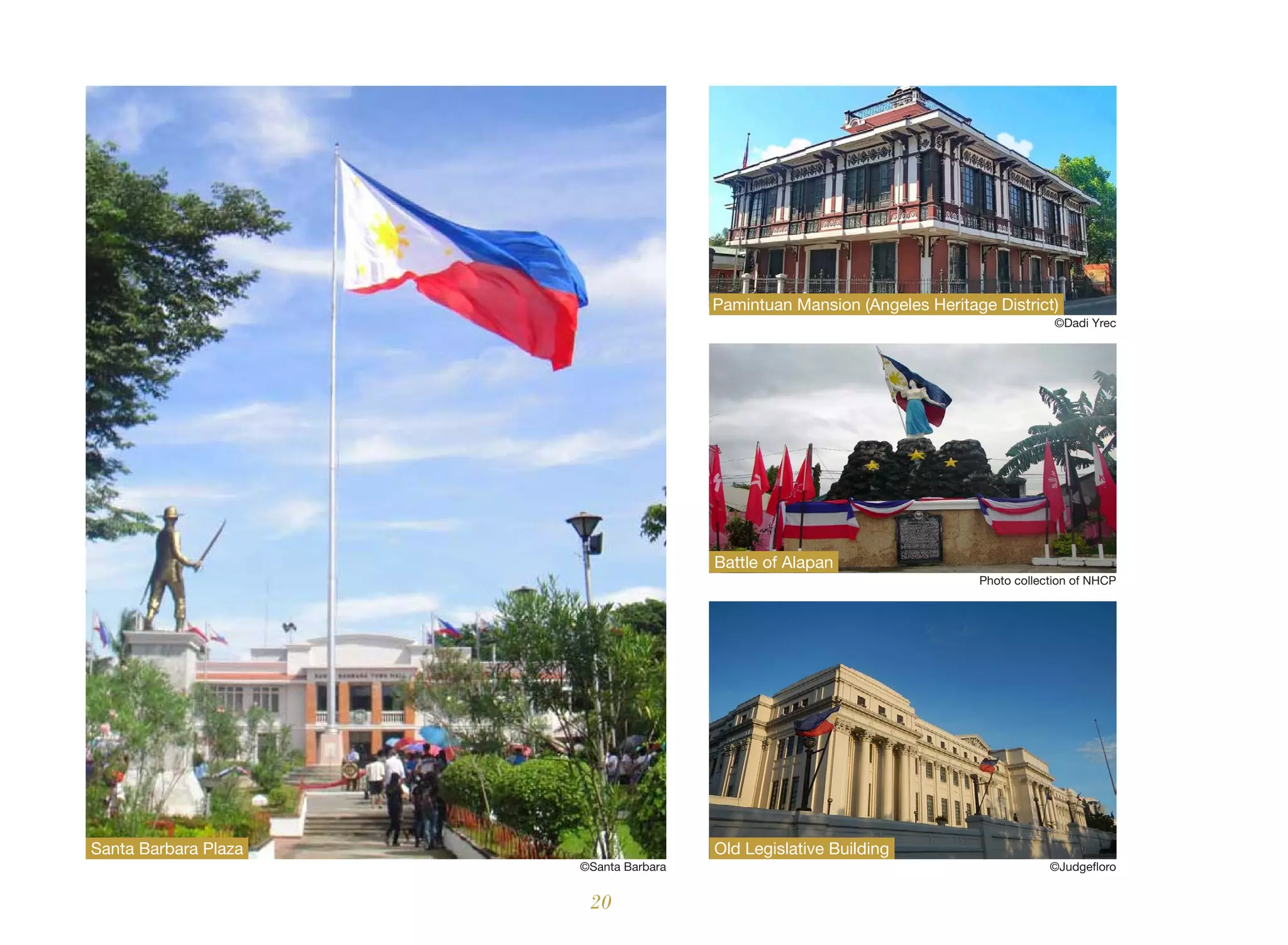
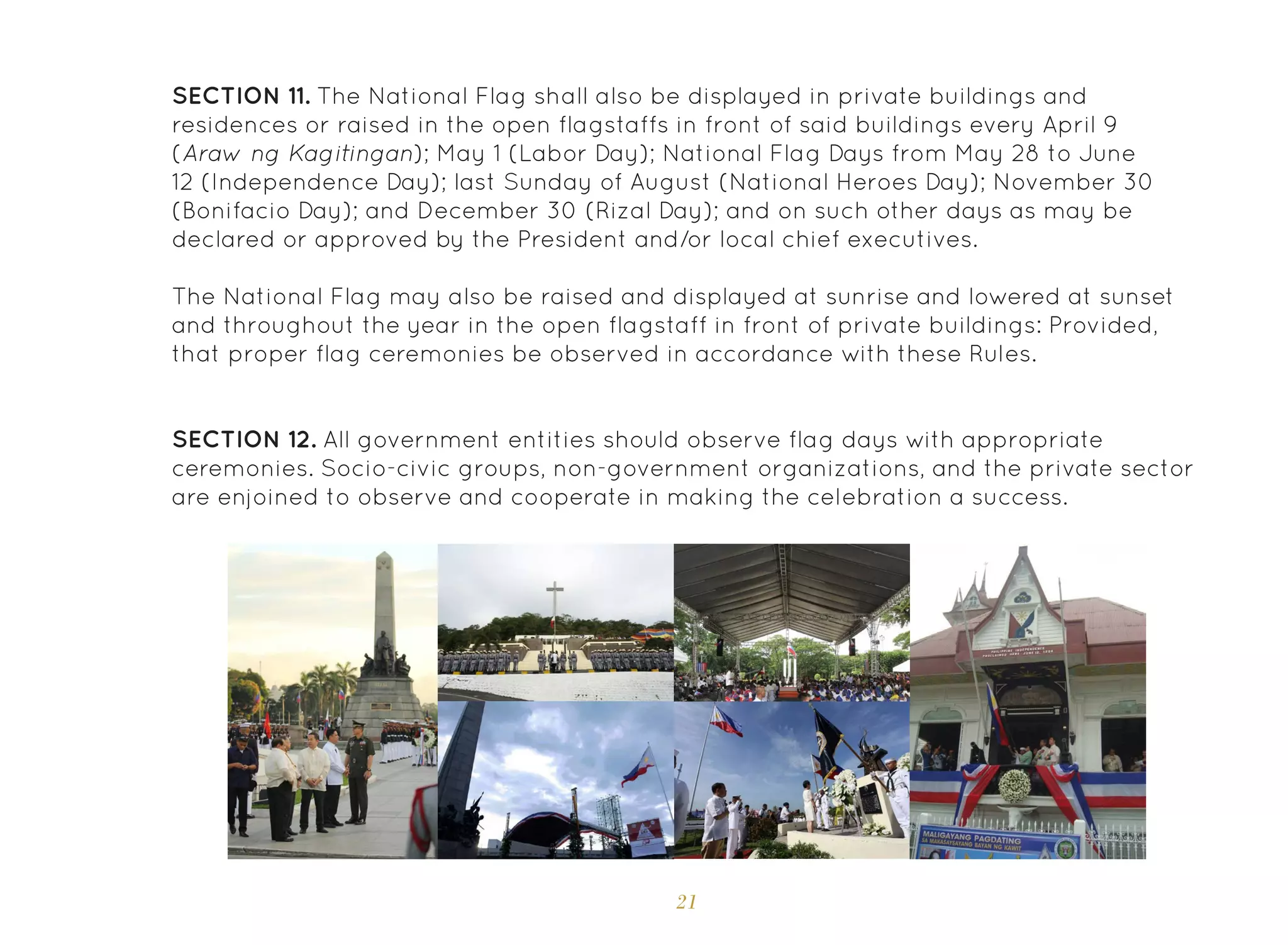
  • 161.
    143 SECTION 3. Effectivity.This Executive Order shall take effect immediately. DONE in the City of Manila, this 24th day of May, in the year of Our Lord, nineteen hundred and ninety four. FIDEL V. RAMOS President of the Philippines TEOFISTO T. GUINGONA, JR. Executive Secretary By the President
  • 162.
    144 Appendix No. 13 MALACAÑANG Manila BYTHE PRESIDENT OF THE PHILIPPINES EXECUTIVE ORDER NO. 343 ADOPTING THE “PANUNUMPA NG KATAPATAN SA WATAWAT” AS THE OFFICIAL PLEDGE OF ALLEGIANCE FOR ALL FILIPINOS WHEREAS, we, as a nation will commemorate the centennial of the proclamation of Philippine Independece on 12 June 1998 which celebration becomes more meaningful to the citizenry if their sense of history and nationhood is properly evoked; WHEREAS, the “Panunumpa ng Katapatan sa Watawat” finalized by the National Commission for Culture and the Arts from a draft prepared by the Commission on the Filipino Language is a soul stirring pledge that we can call truly ours, evincing as it does, a sense of nationhood and the values that every freedom-loving and nationalistic Filipino ought to possess; NOW, THEREFORE, I, FIDEL V. RAMOS, President of the Republic of the Philippines, by the powers vested in me by law, do hereby adopt and institutionalize the “Panunumpa ng Katapatan sa Watawat” as the official oath of allegiance for all Filipinos. I hereby direct each and every citizen to learn the “Panunumpa ng Katapatan sa Watawat,” reflect upon its words and take to heart the dedication to nationhood that the pledge contains:
  • 163.
    145 Ako ay Pilipino Buongkatapatang nanunumpa Sa watawat ng Pilipinas At sa bansang kanyang sinasagisag Na may dangal, katarungan, at kalayaan Na pinakikilos ng sambayanang Maka-Diyos Makakalikasan Maka-tao at Makabansa This Executive Order takes effect immediately. DONE in the City of Manila, this 12th day of June in the year of Our Lord, Nineteen Hundred and Ninety-Six. FIDEL V. RAMOS President of the Philippines By the President RUBEN D. TORRES Executive Secretary
  • 164.
    146 Appendix No. 14 BYTHE PRESIDENT OF THE PHILIPPINES ADMINISTRATIVE ORDER NO. 362 CREATION OF A COMMITTEE ON PRESIDENTIAL AWARDS WHEREAS, it is benefiting to give recognition to public servants, government retirees, distinguished citizens and organizations for their exemplary service and invaluable contribution to the achievement of the programs of the government through the conferment of Presidential Citations and Awards; WHEREAS, appropriate procedures and criteria must be formulated for the processing of nominations for certain Presidential Awards promulgated by laws or presidential issuances; WHEREAS, there is a need for a Committee which shall formulate the procedures and ensure that criteria are observed as well as process nominations for the conferment of these Presidential Citations and Awards; NOW THEREFORE, I, FIDEL V. RAMOS, President of the Republic of the Philippines, by virtue of the powers vested in me by law, do hereby order the following: MALACAÑANG Manila
  • 165.
    147 SECTION 1. Creationof a Committee on Presidential Awards. There is hereby created a Committee On Presidential Awards (hereinafter referred to as “Committee”) which shall be tasked to process the nominations for the conferment of Presidential Citations and Awards. SECTION 2. Composition of the Committee. The Committee shall be composed of the Executive Secretary as Chairman, Presidential Management Staff Head as Vice- Chairman, and the following members: PA for Political Affairs, Appointments Secretary, and Chief of Presidential Protocol. The Committee may create such sub-committees as may be necessary to assist it in the performance of its functions. SECTION 3. Functions of the Committee. The Committee shall have the following functions and responsibilities: a. Formulate the procedures and ensure that the criteria for the conferment of Presidential Awards and Citations as promulgated by law and Presidential issuances, including the following, are observed: 1. Order of Sikatuna 2. Order of Kalantiao 3. Presidential Citation for Outstanding Humanitarian Services 4. Rizal Pro Patria Award
  • 166.
    148 5. Golden HeartPresidentail Award 6. Order of Gabriela Silang 7. Philippine Legion of Honor 8. Rizal Collegiate Palm and the Mabini Teachers’ Award 9. Presidential Merit Award b. Process the nominations from the various government agencies and private groups and individuals for the said award categories; c. Convene quarterly or as often as deemed necessary to consider and process nominations for the Presidential Awards; d. Invite representatives from other government departments and agencies including the DFA, DND, and the DILG, when deliberating on nominations which emanate from or otherwise pertain to the functions and responsibilities of the said departments or agencies; and e. Submit recommendations to the President. SECTION 4. Secretariat. The Presidential Protocol shall provide the technical and administrative support to the Committee. SECTION 5. Effectivity. The Administrative Order shall take effect immediately.
  • 167.
    149 FIDEL V. RAMOS Presidentof the Philippines DONE in the City of Manila, this 30th day of September in the year of Our Lord, Nineteen Hundred and Ninety-Seven. By the President RUBEN D. TORRES Executive Secretary
  • 168.
    150 Appendix No. 15 BYTHE PRESIDENT OF THE PHILIPPINES EXECUTIVE ORDER NO. 297, S. 2000 REGULATING THE MANUFACTURE, SALE, DISTRIBUTION, AND USE OF PNP UNIFORMS, INSIGNIAS, AND OTHER ACCOUTREMENTS WHEREAS, the PNP uniforms, insignias and other accoutrements are symbolic of a discipline and an image which portray the character and being of every policeman most representative of a professional Philippine National Police; WHEREAS, the use or wearing of PNP uniforms, insignias, and other accoutrements projects at the very first instance any identity that establishes a distinctive recognition exclusive to every policeman and the Philippine National Police; WHEREAS, the PNP uniforms, insignias, and other accoutrements are easily available and/or procured from any manufacturer, seller, distributor, or supplier by any person, including unscrupulous and lawless individuals who make a mockery of their use for personal gain, unlawful purposes and/or other designs to degrade the policemen and the Philippine National Police; WHEREAS, while article 179, “Illegal use of uniforms or insignia” of Republic Act 3815, otherwise known as the Revised Penal Code of the Philippines penalizes any person MALACAÑANG Manila
  • 169.
    151 who shall publiclyand improperly make use of insignia, uniforms, or dress pertaining to an office not held by such person or to a class of persons of which he is not a member, it does not include the illegal manufacture, sale, and distribution of the same; WHEREAS, while Republic Act No. 493 was also enacted prohibiting, among others the wearing, use, manufacture, and sale of insignias, decorations and medals, badges, patches, and identification cards prescribed for the “Armed Forces” or “Constabulary,” it does not apply to the Philippine National Police; WHEREAS, there is no law that governs and regulates the manufacture, sale distribution and use of uniforms, insignias and other accoutrements of the Philippine National Police; WHEREAS, to ensure that PNP uniforms, insignias, and other requirements are manufactured, sold, distributed or supplied only by authorized manufacturer distributor, supplier and/or seller and used exclusively by uniformed personnel of the PNP, there is a need for regulation. NOW, THEREFORE, I, JOSEPH EJERCITO ESTRADA, President of the Republic of the Philippines, by virtue of the powers vested in me by law, do hereby order: SECTION 1. The unauthorized manufacture and distribution of PNP uniforms, insignias, and other accoutrements is hereby prohibited. Any violation of this rule shall, after due notice and hearing, result in the immediate closure of the establishment, plant and/or office where the uniforms and other items are manufactured, stored, sold and/ or distributed, the cancellation of its business license or permit, the condemnation, seizure and forfeiture of all paraphernalia used or intended to be used in the
  • 170.
    152 manufacture, sale, and/ordistribution and the imposition of reasonable administrative fines, without prejudice to the filing of administrative, civil, and/or criminal actions. SECTION 2. The use of PNP uniforms, insignias, and other accoutrements by any person who is not a member of the uniformed Philippine National Police personnel is also prohibited. Any violation of this rule shall, after due notice and hearing, be penalized by public censure which shall be published at least once in a newspaper of general circulation without prejudice to the filing of administrative, civil and/or criminal actions. SECTION 3. The Philippine National Police shall adopt its own uniforms, insignias, and other accoutrements for the exclusive use of its uniformed personnel. The uniforms and other items shall be subject to inspection and acceptance procedures of the Philippine National Police with each design and specification approved by the PNP Uniform and Equipment Standardization Board (UESB). As such, only those accredited by the PNP and the National Historical Institute are authorized to manufacture, sell or distribute the same. SECTION 4. The Chief, Philippine National Police shall issue rules and regulations for the effective implementation of this Executive Order. SECTION 5. All orders, issuances, rules and regulations or parts thereof inconsistent with this Executive Order are hereby repealed or modified accordingly.
  • 171.
    153 DONE in theCity of Manila, this 4th day of October in the year of Our Lord, two thousand. JOSEPH EJERCITO ESTRADA President of the Philippines By the President RONALDO B. ZAMORA Executive Secretary
  • 172.
    154 NHI BOARD RESOLUTIONNO. 2, 2003 AUTHORIZING THE CHAIRMAN TO IMPLEMENT SECTION 58, RULE II, CHAPTER IX OF THE RULES AND REGULATIONS IMPLEMENTING REPUBLIC ACT No. 8491, S. 1998 A RESOLUTION AMENDING THE 4TH PARAGRAPH OF SECTION 27 OF THE IMPLEMENTING RULES AND REGULATION (IRR) OR R.A. NO. 8491 WHEREAS, it is fitting and proper to commemorate the noble deeds of our heroes and heroines by way of half-masting the Philippine National Flag during the celebration of their death anniversary; WHEREAS, Section 23 of R.A. No. 8491 and Section 27 of its Implementing Rules and Regulations (IRR) respectively, have no specific provision on the conduct of half-mast of Philippine National Flag during the observance of death anniversary of our heroes and heroines; WHEREAS, Section 58, Amendments of the IRR, states that: “The Chairman and Executive Director shall have the authority to amend, revise, repeal, or otherwise modify these Rules or any provision thereof, as may be deemed necessary to achieve the objectives of R.A. No. 8491 and these Rules.” Appendix No. 16
  • 173.
    155 NOW THEREFORE, inconsideration of the foregoing, be it RESOLVED, as it is hereby RESOLVED that the 4th paragraph of Section 27 of the IRR or R.A. No. 8491, be amended and to read as follows: “The National Flag shall also be flown at half-masting during the death anniversary of heroes or heroines, calamities or grave adversity of national or international solemnity as ordered by the Office of the President, as may be recommended by the Institute.” APPROVED: 31 March 2003 SERAFIN D. QUIASON Member AMBETH R. OCAMPO Chairman JOSE M. CRUZ, S.J. Member HEIDI K. GLORIA Member CORAZON S. ALVINA Ex-Officio Member PRUDENCIANA C. CRUZ Ex-Officio Member
  • 174.
    156 Appendix No. 17 NHIBOARD RESOLUTION NO. 2, S. 2004 A RESOLUTION AMENDING SOME PROVISIONS OF THE IMPLEMENTING RULES AND REGULATIONS (IRR) OF R.A. No. 8491, KNOWN AS “THE FLAG AND HERALDIC CODE OF THE PHILIPPINES” WHEREAS, Executive Director Ludovico D. Badoy issued a Memorandum Order No. 556 dated October 20, 2003 creating a Review Team to conduct a general review on the provisions of the IRR of R.A. 8491 otherwise known as the Flag and Heraldic Code of the Philippines in connection with the reprinting of the Manual entitled “The Flag and Heraldic Code of the Philippines, Illustrated”; WHEREAS, the Review Team held four (4) meetings and came up with certain recommendations/corrections to be incorporated in the IRR and adopted as follows: • With the inclusion of the Senate of the Philippines building and the change of location of the Libingan ng mga Bayani in Taguig, Metro Manila instead of Makati City, Section 10 shall now read as follows: “The National Flag shall be permanently hoisted, day and night, throughout the year, in front of the following: at Malacañang Palace; Senate of the Philippines building; Congress of the Philippines building; Supreme Court building; Rizal Monument in Luneta, Manila; Bonifacio Monument in Caloocan City; Emilio Aguinaldo Shrine in Kawit, Cavite; Barasoain Church Historical Landmark in Malolos, Bulacan; Marcela Agoncillo Historical Landmark in Taal, Batangas;
  • 175.
    157 Tomb of theUnknown Soldier, Libingan ng mga Bayani, Taguig, Metro Manila; Mausoleo de los Veteranos de la Revolucion, North Cemetery, Manila; all international ports of entry and all other places as may be designated by the Institute.” • In Section 27, letters c, d, and e, it would be more appropriate to add the words “or equivalent in rank,” to read as follows: • Also, in Section 27, letter h, the phrase “Veterans of previous wars,” was added to read as follows: c. Cabinet Secretaries, Associate Justices of the Supreme Court, Members of the Senate and House of Representatives, the Chief of Staff of the Armed Forces of the Philippines, and the Director-General of the Philippine National Police, or equivalent in rank, for five (5) days; d. Heads of National Government Agencies, including Government Owned and Controlled Corporations and Government Financial Institutions, or equivalent in rank, for three (3) days; e. The Commanding Generals of the Philippine Air Force and the Philippine Army and the Flag Officer in Command of the Philippine Navy, or equivalent in rank, for three (3) days; h. Veterans of previous wars, Barangay Chairmen and the Barangay Councilmen on the day of interment.
  • 176.
    158 • Section 27,letter l, now includes former Vice-President, the Chief Justice of the Supreme Court, the President of the Senate, and the Speaker of the House of Representatives, and reads as follows: • In the last paragraph of Section 27, Libingan ng mga Bayani, Fort Bonifacio, Makati City was changed to Libingan ng mga Bayani, Taguig, Metro Manila to read as follows: • In Section 28, another paragraph is added to read as follows: l. Other persons to be determined by the Institute, including the former Vice- President, the Chief Justice of the Supreme Court, the President of the Senate, and the Speaker of the House of Representatives, for a period of less than seven (7) days. “The National Flag shall be permanently hoisted at half-mast, day and night, throughout the year at the Tomb of the Unknown Soldier, Libingan ng mga Bayani, Fort Bonifacio, Taguig, Metro Manila; Mausoleo de los Veteranos de la Revolucion, North Cemetery, Manila; and in all memorial cemeteries dedicated to war veterans. The National Flag of these declared sites shall be properly illuminated at night.” “In an open coffin, to view the corpse, the National Flag shall be folded and placed over it.”
  • 177.
    159 Section 52. Theuse of the National Coat-of-Arms, the Great Seal, administrative/corporate seals, logos, insignia in letterheads, stationeries, name cards, greeting cards, and envelopes shall be for official purposes only. Section 53. The recommended size of dry seal for the Great Seal, 3”Ø; corporate/administrative seals for Department level 2 3 /4 ” Ø and Bureau/LGU levels 2”Ø. The use and display of the National Coat-of-Arms, the Great Seal, administrative/corporate seals, logos, and insignia as trademarks, advertisements, or labels for commercial, industrial or agricultural purposes by private persons, corporations or associations, and the printing and stamping of the same on articles or commodities intended for sale, barter or exchange, shall be prohibited. NOW THEREFORE, in consideration of the foregoing, the NHI Board by virtue of the power vested in it by law, hereby resolves that recommendations/corrections made • Addition of two (2) sections on the proper use and recommended size of dry seal for the National Coat-of-Arms, the Great Seal, administrative/corporate seals, logos and insignias to read as follows:
  • 178.
    160 by the ReviewTeam on the IRR of R.A. No. 8491 be incorporated on the IRR in the re- printing of the Manual. APPROVED: 16 April 2004 SERAFIN D. QUIASON Member BENITO J. LEGARDA, JR. Member AMBETH R. OCAMPO Chairman JOSE M. CRUZ, S.J. Member HEIDI K. GLORIA Member CORAZON S. ALVINA Director, National Museum Ex-Officio Member PRUDENCIANA C. CRUZ Director, National Library Ex-Officio Member
  • 179.
    161 Appendix No. 18 REPUBLICACT No. 10086 AN ACT STRENGTHENING PEOPLES’ NATIONALISM THROUGH PHILIPPINE HISTORY BY CHANGING THE NOMENCLATURE OF THE NATIONAL HISTORICAL INSTITUTE INTO THE NATIONAL HISTORICAL COMMISSION OF THE PHILIPPINES, STRENGTHENING ITS POWERS AND FUNCTIONS, AND FOR OTHER PURPOSES Be it enacted by the Senate and House of Representatives of the Philippines in Congress assembled: SECTION 1. Short Title. – This Act shall be known as the “Strengthening Peoples’ Nationalism Through Philippine History Act”. SECTION 2. Declaration of Policy. – It is hereby declared to be the policy of the State to conserve, promote and popularize the nation’s historical and cultural heritage and resources. Pursuant to the Constitution, all the country’s artistic and historic wealth constitutes the cultural treasure of the nation and shall be under the protection of the State which may regulate its disposition. Towards this end, the State shall provide the means to strengthen people’s nationalism, love of country, respect for its heroes and pride for the people’s accomplishments by reinforcing the importance of Philippine national and local history in daily life with the end in view of raising social consciousness; reinvigorating government support for historical research; and sustaining and enhancing programs for the protection,
  • 180.
    162 preservation and conservationof historical relics and memorabilia, monuments, sites and other historical resources. The State shall likewise give utmost priority not only to the research on history but also to the popularization of history. In this way, the State will be able to build a Philippine national identity based on unity and pride in diversity held together by a common history. SECTION 3. Definition of Terms. – For purposes of this Act, the following terms shall be defined as follows: (a) “Built heritage” refers to architectural and engineering structures such as, but not limited to, bridges, government buildings, houses of ancestry and worship, traditional dwellings, technological and industrial complexes and their settings, and landscapes with notable historical and cultural significance. (b) “Classified” refers to structures and sites marked and listed as such and recorded in the National Historical Commission of the Philippines’s National Registry of Historic Sites and Structures, and not falling under any of the five (5) categories of historic sites and structures, namely: National Shrines, National Monuments, National Landmarks, Heritage Houses and Historic Sites. (c) “Conservation” refers to all processes and measures of maintaining the cultural significance of a cultural property including, but not limited to, physical, social or legal preservation, restoration, reconstruction, protection, adaptation or any combination thereof.
  • 181.
    163 (d) “Documentation” refersto the recording in a permanent format of information derived from research, conservation and other activities of the National Historical Commission of the Philippines (NHCP). (e) “Heritage houses” refers to houses of ancestry with notable historical, cultural, social, architectural and artistic value and significance as declared by the NHCP. (f) “Historic site” refers to a place recogmzed to have an important historical SIgnificance as declared by the NHCP. (g) “Historical street name” refers to a street name which has been in existence for at least fifty (50) years. (h) “History” refers to the record of people, places and events in the past; it can also mean the discipline involving the study of people, places and events in the past. (i) “History museum” refers to a place where relics and memorabilia and other resources pertainmg to important people, places and events in the past are thematically presented and systematically preserved, catalogued or displayed for public appreciation and education. (j) “Historical research” refers to the scholarly investigation of people, places and events in the past. (k) “Historical writing” refers to the coherent, narrative and scholarly documentation of people, places and events in the past.
  • 182.
    164 (I) “National historicallandmarks” refers to sites or structures which are associated with events or achievements significant to Philippine history declared as such by the NCHP. (m) “National historical monuments” refers to structures erected as a memorial to great heroes or events in Philippine history declared as such by the NHCP . (n) “National historical shrines” refers to sites or structures hallowed and revered for their history or association declared as such by the NHCP. (o) “National registry of historic sites and structures” refers to the records of all historic sites and structures of the country as found in the documentation of the NHCP. (p) “Philippine history” is the study of people, events and places from the dawn of the recorded past of the Philippines to contemporary period. (q) “Preservation” refers to all activities that employ means to control, minimize or prevent damage or deterioration to cultural property. (r) “Restoration” refers to the action taken or the technical intervention to correct deterioration and alterations and return cultural property to its original state or condition. SECTION 4. Renaming of the National Historical Institute. – The nomenclature of the National Historical Institute (NHI), established pursuant to Presidential Decree No. 1,
  • 183.
    165 (a) conduct andsupport all kinds of research relating to Philippine national and local history; (b) develop educational materials in various media, implement historical educational activities for the popularization of Philippine history, and disseminate information regarding Philippine historical events, dates, places and personages; (c) undertake and prescribe the manner of restoration, conservation and protection of the country’s historical movable and immovable objects; (d) manage, maintain and administer national shrines, monuments, historical sites, edifices and landmarks of significant historico-cultural value; and (e) actively engage in the settlement or resolution of controversies or issues relative to historical personages, places, dates and events. S. 1972, is hereby changed to National Historical Commission of the Philippines (NHCP). The NHCP shall be an independent agency attached to the National Commission for Culture and the Arts (NCAA). SECTION 5. General Mandate. – The NHCP is the primary government agency responsible for history and has the authority to determine all factual matters relating to official Philippine history. In this regard, the NHCP shall:
  • 184.
    166 SECTION 6. TheBoard. – The NHCP shall be governed by a nine (9)-member Board, which shall be created to formulate and implement NHCP policies relating to the agency’s mandate. SECTION 7. Powers and Functions of the Board. – The Board of the NHCP shall exercise the following powers and functions: (a) Conduct and encourage all manner of research pertaining to Philippine national and local history; (b) Acquire important historical documents, collections, memorabilia and other objects that have significant historical value; (c) Acquire real property, buildings and other structures for the purpose of preserving, restoring and conserving their significant historical value; (d) Determine the manner of identification, maintenance, restoration, conservation and preservation of historical sites, shrines, structures and monuments; (e) Approve the declaration of historic structures and edifices such as national shrines, monuments and landmarks or heritage houses; (f) Prescribe the manner of celebration or commemoration of significant events pertaining to Philippine history; (g) Initiate and, in cooperation with the appropriate government or private entity, promote programs for the popularization of Philippine history such as, but not
  • 185.
    167 limited to, theintegration of the subject of history into the school curriculum, among others; (h) Discuss and resolve, with finality, issues or conflicts on Philippine history; (i) Implement and enforce Republic Act No. 8491, otherwise known as the Flag Law, and other special laws where the NHCP has been designated as the implementing body; (j) Secure and receive local, bilateral and international donations, grants and endowments in support of its programs and projects; (k) Develop and implement consortium agreements to link other government agencies and/or private individuals and organizations engaged in or in support of the mandate of the NHCP; (l) Regulate activities pertaining to the preservation, restoration and conservation of historical property or resources; (m) Generate funds from government or private sources, local or international for its programs and projects; (n) Collect reasonable fees for the use, sale or rent of its resources as well as entrance fees to shrines and landmarks under the jurisdiction of the NHCP; (o) Approve grants, create committees or deputize individuals for NHCP projects;
  • 186.
    168 (p) Conduct publichearings and ocular inspections or initiate factual investigations with respect to disputed historical issues for the purpose of declaring official historical dates, places, personages and events; (q) Approve the annual budget of the NHCP before its presentation to the Department of Budget and Management (DBM) and Congress; (r) Appoint the Deputy Executive Directors of the NHCP; and (s) Exercise oversight functions over the administrative operations of the NHCP. SECTION 8. Composition of the Board. – The Board shall be headed by a Chairperson and shall be composed of five (5) distinguished historians representing the private sector who shall serve as regular members of the Board and who shall be appointed by the President of the Republic of the Philippines. Only the regular members can vote on matters relating to historical research and similar academic concerns. The following shall serve as ex officio members: (a) The Director of the National Library of the Philippines; (b) The Director of the National Museum; (c) The Executive Director of the National Archives of the Philippines; and (d) The Executive Director of the NHCP.
  • 187.
    169 SECTION 9. Qualificationsof Regular Members of the Board. – No person shall be appointed or elected to the Board unless he/she possesses the following minimum qualifications: (a) A natural-born citizen of the Republic of the Philippines; (b) At least thirty-five (35) years of age; (c) With good moral character; (d) Has distinguished himself/herself in the field of Philippine history; and (e) Has published works in Philippine history and other academic· fields recognized by scholars and the reading public. SECTION 10. Regular Members; Term of Office. – The regular members of the Board shall serve for a term of four (4) years: Provided, That the first five (5) appointees pursuant to this law shall hold office under the following staggered terms, namely: two (2) appointees will have a full term of four (4) years; two (2) appointees will have a term of three (3) years; and the remaining appointee shall have a term of two (2) years: Provided, further, That the regular members shall not serve for more than two (2) consecutive terms. Appointment to any vacancy shall only be for the unexpired portion of the term of the predecessor. In no case shall a member be appointed or designated in a temporary or acting capacity.
  • 188.
    170 SECTION 11. Electionof the Chairman. – The Board shall be headed by a Chairman who shall be elected from among the regular members in an election to be participated in by all the members of the Board. SECTION 12. Term of Office of the Chairman. – The Chairman shall have a term of three (3) years and shall not serve more than two (2) consecutive terms. SECTION 13. Functions of the Chairman. – The Chairman is the head of the agency and shall represent and act for the Board in all matters pertaining to the NHCP. The Chairman, being the public face of the NHCP, shall: (a) provide leadership in the realization of the vision and mission of the NHCP; (b) advise the President and Congress on matters relating to Philippine history; (c) preside over meetings of the Board; (d) propose the agenda for meetings of the Board; (e) exercise oversight over the Executive Director and Deputy Executive Directors to ensure the implementation of policies, decisions and resolutions of the Board; (f) represent the NHCP on official matters; (g) represent the NHCP in the Board of the NCCA and, other agencies where the NHCP head of agency sits; and
  • 189.
    171 (h) perform suchother authority, functions or duties which the President of the Philippines or the Board may delegate. SECTION 14. The Executive Director. – The Executive Director shall be appointed by the President of the Republic of the Philippines. He/She shall have a rank equivalent to a bureau director. SECTION 15. Functions of the Executive Director. – The Executive Director shall have the following functions: (a) Implement the policies and programs approved and promulgated by the NHCP Board; (b) Administer the day-to-day operations of the NHCP; (c) Represent the NHCP in meetings when authorized or delegated by the Board; and (d) Perform such other functions assigned by the NHCP Board. SECTION 16. The Deputy Executive Directors. – The Executive Director shall be assisted by a Deputy Executive Director for Administration and a Deputy Executive Director for Programs and Projects. The Deputy Executive Directors shall be appointed by the Board.
  • 190.
    172 SECTION 17. Qualificationsof the Executive Director and Deputy Executive Directors. – No person shall be appointed or designated as Executive Director and Deputy Executive Directors of the NHCP unless he/she possesses the following minimum qualifications: (a) A natural-born citizen of the Republic of the Philippines; (b) Has good moral character; (c) Holder of any four (4)-year college degree; (d) Has at least five (5) years of actual and relevant experience in managing a government agency in the case of the Executive Director and three (3) years experience in the case of the Deputy Executive Directors; and (e) Has Career Executive Service Officer (CESO) eligibility only with respect to the Deputy Executive Director position. SECTION 18. Delegation of Authority. – The Executive Director shall have authority over and responsibility for the day-to-day operations of the NHCP. He/She may delegate such authority to the Deputy Executive Directors to implement plans and programs. The delegation shall be in writing; shall indicate the name of specific officer to which the delegation is made; shall indicate the duties and responsibilities delegated; shall indicate the length of period of delegated authority; and shall vest sufficient authority to enable the delegate to discharge his/her assigned responsibility. SECTION 19. Reorganization. – Within one hundred twenty(120) days from the effectivity of this Act, the Board shall have the authority to reorganize the structure of
  • 191.
    173 the NHI, includingits staffing pattern in order to carry out its functions pursuant to its expanded mandate as the NHCP. Employees of the NHI shall be subsumed in the NHCP and, whenever qualified, be upgraded to their analogous positions. Employees opting to avail of an early retirement scheme shall be granted under the existing DBM guidelines. SECTION 20. Historic Sites and Structures Documentation Center. – A Historic Sites and Structures Documentation Center (HSSDC) shall be established within the NHCP, replacing the existing Survey and Documentation Section, which shall be tasked with undertaking the survey, identification, documentation and recommendation for declaration of historic structures and edifices such as national shrines, monuments and landmarks or heritage houses by the NHCP Board and maintaining the National Registry of Historic Sites and Structures. SECTION 21. Local Historical Committees Network. – The existing work of the agency on historical society affiliations shall constitute the Local Historical Committees Network (LHCN). The LHCN shall monitor, coordinate, support and, upon approval of the Board, affiliate various local historical bodies engaged in the collection, documentation, popularization, conservation, restoration and preservation of extant historical materials found in different parts of the Philippines. It shall also record the oral histories of towns, cities, provinces, regions and peoples. SECTION 22. Materials Research Conservation Division. – The Materials Research Conservation Center of the agency shall be renamed as Materials Research Conservation Division (MRCD). Aside from its regular functions, it shall provide consultancy services to collectors of historical objects that are considered valuable
  • 192.
    174 (a) The NHCPshall be exempt from all taxes on its income; (b) All donations in any form to the NHCP shall be exempt from the donor’s tax and the same shall be considered as allowable deduction from the gross income in the computation of the income tax of the donor, in accordance with the provisions of Republic Act No. 8424, otherwise known as the National Internal Revenue Code of 1997, as amended; and (c) Importation of scientific, philosophical, historical and cultural books, supplies and materials for the use in the conservation or preservation work of the NHCP and duly certified by the Board, shall be exempt from customs duties. SECTION 24. Revolving Fund. – The income of the NHCP not exceeding the amount of One million pesos (Php 1,000,000.00) derived from the proceeds of publications, park entrance fees and donations, the rendering of technical services, conferences and workshops and similar income shall be constituted as a revolving fund to augment components of Filipino heritage to ensure that preservation, restoration and conservation techniques and procedures are in accordance with the accepted international standards set in protecting historical objects and materials. The MRCD shall enrich and update knowledge on restoration and preservation techniques through scientific research. It shall likewise establish linkages between the Philippines and various international bodies engaged in the scientific preservation of historical and cultural objects. SECTION 23. Tax Exemption on Donations. – The provisions of any general or special law to the contrary notwithstanding:
  • 193.
    175 the projects wherethe income was derived subject to government auditing rules and regulations: Provided, That proceeds in excess of the aforementioned amount shall be remitted to the National Treasury and accrue to the General Fund. SECTION 25. Funding Provision. – The amount necessary for the effective implementation of this Act shall be included in the annual General Appropriations Act. SECTION 26. T ransitory Provisions. – The incumbent Chairman, Executive Director and Deputy Executive Directors of the NHI shall continue to serve in their respective capacities as the Chairman, Executive Director and Deputy Executive Directors of the herein established NHCP for one (1) year after the effectivity of this Act or until a new Chairman and Executive Director shall have been appointed by the President and the two (2) new Deputy Executive Directors shall have been appointed by the Board. All assets, fixed and movable, and all contracts, records and documents relative to the operations of the NHI are hereby transferred to the NHCP. All agreements and contracts entered into by the NHI shall remain in full force and effect unless otherwise terminated, modified or amended by the NHCP. Officials and employees of the NHI shall be absorbed by the NHCP on the basis of merit and fitness: Provided, That officers and employees who shall be separated from the service as a result of the abolition of any of the divisions therein shall be entitled to retirement and other separation benefits provided under existing laws. SECTION 27. Implementing Rules and Regulations. – The NHCP, in consultation with the other government agencies mentioned in this Act, shall promulgate the implementing
  • 194.
    176 rules and regulationswithin ninety (90) days after the effectivity of this Act. SECTION 28. Separability Clause. – If any provision of this Act is held invalid or unconstitutional, the same shall not affect the validity apd effectivity of the other provisions hereof. SECTION 29. Repealing Clause. – The pertinent provisions of Presidential Decree No. 1, S. 1972 and all other laws, decrees, executive orders and rules and regulations contrary to or inconsistent with the provisions of this Act are hereby repealed or modified accordingly. SECTION 30. Effectivity Clause. – This Act shall take effect fifteen (15) days after its publication in at least two (2) newspapers of general circulation. Approved, JUAN PONCE ENRILE President of the Senate PROSPERO C. NOGRALES Speaker of the House of Representatives
  • 195.
    177 Approved: May 12,2010 GLORIA MACAPAGAL-ARROYO President of the Philippines This Act which is a consolidation of Senate Bill No. 3472 and House Bill No. 6378 was finally passed by the Senate and the House of Representatives on January 26, 2010 and January 27, 2010, respectively. EMMA LIRIO-REYES Secretary of the Senate MARILYN B. BARUA YAP Secretary General House of Representative
  • 196.
    178 Appendix No. 19 TOALL HEADS OF CONSTITUTIONAL BODIES; DEPARTMENT, BUREAUS, AND AGENCIES OF THE NATIONAL GOVERNMENT; LOCAL GOVERNMENT UNITS; GOVERNMENT-OWNED AND/OR CONTROLLED CORPORATIONS WITH ORIGINAL CHARTERS; STATE UNIVERSITIES AND COLLEGES; AND ALL OTHERS CONCERNED Observance of Flag Ceremonies MEMORANDUM CIRCULAR (MC) No. 19, S. 2012 TO : SUBJECT : Republic Act No. 8491, otherwise known as the “Flag and Heraldic Code of the Philippines” requires all government offices and educational institutions to observe the flag-raising ceremony every Monday morning and the flag-lowering ceremony every Friday afternoon. It has been observed that if the regular or special holidays fall on Mondays and Fridays, some government offices do not hold flag-raising and flag-lowering ceremonies. To ensure that government employees regularly accord respect to the Philippine Flag and to provide a venue where they will be constantly reminded of how they must conduct themselves as public servants, all heads of government agencies are enjoined to schedule a flag raising ceremony every Monday, or the next working day Civil Service Commission
  • 197.
    179 if Monday isdeclared a holiday, and a flag-lowering ceremony every Friday or on the last working day of each week. Agencies are advised to conduct the flag-raising and flag-lowering ceremonies at 8 o’clock in the morning and 5 o’clock in the afternoon, respectively. Agency heads are, likewise, enjoined to establish internal guidelines to strictly monitor the attendance of their personnel in the flag ceremonies and ensure strict compliance. This Memorandum Circular shall take effect immediately. Please be guided accordingly. PPSO/PSSD/APE/JLT/PBC/nedy MC-Flag ceremonies FRANCISCO T. DUQUE III, MD, MSc Chairman
  • 198.
    180 Appendix No. 20 NHCPBOARD RESOLUTION NO. 17, S. 2015 A RESOLUTION TO INCLUDE THREE ADDITIONAL SITES UNDER SECTION 10 OF THE IMPLEMENTING RULES AND REGULATIONS (IRR) OF R.A. 8491, KNOWN AS “THE FLAG AND HERALDIC CODE OF THE PHILIPPINES,” WHERE THE PHILIPPINE FLAG SHALL BE PERMANENTLY HOISTED WHEREAS, Section 10 of the Implementing Rules and Regulation of Republic Act 8491 mandates the permanent hoisting of the Philippine flag in the following sites: (a) Malacañang Palace; (b) Senate of the Philippines building; (c) Congress of the Philippines building; (d) Supreme Court building; (e) Rizal Monument in Luneta, Manila; (f) Bonifacio Monument in Caloocan City; (g) Emilio Aguinaldo Shrine in Kawit, Cavite; (h) Barasoain Church Historical Landmark in Malolos City, Bulacan;
  • 199.
    181 (i) Marcela AgoncilloHistorical Landmark in Taal, Batangas; (j) Tomb of the Unknown Soldier, Libingan ng mga Bayani in Taguig City, Metro Manila; (k) Mausoleo de los Veteranos de la Revolucion at the North Cemetery in Manila; and, (l) All international ports of entry and all other places as may be designated by the Commission; WHEREAS, said provision (letter “I” of Section 10) allows the Commission to designate other significant places where the Philippine flag shall be permanently hoisted; WHEREAS, the Pinaglabanan Memorial Complex in San Juan City was the site of the historic battle of San Juan del Monte led by Andres Bonifacio on 30 August 1896, which signaled the beginning of the Philippine revolution against Spain; WHEREAS, Emilio Aguinaldo was moved to display the Philippine flag for the first time after the Filipino revolutionaries victory in the battle of Alapan in Imus, Cavite on 28 May 1898; WHEREAS, the first raising of the Philippine flag outside Luzon on 17 November 1898 was held at the plaza in the municipality of Santa Barbara in Iloilo; WHEREAS, owing to their historical significance, the site of the Battle of San Juan del Monte (Pinaglabanan), the site of the Battle of Alapan, and the Santa Barbara
  • 200.
    182 plaza in Iloilo,deserve to be designated as places where the Philippine flag should be permanently hoisted; NOW THEREFORE, the Board of the National Historical Commission of the Philippines hereby includes the sites of the Battle of San Juan del Monte, the Battle of Alapan, and the Santa Barbara plaza in Iloilo in Section 10 of the Implementing Rules and Regulation of Republic Act 8491, where the Philippine flag shall be permanently hoisted. Approved in the NHCP Board Meeting dated 5 October 2015 MARIA SERENA I. DIOKNO Chair RENE R. ESCALANTE Member FRANCIS A. GEALOGO Member FILOMENO V. AGUILAR Member ABRAHAM P. SAKILI Member VICTORINO MAPA MANALO Ex-Officio Member JEREMY BARNS Ex-Officio Member LUDOVICO D. BADOY Ex-Officio Member ANTONIO M. SANTOS Ex-Officio Member
  • 201.
    183 Appendix No. 21 NHCPBOARD RESOLUTION NO. 8, S. 2017 A RESOLUTION TO INCLUDE ADDITIONAL SITES UNDER SECTION 10 OF THE IMPLEMENTING RULES AND REGULATION (IRR) OF R.A. 8491 KNOWN AS “THE FLAG AND HERALDIC CODE OF THE PHILIPPINES,” WHERE THE PHILIPPINE FLAG SHALL BE PERMANENTLY HOISTED WHEREAS, Section 10 of the Implementing Rules and Regulations of Republic Act 8491 mandates the permanent hosting of the Philippine flag in the following sites: (a) Malacañang Palace; (b) Senate of the Philippines building; (c) Congress of the Philippines building; (d) Supreme Court building; (e) Rizal Monument in Luneta, Manila; (f) Bonifacio Monument in Caloocan City; (g) Emilio Aguinaldo Shrine in Kawit, Cavite; (h) Barasoain Church Historical Landmark in Malolos City, Bulacan;
  • 202.
    184 (i) Marcela AgoncilloHistorical Landmark in Taal, Batangas; (j) Tomb of the Unknown Soldier, Libingan ng mga Bayani in Taguig City, Metro Manila; (k) Mausoleo de los Veteranos de la Revolucion at the North Cemetery in Manila; and, (l) All international ports of entry and all other places as may be designated by the Commission; WHEREAS, said provision (letter “l” of Section 10) allows the Commission to designate other significant places where the Philippine flag shall be permanently hoisted; WHEREAS, falling under the category of international port of entry, the Subic Bay Metropolitan Authority, Subic Bay Freeport deserves to be designated as place where the Philippine flag should be permanently hoisted; WHEREAS, being witness to the grand celebration of the first anniversary of Philippine independence in 1899, the Angeles Heritage District, particularly the sites along Santo Entierro Street namely the Holy Rosary Parish Church atrium (where the main program was held) and Pamintuan Mansion (that served as the Presidential Palace), is deserving as well to be designated as place where the Philippine flag should be permanently hoisted; WHEREAS, being witness to the inauguration of the Philippine Commonwealth and Manuel L. Quezon as president and Sergio Osmeña as vice president, the Old
  • 203.
    185 CESAR GILBERTO Q.ADRIANO Ex-Officio Member Legislative Building is deserving as well to be designated as place where the Philippine flag should be permanently hoisted; NOW THEREFORE, the Board of the National Historical Commission of the Philippines hereby includes the sites of the Subic Bay Metropolitan Authority, Old Legislative Building and Angeles Heritage District in Section 10 of the IRR where the Philippine flag shall be permanently hoisted. Approved in the NHCP Board Meeting dated 29 September 2017 LUDOVICO D. BADOY Ex-Officio Member and Acting Executive Director RENE R. ESCALANTE Chairman ABRAHAM P. SAKILI Member JEREMY BARNS Ex-Officio Member VICTORINO MAPA MANALO Ex-Officio Member
  • 204.
    186 Appendix No. 22 NHCPBOARD RESOLUTION NO. 9, S. 2017 A RESOLUTION PROHIBITING THE MANUFACTURE AND USE OF HERALDIC ITEMS AND DEVICES WITHOUT THE APPROVAL OF THE OFFICE OF THE PRESIDENT, TO BE INCLUDED IN SECTION 49 OF THE IMPLEMENTING RULES AND REGULATION (IRR) OF R.A. 8491 KNOWN AS “THE FLAG AND HERALDIC CODE OF THE PHILIPPINES” WHEREAS, Rule 8, Chapter VI of the Implementing Rules and Regulations of Republic Act 8491 mandates the regulation of the official seals and of the heraldic items and devices. WHEREAS, to ensure the quality of heraldic items or devices, as these represent the ideals, principles, tradition, and history of the nation, government agencies, instrumentalities and/or units are prohibited from issuing, manufacturing or using/ wearing such items, unless approved by the Office of the President. NOW THEREFORE, the Board of the National Historical Commission of the Philippines hereby includes the provision under Section 49 of the IRR that “no government agencies, instrumentalities and/or units can issue, manufacture or use/wear such items unless approved by the Office of the President.”
  • 205.
    187 Approved in theNHCP Board Meeting dated 29 September 2017 CESAR GILBERTO Q. ADRIANO Ex-Officio Member LUDOVICO D. BADOY Ex-Officio Member and Acting Executive Director RENE R. ESCALANTE Chairman ABRAHAM P. SAKILI Member JEREMY BARNS Ex-Officio Member VICTORINO MAPA MANALO Ex-Officio Member
  • 206.
    188 Appendix No. 23 NHCPBOARD RESOLUTION NO. 10, S. 2017 A RESOLUTION TO INCLUDE THE CUSTOM OF SINGING THE NATIONAL ANTHEM FIRST BEFORE AN INVOCATION UNDER SECTION 43 OF THE IMPLEMENTING RULES AND REGULATION (IRR) OF R.A. 8491 KNOWN AS “THE FLAG AND HERALDIC CODE OF THE PHILIPPINES” WHEREAS, Rule 4, Chapter 2 of the Implementing Rules and Regulations of Republic Act 8491 mandates the etiquette in singing the National Anthem WHEREAS, a national anthem preceding the invocation has been a custom elsewhere in the world. WHEREAS, the state guarantees the exercise of freedom of faith under its sovereignty by upholding the principle that citizens who gather together lawfully in/for a public program identify their belongingness to a nation by saluting the flag and singing the national anthem. NOW THEREFORE, the Board of the National Historical Commission of the Philippines hereby includes the following provision under Section 43 of the IRR that “the National Anthem precedes the invocation during the flag raising ceremony and related program. This is non-obligatory for private institutions and schools, especially sectarian/religious learning institutions, in which case invocation may be done prior to the singing of the National Anthem.”
  • 207.
    189 Approved in theNHCP Board Meeting dated 29 September 2017 CESAR GILBERTO Q. ADRIANO Ex-Officio Member LUDOVICO D. BADOY Ex-Officio Member and Acting Executive Director RENE R. ESCALANTE Chairman ABRAHAM P. SAKILI Member JEREMY BARNS Ex-Officio Member VICTORINO MAPA MANALO Ex-Officio Member