Brittany Miller
What is the HGP?

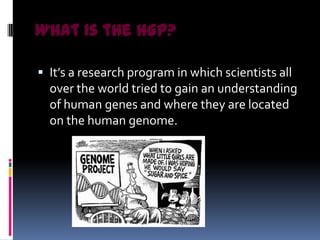
 It’s a research program in which scientists all
  over the world tried to gain an understanding
  of human genes and where they are located
  on the human genome.
How does it work?

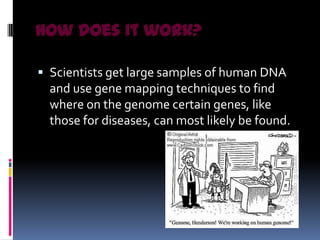
 Scientists get large samples of human DNA
  and use gene mapping techniques to find
  where on the genome certain genes, like
  those for diseases, can most likely be found.
Gene Mapping?

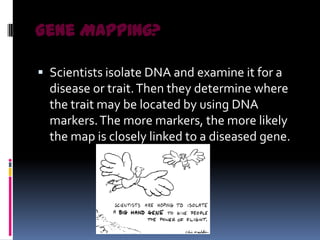
 Scientists isolate DNA and examine it for a
  disease or trait. Then they determine where
  the trait may be located by using DNA
  markers. The more markers, the more likely
  the map is closely linked to a diseased gene.
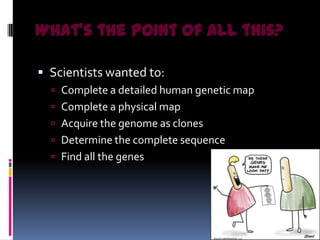
What’s the point of all this?

 Scientists wanted to:
   Complete a detailed human genetic map
   Complete a physical map
   Acquire the genome as clones
   Determine the complete sequence
   Find all the genes
And I care because…?

 Having a better knowledge of the human
  genome can:
   Lead to better diagnosis of diseases and earlier
    detections of predisposition to that disease
   Allow new biofuels to be made
   Help identify criminals
   Teach us how humans evolved and continue to
    evolve
Pros and Cons?

 Pros                         Cons:
   Advances in molecular        Research costs a lot of
    medicine                      money
   Advances in microbial        People are afraid of
    genomics                      discrimination of genes
   Advances in agriculture      People don’t support
    and livestock breeding        gene therapy because
                                  it’s “against nature”
Want to go more in-depth?

 Go to the following link for a great video!
   http://www.youtube.com/watch?v=UfsHl5_2rMw
    &feature=related

Human Genome Project

  • 1.
  • 2.
    What is theHGP?  It’s a research program in which scientists all over the world tried to gain an understanding of human genes and where they are located on the human genome.
  • 3.
    How does itwork?  Scientists get large samples of human DNA and use gene mapping techniques to find where on the genome certain genes, like those for diseases, can most likely be found.
  • 4.
    Gene Mapping?  Scientistsisolate DNA and examine it for a disease or trait. Then they determine where the trait may be located by using DNA markers. The more markers, the more likely the map is closely linked to a diseased gene.
  • 5.
    What’s the pointof all this?  Scientists wanted to:  Complete a detailed human genetic map  Complete a physical map  Acquire the genome as clones  Determine the complete sequence  Find all the genes
  • 6.
    And I carebecause…?  Having a better knowledge of the human genome can:  Lead to better diagnosis of diseases and earlier detections of predisposition to that disease  Allow new biofuels to be made  Help identify criminals  Teach us how humans evolved and continue to evolve
  • 7.
    Pros and Cons? Pros  Cons:  Advances in molecular  Research costs a lot of medicine money  Advances in microbial  People are afraid of genomics discrimination of genes  Advances in agriculture  People don’t support and livestock breeding gene therapy because it’s “against nature”
  • 8.
    Want to gomore in-depth?  Go to the following link for a great video!  http://www.youtube.com/watch?v=UfsHl5_2rMw &feature=related