Reporter: Shih-Feng Yang 2007/11/26 Seminar Report
Andres Thor, David Aumueller, Erhard Rahm. “ Data Integration Support for Mashups .” AAAI 2007 Jin Yu, Boualem Benatallah, Regis Saint-Paul, Fabio Casati, Florian Daniel, Maristella Matera. “ A Framework for Rapid Integration of Presentation Components .” WWW 2007
Outline Introduction A Framework Architecture for Mashups Online Citation Service Conclusion
Introduction Mashup is a new type of interactive web application, combining content from multiple services or sources into a new service. In this paper, they propose a framework for the development of dynamic data integration mashups.
Introduction Information From DBLP Information From Google Scholar Online Citation Service (OCS)
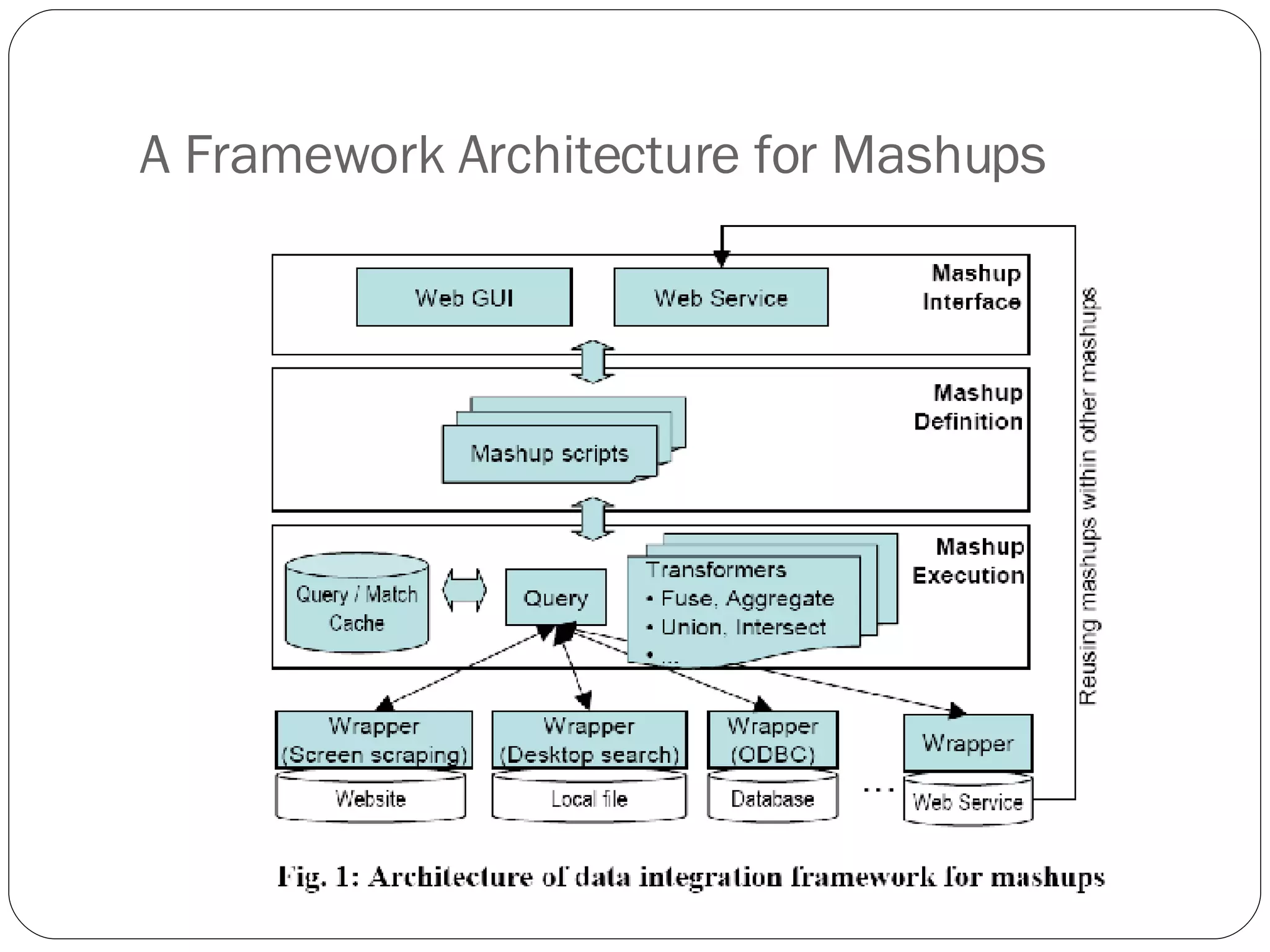
A Framework Architecture for Mashups
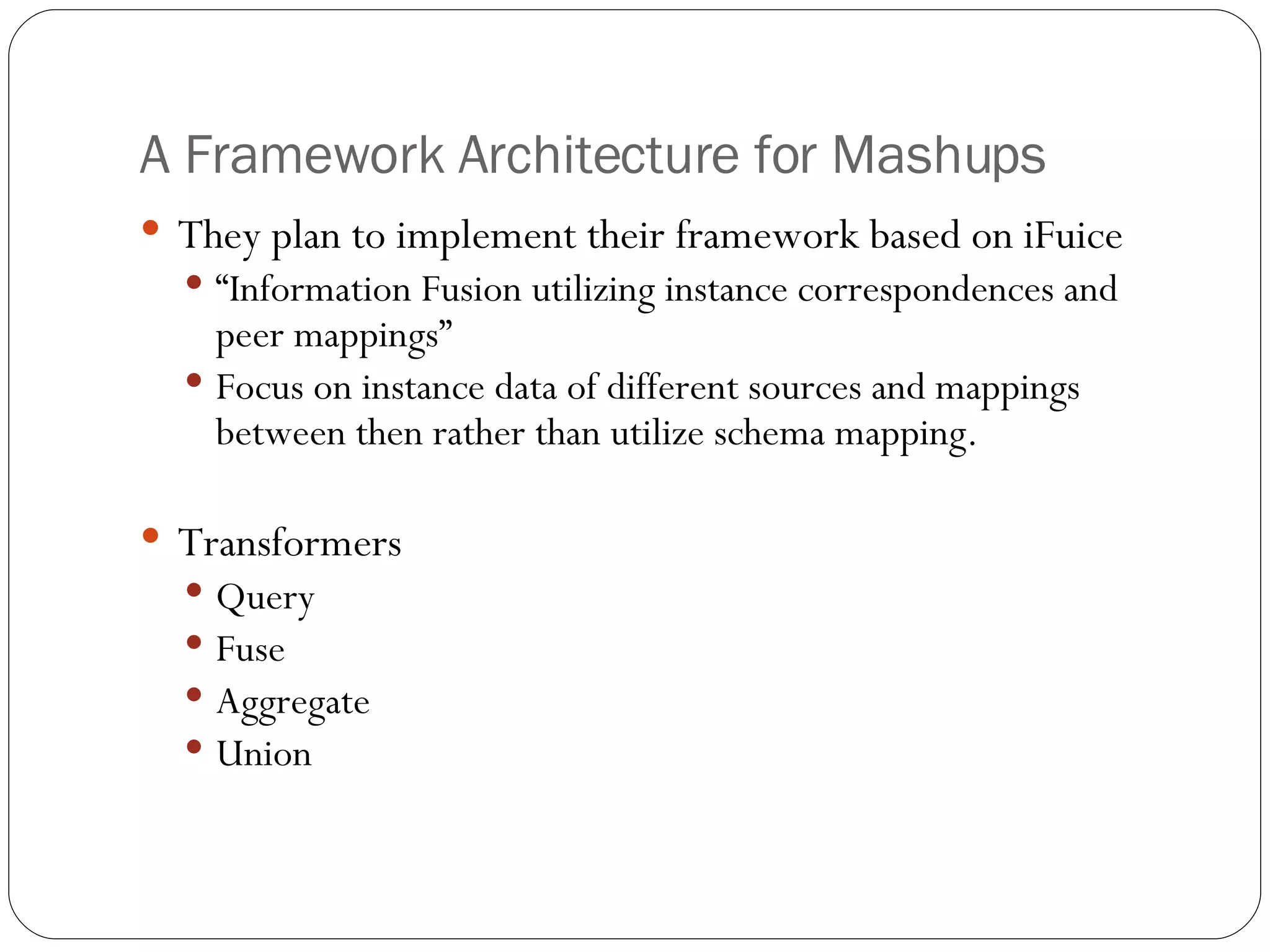
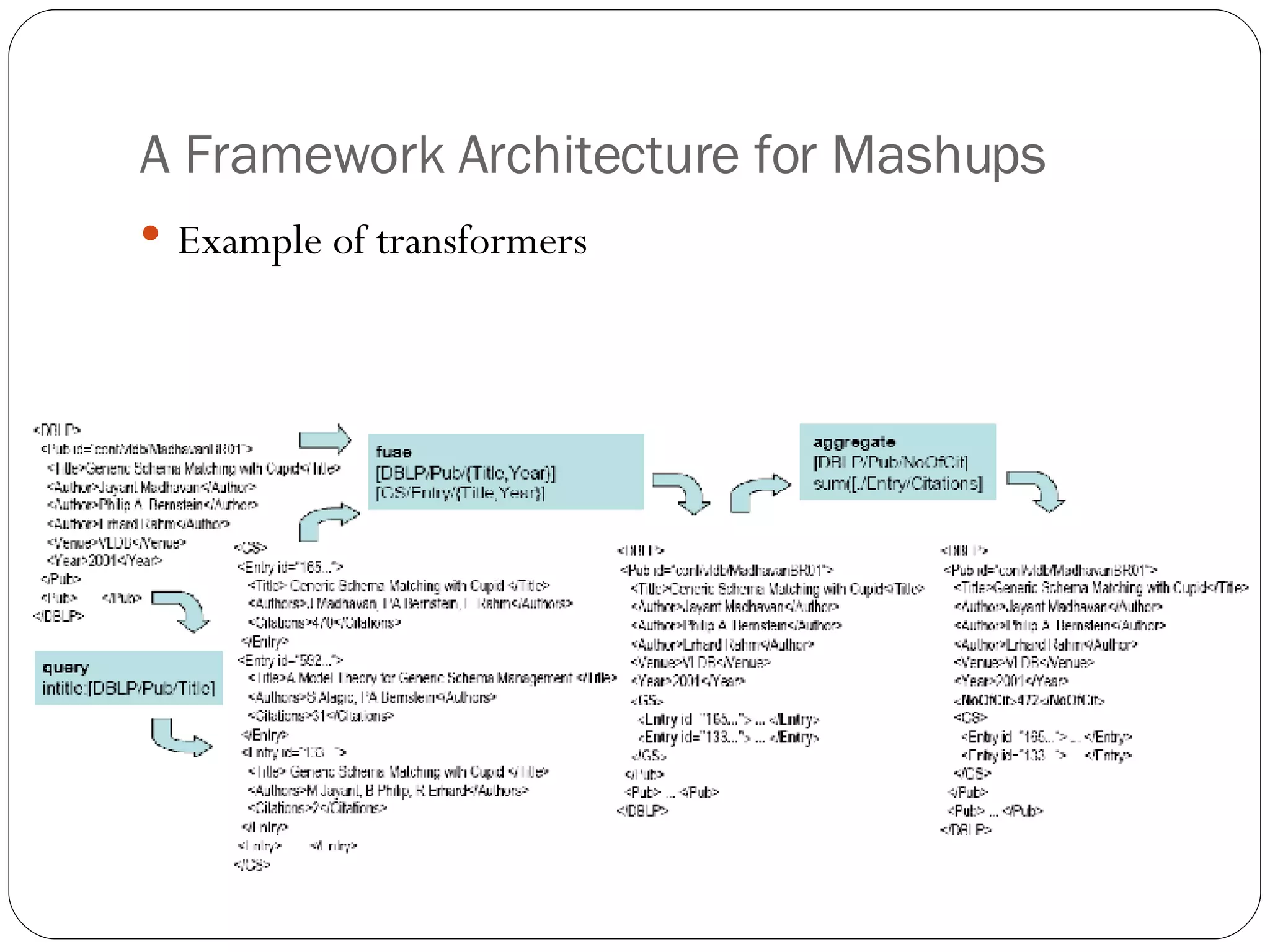
A Framework Architecture for Mashups They plan to implement their framework based on iFuice “ Information Fusion utilizing instance correspondences and peer mappings” Focus on instance data of different sources and mappings between then rather than utilize schema mapping. Transformers Query Fuse Aggregate Union
A Framework Architecture for Mashups Example of transformers
Online Citation Service It allows the generation of citation counts for publication lists of authors and venues. It obtains the publication list from the DBLP bibliography, and obtains the citation counts from Google Scholar.
Online Citation Service Query Strategy Query directly by the name of publication authors and venue. Find the title pattern. First, find the important terms by TF/IDF value, then replace the irrelevant term by ‘*’. Ex. “A survey of approaches to automatic schema matching”-> “survey * approaches * * schema matching”. If publications don’t have matching counterparts, then use keyword strategy by the publication title.
Online Citation Service Query Strategy
Conclusion They proposed a framework architecture supporting the development of mashups incorporating dynamic data integration. The framework provides a script-based definition of mashups and the use of multiple query strategies for accessing external data sources.
Andres Thor, David Aumueller, Erhard Rahm. “ Data Integration Support for Mashups .” AAAI 2007 Jin Yu, Boualem Benatallah, Regis Saint-Paul, Fabio Casati, Florian Daniel, Maristella Matera. “ A Framework for Rapid Integration of Presentation Components .” WWW 2007
Outline Introduction Guiding Principles Presentation Integration Framework Implementation Conclusion
Introduction Creating composite applications from reusable components is important in software engineering and data management. EAI (Enterprise Application Integration) This research focus on presentation level integration rather than data or application level integration.
Introduction Web mashups perform integrations both at the application level and the presentation level. But there is very little support in terms of model and tools for presentation level. The goal is to build composite applications that leverage the components’ individual UIs to produce composite applications possibly with rich and highly interactive user interfaces.
Introduction Example: The national park guide  www.nps.gov Flickr.Net Google Map
Guiding Principles Lessons Learned from EAI Simple, formal, human readable, modular Differences between Presentation and Application Integration Event-driven vs. Methods UI configuration Security and Reliability are not so important in PI
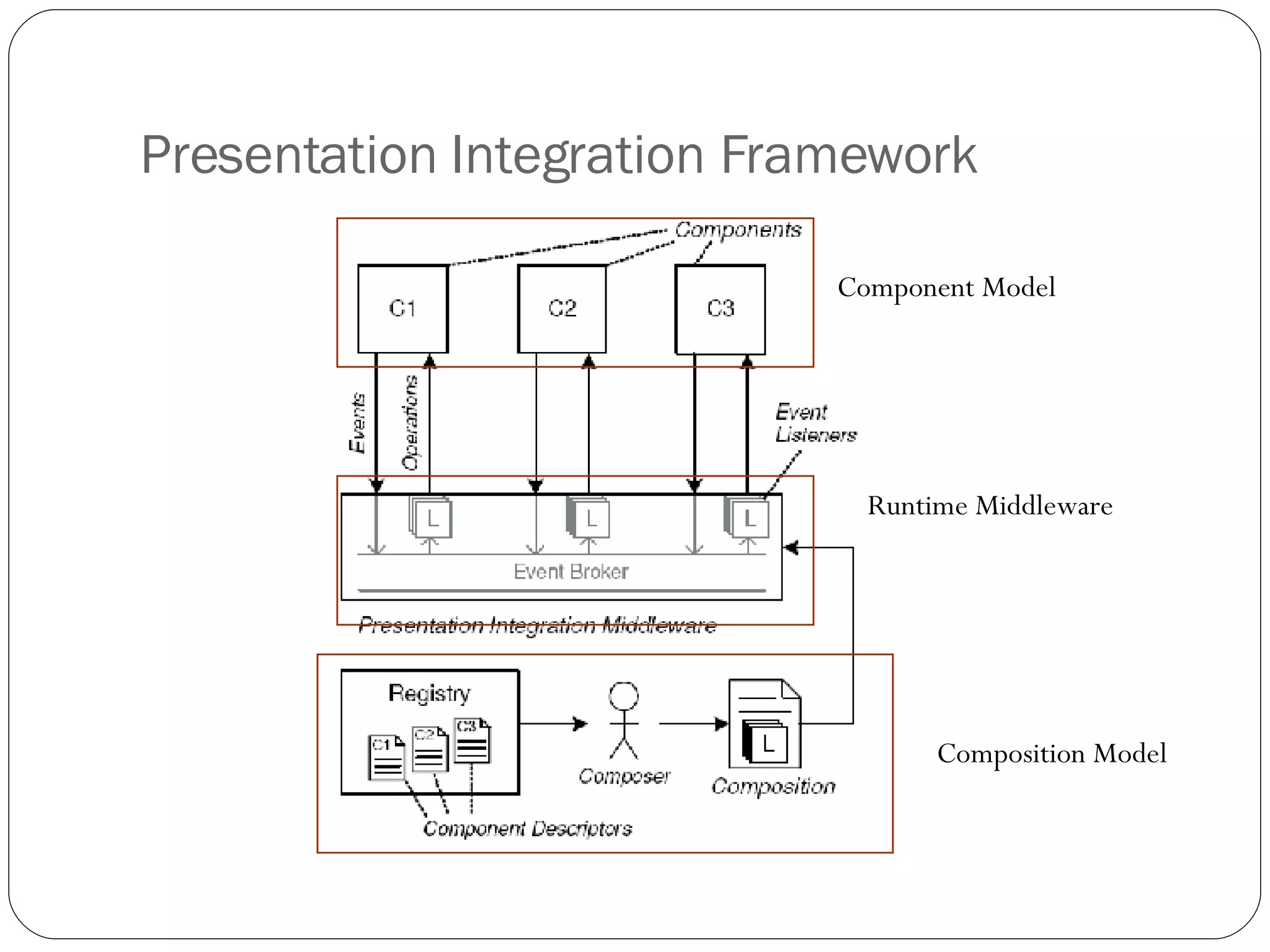
Presentation Integration Framework Component Model Composition Model Runtime Middleware
Presentation Integration Framework Component Model Events Operations Properties Presentation modes
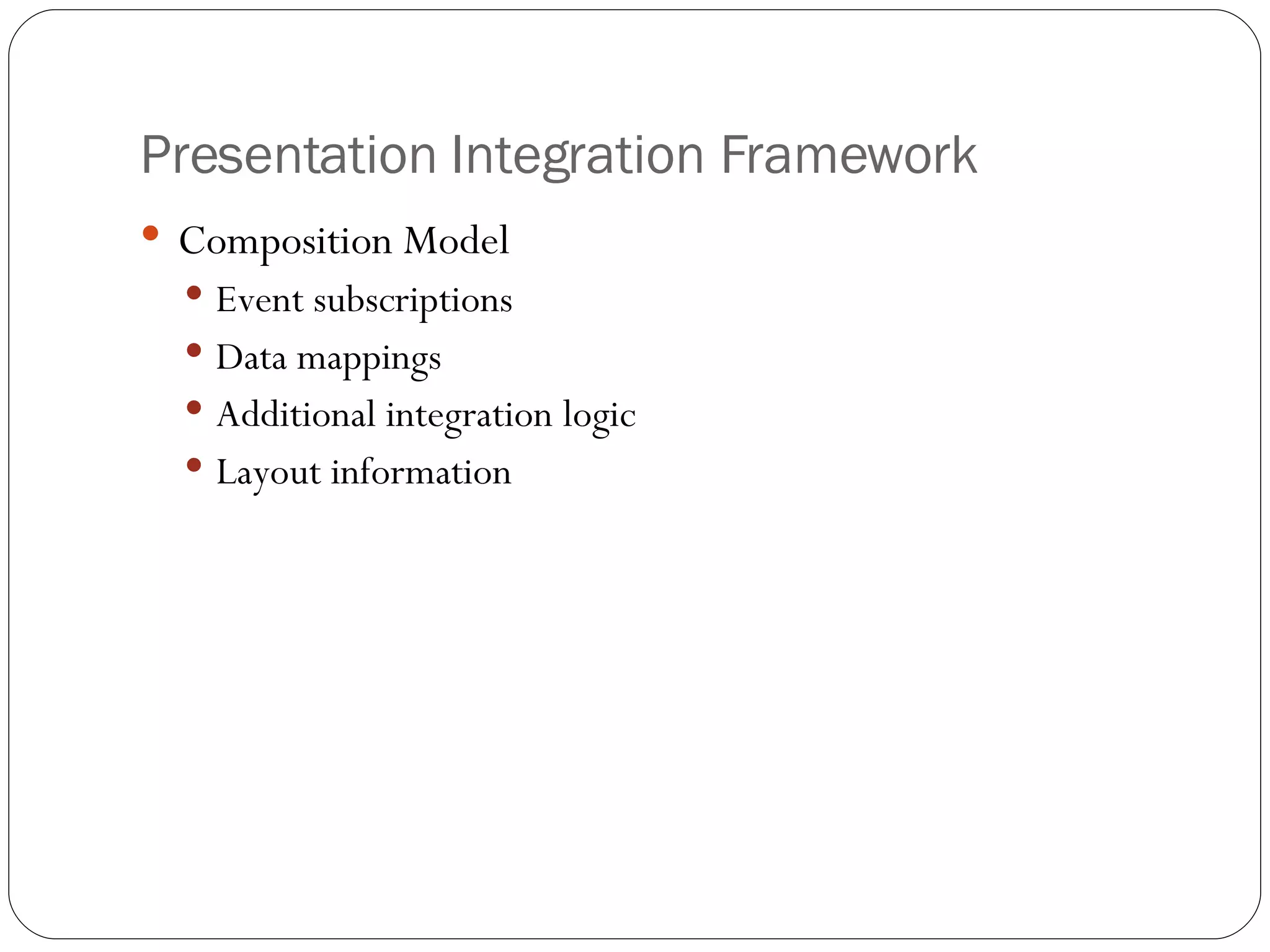
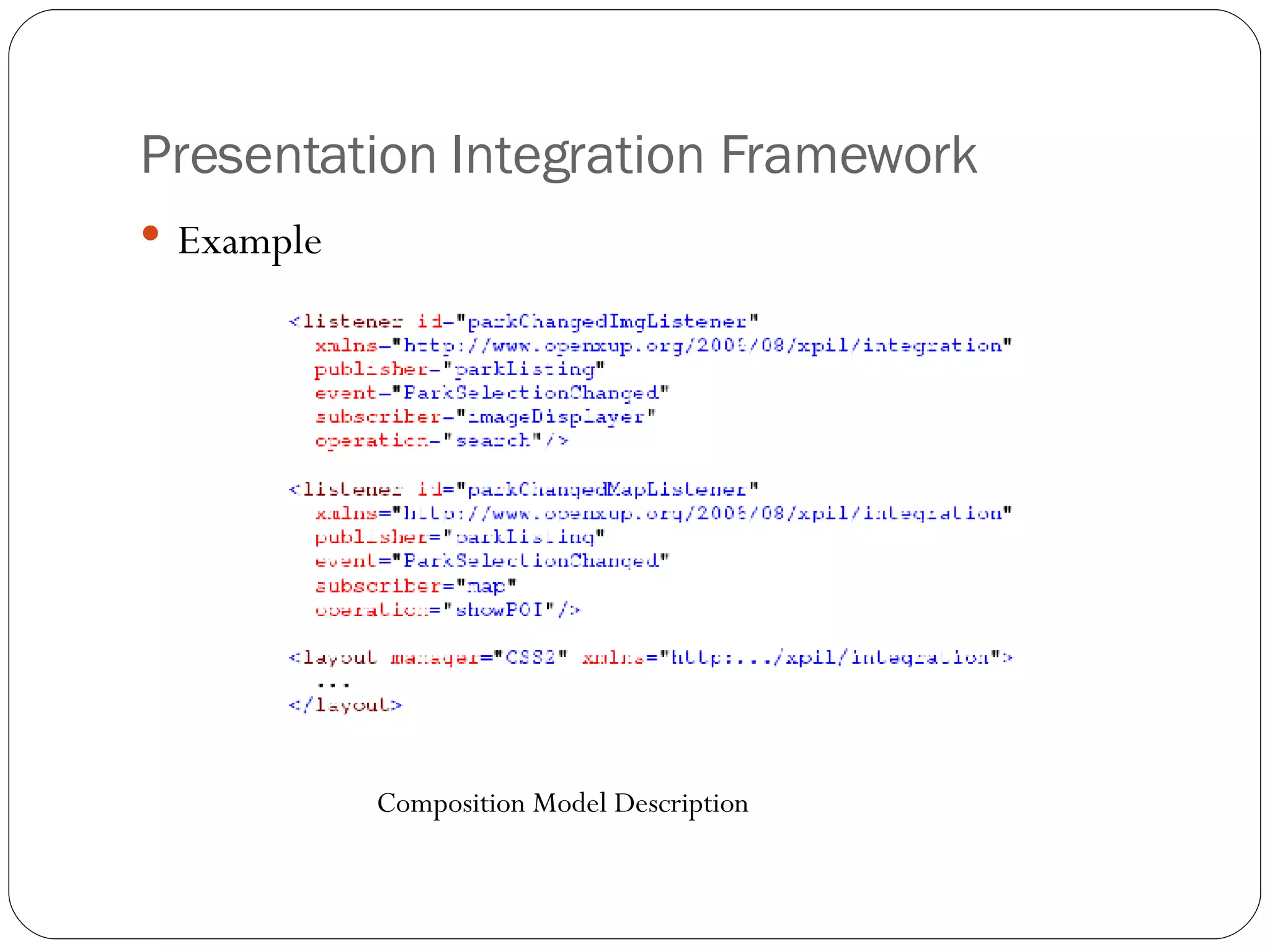
Presentation Integration Framework Composition Model Event subscriptions Data mappings Additional integration logic Layout information
Presentation Integration Framework Language Representation They propose XPIL (Extensible Presentation Integration Language)  XPIL is a language which contains two sets of XML elements (component model and composition model).
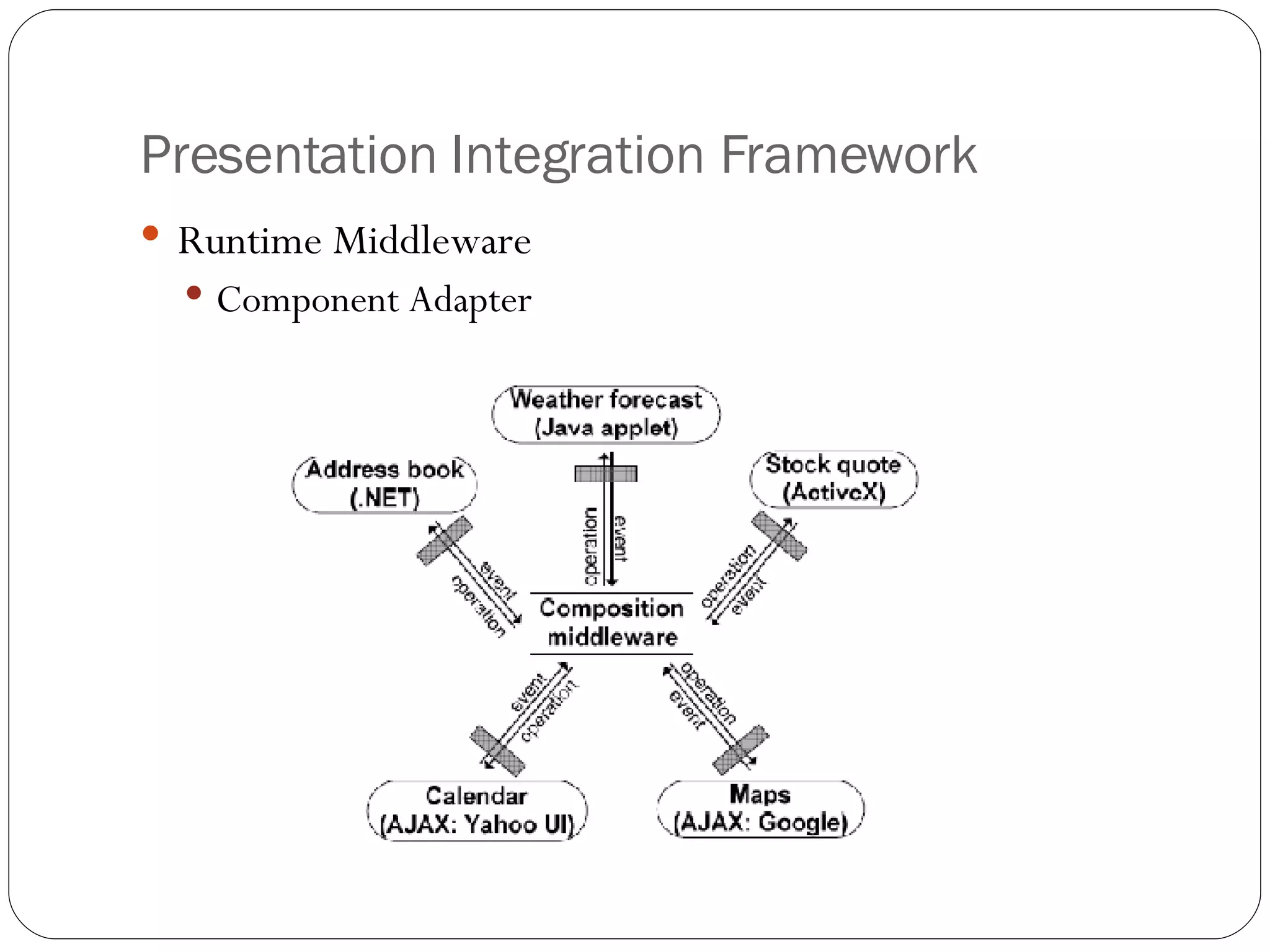
Presentation Integration Framework Runtime Middleware Event automation Capturing event from the publishing component. Automatically invoking operations of the subscribing components. Component adapters and wrappers Component location and instantiation Component inspection Data type mapping Component invocation
Presentation Integration Framework Runtime Middleware Component Adapter
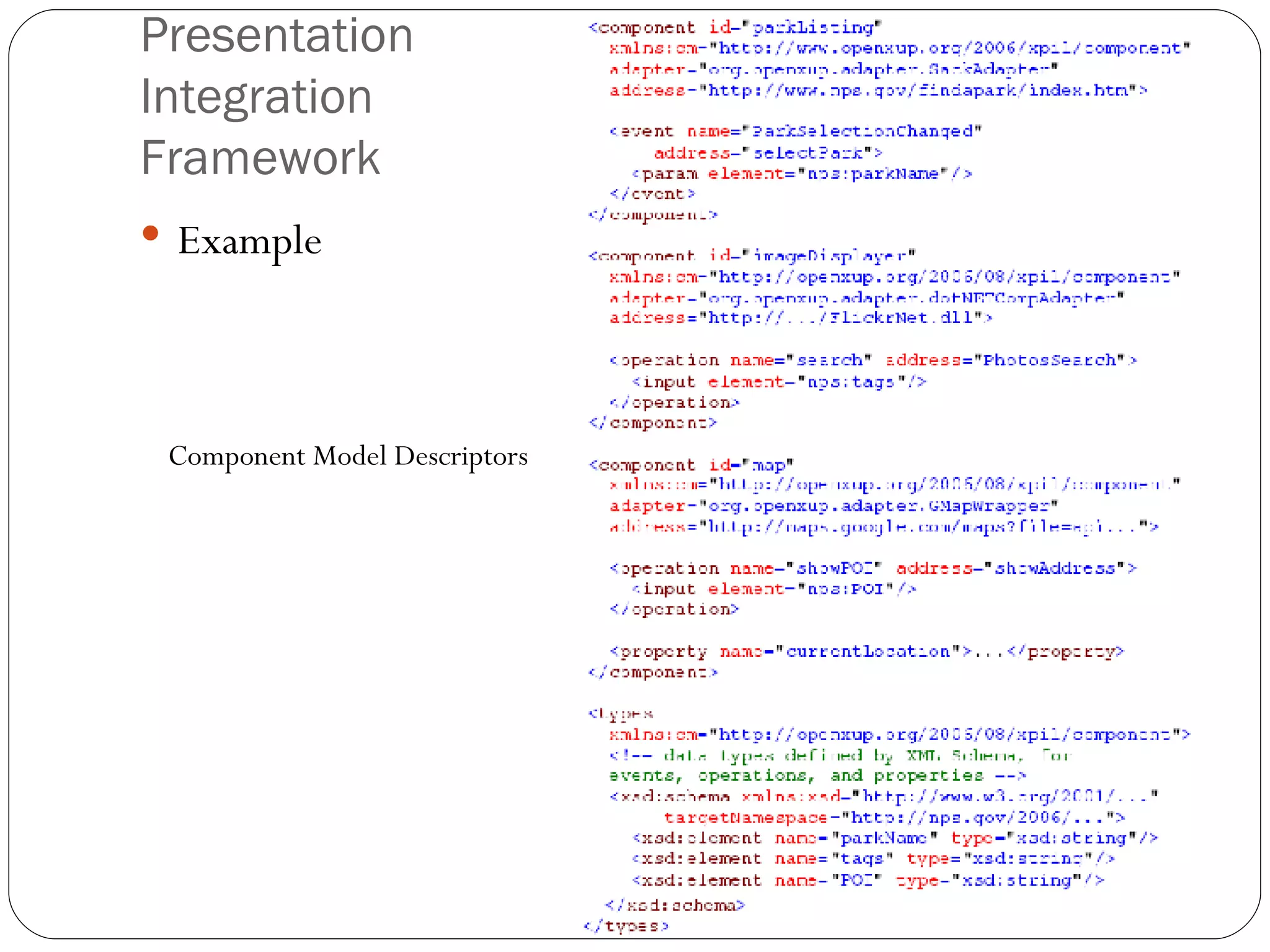
Presentation Integration Framework Example National park guide
Presentation  Integration  Framework Example Component Model Descriptors
Presentation Integration Framework Example Composition Model Description
Presentation Integration Framework Example Middleware- Event automation
Implementation Middleware and Deployment Implemented by ASP.NET Input: one or more XPIL documents Output: a complete HTML page Component Adapter They have implemented .NET adapter for Flickr.NET SACK adapter for AJAX components built with the SACK toolkit. A wrapper for Google Maps Reason1: Google Map is popular, and to expose many of its services should  justify the investment. Reason2: Google Maps API doesn’t support point of interest or address directly.
Conclusion They proposed a presentation integration framework to facilitate the creation of composite applications through a simple declarative composition language, XPIL. The future works: Layout mechanism To build more component adapters for AJAX-based toolkits, such as Yahoo UI and Dojo. To create a visual authoring tool that allows the composition model to be specified in a drag-n-drop fashion with the final output generated in XPIL.

Seminar Report 20071127

  • 1.
    Reporter: Shih-Feng Yang2007/11/26 Seminar Report
  • 2.
    Andres Thor, DavidAumueller, Erhard Rahm. “ Data Integration Support for Mashups .” AAAI 2007 Jin Yu, Boualem Benatallah, Regis Saint-Paul, Fabio Casati, Florian Daniel, Maristella Matera. “ A Framework for Rapid Integration of Presentation Components .” WWW 2007
  • 3.
    Outline Introduction AFramework Architecture for Mashups Online Citation Service Conclusion
  • 4.
    Introduction Mashup isa new type of interactive web application, combining content from multiple services or sources into a new service. In this paper, they propose a framework for the development of dynamic data integration mashups.
  • 5.
    Introduction Information FromDBLP Information From Google Scholar Online Citation Service (OCS)
  • 6.
  • 7.
    A Framework Architecturefor Mashups They plan to implement their framework based on iFuice “ Information Fusion utilizing instance correspondences and peer mappings” Focus on instance data of different sources and mappings between then rather than utilize schema mapping. Transformers Query Fuse Aggregate Union
  • 8.
    A Framework Architecturefor Mashups Example of transformers
  • 9.
    Online Citation ServiceIt allows the generation of citation counts for publication lists of authors and venues. It obtains the publication list from the DBLP bibliography, and obtains the citation counts from Google Scholar.
  • 10.
    Online Citation ServiceQuery Strategy Query directly by the name of publication authors and venue. Find the title pattern. First, find the important terms by TF/IDF value, then replace the irrelevant term by ‘*’. Ex. “A survey of approaches to automatic schema matching”-> “survey * approaches * * schema matching”. If publications don’t have matching counterparts, then use keyword strategy by the publication title.
  • 11.
  • 12.
    Conclusion They proposeda framework architecture supporting the development of mashups incorporating dynamic data integration. The framework provides a script-based definition of mashups and the use of multiple query strategies for accessing external data sources.
  • 13.
    Andres Thor, DavidAumueller, Erhard Rahm. “ Data Integration Support for Mashups .” AAAI 2007 Jin Yu, Boualem Benatallah, Regis Saint-Paul, Fabio Casati, Florian Daniel, Maristella Matera. “ A Framework for Rapid Integration of Presentation Components .” WWW 2007
  • 14.
    Outline Introduction GuidingPrinciples Presentation Integration Framework Implementation Conclusion
  • 15.
    Introduction Creating compositeapplications from reusable components is important in software engineering and data management. EAI (Enterprise Application Integration) This research focus on presentation level integration rather than data or application level integration.
  • 16.
    Introduction Web mashupsperform integrations both at the application level and the presentation level. But there is very little support in terms of model and tools for presentation level. The goal is to build composite applications that leverage the components’ individual UIs to produce composite applications possibly with rich and highly interactive user interfaces.
  • 17.
    Introduction Example: Thenational park guide www.nps.gov Flickr.Net Google Map
  • 18.
    Guiding Principles LessonsLearned from EAI Simple, formal, human readable, modular Differences between Presentation and Application Integration Event-driven vs. Methods UI configuration Security and Reliability are not so important in PI
  • 19.
    Presentation Integration FrameworkComponent Model Composition Model Runtime Middleware
  • 20.
    Presentation Integration FrameworkComponent Model Events Operations Properties Presentation modes
  • 21.
    Presentation Integration FrameworkComposition Model Event subscriptions Data mappings Additional integration logic Layout information
  • 22.
    Presentation Integration FrameworkLanguage Representation They propose XPIL (Extensible Presentation Integration Language) XPIL is a language which contains two sets of XML elements (component model and composition model).
  • 23.
    Presentation Integration FrameworkRuntime Middleware Event automation Capturing event from the publishing component. Automatically invoking operations of the subscribing components. Component adapters and wrappers Component location and instantiation Component inspection Data type mapping Component invocation
  • 24.
    Presentation Integration FrameworkRuntime Middleware Component Adapter
  • 25.
    Presentation Integration FrameworkExample National park guide
  • 26.
    Presentation Integration Framework Example Component Model Descriptors
  • 27.
    Presentation Integration FrameworkExample Composition Model Description
  • 28.
    Presentation Integration FrameworkExample Middleware- Event automation
  • 29.
    Implementation Middleware andDeployment Implemented by ASP.NET Input: one or more XPIL documents Output: a complete HTML page Component Adapter They have implemented .NET adapter for Flickr.NET SACK adapter for AJAX components built with the SACK toolkit. A wrapper for Google Maps Reason1: Google Map is popular, and to expose many of its services should justify the investment. Reason2: Google Maps API doesn’t support point of interest or address directly.
  • 30.
    Conclusion They proposeda presentation integration framework to facilitate the creation of composite applications through a simple declarative composition language, XPIL. The future works: Layout mechanism To build more component adapters for AJAX-based toolkits, such as Yahoo UI and Dojo. To create a visual authoring tool that allows the composition model to be specified in a drag-n-drop fashion with the final output generated in XPIL.