FREE
by Chris Anderson
HOW TODAY’S SMARTEST BUSINESSES
PROFIT BY GIVING SOMETHING FOR
NOTHING
REPORT BY IVAN LEE
TS STRAMA
AGSB
2.
Free Things toThink About
How some companies can give some products away
in order to increase the market for the products that
they charge for.
The book is meant not to preach the gospel of Free!,
but to help readers find a path through an economic
reality that has been with us and gathering strength
for nearly a decade.
Isn’t “Free” a socialist-communist idea?
3.
Objectives
What isFREE?
Brief history of FREE as described by Chris
Anderson
The Psychology behind FREE!
How FREE! is possible
Introduce Freeconomics.
4.
What is FREE?
20th Century free versus the 21st Century FREE!
Atoms versus bits
Nothing free versus everything [digital] is free
Inflationary versus deflationary
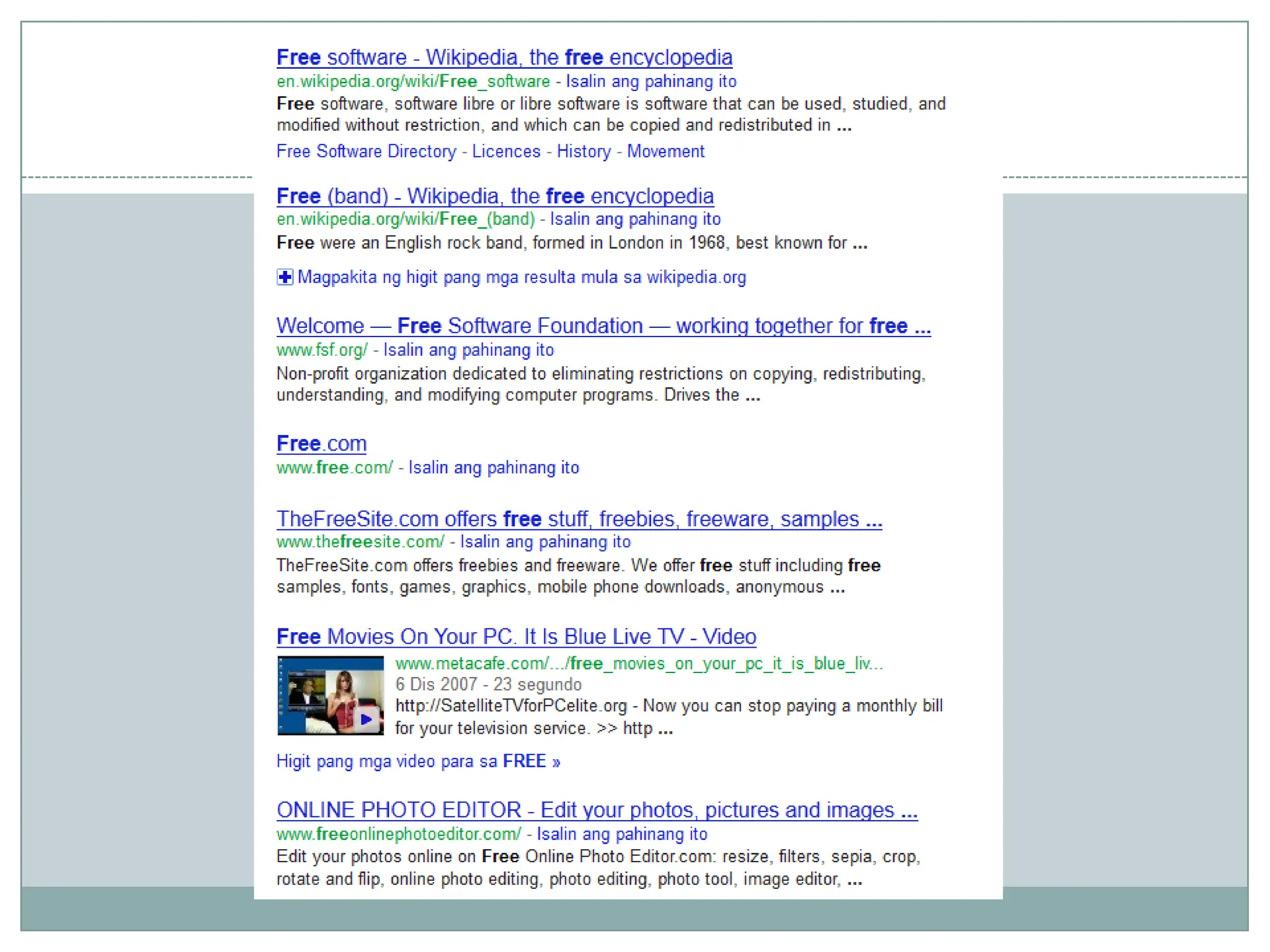
Etymology of FREE
Latin: Liber and Gratis (freedom and thanks)
Celtic: Freogan (beloved and friend)
Free = too many meanings
5.
The 4 typesof FREE
Direct Cross Subsidies (Marketing model)
Three-Party Market (Ad supported free media)
Freemium (Digital economics)
Non-Monetary Markets (Gift economy)
*All shifts money from product to product / person to
person / now to later / monetary to non-monetary
6.
The History ofFREE!
Free is nothing, nothing is Zephirus
An economic system based on nothing?
Barter Trade (Close knit groups)
Collectivism – the “YOUNG” gift economy
The Dunbar Number is 150 people max!
Monetary Economy (Goodwill)
19th Century – the birth of market economy
Free reduced to a marketing gimmick
Nation States (Progressive Taxes and Charity)
20th Century transformative mediums
Radio
Corn
Plastics – Is it really cheap?
7.
The Psychology ofFREE!
Free is relative, never absolute
Free as having to pay for something, even at minimal
The Penny Gap = 0 and everything else
Free as waste
Free as a Time-Money option
Pirates of the Digital World
Free is really free
8.
How Free isPossible
Moore’s Law (Intel)
Faster computing power
Mead’s Law
Advocated “wasting” computing power
Technologist's job is to make technology cheap
The cheapest delivery system possible: As price drops, there’s
advantage to treat them as if it was free...
The Real Digital Age
Everything that bits touch is also touched by its unique economic
proportion – cheaper, better, faster
Information wants to be expensive and free at the same
time
9.
How Free isPossible
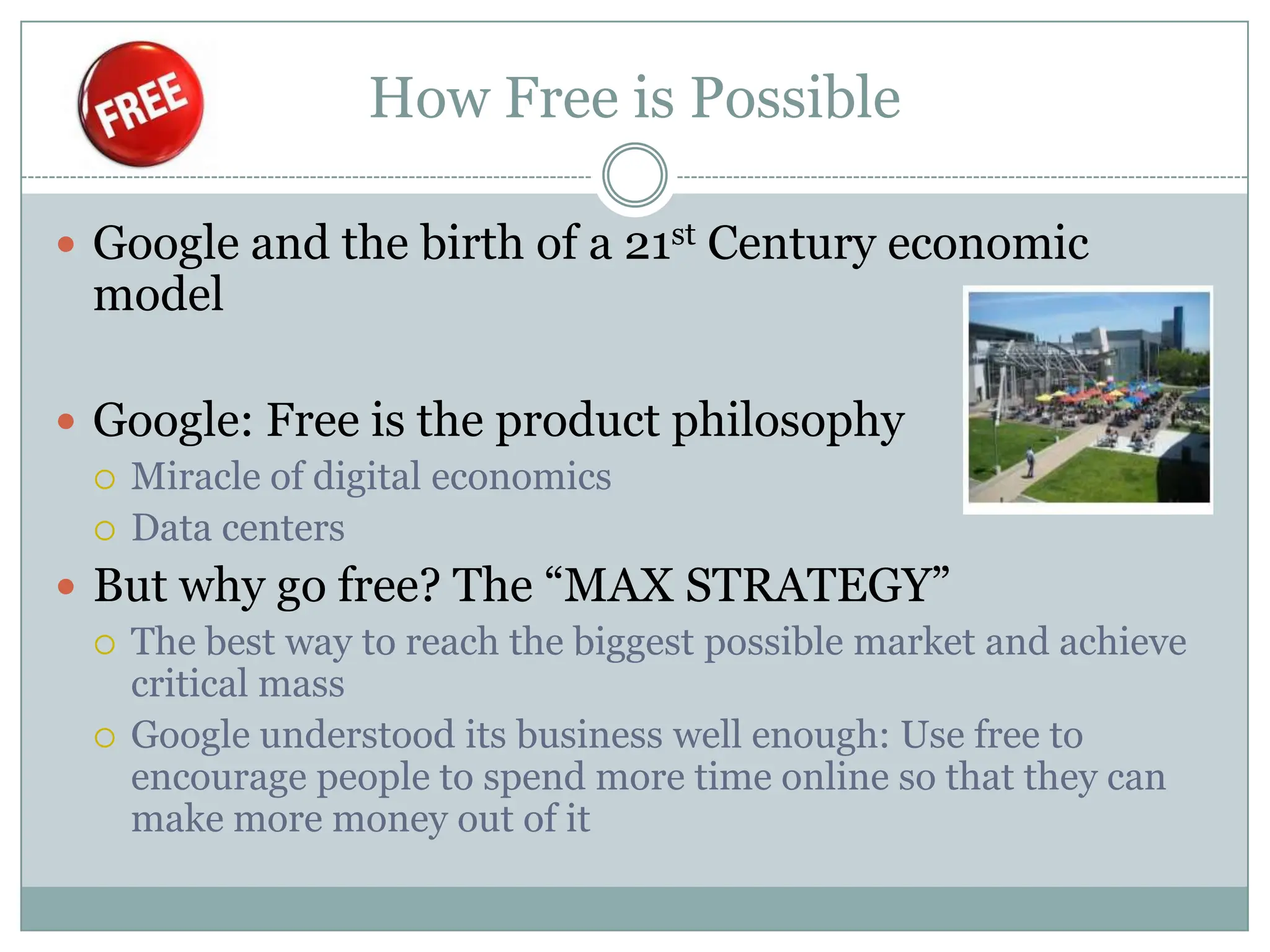
Google and the birth of a 21st Century economic
model
Google: Free is the product philosophy
Miracle of digital economics
Data centers
But why go free? The “MAX STRATEGY”
The best way to reach the biggest possible market and achieve
critical mass
Google understood its business well enough: Use free to
encourage people to spend more time online so that they can
make more money out of it
10.
How Free isPossible
If free is free, who makes all the money?
Craiglist example: erased a $30B industry to generate $40M
The eventual winners are the end consumers
Compliments the capitalist idea (as opposed to socialist-
communist idea) – efficiency leads to better prices
Redefining the market: from matching two people to a broader
sense of an ecosystem with many parties
11.
Freeconomics
The newmedia models for the digital age: Versioning
Freemium is versioning where one is free and others are paid
How big is the Free Economy?
$300 Billion?
Definitely hard to calculate...
The Freeconomics
Joseph Bertrand: “In a competitive market, price falls to the
marginal cost” = Free is inevitable
The new monopoly: Network Effects where “monopolists” like
facebook do not have pricing power
Every market is different – making money out of Free is a matter of
creative thinking and constant experimentation
Freeconomics – money becomes secondary to attention economy
and reputation economy
![What is FREE?
20th Century free versus the 21st Century FREE!
Atoms versus bits
Nothing free versus everything [digital] is free
Inflationary versus deflationary
Etymology of FREE
Latin: Liber and Gratis (freedom and thanks)
Celtic: Freogan (beloved and friend)
Free = too many meanings](https://image.slidesharecdn.com/freever2-111023060105-phpapp01/75/Free-ver2-4-2048.jpg)