
Trends In Languages 2010

Loading...

Flash Player 9 (or above) is needed to view presentations.
We have detected that you do not have it on your computer. To install it, go here.

0 comments

Post a comment

    Post a comment
    Embed Video
    Edit your comment Cancel

    3 Favorites

    Trends In Languages 2010 - Presentation Transcript

    1. - 1 -
      Trends in Languages
      2009 Edition
      Markus Völter
      Indepedent/itemisvoelter@acm.orgwww.voelter.de
    2. - 2 -
      Markus Völter
      voelter@acm.org
      www.voelter.de
      • Independent Consultantfor itemis
      • Based out of Stuttgart, Germany
      • Focus on
      • Model-Driven SoftwareDevelopment, DSLs
      • Software Architecture
      • Product Line Engineering
      About me
      Podcaster
      - 2 -
    3. - 3 -
      C O N T E N T S
      Intro and Overview
      Typing
      OO +/vs. Functional
      Metaprogramming & DSLs
      Contracts
      Concurrency
      Platforms
      Tools
      Summary
    4. - 4 -
      C O N T E N T S
      Intro and Overview
      Typing
      OO +/vs. Functional
      Metaprogramming & DSLs
      Contracts
      Concurrency
      Platforms
      Tools
      Summary
    5. - 5 -
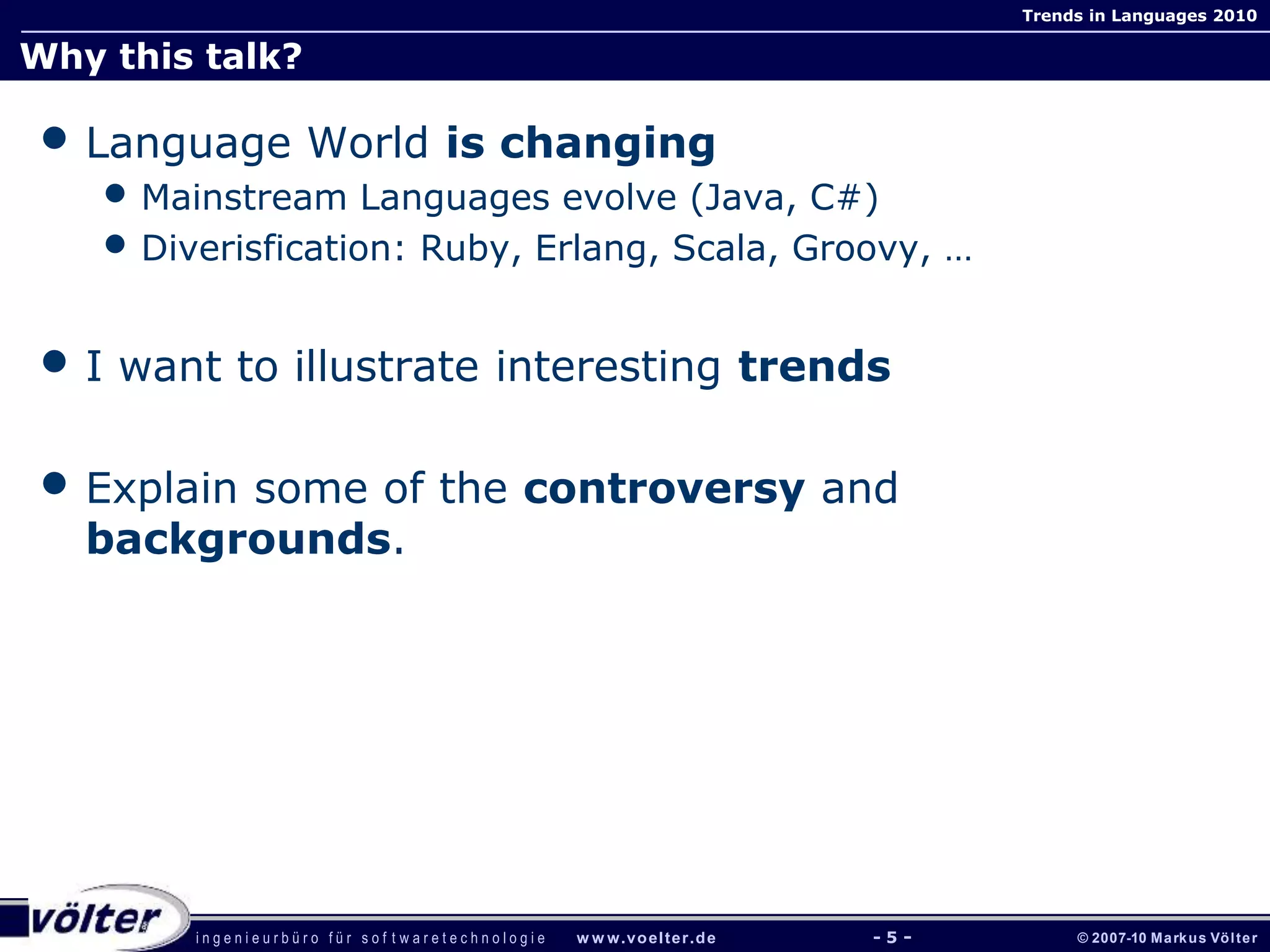
      Why this talk?
      Language World is changing
      Mainstream Languages evolve (Java, C#)
      Diverisfication: Ruby, Erlang, Scala, Groovy, …
      I want to illustrate interesting trends
      Explain some of the controversy and backgrounds.
    6. - 6 -
      C O N T E N T S
      Intro and Overview
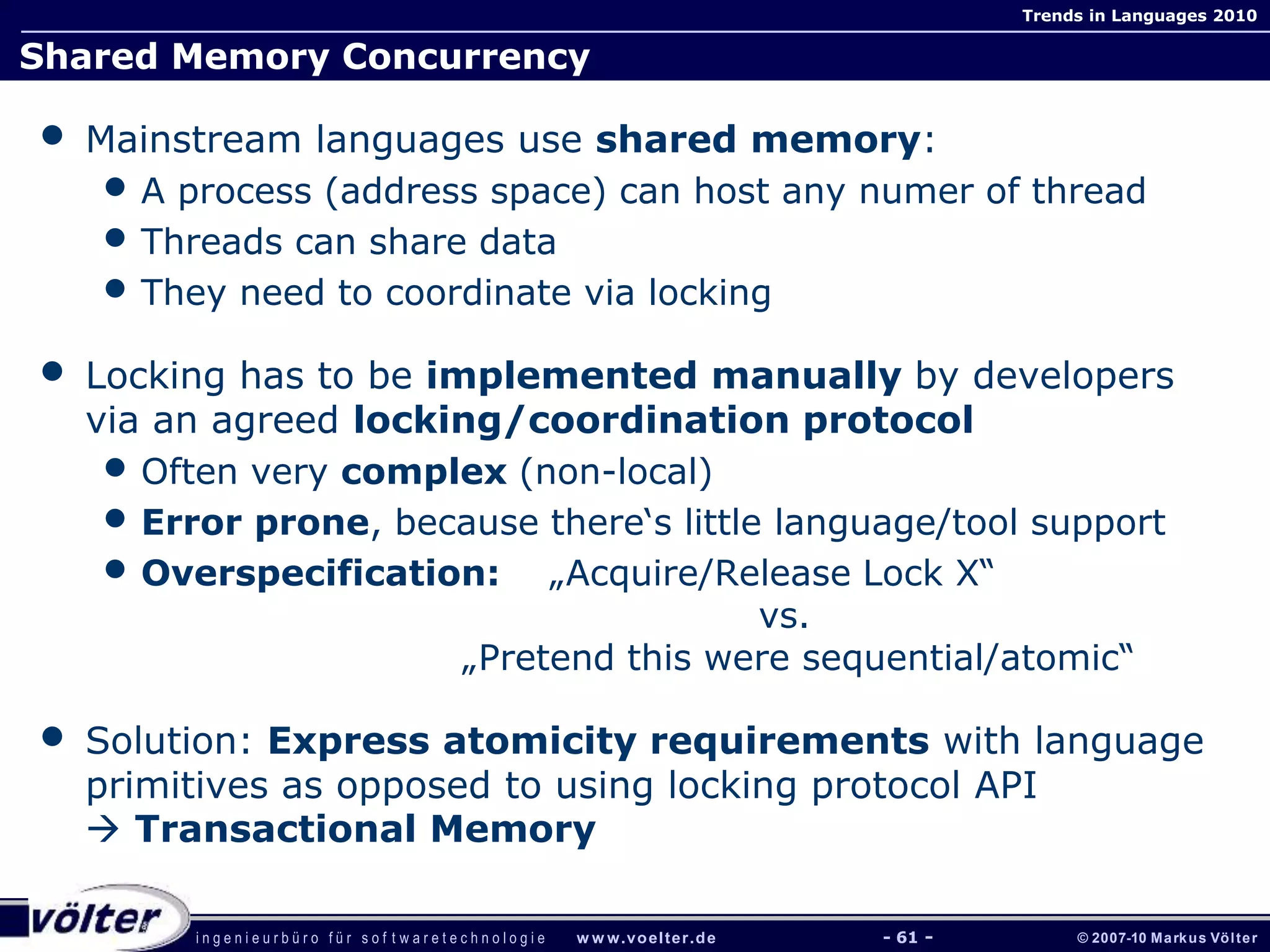
      Typing
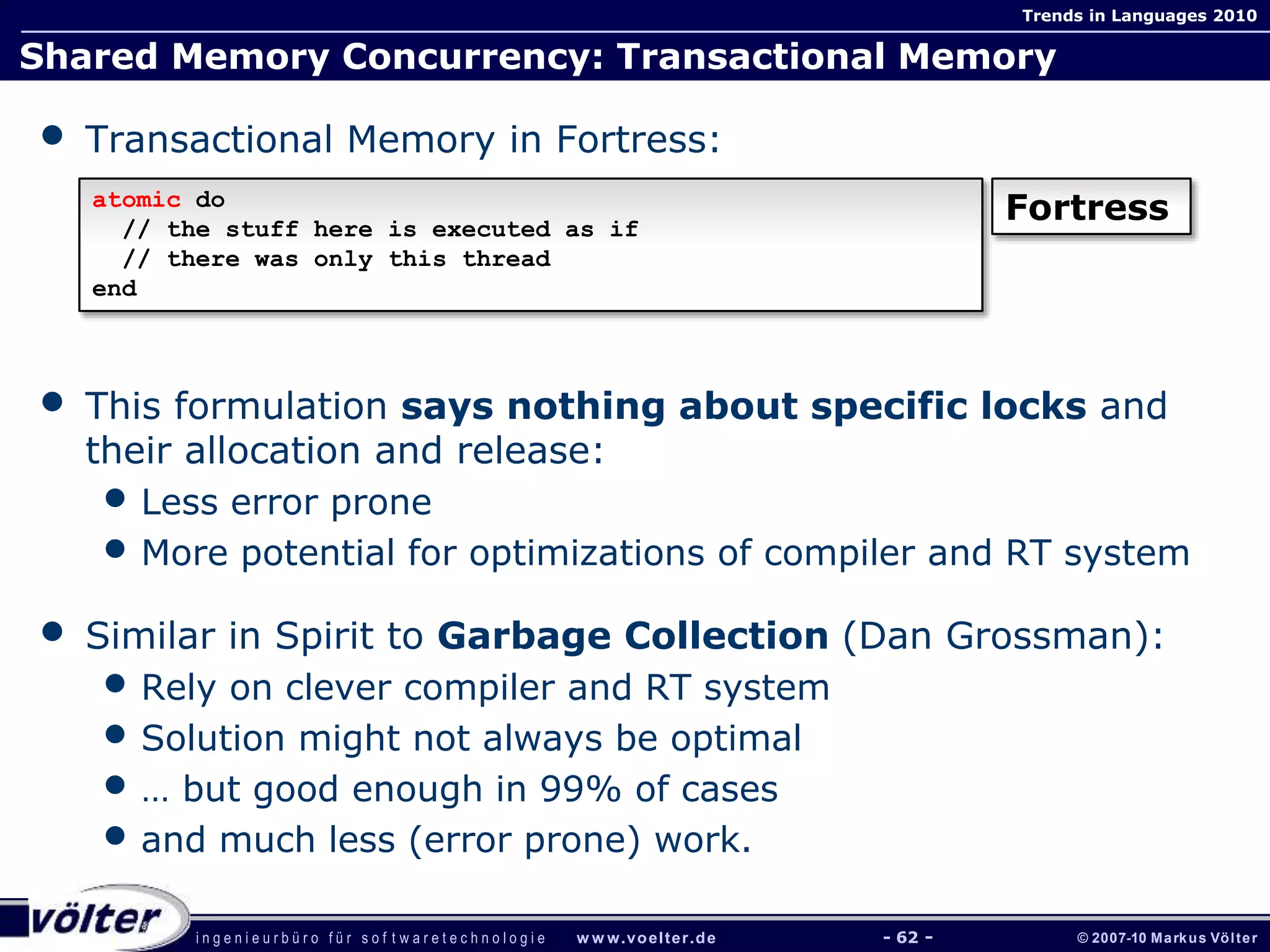
      OO +/vs. Functional
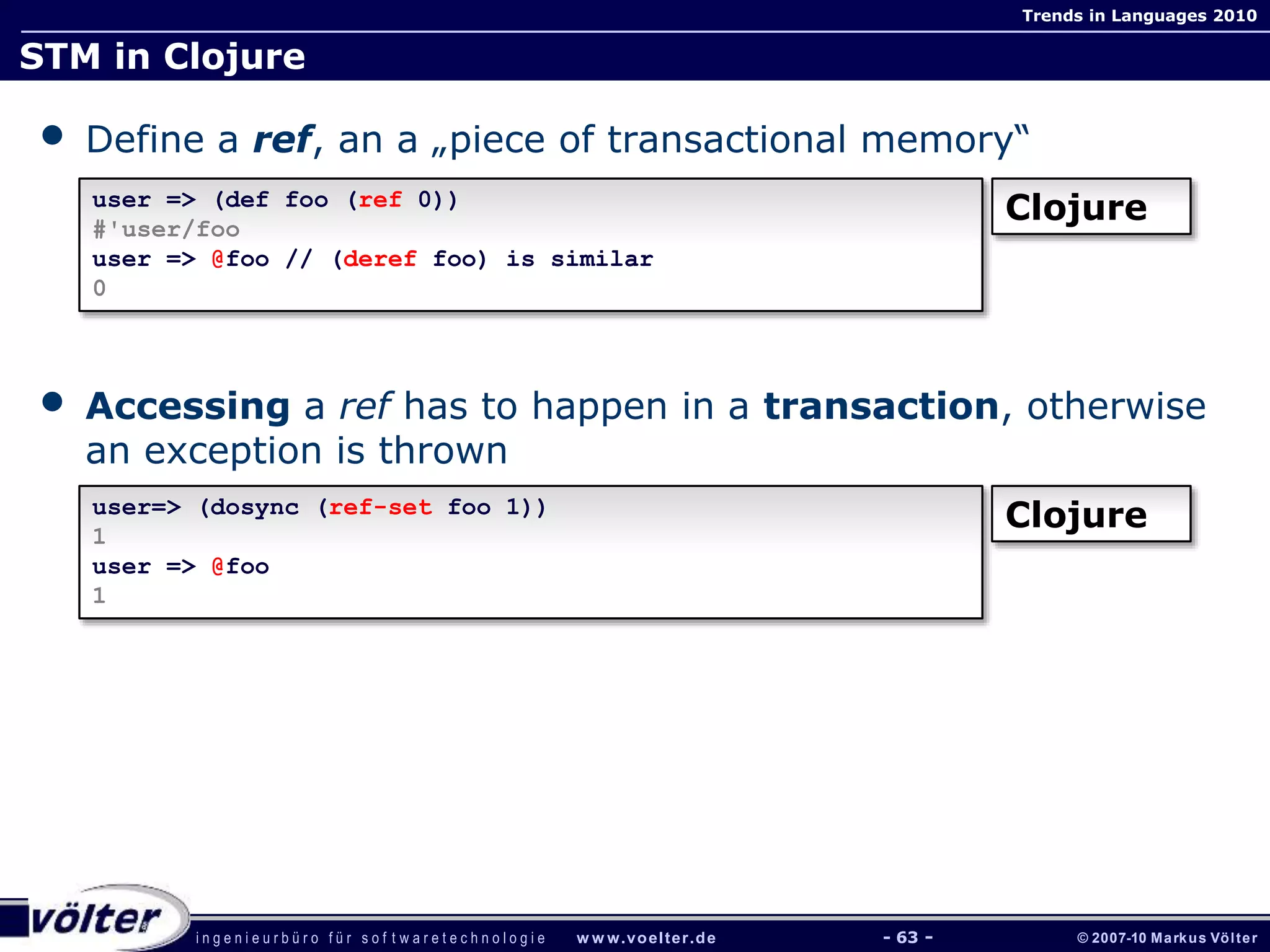
      Metaprogramming & DSLs
      Contracts
      Concurrency
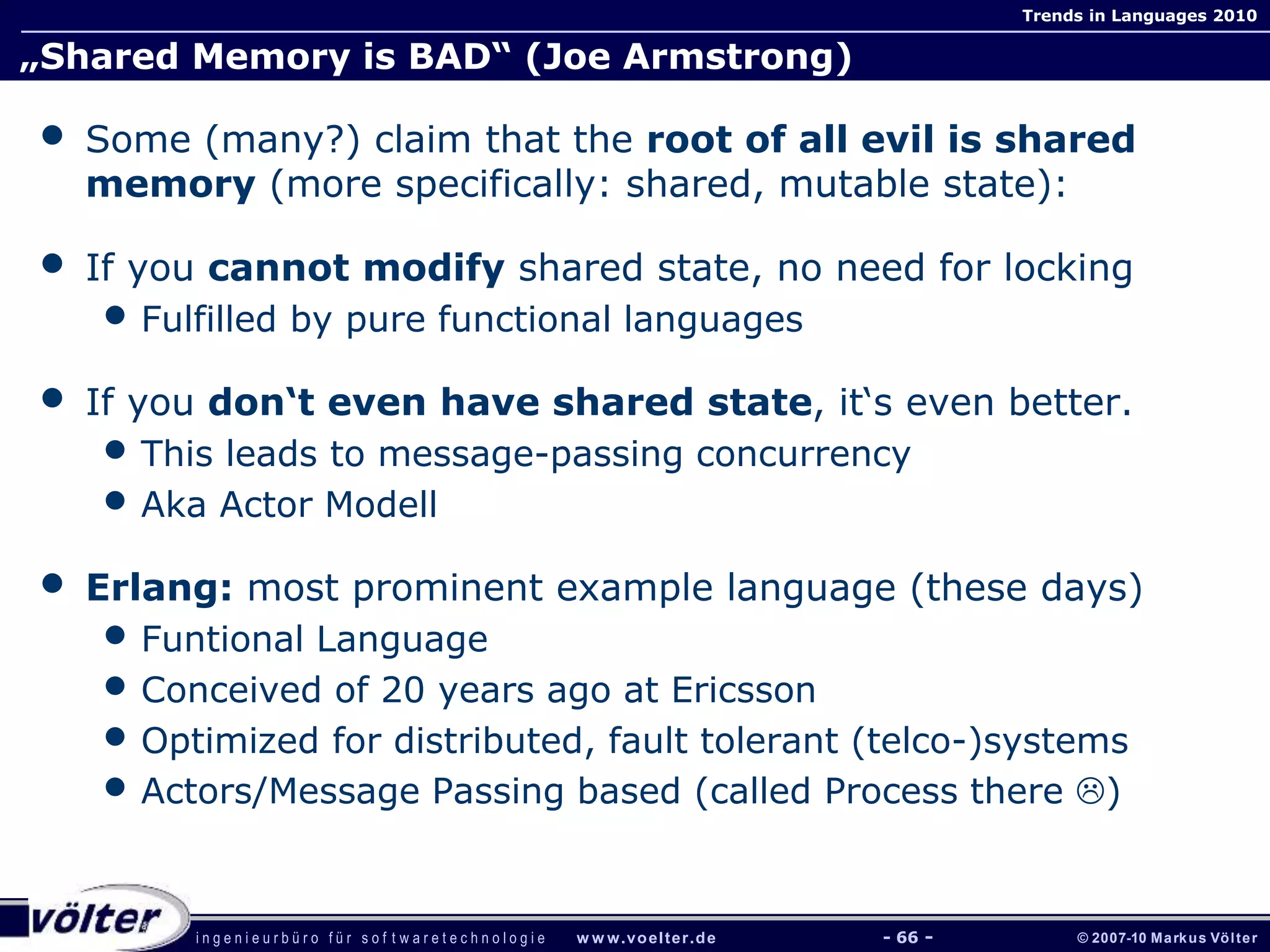
      Platforms
      Tools
      Summary
    7. - 7 -
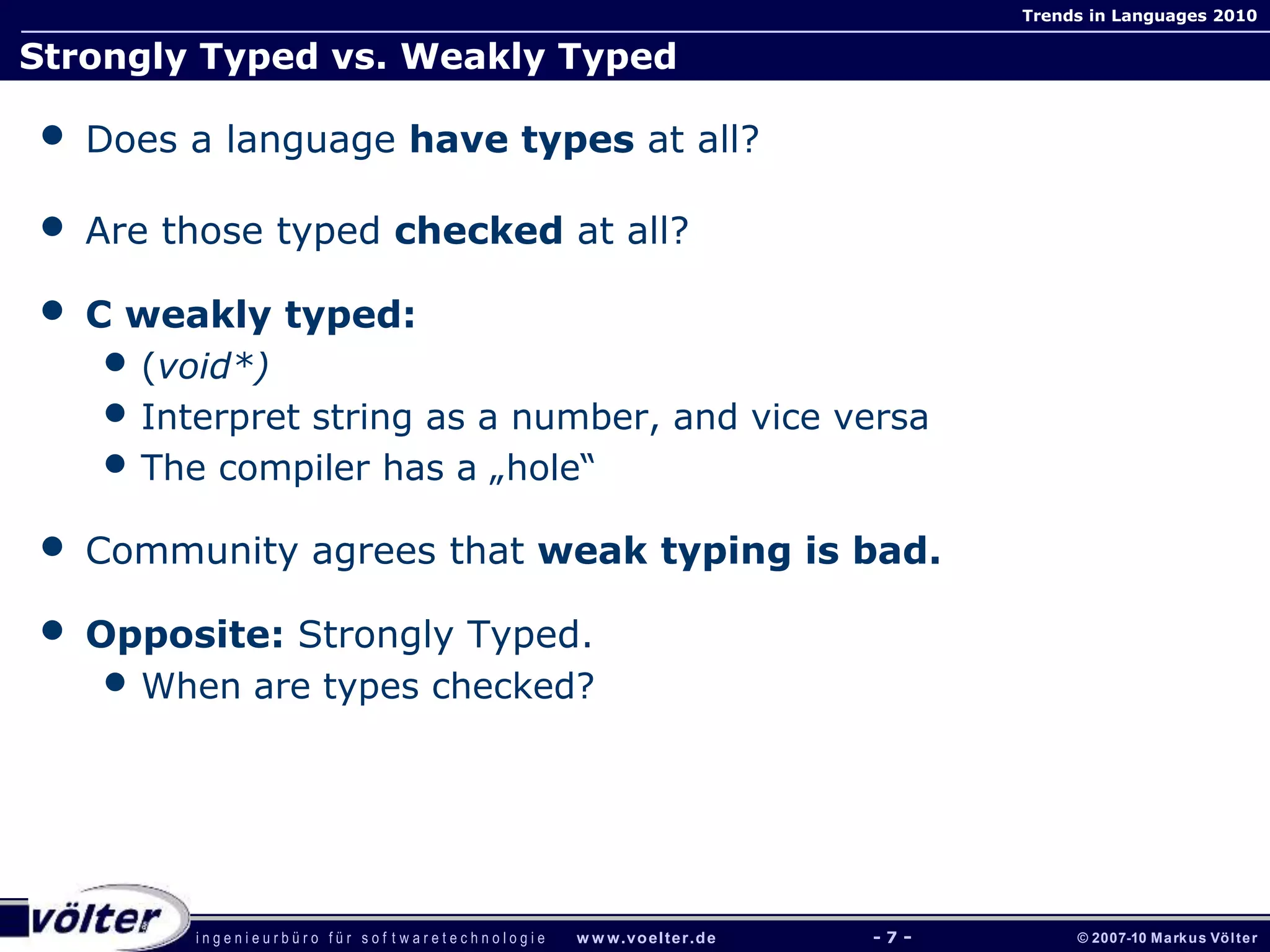
      Strongly Typed vs. Weakly Typed
      Does a language have types at all?
      Are those typed checked at all?
      C weakly typed:
      (void*)
      Interpret string as a number, and vice versa
      The compiler has a „hole“
      Community agrees that weak typing is bad.
      Opposite: Strongly Typed.
      When are types checked?
    8. - 8 -
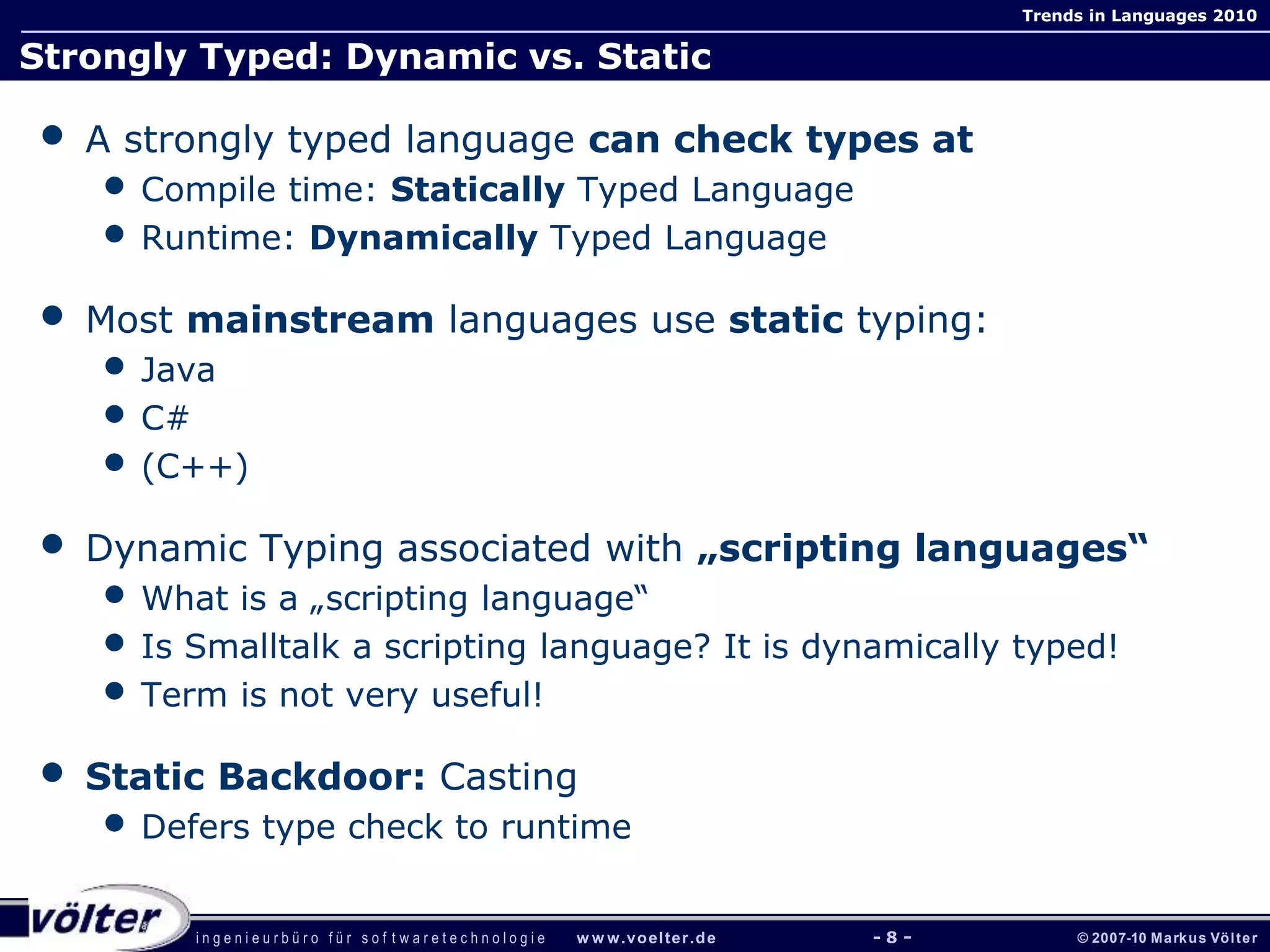
      Strongly Typed: Dynamic vs. Static
      A strongly typed language can check types at
      Compile time: Statically Typed Language
      Runtime: Dynamically Typed Language
      Most mainstream languages use static typing:
      Java
      C#
      (C++)
      Dynamic Typing associated with „scripting languages“
      What is a „scripting language“
      Is Smalltalk a scripting language? It is dynamically typed!
      Term is not very useful!
      Static Backdoor: Casting
      Defers type check to runtime
    9. - 9 -
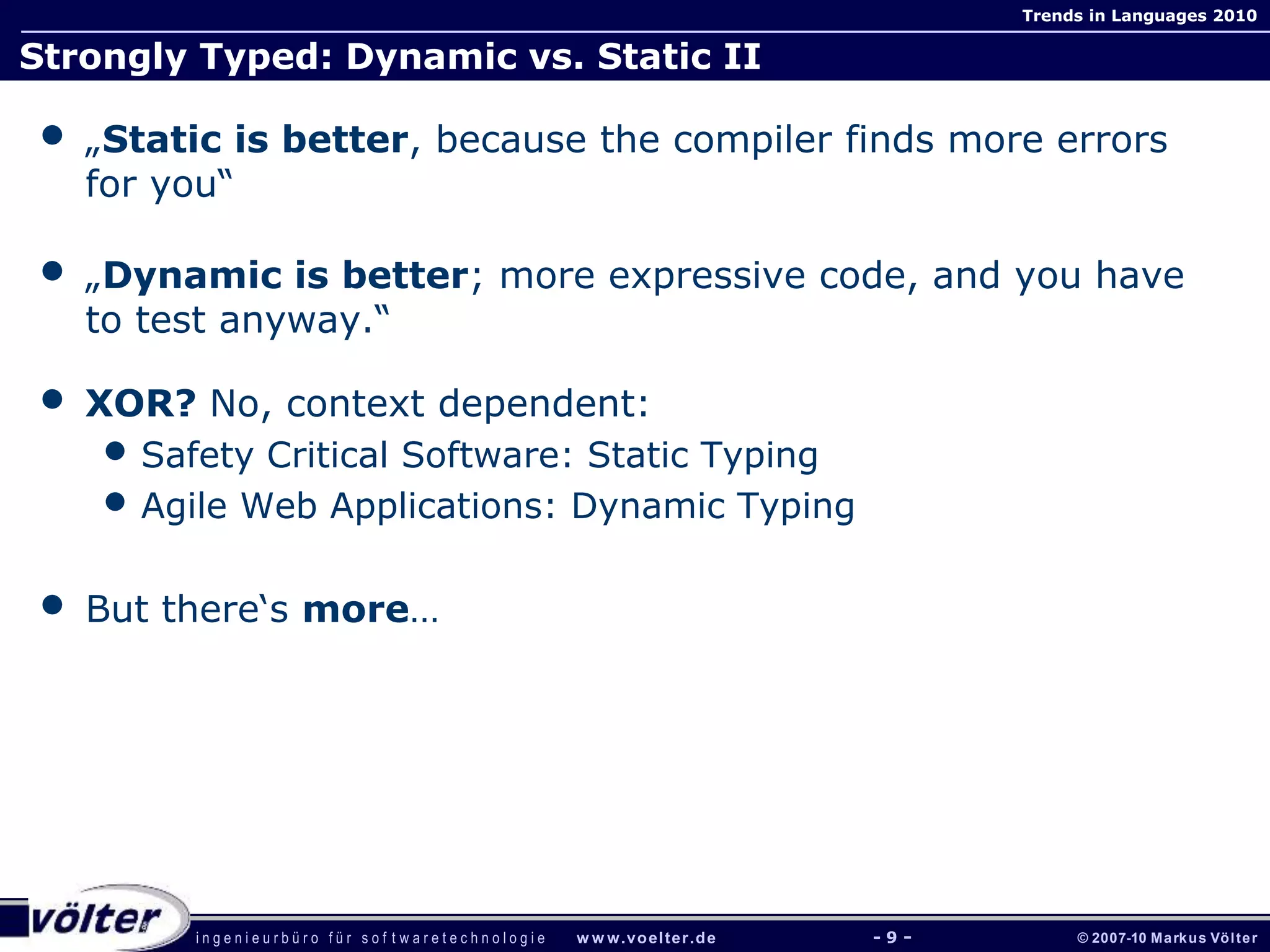
      Strongly Typed: Dynamic vs. Static II
      „Static is better, because the compiler finds more errors for you“
      „Dynamic is better; more expressive code, and you have to test anyway.“
      XOR? No, context dependent:
      Safety Critical Software: Static Typing
      Agile Web Applications: Dynamic Typing
      But there‘s more…
    10. - 10 -
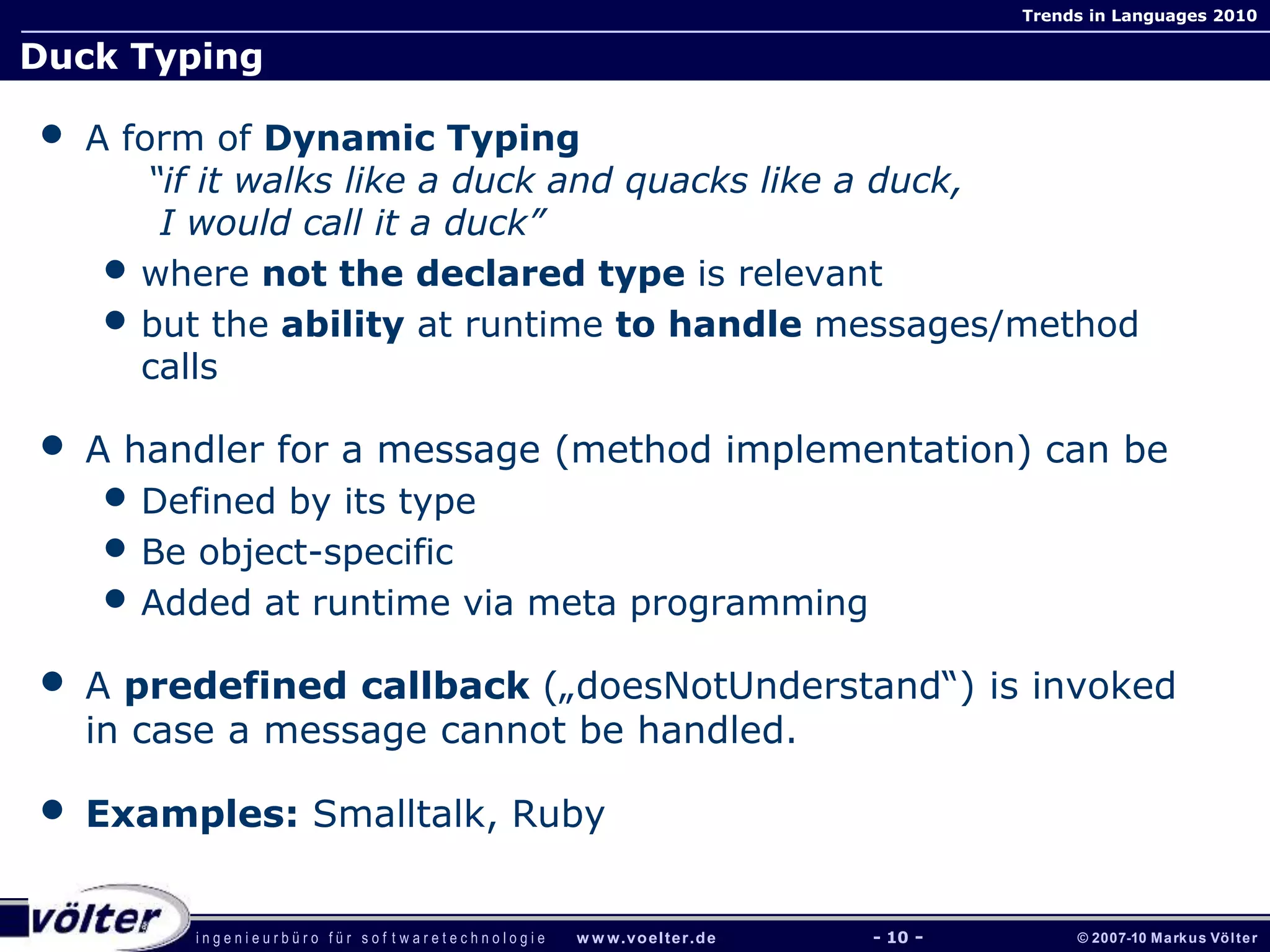
      Duck Typing
      A form ofDynamic Typing“if it walks like a duck and quacks like a duck, I would call it a duck”
      wherenot thedeclared type is relevant
      but theabilityatruntimeto handle messages/methodcalls
      A handlerfor a message (methodimplementation) canbe
      Definedbyits type
      Beobject-specific
      Addedatruntime via metaprogramming
      A predefinedcallback(„doesNotUnderstand“) isinvoked in case a messagecannotbehandled.
      Examples: Smalltalk, Ruby
    11. - 11 -
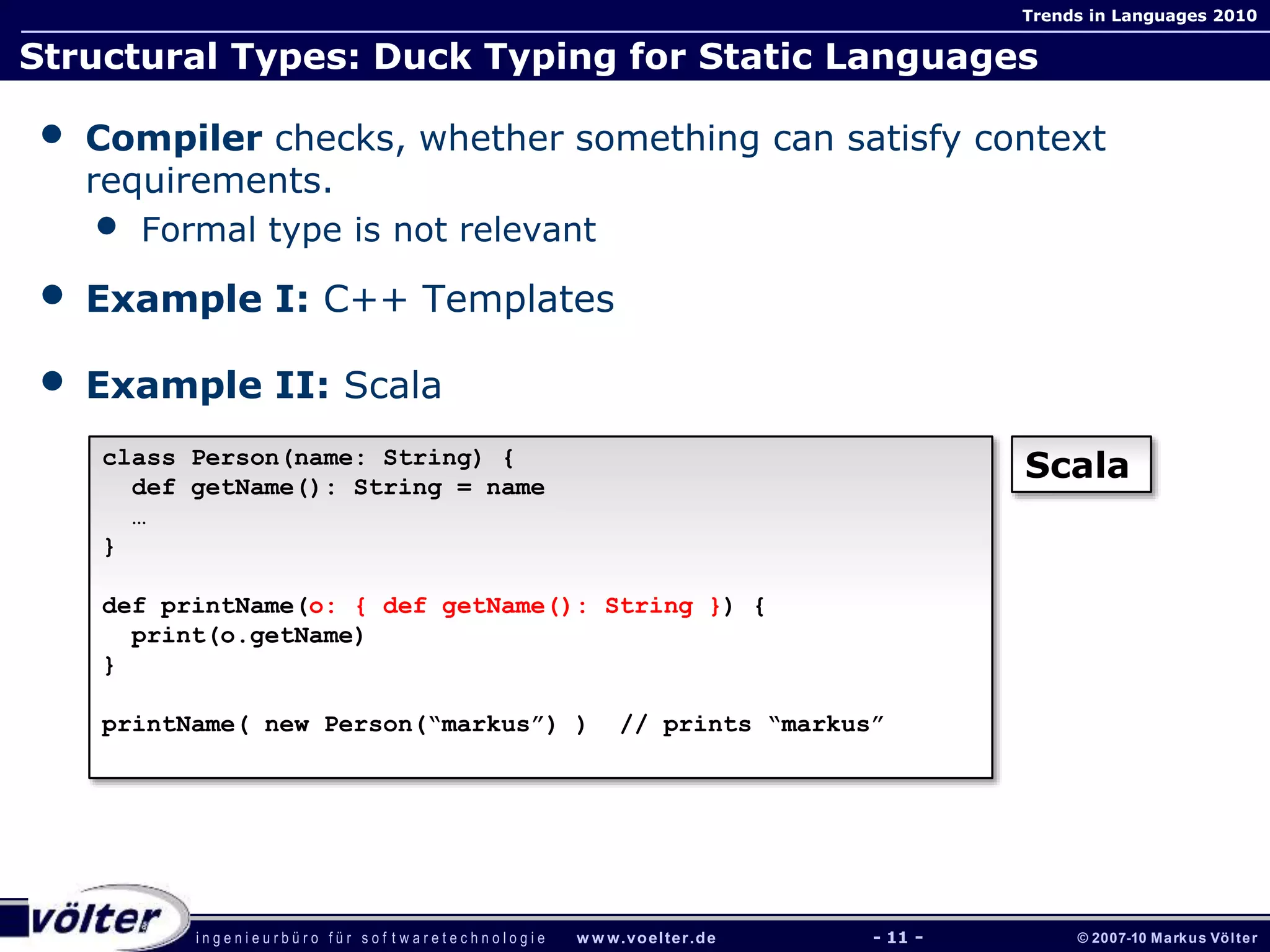
      Structural Types: Duck Typing for Static Languages
      Compiler checks, whethersomethingcansatisfycontextrequirements.
      Formal type is not relevant
      Example I: C++ Templates
      Example II: Scala
      class Person(name: String) {
      defgetName(): String = name

      }
       
      defprintName(o: { defgetName(): String }) { print(o.getName)
      }
       
      printName( new Person(“markus”) ) // prints “markus”
      Scala
    12. - 12 -
      Type Inference: Omit unnecessary type specs
      Compiler Smarts:Youonlyhavetowrite down thosetypesthecompilercannotderivefromthecontext
      Example: (Hypothetical) Java
      Example II: C# 3.0, LINQ
      // valid Java
      Map<String, MyType> m = newHashMap<String, MyType>();
      // Hypothetical Java with Type inference
      var m = newHashMap<String, MyType>();
      Java
      // valid Scala
      var m = newHashMap[String, MyType]();
      Scala
      C# 3
      Address[] addresses = …
      varres = from a in addresses
      selectnew { name = a.name(), tel = a.telephoneNo() };
      foreach (varr in res) {
      Console.WriteLine("Name: {0}, Num: {1}", r.name, r.tel);
      }
    13. - 13 -
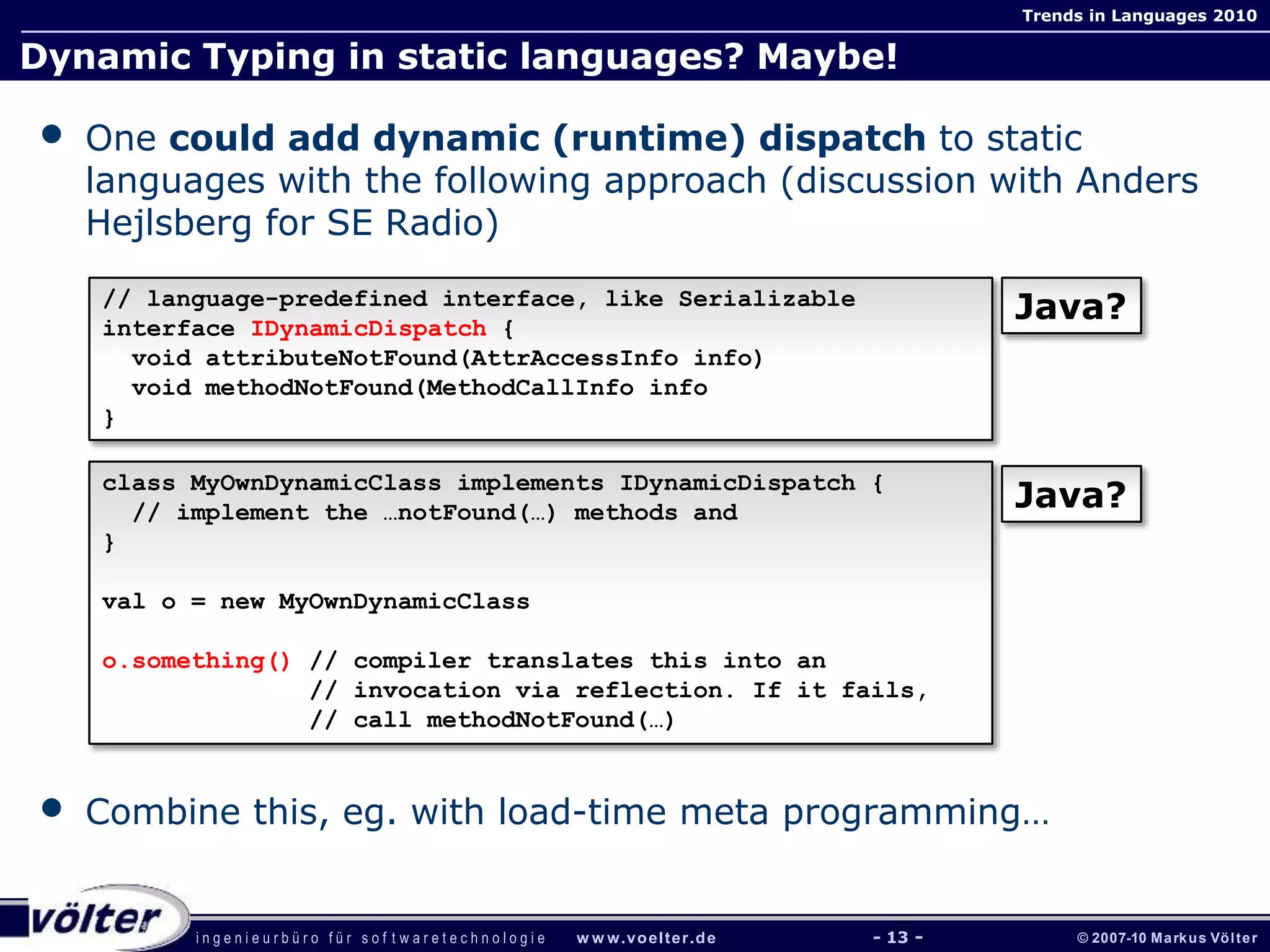
      Dynamic Typing in static languages? Maybe!
      Onecouldadddynamic (runtime) dispatchtostaticlanguageswiththefollowingapproach (discussionwith Anders Hejlsbergfor SE Radio)
      Combine this, eg. withload-time metaprogramming…
      // language-predefinedinterface, likeSerializable
      interfaceIDynamicDispatch {
      voidattributeNotFound(AttrAccessInfoinfo)
      voidmethodNotFound(MethodCallInfoinfo
      }
      Java?
      classMyOwnDynamicClassimplementsIDynamicDispatch {
      // implementthe …notFound(…) methodsand
      }
      val o = newMyOwnDynamicClass
      o.something() // compilertranslatesthisinto an
      // invocation via reflection. Ifitfails,
      // callmethodNotFound(…)
      Java?
    14. - 14 -
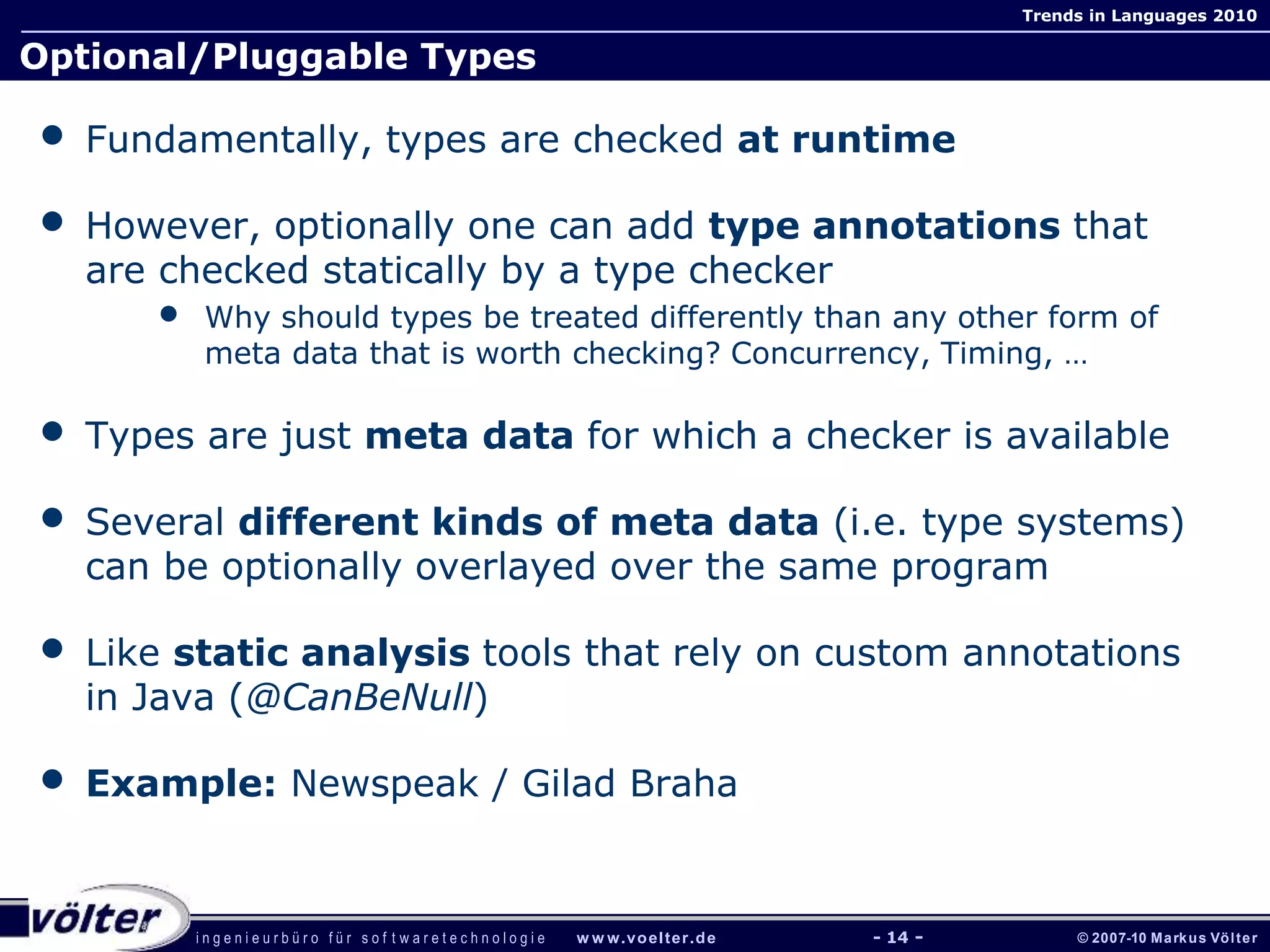
      Optional/Pluggable Types
      Fundamentally, typesarecheckedatruntime
      However, optionallyonecanaddtype annotationsthatarecheckedstaticallyby a type checker
      Whyshouldtypesbetreateddifferentlythananyother form ofmetadatathatisworthchecking? Concurrency, Timing, …
      Typesare just metadataforwhich a checkerisavailable
      Severaldifferent kindsofmetadata (i.e. type systems) canbeoptionallyoverlayedoverthe same program
      Likestaticanalysistoolsthatrely on customannotations in Java (@CanBeNull)
      Example:Newspeak / GiladBraha
    15. - 15 -
      C O N T E N T S
      Intro and Overview
      Typing
      OO +/vs. Functional
      Metaprogramming & DSLs
      Contracts
      Concurrency
      Platforms
      Tools
      Summary
    16. - 16 -
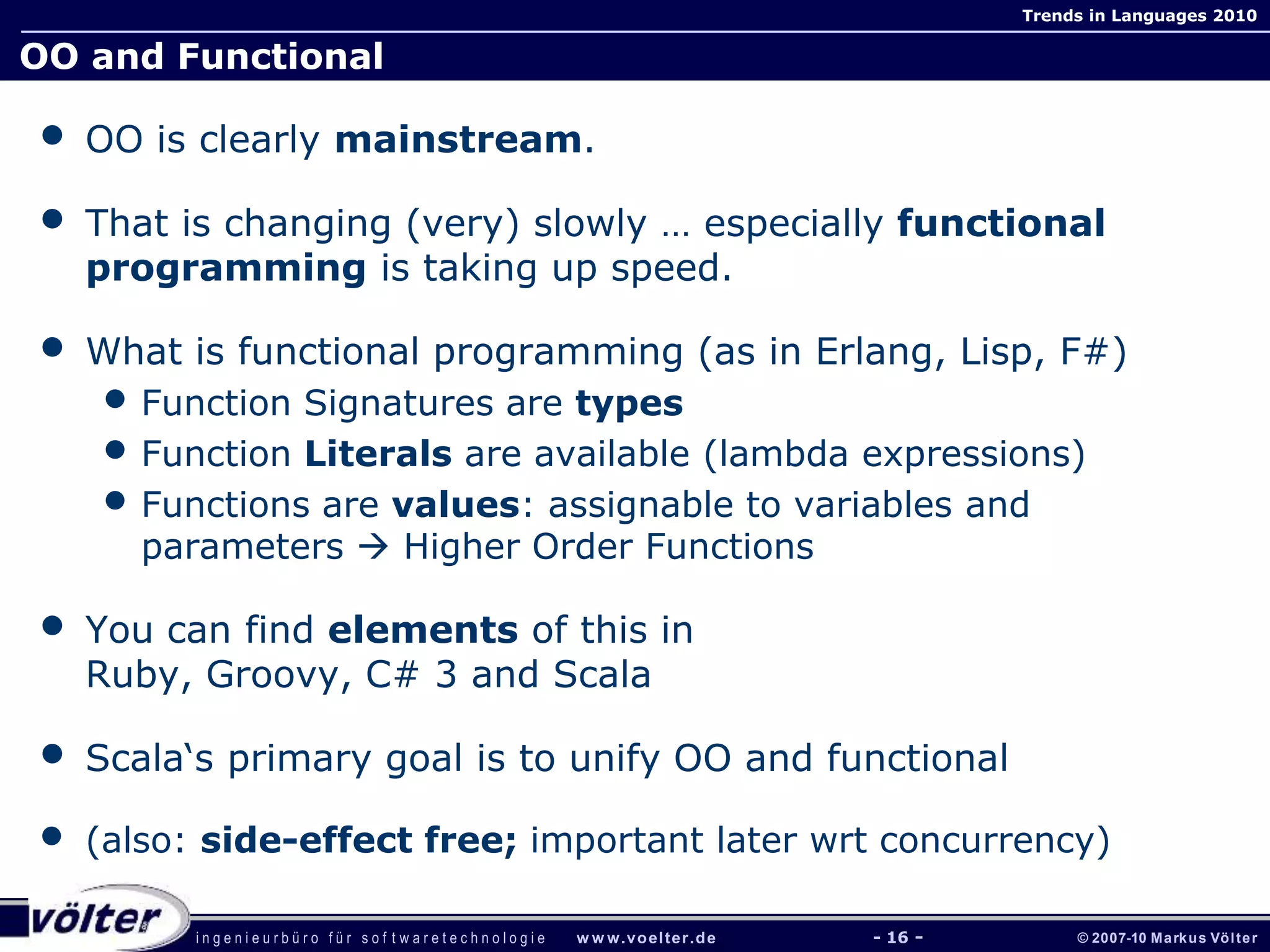
      OO and Functional
      OO isclearlymainstream.
      Thatischanging (very) slowly … especiallyfunctionalprogrammingistakingupspeed.
      Whatisfunctionalprogramming (as in Erlang, Lisp, F#)
      FunctionSignaturesaretypes
      FunctionLiteralsareavailable (lambdaexpressions)
      Functionsarevalues: assignableto variables andparameters Higher Order Functions
      Youcan find elementsofthis in Ruby, Groovy, C# 3 and Scala
      Scala‘sprimarygoalistounify OO andfunctional
      (also: side-effectfree;importantlaterwrtconcurrency)
    17. - 17 -
      From Primitive To Workable
      Primitive functional programming can be done with
      Function pointers (as in C/C++)
      Delegates (C# < 3)
      Command Pattern/Inner Classes in Java
      Better solution: Closures(aka lamda expressions, blocks, anonymous functions)
      Anonymous Functions (Function Literals)
      [1,2,3,4,5,6].each { |element| puts (element * 2) }
      Ruby
      x: Int => x + 1
      Scala
    18. - 18 -
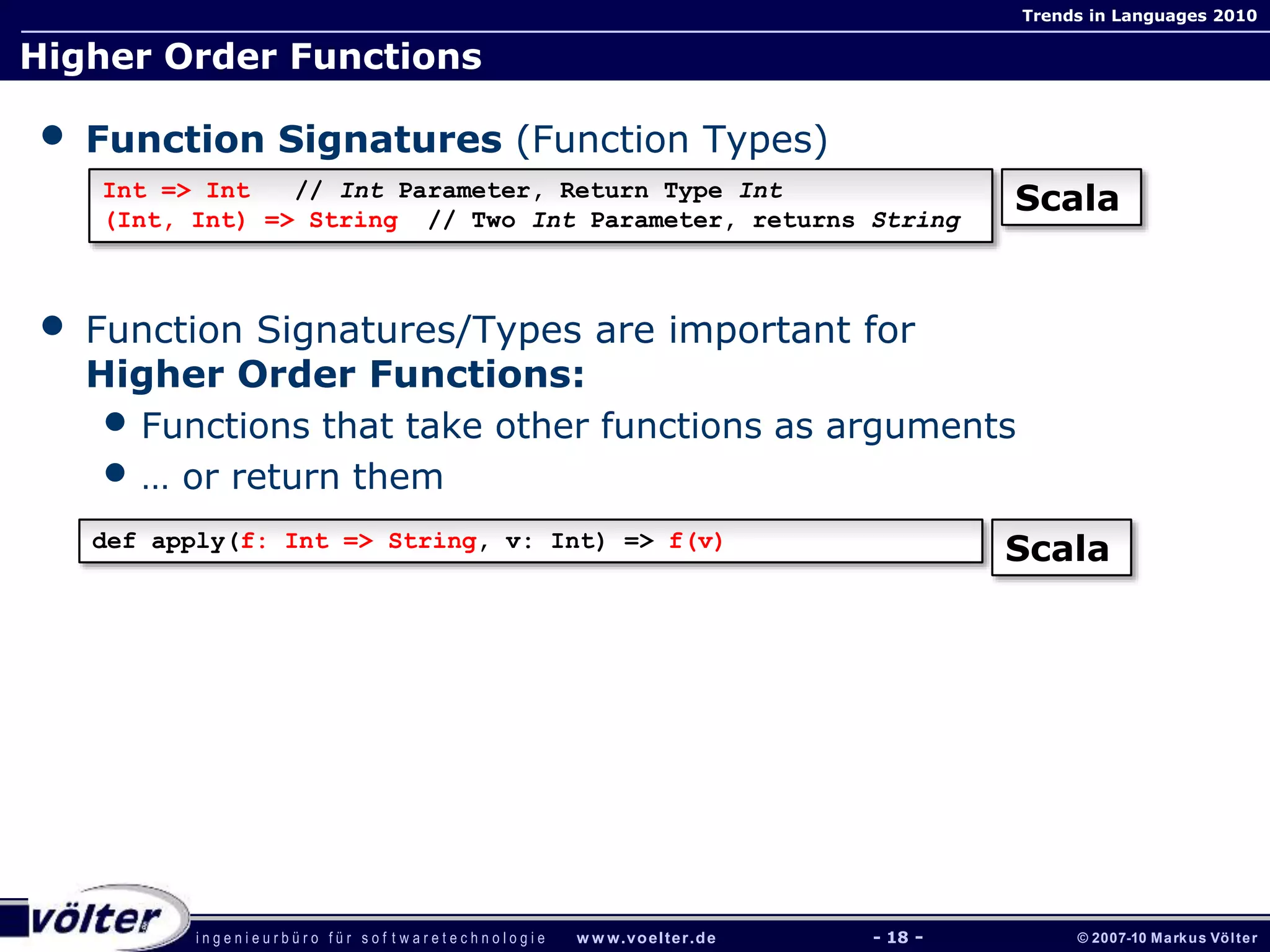
      Higher Order Functions
      FunctionSignatures(FunctionTypes)
      FunctionSignatures/TypesareimportantforHigher Order Functions:
      Functionsthattakeotherfunctionsasarguments
      … orreturnthem
      Int => Int// Int Parameter, Return Type Int(Int, Int) => String // TwoInt Parameter, returnsString
      Scala
      def apply(f: Int => String, v: Int) => f(v)
      Scala
    19. - 19 -
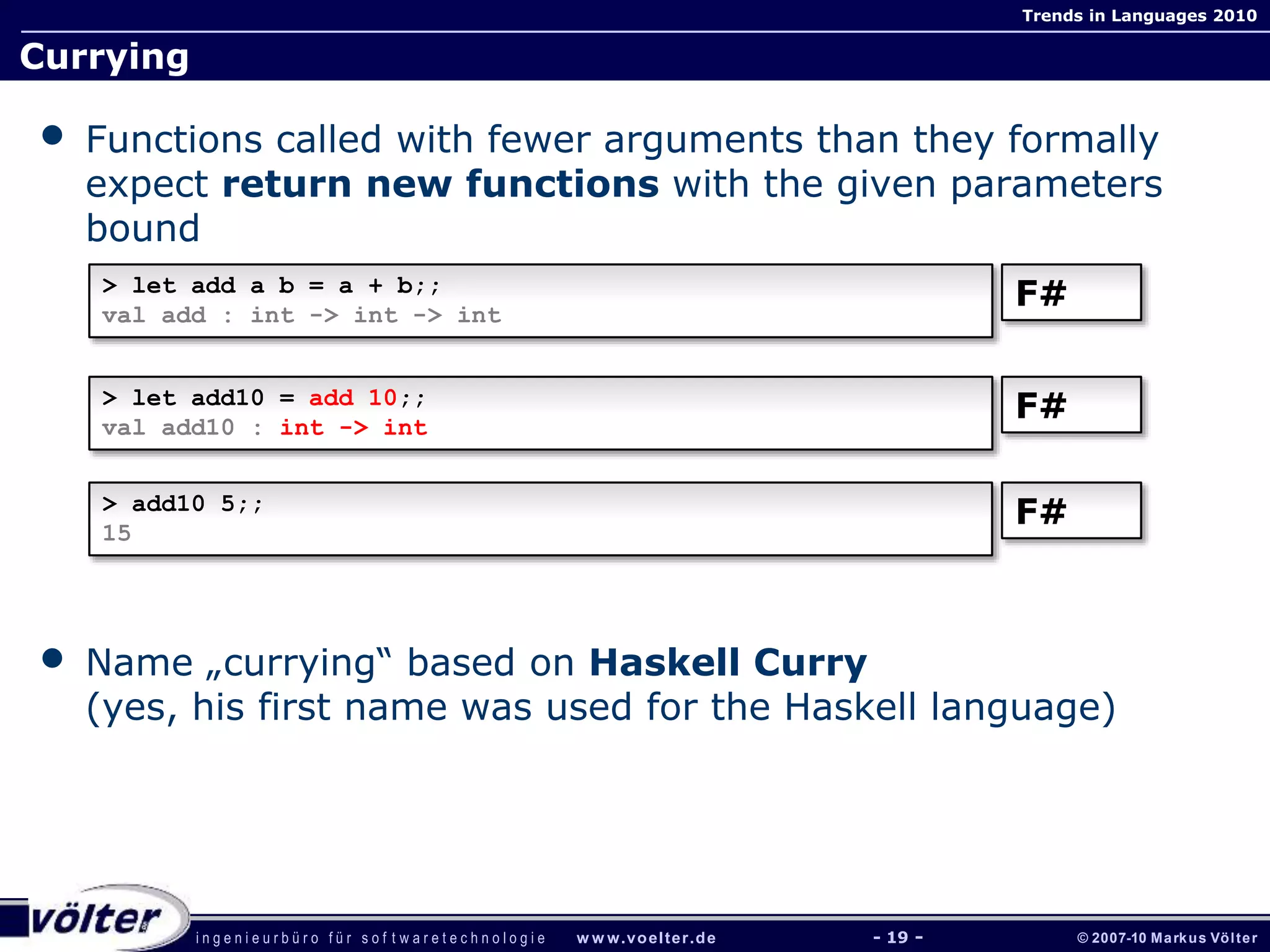
      Currying
      Functionscalledwithfewerargumentsthantheyformallyexpectreturnnewfunctionswiththegivenparametersbound
      Name „currying“ based on Haskell Curry(yes, hisfirstname was usedfortheHaskelllanguage)
      > let add a b = a + b;;
      val add : int -> int -> int
      F#
      > let add10 = add 10;; val add10 : int -> int
      F#
      > add10 5;; 15
      F#
    20. - 20 -
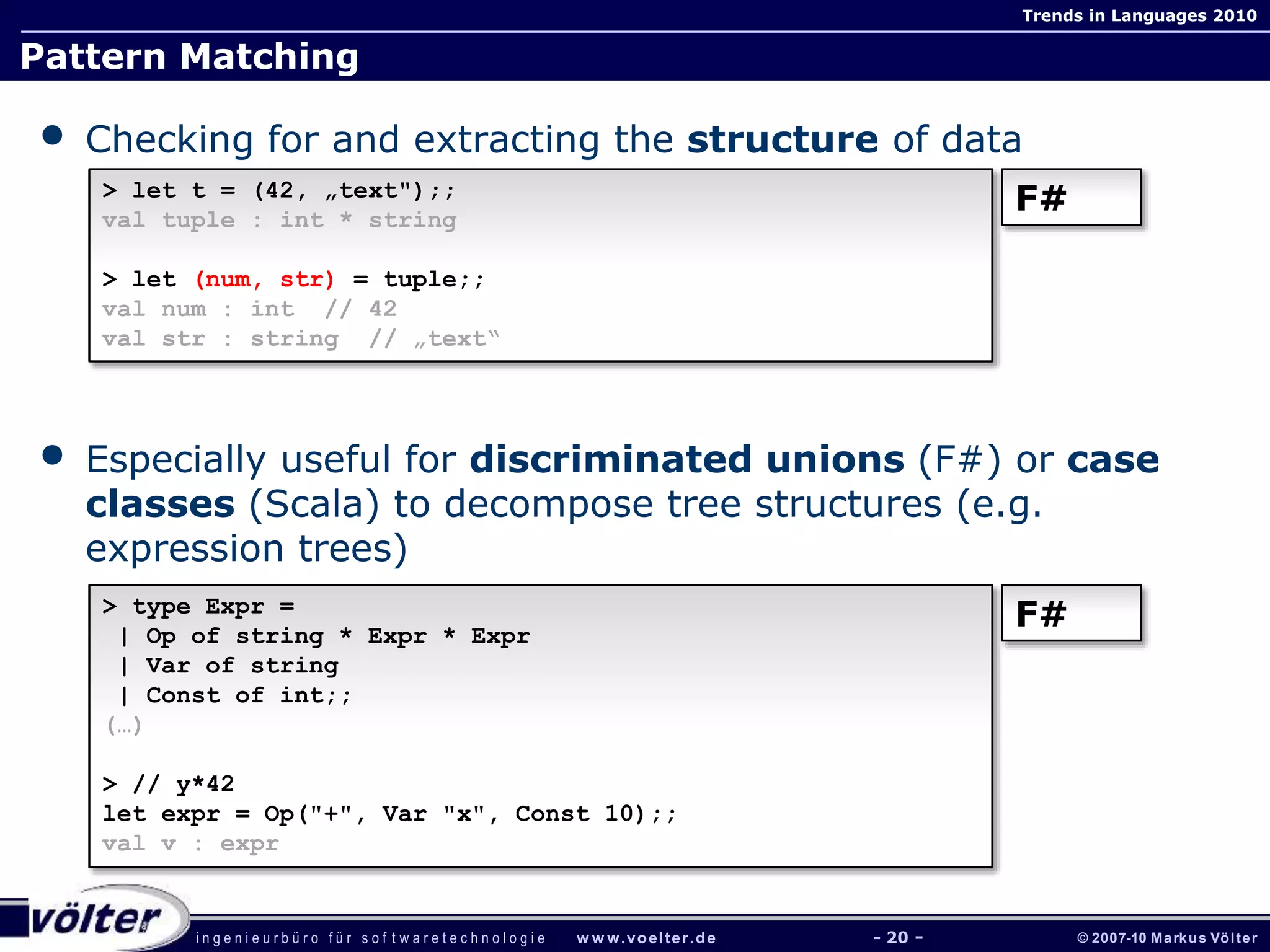
      Pattern Matching
      Checkingforandextractingthestructureofdata
      Especiallyusefulfordiscriminatedunions(F#) orcaseclasses(Scala) todecomposetreestructures (e.g. expressiontrees)
      > let t = (42, „text");;
      valtuple : int * string
      > let(num, str) = tuple;;
      valnum : int // 42
      val str : string // „text“
      F#
      > type Expr =
      | Op of string * Expr * Expr | Var of string | Const of int;;
      (…)
      > // y*42let expr = Op("+", Var "x", Const 10);; val v : expr
      F#
    21. - 21 -
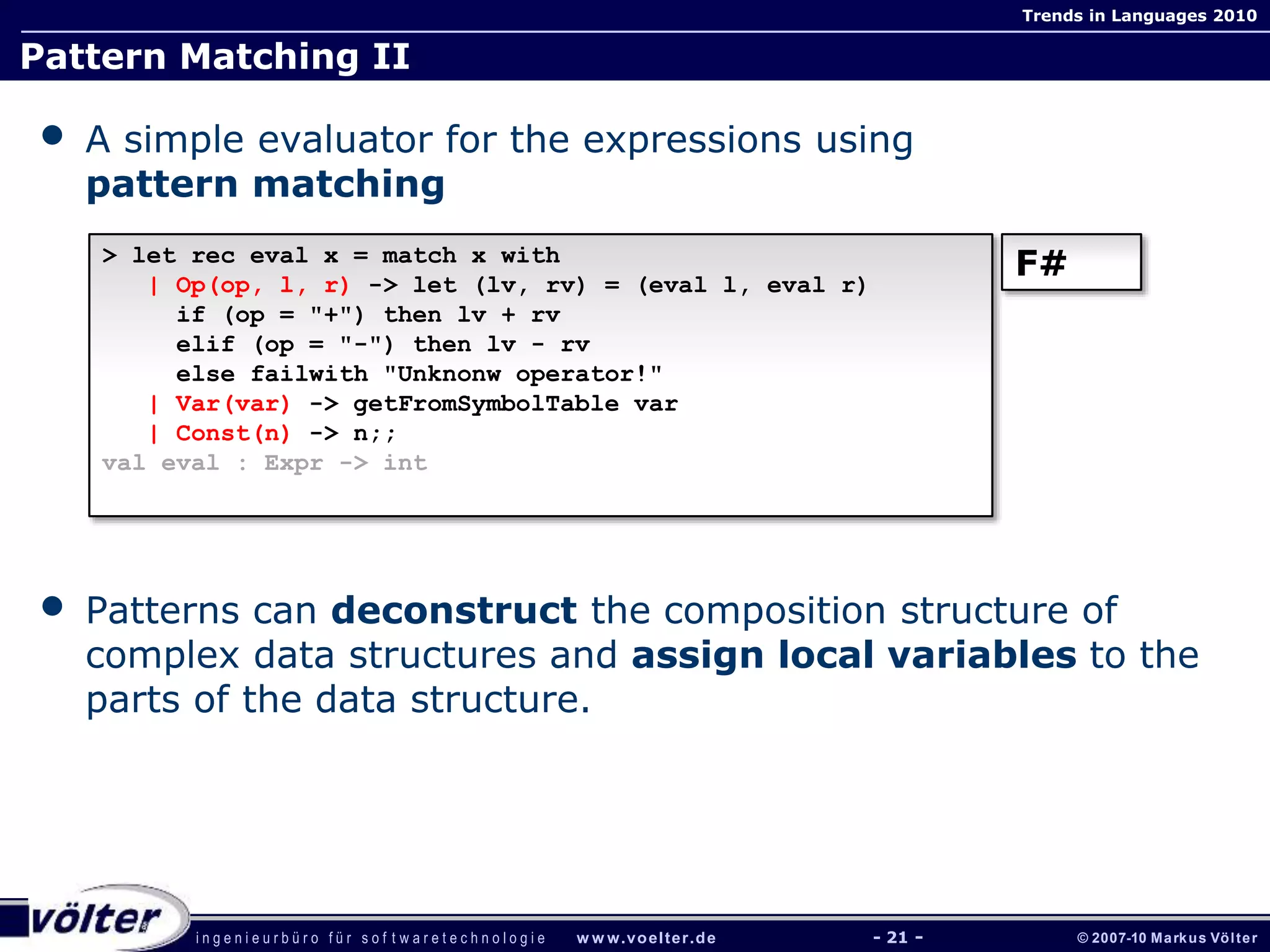
      Pattern Matching II
      A simple evaluatorfortheexpressionsusingpatternmatching
      Patterns candeconstructthecompositionstructureofcomplexdatastructuresandassignlocal variables tothepartsofthedatastructure.
      > letreceval x = match x with
      | Op(op, l, r) -> let (lv, rv) = (eval l, eval r) if (op = "+") thenlv + rvelif (op = "-") thenlv - rvelsefailwith "Unknonwoperator!" | Var(var) -> getFromSymbolTablevar| Const(n) -> n;; valeval : Expr -> int
      F#
    22. - 22 -
      ?
      ?
      (defn move-to [shape x y] (merge shape {:x x :y y}))
      (defn r-move-to [shape x y] (move-to shape (+ (shape :x) x) (+ (shape :y) y)))
      (derive ::rectangle ::shape)
      (derive ::circle ::shape)
      (defn rectangle [x y w h] (with-meta {:x x :y y :width w :height h} {:type ::rectangle}))
      (defn circle [x y r] (with-meta {:x x :y y :radius r} {:type ::circle}))
      (defmulti draw (fn [shape] ((meta shape) :type)))
      (defmethod draw ::rectangle [rect]
      (println (str "Draw a Rectangle at:(" (rect :x) ", " (rect :y)
      "), width " (rect :width) ", height " (rect :height))))
      (defmethod draw ::circle [circle]
      (println (str "Draw a Cicrle at:(" (circle :x) ", " (circle :y)
      "), radius " (circle :radius))))
      (def scribble [(rectangle 10 20 5 6) (circle 15 25 8)])
      (doseq [shape scribble]
      (draw shape)
      (let [s (r-move-to shape 100 100)]
      (draw s)))
      (draw (assoc (rectangle 0 0 15 15) :width 30))
    23. - 23 -
      Clojure – a Lisp for the JVM
      (defn move-to [shape x y] (merge shape {:x x :y y}))
      (defn r-move-to [shape x y] (move-to shape (+ (shape :x) x) (+ (shape :y) y)))
      (derive ::rectangle ::shape)
      (derive ::circle ::shape)
      (defn rectangle [x y w h] (with-meta {:x x :y y :width w :height h} {:type ::rectangle}))
      (defn circle [x y r] (with-meta {:x x :y y :radius r} {:type ::circle}))
      (defmulti draw (fn [shape] ((meta shape) :type)))
      (defmethod draw ::rectangle [rect]
      (println (str "Draw a Rectangle at:(" (rect :x) ", " (rect :y)
      "), width " (rect :width) ", height " (rect :height))))
      (defmethod draw ::circle [circle]
      (println (str "Draw a Cicrle at:(" (circle :x) ", " (circle :y)
      "), radius " (circle :radius))))
      (def scribble [(rectangle 10 20 5 6) (circle 15 25 8)])
      (doseq [shape scribble]
      (draw shape)
      (let [s (r-move-to shape 100 100)]
      (draw s)))
      (draw (assoc (rectangle 0 0 15 15) :width 30))
      Clojure
      Example from
      http://onestepback.org/articles/poly/oo-clojure.html
      • Lisp is the grand daddy of functional programming.
      • Clojure is a new Lisp for the VM with good Java interop and very nice support for concurrency (see later)
    24. - 24 -
      C O N T E N T S
      Intro and Overview
      Typing
      OO +/vs. Functional
      Metaprogramming & DSLs
      Contracts
      Concurrency
      Platforms
      Tools
      Summary
    25. - 25 -
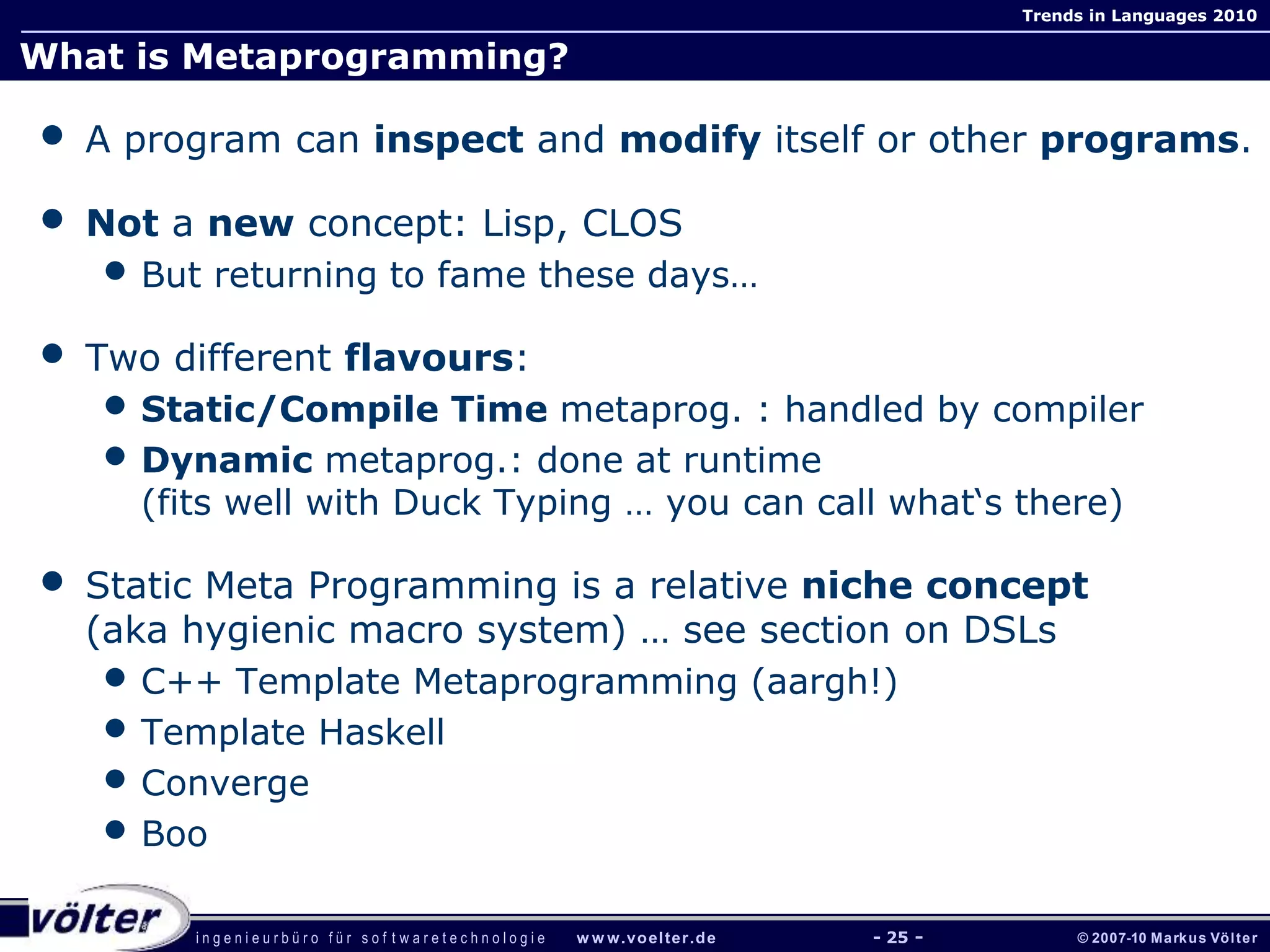
      What is Metaprogramming?
      A programcaninspectandmodifyitself or otherprograms.
      Not a newconcept: Lisp, CLOS
      But returningtofamethesedays…
      Two different flavours:
      Static/Compile Timemetaprog. : handledbycompiler
      Dynamicmetaprog.: doneatruntime(fits well with Duck Typing … youcancallwhat‘sthere)
      StaticMetaProgrammingis a relative nicheconcept(akahygienicmacrosystem) … see section on DSLs
      C++ Template Metaprogramming (aargh!)
      Template Haskell
      Converge
      Boo
    26. - 26 -
      Dynamic Metaprogramming
      Is available in manydynamic OO languages, such asSmalltalk, Ruby, Groovy
      Dynamicallyadd a newmethodto a class:
      Whathappens in Duck languages, ifyoucall a methodthat‘snot available? Remember, nocompiler type check!
      class SomeClass
      define_method(“foo”){ puts "foo" }
      End
      SomeClass.new.foo // prints “foo“
      Ruby
      class Sammler {
      def data = [:]
      def propertyMissing =
      {String name, value-> data [name] = value }
      def propertyMissing =
      {String name-> data [name] }
      }
      Groovy
      def s = new Sammler()
      s.name = "Voelter"
      s.vorname = „Markus“
      s.name // is „Voelter“
    27. - 27 -
      Meta Object Protocols
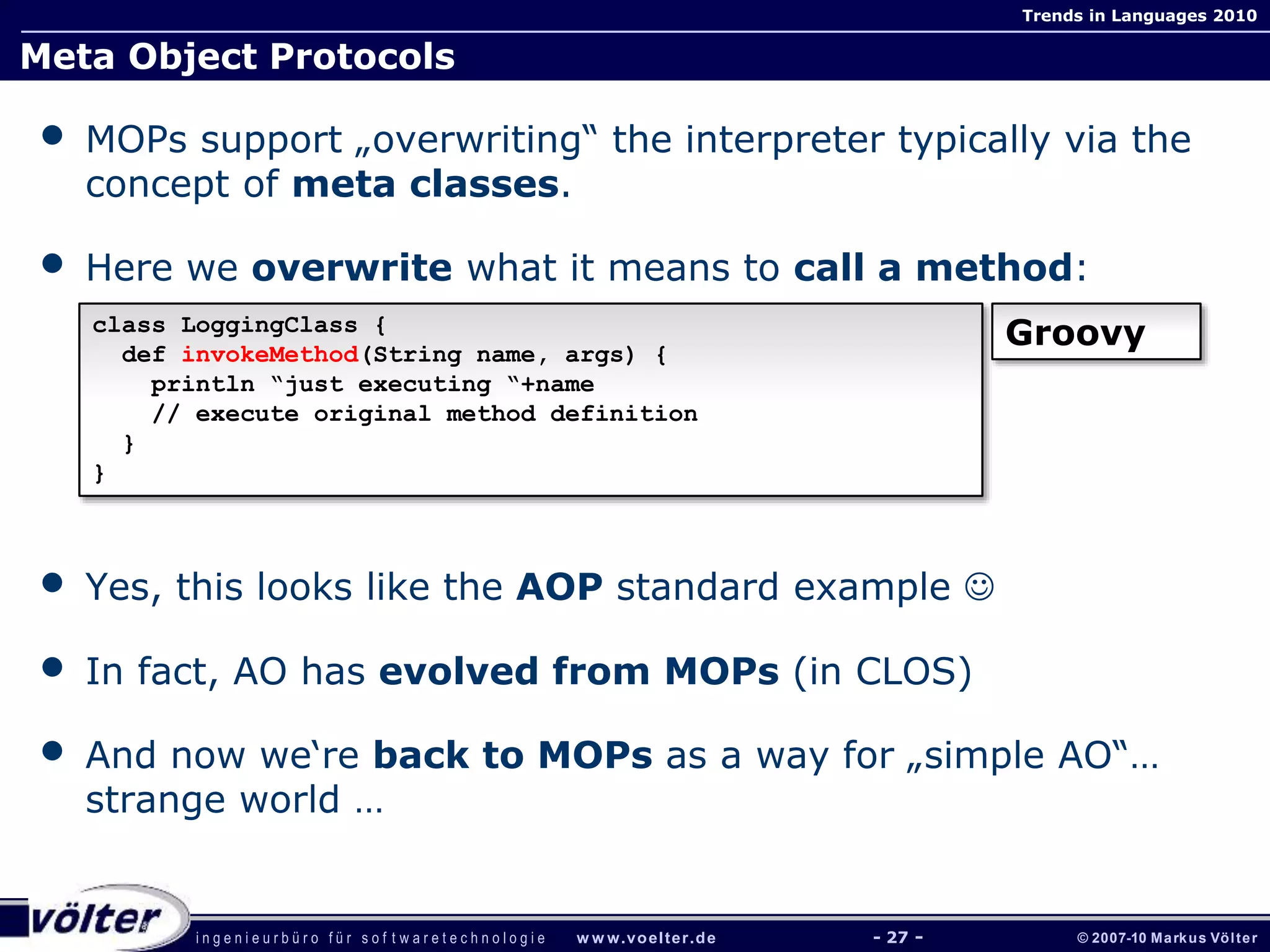
      MOPs support „overwriting“ theinterpretertypically via theconceptofmetaclasses.
      Hereweoverwritewhatitmeanstocall a method:
      Yes, thislooksliketheAOPstandardexample
      In fact, AO hasevolvedfrom MOPs (in CLOS)
      Andnowwe‘reback to MOPs as a wayfor „simple AO“…strangeworld …
      class LoggingClass {
      def invokeMethod(String name, args) {
      println “just executing “+name
      // execute original method definition
      }
      }
      Groovy
    28. - 28 -
      Macro systems
      Macros are transformations of program code that are executed by the compiler during compilation.
      Quotation (and unquotation) is used
      Powerful way to define new language syntax (Growing a Language, Guy Steele)
      Works especially well for „syntaxless“ languages.
      (defmacro with-connection [& body]
      `(binding [*conn* (get-connection)]
      (let [ret# (do ~@body)]
      (.close *conn*)
      ret#
      )
      )
      )
      (with-connection (str *conn*))
      Clojure
    29. - 29 -
      What are DSLs?
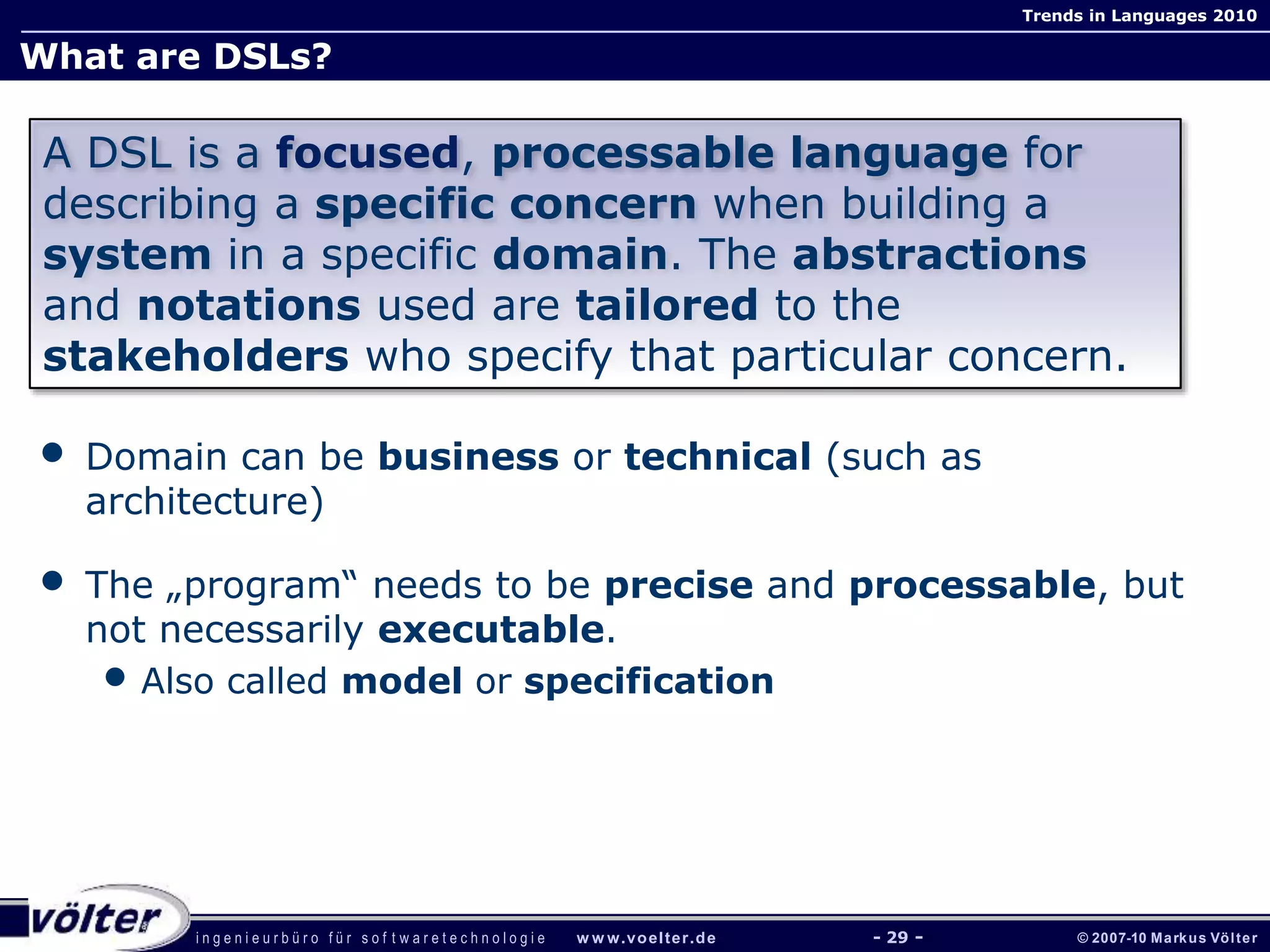
      A DSL is a focused, processablelanguage for describing a specific concern when building a system in a specific domain. The abstractions and notations used are tailored to the stakeholders who specify that particular concern.
      Domain can be business or technical (such as architecture)
      The „program“ needs to be precise and processable, but not necessarily executable.
      Also called model or specification
    30. - 30 -
      Internal DSLs vs. External DSLs
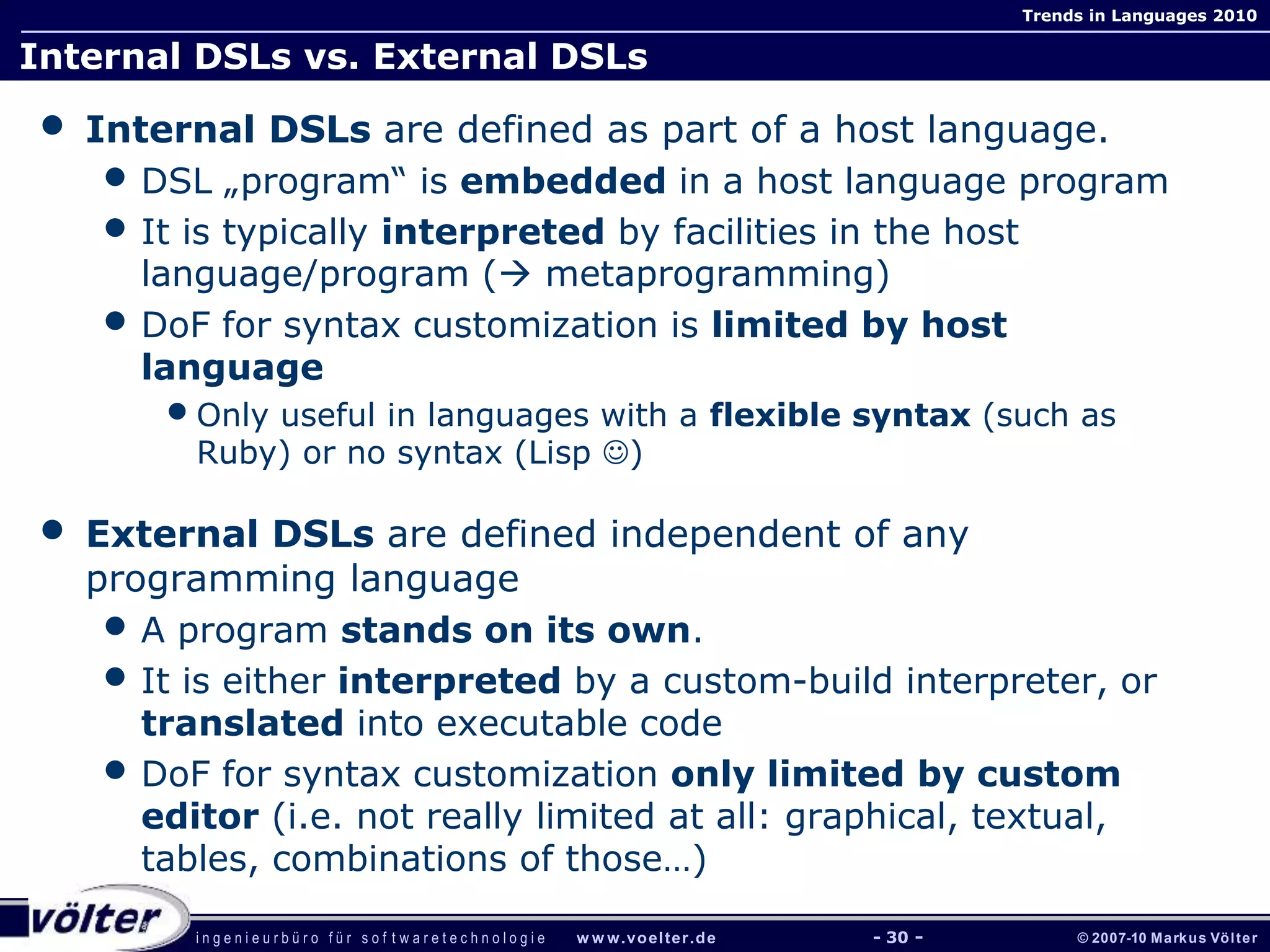
      Internal DSLs are defined as part of a host language.
      DSL „program“ is embedded in a host language program
      It is typically interpreted by facilities in the host language/program ( metaprogramming)
      DoF for syntax customization is limited by host language
      Only useful in languages with a flexible syntax (such as Ruby) or no syntax (Lisp )
      External DSLs are defined independent of any programming language
      A program stands on its own.
      It is either interpreted by a custom-build interpreter, or translated into executable code
      DoF for syntax customization only limited by custom editor (i.e. not really limited at all: graphical, textual, tables, combinations of those…)
    31. - 31 -
      Dynamic Internal DSL Examples: Ruby
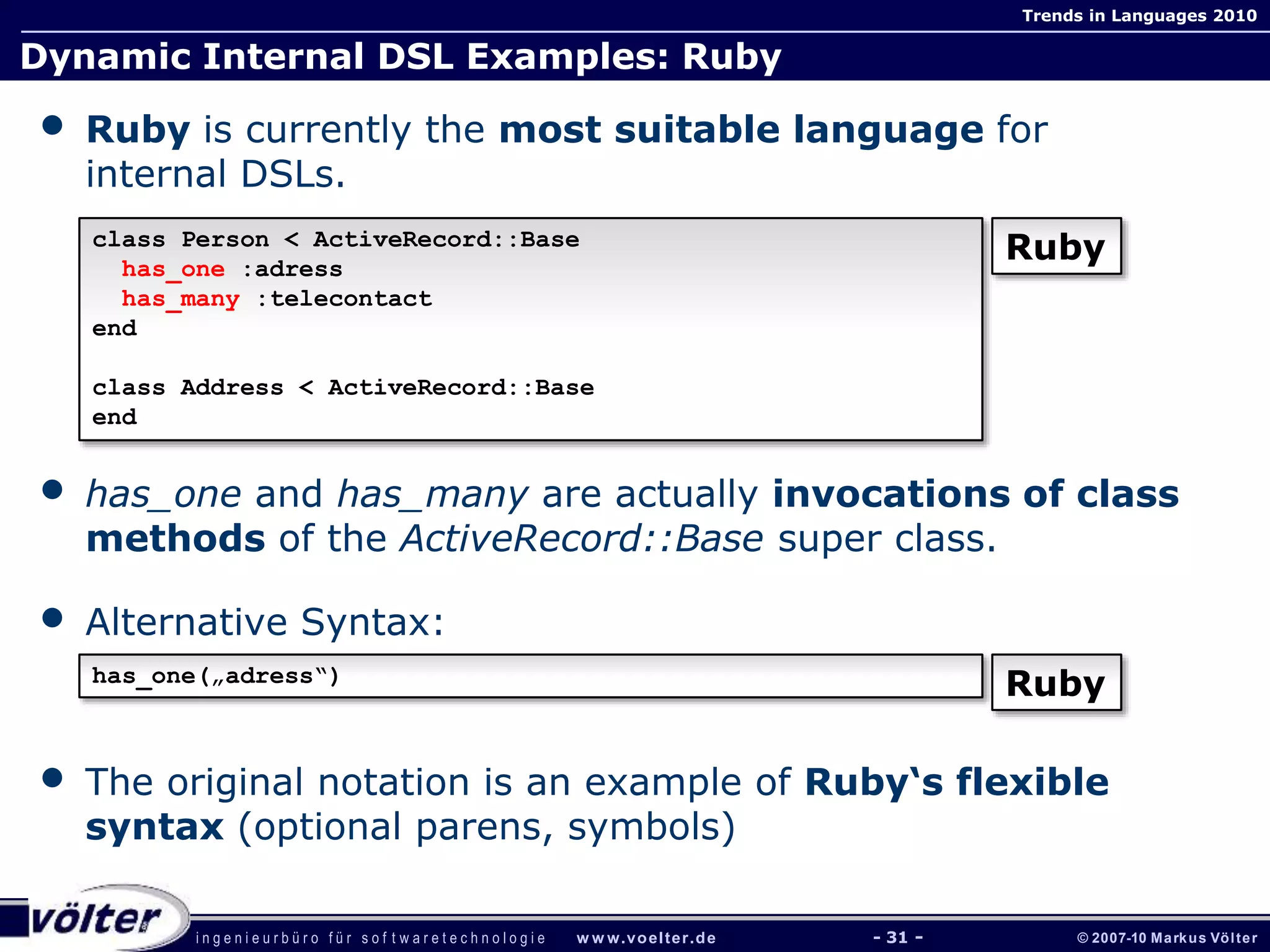
      Ruby is currently the most suitable language for internal DSLs.
      has_one and has_many are actually invocations of class methods of the ActiveRecord::Base super class.
      Alternative Syntax:
      The original notation is an example of Ruby‘s flexible syntax (optional parens, symbols)
      class Person < ActiveRecord::Base
      has_one :adress
      has_many :telecontact
      end
       
      class Address < ActiveRecord::Base
      end
      Ruby
      has_one(„adress“)
      Ruby
    32. - 32 -
      Dynamic Internal DSL Examples: Ruby II
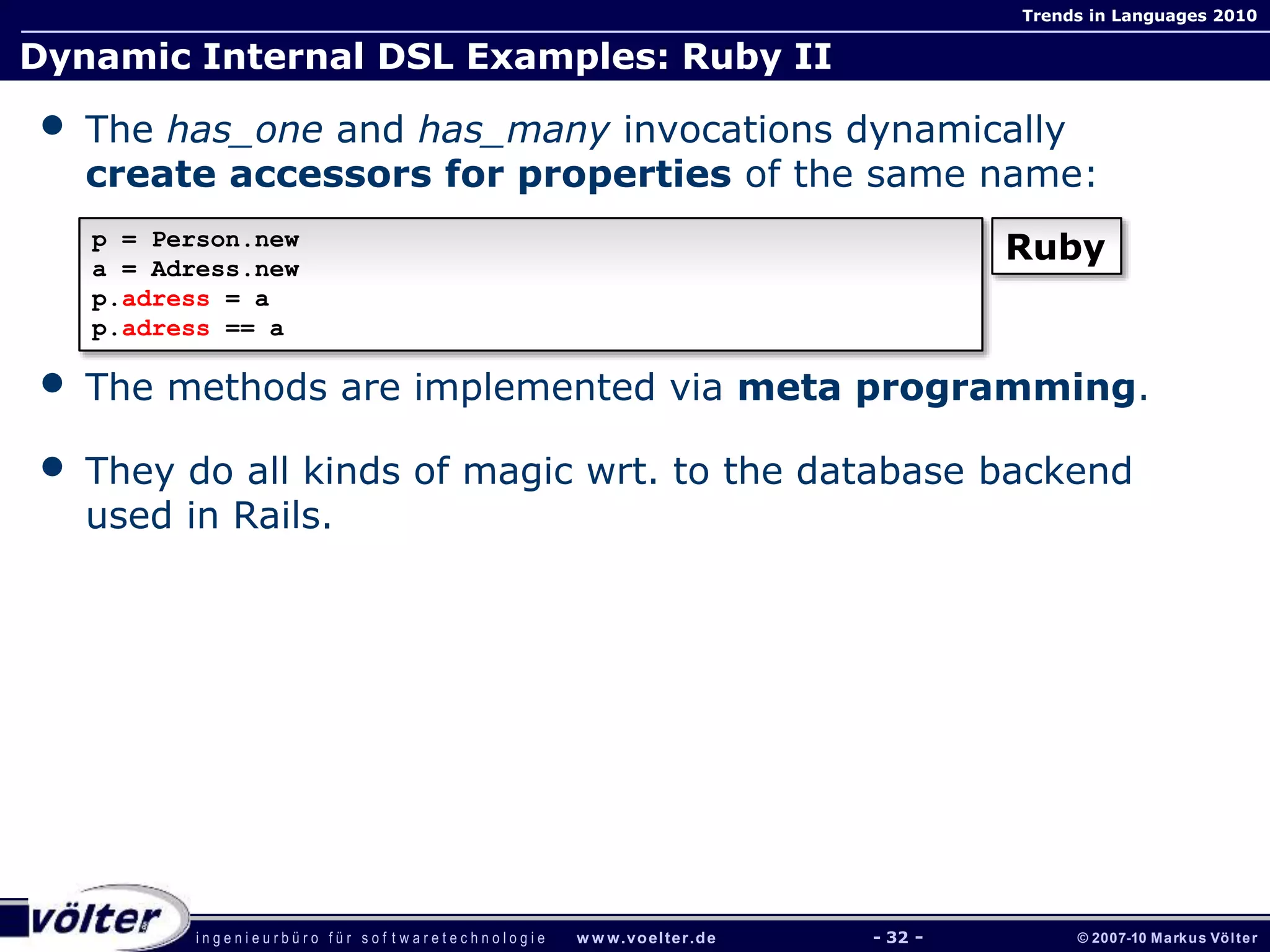
      The has_one and has_many invocations dynamically create accessors for properties of the same name:
      The methods are implemented via meta programming.
      They do all kinds of magic wrt. to the database backend used in Rails.
      p = Person.new
      a = Adress.new
      p.adress= a
      p.adress == a
      Ruby
    33. Static Internal DSL Examples: Scala
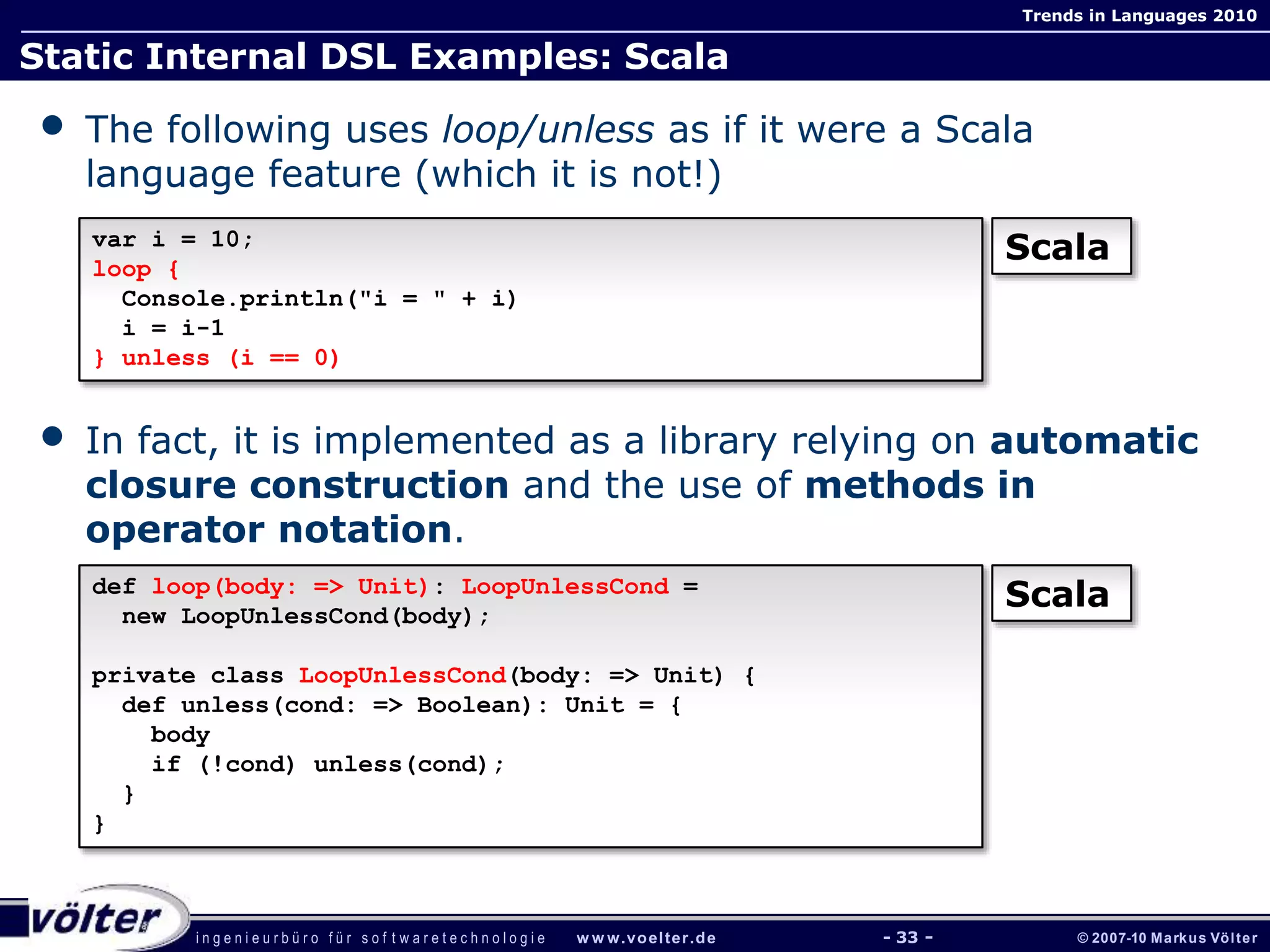
      The following uses loop/unless as if it were a Scala language feature (which it is not!)
      In fact, it is implemented as a library relying on automatic closure construction and the use of methods in operator notation.
      var i = 10;
      loop { Console.println("i = " + i) i = i-1} unless (i == 0)
      Scala
      def loop(body: => Unit): LoopUnlessCond = new LoopUnlessCond(body);
      private class LoopUnlessCond(body: => Unit) { def unless(cond: => Boolean): Unit = { body if (!cond) unless(cond); }}
      Scala
      - 33 -
    34. Static Internal DSL Examples: Boo
      Boo has a full hygienic macro system (open compiler)
      Use it like native language syntax!
      public interface ITransactionable:
      def Dispose(): pass
      def Commit(): pass
      def Rollback(): pass
      Boo
      macro transaction:
      return [|
      tx as ITransactionable = $(transaction.Arguments[0])
      try:
      $(transaction.Body)
      tx.Commit()
      except:
      tx.Rollback()
      raise
      finally:
      tx.Dispse()
      |]
      Boo
      transaction GetNewDatabaseTransaction():
      DoSomethingWithTheDatabase()
      Boo
      - 34 -
    35. Static Internal DSL Examples: Boo
      Boo has a full hygienic macro system (open compiler)
      Use it like native language syntax!
      public interface ITransactionable:
      def Dispose(): pass
      def Commit(): pass
      def Rollback(): pass
      Boo
      macro transaction:
      return [|
      tx as ITransactionable = $(transaction.Arguments[0])
      try:
      $(transaction.Body)
      tx.Commit()
      except:
      tx.Rollback()
      raise
      finally:
      tx.Dispse()
      |]
      Boo
      transaction GetNewDatabaseTransaction():
      DoSomethingWithTheDatabase()
      Boo
      - 35 -
    36. Static Internal DSL Examples: Boo II
      See how the Expression type is used to pass in AST/syntax elements (in this case, an expression)
      [ensure(name is not null)]
      class Customer:
      name as string
      def constructor(name as string): self.name = name
      def SetName(newName as string): name = newName
      Boo
      [AttributeUsage(AttributeTargets.Class)]
      class EnsureAttribute(AbstractAstAttribute):
      expr as Expression
      def constructor(expr as Expression):
      self.expr = expr
      def Apply(target as Node):
      type as ClassDefinition = target
      for member in type.Members:
      method = member as Method
      block = method.Body
      method.Body = [|
      block:
      try:
      $block
      ensure:
      assert $expr
      |].Block
      Boo
      Boo examples taken from Ayende Rahien and Oren Eini‘s InfoQ article Building Domain Specific Languages on the CLR
    37. - 37 -
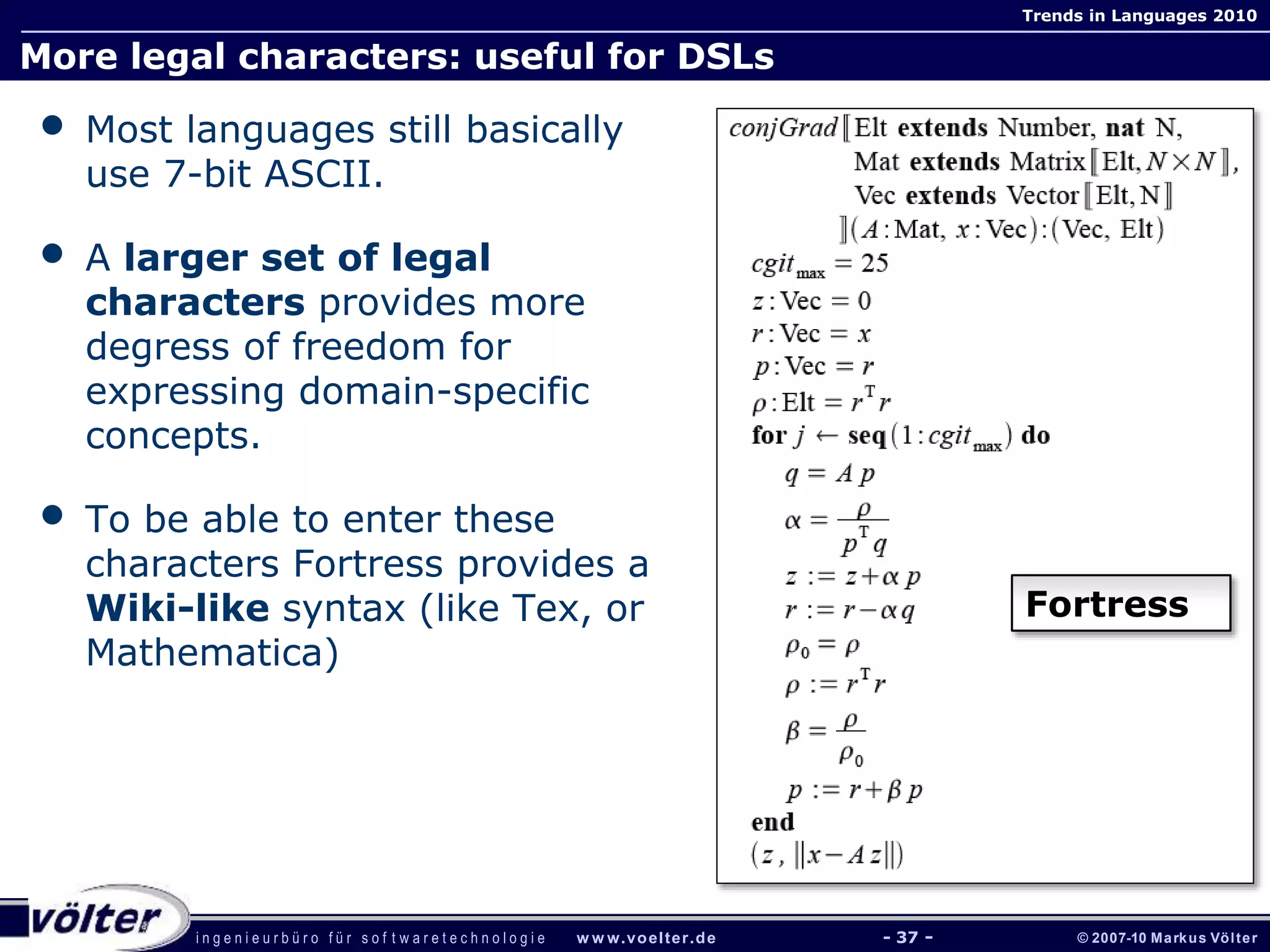
      More legal characters: useful for DSLs
      Most languages still basically use 7-bit ASCII.
      A larger set of legal characters provides more degress of freedom for expressing domain-specific concepts.
      To be able to enter these characters Fortress provides a Wiki-like syntax (like Tex, or Mathematica)
      Fortress
    38. - 38 -
      External DSLs
      Aka Model-Driven Software Development.
      Notation:
      Textual (antlr, Xtext)
      Graphical (GMF, MetaEdit+)
      Or even a mixture (Intentional)
      Execution: Interpretation vs. Code Generation
      Or even a mixture?
      Other advantages:
      Language Specific Tooling (syntax coloring and completion)
      Domain Specific Constraints
      But this is another talk…
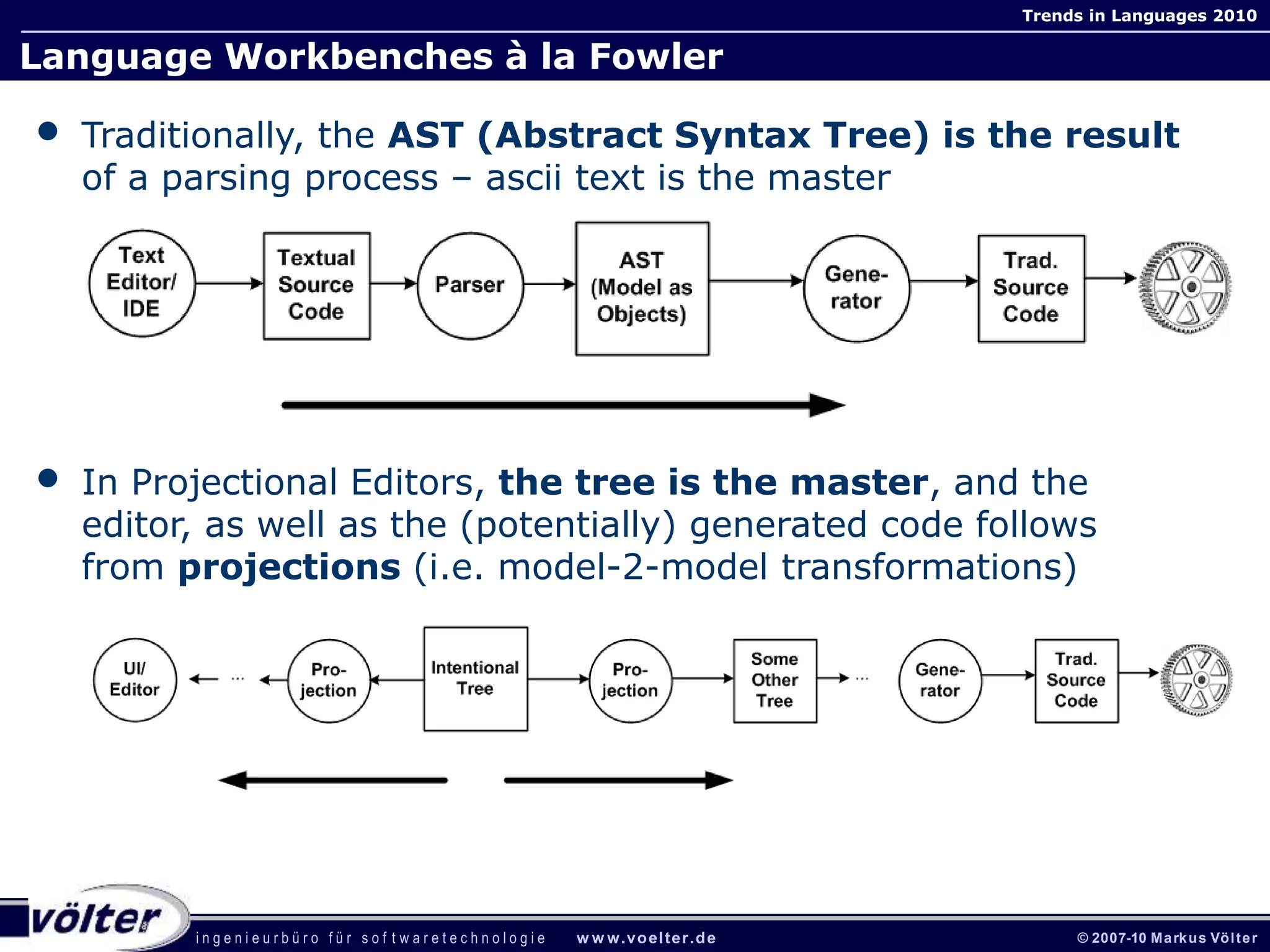
    39. Language Workbenches à la Fowler
      • Traditionally, the AST (Abstract Syntax Tree) is the result of a parsing process – ascii text is the master
      • In Projectional Editors, the tree is the master, and the editor, as well as the (potentially) generated code follows from projections (i.e. model-2-model transformations)
    40. Benefits of Projectional Editing
      • Syntax can be ambiguous
      • Language Modularization becomes much simpler – because see above
      • Language modules can be composed at the site of use – no explicit grammar composition necessary.
      • A much larger range of symbols can be used
      • Textual can graphical notations can be treated similarly
      • Simplifies mixing
      • Semi-graphical notations (mathematical symbols) can be used
      • NB: Parser technology also evolves, scannerless parsers can do some of the same things.
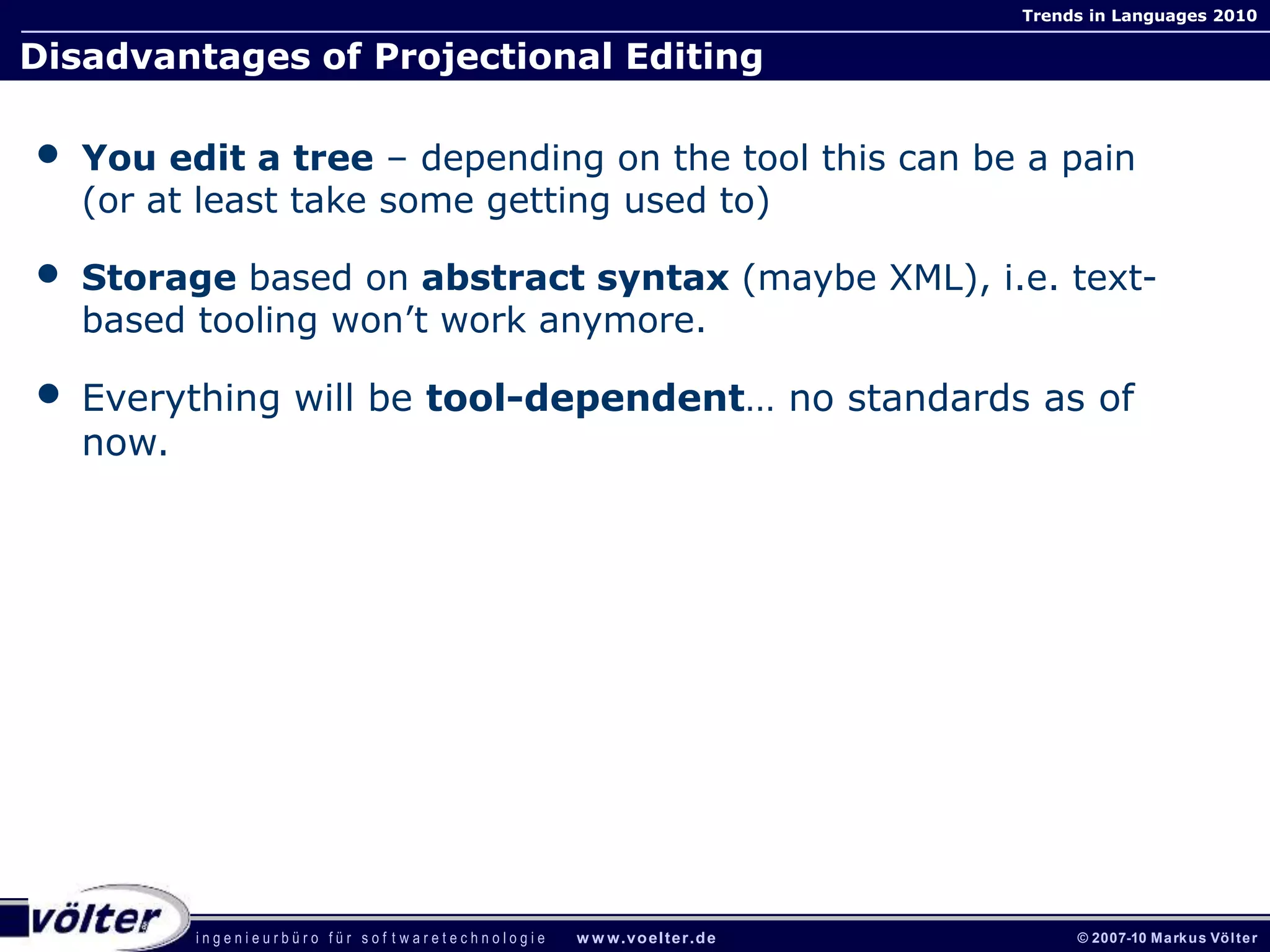
    41. Disadvantages of Projectional Editing
      • You edit a tree – depending on the tool this can be a pain (or at least take some getting used to)
      • Storage based on abstract syntax (maybe XML), i.e. text-based tooling won’t work anymore.
      • Everything will betool-dependent… nostandardsasofnow.
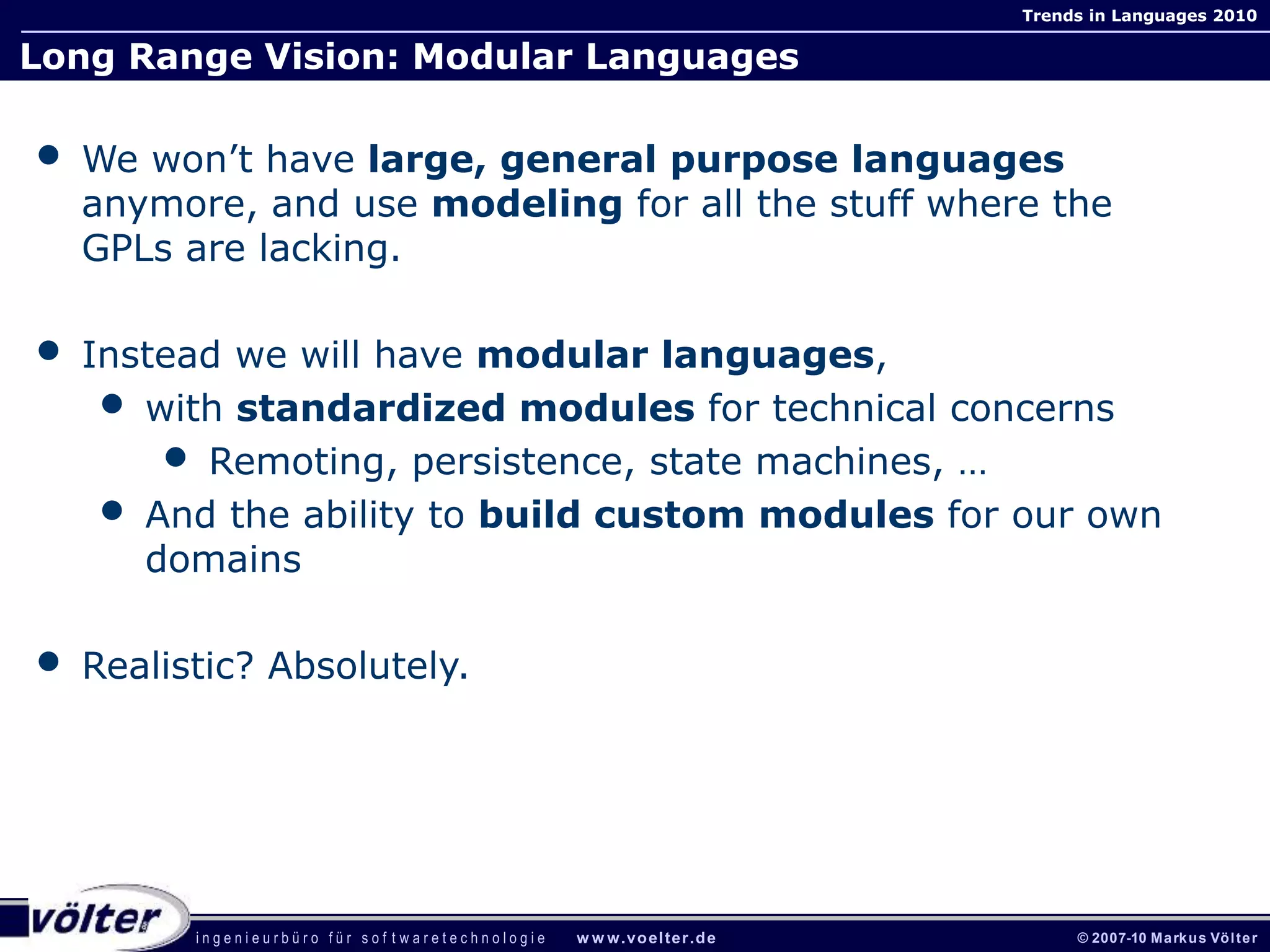
    42. Long Range Vision: Modular Languages
      • We won’t have large, general purpose languages anymore, and use modeling for all the stuff where the GPLs are lacking.
      • Instead we will have modular languages,
      • with standardized modules for technical concerns
      • Remoting, persistence, state machines, …
      • And the ability to build custom modules for our own domains
      • Realistic? Absolutely.
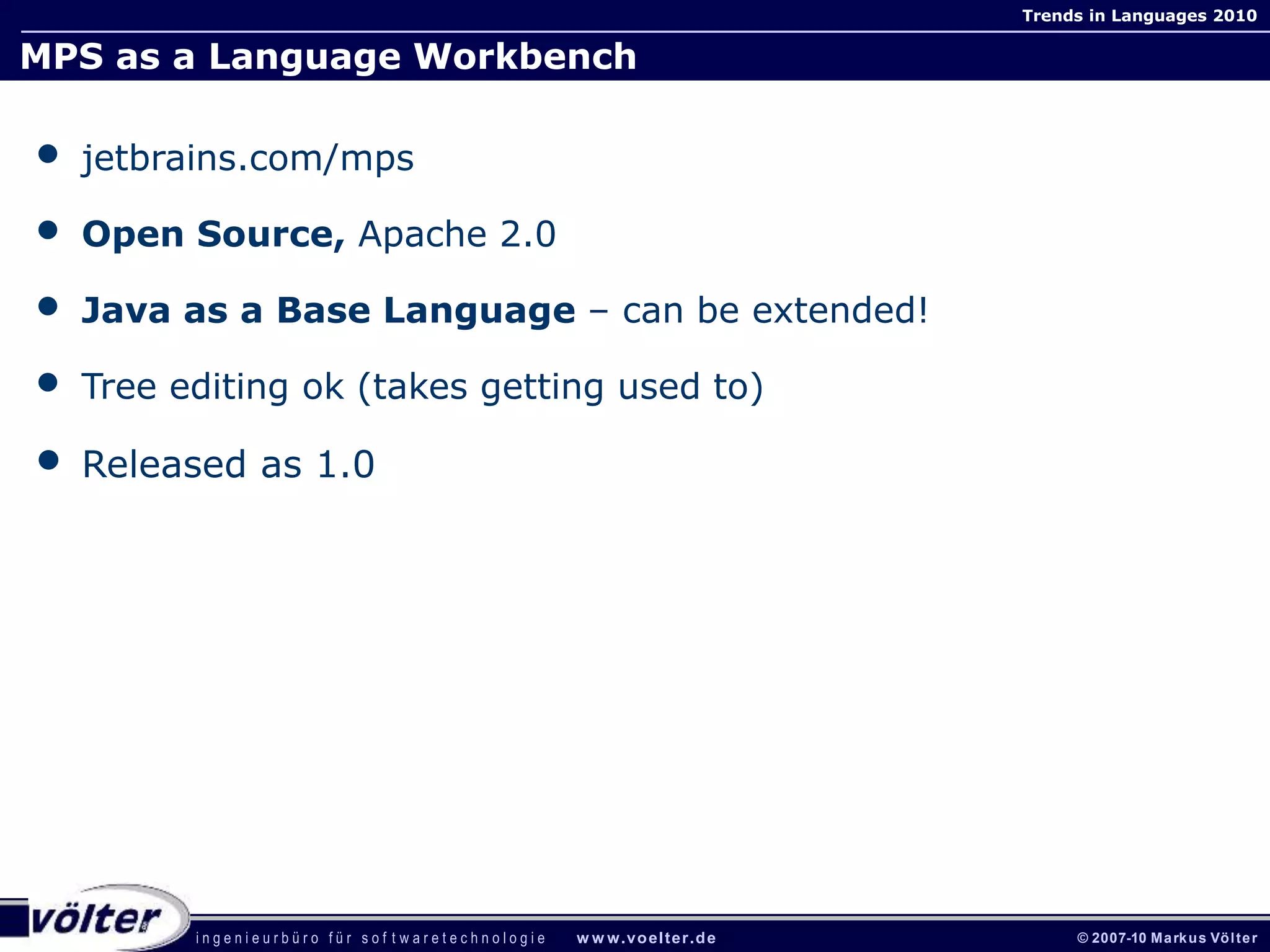
    43. MPS as a Language Workbench
      • jetbrains.com/mps
      • Open Source, Apache 2.0
      • Java as a Base Language – canbeextended!
      • Treeediting ok (takesgettingusedto)
      • Released as 1.0
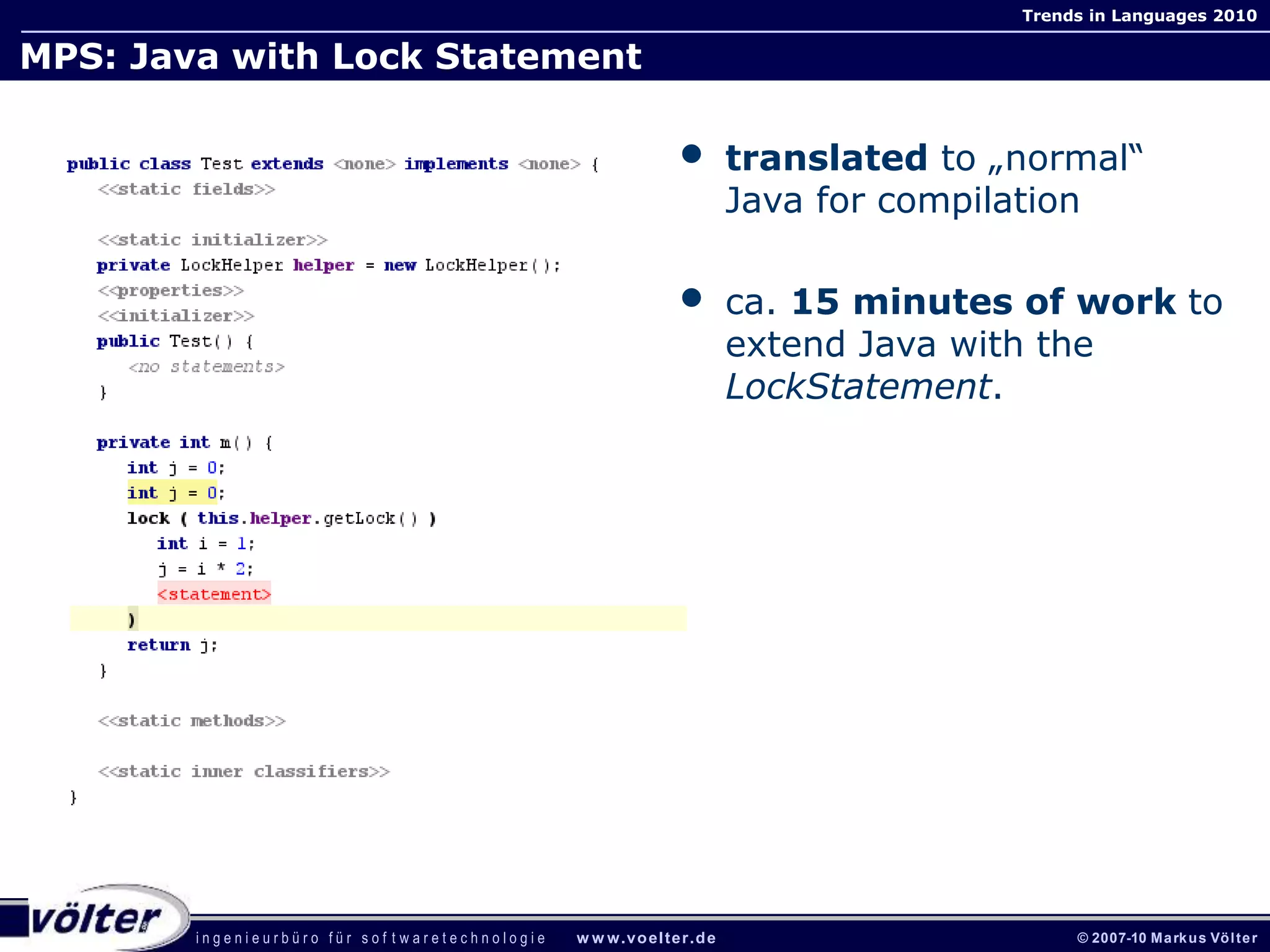
    44. MPS: Java with Lock Statement
      • translated to „normal“ Java for compilation
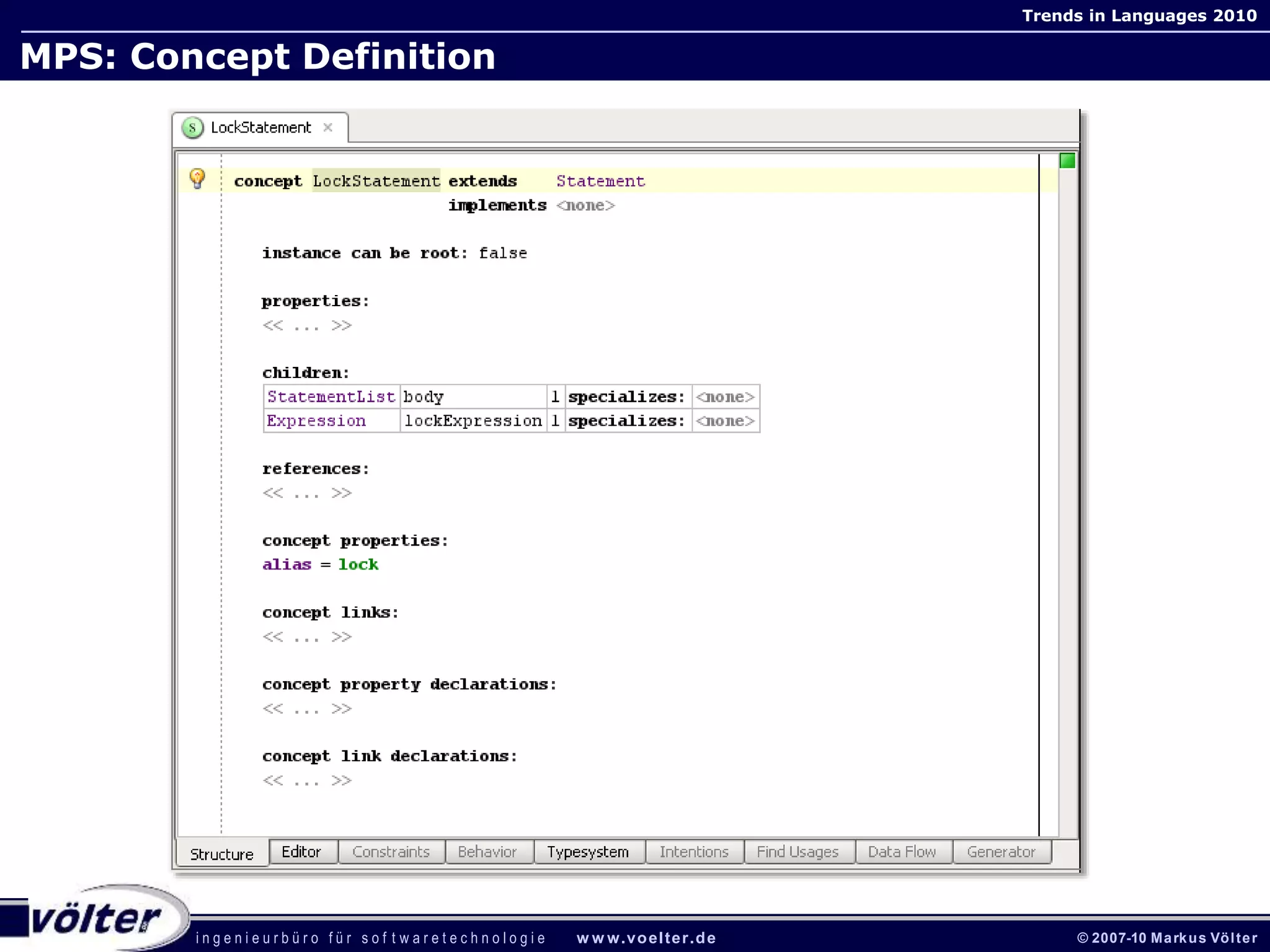
      • ca. 15 minutes of work to extend Java with the LockStatement.
    45. MPS: Concept Definition
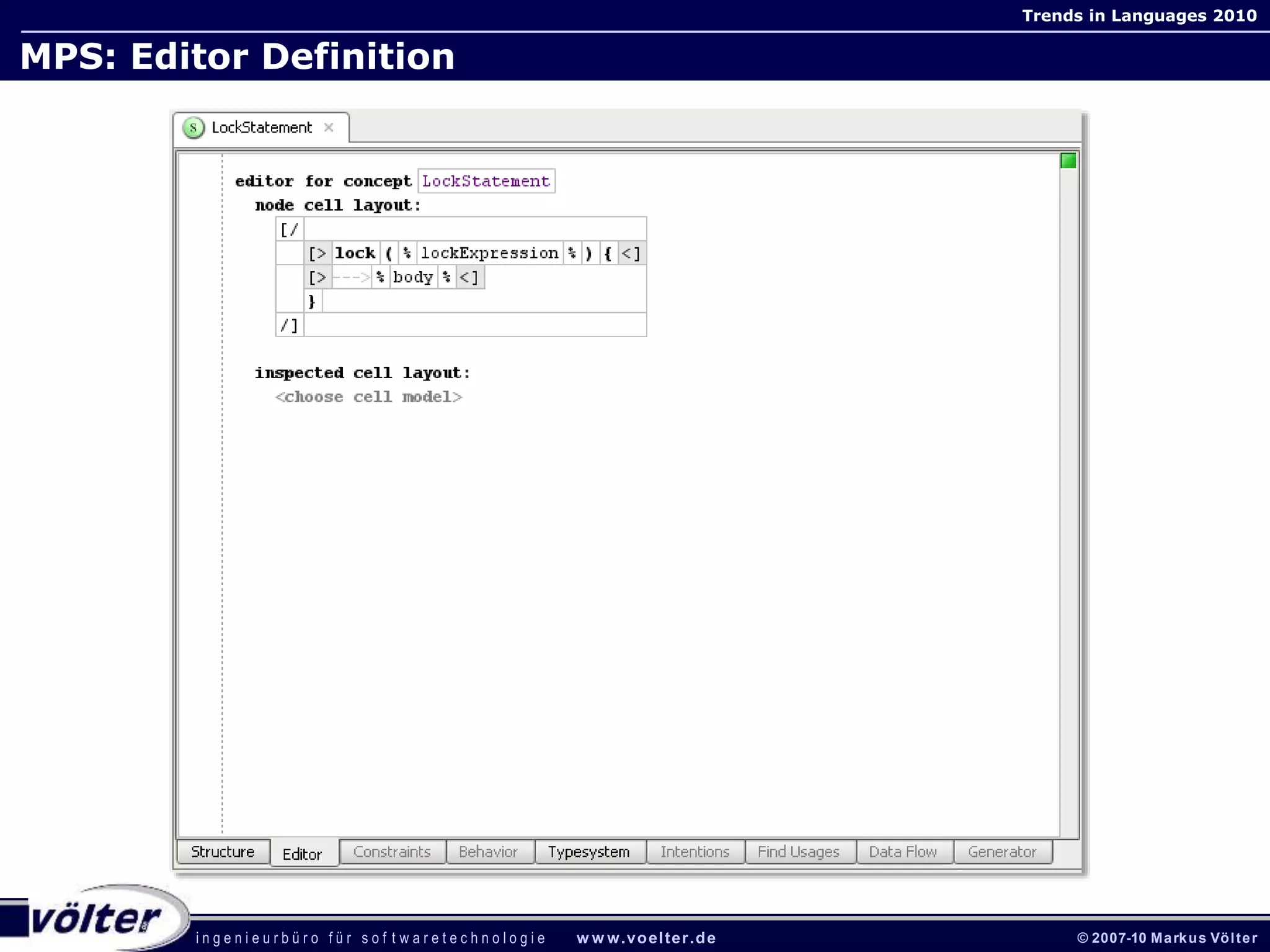
    46. MPS: Editor Definition
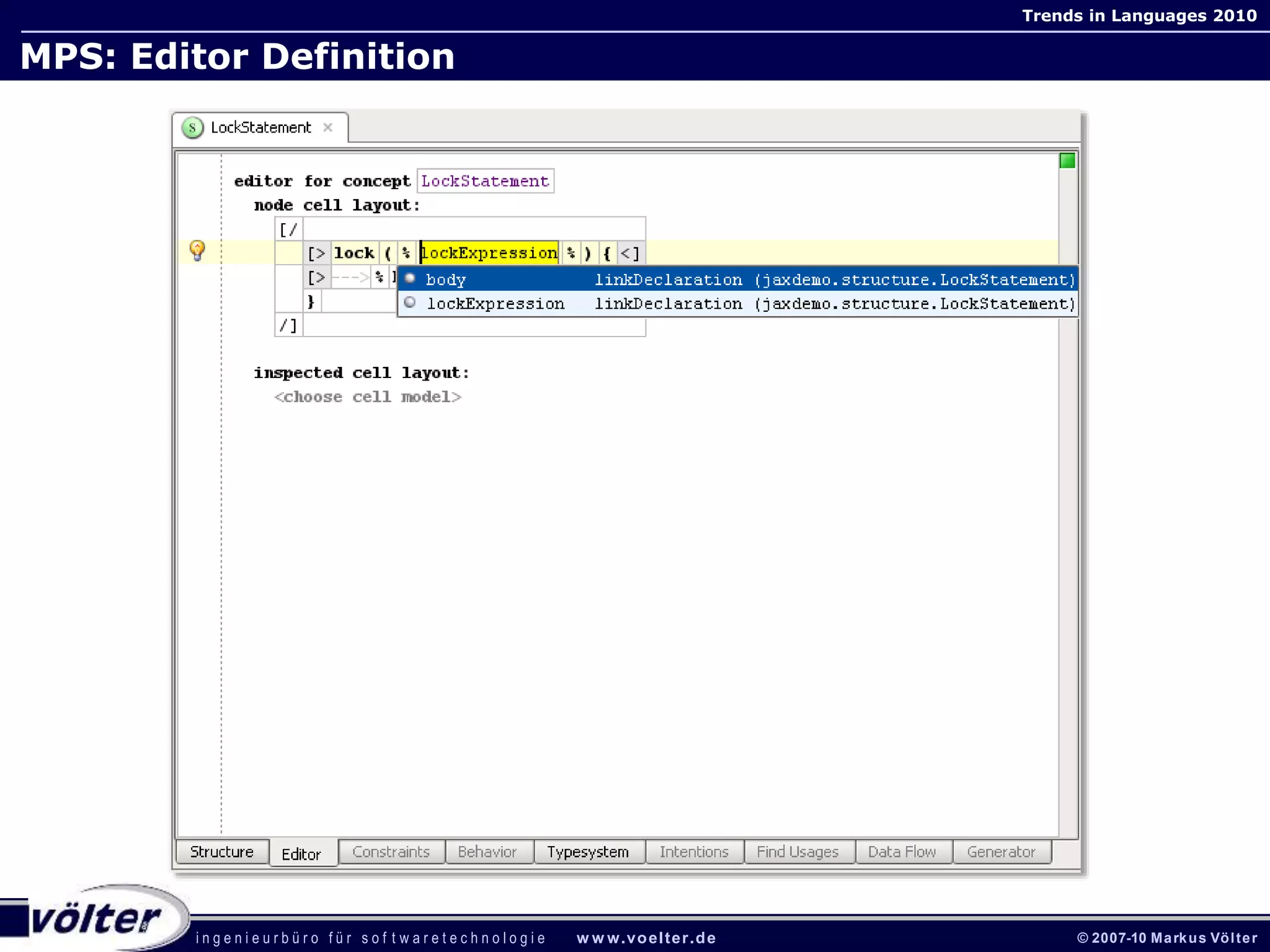
    47. MPS: Editor Definition
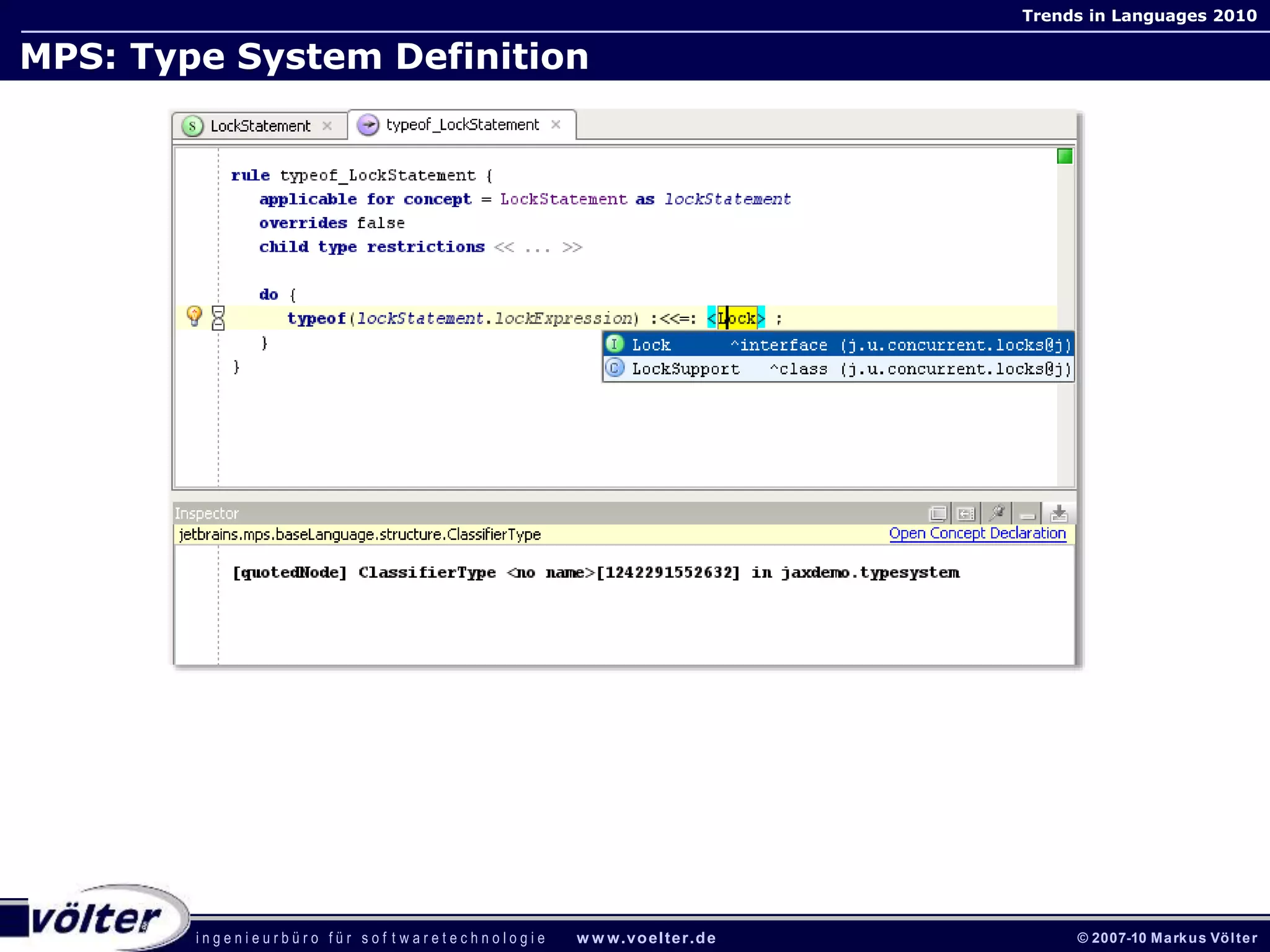
    48. MPS: Type System Definition
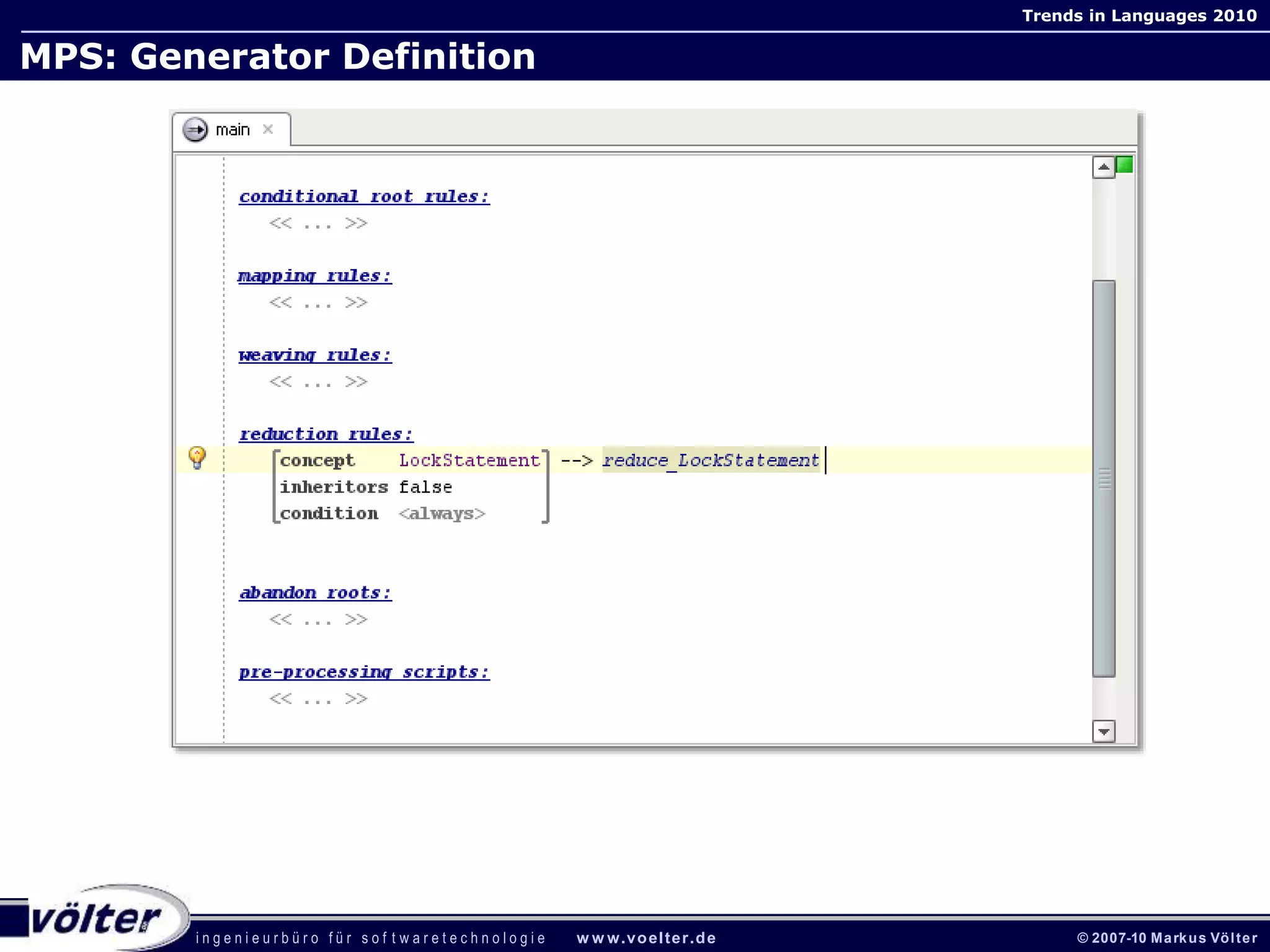
    49. MPS: Generator Definition
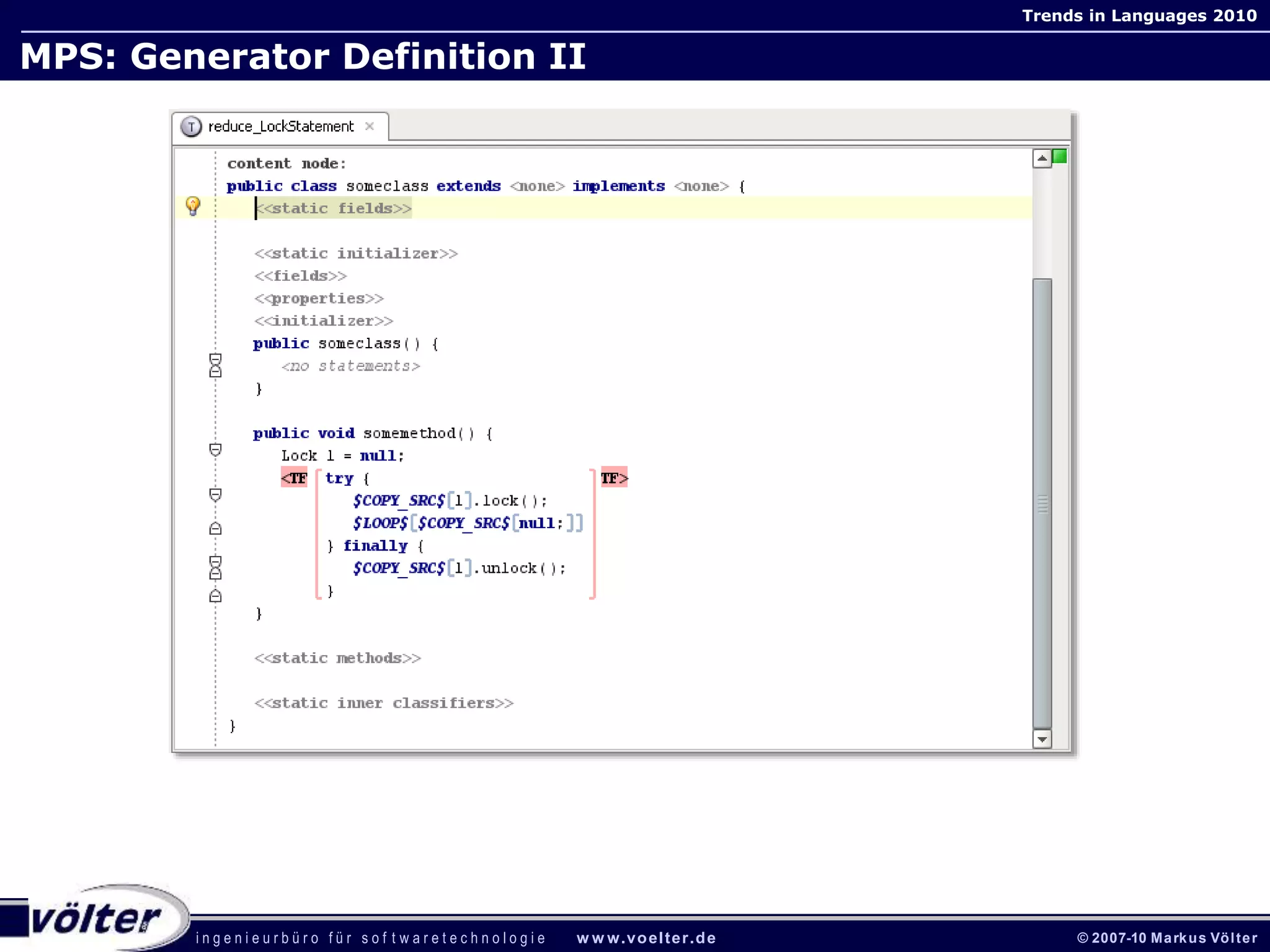
    50. MPS: Generator Definition II
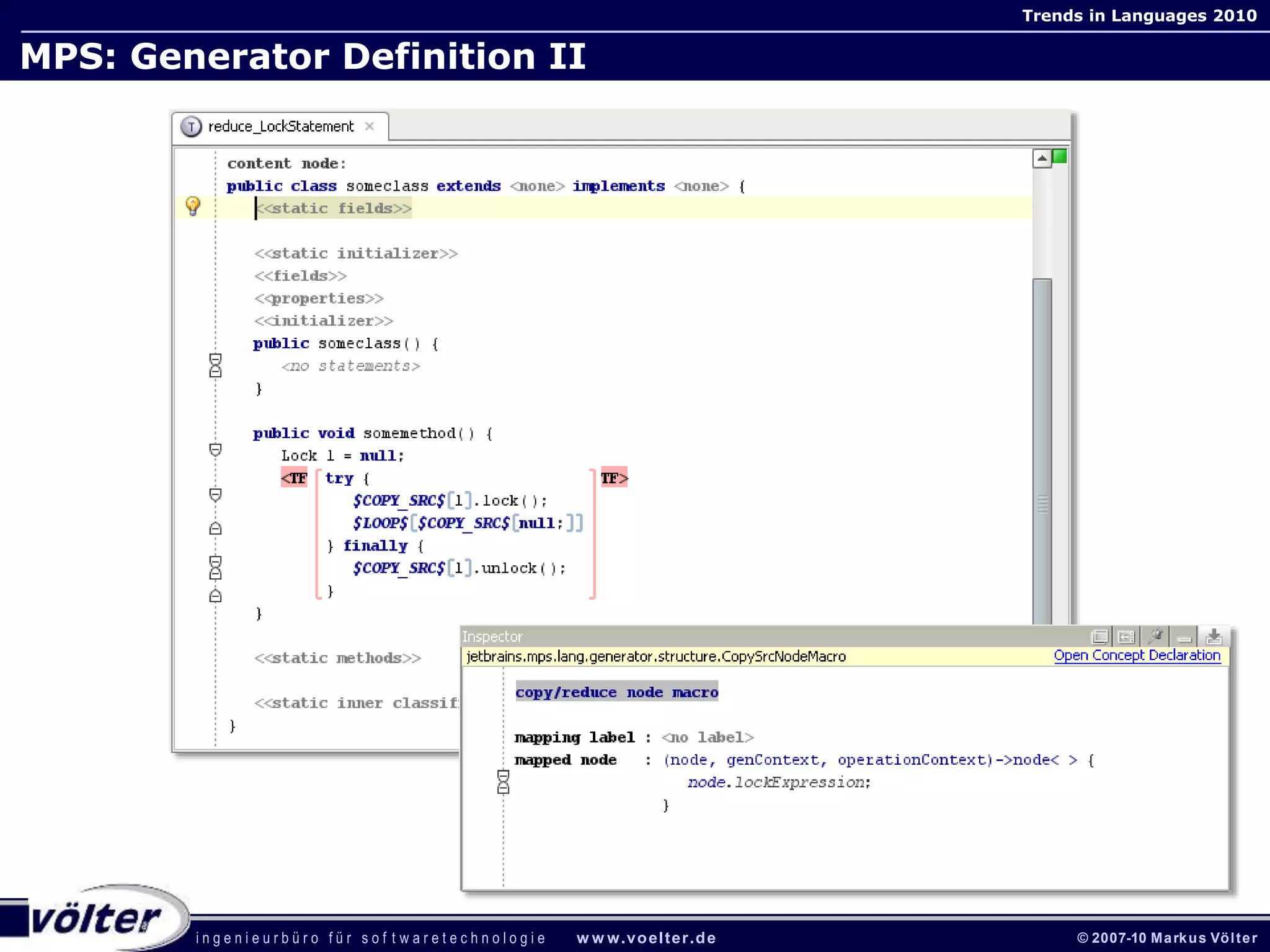
    51. MPS: Generator Definition II
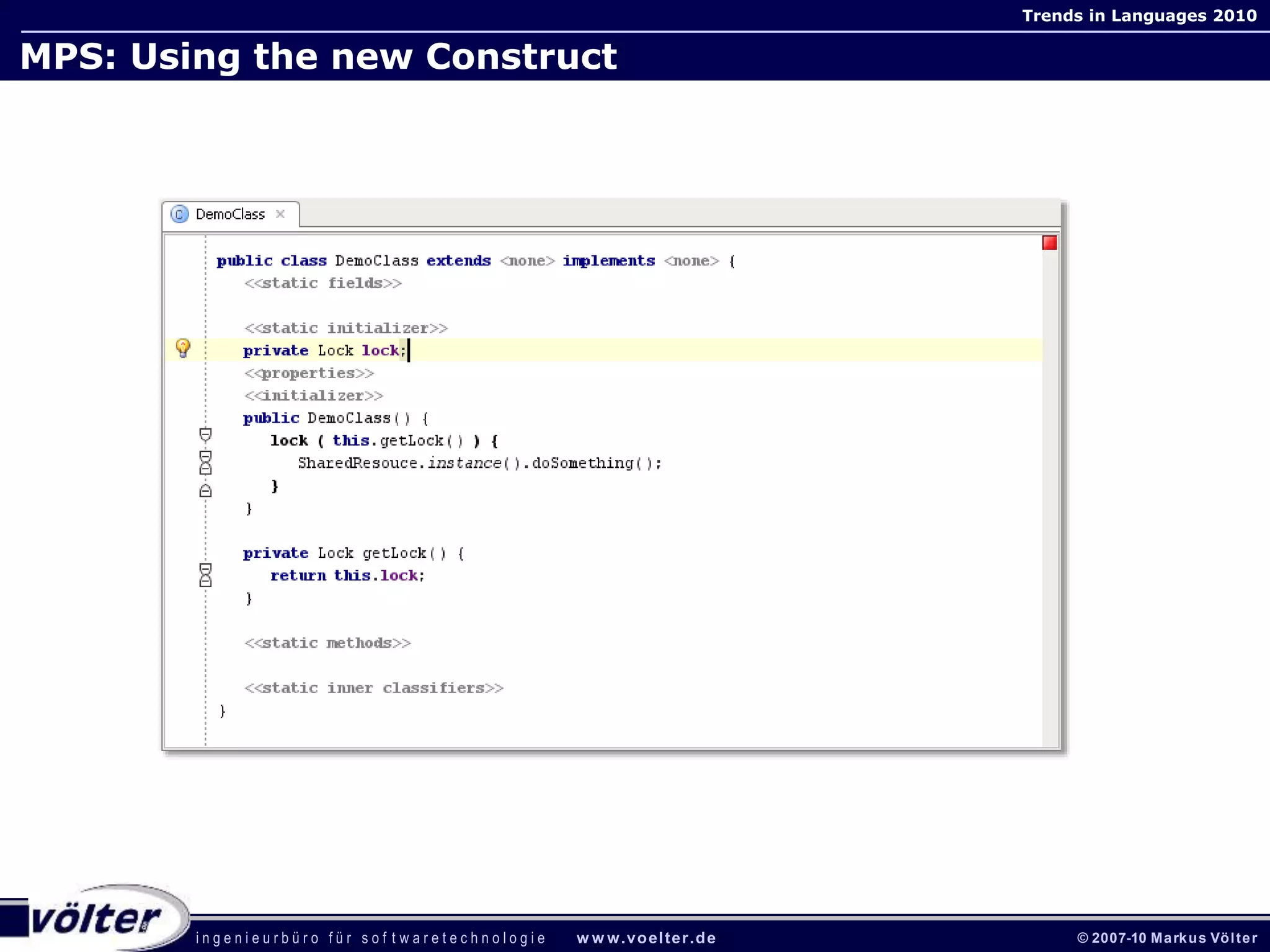
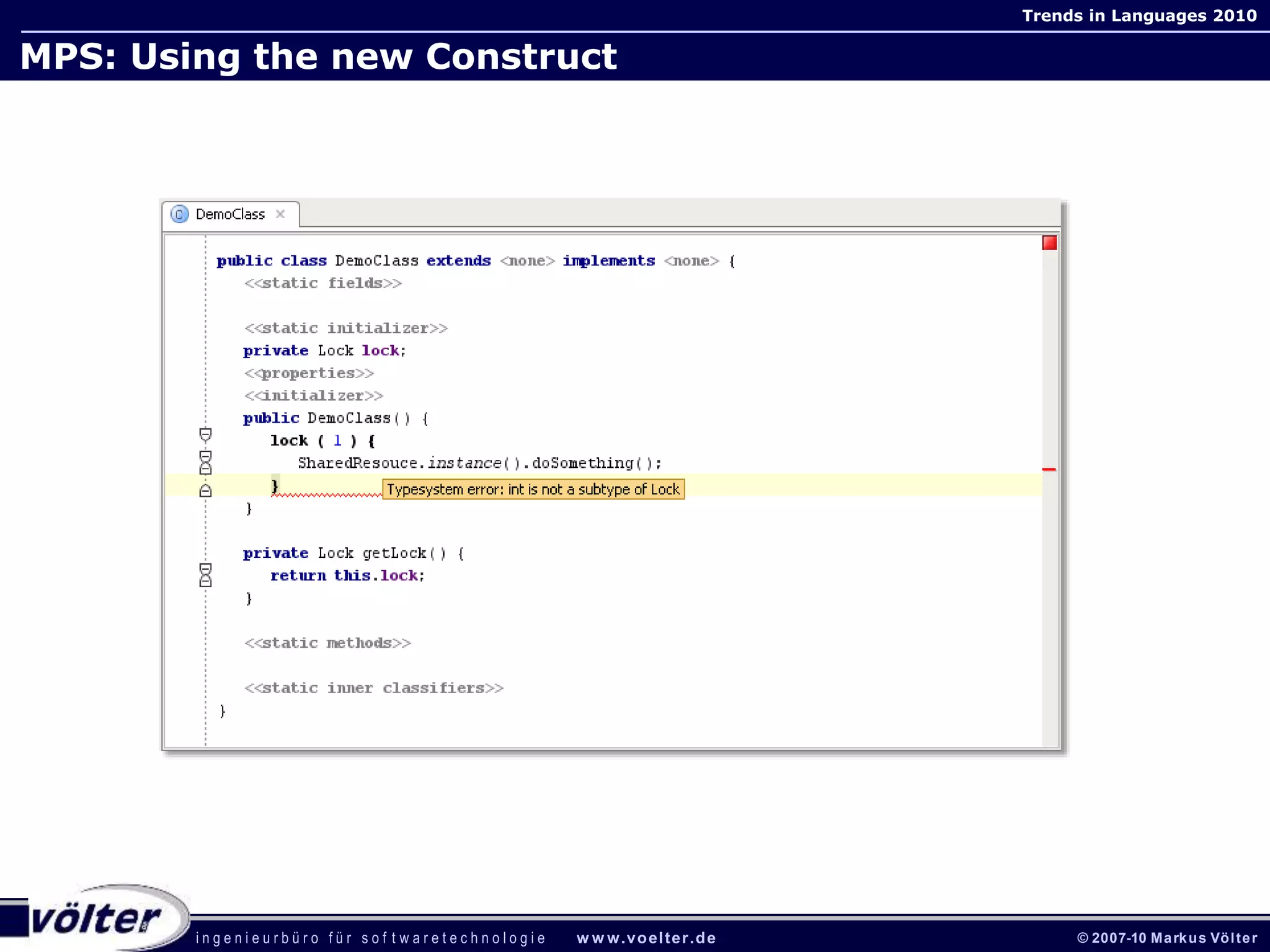
    52. MPS: Using the new Construct
    53. MPS: Using the new Construct
    54. - 54 -
      C O N T E N T S
      Intro and Overview
      Typing
      OO +/vs. Functional
      Metaprogramming & DSLs
      Contracts
      Concurrency
      Platforms
      Tools
      Summary
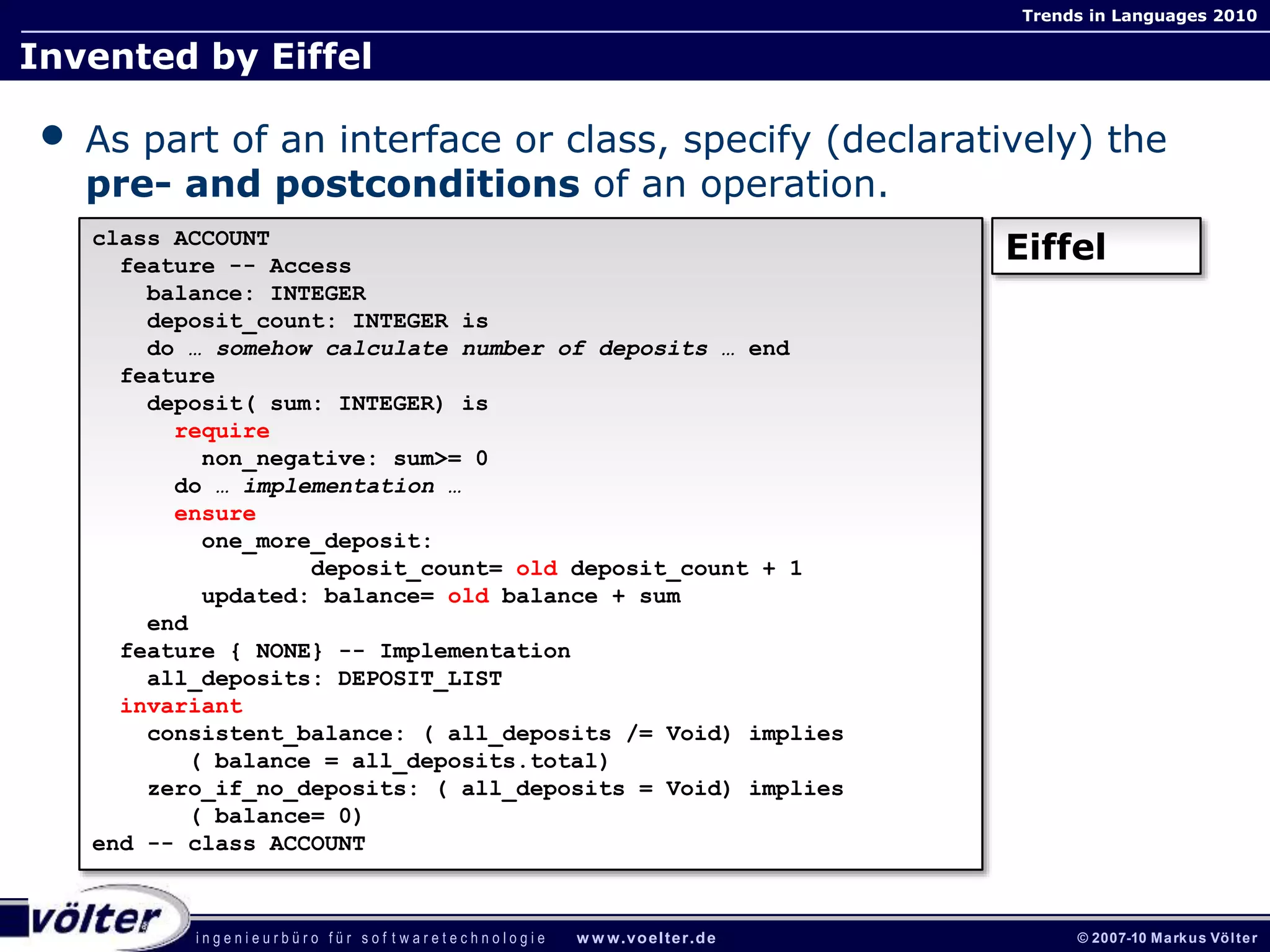
    55. Invented by Eiffel
      As part of an interface or class, specify (declaratively) the pre- and postconditions of an operation.
      class ACCOUNT
      feature -- Access
      balance: INTEGER
      deposit_count: INTEGER is
      do … somehow calculate number of deposits … end
      feature
      deposit( sum: INTEGER) is
      require
      non_negative: sum>= 0
      do … implementation …
      ensure
      one_more_deposit:
      deposit_count= old deposit_count + 1
      updated: balance= old balance + sum
      end
      feature { NONE} -- Implementation
      all_deposits: DEPOSIT_LIST
      invariant
      consistent_balance: ( all_deposits /= Void) implies
      ( balance = all_deposits.total)
      zero_if_no_deposits: ( all_deposits = Void) implies
      ( balance= 0)
      end -- class ACCOUNT
      Eiffel
      - 55 -
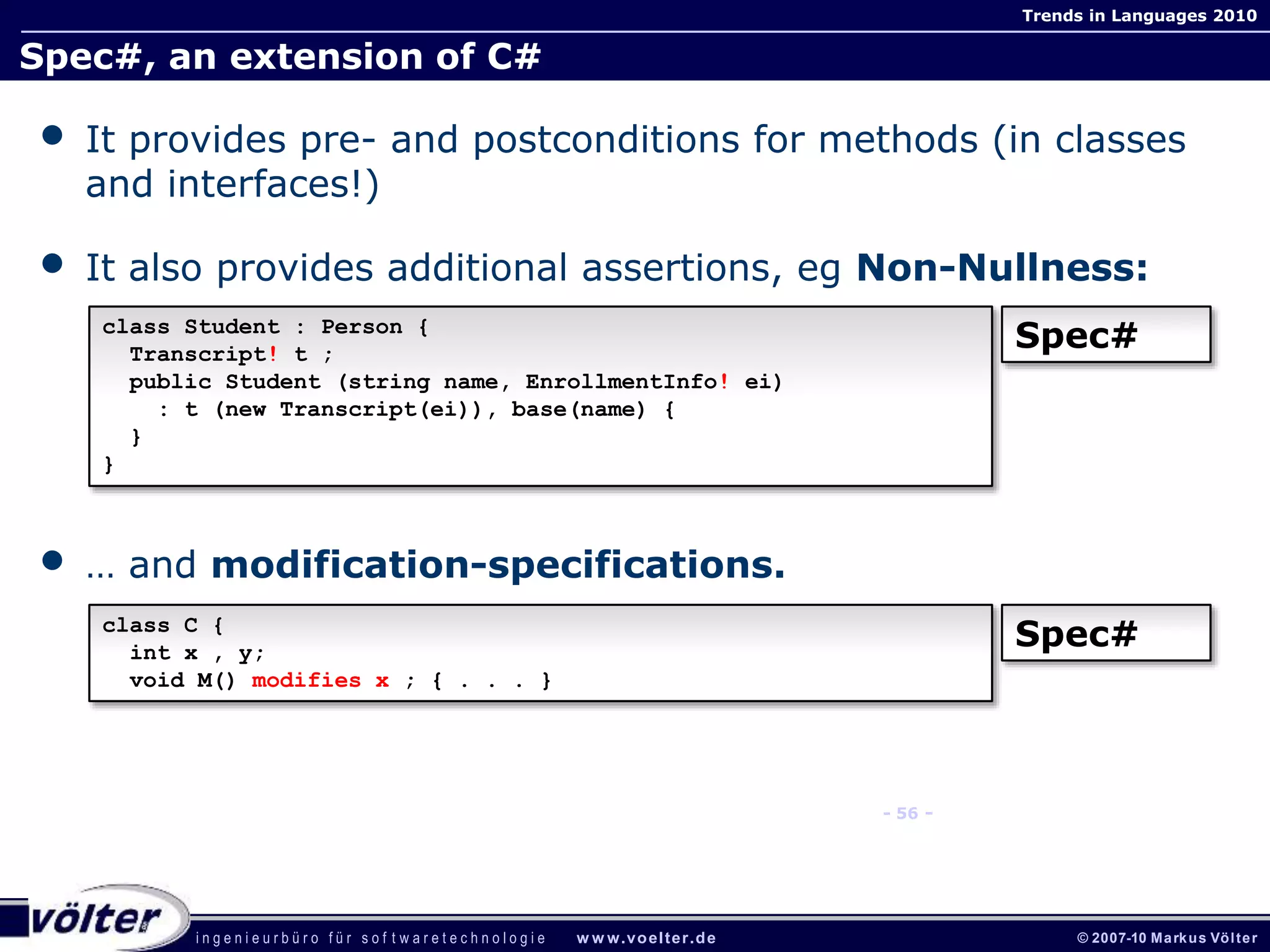
    56. Spec#, an extension of C#
      It provides pre- and postconditions for methods (in classes and interfaces!)
      It also provides additional assertions, eg Non-Nullness:
      … and modification-specifications.
      class Student : Person { Transcript! t ;
      public Student (string name, EnrollmentInfo! ei)
      : t (new Transcript(ei)), base(name) {
      }
      }
      Spec#
      class C {
      int x , y;
      void M() modifies x ; { . . . }
      Spec#
      - 56 -
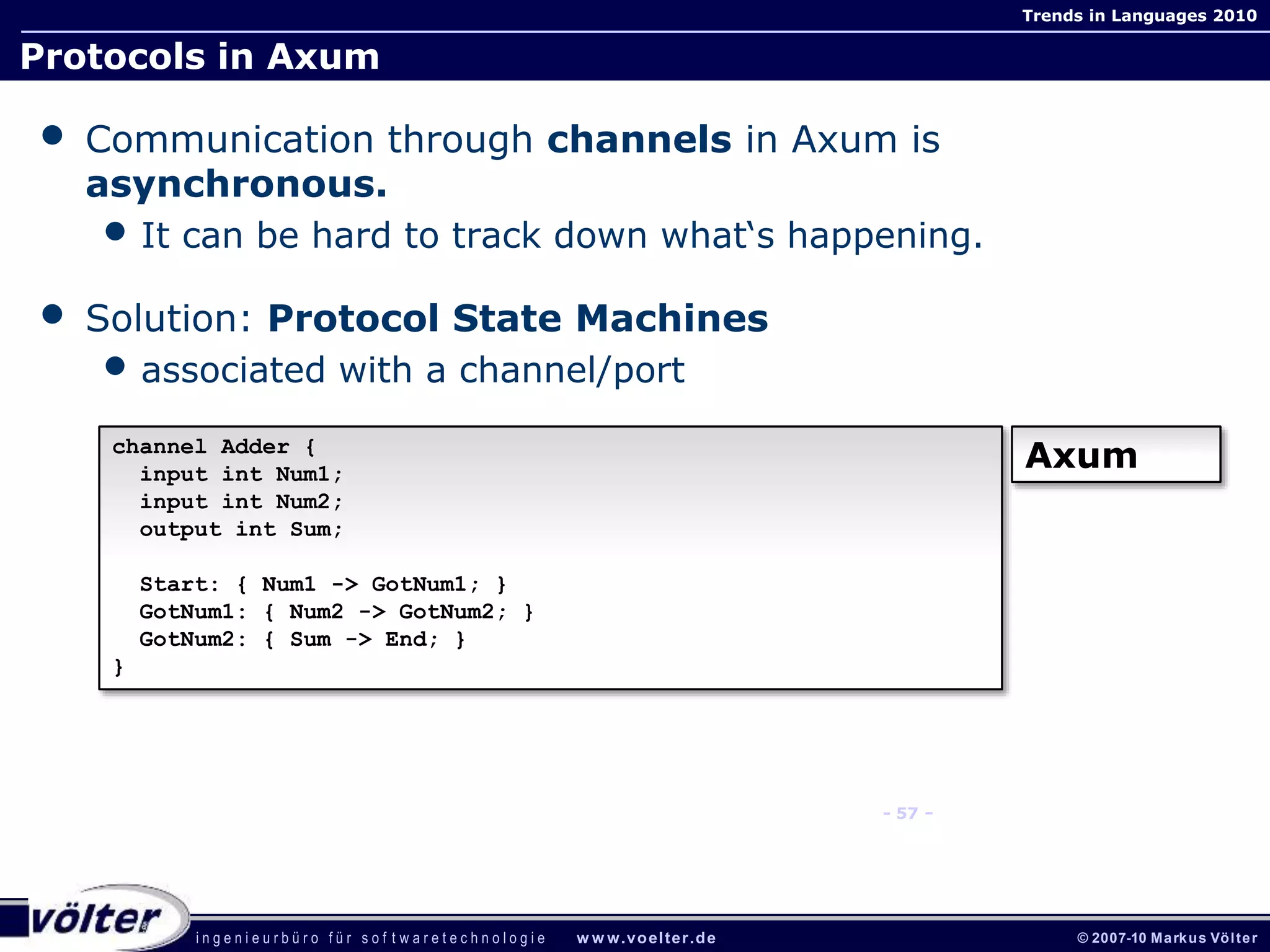
    57. Protocols in Axum
      Communication through channels in Axum is asynchronous.
      It can be hard to track down what‘s happening.
      Solution: Protocol State Machines
      associated with a channel/port
      channel Adder { input int Num1; input int Num2; output int Sum;
      Start: { Num1 -> GotNum1; } GotNum1: { Num2 -> GotNum2; } GotNum2: { Sum -> End; }
      }
      Axum
      - 57 -
    58. - 58 -
      C O N T E N T S
      Intro and Overview
      Typing
      OO +/vs. Functional
      Metaprogramming & DSLs
      Contracts
      Concurrency
      Platforms
      Tools
      Summary
    59. - 59 -
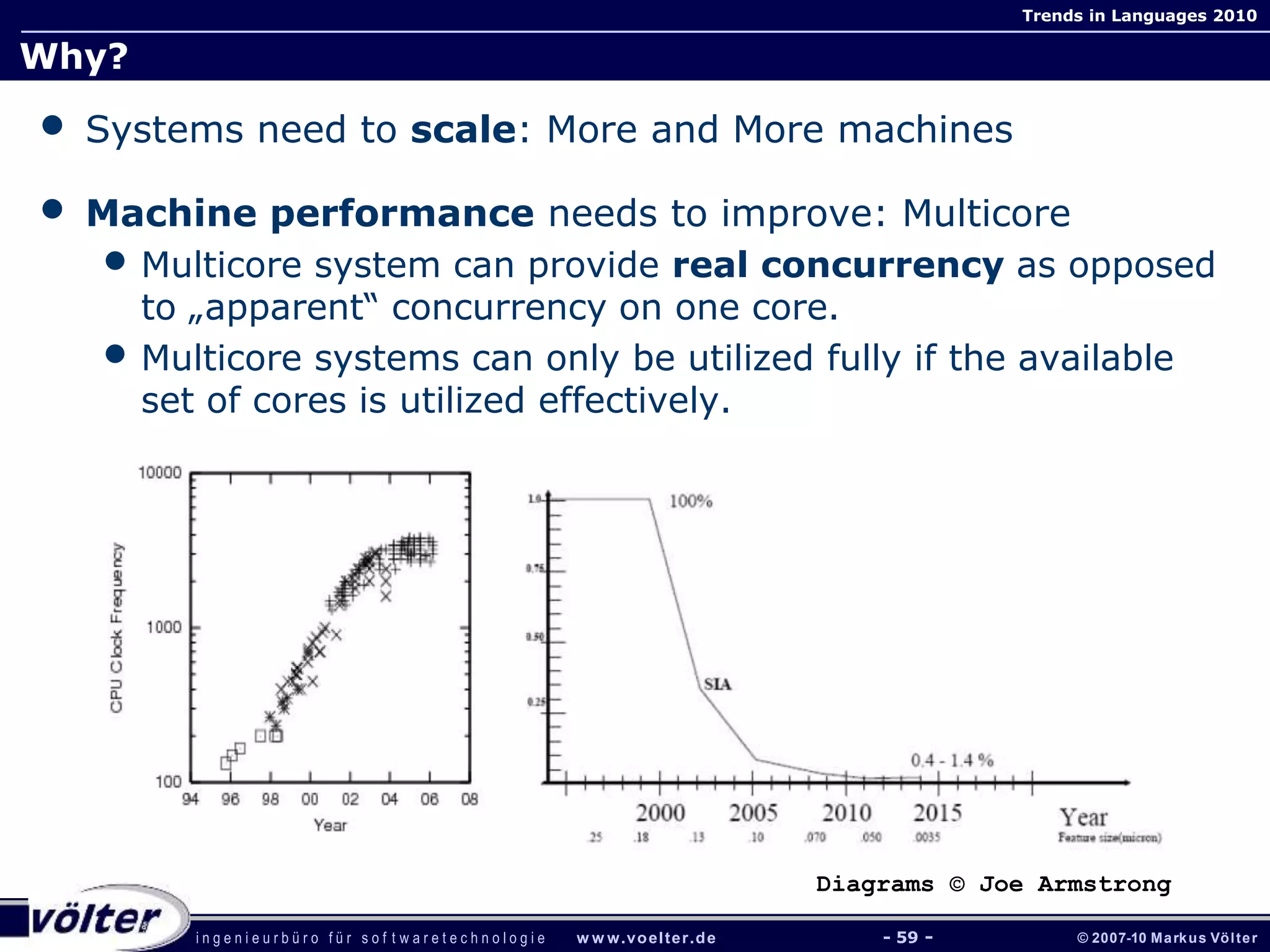
      Why?
      Systems need to scale: More and More machines
      Machine performance needs to improve: Multicore
      Multicore system can provide real concurrency as opposed to „apparent“ concurrency on one core.
      Multicore systems can only be utilized fully if the available set of cores is utilized effectively.
      Diagrams © Joe Armstrong
    60. - 60 -
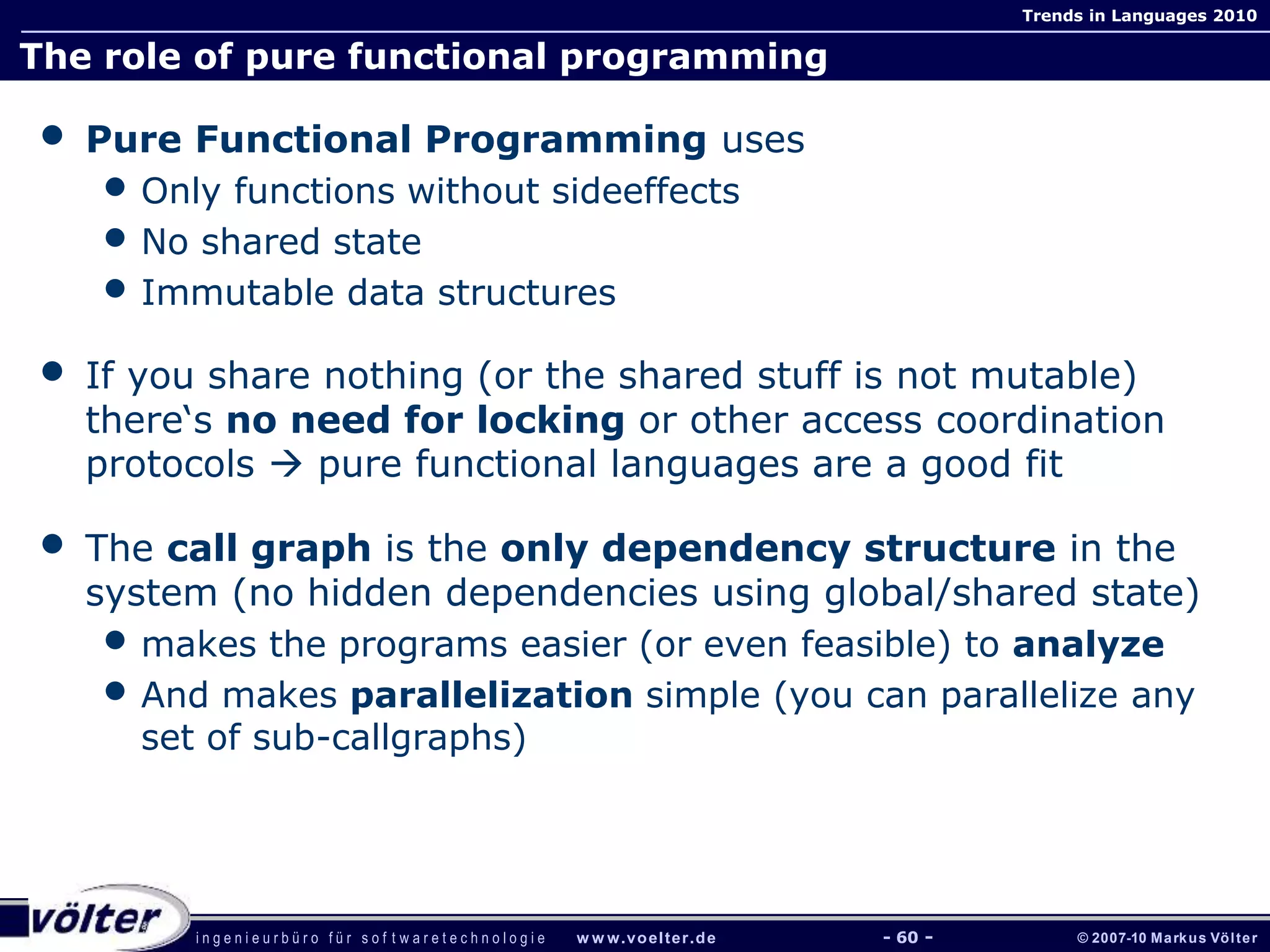
      The role of pure functional programming
      Pure Functional Programming uses
      Only functions without sideeffects
      No shared state
      Immutable data structures
      If you share nothing (or the shared stuff is not mutable) there‘s no need for locking or other access coordination protocols  pure functional languages are a good fit
      The call graph is the only dependency structure in the system (no hidden dependencies using global/shared state)
      makes the programs easier (or even feasible) to analyze
      And makes parallelization simple (you can parallelize any set of sub-callgraphs)
    61. - 61 -
      Shared Memory Concurrency
      Mainstream languages use shared memory:
      A process (address space) can host any numer of thread
      Threads can share data
      They need to coordinate via locking
      Locking has to be implemented manually by developers via an agreed locking/coordination protocol
      Often very complex (non-local)
      Error prone, because there‘s little language/tool support
      Overspecification: „Acquire/Release Lock X“ vs. „Pretend this were sequential/atomic“
      Solution: Express atomicity requirements with language primitives as opposed to using locking protocol API Transactional Memory
    62. Shared Memory Concurrency: Transactional Memory
      Transactional Memory in Fortress:
      This formulation says nothing about specific locks and their allocation and release:
      Less error prone
      More potential for optimizations of compiler and RT system
      Similar in Spirit to Garbage Collection (Dan Grossman):
      Rely on clever compiler and RT system
      Solution might not always be optimal
      … but good enough in 99% of cases
      and much less (error prone) work.
      atomic do
      // thestuffhereisexecutedasif
      // there was onlythisthread
      end
      Fortress
      - 62 -
    63. STM in Clojure
      Define a ref, an a „piece of transactional memory“
      Accessing a ref has to happen in a transaction, otherwise an exception is thrown
      user => (def foo (ref 0))
      #'user/foo
      user => @foo // (deref foo) is similar
      0
      Clojure
      user=> (dosync (ref-set foo 1))
      1
      user => @foo
      1
      Clojure
      - 63 -
    64. More bad overspecification
      Overspecification generally prohibits a compiler or runtime system from introducing optimizations.
      Example: Assume you want to do something for each element of a collection
      (Old) Java solution enforces total ordering. Intended?
      Compiler cannot remove ordering
      (New) Java solution: no ordering implied
      Intent is expressed more clearly
      for ( inti=0; i < data.length; i++ ) {
      // do a computation with data[i]
      }
      Java < 5
      foreach ( DataStructureds in data ) {
      // do something with ds
      }
      Java 5
      - 64 -
    65. The default is parallel
      In Fortress, a loop is by default parallel
      i.e. the compiler can distribute it to several cores
      If you need sequential execution, you have to explicitly specify that.
      Fortress does more for concurrency:
      it knows about machine resources (processors, memory)
      Allocates to those resources explicitly or automatically
      for I <- 1:m, j <- 1:n do
      a[i,j] := b[i] c[j]
      end
      Fortress
      for i <- seq(1:m) do
      for j <- seq(1:n) do
      print a[i,j]
      end
      end
      Fortress
      - 65 -
    66. - 66 -
      „Shared Memory is BAD“ (Joe Armstrong)
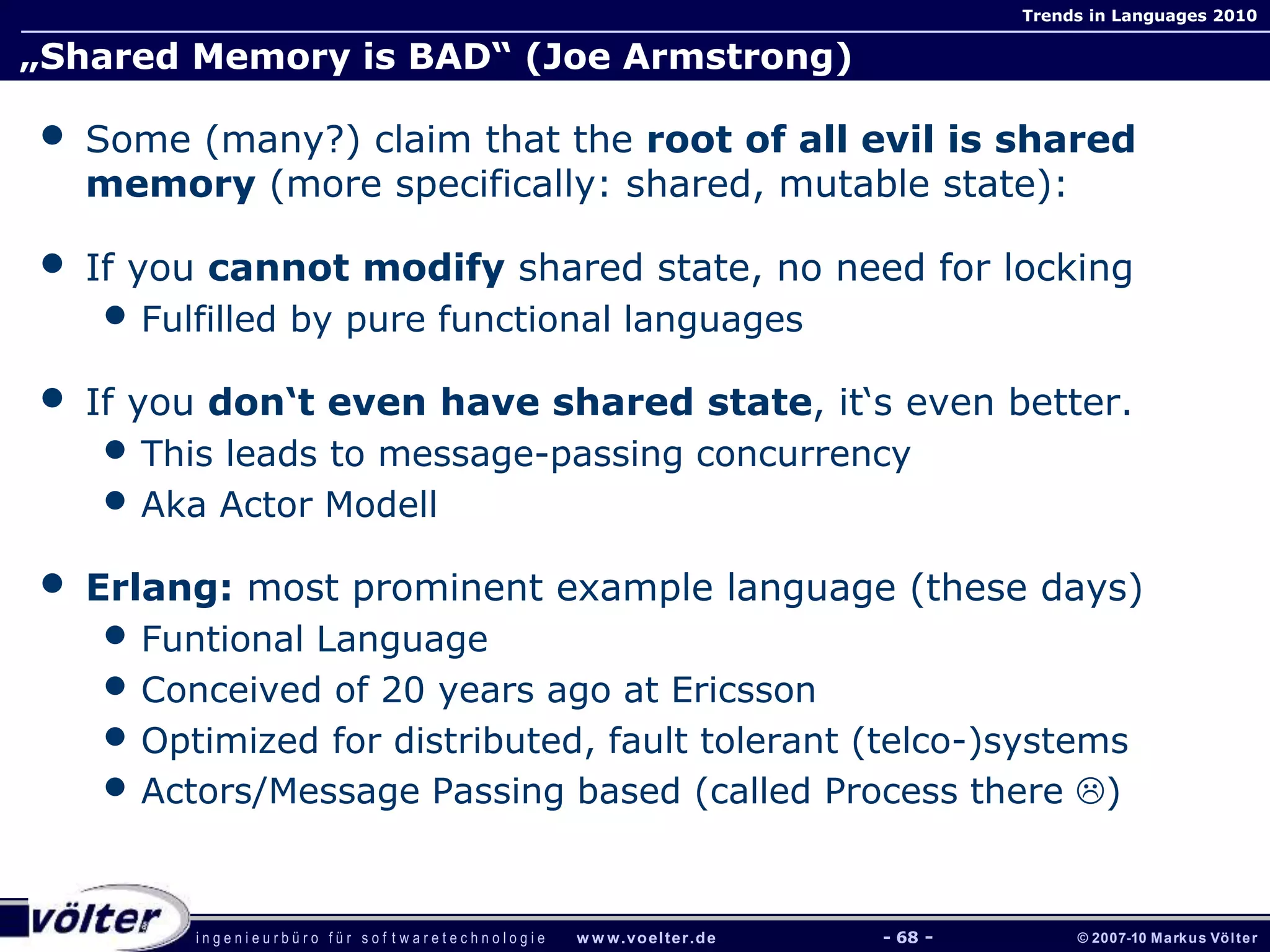
      Some (many?) claim that the root of all evil is shared memory (more specifically: shared, mutable state):
      If you cannotmodify shared state, no need for locking
      Fulfilled by pure functional languages
      If you don‘t even have shared state, it‘s even better.
      This leads to message-passing concurrency
      Aka Actor Modell
      Erlang: most prominent example language (these days)
      Funtional Language
      Conceived of 20 years ago at Ericsson
      Optimized for distributed, fault tolerant (telco-)systems
      Actors/Message Passing based (called Process there )
    67. - 67 -
      „Shared Memory is BAD“ (Joe Armstrong)
      BAD!
      Shared Memory is
    68. - 68 -
      „Shared Memory is BAD“ (Joe Armstrong)
      Some (many?) claim that the root of all evil is shared memory (more specifically: shared, mutable state):
      If you cannotmodify shared state, no need for locking
      Fulfilled by pure functional languages
      If you don‘t even have shared state, it‘s even better.
      This leads to message-passing concurrency
      Aka Actor Modell
      Erlang: most prominent example language (these days)
      Funtional Language
      Conceived of 20 years ago at Ericsson
      Optimized for distributed, fault tolerant (telco-)systems
      Actors/Message Passing based (called Process there )
    69. Actors/Message Passing in Erlang
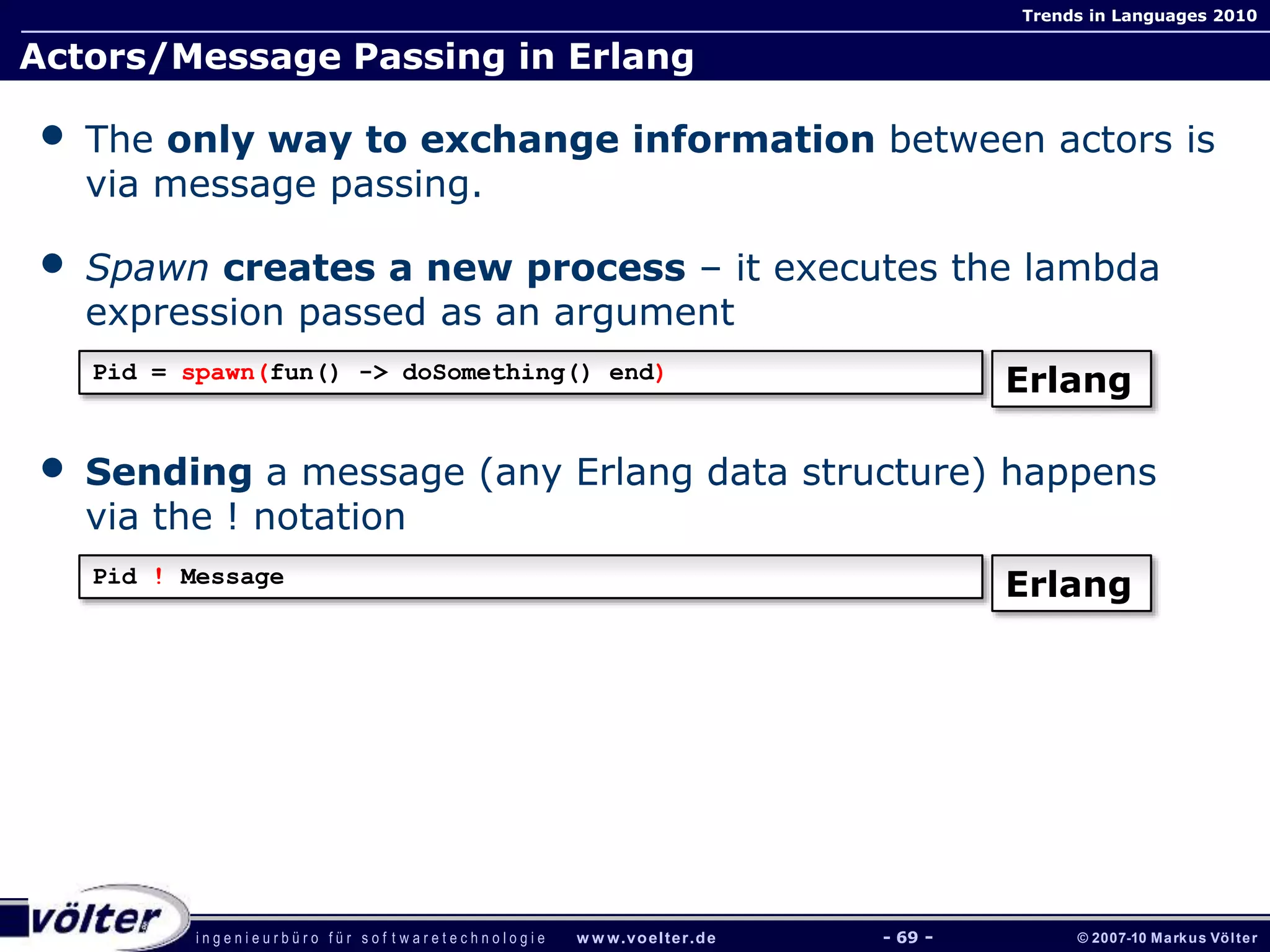
      The only way to exchange information between actors is via message passing.
      Spawncreates a new process – it executes the lambda expression passed as an argument
      Sending a message (any Erlang data structure) happens via the ! notation
      Pid = spawn(fun() -> doSomething() end)
      Erlang
      Pid! Message
      Erlang
      - 69 -
    70. Actors/Message Passing in Erlang II
      An Actor‘s received messages are put into a „mailbox“
      A Unix Select-like command receive takes out one at a time.
      Pattern Matching is used to distinguish between the different messages
      lower case: constants
      upper case: free variables that will be bound)
      loop
      receive
      {add, Id, Name, FirstName} -> ActionsToAddInformation;
      {remove,Id} -> ActionsToRemoveItAgain;
      ...
      after Time -> TimeOutActions
      end
      Erlang
      - 70 -
    71. Erlang-Style Message Passing in Scala
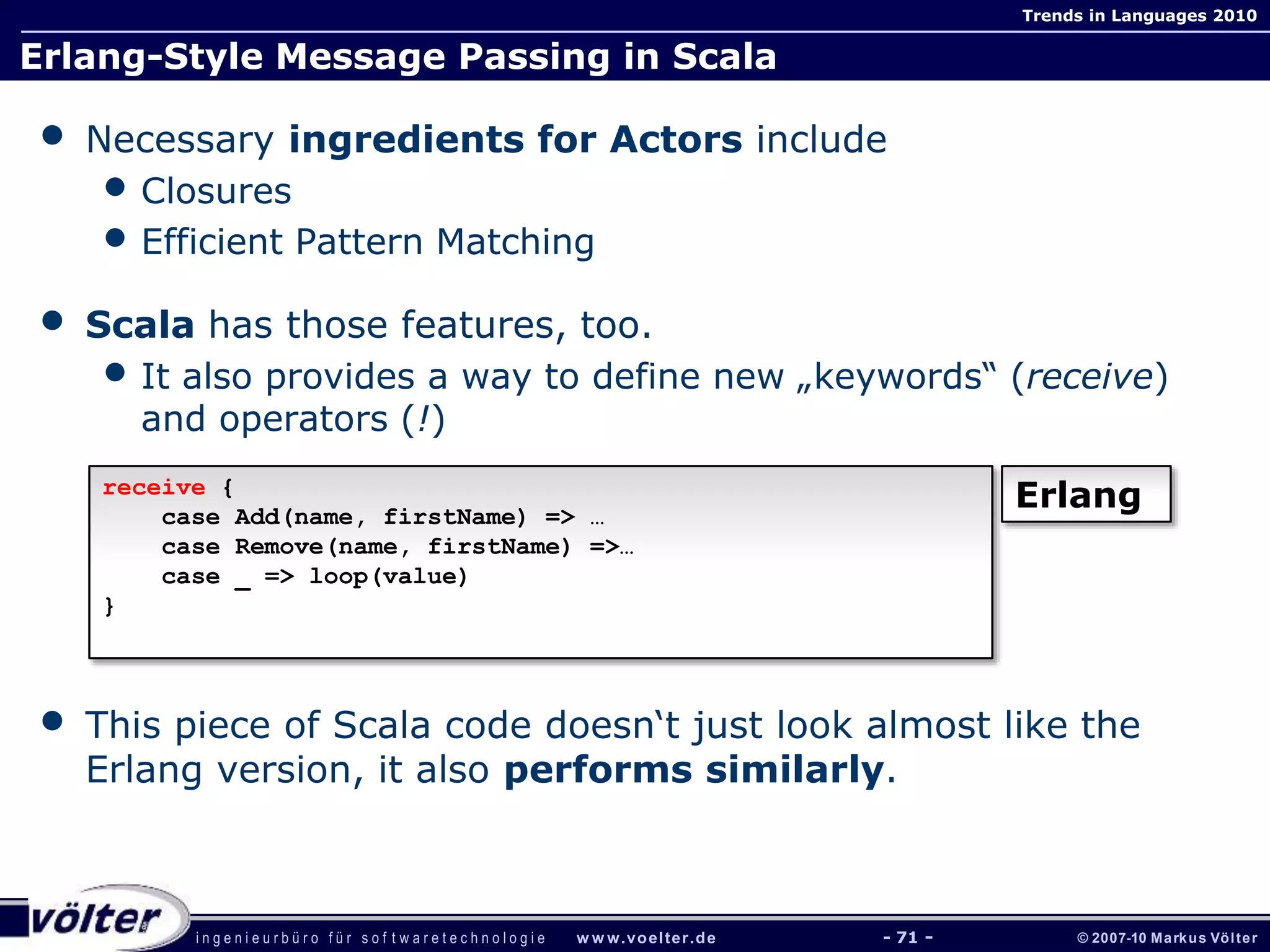
      Necessary ingredients for Actors include
      Closures
      Efficient Pattern Matching
      Scala has those features, too.
      It also provides a way to define new „keywords“ (receive) and operators (!)
      This piece of Scala code doesn‘t just look almost like the Erlang version, it also performs similarly.
      receive {
      case Add(name, firstName) => …
      case Remove(name, firstName) =>…
      case _ => loop(value)
      }
      Erlang
      - 71 -
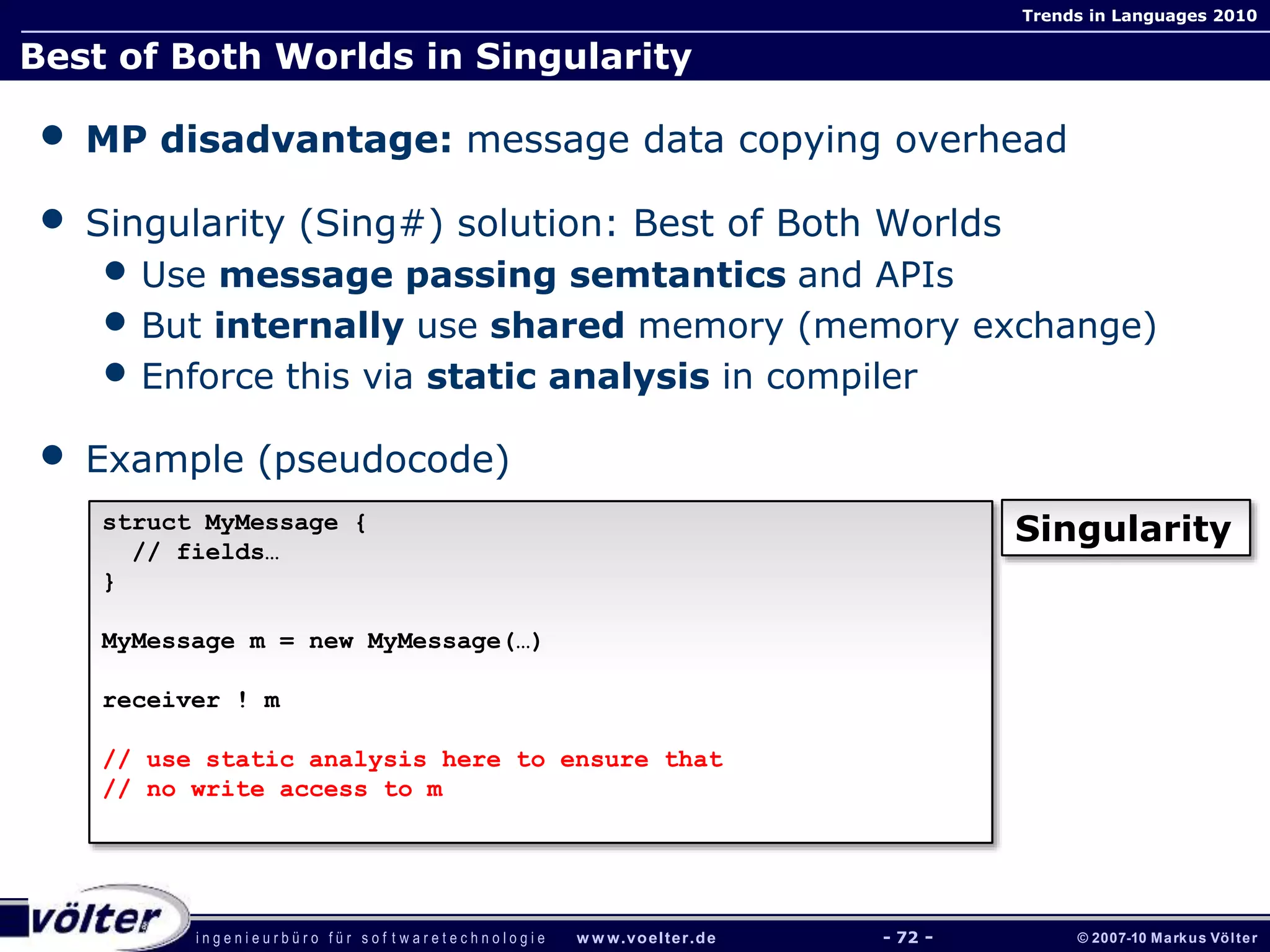
    72. Best of Both Worlds in Singularity
      MP disadvantage: message data copying overhead
      Singularity (Sing#) solution: Best of Both Worlds
      Use message passing semtantics and APIs
      But internally use shared memory (memory exchange)
      Enforce this via static analysis in compiler
      Example (pseudocode)
      Singularity
      structMyMessage {
      // fields…
      }
      MyMessage m = new MyMessage(…)
      receiver ! m
      // use static analysis here to ensure that
      // no write access to m
      - 72 -
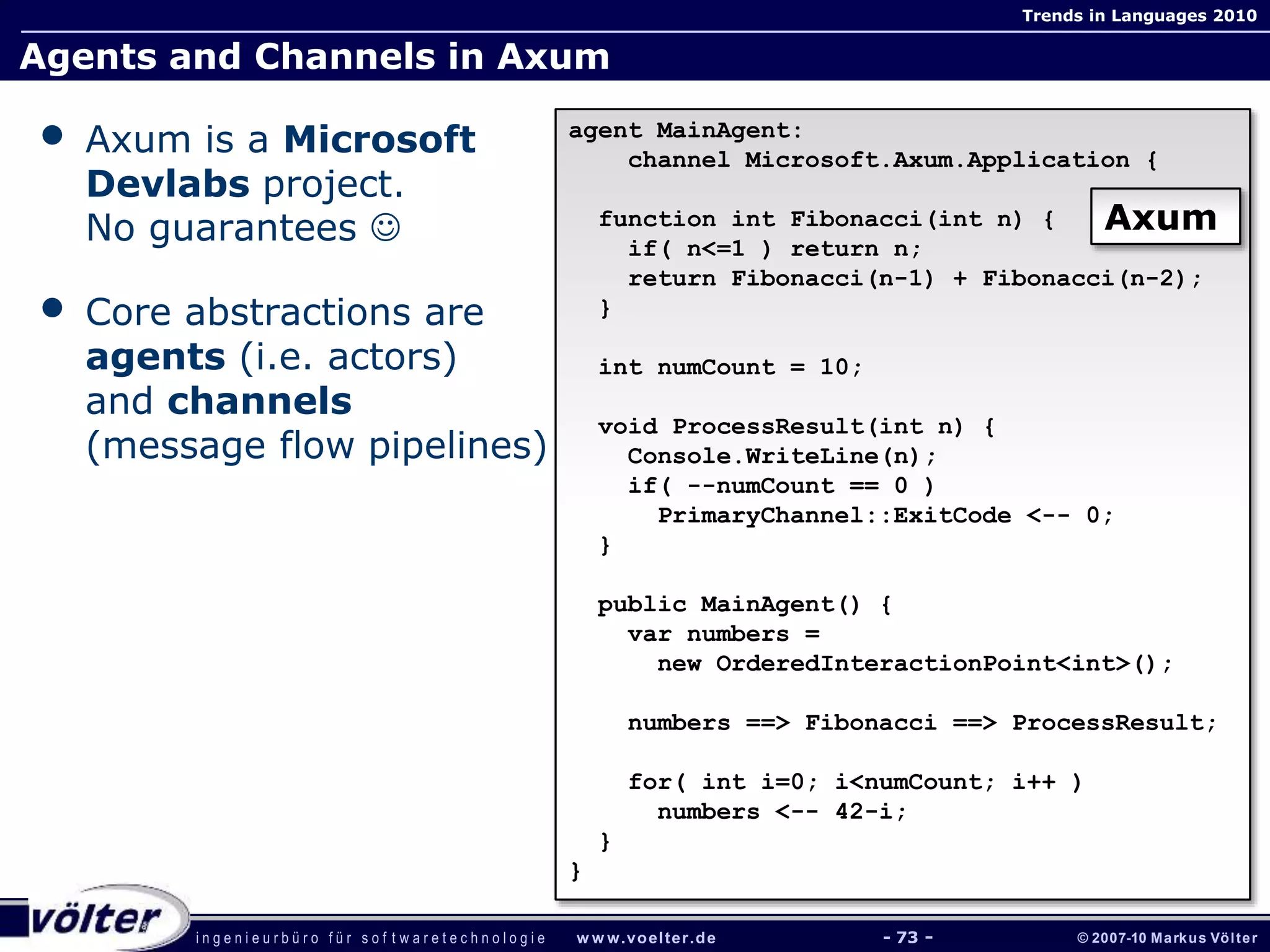
    73. Agents and Channels in Axum
      agent MainAgent: channel Microsoft.Axum.Application {
      function int Fibonacci(int n) {
      if( n<=1 ) return n; return Fibonacci(n-1) + Fibonacci(n-2);
      }
      int numCount = 10;
      void ProcessResult(int n) {
      Console.WriteLine(n);
      if( --numCount == 0 ) PrimaryChannel::ExitCode <-- 0;
      }
      public MainAgent() {
      var numbers = new OrderedInteractionPoint<int>();
      numbers ==> Fibonacci ==> ProcessResult;
      for( int i=0; i<numCount; i++ ) numbers <-- 42-i;
      }
      }
      Axum is a Microsoft Devlabs project. No guarantees 
      Core abstractions are agents (i.e. actors) and channels (message flow pipelines)
      Axum
      - 73 -
    74. Fancy Dataflow Networks
      1:1 – Forwarding
      Many:1- Multiplexing and Combine
      PrimaryChannel::Click ==> HandleClick;
      Axum
      var ip1 = new OrderedInteractionPoint<int>(); var ip2 = new OrderedInteractionPoint<int>(); ip1 <-- 10; ip2 <-- 20; var ips = new OrderedInteractionPoint<int>[]{ ip1, ip2 };
      void PrintOneNumber(int n) { Console.WriteLine(n);
      }
      ips >>- PrintOneNumber; // multiplexing
      void PrintManyNumbers(int[] nums) { foreach(var i in nums) Console.WriteLine(i); }
      ips &>- PrintManyNumbers; // combine
      Axum
      - 74 -
    75. Fancy Dataflow Networks II
      1:Many – Broadcast and Alternate
      agent AdderAgent : channel Adder {
      public AdderAgent() {
      var ipJoin = new OrderedInteractionPoint<int[]>();
      { PrimaryChannel::Num1 ==> ShowNumber, PrimaryChannel::Num2 ==> ShowNumber } &>-ipJoin -<: { GetSum, GetSum } >>- PrimaryChannel::Sum;
      }
      private int ShowNumber(int n) { Console.WriteLine("Got number {0}", n); return n; }
      private function int GetSum(int[] nums) {
      return nums[0] + nums[1];
      }
      }
      Axum
      - 75 -
    76. - 76 -
      C O N T E N T S
      Intro and Overview
      Typing
      OO +/vs. Functional
      Metaprogramming & DSLs
      Contracts
      Concurrency
      Platforms
      Tools
      Summary
    77. - 77 -
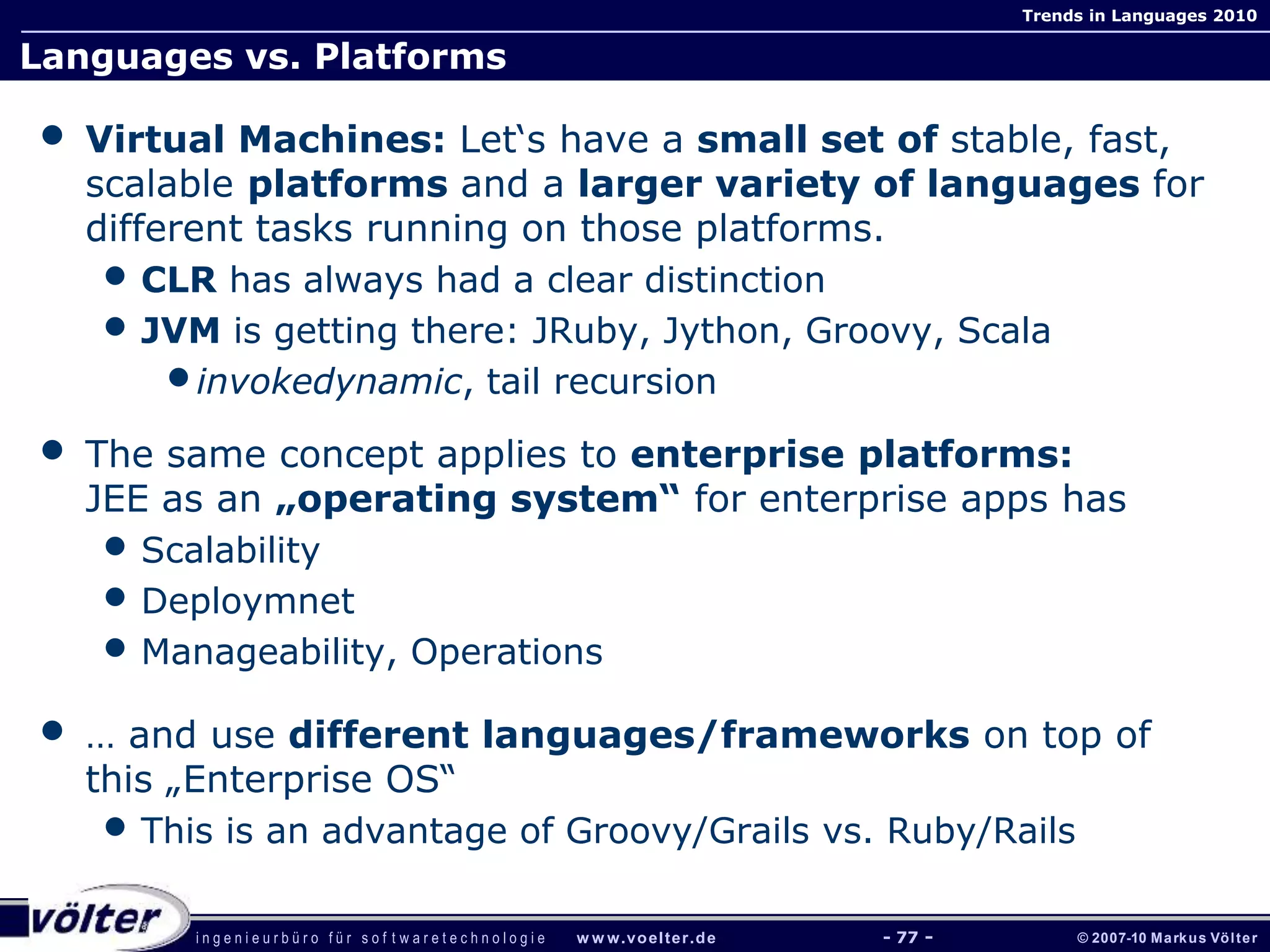
      Languages vs. Platforms
      Virtual Machines: Let‘s have a small set of stable, fast, scalable platforms and a larger variety of languages for different tasks running on those platforms.
      CLR has always had a clear distinction
      JVM is getting there: JRuby, Jython, Groovy, Scala
      invokedynamic, tail recursion
      The same concept applies to enterprise platforms: JEE as an „operating system“ for enterprise apps has
      Scalability
      Deploymnet
      Manageability, Operations
      … and use different languages/frameworks on top of this „Enterprise OS“
      This is an advantage of Groovy/Grails vs. Ruby/Rails
    78. - 78 -
      C O N T E N T S
      Intro and Overview
      Typing
      OO +/vs. Functional
      Metaprogramming & DSLs
      Contracts
      Concurrency
      Platforms
      Tools
      Summary
    79. - 79 -
      When defining a language, always think about tooling!
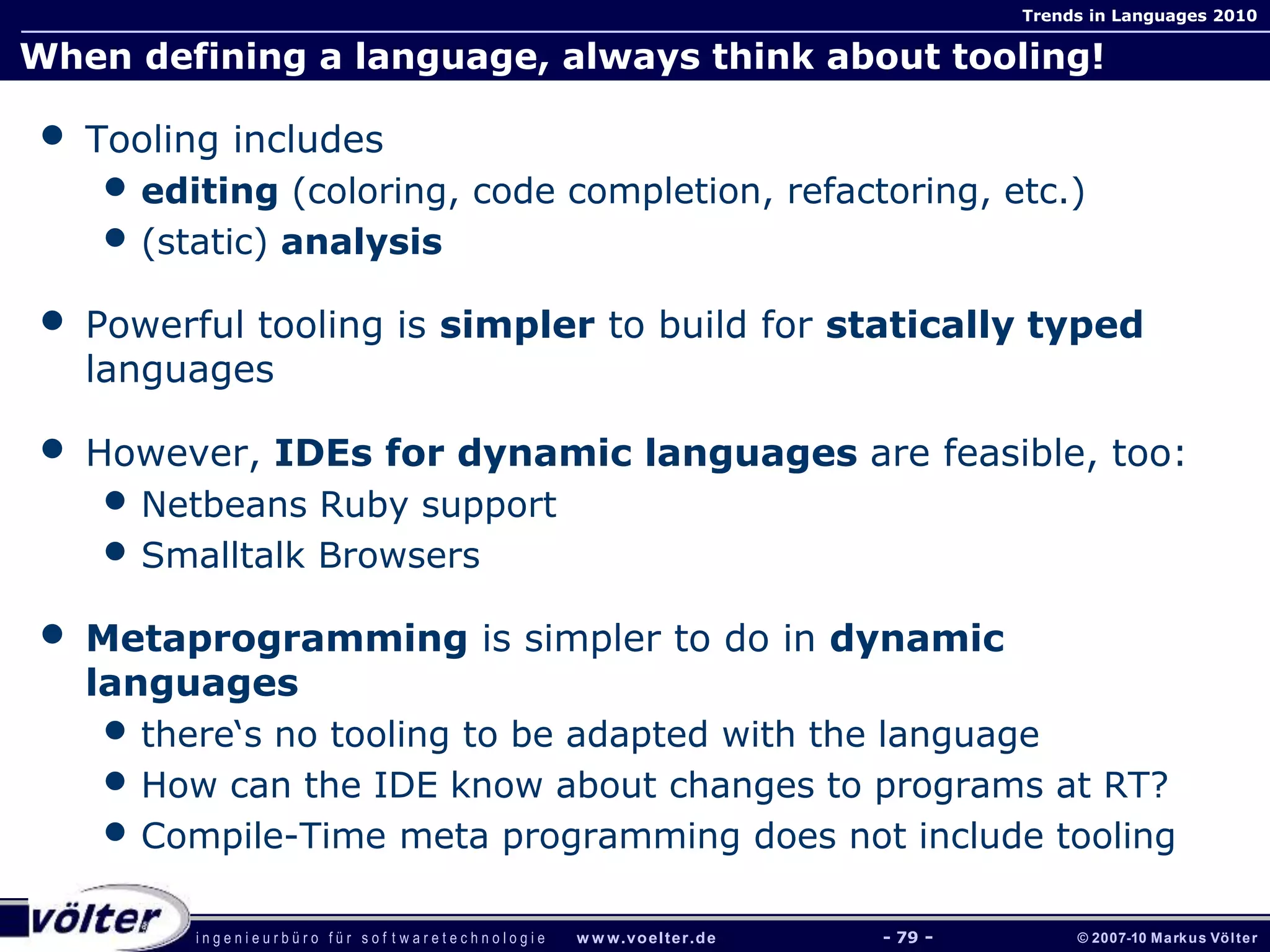
      Tooling includes
      editing (coloring, code completion, refactoring, etc.)
      (static) analysis
      Powerful tooling is simpler to build for statically typed languages
      However, IDEs for dynamic languages are feasible, too:
      Netbeans Ruby support
      Smalltalk Browsers
      Metaprogramming is simpler to do in dynamic languages
      there‘s no tooling to be adapted with the language
      How can the IDE know about changes to programs at RT?
      Compile-Time meta programming does not include tooling
    80. When defining a language, always think about tooling! II
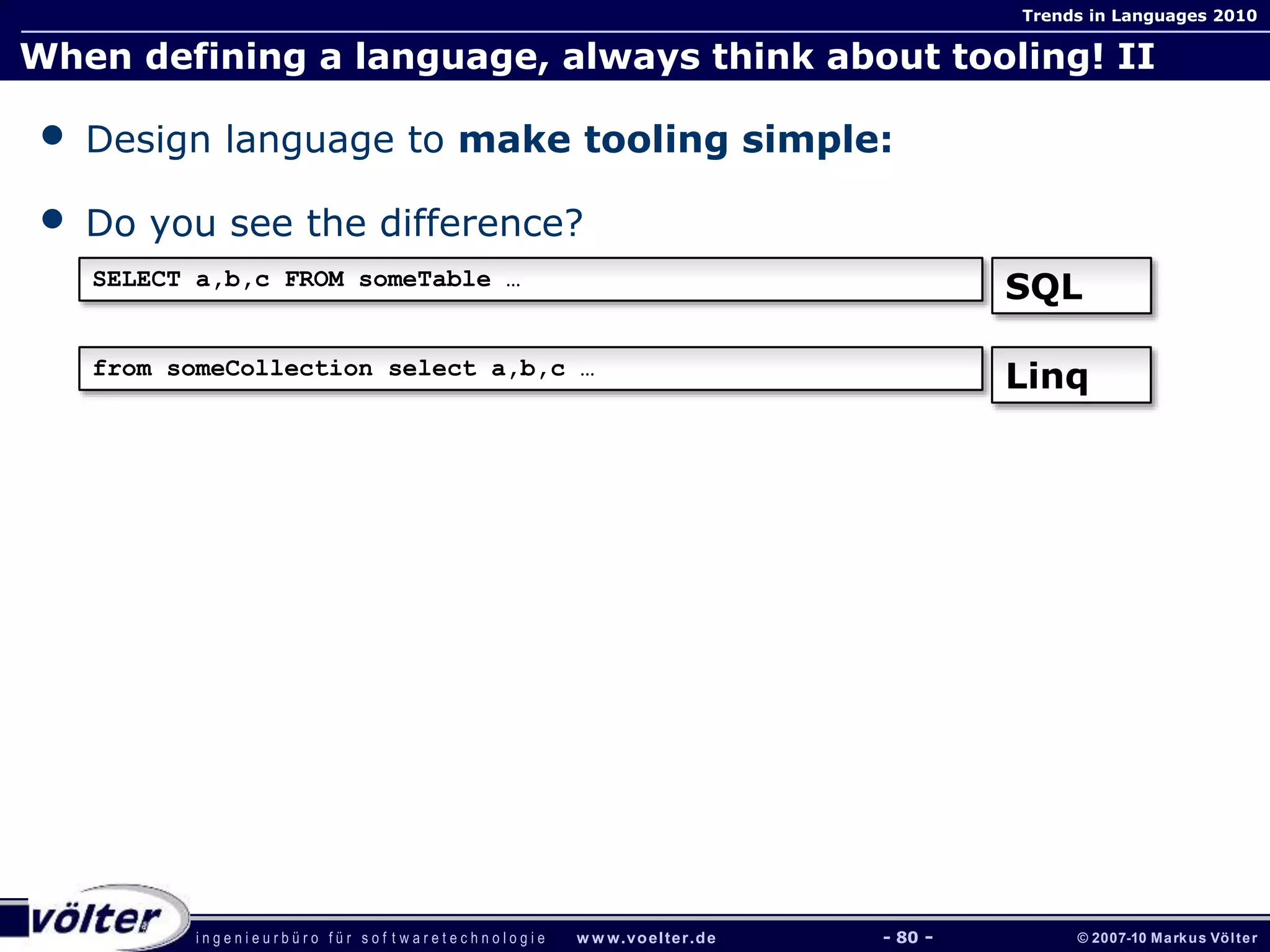
      Design language to make tooling simple:
      Do you see the difference?
      SELECT a,b,c FROM someTable …
      SQL
      from someCollection select a,b,c …
      Linq
      - 80 -
    81. When defining a language, always think about tooling! III
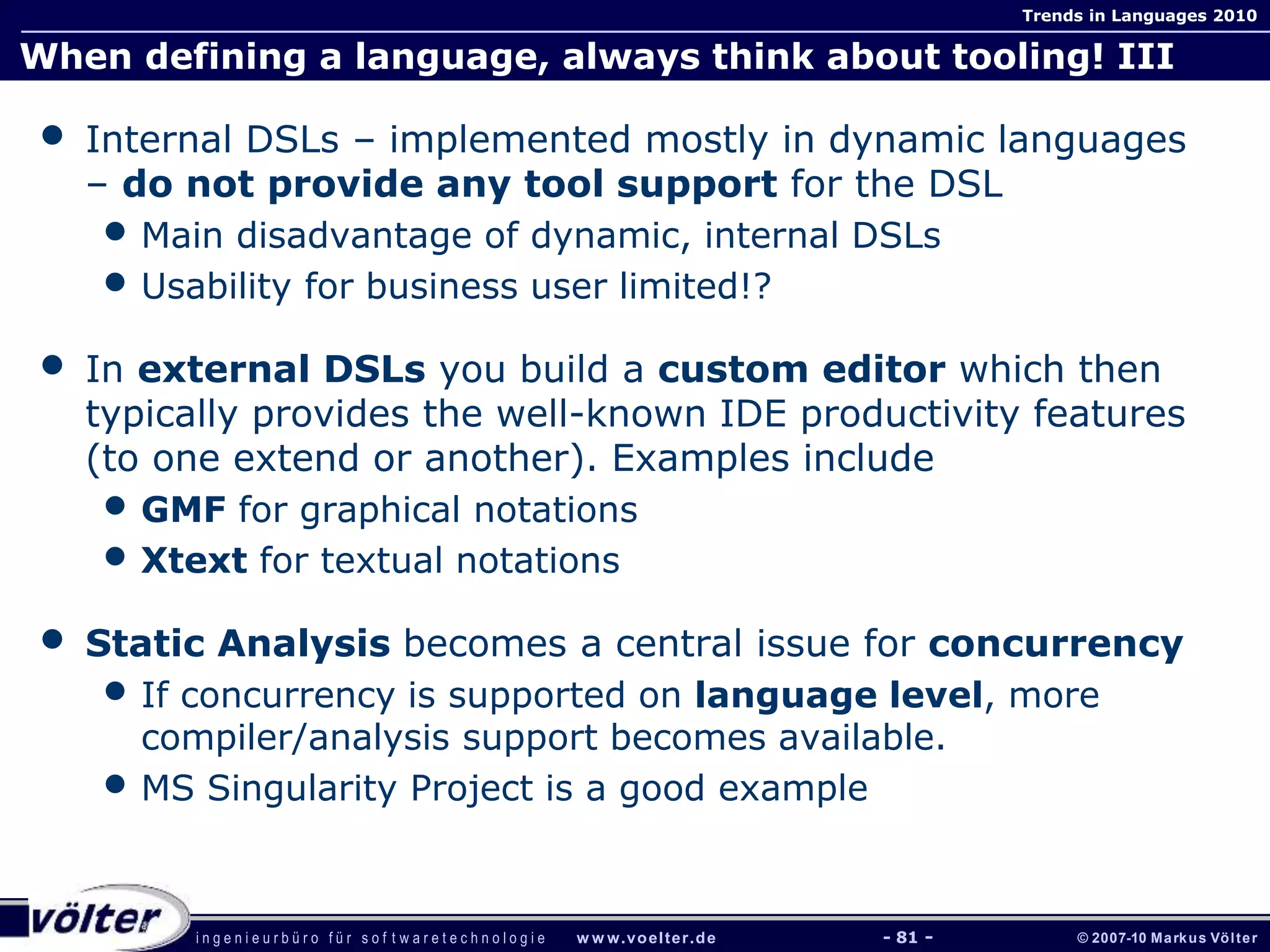
      Internal DSLs – implemented mostly in dynamic languages – do not provide any tool support for the DSL
      Main disadvantage of dynamic, internal DSLs
      Usability for business user limited!?
      In external DSLs you build a custom editor which then typically provides the well-known IDE productivity features (to one extend or another). Examples include
      GMF for graphical notations
      Xtext for textual notations
      Static Analysis becomes a central issue for concurrency
      If concurrency is supported on language level, more compiler/analysis support becomes available.
      MS Singularity Project is a good example
      - 81 -
    82. - 82 -
      C O N T E N T S
      Intro and Overview
      Typing
      OO +/vs. Functional
      Metaprogramming & DSLs
      Contracts
      Concurrency
      Platforms
      Tools
      Summary
    83. - 83 -
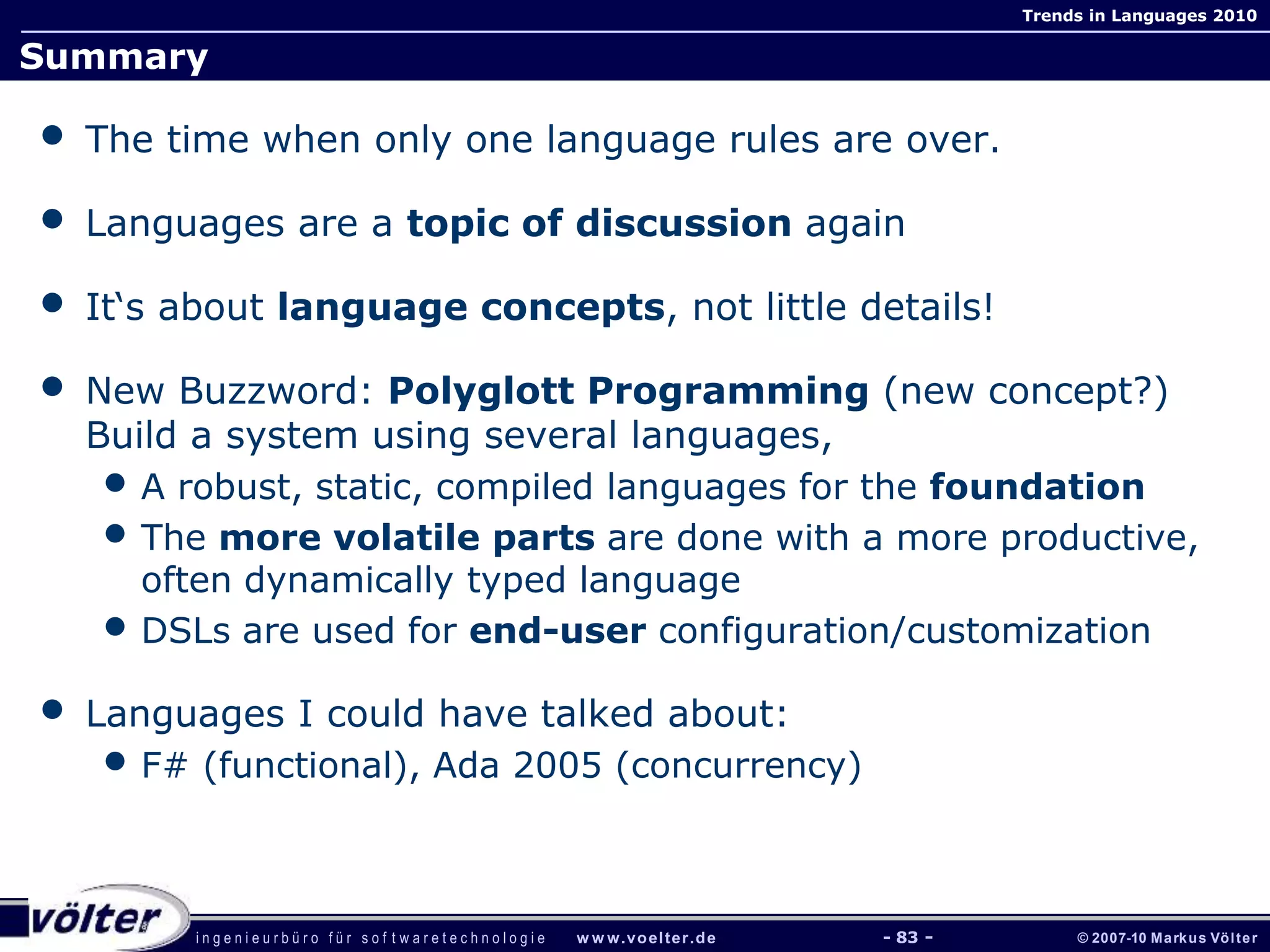
      Summary
      The time when only one language rules are over.
      Languages are a topic of discussion again
      It‘s about language concepts, not little details!
      New Buzzword: Polyglott Programming (new concept?)Build a system using several languages,
      A robust, static, compiled languages for the foundation
      The more volatile parts are done with a more productive, often dynamically typed language
      DSLs are used for end-user configuration/customization
      Languages I could have talked about:
      F# (functional), Ada 2005 (concurrency)
    84. - 84 -
      C O N T E N T S
      Intro and Overview
      Typing
      OO +/vs. Functional
      Metaprogramming & DSLs
      Contracts
      Concurrency
      Platforms
      Tools
      Summary
      THANKS!
      THE END.
    SlideShare Zeitgeist 2009

    + Markus VoelterMarkus Voelter Nominate

    custom

    304 views, 3 favs, 0 embeds more stats

    This slideset covers trends in programming paradigm more

    More info about this document

    © All Rights Reserved

    Go to text version

    • Total Views 304
      • 304 on SlideShare
      • 0 from embeds
    • Comments 0
    • Favorites 3
    • Downloads 0
    Most viewed embeds

    more

    All embeds

    less

    Flagged as inappropriate Flag as inappropriate
    Flag as inappropriate

    Select your reason for flagging this presentation as inappropriate. If needed, use the feedback form to let us know more details.

    Cancel
    File a copyright complaint
    Having problems? Go to our helpdesk?

    Categories