Precarity: city explorations
● In the printed publication on precarity in Europe there's the chance to
narrate non-fictional or even fictional stories that represent the theme of
precarity from your point of view. This is also a chance, for those who like
writing and wish to give a contribution, to get your work on a printed
publication that is going to be distributed.
● One option is that you identify, as a city group, a story of a precarious
worker that it would be interesting to tell 'cause it's emblematic to you or to
your city group.
● A storyteller, then, is chosen by the city group to tell the story. He/she is
accompanied by the precarious worker around the neighbourhood where
the precarious worker lives, while the storyteller asks questions, records
the answers, or takes notes, or even shoots videos depending on his/her
preferences. The precarious worker tells his/her experience of the different
places (his/her workplace, his/her house, the shops he/she's accustomed
to go to, the places he/she visits on a weekly basis) and on how these
places are related to her everyday life and how they make him/her feel.
While visiting the places, always take picture, this will help to visualize the
scenes that you will be describing.
2.
Fictional stories aboutprecarity
Step 1
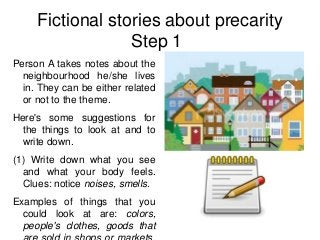
Person A takes notes about the
neighbourhood he/she lives
in. They can be either related
or not to the theme.
Here's some suggestions for
the things to look at and to
write down.
(1) Write down what you see
and what your body feels.
Clues: notice noises, smells.
Examples of things that you
could look at are: colors,
people's clothes, goods that
3.
Step 2
Person B,which lives in a
different part of the city and
don't know much about that
neighbourhood, reads A's
notes.
4.
Step 3
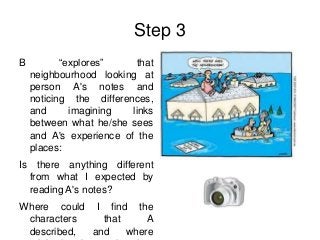
B “explores” that
neighbourhood looking at
person A's notes and
noticing the differences,
and imagining links
between what he/she sees
and A's experience of the
places:
Is there anything different
from what I expected by
reading A's notes?
Where could I find the
characters that A
described, and where
5.
Step 4
B writesdown a description of
his/her own exploration or
a fictional story based on
his/her observation of that
neighbourhood that
reminds the topic of
precarity. It might be
because of the story, or
because of an adjective
that he/she used of found
in A's notes or because of
some image that recalls
our theme.



![Moho Pro 14.4 Crack for MacOS Works Until 2050 [Latest] pptx](https://cdn.slidesharecdn.com/ss_thumbnails/softwareoverview-251207192639-797289c4-thumbnail.jpg?width=640&height=640&fit=bounds)
![Wondershare Filmora 15.0.11 Crack for Mac Key Full Download [Latest] pptx](https://cdn.slidesharecdn.com/ss_thumbnails/software-251207184836-1d16ba16-thumbnail.jpg?width=640&height=640&fit=bounds)
![iStat Menus 7.20 Crack for MacOS 2026 Full Version [Latest] pptx](https://cdn.slidesharecdn.com/ss_thumbnails/softwareoverview-251207191544-22b737dc-thumbnail.jpg?width=640&height=640&fit=bounds)


![WinRAR Crack 7.13 Final Mac Keygen 2026 Download [Latest] Software.pptx](https://cdn.slidesharecdn.com/ss_thumbnails/software-251207185858-eb450678-thumbnail.jpg?width=640&height=640&fit=bounds)
![Chapter4_Initiation_of_Sediment_Motion_v2[1].pptx](https://cdn.slidesharecdn.com/ss_thumbnails/chapter4initiationofsedimentmotionv21-251208223747-f94ef163-thumbnail.jpg?width=640&height=640&fit=bounds)


