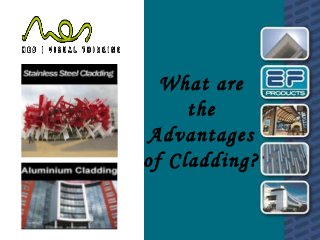
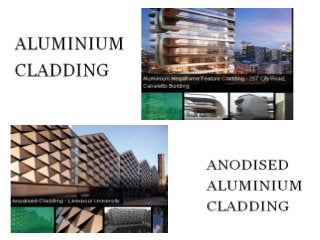
Cladding refers to the metallurgical process of coating a metal onto another metal under high temperature and pressure so as to protect the inner metal from corrosion.For more details, Visit www.nes-solutions.co.uk Website.
Introduction
Cladding refersto the metallurgical process of
coating a metal onto another metal under high
temperature and pressure so as to protect the
inner metal from corrosion. Cladding may be
done using aluminum, stainless steel, anodized
aluminum or copper. Of the lot, aluminum
cladding is traditionally preferred due to its
features like flexibility, lightweight, durability
and recyclable nature.
3.
Advantages and Disadvantagesof
Cladding with Different Metals
• The popularity of aluminum cladding panels is also due
in no small measure to the awareness about the product.
As it has been used traditionally, its durability and
flexibility are a matter of common knowledge.
• Although newer methods also give ample scope for other
metals like copper, its durability can never be compared
to aluminum. Besides copper tends to be heavier than
aluminum and this is also a major drawback when more
lightweight options are easily available and affordable as
well.
4.
Advantages of Anodised
Aluminium Cladding
• Anodised cladding especially anodised aluminum
cladding is also extremely popular as the natural
qualities of aluminum like durability, recyclability,
flexibility and lightweight are enhanced by anodising it
besides giving it a strong contemporary finish.
• Such anodised aluminium also as additional properties
of abrasion and corrosion resistance. The biggest
advantage of anodising when compared to other
processes is that anodising is completely integrated with
the metal's substrate rather than a film that is applied to
cover the surface.
6.
Conclusion:
The seamlessfinish afforded by aluminum is yet another
attractive feature that helps manufacture large panels
without unattractive and unwanted fixtures. In fact,
panels of length up to 8 m can be easily fabricated using
aluminium cladding systems. The metal obtained after
anodisation can in fact be called aluminum with super
powers! Stainless steel is another option that is often
suggested. Although not as lightweight as aluminum,
steel is just as long lasting and often the preferred
alternative to aluminum.
7.
THANK YOU
FeelFree To visit our Website
www.nes-solutions.co.uk Or Contact Us At: