

Recommended
Recommended
More Related Content
Recently uploaded
Recently uploaded (20)
Featured
Featured (20)
Investing In India How Recent Developments In The Cayman Islands Facilitate Inbound Investment
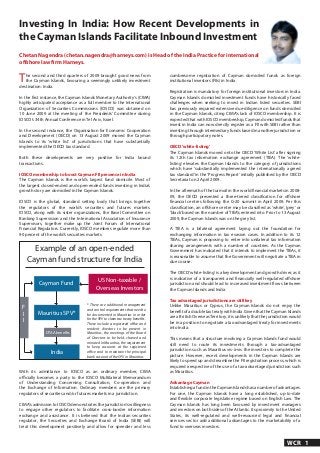
- 1. WCR 1 1 Chetan Nagendra (chetan.nagendra@harneys.com) is Head of the India Practice for international offshore law firm Harneys. Investing In India: How Recent Developments in the Cayman Islands Facilitate Inbound Investment The second and third quarters of 2009 brought good news from the Cayman Islands, favouring a seemingly unlikely investment destination: India. In the first instance, the Cayman Islands Monetary Authority’s (CIMA) highly anticipated acceptance as a full member to the International Organization of Securities Commissions (IOSCO) was obtained on 10 June 2009 at the meeting of the Presidents’ Committee during IOSCO’s 34th Annual Conference in Tel Aviv, Israel. In the second instance, the Organisation for Economic Cooperation and Development (OECD) on 13 August 2009 moved the Cayman Islands to its ‘white list’ of jurisdictions that have substantially implemented the OECD tax standard. Both these developments are very positive for India bound transactions. IOSCO membership to boost Cayman FII presence in India The Cayman Islands is the world’s largest fund domicile. Most of the largest closed-ended and open-ended funds investing in India’s growth story are domiciled in the Cayman Islands. IOSCO is the global, standard setting body that brings together the regulators of the world’s securities and futures markets. IOSCO, along with its sister organizations, the Basel Committee on Banking Supervision and the International Association of Insurance Supervisors, together make up the Joint Forum of International Financial Regulators. Currently, IOSCO members regulate more than 90 percent of the world’s securities markets. With its admittance to IOSCO as an ordinary member, CIMA officially becomes a party to the IOSCO Multilateral Memorandum of Understanding Concerning Consultation, Co-operation and the Exchange of Information. Ordinary members are the primary regulators of securities and/or futures markets in a jurisdiction. CIMA’s admission to IOSCO demonstrates the jurisdiction’s willingness to engage other regulators to facilitate cross-border information exchange and assistance. It is believed that the Indian securities regulator, the Securities and Exchange Board of India (SEBI) will treat this development positively and allow for speedier and less cumbersome registration of Cayman domiciled funds as foreign institutional investors (FIIs) in India. Registration is mandatory for foreign institutional investors in India. Cayman Islands domiciled investment funds have historically faced challenges when seeking to invest in Indian listed securities. SEBI has previously required extensive due-diligence on funds domiciled in the Cayman Islands, citing CIMA’s lack of IOSCO membership. It is expected that with IOSCO membership, Cayman domiciled funds that invest in India can now directly register as a FII with SEBI rather than investing through intermediary funds based in another jurisdiction or through participatory notes. OECD‘white-listing’ The Cayman Islands moved onto the OECD ‘White List’ after signing its 12th tax information exchange agreement (TIEA). The ‘white- listing’ elevates the Cayman Islands to the category of jurisdictions which have ‘substantially implemented the internationally agreed tax standard’ in the ‘Progress Report’ initially published by the OECD Secretariat on 2 April 2009. In the aftermath of the turmoil in the world financial markets in 2008- 09, the OECD presented a three-tiered classification for offshore financial centres following the G-20 summit in April 2009. Per this classification, an offshore centre may be classified as ‘white’, ‘grey’ or ‘black’based on the number of TIEA’s entered into. Prior to 13 August 2009, the Cayman Islands was on the grey list. A TIEA is a bilateral agreement laying out the foundation for exchanging information in tax evasion cases. In addition to its 12 TIEAs, Cayman is proposing to enter into unilateral tax information sharing arrangements with a number of countries. As the Cayman Government has indicated that it intends to implement the TIEAs, it is reasonable to assume that the Government will negotiate a TIEA in due course. The OECD‘white-listing’is a key development and growth driver, as it is indicative of a transparent and financially well-regulated offshore jurisdiction and should lead to increased investment flows between the Cayman Islands and India. Tax advantaged jurisdictions are still key Unlike Mauritius or Cyprus, the Cayman Islands do not enjoy the benefitofadoubletaxtreatywithIndia.GiventhattheCaymanIslands are a British OverseasTerritory, it is unlikely that the jurisdiction would be in a position to negotiate a tax-advantaged treaty for investments into India. This means that a structure involving a Cayman Islands fund would still need to route its investments through a tax-advantaged jurisdiction such as Mauritius vis-à-vis the investors to complete the picture. However, recent developments in the Cayman Islands are likely to speed up and streamline the FII registration process, which is required irrespective of the use of a tax-advantaged jurisdiction such as Mauritius. Advantage Cayman EstablishingafundintheCaymanIslandshasanumberofadvantages. For one, the Cayman Islands have a long established, up-to-date and flexible corporate legislative regime based on English Law. The Cayman Islands has long been favoured by investment managers and investors on both sides of the Atlantic. Its proximity to the United States, its well-regulated and well-resourced legal and financial services sector add additional advantages to the marketability of a fund to overseas investors. Example of an open-ended Cayman fund structure for India US Non-taxable / Overseas Investors F I I Cayman Fund Mauritius SPV* DTAA benefits India * There are additional management and control requirements that need to be documented in Mauritius in order for the SPV to claim tax treaty benefits. These include a registered office and resident directors to be present in Mauritius, the meetings of the Board of Directors to be held, chaired and minuted in Mauritius, the requirement to keep accounts at the registered office and to maintain the principal bank account of the SPV in Mauritius.
- 2. WCR2 There are important differences between an established offshore financial centre and many tax treaty-advantaged jurisdictions. In the long run, issues of flexibility in company structures, credibility of the jurisdiction, marketability to investors, stability to investors, and familiaritywiththelegalsystemoftentipthebalanceinfavourof long- established offshore financial centres such as Cayman. In the case of investing in India, a mix of a tax-treaty benefited jurisdiction with the world’s largest fund domicile offer great flexibility to investment managers and unmatched returns to investors. ■