


Recommended
Recommended
More Related Content
More from Kim Jensen
More from Kim Jensen (20)
Recently uploaded
Recently uploaded (20)
In The Mail Sep 09
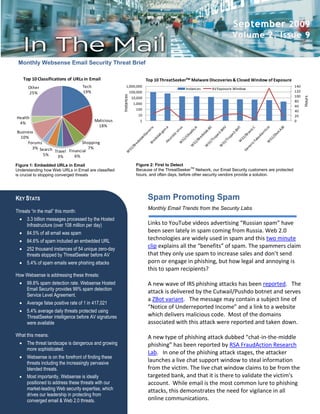
- 1. September 2009 Volume 2, Issue 9 Monthly Websense Email Security Threat Brief Top 10 Classifications of URLs in Email Top 10 ThreatSeekerTM Malware Discoveries & Closed Window of Exposure Other Tech 1,000,000 Instances AV Exposure Window 140 25% 19% 100,000 120 Instances 100 Hours 10,000 80 1,000 60 100 40 10 20 Health Malicious 1 0 4% 18% Business 10% Forums Shopping 3% Search 7% Travel Financial 5% 3% 6% Figure 1: Embedded URLs in Email Figure 2: First to Detect Understanding how Web URLs in Email are classified Because of the ThreatSeekerTM Network, our Email Security customers are protected is crucial to stopping converged threats hours, and often days, before other security vendors provide a solution. KEY STATS Spam Promoting Spam Monthly Email Trends from the Security Labs Threats “in the mail” this month: 3.3 billion messages processed by the Hosted Infrastructure (over 108 million per day) Links to YouTube videos advertising “Russian spam” have 84.5% of all email was spam been seen lately in spam coming from Russia. Web 2.0 84.6% of spam included an embedded URL technologies are widely used in spam and this two minute 252 thousand instances of 54 unique zero-day clip explains all the “benefits” of spam. The spammers claim threats stopped by ThreatSeeker before AV that they only use spam to increase sales and don’t send 5.4% of spam emails were phishing attacks porn or engage in phishing, but how legal and annoying is this to spam recipients? How Websense is addressing these threats: 99.8% spam detection rate. Websense Hosted A new wave of IRS phishing attacks has been reported. The Email Security provides 99% spam detection attack is delivered by the Cutwail/Pushdo botnet and serves Service Level Agreement. a ZBot variant. The message may contain a subject line of Average false positive rate of 1 in 417,021 “Notice of Underreported Income” and a link to a website 5.4% average daily threats protected using ThreatSeeker intelligence before AV signatures which delivers malicious code. Most of the domains were available associated with this attack were reported and taken down. What this means: A new type of phishing attack dubbed “chat-in-the-middle The threat landscape is dangerous and growing phishing” has been reported by RSA FraudAction Research more sophisticated. Lab. In one of the phishing attack stages, the attacker Websense is on the forefront of finding these threats including the increasingly pervasive launches a live chat support window to steal information blended threats. from the victim. The live chat window claims to be from the Most importantly, Websense is ideally targeted bank, and that it is there to validate the victim's positioned to address these threats with our account. While email is the most common lure to phishing market-leading Web security expertise, which attacks, this demonstrates the need for vigilance in all drives our leadership in protecting from converged email & Web 2.0 threats. online communications.
- 2. Spam as a Percent of Inbound Email 95 Why Websense Email Security? 90 85 - The Websense ThreatSeeker 80 Network provides the 75 intelligence to proactively 70 protect against spam and malware – far ahead of traditional anti-spam and anti- virus alone. Figure 3 - Percent of email that contains spam (Average 84.5 %) While this figure fluctuates, this signifies that a very high percentage of incoming email is indeed spam. Without a strong email security solution, customers will experience bandwidth and storage capacity issues, - Today’s pervasive blended frustration, and a drain in productivity, not to mention exposure to significant security risk. threats are best matched by integration of best-in-class Websense Web security with email security for Essential Information Protection. Spam Detection Rate 100.0% 99.9% 99.8% 99.7% 99.6% 99.5% Figure 4 - Percent of spam detected (Average 99.8%) This is evidence that we are consistently maintaining a very high spam detection rate. Therefore, customers should be very confident that with Websense they are receiving the best in anti-spam protection. False Positive Rate (1 in X) 2,500,000 250,000 25,000 2,500 Figure 5 - False Positive Rate (Average 1 in 417,021) This shows how Websense is consistently maintaining a very low false positive rate. While Websense is catching a high percentage of spam, customers are rarely inhibited by messages falsely landing in a spam queue.