NoSQL at Twitter
Kevin Weil -- @kevinweil
Analytics Lead, Twitter

April 21, 2010


                           TM
Introduction
‣   How We Arrived at NoSQL: A Crash Course
‣     Collecting Data (Scribe)
‣     Storing and Analyzing Data (Hadoop)
‣     Rapid Learning over Big Data (Pig)
‣   And More: Cassandra, HBase, FlockDB
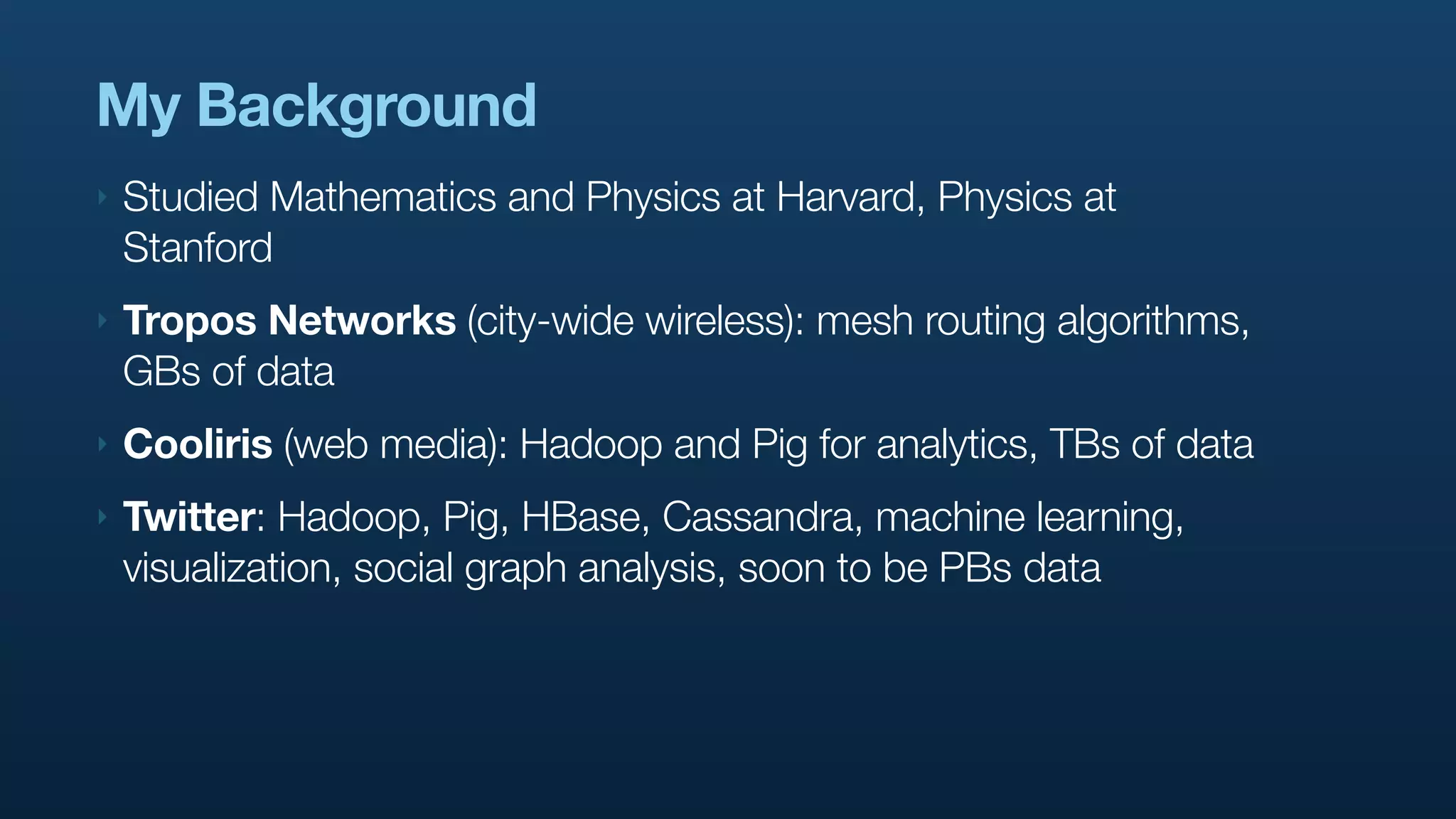
My Background
‣   Studied Mathematics and Physics at Harvard, Physics at
    Stanford
‣   Tropos Networks (city-wide wireless): mesh routing algorithms,
    GBs of data
‣   Cooliris (web media): Hadoop and Pig for analytics, TBs of data
‣   Twitter: Hadoop, Pig, HBase, Cassandra, machine learning,
    visualization, social graph analysis, soon to be PBs data
Introduction
‣   How We Arrived at NoSQL: A Crash Course
‣     Collecting Data (Scribe)
‣     Storing and Analyzing Data (Hadoop)
‣     Rapid Learning over Big Data (Pig)
‣   And More: Cassandra, HBase, FlockDB
Data, Data Everywhere
‣   Twitter users generate a lot of data
‣   Anybody want to guess?
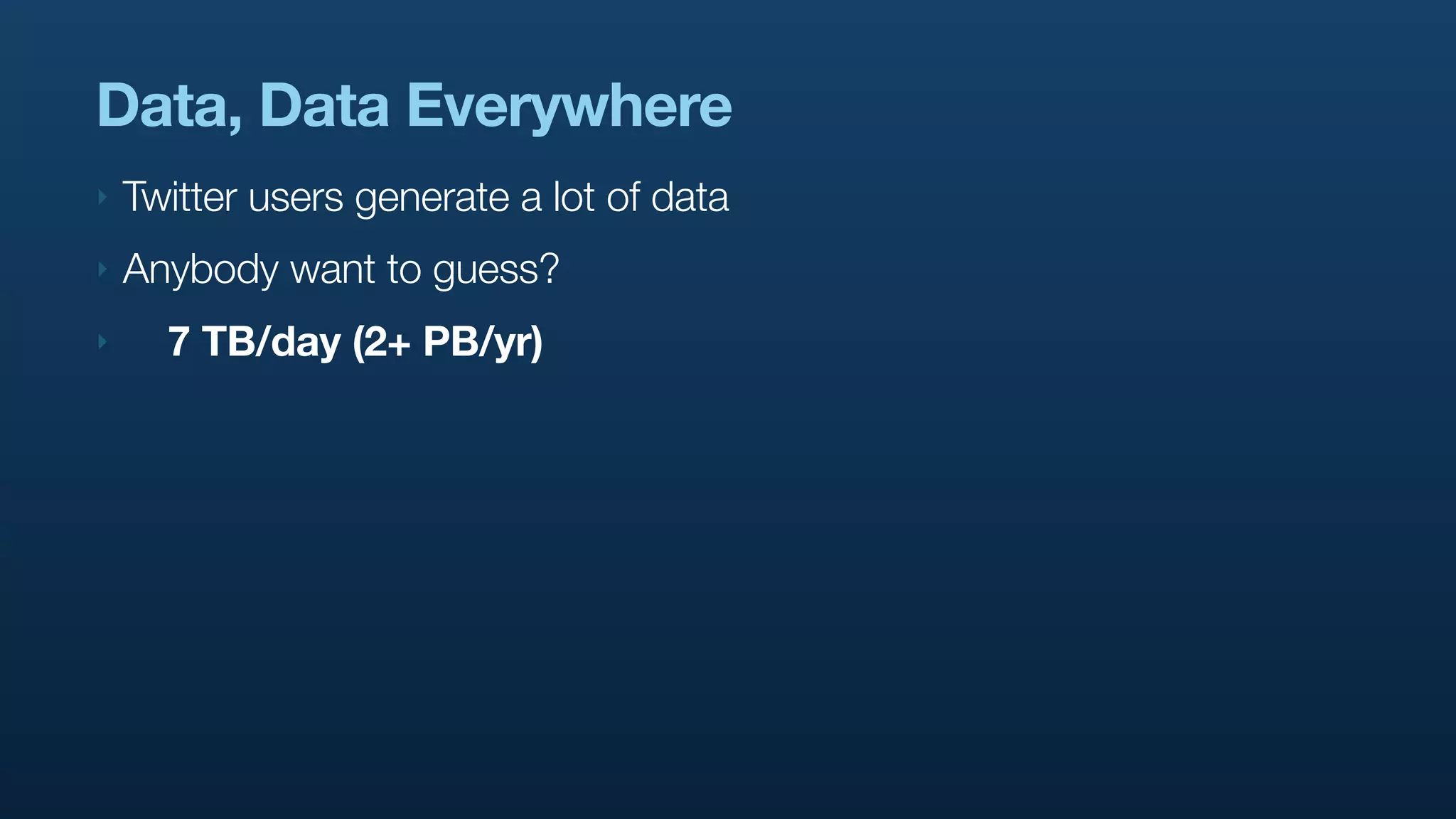
Data, Data Everywhere
‣   Twitter users generate a lot of data
‣   Anybody want to guess?
‣     7 TB/day (2+ PB/yr)
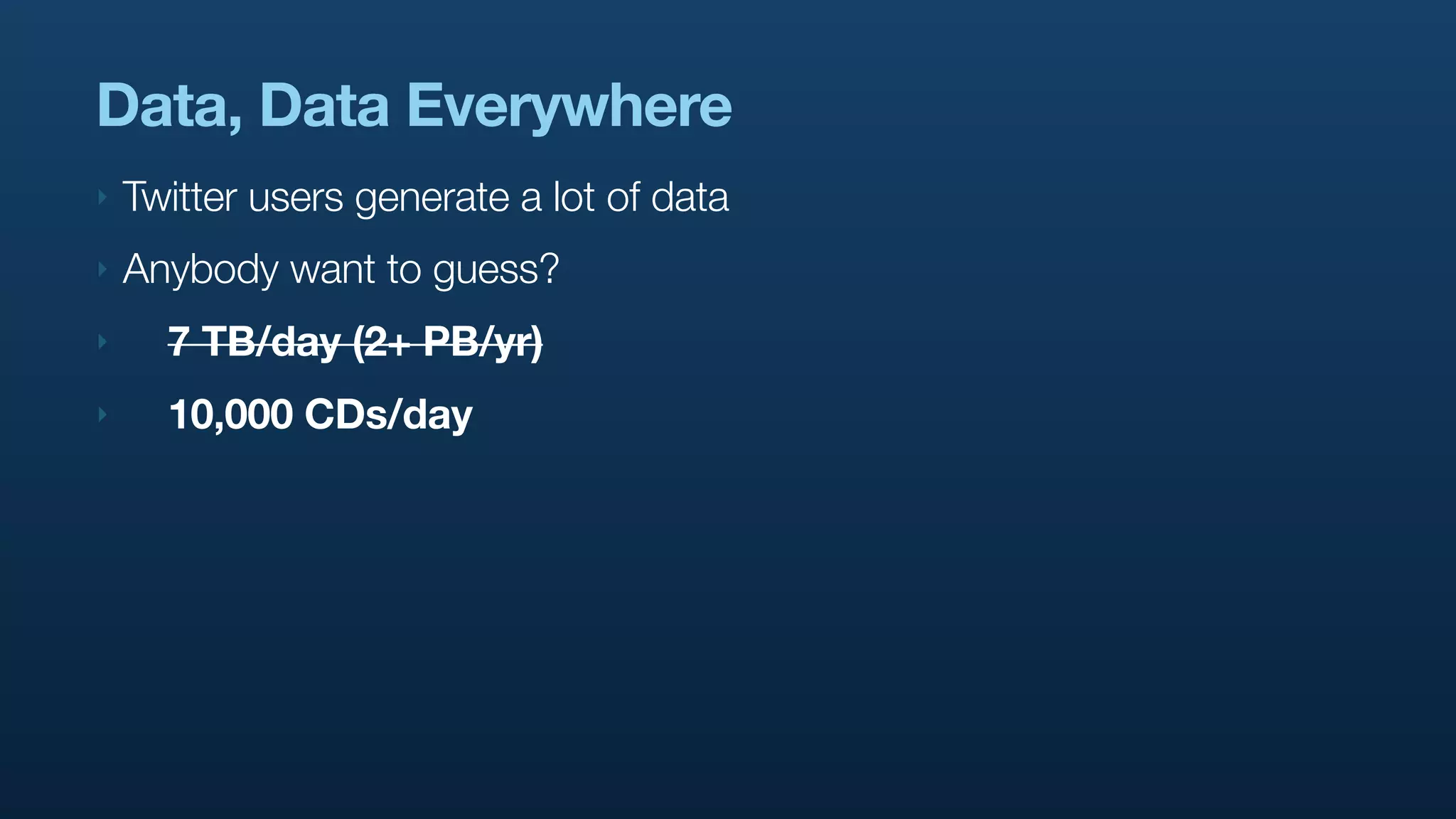
Data, Data Everywhere
‣   Twitter users generate a lot of data
‣   Anybody want to guess?
‣     7 TB/day (2+ PB/yr)
‣     10,000 CDs/day
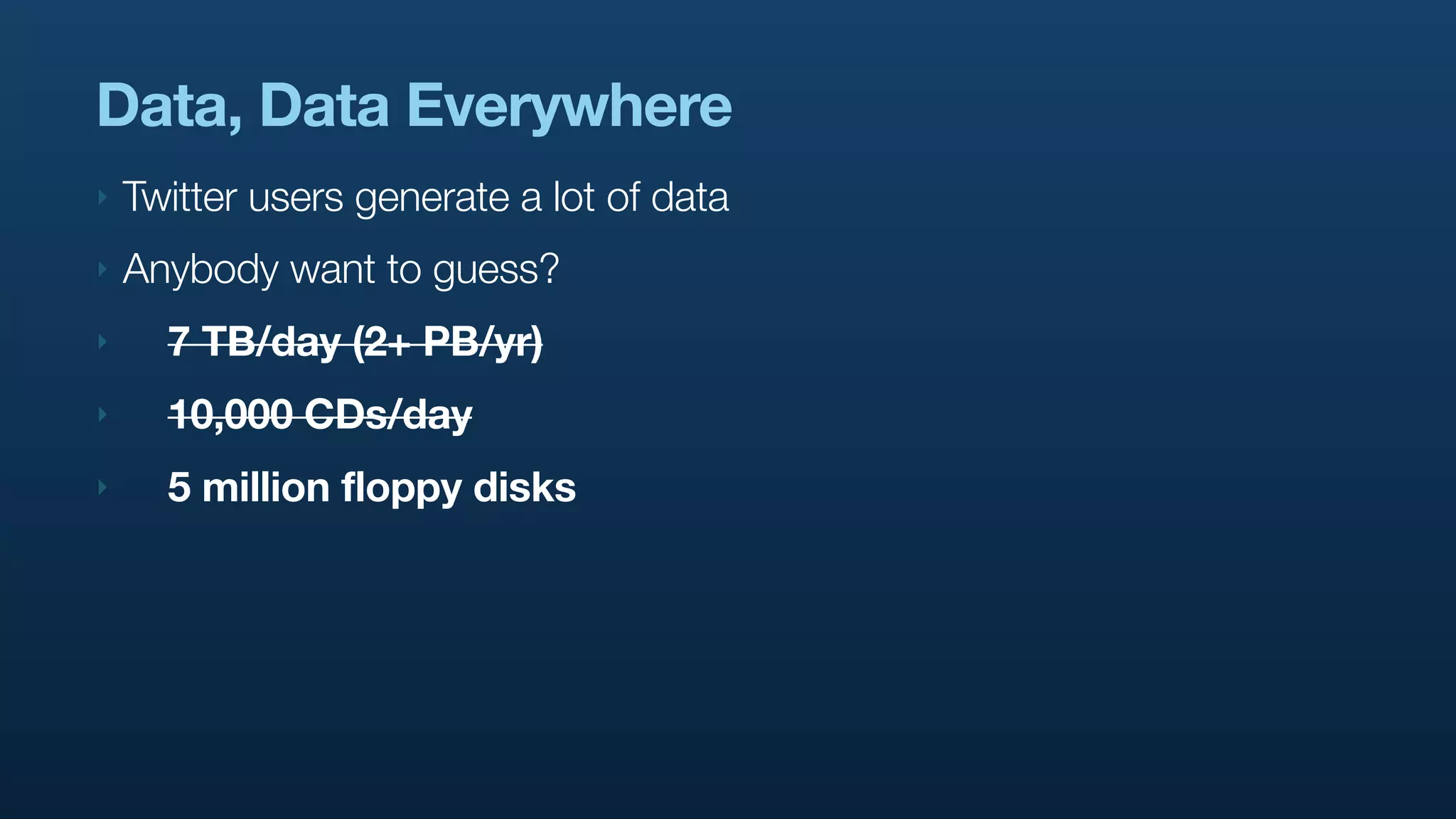
Data, Data Everywhere
‣   Twitter users generate a lot of data
‣   Anybody want to guess?
‣     7 TB/day (2+ PB/yr)
‣     10,000 CDs/day
‣     5 million floppy disks
Data, Data Everywhere
‣   Twitter users generate a lot of data
‣   Anybody want to guess?
‣     7 TB/day (2+ PB/yr)
‣     10,000 CDs/day
‣     5 million floppy disks
‣     300 GB while I give this talk
Data, Data Everywhere
‣   Twitter users generate a lot of data
‣   Anybody want to guess?
‣     7 TB/day (2+ PB/yr)
‣     10,000 CDs/day
‣     5 million floppy disks
‣     300 GB while I give this talk
‣   And doubling multiple times per year
Syslog?
‣   Started with syslog-ng
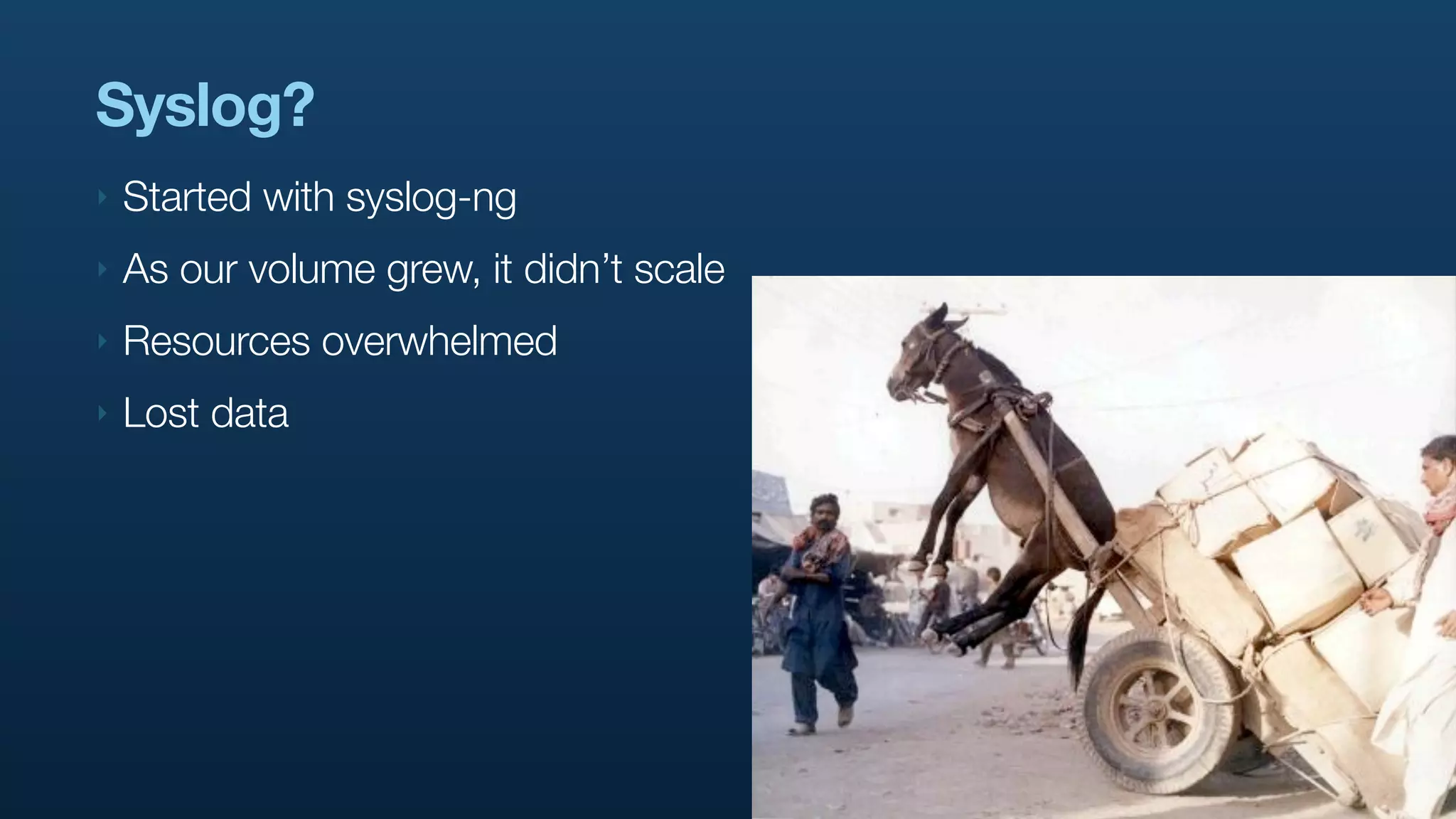
‣   As our volume grew, it didn’t scale
Syslog?
‣   Started with syslog-ng
‣   As our volume grew, it didn’t scale
‣   Resources overwhelmed
‣   Lost data
Scribe
‣   Surprise! FB had same problem, built and open-sourced Scribe
‣   Log collection framework over Thrift
‣   You write log lines, with categories
‣   It does the rest
Scribe
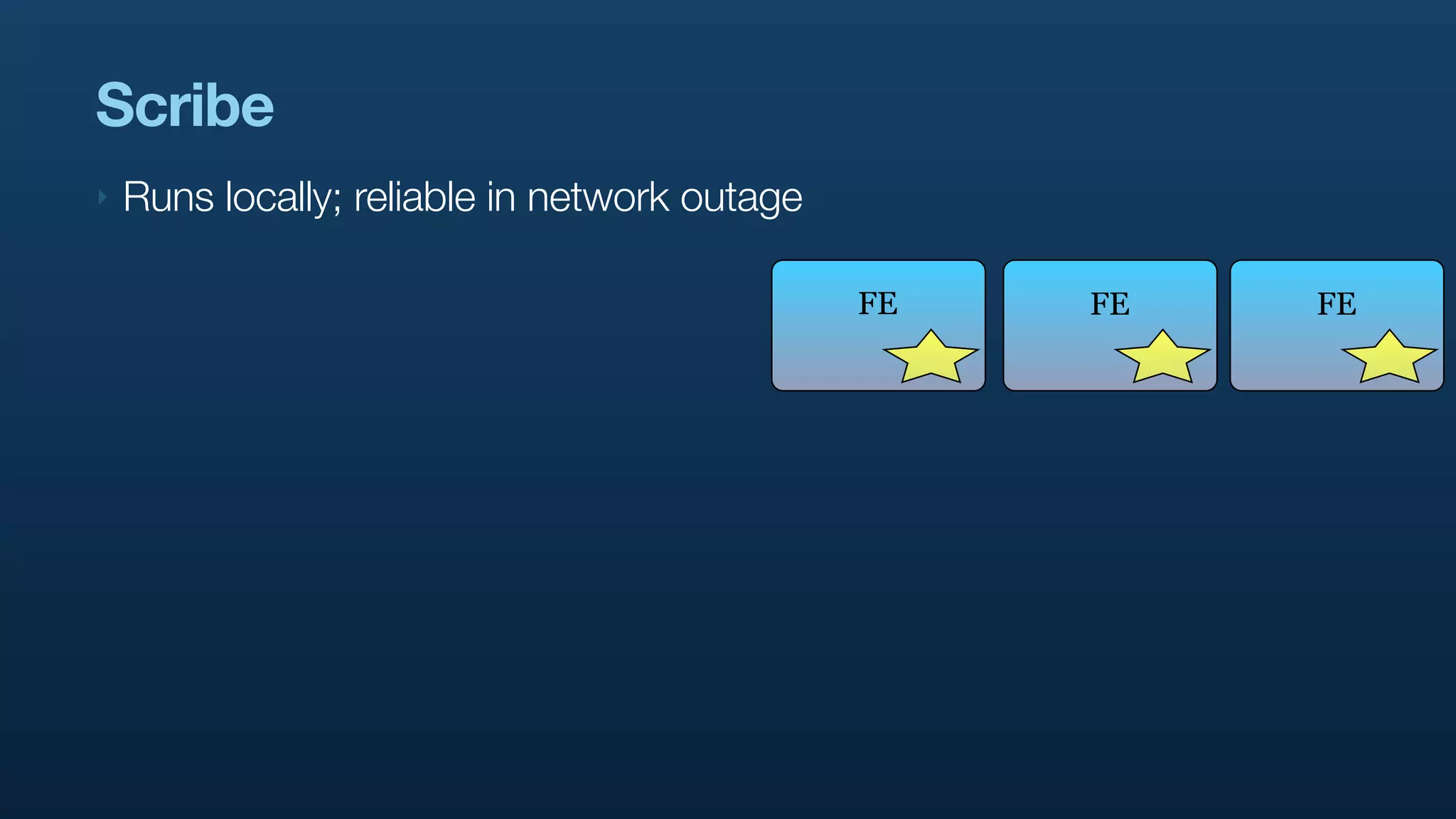
‣   Runs locally; reliable in network outage

                                               FE   FE   FE
Scribe
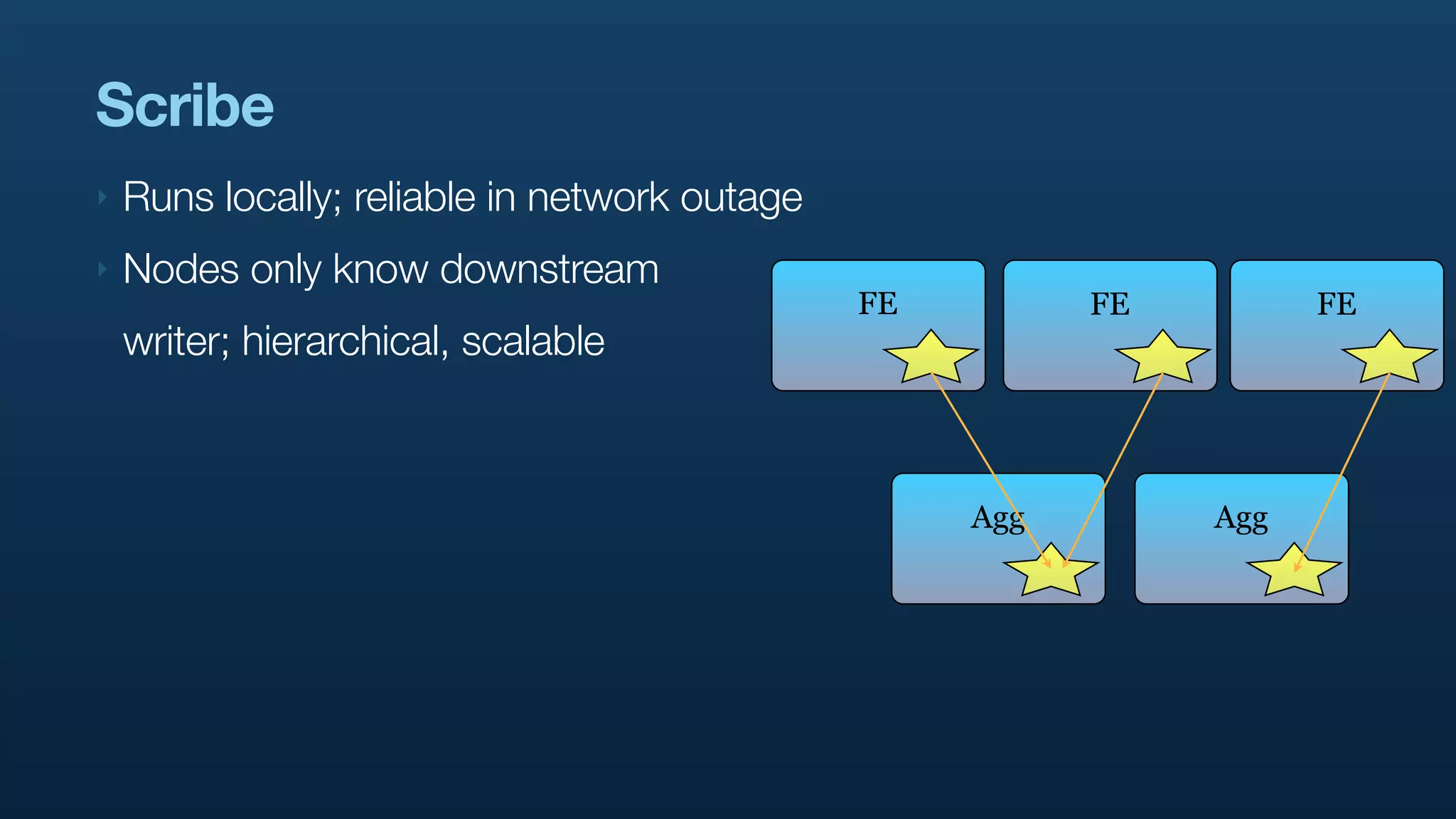
‣   Runs locally; reliable in network outage
‣   Nodes only know downstream
                                               FE         FE         FE
    writer; hierarchical, scalable


                                                    Agg        Agg
Scribe
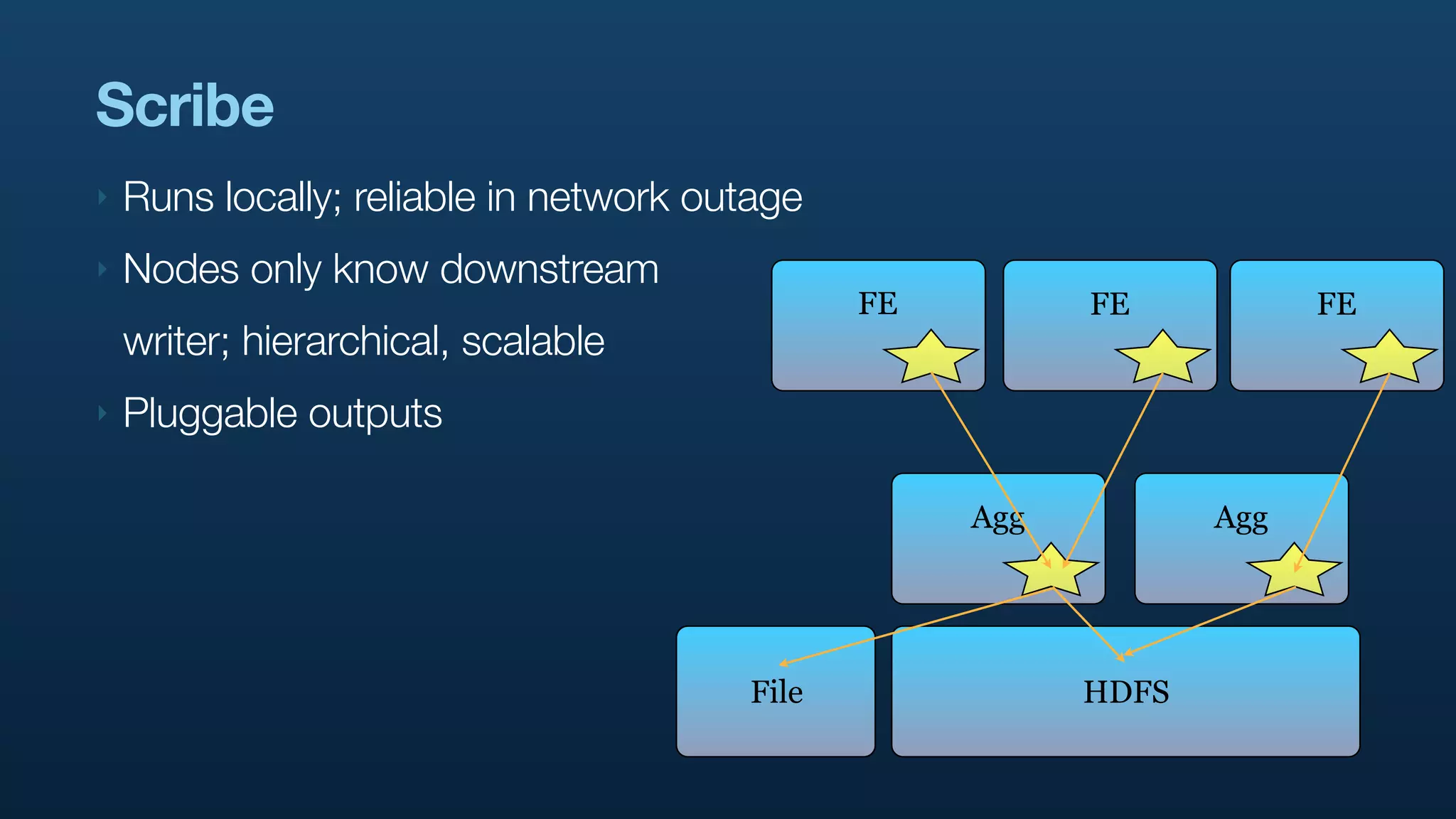
‣   Runs locally; reliable in network outage
‣   Nodes only know downstream
                                               FE         FE           FE
    writer; hierarchical, scalable
‣   Pluggable outputs

                                                    Agg          Agg


                                        File              HDFS
Scribe at Twitter
‣   Solved our problem, opened new vistas
‣   Currently 30 different categories logged from multiple sources
‣     FE: Javascript, Ruby on Rails
‣     Middle tier: Ruby on Rails, Scala
‣     Backend: Scala, Java, C++
Scribe at Twitter
‣   We’ve contributed to it as we’ve used it
‣       Improved logging, monitoring, writing to HDFS, compression
‣       Continuing to work with FB on patches
‣   GSoC project! Help make it more awesome.


    • http://github.com/traviscrawford/scribe
    • http://wiki.developers.facebook.com/index.php/User:GSoC
Introduction
‣   How We Arrived at NoSQL: A Crash Course
‣     Collecting Data (Scribe)
‣     Storing and Analyzing Data (Hadoop)
‣     Rapid Learning over Big Data (Pig)
‣   And More: Cassandra, HBase, FlockDB
How do you store 7TB/day?
‣   Single machine?
‣   What’s HD write speed?
How do you store 7TB/day?
‣   Single machine?
‣   What’s HD write speed?
‣     ~80 MB/s
How do you store 7TB/day?
‣   Single machine?
‣   What’s HD write speed?
‣     ~80 MB/s
‣   24.3 hours to write 7 TB
How do you store 7TB/day?
‣   Single machine?
‣   What’s HD write speed?
‣     ~80 MB/s
‣   24.3 hours to write 7 TB
‣   Uh oh.
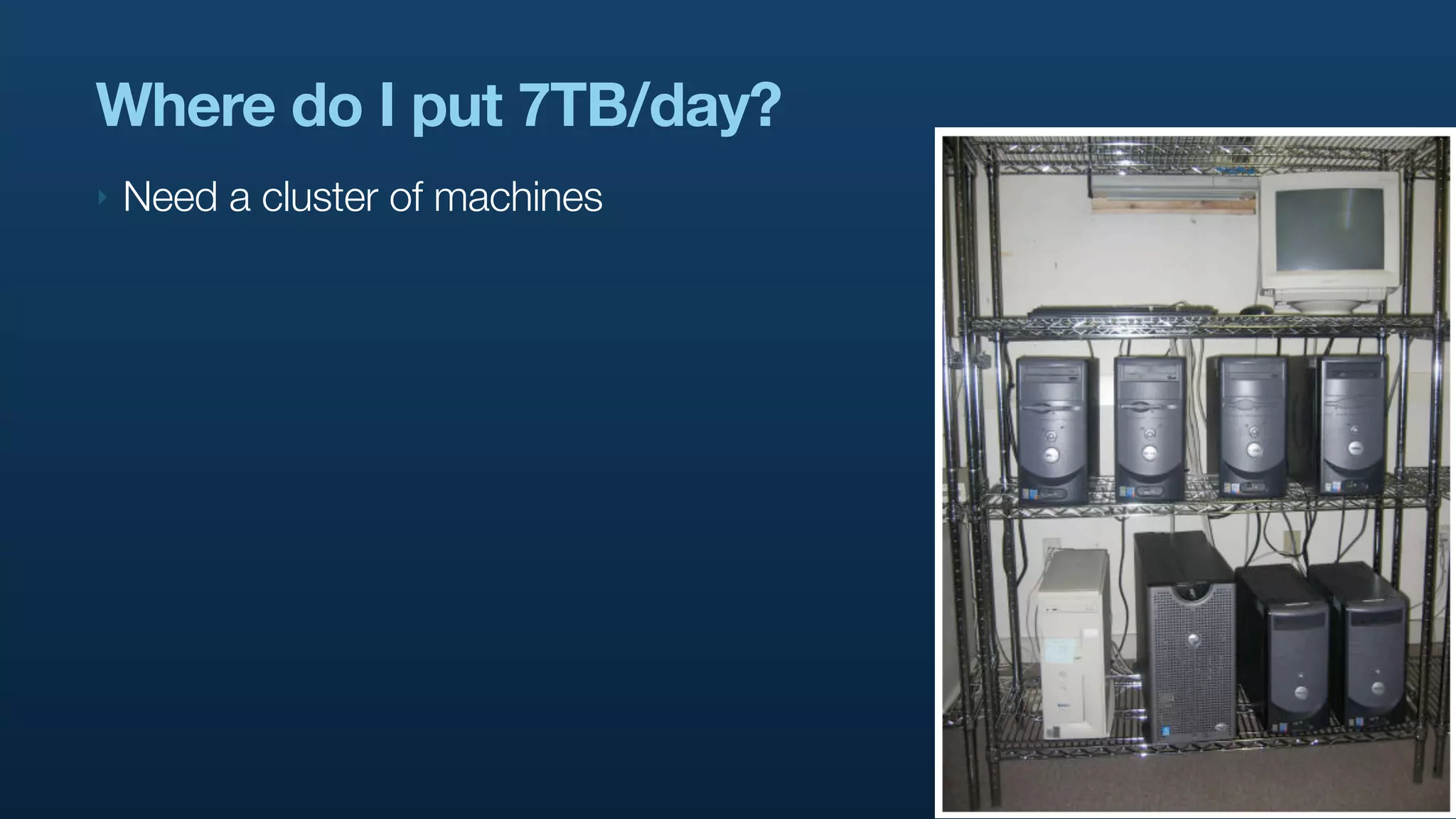
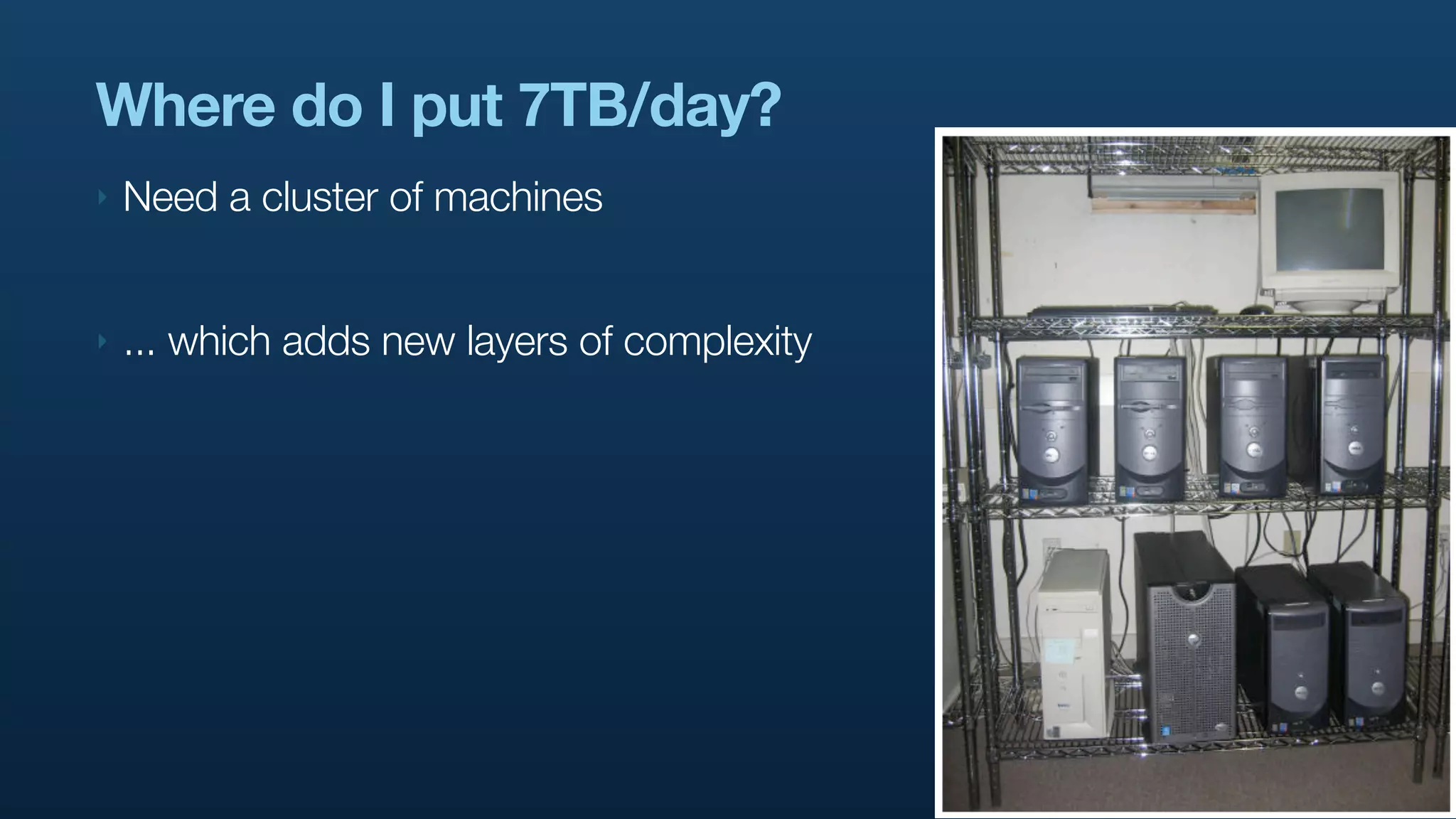
Where do I put 7TB/day?
‣   Need a cluster of machines
Where do I put 7TB/day?
‣   Need a cluster of machines


‣   ... which adds new layers of complexity
Hadoop
‣   Distributed file system
‣     Automatic replication, fault tolerance
Hadoop
‣   Distributed file system
‣     Automatic replication, fault tolerance
‣   MapReduce-based parallel computation
‣     Key-value based computation interface allows for wide
    applicability
Hadoop
‣   Open source: top-level Apache project
‣   Scalable: Y! has a 4000 node cluster
‣   Powerful: sorted 1TB of random integers in 62 seconds


‣   Easy packaging: free Cloudera RPMs
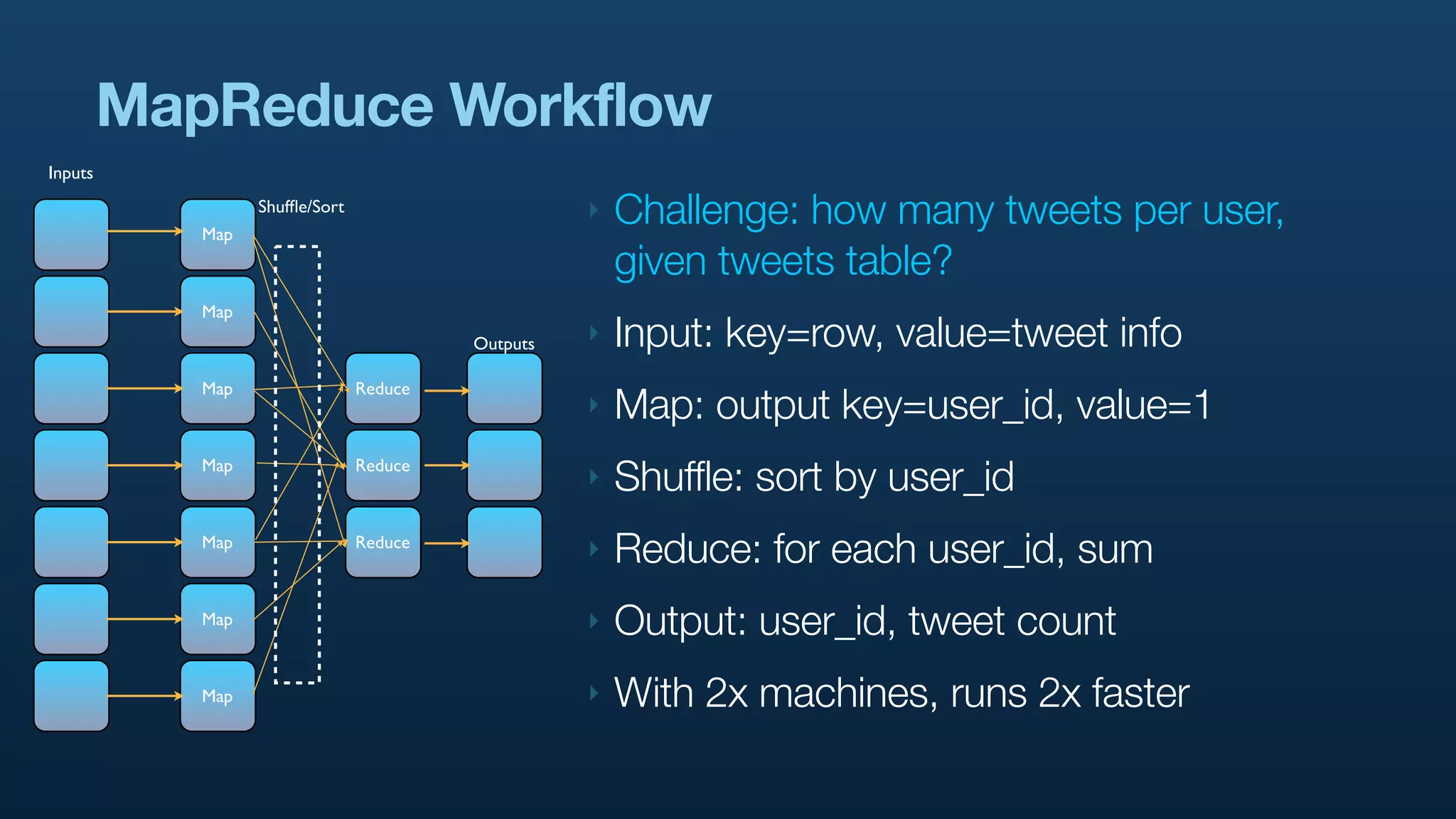
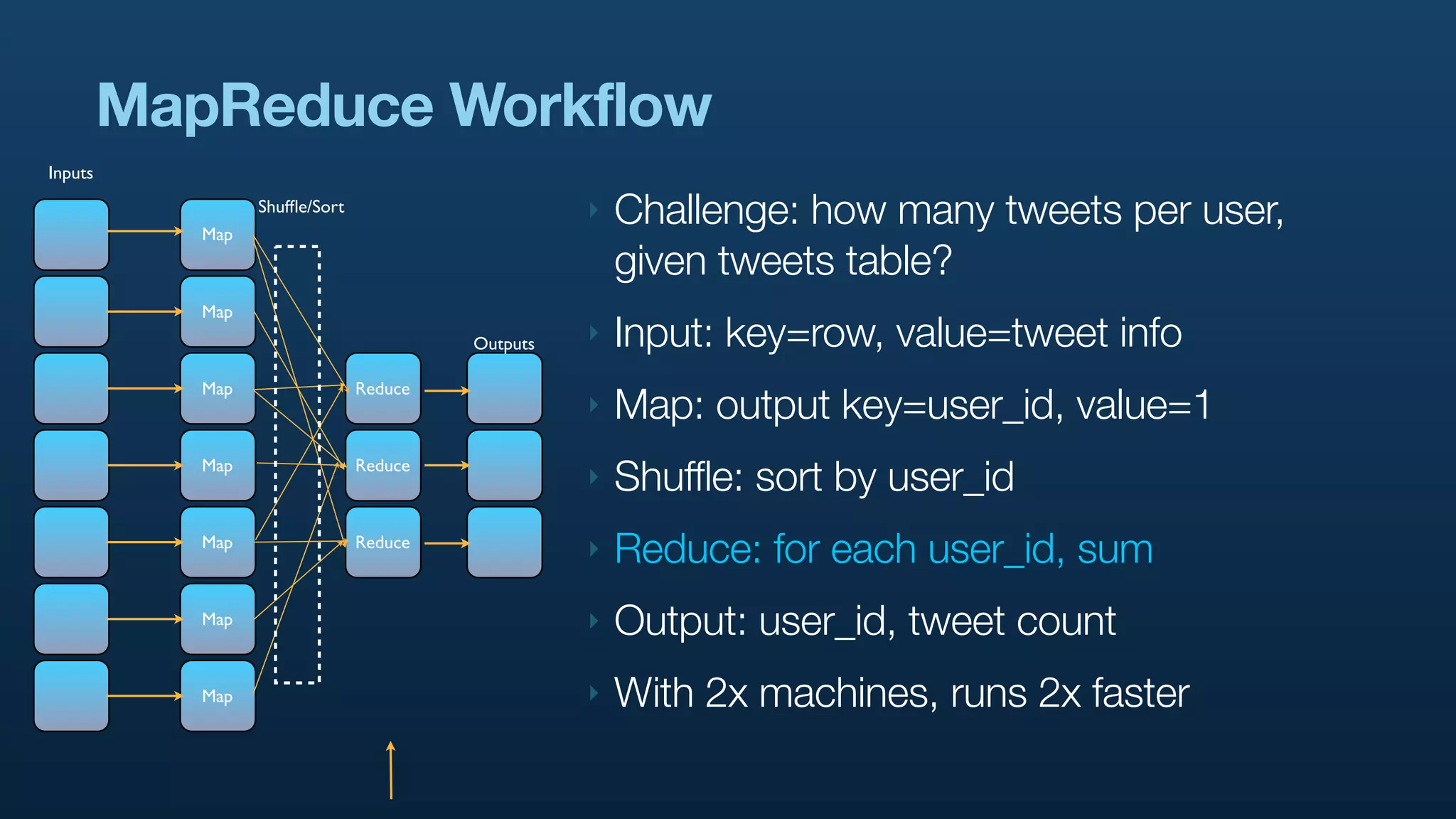
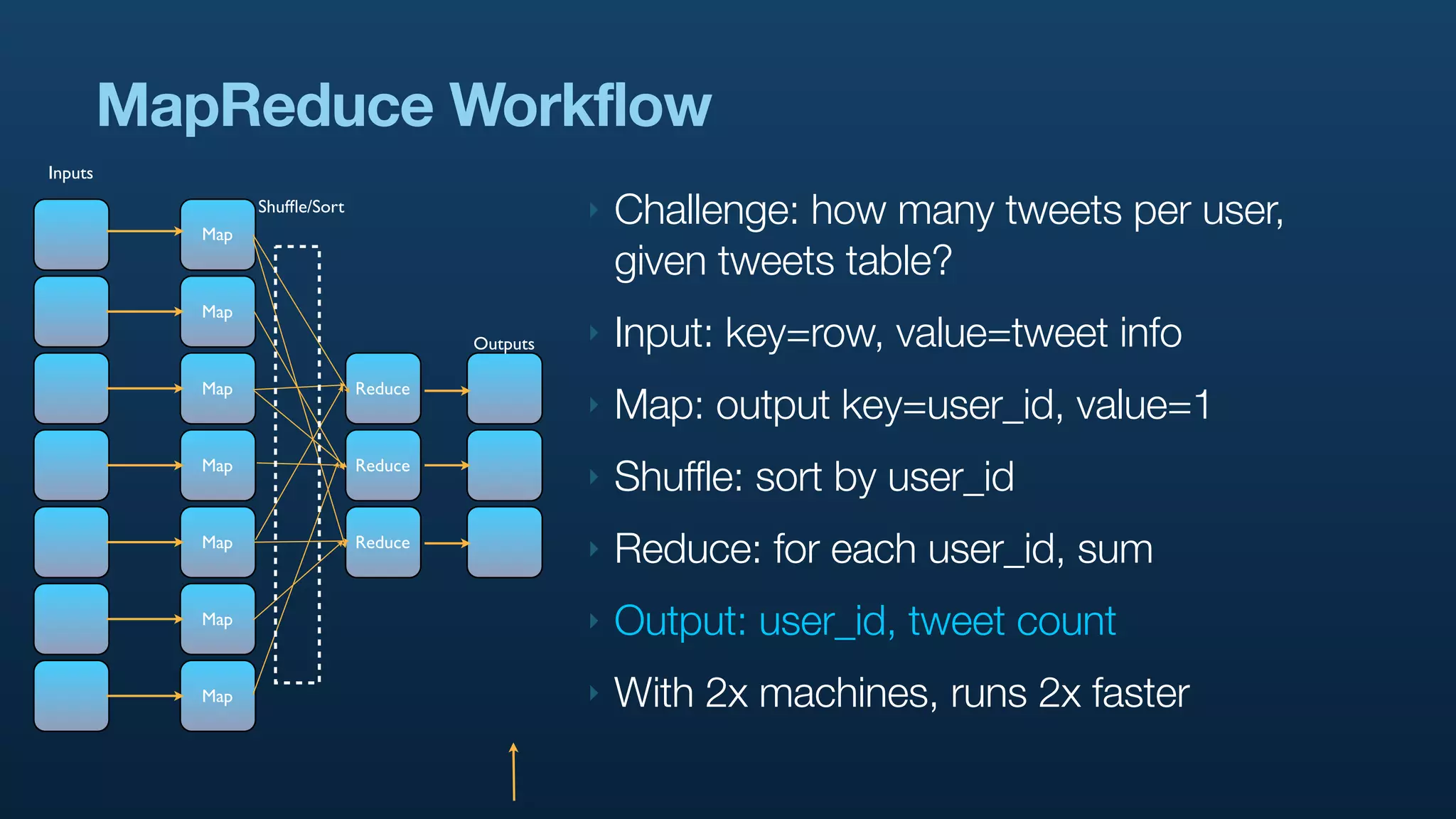
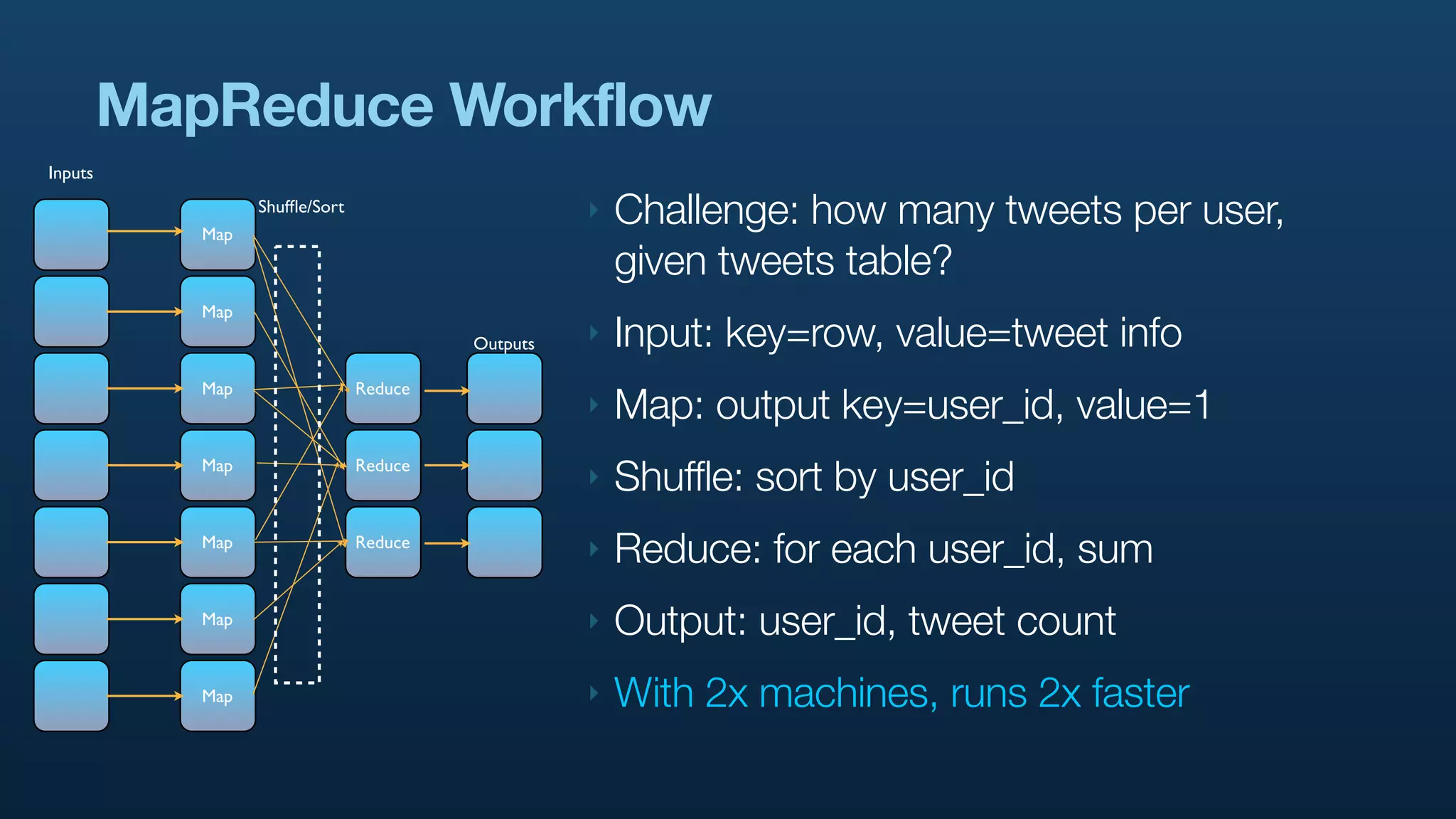
MapReduce Workflow
Inputs


            Map
                  Shuffle/Sort                      ‣   Challenge: how many tweets per user,
                                                       given tweets table?
            Map
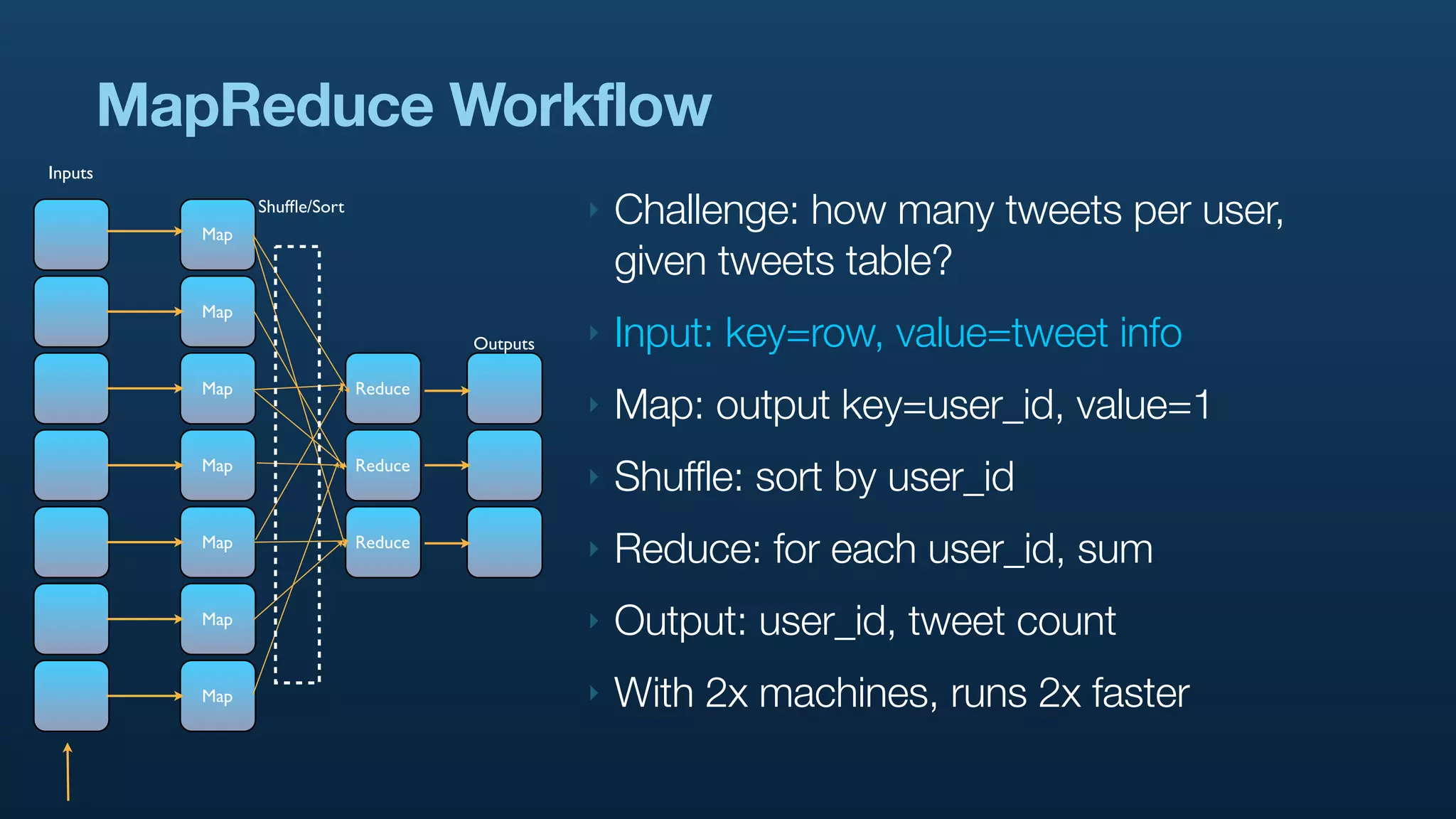
                                         Outputs   ‣   Input: key=row, value=tweet info
            Map                 Reduce
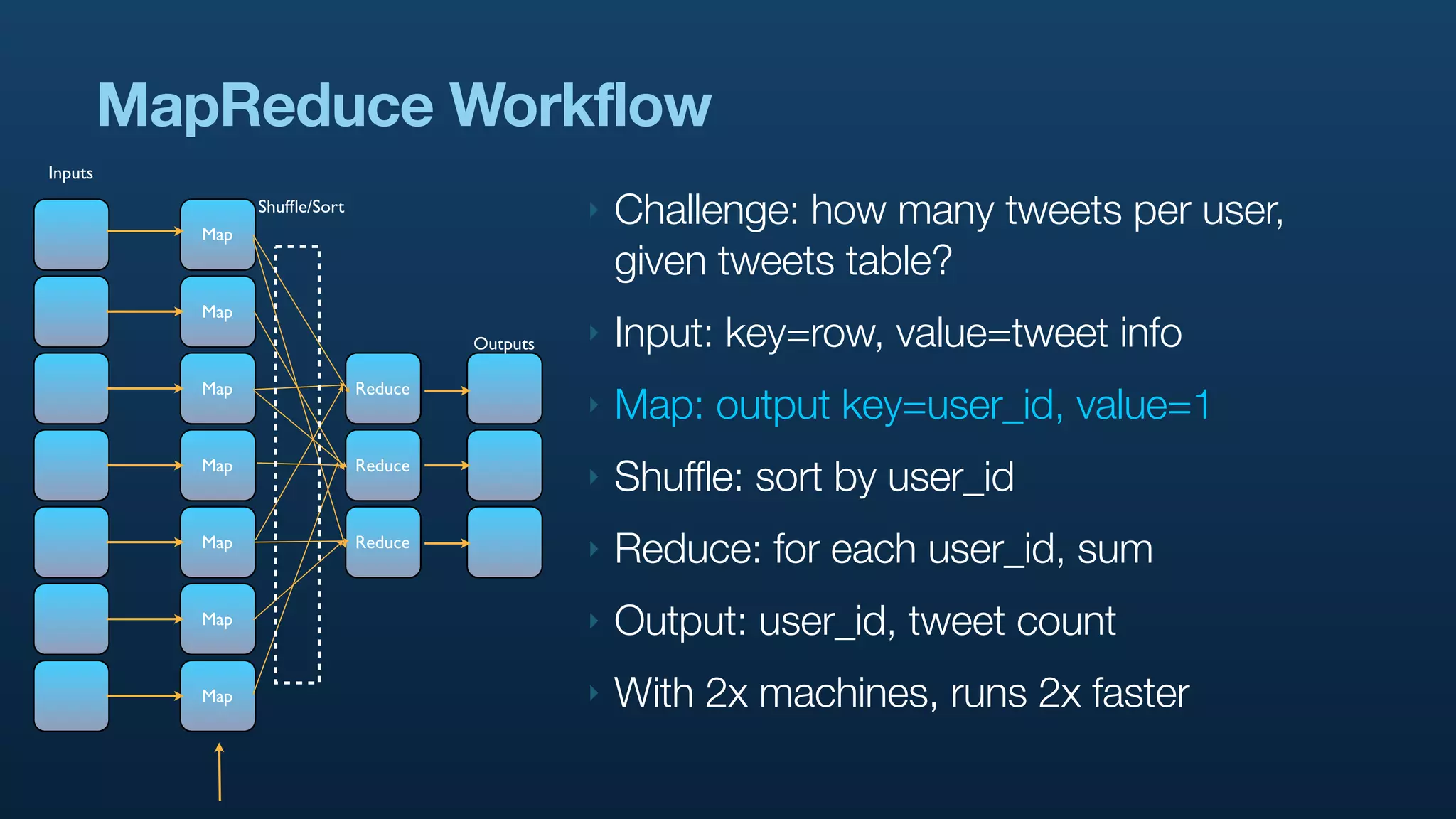
                                                   ‣   Map: output key=user_id, value=1
            Map                 Reduce
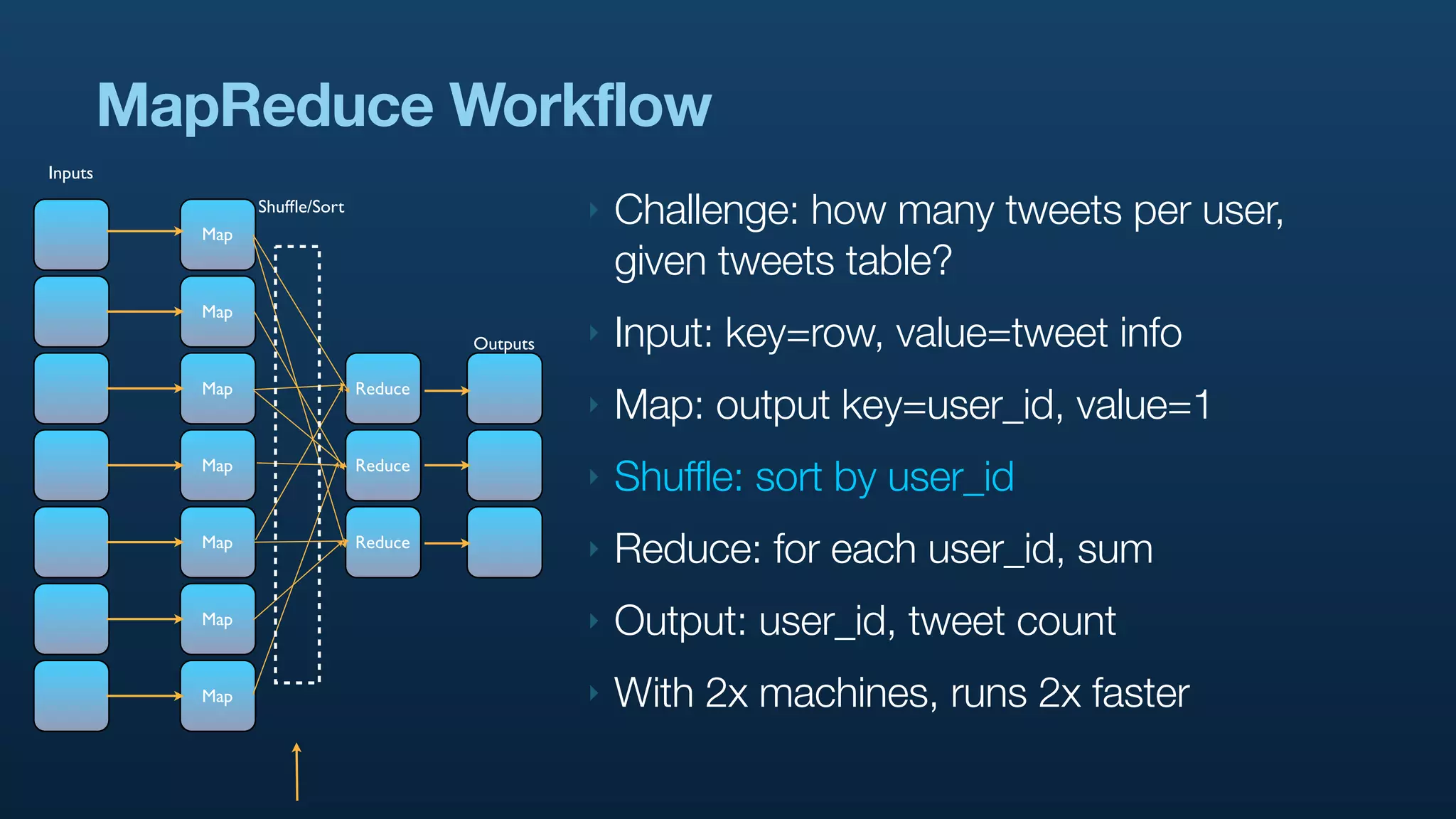
                                                   ‣   Shuffle: sort by user_id
            Map                 Reduce
                                                   ‣   Reduce: for each user_id, sum
            Map                                    ‣   Output: user_id, tweet count
            Map                                    ‣   With 2x machines, runs 2x faster
MapReduce Workflow
Inputs


            Map
                  Shuffle/Sort                      ‣   Challenge: how many tweets per user,
                                                       given tweets table?
            Map
                                         Outputs   ‣   Input: key=row, value=tweet info
            Map                 Reduce
                                                   ‣   Map: output key=user_id, value=1
            Map                 Reduce
                                                   ‣   Shuffle: sort by user_id
            Map                 Reduce
                                                   ‣   Reduce: for each user_id, sum
            Map                                    ‣   Output: user_id, tweet count
            Map                                    ‣   With 2x machines, runs 2x faster
MapReduce Workflow
Inputs


            Map
                  Shuffle/Sort                      ‣   Challenge: how many tweets per user,
                                                       given tweets table?
            Map
                                         Outputs   ‣   Input: key=row, value=tweet info
            Map                 Reduce
                                                   ‣   Map: output key=user_id, value=1
            Map                 Reduce
                                                   ‣   Shuffle: sort by user_id
            Map                 Reduce
                                                   ‣   Reduce: for each user_id, sum
            Map                                    ‣   Output: user_id, tweet count
            Map                                    ‣   With 2x machines, runs 2x faster
MapReduce Workflow
Inputs


            Map
                  Shuffle/Sort                      ‣   Challenge: how many tweets per user,
                                                       given tweets table?
            Map
                                         Outputs   ‣   Input: key=row, value=tweet info
            Map                 Reduce
                                                   ‣   Map: output key=user_id, value=1
            Map                 Reduce
                                                   ‣   Shuffle: sort by user_id
            Map                 Reduce
                                                   ‣   Reduce: for each user_id, sum
            Map                                    ‣   Output: user_id, tweet count
            Map                                    ‣   With 2x machines, runs 2x faster
MapReduce Workflow
Inputs


            Map
                  Shuffle/Sort                      ‣   Challenge: how many tweets per user,
                                                       given tweets table?
            Map
                                         Outputs   ‣   Input: key=row, value=tweet info
            Map                 Reduce
                                                   ‣   Map: output key=user_id, value=1
            Map                 Reduce
                                                   ‣   Shuffle: sort by user_id
            Map                 Reduce
                                                   ‣   Reduce: for each user_id, sum
            Map                                    ‣   Output: user_id, tweet count
            Map                                    ‣   With 2x machines, runs 2x faster
MapReduce Workflow
Inputs


            Map
                  Shuffle/Sort                      ‣   Challenge: how many tweets per user,
                                                       given tweets table?
            Map
                                         Outputs   ‣   Input: key=row, value=tweet info
            Map                 Reduce
                                                   ‣   Map: output key=user_id, value=1
            Map                 Reduce
                                                   ‣   Shuffle: sort by user_id
            Map                 Reduce
                                                   ‣   Reduce: for each user_id, sum
            Map                                    ‣   Output: user_id, tweet count
            Map                                    ‣   With 2x machines, runs 2x faster
MapReduce Workflow
Inputs


            Map
                  Shuffle/Sort                      ‣   Challenge: how many tweets per user,
                                                       given tweets table?
            Map
                                         Outputs   ‣   Input: key=row, value=tweet info
            Map                 Reduce
                                                   ‣   Map: output key=user_id, value=1
            Map                 Reduce
                                                   ‣   Shuffle: sort by user_id
            Map                 Reduce
                                                   ‣   Reduce: for each user_id, sum
            Map                                    ‣   Output: user_id, tweet count
            Map                                    ‣   With 2x machines, runs 2x faster
Two Analysis Challenges
‣   1. Compute friendships in Twitter’s social graph
‣     grep, awk? No way.
‣     Data is in MySQL... self join on an n-billion row table?
‣        n,000,000,000 x n,000,000,000 = ?
Two Analysis Challenges
‣   1. Compute friendships in Twitter’s social graph
‣     grep, awk? No way.
‣     Data is in MySQL... self join on an n-billion row table?
‣        n,000,000,000 x n,000,000,000 = ?
‣        I don’t know either.
Two Analysis Challenges
‣   2. Large-scale grouping and counting?
‣    select count(*) from users? Maybe...
‣    select count(*) from tweets? Uh...
‣    Imagine joining them...
‣    ... and grouping...
‣    ... and sorting...
Back to Hadoop
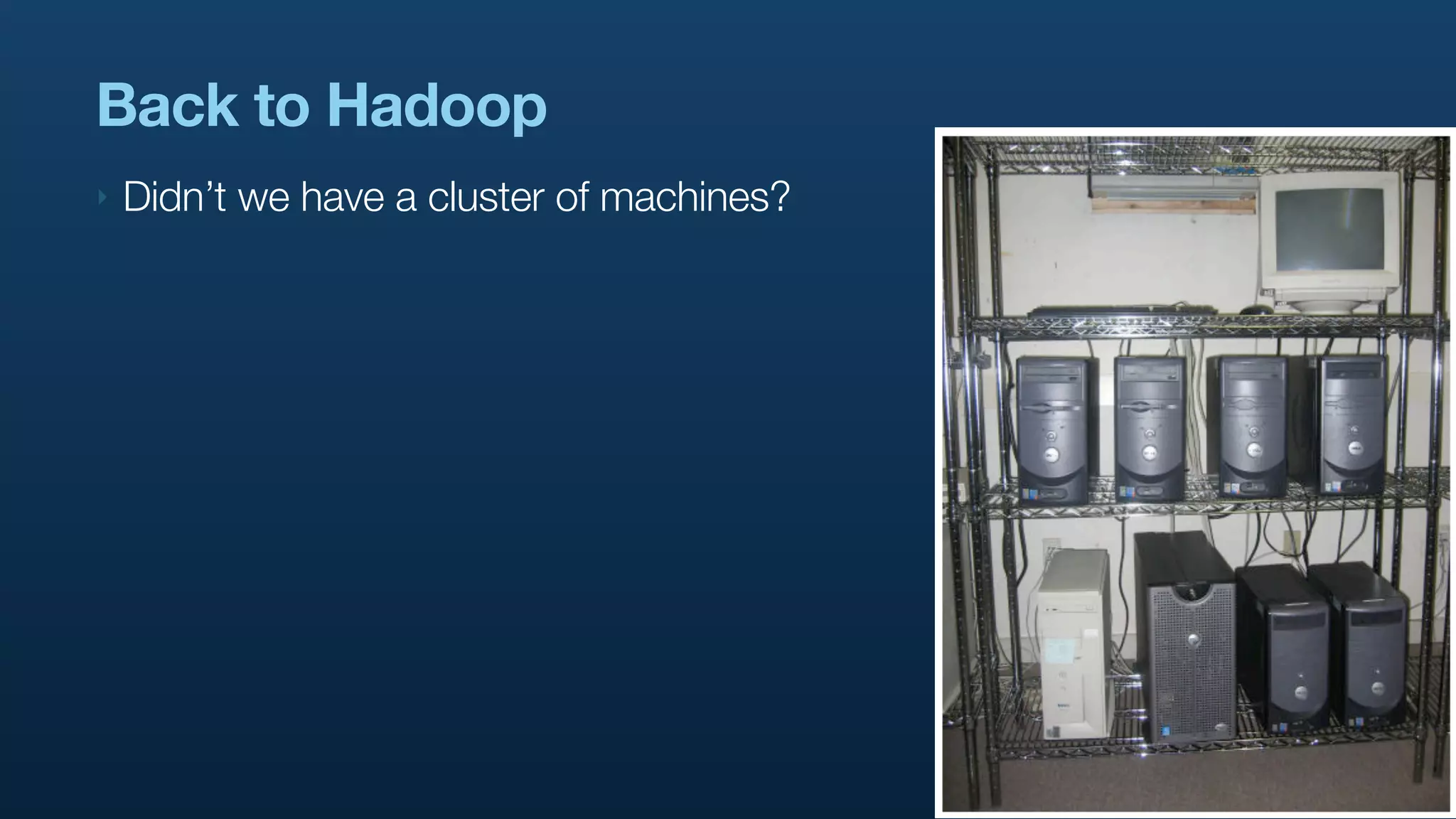
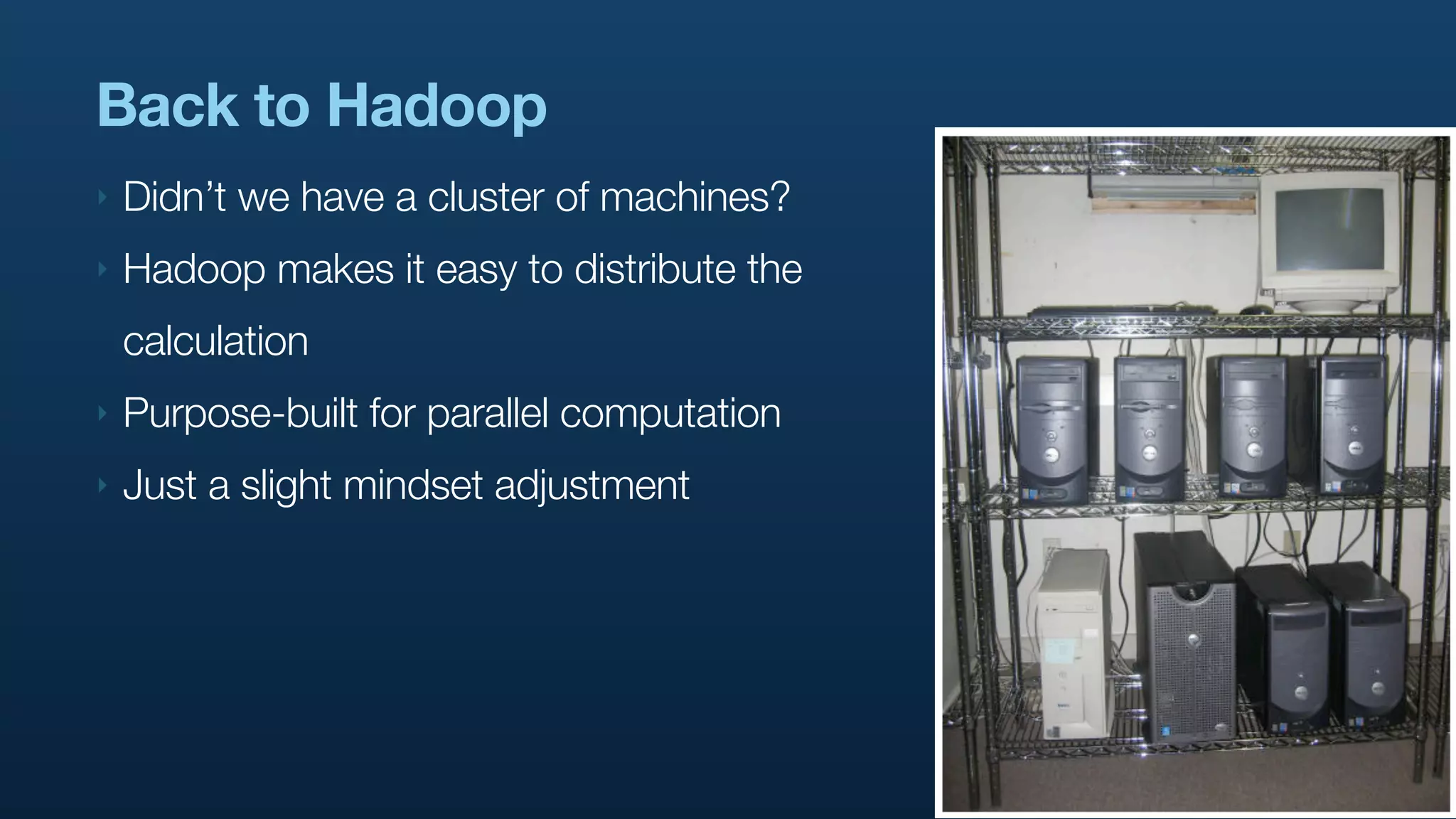
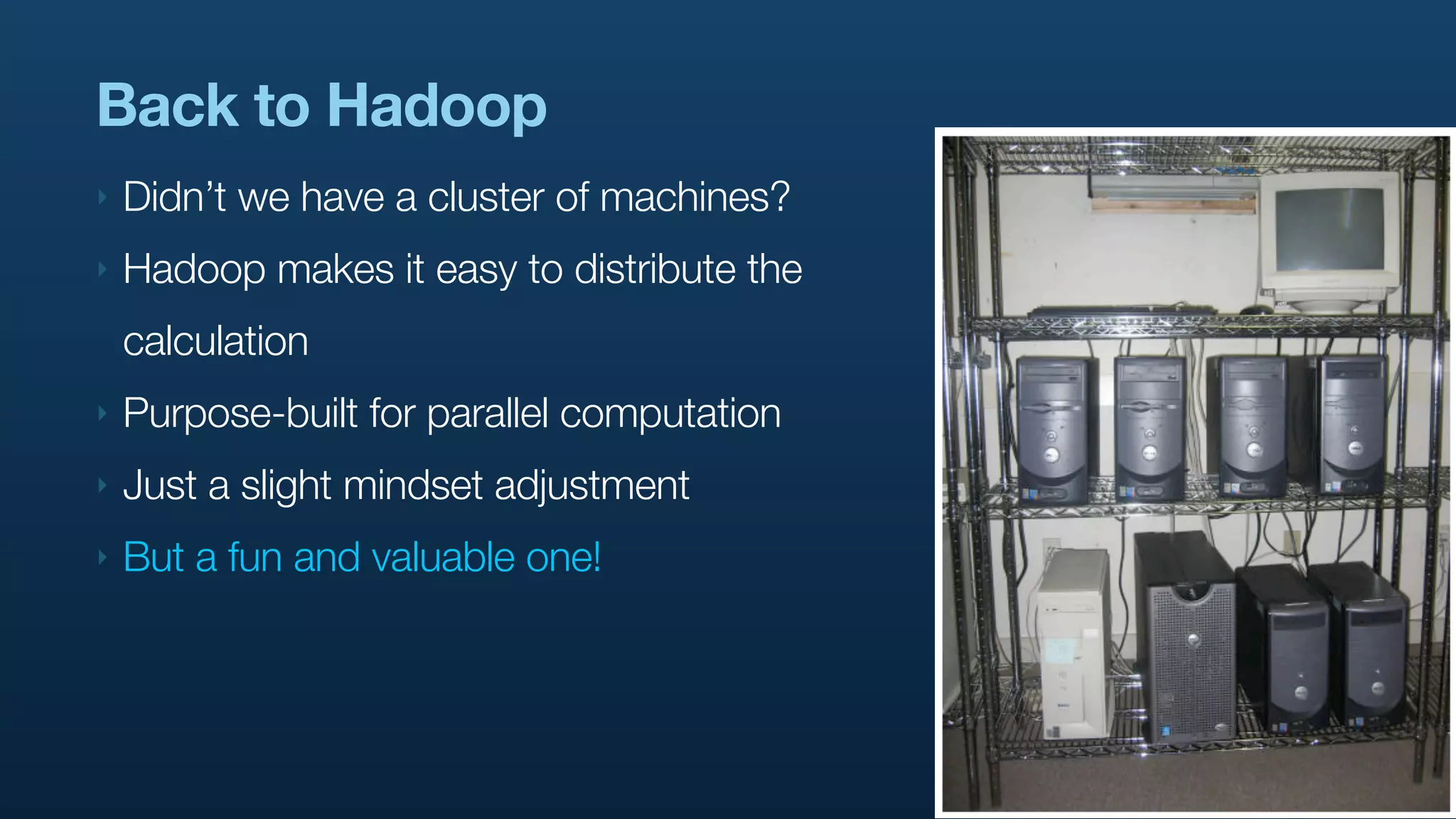
‣   Didn’t we have a cluster of machines?
Back to Hadoop
‣   Didn’t we have a cluster of machines?
Back to Hadoop
‣   Didn’t we have a cluster of machines?
‣   Hadoop makes it easy to distribute the
    calculation
‣   Purpose-built for parallel computation
‣   Just a slight mindset adjustment
Back to Hadoop
‣   Didn’t we have a cluster of machines?
‣   Hadoop makes it easy to distribute the
    calculation
‣   Purpose-built for parallel computation
‣   Just a slight mindset adjustment
‣   But a fun and valuable one!
Analysis at scale
‣   Now we’re rolling
‣   Count all tweets: 12 billion, 5 minutes
‣   Hit FlockDB in parallel to assemble social graph aggregates
‣   Run pagerank across users to calculate reputations
But...
‣   Analysis typically in Java
‣     “I need less Java in my life, not more.”
But...
‣   Analysis typically in Java
‣     “I need less Java in my life, not more.”
‣   Single-input, two-stage data flow is rigid
But...
‣   Analysis typically in Java
‣     “I need less Java in my life, not more.”
‣   Single-input, two-stage data flow is rigid
‣   Projections, filters: custom code
But...
‣   Analysis typically in Java
‣     “I need less Java in my life, not more.”
‣   Single-input, two-stage data flow is rigid
‣   Projections, filters: custom code
‣   Joins are lengthy, error-prone
But...
‣   Analysis typically in Java
‣     “I need less Java in my life, not more.”
‣   Single-input, two-stage data flow is rigid
‣   Projections, filters: custom code
‣   Joins are lengthy, error-prone
‣   n-stage jobs hard to manage
But...
‣   Analysis typically in Java
‣     “I need less Java in my life, not more.”
‣   Single-input, two-stage data flow is rigid
‣   Projections, filters: custom code
‣   Joins are lengthy, error-prone
‣   n-stage jobs hard to manage
‣   Exploration requires compilation!
Introduction
‣   How We Arrived at NoSQL: A Crash Course
‣     Collecting Data (Scribe)
‣     Storing and Analyzing Data (Hadoop)
‣     Rapid Learning over Big Data (Pig)
‣   And More: Cassandra, HBase, FlockDB
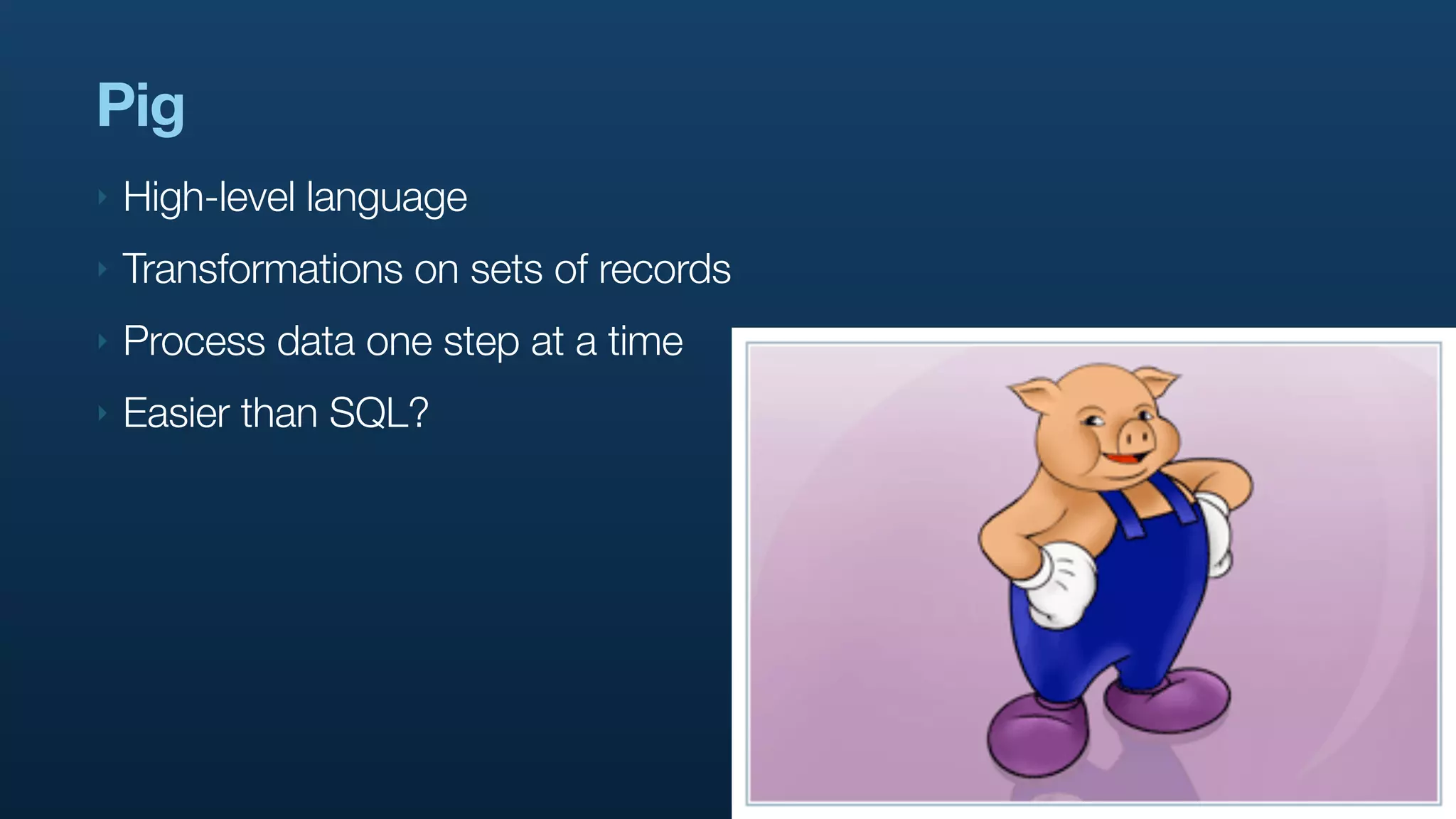
Pig
‣   High-level language
‣   Transformations on sets of records
‣   Process data one step at a time
‣   Easier than SQL?
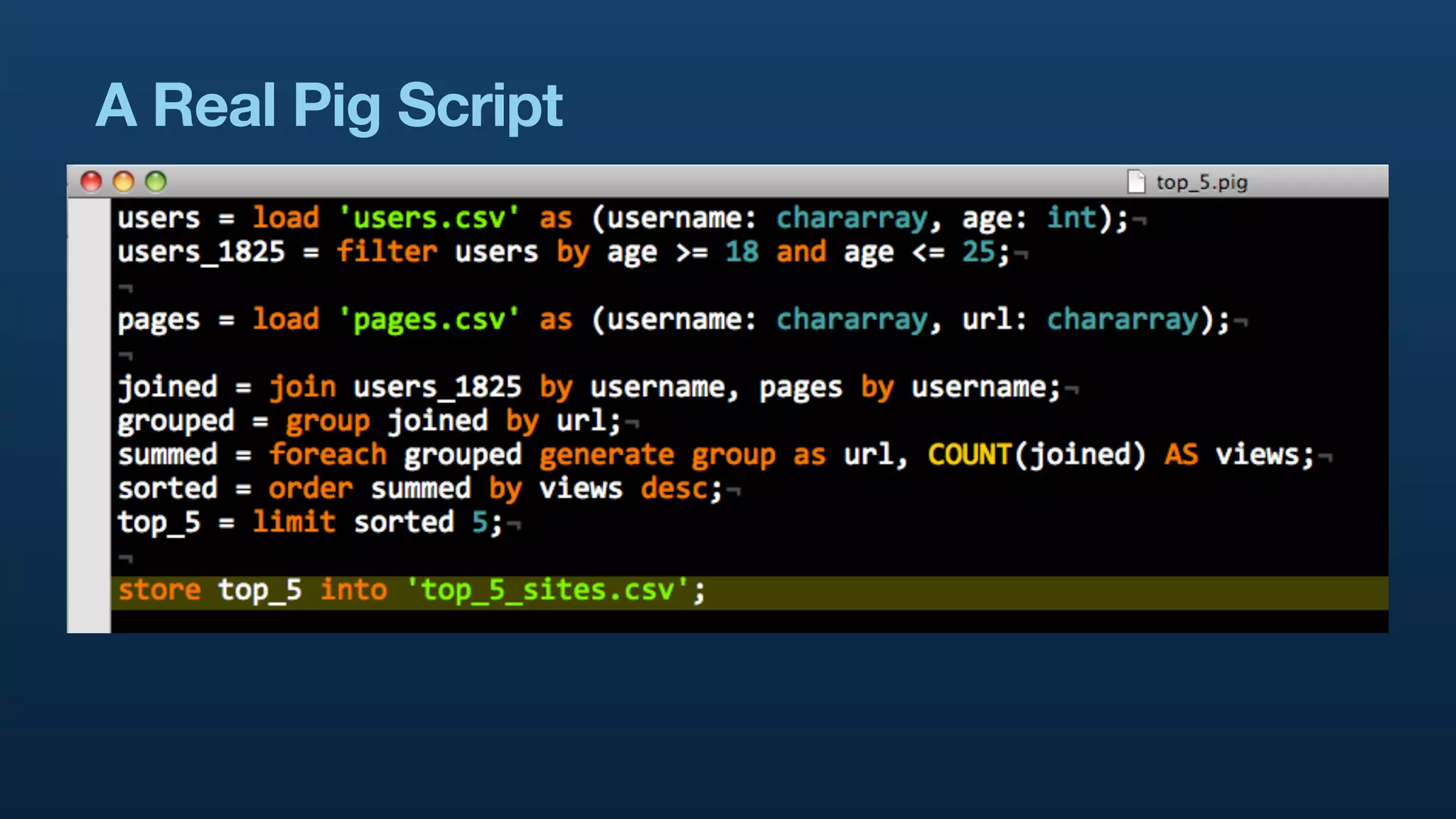
Why Pig?
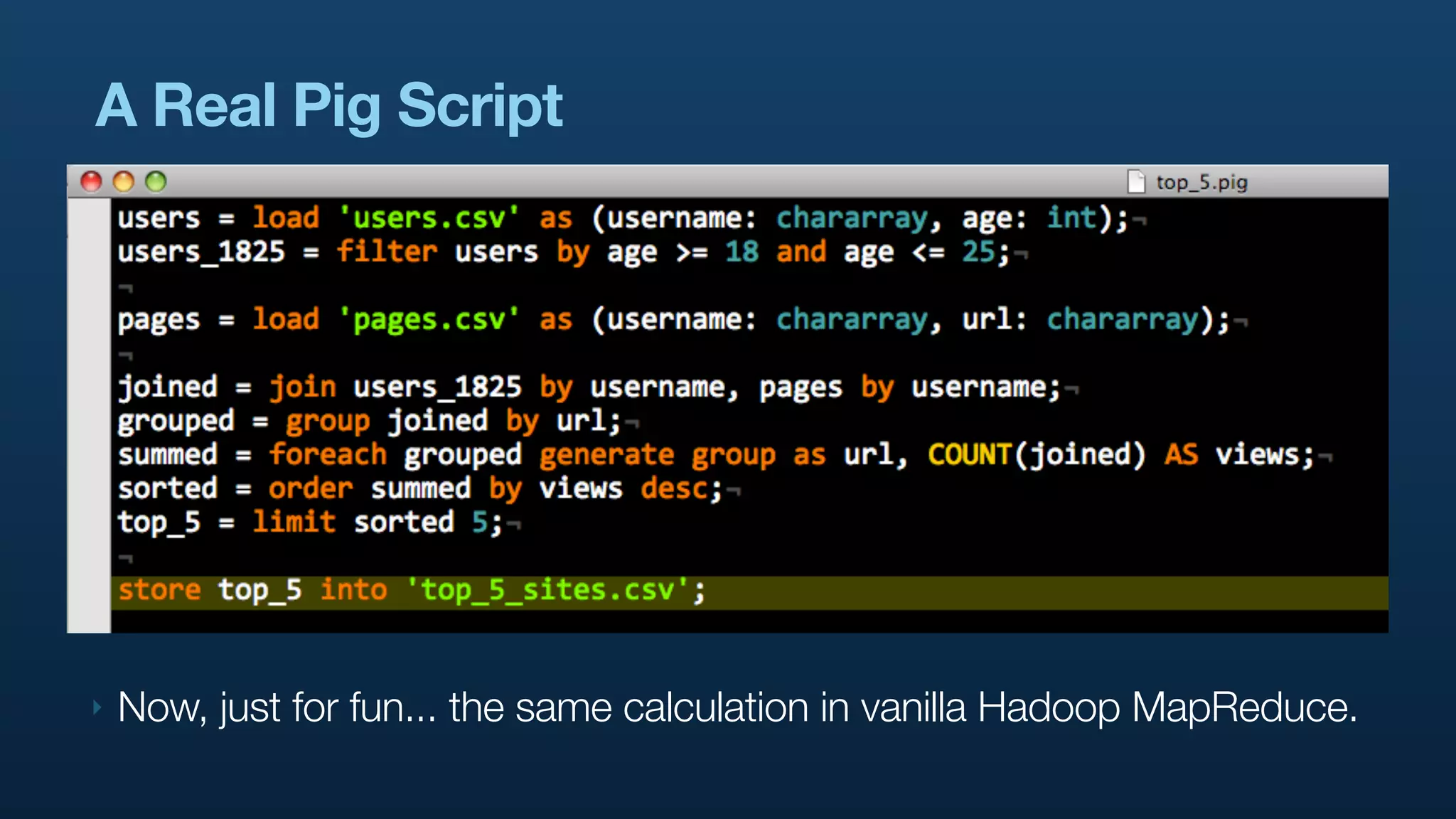
‣   Because I bet you can read the following script.
A Real Pig Script
A Real Pig Script


‣   Now, just for fun... the same calculation in vanilla Hadoop MapReduce.
No, seriously.
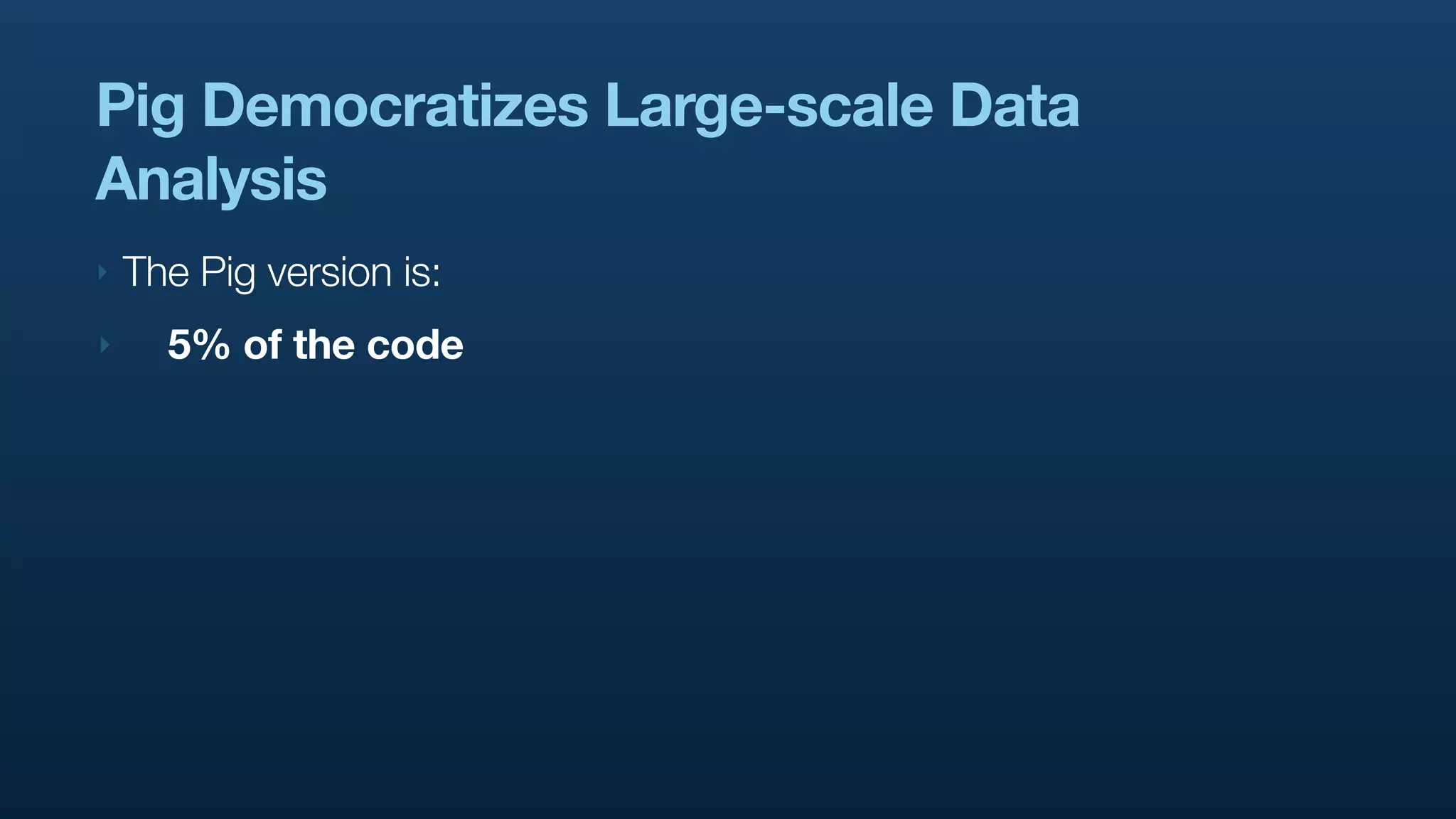
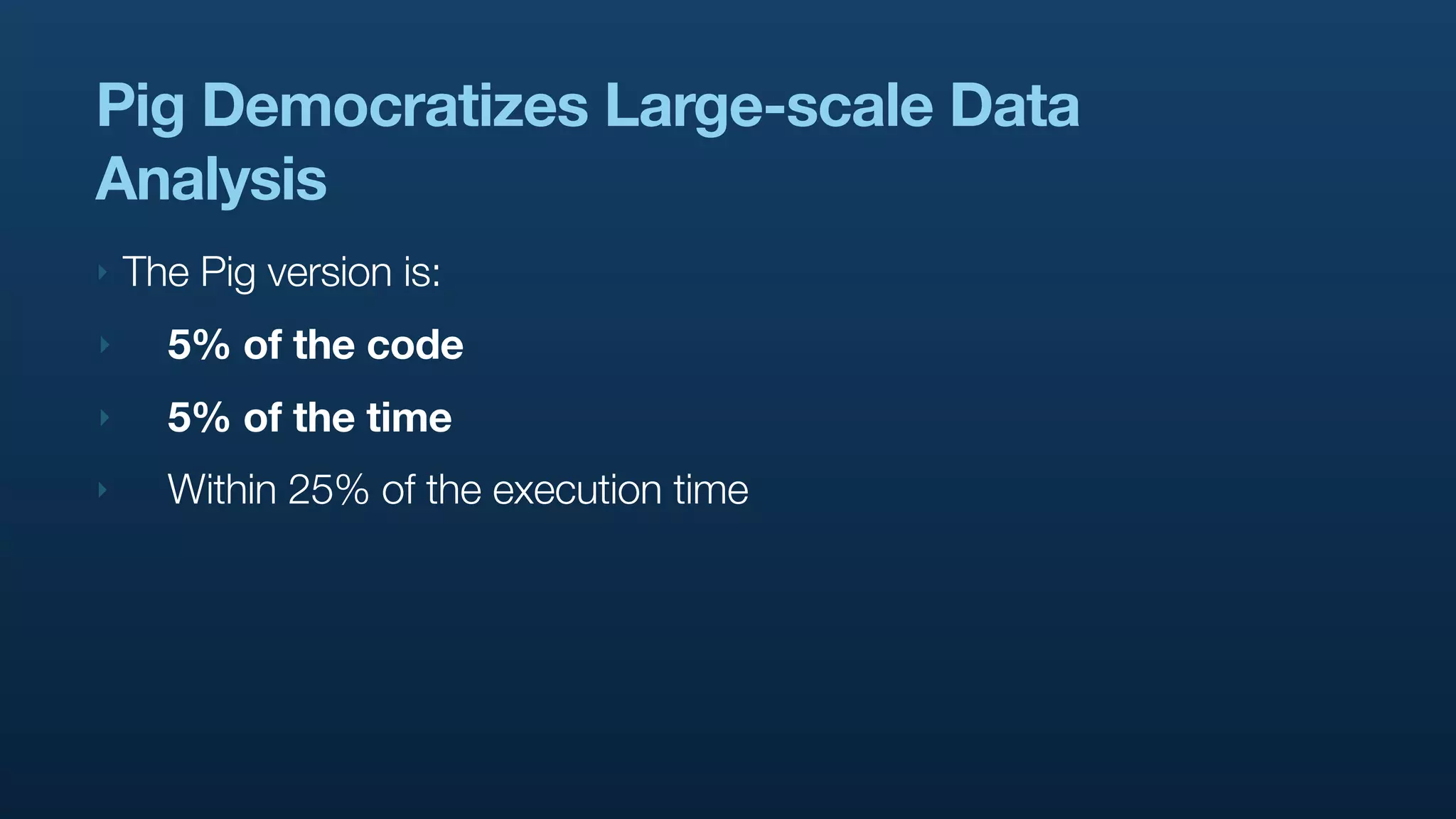
Pig Democratizes Large-scale Data
Analysis
‣   The Pig version is:
‣     5% of the code
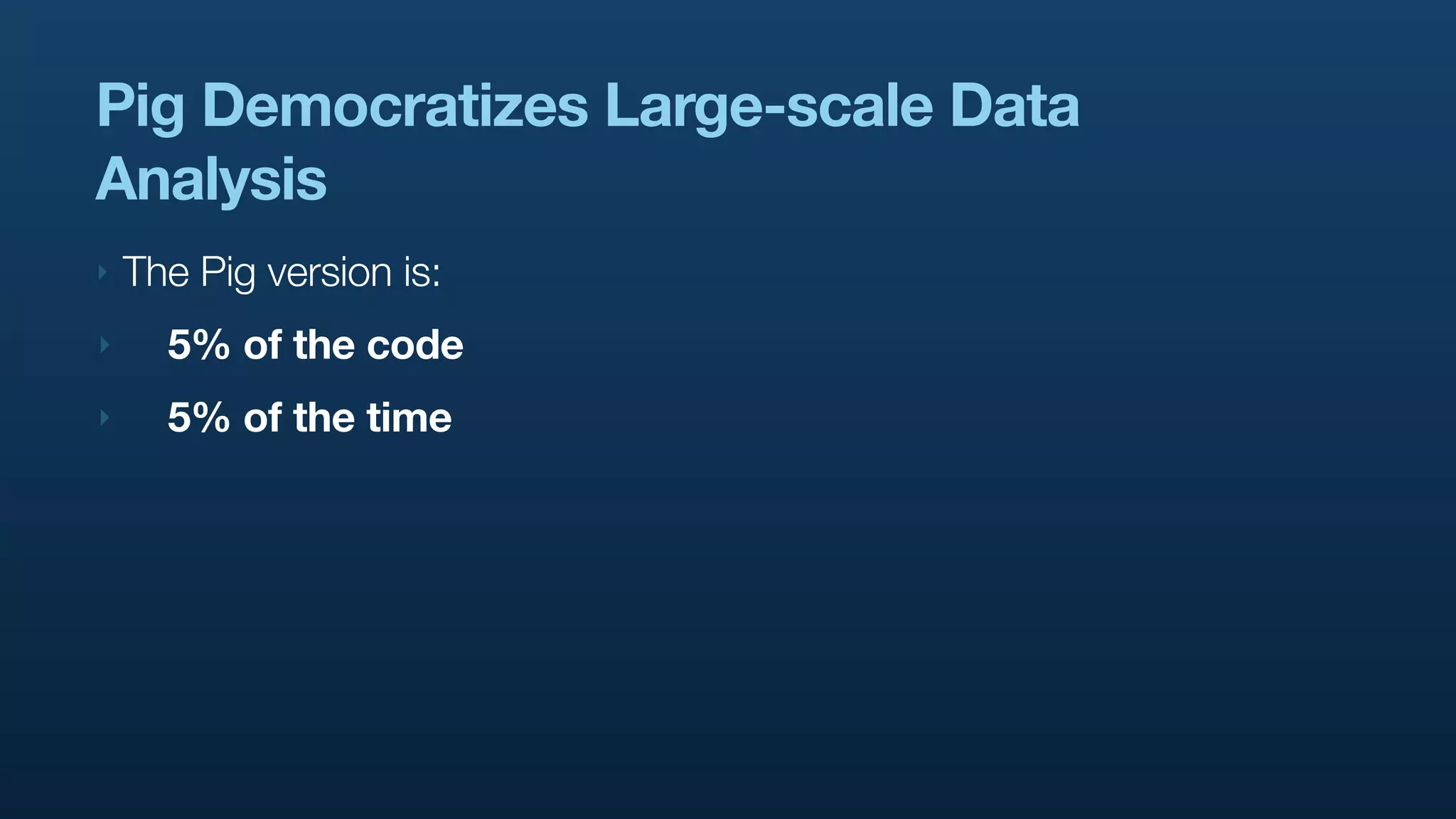
Pig Democratizes Large-scale Data
Analysis
‣   The Pig version is:
‣     5% of the code
‣     5% of the time
Pig Democratizes Large-scale Data
Analysis
‣   The Pig version is:
‣     5% of the code
‣     5% of the time
‣     Within 25% of the execution time
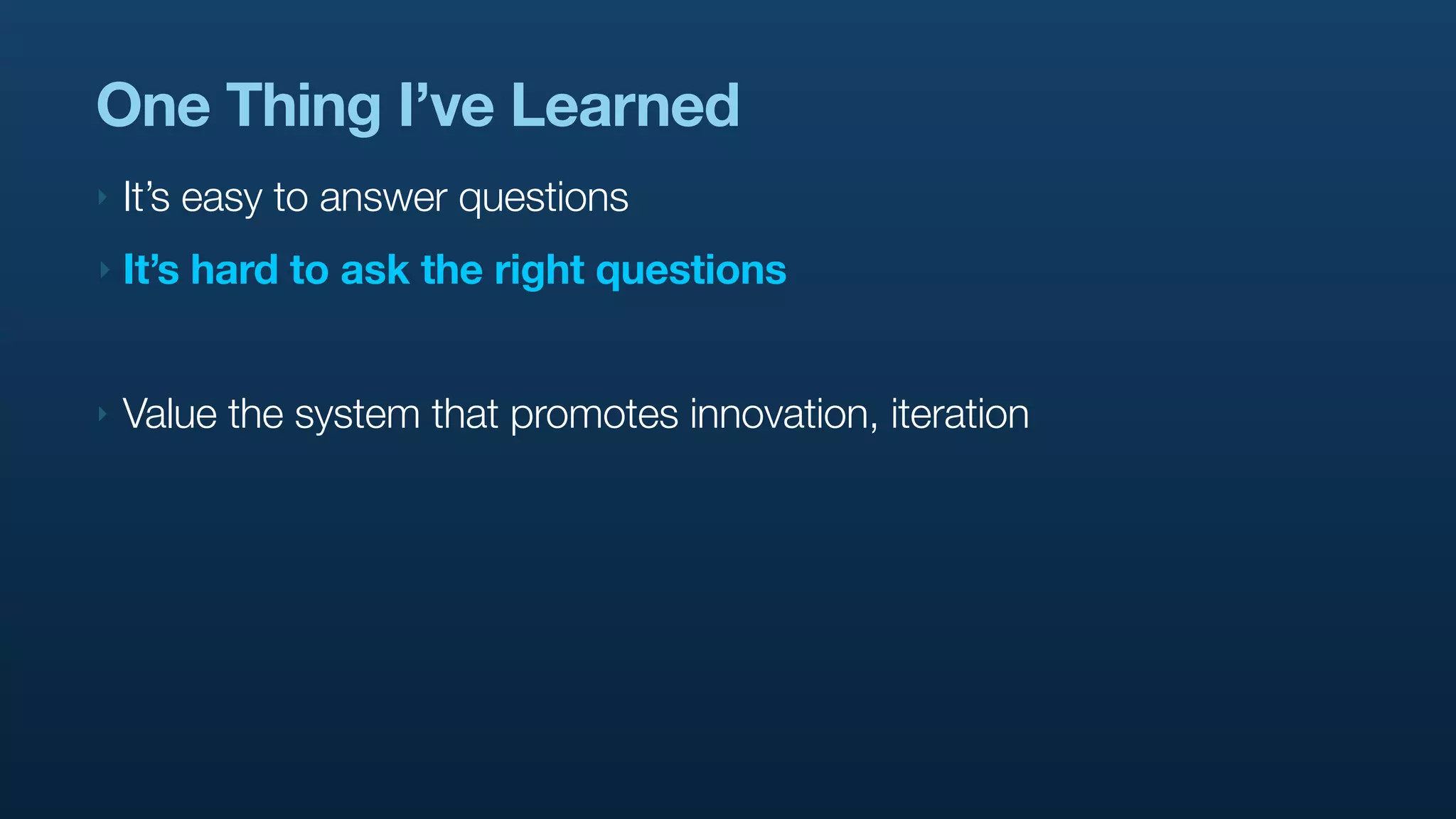
One Thing I’ve Learned
‣   It’s easy to answer questions
‣   It’s hard to ask the right questions
One Thing I’ve Learned
‣   It’s easy to answer questions
‣   It’s hard to ask the right questions


‣   Value the system that promotes innovation, iteration
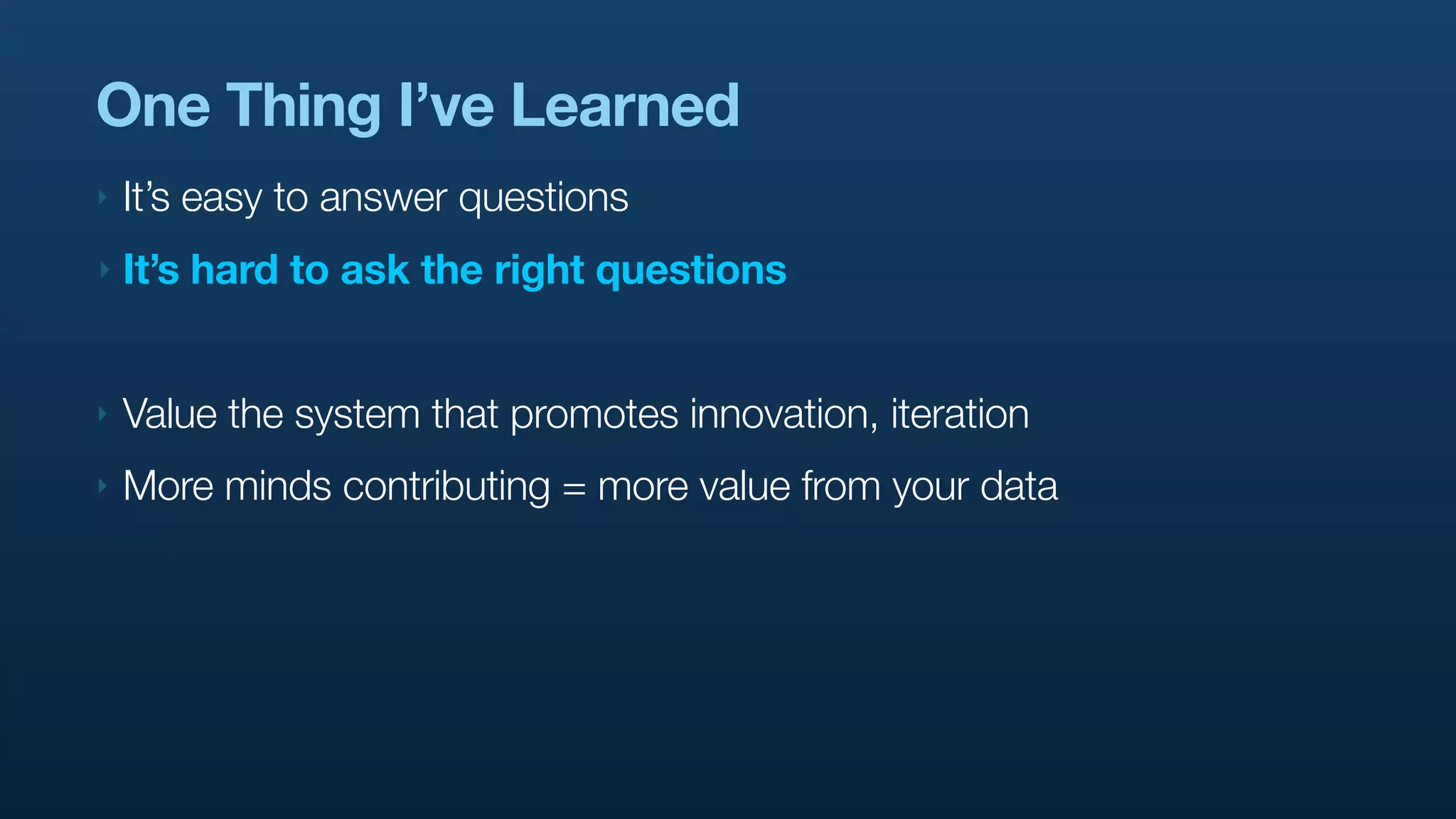
One Thing I’ve Learned
‣   It’s easy to answer questions
‣   It’s hard to ask the right questions


‣   Value the system that promotes innovation, iteration
‣   More minds contributing = more value from your data
The Hadoop Ecosystem at Twitter
‣   Running Cloudera’s free distro, CDH2 and Hadoop 0.20.1
The Hadoop Ecosystem at Twitter
‣   Running Cloudera’s free distro, CDH2 and Hadoop 0.20.1
‣   Heavily modified Scribe writing LZO-compressed to HDFS
‣     LZO: fast, splittable compression, ideal for HDFS*


‣   * http://www.github.com/kevinweil/hadoop-lzo
‣
The Hadoop Ecosystem at Twitter
‣   Running Cloudera’s free distro, CDH2 and Hadoop 0.20.1
‣   Heavily modified Scribe writing LZO-compressed to HDFS
‣     LZO: fast, splittable compression, ideal for HDFS*
‣   Data either as flat files (logs) or in protocol buffer format (newer
    logs, structured data, etc)
‣     Libs for reading/writing/more open-sourced as elephant-bird**


‣   * http://www.github.com/kevinweil/hadoop-lzo
‣   ** http://www.github.com/kevinweil/elephant-bird
The Hadoop Ecosystem at Twitter
‣   Running Cloudera’s free distro, CDH2 and Hadoop 0.20.1
‣   Heavily modified Scribe writing LZO-compressed to HDFS
‣     LZO: fast, splittable compression, ideal for HDFS*
‣   Data either as flat files (logs) or in protocol buffer format (newer
    logs, structured data, etc)
‣     Libs for reading/writing/more open-sourced as elephant-bird**
‣   Some Java-based MapReduce, a little Hadoop streaming


‣   * http://www.github.com/kevinweil/hadoop-lzo
‣   ** http://www.github.com/kevinweil/elephant-bird
The Hadoop Ecosystem at Twitter
‣   Running Cloudera’s free distro, CDH2 and Hadoop 0.20.1
‣   Heavily modified Scribe writing LZO-compressed to HDFS
‣     LZO: fast, splittable compression, ideal for HDFS*
‣   Data either as flat files (logs) or in protocol buffer format (newer
    logs, structured data, etc)
‣     Libs for reading/writing/more open-sourced as elephant-bird**
‣   Some Java-based MapReduce, some HBase, Hadoop streaming
‣   Most analysis, and most interesting analyses, done in Pig
‣   * http://www.github.com/kevinweil/hadoop-lzo
‣   ** http://www.github.com/kevinweil/elephant-bird
Data?
‣   Semi-structured: apache logs
    (search, .com, mobile), search query
    logs, RoR logs, mysql query logs, A/B
    testing logs, signup flow logging, and
    on...
Data?
‣   Semi-structured: apache logs
    (search, .com, mobile), search query
    logs, RoR logs, mysql query logs, A/B
    testing logs, signup flow logging, and
    on...
‣   Structured: tweets, users, blocks,
    phones, favorites, saved searches,
    retweets, geo, authentications, sms,
    3rd party clients, followings
Data?
‣   Semi-structured: apache logs
    (search, .com, mobile), search query
    logs, RoR logs, mysql query logs, A/B
    testing logs, signup flow logging, and
    on...
‣   Structured: tweets, users, blocks,
    phones, favorites, saved searches,
    retweets, geo, authentications, sms,
    3rd party clients, followings
‣   Entangled: the social graph
So what do we do with it?
Counting Big Data
‣               standard counts, min, max, std dev
‣   How many requests do we serve in a day?
Counting Big Data
‣               standard counts, min, max, std dev
‣   How many requests do we serve in a day?
‣   What is the average latency? 95% latency?
‣
Counting Big Data
‣               standard counts, min, max, std dev
‣   How many requests do we serve in a day?
‣   What is the average latency? 95% latency?
‣   Group by response code. What is the hourly distribution?
‣
Counting Big Data
‣               standard counts, min, max, std dev
‣   How many requests do we serve in a day?
‣   What is the average latency? 95% latency?
‣   Group by response code. What is the hourly distribution?
‣   How many searches happen each day on Twitter?
‣
Counting Big Data
‣               standard counts, min, max, std dev
‣   How many requests do we serve in a day?
‣   What is the average latency? 95% latency?
‣   Group by response code. What is the hourly distribution?
‣   How many searches happen each day on Twitter?
‣   How many unique queries, how many unique users?
‣
Counting Big Data
‣                standard counts, min, max, std dev
‣   How many requests do we serve in a day?
‣   What is the average latency? 95% latency?
‣   Group by response code. What is the hourly distribution?
‣   How many searches happen each day on Twitter?
‣   How many unique queries, how many unique users?
‣   What is their geographic distribution?
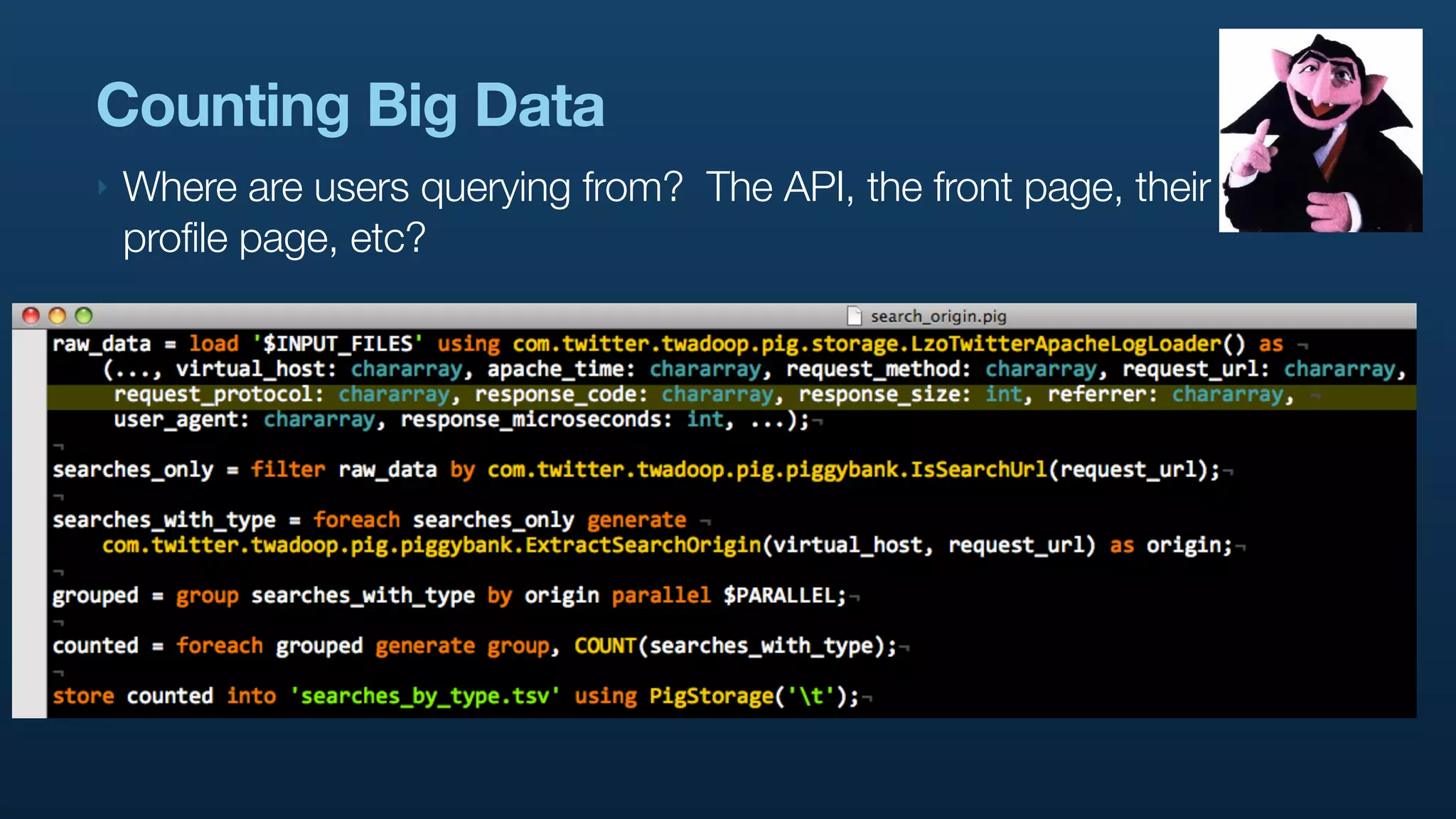
Counting Big Data
‣   Where are users querying from? The API, the front page, their
    profile page, etc?
‣
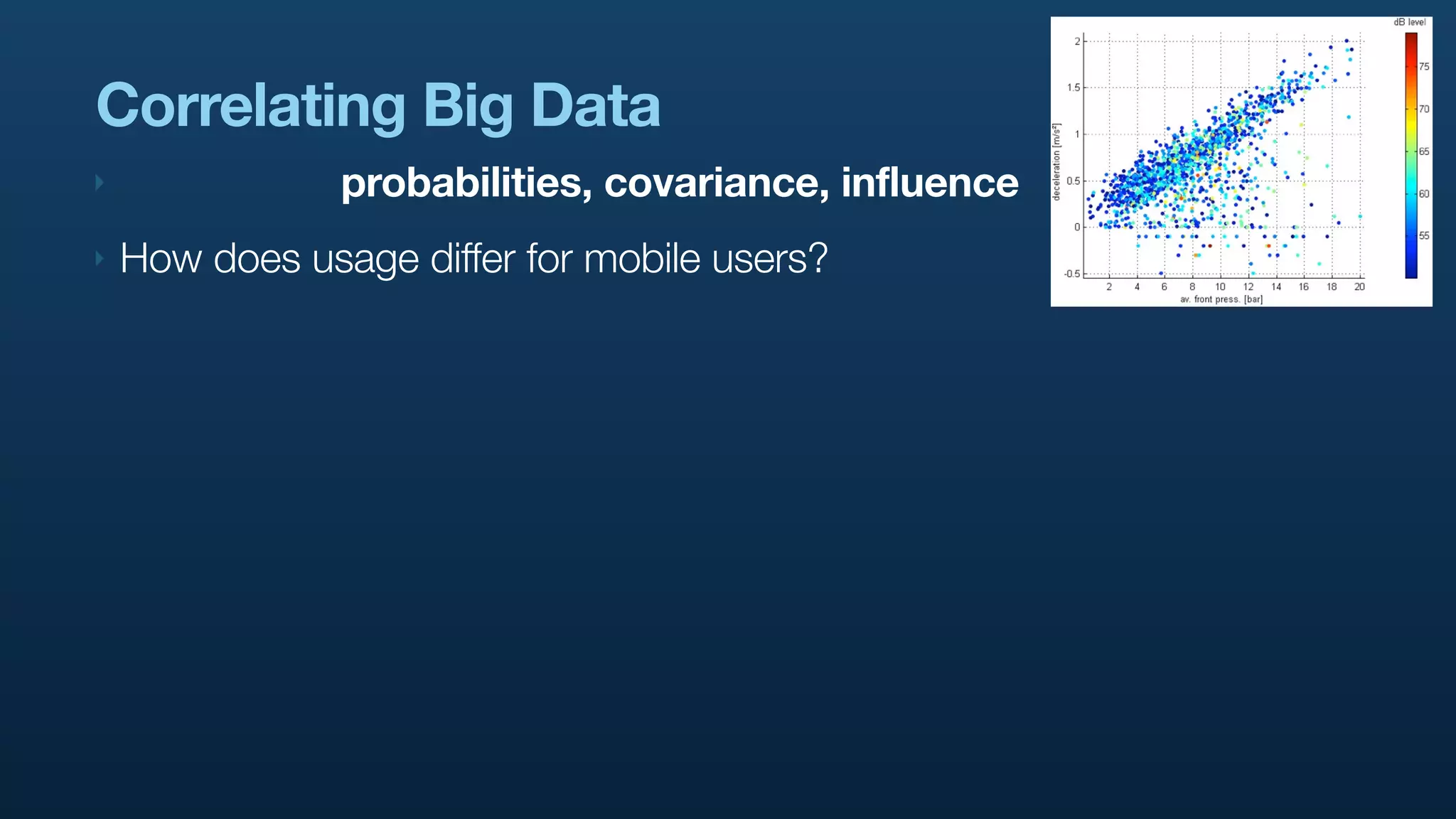
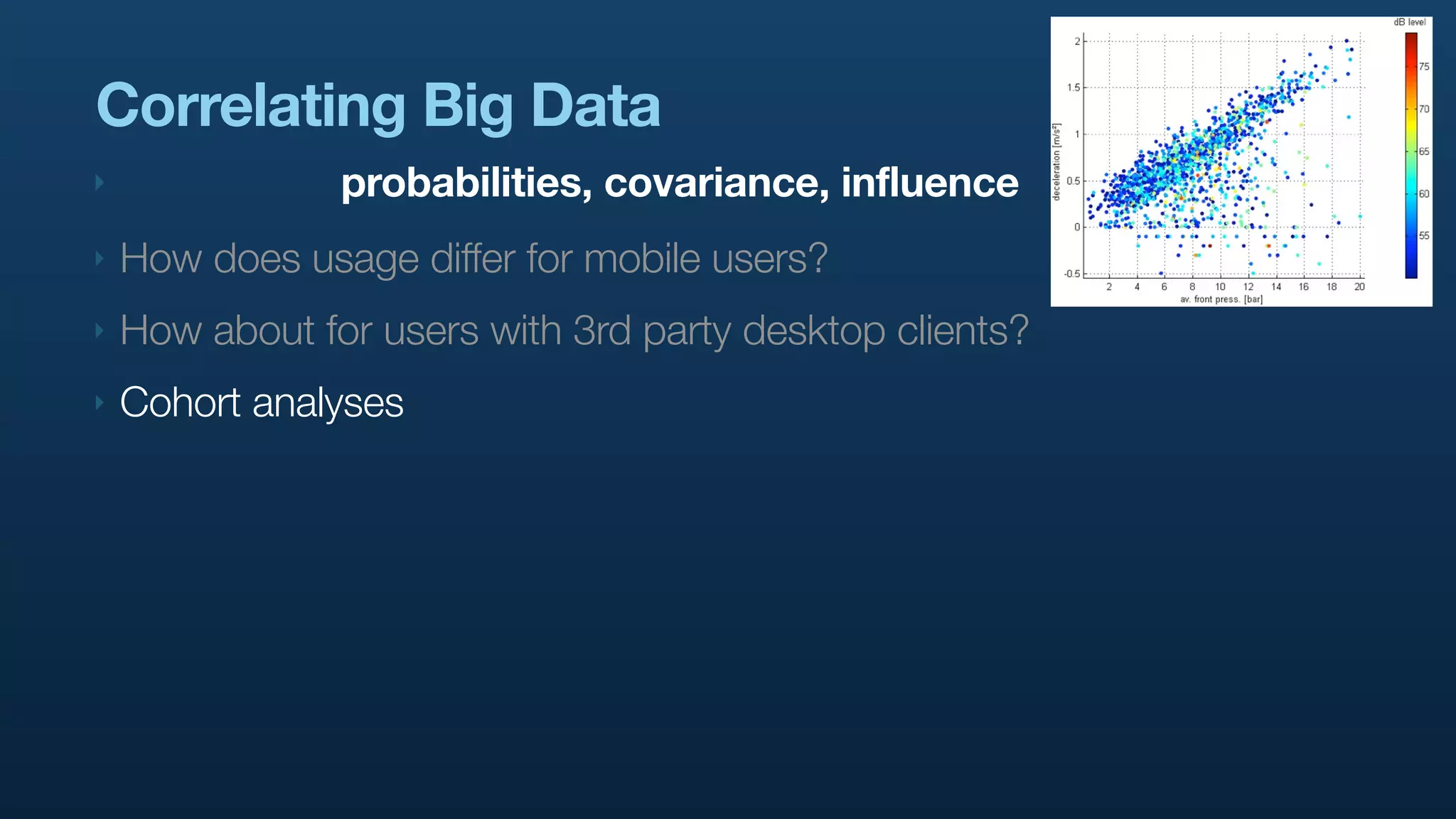
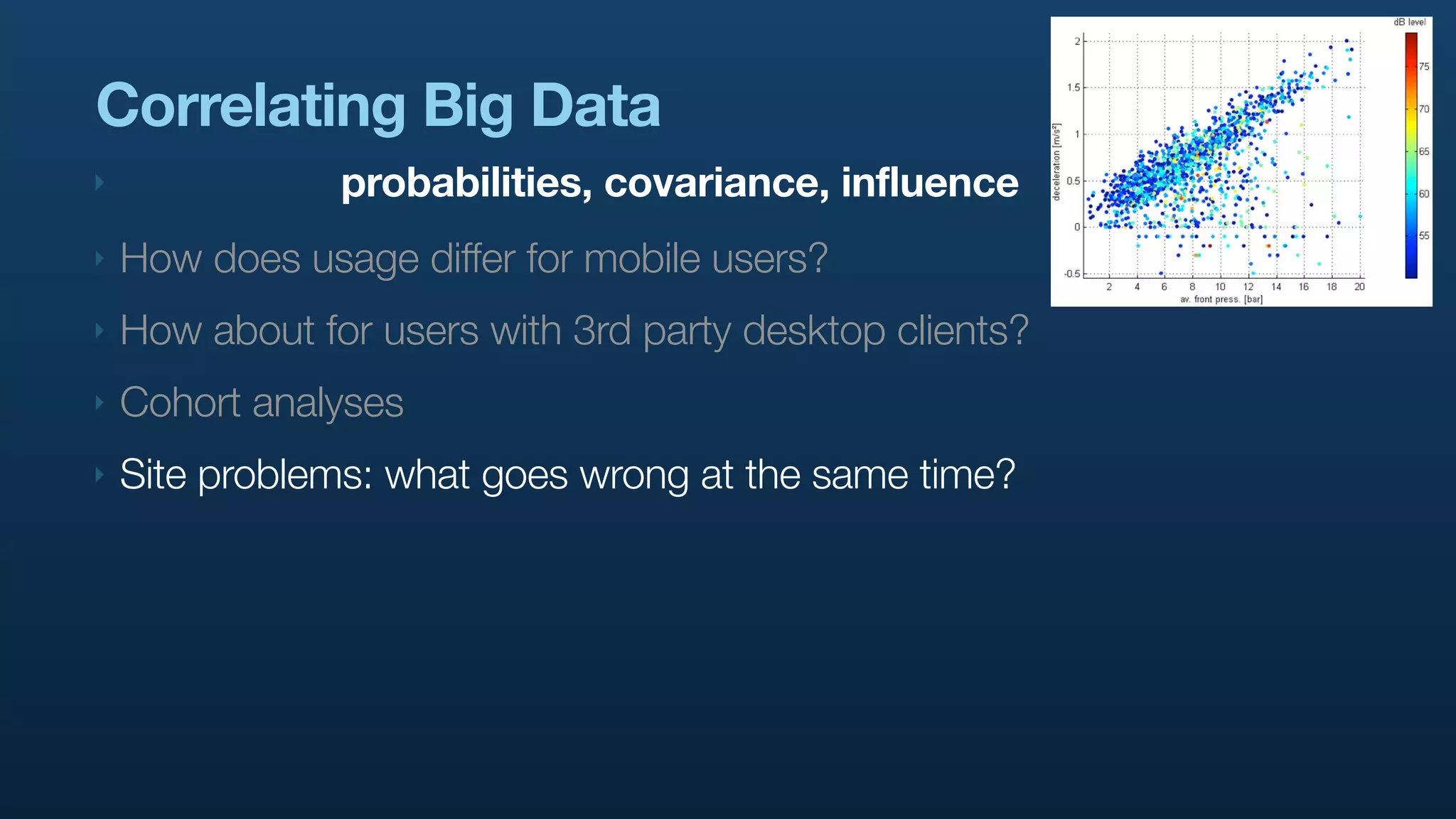
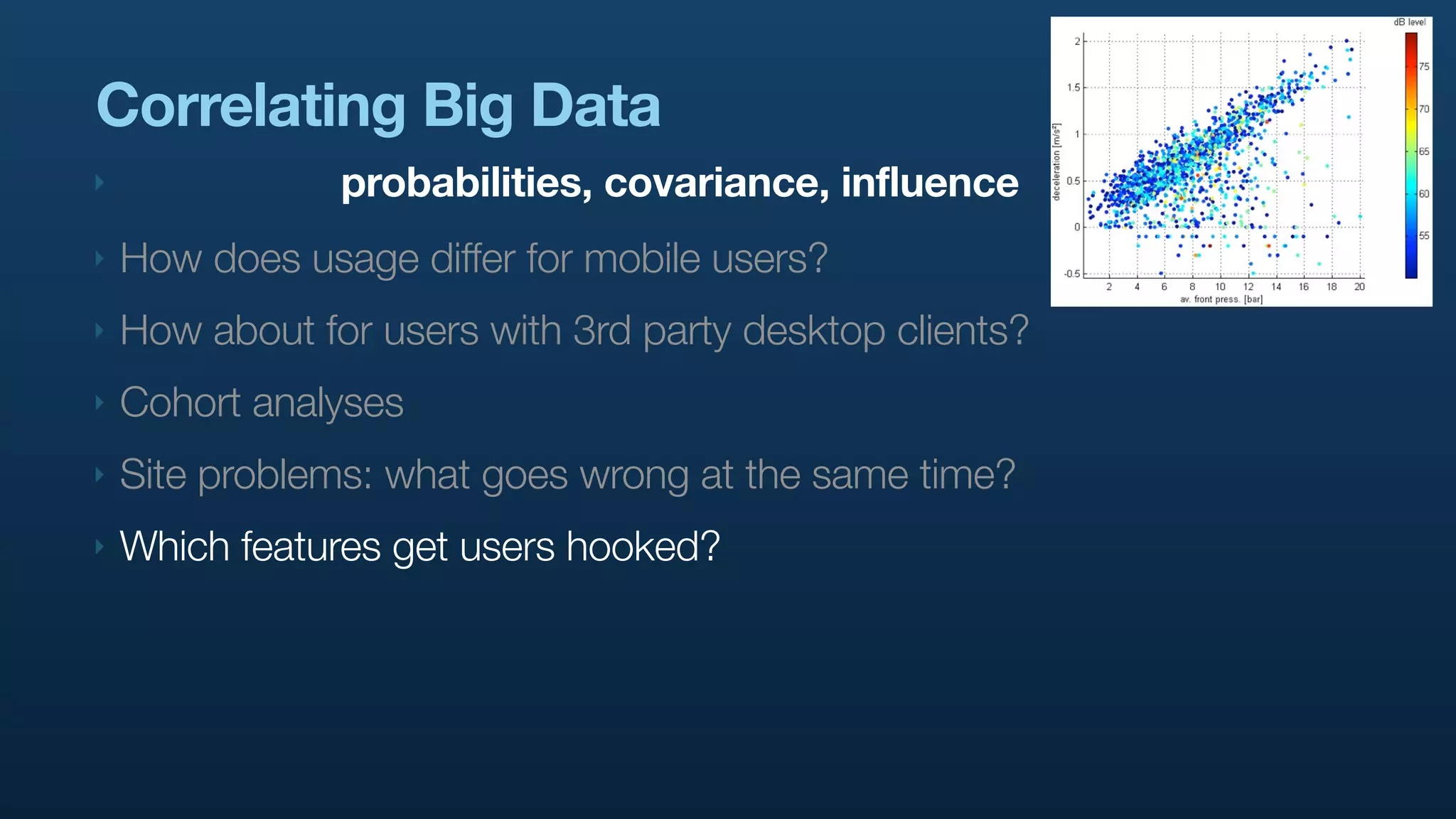
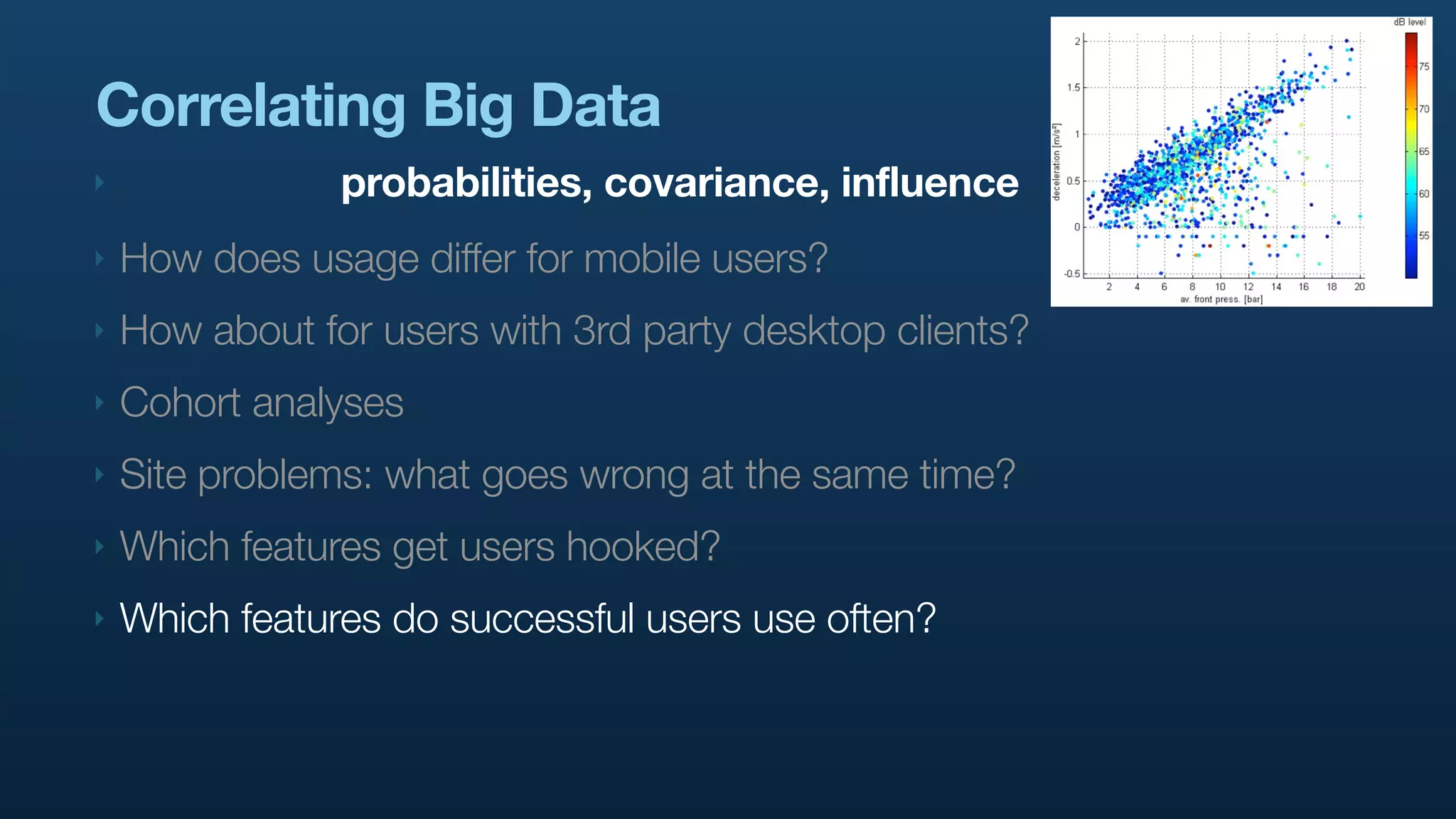
Correlating Big Data
‣               probabilities, covariance, influence
‣   How does usage differ for mobile users?
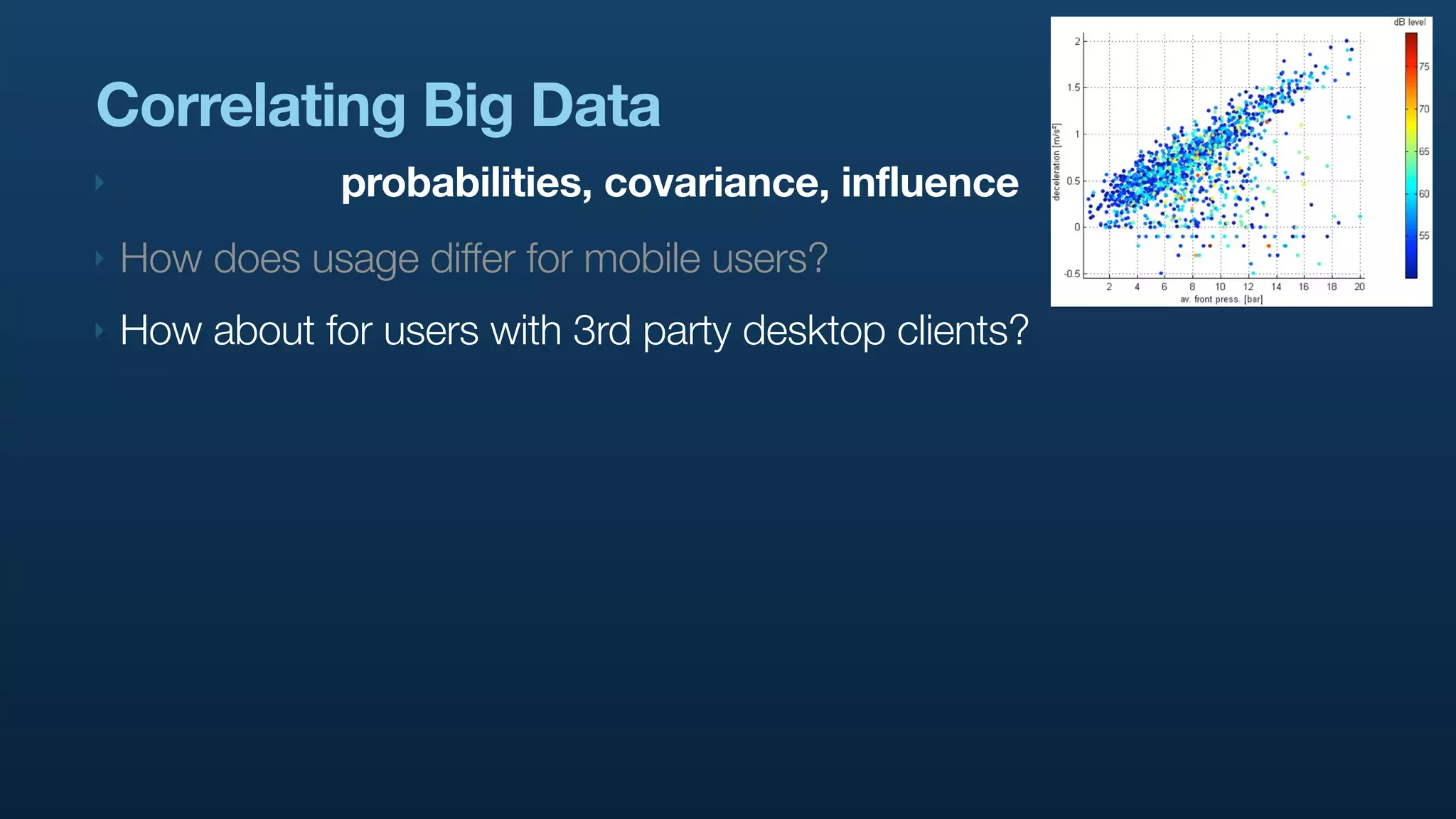
Correlating Big Data
‣               probabilities, covariance, influence
‣   How does usage differ for mobile users?
‣   How about for users with 3rd party desktop clients?
Correlating Big Data
‣               probabilities, covariance, influence
‣   How does usage differ for mobile users?
‣   How about for users with 3rd party desktop clients?
‣   Cohort analyses
Correlating Big Data
‣               probabilities, covariance, influence
‣   How does usage differ for mobile users?
‣   How about for users with 3rd party desktop clients?
‣   Cohort analyses
‣   Site problems: what goes wrong at the same time?
Correlating Big Data
‣               probabilities, covariance, influence
‣   How does usage differ for mobile users?
‣   How about for users with 3rd party desktop clients?
‣   Cohort analyses
‣   Site problems: what goes wrong at the same time?
‣   Which features get users hooked?
Correlating Big Data
‣               probabilities, covariance, influence
‣   How does usage differ for mobile users?
‣   How about for users with 3rd party desktop clients?
‣   Cohort analyses
‣   Site problems: what goes wrong at the same time?
‣   Which features get users hooked?
‣   Which features do successful users use often?
Correlating Big Data
‣               probabilities, covariance, influence
‣   How does usage differ for mobile users?
‣   How about for users with 3rd party desktop clients?
‣   Cohort analyses
‣   Site problems: what goes wrong at the same time?
‣   Which features get users hooked?
‣   Which features do successful users use often?
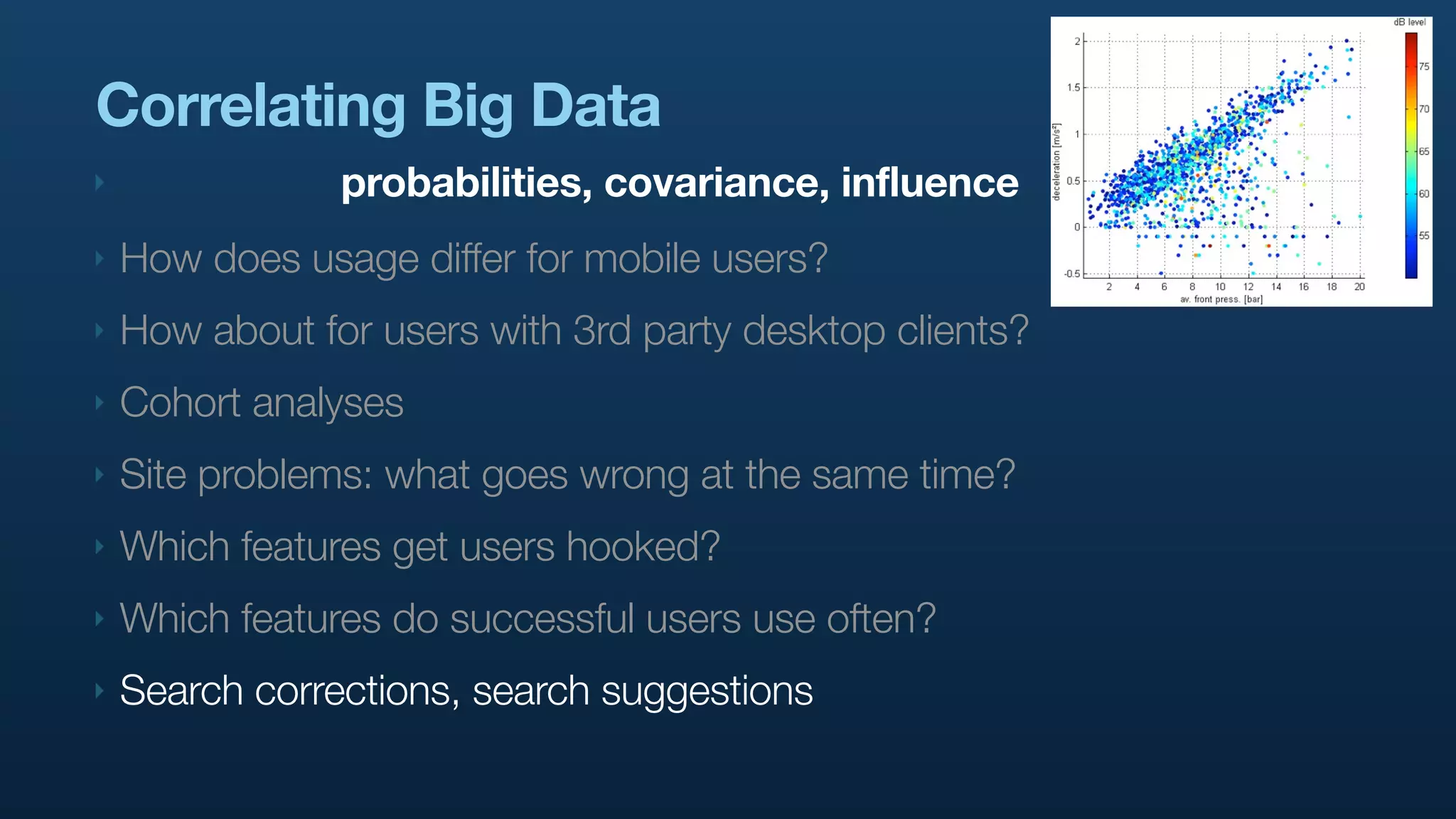
‣   Search corrections, search suggestions
Correlating Big Data
‣                 probabilities, covariance, influence
‣   How does usage differ for mobile users?
‣   How about for users with 3rd party desktop clients?
‣   Cohort analyses
‣   Site problems: what goes wrong at the same time?
‣   Which features get users hooked?
‣   Which features do successful users use often?
‣   Search corrections, search suggestions
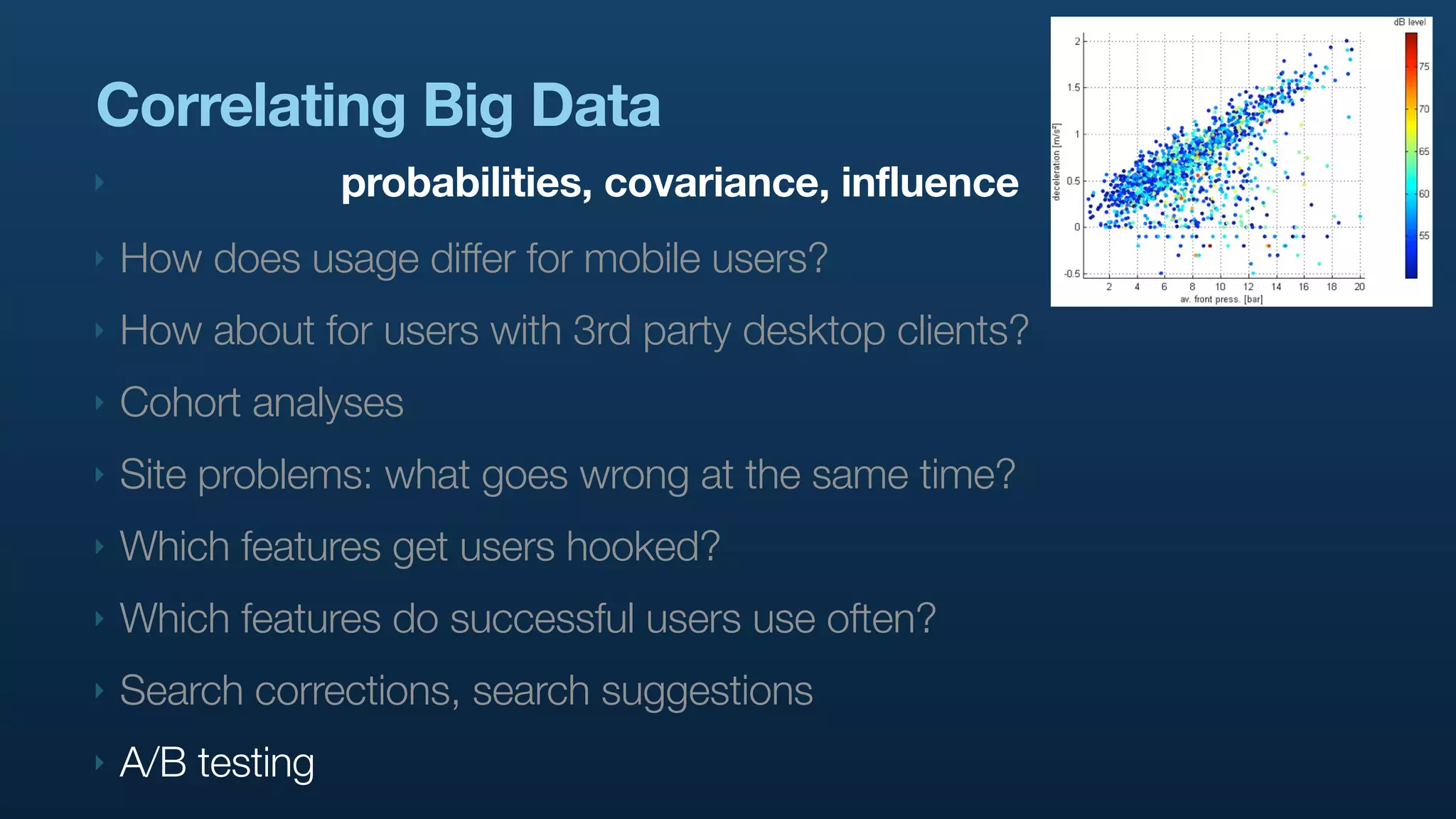
‣   A/B testing
Correlating Big Data
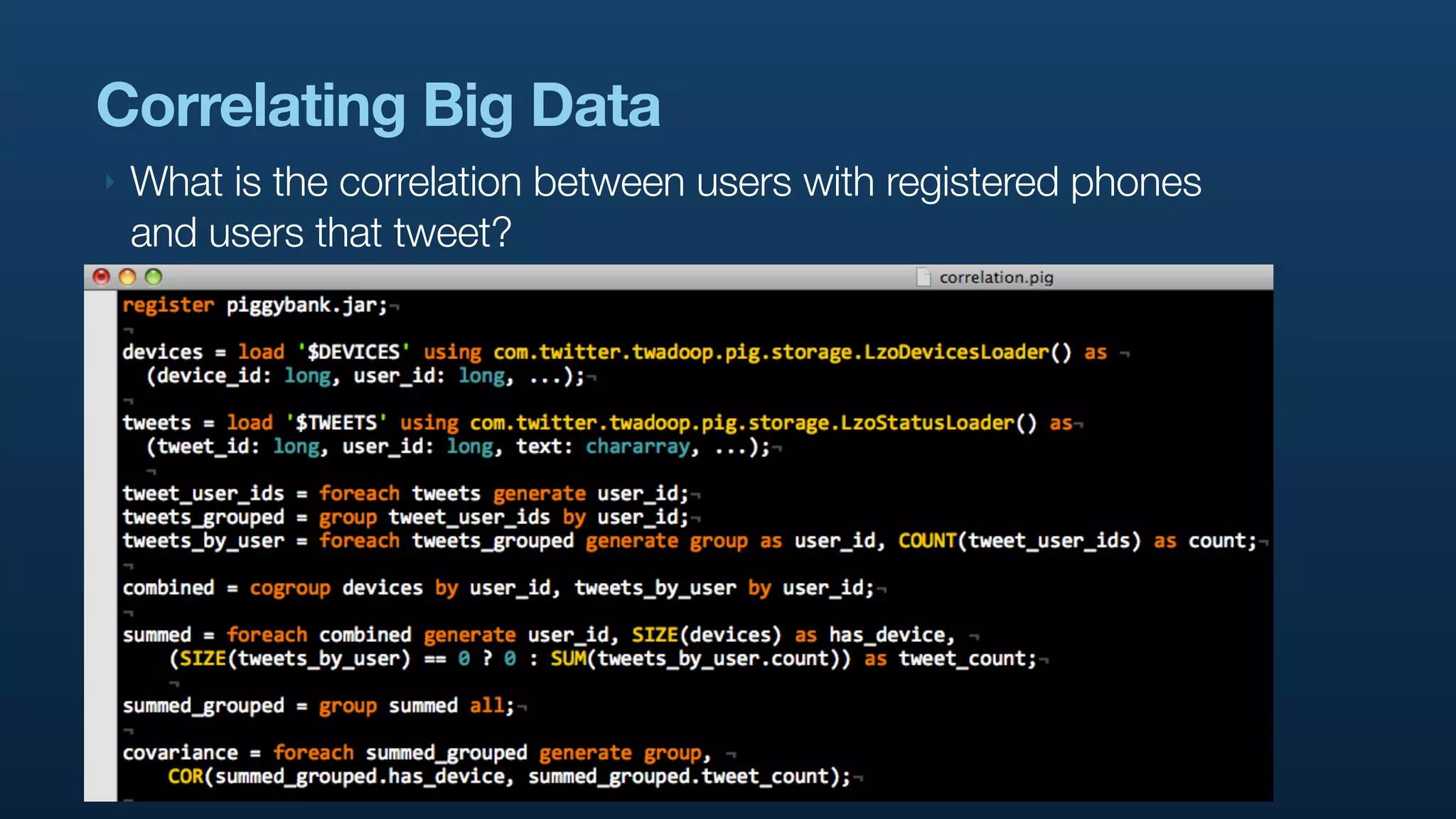
‣   What is the correlation between users with registered phones
    and users that tweet?
Research on Big Data
‣           prediction, graph analysis, natural language
‣   What can we tell about a user from their tweets?
Research on Big Data
‣           prediction, graph analysis, natural language
‣   What can we tell about a user from their tweets?
‣     From the tweets of those they follow?
Research on Big Data
‣           prediction, graph analysis, natural language
‣   What can we tell about a user from their tweets?
‣     From the tweets of those they follow?
‣     From the tweets of their followers?
Research on Big Data
‣           prediction, graph analysis, natural language
‣   What can we tell about a user from their tweets?
‣     From the tweets of those they follow?
‣     From the tweets of their followers?
‣     From the ratio of followers/following?
Research on Big Data
‣           prediction, graph analysis, natural language
‣   What can we tell about a user from their tweets?
‣     From the tweets of those they follow?
‣     From the tweets of their followers?
‣     From the ratio of followers/following?
‣   What graph structures lead to successful networks?
Research on Big Data
‣           prediction, graph analysis, natural language
‣   What can we tell about a user from their tweets?
‣     From the tweets of those they follow?
‣     From the tweets of their followers?
‣     From the ratio of followers/following?
‣   What graph structures lead to successful networks?
‣   User reputation
Research on Big Data
‣          prediction, graph analysis, natural language
‣   Sentiment analysis
Research on Big Data
‣          prediction, graph analysis, natural language
‣   Sentiment analysis
‣   What features get a tweet retweeted?
Research on Big Data
‣          prediction, graph analysis, natural language
‣   Sentiment analysis
‣   What features get a tweet retweeted?
‣     How deep is the corresponding retweet tree?
Research on Big Data
‣          prediction, graph analysis, natural language
‣   Sentiment analysis
‣   What features get a tweet retweeted?
‣     How deep is the corresponding retweet tree?
‣   Long-term duplicate detection
Research on Big Data
‣          prediction, graph analysis, natural language
‣   Sentiment analysis
‣   What features get a tweet retweeted?
‣     How deep is the corresponding retweet tree?
‣   Long-term duplicate detection
‣   Machine learning
Research on Big Data
‣          prediction, graph analysis, natural language
‣   Sentiment analysis
‣   What features get a tweet retweeted?
‣     How deep is the corresponding retweet tree?
‣   Long-term duplicate detection
‣   Machine learning
‣   Language detection
Research on Big Data
‣            prediction, graph analysis, natural language
‣   Sentiment analysis
‣   What features get a tweet retweeted?
‣     How deep is the corresponding retweet tree?
‣   Long-term duplicate detection
‣   Machine learning
‣   Language detection
‣   ... the list goes on.
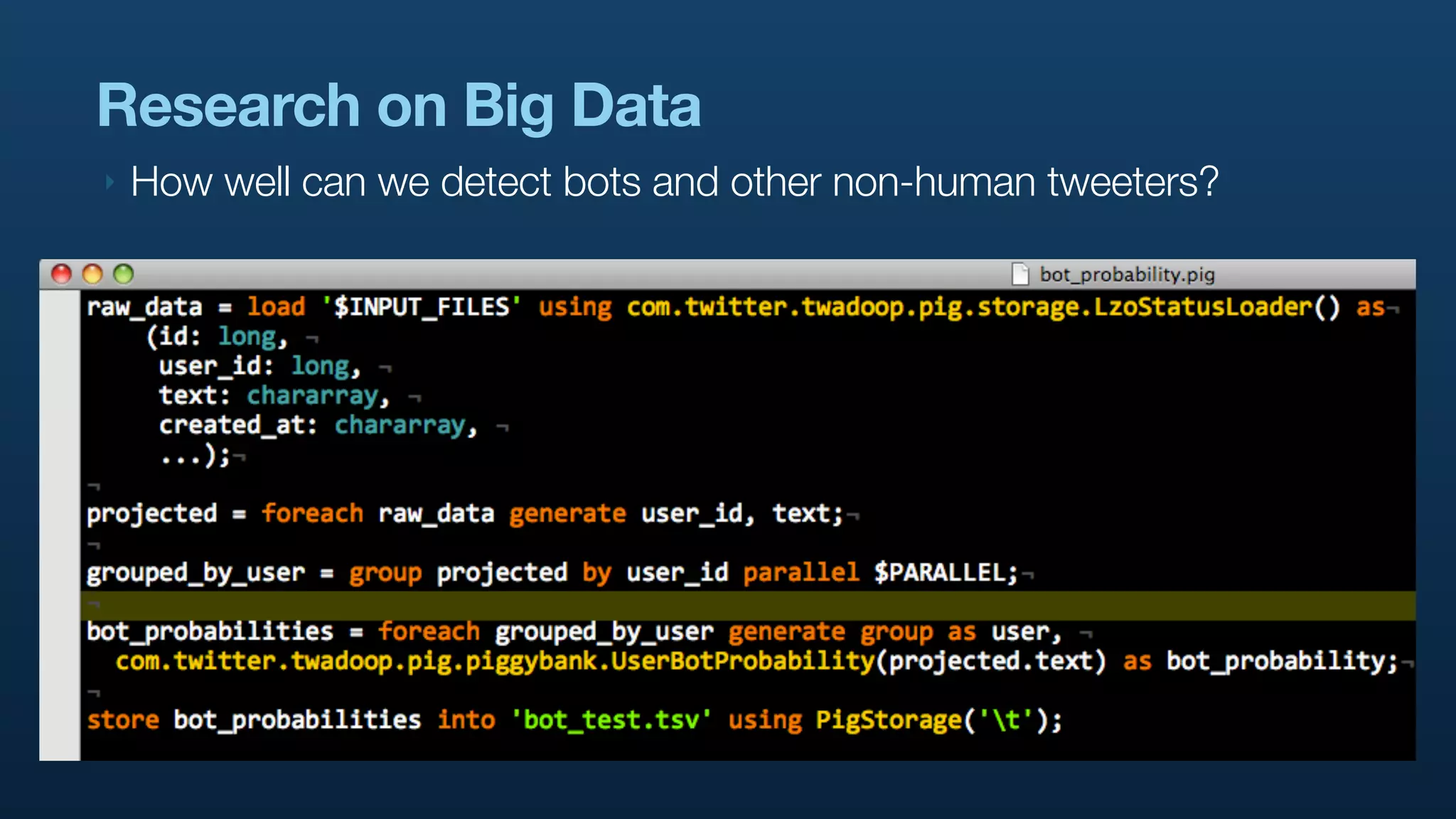
Research on Big Data
‣   How well can we detect bots and other non-human tweeters?
Introduction
‣   How We Arrived at NoSQL: A Crash Course
‣     Collecting Data (Scribe)
‣     Storing and Analyzing Data (Hadoop)
‣     Rapid Learning over Big Data (Pig)
‣   And More: Cassandra, HBase, FlockDB
HBase
‣   BigTable clone on top of HDFS
‣   Distributed, column-oriented, no datatypes
‣   Unlike the rest of HDFS, designed for low-latency
‣   Importantly, data is mutable
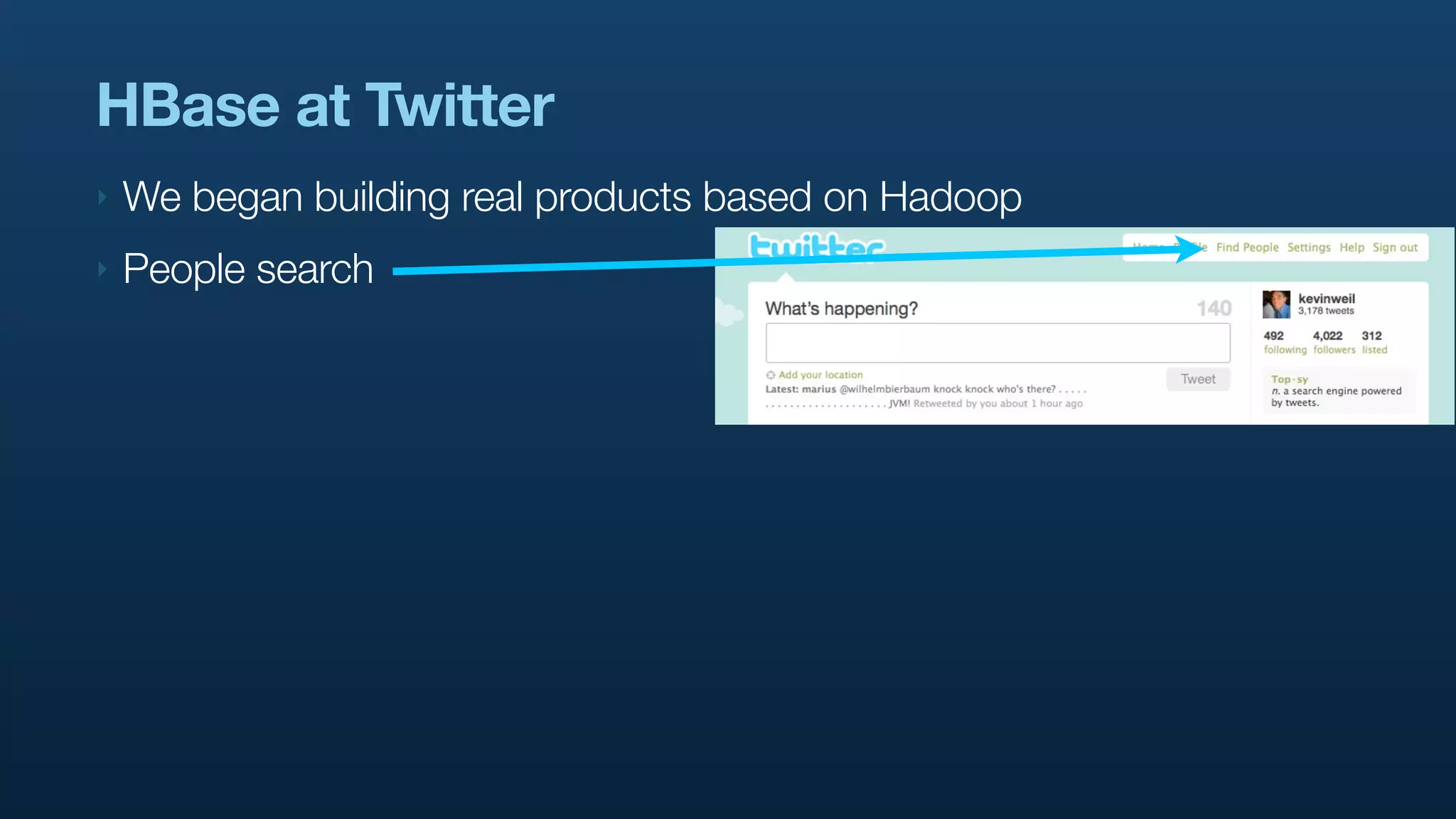
HBase at Twitter
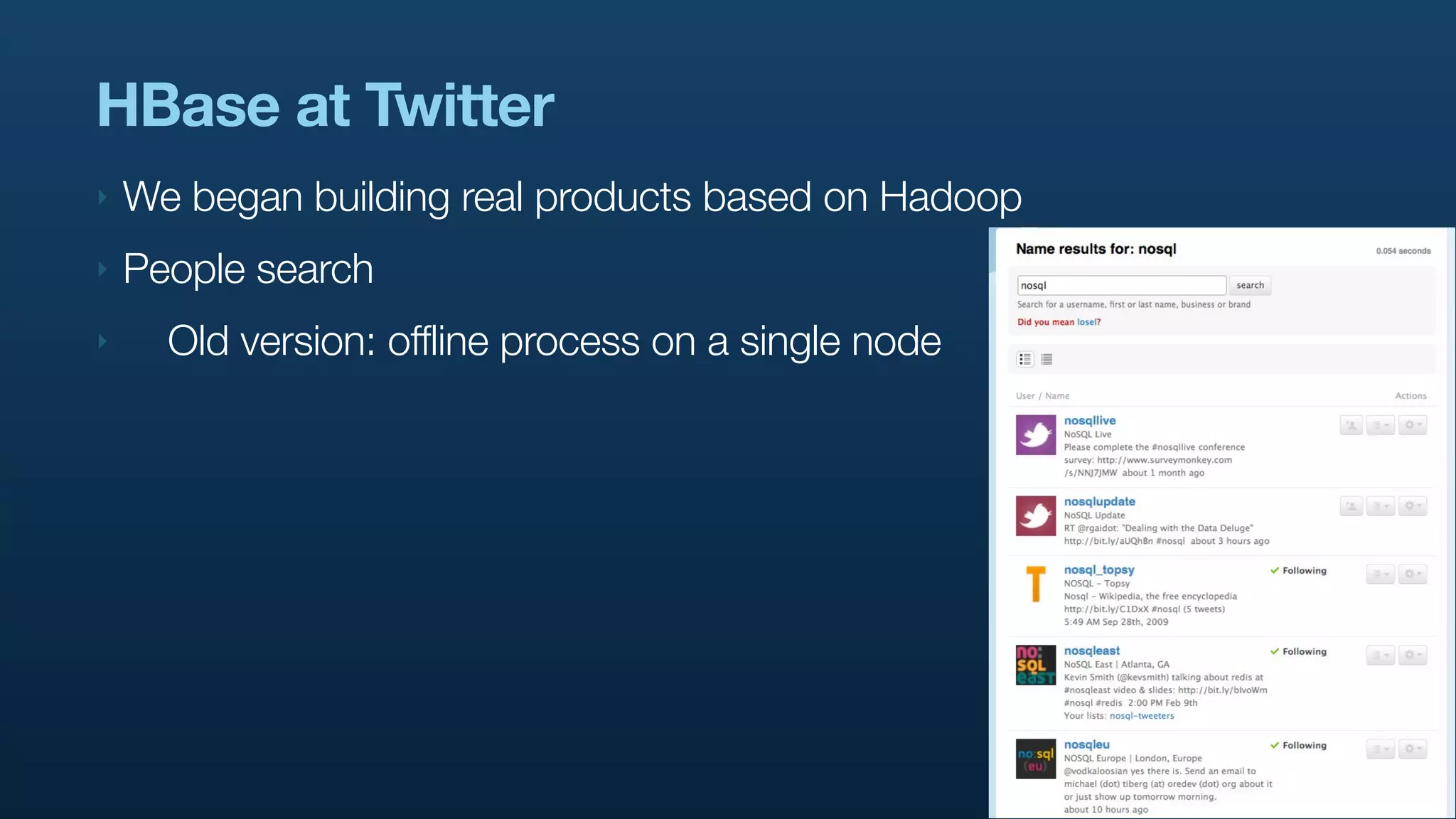
‣   We began building real products based on Hadoop
‣   People search
HBase at Twitter
‣   We began building real products based on Hadoop
‣   People search
‣     Old version: offline process on a single node
HBase at Twitter
‣   We began building real products based on Hadoop
‣   People search
‣     Old version: offline process on a single node
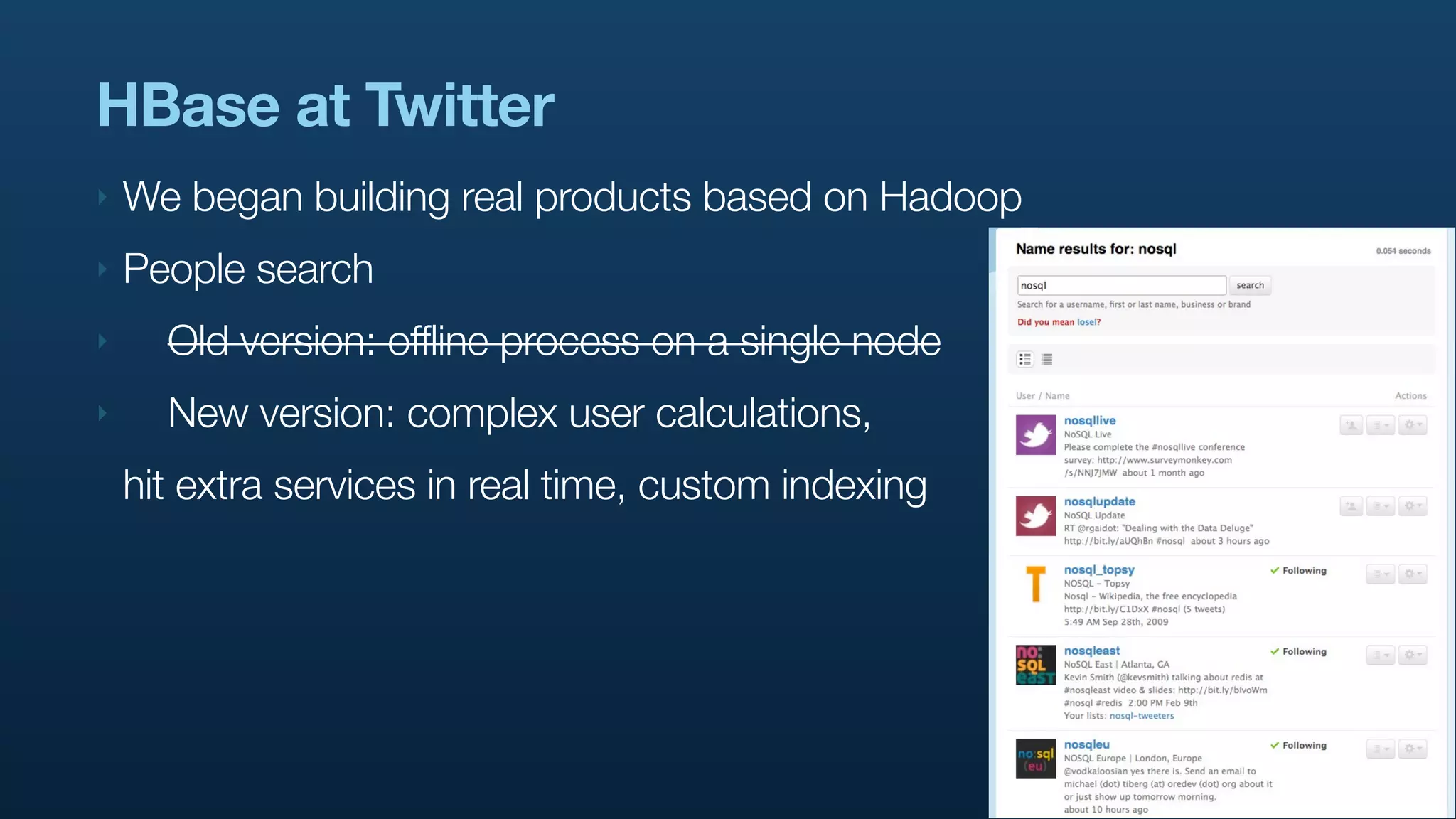
‣     New version: complex user calculations,
    hit extra services in real time, custom indexing
HBase at Twitter
‣   We began building real products based on Hadoop
‣   People search
‣     Old version: offline process on a single node
‣     New version: complex user calculations,
    hit extra services in real time, custom indexing
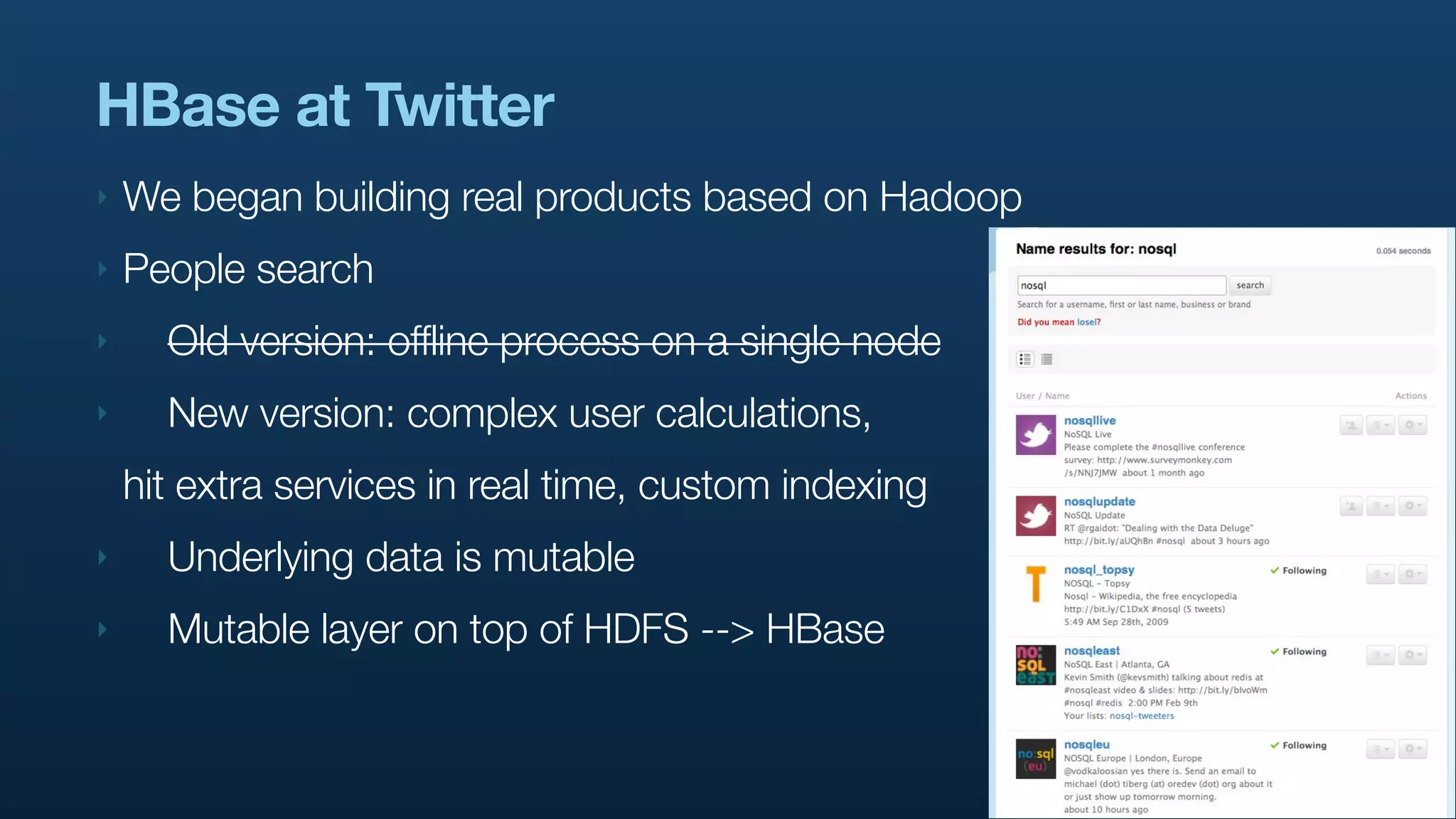
‣     Underlying data is mutable
‣     Mutable layer on top of HDFS --> HBase
People Search
‣   Import user data into HBase
People Search
‣   Import user data into HBase
‣   Periodic MapReduce job reading from HBase
‣     Hits FlockDB, multiple other internal services in mapper
‣     Custom partitioning
People Search
‣   Import user data into HBase
‣   Periodic MapReduce job reading from HBase
‣     Hits FlockDB, multiple other internal services in mapper
‣     Custom partitioning
‣     Data sucked across to sharded, replicated, horizontally
    scalable, in-memory, low-latency Scala service
‣        Build a trie, do case folding/normalization, suggestions, etc
People Search
‣   Import user data into HBase
‣   Periodic MapReduce job reading from HBase
‣     Hits FlockDB, multiple other internal services in mapper
‣     Custom partitioning
‣     Data sucked across to sharded, replicated, horizontally
    scalable, in-memory, low-latency Scala service
‣        Build a trie, do case folding/normalization, suggestions, etc
‣   See http://www.slideshare.net/al3x/building-distributed-systems-
    in-scala for more
HBase
‣   More products now being built on top of it
‣   Flexible, easy to connect to MapReduce/Pig
HBase vs Cassandra
‣   “Their origins reveal their strengths and weaknesses”
HBase vs Cassandra
‣   “Their origins reveal their strengths and weaknesses”
‣   HBase built on top of batch-oriented system, not low latency
HBase vs Cassandra
‣   “Their origins reveal their strengths and weaknesses”
‣   HBase built on top of batch-oriented system, not low latency
‣   Cassandra built from ground up for low latency
HBase vs Cassandra
‣   “Their origins reveal their strengths and weaknesses”
‣   HBase built on top of batch-oriented system, not low latency
‣   Cassandra built from ground up for low latency
‣   HBase easy to connect to batch jobs as input and output
HBase vs Cassandra
‣   “Their origins reveal their strengths and weaknesses”
‣   HBase built on top of batch-oriented system, not low latency
‣   Cassandra built from ground up for low latency
‣   HBase easy to connect to batch jobs as input and output
‣   Cassandra not so much (but we’re working on it)
HBase vs Cassandra
‣   “Their origins reveal their strengths and weaknesses”
‣   HBase built on top of batch-oriented system, not low latency
‣   Cassandra built from ground up for low latency
‣   HBase easy to connect to batch jobs as input and output
‣   Cassandra not so much (but we’re working on it)
‣   HBase has SPOF in the namenode
HBase vs Cassandra
‣   Your mileage may vary
‣     At Twitter: HBase for analytics, analysis, dataset generation
‣     Cassandra for online systems
HBase vs Cassandra
‣   Your mileage may vary
‣     At Twitter: HBase for analytics, analysis, dataset generation
‣     Cassandra for online systems


‣   As with all NoSQL systems: strengths in different situations
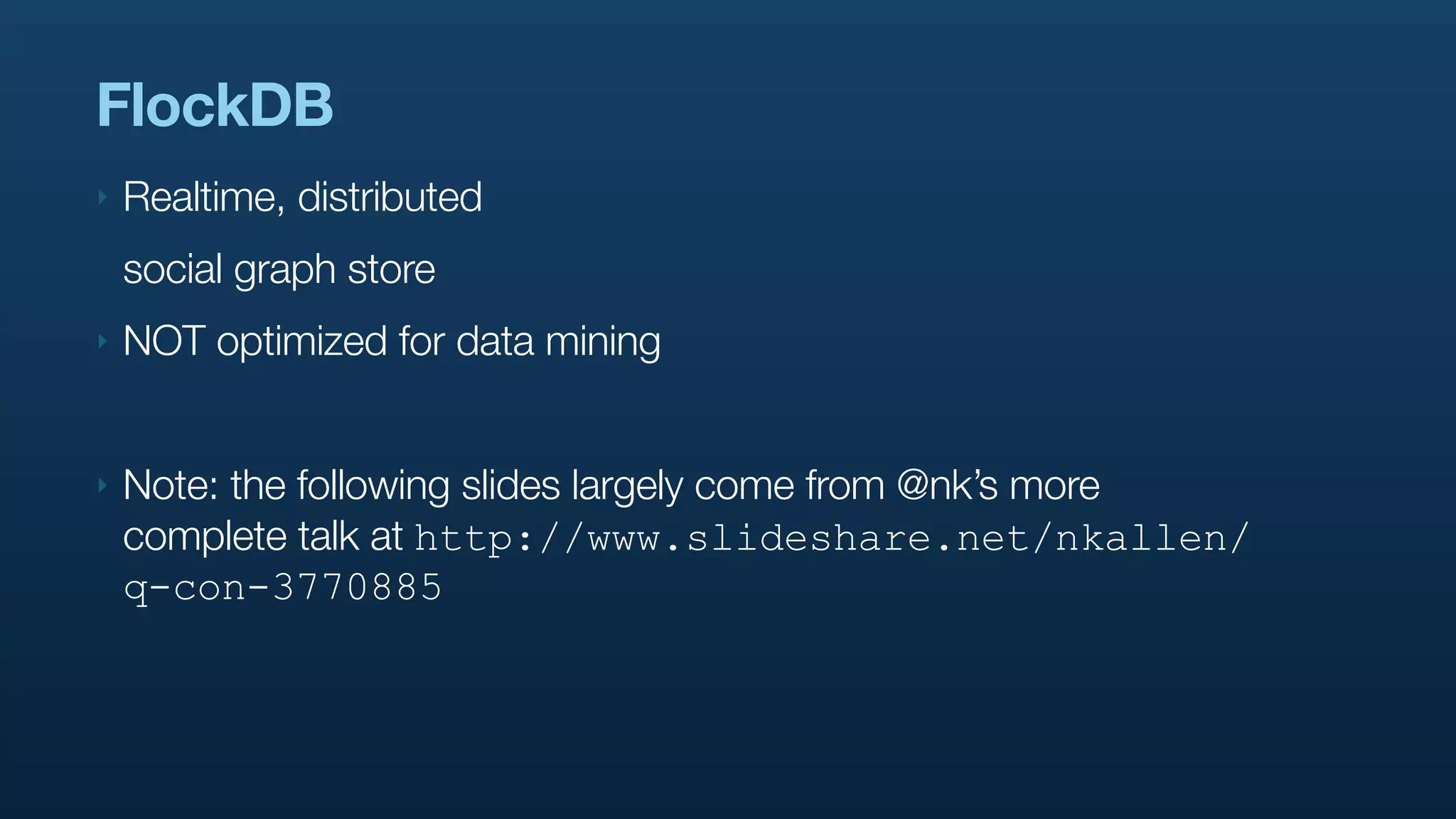
FlockDB
‣   Realtime, distributed
    social graph store
‣   NOT optimized for data mining


‣   Note: the following slides largely come from @nk’s more
    complete talk at http://www.slideshare.net/nkallen/
    q-con-3770885
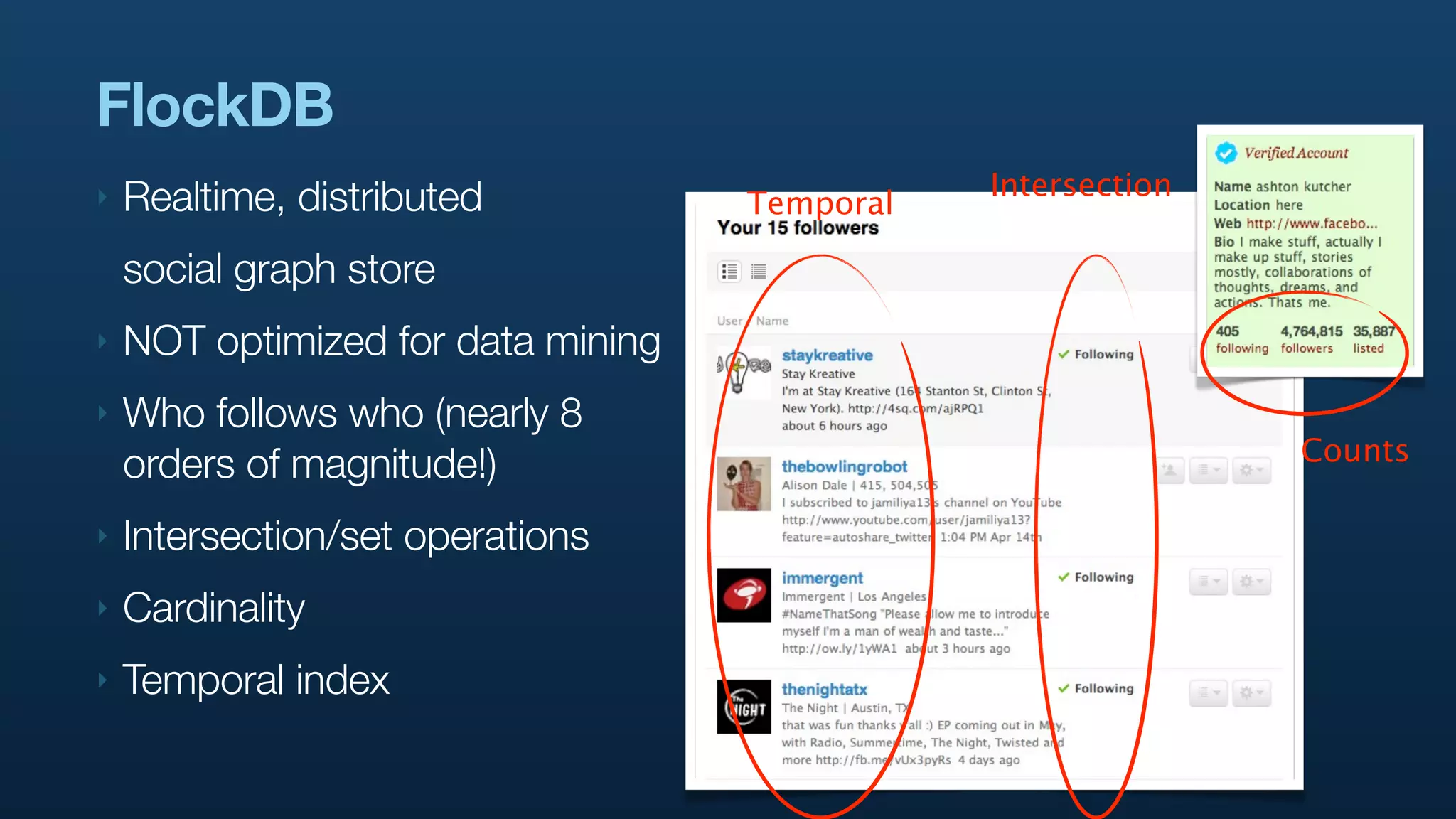
FlockDB
‣   Realtime, distributed                      Intersection
                                    Temporal

    social graph store
‣   NOT optimized for data mining
‣   Who follows who (nearly 8
                                                              Counts
    orders of magnitude!)
‣   Intersection/set operations
‣   Cardinality
‣   Temporal index
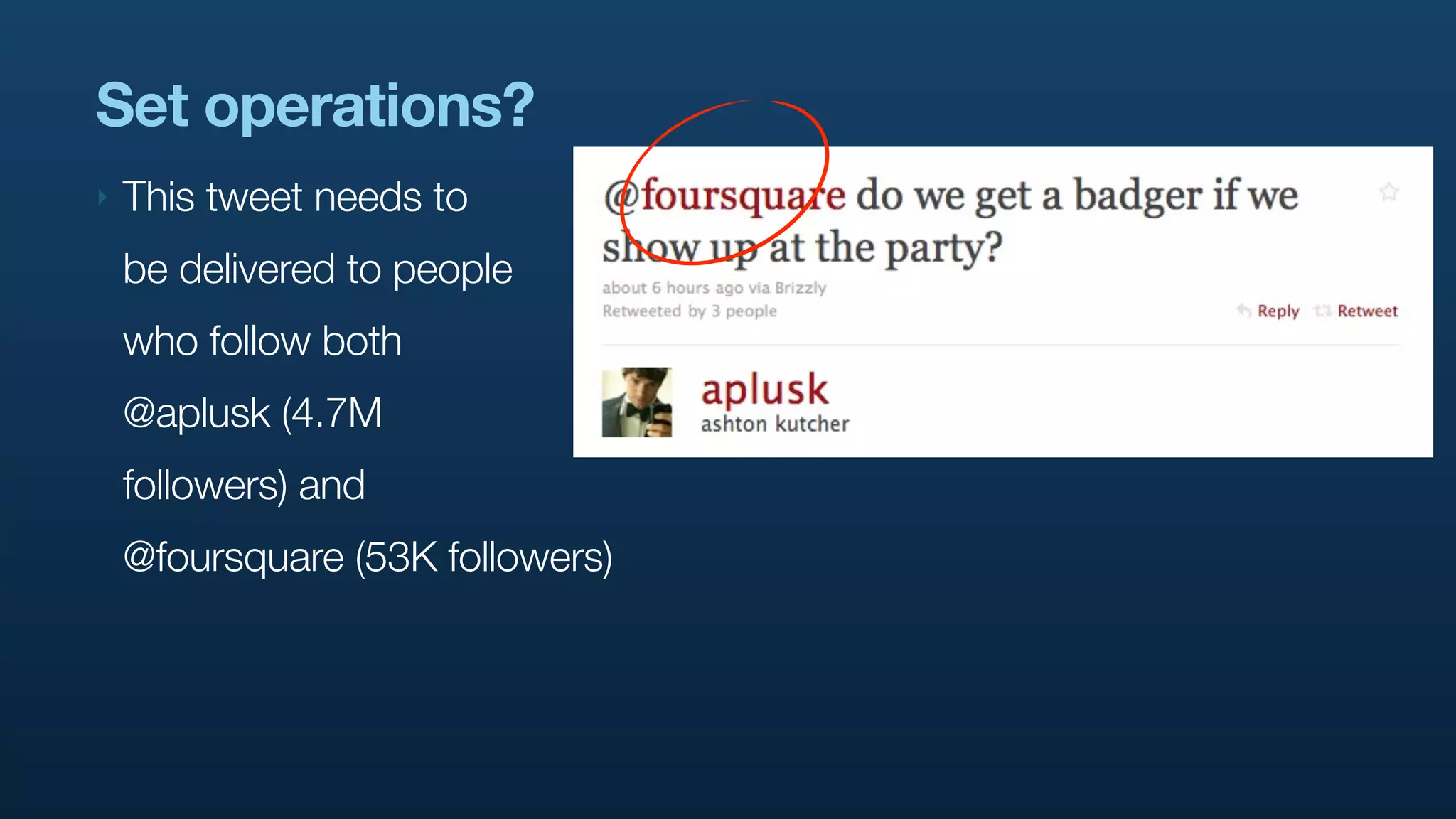
Set operations?
‣   This tweet needs to
    be delivered to people
    who follow both
    @aplusk (4.7M
    followers) and
    @foursquare (53K followers)
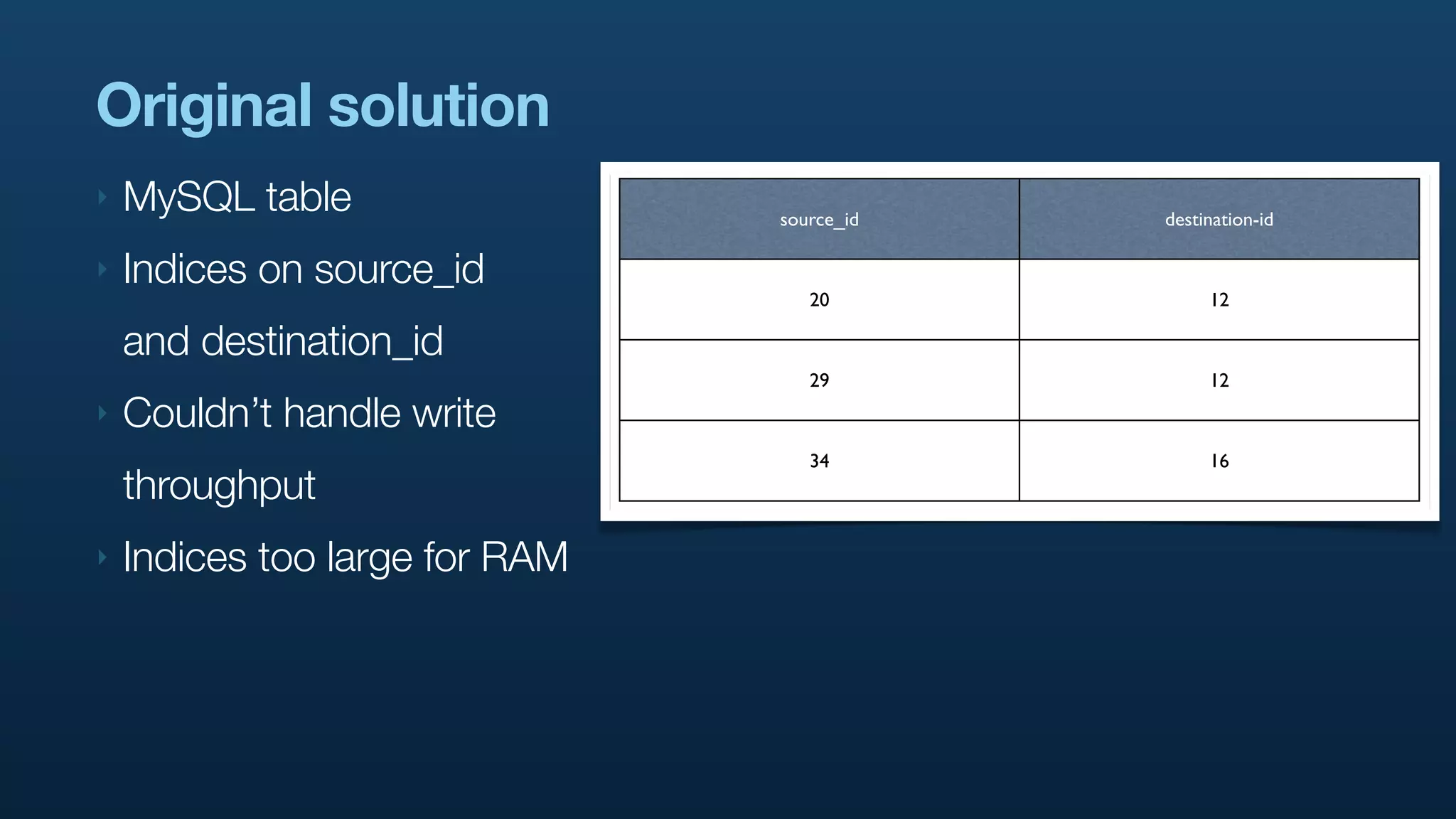
Original solution
‣   MySQL table                 source_id   destination-id

‣   Indices on source_id
                                   20            12

    and destination_id
                                   29            12
‣   Couldn’t handle write
                                   34            16
    throughput
‣   Indices too large for RAM
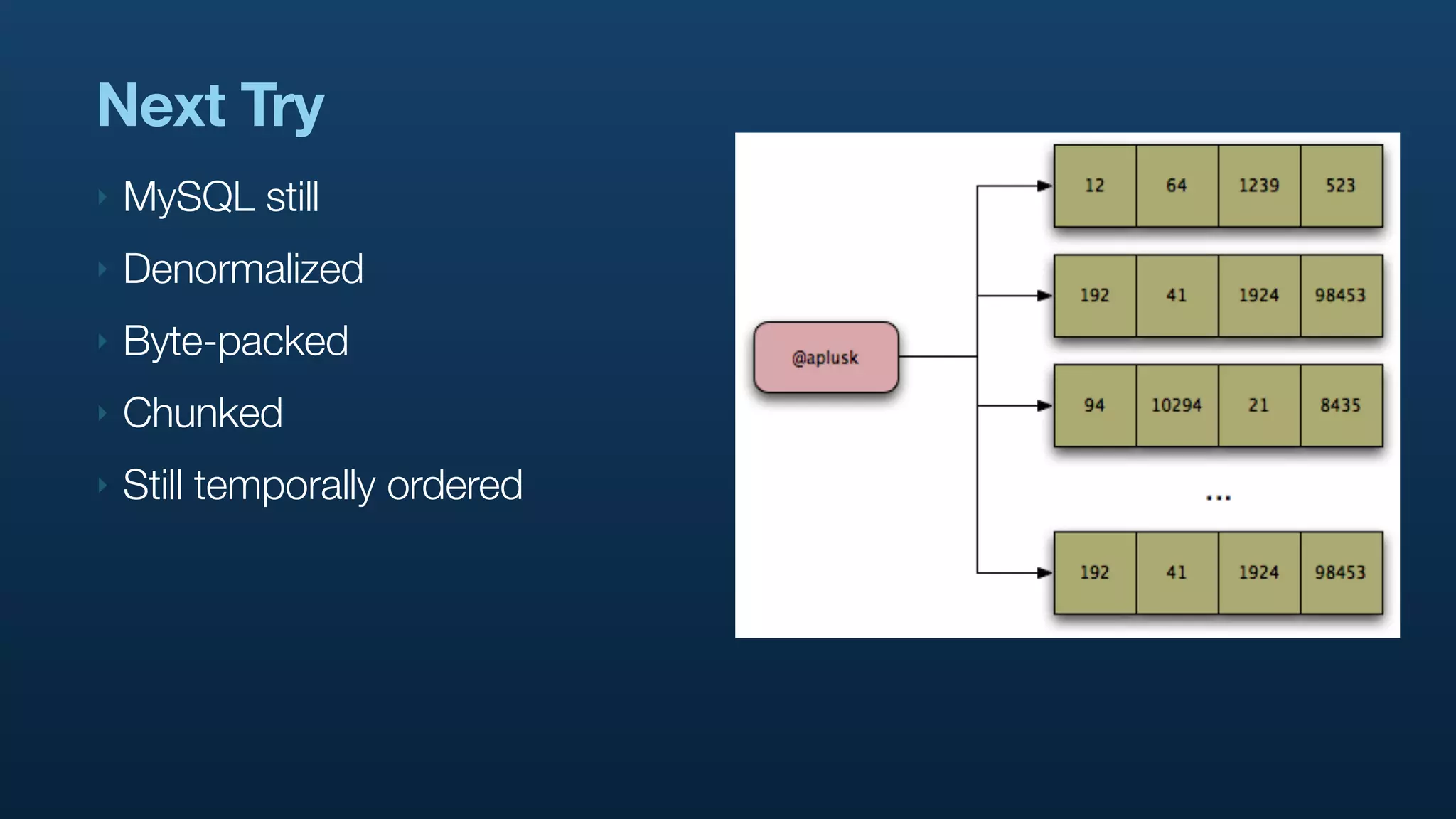
Next Try
‣   MySQL still
‣   Denormalized
‣   Byte-packed
‣   Chunked
‣   Still temporally ordered
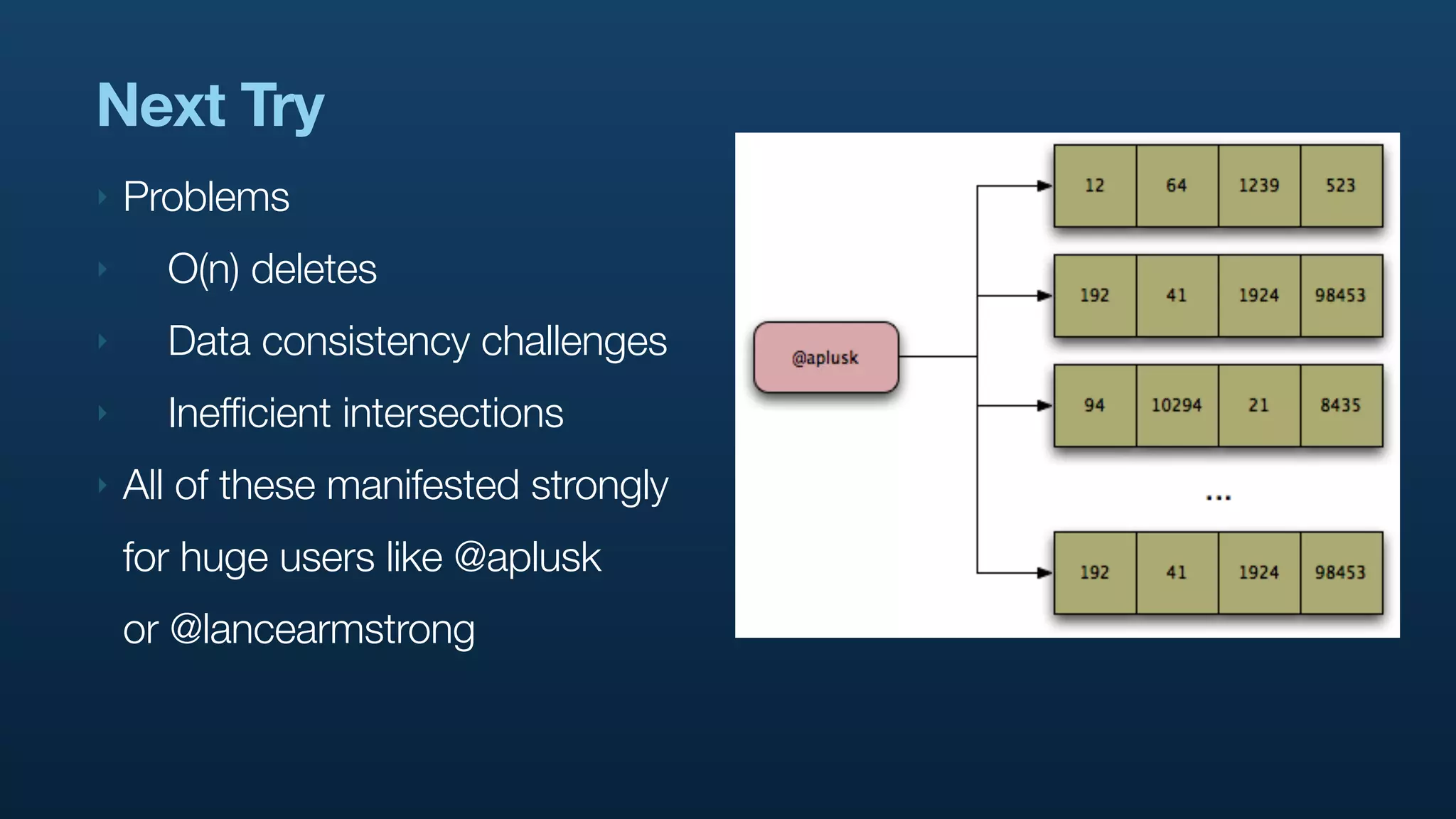
Next Try
‣   Problems
‣     O(n) deletes
‣     Data consistency challenges
‣     Inefficient intersections
‣   All of these manifested strongly
    for huge users like @aplusk
    or @lancearmstrong
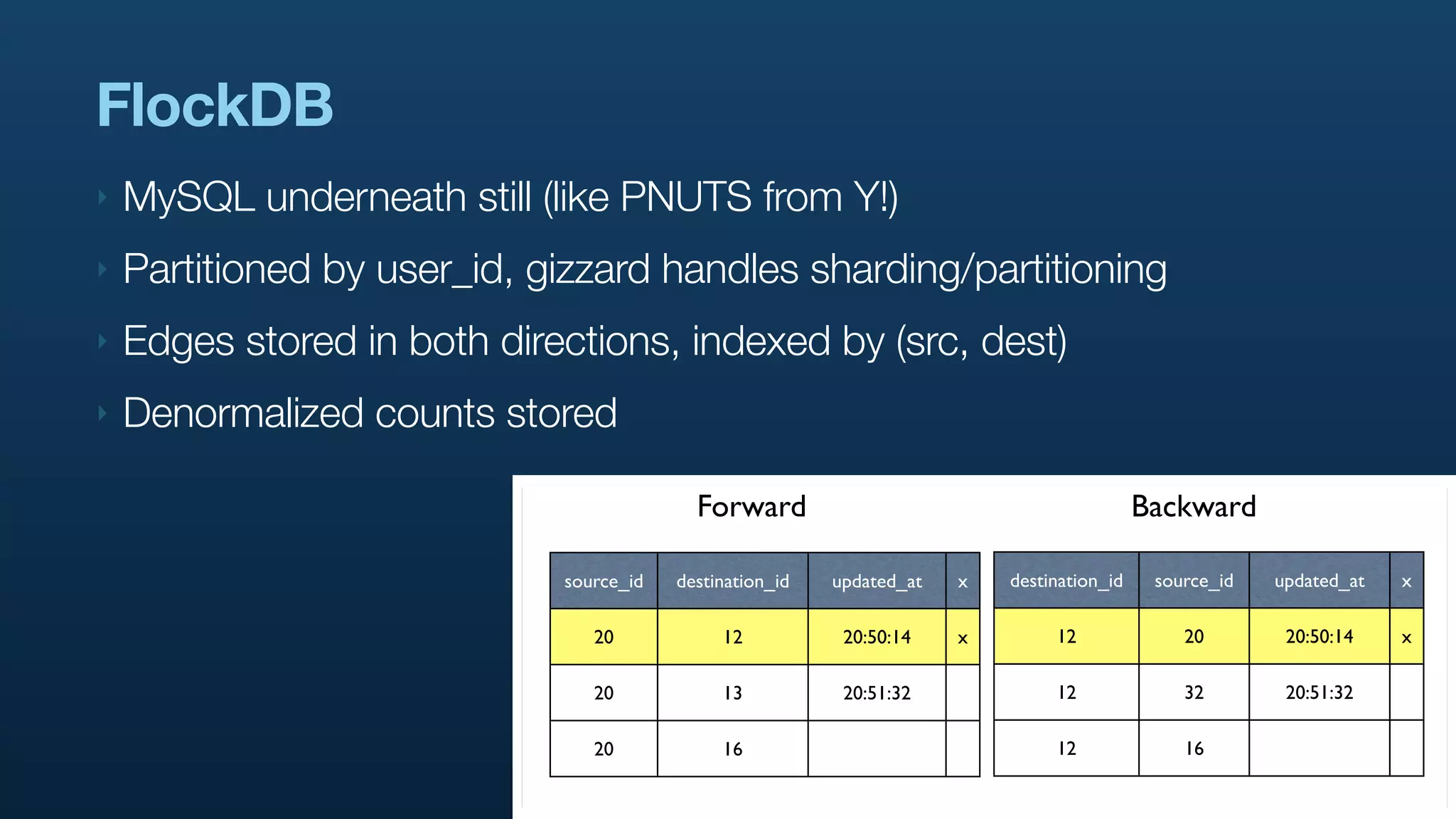
FlockDB
‣   MySQL underneath still (like PNUTS from Y!)
‣   Partitioned by user_id, gizzard handles sharding/partitioning
‣   Edges stored in both directions, indexed by (src, dest)
‣   Denormalized counts stored

                                           Forward                                          Backward

                             source_id   destination_id   updated_at   x   destination_id    source_id   updated_at   x

                                20            12           20:50:14    x        12              20        20:50:14    x

                                20            13           20:51:32             12              32        20:51:32

                                20            16                                12              16
FlockDB Timings
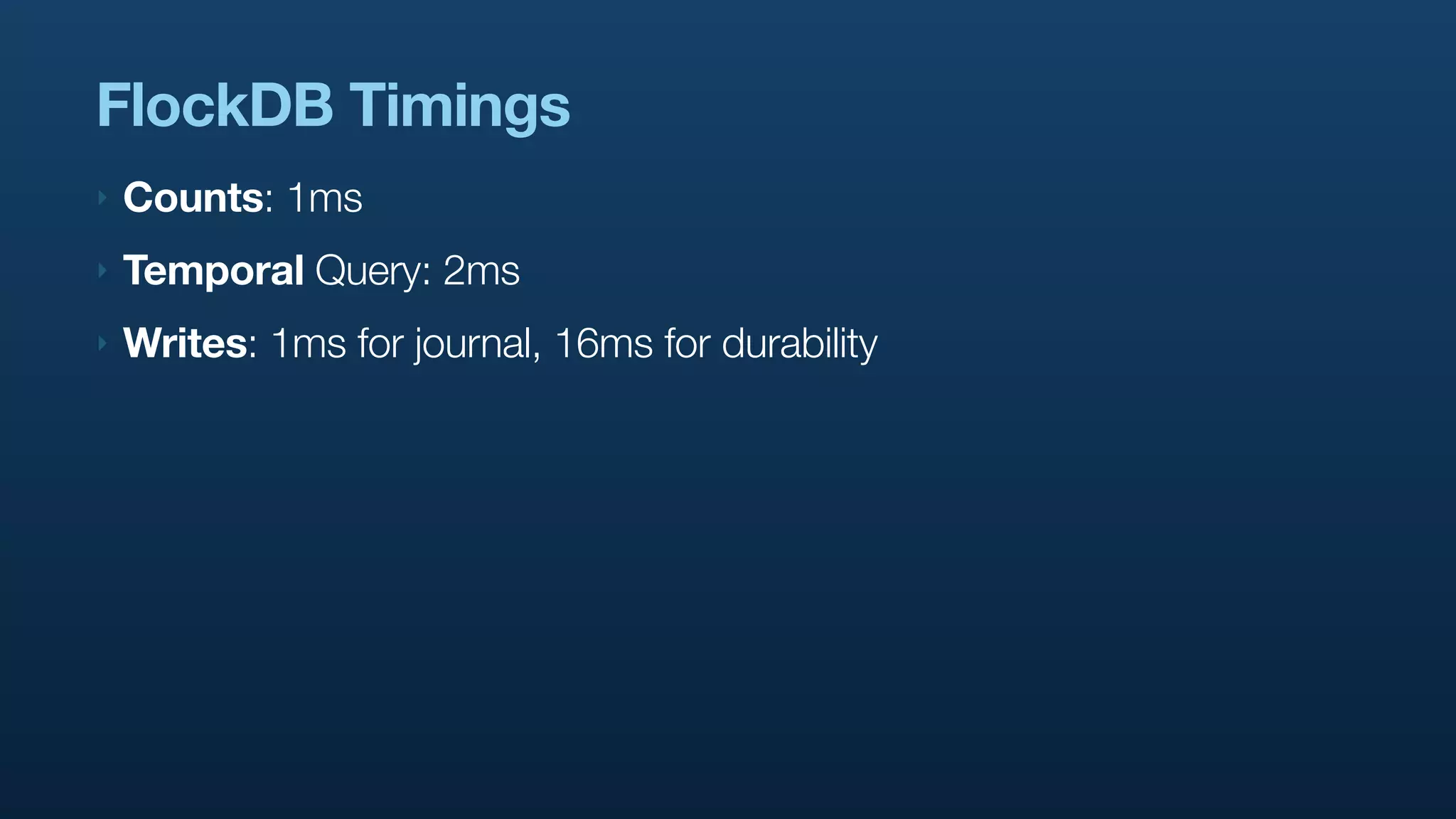
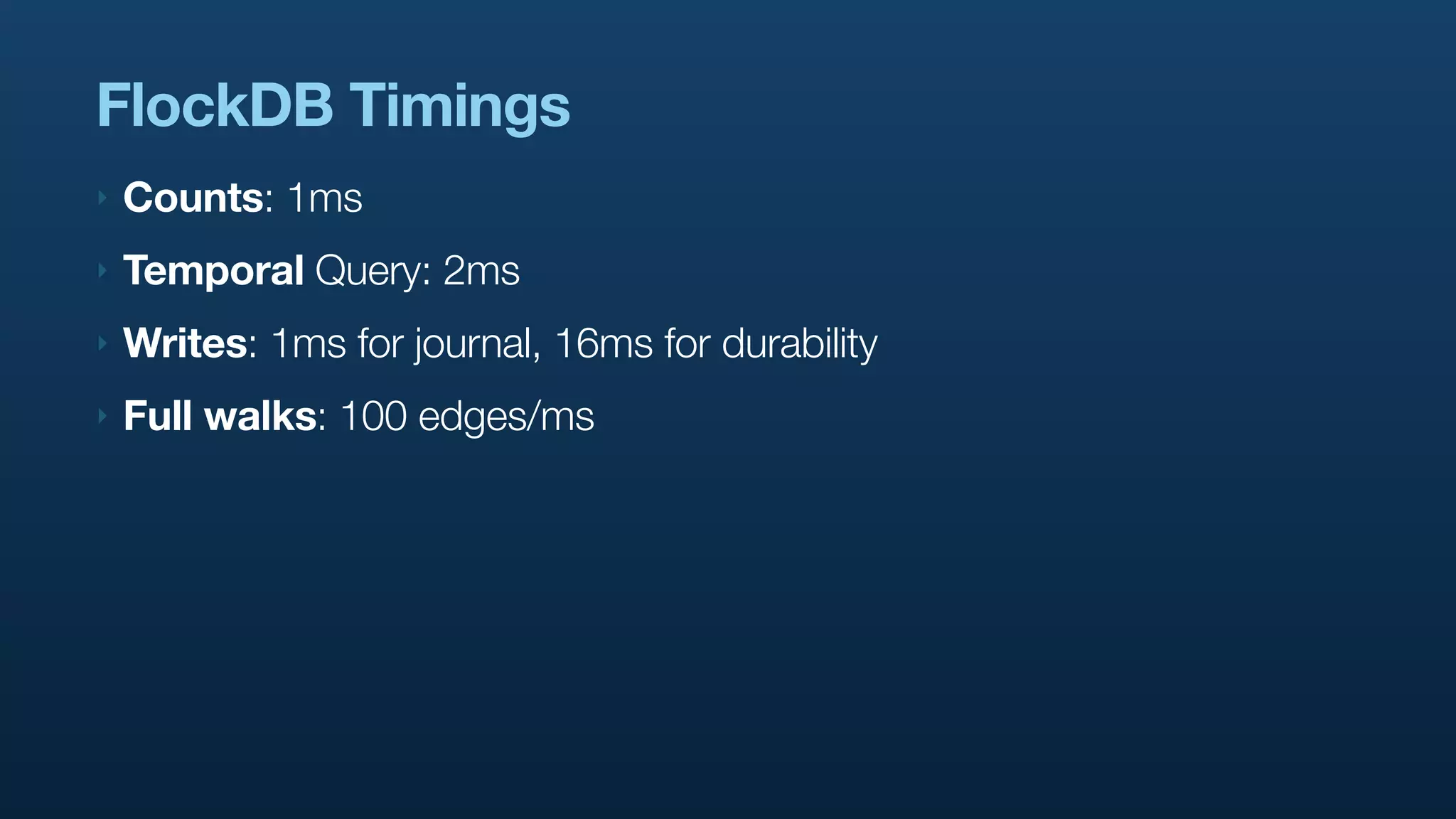
‣   Counts: 1ms
FlockDB Timings
‣   Counts: 1ms
‣   Temporal Query: 2ms
FlockDB Timings
‣   Counts: 1ms
‣   Temporal Query: 2ms
‣   Writes: 1ms for journal, 16ms for durability
FlockDB Timings
‣   Counts: 1ms
‣   Temporal Query: 2ms
‣   Writes: 1ms for journal, 16ms for durability
‣   Full walks: 100 edges/ms
FlockDB is Open Source
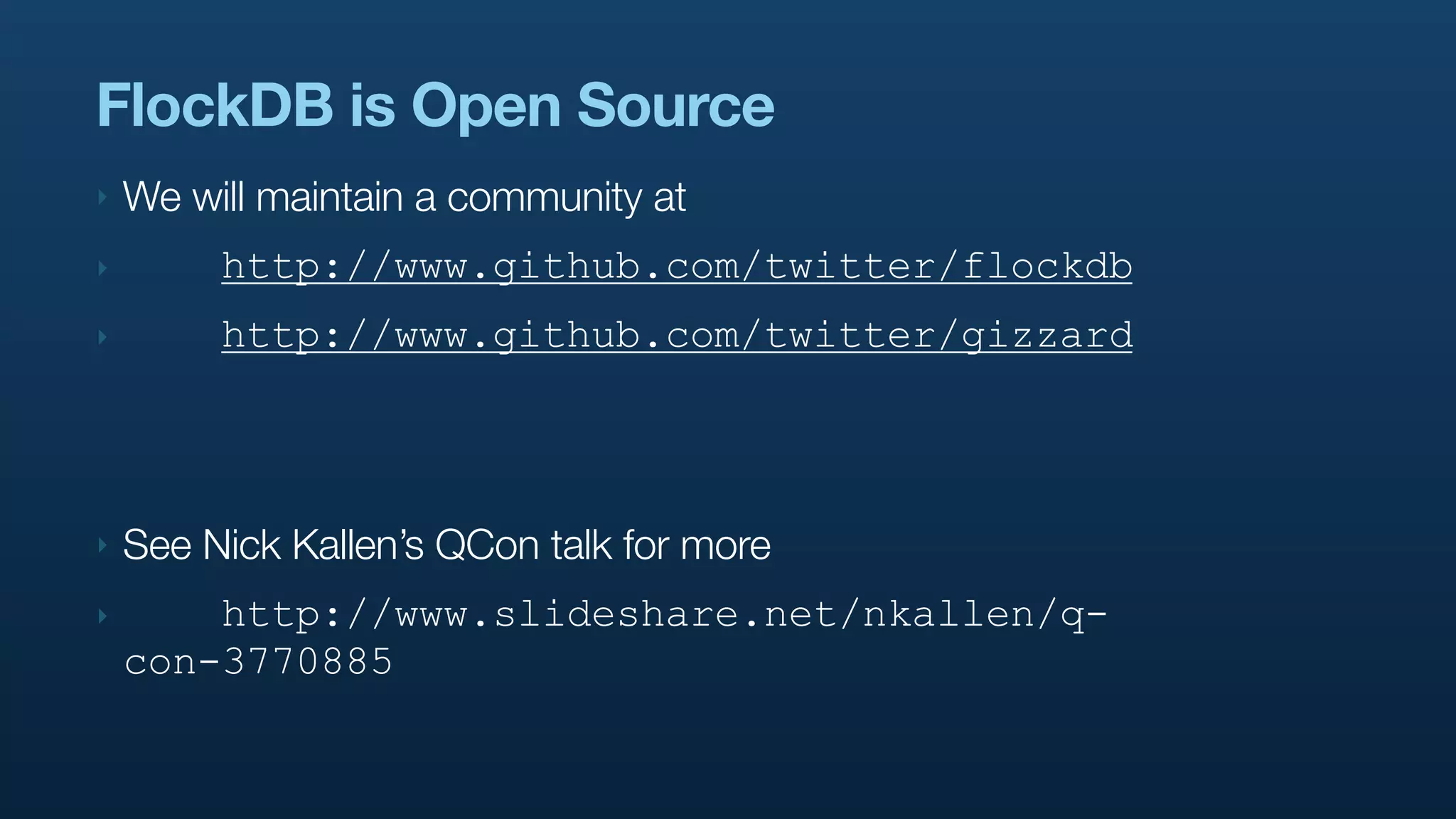
‣   We will maintain a community at
‣        http://www.github.com/twitter/flockdb
‣        http://www.github.com/twitter/gizzard


‣   See Nick Kallen’s QCon talk for more
‣       http://www.slideshare.net/nkallen/q-
    con-3770885
Cassandra
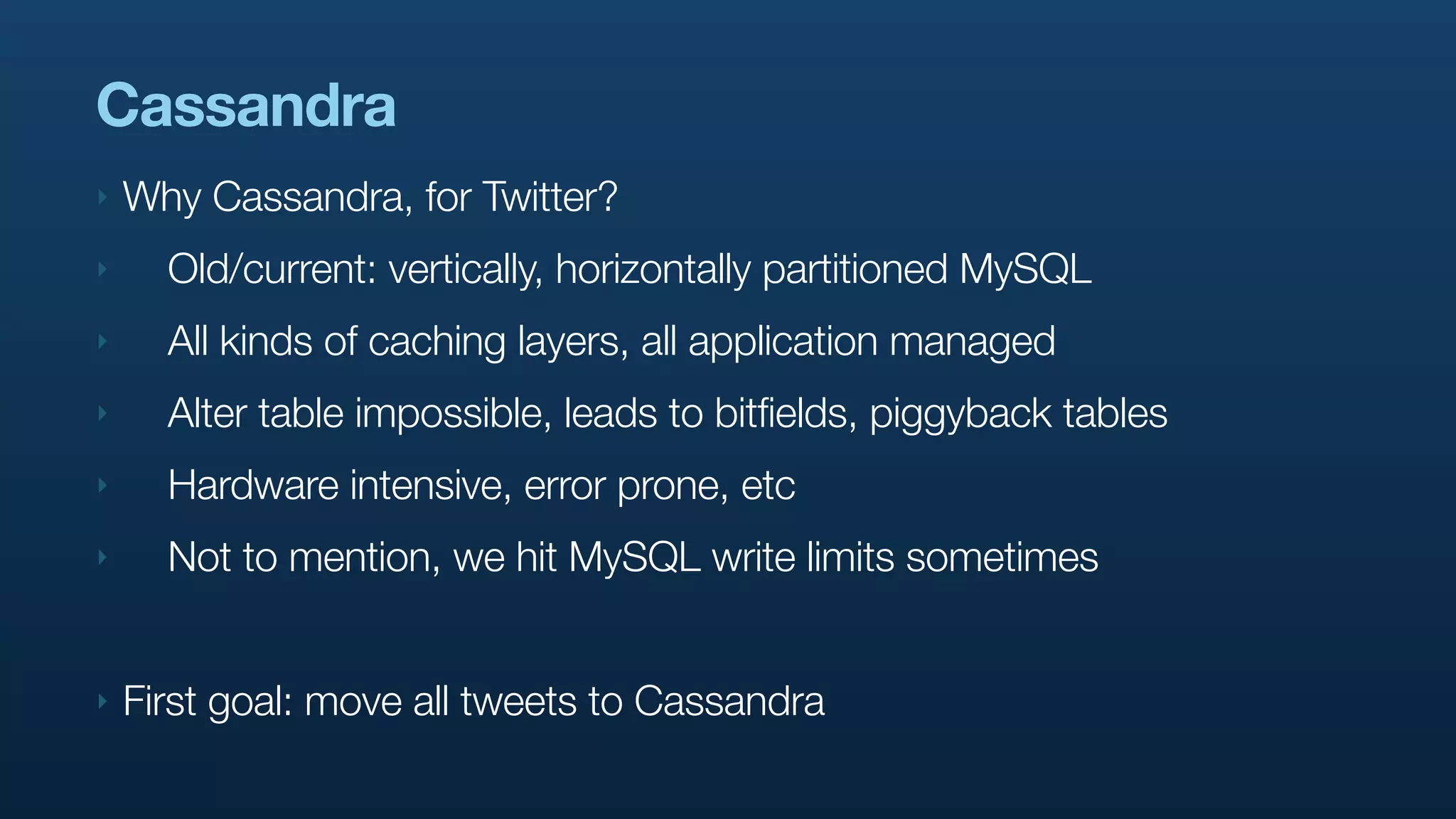
‣   Why Cassandra, for Twitter?
Cassandra
‣   Why Cassandra, for Twitter?
‣     Old/current: vertically, horizontally partitioned MySQL
Cassandra
‣   Why Cassandra, for Twitter?
‣     Old/current: vertically, horizontally partitioned MySQL
‣     All kinds of caching layers, all application managed
Cassandra
‣   Why Cassandra, for Twitter?
‣     Old/current: vertically, horizontally partitioned MySQL
‣     All kinds of caching layers, all application managed
‣     Alter table impossible, leads to bitfields, piggyback tables
Cassandra
‣   Why Cassandra, for Twitter?
‣     Old/current: vertically, horizontally partitioned MySQL
‣     All kinds of caching layers, all application managed
‣     Alter table impossible, leads to bitfields, piggyback tables
‣     Hardware intensive, error prone, etc
Cassandra
‣   Why Cassandra, for Twitter?
‣     Old/current: vertically, horizontally partitioned MySQL
‣     All kinds of caching layers, all application managed
‣     Alter table impossible, leads to bitfields, piggyback tables
‣     Hardware intensive, error prone, etc
‣     Not to mention, we hit MySQL write limits sometimes
Cassandra
‣   Why Cassandra, for Twitter?
‣     Old/current: vertically, horizontally partitioned MySQL
‣     All kinds of caching layers, all application managed
‣     Alter table impossible, leads to bitfields, piggyback tables
‣     Hardware intensive, error prone, etc
‣     Not to mention, we hit MySQL write limits sometimes


‣   First goal: move all tweets to Cassandra
Cassandra
‣   Why Cassandra, for Twitter?
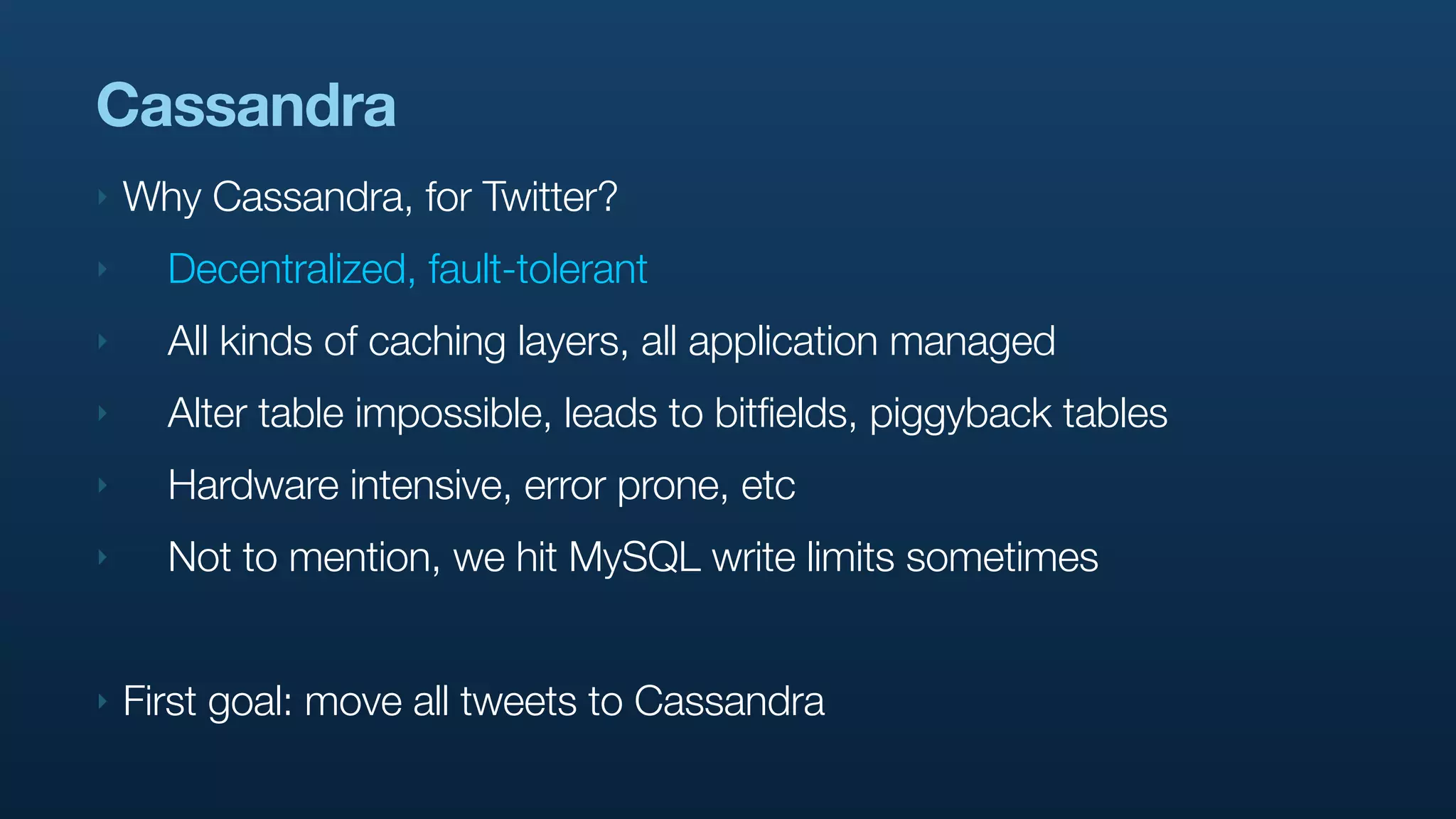
‣     Decentralized, fault-tolerant
‣     All kinds of caching layers, all application managed
‣     Alter table impossible, leads to bitfields, piggyback tables
‣     Hardware intensive, error prone, etc
‣     Not to mention, we hit MySQL write limits sometimes


‣   First goal: move all tweets to Cassandra
Cassandra
‣   Why Cassandra, for Twitter?
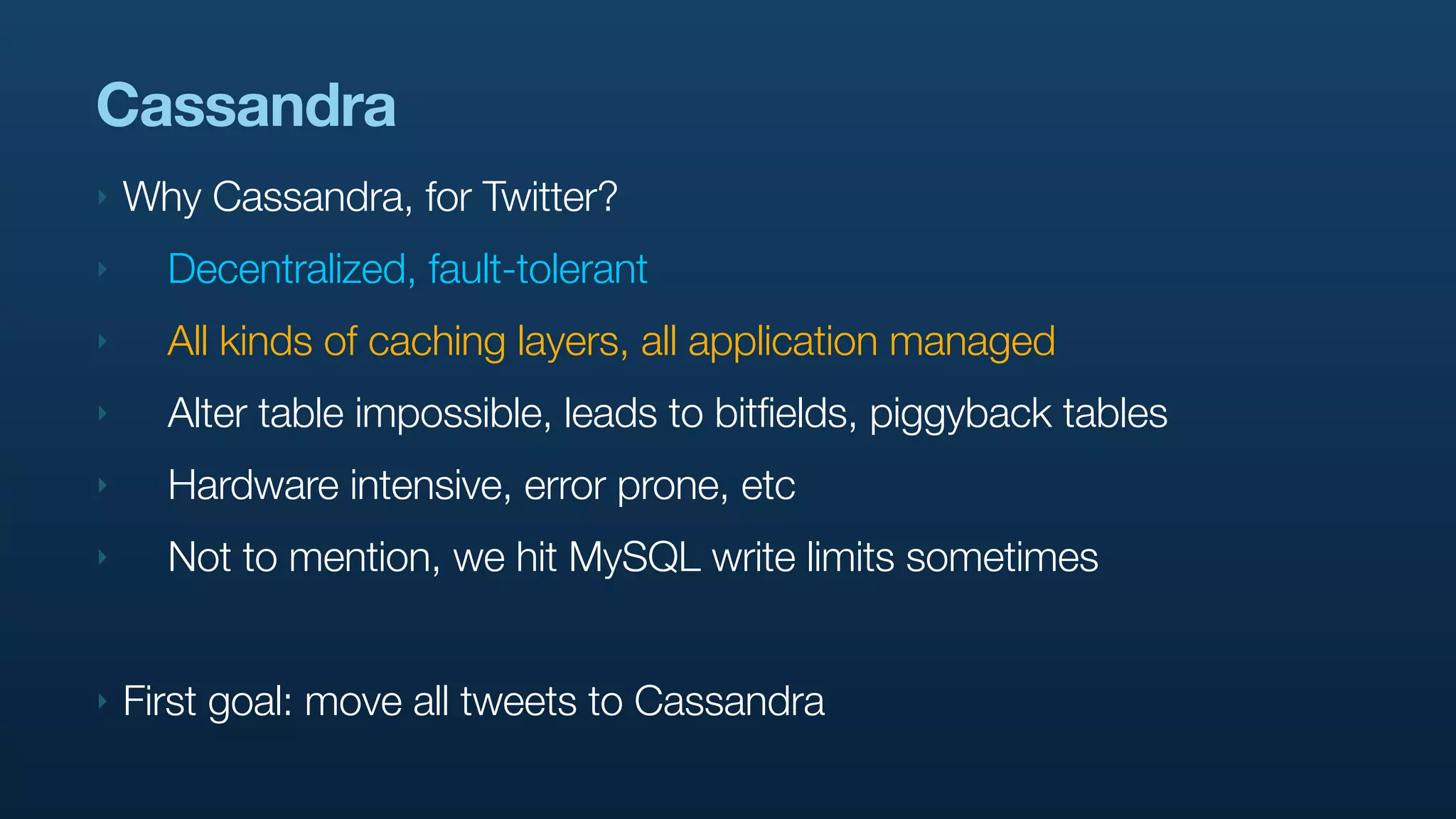
‣     Decentralized, fault-tolerant
‣     All kinds of caching layers, all application managed
‣     Alter table impossible, leads to bitfields, piggyback tables
‣     Hardware intensive, error prone, etc
‣     Not to mention, we hit MySQL write limits sometimes


‣   First goal: move all tweets to Cassandra
Cassandra
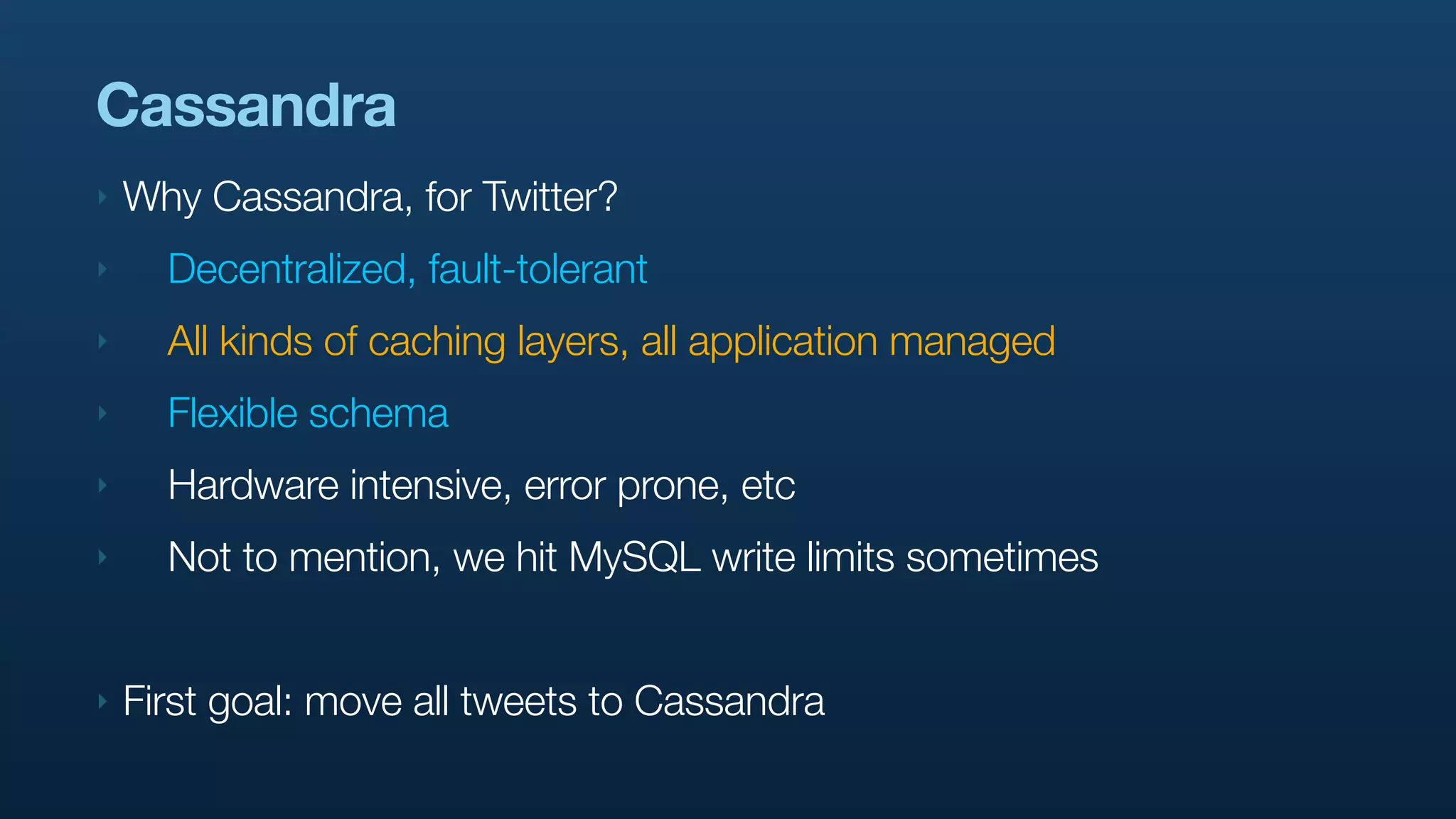
‣   Why Cassandra, for Twitter?
‣     Decentralized, fault-tolerant
‣     All kinds of caching layers, all application managed
‣     Flexible schema
‣     Hardware intensive, error prone, etc
‣     Not to mention, we hit MySQL write limits sometimes


‣   First goal: move all tweets to Cassandra
Cassandra
‣   Why Cassandra, for Twitter?
‣     Decentralized, fault-tolerant
‣     All kinds of caching layers, all application managed
‣     Flexible schema
‣     Elastic
‣     Not to mention, we hit MySQL write limits sometimes


‣   First goal: move all tweets to Cassandra
Cassandra
‣   Why Cassandra, for Twitter?
‣     Decentralized, fault-tolerant
‣     All kinds of caching layers, all application managed
‣     Flexible schema
‣     Elastic
‣     High write throughput


‣   First goal: move all tweets to Cassandra
Eventually Consistent?
‣   Twitter is already eventually consistent
Eventually Consistent?
‣   Twitter is already eventually consistent
‣   Your system may be even worse
Eventually Consistent?
‣   Twitter is already eventually consistent
‣   Your system may be even worse
‣     Ryan’s new term: “potential consistency”
‣     Do you have write-through caching?
‣     Do you ever have MySQL replication failures?
Eventually Consistent?
‣   Twitter is already eventually consistent
‣   Your system may be even worse
‣     Ryan’s new term: “potential consistency”
‣     Do you have write-through caching?
‣     Do you ever have MySQL replication failures?
‣   There is no automatic consistency repair there, unlike Cassandra
Eventually Consistent?
‣   Twitter is already eventually consistent
‣   Your system may be even worse
‣     Ryan’s new term: “potential consistency”
‣     Do you have write-through caching?
‣     Do you ever have MySQL replication failures?
‣   There is no automatic consistency repair there, unlike Cassandra


‣   http://www.slideshare.net/ryansking/scaling-
    twitter-with-cassandra
Rolling out Cassandra
‣   1. Integrate Cassandra alongside MySQL
‣     100% reads/writes to MySQL
‣     Dynamic switches for % dark reads/writes to Cassandra
Rolling out Cassandra
‣   1. Integrate Cassandra alongside MySQL
‣     100% reads/writes to MySQL
‣     Dynamic switches for % dark reads/writes to Cassandra
‣   2. Turn up traffic to Cassandra
Rolling out Cassandra
‣   1. Integrate Cassandra alongside MySQL
‣     100% reads/writes to MySQL
‣     Dynamic switches for % dark reads/writes to Cassandra
‣   2. Turn up traffic to Cassandra
‣   3. Find something that’s broken, set switch to 0%
Rolling out Cassandra
‣   1. Integrate Cassandra alongside MySQL
‣      100% reads/writes to MySQL
‣      Dynamic switches for % dark reads/writes to Cassandra
‣   2. Turn up traffic to Cassandra
‣   3. Find something that’s broken, set switch to 0%
‣   4. Fix it
Rolling out Cassandra
‣   1. Integrate Cassandra alongside MySQL
‣      100% reads/writes to MySQL
‣      Dynamic switches for % dark reads/writes to Cassandra
‣   2. Turn up traffic to Cassandra
‣   3. Find something that’s broken, set switch to 0%
‣   4. Fix it
‣   5. GOTO 2
Cassandra for Realtime Analytics
‣   Starting a project around realtime analytics
‣   Cassandra as the backing store
‣     Using, developing, testing Digg’s atomic incr patches
‣   More soon.
That was a lot of slides
‣   Thanks for sticking with me.
Questions?   Follow me at
             twitter.com/kevinweil


                          TM

NoSQL at Twitter (NoSQL EU 2010)

  • 1.
    NoSQL at Twitter KevinWeil -- @kevinweil Analytics Lead, Twitter April 21, 2010 TM
  • 2.
    Introduction ‣ How We Arrived at NoSQL: A Crash Course ‣ Collecting Data (Scribe) ‣ Storing and Analyzing Data (Hadoop) ‣ Rapid Learning over Big Data (Pig) ‣ And More: Cassandra, HBase, FlockDB
  • 3.
    My Background ‣ Studied Mathematics and Physics at Harvard, Physics at Stanford ‣ Tropos Networks (city-wide wireless): mesh routing algorithms, GBs of data ‣ Cooliris (web media): Hadoop and Pig for analytics, TBs of data ‣ Twitter: Hadoop, Pig, HBase, Cassandra, machine learning, visualization, social graph analysis, soon to be PBs data
  • 4.
    Introduction ‣ How We Arrived at NoSQL: A Crash Course ‣ Collecting Data (Scribe) ‣ Storing and Analyzing Data (Hadoop) ‣ Rapid Learning over Big Data (Pig) ‣ And More: Cassandra, HBase, FlockDB
  • 5.
    Data, Data Everywhere ‣ Twitter users generate a lot of data ‣ Anybody want to guess?
  • 6.
    Data, Data Everywhere ‣ Twitter users generate a lot of data ‣ Anybody want to guess? ‣ 7 TB/day (2+ PB/yr)
  • 7.
    Data, Data Everywhere ‣ Twitter users generate a lot of data ‣ Anybody want to guess? ‣ 7 TB/day (2+ PB/yr) ‣ 10,000 CDs/day
  • 8.
    Data, Data Everywhere ‣ Twitter users generate a lot of data ‣ Anybody want to guess? ‣ 7 TB/day (2+ PB/yr) ‣ 10,000 CDs/day ‣ 5 million floppy disks
  • 9.
    Data, Data Everywhere ‣ Twitter users generate a lot of data ‣ Anybody want to guess? ‣ 7 TB/day (2+ PB/yr) ‣ 10,000 CDs/day ‣ 5 million floppy disks ‣ 300 GB while I give this talk
  • 10.
    Data, Data Everywhere ‣ Twitter users generate a lot of data ‣ Anybody want to guess? ‣ 7 TB/day (2+ PB/yr) ‣ 10,000 CDs/day ‣ 5 million floppy disks ‣ 300 GB while I give this talk ‣ And doubling multiple times per year
  • 11.
    Syslog? ‣ Started with syslog-ng ‣ As our volume grew, it didn’t scale
  • 12.
    Syslog? ‣ Started with syslog-ng ‣ As our volume grew, it didn’t scale ‣ Resources overwhelmed ‣ Lost data
  • 13.
    Scribe ‣ Surprise! FB had same problem, built and open-sourced Scribe ‣ Log collection framework over Thrift ‣ You write log lines, with categories ‣ It does the rest
  • 14.
    Scribe ‣ Runs locally; reliable in network outage FE FE FE
  • 15.
    Scribe ‣ Runs locally; reliable in network outage ‣ Nodes only know downstream FE FE FE writer; hierarchical, scalable Agg Agg
  • 16.
    Scribe ‣ Runs locally; reliable in network outage ‣ Nodes only know downstream FE FE FE writer; hierarchical, scalable ‣ Pluggable outputs Agg Agg File HDFS
  • 17.
    Scribe at Twitter ‣ Solved our problem, opened new vistas ‣ Currently 30 different categories logged from multiple sources ‣ FE: Javascript, Ruby on Rails ‣ Middle tier: Ruby on Rails, Scala ‣ Backend: Scala, Java, C++
  • 18.
    Scribe at Twitter ‣ We’ve contributed to it as we’ve used it ‣ Improved logging, monitoring, writing to HDFS, compression ‣ Continuing to work with FB on patches ‣ GSoC project! Help make it more awesome. • http://github.com/traviscrawford/scribe • http://wiki.developers.facebook.com/index.php/User:GSoC
  • 19.
    Introduction ‣ How We Arrived at NoSQL: A Crash Course ‣ Collecting Data (Scribe) ‣ Storing and Analyzing Data (Hadoop) ‣ Rapid Learning over Big Data (Pig) ‣ And More: Cassandra, HBase, FlockDB
  • 20.
    How do youstore 7TB/day? ‣ Single machine? ‣ What’s HD write speed?
  • 21.
    How do youstore 7TB/day? ‣ Single machine? ‣ What’s HD write speed? ‣ ~80 MB/s
  • 22.
    How do youstore 7TB/day? ‣ Single machine? ‣ What’s HD write speed? ‣ ~80 MB/s ‣ 24.3 hours to write 7 TB
  • 23.
    How do youstore 7TB/day? ‣ Single machine? ‣ What’s HD write speed? ‣ ~80 MB/s ‣ 24.3 hours to write 7 TB ‣ Uh oh.
  • 24.
    Where do Iput 7TB/day? ‣ Need a cluster of machines
  • 25.
    Where do Iput 7TB/day? ‣ Need a cluster of machines ‣ ... which adds new layers of complexity
  • 26.
    Hadoop ‣ Distributed file system ‣ Automatic replication, fault tolerance
  • 27.
    Hadoop ‣ Distributed file system ‣ Automatic replication, fault tolerance ‣ MapReduce-based parallel computation ‣ Key-value based computation interface allows for wide applicability
  • 28.
    Hadoop ‣ Open source: top-level Apache project ‣ Scalable: Y! has a 4000 node cluster ‣ Powerful: sorted 1TB of random integers in 62 seconds ‣ Easy packaging: free Cloudera RPMs
  • 29.
    MapReduce Workflow Inputs Map Shuffle/Sort ‣ Challenge: how many tweets per user, given tweets table? Map Outputs ‣ Input: key=row, value=tweet info Map Reduce ‣ Map: output key=user_id, value=1 Map Reduce ‣ Shuffle: sort by user_id Map Reduce ‣ Reduce: for each user_id, sum Map ‣ Output: user_id, tweet count Map ‣ With 2x machines, runs 2x faster
  • 30.
    MapReduce Workflow Inputs Map Shuffle/Sort ‣ Challenge: how many tweets per user, given tweets table? Map Outputs ‣ Input: key=row, value=tweet info Map Reduce ‣ Map: output key=user_id, value=1 Map Reduce ‣ Shuffle: sort by user_id Map Reduce ‣ Reduce: for each user_id, sum Map ‣ Output: user_id, tweet count Map ‣ With 2x machines, runs 2x faster
  • 31.
    MapReduce Workflow Inputs Map Shuffle/Sort ‣ Challenge: how many tweets per user, given tweets table? Map Outputs ‣ Input: key=row, value=tweet info Map Reduce ‣ Map: output key=user_id, value=1 Map Reduce ‣ Shuffle: sort by user_id Map Reduce ‣ Reduce: for each user_id, sum Map ‣ Output: user_id, tweet count Map ‣ With 2x machines, runs 2x faster
  • 32.
    MapReduce Workflow Inputs Map Shuffle/Sort ‣ Challenge: how many tweets per user, given tweets table? Map Outputs ‣ Input: key=row, value=tweet info Map Reduce ‣ Map: output key=user_id, value=1 Map Reduce ‣ Shuffle: sort by user_id Map Reduce ‣ Reduce: for each user_id, sum Map ‣ Output: user_id, tweet count Map ‣ With 2x machines, runs 2x faster
  • 33.
    MapReduce Workflow Inputs Map Shuffle/Sort ‣ Challenge: how many tweets per user, given tweets table? Map Outputs ‣ Input: key=row, value=tweet info Map Reduce ‣ Map: output key=user_id, value=1 Map Reduce ‣ Shuffle: sort by user_id Map Reduce ‣ Reduce: for each user_id, sum Map ‣ Output: user_id, tweet count Map ‣ With 2x machines, runs 2x faster
  • 34.
    MapReduce Workflow Inputs Map Shuffle/Sort ‣ Challenge: how many tweets per user, given tweets table? Map Outputs ‣ Input: key=row, value=tweet info Map Reduce ‣ Map: output key=user_id, value=1 Map Reduce ‣ Shuffle: sort by user_id Map Reduce ‣ Reduce: for each user_id, sum Map ‣ Output: user_id, tweet count Map ‣ With 2x machines, runs 2x faster
  • 35.
    MapReduce Workflow Inputs Map Shuffle/Sort ‣ Challenge: how many tweets per user, given tweets table? Map Outputs ‣ Input: key=row, value=tweet info Map Reduce ‣ Map: output key=user_id, value=1 Map Reduce ‣ Shuffle: sort by user_id Map Reduce ‣ Reduce: for each user_id, sum Map ‣ Output: user_id, tweet count Map ‣ With 2x machines, runs 2x faster
  • 36.
    Two Analysis Challenges ‣ 1. Compute friendships in Twitter’s social graph ‣ grep, awk? No way. ‣ Data is in MySQL... self join on an n-billion row table? ‣ n,000,000,000 x n,000,000,000 = ?
  • 37.
    Two Analysis Challenges ‣ 1. Compute friendships in Twitter’s social graph ‣ grep, awk? No way. ‣ Data is in MySQL... self join on an n-billion row table? ‣ n,000,000,000 x n,000,000,000 = ? ‣ I don’t know either.
  • 38.
    Two Analysis Challenges ‣ 2. Large-scale grouping and counting? ‣ select count(*) from users? Maybe... ‣ select count(*) from tweets? Uh... ‣ Imagine joining them... ‣ ... and grouping... ‣ ... and sorting...
  • 39.
    Back to Hadoop ‣ Didn’t we have a cluster of machines?
  • 40.
    Back to Hadoop ‣ Didn’t we have a cluster of machines?
  • 41.
    Back to Hadoop ‣ Didn’t we have a cluster of machines? ‣ Hadoop makes it easy to distribute the calculation ‣ Purpose-built for parallel computation ‣ Just a slight mindset adjustment
  • 42.
    Back to Hadoop ‣ Didn’t we have a cluster of machines? ‣ Hadoop makes it easy to distribute the calculation ‣ Purpose-built for parallel computation ‣ Just a slight mindset adjustment ‣ But a fun and valuable one!
  • 43.
    Analysis at scale ‣ Now we’re rolling ‣ Count all tweets: 12 billion, 5 minutes ‣ Hit FlockDB in parallel to assemble social graph aggregates ‣ Run pagerank across users to calculate reputations
  • 44.
    But... ‣ Analysis typically in Java ‣ “I need less Java in my life, not more.”
  • 45.
    But... ‣ Analysis typically in Java ‣ “I need less Java in my life, not more.” ‣ Single-input, two-stage data flow is rigid
  • 46.
    But... ‣ Analysis typically in Java ‣ “I need less Java in my life, not more.” ‣ Single-input, two-stage data flow is rigid ‣ Projections, filters: custom code
  • 47.
    But... ‣ Analysis typically in Java ‣ “I need less Java in my life, not more.” ‣ Single-input, two-stage data flow is rigid ‣ Projections, filters: custom code ‣ Joins are lengthy, error-prone
  • 48.
    But... ‣ Analysis typically in Java ‣ “I need less Java in my life, not more.” ‣ Single-input, two-stage data flow is rigid ‣ Projections, filters: custom code ‣ Joins are lengthy, error-prone ‣ n-stage jobs hard to manage
  • 49.
    But... ‣ Analysis typically in Java ‣ “I need less Java in my life, not more.” ‣ Single-input, two-stage data flow is rigid ‣ Projections, filters: custom code ‣ Joins are lengthy, error-prone ‣ n-stage jobs hard to manage ‣ Exploration requires compilation!
  • 50.
    Introduction ‣ How We Arrived at NoSQL: A Crash Course ‣ Collecting Data (Scribe) ‣ Storing and Analyzing Data (Hadoop) ‣ Rapid Learning over Big Data (Pig) ‣ And More: Cassandra, HBase, FlockDB
  • 51.
    Pig ‣ High-level language ‣ Transformations on sets of records ‣ Process data one step at a time ‣ Easier than SQL?
  • 52.
    Why Pig? ‣ Because I bet you can read the following script.
  • 53.
    A Real PigScript
  • 54.
    A Real PigScript ‣ Now, just for fun... the same calculation in vanilla Hadoop MapReduce.
  • 55.
  • 56.
    Pig Democratizes Large-scaleData Analysis ‣ The Pig version is: ‣ 5% of the code
  • 57.
    Pig Democratizes Large-scaleData Analysis ‣ The Pig version is: ‣ 5% of the code ‣ 5% of the time
  • 58.
    Pig Democratizes Large-scaleData Analysis ‣ The Pig version is: ‣ 5% of the code ‣ 5% of the time ‣ Within 25% of the execution time
  • 59.
    One Thing I’veLearned ‣ It’s easy to answer questions ‣ It’s hard to ask the right questions
  • 60.
    One Thing I’veLearned ‣ It’s easy to answer questions ‣ It’s hard to ask the right questions ‣ Value the system that promotes innovation, iteration
  • 61.
    One Thing I’veLearned ‣ It’s easy to answer questions ‣ It’s hard to ask the right questions ‣ Value the system that promotes innovation, iteration ‣ More minds contributing = more value from your data
  • 62.
    The Hadoop Ecosystemat Twitter ‣ Running Cloudera’s free distro, CDH2 and Hadoop 0.20.1
  • 63.
    The Hadoop Ecosystemat Twitter ‣ Running Cloudera’s free distro, CDH2 and Hadoop 0.20.1 ‣ Heavily modified Scribe writing LZO-compressed to HDFS ‣ LZO: fast, splittable compression, ideal for HDFS* ‣ * http://www.github.com/kevinweil/hadoop-lzo ‣
  • 64.
    The Hadoop Ecosystemat Twitter ‣ Running Cloudera’s free distro, CDH2 and Hadoop 0.20.1 ‣ Heavily modified Scribe writing LZO-compressed to HDFS ‣ LZO: fast, splittable compression, ideal for HDFS* ‣ Data either as flat files (logs) or in protocol buffer format (newer logs, structured data, etc) ‣ Libs for reading/writing/more open-sourced as elephant-bird** ‣ * http://www.github.com/kevinweil/hadoop-lzo ‣ ** http://www.github.com/kevinweil/elephant-bird
  • 65.
    The Hadoop Ecosystemat Twitter ‣ Running Cloudera’s free distro, CDH2 and Hadoop 0.20.1 ‣ Heavily modified Scribe writing LZO-compressed to HDFS ‣ LZO: fast, splittable compression, ideal for HDFS* ‣ Data either as flat files (logs) or in protocol buffer format (newer logs, structured data, etc) ‣ Libs for reading/writing/more open-sourced as elephant-bird** ‣ Some Java-based MapReduce, a little Hadoop streaming ‣ * http://www.github.com/kevinweil/hadoop-lzo ‣ ** http://www.github.com/kevinweil/elephant-bird
  • 66.
    The Hadoop Ecosystemat Twitter ‣ Running Cloudera’s free distro, CDH2 and Hadoop 0.20.1 ‣ Heavily modified Scribe writing LZO-compressed to HDFS ‣ LZO: fast, splittable compression, ideal for HDFS* ‣ Data either as flat files (logs) or in protocol buffer format (newer logs, structured data, etc) ‣ Libs for reading/writing/more open-sourced as elephant-bird** ‣ Some Java-based MapReduce, some HBase, Hadoop streaming ‣ Most analysis, and most interesting analyses, done in Pig ‣ * http://www.github.com/kevinweil/hadoop-lzo ‣ ** http://www.github.com/kevinweil/elephant-bird
  • 67.
    Data? ‣ Semi-structured: apache logs (search, .com, mobile), search query logs, RoR logs, mysql query logs, A/B testing logs, signup flow logging, and on...
  • 68.
    Data? ‣ Semi-structured: apache logs (search, .com, mobile), search query logs, RoR logs, mysql query logs, A/B testing logs, signup flow logging, and on... ‣ Structured: tweets, users, blocks, phones, favorites, saved searches, retweets, geo, authentications, sms, 3rd party clients, followings
  • 69.
    Data? ‣ Semi-structured: apache logs (search, .com, mobile), search query logs, RoR logs, mysql query logs, A/B testing logs, signup flow logging, and on... ‣ Structured: tweets, users, blocks, phones, favorites, saved searches, retweets, geo, authentications, sms, 3rd party clients, followings ‣ Entangled: the social graph
  • 70.
    So what dowe do with it?
  • 71.
    Counting Big Data ‣ standard counts, min, max, std dev ‣ How many requests do we serve in a day?
  • 72.
    Counting Big Data ‣ standard counts, min, max, std dev ‣ How many requests do we serve in a day? ‣ What is the average latency? 95% latency? ‣
  • 73.
    Counting Big Data ‣ standard counts, min, max, std dev ‣ How many requests do we serve in a day? ‣ What is the average latency? 95% latency? ‣ Group by response code. What is the hourly distribution? ‣
  • 74.
    Counting Big Data ‣ standard counts, min, max, std dev ‣ How many requests do we serve in a day? ‣ What is the average latency? 95% latency? ‣ Group by response code. What is the hourly distribution? ‣ How many searches happen each day on Twitter? ‣
  • 75.
    Counting Big Data ‣ standard counts, min, max, std dev ‣ How many requests do we serve in a day? ‣ What is the average latency? 95% latency? ‣ Group by response code. What is the hourly distribution? ‣ How many searches happen each day on Twitter? ‣ How many unique queries, how many unique users? ‣
  • 76.
    Counting Big Data ‣ standard counts, min, max, std dev ‣ How many requests do we serve in a day? ‣ What is the average latency? 95% latency? ‣ Group by response code. What is the hourly distribution? ‣ How many searches happen each day on Twitter? ‣ How many unique queries, how many unique users? ‣ What is their geographic distribution?
  • 77.
    Counting Big Data ‣ Where are users querying from? The API, the front page, their profile page, etc? ‣
  • 78.
    Correlating Big Data ‣ probabilities, covariance, influence ‣ How does usage differ for mobile users?
  • 79.
    Correlating Big Data ‣ probabilities, covariance, influence ‣ How does usage differ for mobile users? ‣ How about for users with 3rd party desktop clients?
  • 80.
    Correlating Big Data ‣ probabilities, covariance, influence ‣ How does usage differ for mobile users? ‣ How about for users with 3rd party desktop clients? ‣ Cohort analyses
  • 81.
    Correlating Big Data ‣ probabilities, covariance, influence ‣ How does usage differ for mobile users? ‣ How about for users with 3rd party desktop clients? ‣ Cohort analyses ‣ Site problems: what goes wrong at the same time?
  • 82.
    Correlating Big Data ‣ probabilities, covariance, influence ‣ How does usage differ for mobile users? ‣ How about for users with 3rd party desktop clients? ‣ Cohort analyses ‣ Site problems: what goes wrong at the same time? ‣ Which features get users hooked?
  • 83.
    Correlating Big Data ‣ probabilities, covariance, influence ‣ How does usage differ for mobile users? ‣ How about for users with 3rd party desktop clients? ‣ Cohort analyses ‣ Site problems: what goes wrong at the same time? ‣ Which features get users hooked? ‣ Which features do successful users use often?
  • 84.
    Correlating Big Data ‣ probabilities, covariance, influence ‣ How does usage differ for mobile users? ‣ How about for users with 3rd party desktop clients? ‣ Cohort analyses ‣ Site problems: what goes wrong at the same time? ‣ Which features get users hooked? ‣ Which features do successful users use often? ‣ Search corrections, search suggestions
  • 85.
    Correlating Big Data ‣ probabilities, covariance, influence ‣ How does usage differ for mobile users? ‣ How about for users with 3rd party desktop clients? ‣ Cohort analyses ‣ Site problems: what goes wrong at the same time? ‣ Which features get users hooked? ‣ Which features do successful users use often? ‣ Search corrections, search suggestions ‣ A/B testing
  • 86.
    Correlating Big Data ‣ What is the correlation between users with registered phones and users that tweet?
  • 87.
    Research on BigData ‣ prediction, graph analysis, natural language ‣ What can we tell about a user from their tweets?
  • 88.
    Research on BigData ‣ prediction, graph analysis, natural language ‣ What can we tell about a user from their tweets? ‣ From the tweets of those they follow?
  • 89.
    Research on BigData ‣ prediction, graph analysis, natural language ‣ What can we tell about a user from their tweets? ‣ From the tweets of those they follow? ‣ From the tweets of their followers?
  • 90.
    Research on BigData ‣ prediction, graph analysis, natural language ‣ What can we tell about a user from their tweets? ‣ From the tweets of those they follow? ‣ From the tweets of their followers? ‣ From the ratio of followers/following?
  • 91.
    Research on BigData ‣ prediction, graph analysis, natural language ‣ What can we tell about a user from their tweets? ‣ From the tweets of those they follow? ‣ From the tweets of their followers? ‣ From the ratio of followers/following? ‣ What graph structures lead to successful networks?
  • 92.
    Research on BigData ‣ prediction, graph analysis, natural language ‣ What can we tell about a user from their tweets? ‣ From the tweets of those they follow? ‣ From the tweets of their followers? ‣ From the ratio of followers/following? ‣ What graph structures lead to successful networks? ‣ User reputation
  • 93.
    Research on BigData ‣ prediction, graph analysis, natural language ‣ Sentiment analysis
  • 94.
    Research on BigData ‣ prediction, graph analysis, natural language ‣ Sentiment analysis ‣ What features get a tweet retweeted?
  • 95.
    Research on BigData ‣ prediction, graph analysis, natural language ‣ Sentiment analysis ‣ What features get a tweet retweeted? ‣ How deep is the corresponding retweet tree?
  • 96.
    Research on BigData ‣ prediction, graph analysis, natural language ‣ Sentiment analysis ‣ What features get a tweet retweeted? ‣ How deep is the corresponding retweet tree? ‣ Long-term duplicate detection
  • 97.
    Research on BigData ‣ prediction, graph analysis, natural language ‣ Sentiment analysis ‣ What features get a tweet retweeted? ‣ How deep is the corresponding retweet tree? ‣ Long-term duplicate detection ‣ Machine learning
  • 98.
    Research on BigData ‣ prediction, graph analysis, natural language ‣ Sentiment analysis ‣ What features get a tweet retweeted? ‣ How deep is the corresponding retweet tree? ‣ Long-term duplicate detection ‣ Machine learning ‣ Language detection
  • 99.
    Research on BigData ‣ prediction, graph analysis, natural language ‣ Sentiment analysis ‣ What features get a tweet retweeted? ‣ How deep is the corresponding retweet tree? ‣ Long-term duplicate detection ‣ Machine learning ‣ Language detection ‣ ... the list goes on.
  • 100.
    Research on BigData ‣ How well can we detect bots and other non-human tweeters?
  • 101.
    Introduction ‣ How We Arrived at NoSQL: A Crash Course ‣ Collecting Data (Scribe) ‣ Storing and Analyzing Data (Hadoop) ‣ Rapid Learning over Big Data (Pig) ‣ And More: Cassandra, HBase, FlockDB
  • 102.
    HBase ‣ BigTable clone on top of HDFS ‣ Distributed, column-oriented, no datatypes ‣ Unlike the rest of HDFS, designed for low-latency ‣ Importantly, data is mutable
  • 103.
    HBase at Twitter ‣ We began building real products based on Hadoop ‣ People search
  • 104.
    HBase at Twitter ‣ We began building real products based on Hadoop ‣ People search ‣ Old version: offline process on a single node
  • 105.
    HBase at Twitter ‣ We began building real products based on Hadoop ‣ People search ‣ Old version: offline process on a single node ‣ New version: complex user calculations, hit extra services in real time, custom indexing
  • 106.
    HBase at Twitter ‣ We began building real products based on Hadoop ‣ People search ‣ Old version: offline process on a single node ‣ New version: complex user calculations, hit extra services in real time, custom indexing ‣ Underlying data is mutable ‣ Mutable layer on top of HDFS --> HBase
  • 107.
    People Search ‣ Import user data into HBase
  • 108.
    People Search ‣ Import user data into HBase ‣ Periodic MapReduce job reading from HBase ‣ Hits FlockDB, multiple other internal services in mapper ‣ Custom partitioning
  • 109.
    People Search ‣ Import user data into HBase ‣ Periodic MapReduce job reading from HBase ‣ Hits FlockDB, multiple other internal services in mapper ‣ Custom partitioning ‣ Data sucked across to sharded, replicated, horizontally scalable, in-memory, low-latency Scala service ‣ Build a trie, do case folding/normalization, suggestions, etc
  • 110.
    People Search ‣ Import user data into HBase ‣ Periodic MapReduce job reading from HBase ‣ Hits FlockDB, multiple other internal services in mapper ‣ Custom partitioning ‣ Data sucked across to sharded, replicated, horizontally scalable, in-memory, low-latency Scala service ‣ Build a trie, do case folding/normalization, suggestions, etc ‣ See http://www.slideshare.net/al3x/building-distributed-systems- in-scala for more
  • 111.
    HBase ‣ More products now being built on top of it ‣ Flexible, easy to connect to MapReduce/Pig
  • 112.
    HBase vs Cassandra ‣ “Their origins reveal their strengths and weaknesses”
  • 113.
    HBase vs Cassandra ‣ “Their origins reveal their strengths and weaknesses” ‣ HBase built on top of batch-oriented system, not low latency
  • 114.
    HBase vs Cassandra ‣ “Their origins reveal their strengths and weaknesses” ‣ HBase built on top of batch-oriented system, not low latency ‣ Cassandra built from ground up for low latency
  • 115.
    HBase vs Cassandra ‣ “Their origins reveal their strengths and weaknesses” ‣ HBase built on top of batch-oriented system, not low latency ‣ Cassandra built from ground up for low latency ‣ HBase easy to connect to batch jobs as input and output
  • 116.
    HBase vs Cassandra ‣ “Their origins reveal their strengths and weaknesses” ‣ HBase built on top of batch-oriented system, not low latency ‣ Cassandra built from ground up for low latency ‣ HBase easy to connect to batch jobs as input and output ‣ Cassandra not so much (but we’re working on it)
  • 117.
    HBase vs Cassandra ‣ “Their origins reveal their strengths and weaknesses” ‣ HBase built on top of batch-oriented system, not low latency ‣ Cassandra built from ground up for low latency ‣ HBase easy to connect to batch jobs as input and output ‣ Cassandra not so much (but we’re working on it) ‣ HBase has SPOF in the namenode
  • 118.
    HBase vs Cassandra ‣ Your mileage may vary ‣ At Twitter: HBase for analytics, analysis, dataset generation ‣ Cassandra for online systems
  • 119.
    HBase vs Cassandra ‣ Your mileage may vary ‣ At Twitter: HBase for analytics, analysis, dataset generation ‣ Cassandra for online systems ‣ As with all NoSQL systems: strengths in different situations
  • 120.
    FlockDB ‣ Realtime, distributed social graph store ‣ NOT optimized for data mining ‣ Note: the following slides largely come from @nk’s more complete talk at http://www.slideshare.net/nkallen/ q-con-3770885
  • 121.
    FlockDB ‣ Realtime, distributed Intersection Temporal social graph store ‣ NOT optimized for data mining ‣ Who follows who (nearly 8 Counts orders of magnitude!) ‣ Intersection/set operations ‣ Cardinality ‣ Temporal index
  • 122.
    Set operations? ‣ This tweet needs to be delivered to people who follow both @aplusk (4.7M followers) and @foursquare (53K followers)
  • 123.
    Original solution ‣ MySQL table source_id destination-id ‣ Indices on source_id 20 12 and destination_id 29 12 ‣ Couldn’t handle write 34 16 throughput ‣ Indices too large for RAM
  • 124.
    Next Try ‣ MySQL still ‣ Denormalized ‣ Byte-packed ‣ Chunked ‣ Still temporally ordered
  • 125.
    Next Try ‣ Problems ‣ O(n) deletes ‣ Data consistency challenges ‣ Inefficient intersections ‣ All of these manifested strongly for huge users like @aplusk or @lancearmstrong
  • 126.
    FlockDB ‣ MySQL underneath still (like PNUTS from Y!) ‣ Partitioned by user_id, gizzard handles sharding/partitioning ‣ Edges stored in both directions, indexed by (src, dest) ‣ Denormalized counts stored Forward Backward source_id destination_id updated_at x destination_id source_id updated_at x 20 12 20:50:14 x 12 20 20:50:14 x 20 13 20:51:32 12 32 20:51:32 20 16 12 16
  • 127.
  • 128.
    FlockDB Timings ‣ Counts: 1ms ‣ Temporal Query: 2ms
  • 129.
    FlockDB Timings ‣ Counts: 1ms ‣ Temporal Query: 2ms ‣ Writes: 1ms for journal, 16ms for durability
  • 130.
    FlockDB Timings ‣ Counts: 1ms ‣ Temporal Query: 2ms ‣ Writes: 1ms for journal, 16ms for durability ‣ Full walks: 100 edges/ms
  • 131.
    FlockDB is OpenSource ‣ We will maintain a community at ‣ http://www.github.com/twitter/flockdb ‣ http://www.github.com/twitter/gizzard ‣ See Nick Kallen’s QCon talk for more ‣ http://www.slideshare.net/nkallen/q- con-3770885
  • 132.
    Cassandra ‣ Why Cassandra, for Twitter?
  • 133.
    Cassandra ‣ Why Cassandra, for Twitter? ‣ Old/current: vertically, horizontally partitioned MySQL
  • 134.
    Cassandra ‣ Why Cassandra, for Twitter? ‣ Old/current: vertically, horizontally partitioned MySQL ‣ All kinds of caching layers, all application managed
  • 135.
    Cassandra ‣ Why Cassandra, for Twitter? ‣ Old/current: vertically, horizontally partitioned MySQL ‣ All kinds of caching layers, all application managed ‣ Alter table impossible, leads to bitfields, piggyback tables
  • 136.
    Cassandra ‣ Why Cassandra, for Twitter? ‣ Old/current: vertically, horizontally partitioned MySQL ‣ All kinds of caching layers, all application managed ‣ Alter table impossible, leads to bitfields, piggyback tables ‣ Hardware intensive, error prone, etc
  • 137.
    Cassandra ‣ Why Cassandra, for Twitter? ‣ Old/current: vertically, horizontally partitioned MySQL ‣ All kinds of caching layers, all application managed ‣ Alter table impossible, leads to bitfields, piggyback tables ‣ Hardware intensive, error prone, etc ‣ Not to mention, we hit MySQL write limits sometimes
  • 138.
    Cassandra ‣ Why Cassandra, for Twitter? ‣ Old/current: vertically, horizontally partitioned MySQL ‣ All kinds of caching layers, all application managed ‣ Alter table impossible, leads to bitfields, piggyback tables ‣ Hardware intensive, error prone, etc ‣ Not to mention, we hit MySQL write limits sometimes ‣ First goal: move all tweets to Cassandra
  • 139.
    Cassandra ‣ Why Cassandra, for Twitter? ‣ Decentralized, fault-tolerant ‣ All kinds of caching layers, all application managed ‣ Alter table impossible, leads to bitfields, piggyback tables ‣ Hardware intensive, error prone, etc ‣ Not to mention, we hit MySQL write limits sometimes ‣ First goal: move all tweets to Cassandra
  • 140.
    Cassandra ‣ Why Cassandra, for Twitter? ‣ Decentralized, fault-tolerant ‣ All kinds of caching layers, all application managed ‣ Alter table impossible, leads to bitfields, piggyback tables ‣ Hardware intensive, error prone, etc ‣ Not to mention, we hit MySQL write limits sometimes ‣ First goal: move all tweets to Cassandra
  • 141.
    Cassandra ‣ Why Cassandra, for Twitter? ‣ Decentralized, fault-tolerant ‣ All kinds of caching layers, all application managed ‣ Flexible schema ‣ Hardware intensive, error prone, etc ‣ Not to mention, we hit MySQL write limits sometimes ‣ First goal: move all tweets to Cassandra
  • 142.
    Cassandra ‣ Why Cassandra, for Twitter? ‣ Decentralized, fault-tolerant ‣ All kinds of caching layers, all application managed ‣ Flexible schema ‣ Elastic ‣ Not to mention, we hit MySQL write limits sometimes ‣ First goal: move all tweets to Cassandra
  • 143.
    Cassandra ‣ Why Cassandra, for Twitter? ‣ Decentralized, fault-tolerant ‣ All kinds of caching layers, all application managed ‣ Flexible schema ‣ Elastic ‣ High write throughput ‣ First goal: move all tweets to Cassandra
  • 144.
    Eventually Consistent? ‣ Twitter is already eventually consistent
  • 145.
    Eventually Consistent? ‣ Twitter is already eventually consistent ‣ Your system may be even worse
  • 146.
    Eventually Consistent? ‣ Twitter is already eventually consistent ‣ Your system may be even worse ‣ Ryan’s new term: “potential consistency” ‣ Do you have write-through caching? ‣ Do you ever have MySQL replication failures?
  • 147.
    Eventually Consistent? ‣ Twitter is already eventually consistent ‣ Your system may be even worse ‣ Ryan’s new term: “potential consistency” ‣ Do you have write-through caching? ‣ Do you ever have MySQL replication failures? ‣ There is no automatic consistency repair there, unlike Cassandra
  • 148.
    Eventually Consistent? ‣ Twitter is already eventually consistent ‣ Your system may be even worse ‣ Ryan’s new term: “potential consistency” ‣ Do you have write-through caching? ‣ Do you ever have MySQL replication failures? ‣ There is no automatic consistency repair there, unlike Cassandra ‣ http://www.slideshare.net/ryansking/scaling- twitter-with-cassandra
  • 149.
    Rolling out Cassandra ‣ 1. Integrate Cassandra alongside MySQL ‣ 100% reads/writes to MySQL ‣ Dynamic switches for % dark reads/writes to Cassandra
  • 150.
    Rolling out Cassandra ‣ 1. Integrate Cassandra alongside MySQL ‣ 100% reads/writes to MySQL ‣ Dynamic switches for % dark reads/writes to Cassandra ‣ 2. Turn up traffic to Cassandra
  • 151.
    Rolling out Cassandra ‣ 1. Integrate Cassandra alongside MySQL ‣ 100% reads/writes to MySQL ‣ Dynamic switches for % dark reads/writes to Cassandra ‣ 2. Turn up traffic to Cassandra ‣ 3. Find something that’s broken, set switch to 0%
  • 152.
    Rolling out Cassandra ‣ 1. Integrate Cassandra alongside MySQL ‣ 100% reads/writes to MySQL ‣ Dynamic switches for % dark reads/writes to Cassandra ‣ 2. Turn up traffic to Cassandra ‣ 3. Find something that’s broken, set switch to 0% ‣ 4. Fix it
  • 153.
    Rolling out Cassandra ‣ 1. Integrate Cassandra alongside MySQL ‣ 100% reads/writes to MySQL ‣ Dynamic switches for % dark reads/writes to Cassandra ‣ 2. Turn up traffic to Cassandra ‣ 3. Find something that’s broken, set switch to 0% ‣ 4. Fix it ‣ 5. GOTO 2
  • 154.
    Cassandra for RealtimeAnalytics ‣ Starting a project around realtime analytics ‣ Cassandra as the backing store ‣ Using, developing, testing Digg’s atomic incr patches ‣ More soon.
  • 155.
    That was alot of slides ‣ Thanks for sticking with me.
  • 156.
    Questions? Follow me at twitter.com/kevinweil TM