No, it is  not   “All about story.” Prof. Tom Johnson Institute for Analytic Journalism Santa Fe, New Mexico USA t o m @ j t j o h n s o n . c o m Natal Witness Durban, South Africa 5 September 2006
And   or   &   or   + Prof. Tom Johnson Institute for Analytic Journalism Santa Fe, New Mexico USA t o m @ j t j o h n s o n . c o m Natal Witness Durban, South Africa 5 September 2006
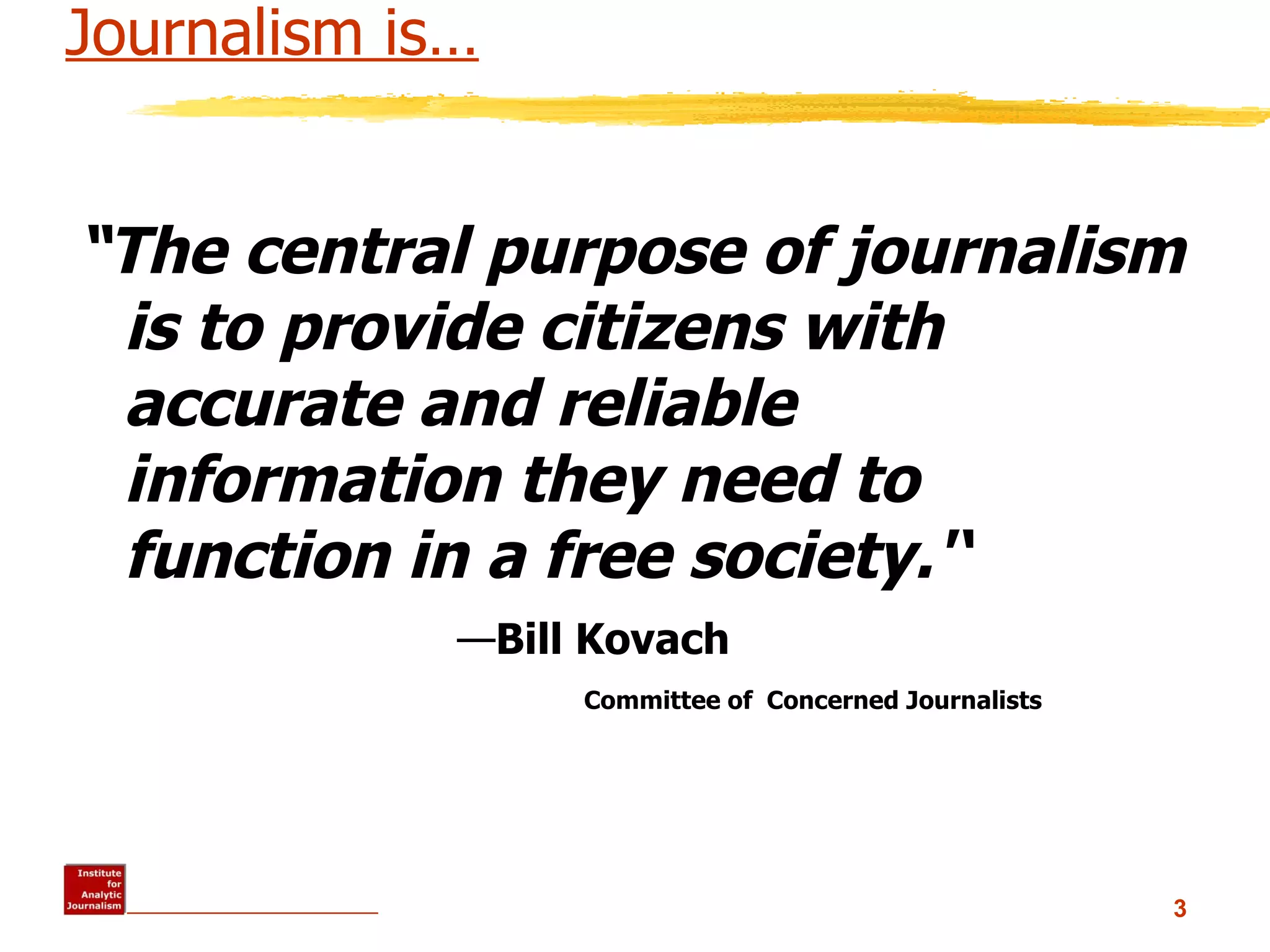
Journalism is… “ The central purpose of journalism is to provide citizens with accurate and reliable information they need to function in a free society.'‘   — Bill Kovach Committee of  Concerned Journalists
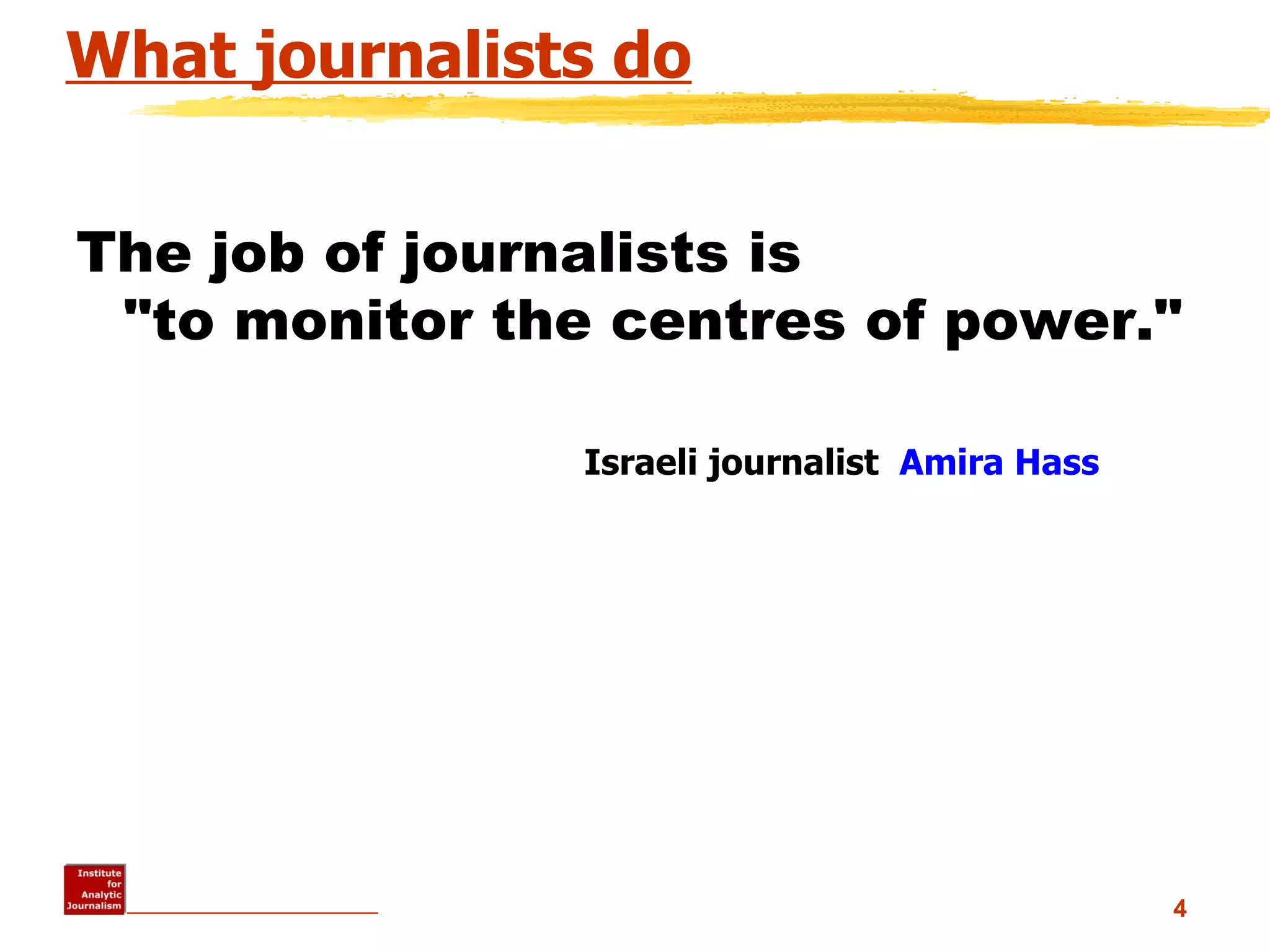
What journalists do The job of journalists is  "to monitor the centres of power."                                                                                           Israeli journalist   Amira  Hass
Today’s objectives Discuss journalism (and journalists) as a species existing in the  Datasphere Review the changes in the information environment Suggest steps journalism can (Should? Must?) take to adapt to those changes if we are to survive Suggest the possible disappearance of the species  journalist serioso
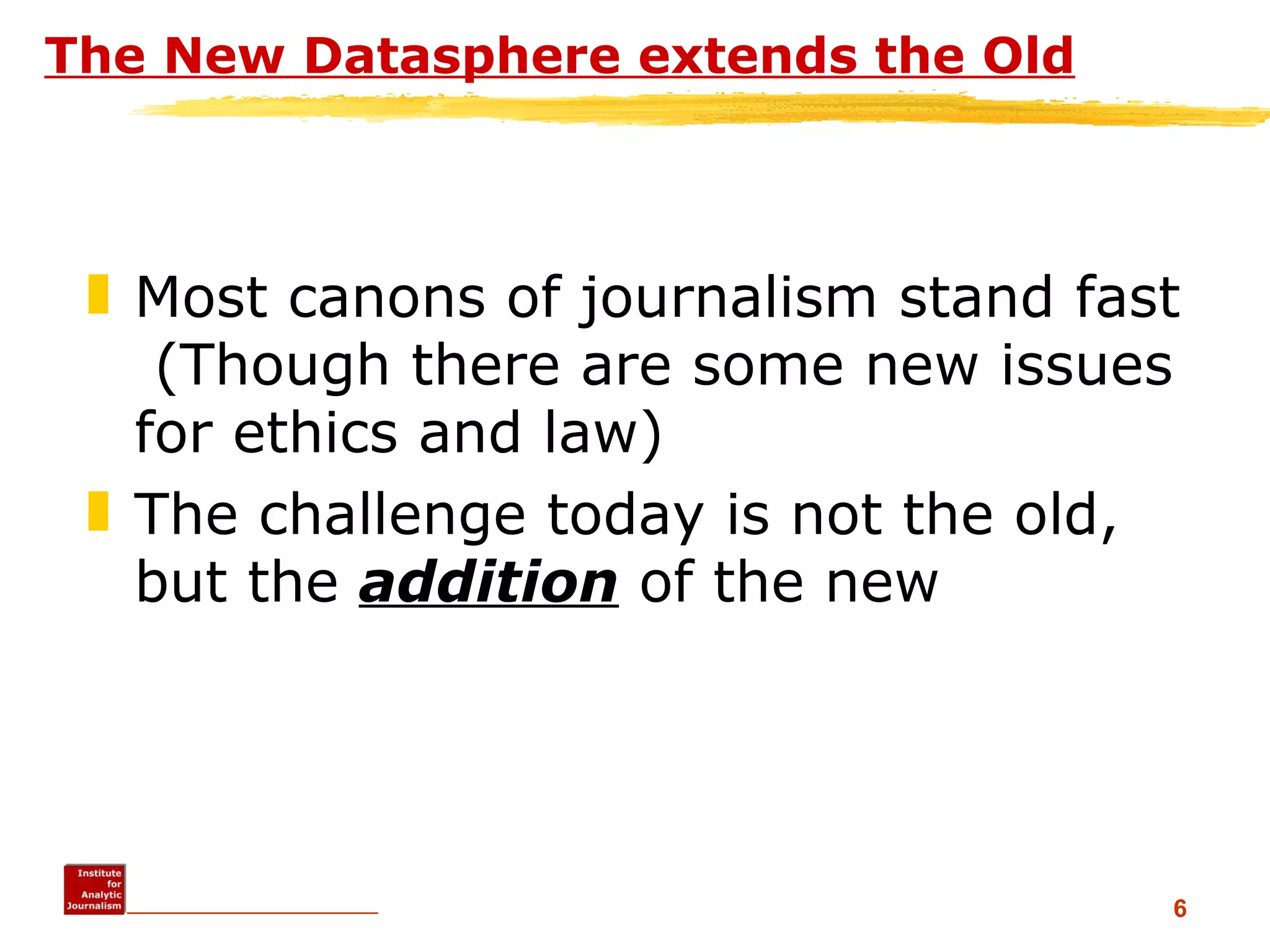
The New Datasphere extends the Old Most canons of journalism stand fast  (Though there are some new issues for ethics and law) The challenge today is not the old, but the  addition  of the new
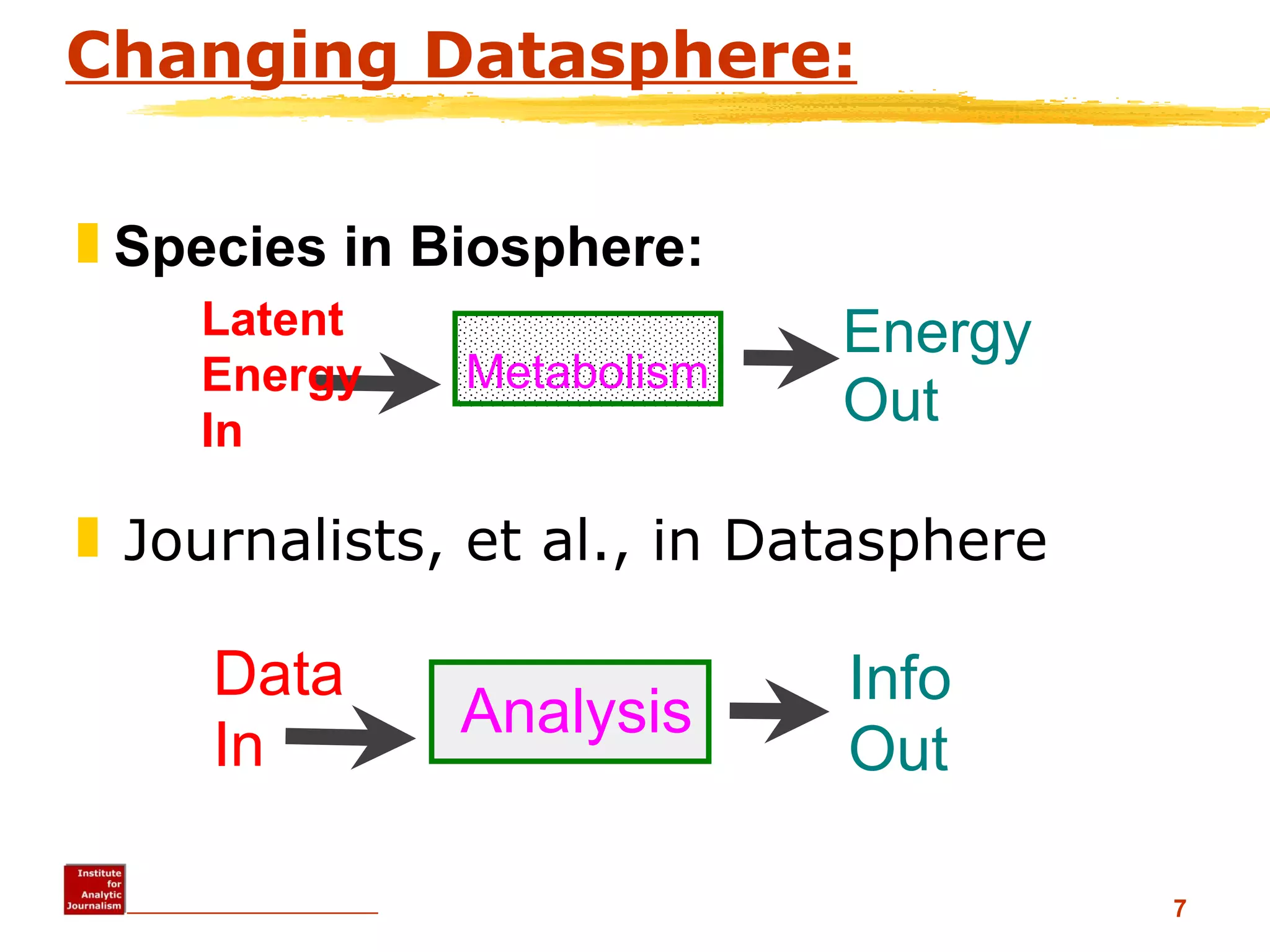
Journalists, et al., in Datasphere Changing Datasphere: Metabolism Latent  Energy In Energy Out Species in Biosphere:
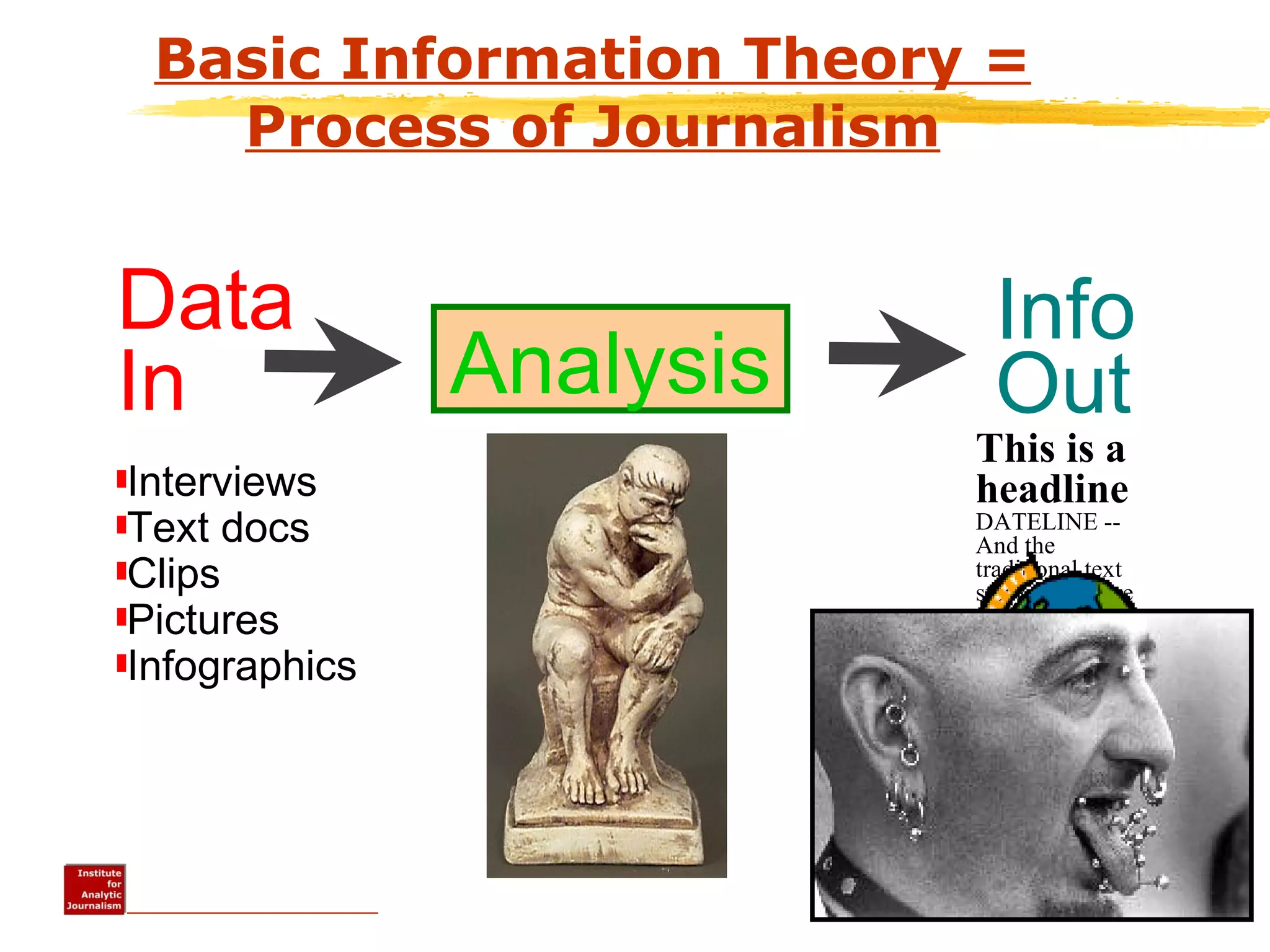
Basic Information Theory = Process of Journalism Data  In Info Out Interviews Text docs Clips Pictures Infographics Analysis This is a headline  DATELINE -- And the traditional text story starts here and goes on and on and on.
Communications Revolution? 2nd Era =   Symbols   Print   Paper     Ink   Writing 1st Era =
“ 100% de la Población Sufre Problemas de Salud Mental”
Challenge of Digital Revolution 100% de la Poblacion Sufre Problemas de Salud Mental 010100100100100110101101 101011101010101010101010 010101010101010100111010
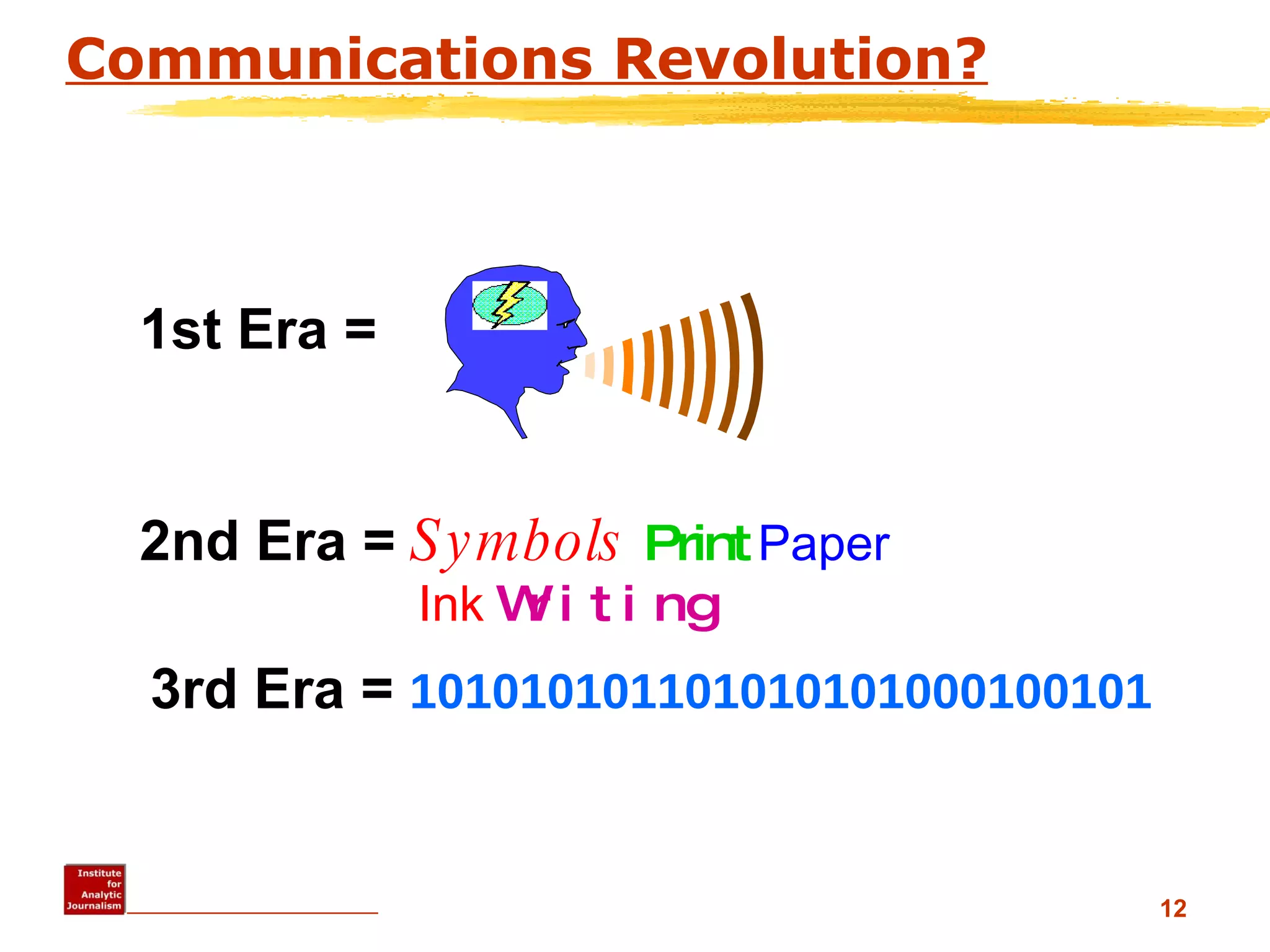
Communications Revolution? 2nd Era =   Symbols   Print   Paper     Ink   Writing 3rd Era =  101010101101010101000100101 1st Era =
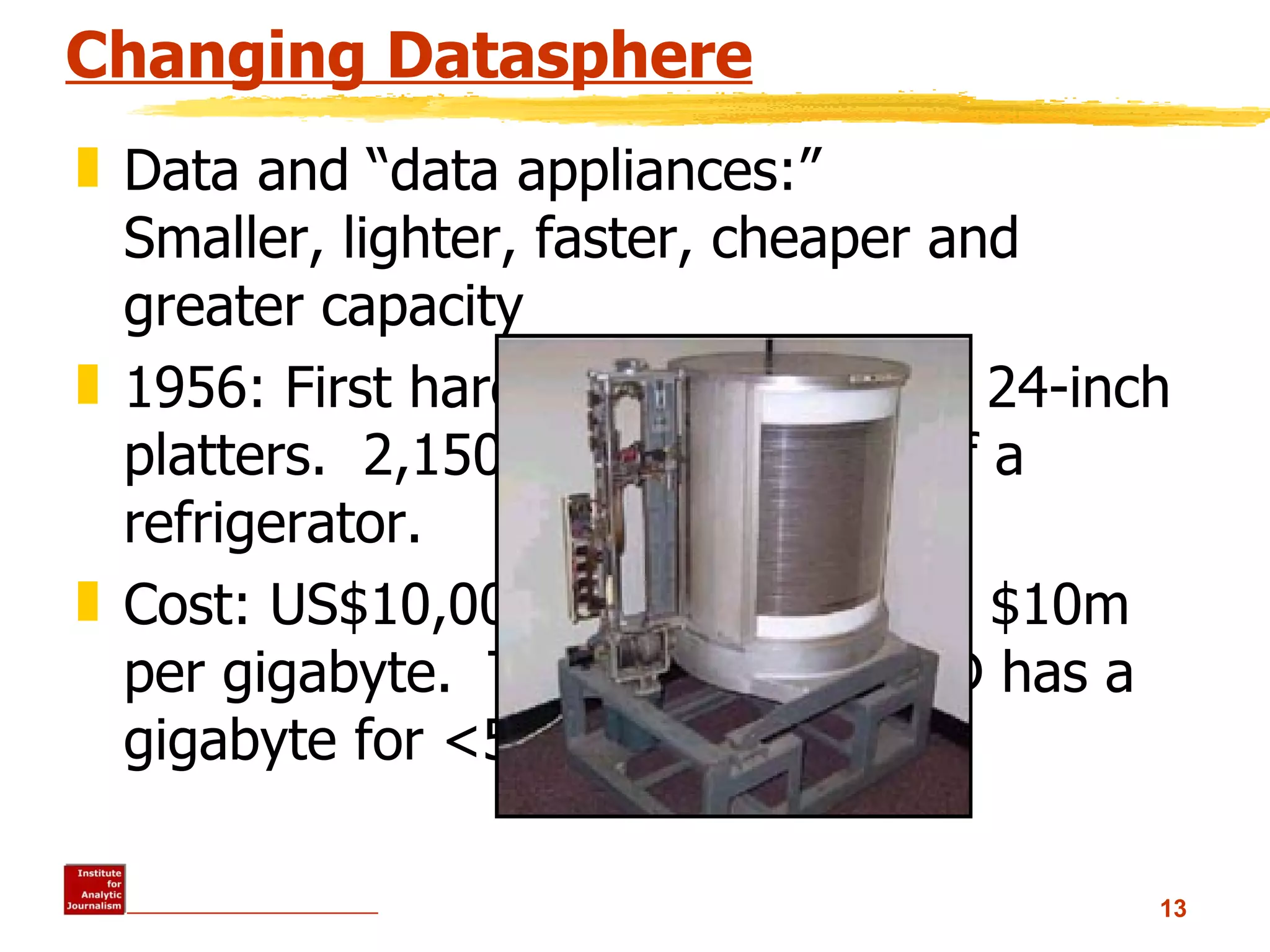
Changing Datasphere Data and “data appliances:”  Smaller, lighter, faster, cheaper and greater capacity 1956: First hard drive.  5mgb.  50 24-inch platters.  2,150 pounds the size of a refrigerator. Cost: US$10,000 per megabyte or $10m per gigabyte.  Today: one 3.5” HD has a gigabyte for <50 cents.
Changing Datasphere In 50 years, areal density of HDs increased by 50 MILLION times Expect to see 1-inch terabyte drives in 10 years 1991 - First 2.5-inch HD for laptops held 63mgb. Today – 2.5-inch HD holds 160gbyte and is 60 times as shock-resistant Moore’s Law.  Yes, but….
Major Changes for Society/Economy Power/information shift away from government, mfgrs, marketers, politicians media  TO  citizens Era of increasing -- not diminishing -- resources Era of increasing -- not decreasing -- returns
Major Changes for Industry/Journalism educ. Data/information in digital form: requires new tools, analytic skills, delivery methods Network TV news dead; Newspapers (in much of Europe and U.S.) are comatose
Major Changes for Industry Become data/information driven in decision-making Get out of the news PAPER  or broadcasting business; get into  NEWS  and  DATA/Info rmation biz Deliver content however consumers want it whenever and wherever they want it Leverage journalism’s data and skills to customize data/info. for users
Role of news institutions Must become the HUB for “transactions” between individuals and the data they need, want, seek: Intellectual transactions Cultural transactions Economic transactions Political transactions
“Hub” model of journalism Journalism  Institution:  3 unique values Data Resources needing users Economic Culural Occupational Entertainment Users with data needs Economic Cultural Occupational Entertainment
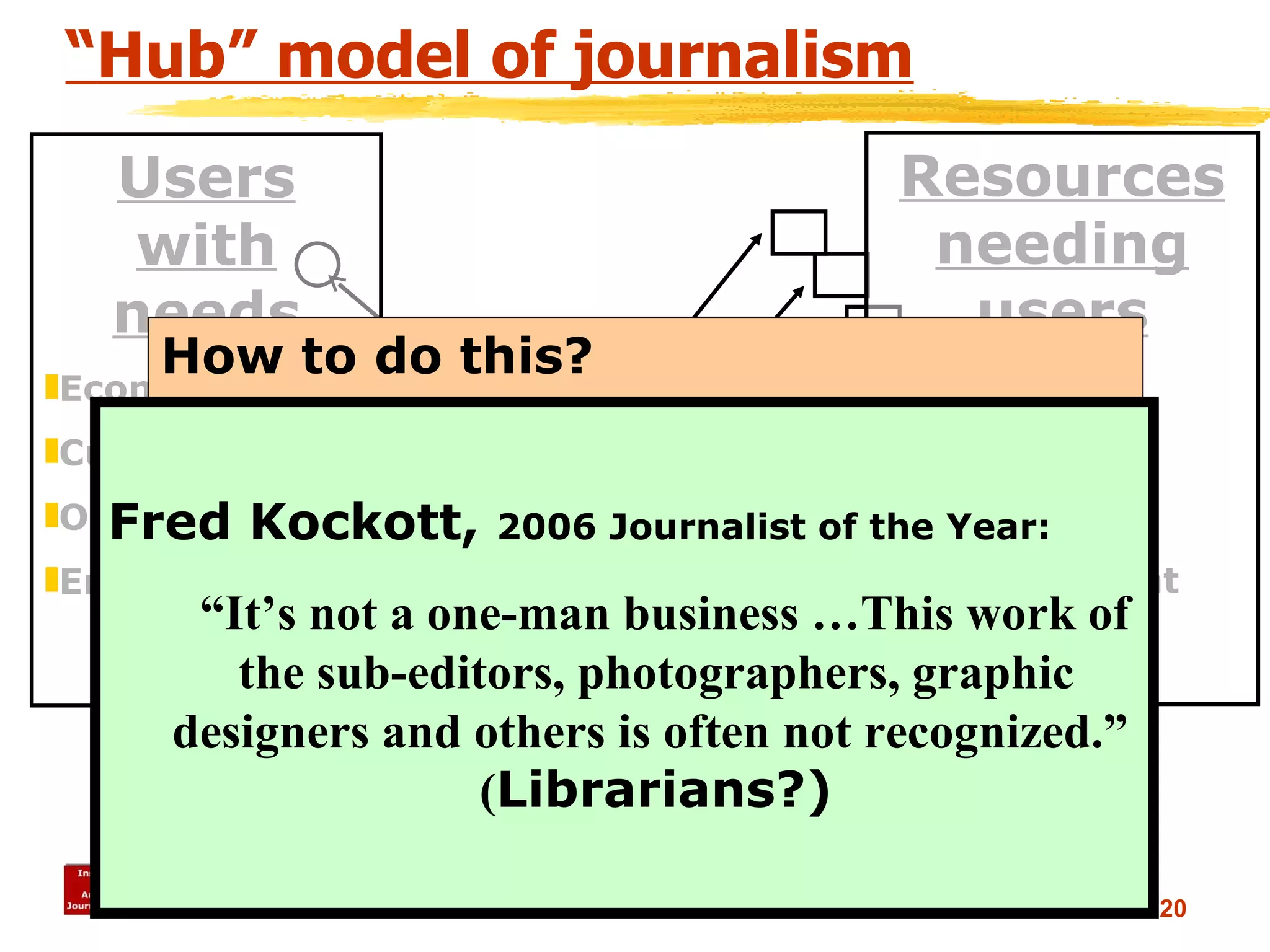
“Hub” model of journalism Journalism  institution Users with needs Economic Cultural Occupational Entertainment Resources needing users Economic Cultural Occupational Entertainment How to do this? See “data” as a  renewable/reusable  resource To survive means to learn.  Constantly It’s about “ teams ,” knowledge  management, coordination Fred Kockott,  2006 Journalist of the Year: “ It’s not a one-man business …This work of the sub-editors, photographers, graphic designers and others is often not recognized.”  ( Librarians?)
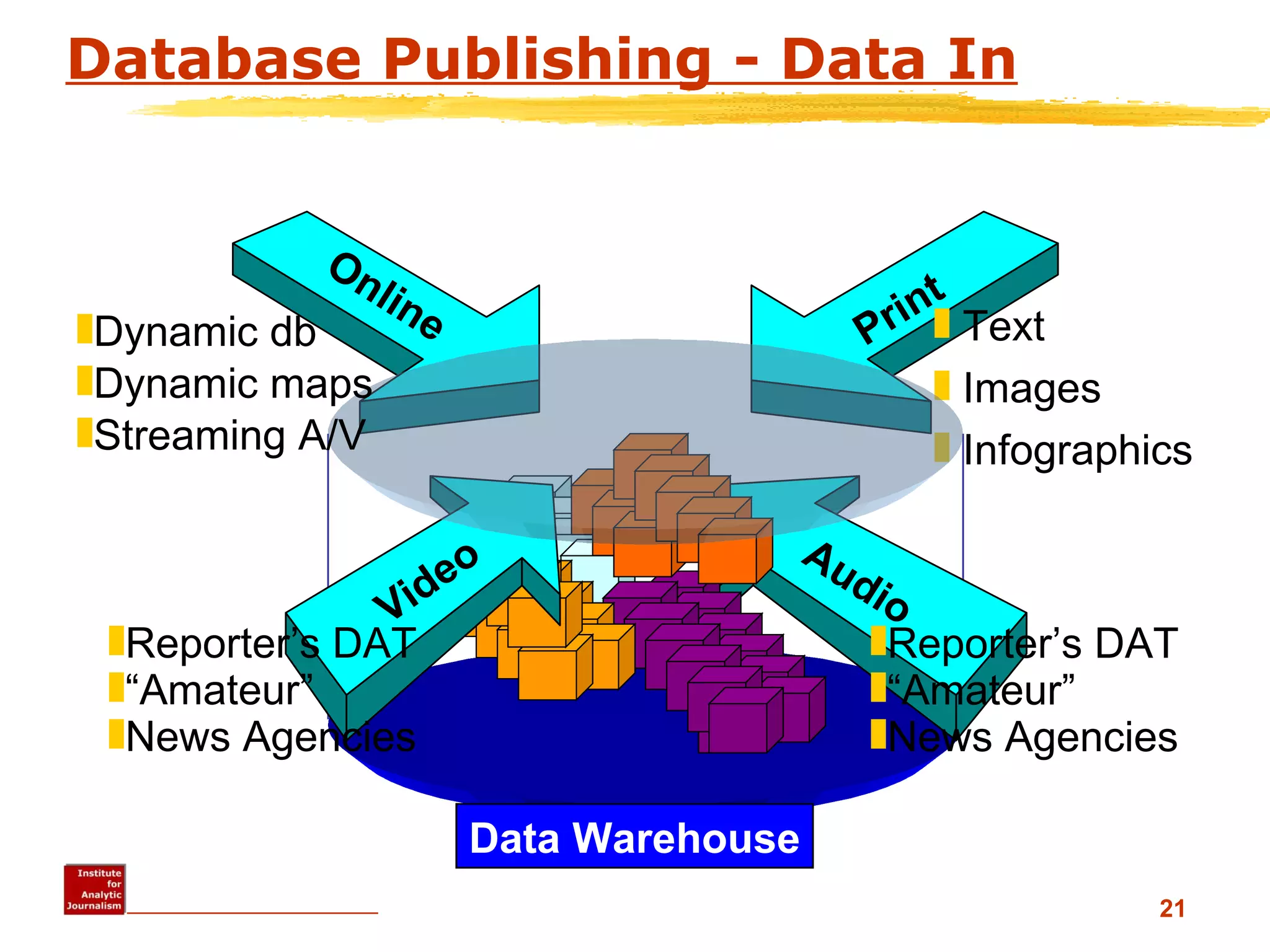
Database Publishing - Data In Data Warehouse Reporter’s DAT “ Amateur” News Agencies Data Warehouse Dynamic db Dynamic maps Streaming A/V Audio Reporter’s DAT “ Amateur” News Agencies Online Video Print Text Images Infographics
Database Publishing-Info Out Data Warehouse Audio PDA/Cellphone Video Data Warehouse Print TBA
Classic Journalism Information Environment I-o-P storage, analysis and communication Linear intake of data as TEXT Primitive analytic tools Only literary skills needed and highly regarded 100% of our work was  qualitative : text or static images Journalism: The first refuge of  the mathematically phobic!
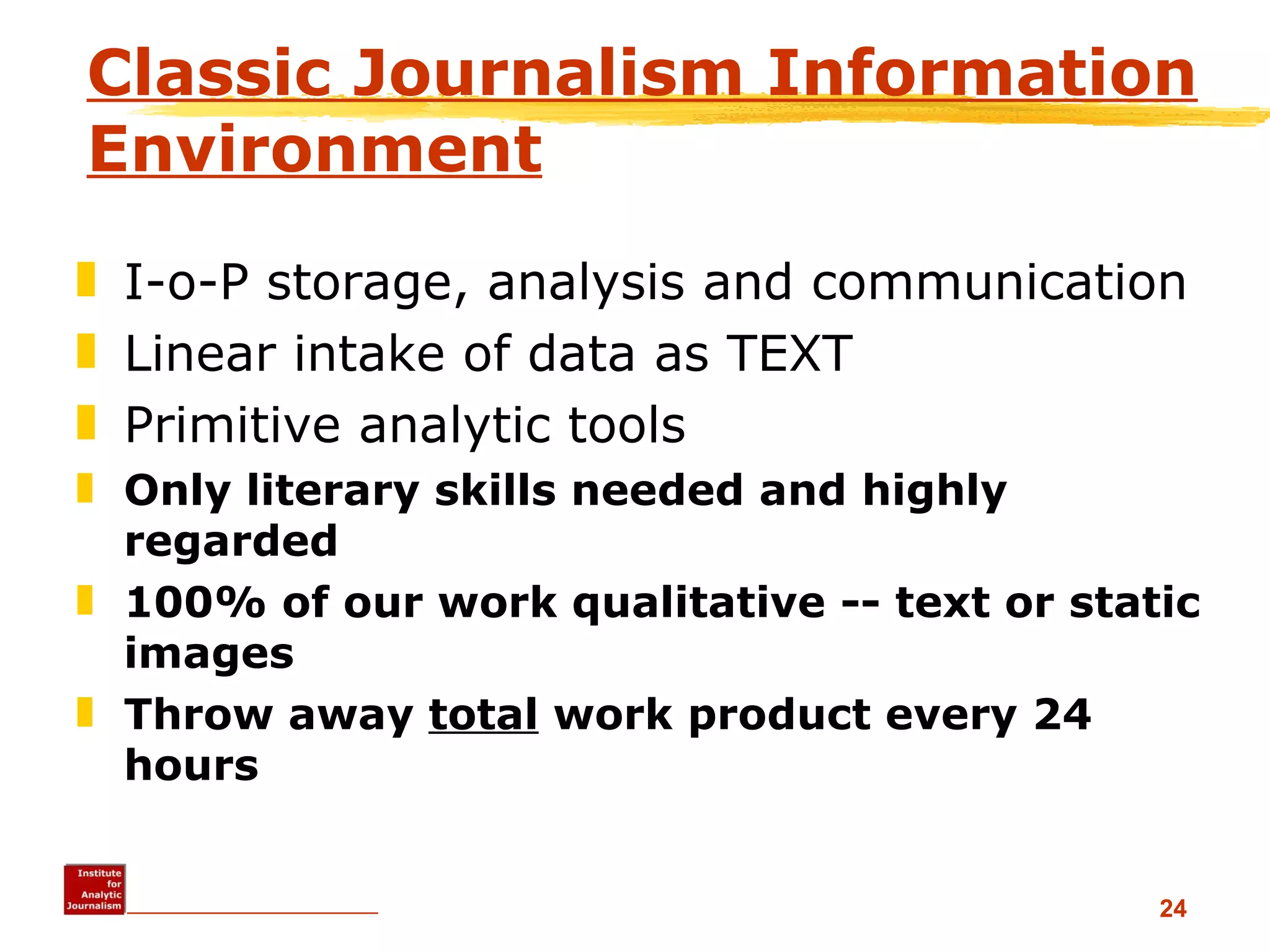
Classic Journalism Information Environment I-o-P storage, analysis and communication Linear intake of data as TEXT Primitive analytic tools Only literary skills needed and highly regarded 100% of our work qualitative -- text or static images Throw away  total  work product every 24 hours
Changing Datasphere As storage medium changes from I-o-P to 1's and 0's… ...we need  functional technology  between the data/info and our brain. Requires  new awareness/skills  for  RRAW-P  ( R esearch,  R eporting,  A nalysis,  W riting- P ackaging model) Adopt  new literacy  to survive, NOT as old-style hunters-and-gathers but new era  interpreters  and  explainers . Some  of us move from  data  fishermen  to  data  farmers  to support the community
RRAW-P Process of Journalism R esearch DEADLINE! R eporting A nalysis W riting P ublishing- P roducing-  P ackaging
Process, and Emphasis, of  Classic Journalism: RRAW-P Reporting Analysis The focus of… Journalism education On-the-job training Mid-career training Most graduate studies Writing-  Publishing,  Producing,  Packaging Research
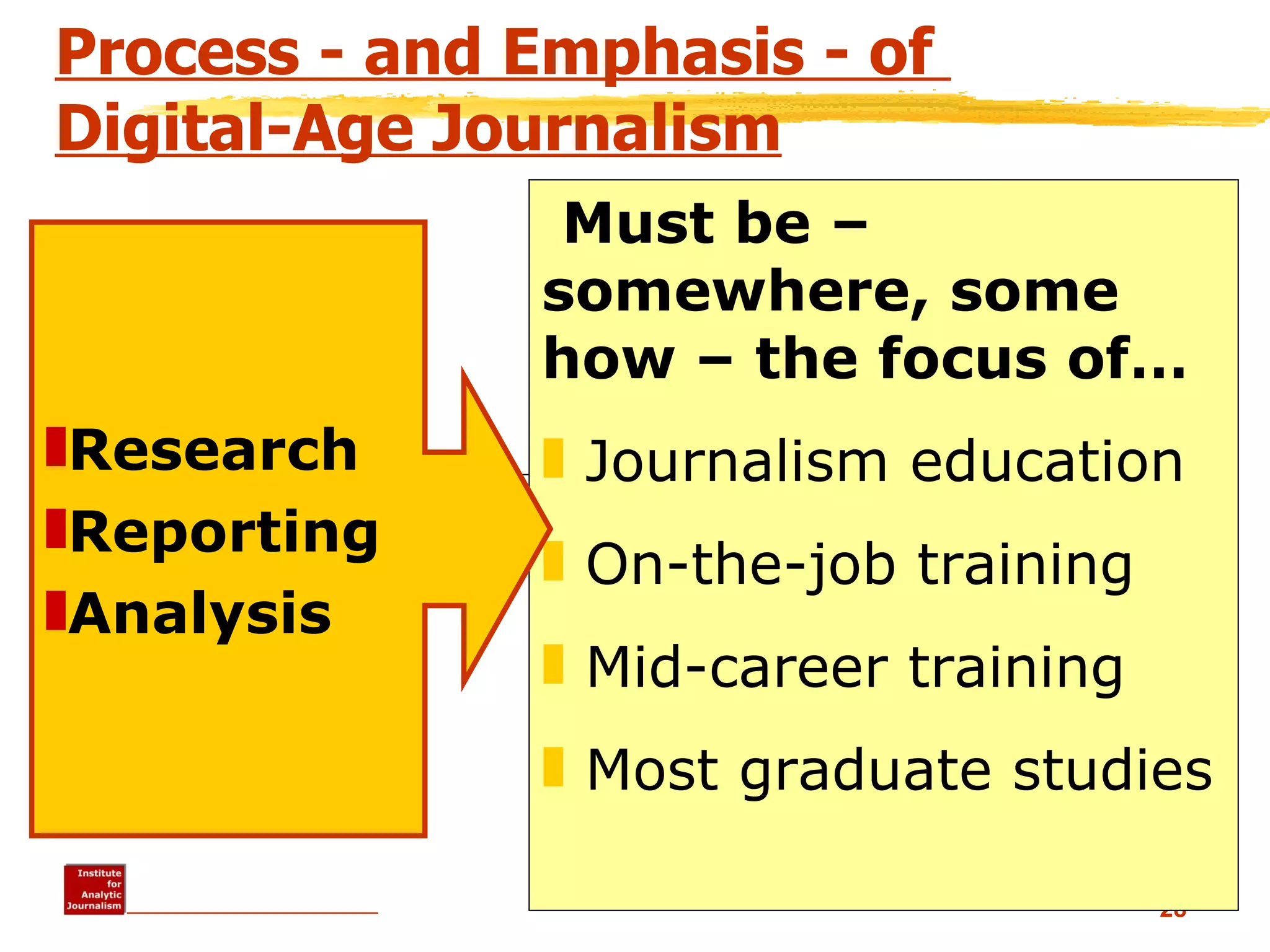
Process - and Emphasis - of  Digital-Age Journalism Reporting Analysis Must be – somewhere, some how – the focus of… Journalism education On-the-job training Mid-career training Most graduate studies Research Reporting Analysis Research
Classic Journalism  Information Environment I-o-P storage, analysis and communication Linear intake of data as TEXT Primitive analytic tools Only literary skills needed and highly regarded 100% of our work qualitative -- text or static images
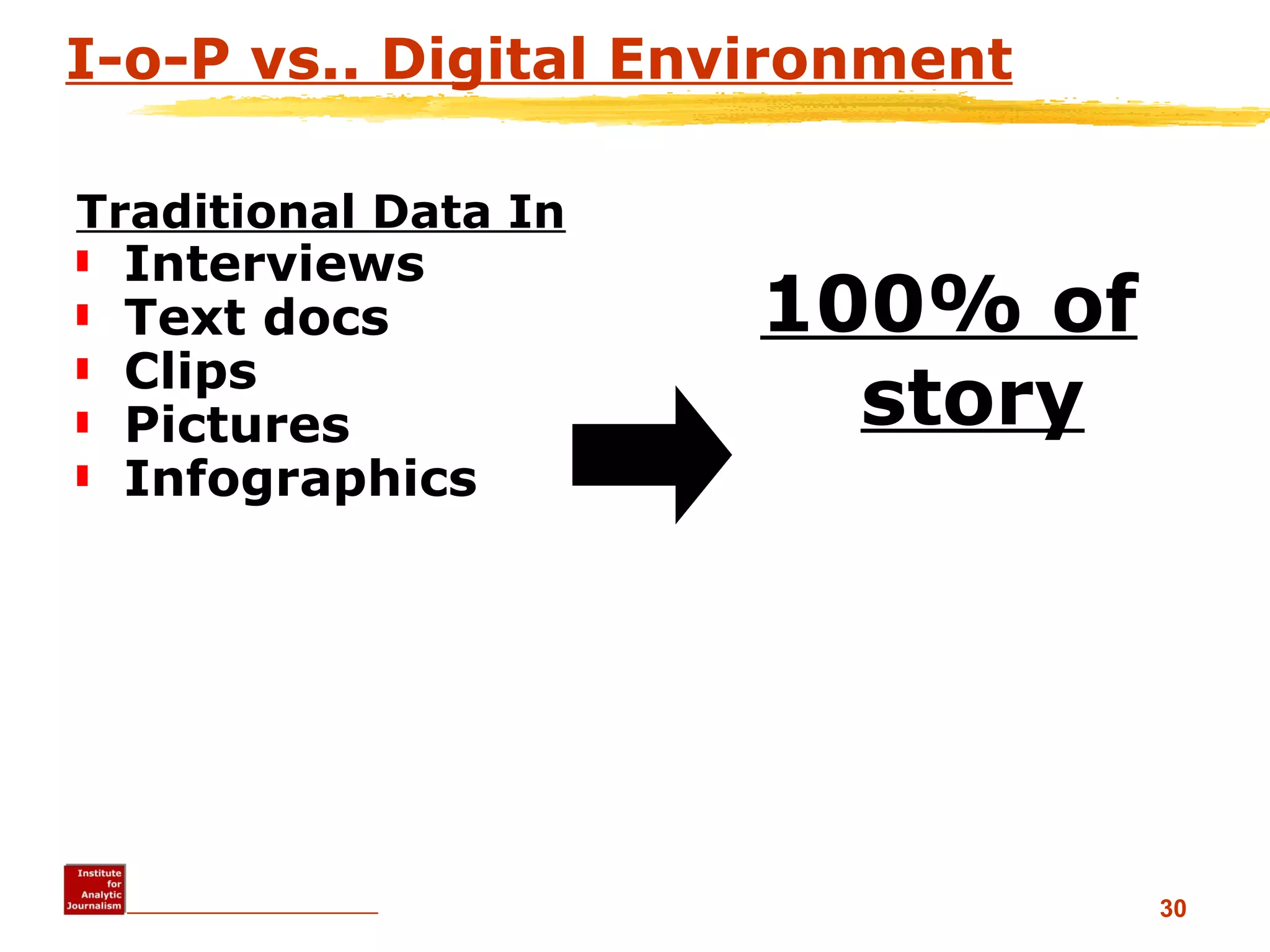
I-o-P vs.. Digital Environment Traditional Data In Interviews Text docs Clips Pictures Infographics 100% of story
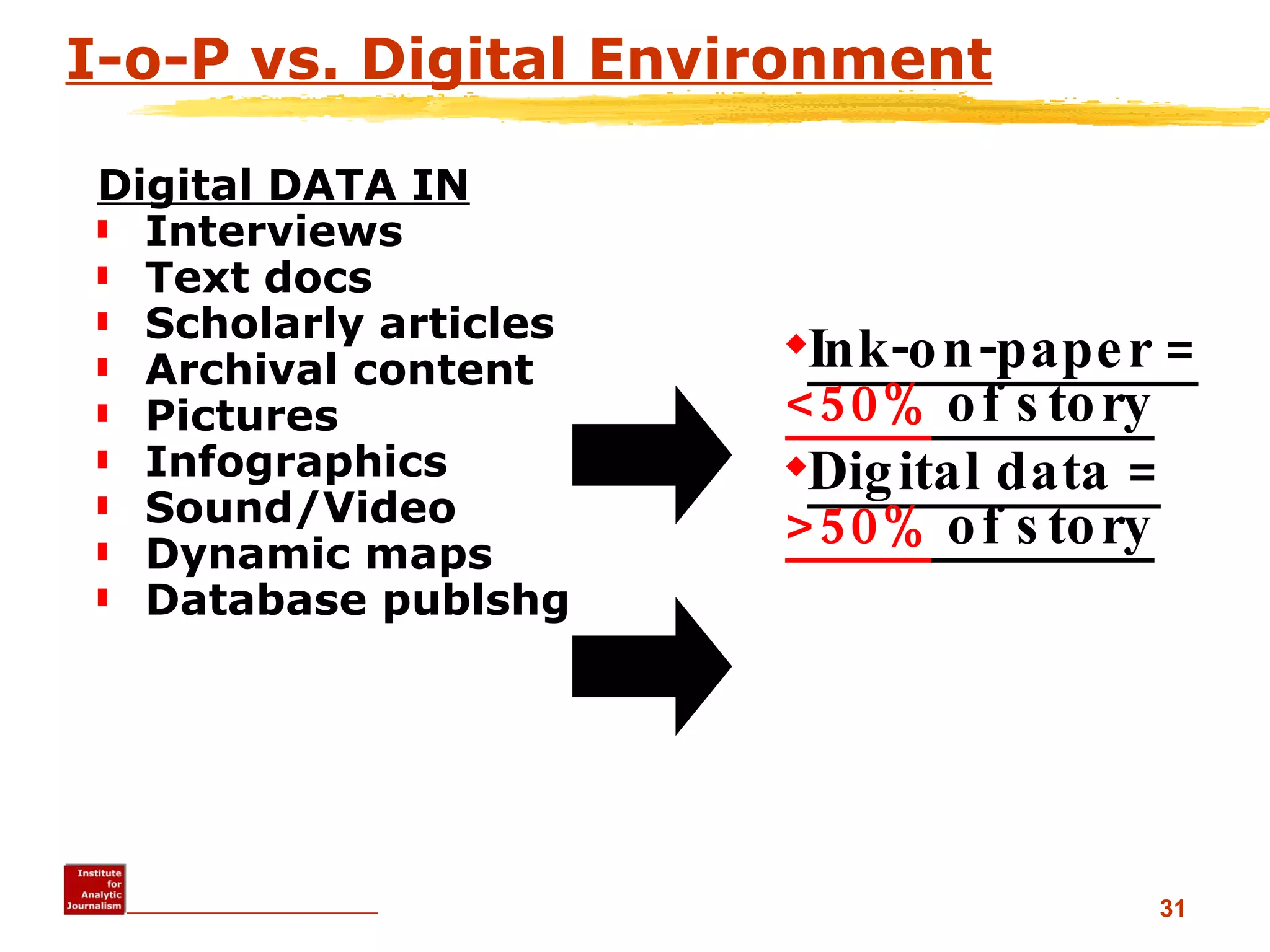
I-o-P vs. Digital Environment Digital DATA IN Interviews Text docs Scholarly articles Archival content Pictures Infographics Sound/Video Dynamic maps Database publshg Ink-on-paper =  <50%  of story Digital data =  >50%  of story
Major Changes for Media Production “ Data In” is qualitative AND quantitative “ Info Out” must be qualitative and quantitative
Major Changes for Datasphere Newsroom Journalists must be able to work like good social scientists  and  good poets  Literally put information specialists (aka:  librarians ) in center of space and process  Implement team -- conceptual or skills -- approach
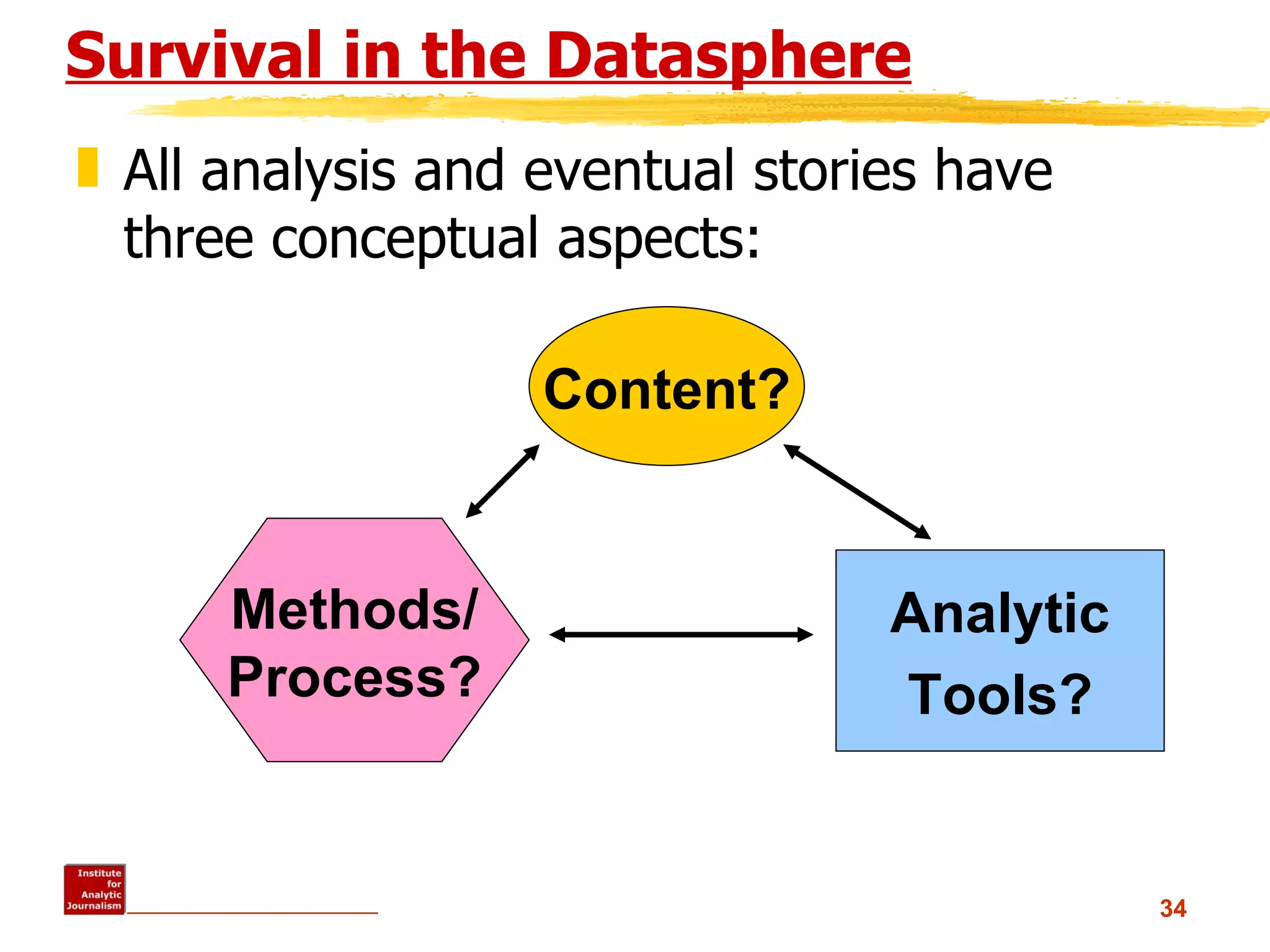
Survival in the Datasphere All analysis and eventual stories have three conceptual aspects: Content? Analytic Tools? Methods/ Process?
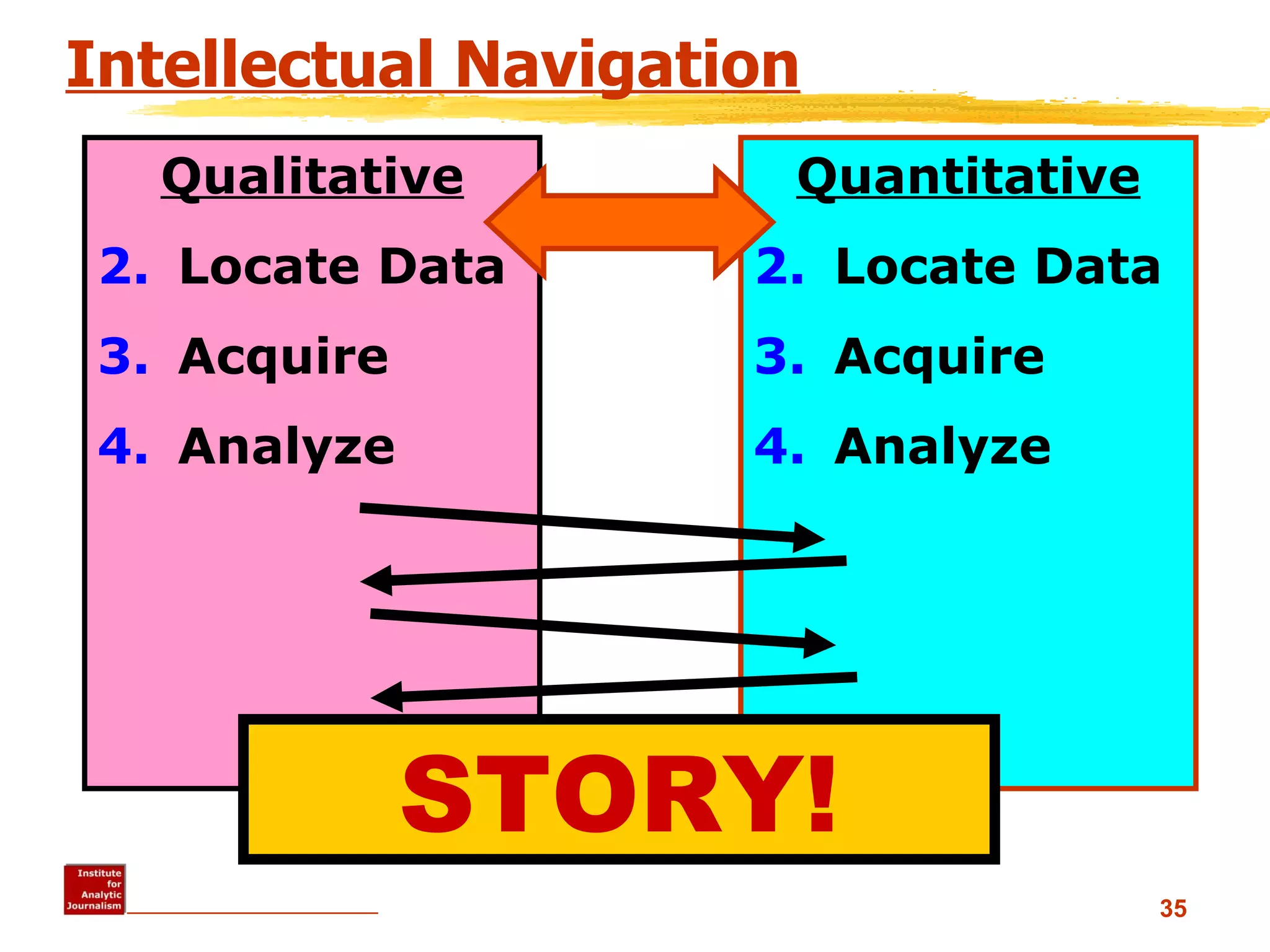
Intellectual Navigation Quantitative Locate Data Acquire Analyze Qualitative Locate Data Acquire Analyze STORY!
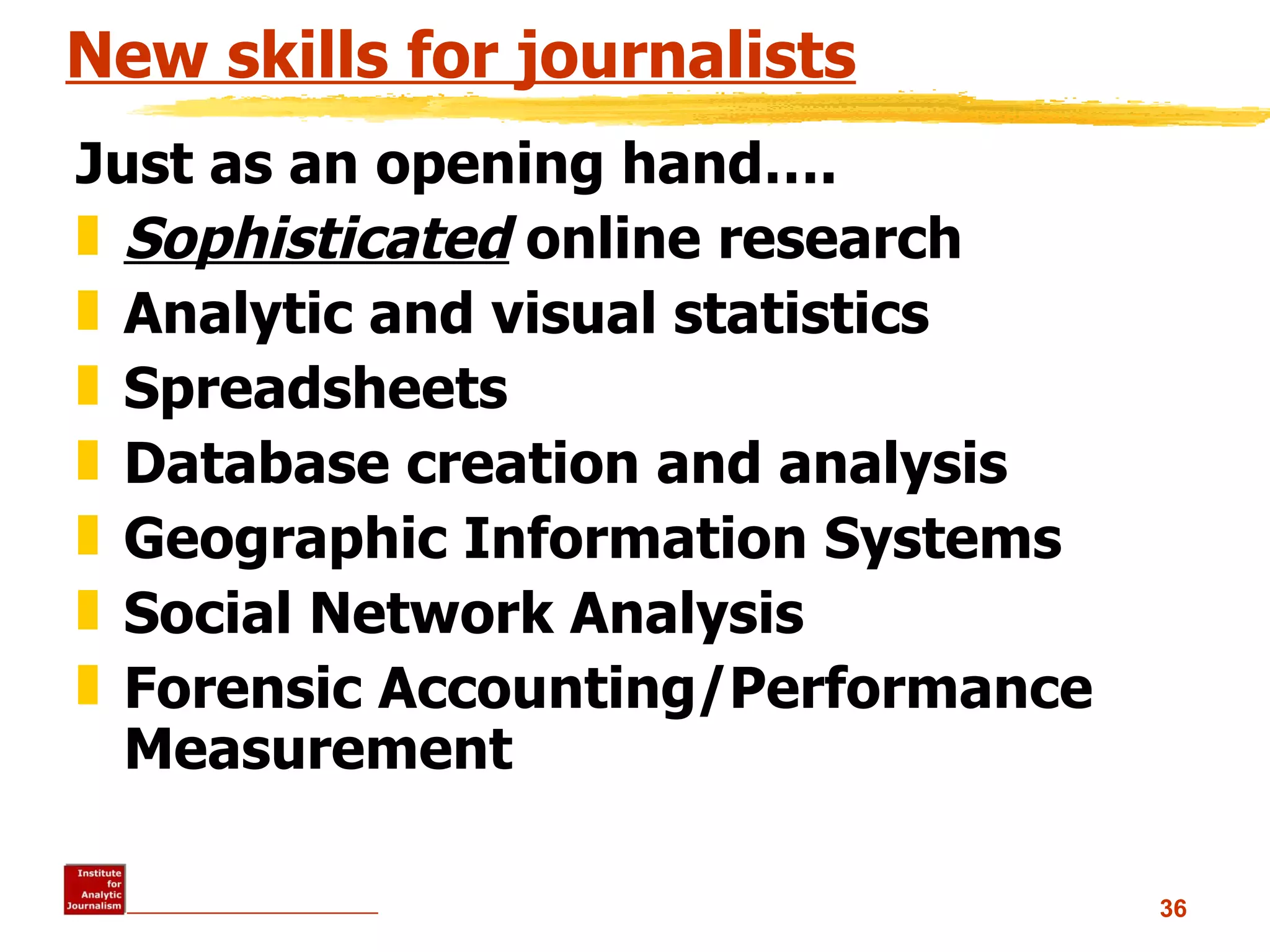
New skills for journalists Just as an opening hand…. Sophisticated  online research Analytic and visual statistics  Spreadsheets Database creation and analysis Geographic Information Systems Social Network Analysis Forensic Accounting/Performance Measurement
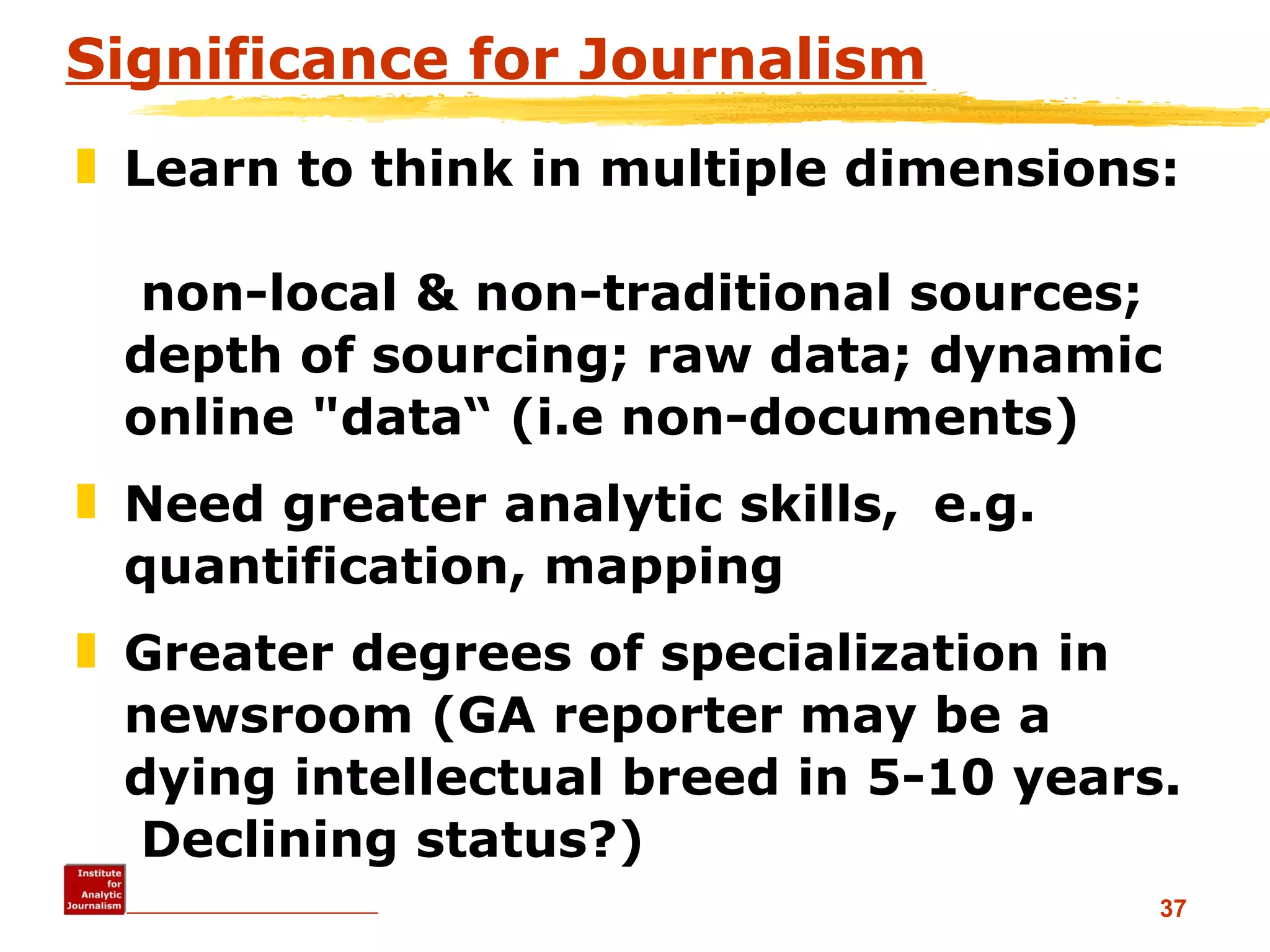
Significance for Journalism Learn to think in multiple dimensions:   non-local & non-traditional sources; depth of sourcing; raw data; dynamic online &quot;data“ (i.e non-documents) Need greater analytic skills,  e.g. quantification, mapping Greater degrees of specialization in newsroom (GA reporter may be a dying intellectual breed in 5-10 years.  Declining status?)
No, it is  not   “All about story.”  It’s about  AND ,  &   and   + Prof. Tom Johnson Institute for Analytic Journalism Santa Fe, New Mexico USA t o m @ j t j o h n s o n . c o m Natal Witness Durban, South Africa 5 September 2006
R RAW-P  = RESEARCH What has been published in I-o-P or online related to our topic of investigation? Keywords? (Broad or narrow) Likely sources? (Gov’t./NGOs/unions/scholars,etc.) Forms of data? (I-o-P (( T-e-P ); PDF; Tables; spreadsheets)  How will I retrieve and store/manage data found?
Examples of Research Military expenditures in Venezuela? Stockholm International Peace Research Institute  Search  Military Expenditure and Arms Production Publications Find “ CBMS IN LATIN AMERICA AND THE EFFECT OF ARMS ACQUISITIONS BY VENEZUELA (WP)”  SIPRI Military Expenditure Database   http://first. sipri .org/non_first/ milex _06.php How do we save URL?  Save data in searchable form? What if the article is T-e-P (I-o-P)?  Are we teaching OCR? PDF text and table data extraction?
R R AW-P  = REPORTING Talk  to sources to fill in developments, data between what was last published and today. (What tools to use to keep track of source contact information?) Any major theoretical or institutional changes in policies? Any sources that I should know but do not yet know?
RR A W-P  = Analysis What are the questions? What form is your data?  (Text?  Spreadsheets? Data bases? GIS? Social Network Analysis? Etc.? For major investigations, create a process “flow chart” (See  SmartDraw )
RRA W-P  = Writing & Publishing Important and significant only if the  R-R-A  aspects have been successful. Writing & Publishing requires only about 10-20 percent of entire story-making process. Traditional journalism education programs concentrate on this 20 percent and, many, ignore the more important 80 percent. We know how to teach people to write, but good journalism requires that first they must have something important to say. That requires  Analytic Journalism
Inst. for Analytic Journalism General Systems Theory Statistics Visual Statistics and Infographics Simulation modeling Our “Cornerstones”
Introduction to Analytic Journalism: Cornerstone 1: Ways of seeing/understanding:  General Systems Theory
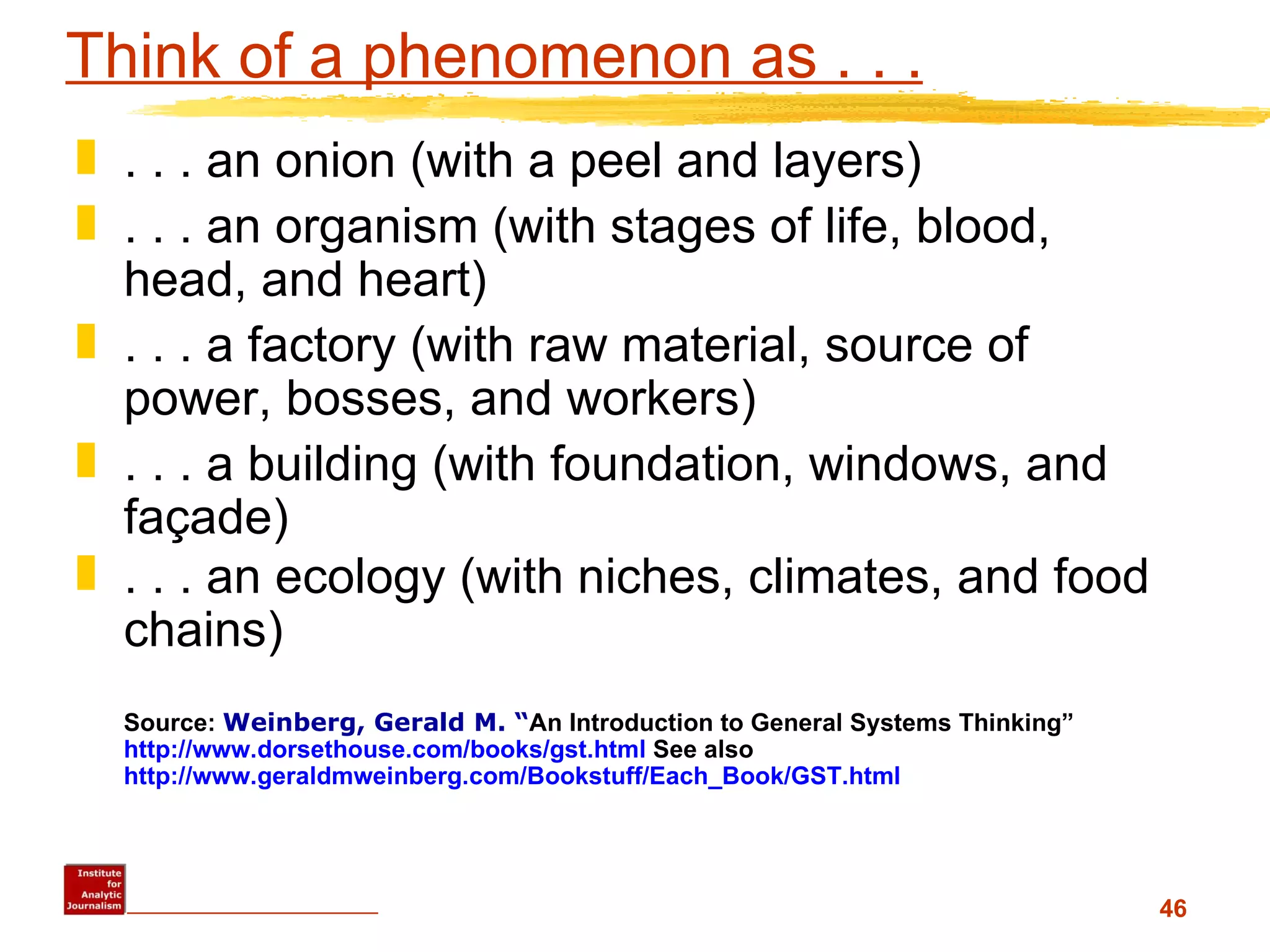
Think of a phenomenon as . . . . . . an onion (with a peel and layers)  . . . an organism (with stages of life, blood, head, and heart) . . . a factory (with raw material, source of power, bosses, and workers) . . . a building (with foundation, windows, and façade) . . . an ecology (with niches, climates, and food chains)   Source:  Weinberg, Gerald M. “ An Introduction to General Systems Thinking”  http://www.dorsethouse.com/books/gst.html  See also  http://www.geraldmweinberg.com/Bookstuff/Each_Book/GST.html
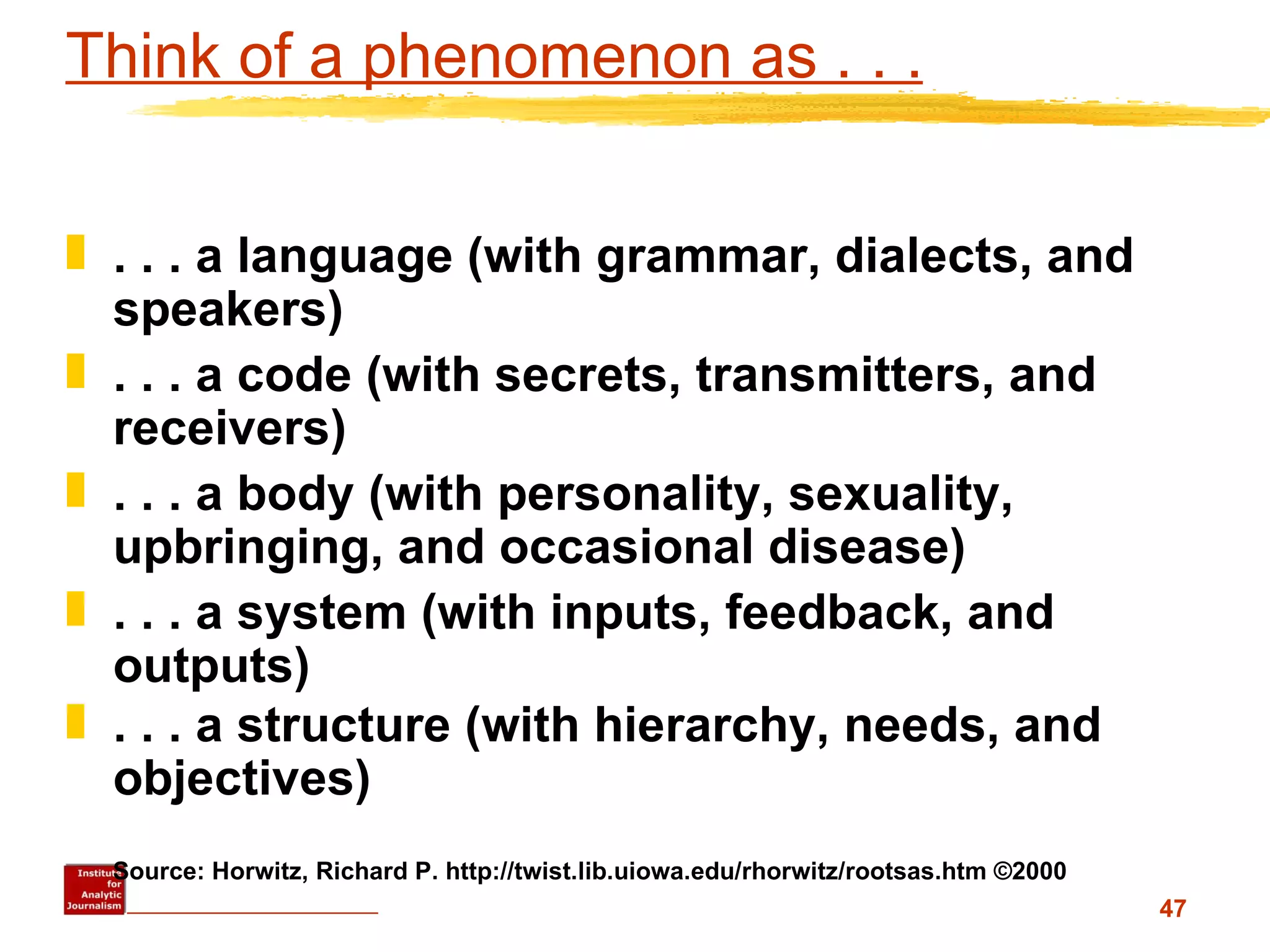
Think of a phenomenon as . . . . . . a language (with grammar, dialects, and speakers) . . . a code (with secrets, transmitters, and receivers) . . . a body (with personality, sexuality, upbringing, and occasional disease) . . . a system (with inputs, feedback, and outputs) . . . a structure (with hierarchy, needs, and objectives) Source: Horwitz, Richard P. http://twist.lib.uiowa.edu/rhorwitz/rootsas.htm ©2000
Think of a phenomenon as . . . . . . a game (with plays, rules, and referees) . . . a drama (with roles, script, and audience) . . . a city (with streets, sewer lines, and neighborhoods) . . . a text (with authors, genres, and readers) . . . an ideology (with premises and implications) . . . a regime (with a currency, rulers, and rebels). Source: Horwitz, Richard P. http://twist.lib.uiowa.edu/rhorwitz/rootsas.htm ©2000
Why General Systems Theory? If one learns the structures, when transferring from one discipline to another, much of the learning could be transferred. When studying a new discipline one would simply have to learn the labels on the structures in the new discipline.
Narrowing the Focus: GST Resource:  http://www.systems-thinking.org/welcome.htm &quot; Studies the  organization  of phenomena....  Investigates both principles common to all complex entities and the 'models' (usually mathematical) which can be used to describe them.“ SYSTEMS: &quot;...things that collectively behave differently as opposed to their behavior when separated.“
Brief introduction to GST Attributes of a  system …. Composed of  variables , i.e. elements that can be defined, or described, separately. Sub-variables.  Tree-to-branch-to-leaf-to-cell There are  relationships  between variables Horizontal relationships Vertical (i.e. hierarchical) relationships
Brief introduction to GST A system has  boundaries Conceptual Legal: corporate, jurisdiction Geographic Cultural “ Scalability” A system has  goals ,  self-defined or with a definition imposed by a server/researcher Make money Provide for group security, happiness, procreation
Brief introduction to GST A system  exists  in a  context  and in an  environment These change with time, resources and personalities Changes in the context can drive changes in the system… A system  learns  from changes in its variables or environment This requires a feedback loop
A newspaper as a system Editorial Production Circulation Advertising “ Backoffice”
A newspaper as a system Local News Int’l News Business Sports Editorial
A newspaper variables and sub-systems Local News Int’l News Business Sports Editorial High School College Professional
System hierarchy and “scalability” Editorial Sports Newspaper Media Football H. S. Football Higher Concept Lower Concept Macro Scale Micro Scale
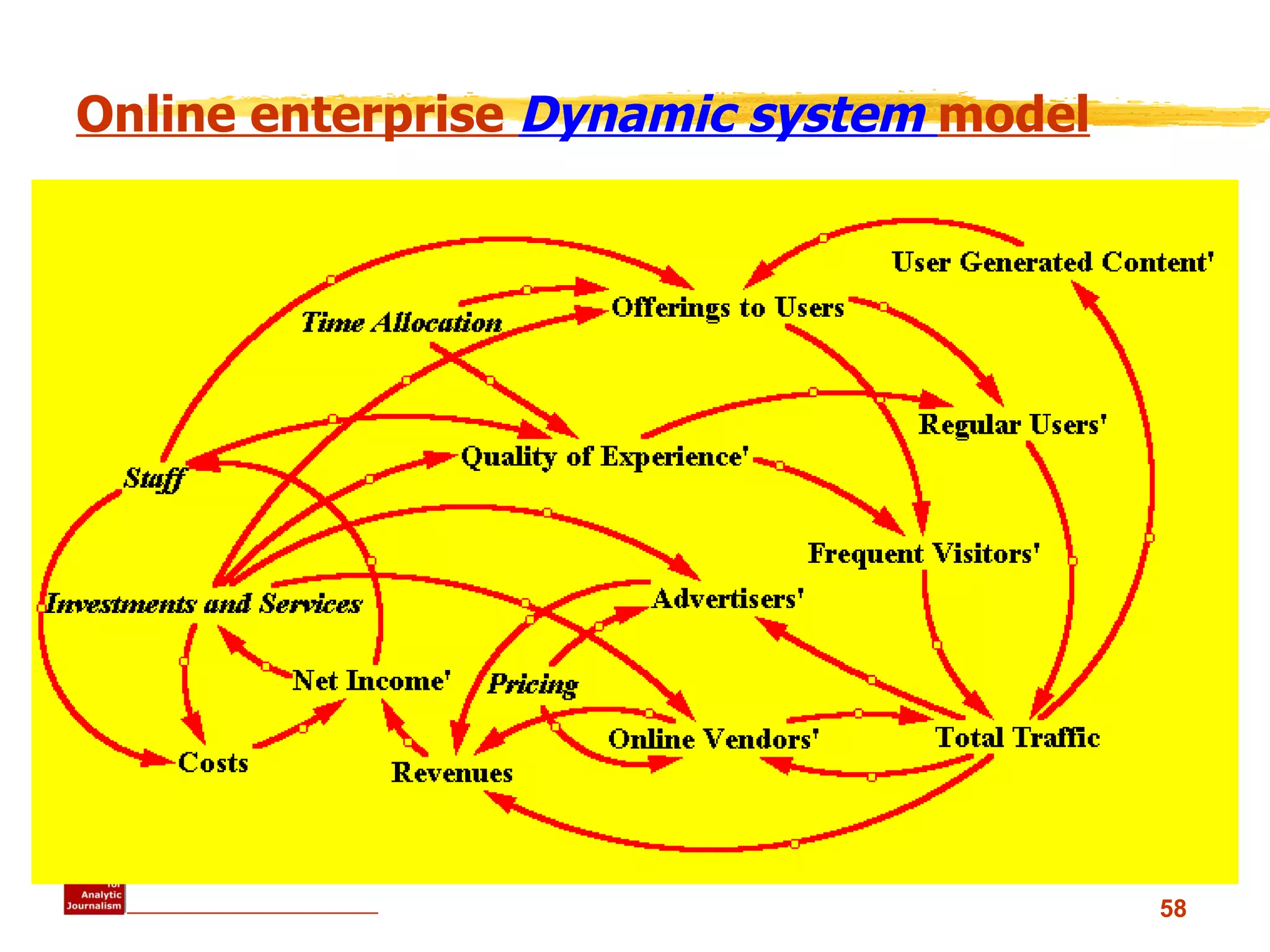
Online enterprise   Dynamic  system  model
Value of GST Demands definition/focus on  exactly  what system are you talking about? Demands consideration of level of analysis, i.e. “zooming” levels of focus Demands definition of variables and then the relative importance of those variables Demands consideration  of relationships between variables
GST as basis for simulation models Once system, goals, variables and relationships defined, can start to ask “How do we measure the strength of those relationships?” This is where dynamic simulation models become valuable.
These activities involve resources and power Resources:   The symbolic and material components  a system needs to carry out its tasks. Power:    The use of resources by one system in  order to gain compliance by another  system.
Power role Power roles Resource-controlling relationships Taken on mostly by systems Producer Power Role Creates material for release to public Competition over niches
Why General Systems Theory? If one learns the structures, when transferring from one discipline to another, much of the learning could be transferred.  When studying a new discipline one would simply have to learn the labels on the structures in the new discipline.
How many ways to “knowing”?
Journalism’s Future Journalism is NOT just about telling stories.  It is about facilitating the “transaction” between people who want data (to make their own information), and the sources with the data. (Analysis of the data helps, but only if it is valid and meaningful.) Tools like  ASP.Net This  transaction  includes commerce.  (How can we link the products to the interested people? Use PDF page files and XML tags)
Journalism’s Future Journalism educators should be researching the whole of journalism, not just teaching how to write.  The Three Unique Aspects of news organizations The “Brand” The Archives The “Wetware” in the newsroom
Journalism’s Future What is the role of “knowledge management” in news organizations? How do we structure and manage team reporting? How do we do on-the-job training (and how much and what?) How do we increase multiple revenue streams and compensate the staff?
Analytic thinking/journalism What is it? Where did it come from? How does it work? What are the necessary variables? Frame the appropriate question Find and retrieve appropriate data Use appropriate analytic tools Show what you know with story-appropriate media
What journalists do:  Not an orderly, serial [i.e. step-by-step] progression. RRAW-P  process Research Reporting Analysis Writing Publishing-Producing-Packaging
Intellectual multi-tasking Applications Mail handlers Sophisticated use of browsers MS Word Excel Possible GIS applications  Sites to “learn” applications http://www.sfsu.edu/infotech.htm http://www.PCShowAndTell.com http://www. elementk .com/
Digital Skills Managing YOUR information Handling e-mail Outlook, Eudora or Netscape Mail No AOL, Hotmail, Yahoo! E-mail accounts Use BU or other “professional” ISP – AT&T, RCN, Register your own domain  www.namesecure.com   Correct SUBJECT: line vital (see syllabus) Organize in folders Calendars To-do lists Ticklers Varied assignment deadlines
Major Changes for Media Industry Become data/information driven in decision-making Get out of the news PAPER  or broadcasting business; get into  NEWS  biz Deliver content however consumers want it Develop team approach in newsroom and across company
Major Changes for Media Industry Move away from assembly line cost analysis to “frontloading” of production process Embrace “all the time” education  “ In a time of drastic change it is the learners who inherit the future.&quot; — Eric Hoffer Longshoreman, philosopher
Major Changes for Media Industry Understand/leverage quadra-helix of  news ,  transactions ,  community  and  individual Stop throwing away work product.  Reuse/repackage/reposition content
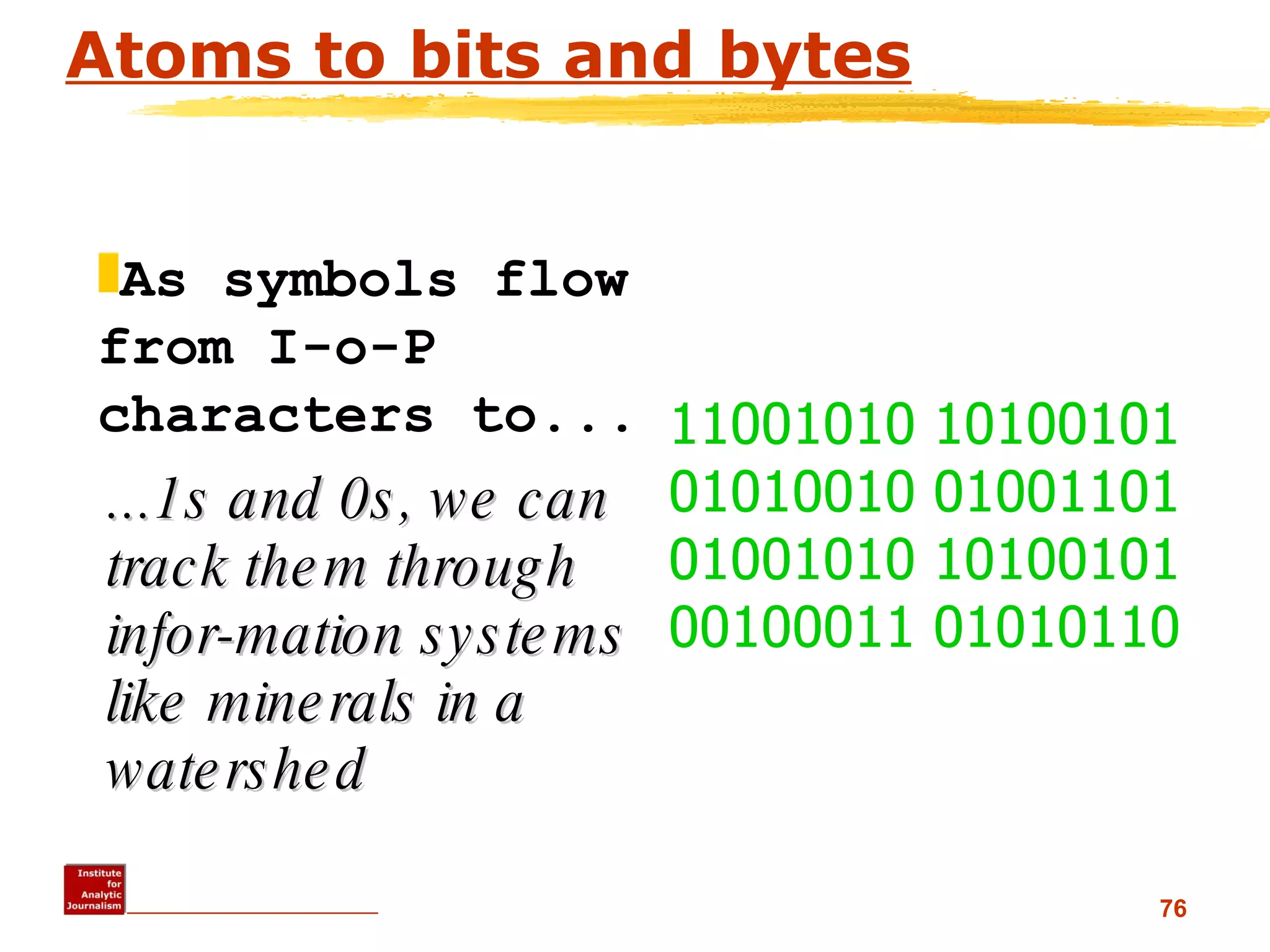
Changes for communication scholarship Perception, observation and manipulation of 1s and 0s equivalent to atomic theory or quantum mechanics  Meaning ,  usage  and  context  open to new forms of analysis Theories  of communications can become  experiments  can become “ technology ”
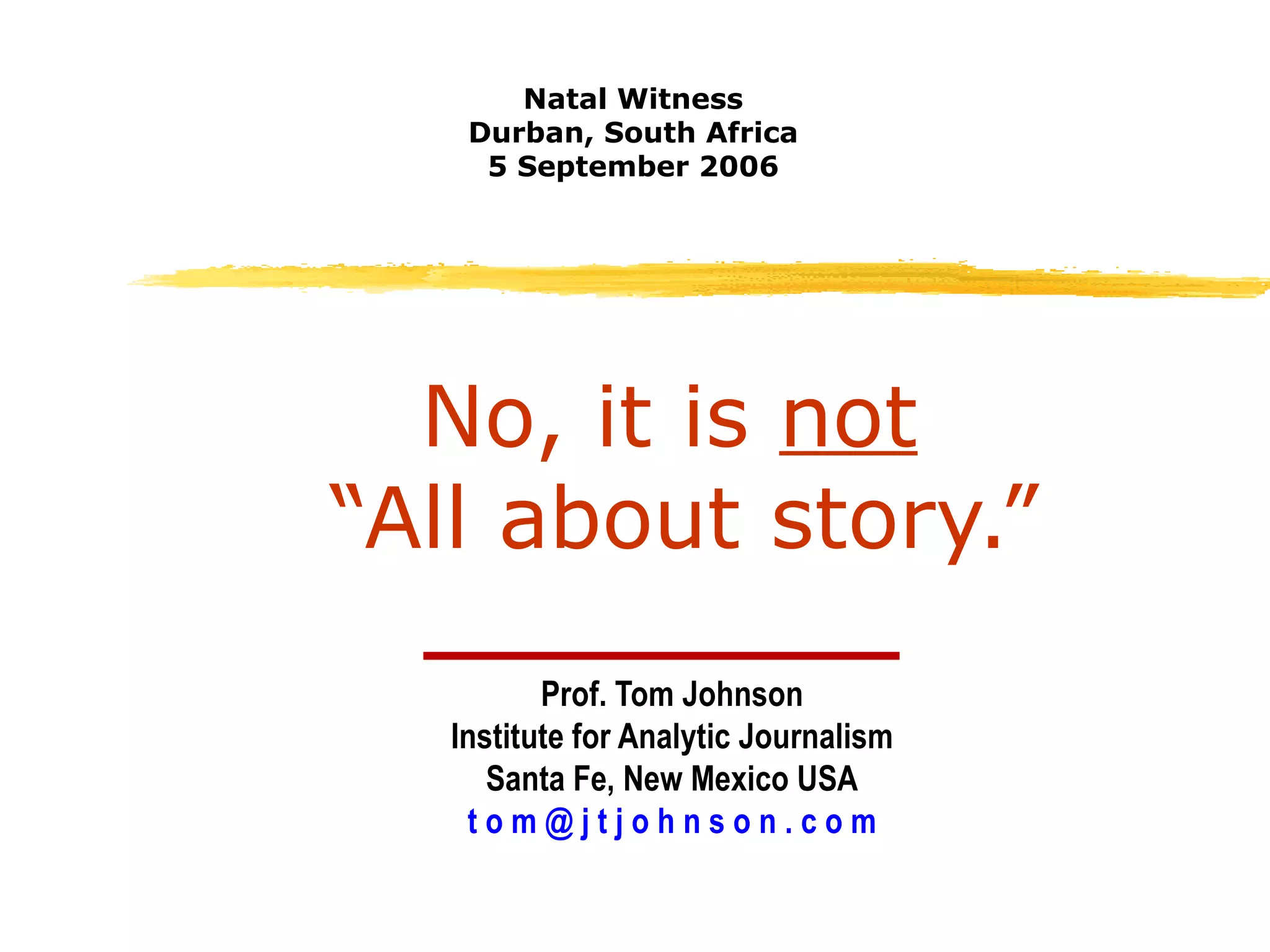
Atoms to bits and bytes ...1s and 0s, we can track them through infor-mation systems like minerals in a watershed As symbols flow from I-o-P characters to...   11001010 10100101 01010010 01001101 01001010 10100101 00100011 01010110
Dynamic Datasphere models: hydrology
Dynamic Datasphere models: Chemical Eng.
Dynamic Datasphere Models: Epidemiology Figure 4. Hantavirus pulmonary syndrome cases in the Four Corners region, by probable exposure site location, 1993–1995 (n = 53 cases and 52 exposure sites).
Dynamic Datasphere Models: Crime Analysis
Analytic Journalism Ways of seeing/understanding First Cornerstone: General Systems Theory

No, it is not "All about story."

  • 1.
    No, it is not “All about story.” Prof. Tom Johnson Institute for Analytic Journalism Santa Fe, New Mexico USA t o m @ j t j o h n s o n . c o m Natal Witness Durban, South Africa 5 September 2006
  • 2.
    And or & or + Prof. Tom Johnson Institute for Analytic Journalism Santa Fe, New Mexico USA t o m @ j t j o h n s o n . c o m Natal Witness Durban, South Africa 5 September 2006
  • 3.
    Journalism is… “The central purpose of journalism is to provide citizens with accurate and reliable information they need to function in a free society.'‘ — Bill Kovach Committee of Concerned Journalists
  • 4.
    What journalists doThe job of journalists is &quot;to monitor the centres of power.&quot;                                                                                         Israeli journalist  Amira Hass
  • 5.
    Today’s objectives Discussjournalism (and journalists) as a species existing in the Datasphere Review the changes in the information environment Suggest steps journalism can (Should? Must?) take to adapt to those changes if we are to survive Suggest the possible disappearance of the species journalist serioso
  • 6.
    The New Datasphereextends the Old Most canons of journalism stand fast (Though there are some new issues for ethics and law) The challenge today is not the old, but the addition of the new
  • 7.
    Journalists, et al.,in Datasphere Changing Datasphere: Metabolism Latent Energy In Energy Out Species in Biosphere:
  • 8.
    Basic Information Theory= Process of Journalism Data In Info Out Interviews Text docs Clips Pictures Infographics Analysis This is a headline DATELINE -- And the traditional text story starts here and goes on and on and on.
  • 9.
    Communications Revolution? 2ndEra = Symbols Print Paper Ink Writing 1st Era =
  • 10.
    “ 100% dela Población Sufre Problemas de Salud Mental”
  • 11.
    Challenge of DigitalRevolution 100% de la Poblacion Sufre Problemas de Salud Mental 010100100100100110101101 101011101010101010101010 010101010101010100111010
  • 12.
    Communications Revolution? 2ndEra = Symbols Print Paper Ink Writing 3rd Era = 101010101101010101000100101 1st Era =
  • 13.
    Changing Datasphere Dataand “data appliances:” Smaller, lighter, faster, cheaper and greater capacity 1956: First hard drive. 5mgb. 50 24-inch platters. 2,150 pounds the size of a refrigerator. Cost: US$10,000 per megabyte or $10m per gigabyte. Today: one 3.5” HD has a gigabyte for <50 cents.
  • 14.
    Changing Datasphere In50 years, areal density of HDs increased by 50 MILLION times Expect to see 1-inch terabyte drives in 10 years 1991 - First 2.5-inch HD for laptops held 63mgb. Today – 2.5-inch HD holds 160gbyte and is 60 times as shock-resistant Moore’s Law. Yes, but….
  • 15.
    Major Changes forSociety/Economy Power/information shift away from government, mfgrs, marketers, politicians media TO citizens Era of increasing -- not diminishing -- resources Era of increasing -- not decreasing -- returns
  • 16.
    Major Changes forIndustry/Journalism educ. Data/information in digital form: requires new tools, analytic skills, delivery methods Network TV news dead; Newspapers (in much of Europe and U.S.) are comatose
  • 17.
    Major Changes forIndustry Become data/information driven in decision-making Get out of the news PAPER or broadcasting business; get into NEWS and DATA/Info rmation biz Deliver content however consumers want it whenever and wherever they want it Leverage journalism’s data and skills to customize data/info. for users
  • 18.
    Role of newsinstitutions Must become the HUB for “transactions” between individuals and the data they need, want, seek: Intellectual transactions Cultural transactions Economic transactions Political transactions
  • 19.
    “Hub” model ofjournalism Journalism Institution: 3 unique values Data Resources needing users Economic Culural Occupational Entertainment Users with data needs Economic Cultural Occupational Entertainment
  • 20.
    “Hub” model ofjournalism Journalism institution Users with needs Economic Cultural Occupational Entertainment Resources needing users Economic Cultural Occupational Entertainment How to do this? See “data” as a renewable/reusable resource To survive means to learn. Constantly It’s about “ teams ,” knowledge management, coordination Fred Kockott, 2006 Journalist of the Year: “ It’s not a one-man business …This work of the sub-editors, photographers, graphic designers and others is often not recognized.” ( Librarians?)
  • 21.
    Database Publishing -Data In Data Warehouse Reporter’s DAT “ Amateur” News Agencies Data Warehouse Dynamic db Dynamic maps Streaming A/V Audio Reporter’s DAT “ Amateur” News Agencies Online Video Print Text Images Infographics
  • 22.
    Database Publishing-Info OutData Warehouse Audio PDA/Cellphone Video Data Warehouse Print TBA
  • 23.
    Classic Journalism InformationEnvironment I-o-P storage, analysis and communication Linear intake of data as TEXT Primitive analytic tools Only literary skills needed and highly regarded 100% of our work was qualitative : text or static images Journalism: The first refuge of the mathematically phobic!
  • 24.
    Classic Journalism InformationEnvironment I-o-P storage, analysis and communication Linear intake of data as TEXT Primitive analytic tools Only literary skills needed and highly regarded 100% of our work qualitative -- text or static images Throw away total work product every 24 hours
  • 25.
    Changing Datasphere Asstorage medium changes from I-o-P to 1's and 0's… ...we need functional technology between the data/info and our brain. Requires new awareness/skills for RRAW-P ( R esearch, R eporting, A nalysis, W riting- P ackaging model) Adopt new literacy to survive, NOT as old-style hunters-and-gathers but new era interpreters and explainers . Some of us move from data fishermen to data farmers to support the community
  • 26.
    RRAW-P Process ofJournalism R esearch DEADLINE! R eporting A nalysis W riting P ublishing- P roducing- P ackaging
  • 27.
    Process, and Emphasis,of Classic Journalism: RRAW-P Reporting Analysis The focus of… Journalism education On-the-job training Mid-career training Most graduate studies Writing- Publishing, Producing, Packaging Research
  • 28.
    Process - andEmphasis - of Digital-Age Journalism Reporting Analysis Must be – somewhere, some how – the focus of… Journalism education On-the-job training Mid-career training Most graduate studies Research Reporting Analysis Research
  • 29.
    Classic Journalism Information Environment I-o-P storage, analysis and communication Linear intake of data as TEXT Primitive analytic tools Only literary skills needed and highly regarded 100% of our work qualitative -- text or static images
  • 30.
    I-o-P vs.. DigitalEnvironment Traditional Data In Interviews Text docs Clips Pictures Infographics 100% of story
  • 31.
    I-o-P vs. DigitalEnvironment Digital DATA IN Interviews Text docs Scholarly articles Archival content Pictures Infographics Sound/Video Dynamic maps Database publshg Ink-on-paper = <50% of story Digital data = >50% of story
  • 32.
    Major Changes forMedia Production “ Data In” is qualitative AND quantitative “ Info Out” must be qualitative and quantitative
  • 33.
    Major Changes forDatasphere Newsroom Journalists must be able to work like good social scientists and good poets Literally put information specialists (aka: librarians ) in center of space and process Implement team -- conceptual or skills -- approach
  • 34.
    Survival in theDatasphere All analysis and eventual stories have three conceptual aspects: Content? Analytic Tools? Methods/ Process?
  • 35.
    Intellectual Navigation QuantitativeLocate Data Acquire Analyze Qualitative Locate Data Acquire Analyze STORY!
  • 36.
    New skills forjournalists Just as an opening hand…. Sophisticated online research Analytic and visual statistics Spreadsheets Database creation and analysis Geographic Information Systems Social Network Analysis Forensic Accounting/Performance Measurement
  • 37.
    Significance for JournalismLearn to think in multiple dimensions: non-local & non-traditional sources; depth of sourcing; raw data; dynamic online &quot;data“ (i.e non-documents) Need greater analytic skills, e.g. quantification, mapping Greater degrees of specialization in newsroom (GA reporter may be a dying intellectual breed in 5-10 years. Declining status?)
  • 38.
    No, it is not “All about story.” It’s about AND , & and + Prof. Tom Johnson Institute for Analytic Journalism Santa Fe, New Mexico USA t o m @ j t j o h n s o n . c o m Natal Witness Durban, South Africa 5 September 2006
  • 39.
    R RAW-P = RESEARCH What has been published in I-o-P or online related to our topic of investigation? Keywords? (Broad or narrow) Likely sources? (Gov’t./NGOs/unions/scholars,etc.) Forms of data? (I-o-P (( T-e-P ); PDF; Tables; spreadsheets) How will I retrieve and store/manage data found?
  • 40.
    Examples of ResearchMilitary expenditures in Venezuela? Stockholm International Peace Research Institute Search Military Expenditure and Arms Production Publications Find “ CBMS IN LATIN AMERICA AND THE EFFECT OF ARMS ACQUISITIONS BY VENEZUELA (WP)” SIPRI Military Expenditure Database http://first. sipri .org/non_first/ milex _06.php How do we save URL? Save data in searchable form? What if the article is T-e-P (I-o-P)? Are we teaching OCR? PDF text and table data extraction?
  • 41.
    R R AW-P = REPORTING Talk to sources to fill in developments, data between what was last published and today. (What tools to use to keep track of source contact information?) Any major theoretical or institutional changes in policies? Any sources that I should know but do not yet know?
  • 42.
    RR A W-P = Analysis What are the questions? What form is your data? (Text? Spreadsheets? Data bases? GIS? Social Network Analysis? Etc.? For major investigations, create a process “flow chart” (See SmartDraw )
  • 43.
    RRA W-P = Writing & Publishing Important and significant only if the R-R-A aspects have been successful. Writing & Publishing requires only about 10-20 percent of entire story-making process. Traditional journalism education programs concentrate on this 20 percent and, many, ignore the more important 80 percent. We know how to teach people to write, but good journalism requires that first they must have something important to say. That requires Analytic Journalism
  • 44.
    Inst. for AnalyticJournalism General Systems Theory Statistics Visual Statistics and Infographics Simulation modeling Our “Cornerstones”
  • 45.
    Introduction to AnalyticJournalism: Cornerstone 1: Ways of seeing/understanding: General Systems Theory
  • 46.
    Think of aphenomenon as . . . . . . an onion (with a peel and layers) . . . an organism (with stages of life, blood, head, and heart) . . . a factory (with raw material, source of power, bosses, and workers) . . . a building (with foundation, windows, and façade) . . . an ecology (with niches, climates, and food chains) Source: Weinberg, Gerald M. “ An Introduction to General Systems Thinking” http://www.dorsethouse.com/books/gst.html See also http://www.geraldmweinberg.com/Bookstuff/Each_Book/GST.html
  • 47.
    Think of aphenomenon as . . . . . . a language (with grammar, dialects, and speakers) . . . a code (with secrets, transmitters, and receivers) . . . a body (with personality, sexuality, upbringing, and occasional disease) . . . a system (with inputs, feedback, and outputs) . . . a structure (with hierarchy, needs, and objectives) Source: Horwitz, Richard P. http://twist.lib.uiowa.edu/rhorwitz/rootsas.htm ©2000
  • 48.
    Think of aphenomenon as . . . . . . a game (with plays, rules, and referees) . . . a drama (with roles, script, and audience) . . . a city (with streets, sewer lines, and neighborhoods) . . . a text (with authors, genres, and readers) . . . an ideology (with premises and implications) . . . a regime (with a currency, rulers, and rebels). Source: Horwitz, Richard P. http://twist.lib.uiowa.edu/rhorwitz/rootsas.htm ©2000
  • 49.
    Why General SystemsTheory? If one learns the structures, when transferring from one discipline to another, much of the learning could be transferred. When studying a new discipline one would simply have to learn the labels on the structures in the new discipline.
  • 50.
    Narrowing the Focus:GST Resource: http://www.systems-thinking.org/welcome.htm &quot; Studies the organization of phenomena.... Investigates both principles common to all complex entities and the 'models' (usually mathematical) which can be used to describe them.“ SYSTEMS: &quot;...things that collectively behave differently as opposed to their behavior when separated.“
  • 51.
    Brief introduction toGST Attributes of a system …. Composed of variables , i.e. elements that can be defined, or described, separately. Sub-variables. Tree-to-branch-to-leaf-to-cell There are relationships between variables Horizontal relationships Vertical (i.e. hierarchical) relationships
  • 52.
    Brief introduction toGST A system has boundaries Conceptual Legal: corporate, jurisdiction Geographic Cultural “ Scalability” A system has goals , self-defined or with a definition imposed by a server/researcher Make money Provide for group security, happiness, procreation
  • 53.
    Brief introduction toGST A system exists in a context and in an environment These change with time, resources and personalities Changes in the context can drive changes in the system… A system learns from changes in its variables or environment This requires a feedback loop
  • 54.
    A newspaper asa system Editorial Production Circulation Advertising “ Backoffice”
  • 55.
    A newspaper asa system Local News Int’l News Business Sports Editorial
  • 56.
    A newspaper variablesand sub-systems Local News Int’l News Business Sports Editorial High School College Professional
  • 57.
    System hierarchy and“scalability” Editorial Sports Newspaper Media Football H. S. Football Higher Concept Lower Concept Macro Scale Micro Scale
  • 58.
    Online enterprise Dynamic system model
  • 59.
    Value of GSTDemands definition/focus on exactly what system are you talking about? Demands consideration of level of analysis, i.e. “zooming” levels of focus Demands definition of variables and then the relative importance of those variables Demands consideration of relationships between variables
  • 60.
    GST as basisfor simulation models Once system, goals, variables and relationships defined, can start to ask “How do we measure the strength of those relationships?” This is where dynamic simulation models become valuable.
  • 61.
    These activities involveresources and power Resources: The symbolic and material components a system needs to carry out its tasks. Power: The use of resources by one system in order to gain compliance by another system.
  • 62.
    Power role Powerroles Resource-controlling relationships Taken on mostly by systems Producer Power Role Creates material for release to public Competition over niches
  • 63.
    Why General SystemsTheory? If one learns the structures, when transferring from one discipline to another, much of the learning could be transferred. When studying a new discipline one would simply have to learn the labels on the structures in the new discipline.
  • 64.
    How many waysto “knowing”?
  • 65.
    Journalism’s Future Journalismis NOT just about telling stories. It is about facilitating the “transaction” between people who want data (to make their own information), and the sources with the data. (Analysis of the data helps, but only if it is valid and meaningful.) Tools like ASP.Net This transaction includes commerce. (How can we link the products to the interested people? Use PDF page files and XML tags)
  • 66.
    Journalism’s Future Journalismeducators should be researching the whole of journalism, not just teaching how to write. The Three Unique Aspects of news organizations The “Brand” The Archives The “Wetware” in the newsroom
  • 67.
    Journalism’s Future Whatis the role of “knowledge management” in news organizations? How do we structure and manage team reporting? How do we do on-the-job training (and how much and what?) How do we increase multiple revenue streams and compensate the staff?
  • 68.
    Analytic thinking/journalism Whatis it? Where did it come from? How does it work? What are the necessary variables? Frame the appropriate question Find and retrieve appropriate data Use appropriate analytic tools Show what you know with story-appropriate media
  • 69.
    What journalists do: Not an orderly, serial [i.e. step-by-step] progression. RRAW-P process Research Reporting Analysis Writing Publishing-Producing-Packaging
  • 70.
    Intellectual multi-tasking ApplicationsMail handlers Sophisticated use of browsers MS Word Excel Possible GIS applications Sites to “learn” applications http://www.sfsu.edu/infotech.htm http://www.PCShowAndTell.com http://www. elementk .com/
  • 71.
    Digital Skills ManagingYOUR information Handling e-mail Outlook, Eudora or Netscape Mail No AOL, Hotmail, Yahoo! E-mail accounts Use BU or other “professional” ISP – AT&T, RCN, Register your own domain www.namesecure.com Correct SUBJECT: line vital (see syllabus) Organize in folders Calendars To-do lists Ticklers Varied assignment deadlines
  • 72.
    Major Changes forMedia Industry Become data/information driven in decision-making Get out of the news PAPER or broadcasting business; get into NEWS biz Deliver content however consumers want it Develop team approach in newsroom and across company
  • 73.
    Major Changes forMedia Industry Move away from assembly line cost analysis to “frontloading” of production process Embrace “all the time” education “ In a time of drastic change it is the learners who inherit the future.&quot; — Eric Hoffer Longshoreman, philosopher
  • 74.
    Major Changes forMedia Industry Understand/leverage quadra-helix of news , transactions , community and individual Stop throwing away work product. Reuse/repackage/reposition content
  • 75.
    Changes for communicationscholarship Perception, observation and manipulation of 1s and 0s equivalent to atomic theory or quantum mechanics Meaning , usage and context open to new forms of analysis Theories of communications can become experiments can become “ technology ”
  • 76.
    Atoms to bitsand bytes ...1s and 0s, we can track them through infor-mation systems like minerals in a watershed As symbols flow from I-o-P characters to... 11001010 10100101 01010010 01001101 01001010 10100101 00100011 01010110
  • 77.
  • 78.
  • 79.
    Dynamic Datasphere Models:Epidemiology Figure 4. Hantavirus pulmonary syndrome cases in the Four Corners region, by probable exposure site location, 1993–1995 (n = 53 cases and 52 exposure sites).
  • 80.
  • 81.
    Analytic Journalism Waysof seeing/understanding First Cornerstone: General Systems Theory

Editor's Notes

  • #2 Anecdote of overheard conversation at a journalists’ convention, concluding with, “Yes, it’s all about story.” We in journalism education – and the profession – are very skilled at teaching writing and at telling stories. The problem is, we are far less skilled in having something to say, something of importance and rich with insight that can help – and not merely entertain – our readers and listeners. So this presentation could also be titled [CLICK]