
AN INTRODUCTION TO
ISTQB FOUNDATION LEVEL
CERTIFICATION
Sagar Joshi
CTFL, CTAL-CL (CTAL-TM, CTAL-TA, CTAL-TTA)
1
What is ISTQB & ITB?
 ISTQB – International Software Testing Qualification
Board
 ISTQB was founded in 2002
 ISTQB defined a certification scheme that became
world wide leader in the certification of software
testing.
 ITB – Indian Testing Board
 ITB is the ISTQB approved national board for India.
 ITB is responsible for the "ISTQB-Certified-Tester“
certification in India.
2
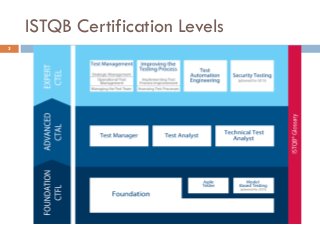
ISTQB Certification Levels
3
Foundation Level Exam Pattern
 The Foundation Level exam is characterized by:
 40 multiple choice questions
 Each question will have only one correct answer
 A scoring of 1 point for each correct answer
 No negative marks for incorrect answer
 A score of at least 65% (26 or more points) is required
to pass
 A duration of 60 minutes
ISTQB Foundation Level Certificate is valid for life time.
4
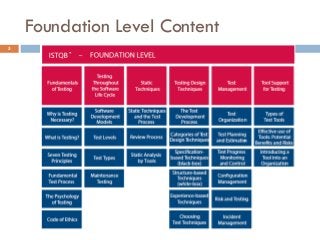
Foundation Level Content
5
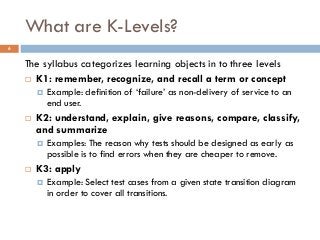
What are K-Levels?
The syllabus categorizes learning objects in to three levels
 K1: remember, recognize, and recall a term or concept
 Example: definition of ‘failure’ as non-delivery of service to an
end user.
 K2: understand, explain, give reasons, compare, classify,
and summarize
 Examples: The reason why tests should be designed as early as
possible is to find errors when they are cheaper to remove.
 K3: apply
 Example: Select test cases from a given state transition diagram
in order to cover all transitions.
6
Foundation Level Exam Pattern
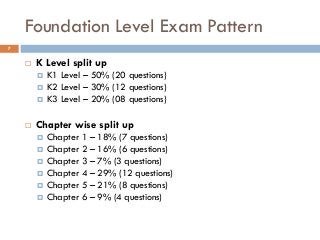
 K Level split up
 K1 Level – 50% (20 questions)
 K2 Level – 30% (12 questions)
 K3 Level – 20% (08 questions)
 Chapter wise split up
 Chapter 1 – 18% (7 questions)
 Chapter 2 – 16% (6 questions)
 Chapter 3 – 7% (3 questions)
 Chapter 4 – 29% (12 questions)
 Chapter 5 – 21% (8 questions)
 Chapter 6 – 9% (4 questions)
7
Foundation Level Exam Pattern
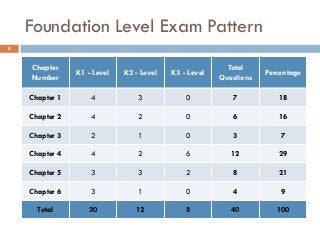
Chapter
Number
K1 - Level K2 - Level K3 - Level
Total
Questions
Percentage
Chapter 1 4 3 0 7 18
Chapter 2 4 2 0 6 16
Chapter 3 2 1 0 3 7
Chapter 4 4 2 6 12 29
Chapter 5 3 3 2 8 21
Chapter 6 3 1 0 4 9
Total 20 12 8 40 100
8
Related Books
 Foundations of Software Testing – ISTQB Certification
- By Rex Black, Erik Van Veenendaal, Dorothy Graham
 Software Testing: An ISTQB-ISEB Foundation Guide
- By Peter Morgan, Angelina Samaroo, Brian Hambling
 Software Testing Foundations: A Study Guide for the
Certified Tester
- By Andreas Spillner, Tilo Linz and Hans Schaefer
 Fundamentals of Software Testing ,
- By Bernard Homès,
9
THANK YOU … !!!
Drop an e-mail to joshisagarr@gmail.com to get more such slides
with your comments and suggestions.
10

Introduction to ISTQB Foundation Level Certification Exam

  • 1.
    AN INTRODUCTION TO ISTQBFOUNDATION LEVEL CERTIFICATION Sagar Joshi CTFL, CTAL-CL (CTAL-TM, CTAL-TA, CTAL-TTA) 1
  • 2.
    What is ISTQB& ITB?  ISTQB – International Software Testing Qualification Board  ISTQB was founded in 2002  ISTQB defined a certification scheme that became world wide leader in the certification of software testing.  ITB – Indian Testing Board  ITB is the ISTQB approved national board for India.  ITB is responsible for the "ISTQB-Certified-Tester“ certification in India. 2
  • 3.
  • 4.
    Foundation Level ExamPattern  The Foundation Level exam is characterized by:  40 multiple choice questions  Each question will have only one correct answer  A scoring of 1 point for each correct answer  No negative marks for incorrect answer  A score of at least 65% (26 or more points) is required to pass  A duration of 60 minutes ISTQB Foundation Level Certificate is valid for life time. 4
  • 5.
  • 6.
    What are K-Levels? Thesyllabus categorizes learning objects in to three levels  K1: remember, recognize, and recall a term or concept  Example: definition of ‘failure’ as non-delivery of service to an end user.  K2: understand, explain, give reasons, compare, classify, and summarize  Examples: The reason why tests should be designed as early as possible is to find errors when they are cheaper to remove.  K3: apply  Example: Select test cases from a given state transition diagram in order to cover all transitions. 6
  • 7.
    Foundation Level ExamPattern  K Level split up  K1 Level – 50% (20 questions)  K2 Level – 30% (12 questions)  K3 Level – 20% (08 questions)  Chapter wise split up  Chapter 1 – 18% (7 questions)  Chapter 2 – 16% (6 questions)  Chapter 3 – 7% (3 questions)  Chapter 4 – 29% (12 questions)  Chapter 5 – 21% (8 questions)  Chapter 6 – 9% (4 questions) 7
  • 8.
    Foundation Level ExamPattern Chapter Number K1 - Level K2 - Level K3 - Level Total Questions Percentage Chapter 1 4 3 0 7 18 Chapter 2 4 2 0 6 16 Chapter 3 2 1 0 3 7 Chapter 4 4 2 6 12 29 Chapter 5 3 3 2 8 21 Chapter 6 3 1 0 4 9 Total 20 12 8 40 100 8
  • 9.
    Related Books  Foundationsof Software Testing – ISTQB Certification - By Rex Black, Erik Van Veenendaal, Dorothy Graham  Software Testing: An ISTQB-ISEB Foundation Guide - By Peter Morgan, Angelina Samaroo, Brian Hambling  Software Testing Foundations: A Study Guide for the Certified Tester - By Andreas Spillner, Tilo Linz and Hans Schaefer  Fundamentals of Software Testing , - By Bernard Homès, 9
  • 10.
    THANK YOU …!!! Drop an e-mail to joshisagarr@gmail.com to get more such slides with your comments and suggestions. 10