Download as PDF, PPTX

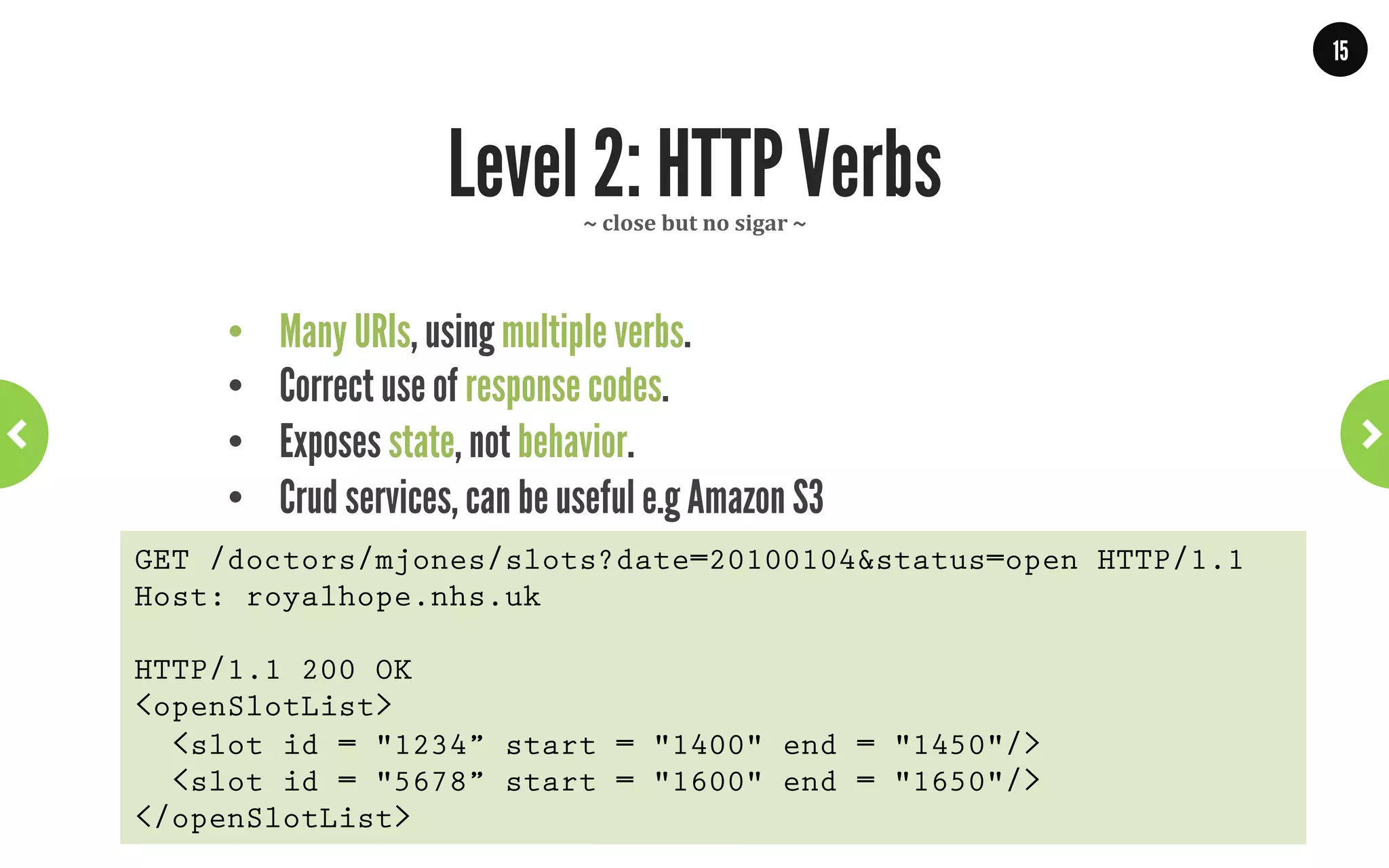
![14
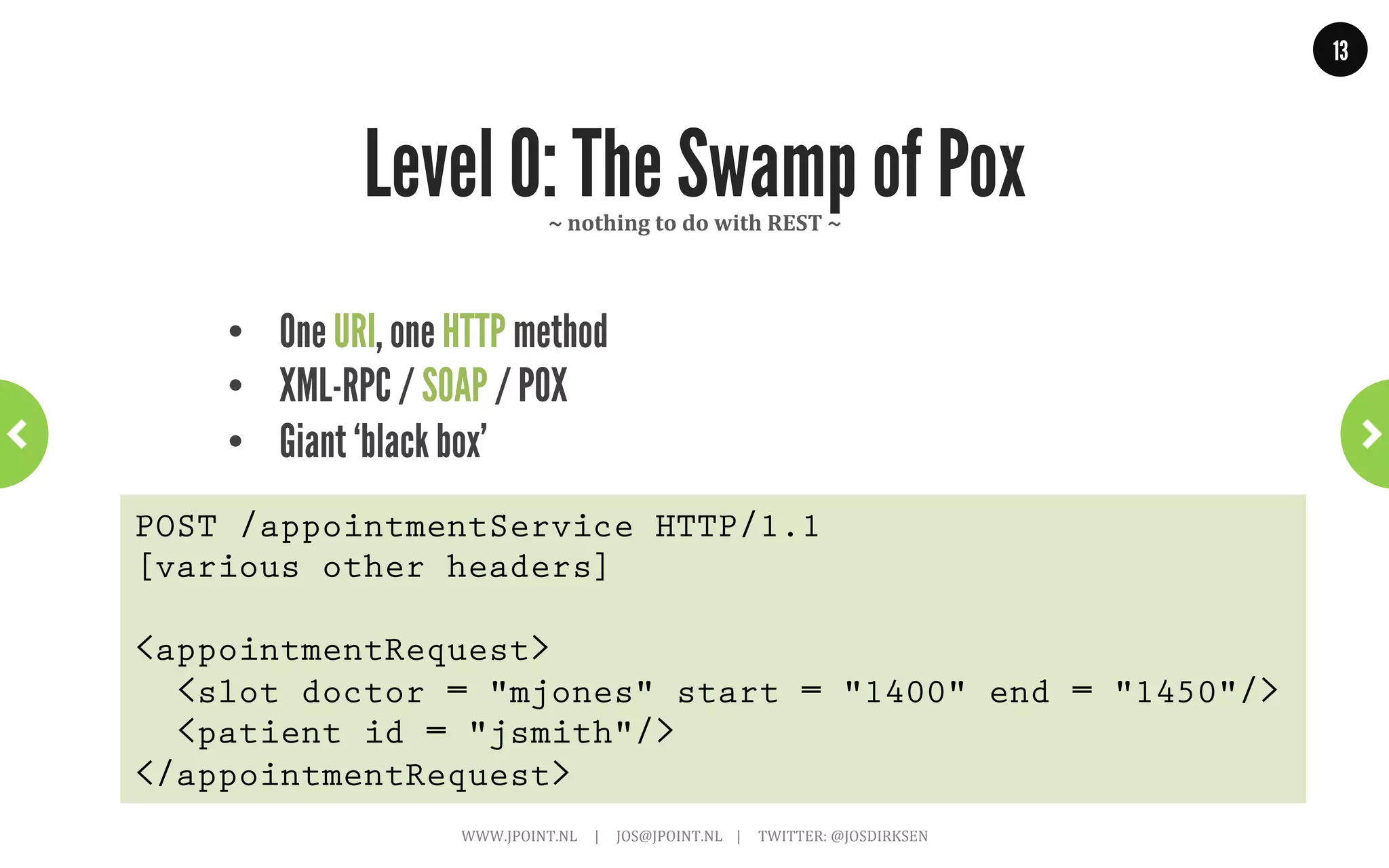
Level 0: The Swamp of Pox ~
nothing
to
do
with
REST
~
• One URI, one HTTP method
• XML-RPC / SOAP / POX
• Giant ‘black box’, is what eBay uses.
POST /appointmentService HTTP/1.1
[various other headers]
<appointmentRequest>
<slot doctor = "mjones" start = "1400" end = "1450"/>
<patient id = "jsmith"/>
</appointmentRequest>
WWW.JPOINT.NL
|
JOS@JPOINT.NL
|
TWITTER:
@JOSDIRKSEN](https://image.slidesharecdn.com/restgethateoas-120508013518-phpapp01/75/REST-From-GET-to-HATEOAS-14-2048.jpg)
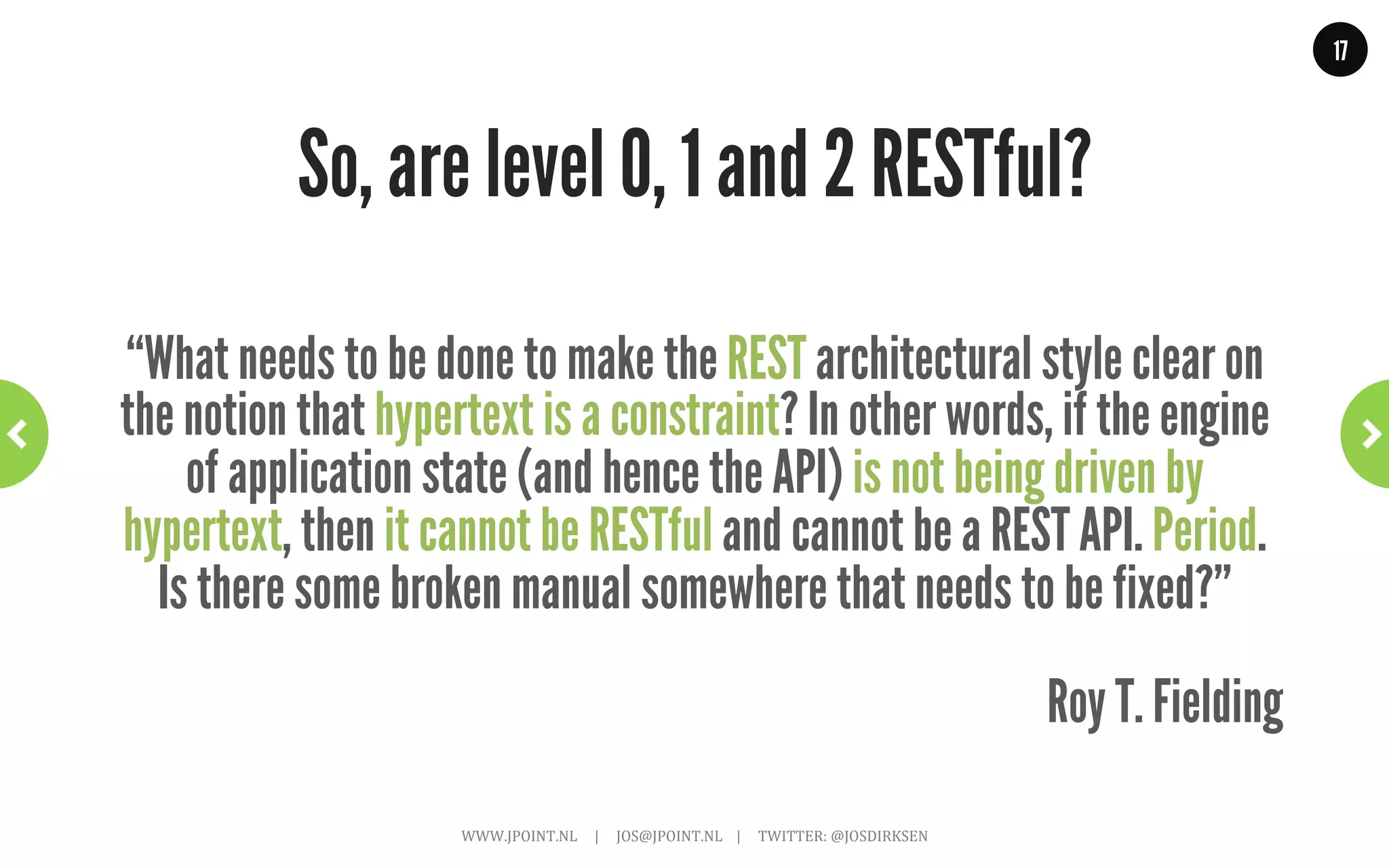
![16
Level 1: Resources
~
lots
of
APIs
start
out
this
way
~
• Each resource has an unique URI
• Single HTTP verb (usually POST or GET)
• Verbs have no meaning, used to tunnel over HTTP
• Early versions of Flickr, del.ico.us and Amazon
POST /slots/1234 HTTP/1.1
[various other headers]
<appointmentRequest>
<patient id = "jsmith"/>
</appointmentRequest>
WWW.JPOINT.NL
|
JOS@JPOINT.NL
|
TWITTER:
@JOSDIRKSEN](https://image.slidesharecdn.com/restgethateoas-120508013518-phpapp01/75/REST-From-GET-to-HATEOAS-16-2048.jpg)
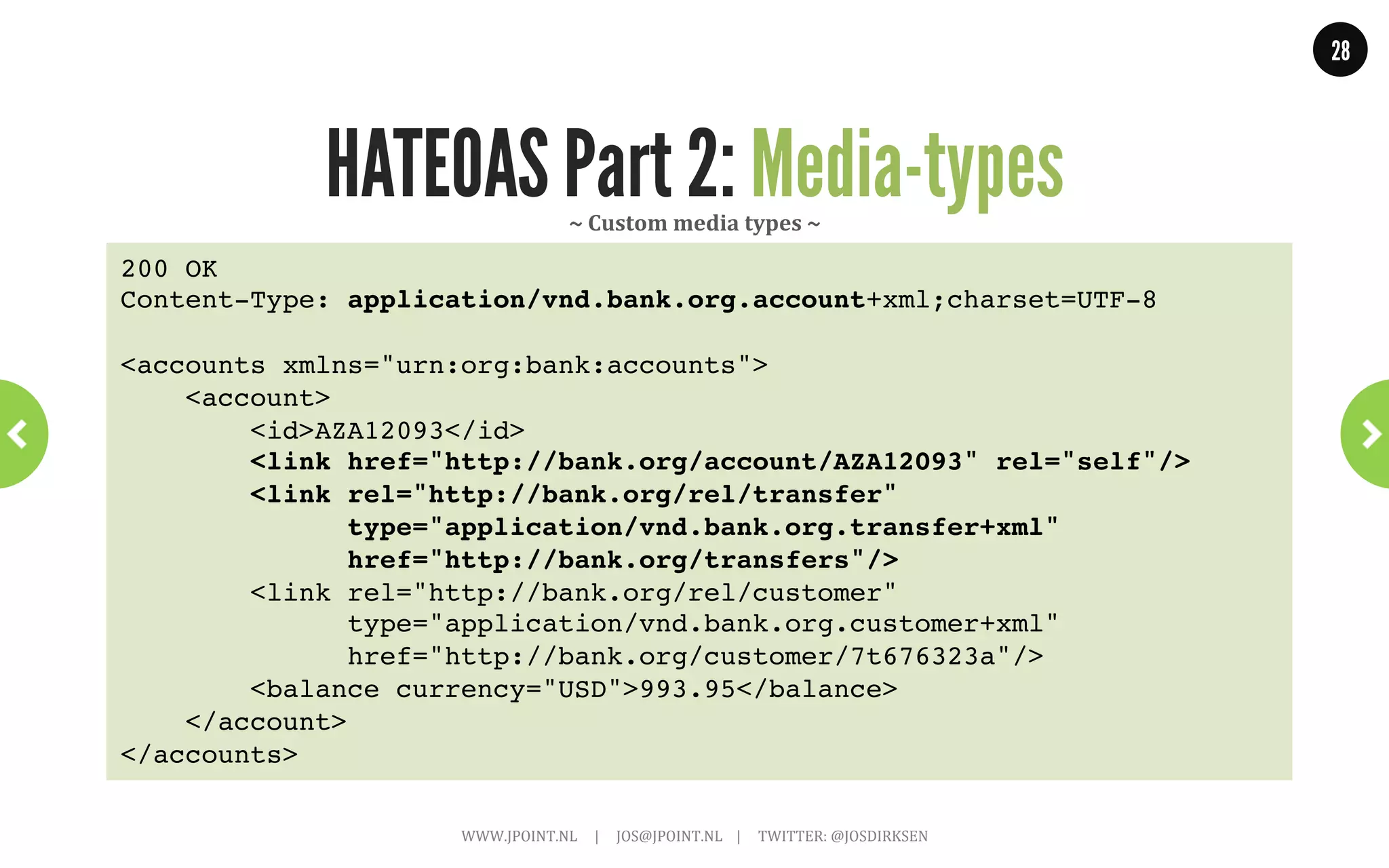
![26
HATEOAS Part 1: Twitter Example ~
Before
using
links~
GET .../followers/ids.json?cursor=-1&screen_name=josdirksen
{
“previous_cursor”: 0,
“previous_cursor_str”: 0,
“ids”: [
12345678,
87654321,
11223344
],
“next_cursor”: 0,
“next_cursor_str”: “0”
}
WWW.JPOINT.NL
|
JOS@JPOINT.NL
|
TWITTER:
@JOSDIRKSEN](https://image.slidesharecdn.com/restgethateoas-120508013518-phpapp01/75/REST-From-GET-to-HATEOAS-26-2048.jpg)
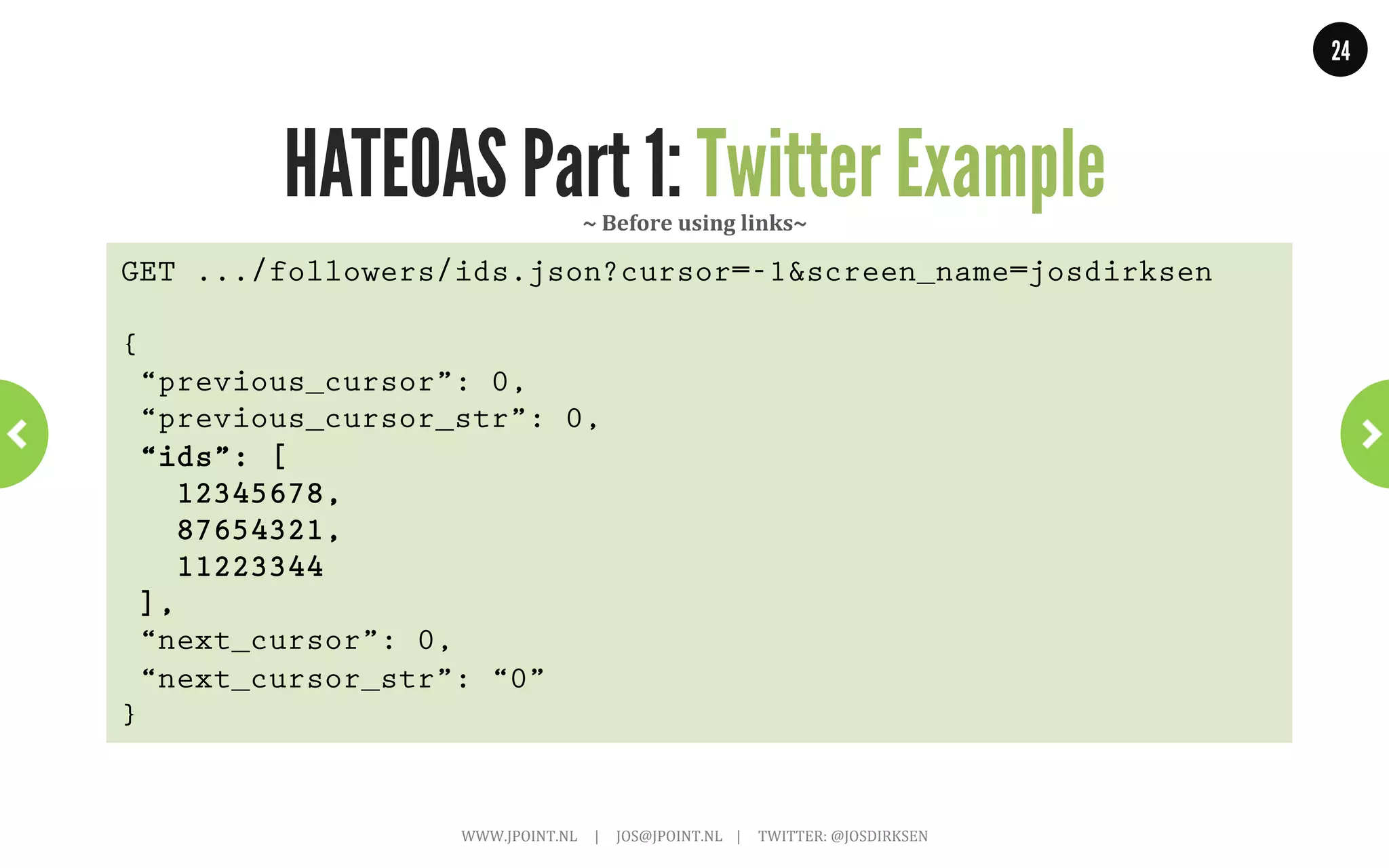
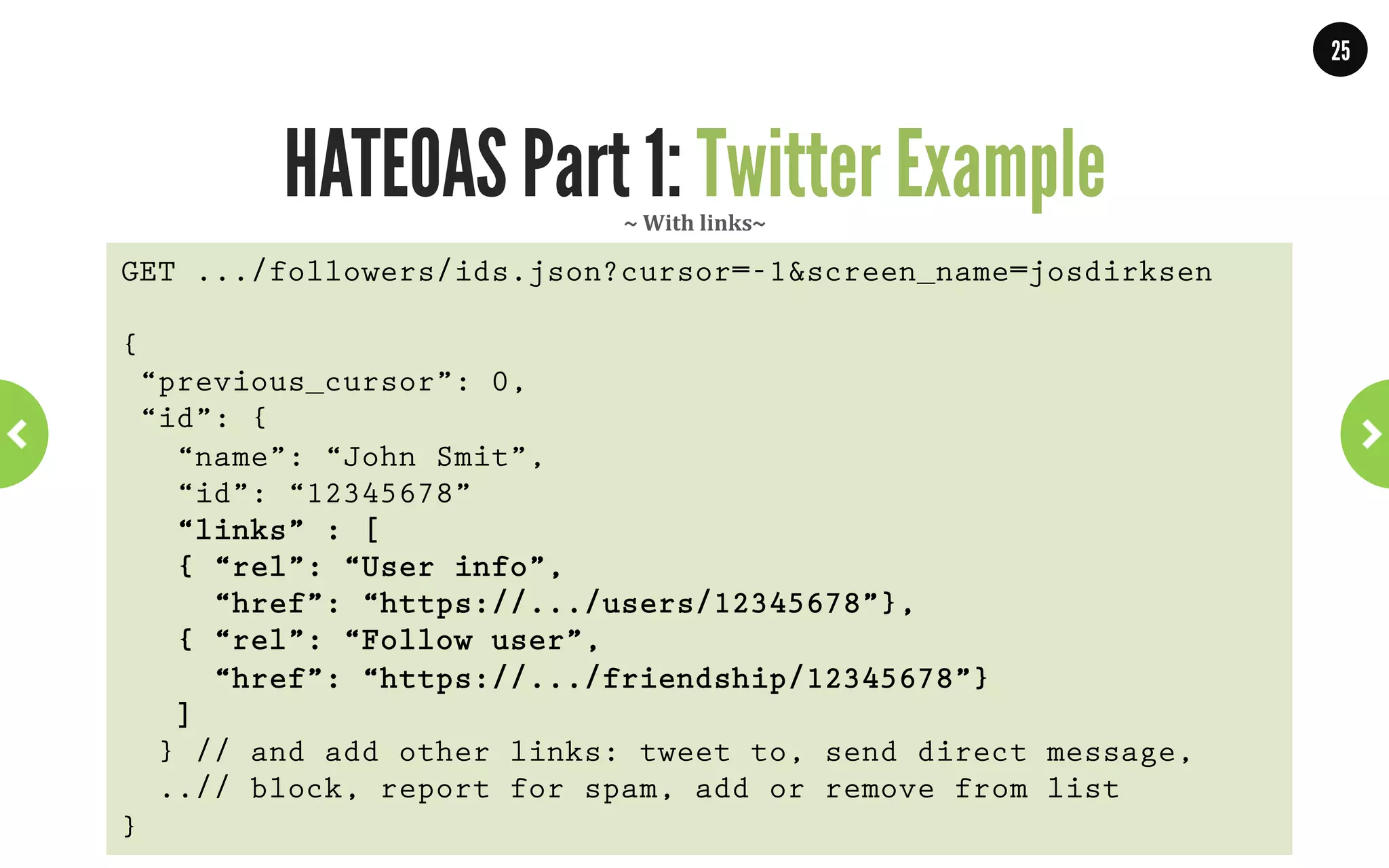
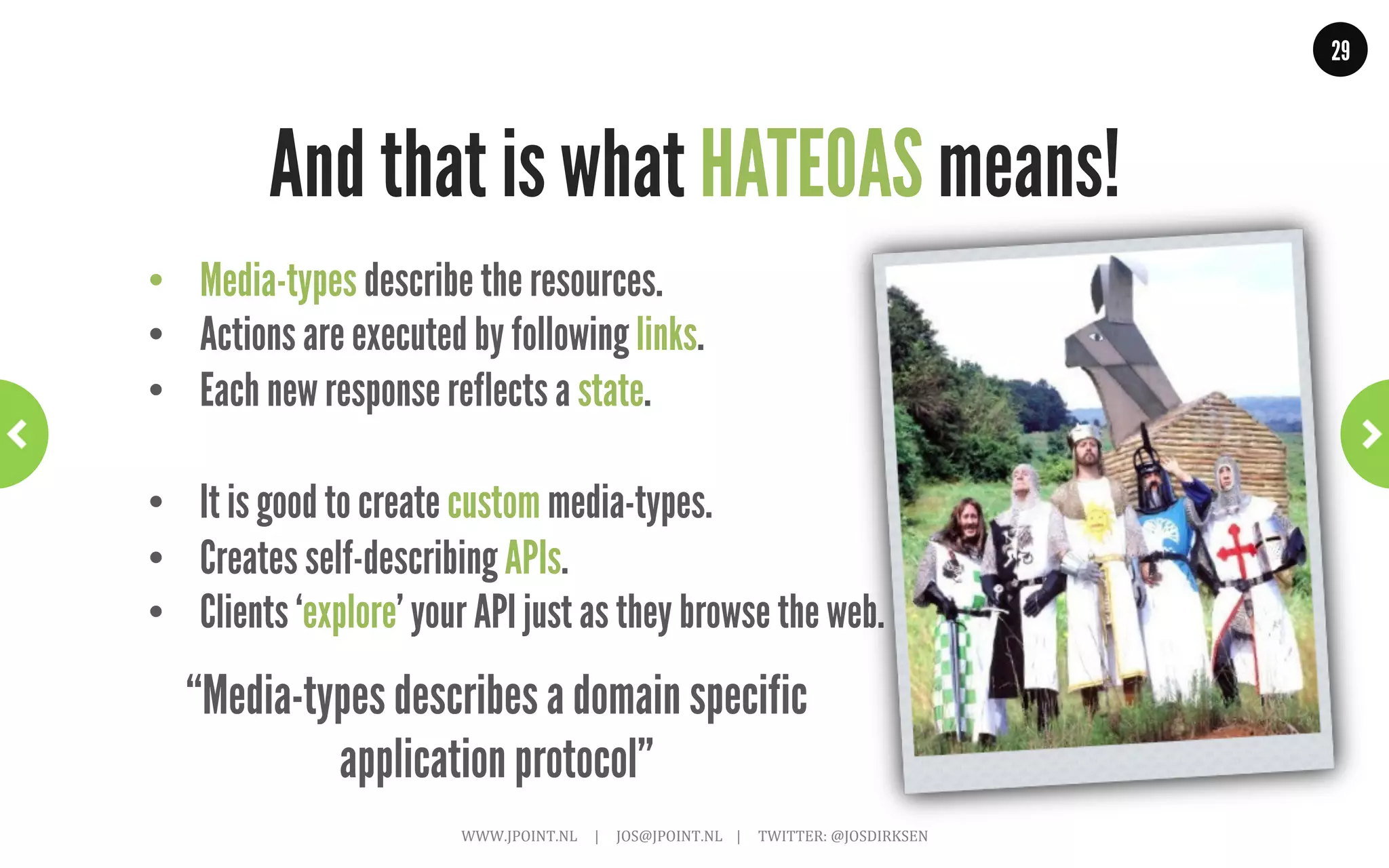
![27
HATEOAS Part 1: Twitter Example ~
With
links~
GET .../followers/ids.json?cursor=-1&screen_name=josdirksen
{
“previous_cursor”: 0,
“id”: {
“name”: “John Smit”,
“id”: “12345678”
“links” : [
{ “rel”: “User info”,
“href”: “https://.../user/12345678”},
{ “rel”: “Follow user”,
“href”: “https://.../friendship/12345678”}
]
} // and add other links: tweet to, send direct message,
..// block, report for spam, add or remove from list
} WWW.JPOINT.NL
|
JOS@JPOINT.NL
|
TWITTER:
@JOSDIRKSEN](https://image.slidesharecdn.com/restgethateoas-120508013518-phpapp01/75/REST-From-GET-to-HATEOAS-27-2048.jpg)
![32
HATEOAS Part 2: Twitter Example
~
With
links,
but
no
media-‐type
~
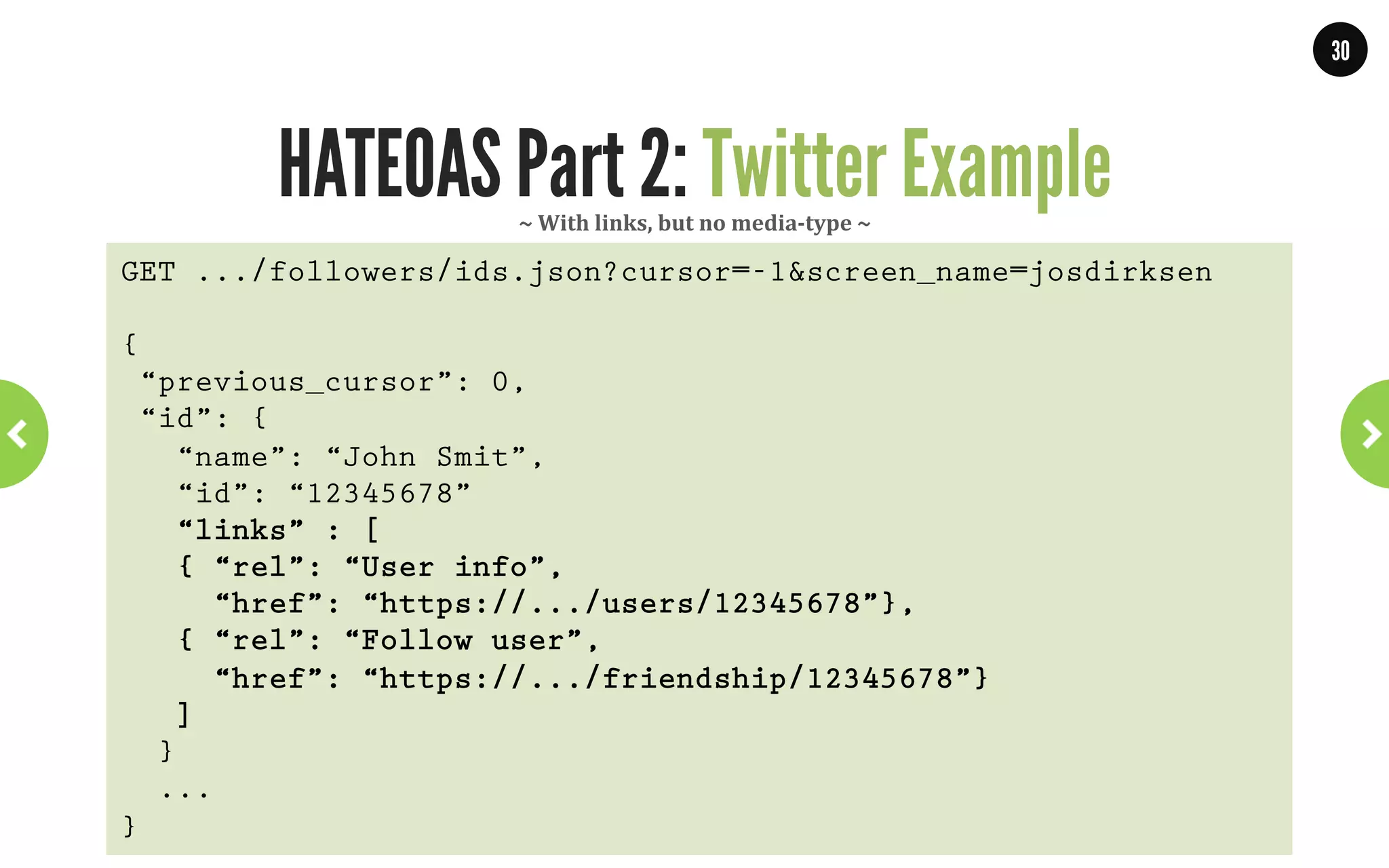
GET .../followers/ids.json?cursor=-1&screen_name=josdirksen
{
“previous_cursor”: 0,
“id”: {
“name”: “John Smit”,
“id”: “12345678”
“links” : [
{ “rel”: “User info”,
“href”: “https://.../user/12345678”},
{ “rel”: “Follow user”,
“href”: “https://.../friendship/12345678”}
]
}
...
} WWW.JPOINT.NL
|
JOS@JPOINT.NL
|
TWITTER:
@JOSDIRKSEN](https://image.slidesharecdn.com/restgethateoas-120508013518-phpapp01/75/REST-From-GET-to-HATEOAS-32-2048.jpg)
![33
HATEOAS Part 2: Twitter Example ~
With
links
&
media-‐type
~
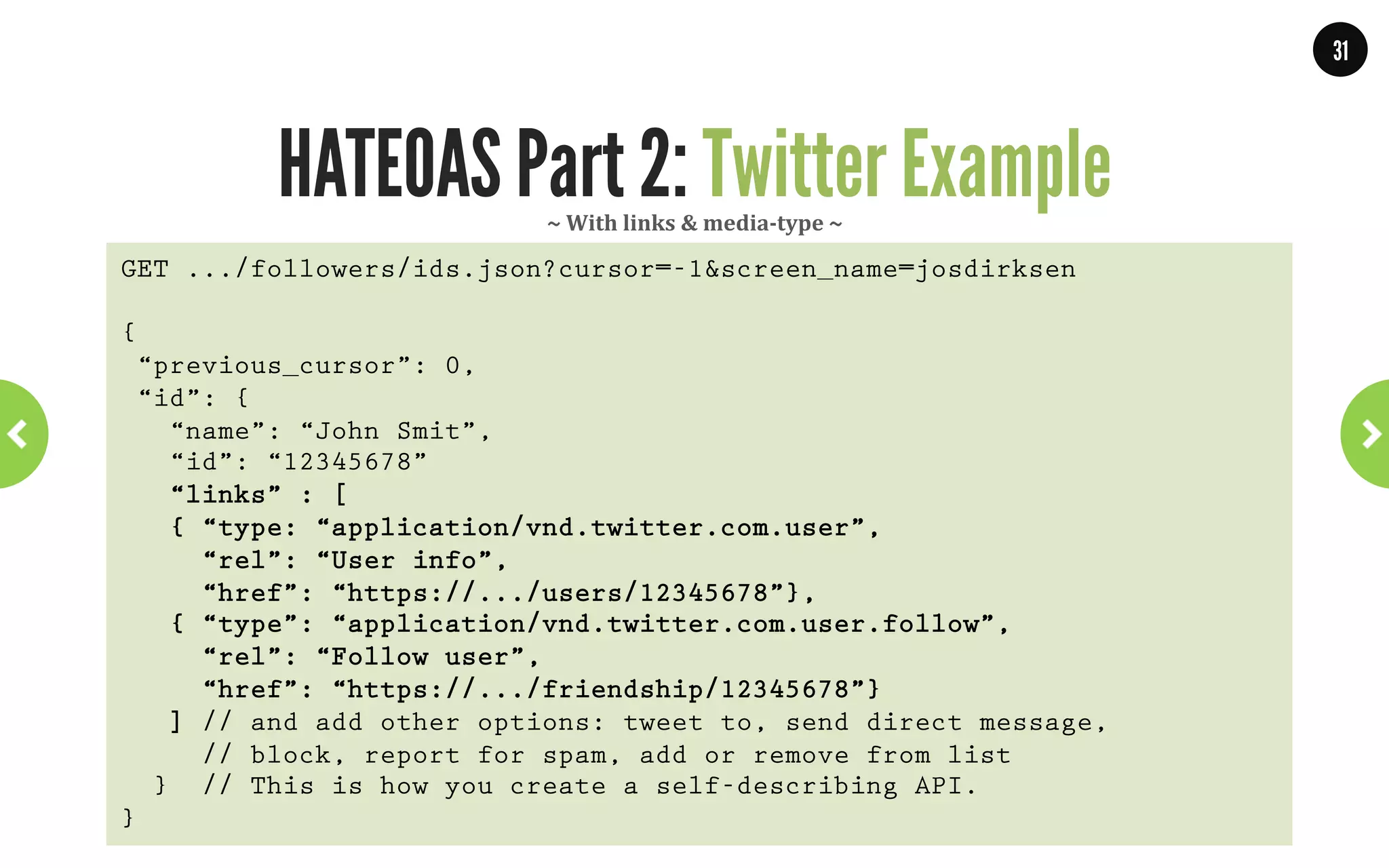
GET .../followers/ids.json?cursor=-1&screen_name=josdirksen
{
“previous_cursor”: 0,
“id”: {
“name”: “John Smit”,
“id”: “12345678”
“links” : [
{ “type: “application/vnd.twitter.com.user”,
“rel”: “User info”,
“href”: “https://.../user/12345678”},
{ “type”: “application/vnd.twitter.com.user.follow”,
“rel”: “Follow user”,
“href”: “https://.../friendship/12345678”}
] // and add other options: tweet to, send direct message,
// block, report for spam, add or remove from list
} // This is how you create a self-describing API.
}
WWW.JPOINT.NL
|
JOS@JPOINT.NL
|
TWITTER:
@JOSDIRKSEN](https://image.slidesharecdn.com/restgethateoas-120508013518-phpapp01/75/REST-From-GET-to-HATEOAS-33-2048.jpg)
![36
eBay: add to watchlist
~
API
should
tell
us
what
to
do
~
GET .../item/180881974947
{
“name” : “Monty Python and the Holy Grail white rabbit big pointy teeth”,
“id” : “180881974947”,
“start-price” : “6.50”,
“currency” : “GBP”,
...
“links” : [
{ “type: “application/vnd.ebay.item”,
“rel”: “Add item to watchlist”,
“href”: “https://.../user/12345678/watchlist/180881974947”},
{
// and a whole lot of other operations
]
}
WWW.JPOINT.NL
|
JOS@JPOINT.NL
|
TWITTER:
@JOSDIRKSEN](https://image.slidesharecdn.com/restgethateoas-120508013518-phpapp01/75/REST-From-GET-to-HATEOAS-36-2048.jpg)

![39
eBay: place bid
~
Depending
on
rights
we
get
different
links
~
GET .../item/180881974947
{
“name” : “Monty Python and the Holy Grail white rabbit big pointy teeth”,
“id” : “180881974947”,
“start-price” : “6.50”,
“currency” : “GBP”,
...
“links” : [
{ “type: “application/vnd.ebay.bid”,
“rel”: “Place bid”,
“href”: “https://.../user/12345678/bid/180881974947”},
{
// and a whole lot of other operations
]
}
WWW.JPOINT.NL
|
JOS@JPOINT.NL
|
TWITTER:
@JOSDIRKSEN](https://image.slidesharecdn.com/restgethateoas-120508013518-phpapp01/75/REST-From-GET-to-HATEOAS-39-2048.jpg)



![50
HMAC based authentication ~
example
~
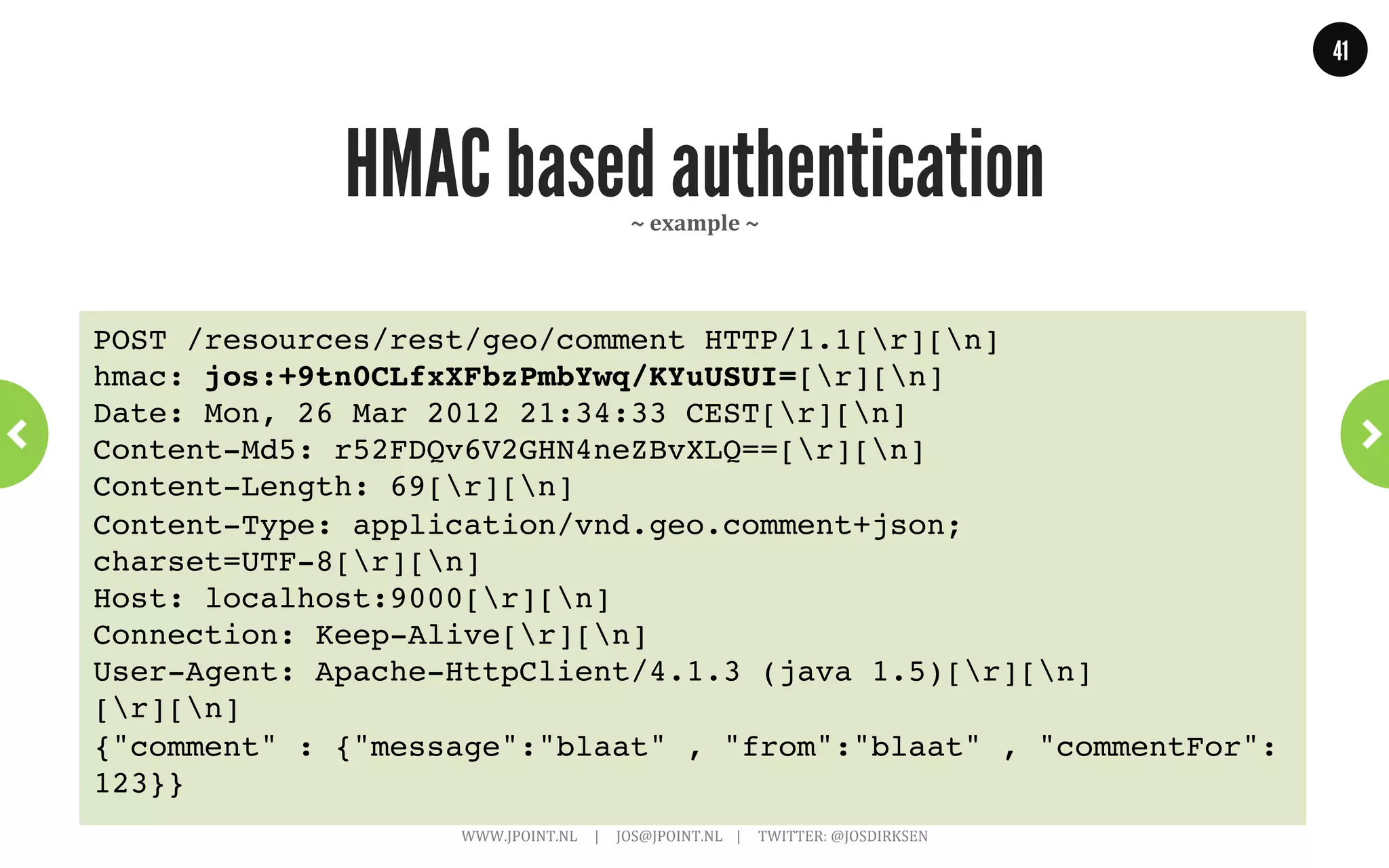
POST /resources/rest/geo/comment HTTP/1.1[r][n]!
hmac: jos:+9tn0CLfxXFbzPmbYwq/KYuUSUI=[r][n]!
Date: Mon, 26 Mar 2012 21:34:33 CEST[r][n]!
Content-Md5: r52FDQv6V2GHN4neZBvXLQ==[r][n]!
Content-Length: 69[r][n]!
Content-Type: application/vnd.geo.comment+json;
charset=UTF-8[r][n]!
Host: localhost:9000[r][n]!
Connection: Keep-Alive[r][n]!
User-Agent: Apache-HttpClient/4.1.3 (java 1.5)[r][n]!
[r][n]!
{"comment" : {"message":"blaat" , "from":"blaat" , "commentFor":
123}}!
WWW.JPOINT.NL
|
JOS@JPOINT.NL
|
TWITTER:
@JOSDIRKSEN](https://image.slidesharecdn.com/restgethateoas-120508013518-phpapp01/75/REST-From-GET-to-HATEOAS-50-2048.jpg)


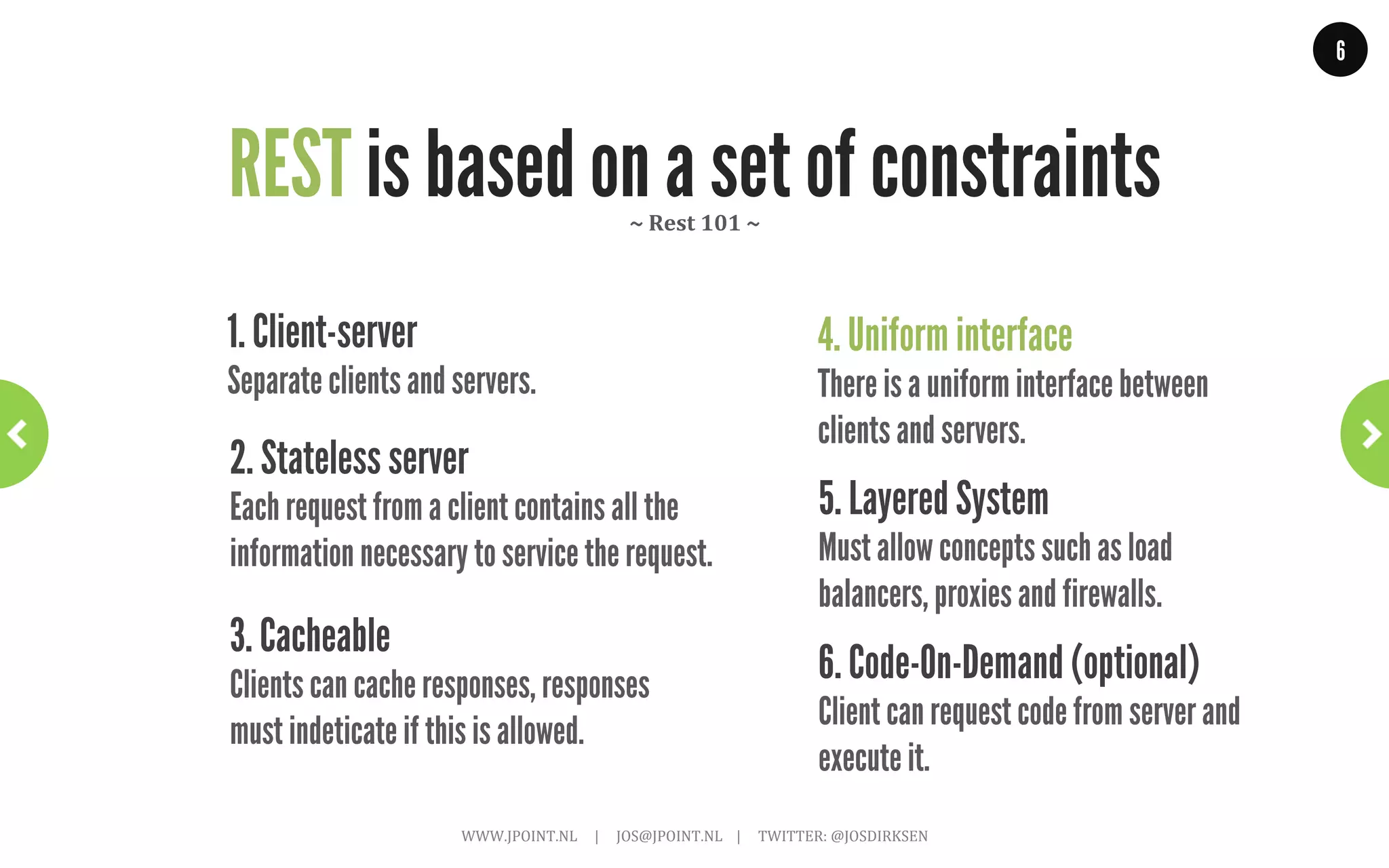
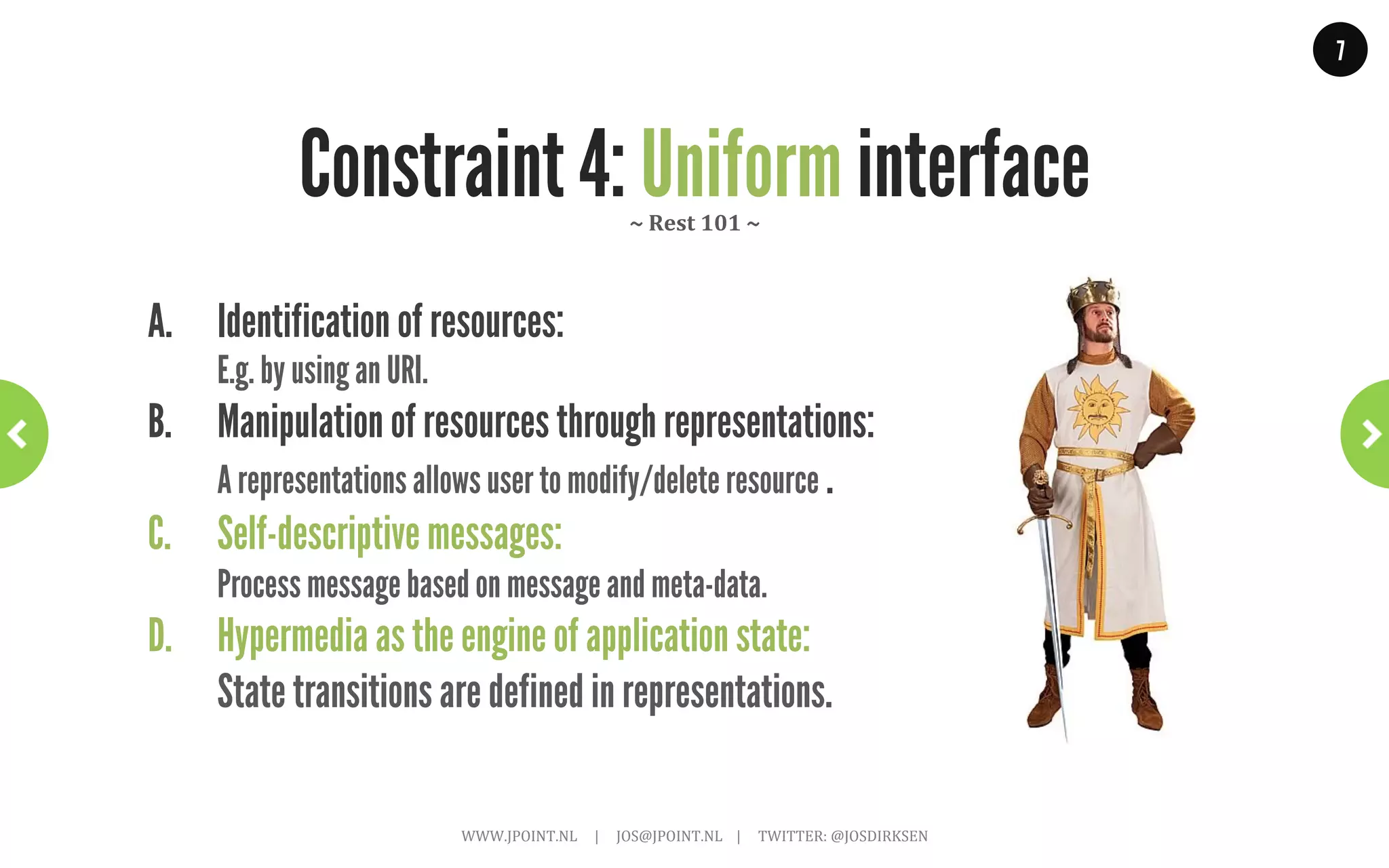
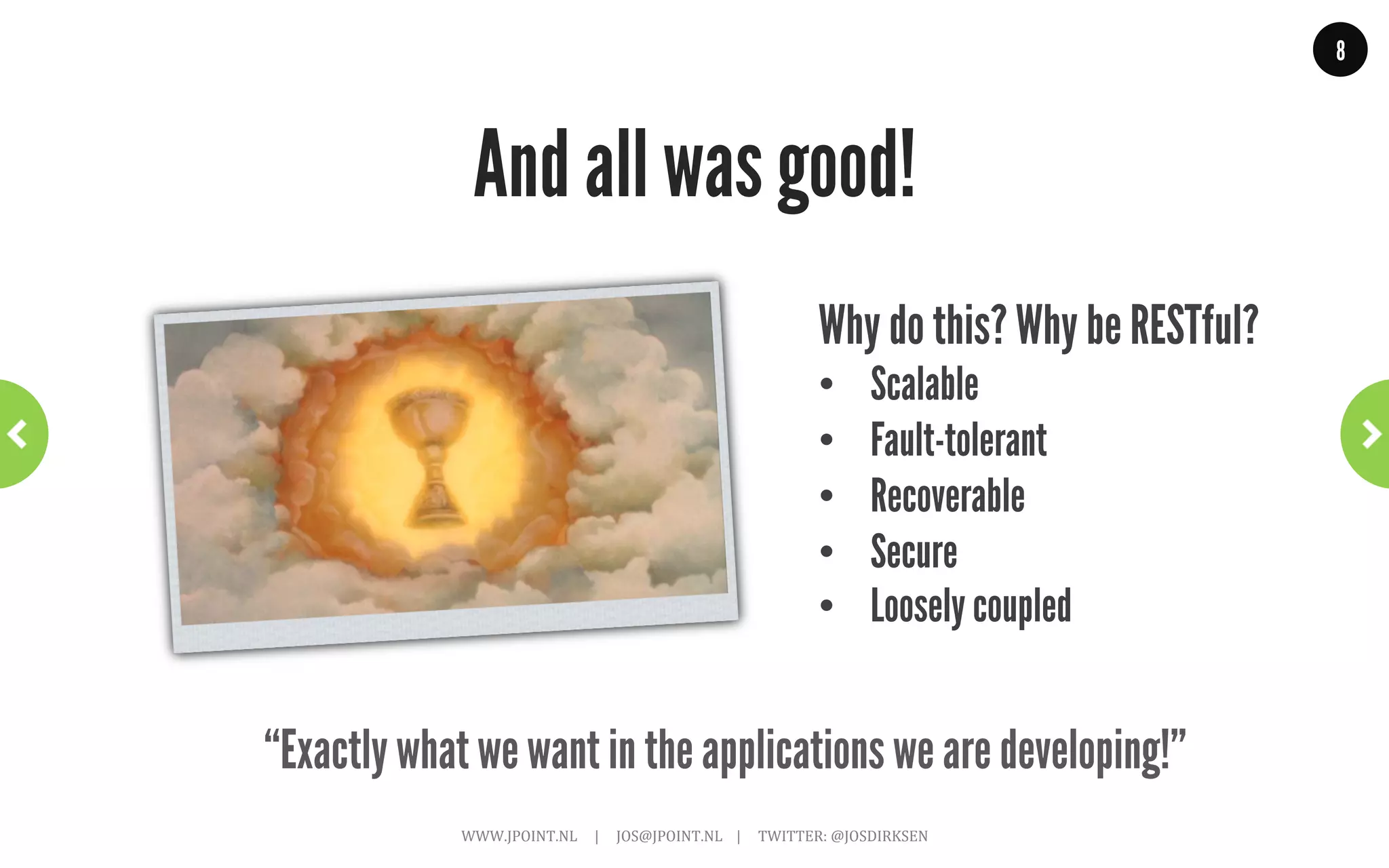
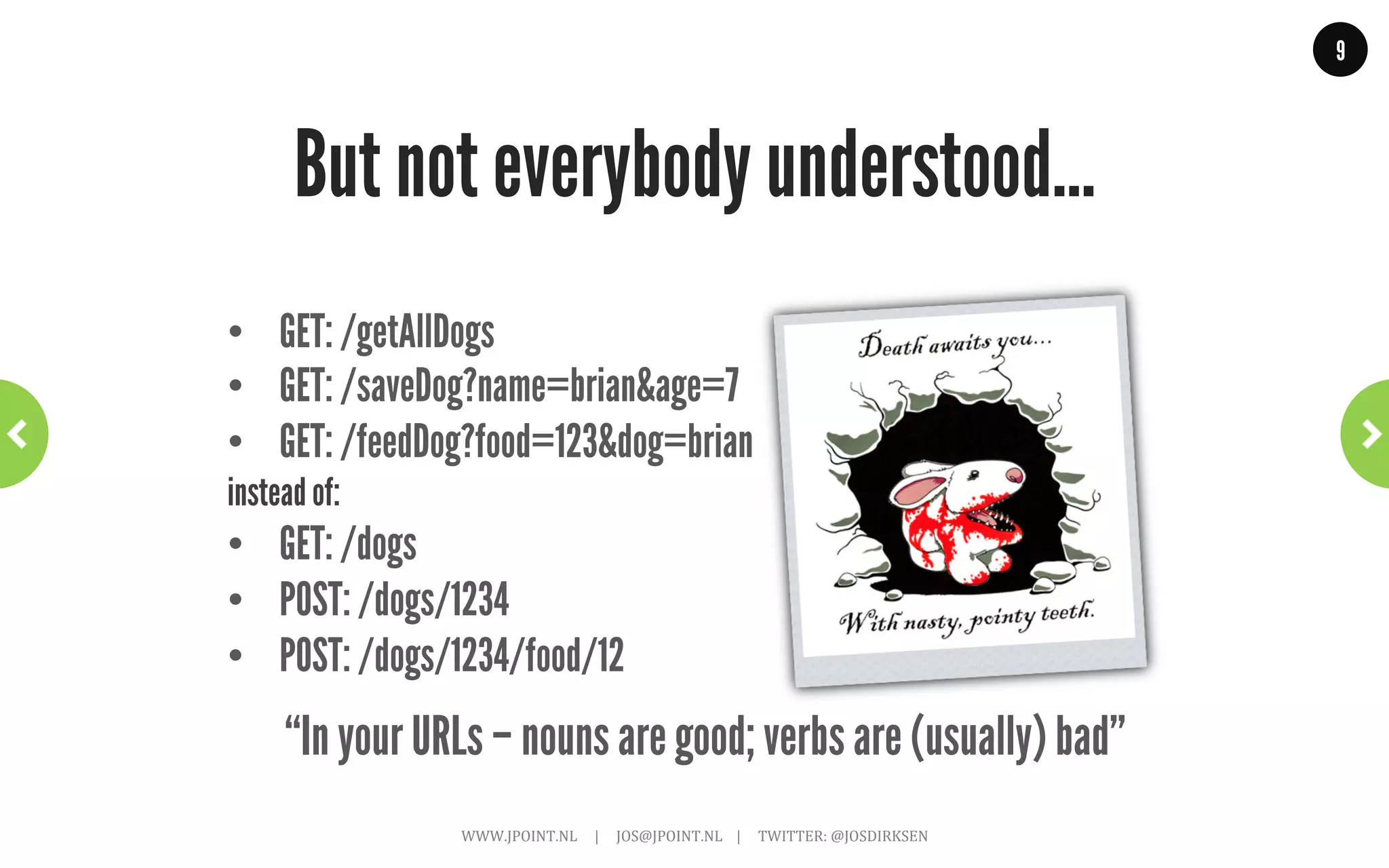
The document discusses the creation of RESTful APIs, emphasizing the importance of hypermedia and the HATEOAS (Hypermedia as the Engine of Application State) principle. It outlines the constraints of REST architecture, compares different maturity levels of RESTful APIs, and provides examples to illustrate best practices for API design. The content is opinionated, reflecting the author's perspective on effective REST implementation and interoperability.


![쿠키런: 킹덤 대규모 인프라 및 서버 운영 사례 공유 [데브시스터즈 - 레벨 200] - 발표자: 용찬호, R&D 엔지니어, 데브시스터즈 ...](https://cdn.slidesharecdn.com/ss_thumbnails/t3s3-221108102039-c0f48289-thumbnail.jpg?width=640&height=640&fit=bounds)


![Vibe Coding vs. Spec-Driven Development [Free Meetup]](https://cdn.slidesharecdn.com/ss_thumbnails/vibecodingvsspecdrivendevelopment-251209105622-43f455e7-thumbnail.jpg?width=640&height=640&fit=bounds)


