Ultimate Job Search by JobsOutNow.com - Presentation Transcript
Ultimate Job Search, Interview &
Career Management 2009
Content
Job Search:
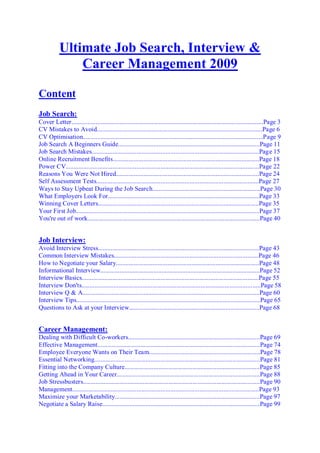
Cover Letter.......................................................................................................................Page 3
CV Mistakes to Avoid.......................................................................................................Page 6
CV Optimisation................................................................................................................Page 9
Job Search A Beginners Guide........................................................................................Page 11
Job Search Mistakes........................................................................................................Page 15
Online Recruitment Benefits...........................................................................................Page 18
Power CV........................................................................................................................Page 22
Reasons You Were Not Hired.........................................................................................Page 24
Self Assessment Tests.....................................................................................................Page 27
Ways to Stay Upbeat During the Job Search...................................................................Page 30
What Employers Look For..............................................................................................Page 33
Winning Cover Letters....................................................................................................Page 35
Your First Job..................................................................................................................Page 37
You're out of work...........................................................................................................Page 40
Job Interview:
Avoid Interview Stress....................................................................................................Page 43
Common Interview Mistakes..........................................................................................Page 46
How to Negotiate your Salary.........................................................................................Page 48
Informational Interview...................................................................................................Page 52
Interview Basics..............................................................................................................Page 55
Interview Don'ts...............................................................................................................Page 58
Interview Q & A..............................................................................................................Page 60
Interview Tips..................................................................................................................Page 65
Questions to Ask at your Interview.................................................................................Page 68
Career Management:
Dealing with Difficult Co-workers..................................................................................Page 69
Effective Management.....................................................................................................Page 74
Employee Everyone Wants on Their Team.....................................................................Page 78
Essential Networking.......................................................................................................Page 81
Fitting into the Company Culture....................................................................................Page 85
Getting Ahead in Your Career.........................................................................................Page 88
Job Stressbusters..............................................................................................................Page 90
Management....................................................................................................................Page 93
Maximize your Marketability..........................................................................................Page 97
Negotiate a Salary Raise..................................................................................................Page 99
Optimize Your Relationship with Your Boss................................................................Page 104
Performance Appraisal..................................................................................................Page 106
Powers of Success.........................................................................................................Page 108
Promotion to Management............................................................................................Page 109
Recharge Your Career...................................................................................................Page 112
Salary Negotiations.......................................................................................................Page 114
Starting a New Job.........................................................................................................Page 117
Stay Motivated at Work.................................................................................................Page 120
Steps to a Better Life.....................................................................................................Page 122
Stress and the Workplace..............................................................................................Page 125
Succeeding as a Team Player........................................................................................Page 128
Successful Hire..............................................................................................................Page 131
Time to Quit..................................................................................................................Page 135
Winner's Traits...............................................................................................................Page 138
Cover Letter
A cover letter introduces you to a potential employer and lends your CV a more personal
touch. A cover letter should communicate to the employer your objectives and interest in
his/her company as well as your skills and experience. Use it to grab an employer's attention
and highlight any special attributes that make you uniquely qualified for the job. A successful
cover letter will leave the employer with a favourable impression of you and will make him
interested in reading your CV. We recommend you include a cover letter every time you send
out a CV.
Below we have provided a rough framework and some tips and examples for building your
cover letter. Remember to use Action Verbs:- a list is provided.
1. Introductory Paragraph
This is the most significant part of the letter. Use it to grab the attention of the potential
employer.
Examples:
At a recent lecture in (name of place), your company's name arose repeatedly as one
of the rapid growth prospects in the (name of industry)
As a (teacher, social worker, etc.) I have developed my skills in (team motivation,
public speech, public relations, etc.). I am known for (meeting deadlines, following
through commitments, being well organized, etc.)
With just less than 7 weeks until my graduation from (name of school) with a (type of
degree) in (area of study), I am eager to gain and learn some practical experience and
apply my skills.
(Name of person) suggested I get in touch with you, etc.
(Name of person) at (name of company) mentioned that you are looking for an
experienced person to develop, etc.
My interest in the (position) recently advertised, has prompted me to forward my
resume for your consideration.
Tips:
Use this introductory paragraph to introduce yourself, your capabilities and skills.
If you mention where you learned about the job opening, try to write a sentence or
two about the research you have done about the target company. You will come
across as someone professional who has done their homework.
If you are writing at the suggestion of someone who is known to the hiring manager,
mention it. However, make sure you have permission to use that person's name.
2. Body
The body can be up to 3 paragraphs long. Use it to list your achievements and qualifications.
Remember to keep it positive and sell yourself!
Examples:
I would like to be part of an organization that offers (potential growth, advancement
opportunities, stability, etc.)
My background in (i.e. graphic design) would be a great asset to your company's
work in (i.e. advertisement)
My past experience in (i.e. market research) would complement your company's
(strategy, objectives, visions, projects, etc).
I have a record of outstanding success in the management of (i.e. corporate financial
operations) in multinational and international environments.
My experience has encompassed the successful management of (i.e. corporate real
estate, human resources, and general operations).
I received several commendations for my dedication and professionalism, and
continually received recognition for my communication skills and leadership
excellence.
Based on my qualifications, I believe I am the right person to oversee the delivery of
(type of service) for one or more of your clients.
Tips:
Try not to use too formal a tone when writing your cover letter. Personalize it in order
to show the prospective employer your positive and personal qualities.
The letter is only a few paragraphs long. Try to only include vital information that
will directly show the hiring manger what you can do for the target company.
Emphasize your skills and past experience.
If you have been out of the workforce for a while, mentioning what you have done is
a plus. Mention organizations you have joined, volunteer work, types of activities,
conferences you have attended or private classes you have taken.
Remember to use active verbs!
Double-check for spelling and grammar mistakes!
3. Concluding Paragraph
The concluding paragraph is usually brief and is mainly comprised of a thank-you message
and a request for follow-up.
Examples:
The enclosed resume is a brief summary of my qualifications. I would be delighted to
meet with you in a personal interview and will call your office during the week of
(specific date).
My resume is a good summary of my background and general experience. I would
like to arrange a mutually convenient time for a meeting, during which we can further
discuss your current or anticipated openings. Thank you for your consideration.
I will call you next week to see if we can arrange a meeting. Thank you for your time.
I would like a chance to convince you that my skills and energy would be an asset to
your department.
Thank you in advance for your generous consideration. I may be reached at my home
number indicated above should you desire to contact me. I would be happy to make
myself available for a personal interview at your convenience.
Sincerely
Sincerely yours,
Regards,
Best wishes,
Tips:
State in the concluding paragraph that you will call on a specific week or day in the
near future. You need to work for an interview!
Remember to thank the recipient for his/her time and co-operation.
Do not forget to attach your resume!
CV Mistakes to Avoid
Make sure your CV is your springboard to the next stage
of the job search. Here are some key CV mistakes to
avoid.
Your CV is often the first impression a hiring manager has of you and more often than not
you will only have a few seconds to grab his/her attention and leave him/her wanting to read
more and invite you in for an interview. It is essential that you get this vital piece of
communication right and use it as a springboard to the next stage of the job search. The
following are some common CV mistakes to avoid at all costs.
1. Insufficient Contact Details
Make sure your CV clearly details your full name, address and contact details for a
prospective employer to reach you including phone numbers and email address. This may
sound obvious but remarkably, a few candidates will send their CV out omitting key contact
information or with outdated contact details. If your email address reads particularly
unprofessionally (eg hotbabe) or is a work email address it may be well worth while changing
it for a different one to utilize for correspondence with employers.
2. No Objective
Every CV should begin with a clear and concise objective citing the position you are seeking
and a supporting short skills statement summarizing the reason you are highly qualified for
this role; e.g. \"Seeking a senior marketing analyst role where I can apply my 3 years
experience in marketing analysis gained with a leading Fortune 500 FMCG company as well
as my skills in copywriting, strategic analysis, business development, client servicing and
media planning.\" Remember, the goal of the CV is to outline what you can do for your
prospective employer not what your employer can do for you.
3. Passive Language
Remember to use active verbs that show leadership and accomplishments rather than weak
passive words. Words like achieved, spearheaded, managed, exceeded, pioneered, led,
created, developed and motivated convey an active, dynamic successful professional.
Substitute all weak descriptive sentences for sentences that detail accomplishments in no
uncertain terms eg instead of \"Managed the firm's emerging markets equity portfolio\" try
\"Managed and achieved a 34% annualized return on the firm's flagship £200 million
emerging markets equity portfolio.\"
4. Writing in the first person
Do not start sentences with the word 'I' or use the personal pronoun in your job descriptions.
Keep your sentences short and dynamic and begin them wherever possible with strong action
words.
5. Lack of Focus
Every CV should be focused on the particular job and industry you are targeting. If you are
applying to jobs in 2 different industries make sure you have different CVs that cater
specifically to the different skills required in each industry. The best CVs are customized for
the individual job at hand and emphasize objectives, skillsets, past accomplishments,
aptitudes and qualifications that are uniquely relevant to that role. Generic, unfocused CVs
rarely make the mark.
6. Poor Formatting
Your CV will get no more than a cursory glance if the formatting is poor and it shows bad
planning, poor organization or clutter. Makes sure you adhere to an acceptable format that is
professional, simple and attractive to the eye. Use bullet points wherever possible rather than
long, winding prose and be consistent with font, headings, spaces and layout. Avoid the
coloured paper, illustrations and glitzy touches - if you are applying for a creative position
show your creativity in your portfolio not by jazzing up your CV. Aim to send your CV on
high quality paper (if not on-line) and make sure it is no longer than 1 page if you are entry
level and a maximum of 2 pages if you are a seasoned professional.
7. No Proofreading
Spelling mistakes, poor grammar and glaring errors are a surefire way to get your CV
dismissed and stop the job search process in its tracks. Read and reread your CV before
sending it to the employer, run a spellcheck and have some-one else read it for an extra check
before sending it out.
8. Omission of Key Facts
Educational qualifications and professional experience must be included in your CV with
proper dates, titles, institution names and descriptions. Use plenty of keywords in describing
your role and accomplishments in each job as well as in the Skills section - these will often be
the hook that makes the difference between your CV being considered or overlooked,
particularly with an online employer CV search. If you are unsure what keywords to use, read
the job description thoroughly, read detailed job descriptions for similar jobs with other
companies and ask peers in the industry what skills/qualifications are particularly relevant for
this role.
9. Lies
Lies and half-truths will be discovered sooner or later and you are better off omitting them
from the start. If you have not finished a university degree make that clear on your CV
without neglecting to include the coursework you did complete and the educational
accomplishments you do have. Similarly do not list promotions, jobs, titles, dates or job
descriptions that do not accurately reflect your work history. Most companies run very
detailed background checks and lies and exaggerations that are not glaringly obvious on the
CV or at the interview will often be discovered at the reference or background check.
10. Poor Targeting
Make sure you send your CV to the right person at the company and accompany it with a
short, concise cover letter that personalizes it and summarizes your skills, objectives and the
value you will bring to the job. Spend some time researching who heads the division you are
targeting and what the most relevant skills are to target in your correspondence and send your
introductory CV and cover letter directly to them. Your CV is more likely than not to be
disregarded completely if you send it to the wrong person or to a nameless \"To whom it may
concern\".
CV optimisation
Five tips to supercharge your JobsOutNow CV and get
hired faster.
1. Refresh Often
One of the most popular ways hiring managers search CVs on JobsOutNow is by the date
they were posted. Keep your CV updated in the system by renewing it at least once every 30
days. To refresh your CV on JobsOutNow:
1. Log on to your JobsOutNow account.
2. Click on My Workspace to manage your CV.
3. Find your active CV and click on Refresh My CV.
2. Target Your Position Sought
Position Sought is one of the most important sections of your JobsOutNow CV. When hiring
managers search for CVs on JobsOutNow, they often look at the Position Sought first to
decide whether or not to view a CV. It's best to include the specific job title you're pursuing,
along with a brief description of your top credentials. These keywords will help employers
target your CV easily and quickly in a search. Examples of good headlines:
Network Administrator - CNA Specializing in NetWare - 5 Years' Experience.
Technical Sales Representative - Maximizing Sales for the Technology Industry.
Secretary/Administrative Assistant with 10 Years' Experience.
3. Maximize Your Keywords
One of the best ways to increase the number of times your CV is read is to include an
abundance of keywords that are relevant to your job and the industry you are applying into.
Search jobs on JobsOutNow to get an idea of what credentials hiring managers value. Then
look for places in your CV where you could incorporate these keywords. The Skills section
on JobsOutNow is a great place to include keywords that don't appear elsewhere on your CV.
4. Show that You Care About Employers' Needs
Revise your objective to show the benefits you offer potential employers. Consider these
before-and-after ideal job descriptions:
Before: A challenging position with a large firm that offers great pay/benefits and a
comfortable working environment.
After: Customer service position providing world-class service to international guests.
5. Proofread
Employers are immediately turned off by CVs with spelling mistakes, so thoroughly
proofread your JobsOutNow CV, and take advantage of the spell-check function offered on
the JobsOutNow CV Builder. Show your CV to a friend or colleague with excellent
proofreading skills to make sure it is perfect.
Job Search: A Beginners Guide
Your first task as a job-hunter is to identify your area(s) of interest from the universe of
career possibilities out there. In this age of opportunity, it is quite common to be torn between
multiple career directions. Today's fresh graduate may well start off his search indifferent
between careers in cardiology and dolphin training and that's okay! Many of us are unclear
about what road to take and what the opportunities are ahead of us, and it is entirely your
prerogative to explore different career paths. The risk here however is that your search and
CV will be too broad for either role and you end up with nothing!
So what to do? Approach each search INDEPENDENTLY and make sure your CV, cover
letter and research activities are tailored for the particular search. Once you have one or two
well-defined targets, you can hone in on a few select companies/ institutions that excel in the
particular area and from there start a dialogue with the companies and search for actual
positions.
Research
Do your homework. Research target companies thoroughly and make sure you understand the
relevant industry, the competition, the challenges the company is facing and where it is likely
to expand/ change direction in the near future. Refer to industry journals, research newspaper
archives, ask for company annual reports and marketing materials and look them up on the
Internet. Most companies are more than happy to send you information packages and annual
reports so just pick up the phone and ask for information.
Leverage the media. Read trade magazines and business sections in local newspapers many
of which are available on-line and can be a rich source of information on the latest industry
trends. Also research the requirements of the actual position you are applying for. Do you
really understand what responsibilities a Financial Analyst at an investment bank has or what
an Account Executive at an Advertising Company does on a day-to-day basis. Asking
questions relating to jobs and job descriptions in the chatrooms and forums of online
jobboards is also a great way to get the inside scoop. University chatrooms are another rich
source of career tips and potential leads.
Network
Your best source of information is your circle of friends and family. Most jobs are filled by
word-of-mouth referral before they are ever advertised or publicized. Talk to everyone you
know including old teachers, family doctors, lawyers, reporters, clergy and neighbors. Make
it known that you are in the market and don't be shy about asking for leads.
As part of your networking activities, start building professional relationships. Call up
companies and ask to speak to people in the relevant departments. Ask pertinent questions
that show you have done your homework and portray you in the best possible light. Try to get
an 'informational' interview to learn more about the company and introduce yourself face-to-
face. Failing that, always try to get a recommendation of someone else you can talk to in the
particular industry. Industry insiders are usually well-connected and a false lead in one
company may well generate 'But I have a friend at the Bridge Corp. who may be looking to
hire'.
Remember, you are searching for 'hidden' positions - those that have not yet been advertised
or are still in the human resources pipeline as well as currently advertised positions.
Aggressive networking and research should assist you in finding these positions before your
competition has even heard of them.
Perfect Your Marketing Kit
Think of your CV and cover letter as your marketing and introduction kit. They will either
open doors to the next stage of the process or eliminate you from the search. Use them to
reflect all you have learnt about the industry and position through your research and
networking activities. Fine-tune them for the relevant target and make sure they portray you
in the best possible light. Finally, make sure they are interesting and well-presented. A sound
investment at this crucial stage in the job search process will definitely reap rewards. Make
sure you have different CVs/ cover letters if you are exploring different career options eg.
marketing and investment banking.
JobsOutNow's CV Builder and Cover Letter Guide take you through the CV building process
step-by-step. Refer to other articles such as JobsOutNow’s 'Power CV' as well as CV-
building books (some recommended in JobsOutNow’s Career Center) to perfect the final
product. We highly recommend attaching a Cover Letter to every CV to introduce you in a
more personal light and highlight your areas of strength and personal skills. A strong or
interesting cover letter may well compensate for a less than relevant CV.
Don't Wing the Interview
Interview skills are acquired. There is a fine art to presenting yourself in an attractive,
interesting and professional light. Practice makes perfect is extremely applicable at this
junction in the job search process. We highly recommend you take the time to prepare for the
Interview in all the ways described below:
1. Research the company inside and out. Be aware of current events in the industry and
any noteworthy news on the competition.
2. Research the position you are targeting.
3. Read a book on Interview Skills (see JobsOutNow’s recommendations) and make
sure you have thought of and have answers for all the possible questions.
4. If you have little Interview experience, practice with a friend.
Once you are firmly ensconced in the interview chair, a few pointers to alleviate the stress:
1. The employer may be just as nervous and stressed as you, especially if he is not a HR
person. Try to make their life easier by being pleasant, relaxed and proactive.
Imagining yourself in their shoes trying to balance a day's work with the demands of
numerous interviews should make you feel more confident and in control.
2. Remember, you are interviewing them as well. This may well be the wrong position/
culture/ team for you. Ask lots of questions that reflect you know the company and
know what you are looking for.
3. Employers like to work with people they like! Compensate for a less than stellar track
record by emphasizing your enthusiasm, willingness to learn, professionalism and
personal qualities. Aim to appeal to the employer's human as well as professional
side.
Persistence Pays
Employers want enthusiastic employees. Persistence with the follow-up indicates you mean
business and are genuinely interested in the company/ position. Follow up at every stage of
the process:
1. After you mail your CV and cover letter, call to confirm receipt. You may at this point
ask for an interview
2. Call again if you do not hear from the employer and use this opportunity to again ask
for an Interview
3. Follow up after the Interview with an immediate Thank You letter.
4. Allow some time to pass and then follow up with phone calls until you secure the job.
Ask questions at this stage like 'Is there any other information you would like to know
about me' or 'I would like to send you some samples of my work' or 'I read in the
news yesterday that your company was xyz etc.' Your goal is to keep the dialogue
going until you secure the job!
5. DON'T FORGET THE THANK YOU. Thank the employer sincerely and
professionally whenever you can: for their time on the phone, for any written
materials they send you, for the Interview and for every follow up from their side.
Even if you do not secure the job, you will be remembered in a positive light and may
well be called again the next time there is an opportunity. It helps to remember that
everyone you meet in the job search process is a potential client or future employer.
Don't Jump the Finishing Line
Okay, so having followed JobsOutNow’s advice, you now have a job offer and are en route to
Ferrari dealer to celebrate with a new set of wheels. Before you do, we recommend you make
sure you have soundly crossed the finishing line.
1. Get the offer in writing. Many a verbal offer has gone up in smoke.
2. Negotiate the package. NOW is the time to ask for more. An employer expects you to
negotiate so don't let him down. Ask for more pay and then maybe settle for
additional perks such as club memberships, house allowance, car allowance
insurance, educational assistance etc.
3. Enquire about career progression. This is a good time to ask for a guaranteed bonus or
a raise after x months providing you meet a required set of criteria etc. Try to have
pay milestones included in the contract.
4. If you are an Expat, you should be entitled to moving costs and airline tickets home
once a year in addition to house, car and schooling allowances. Make sure you have
them all in writing.
It Ain't Over
Ready to rest on your laurels? Well, you could, but it isn't advisable. Your career is an
ongoing learning and growth process. You will constantly be facing challenges, whether they
be technical, financial, client-related, competitor driven or simply office politics. Your
success depends on your flexibility and your willingness and ability to continue to grow and
adapt to the challenges of a dynamic market place. Arm yourself with all the tools you need
to learn and grow. Ongoing education through industry seminars and night courses,
independent reading, networking activities, and special help in those areas where you are
having difficulties (eg. technical, quantitative, interpersonal) will strengthen you and make
you an ever-qualified candidate in today's marketplace.
Job Search Mistakes
Learn how to avoid a few common mistakes while
approaching your job search.
Is your job search crawling at a snail's pace when it should be cruising at a high altitude? To
get on the fast track, make sure your search approach is not suffering from any of the
following fatal flaws:
Lack of structure and discipline
Treat the job search process as a job in itself and apply the same discipline and structure to
your activities that you would apply to your job. Create a ledger of job search activities from
researching a company on the internet or in publications to sending initial introduction letters
to follow-up calls, follow-up notes, interviews and thank-you letters. Update this ledger
systematically and make sure you follow a disciplined process. Keep accurate records of your
research results and be ready to refer to this knowledge in your telephone soft sell and in the
interview.
Poor research
A process of haphazard mailings and phone calls to companies you know very little about
rarely yields positive results. Successful research will benefit you in three major ways.
Firstly, it will help you find the focus you need to target the right companies and positions.
As you research investment management jobs for example, you may find that you would like
to focus on those institutions that are strong in the emerging markets area as that will utilize
your experience working in Asia and your Asian language skills. Your research effort will
develop a momentum of its own as you identify areas and industries that appeal to you and
research them further.
Secondly, it will reveal those skills and character traits that you need to highlight in your cv
and other correspondence with the firm. You should be able to discern from your research
activities whether you are in fact suited to jobs you are pursuing, in background, skills and
temperament. Your research activities should be accompanied by thorough self-assessment in
order to weed out unsuitable jobs such as those jobs that require hours longer than you would
like, those that have demands too stringent for your taste, jobs with a workstyle or philosophy
that doesn't suit you or companies where the general 'fit' is simply not right.
Thirdly, it will make you sound like an insider at the interview stage. Even if you have never
worked in that particular field before, talking the industry lingo and being aware of company
and industry developments will impress the person interviewing you.
Poor CV
Poor focus, major omissions, spelling and grammar mistakes and lack of emphasis on
pertinent skills are common mistakes that immediately eliminate your CV from the search
process. Perfect your CV. Make sure it represents you in the best possible light and that it is
geared for the job you are targeting. Highlight those skills and attributes your research efforts
have indicated would be in demand for the job.
No cover letter
Your cover letter is your chance to really sell yourself and highlight exactly those skills and
personal attributes you think the employer is looking for. This is your opportunity to really
shine so don't waste it or take it lightly. Write a glowing high impact reference letter for
yourself that makes the employer eager to read your CV and meet with you. Too many CVs
sent out without a cover letter get little more than a cursory glance from employers. Letters
that are bland, boring, too long or lacking in enthusiasm rarely make the mark.
Poor networking
Many people make the mistake of networking just to \"sell themselves\" for an immediate
opportunity or to be referred to a company hiring at the present time. Effective networking is
a long term give-and-take process that puts you on the inside track in the area that interests
you and establishes you in the running for any attractive position that comes up in the future.
Your goal is to create a dialogue with a contact that goes beyond one phone call. You should
aim to impress and develop a sufficiently good rapport with a contact for them to refer useful
information to you over the long run, refer you to friends of theirs in the industry and perhaps
even create a position for you. Networking should not only happen when you are actively
looking for a job.
Effective networking has the following advantages: -
1. There is a vast 'hidden' market of vacancies that are filled by word-of-mouth referral before
they are ever advertised. You need to be talking to people in the industry to learn about and
be considered for these positions. By opening a dialogue with professionals in your chosen
field and following up with them regularly, you will learn about people who are leaving their
position or have been promoted to a different position, others who will be expanding and
hiring in the near future, new units, new areas and developments that would support your
application.
2. Talking to insiders reveals events and trends in the industry and specific companies that you
may not otherwise have learnt.
3. Even if a contact has no vacancy for you, the communication you have with him may tell you
a lot about what it takes to succeed in the industry, what skills you need to focus on and
develop further, who the different players are, what to emphasize in your communication
with other firms and how to approach your job search in general.
Careless follow-up
Sending a mass mailing of CVs and waiting for the companies to contact you is not an
optimal job search strategy. The key is in the follow-up. Plan your follow-up strategy and
execute it well. Follow up by phone to make sure the relevant manager has received your CV,
follow up again to ask for a meeting and follow up with notes regularly until you have
received some form of a response. Make sure you have a high-impact 2-3 minute phone pitch
prepared that describes your background, interests and what you have to contribute to this
particular company. Keep the dialogue open by sending relevant clippings from newspapers
and magazines that you think the manager would find interesting as well as information on
pertinent industry seminars and events. It doesn't matter if he already knows about them - the
important thing is that you do!
Poor interview skills
If you have made it to the interview stage, you probably have all the credentials, experience
and skills that an employer is looking for. Do not jeopardize your chances by shortselling
yourself at this stage or otherwise misrepresenting yourself or blundering.
Some common interview mistakes include:
1. Lack of preparation. Research the company thoroughly before the interview and have your
CV memorized inside out.
2. Not having answers to common interview questions. Read a good book on interviewing to
know what to expect, get into the mood and perfect your answers.
3. Lack of enthusiasm. Try not to sound jaded or tired even if you have been in the industry for
decades and the person interviewing you is younger than yourself. Try to sound excited
about the company and the position. Enthusiasm is infectious and managers hope that a
candidate's positive energy will communicate itself to the whole team. Moreover, employers
are looking for someone who can be managed and given directions so you need to
communicate that you are such a person not someone who has a problem with criticism and
authority.
4. Negative answers. Always respond to questions about your weaknesses with a commentary
on your strengths. The answer to \"Have you done 'AB' before?\" is not \"No\". It is \"I have done
'YZ' in such and such a way\". The answer to \"What are your weaknesses\" is \"I am too
ambitious, workaholic, too dedicated, always looking to take on new projects with increased
responsibilities\" etc. Everyone has weaknesses and the interview is not the time to showcase
them.
Online Recruitment Benefits
Online job sites have revolutionized the recruitment
landscape for both employers and job seekers and largely
increased the efficiency with which hiring decisions can
take place. Read how employers and in turn jobseekers
have benefited from online recruitment.
Gone are the days when online recruitment was the exclusive domain of the technologically
savvy, the curious and the ultra-sophisticated. Today, with this medium tried, tested and
proven to be true and more importantly indispensable, professional recruiters and employers
alike rely on job portals as a primary source of professional talent both on a stand-alone basis
and in some cases to complement traditional hiring methods. There has been a paradigm shift
in the way companies recruit thanks to the value, efficacy and ease-of-use of today's career
sites and with internet penetration levels ever skyrocketing, geographic boundaries blending
when it comes to professional mobility and the quest for top talent at fever pitch in booming
regional economies, this medium is definitely here to stay.
So what are the benefits of online recruitment that have led to such a meteoric rise in its use
and revolutionized the way companies hire and candidates search for jobs in such a short time
span? Below we list some:
Reduced time-to-hire
E-cruitment allows for immediate real-time interaction and 24 x 7 hiring/job search activity.
Employers can post a job in as little as 20 minutes on a career site such as JobsOutNow.com
with no limits to ad size and start receiving CVs in response immediately. The posting
typically remains active for as long as 30 days and continues to receive applicant CVs
immediately as job seekers come across it. This is in comparison to traditional methods
where a newspaper ad may take appear a week later and only for a day, or a recruiter has to
wait till month-end to reap the benefits of an ad in a monthly industry or geography-specific
publication. Typically, e-cruitment hiring is on average 70% faster than traditional hiring
methods and the recruiting cycle is speeded up at every stage from posting, to receiving CVs
to filtering to managing the contacts and workflow.
Reduced cost-of-hire
Costs of posting jobs and/or searching for candidates on job portals can be up to 90% lower
than the costs of using traditional search firms and/or advertising methods. Online postings at
approximately £250 on a site like JobsOutNow.com are substantially more cost-effective than
the 30% of annual salaries fee that many traditional recruiters charge or the costs of
newspaper/publication ads for the same reach and time period.
Wider reach for employers
Unlike traditional methods which are usually restricted by career level, geography, industry
or other parameters online recruitment portals typically have current and active talent
databases that cover all career levels, industries and regions. Top marketing dollars are spent
ensuring the databases are diverse, updated regularly, relevant and high quality. Sprawling
business development teams also ensure that affiliations are established whereby the portals
are always prominent and top-of-mind with the relevant candidates and are visited by the
target job seekers regularly.
Wider reach for candidates
Candidates benefit immensely from the wider scope they gain through online job sites. They
are able to access jobs in companies, industries and locations they may not otherwise have
learned of and can apply immediately with the click of a mouse. By posting their CVs online
they can be contacted by employers/recruiters directly for opportunities that may not even be
advertised.
State-of-the-art filtration tools
State-of-the-art on-line screening/filtering tools allow employers/recruiters to immediately
hone in on the right candidate using up to 20 criteria on a site like JobsOutNow.com
including country of residence, skills, education, career level previous experience etc. This
dramatically increases the efficiency of the e-cruiting process and the quality of the
candidates selected. Easy to administer online Questionnaires which can be used to
administer standard evaluation tests provide another level of objective screening. State-of-
the-art tools and technologies usually also allow for the establishment of automated \"Search
Agents\" which once set up search the database on a 24*7 basis scouting for CVs that match
all the employer's selection criteria.
Branding opportunity for employers
Employers can use their job ads to project a consistent brand and company image/values to
prospective job seekers. With the heat on for top talent, candidates can be very particular
about who they work for and these company descriptions often serve as a basis for their
application decisions.
Sophisticated management tools
The entire recruitment process is managed from one location which allows the employer to
post vacancies, receive CVs, screen, prioritize and contact candidates individually or
collectively and track all activities from the confines of a private and highly functional
employer Workspace. job seekers similarly can track the progress of their application at every
stage of the hiring process from their own functional Workspace. This allows for an enhanced
user experience for both employer ad job seeker.
Allows for confidentiality
Both employers and job seekers can elect to maintain their confidentiality. Employers can
elect to search the databases without posting a job if the vacancy is sensitive in nature, or they
can post a vacancy while keeping the company name confidential. Similarly, candidates can
post their CVs online while keeping their names and present employer's name confidential.
Allows for proactivity
The employer/recruiter is in full control of the hiring process with online recruitment, can
contact candidates real-time and directly and does not require a middleman to sift through,
filter, assess or select the required candidates. By being in the driving seat the employer gains
valuable insight into the nature of the marketplace and the competitive landscape for the
position. He is also able to ensure a superior match and a better fit for the long term.
Allows for database build-up
Employers can save high profile or particularly attractive CVs from an existing online search
to build a priority database of pre-screened star talent for future use.
Power CV
Tips and tools to creating a winning CV that will get you
noticed.
Your CV is your gateway to the universe of career opportunities and investing in the right
focus, structure, phrasing and syntax at this early stage of the job search process will reap
tremendous rewards in opening doors to the next critical stage: the Interview. Below we have
identified some of the key factors that differentiate a successful CV from those that never
make it through the search.
Focused
A good CV shows clarity of vision. The jobseeker knows what it is they are looking for and
has clearly highlighted what attributes/ skills/ experience they have that will enable them to
succeed in that direction. You will win the interview primarily on the strength of your
skills/experience and their direct relevance to the job at hand. Vague/ fuzzy statements in the
Title, Objectives or Experience sections will detract from the impact of your CV and raise
questions rather than opening doors.
Truthful
Exaggerated claims on CVs are easily detected, if not immediately, then upon reference
checks at a later date in the process. To avoid embarrassment, you should be as factual and
accurate as possible. Ommit details that don't make you look good at the CV stage (eg. a less
than attractive GPA or the fact that you were terminated from a job) but do not present facts
that cannot be substantiated. Do highlight your areas of strength in the best possible light
(hobbies/ interests/ skills can be embellished); however, do not provide glaring
misrepresentations.
Professional
The structure of the CV is critical and a sound CV follows these simple guidelines
1. Clearly defined and catchy objective that makes an employer want to read more
2. Work experience arranged in chronological order to clearly show career progression with
strongest and most recent positions getting the most attention. Job descriptions should be
concise and impressive using strong action verbs and data to support claims wherever
possible.
3. Education and Qualifications should be organized to maximise impact and relevance.
Wherever possible, they should show a commitment to career development eg. ongoing
courses, seminars, workshops related to job.
4. Achievements and affiliations details will highlight professional roles above and beyond
direct job responsibilities (eg. Active Member of European Entrepreneur's Association,
Chairman of University Student Union etc.) This area is particularly important for fresh
graduates who do not have a lot of direct job experience.
Attractive
The most impressive content will barely get gleaned over if the general layout is not user-
friendly. Some simple rules:
1. Avoid clutter.
2. Use short sentences and bullet points wherever appropriate.
3. Headings and dates should be clearly differentiated from other text
Simple
Avoid the jargon and flowery anecdotes. Deliver the message in the most concise, impressive
and relevant light. A successful CV will be well-researched and will be honed down to
contain many of the exact skills and attributes an employer has utilized in his job search
description.
Interesting
Keep in mind that an employer is hiring a human being not a robot. Do include skills, hobbies
and qualifications that will make your CV stand apart from the crowd and may endear you to
the employer. Most employers will sift through countless CVs while trying to weed out
Interview candidates so make your CV interesting and memorable.
Reasons You Weren’t Hired
Here are the top ten reasons candidates often fail to secure
the job of their dreams.
Your CV was prepared by a professional, you did all the necessary groundwork before the
interview and you thought the interview went extremely smoothly. So why aren't you
celebrating an offer letter yet? Here are the top ten reasons candidates often fail to secure the
job of their dreams.
1. Your CV missed the mark
Many jobseekers make the mistake of using the same generic unfocused CV to apply for very
different positions in different industries. Your CV should to the extent possible be tailored to
the specific job you are targeting and should show in a very direct manner skills,
qualifications and experiences that directly come to bear on the given job. If you are targeting
a number of different jobs, have different CVs for each job type so that your CV can be
customized to the unique requirements of each industry. Find out what skills and
qualifications to showcase in each CV by looking at the job description, researching the
position and industry and talking to people in the industry, then highlight the skills and
expertise that make you a perfect match. Employers want to hire people who are focused and
specifically interested in their industry and company, so having a generic unfocused CV with
a very vague objective statement and skills inventory will fail to capture the employer's
attention or convince them that you are the best fit for the job.
2. You omitted a cover letter
Every CV should be accompanied by a cover letter to personalize your CV and communicate
in a precise, specific manner your objectives and the specific value-added you will bring to
the job. The cover letter should be short and specific and should leave the employer in no
doubt as to your interest in the company and industry and your unique qualifications for the
job you are targeting. Cover letters, like the CV, should be tailored to the company and
industry and should communicate in no uncertain terms the suitability of the experiences and
qualifications listed on your CV to the job at hand as well as your enthusiasm to work for the
specific company. A CV sent without a cover letter will lack the 'personal touch' and will
likely be lost in the fray.
3. Poor follow up on CV
The average employer is inundated with CVs on an ongoing basis and is more likely than not
to add your CV to the pile, pending possible future follow-up. To ensure your CV is acted on
and does not get buried with the rest, you MUST follow up in a diligent manner. Remember,
the purpose of the CV and cover letter is to get an interview so call each employer shortly
after you send the CV and communicate you are calling to follow up, ensure receipt and
arrange for a face-to-face interview. Prepare a very short 'soft sell' for the phone conversation
to 'educate' the employer as to who you are and why you are uniquely suited to the job and
'excite' him to want to meet you in person in an interview situation to talk further details.
4. Lack of preparation for the interview
Many candidates make it to the interview stage and disappoint the employer with their
obvious lack of preparation for the meeting. Poor preparation includes slovenliness in
researching the company, not being up-to-date on industry news, not understanding what the
job requirements are and not having answers to common interview questions. You must,
must, must enter the interview armed with the maximum amount of knowledge about the
company, industry and specific job so you can then tailor your answers specifically and
position your skills and past experience in a manner that demonstrates your unique suitability
for the position in question and the valuable contributions you can make to the company.
5. Unprofessional attire for interview
First impressions go a long way and you may be hard-pressed undoing the damage if you
send out a wrong message with your interview attire. Dressing too casually or completely
inappropriately for the interview may communicate a lack of respect for professional norms
of conduct as well as an unprofessional non-conformist attitude overall. Always aim to err on
the conservative side in your attire with crisp, clean business attire and avoid tight, casual or
loud clothes as well as unnecessary accessories and excess make-up for women.
6. Unprofessional behaviour during interview
The interviewer is screening you during the course of the interview for suitability to the job at
hand and is assessing you in terms of your ability to conform in a professional way to the
requirements of the job and the company culture; any unprofessional conduct will reflect
negatively on you and is likely to immediately take you out of the running. This includes any
behaviour that shows a lack of respect for the interviewer and professional norms of conduct
such as arriving late, arriving unprepared, aggressive or unprofessional body language, being
unfamiliar with your CV, treating the interviewer in a condescending or overly familiar
manner, talking at length about your personal life and problems and/or obvious exaggerations
or outright lies about your work history. It is very helpful to read some literature about body
language and interview skills if you are relatively new to the interviewing scene and
unfamiliar with the basics.
7. Lack of interest in the company
It is surprising how many jobseekers will make it to the interview stage and then demonstrate
a total ambivalence and lack of interest in the company not to mention an obvious failure to
research it in detail. Employers want to hire people who will be keen, enthusiastic members
of the team and will carry the company banner with pride; the last thing they want are
disgruntled employees who are less than enthusiastic about the company's products and
bottom line and will negatively impact the company culture. You must show a familiarity
with and interest in the company and ask intelligent, relevant questions, prepared beforehand,
that demonstrate you have done your homework and are very excited about joining the team.
Any reluctance you have about joining the company should be kept to yourself at this early
stage of the process; concentrate your efforts during your interviews on securing the position.
8. Unclear about value-added to company
If you are unconvinced about your value-added to the company, it is less than likely that you
will be able to convince the employer. Make sure as you sit in the interview seat that you are
intimately aware of the requirements of the position and can directly relate your past work
history, aptitudes, qualifications and skills to the requirements of the position. Imagine
yourself already on the job and communicate to the employer how you will contribute
significantly and in record time to the company's bottom line and how you will excel in
performance and exceed targets and expectations. Make sure to include every skillset and
past success in bringing to bear how you will positively impact the company's performance.
If you already see yourself on the job and can mentally apply your past successes and skills
inventory to achieving your new targets you are more likely to convince the employer across
the table from you of your unique and undisputed suitability for the position.
9. Poor follow up after interview
Many candidates make the mistake of assuming the ball is outside their court following the
interview stage and fail to follow-up, thereby losing what was a viable job opportunity. You
must follow up! Oftentimes the interviewer has had to travel following an interview, is
bogged down with a heavy workload and tight deadlines or is simply waiting for you to
follow-up to determine your proactivity, energy level and interest in the job. Immediately
after an interview while the questions and answers are fresh in your mind write a thank you
letter to the employer which leaves him in no uncertain terms as to your interest in the
company and your unique suitability for the job. Reiterate the qualifications and past
successes that are immediately applicable to the position and emphasize any points that
support your case and add gravitas to your application. If you would like to make up for any
important facts that were missed out during the interview process or if you feel there are
specific strengths you want to highlight following what your learned during the interview,
this is your opportunity. Then follow up on the thank you letter with a phone conversation
reiterating your interest in the position and enquiring what the next steps should be.
10. Poor reference checks
Before giving a prospective employer names of references make sure you are very familiar
with their professional opinion of you and there will be no unpleasant surprises. Many a
successful job application has ground to a halt because of unsatisfactory or outright negative
feedback from references at or after the job offer stage. Wherever possible, get the references
in writing so that you are intimately aware of the feedback your reference source has on you
and there is no margin for error.
Self-Assessment Tests
Standing at the career crossroads with no idea what
direction to take? Why not start by taking a few self-
assessment tests to aid you in mapping out your strengths
and weaknesses.
Are you still uncertain of what it is you really want to be when you grow up? Do you
oscillate widely in your career preferences and wonder what profession you are really suited
for? The decision on what road to take as you map out your career is often a difficult one and
one which requires through self-analysis and much research. Self-assessment tests are a
useful tool to explore as you stand at the career cross-roads as they can shed light on your
personality, skills, strengths and motivations and help you find some focus and direction.
While no single test will provide you with the definitive answer on who you are and what
career to pursue, they are well worth exploring as part of a general self-analysis and as a
means to fine-tune your career planning activities, highlight strengths and identify weaker
areas that could use development.
The advantages of taking tests:
1. A quick, easy and reasonably accurate way to gauge your skills, interests, values, motivations
and/or personality as a foundation for planning a career move or making career change
choices.
2. Tests can highlight areas of strength and weakness to aid you in your career choice as well as
in your performance enhancement activities on the job.
3. Many tests are totally free and most are available on-line with comprehensive results often
ready almost immediately.
4. A great way to explore career avenues you may not previously have considered and identify
personality traits in yourself you may not have thought of before.
Tips to remember when taking tests:
1. There are very many tests available and some are much more professional and accurate
than others. Make sure the tests you take are credible and highly rated. It is always better to
take more than one test and compare results.
2. Trust your intuition when interpreting test results. If something seems way off the mark, go
with your gut instinct.
3. Tests should be used as part of a more comprehensive self-assessment and career research
effort. They are no substitute for talking to a career counselor and friends and peers in
different industries. Use the tests to complement a much larger research and self-
assessment framework.
4. Remember that you have your own unique set of strengths, weaknesses, skills and values
and while a test may succeed in placing you in an appropriate 'category', it cannot capture
completely the essence of you and the full impact of your values, competencies and
experiences, nor can it predict fully how you will react in different circumstances.
5. Results are only as accurate as the accuracy with which you answer the questions. If you
answer in terms of how you would like to behave instead of how you really would behave
for example, or if you pick a random answer because none of the answers seem relevant to
you, the results will be skewed accordingly and will misrepresent your true behaviour and
motivations.
Some of the better known tests are:
The MAPP focuses on measuring your motivations and interests and how these relate to your
aptitude on the job. The goal is to aid you in identifying your motivations in order to leverage
them to optimize your career and lifestyle engineering activities. Very detailed results for the
test are sent via e-mail and for a small fee, you can opt to receive even more detailed results
and guidance. The test is comprised of 71 questions and can be completed in less than an
hour.
Myers-Briggs Type Indicator (MBTI)
The MBTI is one of the most widely used and administered personality tests in the world and
is well known for its accuracy and effectiveness. The test analyzes your preferences in four
main categories:
Where primarily you direct your energy (Extrovert versus Introvert)
How you prefer to process information (Sensing vs Intuition)
How you prefer to make decisions (Thinking vs Feeling)
How you prefer to organize your life (Judgement vs Perception)
The test then categorizes your results into 1 of 16 personality types such as ESFP or ISTJ or
ESTJ.
The Birkman Method
The Birkman Method plots four behavioural types (expediting, communicating, planning and
administrating) and expresses possible career interests and work styles accordingly. The test
is claimed to remarkably accurate and is original in that it does not assume behaviour is
necessarily equated with motivational needs; in other words it does not assume the way you
act is the way you would like to be treated. A shorter version of the test is available on-line
for free and the full test which analyzes behaviour by four dimensions (interests, style, needs
and stress behavior) can be taken for a fee.
Holland Self Directed Search (SDS)
Dr. John Holland's Self Directed Search is based on the theory that both people and work
environments can be classified into 6 basic types and that people who choose careers that
most match their types are most likely to achieve success and job satisfaction. The 6 types
are: Realistic, Conventional, Enterprising, Investigative, Artistic and Social. An online
version of the very popular and highly respected test is available for a small fee and takes 15 -
20 minutes to complete. The results are summarized on a detailed personalized on-line report.
Keirsey Temperament Sorter
The Keirsey Temperament Sorter is related to the Myers Brigg Type Indicator and gives
results in the form of Myers Briggs types based on Carl Jung's theories of psychological type.
The four broad 'Temperaments' are classified as: Guardians, Artisans, Idealists and Rationals.
The 70 question test is available on-line for free.
ImproveNow Jobstyle Indicator and Personal Style Indicator
The two tests measure job style and personal style respectively and the results are provided in
the form of a very detailed report with an even more detailed report available for a fee. The
Jobstyle Indicator (JSI) seeks to improve job performance and satisfaction by helping you to
identify and articulate behaviour styles pertine/nt to the specific job. The PSI gives you a
profile of your personal style and analyzes the relative influence on your work and personal
life of four 'dimensions' of personal style: Behavioral (ACTION), Cognitive (ANALYSIS),
Interpersonal (HARMONY) and Affective (EXPRESSIVE).
Ansir's 3 Sides of You Self Perception Profiling System
This lengthy test (168 questions), is a 3 part self perception test that helps users identify
dominant personality styles in three realms, Thinking, Working and Emoting. The test is
based on the ancient premise that human beings are three-sided beings and recognizes
intuitive and spiritual personality styles. The Ansir 3 sides of You methodology recognizes
2,744 personality style combinations. The test is available for free and yields very
comprehensive results.
Ways to Stay Upbeat During the Job Search
Job hunting getting you down? Don't lose confidence!
JobsOutNow.com presents you with 10 ways to avoid the
job search doldrums and stay motivated and upbeat.
1. Recognize if you are in a slump
The first step to getting out of the doldrums is to recognize that you are indeed in a slump. If
you are suffering from the jobseeker blues take the time out to re-energize and seek the focus,
strength and inner peace you need to pursue your job search and get ahead with your career.
Talk to people you trust and seek professional help if you need it.
2. Organize your day
Even if you are out of a job, structure your day with the same discipline as you would a work
day. Lounging about the house being unproductive will not further your job search and will
only feed your inertia and panic at being unemployed. Treat your job search as u would a full
time job and approach it with the same vigor, organizational skills and discipline as you
would a work day. Build into your day a multitude of tasks that will further your job search
including networking activities, research activities, training activities, visits with your
mentor, cold calls etc. Don't forget to document the results and make sure you stay on top of
the follow-up. By organizing your week days in this strict disciplined manner you will
maintain a feeling of control over the job search and lose the panic many jobseekers feel
which is often directly attributed to the feeling of helplessness and loss of control over the
course their life is taking.
3. Build a support network around you
Don't let negative types discourage or distract you from your job search. Instead, observe and
learn from successful, happy professionals who are where you would like to be and enlist
their support in getting there. Seek to surround yourself with encouraging upbeat people who
will inspire and motivate you rather than bring you down. Enthusiasm is contagious and the
more keen and confident those around you are, the more confident you will be in your
strengths, abilities and marketability.
4. Stay motivated
Learn from the success stories of others and the advice of motivational experts how to stay
motivated. Read motivational books and autobiographies from those who have made it in the
industry or line of business you are targeting or those whose lives and successes have
inspired you and motivated you to accomplish and succeed in the past. There are many best-
selling highly effective motivational books that come with audiotapes and you can build into
your daily routine listening to them even as you drive or engage in other important tasks.
5. Remind yourself of your past accomplishments
Often, it is easy to lose all confidence in yourself if your job search is extending itself
indefinitely and there are no positive outcomes in sight. Whenever you think you have
reached a dead end and your confidence in your abilities is waning, remind yourself of past
successes even as you re-energize and rethink the strategy for your job search. Picture your
last major success and remind yourself of how you got there and the feeling of euphoria that
comes with a major accomplishment, then visualize yourself repeating that success in your
new endeavors and outline a roadmap for getting there. You may want to keep a photo of
yourself after that last accomplishment prominently displayed or on you at all times to remind
yourself constantly of your capabilities.
6. Learn a new skill
Use this time in between jobs to learn a new skill. You may want to attend a course or read
books that deal specifically with certain aspects of the job search such as interviewing skills,
writing a CV, networking; or you may want to work on other areas you would like to develop
whether it be confidence building, public speaking, sales, managing a team, getting along
with peers, maintaining a work/life balance or just succeeding in life in general. You may
also have technical skills related to your chosen industry that you need to fine-tune or have
always wanted to acquire; use this time in between jobs to gain these skills and include them
on your CV once you have.
7. Reward yourself for achieving short term goals
Don't dwell on the downside. Set realistic short-term goals that advance your long-term
objectives and on a daily basis revisit and reward yourself for your positive accomplishments
for the day. These goals may include a specific number of CVs sent out, interviews gained,
cold calls made, new skills acquired, professional books completed etc. Make sure your goals
are reasonable and focus on achieving them one goal at a time.
8. Do some volunteer work
Volunteering is one way to feel more useful, widen your all-important networking circle and
in some cases, beef up your CV. You will enjoy the learning that comes with a new activity
as well as the immense sense of satisfaction that comes with helping others if you are
involved in charitable works.
9. Count your blessings
No matter how strenuous and uphill the job search may be remember your blessings in other
areas of your life and be thankful. Keep things in perspective at all times and don't lose sight
of your successes and accomplishments.
10. Don't lose balance
Include exercise and relaxation in your weekly schedule as well as other means to expend
positive energy, let off steam and indulge in activities you enjoy. Whether it's a daily 30
minute walk around the block, an hour of power yoga, cycling with the kids after school or an
hour looking after the daffodils and hydrangea in the kitchen garden, don't lose sight of the
activities that you enjoy best and that maintain a critical balance in your life.
What Employers Look For
There are 6 key areas an employer will evaluate you on.
Aim to outshine in every one of them.
The interview seat looks tired and worn and you know you have a difficult task ahead of you,
competing with all those candidates who occupied the chair before you. The next time you
find yourself seated across the desk from a potential employer, bear in mind that there are 6
key areas you will be evaluated on and aim to outshine in every one of them!
1. Work Experience and Education
Your skills, credentials and training will be paramount in placing you above the fray. Have
all your relevant work experience at the tip of your tongue and ready to recite. There is no
substitute for the right experience and qualifications and you need to be able to recite a
history and general aptitude for success in the given role and industry. The right credentials
coupled with sound examples of how these credentials have been professionally applied in
different positions to add to productivity will be the main determinants of your suitability for
any role.
2. Business Sensibility
Employers look for candidates with a sound understanding of how businesses in general, and
this business in particular, are run. They are looking for efficiency-minded people with an eye
for productivity and the bottom line and a keen sense of business policies and procedures. In
any position you apply for, the employers are looking for individuals with finely honed
problem-solving skills who can identify and define a problem with clarity and find and
implement the optimal business solution.
3. Enthusiasm and Willingness to Learn
Attitude alone will not get you the job but goes a long way in bridging the gap between you
and a potential employer. Enthusiastic employees with a positive attitude typically show
more initiative in their role and are more likely to go the extra mile. In any role, your initial
learning curve will probably be steep and employers want to be sure that you are willing to
make the effort and put in the time to learn the ropes, perfect the role and continue to take the
initiative to make positive strides forward. Moreover, employers know that enthusiasm is
contagious and they hope that adding an employee with a positive attitude and unbounded
energy will rub off positively on the rest of the team and elevate the general morale and spirit
of the unit.
4. Work Ethic
A professional attitude, work style and work ethic are critical in any business setting. You
need to demonstrate dedication and commitment to the company and your career, honesty,
integrity, sound business judgement, motivation and reliability. Make sure you always
present yourself in a professional light and have a keen understanding of how your
professional role impacts the company and the bottom line.
5. Interpersonal Skills
Your emotional intelligence and ability to get along well with peers, management and clients
will play a key role in your success and will be under the spotlight during the interview. Be
sure to demonstrate that you are a cooperative teamplayer and have no problems interacting
with other people.
6. Manageability
Even star performers have to report to their boss and have to follow company rules and
procedures. An employer's worst nightmare is an entrepreneurial type who cannot take
directions and is focused on outperforming in his own little domain independent of the team
and the manager. Make sure you emphasize your ability to work in a team, follow the chain
of command and take instructions, advice and constructive criticism positively.
Winning Cover Letters
When trying to land a job, a strong, distinct cover letter is
one of the best tools you can use to get noticed. And unlike
other first impressions, the cover letter puts the
opportunity to succeed largely in your hands. Read on to
learn how to avoid wince-worthy moments and create a
terrific first impression with your cover letters.
Ever had a wince-worthy moment? A moment that you wish you could do over? One of mine
came during a job search several years ago. I had learned about a hot job opportunity through
a friend, and, convinced I had discovered my \"dream job,\" I quickly dashed off a cover letter
and resume. I still cringe today when I think about the hiring manager's parting words upon
viewing my materials: \"Well, Liz, we actually liked your qualifications, but your cover letter
contained about ten spelling mistakes. You even misspelled the name of our company.\" The
most upsetting thing about this experience is that if I had simply taken the time to carefully
review my cover letter, I could have avoided this wince-worthy occurrence altogether.
As the saying goes, we only get one chance to make a first impression. In a competitive job
market where human resources departments are flooded with applicants, a first impression
may be your only opportunity to make an impact. When trying to land a first job or
internship, a strong, succinct cover letter is one of the best tools you can use to get noticed.
And unlike other first impressions, the cover letter puts the opportunity to succeed largely in
your hands. To avoid wince-worthy moments and create a terrific first impression, read on for
a couple of winning cover-letter suggestions.
Suggestion #1: Try the Convince ... That ... Because
Method
A strong cover letter doesn't just create a good impression -- it helps you sell yourself. But
selling yourself isn't always easy. So use a technique that marketers use to sell us stuff: the
convince ... that ... because method. When drafting your cover letter, think about the
following:
Whom do you want to convince?
For instance, you might be writing to a hiring manager who needs somebody with strong
writing skills. By knowing your audience, you'll have the opportunity to specifically address
the concerns or needs of your readers in your persuasive cover letter. One caveat: You may
find job announcements that instruct applicants to send a letter to human resources, rather
than provide a specific name of an individual. In these instances, you can try to track down,
through company sources or networking, the name and title of a specific individual to whom
you can address your letter. Otherwise, use the job description and knowledge of the
company to best gauge your audience's needs.
What are you trying to convince them of?
Using the example above, you are trying to convince a hiring manager that you have terrific
writing skills. You may also want the hiring manager to know about your ability to speak
French and your mastery of PowerPoint, if these are skills that are relevant to the job for
which you're applying. Be specific here: If you want to talk about your skills as a leader, be
sure to mention a situation in which you demonstrated leadership skills. And remember to
discuss the same skills that appear on your resume, providing additional information and
detail in your letter.
Why should you be hired over someone else?
Here's your opportunity to make a persuasive, convincing argument and sell your unique
abilities. Using the previous example, you want to convince a hiring manager that you have
terrific writing skills because you've consistently written on a wide range of topics for your
school's newspaper, providing valuable information to over five hundred students on a
weekly basis for the past three years. Whatever your example, make sure you point out how
your work made a positive difference, quantifying this difference whenever possible.
Suggestion #2: Look Sharp
Think of your cover letter as you, on paper. So you want to look your best and present a neat,
professional package to your prospective employer. For starters, choose a quality paper (such
as the kind used for resumes) in a conservative color (like white or ivory) to send your
message, and make sure you use the same paper and font for your cover letter, resume, and
envelope, since they are typically packaged together. Save the pink paper and funky font for
another time, and watch smudges, crinkles, and other sloppy marks. Finally, make sure your
letter is generally readable. If the font is too small (nothing less than ten points) or the letter
too long (over a page, generally), you've probably alienated your audience already.
Writing a winning cover letter isn't the easiest task, but it's well worth the effort, especially
when you know that it can make the difference between a good first impression and a bad
one. After all, taking the time to write a great letter ensures you'll impress a prospective
employer and practically guarantees a wince-free moment.
Your First Job
To help you out with your first job, here are a few steps
that are essential for success.
Any-one faced with the daunting task of finding their first job is likely to find themselves in a
quandary of perplexing proportions. Their CVs are thin if not non-existent, their industry
knowledge is limited and their contacts in the business world are few and far between. The
good news is that a record number of jobs exist in the region for fresh college grads and with
the roaring economies of the Persian Gulf and the emphasis on training, human resource
development and growing from within, this is unlikely to abate soon. To help you out with
your first job, here are a few steps that are essential for success.
Know Thyself
You will not sound very convincing to a prospective employer if you are not convinced
yourself of your strengths and weaknesses and that you will be an asset to his team. Take the
time to understand what types of jobs interest you, what areas you enjoy and excel in and
what skills/competencies you have that can translate in meaningful ways to the jobs you are
applying for. Prepare an honest detailed personal inventory of your unique skills, strengths
and weaknesses and use it to hone in on the industry, companies and positions you think you
can do best in.
Various books are available for fresh grads and people contemplating a career transition that
help you identify your areas of strength and steer your job search in the right direction. In
addition, there are a number of personality tests, many of which can be taken free on-line,
that can help shed light on suitability for various professions. It is also very helpful to talk to
peers, professors and family members who know you well to get an added perspective. If you
are unsure what different types of jobs entail, there is no substitute for talking to people
inside the industry and asking the types of questions that help you identify whether this is
indeed an area you will excel in.
Focus
Once you have identified those areas you are interested in and believe you can excel in, focus
your efforts accordingly. Your CV and cover letter should be uniquely tailored to those
professions and industries as should your research activities, networking activities and any
training activities you undertake. Start reading the industry journals, attending industry events
and widening your circle of contacts within the industry. Envision yourself obtaining and
succeeding in the position you are targeting and then work backwards to see how you got
there.
Research
Research should be the core and foundation of your job search activities. Research will help
you identify what companies, departments and positions to target and will uncover who is
hiring in your target segments. The more you research your target industries the more
cognizant you will become of what a typical job in your target area entails, where the overall
industry is heading and where the best jobs are. Read the industry journals, look up target
companies' websites, read their press and talk to as many people as you can within the
industry to gain perspective. Research will also uncover jobs in the \"hidden\" job market ie
jobs that are filled by referrals and word of mouth without ever being advertised. Websites
such as www.JobsOutNow.com are ideal for positioning your CV within the \"hidden\" job
market traffic as a large number of companies use the website to find candidates without ever
advertising their jobs.
Perfect Your Toolkit
Your CV and Cover Letter are usually the first interaction you will have with a potential
employer so use them to leave a positive and high-impact first impression. Make sure the
format, content and flow of both is professional and appropriate. If you are uncomfortable
creating your own CV, have the experts prepare it for you. Companies such as
JobsOutNow.com have dedicated CV Services divisions that cater to jobseekers who prefer
to outsource the writing of your CVs to professionals.
Many new graduates have no work experience and are unsure what to put on their CV. Here
is where your education and activities during your college years must be highlighted.
Emphasize in your CV and/or cover letter all activities that have prepared you directly for the
job at hand including directly relevant courses, related research, special papers or
publications, leadership positions in college, internships, volunteer work, student or
professional organisations you joined etc. Spend a lot of time on skills you have acquired
such as IT skills, languages, presentation skills, project management skills, writing skills, etc.
Treat the Job Search as a Full Time Job
Approach the job search methodically, logically and systematically applying the same
discipline and organisational skills you would apply to a real job. Identify your targets and set
a game plan in place that includes companies you will target, activities you will undertake,
dates and follow up plans. Set aside a number of hours per day and develop a routine for your
job search that resembles a real work day. Keep a record of every interaction you have with
every company and make sure you follow up diligently and ask for leads at every juncture.
Widen the Net
Finding that first job is for many like swimming upstream so set a realistic gameplan and
maximize the number of companies you target in your given field. Talk to friends, alumni,
peers, family and the career planning team at your college and make sure your CV is
circulating in the right groups. Placing your CV on a website like www.JobsOutNow.com
vastly increases its visibility and allows you access to both advertised positions as well as the
\"hidden\" job market.
Prepare for the Interview
Employers are primarily looking for candidates that have the right kind of experience, can do
the job and will fit in well with the company culture. With new grads, experience becomes
less relevant than whether you can in fact do the job and will fit in seamlessly with the
culture. The employer may ask you during the interview to demonstrate how you would
actually do a specific part of the job whether be it dealing with a difficult client, selling the
company product or service, solving a problem etc. The employer will also want to know
what aspects of your past endeavours position you directly for the job you are applying for. A
plethora of literature exists on common interview questions and what employers are looking
for during the interview. Be prepared. Above all act professional and display enthusiasm, a
willingness to learn and a knowledge of the company, its products and the industry
Your Out of Work
Who said being fired was the end of the road. Your life
may well have just begun! In 40 points, let us count the
ways...
1. Go for a walk A long walk. Preferably barefoot on a very long strip of beach. Imagine you're
leaving the past job and past life behind you with every step you take. Throwing pebbles and
large stones into the ocean optional. Avoid swimmers even if they resemble old colleagues.
2. Make a list of everything you hated about your job Keep referring to it when you feel like
screaming.
3. Make a list of everything you hate about yourself Burn that list in a little bonfire in a
midnight ritual - you are now ready to resume life as a new, improved YOU.
4. Go to your favourite restaurant Order everything you've ever wanted to eat there and eat it
all at once. Then order some more.
5. Go for a long swim in the ocean Pretend you're never coming back - but make sure you can.
Alert lifeguard on duty before you embark on this exercise.
6. Go for a cruise in your car blasting your favorite song at full volume Then sing along at the
top of your voice and don't mind the stares you get from scared or concerned motorists. If
your boss sees you, all the better...
7. Take up kickboxing in the evenings A great way to vent your anger and frustration and at
the same time network with other angry overworked, underpaid or unemployed
professionals.
8. Go somewhere you've always wanted to go Whether it be that 5-bedroom motel in a
neighbouring village, a riverside shack in Thailand or a 5* hotel in Switzerland now is the
time to indulge. Make sure you stay long enough to unwind without depleting your hard-
earned savings.
9. Get your finances in order Make sure you are on a sustainable budget and that your savings
are invested at the optimal risk/ reward ratio given your age, state of unemployment and
expenditures.
10. Buy a trashy novel and read it all in one go Comfy pillow and assorted junk food items need
to be at hand.
11. Call your best childhood friend Cry to her/him about the injustice and degradation of it all.
12. Go window-shopping in the most expensive part of town Make a mental inventory of all
those items you will buy when you land the next job.
13. Open a cook book and make a lavish dinner for 20 Invite everyone you can locate at short
notice. Tell them all when they come that you're looking for a job.
14. Go for a manicure/pedicure Whine to the manicurist about the perils and boredom of
unemployment.
15. Go for a long massage Then have them remove you supine, on a stretcher.
16. Go through your old photographs Remember what it was like when you had your whole life
ahead of you and the world seemed plush with opportunities. Stay in that mind-frame.
17. Buy all the flavours of your favorite ice-cream brand Then invite one friend to a comedy
movie night.
18. Organize all the cupboards in your house Purchase fragranced tissue lining paper, line your
clothes closets and put one fragranced tissue paper on top of each meticulously folded item
of clothing. Colour code your closets and tissue paper for an added sense of achievement.
19. Put fresh flowers in every corner and crevice of your house Nothing like that fresh scent
and the sight of live blooms to lift your spirits.
20. Take up a new hobby Now is the time to discover and nurture the nascent Botticcelli or
Tchaikovsky in you. Make sure to offend. Practice musical overtures on anyone who will
listen (or won't) and make sure your artistic endeavours grace everything from the milk
bottles you hand back to the milkman every morning to the t-shirt your best friend lent you,
the window that most overlooks the neighbours' living room and the dining room ceiling
your husband took pains to plaster.
21. Go to Disneyworld Regress to that time in your life when only the important things
mattered. Local variation on Disneyland will do if finances/ visa requirements/ state of
nervous breakdown don't permit travel.
22. Learn a Language Buy a beret and enroll in an intensive French course or pick up German to
go with your newly found infatuation with Beethoven. Make sure the course is a daily one
and that you take pains to immerse yourself in the language and the culture.
23. Buy a Goldfish Name him after the manager who fired you. That way when the goldfish is
deceased - and they have a horrible habit of doing that - your grief will be short-lived. In the
meantime, admire the miraculous peace and serenity of this life form in your house. This is
NOT a recipe for sushi.
24. Enrol in a Charity Nothing like doing good things for other people to lift the spirit and give
you a sense of achievement and fulfillment. You don't need to feel very strongly about the
charity - just do something that unselfishly puts you out on a limb for someone else's sake.
25. Open a stock trading account and try to beat the indices Move aside back issues of
Cosmopolitan and Archie and start collecting finance and trade literature. You will also need
spectacles (rectangular brown tortoise shell), a coffee maker and a computer in the
bedroom. Can be done in your Tintin pajamas but make sure you only put your bowling
money on the line at this stage.
26. Take up Photography Then redecorate your hallway with a series of bleached wood framed
black-and-white photographs of your favorite person or scene.
27. Find a Friend with a Baby Nothing like spending time with a candy-wrapped bundle of
innocence and laughs to recharge your batteries and remind you of what matters most.
28. Read Proust's Remembrances of Things Past And console yourself with dreams of buying a
French chateau, complete with bubbles, when you succeed in your next job.
29. Do a thorough self-analysis Who are you really? What makes you tick? What do you really
like and enjoy? What are your strengths and weaknesses? Where would you like to be? Put
this self-analysis down on paper and use it to plan your next career move.
30. Take a Course Hone your skills whether they be business, finance, marketing or other by
enrolling in the best course available, in or out of town, and giving it your all.
31. Start polishing your Job Search Skills Sift through job hunting articles on a major site's
Career Center and read everything you can get a hold of on job hunting skills.
32. Learn to bake bread An endangered skill and one that is a conversation-stopper in cocktail
parties and a sure winner if you are inviting your other half to an intimate dinner for two at
home.
33. Exercise your body back into shape Who says you can't look like you did when you were
twenty? Join a gym and attend daily for an hour; you should see results within 3 weeks.
34. Post your CV on the best regional internet job site Then lie back while the site's Saved
Search does all the work.
35. Practice your interviewing skills on anyone who will listen Read Interview Tips and
Interview Don'ts in JobsOutNow.com's career center.
36. Don't waste time No time like the present to network, research companies you want to
work for and apply to all the positions you find attractive on a regional job site.
37. Spread the grief Join a Workstyle Community Forum where you can share your experiences,
ideas, hopes and aspirations with other professionals.
38. Plan for Success Repeat 100 times:- You WILL succeed in your next job, you WILL succeed in
your next job, you WILL succeed in your next job... envisioning yourself as a high flyer in your
field. Then pick up a pen and paper and plan in intricate detail for that success.
39. Read industry literature Now is the time to catch up on all those trade magazines and
periodicals you haven't had time to read on your job. Bringing yourself up to speed on the
latest developments in your industry is sure to impress in your next interview.
40. Remember, the sky's the limit You will work hard, play fair and be good to those around
you. In short, you will SUCCEED wildly, extravagantly and beyond your wildest dreams. You
just need to get started...
Avoid Interview Stress
Do you experience severe interview stress? This article is
for you.
The interviewer is buttoned-up, formal and not smiling as warmly as you would have liked.
The interview chair is hard and unwelcoming, your palms and face are sweating profusely,
your normal eloquence has given way to stuttering and stammering and you have begun to
tremble from head to toe. If you are one of the multitude of jobseekers who begin to hyper-
ventilate at the very thought of interviewing for a new position and to whom the interview is
a source of unlimited stress and trepidation, the following are some basic tips to help you
through your interview woes:
Interviewer is more stressed out than you are
A technique favored by many to alleviate their own stress is to remind themselves that the
interviewer may be more nervous and stressed out than they are, especially if he is not a
seasoned HR professional and does not normally interview new candidates. The interviewer
may not feel very comfortable assuming a role normally reserved for the HR department and
may be more anxious than you are as a result. In this case you can shift your focus to
alleviating the stress in the room and lightening the mood realizing you are both new to this
role and that both sides will win by making the interview as smooth, fluid and informative as
possible.
Interviewer's shoes
It helps to remember when sitting in the interview spotlight that the interviewer himself is a
busy man with deadlines, a job and a boss to report back to. By mentally envisioning the
interviewer as a professional just like yourself who has taken time out of his busy routine to
give you an opportunity to interview for the job, you can begin to empathize with the
interviewer, relate to him and feel a sense of gratitude that you have made it as far as the
interview stage. Remember, getting this far is already an accomplishment and the fact that the
employer has given you such a generous block of time means they are interested in your
profile, abilities and qualifications. Convince yourself that the difficult part is already over
(providing you have not lied on your CV) and the interview itself is just a platform to build a
rapport with the team and articulate in person what they already know from your CV.
To take this a step further, you may want to put yourself in the employer's shoes - imagine
you are in full control of the interview and the aim is to deliver to the employer all the
answers he needs to sell you to the rest of the team clearly and succinctly. You can even go
so far as to imagine that you already have the job and are just getting to know the interviewer
as a professional colleague - this technique really works to alleviate the stress of the moment
and reveal your real work persona and interpersonal skills.
Subject matter
Your subject matter is primarily yourself and your professional achievements, interests, skills
and qualifications, particularly as summarized on your CV and as they relate to this particular
job. The interview is not the time to start racking your brain for the answer to \"How long did
you work for ABC Motors\" or \"When did you join DEF\" - you should know your
employment history and CV like the back of your hand and be able to explain or expound on
any aspect of it immediately. Remember, you are the world's best expert on this subject
matter and for the length of the interview you are completely in control of the subject matter,
have an edge over the interviewer with this knowledge, and can deliver the relevant facts and
figures with utmost confidence.
Interview books
Reading interview books will give you that extra self-confidence you need to appear calm at
the interview and anticipate some of the more common questions. By eliminating most of the
'shock' value of the interview and feeling you are armed with answers to most questions that
can come your way you will feel much more relaxed, comfortable and in control of the
interview.
Prepare and Practice
Nothing beats practice and preparation for confidence building. While knowing yourself is
the fundamental building block in the successful interview formula, knowing the job, the
industry and the company come in a close second. Research these areas extensively so that
the next time you are seated across from the interviewer you have a detailed knowledge of
what it is they are looking for, how recent market events have shaped and influenced the
company in specific and industry in general and what it is about your profile that is uniquely
relevant to the job in question and can directly influence the bottom line. Once you can see
yourself as a vital piece of the puzzle by virtue of the unique skills, attributes and value-
added you bring to the specific role, you can tailor the answers to all interview questions
accordingly. Practice your answers bearing in mind at all times what the employer is looking
for based on your research activities, and keep repeating and fine-tuning your answers till you
have perfected both the content and delivery. Ask some-one you trust to assume the role of
the interviewer and aim to perfect the answers to all the common (and any anticipated
uncommon) questions you are likely to come across in the interview.
Do not dwell on mistakes
Remind yourself that everyone is fallible and that should you stumble or falter with a
particularly difficult question, you can quickly recover. The secret is not to make a big issue
out of a bad or outright wrong answer but to quickly take stock of what went wrong, regain
composure, take remedial action if possible then refocus and move on to the next question.
Keep a professional front at all times and don't let yourself get mired in any interview traps or
potentially harmful comments you may inadvertently have made. It helps immensely to
remember that flexibility will win the day and that should you inadvertently slip, you have
the wit and intelligence to make it up with well-rehearsed, honest, sincere, exemplary
answers to other interview questions.
Be Optimistic and Smile
Laughter is the closest distance between any two people and a good smile (a close relative to
laughter) can melt many a concrete professional heart. Aside from endearing you to the
interviewer, showing you are pleasant and breaking the ice, a polite smile will actually make
you feel happier and will lift your spirits. Aim to smile as sincerely and as often as is possible
during the interview and watch how your mood and temperament lighten up and the
interview takes on a more positive light.
Common Interview Mistakes
Your professional CV and attention-grabbing cover letter
are landing you interviews with your target companies yet
somehow you are never able to make it past the interview
stage. Make sure you are not suffering from the following
career-blowing deficiencies.
Professionalism
You will not get a second chance to make a first impression so it is imperative that the way
you look and act in the interview are in keeping with the professional context and not
working against you.
Arrive at the interview on time. Nothing shows as much disrespect to the employer as
arriving late and having no good reason for it. Aim to give yourself plenty of lead time; those
precious minutes you spend waiting for the employer when you arrive early can be used to
assimilate the new surroundings, read any company literature in the waiting area and get
yourself in the right mood and frame of mind.
Arrive at the interview alone. This is not the time to bring along your children, spouse,
domestic help or parents and it is surprising how many candidates bring along an uninvited
significant other for moral support or other unjustifiable reasons.
Arrive properly dressed, perfectly groomed and with a professional smile and firm
handshake that indicates you are happy to be there, happy to make the interviewer's
acquaintance and mean business. There is plenty of literature available on dressing for the
workplace so make sure you do not miss the mark. Dress conservatively and sensibly in a
business suit that is not too tight or revealing and is appropriate for the industry you are
interviewing for. Busy accessories, busy or revealing attire, attire that is too casual, or
unclean, sloppy careless attire, excessive or inappropriate make-up will all send out the
wrong message.
Bring extra copies of your CV in mint condition, and if relevant, your portfolio.
Be courteous. Listen to the interviewer attentively, smile politely and do not interrupt. Tailor
your answers to the precise questions to show you are in fact listening and understanding all
that is being said.
Watch your body language. Sit upright in the chair, maintain comfortable eye contact, smile
and nod politely without staring the interviewer down or using aggressive, domineering,
passive, bored, overly familiar or overly confident body language. Your voice, hand gestures
and eye contact are all sending out signals to the interviewer; make sure you are aware of
the impression you are making and that it is a professional and appropriate one. You need to
come across as energetic, interested, confident, courteous, and happy to be there.
Preparation
If you are properly prepared, your answers and how you deliver them should be well
rehearsed and very few if any questions should come as a surprise.
The interviewer is looking for the candidate who is most skilled, competent and generally
appropriate in the context of a given job, company and industry and all your answers should
be tailored accordingly. You should be very familiar with the skills and competencies the
employer is looking for from your research activities and be able to demonstrate them in
your answers.
You should know your CV inside out and support all your answers on personal strengths with
directly relevant specific examples from your past work experiences and/or education.
You should be familiar with recent events in the company and conversant in industry trends
and news if asked about them.
Avoid long rambling answers that do not specifically address the skills or experience in
question. Be succinct and precise in the delivery of your response.
Don't forget to ask intelligent questions. Your questions should indicate that you have
researched the company and industry thoroughly and are familiar with pressing issues and
trends.
Interest
Your attitude can make or break the interview. Employers are looking for energetic
professionals who will be positive and enthusiastic members of the team. Looking bored or
tired or displaying lack of interest during the interview will work against you. Over-
confidence, superiority, bragging or excessive name-dropping will also not go down well
with the prospective employer. Negative comments about previous employers, bosses or
peers are generally regarded negatively and you should refrain from them at any stage of the
job search. Answer questions attentively, respectfully and in a manner that engages the
employer and demonstrates your interest in the company and the job.
Honesty
Exaggerations and outright lies at the interview stage are more often than not glaringly
obvious. Experienced employers will be more or less familiar with what the limits of your job
would have been at your current or previous places of employment and will probably probe
deep where they detect inconsistencies or fabrications. Make sure the dates and facts on your
CV and cover letter are accurate and that your answers are brief, to the point and illustrate
your strengths rather than weaknesses without resorting to lies.
Follow-Up
Many a potential job is lost by poor follow-up. Companies are interested in candidates who
are interested in them and you need to reiterate and confirm this interest in a thank-you letter
and diligent follow-up after the interview. Remember that employers are busy and may have
been side-tracked from your application so don't assume it's over till you have received
confirmation of the outcome of your application one way or another. Your first follow-up
letter following an interview should thank the interviewer for their time, reiterate the skills,
competencies and experiences that make you uniquely suitable for the job and give a
time/date at which you will call the employer to follow up. More often than not, the employer
is waiting for you to make that next move after the interview and your thank-you letter should
be used to sell yourself again.
How to Negotiate your Salary
JobsOutNow.com reveals some basic tools to use when you
ask the employer to show you the money!
Congratulations! You've landed the job. Now to take home the package that is most
commensurate with your skills, ability, experience and the job responsibilities.
JobsOutNow.com reveals some basic tools to use when you ask the employer to show you the
money!
Negotiate
Yes, do negotiate. Employers actually EXPECT you to negotiate your package even when
they pretend they don't so don't deprive them, or yourself, of that pleasure.
Negotiate After You Have An Offer
The time to negotiate your salary is after the employer has decided he wants you on board
and has made you a concrete offer - not in the elevator on the way up to the Interview or after
an interview question you think you've particularly aced. An offer indicates that the employer
wants you on board and is convinced you have the skillset and potential to be a valuable
addition to the team. You now have the upper hand and should use it to secure a
compensation package commensurate with your worth. It is far easier to negotiate a
satisfactory package at this stage when the employer really wants you and is focused on
getting you on board, than after you are on board and firmly entrenched at a given salary
level and job description. It is unlikely you will ever be in a better position to negotiate a
good package than you are at this stage.
Establish Job Responsibilites
Clarify your job responsibilities before beginning to negotiate the compensation. Make sure
you have all the facts pertaining to the new position and are very clear about your role,
responsibilities and the job title. This detailed knowledge of the position will come in handy
as you negotiate your package.
Determine Your Salary Range Beforehand
Before you can begin negotiating, you need to determine a salary range that you can base
your discussions with the employer on.
Firstly, determine the minimum salary you could possibly accept, and make sure this is a
salary that you can survive on. This minimum is not to be revealed to the employer in your
negotiations.
Next, determine a reasonable mid-point salary based on what the job responsibilities are,
what you have to offer the employer and what you are worth in the market. To get a realistic
idea of what the position is worth, research the market. Look at published annual salary
surveys and job ads for similar positions in newspapers, magazines and on internet job sites
and talk to friends in the industry and recruitment agents. If you are applying to a position at
the right level, there should not be a large discrepancy between what the position is worth
based on your research and what you are worth based on your experience, education,
compensation history and what you have to offer the position.
Finally, determine an extremely generous salary level that is not too unrealistic for the
position and that you would be extremely ecstatically happy to receive.
Get the Employer to Reveal his Hand First
Always get your employer to reveal his hand first to avoid pricing yourself out of the game or
limiting the discussions prematurely. If you are first to put a number on the table, you run the
risk of being perceived as 'overqualified' if your range is too high or casting doubts on your
professional abilities and track record if you shortsell yourself. Revealing your expectations
or salary history will limit your negotiating range and remove a lot of the leverage you
otherwise have.
Often, the employer will make you a verbal offer and throw the salary ball into your field by
asking you what salary you expect, or what salary you made in your previous position. Try to
throw the ball right back in the employer's field by countering with another question, such as
\"What do you think someone with my track record, experience and skills could make in this
position?\" or \"You now have a good idea of my skills and track record and potential. What do
you think is a fair salary given the job's requirements and responsibilities?\"
Do not reveal your previous salary if you can possibly help it. Focus the discussion instead on
what your background, responsibilities and potential contributions are worth in this position.
Your goal should be to maximize your worth and potential value to this employer through
effective negotiation - the value your previous employer placed on you should be irrelevant.
Remember, what you are worth to this employer is a function of the value-added you can
bring to this particular job and your potential contributions in the new role, not a function of
how your skills were utilized (or misutilized) in the last job.
If absolutely pressed for a number and the employer will not give you an idea of his target
range despite all your best efforts to gain the upper hand, you can present the employer with
the range you have determined beforehand. The 'expected' salary range you reveal will have
what is really your midpoint as the minimum, with the upper bound representing your 'dream'
salary. Make sure you always start your negotiations with a range, not a specific salary level.
Let the Games Begin
You are now officially at the starting line, equipped with a verbal offer, your own well-
studied salary range and a solid understanding of your job responsibilities in this new role.
The negotiations will be fired either with the employer revealing his salary range for the
position or, despite all your best efforts to reverse the roles, you revealing your predetermined
'expected' salary range first.
Best case scenario: You have played your cards right and the employer extends you an offer
that is at the upper bound or significantly above your expectations. Your downside risk has
been eliminated and you can now focus your discussions on making a good situation even
better. If your predetermined salary range was £75,000-£90,000 and the employer has offered
you £90,000 - £95,000, you can counter with something akin to \"That is close to the range I
had in mind. My expectations given my background and the job responsibilities were closer
to £95,000 - £105,000 with £95,000 really having been my very minimum. How much
flexibility do you have on the upside?\"
Worst case scenario: You have prematurely limited your negotiating range by revealing your
hand too soon and the employer counters with a lower range, or the employer starts the
negotiations with an offer below your expectations. This is where your negotiating savvy
really comes into play.
Before you begin to negotiate, make sure you and the employer are roughly in the same
ballpark. If your well researched and well thought out range of £75-90,000 was met with an
offer of £50-55,000 from the employer, you have either misconstrued the job responsibilities
or the employer is paying significantly below the market. This is where your minimum salary
comes in. Does the range meet your minimum threshold? If not and your negotiations don't
bring you upto that minimum requirement, this may well be the wrong position and/or
company for you!
Justify Your Counter-Offer
Your £75-90,000 range was met with a £70-75,000 offer from the employer. All is not lost.
You will keep the discussion alive by coming back with a sell proposition along the lines of
\"Well let me see, the job's responsibilities as I understand them are ABC\" at which time you
carefully recite in detail all the various aspects of the job. \"I really feel that someone with my
track record and qualifications could be making a minimum of £75,000 on the job. I was
actually looking for a salary much closer to the $80,000 mark.\" You then proceed to justify
your range. Confirm to the employer that you are very interested in working with the
company and that you feel you would really fit into the team and could make a significant
contribution there. Recap on your most relevant work experience and mention again the skills
you will immediately put to productive use on the job. Mention that you feel your ideal salary
is actually very realistic given your experience and the job requirements.
Gain Leverage by Negotiating the Job Responsibilities
If the employer's range is carved in stone despite all your well-rehearsed negotiation tactics,
move to another stone. You do this by altering the role, albeit modestly to justify a higher
salary. This is where your detailed knowledge of the position comes in.
You can do this in three ways. Firstly, you can add to the list of job requirements a task or
responsibility you have thought of beforehand; one that you have either read about, thought
of yourself or heard about from a friend in the industry. Secondly, you can seize on one of the
problems the employer mentioned during the Interview and offer a solution that you would
personally be responsible for. Thirdly, you can ask the employer outright, what added
responsibilities he would ideally like to have the person holding this job ultimately assume if
they were brought upto speed quickly enough. Another way to pose the latter question is what
added responsibilities or areas does the employer wish your predecessor had taken charge of.
Asking the question \"What are some of the areas you would like improved on\" or \"What are
some of the problems that my predecessor faced\" during the Interview comes in useful at this
stage of the negotiations as you try to establish additional value-added ground.
The 'business solution' or added responsibility you come up with need not be monumental; in
fact you should refrain from making any big promises. It can be something as simple as a
Marketing Executive offering to arrange a brief monthly newsletter for the firm's clients, or a
database that would speed client reporting up, or a slightly revised format for the monthly
reports that would be more visually appealing. The important thing is that once you have
elevated the position to a slightly higher plateau, you can then proceed to justify your 'ideal'
salary as commensurate with the increased responsibilities. You can go back to the employer
with \"From what I understand, my role in this position would be XYZ. However, I am also
bringing to the job the following function(s) and responsibilities . . . \" at which point you
recant the additional responsibilities.
Justifying your desired salary as being commensurate with a higher level of responsibility is
an excellent way to jumpstart stalled negotiations.
Negotiate the Package not just the Salary
You should be ready to negotiate the entire package, not just the salary. Remember that you
can enhance a less than stellar salary by negotiating the perks. If your most ardent, well-
rehearsed salary negotiation tactics were ineffective at boosting the starting salary, you can
try to gain the lost ground at this stage of the game. Your discussions can include medical
insurance, car and housing allowance, children's education, plane tickets home for expats,
club memberships and further education and professional training for yourself. Try to get any
courses, seminars or further education you intend to take included in your package. In many
industries you can negotiate a guaranteed bonus at a given date or a sign-up bonus. You can
try to secure a commitment to a minimum salary increase and/or title promotion at a
prespecified date in the future providing you meet certain performance criteria. At the very
minimum, you can ask for a performance (and salary) review a few months after joining.
Informational Interview: A Key Networking Event
The \"informational interview\" is an invaluable resource
and a welcome addition to any job seeker's toolkit.
Any resourceful jobseeker will have relatively little trouble unearthing key information about
target industries as well as specific companies and job descriptions. Industry publications and
journals abound and in addition to company annual reports, advertising materials and
websites, there are a plethora of industry and market websites on-line that lend current and
relevant information for the diligent jobseeker. There is no substitute however for meeting
people within the industry and getting the key facts firsthand and for this reason, the
\"informational interview\" is an invaluable resource and a welcome addition to any jobseeker's
toolkit.
What is an \"informational interview\"?
The \"informational interview\" is a formal meeting between a jobseeker and a professional in
the industry used by the jobseeker to gather key data about the market, the industry, the
specific company and the position targeted. It is a forum for jobseekers to learn about the
industry and company from an \"insider\" and to ask questions that are best answered by some-
one already in the field. Beside being a vital forum for gathering key information firsthand,
the information interview can also propel the job search forward by providing a springboard
for networking within the industry. Moreover, if the chemistry is right, the professional may
well end up providing ongoing mentorship for the candidate going forward as well as a
source of information in the future about any vacancies that arise either within his company,
at affiliates or at competing firms.
How do you arrange an Informational Interview?
The first step in arranging an informational interview is to identify the professionals you
would like to meet. Research the industry and companies you are looking to enter and
identify a professional who is in your preferred role and in a senior enough capacity to be
able to give appropriate information about the industry and company in general as well as
about specific job prospects in the field.
Once you have identified the target professional, send him/her a letter requesting no more
than 30 minutes of their time for an informational interview to learn more about the industry
and the position you are targeting. Introduce yourself with a brief summary of your
experience and career objectives and make it clear that you are not approaching them for a
job but merely to lean more about the industry from a seasoned, successful professional.
To facilitate matters, try to get a referral from someone you know - ex-employers, friends,
family, neighbours or someone already at that company, so that you are not calling entirely
cold. Alumni associations are very helpful in this instance; contact your alma mater's alumni
association for names of professionals who work in your target company/field and approach
them making it clear that you went to the same university and got their name form the alumni
association. Fellow alumni are usually more than happy to meet with you, offer needed
advice and point you in the right direction.
How do you conduct an informational interview?
Make sure you arrive at the informational interview prepared with a list of questions pertinent
to your jobhunt and research activities and that you respect the professional's time. Take a
CV with you and give it to the interviewee then spend a few minutes introducing yourself,
your experience and your present career objective ending with what you hope to achieve by
way of information-gathering from this meeting.
Sample questions you may want answered during the interview include:
\"How did you get started in this industry?\"
\"What are the prospects for the industry/ company in your opinion in the next 5 years?\"
\"What does it take to enter this field of work?\"
\"How should I approach my job hunt? Are there any specific companies you know of that are
hiring?\"
\"What does a typical day on the job look like?\"
\"What skills are key to success in this role?\"
\"What do you like most about your role? What do you like least?\"
\"What is the most challenging aspect of your job?\"
\"Do you have any advice for me as a jobseeker wishing to enter this field given my past
experience?\"
\"Are there any courses you recommend I take to supplement my CV?\"
\"What industry associations or journals would you recommend for me to learn more about
this field?\"
Treat the information interview as you would a formal interview, dressing in conservative
business attire, arriving early, behaving professionally, having the company and industry well
researched before-hand and to the extent possible, also researching the career and successes
of the professional you are interviewing. Listen attentively, take notes and make sure you do
not rudely interrupt or act overly controlling in the interview - the interviewee may well have
relevant advice and factoids for you that do not fall specifically within your line of
questioning. Thank the interviewee sincerely for his time after the interview and do not
hesitate to ask him if he can refer you to anyone else in the industry that may be hiring or
may serve as an additional springboard for your networking activities. Beside the information
gathered on your target company and occupation, getting further referrals is a key objective
of an informational interview.
What to expect from an informational interview
There are four key benefits of an informational interview:
Firstly, by preparing with adequate questions and building a good rapport with the
professional being interviewed, you will gain invaluable insight from an insider on your
target industry and company as well as the skills required to enter and excel in your target
occupation. The information you gather will be up-to-date and directly relevant as you are
getting it first-hand from an industry practitioner.
Secondly, you will gain important visibility, widen your professional network and gain
invaluable referrals in the industry if the interviewee is accommodating and gives you the
names of peers in the industry who may be of further help. These referrals may well end up
revealing a position in the pipeline that you were not previously aware of.
Thirdly, informational interviews are an excellent forum to build confidence, reduce anxiety
and prepare for real job interviews when a position does arise. Many jobseekers gain
significant composure and self-esteem from conducting these interviews, particularly if they
have been interviewing for jobs for a while and meeting with negative responses. These
interviews are a great method to practice talking with a seasoned professional in your target
field and asking and answering questions without experiencing rejection.
Fourthly, the informational interview will aid you in clarifying your career goals as you
explore different career paths and learn more about the different roles, skills required and
responsibilities entailed from an experienced insider.
What happens after the information interview?
Your information interview is a key networking event and you should aim to leverage the
contact you made to build a professional long-term relationship. Follow up with a thank-you
note after the meeting and then periodically keep the interviewee informed of milestones in
your job hunt and in your career in general. The interviewee may well end up at a later stage
either hiring himself or referring you to a peer in the industry who is hiring or is a more
effective springboard for networking and information gathering activities. Beside the
importance of the information you gather in propelling your job search forward, there is no
substitute in the long-run for having a close personal rapport with peers in the industry to
advance your personal and professional network.
Interview Basics A to L
Twelve key points to bear in mind in order to transform
your hard-won job interview to a lucrative offer.
Below are twelve key points to bear in mind in order to transform your hard-won job
interview to a lucrative offer.
A. Practice
The importance of practice and preparation cannot be emphasized enough. Generally, a
jobhunter is much more versed in the fine art of interviewing if they have been out looking
for jobs and interviewing for a while; it is critical however for newcomers to the interviewing
scene to know what to expect, how best to behave in an interview setting and how to answer
the questions in a manner that reflects on them most positively. Read the current literature on
interview trends, prepare answers to the most common interview questions and perhaps
rehearse by having a friend or better still, a peer in the industry conduct a realistic mock
interview and analyze your conduct and answers. You should know your CV inside out and
be able to answer any questions that relate to it without hesitation. Job descriptions for a
given role are key wellsprings of information on the skills required - aim to present each and
every one of these required skills in a personal skills inventory as you answer the interview
questions.
B. Have the company well researched
You are much more likely to impress and convince the employer of your unique suitability
for the job if you are intimately familiar with the company, its position in the industry, its
product lines and what may be required for a candidate in your role. Once you can see
yourself as part of a \"big picture\" you can better formulate your answers, prepare your skills
inventory and formulate your success stories as they directly relate to the company's
requirements.
C. Arrive 15 mins early
Respect the interviewer's time. Aim to arrive 15 minutes early and busy yourself with the
company or industry literature while you wait. You can also use the time to go over your CV
and answers you have prepared so you feel more relaxed and in control during the interview.
If disaster strikes and you are running late, make sure to call the interviewer to inform them.
D. First impressions realy do last
As you have heard a myriad times before, you will not get a second chance to make a first
impression so make sure your first impression conveys a successful, enthusiastic, well-
mannered professional who will be an asset to the team. Smile and shake hands firmly when
you meet the interviewer and be aware that over 60% of the cues being communicated to the
interviewer are non-verbal cues. Watch your body language, gestures and tone of voice and
bear in mind that the manner in which you are conveying information may be as important as
what you are saying. Stay calm and focused and demonstrate self-confidence and
professionalism in your answers and how you deliver them. Your attire MUST be
professional and you must be well-groomed for your interviews, it is far better to err on the
conservative side than to arrive dressed in a slovenly manner and communicate a complete
disregard and disrespect for industry norms and the company culture.
E. Answer brief and to the point
Answer the questions directed at you in a precise and succinct manner and make sure you do
not ramble or get carried away on an irrelevant and inconsequential tangent. The more you
get carried away on a given question the more likely you are to slip up and communicate
weaknesses or factoids that are best not brought to bear at the interview stage. Demonstrate
clarity of mind and thought process by making your answers simple and to the point - this
does not however involve killing the conversation flow with yes/no answers. Aim to keep the
conversation going on a pleasant professional respectful tone with answers that illustrate your
strengths and experience and keep the interviewer excited to learn more.
F. Facts and data from your past experiences to support
your answers
Make sure to support all your answers with accurate facts and figures to gain credibility with
the interviewer and show you have a keen eye for the bottom line. Expound in detail on
targets achieved or overachieved and talk about measurable milestones and contributions to
the bottom line whether they be in terms of money made, money saved, losses averted or
otherwise. Be very specific about your skills and describe past success stories that support
them in accurate, quantifiable detail.
G. Know your strengths and communicate them at least
once
The interviewer is looking to hire a winner who has had a record of achieving success in a
similar capacity in the past. Be prepared to elaborate on past successes that bear in a direct
manner on the present job and show how those experiences are directly relevant to the role,
responsibilities and skillset required for the present job. Keep in mind that the employer is
looking to minimize his/her risk by hiring a candidate who has excelled in a similar or
identical role in the past and can brings these skills to bear on the present job. Even if your
past job was very different than the present one, you will be able to come up with success
stories that relate directly to the job requirements in that they highlight key skills or character
traits whether they be creativity, initiative, problem-solving acumen, sales skills, negotiation
skills, communication skills etc.
H. Don’t dwell on weaknesses or personal matters
Two areas that have no place during the interview stage are your weaknesses and your
personal life. Avoid talking about personal matters and answer any question on weaknesses
with either a brief explanation of what area you would like to further develop your skills in or
by reiterating a key strength of yours that you perhaps take too far. The first shows you know
what key skill you need further work on and are willing to take action on it and the second
approach reiterates a key point of strength. You may also mention a weakness that is
completely unrelated to the position at hand eg if you are applying for a creative role in and
advertising agency you can mention that your accounting or investment management skills
are not your strongest point and you are much more comfortable in a creative role. Whatever
you do don't open a can of worms and torpedo your chances of securing the job by dwelling
on real weaknesses and shortcomings that directly relate to your ability to excel at the job.
I. Questions
Have a list of questions prepared beforehand that are designed to impress the employer and
show that you are familiar with current company/industry issues. An appropriate line of
questioning can make for excellent conversation and will leave the employer with the
impression that you have done your due diligence and researched the company and industry
thoroughly. Do not ask about salary and vacations at the early interview stages.
J. Talk like an insider
If you have researched the company, industry and product lines thoroughly you will be able
to talk like an insider and impress with your insider's insight on relevant issues. Keep the
conversation flow fluid and informative by bringing up facts you have learned about the
company and its products and competitors and show how you, armed with your unique
skillset and experiences, can positively impact the bottom line.
K. Don’t discuss salary too early
Asking about salary too early in an interview will make you appear mercenary. A potential
employer will look for enthusiasm for the job itself, not just the salary on offer. Most serious
companies will have a formal wage structure - so don't be afraid to ask about it at the
appropriate time. Prior research into realistic salary expectations will also help avoid
embarrassment.
L. Don’t overpromise
Don't promise what you are not in a position to deliver. Your over confidence will eventually
catch you out, with potentially serious consequences, should you actually get the job.
Promote your skills enthusiastically but stick to the facts.
Interview Don'ts
Some job interview pitfalls to avoid.
1. Don't arrive at the interview late.
2. Don't over or under dress or dress inappropriately for the position. First impressions
do count and you want to be dressed to show that you fit into the desired role.
3. Don't wear strong perfume.
4. Don't forget to take with you extra clean copies of your CV as well as a notebook and
pen with which to take notes.
5. Don't forget to shake the hand of the Interviewer firmly - a limp or sweaty handshake
will not be looked on favorably.
6. Don't chew gum, smoke, eat or drink at the Interview.
7. Don't act distracted. Look the Interviewer straight in the eye and give him your full
and undivided attention.
8. Don't let your body language send the wrong messages. Be aware of the nonverbal
cues you are sending out! Sit upright and straight in the chair facing the employer and
smile. Lean forward occasionally to express interest. Avoid crossing your arms or legs
in front of you (suggests defensiveness), slouching in the chair (suggests sloppiness
and lack of energy), leaning too far back (may be interpreted as being overly familiar
and disrespectful), talking to the floor (lack of confidence) or flirting.
9. Don't refer to the Interviewer by his first name unless he specifically asks you to do
so.
10. Don't talk about your weaknesses or failings or apologize for lack of education,
experience, training etc. Everyone has weaknesses; the Interview is the time to
showcase your enthusiasm and strengths.
11. Don't make derogatory comments about previous bosses or peers. This is never
acceptable and particularly works against you in the Interview.
12. Don't act tired or jaded. Employers are invariably looking for someone to energize,
inspire and uplift the team. Try to act enthusiastic and full of energy and motivation.
13. Don't act unfocused and uncertain about what you want. Whatever interview you're in
- you want THAT job.
14. Don't lie. Answer briefly, truthfully and concisely.
15. Don't interrupt.
16. Avoid giving 'yes' or 'no' answers. Support your answers with examples and be as
factual and concise as you can.
17. Don't talk too much. Focus your answers on the particular question and on your
related strengths. Watch for signals that the Interviewer is losing interest and stop
talking immediately.
18. Don't talk about your personal life. You have not been hired yet so keep it
professional. This is no the time to talk about failed love lives, a husband who asked
you to quit your job etc.!
19. Don't treat questions as jokes or try to be too funny.
20. Don't ask about holidays, perks, hours or compensation until you've actually been
made a serious offer.
21. Don't act overly confident or superior. Ultimately, unless you are applying to the very
senior level positions, the Interviewer is looking for someone who is manageable and
will fit into the team.
22. Don't drop names of influential friends and acquaintances unless you are passing a
message or someone has referred you. Be very careful and professional when you
mention names of clients and make sure you are never giving out confidential
information.
23. Don't leave abruptly. Shake the Interviewer's hand firmly, thank him for his time and
ask what the next step will be.
Interview Q & A
Some sample job interview questions and answers.
Common Interview Questions:
1. Tell me about yourself.
Keep your answer short and focused on your professional life. This is not the time to bring up
relationships, childhood experiences, family etc. A brief history of education, career and
special interests is what is called for here. End it with why you are interested in this particular
job.
2. Why are you applying for this particular job?
Show interest and demonstrate that you have researched the job and know what you are
getting into. Bring up evidence from past work/ studies that supports your interest in this role
and any skills you have acquired in preparation for the role. You can say something like 'I
would like to work for a leader in innovative network and telecommunications solutions and
my college degree in computational mathematics has given me a solid background for this
role. Mention the value-added you can bring to the job.
3. What do you know about our company?
Indicate what you have learnt from your research activities - from their annual reports,
newspapers, word of mouth, other employees etc. Use this to flatter them and show that you
have done your homework.
4. What makes you qualified for this particular job?
Again, explain that you are very interested in the job and demonstrate what it is about your
past experiences, education and qualifications that makes you ideal for the job. Show
enthusiasm and support your answers with evidence wherever you can (eg. my summer
internship at Citibank gave me broad exposure to the area of equity analysis and I think I can
apply many of the tools I learnt there in this job). Elaborate on all the past experiences and
skill sets that make you suitable for the job.
In cases where your past experience is not directly relevant, you can still find elements of it
that can be useful. Play up teamskills, computer skills, leadership roles, specific courses and
independent research activities that can be useful to the job at hand to show your initiative
even where you don't have directly relevant job experience.
5. What can you do for us that someone else can't?
Demonstrate key strengths, skills and personal characteristics.
6. Why should we hire you?
See 3. Because you have all the experience/ traits/ credentials demonstrated in 3 and in
addition to being qualified, you are enthusiastic, intelligent, hardworking, flexible and willing
to learn. Also mention any key relationships you may have that may assist you in the job.
7. What do you look for in a job?
Be honest. Also mention keywords such as challenging, steep learning curve, good work
culture, demanding, rewarding, opportunities for advancement and growth, team
environment, opportunity to build and maintain client relationships etc.
8. Why are you looking to make a career change?
Mention your interests and make sure you bring up all skills/ experience however
insignificant that can support your move in this new direction. It is quite common in this day
and age to make a career switch. You need however to show that you have very carefully
thought about the change, have a strong interest in the new career and can use some of your
previous skills/ education/ relationships to make that move.
9. Why did you leave your last job?
Do NOT use this as an opportunity to badmouth past employers or peers or talk about a
failure of any sort. Any of these answers are acceptable: you were looking for a new
challenge, your learning curve had flattened out in the previous job and you were looking for
a new learning opportunity, the company or department were restructuring, you were ready to
start something new after achieving your career goals at the previous company etc.
10. Why do you want to work for us (as opposed to the
competitor companies)?
Demonstrate that you know something about the company, that you believe they are leaders/
innovators in what they do, or you think their work culture is exactly what you are looking
for, or you like their product(s) or you have friends who work there and have always been
attracted to the company etc. Flatter the company and show you know something about it.
11. How long will it take you to start making a meaningful
contribution?
Show that you are enthusiastic and willing to learn and will put in all the hours and effort
necessary to learn the ropes and start making an immediate contribution. Indicate that your
past experiences/ skills/ credentials will enable you to make an immediate contribution at
some level while you quickly learn all new aspects of the job. An Interviewer wants someone
who is willing and able to learn and will make a return on his investment sooner rather than
later.
12. What are your strengths?
See 14 below. In addition, keywords such as good teamplayer, work very well under
pressure, very creative, very strong quantitative or computer skills, and very strong client
relationship skills may be appropriate depending on your chosen field.
13. What are your weaknesses?
Do NOT mention key weaknesses here. This is not the place to say you are bad at meeting
deadlines or you never mastered highschool mathematics etc. Turn this question around to
your benefit. For example, you are 'overambitious' or 'extremely attentive to detail' or 'like to
take on too many projects'. Make it sound positive.
14. What are your career goals?
Show you have thought forward and are committed to your career.
15. How would you describe yourself?
Any of these are good examples of attributes employers are looking for: intelligent,
hardworking, quick to learn, enthusiastic, honest, efficient, productive, ambitious, successful,
compassionate (in the medical fields).
16. How would your colleagues describe you?
Do not bring up anything negative here.
17. How would your boss describe you?
They will check references anyways so bring up the most positive attribute you can think of
about yourself eg hardworking, honest etc. and leave it to your Boss to say anything to the
contrary.
18. What did you most like/ dislike about your past job?
Do not use this to badmouth past jobs/ employers. Keep it light and in your favour eg I
outgrew the job, there wasn't a clear career progression, I wasn't learning anything new etc.
Ideally, you will have loved your last job and would like to achieve the same kind of success
and job satisfaction in a more challenging area as you have now 'outgrown' that job and are
ready for 'new challenges'.
19. Describe a situation in your past where you showed
initiative?
You could describe any new methods you came up with to do your job or to save money for
the company or to turn around a bad situation. It can be something as simple as changing a
filing system, or establishing a relationship with a vendor that saved your department a lot of
money. If you are in sales, you may want to talk about how you brought in that big account.
Creatives may talk about how they came up with that cutthroat image or design that brought
in the business.
20. What were your main responsibilities in your last job?
Have these ready and list them all. Dwell on the ones that are most relevant to the new job.
This answer should be smooth and practiced.
21. What do you consider your greatest accomplishments?
Many of us have one or two milestones in our career that we are very proud of eg. that early
promotion, that 'huge' deal we brought in, the design we came up with, the costs we saved,
the revenues we increased, the people we trained, a new invention or process we came up
with etc. Examples of accomplishments may be: 'Reduced costs by X%; or renamed and
repositioned a product at the end of its lifecycle, or organized and led a team to do do XYZ,
or achieved sales increase of X% etc. If you are a fresh college graduate, talk about
extracurricular activities, leadership roles and grades.
22. Describe your management style (if relevant)
No answer
23. Do you work better in teams or independently?
Show that you are a proactive teamplayer and like to bounce ideas off others and get input;
however you are very capable of working independently (give examples).
24. How do you work under pressure?
Well. Give evidence.
25. What other jobs have you applied for?
Don't mention jobs in different career directions (eg advertising and investment banking). Do
however bring up any other offers or Interviews from competing firms.
26. How did you do in college?
Keep it positive. It's okay to say you were very busy making the most of college and were
very involved in sports, activities, social life etc. Employers want human beings not robots.
Mention the areas you did very well in even if it was just one or two courses you excelled in.
They will check for themselves.
27. What kind of hours would you like to work?
Employers want to see flexibility. Indicate you are willing to put in whatever hours are
necessary to finish the job. Do however mention any constraints you have eg. you would like
to be home to pick your kids up from school at 3:30. Most employers are willing to work
around your constraints if you show flexibility on your side as well.
28. Do you have any questions for me?
YES you do. Questions engage the Interviewer and show your interest. Ask questions that
show you know something about the company or the job, that you are planning ahead, that
you are anxious and willing to learn the ropes and that you are committed to the position. See
Questions to Ask the Interviewer for examples.
Interview Tips
Interview skills are learnt. Do your pre-interview
homework, learn what questions you can anticipate and
how best answer them. Practice and preparation are key
for a successful interview.
Your CV has impressed, your research and networking activities have paid off and you have
landed an Interview with your company of choice. Now to make sure you turn this Interview
into a pot of gold and secure the job of your dreams. Below are some general tips and
guidelines that should assist you through the Interview:
1. Research
Most of you will have researched your company of choice thoroughly in order to get to this
point. For those who haven't, it is essential that you do some background research on the
company and the job before you walk in that door. The Interviewer will expect you to know a
little about the industry and the company and will be very impressed if you are familiar with
specific events, news and concerns relating to the business. Newspapers, industry and trade
magazines, local libraries and the Internet are all a good source of information. Feel free to
pick up the phone and ask the company for their annual reports any marketing materials -
most companies are more than happy to oblige. The very minimum information you will
want to know is what the company does, what job you are applying for and any well-known
news pertaining to the company eg. Merger, big scandal, new CEO.
2. Be prepared
For those of you who were cubscouts, we are not suggesting ropes and a tent. We would
however recommend you take with you a notebook and extra copies of your CV (in many
cases the employer will have misplaced it, have an unclear copy or simply expect you to
provide it). In many types of jobs, you may want to take with you examples of your work eg.
past creative work if you are in advertising, design or similar roles, architectural plans you
are proud of if you are an architect, an example of something you have had published in a
journal etc. Employers are usually very impressed to see examples of your work - it shows
you have taken initiative and it makes their decision much easier.
One other thing we recommend you bring with you for Middle Eastern job interviews is your
college graduation certificate(s) where available. Employers often specifically request to see
this, so you should be prepared.
3. Dress for success
Your first Interview is the first impression an employer will have of you and it is essential to
make a favorable first impact. You should always plan to dress conservatively for the first
Interview even if the job involves casual wear. You can always dress down in later meetings.
Generally, the image you want that first meeting is clean, well-groomed and conservative.
Men should wear dark suits, preferably in navy or charcoal grey. Pinstripes are fine. We
recommend you wear a white shirt which should be crisply ironed with a conservative
necktie. Socks and shoes should be dark, preferably black. Jewellery on men is usually not
favourably looked upon at the Interview stage - you can always dig out the hairdye and that
amethyst ring from your great granddad after you have secured the job.
Women are also advised to wear dark suits for that first Interview. In the Middle East it is
advisable that skirts are below the knee and not exorbitantly figure hugging. Trouser suits are
more casual but quite acceptable these days. Blouses can be any colour but again we
recommend they are on the conservative side in cut and print. As a general rule of thumb
shoes should be dark, with a low-to-moderate conservative heel and no stilletos. If the
weather permits (often not the case in the Middle East) it is highly advisable to wear skin-
colour tights with your shoes. Excessive jewelery looks unprofessional and we would advise
you to keep it to the minimum: earrings, wedding ring(s) and maybe a pendant or a brooch or
a simple bracelet. Long dangly busy earrings are generally unprofessional looking. Finally,
wear your hair cleanly washed and well-groomed; if it is long and unruly, we recommend
sweeping it off your face in a simple style that will allow the Interviewer to see your face and
eyes. The first interview will give you a feel for the company culture and you can choose to
tailor your look accordingly thereafter.
In the Middle East and other Asian countries, dress allowances are usually made for local
attire in the domestic companies. A Kuwaiti man may be expected to show up for an
interview at the National Bank of Kuwait in a Dishdash for example and the same may apply
across the board in the Gulf. General Western dress code rules are often relaxed in Middle
Eastern companies to allow for the diversity of our work cultures with Saris, Dishdashes and
different types of headdress being very permissible and quite common in the local companies.
4. Be punctual
Make sure you arrive for the Interview a good 15 minutes early. Allow yourself plenty of
time for any potential mishaps eg traffic jams, unclear directions, public transportation
difficulties etc.
5. Attitude counts
This is the time to show off your interpersonal skills. Employers are looking for certain key
character traits and you need to demonstrate them at the Interview. Keep the following in
mind:
Listening skills. Make sure you let the Interviewer complete his sentences and you
don't interrupt. At the same time, show interest in what he is saying and encourage
him to talk and ask questions. Good listening skills and a friendly pleasant demeanor
are key attributes in any job.
Enthusiasm. In many cases, you will not be ideally qualified for the position, or you
may have a steep learning curve ahead of you. You need to demonstrate to the
Employer that you are extremely interested in the position and love what you do!
Enthusiasm is contagious and employers are always keen to add enthusiastic members
to their team. Your positive attitude will also rub off on the interviewer as long as it is
genuine and not overplayed and he will leave the Interview with a favorable 'feel'
about you.
Eye contact. Maintain eye contact with the Interviewer. Looking away continuously
suggests distractibility and disinterest. Looking down suggests shyness and lack of
confidence. By all means though keep it natural and feel free to nod your head and
smile and even laugh where appropriate.
Flexibility. You need to demonstrate to the Interviewer that you are flexible, ie
willing and able to adapt readily to new environments, demands, people, work styles
etc. The Interview is a good place to demonstrate this. Be sensitive to the
Interviewer's personal style by paying attention to his general behavior, his demeanor,
his office space and the types of questions he asks and tailor your answers
accordingly.
Professionalism. Above all, BE PROFESSIONAL! Respect the Interviewer-
Interviewee boundaries at all times and do not behave in an overly friendly or casual
fashion with the Interviewer. Avoid bringing up any of your personal life unless in a
directly relevant manner, do not comment on politics, religion or any other
controversial topics dear to your heart, do not stray from the Interview topics unless
you have a common interest such as golf, and keep your answers factual, honest and
professional.
6. Have the answers
There is no telling what style an Interviewer will take and what questions he will come up
with. Interviews range from the very structured and professional ones conducted by HR
departments in multinationals and banks, to ad hoc conversations in small outfits where the
employer may ask you to simply talk about yourself. In most large corporations however,
certain questions are very standard and we recommend you take the time to really think about
them, develop answers and find evidence to support your answers from past experiences and
qualifications. JobsOutNow has prepared a list of Common Interview Questions that you can
start practicing on.
Questions to Ask at your Interview
Here are some questions to ask to know what you're
getting into.
1. Why is this position open?
2. What level of experience/ skill are you looking for in the person who fills this role?
3. What kind of training would be available?
4. What would my initial responsibilities on the job be?
5. What would a typical day look like in terms of projects, responsibilities, deadlines etc?
6. Can you tell me something about the team I would be working with?
7. What objectives would you like the person in this role to accomplish?
8. Is there a specific career progression path that I would have with your company?
9. What are some of the more difficult problems I might face in this role?
10. What resources would the person in this role have - in terms of support, budget etc.
11. What significant changes do you foresee in the company in the near future?
12. In what areas do you consider your company to have the greatest strength?
13. How would my performance be evaluated in this position?
Dealing with Difficult Co-workers
Difficult coworkers interfering with your ability to
perform? Some tips to cope.
No matter how well-intentioned the management and stringent the criteria are for employee
selection and retention, chances are that in one job or another you have worked with or will
have to work with difficult coworkers. Some are chronically difficult and others are difficult
as a result of a specific temporal problem they are encountering. Either way, their attitude and
behaviours affect you and you are left wondering how to deal with and defuse the situation.
The following are some key tips on dealing with difficult employees.
Recognize that a problem exists
There are many types of difficult coworkers. Whether it is cold-shoulder treatment you
consistently get from a coworker or constant whining, gossiping, arrogance, rudeness,
hostility, shirking of responsibility, bullying, misappropriation of credit and blame, or other
aggressive behaviour, the first step in dealing with the problem of a difficult coworker is to
acknowledge that it exists.
Analyze your reactions
Before allocating blame and pointing the accusatory finger at a seemingly difficult coworker
examine your own feelings, motivations and reactions and make sure that the problem is not
your own inflexibility, intolerance or overreaction to the situation. Perhaps you experience
similar problems with other coworkers; perhaps your past experiences have obstructed your
ability to deal fairly with a certain character type. It may be that you need to brush up on your
own interpersonal skills and be less judgemental and prone to jump to conclusions or
misinterpret a situation.
Recognize that you have choices in dealing with the
situation.
You can chose to either confront or ignore a negative coworker and if you do chose to
confront there are many ways to do so to effect a positive outcome. If the problem coworker
is not interfering with or affecting your well-being and the outcome of your work and you
sincerely believe you can live with the situation, then you can chose to ignore the problem
and see it as an opportunity for self-development and growth. If on the other hand, your
productivity or ability to do your job are being affected and the negative atmosphere is
draining your energy, stressing and burning you out, you can take the bull by the horns and
confront the situation in a diplomatic, well-planned, well-rehearsed and professional manner.
Letting negativity simmer just below the surface unaddressed indefinitely will eventually
impact both your performance and the perception of your work attitudes by others.
Celebrate the differences
A large part of the success of the modern corporation is derived from the diversity of its
workforce and the tremendous synergies that arise from working functionally in teams
composed of people with divergent skills, talents and backgrounds. This however also means
that you will be forced to work on many occasions with people with very different agendas,
styles and attitudes to yours. Learn to accept and celebrate the differences. Remember that the
good of the organization is your ultimate goal and you need to work synergistically to
achieve that.
Try to understand a difficult coworker's perspective
Open-mindedness is key in conflict resolution. Try to understand what perspective a difficult
coworker is coming from and what objectives and motivations are influencing their
behaviors. Recognize that some employees may have permanent schizoid tendencies towards
all people while others may be experiencing temporary character flaws due to a myriad of
factors. The latter may include job insecurity, an excessive workload, dissatisfaction with
working conditions or management, feelings of inferiority or inadequacy, lack of clarity
about their own role, general professional ineptitude or even personal or family problems at
home. Try to understand their view of the world as viewed from their very own unique
'mountain top' in order to better anticipate and respond to their difficult behaviours.
Adopt a positive mindframe
In order to defuse a conflict you must have a positive, optimistic attitude and the confidence
to accept that the situation can be resolved be it through learning to accommodate the
difficult coworker, negotiating with the coworker to achieve a compromise for one or both
parties, or collaborating with them to effect a positive resolution where all parties win and are
happy. Have faith that the negativity need not drag on indefinitely and that both parties can
learn to work together peacefully, if not completely collaboratively.
Define the difficult behavior
Clarify the problem by defining precisely the behaviours that bother you from the difficult
coworker. Write them down and include specific examples. Then determine which you can
try to change and which you will chose to ignore.
Define the desired outcome
Once you have dissected the problem and analyzed precisely what the behaviours of the
difficult coworker are that you would like to change, you can decide what positive outcomes
you would like to effect and construct a specific gameplan for achieving them. Make sure the
goals you set are measurable, specific and realistic.
Anticipate the obstacles
Beyond having a clear set of goals for a confrontation, you must be able to anticipate and arm
yourself against all the obstacles that may block your path. Make sure you are well prepared
for any response, objection or negative reaction from the difficult coworker and that you have
the stamina, tact and courage to stay your course until your desired outcome is achieved.
Stay calm and collected
Distance yourself emotionally from the problem and stay calm, collected and in control at all
times. Don't get defensive or let negative feelings fester or boil over the top. Maintain your
peace and objectivity by asking yourself what learning is to be had from the situation and
latching on to the positive aspects of the relationship versus the negative at all times. If there
are no positive aspects to the relationship concentrate on the positive outcome you wish to
achieve. Practice deep breathing and visualization techniques whenever you feel the
resentment growing and fear loss of control. The more calm and collected you are the more
rational will be your approach to tackling the issue and the more likely you are to win the
difficult coworker's trust, confidence and respect.
Be tactful but direct
Once you chose to confront a difficult coworker, make sure you give well-rehearsed,
constructive criticism and that you deliver it in a calm, polite, tactful, diplomatic and non-
threatening manner. Keep your voice low and select your words carefully. State your points
of contention clearly, directly and unambiguously and give concrete examples to support
them. Do not harshly criticize or humiliate a coworker or make accusatory remarks.
Remember, the goal of the confrontation is to find solutions and alleviate the negative
atmosphere not feed them.
Have your discussion face-to-face
Make sure that when you do decide to confront a difficult coworker, you do so face-to-face
and not over the phone, by memo or by e-mail. You are much more likely to understand each
other and come to a healthy resolution if you can watch and monitor each other's body
language and communicate in a free, spontaneous and unhampered fashion.
Listen actively
Many a volatile situation has been defused by the simple art of active listening. Learn to ask
questions, give and receive feedback and actively and intently listen to the difficult coworker
as they expound on their frustrations, their view of the world and why they act the way they
do. Allow them to vent their feelings and frustrations before you explore means to clear the
air and improve the atmosphere between you. Oftentimes, just the feeling of being listened to
objectively and understood may win their confidence, alleviate any harsh feelings they may
harbour towards you and generally ease the situation.
Maintain a healthy perspective
In the heat of the moment, it is easy to lose sight of the fact that negative actions or attitudes
may have been wholly unintended. Coworkers cannot read your mind and unless you make a
conscious effort to let them know exactly what behaviours or attitudes are bothering you,
they may well not have any idea of the trouble that is brewing just below the surface and the
pain they are causing. It is very helpful to bear in mind that inadvertently offensive
behaviours may not have been designed to be so and are in all likelihood not targeted at you
personally. Remind yourself at all times that the difficult coworker's hostility, rudeness or
other unacceptable character flaws are not about you but about their own conditioning,
experiences and view of the world.
Avoid guerrilla tactics
Don't engage in negative behaviours with the aim of exacting revenge or outdoing the
negative coworker at their own game. Such counterproductive negative behaviours include
verbally attacking the difficult coworker, shunning them in both private and public, rallying
the troops to alienate and gang up against them or approaching the coworker's boss to
complain about them before you have raised the issue with them. Opt instead to engineer a
win-win scenario for conflict resolution that leaves both of you and the organization as a
whole happier, healthier and more enriched.
Dont burn bridges
Losing your temper, saying hurtful things, making accusatory remarks at coworkers or
management will not solve matters and may only come back to haunt you. Avoid burning
bridges. You never know who you will have to work with at a later date on a different project
or even in a different company. Keep your relationships healthy and avoid saying or doing
anything you may regret.
Be generous
Stroke the difficult coworker's ego where appropriate, point out their strengths, give them
recognition and credit for positive actions taken, acknowledge their successes and be kind
and gracious in your sincere attempts to find common ground. Rather than dictating an
outcome, allow them to have input and give them options and choices. Treat them as you
would like to be treated as you address the issues of concern and your courtesy and
professionalism may well turn the office nightmare into a close and lasting friend.
Document
It is a good idea with chronically difficult coworkers to document their negative words and
actions. This will help you gain perspective and will give you specific and concrete examples
to refer to when you confront them or if matters escalate and management gets involved.
Recognize when you need help
If despite all your good intentions, flexibility and tactful discussions with the difficult
coworkers about their troublesome behaviour, the negative behaviour persists, it may be time
to talk to you boss. This is especially necessary if your own performance is being affected
and there is no positive outcome in sight. Again, the goal is to seek a resolution so be clear
about the problem and the desired solution as you approach your boss.
Recognize when you have to leave
It may be that management itself is inadvertently rewarding or positively reinforcing negative
behaviours. It may also be that they are unwilling or incapable of stopping it or that the do
not adequately comprehend or accept the seriousness of the situation. In these cases you may
be better off seeking greener pastures elsewhere, whether it be in a different role or division
within the company where you do not have to deal with the difficult coworker, or in a
different company altogether. Make sure you leave on a positive and professional note and
give adequate notice.
Effective Management
Ten secrets of effective management from the pros.
The costs of poor management are severe and manifest themselves in countless negative
ways including demotivated, demoralized staff, high staff turnover, reduced employee
productivity, increased employee uncertainty, a client/company disconnect and increased
customer complaints. While a plethora of literature exists on the myriad ways managers can
up their performance and positively impact and influence their companies and their teams,
below we outline ten basic management tips from the pros.
1. Lead don't manage
Leaders who 'inspire' their teams to perform by example and by communicating and eliciting
excitement for a common vision, mission and set of values and goals are far more effective
over the long run than their more subdued counterparts who 'manage' rather than 'lead'. While
managers control, meddle, limit and demoralize, the leaders excite, enthuse and infuse the
organisation with their own contagious positive energy, motivation and dedication to
professional principles and ideals as well as their solid, passionate and unwavering
commitment to the company and the clients. Leaders manage less rather than more and while
guiding and overseeing broad strategic issues and communicating closely with their teams,
refrain from regularly interfering in the day-to-day tasks and workloads or micromanaging.
As people take their cues from the boss, the boss's principles, tone, work ethic, values,
workstyle, energy and motivation will largely influence and determine the corporate culture.
2. Hire the best
A manager's performance is a direct function of the performance of his team - by definition
his role is to achieve a specific output or desired result through his employees and as such
there is no substitute for surrounding yourself with the best possible players in the field and
grooming them to excel. Confident managers are not afraid to hire Grade A players, they do
not fear such employees will downplay their own track record or undermine their profile and
abilities. To the contrary, good managers recognize that top performers will lift the whole
division and will reflect directly in purely positive terms on their boss. Grade A players are
motivated, driven, energetic, innovative, have the right attitude, aptitude, experience, abilities
and their enthusiasm and quest for excellence usually sifts through the entire organization
infusing it with renewed vigor and competitiveness. Just as excellence is contagious, so is
mediocrity and incompetency - good managers are vigilant to never permit mediocrity in the
front door and to excise it immediately should it rear its uncompetitive head before it
manifests itself further across the organisation to everyone's detriment.
3. Set clear goals
Setting goals is the first step towards achieving peak performance. These goals must be clear,
specific, reasonable and attainable. The team must be able to articulate these goals in no
uncertain terms and commit to them. Once the expectations are set, training programs and
resource allocation can be tailored around these milestones and performance measured
accordingly. A team that cannot articulate the company's mission and goals and their own is a
team destined for failure. A team set unreasonable, unrealistic goals is also set for failure.
Good managers understand what is reasonable and attainable and ensure that the teams have
the tools, training, infrastructure, resources and know-how necessary to achieve these goals.
A good rule is to tell your team \"what\" needs to be done and \"why\" and leaving them to
determine the \"how\" based on their best professional judgement and all the resources and
know-how made available to them.
4. Listen to your team
A good manager listens to his team, closely monitors the issues they are facing and acts as a
sounding board for their concerns, problems and ideas. Good listening starts with being open
minded and approachable and involves paying close attention and making an effort to truly
understand the issues raised while respecting the different viewpoints, communicating your
understanding and offering nuggets of wisdom, direction, guidance or advice where sought
for or appropriate. Ask questions where you are unclear about something. Probe. Reiterate
key points to make sure you understand correctly. A manager divorced from the unique needs
of his team cannot begin to motivate or inspire them toward a common goal. A manager who
listens with objectivity, respect and discipline translates into a team that listens, both to each
other and to the client and this is often the first step towards a winning, client-oriented service
and product line. Good listening need not stop with the team - ideas, feedback and advice can
come from anywhere, often from unlikely sources, and a good manager is always receptive to
them.
5. Communicate effectively
Effective communication means clear, concise and timely communication and open lines of
communication between the manager and his team. This goes beyond effective listening to
communicating the mission, goals, standards, values and job expectations, giving ongoing
and regular feedback to employees, seeking and acknowledging feedback from the team on
decisions that affect them, relaying both positive and negative news in a timely manner,
motivating and coaching the team and positively reinforcing employees in both public and
private for jobs well done.
6. Respect your team
A good manager is consistently and unwaveringly respectful towards his team in attitude,
words and actions. They do not look down on their teams nor do they consider themselves
above maintaining a healthy, robust and direct line of communication with them. Good
managers never belittle, humiliate, embarrass, threaten or otherwise undermine the integrity
of their employees. When they need to criticize they do so professionally, constructively and
in private; in public they laud, commend and motivate. Good managers never single out an
employee to publicly flog or scream at nor do they create a culture where anger, ranting,
raving, blaming, accusing or screaming are acceptable. Autocrats and dictators fail as
managers over the long run; respectful leaders win the loyalty and commitment of their teams
and succeed.
7. Create a learning culture
Teaching is a high leverage activity - the amount of time you spend training and coaching an
employee or group of employees will generate a high return on investment that should with
positive ramifications infiltrate many levels of the organisation. While you teach, your own
learning and understanding of the subject matter will be enhanced. Make sure your own
training and self-education remains uninterrupted as you progress up the career ladder even
as you teach and provide training programs for subordinates. In this knowledge-economy age
we live in, education, skills, knowledge rapidly become obsolete and it is essential to stay
ahead of the productivity and innovation curve through constant training and education.
Competitiveness necessitates a highly trained workforce - make sure you allocate key
resources including some of your own precious time to the regular and ongoing training and
development of employees. Groom them for success and cultivate great future leaders by
providing the best training feasible while continuously updating, refining and enhancing your
own skills.
8. Delegate Don't Abdicate
Good managers don't hire a team then do the job themselves - they delegate then supervise,
monitor, inspect and provide feedback. Delegating does not mean a handover then washing
your hands clean of the project - delegation without supervision is abdicating! Make sure you
set a clear schedule for follow-up and regularly track progress towards agreed goals.
Managers who delegate without ensuring their teams receive the proper resources, tools and
training are setting their teams up for failure. Similarly, managers who assign responsibilities
then rob their subordinates of all decision-making ability and authority while maintaining
complex bureaucracy and rigid, archaic policies/procedures are dooming their teams to
failure. Finally, managers who meddle, control, micro-manage and routinely take over tasks
that veer off-course rather than leaving their subordinates to take charge and see the project
through to completion are also inefficiently allocating valuable resources and undermining
their subordinates. Employees who are routinely divorced of their responsibilities in such a
manager cease to feel accountable and eventually lose motivation.
9. Remove barriers to success
Make sure the policies and procedures in place in your company help rather than hinder peak
performance and success. Workplace rules and regulations should be minimized and
facilitated to be easy to comprehend and follow rather than a barrier to success. Any
rules/procedures, bureaucracies or other boundaries that paralyze, delay and frustrate rather
than catalyze the efficient production process should be rethought and wherever possible
removed or alternatives found. Workers should be encouraged to constantly innovate and
optimize on their work processes and output and work processes should consequently be
flexible enough to allow for this constant redefining and innovation. Strive to give employees
freedom - the unfettered freedom to create, innovate, improve and exceed all expectations
and performance targets.
10. Focus on the Customer
Effective managers realize that the customer is the real boss. Customers through their
purchasing decisions hire and fire employees every day and their actions, attitudes and habits
ultimately determine the shape, focus and size of the organisation. A boss's focus on the
customer will permeate the organization and create a customer-driven organization where
everyone realizes that they work for and are ultimately paid by the customer. All positions in
an effective organisation should be geared towards either getting or keeping a customer. The
successful manager will take responsibility for training the employees in the fine art and
science of getting and keeping customers while removing all corporate and procedural
barriers that fetter these activities.
Employee Everyone Wants on Their Team
JobsOutNow.com's tips on becoming the employee
everyone wants on their team.
In today's increasingly competitive, ever-changing, ever-evolving marketplace it is
increasingly important to differentiate yourself and build your own unique brand as a star
player within your company and industry. The following are some basic guidelines to help
you establish yourself as the employee everyone wants to have on their team.
Treat people with respect at all times
The golden rule - treat others in the organisation as you yourself would like to be treated.
This includes respecting yourself and others at all times, being pleasant, cordial and cheerful
even in times of stress and making the effort to understand other people's viewpoints even
when they are sharply divergent from your own. People want to work with people they like
and respect so make sure at all times you treat people well and in a manner that conveys you
respect them and value their professional judgement, skills and contributions.
Be an expert in your job
There is no substitute for being an expert in your field to get the full positive
acknowledgement and recognition you need for a firm foothold on your career. Knowledge,
skills, training rapidly become obsolete in today's ever-evolving marketplace and it is
essential to stay ahead of the change curve by constantly reinventing yourself, updating your
skills and maintaining your edge in the marketplace. Take personal control of your ongoing
education and don't let any impediments stand in your path. If the company won't fund your
self-education find alternative ways to avail yourself of the training you need. Attend courses,
seminars, read the industry literature and make sure that your skills never become redundant
or obsolete and that they continue to differentiate you positively and give you an extra edge
over your competitors.
Develop a reputation as a problem solver
Problem solving is key in any job. Don't be the person who gets mired in difficulties and
wallows in duress. Instead, become known as a cool-headed, creative thinker who can rise to
a challenge, think on his/her feet, assess a difficult situation and make concise, impactful
decisions that save the day and positively affect the team's overall performance. Make sure
you go through the proper channels of command in making and implementing decisions and
take the time you need to make optimal decisions rather than making hasty decisions you will
regret later. People who can think outside the box and through research, hard work, creativity,
experience and analytical acumen find versatile, cost-effective pertinent solutions to both
common and uncommon problems are invaluable in any job.
Be a team player
In almost any job your work will necessitate working with others and you need to perfect the
skill of being a teamplayer who can roll up his/her sleeves and contribute to the welfare of the
organisation and the company's bottom line by working closely, fluidly and cohesively within
a team. Essential team dynamics include taking responsibility for you actions; giving credit
where credit is due; listening attentively and respectfully to others' viewpoints; contributing
and being accountable for your own efforts and viewpoints; and being pleasant and
professional to all team members at all times. Good team players are adaptable, collaborative,
commited, dependable, disciplined, enthusiastic, solution oriented and tenacious. They are
also knowledgeable, well-informed and always prepared when working on team projects.
Perfect your communication skills
Good communication includes talking as well as listening. You need to be able to
communicate effectively with superiors, peers and subordinates. Learn to give feedback that
is constructive, motivational and conducive to bolstering team spirit, productivity and morale.
Be attentive and polite when others are giving you feedback and advice, acknowledge you
understand what is being said, reiterate key points and articulate what you believe are next
steps that need to be taken. Clear, respectful communication is key to professional success in
the long run. Making an effort and taking the time to show others appreciation for their work
and effort is a key component of sound communication; make sure your positive feedback is
sincere, heartfelt and specific to a certain project, task or behaviour so that its full
motivational force and benefit is felt.
Be professional at all times
The workplace is not the place to vent your frustrations or air your private troubles whatever
they may be. At all times maintain a pleasant, professional demeanor and try to limit your
discussions to matters that pertain directly to the workplace and the industry. If the team
engages in light banter about the weekend football games, seasonal sales or upcoming
weddings by all means don't be the party pooper who puts a damper on the discussions but do
not be known as the employee who always starts or feeds the office gossip. Never engage in
negative talk about management or colleagues and avoid backstabbing and rumor-mongering
at all costs. People will trust you and value you more if they know you are not the type to
undermine them or engage in negative banter behind their backs.
Have a strong work ethic
It may not do too much for your popularity in the short run if you are the person who works a
8 - 7 workday when everyone works 9-5 but a strong work ethic coupled with a pleasant
work style, team spirit and all the other attributes we mentioned before will win the day in the
long run. Employees ultimately look up to those who are consistent and dependable in their
hard work and positive results and see them as indispensable members of the team over the
long haul. Nothing attracts success like success, so aim to shine and make the rest of your
team shine with you to get the credit and credibility you need to succeed.
Love your job
This may be easier said than done but nothing is more attractive and contagious than sincere
outright enthusiasm. Sure, some days are better than others for everyone but employees who
are doing what they love to do and are sincerely excited and enthusiastic abut their job,
project or tasks will generally infuse the organisation with a certain vigour and energy and
will almost always be a joy to have around providing they remain modest team players and
don't outright boast or gloat about their job satisfaction and/or results.
Essential Networking
Networking is a skill well worth learning to advance your
job search as well as to succeed in your chosen career.
Avoid the main networking blunders and you will find
that most people are only too willing to help.
Most of us, trained and seasoned sales professionals occasionally excepted, have an innate
aversion to approaching strangers, even if it means just picking up the phone and asking a
referred contact for their valuable career advice. Networking however is a skill well worth
learning to advance your career and an essential activity for any aspiring jobseeker. Avoid
key networking blunders and you will find that most people, approached correctly, are only
too happy to offer valuable advice when it comes to your job hunt or at least to point you in
the right direction. So what are the most common networking mistakes and how do you avoid
them to ensure your networking is successful?
The following is a summary guide of the key networking don'ts and how to circumvent them
from JobsOutNow.com.
Don't lose sight of your objective
Your objective through networking is to survey the employment landscape by enlisting the
help and advice of others and to find out from people you know and the network of people
they know which companies may be hiring now or in the near or intermediate future.
Networking is a great way to expand your circle of professional contacts, to get the word out
in the right circles that you are looking for a job and to uncover the \"hidden\" job market
which is the vast market of jobs that are filled by word-of-mouth referrals and never
advertised. Aim to get valuable advice, information and pointers about the job market as well
the names of at least three professionals who can further help you from every contact you
approach.
Don't approach networking in a haphazard manner
Approach your networking activities in the same manner you would broach any important
project; with careful planning, research and preparation. Start with a mind-map of where you
are, what you have to achieve and how you plan to get there; then map out a strategy for
success that begins with a comprehensive list of people you currently know, people you
would like to know in the industries and companies you are targeting, and questions you need
to ask, functions you need to attend and people you need to target to get there.
Don't underestimate your existing contacts
Include everyone you know who could possible be of any help in your initial list of contacts
and don't underestimate who or what your immediate contacts may know. You may be very
pleasantly surprised to find that the most unlikely people in your immediate circle can
through their own contacts link you to a suitable vacancy. Approach everyone you know and
aim to get the word out in the market that you are looking for a suitable position.
Don't be shy in beefing up your new contacts list
The \"six degrees of separation protocol\" would suggest that only a few phone calls will get
you to the right contacts in your target companies or at least highlight a vacancy or two in the
market. However our recommendation is to spread your wings and be as aggressive and
creative as possible in constructing your list of contacts. Expand your list of people to call
and/or meet beyond just friends and family to previous coworkers, previous clients and
suppliers, members of clubs and groups you belong to and accessible mailing lists of
professionals who attended training seminars, conferences or other functions within your
industry. Aim to attend events held by local trade organizations, chambers of commerce and
any other relevant industry events where you can interact with people and expand your
network.
Don't \"wing\" your networking script
There is a middle ground between having a rigid script and an informative interesting two-
way conversation; effective networkers are able to find and tread that middle ground
successfully. Have a professional and concise script ready for when you approach your
contacts, rehearse the script and plan to walk through it systematically, but be prepared to
amend it to take into account the questions and personal agenda of the person you are
soliciting advice from. Ideally, you should approach each cold contact via a referral from
someone who knows them. Once you have briefly introduced yourself, mentioned your
referral source and secured their permission to take a few minutes of their time, get straight to
the business of networking which is to ask for any advice, tips and market intelligence that
can help you in your job search as well names of additional people you can contact to further
your search.Back to Top
Don't ask for a job outright
While your overarching aim via your networking activities is most definitely to get a job, you
should be very clear when you approach individual contacts that you are calling/meeting
them to get their valuable advice and any pointers, tips and referrals they can give you to that
end. Do not approach them by asking directly if they have an immediate vacancy.
Approaching a cold call with a \"Do you have a job\" proposition will in most cases lead to an
outright \"No\" and close the door in the face of the wealth of other information and referrals
and future opportunities you may have learned of from this source. Make sure you do not
\"waste\" you contacts in this way.
Don't treat each contact as a one-off activity
While not every call or visit will produce long-lasting chemistry it is a pleasant added
advantage if at least a few of your networking calls did lead to prolific professional long-term
relationships beyond that first cursory introduction. Aim to impress the other party with your
professionalism and listening skills and try to make the conversation a fluid two way street
where you can give and take market insight, feedback and advice. You will get a lot more in
the way of advice, information and referrals both immediately and in the longer term if you
establish a rapport with the other party and gain his trust and confidence.
Don't waste anyone's time
Make your intentions clear and keep your conversation concise, focused and professional.
Avoid approaching people you don't know with questions and comments like \"How are you
doing today\" and \"great weather we're having today\" as well as any unnecessary personal or
casual banter that veers away from the main purpose of the call. Demanding too much of
someone's time also shows a disrespect for their time and agenda - aim to limit your
conversation to about 5 minutes and if the other party chooses to engage you for longer with
helpful tips and advice then let that be a pleasant bonus.
Don't be discouraged
If the person you are calling informs you outright that this is a bad time to call don't slam the
phone and give up, instead get a firm date for a future contact. Ask very politely when a
better time to call is or if you can invite him/her for a very quick cup of coffee instead at a
time that is convenient for them. In-person meetings often accomplish a lot more in terms of
breaking the ice than phone calls. Whatever you do, don't take things personally; if one
contact is less than forthcoming move immediately on to the next one.
Don't take the other party for granted
Most people are very busy with more pressing priorities and taking time out of their busy
schedules to give you career advice should be perceived as the very generous gesture it is.
Whatever you do don't monopolize the conversation. Whether on the phone or in a meeting
your \"elevator pitch\" describing yourself and your objectives should be no more than 30
seconds long and the rest of the conversation should involve asking questions and responding
to them. Show appreciation for the time the people you contact spend with you by following
up each phone call and meeting with a professional thank you letter. Let them know your
own door is open for any advice or help or pointers you can give them in the future.
Don't forget to document
A successful job-hunting networking campaign will probably involve you talking to
approximately 50-100 people and you are more likely than not to forget key facts, figures and
information you learn along the way. To avoid this, take thorough notes that include
everything you learn about each individual contact as well as names, numbers and email
addresses of referrals. Don't forget any details. You never now what information will come in
useful at a later stage and you need to be prepared if any contact calls you back in the future.
Don't forget to follow up
If you make any promises, make sure you keep them; whether that involves calling your
contacts at a later date, or sending a CV, or some other item that is of help to your contacts.
Aim to stay top of mind with the occasional email or phone call informing them of any item
that may be of interest to them; whether it is picking up on a subject close to their heart,
mentioning that you saw their name in the news, or congratulating them on a sale or a
promotion you hear of. Remember that successful long-term relationships involve trust, open
communication, reciprocity and mutual benefit.
Fitting into the Company Culture
Beyond the salary and the perks, how can you determine if
a company will be a mismatch or a perfect fit?
The position, pay and perks were exactly what you hoped for and the job search didn't take
that long after all. You even got that corner office with a view of the sycamore tree that you
were craving. And yet, four weeks after joining, it all doesn't feel right; in fact you feel quite
miserable and depressed about the new job. So what went wrong? Chances are, you simply
don't fit into the company culture.
What is company culture?
Company culture is that intangible, difficult to define, set of values, beliefs, practices, styles
and attitudes that are shared by, and shape the interactions of a company's employees. It is at
its most basic, the 'personality', or 'character' of a company as defined by the collective styles
and personalities of the people that work there.
Cultures may change over time as employees leave a company and others take their places
bringing with them a different set of values, attitudes and agendas but the stronger and more
ingrained a company culture is and the more leadership has taken steps to align the culture
with the company's goals, the slower that pace of change will be.
Why is it important to define a company's culture?
Working at a company where the vision, mission, ethics and values, as manifested by the
norms of the group, or as articulated in the company handbook, are incongruent with yours
can be highly stressful, unrewarding and counterproductive. Employees who clash with the
company culture may feel their acceptance by the group wane and will generally experience a
feeling of hopelessness and despair with their surroundings that will probably permeate their
attitude and influence their productivity and longevity in the position. Employees who really
feel at odds with the culture and alienated by it may start experiencing all the symptoms of
depression with the result that their work performance may be severely impeded
You are far from likely to advance and excel in a company if you are dissatisfied with the
work conditions and environment or if the generally acceptable behavioral cues are alien or
unacceptable to you.
Professional career consultants at top executive search firms such as JobsOutNow Executive
Search spend an inordinate amount of time trying to understand a company's culture to ensure
that the candidate they place, in addition to being able and willing to do the job, is a perfect
cultural fit, and that the placement they make is one that will withstand the long-term.
How can you assess the company culture?
So how can you determine a company's culture before it is too late and you have already
signed on the dotted line?
The answer is to be a keen observer and ask all the right questions at the interview stage,
perhaps right after you receive the offer letter, but before you sign your life away. If you have
friends or acquaintances in the company, even better; have them elaborate on what it is really
like, on a day by day basis, to work for the company.
Better still, ask to visit the company for a day to spend time with the people you will be
working with if permissible or to attend a meeting where you can observe the people in their
own surroundings and analyse, albeit to a very limited extent, their interactions and modus
operandi. If that is out of the question, ask for a tour of the company.
It is important to meet every person you will be working with so if you haven't yet by the
time you receive the offer letter, ask before you sign it. When you do visit the company, trust
your instincts, and don't turn a blind eye to screaming cultural cues, be it a highly clinical
atmosphere, happy friendly faces in the cafeteria, a row of consistently closed doors, a throng
of people playing pool in the lobby area or an unbudging full house at 6 pm.
Blogs, company message boards, college alumni boards and other networking sites are also a
good way to make enquiries about a company's culture and to assess the 'intangible' benefits
or drawbacks of working there. Contact your college alumni association, find out if there are
fellow alumni who work at the company and ask to speak with them to ask the questions you
really need answered. Suppliers, competitors and clients can also often shed valuable insight
into the company's culture.
What are the key questions?
The following are some key questions that can shed light on the company's culture and
should help you make the decision as to whether your values and life choices are consistent
with the company's. The more the interviewer or employee can articulate answers to the
following questions, the less likely you are to be taken by surprise the first week of the job.
Watch out for the word unspoken and the question left unanswered as that may also shed
some light on what areas the employer may be weak in or prefers to leave unaddressed.
What is the company's vision, mission and value statement?
What are the company's main priorities for the near and intermediate term and what does it
mean for your role and division?
How would you describe the work environment? Is it formal or relaxed? Is the dresscode
casual? Do people sit in an open space that encourages open communication or are they
compartmentalized in closed offices or cubicles? Is there a company cafeteria or other
casual meeting place?
What does it take for someone to advance and succeed in this company? How are
expectations communicated? What behaviors, skills and character traits are rewarded?
What are the opportunities for growth in the company? To what extent is the company a
meritocracy? (Ask for examples)
What performance appraisal systems are in place? How often are they administered? Do
they apply to everyone? If not, who do they apply to?
How does the company reward its employees? Do employees have access to a profit-sharing
plan? Are bonuses a significant part of total pay? Are there regular recognition awards for
exemplary performance?
What is your company's view on work/life balance? Are flex-time arrangements possible?
Does the company have daycare facilities? Is there a company gym? What are the hours
expected on the job and what are the hours actually maintained by most employees?
How are decisions in the firm made and communicated? What latitude is there for individual
decision-making?
To what extent are employees empowered?
How much room is there for initiative, creativity and innovation?
To what extent are employees encouraged and able to maintain 360 degree
communications with all around them? Do people from different departments interact?
How and how often does leadership communicate with employees? Are employees
frequently brought upto speed on the big picture?
How political is the company?
To what degree is diversity emphasized? Is the uniqueness of each employee celebrated?
What is the company's commitment to the training and development of its employees?
What form does this training take? How frequent is it? How does the company invest in its
people?
What is employee turnover like? What actions has the company taken to attract and retain
top calibre employees? What are the main reasons people leave the company?
Does the company promote working individually or in teams?
How would you define the customer orientation of the company?
At the end of the day, if you are looking to advance and excel in a company, you are better
off in a place that upholds the same set of values you do or at least where there is no
significant cultural clash and you do not feel your ethics, values, objectives or sense of
integrity are being compromised in any way. Forewarned is forearmed as they say and while
you will never really know a company till you work there, diligent detective work and the
right line of questioning should at least avert any substantial surprises once your new
business cards have been ordered and your nameplate is at the door.
Getting Ahead in Your Career
JobsOutNow's guide to vaulting up the career ladder.
1. Find a Mentor
A good mentor is that special someone who will take the trouble to see things from your
point of view, take your side and guide you in the right direction. The best professional
mentors are people with experience in your own industry who can give sound professional
advice, help you brainstorm and solve problems, put matters in perspective and sometimes
open doors for you. Mentors however need not be from your own industry. An old college
professor, an entrepreneur friend of the family, a family banker with a good overall business
sense or even someone in a completely unrelated field whose integrity, judgement and
intuition you trust, can all serve as allies and sounding boards as you progress up the career
ladder. Try to find that someone you can learn from and who can help you through the
uncertain patches in your job and overall career.
2. Effective Time Management
Effective time management boils down to setting specific goals and meeting them. Plan
ahead both in macro terms and micro terms. Set deadlines for projects and then break the
projects up into individual milestones with separate deadlines which you can tick off as you
accomplish them. Delegate along the way. Dina in graphics for example may be better
equipped to draw those Excel charts and make them visually appealing than you, so allocate
that particular microtask to her. Make your deadlines reasonable and aim to overdeliver rather
than overpromise. It is always better to have some slack time at the end of a project to check
for detail and presentation rather than have to rush the next item on your agenda.
You will find that this kind of planning is so attractive that it will spill over into your personal
life. Little Johnny's life will be so much fuller when you see how many activities you can
schedule for him on paper and when you can allocate that half hour between your lunch break
and that meeting to paying him a surprise icecream visit at school. You will also find yourself
scheduling more 'fun' and 'relaxing' activities for yourself when you take control of your time
by planning ahead.
3. Manage Your Boss
Bosses have lives, career roadblocks, deadlines and worries of their own and a smart
employee will learn how to ingratiate themselves to their boss amidst all the noise and create
an ongoing professional dialogue that achieves both parties' objectives. Proactivity is the key
to a successful employee/ employer relationship. Take control of your career and
communicate your goals, aspirations, ideas and concerns to your boss on an ongoing basis
rather than hoping he will make plans that suit you and notice all the work you get done.
Effective communication in the right tone at the right time is a very important component of
this relationship as is full transparency, making it easier for your boss to see and appreciate
your work and efforts and promote you.
4. Negotiate for What You're Worth
There's nothing like feeling underpaid and undervalued to put a damper on your career
aspirations and stifle your motivation and productivity. Take control of the situation and try
to negotiate a compensation package that is more in line with what you feel you're worth.
Remember, there are specific rules to successful negotiation. First of all, make sure what you
are about to negotiate for is realistic. Arm yourself with some knowledge of what your peers
in the industry and in the company are making and a sound judgement regarding how much
you feel your boss really values you.
Secondly, target a win-win scenario. Aim to show your job how much better off he will be
having a better paid employee who will then exert more effort, take more initiative and live
up to the yet untapped potential everyone knows she has. The message essentially is
\"employee is unhappy, unhappy employee is unmotivated, employee sees no fairness in
situation, let's make company more profitable and boss look much better by paying employee
to be more motivated and produce more and better work.\"
Thirdly, make sure the tone is right and that you are flexible so you can win in a number of
different scenarios. Listen carefully to your boss's point of view and anticipate his concerns.
Be prepared to offer different means for him to meet your justified aspirations. For instance,
if after a respectful and well argued dialogue, your boss is unable to meet your demands for a
cash raise, ask for a guaranteed bonus, or a raise 3 or 6 months down the road providing you
meet specific milestones, or non-cash compensation hikes such as medical insurance,
children's schooling or stock options. It may be that you will be happy just with a new title
which will more adequately reflect your position and responsibilities. Plan several ways you
can proceed towards the compensation package you find satisfactory and aim to leave the
meeting having advanced in one of these directions.
5. Delegate
This is not about passing the buck. It's about freeing yourself to do what you do best and
achieving maximum efficiency all around. It's not entirely optimal for a consultant with a
PHD in Stochastics to spend 3 hours perfecting the pastel shades on his powerpoint
presentation when he could have used that time to execute strategy for another client.
Effective delegation can spread the workload amongst people so that each is challenged in
their own domain and so that others can learn new skills and improve old ones. The whole
outfit benefits when everyone is doing what they do best.
6. Take Ownership
Whether it's that filing cabinet you're responsible for keeping in chronological order and safe
from natural disasters and epidemics, or a team of 6 bankers that you are in charge of, taking
ownership of your work is the first step toward personal and professional satisfaction. If you
think of yourself as 'owning' your little domain - sometimes as part of a team - you will take
special pride in your output and results. That feeling of 'ownership' will boost your creativity
as you look for new ways to indulge and improve your professional terrain and the attitude
will almost always communicate itself to your boss and peers. Think of every professional
task, no matter how small, as a project worthy of your signature and make sure the quality of
the work you produce lives up to your name!
Job Stressbusters
Winning techniques to alleviate stress on and off the job.
Is work stressing you out? Has stress become a routine part of your life? That needn't be the
case. JobsOutNow has identified some effective stress-busting techniques which incorporated
into your routine should enhance your emotional well-being and improve your performance
both on and off the job!
Breathing Exercises
One way in which stress often manifests itself is in feelings of panic which in turn result in
disrupted breathing patterns. You may feel like you simply can't get enough air and that your
breathing is very shallow. If you are having breathing difficulties, remedial action is
definitely in order.
Yoga is an excellent way to regain a feeling of balance and control and regulate your body
and emotions. Many yoga techniques in addition to generating an overall feeling of peace and
relaxation also tone the body and add to its flexibility. Some yoga classes actually provide
quite a robust work-out. There are many yoga techniques so enjoy experimenting with
different ones until you find the one that really works for you.
Meditation and simple breathing exercises you can do from your desk can also help. Effective
meditation can clear your mind and allow you to enter a realm of profound relaxation where
your body and heart can begin healing from the adverse effects of stress.
Set aside a special time and place either at home or in the privacy of your office. Clear your
mind of all its worries, imagine your mind is a clean white slate and focus on a warm bright
light (or object) and breathing slowly and deeply in and out in regular counts of 5. In the
midst of panic attacks, lying down on the floor and placing your hands on your stomach as
you breathe in and out at regular counts also helps you regulate your breathing as you feel
your stomach expand and contract every time you inhale/ exhale.
Remember, many people react to stressful situations by holding their breath which adds to
that feeling of heightened stress and discomfort as their body tries to come to terms with its
diminished oxygen supply. That feeling that you simply can't get in enough air may be a
signal that you are actually breathing in too much air in panic and forgetting to exhale.
Diet
Is your diet rich in all the wrong things? Do you pile up on the sugar for energy in the
mornings and spend the rest of the day fighting sugar withdrawal symptoms which can
include feelings of depression and general heightened anxiety? Do you drink too much coffee
and end up with more 'buzz' than you can possibly channel in a positive direction? Are you
malnourished because of a general fashionable preoccupation with being thin and as a result
feeling weak, lethargic and drained? Or maybe you're overeating and ending up feeling slow
and unhappy with yourself?
A balanced diet is your first step to general physical and emotional health. No amount of
stressbuster techniques can make up for a diet lacking in essential requirements. Emotional
health is often symptomatic of underlying physical problems so make sure you start out by
treating your body right and giving it the nutrients vitamins and minerals it deserves. Aim to
drink 8 glasses of water a day to help detox your body and keep the circulation going.
Exercise
Another way to treat your body right and vastly improve your emotional well-being is
physical exercise. Exercise helps you look and feel young and full of energy! Try to
incorporate regular exercise at least twice a week into your routine. There are so many types
of exercise out there that being 'unathletic' is no excuse! For those who don't like to
rollerblade or jog or do pump aerobics, a brisk 45 minute walk can do wonders as can
skipping rope, a low-impact toning class or a wonderful revitalising swim.
Formulate an exercise plan that works for you and vary it to keep it interesting. The
emotional high you get from exercising is immediate and for most moderately strenuous
aerobic or muscle-building programs, you should start to notice physical results too after
about three weeks providing you stick to a healthy diet and a regular exercise routine of three
times a week.
Aromatherapy
After a long day's work in a highly stressful environment, if you are too drained to do
anything at all, aromatherapy may be just what the doctor ordered to rejuvenate and unwind.
Aromatherapy involves using the sense of smell to heal and restore physical and mental
harmony. Essential oils for aromatherapy are generally available in cosmetic as well as health
food stores. Essential oils based candles, soaps and bath salts can also do the trick.
One of the most common and well-known healing oils is lavender which is well-known for
its soothing and relaxing qualities as well as its antiseptic abilities. Other relaxing oils include
cinnamon, lemon balm and geranium. For general mood enhancement, chamomile, clearly
sage, marjoram and rosemary are very effective. Thyme, peppermint, frankinsence and citrus
scents such as orange, lemon and grapefruit can also act as stimulants. Ginger, sandalwood
and jasmine are known to have aphrodisiac qualities.
Talk Therapy
This really works. Find someone to talk to about your work problems and stresses. This will
help you see things in more perspective and even if the person isn't able to provide
constructive advice, you will benefit from an objective party's viewpoint on the situation.
You can talk to a professional for really effective advice - either a career counselor or a
psychologist or a veteran in the industry. Professional talk therapy can be remarkably
effective in helping you see and shed bad habits or thinking patterns and resume a positive
direction in your life. Alternatively, a friend or family member who will not provide
unwarranted criticism and impose their own needs can be an effective sounding board.
Ideally, try to a mentor who will be a good sounding board as well as a source of wisdom and
strength.
Music
Much has been written about the advantages of music in soothing and calming the nerves.
Classical music has been found to have positive effects even with newborn babies and
toddlers.
Experiment with different types of classical music to find something that works for you. You
may prefer to unwind with Italian opera music, German piano concertos, a Tchaikovsky
ballet or some Chopin and Mozart Waltzes. Visualize the music and let your mind completely
wander off with the notes as your daily worries slip away.
Classical music is not the only way to unwind. Arabic or any local music, slow pop music,
jazz or a top-of-the-charts album can be just as effective for many. Whatever the music type
you enjoy, try to lose yourself in the rhythm and really let your worries slip away for the
duration.
Creative Endeavours
Does your job leaving you feeling bored and unfulfilled? It may be your creative impulses
that are not being stimulated. Oftentimes, taking up a creative endeavour can do wonders to
channel your negative vibes and giving you a sense of fulfillment and centredness.
Writing in a journal, writing fiction, drawing, sculpture, baking, experimenting with cooking
techniques, decorating, arts and crafts for the home, music, photography are all means to
channel and challenge your creative impulse. Remember, the goal is not to replicate
Rembrandt or Wagner, you are merely venting artistic energy and trying to make the art that
makes you happy.
Hobbies
Take up a hobby that will add a new dimension to your life and allow you to feel a sense of
accomplishment and joy quite distinct from your professional life. Find something you really
enjoy or have always wanted to do or learn. Remember, you are never too old to start
something new.
For some, a class in oil painting or pottery may be just the outlet they need for their creative
impulses after a long day in a staid job. Others may require a hobby that stimulates their
intellect such as an archaeology or chess club or a language class. Exercise is always a good
thing to add to your hobby list whether it be fencing, kickboxing, swimming, joining a
football club, squash, tennis or whatever. Sewing, stamp collection or art appreciation clubs
provide a tranquil setting for the release of your daily frustrations.
There are many many options for hobbies to pursue and you are bound to find at least one
that interests you and s logistically feasible. Make the time to pursue your hobby and make
sure your hobby makes you happy and fulfilled.
Holidays
Needless to say, a holiday does wonders for your emotional health. While most of us would
love an exotic getaway to our location of choice, holidays need not entail a suitcase, an airline
ticket and a huge expenditure. After a really stressful month, checking into that delightful 5
star hotel down the road for the weekend may take all the energy and time you can muster
and may be just as effective!
Stress-busting holidays the JobsOutNow team have noticed nearby include very cost-
effective yoga weeks in exotic rural locations in Asia, roughing it in shacks on the riverbanks
in Thailand and desert treks where you can camp among the dunes and experience a different
face of nature. In addition there is the usual assortment of sinfully delicious European spas
which are not too far to enjoy and are almost guaranteed to make you come back as sharp,
shapely and polished as a gem.
Management
Don't fall prey to the following management traps.
Much has been written about the secrets of good management and few will argue that the best
managers are inspired, visionary, dedicated, industrious, energetic, energizing and display
integrity, leadership, common sense and courage. So where is it that managers commonly fail
or falter and lose their precious foothold on the corporation's top rungs? The following are ten
of the most basic management traps and tips to avoid them:
Weak managers set weak goals
As a manager your role is to get specific jobs completed by employees in the most optimal,
efficient and innovative manner and in order to do that, you need to set clear objectives.
Successful managers set SMART goals - goals that are specific, measurable, achievable,
realistic and time-based. They are able to communicate these goals clearly, simply and
concisely to their employees so that none are vague or uncertain about expectations. By all
means reach for the stars in your objectives but to do so without supplying employees with
the training, resources, flexibility and freedom they need to accomplish their goals and a
schedule of regular supervision and feedback is to set them (and yourself) up for failure.
Weak managers micro-manage - effective leaders inspire
The days of command and control organizations are long over - today's managers recognize
that in order to leverage their skills and maximize their team's output they need to adopt a
flexible approach and 'lead' their teams to excellence rather than closely supervise, instruct
and control them. The best leaders communicate to their employees a vision and ignite in
them the fire, motivation and desire to work towards making this vision a reality. Good
leaders unleash their employees to innovate and achieve optimal solutions by commu nicating
top-level goals and objectives and a suggested blueprint for success then leaving the
employees to determine how to get there most optimally while ensuring they have the
aptitudes, training, resources and work environment necessary to achieve superior results.
While a program of regular feedback and supervision is essential, managers should ensure
that their management style is not repressive, meddling or overly overbearing. The golden
rule is to communicate the 'what' and the 'why' of the work that needs to be done and leave
the employees to determine the 'how' without burdening them with strict instruction manuals
or prescribed rules and patterns that are largely redundant and inconducive to speed,
creativity, progress and innovation.
Weak managers are afraid of hiring/cultivating strong
leaders
Strong leaders/managers have the self-confidence to hire the best people, take them to new
levels and cultivate in them all the qualities needed to make them in turn effective leaders of
the future. Weak leaders replicate themselves in their hiring decisions and hire mediocre
players, mistakenly believing that an employee with more skills, acumen or industry
knowledge than themselves will ultimately undermine them or make them look bad. The best
managers are characterized by an ability to stimulate their employees to superior performance
and through coaching, training, feedback as well as by example, inspire in them all the
qualities needed to make effective managers. A good manager helps employees achieve their
full potential and constantly raises the bar so that employees never stop learning, innovating
and growing. Coaching, training, career planning and programs for ongoing growth and
development of key staff are high on the priority lists of the best managers.
Weak managers belittle their employees
Bosses who favour the archaic 'tough' management style where employees are singled out for
public reprimand and negative feedback is plentiful while recognition and positive
reinforcement are scarce will fail to win the loyalty, respect and commitment of their teams
over the long run. Without an inspired, fired up, self-confident employee base these managers
set themselves and their teams up for failure. Effective leaders by contrast, respect their
employees and give them regular feedback with intelligent constructive criticism and loudly
laud special accomplishments in both public and private, while communicating any negative
feedback ONLY in private and focusing such criticism strictly on the job performance, not
the person's character. Strong leaders recognize and reward a job well done. These leaders
inspire their teams to perform at their best and are able to elicit from them a high degree of
loyalty and a 'hunger' to raise the bar and continuously excel. In such organisations,
employees are not afraid to challenge their boss's ideas or upset the status quo in the interest
of innovation and excellence and are encouraged to take risks to elevate the business to a new
level. The autocrats and bureaucrats on the other hand sap their employees' self-confidence,
drive and energy with their overbearing management style and fail to induce in them any
motivation to raise the bar or excel.
Weak managers have obsolete skills-strong leaders
constantly reinvent themselves
In today's knowledge-driven economies and highly competitive environment, skills, training
and education rapidly become obsolete and effective managers know that they must
constantly re-educate themselves and update their skills to maintain an edge. While over-
confident managers with an inertia to further education fall by the wayside, good managers
regularly take an honest inventory of their skills and abilities and upgrade their technical
knowledge and soft skills wherever appropriate. They encourage their teams to do likewise
with sound career planning and performance appraisal programs and an emphasis on training
and self-education.
Weak managers have poor communication skills
Good communication includes cultivating and maintaining open channels of communication
with the team and others in the organisation, giving constructive, intelligent feedback,
eliciting ideas through brainstorming sessions or otherwise, articulating the company vision
and mission in no uncertain terms, setting clear objectives and listening attentively with an
open-mind to employees grievances, suggestions and any other issues. Effective leaders have
an open-door policy that welcomes input, suggestions and feedback from employees and
recognize that good ideas and the next best idea/process/innovation can come from anywhere.
Strong leaders listen; weak leaders talk. Strong leaders pay attention to their employees and
encourage them to express professional opinions and ask for more responsibility; weak
leaders think they are above such open-door policies. Employees who are not listened to and
are not made to feel important or respected as professionals or individuals are unlikely to
innovate or express any exciting new ideas that can move a company forward.
Weak managers blame
Everybody makes mistakes and strong leaders protect their good people from taking the fall
when they err. Good bosses recognize that the occasional slip-ups are inevitable and can be
learning opportunities and are ready to take personal responsibility when the team makes a
misstep. A good boss realizes that his most promising employees want to succeed, will grow
as a result of their mistakes and are unlikely to repeat the same mistakes. They do no set their
people up as a negative example for the rest of the organization nor point fingers when the
going gets tough. Good bosses are personably accountable for their actions as well as the
actions of their subordinates and do not allow a culture of blame to permeate the organisation.
Weak managers take full credit for their team's
accomplishments
While weak leaders usurp all the credit for a job well done by their teams, the strongest
leaders will give the full credit to the team as a whole or the team member responsible for the
project. Strong leaders motivate, energize and inspire by giving credit where credit is due and
being generous with reward and recognition wherever appropriate. Strong leaders publicly
thank their employees for a job well done and recognize that a motivated, successful,
energized team will reflect directly on the boss.
Weak managers thrive on bureaucracy
Weak leaders are fond of, augment and live well with the layers and bureaucratic shackles
that tie an organisation down; strong leaders remove them. Today's effective leaders
recognize that in order to compete they must operate like a small company with a high level
of speed, responsiveness and flexibility. They realize that to maintain their edge in today's
marketplace their organization needs to be responsive to changing market conditions and
remove the shackles, boundaries, layers, clutter and obsolete policies, procedures and
routines that get in the way of the freedom and free flow of people, resources and ideas.
Weak managers are divorced from their teams
Effective managers genuinely care about their employees and take the time to get to know
them and to understand their strengths, weaknesses, what makes them tick and their goals and
ambitions. They also take the time to learn something about their personal life. While weak
managers will maintain an outdated aloofness and a formal distance from their teams,
exceptional managers are able to bring out the best in every employee and win their loyalty
and respect by understanding their unique needs, motivations and abilities and showing the
team that they are important and personally significant. Strong managers are team players and
through their constant involvement with their teams communicate to them that they are there
for them and supportive of them. Effective managers by building a supportive work
environment, build a camaraderie and team spirit that enthuses and excites the team to new
levels of performance.
Maximize your Marketability
Maximize your growth and earning potential by using
these effective career management tactics.
The job search should be viewed as a lifelong process that does not end with interviewing for
and securing a new position. Successful career management involves treating your career as a
continuum of opportunities for growth and advancement and constructing a framework for
creating, exploring and exploiting these opportunities. Plan for a stellar long-term career by
following these simple guidelines for staying 'marketable':
Maintain a long-term vision and take control.
Always plan ahead and make sure it is you at the steering wheel of your career. Do not let a
job in Marketing dwindle to a position in graphics for example, because of missed
opportunities, poor assertiveness skills and lack of direction. Take on projects and
assignments that lead you further along your chosen route and try to veer away from others
that do not promote your growth and advancement whenever it is possible. Your career
should be a learning path and you should always steer towards the track that involves new
learning and growth opportunities.
Build relationships both in and outside of your firm.
Get to know people in your chosen profession and make networking both within and outside
of your firm part of your job description. The more connected you are with others in the
profession, the easier it will be to secure a new position. Follow up with the people you meet
on a regular basis and exchange information on your respective businesses as well as on your
professional development eg, projects you are involved in, courses you have taken, deals you
have landed etc. A close network of friends and/or professional associates is an invaluable
career management resource.
Research your industry thoroughly.
Learn about competitors and new areas, products and innovations in the industry. Know who
the players are and keep abreast of what direction the industry and the different players are
moving in. The more you know about your domain, the more valuable you are to your present
employer and the easier it is for you to market yourself to a different company.
Update your skills and develop new unique skills.
Some skills are always in more demand than others and successful research will identify what
areas to focus on to make you most marketable in your chosen field. Whether it be taking a
course in computer programming or soft skills training, aim to continuously enhance your
skills and further your education. Plan on taking evening courses, attending seminars and
maybe even getting a further degree part-time to stay ahead of the game.
Join professional associations.
These look great on your CV and are a great way to network with others, gain visibility and
keep abreast of the changes in your industry. Your boss will be very pleased if you are aware
of developments in your industry and if you are making a reputation for yourself that reflects
positively on the firm. Try to speak at these meetings if you can.
Read the trade journals and industry literature.
There is no substitute for reading the trade literature to stay abreast of new developments and
remain competitive. Always communicate the relevant material to your manager so he is
aware of your efforts to keep ahead of the curve and also so that you can incorporate them
into your unit's gameplan.
Negotiate a Salary Raise
Does your salary accurately reflect your responsibilities,
experience level and recent performance? If it doesn’t
here are some key tips on how to negotiate the raise you
deserve.
With regional human resources practices varying sharply in their competitiveness and
sophistication and modern employee performance appraisal systems still new to many
companies and often lacking in regularity and effectiveness, chances are that if you want the
salary increase you deserve you may well have to ask for one.
For some, negotiating is second nature and they can comfortably hold their own, outwit, out-
charm and outmaneuver their negotiating partner and secure the outcome they want in any
scenario. For others, the very thought of a confrontational situation sets their pulses racing
and their eyes darting towards the nearest exit. Given that negotiation skills are pivotal to any
role, if you belong to the latter group, you are well advised to start practicing and acquire this
key skill set early on. Employers, like clients, are usually wise to this deficiency and in some
cases will exploit it to advance their own interests at the expense of yours.
Below are some key tips from JobsOutNow.com to help you successfully negotiate a salary
increase from your present employer.
1. Identify the right negotiating partner
In case you have any doubts at all, the right partner when it comes to asking for a raise is
your direct boss. No ambiguity about it. Not the Head of HR (unless he/she is your direct
boss), not your boss's boss, not the top brass at the company you work for, just your direct
boss. Bypass your direct boss and you not only jeopardize your chances of success at
negotiating a raise but also your potential longevity at the firm.
2. Get the timing right
Did you get a substantial raise after much negotiation as recently as 6-9 months ago? Then
question the wisdom of asking again so soon. Has your performance or your team's been on
the wane lately? Is the company suffering a profitability downturn or going through a period
of stringent cost-cutting? Has your boss recently had a hard time justifying the costs of his
department? Then perhaps this is not the right time. No harm trying of course but be aware
that the best time for negotiating an increase is after a period of consistently stellar
performance.
3. Do your homework
Planning and preparation is key to the success of any negotiation. Know the terrain and where
you stand relative to peers in the company and industry. Research salary ranges on the
internet, look at advertised job postings, talk to friends and peers in the industry and tune into
the industry rumor mills to determine your actual worth. Arm yourself with the maximum
amount of information on what others doing a similar job are making so you can make a
strong case for the figure you are targeting.
4. Base your request on clear and objective criteria
Base your request for a raise on a set of clear and objective criteria that include industry
salary standards and your recent performance. In addition to determining what your actual
\"fair and equitable\" market worth is based on industry standards, be clear about the value of
your recent contributions to the firm in terms of increased revenues and productivity,
resources saved, initiatives taken, processes improved etc. Be prepared to walk your boss
through your recent successes and accomplishments and gather all the documentation you
need to support your cause.
5. Be clear about the strength of your negotiating position
Be very clear about how strong your negotiating position is. At certain times certain positions
or departments are less in favor than others. It may be that your whole division is being held
up to close scrutiny due to poor performance or that your own recent performance has been
found wanting. It may be that the whole industry is going through a downswing or your own
role in the company or industry is becoming increasingly redundant. Having no illusions
about your bargaining position will enable you to plan your negotiations optimally.
6. Define your goals
Never walk in to a negotiation without a clear and well supported set of objectives in sight.
Define the exact raise you are aiming for and don't be afraid to aim as high as you can
without being too unrealistic. There is a strong correlation between results and aspirations so
shoot for the moon. Going in to a negotiation targeting an undefined, unspecific raise is not
an advisable or potentially prolific strategy.
7. Give yourself leeway to maneuver
Whatever raise you are aiming for, start the conversation with a figure well above that and be
prepared to negotiate back to a figure closer to your minimum acceptable raise. Leave
yourself plenty of leeway to give in and compromise without having to be priced out of your
target range.
8. Be creative
Benefits, bonuses and perks can account for a substantial component of total pay so be
creative in pre-determining the types of final packages you are willing to accept. With
companies increasingly opting for performance-based bonuses as a big chunk of total pay,
engineer your acceptable options accordingly. It may be that you are willing to negotiate for a
lower increase in base salary in return for a hefty performance-based bonus and/or other
perks such as more paid time off, a sports club membership, higher car or housing
allowances, children's school tuition, more training etc. Perhaps a new title will compensate
for the financial ground the employer is not able to cover in the negotiation. Have a range of
scenarios prepared and present your employer with a wide range of options to show you are
flexible and open for discussion.
9. Aim for win-win
In order for your negotiations to be effective, realize that both you and your boss need to
walk away from the table feeling you have gained. Make sure your boss is aware of what the
company is getting in return for the package you are commanding. Ask your boss if you can
take on more responsibility or redefine your role to justify the raise. Perhaps you can work on
the next exciting project or take a training course to broaden your skills and expand the
boundaries of your role. Ask your boss for suggestions on what added responsibilities you
can assume to further justify the raise.
10. Negotiate face-to-face
There is no substitute for face-to-face discussions when seeking a pay rise, so avoid trying to
have the discussion over the phone or worse, by email. A salary negotiation is often a lengthy
process and chances are that it will be abruptly cut short, and against your interests, if
conducted in an impersonal manner and in the absence all the non-verbal cues that facilitate
effective face-to-face negotiation.
11. Prepare yourself for all possible scenarios
Anticipate all the concerns and possible objections your employer may have and prepare an
adequate response for all possible scenarios. Concerns may include the fact that your
department is downsizing, the fact that the company is going through a period of
retrenchment, the fact that you are already overpaid for your role in the company or only
recently got a raise etc. Remember that your boss will also most probably have to answer to
several people to justify your raise.Back to Top
12. Listen
Don't feel pressurized to do all the talking as that will only alienate your boss and probably
lead you to making unnecessary concessions. Listen to what your boss has to say and make
every effort to understand where he is coming from and what his needs and concerns are so
that you can try to tailor potential solutions accordingly. Your boss will feel much better
knowing you are an active partner in the process and that his input and opinions are valued
and respected.
13. Turn on the charm
No reason to be hostile just because you are sitting across the table from someone whose
agenda is not identical to yours. Step up the charm and be polite, courteous and respectful at
all times. Chose a tone that conveys you are seeking to work together in a collaborative
manner to find a mutually agreeable, synergistic solution. This will disarm your boss and take
you a lot further than an argumentative confrontational posture.
14. Don't get emotional
Emotions have no place at the negotiating table. In a professional environment keep the tone
professional, the arguments objective and the end goal clearly in sight. Don't take conflicting
goals, disagreements or strong rebuttals personally; instead be prepared with logical rational
arguments that address every eventuality. Tears, tantrums and thoughtless tirades will only
work against you.
15. Don't burn bridges
Remember that at the end of the day you will still have to work for your boss so avoid saying
anything you may later regret. Even if you decide to quit the job after an obviously
unsuccessful negotiation process you will need reference letters and may well cross paths
with your boss again in your future career.
16. Don't fabricate
Outright lies and exaggerations or fabricating the data you use to support your request for a
raise will usually be found out and are almost certain to backfire. Make sure all data points
and arguments you use are accurate and can be substantiated. Employers don't want a
dishonest employee so aim to sell yourself by highlighting your strengths and maximizing
your present and future value to the firm.
17. Avoid an ultimatum
Employers don't take well to ultimatums so issue one at your own peril. Much as we hate to
admit it most of us are quite dispensable to our employers and confronting them with a threat
to quit if negotiations don't go precisely as per plan may well find ourselves replaced with
people who are less abrasive and more politically adept at the negotiating table.
18. Get it in writing
Whatever the terms reached at the negotiating table get it in writing with the right signatures
so that there is no question of commitment and no room for ambiguity or retreat.
19. Take your time
Don't be pressured into making a hasty decision. Request time to think over the final terms
offered, validate any new data your boss may have thrown your way and get comfortable
with the offer and its implications. You can always revisit the terms armed with a new set of
information and a more realistic or accommodative agenda.
20. Facilitate the next steps
Make it easy for your boss to get buy-in from the chain of command. Give him all the
supportive documentation he needs to make a solid case for your raise to his management
whether it be details of your performance over the past 6 months, descriptions of the special
projects you have been involved with, a synopsis of your plan to boost profits over the next 6
months, a description of your new increased responsibilities etc.
Optimize Your Relationship with Your Boss
Make your relationship with your manager a winning one!
Your relationship with your boss can be a wellspring of growth possibilities if nurtured
properly or a career minefield if left to go sour. Maintaining a good professional relationship
with your manager can make all the difference in the type and quality of projects that get sent
your way, in your career advancement, in your relationship with others in the firm and in
your overall reputation in the industry even after you leave the firm. Take the time to work on
this relationship and follow this simple checklist to keep you on the right track.
1. Perfect Your Role
Your relationship with your manager will to a very large extent be determined by your
overall professional skills, attributes and success at the job you are doing. A manager will
take far more pride in the employee who constantly produces quality work, meets deadlines
and is pleasant to work with. Perfect your job by knowing exactly what your manager's
objectives for the position are and then exceeding his expectations. Always aim to go the
extra mile to show that you are truly dedicated to the position and that you take your career
very seriously. This can include volunteering to help others when you have time, taking on
additional projects when you can afford to, cultivating unique skills and coming up with new
ideas to improve performance, win clients or cut costs. Building a reputation for yourself as
someone who does the job extremely well, is professional, pleasant and always goes the extra
mile will reflect just as positively on your boss.
2. Communication
The importance of building an open dialogue with your manager cannot be overemphasized.
Maintaining an open channel of communication with your boss is one of the key ingredients
of a successful long-term relationship. The goal of these communications is to build a
professional rapport, gain visibility and ensure an unhampered flow of information about the
firm, the unit, your own performance and any problems, concerns, issues, accomplishments
on either side.
Invest in building an open channel of communication early on. Get your boss accustomed
to your wandering into his office for a chat or scheduling a meeting for yourself in his diary
on a periodic basis. Do not wait for him to schedule these meetings! Do them often and as
casually as you can so that your meetings with him become a routine part of his day, week
or month. This will ensure you do not end up piling up grievances, complaints and
unanswered questions simply because you don't have the guts to face your boss or have
never taken the time to build an open dialogue. Always go to these meetings prepared. Try
to include the casual and comical occasionally in these meetings to break the ice. Your boss
will appreciate it if, in addition to your professional issues, you keep him casually informed
of what is going on in the firm at your level, eg. the marketing unit ae going away on a
brainstorming weekend, the new temp appears to be running a business of her own from
her desk, the traders downstairs smashed a phone at the coffee machine the day before etc.
AVOID gossip; the goal of these meetings is not trivialties, it is to build a comfort level and
flow of career-related information that promotes your PROFESSIONAL growth.
Learn to listen to your boss. Listening to your boss means understanding the tone as well as
the content. Make sure you really understand both your manager's directions and where he
is coming from. Ask questions if you don't. Your boss will generally set the objectives and
vision for the unit and you will only understand his philosophy and general business style if
you really listen.
Learn to cope with constructive criticism. Some bosses are psychological bullies and
criticism from such manager types is far more difficult to take. However, most managers
dole out criticism with the territory and you should be prepared to handle the criticism in a
professional manner and learn from it. Constructive criticism should be used as a means to
steer your professional development and should help you avoid career pitfalls.
3. Manage His Expectations
Once you have a good grip on the job requirements and have a solid relationship with your
boss in place that is built on trust and mutual respect, you can begin to manage your boss's
expectations regarding the quality and quantity of your work. This is an essential damage-
control tactic if you are to avoid many of the pitfalls that are essentially the result of poor
assertiveness skills. Learn to tell your manager that you are overburdened (only when you are
of course). Use words like 'we need an additional resource', 'I have to prioritize', 'I have a
more urgent deadline', ' I don't want to compromise the quality of the project' to communicate
your own time schedule and your existing workload. Always have a list ready of projects you
are engaged in and their priority so your manager can more easily plan the projects he sends
your way. You should focus on being 'productive' rather than merely 'busy' so your manager
learns to respect your prioritization skills and general work aptitude.
4. Reverse Feedback
Your boss has a boss and deadlines too, so learn to make his life a bit easier by sending some
reverse positive feedback his way when you can. Avoid the false superficial kind of
schmoozing but DO compliment or thank your boss whenever you can - on something he
taught you, a course he sent you to, a project he sent your way, a project he didn't send your
way, a tip he gave you or some other form of constructive criticism he made, a resource he
assigned you, a deal he landed, a client he made happy, a new idea, a presentation he made
etc. He will appreciate the flattery if it is genuine and delivered professionally. He will also
be more inclined to help you in the future if you are appreciative of the steps he takes to
guide and promote you.
Performance
Does the prospect of receiving formal feedback from your
boss, peers and subordinates in the form of a professional
performance appraisal have your petrified to the core?
Here are some tips from JobsOutNow.com on how to
make the most of your performance appraisal and turn it
to your advantage.
It's that dreaded time of year again. The rumour mill has it that those much-maligned annual
performance reviews are already in the process of being churned by the HR departments and
that this year they are even more rigorous and detailed than last year. The sudden silence
from the HR quarters would seem to confirm this. Word even has it that last year's grades
were considered \"inflated\" across the board and that this year managers were being coaxed to
take a more subdued approach and \"rein in\" their accolades! No wonder the whole
organisation is suddenly in a flurry of obsequious activity as each employee attempts to put
some last-minute boss brown-nosing under their belt. So how do you minimize of the
performance appraisal jitters and substitute them for a performance review that glows and
glitters? Below are a few tips from JobsOutNow.com:
1. Make sure you are very clear about your job description and the goals and targets expected
of you. Your performance appraisal will be directly based on these parameters, so if you
have any lingering doubts about them or feel there is any ambiguity, seek a written
description of your roles and responsibilities and clarify your targets immediately.
2. Ask your boss and/or the HR department what format the appraisal will take and what
particular areas you will be appraised on. If the term \"Interpersonal Skills\" on the
performance review sends you running for the door in light of your recent well-publicized
tantrums, or the field \"Takes Initiative\" leaves you gagging because you thought your job
was to do exactly as you're told, it is better to be forewarned so you can modify your actions
and expectations accordingly.
3. Don't let the feedback at the annual performance appraisal take you by surprise. Make it a
point to solicit feedback from your direct manager regularly throughout the course of the
year. Invite him/her for a cup of coffee or a lunch at frequent intervals and tell him/her you
would like to take this as an opportunity to enquire as to how you're doing at the firm,
whether your boss is happy with your performance and how you can improve your
performance even further.
4. Come to the appraisal prepared with a list of all your accomplishments and achievements
over the year - try to be as factual as possible expressing achievements in terms of money,
time and resources you've saved, targets you've met or exceeded, deadlines you've met
ahead of time, new skills you have acquired, products/processes/procedures you've
introduced, innovations you have been responsible for, clients you have won for the firm,
colleagues you have trained and mentored etc. That way if your employer has missed any or
if his appraisal is not in sync with your actual contributions to the firm you can interject with
factual evidence of your contributions.
5. Remember, annual performance appraisals are often as cumbersome and uncomfortable for
your boss as they are for you. This is especially true if your boss has a large number of direct
reports and has to complete the paperwork and rigorous analysis and suffer the difficult
confrontation for each and every one of them. Be prepared to take the lead and spare your
boss the burden by offering to give your own objective appraisal of your performance for
the period, making sure to support your every category appraisal with clear quantifiable
evidence.
6. Think ahead of your goals, objectives and targets for the next year. Remember in today's
organisation you have to take personal responsibility for charting your career path. Now is
the time to mention what you wish to achieve at the firm in terms of career progression as
well as any resources you need to better meet your objectives.
7. Plan for the training and development needs that will help you achieve your career goals. Be
proactive in designing a training/ skills development program for the next 12 months
complete with details on how/where you can best receive this training whether it be
through a job rotation, in-house offered workshops, external conferences and seminars,
enrollment in a part-time university program etc. When you present this, make sure to be
very specific about where/how you intend to source the necessary training, the costs of
these courses, how you will manage your workload during your training modules and how
this training will positively impact the company's bottom line. Sell the importance of your
personal development to the company and be prepared with solutions for any obstacles
your supervisor may think of including how to manage your workload while away on
training, and the wisdom, price-efficiency and time-efficiency of choosing certain
courses/training programs over others.
8. Remember, your performance appraisal is not intended to be a court date with a judge (your
boss) but an open forum for honest communication where thoughts, ideas, feedback and
plans can be shared with candor and professionalism. Seek to participate actively and keep
in mind that the end goal is to develop you as a professional and to ensure that your
strengths are being rewarded and optimally channeled, your goals and aspirations are
understood and aligned with the organisation's, and your weaknesses addressed and
solutions found for them.
A successful performance review conducted professionally and constructively should
facilitate the following:
1. Improve communication between managers and their subordinates.
2. Provide direction for counseling/coaching/mentoring activities.
3. Provide direction for the upcoming year's training and development modules/calendars.
4. Provide a basis on which to link compensation for the upcoming year by signaling employees
to receive financial rewards and incentives in the forms of bonuses, raises, perks etc. and
providing a framework to prioritize the allocation of these rewards.
5. Provide a basis for planning staffing needs for the upcoming year as different employees are
promoted, laid off, made redundant, sent away on training programs, rotated internally etc.
6. Improve employees' performance, motivation and morale by recognizing and rewarding
their strengths and channeling them optimally.
7. Create specific and measurable goals and establish and achieve consensus on performance
standards for the upcoming year
8. Fine-tune job definitions, roles and responsibilities across the board.
9. Establish clarity on how every individual's specific roles and responsibilities fit into the
overall picture for the department and the company as a whole.
10. Allow for the discussion and ironing out of any areas of difference difficulty or discontent.
11. Establish commitment to adhere to the performance goals agreed on and review progress
against these goals with supervisors on a frequent and ongoing basis.
12. Give supervisors important feedback regarding their own
management/mentoring/coaching/communication styles and expectations.
Powers of Success
Robert Benninga, Founder of Mind Power International,
highlights 5 powers that will help you achieve true success.
1. Status Power
Here the main focus lies on titles, functions, money, car, resume, in brief: 'the name and fame'
of the person involved. With a carefully, well build-up status you are worth your name in
gold. Be aware of how much ego-aspects can be involved in status and if the status is indeed
well deserved?!
2. Network and Relationships Power
'Who do you know?' All things being equal, 'the deal' will always go to people who have a
fine relationship where at the end, respect (for each other and yourself) and mutual benefit
(win-win) are the prime focus. Listen well, have patience and be sincerely interested in the
other. The right connection is the key.
3. Knowledge and Experience Power
'What do you know! Been there, seen it, done it!'. This healthy maturity, great 'hands-on'
experience and good preparation determines who gets the business. A never ending eagerness
to learn and grow is fun and fundamental.
4. Presentation Power
This is where our traditional senses - seeing, hearing, smelling, tasting, feeling - play the
main role as stated in the 1967 UCLA research outcomes that words are 7%, tonality, 38%
and body language (including 'good looks') are 55% of the message.
5. Inner Power
Here we talk about the 'real presence' of a person that is perceived with the '6th sense'; it can
be described in terms of integrity, sincerity, 'heart and soul', passion, charisma, the real
person!? It is that natural authority of authenticity, trust and 'the right feeling'. Recent
research show that this is actually about 65% of our communication. It is what makes us
admire people such as Mahatma Ghandi, Nelson Mandela and Martin Luther King Jr. The
better you manage yourself, the greater this all important 5th power. If your inner power is
strong the first four will score high automatically and this road is faster and more affective
than the other way around!
Promotion to Management
So now you're the boss? Here are some tactics to start off
on the right foot.
You have just been promoted to a management slot and suddenly you are responsible for the
welfare and productivity of a whole unit. Your success is suddenly dependent on variables
outside of your own personal domain and a new set of eyes is turning to you for guidance and
support.
Successful management requires skills entirely separate from the job skills that got you
promoted. In all likelihood, you have demonstrated these skills during the course of your
career in order to secure the promotion in the first place. However, it helps to pinpoint exactly
what it is that will be required of you in this new role and to armour yourself with all the
skills you will need in order to succeed as a manager.
JobsOutNow has identified some tips to help you with this transition into a management slot
and guide you through the first few months as you assume your new responsibilities.
Formulate a Game Plan
This is best done well before you assume your new role. Arriving on the first day gameplan
intact allows you to firmly and solidly start making your mark without appearing hesitant and
indecisive to the team.
Take time off in between roles to brainstorm and plan ahead with a clear mind. Start by
researching the new role in detail. If the promotion involves a move to a new company, get
all the information you can on the company, the industry and the people you will work with.
Learn about the company's reputation in its industry and its competitive positioning. Has the
company/ unit been losing ground to its competitors? If so, why? Are others in the industry
diminishing your market share through innovations, cost advantages or pricing strategies?
How effective does the company's marketing strategy appear to be? You will also want to
know how your own unit is faring both within the organization and in relation to competitors
outside of the organization.
Once you have a good feel for the terrain, you can start formulating a rough gameplan for the
first few months. Does your research indicate that your unit needs change? What changes do
you anticipate making and in what time frame? Your gameplan should incorporate goals
defined for you by your own manager as discussed during the interview stage as well as
enhancements you yourself anticipate making. Plan for the near term as well as for the
intermediate and long term. This plan will be revised a multitude of times as you assume your
role and learn more about the company and unit, but it helps tremendously to have a rough
framework to build on. The more you can learn about the product/service, company, industry
and team at this stage, the more you can anticipate your role and plan ahead.
Plan an Early Success
Start as you mean to carry on. It is ideal if your gameplan can include guidelines for a
successful project that your team can start implementing immediately. An early success will
boost the team's morale and establish you as a successful leader early on. Choose this first
project carefully and plan for it to involve the whole team. Make sure the project is one that
carries a very low risk of failure while having high visibility and a clear value-added to the
rest of the company. It can be a new mandate or client you are quite confident of winning,
improved customer service, increased sales or the implementation of a new system you are
already familiar with. Whatever you choose make sure the success milestone is quite
achievable. Also ensure that you yourself will play a role and exhibit effective leadership
skills throughout the course of the project. Upon completion however, give the whole team
credit and play down your own involvement to maximize their sense of accomplishment and
their pride in their success. Emphasize the difficulty and importance of the project so that the
team will feel a heightened sense of achievement and will have more confidence in your
leadership.
Know Your Team
Your first few weeks on the job should be about getting to know your team and the role of
your unit within the organization. Meet your team members in one-to-one meetings and get to
know what each person does, what their personal goals and ambitions are, what their skills
are, how challenged they are in their role, what problems they have had in the past, what they
would like to see done differently and what they expect from their manager. These meetings
should give you a general grasp of each person's competence and attitude, both crucial
variables in deciding who you want to keep and who needs special attention. As you assess
the skills of each of your team members, ask yourself how you can build and capitalize on
these strengths to help the unit and challenge the team. These meetings are also crucial in
getting you in the habit of listening to your people. In any organization, the people are the
most important asset and a good manager will maintain a constant unhampered dialogue with
his people that wins their trust and loyalty and ensures they are inspired to work at their
optimal level of productivity.
Define Your Team's Mission and Value System
A team with a well defined set of objectives and a clear sense of the unit's value system
works better than a team engaged in an endless array of daily tasks. Defining your team's
'mission' successfully should include both a set of solid, quantitative objectives as well as a
less easily defined framework of shared 'values'.
The solid objectives may include goals such as increasing sales by 10% per annum, creating a
new product or service, or providing a low cost solution to a client/company problem.
However these solid goals are not enough to sustain growth momentum in the long run. To
ensure maximum resilience in the long run, successful organizations invest just as much in
establishing a value structure for their organization. What are the set of beliefs or what is the
'spirit' that will appeal to your team and that will ensure their maximum loyalty, flexibility
and productivity? What unified sense of purpose or 'philosophy' can you build into the overall
framework to boost morale and lift the team's spirit? True long-term success will be achieved
if beyond communicating clear quantitative performance targets, you can unify your team
behind a common philosophy and give them a sense of true pride and accomplishment as
they work towards some common purpose. Your unit's mission and value structure should be
defined such that at the end of the day, everyone takes a special pride in their work and feels
like a winner.
Act Like a Leader
The best leaders lead by example. Confidence, integrity, fairness and a strong work ethic of
your own are critical to your winning the respect and loyalty of your team. You will then
need a clear vision, solid administrative skills, open communications channels, flexibility and
a good understanding of all the different personalities that work for you in order to ensure
that the team is challenged and working towards some common goal. Remember that the
team is always looking for the precedent set by yourself and exhibit the skills, attitude and
work ethic you would like to foster in them. A good manager will, by example, motivate and
inspire his team to be the best that they can be and will give them the opportunity to
showcase their skills and contribute to the welfare of the overall organization. Flexibility is
key in bringing out the initiative of each individual team member; by allowing them to step
outside the narrow confines of their daily routines you nurture their creativity and
independence and increase their productivity. The best leaders are capable, through their own
example, and through guidance, positive reinforcement and inspiration rather than
domination, of bringing out the dormant talents and latent capabilities of their team members
and thereby improving the productivity of the organization.
Recharge Your Career
Six surefire ways to inject some momentum into your
career and get back on the right track.
Set goals
On a routine basis, you need to sit back and take stock of your career to make sure you are on
the right track and have not been veered off-course. If you do not have a career roadmap, now
may be the time to start thinking about your career aspirations and ambitions and formulate a
game plan. Do you know where you want to be at the end of the year, in 5 years and in 10
years? It is far easier to pursue and measure your personal success if you have a vision of that
success and a clearly defined path for getting there. As you plan your career development,
take the time to get to know yourself and assess your skills, strengths, weaknesses and
preferences. Ask yourself whether you like what you do and what it is you like and dislike
about your job and career. Sometimes, a complete career change may be in order if your
likes, dislikes, competencies and aspirations push you in a different direction. In any event,
clearly defining your career goals and setting milestones for your success will help you in
achieving minor successes along the way.
Work on your communications skills
Learn to give and listen to feedback better. Give positive feedback and express appreciation
for a job well done whenever it is warranted and you can do so sincerely; people will
remember you for it. Learn to listen to feedback from others with an open mind and
incorporate constructive criticism into your work habits. You can learn a lot from what others
have to say about your work and by asking how others think the job should be done. Learn
not to take negative criticism defensively and if you believe the criticism is unfair,
unconstructive or undeserved, state your position calmly and professionally without turning
the situation into a personal confrontation. Good communication skills include listening to
directions as well as feedback and asking the right questions at the right time rather than
trying to second-guess your boss and peers.
Improve your relationships with others
Work on improving your people skills and aim to build strong relationships within your firm
and within your industry. Become a 'person to be known' in your field. Interpersonal skills are
often what make the difference between those that get promoted and those that never get
ahead. Take a good honest look at your professional relationships and ask yourself what areas
need work. It may be that you are too confrontational or too meek or too defensive. Make a
conscious effort to acquire conflict-resolution, assertiveness and negotiation skills and to
always respect the dignity and integrity of your peers and target a 'win-win' solution to peer
conflicts. Be proactive in extending a hand to others in your firm and your industry and avoid
acquiring a reputation as the one who only approaches others in moments of need, even if
you are quite shy in nature. In the long run, your relationships are as important as your skills
so nurture your contacts, cultivate them and extend a helping hand and a listening ear
whenever you can.
Learn a new skill or develop an old one
You should constantly be on the lookout for opportunities to reeducate yourself, sharpen your
skill set and broaden your knowledge base. At the very least, you should aim to stay on top of
industry trends and be well-versed with the latest in industry journals and publications. Stay
abreast of the conferences and seminars in your field and aim to attend the ones that will keep
you at the cutting edge of your industry. You might also want to consider picking up a new
skill or learning a trade you have always wanted to learn. Cross-training is becoming
increasingly popular as different industries intermarry and technology becomes an
indispensable part of our lives.
Go the extra mile in your job
That extra hurdle past the finishing line is the stuff that makes a reputation. Do you take the
time to look back at your work and make sure it is of the highest quality and cannot possibly
be improved on further? Do you always aim to exceed your boss's expectations and stretch
your own limits? There are people who are happy to meet goals and others who look back at
their work with great pride and accomplishment knowing they have set new standards and
have given their company far more than would have been simply 'satisfactory'. Take
ownership of your work and always ask how you can deliver the best possible product or
service and help others on your team do the same. Be aware of what the competition is up to
and aim to present something superior.
Help your manager do his job better
How you approach your manager is often a large predictor of your success. Approach
him/her as an adversary or as a ceiling and you are creating for yourself an unnecessary
encumbrance. Approach him/her as an ally and role model and work to nurture a
collaborative partnership and you are well on your way to making great music as a team.
Remember, your boss is a valuable resource and you should treat him as such. Ask yourself
what type of person you would like reporting to you and what you would expect from this
person, then aim to deliver the same to your boss. Always put yourself in your boss's shoes
and try to make his life easier by anticipating his needs and having the solution ready. Work
hard to help your boss soar and he will take you with him.
Salary Negotiations: Common Pitfalls
Don’t jeopardize your salary negotiations with an
unnecessary bluff, an ultimatum, poor preparation or any
of the following common negotiating missteps.
You have done your homework, tuned into the office grapevine and been through all the
required due diligence. The evidence is overwhelming in your favor. You are underpaid and
deserve a raise. Industry benchmarks, your recent stellar performance and the fact that your
last salary increase was 3 years ago all support your case. Walk into your salary negotiations
with your head held high and your eyes firmly set on the finishing line. Be wary however of
committing any of the following key negotiations mistakes.
1. Don't walk in unprepared
Your success at the negotiating table will be directly correlated to how well you have
prepared your case and the strength of the evidence you bring to the table to support it. Your
preparations should include getting a firm grasp of what your position is worth based on your
performance and industry benchmarks. You should also have contingency plans for every
scenario in the form of what well-backed counterargument you will give to every objection
thrown your way.
2. Don't reveal all your cards
Uncertainty works to your favor in negotiations. Revealing your bottom line too soon will
almost always result in limiting your upside. Listen more than you speak and make sure when
you do speak it is to articulate a set of very carefully pre-prepared arguments that support
your cause. With careful preparation you should have been able to anticipate all the concerns/
objections your boss may throw your way and have tailored counterarguments backed by
solid facts and based on objective criteria. Rambling on outside of these parameters may
reveal weaknesses and sensitivities that do not further your cause and only give your boss
ammunition to use against you.
3. Don't get emotional
There is no room for the personal and the emotional in work negotiations. Keep your
emotions in check and the details of your personal life out of the way. Do not include
histrionics or personal banter as part of your negotiating repertoire. Aim for a friendly but
professional tone and keep the end goal in sight at all times. In the event your boss acts
hostile maintain a calm, cordial and detached air and refuse to get drawn in to the hostility.
4. Don't issue an ultimatum
Ultimatums are a clear indication that your negotiating skills are lacking, a deficiency in any
role, and that your judgment may be somewhat impaired. Do not use them as a weapon of
first resort, aim instead for a fertile playing field in which you can brainstorm and bargain
and balance your interests with the needs and interests of your boss.
5. Don't forget your backup plan
Be clear on what your options are of the negotiations fail. Will you stay on in the company
and try to get a raise at a later date? Perhaps you can get a firm commitment on this at this
stage, in terms of both timing and quantity. Will you try to get a job in a different division? In
a different firm? Perhaps you will simply ask to work on a different project with more
responsibilities, visibility and room for growth? Look into all the possibilities and educate
yourself on what the different alternatives are. Make sure if you do decide to quit in the event
that negotiations do not produce any fruit that you are financially, psychologically and
logistically prepared to do so and that the timing is right.
6. Don't leave matters open-ended
Do not walk into the negotiations looking for a \"raise, any raise.\" Be very specific in defining
the salary range that is acceptable to you and all other aspects of the package including the
trade-offs that you are willing to consider such as added perks, benefits and bonuses in lieu of
increases in fixed salary. Be clear when you or your boss ask for time to think things over
that you define the date at which agreement will be reached. Similarly, if you incorporate
future performance reviews, title changes and salary increments into your agreement make
sure the dates are firmly specified and that you get this in writing.
7. Don't circumvent the chain of command
Too many hapless employees, tired of chronically low salaries will walk into the office of the
Head of HR or as close as they can get to the company's top honcho to angle for a raise. Your
boss will inevitably find out and will only get infuriated. The last thing you want to lose is
your boss's trust. Whoever the final decision-maker is, your first discussions regarding a raise
should be with your immediate boss. Your boss can then make any decisions he needs to and
refer the matter to the appropriate parties.
8. Don't be adversarial
Adopt a cordial but assertive tone and refuse to get drawn into any hostilities. Listen
attentively, smiling and showing respect for your negotiating partner will take you a lot
further than an aggressively confrontational posture. At the end of the process you want to
secure the desired raise while making your boss feel you have arrived there as a result of a
cooperative consultative mutually beneficial process.
9. Don't lie
The world is small and news travel fast, so even if he doesn't actually go out and verify the
data, any lies about alternative job offers, industry benchmark salaries, peer packages or your
own performance will inevitably be found out by your boss. Without in any way
downplaying your own achievements, past and expected, be as accurate as you can about any
figures you use to support your case.
10. Don't aim too low
Remember that even if you are uncomfortable and amateur at the negotiating table, your boss
is not, and he will seek to further his own interests and the company's, while you must seek to
further yours. Aim as high as you can without being too unrealistic in order to leave yourself
plenty of bargaining room and be very enthusiastic, confident and persuasive in presenting
your case to justify the salary. Whatever figure you aim for, make sure you have supporting
facts and arguments. The more convinced you are that you firmly deserve the raise and that
the company will ultimately gain from retaining you at the higher salary the more successful
you will be in convincing your boss.
Starting a New Job
Your first weeks on the job are your time to really
establish who you are and set your career off on the right
trajectory. Aim to shine and set off on the right foot.
Congratulations. You've secured the job of your dreams. Your task now is to deliver on all
that you promised during the Interview and all that is implicitly expected of you.
JobsOutNow has identified some key pointers to ease you through the transition period and
get you off to a flying start.
Be prepared
One of our favourite mottos here at JobsOutNow. Before you start the job, review all the
research you did on the company prior to the Interview in addition to any readings that may
have been suggested during the Interview. It's a good idea to call the company and ask for
any readings that can help you make an early contribution. If you know your team try asking
them for materials on the latest deals/ transactions to get you up to speed and ready to
partcipate. If you know your job description and your initial responsibilities, start planning
ahead. Its always a good idea to take some time to review your past performance, confront
your key areas of weakness in the past and determine how to improve your performance in
the future and how not to repeat your mistakes. Set targets for yourself to address past
weaknesses and hone specific skills. Finally, visualize yourself succeeding at this next job by
accomplishing the goals you set out for yourself, developing new skills and not repeating past
mistakes.
Know what you're in for
In order to deliver, you must first identify exactly what it is that is expected of you. Too many
jobs are taken where the title is fuzzy and the job description vague. Your first task is to make
sure you have an adequate job description if one was not provided during the Interview stage.
Identify your key responsibilities, daily requirements, areas of direct accountability, clarify
your reporting line and the support structure you will work with, and finally, get to know
your team. Find out the hours expected, your role in different projects and what you can do to
make your boss's life easier. You can learn a lot from asking about what your predecessor (if
there was one) did right and wrong. Also take this time to understand the performance
evaluation system that will be used to judge you so you can plan to deliver on exactly those
criteria. Ask a lot of questions at this stage. Being perceived as nosy and obnoxious at this
stage is far better than being perceived as slow, unenthusiastic and clueless later on. Your
first weeks are the time to ask every question that comes to mind without fear. You can
always calm down and retreat into your own personal territory once you are comfortable all
your questions have been answered.
Plan, plan, plan
It is critical to plan for success. Your first few weeks on the job are the best time to start
constructing your roadmap to success. This roadmap should include milestones with
deadlines. Milestones may be specific projects, personal skills, courses and other areas of
self-development. Plan on a macro level and on a micro level. Keep a list of all the little goals
you set for yourself on a daily basis and check them as you accomplish them. Also have on
your list the longer-term projects and personal development milestones and make sure these
are broken down into micro tasks and accomplished at the right time.
Detailed planning keeps you in touch with and working towards the big picture while you
concentrate on achieving your immediate goals and deadlines. Your plans should also include
priorities. Assign a priority to each task which takes into account its importance, the deadline
and your accountability for the task. Determine beforehand the amount of time you should be
allocating to each task. Include in your plan a couple of projects/ tasks/ improvements that
will really make a difference to the company, however small.
Respect the culture
In today's workplace diversity abounds - in workstyle, dresscode, background and modes of
self-expression. No-one is asked to adhere to a specific mould. Still, you will flatter those
around you and show respect by understanding the culture and respecting it. That means
respecting the dress codes of others around you, their mode of conduct and the general
'culture'. It has traditionally been recommended that you do not dress more expensively than
your boss, that you keep hours at least as long as your boss unless the latter keeps absolutely
ridiculous hours and that you try to emulate the stars. You will flatter the latter and who
better to learn from after all!
Listen and watch
Your first few weeks are about learning. You will do so by asking a lot of questions and also
by listening and watching those around you. Remember that you are the new kid on the block
and drop the attitude if you have one. Constantly alluding to the way you did things in your
last job, or your old team, or your old boss will alienate you from your new peers and
highlight your differences. Avoid doing so. Instead, try to blend in, be as helpful as you can,
ask what you can do to make everyone else's life easier while you learn, and keep a long-term
perspective to tide you through the initial shock. Modesty is an excellent virtue for new (and
old) employees so stay humble and let your work speak for you.
Try to make an immediate contribution
Try to get your hands 'dirty' from day one. Ask how you can get involved and be helpful and
take on whatever projects or portions of projects you can from the outset, to show your boss
that you are willing and enthusiastic and determined. Your boss hired you as a long-term
investment but he/she will be very pleased to see you making a contribution so soon.
Underpromise, overdeliver
There is nothing worse than promising the world and then failing to deliver. Aim instead to
promise to 'do your best' and then shine. Humility - not the sickening false kind - followed by
a star performance are the way to plan to go about building a reputation for yourself.
Remember, you are always learning and there are many obstacles in any project so don't
boast about it until you are ready to deliver. In other words, always aim to include the 'bonus'
factor in the work you do. Aim to deliver more, faster and better than expected for that
surprise element of value-added that will make your boss or customer's day.
Do not stray from professional values
A pleasant demeanour, common courtesy, good manners and a generally helpful attitude are
those intangibles that make the difference between an employee people want to have around
and one they avoid. Of course some people (your author is one) are too nice around the office
and get walked all over. If you are one of those, we highly recommend you take a course in
leadership and assertiveness in between jobs to avoid repeating past mistakes.
Most companies operate on a meritocratic basis where your professional skills are paramount.
Still, given two people with similar skillsets, say two fresh college graduates, the difference
between the stars and those that get bypassed for promotions is often a political one and one
that reflects their interpersonal skills as much as their professional skills. Emotional smarts
and that ability to gauge your peers and clients and boss and learn how to work with them and
be a pleasant, helpful, unobtrusive addition to the team, play a crucial role in differentiating
the plodders from the stars. We do not recommend trying to outshine everyone and making a
big show of it. Nor do we recommend being different by being secretive and underhanded. A
much better policy is to aim to be accepted by the team and to integrate in a manner that
makes you a pleasant and indispensable component in the overall equation. Your work will
speak for itself.
Other rules of thumb to adhere to include never badmouthing peers or boss, past or present;
being truthful and always being accountable for work that falls under your responsibility.
Also, learning to admit mistakes and apologize for them if necessary is critical to the success
of your internal and external client relationships. Contrary to what many believe, it does not
reflect badly on you; to the contrary it highlights your professionalism, builds a level of trust
and also helps you to move on. Above all, be tactful, respect your colleagues and aim for
diplomacy without sacrificing your integrity.
Stay Motivated at Work
Even the most motivated of employees occasionally
experience a slump and need a boost to regain their
normal motivation levels. This article presents seven
methods to stay motivated at work and enhance
performance when you are going through a period of low
motivation.
It is well known that motivated employees are happier, more energetic, more enthusiastic,
more productive, more driven and better performing than their unmotivated peers. Employers
are always on the lookout for motivated employees and realize that motivation is often
contagious and has positive spillover effects on the whole team. Even the most motivated of
employees however, experience an occasional slump and need a boost to regain their normal
motivation levels. Below are 6 methods to stay motivated at work and enhance performance
when you are going through a period of low motivation.
1. Clarify your goals
Nothing is more demotivating than working haphazardly without having a clear vision,
mission and set of objectives for your work. Without a clear vision and knowledge of how
your work impacts the big picture you may well end up spending a lot of time on urgent
unimportant matters rater than tasks that positively impact the big picture. Clarify in no
uncertain terms your vision, mission and objectives and focus on them beginning always with
the end in mind. It is remarkable what you will achieve once you have honed in on your
precise goals and can focus on them and visualize yourself achieving them.
2. Establish a clear game plan for achieving your goals
Once you have clarified your vision and goals, formulate a detailed strategy for getting there
and chart your progress on a regular and ongoing basis. Break down large complex projects
into a series of manageable tasks that are interesting and achievable. Having a blueprint for
success that is composed of clear, sensible milestones and achievable interesting tasks will
greatly simplify and lend meaning to your daily routine and will also give you a feeling of
control over your work and deadlines which largely boosts motivation. The more organized
you are and can focus and adhere to accomplishing your goals according to your detailed
blueprint for success, the more motivated you will be and the less likely you are to fall into a
fit of panic or insecurity and lose confidence and motivation.
3. Ride the Wave of your Successes
Success is very stimulating. Work hard enough to achieve successful results and see how
motivated you are to achieve further successes as you excel in your performance. Work hard,
aim to overachieve your goals and ride the momentum of each success to achieve further
successes. Remind yourself that once your vision is clear and you have a set of well-defined,
reasonable objectives and milestones to reach, the secret of success is hard work, creativity
and perseverance. Aim to ride the wave of each success to further the next success and
channel the positive energy to achieving similar superlative performance in your next task or
project. It is not always that you can ride the wave of euphoria that arises from a sound
success story so make sure you leverage an dtake advantage of these bursts of energy and
motivation to the extent possible.
4. Reward yourself
Reward yourself as you achieve your objectives and/or reach specific important milestones.
Plan ahead what forms this reward will take and what tasks/projects/results will be rewarded.
This will give you something to look forward to, extra drive to get there and a surge of
excitement and enthusiasm when you do attain your desired goals.
5. Keep Things in Perspective
It is important to keep things in perspective and always remind yourself of why you work.
Beside the pay, it is often about realizing your potential, feeling alive and useful, feeling
connected, making a difference in the world, expressing creativity, expanding your skills and
abilities, helping others and contributing to the community. List the reasons you entered the
field you are in and when times are tough remind yourself of why you do the work you do.
Also remind yourself that work is work and that you have a life outside of work to look
forward to, enjoy and make a difference in.
6. Maintain a healthy work/life balance
It is very easy to lose yourself at work and forget what awaits you outside of the work arena.
Maintaining a healthy work/life balance is essential both for your general motivation level
and your overall wellbeing. Make sure you take the time to do the things you like to do
outside of work whether it be connecting with friends and family, exercising, reading, taking
courses, shopping or other hobbies and activities that channel your creativity and energy.
Having something to look forward to after work will see you through moments of drudgery at
work when your motivation and energy levels are not as high as they could be and will also
make you more productive at work.
7. Think positive
Negativity is a contagious affliction that drains you of energy, slows you down, saps your
enthusiasm and blinds you to the reasons you work. Avoid negative feelings at all costs and
concentrate on the positive. To do this, listen to motivational tapes, to music that particularly
inspires you, read motivational books, talk to inspired or inspiring people, surround yourself
with positive stimuli and concentrate on the reasons you work. Find things to laugh at as long
as you are not laughing at your peers and count your blessings at every opportunity. Focus on
positives regardless of how small or inconsequential they are whether it be a positive remark
from a boss or peer, accomplishing your day's goals earlier than usual, overachieving on a
small deliverable, working well with people, a looming vacation, completing a difficult task
or any other positive stimulus.
Steps to a Better Life
There are a multitude of ways to succeed in your personal
and professional life. The following is the
JobsOutNow.com 12-step guide.
Is your life spiraling out of control or trudging along at a snail's pace when you should be
comfortably cruising? Have you lost sight of the big picture and become mired in the day to
day difficulties? If the answer is yes, then this is a good time to retrench, regain direction and
establish a gameplan for leading an optimal life. The secret to successful goal setting is
choosing goals that are achievable and within reach. While there are a multitude of ways to
succeed in your personal and professional life, the following is the JobsOutNow.com 12-step
guide to a better life.
1. Define your passion
What is it that makes you enthusiastic? That fuels your passion and motivates you? If you
don't know, now is the time to sit back and draw up a wish-list. Include everything you've
ever wanted to be, do and have in your life, and work out a way to incorporate these dreams
into your present every-day reality or your intermediate to long-term plans. Whether this
entails a complete career shift, changes in your personal life or a revamped work -life balance,
working towards achieving goals that inspire and motivate you will add an extra impetus to
your life and drive you to further success.
2. Create a 5 year plan
Once you have defined your passion and what fuels and motivates you, plan for success. Set
clear goals for yourself and create a 5 year plan that takes into account how and when you
will achieve them. Make sure your objectives are clear and be as detailed as possible in your
planning, including realistic time frames and taking into account any resources needed.
Rather than getting wrapped up and swamped in the demands of day-to-day life and spending
your days rushing from one deadline to another, intelligent planning on both a macro and
micro basis will allow you to optimize your workdays, weeks and months and never lose
sight of the big picture and main priorities. Examples of your goals may be to build
leadership skills, achieve a certain position within your company, learn a new skill, master an
old one, gain a higher degree, work on people skills, change careers etc.
3. Make it a goal to regularly upgrade your skills
Updating and upgrading your skills should be an important and integral part of your 5 year
plan whatever line of work you are in. Pinpoint the skills you need to work on and research
and identify materials you need to read and/or courses you will need to take to achieve your
goals whether they be on-line, in the community college, through employer-sponsored
training and continuing education programs or otherwise. Learning more about new
technology is always a good idea in any profession as is learning a foreign language and
taking any courses/ seminars that allow you to stay at the vanguard of your industry and
profession.
4. Find a mentor
Why face the world alone when you can have the wisdom, experience and sensibilities of a
mentor to guide and help you along the way. Effective mentors are invaluable resources and
can lend a great a deal of momentum to your career through their encouragement and advice
in both the good times and the tough. Career obstacles can often be better faced when viewed
from the lenses of an experienced mentor and many a career has been accelerated to
overdrive mode thanks to the wisdom and careful guidance of a veteran practitioner in the
field who also acted as a mentor. Chose a mentor who is a good listener, whose professional
judgement you trust and whose wisdom and experience you value.
5. Separate personal life from professional life
It is critical for your long term success in both your personal and professional lives to achieve
a healthy work-life balance and a clear separation between the two. Make sure you give each
platform your all and apply yourself completely, both emotionally and mentally to each at the
appropriate time. When one aspect of your life starts to spill over into another, your
performance will slack and you will begin to feel yourself losing control and your confidence
waning. Create healthy boundaries between your work life and your personal life and give
each its due without sabotaging that important balance that leads to mental and emotional
health and well-being. Learn to say 'no' to things that overload your schedule needlessly and
do not support your primary goals and priorities.
6. Commit to a positive mindset
Crucial to your long-term health and well-being is to commit to a positive mindset, regardless
of circumstances. The way we see the world and our response to events is a choice we make
and it is always preferable to maintain a positive mental mindframe and commit to a
consistently optimistic attitude about the world. Feed your emotional, spiritual and mental
self regularly the same way you would feed your physical self in order to maintain its optimal
health. This can take the form of reading motivational books, listening to inspirational tapes,
relationships that lift and inspire you, or simply time spent 'playing' frivolously and doing the
things you like to do best. If you see the glass as half full and the world as full of potential
and possibility you will be more able to endear yourself to others, confront life's daily
vagaries and succeed in both your personal and professional lives.
7. Be persistent
Persistence pays. Consistent hard work, married with detailed planning, effective time
management and enthusiasm will eventually reap rewards. Once you have committed to a
goal, allow nothing to stand in our way whether it be doubts, criticism, outside influences,
distractions, low self-esteem or impatience. Keep your vision in sight at all times and remind
yourself of where you are headed when times are tough.
8. Take responsibility for your actions
Taking responsibility for your actions will enable you to focus on your strengths, work on
your weaknesses and stop the time-consuming career quicksand of blaming others. Once you
take full accountability for your work, you can focus on perfecting it and on finding solutions
rather than laying the blame at someone else's door. An attitude of full accountability coupled
with a solution-focused mentality is a sure formula for success.
9. Aim for excellence
Settle for nothing less than excellence in all your endeavours. An attitude of excellence
should permeate everything you do and you should aim to work on yourself to the extent
necessary to achieve your excellence benchmarks. Make continuous self-improvement an
integral part of your planning and goal setting activities in order to attain consistent
excellence standards.
10. Take time out to nurture yourself
Every successful professional needs some \"me-time\" to refuel, recharge the batteries and
regain perspective. Take time out of your busy schedule regularly to do what you enjoy,
whether it be reading, pottering around the garden, volunteering in the community, pursuing
sports or singing in the village choir. By enriching yourself and becoming your optimum and
healthiest self, you will be able to better contribute both at work and at home with the family.
11. Take control of your finances
Make sure your budget and financial planning activities allow for a robust savings and
investment margin. It is never too early to plan for a comfortable retirement. Enlist the help
of professionals to advise you on how to build a comfortable nest-egg for yourself and your
family while you are still earning a healthy income.
12. Be grateful
Key to your emotional and spiritual wellbeing is to regularly step back and count your
blessings. Always remind yourself of where you have succeeded in life and what your past
achievements are and never lose sight of the myriad of little and not so little blessings that
have populated your life to date.
Stress and the Workplace
Long hours, tough deadlines and difficult peers getting
you down? Here are some tips on how to cope with stress
in the workplace.
Job stress affects almost everyone at some stage of their career and for some it is quite an
endemic part of their day-to-day existence on the job. Prolonged, unadressed stress often
manifests itself in physical and psychosomatic ailments such as high blood pressure, ulcers,
stomach disorders, sleeplessness and general ongoing feelings of fatigue and anxiety. While
the stress aspect of some jobs cannot be avoided, (the occupational stress faced by a surgeon
or a defence lawyer for example), in many instances stress on the job can be mitigated
enough to meaningfully improve the quality of one's life.
JobsOutNow has identified several ways to overcome occupational stress and get a better grip
on one's emotional well-being. Remember, when you're happier, more relaxed and more in
control, you will perform better and that in turn will set your career off on a more positive
track.
Face the Problem
Do you have trouble sleeping? Do you resent going to work with a vengeance? Does your
heart start palpitating as you approach the office or as you hear your boss' voice? Does your
stomach turn topsy-turvy at the thought of going to a certain meeting? Trouble concentrating
and moving forward with anything? Are you over/undereating, listless and/or generally
anxious and uncertain but not sure why?
If the answer to these or related questions is 'yes' and has been for some time, chances are you
are experiencing stress. The first task is to admit to yourself that you are stressed out and to
genuinely confront the magnitude of your stress and decide to do something about it. Sit
down with a pen and paper, document each and every matter that causes you stress and try to
see it in proportion. Is it really that bad? Are your feelings of stress commensurate with the
situation or the event? Once you have come to terms with the sources of your stress and can
see matters somewhat in proportion, you may be able to confront them.
Ask the Right Questions
If the stress you are feeling is severe, you may well be in an unsuitable job. Are you over/
under qualified for the job? Did you take this job because there was nothing else out there or
because you were in a hurry? Do you really hate your boss and see no way to improve the
relationship? Is the environment unfair and the criticism unconstructive? Do you see yourself
going nowhere in this job even though you have taken various action steps to move your
career forward? Is the environment very 'political' and you feel constantly excluded? If the
answer to some of the above is a resounding YES then you may want to consider looking
around either in the same company or elsewhere or making other real changes such as taking
courses or undergoing counseling to make you more confident in your career.
Take Control
Nothing like feeling helpless and out-of-control to send one into blind panic and prolonged
stress. Take control of your career! Do so by confronting your problems, setting goals,
prioritizing and investing in 'Brand You'.
Confront your problems. This includes taking coursework you need, asking for the raise you
deserve, telling your boss of something that bothers you, communicating better, improving
your relationships with those around you and addressing your weaknesses.
Set goals. What do you want to achieve by the end of the year? By the performance review?
What changes do you have in mind for the company? What are your personal goals in terms
of education, promotion, relationship-building, cost-cutting, revenue generating etc. To
optimize on your success and build your future you need to plan forward and set personal and
professional milestones at specific dates which you can work towards accomplishing.
Prioritise tasks. This is an excellent way to regain a feeling of control and alleviate panic. Get
into the habit of having a To-do list and approach every task by assigning it a priority. Your
list may include the following priority columns: 'Top Priority, Today, This Week, Ongoing\".
Within the day's tasks again prioritize by order of importance. Check every task as you
complete it. Any uncompleted tasks for the day can be transferred to the following day's lists.
A clean organized approach to your tasks is a great start to achieving overall success. You
will feel a sense of accomplishment at the end of each day at each task you have completed.
Invest in 'Brand You'. You are a unique individual with unique talents, strengths, interests
and circumstances. Get to know yourself and come to terms with what your limits and
strengths really are. You can then invest in yourself and concentrate on building your unique
areas of strength. There is nothing like constant education and self-advancement (very
distinct from self-promotion) to give you that extra confidence you need to face your job and
peers on a relaxed footing. Knowing you have something to 'give' is a great boost to your
overall sense of well-being.
Set Reward Milestones
So many workers in the Middle East are working so hard to build a nest-egg and save for
their family's future that they neglect to take care of themselves. Set yourself reasonable
reward milestones that you can look forward to and enjoy.
At every milestone (for instance after your internet site has launched, or after you have
brought in 50 clients or gained that promotion), reward yourself with something that truly
makes you happy. Having something positive to look forward to can really make a difference
in your overall emotional well-being. Impossible tasks and difficult co-workers may cause
you less stress if you know that at the end of the task you will be indulging in some
wonderful activity be it shopping, vacationing, redecorating or whatever else makes you
happy.
Incorporate StressBusters into your Routine
Some degree of stress will be an inevitable component of most jobs. Fortunately, there are
many tricks and habits you can incorporate into your lifestyle to generally alleviate stress and
improve your emotional well-being.
Effective stressbusters range from incorporating regular exercise into your routine to
meditation to special feel-good treats such as aromatherapy and massage. Creative
endeavours and other hobbies help to take your mind off stressful aspects of your life and
channel your 'stress energy' in a more positive direction. Music is a wonderful way to
unwind. Talk therapy also helps a lot. The latter need not be with a professional; you can find
a mentor to talk to about your daily difficulties or a peer who is a good listener.
Remember, your general goal is to mitigate stress as much as possible by confronting the
sources, seeing them in proportion and finding ways to enhance your emotional well-being
and avoid a crisis. If you can strike a balance in your life between work and home and not
allow your work stresses to trespass into your home routine, you are well on the way to a
more healthy lifestyle.
Succeeding as a Team Player
JobsOutNow.com identifies thirteen key attributes that
help single out effective team players.
In today's workplace one of the key requirements to success for most jobs is being an
effective teamplayer. What are the intangible assets that define a great team player who
fosters the conditions necessary for effective teamwork and contributes actively and
meaningfully to the team's success? Below we have identified thirteen key attributes that help
single out effective team players who are able to tap into the dynamics and synergies in
professional team settings to achieve superior results.
1. Cooperative
Team players are skilled at working with others in a cohesive, collaborative manner with the
intention of achieving a common goal. They pitch in where required, respond to requests for
assistance from the team, contribute their own ideas and viewpoints, add positively to the
group dynamic, make an effort to understand conflicting viewpoints and agendas and try to
lift the team's spirit and morale. Cooperative team players understand that the group effort
may be considerably better than the sum of its parts and work consistently towards tapping
into the synergies that result in superior results.
2. Proactive
Essential team dynamics include being proactive and approaching the group effort in a
responsible and contributive manner. For the team to be successful each and every team
member must contribute to the overall effort and take personal responsibility for their actions,
decisions and viewpoints. Being proactive means taking the initiative to constructively share
in the discussion of problems, participating in offering and discussing creative solutions and
pitching in to work on specific tasks that contribute to the group effort.
3. Adaptable
Team members are often agents of change, sometimes dramatic change, and must have an
open mind, creativity and a willingness to analyze, engineer and embrace that change in order
to succeed. The need for adaptability encompasses both adaptability to change management
in the macro scheme of things as well as adaptability to the group dynamic as it shifts and
changes. Successful team members are willing to alter or modify their viewpoints if
necessary and if the facts support that, and do not cling stubbornly to outdated, redundant or
suboptimal stances where the team has proved them unjustifiable. Successful team members
are not resistant to change and are flexible enough to modify their thinking to accommodate
different perspectives in pursuit of a better outcome and superior returns. The most adaptable
employees are open to learning and highly teachable as well as being emotionally secure
enough to not feel threatened by alternate views or change in the way things are done.
Adaptable employees are more concerned with the welfare of the team and organisation than
the enforcement of their own agendas.
4. Committed
Successful team members are committed to the team and strongly and visibly dedicated to
achieving the team's goals. They do not throw in the towel when the going gets tough nor do
they exhibit a wavering commitment to the team agenda or a disposition to abandoning the
effort. Committed team members show up to work and meetings on time, work very hard,
display responsibility, exhibit they are in it for the long haul and demonstrate they are truly
concerned about the job at hand and the team as a whole. Their overriding objective is to see
the project through to its completion and achieve optimal, maximized risk-adjusted returns
for the team and the organization as a whole. They are steadfast and tenacious in pursuing the
team's goals, take personal pride in their own work as well as the team's and put in a
maximum amount of effort to achieve superior results.
5. Respectful
Team players exhibit the golden rule - they treat others as they themselves would like to be
treated and display the utmost respect for all other team members at all times regardless of
differences in viewpoints and agendas. Team players respect differences, are open to ideas
that are not their own and try to understand and accommodate divergent viewpoints in a
professional and courteous manner rather than rudely and stubbornly dismissing them at face
value.
6. Listen Attentively
Strong team members have learnt to listen attentively and with genuine interest to others on
the team, with the intention of truly understanding the different viewpoints, not with a faked
superficial interest or the egocentric intent to simply move on to their own agenda. Attentive
listening involves being truly engaged in trying to understand the other members of the team,
listening fully and actively without a stream of constant interruptions until the others have
finished voicing their opinions and showing a sincere and genuine desire to accommodate
alternative stances or at least discuss them constructively and completely. Effective team
members have perfected the discipline of hearing others out and not listening superficially,
listening selectively or interrupting at every opportunity.
7. Communicate effectively
Effective communication in a team setting means the confidence to put your point across in a
clear, cohesive, concise manner that is professionally worded and displays utmost respect for
the group dynamic and viewpoints of others on the team. Good communicators can talk
confidently and with ease to people across the organization regardless of rank or seniority and
are not afraid to make their point across or discuss and debate issues pertinent to the job
openly, constructively and professionally.
8. Dependable
Effective team players can be relied on to complete tasks allotted to them in the proper
manner, to arrive to meetings on time, pull their weight in active debates and discussions and
contribute positively and meaningfully at all times to the team effort. These team members
always have the welfare of the group in mind and never waver in their sincere and
professional commitment to the company, the project and the team.
9. Enthusiastic
To lift the spirits of the team, hike the morale and increase the energy level and productivity,
every team needs its members to be keen and enthusiastic. Genuine enthusiasm in a job well
done is contagious and very soon manifests itself in the group as a whole working on an
elevated, more rigorous plateau. Dedicated, enthusiastic, energized employees who respect
other team members and agendas are an asset to any team they work on.
10. Solution oriented
Effective team members are solution-oriented and approach problem solving in a
constructive, efficient and creative manner that carefully weighs the pros and cons of
alternative solutions and seeks to identify the most optimal, profitable, resource-effective and
appropriate solutions.
11. Prepared
Effective team members are always prepared. They do not come to meetings without a sound
knowledge base and sufficient preparation to participate fully and constructively in the group
discussions. They do their homework, complete the work assigned to them to the required
standards and arrive at meetings open to share their work and results with others and learn
from the work, experience, knowledge base and background of others on the team.
12. Tenacious
Effective team members are steadfast and tenacious in pursuing the team's goals regardless of
the hurdles they face and work had to overcome any obstacles no matter what they are. They
do not allow anything to come in the way of pursuing their goal and accomplishing their
mission and are skilled at tapping into the combined strength of the team to achieve a
forward-moving momentum that creatively eliminates obstacles.
13. Supportive
For a team to succeed, individual team members must be supportive of each other. Lack of
trust, selfishness, big egos and superstar mentalities hamper the free flow of information and
create a negative dynamic and tension that impede effective problem-solving. Team members
must be ready and willing to positively reinforce each other, give credit where credit is due
and feed the morale and self-esteem of the team as a whole.
Successful Hire
Here are six steps to help streamline the recruiting process
and avoid common pitfalls.
The costs of a bad hire are enormous as any human resources department can well attest;
costs in terms of time and resources entailed in sourcing, orientation, administration,
relocation, training and upfront bonuses as well as costs in terms of team and manager
morale, company reputation and delayed roles and responsibilities. Here are six steps to help
streamline the recruiting process and avoid common pitfalls:
1. Widen your Candidate Pool
Involve everyone in the candidate sourcing process and aim to exhaust both the active
jobseeker pool as well as the \"hidden talent\" marketplace. Very often a company in filling a
position will rely exclusively on responses to an ad placed in a newspaper, industry journal or
industry website, or even more narrowly their existing internal database of candidates. Whilst
these are good sources of CVs from \"active\" jobseekers, as are industry or college career fairs
and company open-houses, these methods of sourcing candidates limit the efficacy of the
hiring process by eliminating the vast pool of qualified professionals who are ideal for the
position but are not actively looking for a position at the time. Moreover, as the company is
not in the core business of collecting CVs or keeping them current, their databases will likely
be incomplete or dated and often, especially if a new department or job is being created,
somewhat irrelevant.
To augment its sourcing activities, broaden the talent pool in a targeted manner and reach this
\"hidden\" or \"passive\" jobseeker market it is imperative for a hiring company to widen the net
in its sourcing activities. Targeted on-line recruitment firms such as www.JobsOutNow.com
which aggressively and professionally market themselves to and capture both passive and
active jobseekers have extremely rich, current and easily searchable pan-regional, pan-
industrial databases which cover all career levels and are thus a goldmine for employers.
Another way to widen the net is to network aggressively within the professional community
in order to identify relevant winning candidates and approach or \"headhunt\" them either
directly or through a professional recruitment services firm. The most professional
recruitment firms have research departments staffed with industry specialists who are
extremely familiar with the target industry segment and can quickly identify and hone in on
the right candidates. JobsOutNow.com augments its global databases with a world-class
Executive Search department which researches and \"headhunts\" candidates for senior
executive assignments. JobsOutNow.com also has a Traditional recruiting arm for companies
that are under-resourced or shy away from the online option. Head-hunting can however also
be done in-house by the hiring manager and his team. Vendors, competitors, clients, affiliates
and friends in the industry can all be approached when searching for a prime candidate to
exhaust this \"hidden\" market for talent and gain a networking \"foothold\" within the circles
the target candidate operates in. Line managers should be very conversant with the circle of
influence an ideal candidate will have, and should base their search accordingly as they start
networking and sending out search signals within their professional community.
Many firms offer internal reward schemes for employees who recommend candidates that get
hired as a way to encourage networking, decrease hiring costs and widen their candidate pool.
It is also important that the company doesn't overlook its most important talent pool, its
existing workforce. It may well be that for a given position the best candidate is found by
hiring and developing from within.
2. Be very specific about the nature of the position
It is critical before embarking on a candidate search to really gain an understanding of the
unique requirements of the job and construct an accurate job description with its
corresponding skills and competency requirements. The manager with the support of the team
must really hone in with intricate detail on the objectives of the position, the individual roles
and responsibilities entailed and the skills, competencies and abilities required to optimize
performance on the job. The question \"What makes a successful candidate\" must be answered
in fine detail by the manager and his team before a successful job search can be embarked on.
Once a manager and his team have become very attuned to the precise nature and
requirements of the job, both strategic and tactical, they can formulate a precise job
description and from that a unique and accurate skills/competencies inventory and embark on
finding appropriate candidates. Having an overriding objective for the job is insufficient to
identify star candidates; the manager must be conversant with the tactical aspects in terms of
the multitude of essential individual tasks and responsibilities that the potential new team
member must be able to perfect in order to excel in the job. To recruit the right candidate
there is no substitute for a sound understanding of the intricacies of the job and all the skills
and competencies required to achieve the objective and fulfil the role's responsibilities to the
required standard.
3. Focus the job interview on the job
Too many broad traditional interviews fail miserably because by now all interviewees have
learnt to master this type of interview and can prepare for and marshal all the correct
responses from the plethora of literature available on the fine art of passing an interview. A
lot of questions asked in this type of interview are largely irrelevant and rendered even more
so by the fact that the jobseekers have swallowed the standard textbook responses and can
pass this type of interview in their sleep. Job interviews must be tailored to the job at hand.
It is critical to remember when interviewing a candidate that he/she is being screened for
willingness and ability to do the particular job as well his/her ability to fit into the immediate
team and company culture using past experiences/aptitudes as a frame of reference. A lot of
time must be spent determining each of the candidate's abilities, his/her aptitude, his/her
attitude and whether the candidate is indeed the right match for the job ie. whether the
candidate can actually do the required work and achieve the role's objectives and at the same
time be an accepted, welcome addition to the existing team. All interview questions must be
tailored accordingly. Once a given position's key roles and responsibilities have been
properly defined and a skills inventory for the star candidate has been formulated, interview
questions can be mapped accordingly. The candidate should wherever possible be asked to
refer to examples from his/her past experiences to support his/her answers.
The most effective interviews have broken down the job at hand into its required integral
components and are able to address each of the required areas of expertise through a focused
job-specific behavioral interview. The interview should cover both \"technical\" skills and
\"soft\" skills. The key is to determine the problems and gaps a candidate will be facing on the
job and assess during the interview to the extent possible how he/she will solve the problems
and fill the needs gaps efficiently, effectively and profitably and within the company's
general guidelines. A candidate's problem solving abilities and his/her acumen in
approaching a relevant problem, thinking it through and delivering a response that is
profitability-driven and adherent to the company's vision, mission and
operational/technical/cultural parameters should be key to whether the candidate gets hired.
His/her ability to formulate and articulate a valid bottom-line driven response to an actual
company/job-specific problem will demonstrate his/her suitability for the job at hand far
more effectively and precisely than more general interview questions.
Often the interview process is broken into at least two stages; the first stage is to determine
the candidate's technical skills and whether he/she can and will actually do the job effectively
using his/her past history as a reference; and the second stage to test soft skills, emotional
intelligence, rapport with the team and other intangibles such as character, style and
personality.
4. Allow the candidate to come to the interview prepared
Since the goal is to determine whether the candidate is willing and able to do the job,
allowing him/her to come to the interview fully prepared may be a very wise step. Giving
him/her a full job description and the option of researching the company beforehand by
pointing out websites, company literature and industry news leaves fertile ground to test his
job acumen as well as proactivity, thoroughness and \"willingness\" quotient at the interview.
Failure to research the company and industry despite having been prompted in that direction
before-hand may well indicate laziness, sloppiness and a certain lack of \"willingness\" to take
and adapt to the job.
Another good idea depending on the nature of the position is to give the candidate
\"homework\". His/her response to the problems posed to him/her and the extent to which
he/she has gone above and beyond the call of duty to formulate a valid solution as presented
during the interview will go a long way in shedding light on both the candidate's character
and work ethic as well as his/her technical skills, communication skills, problem-solving
ability and work style. It will also go a long way in showing the line manager whether the
candidate can actually understand the problems faced and can apply his/her existing skillset
in all its manifestations to do the job at hand within the required timeframes. An alternative to
doling out \"homework\" is to give the candidate a real-life problem during the interview to
solve or to ask the candidate to actually do a certain aspect of the job during the interview.
Management consulting firms are well known to present prospective employees with realistic
problems and case studies during their interviews to see how quickly the candidates can think
on their feet and in what direction their problem-solving acumen takes them.
5. Make the hiring decision a team effort
Just as it is of tremendous value-added that the sourcing activity is not left exclusively in the
domain of the human resources department but disbursed to and dissolved amongst the
manager and his team, it is also critical that the hiring decision is a team effort with multiple
decision-makers, especially the line manager, involved. Have the entire team as well as others
in the firms he/she may be regularly interacting with meet with the candidate if possible.
Specifically with the more technical positions, since they are more conversant in the finer
technical details than the HR department, the line management with the support of their
teams, must take a very active role in the sourcing, screening and hiring process.
Another reason hiring must be a team effort is that the candidate, in addition to knowing the
technicalities of the job and having a sound understanding of the trajectory he/she will pursue
to achieve his/her goals profitably, must also get along with the rest of the team as well as
everyone else in the firm he/she will have to interact with on an ongoing basis. The time to
discover if the candidate will have a good rapport with the team and does not have a
detrimental relationship with someone important in the firm is at the interview stage not
shortly after he/she has been hired.
6. Check references
There is no substitute for a sound reference check to determine whether the candidate has
indeed accomplished all that is stated on his/her CV and is in a position to contribute to your
company's bottom line. Reference checks are ideally conducted by the line manager who can
use them to ask questions about the candidate that were left unanswered during the interview
stage and to ensure that the candidate has not misrepresented his/herself.
Common reference questions are \"Why did the candidate leave your company?\" \"What were
the candidate's roles and responsibilities?\" \"How would you rate the candidate's performance
on the job?\" \"Do you recommend this candidate for a job that requires xyz...?\" and \"Would
you hire this candidate to work with you again?\" Listen for the enthusiasm with which the
previous employer recommends the candidate and allow him/her to talk in as much detail as
possible about his/her experience with the candidate and the candidate's strengths and
weaknesses. This is an ideal time to cover bases that were not covered during the interview or
address areas the manager is still in doubt about whether it be technical skills, attitude,
motivation, personality, emotional intelligence or aptitude to learn.
Time to Quit
Has your work routine become a permanent nightmare
and your weekend become a lengthy game of worrying
about the advent of a new work week? Are you
consistently overlooked for a well-deserved raise or
promotion? JobsOutNow.com looks at ten reasons that
indicate it may be time to quit.
A certain amount of turmoil, trepidation and week-day morning blues is part of the territory
in any job. Usually this is tempered by moments of euphoria, excitement, satisfaction and a
general sense of purpose and accomplishment. So how do you know that it is really time to
leave a dead-end job and not a momentary slump or burn-out you are experiencing? Below
JobsOutNow.com outlines 10 key factors that indicate it may well be time to move on.
1. Your health is suffering
Whether it’s your mental or physical health that is being significantly impaired by the stresses
of the job, heed the early warning signs and don’t wait until the symptoms are long-term and
severe. Common symptoms include being chronically fatigued, insomnia, poor concentration,
inability to focus and chronic headaches, backaches and/or stomach pains.
2. The demands of your job are unrealistic
If you find yourself doing a job that is best suited for two people or more and you have been
unable to marshal the resources or support to lighten the workload to a more realistic level, it
may well be time to leave before you completely burn-out. This state of affairs may be due to
a recent merger or acquisition, cost-cutting activity or simply oversight by your boss;
whatever it is, don’t allow yourself to be taken for granted and make sure your boss is made
aware of the nature of the burden you are carrying before you call it quits and seek more
realistic job responsibilities elsewhere.
3. Your relationship with your boss is damaged beyond
repair
It may be that you have allowed your relationship with your old manager to turn irreversibly
sour over the years through poor communication skills, laziness, unprofessional conduct,
poor judgement or simply an inertia to invest in the relationship. Perhaps a new boss has
replaced your old boss and you simply cannot get along with him despite your best efforts or
he has made it clear that you do not feature in any of his plans for the department. Needless to
say, your future prospects with the firm are largely impaired if your relationship with your
manager cannot be salvaged and it is better to leave before you find yourself increasingly
marginalized or forced to the door.
4. Your relationship with co-workers is damaged beyond
repair
Have you lost all interest in your colleagues lately and begun to find yourself left out of team
projects, group discussions or even the office grapevine? Do you find it increasingly difficult
to get along with your peers and have trouble completing projects or meeting deadlines
because of this? Have you lost the respect of your work colleagues through misconduct, poor
performance or poor team-playing skills? You may be better off learning from this
experience, starting afresh elsewhere and committing to never let the situation repeat itself.
5. Your relationship with your key clients is damaged
beyond repair
Burning bridges with key clients, as with anyone you work with, is highly unadvisable and
may be a very valid reason to leave graciously. If you have acted unprofessionally,
unethically or persistently underperformed for a key client or any number of important
clients, you may want to spare your firm further embarrassment and leave before the clients
do.
6. You have consistently been overlooked for a raise or
promotion
The need to be recognized and appreciated by your employer is a key motivational factor and
nothing is more demeaning and unsettling than being consistently overlooked for a raise or
promotion particularly if your peers and subordinates are rising through the ranks and
perhaps even overtaking you in the salary and titles race while your position remains largely
static. Make sure you talk the situation through with your boss before making any rash
decisions as he may have big plans for you down the line that you are unaware of. If your
boss is unresponsive and you see no future growth prospects either in your present job or in
other roles within the company, it may well be time to call it a day and seek momentum for
your career elsewhere.
7. The job is unchallenging
When boredom sets in and the job becomes a routine monotonous ordeal with no learning
curve left to speak of it is may be time to move to greener pastures. The means and
opportunity to explore new challenges and acquire new skills and knowledge is an important
aspect of any job, especially if you value your career progression and don’t wish to be
pigeon-holed or unfairly pushed to a premature learning glass ceiling. Make sure you have
tried to broaden the role, acquire new training and add more challenging tasks and
responsibilities before you commit to seeking growth and learning elsewhere.
8. The dread factor is very high
Has going to work become a matter of grave consternation for you? Do you hyperventilate at
the mere thought of reporting to the office and spend the weekend dreading the first day of
the week? While every job has its ups and downs, when the job loses all joy and excitement
for you and you are confident that this is a chronic not a temporary phenomenon there is very
little reason to stay on and suffer.
9. The company or your boss is unethical
Corporate scandals abound lately and should be a serious lesson to us all. If you find yourself
working for an unethical organisation or asked to do something remotely unethical or that
does not fully agree with your own values, standards and beliefs, leave immediately.
10. The company is in a state of permanent decline
If downsizing is around the corner and the company is in a state of sustained and long-term
decline, there is no reason to cling steadfastly to a sinking ship. Rescue your career by
seeking greener pastures elsewhere.
Whatever your reasons for leaving, don’t under-estimate the impact of this decision on your
life and rush into it before thinking through the consequences. Depending on your reason for
choosing to leave your job, you may want to consider the following if circumstances and the
nature of your situation allow:
Asking for a short break or longer term sabbatical to rejuvenate, rethink and re-energize
before resuming your work responsibilities or deciding to leave.
Asking to be put on another project or finding another position within the same firm.
Getting an alternate job offer elsewhere and securing your next career move before you
quit.
Asking to relocate to a different geographic location for a fresh perspective and new or
broader job responsibilities.
Asking for training to update your skills and aid you in upward mobility or in moving to a
more favorable or interesting area of the business.
Asking for additional resources to help you with your job, whether it be technical resources,
financial resources or additional team members.
Getting serious feedback from your manager regarding your performance and your future
prospects with he firm.
In some cases, a speedy exit may be warranted and it would be futile and counterproductive
to drag on a bad situation needlessly. Analyze your situation objectively, talk it through with
your mentor and significant others and make sure you don’t jeopardize your career by acting
too hastily or by declining to act fast enough in response to the writing on the company walls.
Winner's Traits
JobsOutNow.com defines fifteen character traits that the
pros agree are your tickets to long-term career success.
Certain universally admired traits are proven to be uniquely relevant to the workplace and if
displayed in the interview and strictly espoused in one's professional life are the keys to
consistent success. Below we have defined the fifteen character traits that the pros agree are
your tickets to long-term career success.
1. Honesty
Your word is your bond in the business world and trust and trustworthiness are the keys to
building stable enduring long-term relationships. Make sure you are true to your word,
completely trustworthy and display the highest integrity in all your actions. Always have the
company's welfare in mind in all your decisions and abide by an honor code whereby you
play by the rules and take full responsibility for all your actions whatever the outcome or
ramifications.
2. Motivation
Drive and motivation are that intangible asset that make a professional reach out
wholeheartedly to achieve and accomplish more and in better, more efficient, more creative
ways, and constantly strive to improve, perfect, and overdeliver. Driven, motivated
employees display an infectious enthusiasm that often spreads across the organisation and
increases the output and productivity of those that work with them as well.
3. Proactivity
Successful employees don't wait to be spoonfed tasks, ideas and procedures; they take
initiative and come up with well studied well analyzed proposals to meet the company's
targets in new creative ways that save time, money and resources and contribute positively to
the company's bottom line. Proactive employees are always on the look-out for new ways to
meet objectives, increase output and improve efficiencies and always contribute effectively
and wholeheartedly to the teams they work on.
4. Goal-oriented
Success means keeping the end always in mind and not getting lost in mundane tasks that
may or may not be the optimal means to achieving the goals. Effective employees have a
clear and unmired vision of the goals they must achieve and a clear plan for achieving them.
5. Communication Skills
There is no substitute for sound communication skills for getting ahead in today's workplace.
This includes both written and spoken communications as well as the ability to be an
empathic, active listener who is able to listen intently and objectively with the goal of truly
understanding. Listening skills are a crucial component of sound communications and an art
that must be perfected if an employee is to be truly effective.
6. Energy
Energy, like enthusiasm, is often contagious and can spread across the organization like
wildfire. Energetic employees make that extra effort, reach out that much further, extend
themselves to a greater extent and apply themselves to their jobs that much more than their
tired or burned out counterparts. Energetic employees often pick up the pieces when those
around them tire or falter and they are not afraid of taking on new tasks and applying
themselves to new goals.
7. Confidence
Confident employees are able to comfortably, effectively and professionally interact with
colleagues all across the organization regardless of title or seniority and are not afraid to
approach those more senior than themselves. Confidence must also extend to dealings with
clients, suppliers etc. Employees must be secure enough to handle themselves with poise,
professionalism and elegance with anyone, effectively representing the company under any
circumstance and regardless of who the second party is.
8. Dependability
Consistently reliable, dependable employees are a rock for the organisation and the pillar top
management is comfortable leaning on. Dependable employees steadfastly pursue a task until
it is completed to the required quality and specifications and do not let their team or company
down by giving up unprofessionally midway through a project. They are also firm and
consistent in following the procedures and chain of command and keeping management
informed of progress at every juncture.
9. Ownership
Effective employees take ownership of their work and feel a sense of personal pride in a job
well done. They are willing to go that much further to ensure the results are perfect and that
the objectives have truly been met in the most efficient and optimal manner and accurately
reflect the individual's or team's best efforts. The sense of ownership felt by employees over
their work tremendously extends the limits employees will go to in pursuit of excellent results
they can take personal pride in.
10. Persistence
Persistent, determined employees don't give up when the going gets tough. They battle it out
regardless of circumstances and never lose sight of the company's mission or values and their
goals and objectives. Determined employees are in it for the long haul and dont let anything
impede them or get in their way.
11. Analytical / Problem-Solving Skills
All employees regardless of position are ultimately at the heart of the matter selected for the
same job - that of problem solver. Your analytical/ problem solving skills encompass your
ability to understand a problem, dissect it, and come up with optimal, cost-effective, time-
effective, creative solutions that meet the objective and achieve a positive risk-adjusted return
for the company.
12. Creativity
Creativity is at the heart of effective problem-solving. At its most basic, creativity applies to a
professional's ability to think outside the box to come up with new, optimal solutions that
meet objectives within require parameters and resource constraints and save time, save
money or make money for the company. Creativity in problem solving can be applied to any
job whether it be the receptionist's call taking habits, in-house reporting methods or an ad
campaign for a new product.
13. Organisation
Organisation in this capacity implies the discipline to manage one's time and prioritize
effectively. Successful professionals put first things first; they don't allow trivial unimportant
matters to get in the way of important tasks or pursuits and plan forward to ensure that
important matters receive the time and attention they deserve. Effective employees do not
approach their time in an ad hoc matter - their time is planned well in advance and plenty of
allowance is made for unanticipated urgent matters without letting the latter category of tasks
clutter or dominate their time allocation.
14. Efficiency
Successful employees realize that there are always two kinds of solutions to problems -
efficient ones and inefficient ones. Effective employees are always on the lookout for optimal
solutions - solutions that maximizes risk-adjusted return for a given allocation of resources ie
achieve maximum risk-adjusted return for a given allocation of time, money, effort etc.
15. Win-Win
Effective employees approach their business relationships and usually all other relationships
with a win-win attitude. They realize that synergies can be attained by combining forces with
others to seek a solution that is better than the solution either party would have attained on
their own. By seeking these synergies, solutions are often found that ultimately please all
parties and vastly improve on originally conceived outcomes that did nor benefit from the
rich team dynamic and win-win approach.
0 comments
Post a comment