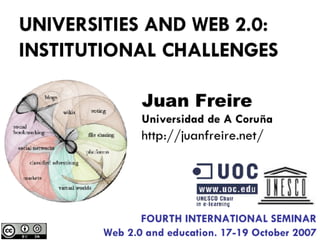
Universities and web 2.0: Institutional challenges

Loading...

Flash Player 9 (or above) is needed to view presentations.
We have detected that you do not have it on your computer. To install it, go here.

4 comments

Comments 1 - 4 of 4 previous next Post a comment

  • + alysaally Alysaally 2 years ago
    Really good information i got from your presentation its an advanced information.
  • + ClickSA ClickSA 2 years ago
    no download
  • + guest42b54a guest42b54a 2 years ago
    No file be found for download

  • + etalbert NSW Department of Education 3 years ago
    Outstanding slideshow - all the concepts, ideas and issues, relevant to most levels of education. Thanks

Post a comment
Embed Video
Edit your comment Cancel

32 Favorites & 2 Groups

Universities and web 2.0: Institutional challenges - Presentation Transcript

  1. UNIVERSITIES AND WEB 2.0: INSTITUTIONAL CHALLENGES Juan Freire Universidad de A Coruña http://juanfreire.net/ FOURTH INTERNATIONAL SEMINAR Web 2.0 and education. 17-19 October 2007
  2. 1.The promises and reality of web 2.0 3. What is web 2.0? Beyond technology 5. Bottlenecks for institutional adoption 7. Institutional fears 9. Elements for a strategy of web 2.0 adoption in universities
  3. 1. THE PROMISES AND REALITY OF WEB 2.0
  4. WE NEED A CHANGE IN LEARNING PARADIGMS Teacher - centered Learning networks Active students Hierarchical Teachers as facilitators
  5. WHY • European Space for Higher Education • Contemporary social needs and requirements Focus in • innovation • creativity • entrepreneurship HOW. WEB 2.0? • Learning by doing • Collaborative and active learning
  6. BUT … • Web 2.0 is real in universities. Lead users (employees and students) using it independently • No scaling • Web 2.0 is not real at the institutional level • Widening of the “digital divide” among persons and with their organizations
  7. 2. WHAT IS WEB 2.0? BEYOND TECHNOLOGY
  8. TECHNOLOGY: WEB 2.0 TOOLS 1. Blogs 2. Wikis 3. Audiovisual content, presentations: Fickr, Youtube, Slideshare 4. Microblogging, IM (?): Twitter, Jaiku, Pownce 5. Social networks: Facebook, MySpace … 6. Tagging and managing references (links): del.icio.us, Furl, CiteULike … 7. Especialized searching engines: Technorati, Blogsearch … 8. Agreggators and feeds readers: Google Reader, Netvibes, Bloglines … 9. …
  9. LOOSELY-COUPLED SYSTEM OF INTERNET APPLICATIONS http://www.internality.com/web20/
  10. CHARACTERISTICS • Open source. Open APIs • Tool integration. Mashups • Free or low cost • Easy learning • Easily adapted to specific needs • Users do not need to be geeks
  11. WEB 2.0 ECOSYSTEM FOR LEARNING LOOSE e-Mail (?) COUPLING FEEDS AGGREGATORS (RSS) IM Conversations Blogs FEEDBACK Community FOLKSONOMIES management Analitics social Collectibve blogs Aggregators networks Technorati Wikis Persons Del.icio.us nt te on Flickr, Youtube, Slideshare C
  12. “TROYAN HORSE” FOR A NEW SOCIAL AND CULTURAL PARADIGM Technologies for social creation of knowledge
  13. VIDEO
  14. VIDEO
  15. Tools 2.0 Web 2.0 Social networks
  16. 1. TECHNOLOGY • From “push” to “pull” • From portals to personal aggregators and searching engines
  17. THE OLD DIGITAL ORDER Yahoo! 1997
  18. THE NEW DIGITAL (DIS)ORDER Netvibes Universes 2007
  19. 2. KNOWLEDGE • from copyright to open access and content remix Origins • Free software • Scientific communities, … Open knowledge • Independent (“free speech”) • Low or 0 cost (“free beer”) • Modular • Generative
  20. 3. USERS • the revenge of amateurs • from consumers to creators and curators • social networks
  21. HOW TO NAVIGATE THE EXUBERANCE OF INFORMATION CONVENTIONAL, 1.0, APPROACH • External authorities. Hierarchies • External filters to offer contents to consumers WEB 1.5 • New filters and authorities (collective and/or imposed): Wikipedia model WEB 2.0 • Build personalized filters: Technology 2.0 + Educated users (third culture, freedom, responsability)
  22. New roles for teachers • Coaches and mentors of students • Facilitators for learning • Media and tool design • Virtual tuition • Examiners and advisers New roles for students • Active learning • Collaboration among them and with teachers • Team work
  23. 3. BOTTLENECKS FOR INSTITUTIONAL ADOPTION
  24. • Rejection by the users • Lack of an incentive system or perverse effects • Available pre-web 2.0 technology • Culture of aversion to innovation and enterpreneurship
  25. REJECTION BY USERS The case of the “open review trial” by Nature
  26. HOW TO CHANGE THE OPPOSTION OF USERS • Introduce and expand a new knowledge culture (strange to ”conventional” students and teachers) • Digital natives are entering the campuses. Opportunity or widening the divide?
  27. REQUISITES FOR A COLLABORATIVE ORGANIZATION Technological ORGANIZATION DANGER!! HIGH 2.0 abilties LOW START WITH LOW POTENTIAL LEAD USERS LOW HIGH Collaborative culture http://artesaniaenred.blogspot.com/
  28. AVAILABLE PRE-WEB 2.0 TECHNOLOGY
  29. BOTTLENECKS • 1980, 90s. Large investments in infrastructure and software • Distrust of free software and open source • Web 2.0 available almost for free • Need of a shift of efforts to integration and adaptation to the users needs: MASHUPS
  30. 4. INSTITUTIONAL FEARS OF WEB 2.0
  31. ULTIMATE CAUSES 3. Difficulties to assume the criticism of the traditional model of education and knowledge production 5. Control and power of IT departments
  32. RISKS PERCEIVED BY ORGANIZATIONS • reliability • security • governance • compliance • privacy Uncontrolled use of web 2.0: “unsanctioned employee usage” Web 2.0 policies and usage guidelines? Reduction of user innovation
  33. TRUST VS. OPENNESS Competing needs: 5. Visibility 6. Security and trust
  34. SOCIAL NETWORK TOOLS AS A SOLUTION? THE “FACEBOOK APPROACH”
  35. CONTENT: Integration of third party web 2.0 tools http://radar.oreilly.com/archives/2007/10/facebook_long_tail_report.html
  36. USERS: individual monitoring, group work PEOPLE t en em t ag in an Jo m CONTENT
  37. TRUST VS. OPENNESS IN INFRAESTRUCTURES 3. Closed network for critical, 1.0, processes 4. Open network for web 2.0 usage
  38. 5. ELEMENTS FOR A STRATEGY OF WEB 2.0 ADOPTION IN UNIVERSITIES
  39. 0. OBJETIVES AND STRATEGY PROMOTED BY MANAGERS, especially those related to knowledge and people management Requires radical cultural changes
  40. 1. LEARNING FROM PREVIOUS AND ON-GOING EXPERIENCES • Lead users inside the organization • Other organizations adopting web 2.0 and open paradigms
  41. THE VALUE OF LEAD USERS C. Let the community (teachers, students) to explore and adapt tools E. Learning by “data mining“ these experiences G. Integration of successful experiences, tools and practices
  42. Organizations: Universities
  43. Organizations: Universities
  44. Organizations: Universities
  45. Organizations: Universities
  46. Organizations: Research institutions
  47. Organizations: Research institutions
  48. 2. OPEN ACCESS AND USE OF CONTENTS Knowledge: • Digital • Modular • Flexible licenses (use and distribution) Technological (i.e. databases, XHTML) and social (i.e. tagging) standards • search engines • aggregators
  49. FLEXIBLE LICENSES
  50. 3. ORGANIZATIONS AS OPEN PLATFORMS FOR KNOWLEDGE CREATION AND SHARING Learning from experiences in business management • Open innovation • User innovation • Crowdsourcing •…
  51. EVOLUTION TO BUSINESS 2.0 1. From hierarchical and closed structures To distributed and open platforms 2. From marketing To conversations (external) 3. From knowledge management, technolgoy surveillance, prospective ... To conversations, networks and communities
  52. THE GROWING IMPORTANCE OF OPEN INNOVATION
  53. Advantages of open platforms respect to closed organizations • Lowering costs: Crowdsourcing • Accelerating innovation and knowledge creation • Increasing creativity
  54. New threats (and opportunities) • How to manage intellectual property? • How to compete being open? • How to manage human resources? • What about research?

+ Freire JuanFreire Juan, 3 years ago

custom

6328 views, 32 favs, 22 embeds more stats

UOC UNESCO Chair in eLearning. Fourth International more

More info about this document

CC Attribution-NonCommercial-ShareAlike LicenseCC Attribution-NonCommercial-ShareAlike LicenseCC Attribution-NonCommercial-ShareAlike License

Go to text version

  • Total Views 6328
    • 5875 on SlideShare
    • 453 from embeds
  • Comments 4
  • Favorites 32
  • Downloads 762
Most viewed embeds
  • 334 views on http://nomada.blogs.com
  • 27 views on http://ictlogy.net
  • 22 views on http://www.blocdeblocs.net
  • 18 views on http://redsocial.uimp20.es
  • 9 views on http://www.netvibes.com

more

All embeds
  • 334 views on http://nomada.blogs.com
  • 27 views on http://ictlogy.net
  • 22 views on http://www.blocdeblocs.net
  • 18 views on http://redsocial.uimp20.es
  • 9 views on http://www.netvibes.com
  • 7 views on http://tresescompanyia.blogspot.com
  • 5 views on http://www.sociedadytecnologia.org
  • 4 views on http://www.360doc.com
  • 4 views on http://workshopweb20.blogspot.com
  • 4 views on http://dogcb.blogspot.com
  • 3 views on http://www.joanmayans.com
  • 3 views on http://reestols.blogspot.com
  • 2 views on file://
  • 2 views on http://www.zhuaxia.com
  • 2 views on http://conectafrica.wordpress.com
  • 1 views on http://209.85.207.104
  • 1 views on http://www.cityes.org
  • 1 views on http://contrasensus.net
  • 1 views on http://patricionovoa.bligoo.com
  • 1 views on http://www.tresescompanyia.blogspot.com
  • 1 views on http://www.unsizeros.net
  • 1 views on http://www.typepad.com

less

Flagged as inappropriate Flag as inappropriate
Flag as inappropriate

Select your reason for flagging this presentation as inappropriate. If needed, use the feedback form to let us know more details.

Cancel
File a copyright complaint
Having problems? Go to our helpdesk?

Categories