Narrative explanation
in agent-based modelling


   James D.A. Millington*
      David O’Sullivan
     George L.W. Perry


                         http://landscapemodelling.net
When ABM are worth it
   ABM most appropriate for systems with:
       Interactions (between agents)
       Heterogeneity (in agents’ context)
       Organized Complexity (i.e., middle-numbered)


Argument
these properties mean a narratives can
explain how ABM structure produces
emergent system-level patterns
                                      http://landscapemodelling.net
‘Generative’ Simulation
   Specification of micro-level properties, or
    rules of element interactions, used to
    generate observed macro-level patterns

            “If you didn’t grow it,
      you didn’t explain its emergence”

                             Epstein (1999, p.43)


                                   http://landscapemodelling.net
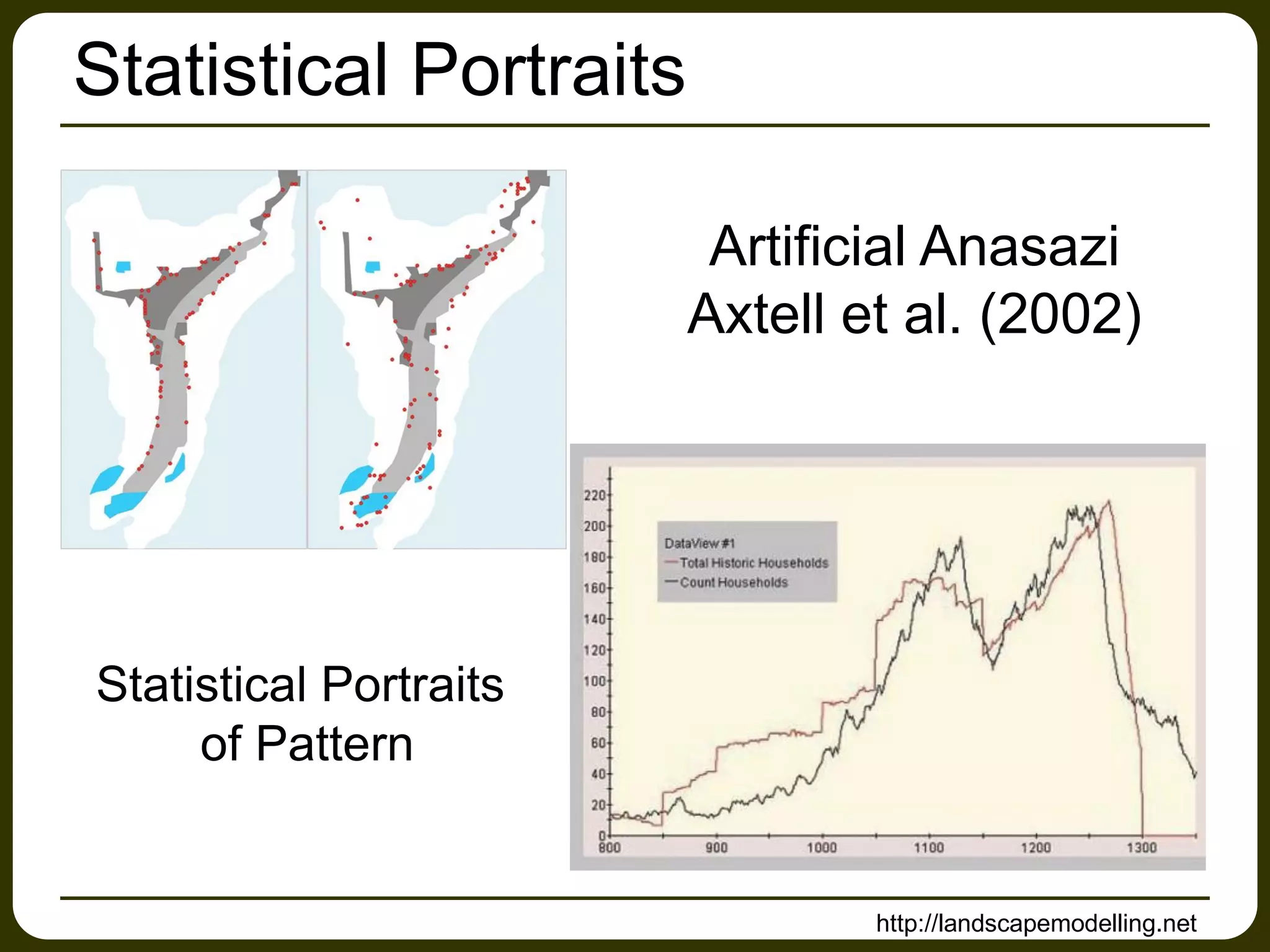
Statistical Portraits

                         Artificial Anasazi
                        Axtell et al. (2002)


Statistical Portraits
     of Pattern


                                http://landscapemodelling.net
Elaborate Black-Boxes?

“There are some warning signs here in the ABM
enterprise insofar as that greatest criterion of
‘success’ – and the claim to novelty itself – is that
patterns are produced as outcomes whereas the
intermediate process (i.e. interactions between
simple rules) which leads to structure is shrouded.”
                               (Clifford 2008, p. 682).


                                       http://landscapemodelling.net
ABM are Event-Driven
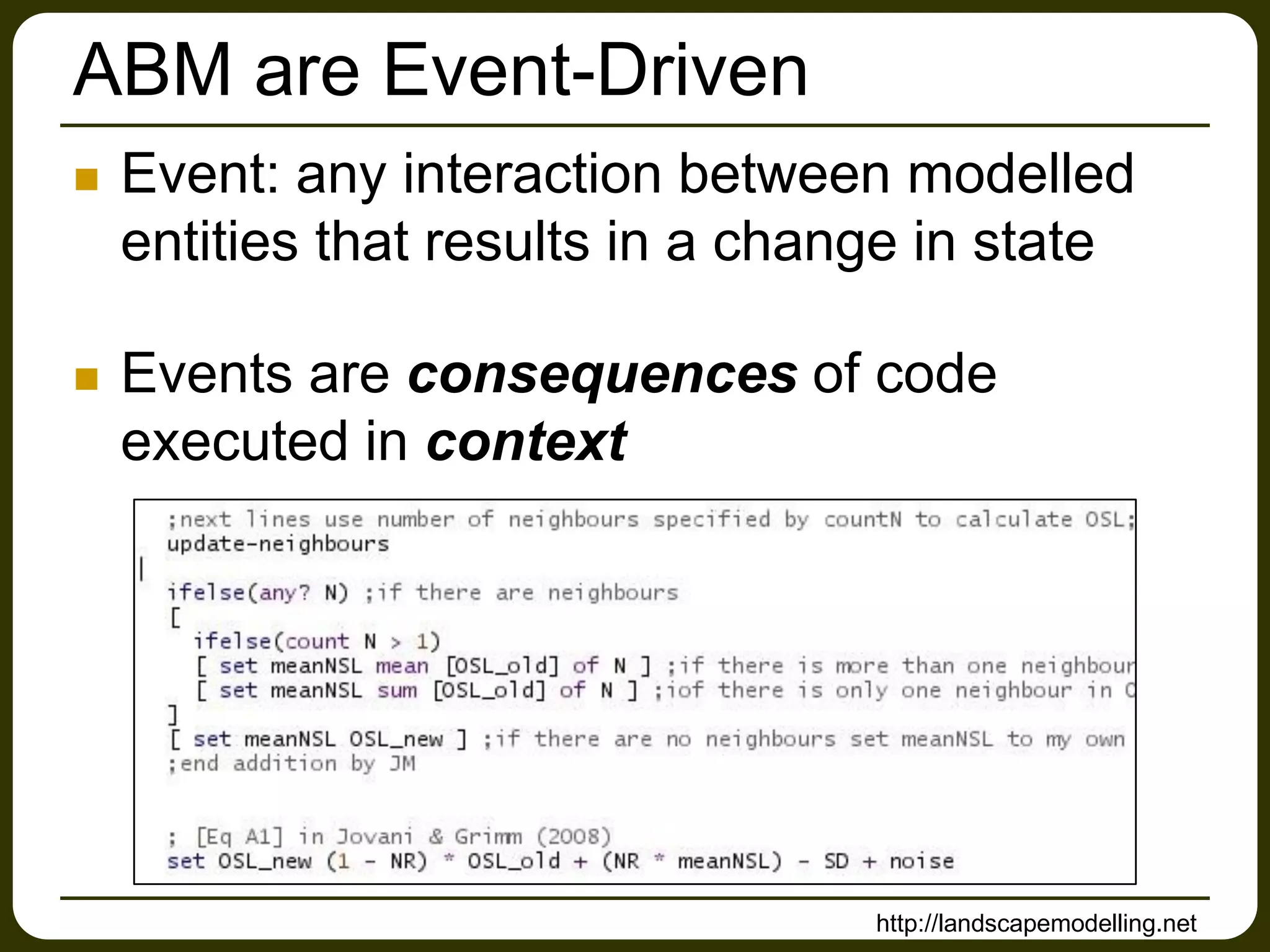
   Event: any interaction between modelled
    entities that results in a change in state of
    at least one entity attribute

    Direction
                                       Stress Level
    of travel
                         Location


                Wealth              Any other
                                     attribute
                                       http://landscapemodelling.net
ABM are Event-Driven
   Event: any interaction between modelled
    entities that results in a change in state

   Events are consequences of code
    executed in context


                                   http://landscapemodelling.net
ABM are Event-Driven
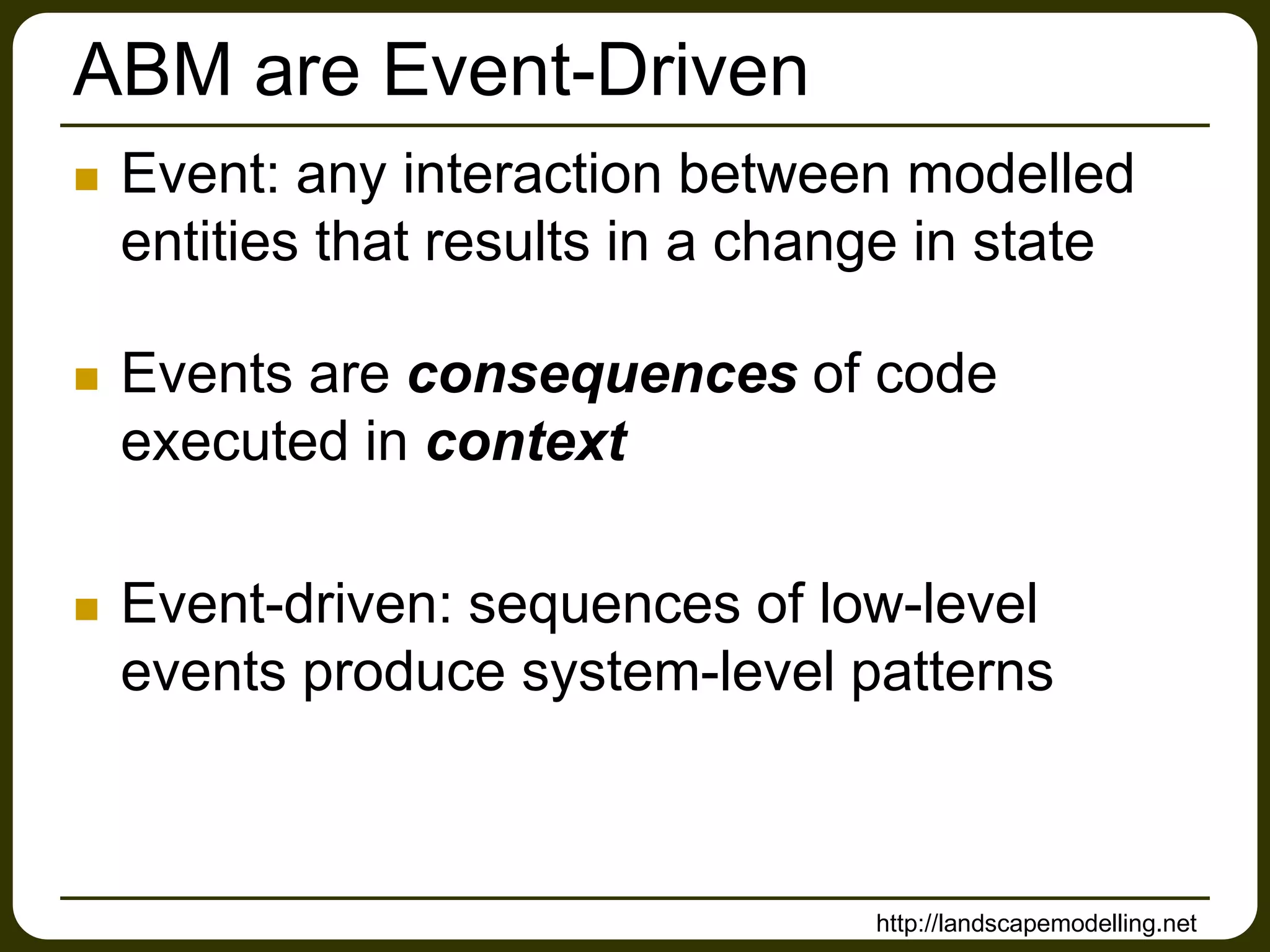
   Event: any interaction between modelled
    entities that results in a change in state

   Events are consequences of code
    executed in context

   Event-driven: sequences of low-level
    events produce system-level patterns


                                   http://landscapemodelling.net
Narrative Explanation
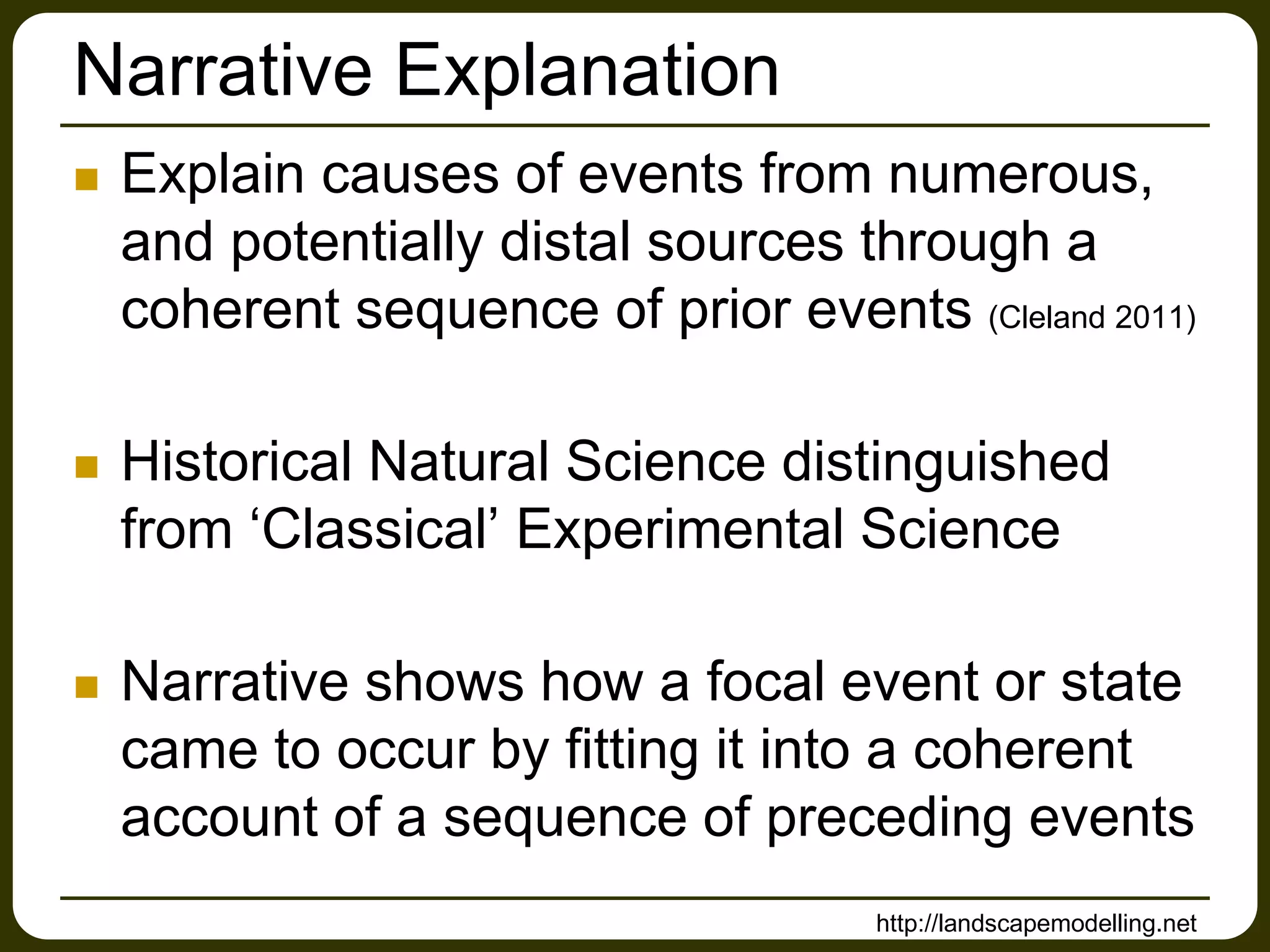
   Explain causes of events from numerous,
    and potentially distal sources through a
    coherent sequence of prior events (Cleland 2011)

   Historical Natural Science distinguished
    from ‘Classical’ Experimental Science

   Narrative shows how a focal event or state
    came to occur by fitting it into a coherent
    account of a sequence of preceding events
                                     http://landscapemodelling.net
What is a narrative?

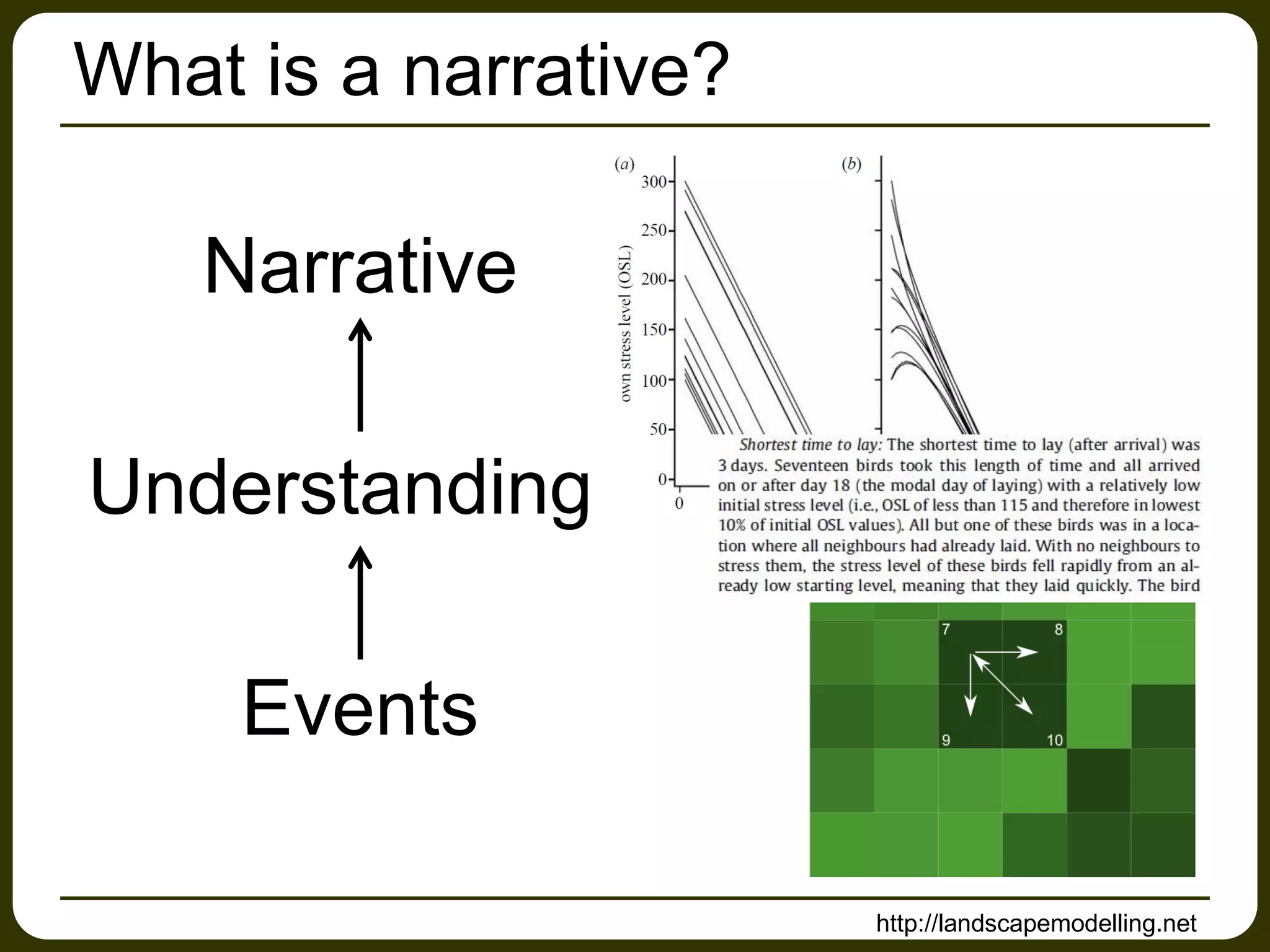
   Narrative

Understanding

     Events

                       http://landscapemodelling.net
What is a narrative?

   Narrative

      …may move back and forth between
      accounts of low-level events and
      system level (statistical) summaries to
      show how they are linked

      … is not simply a chronicle of events

                               http://landscapemodelling.net
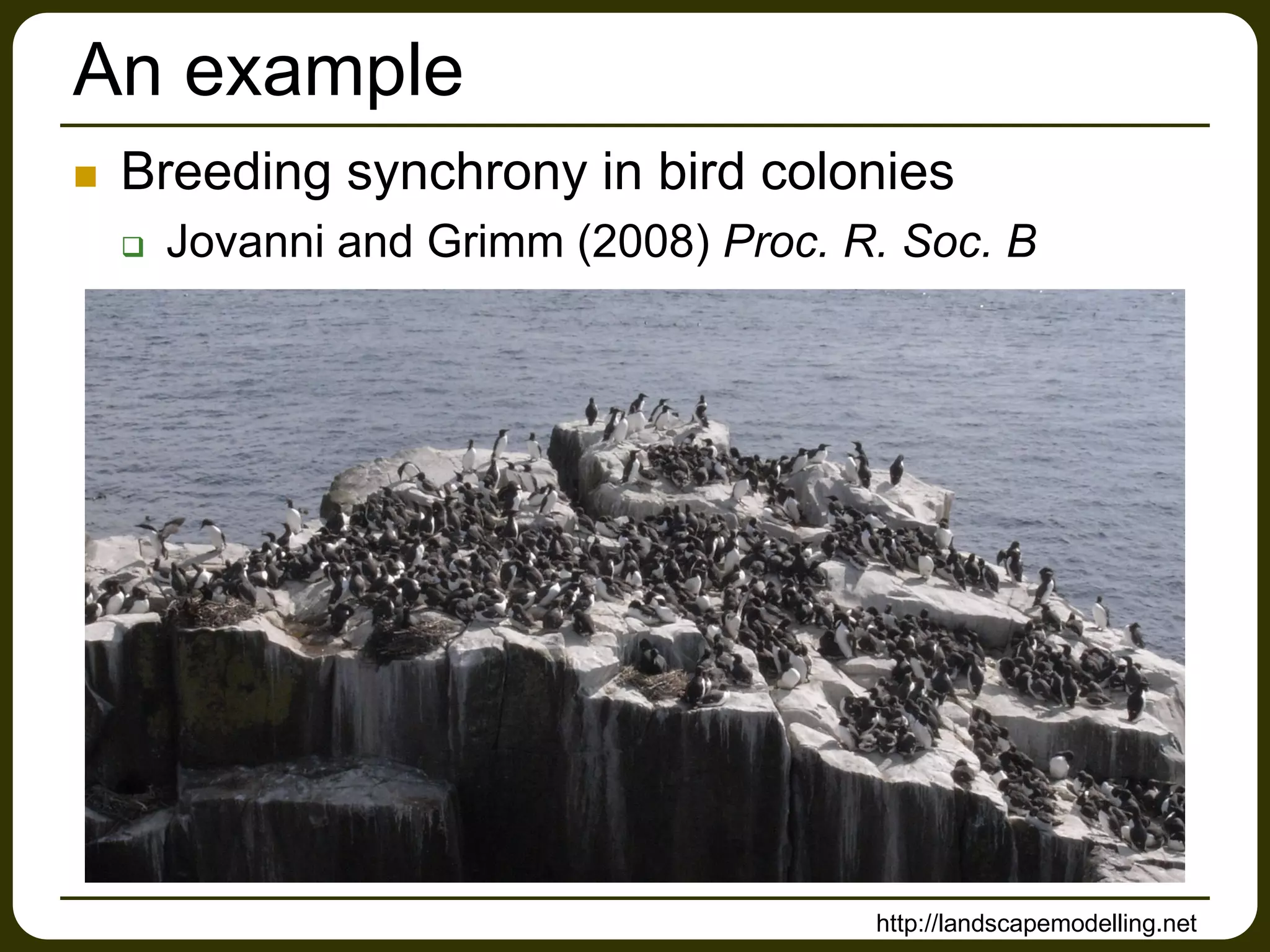
An example
   Breeding synchrony in bird colonies
       Jovanni and Grimm (2008) Proc. R. Soc. B


                                        http://landscapemodelling.net
An example
   Breeding synchrony in bird colonies
       Jovanni and Grimm (2008) Proc. R. Soc. B


                 Hypothesis:
    interactions between neighbouring
    birds’ stress levels drives synchrony


                                        http://landscapemodelling.net
Breeding Synchrony Model

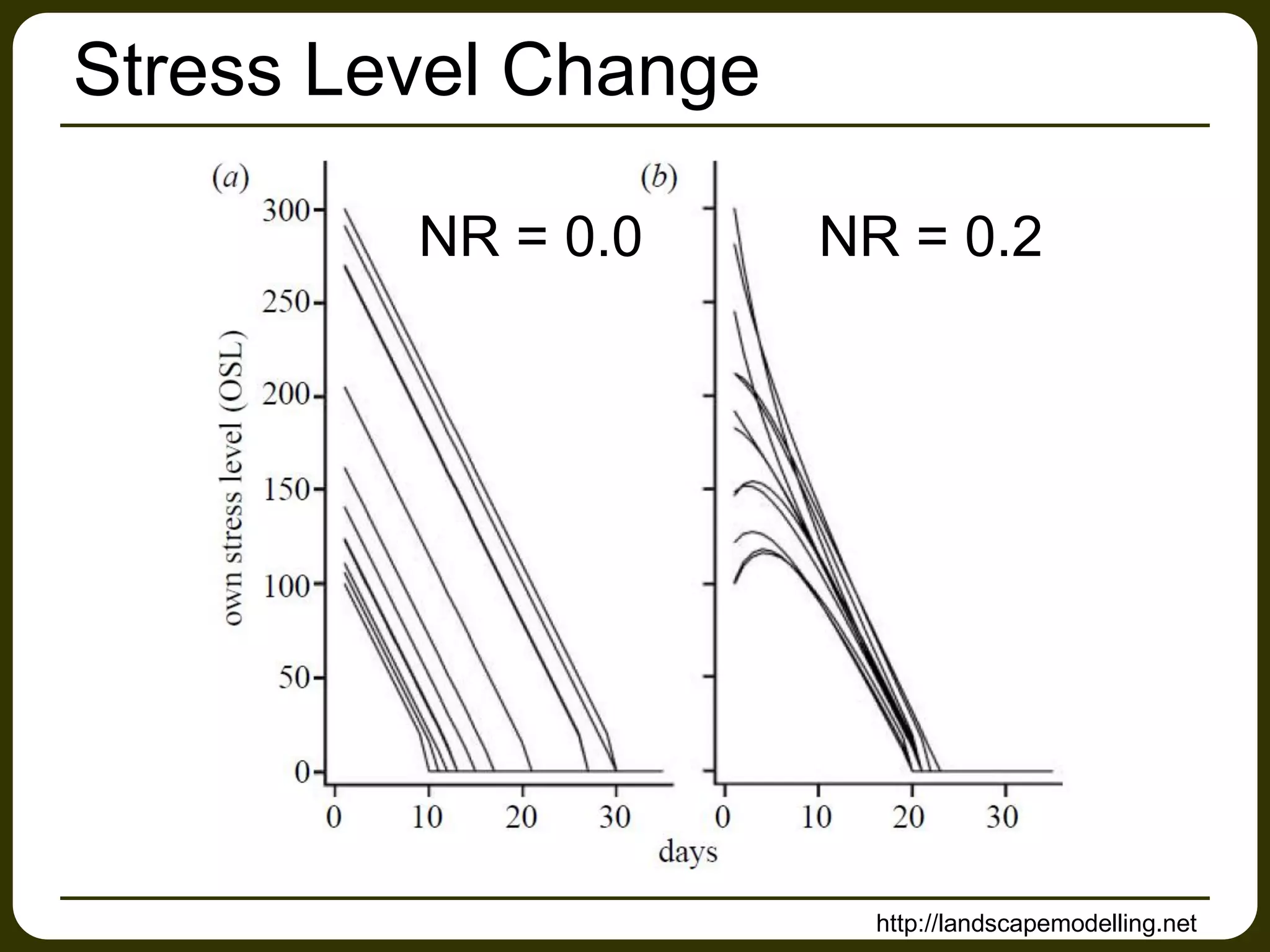
    SLt+1 = [(1-NR) × SLt] + (NR × NSLt) – SD

   SL: stress level [initially 100-300]
   NSL: neighbour(s) stress level

   NR: neighbour relevance [0,1]
   SD: stress decay [1,100]


                                     http://landscapemodelling.net
Stress Level Change

         NR = 0.0     NR = 0.2


                        http://landscapemodelling.net
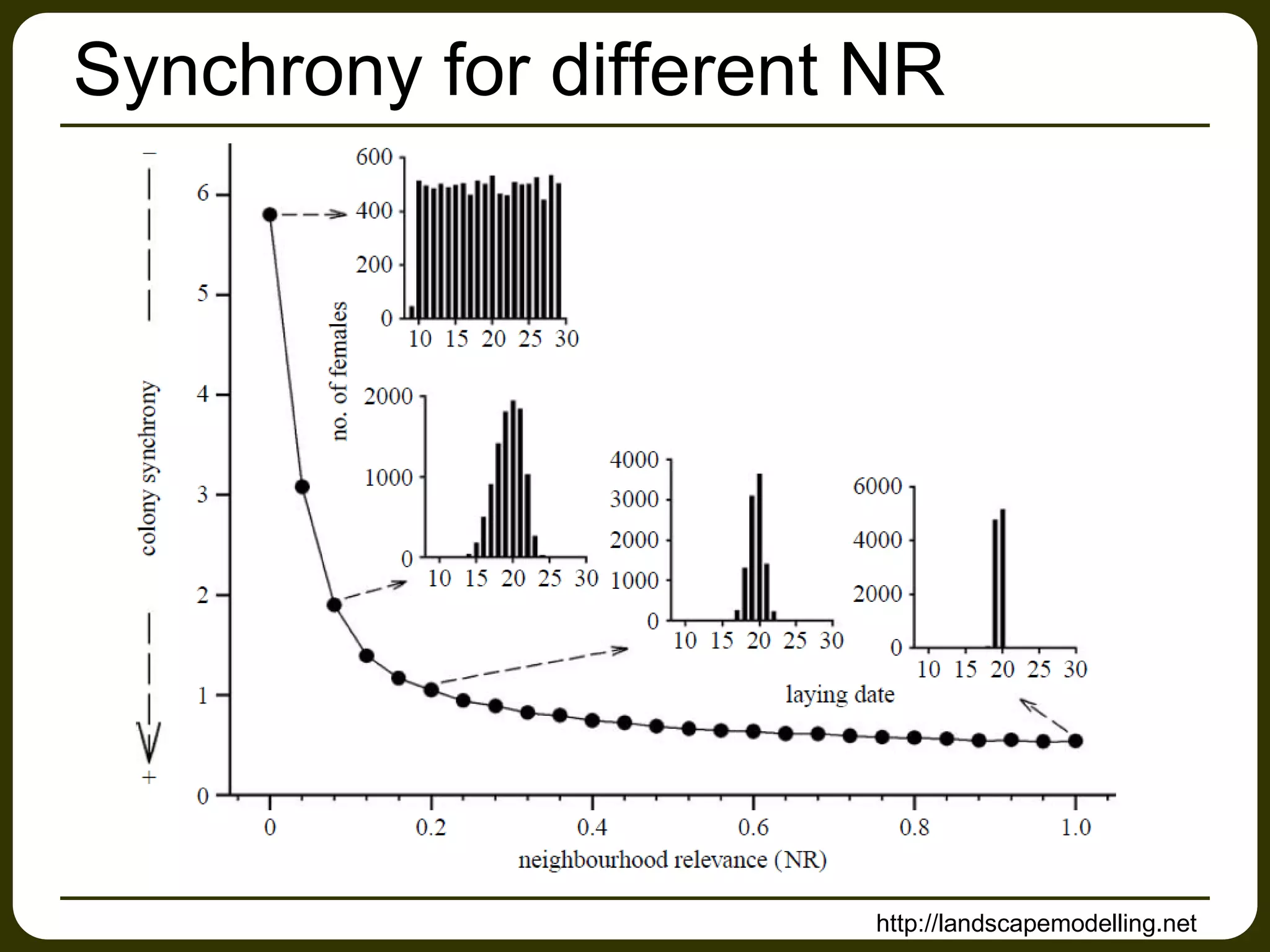
Synchrony for different NR


                       http://landscapemodelling.net
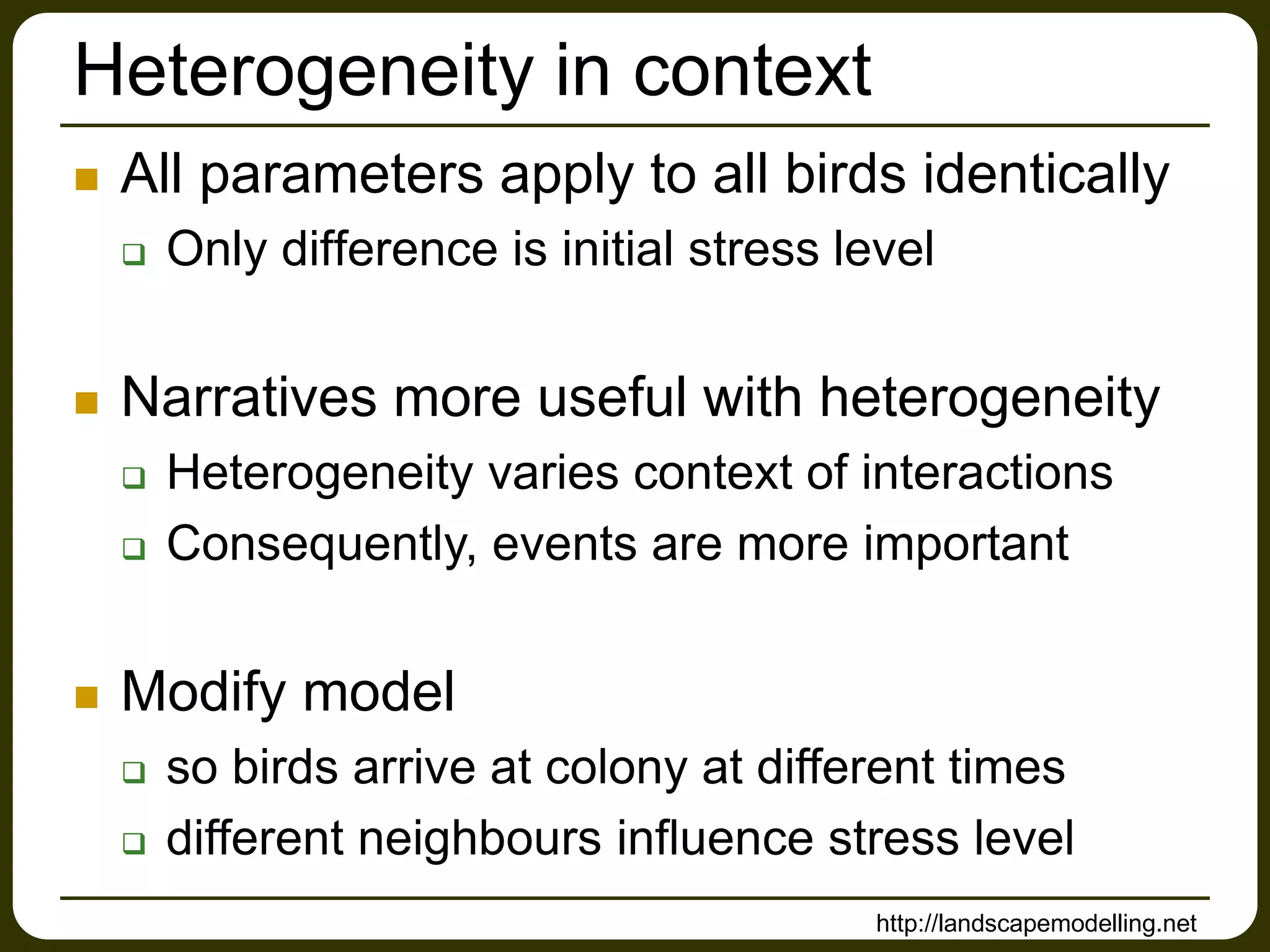
Heterogeneity in context
   All parameters apply to all birds identically
       Only difference is initial stress level


   Narratives more useful with heterogeneity
       Heterogeneity varies context of interactions
       Consequently, events are more important


   Modify model
       so birds arrive at colony at different times
       different neighbours influence stress level
                                            http://landscapemodelling.net
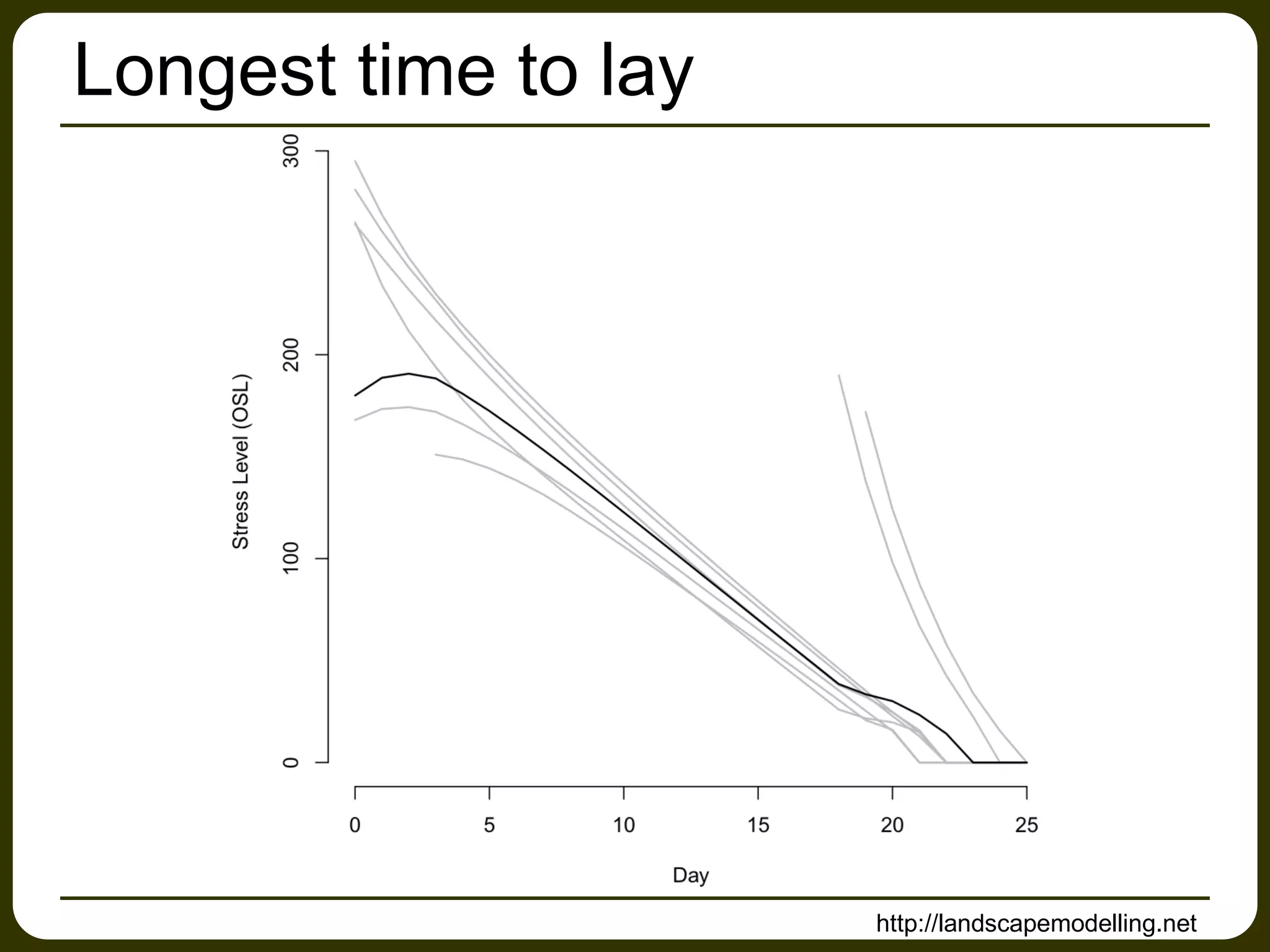
Longest time to lay


                      http://landscapemodelling.net
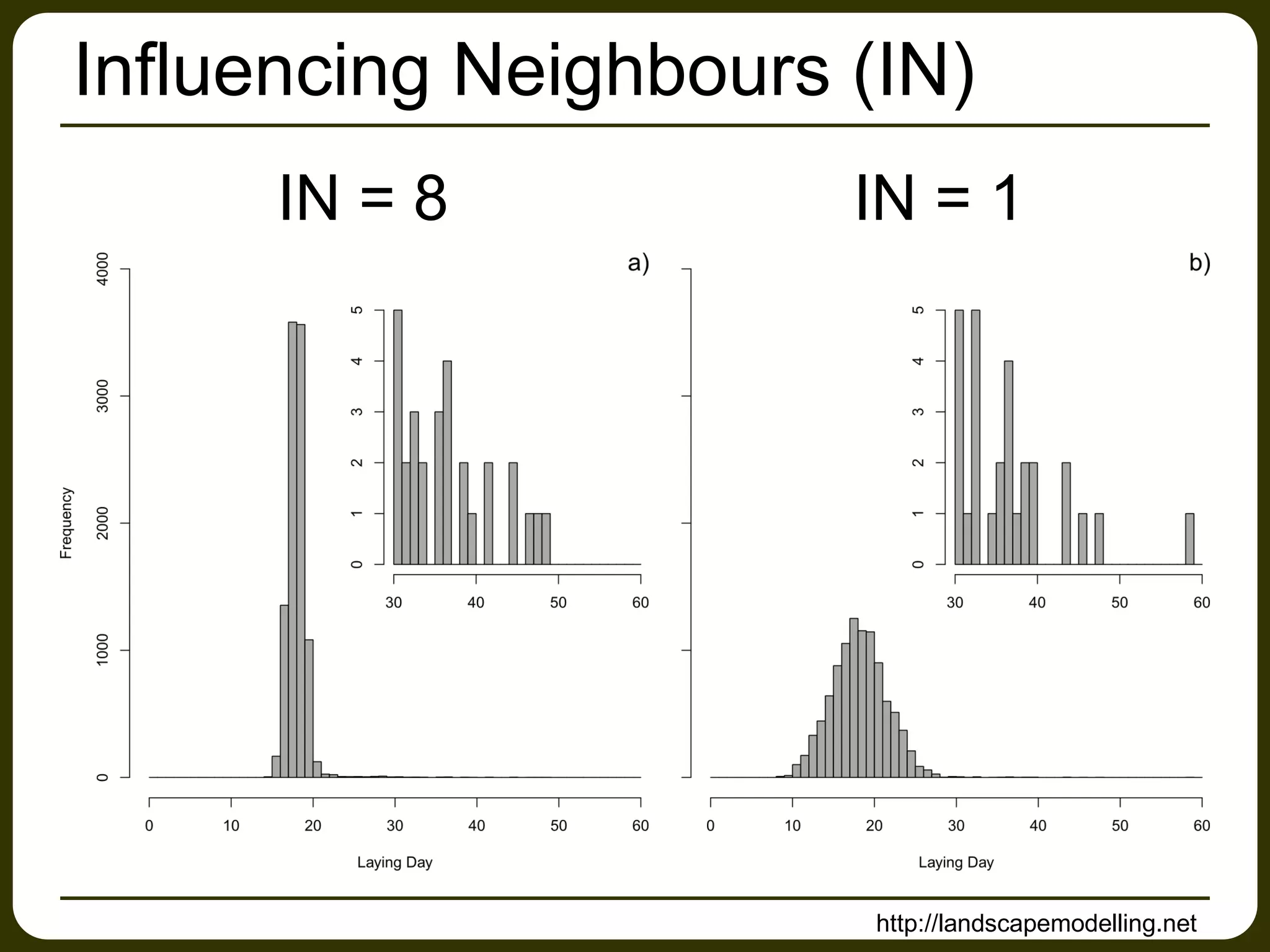
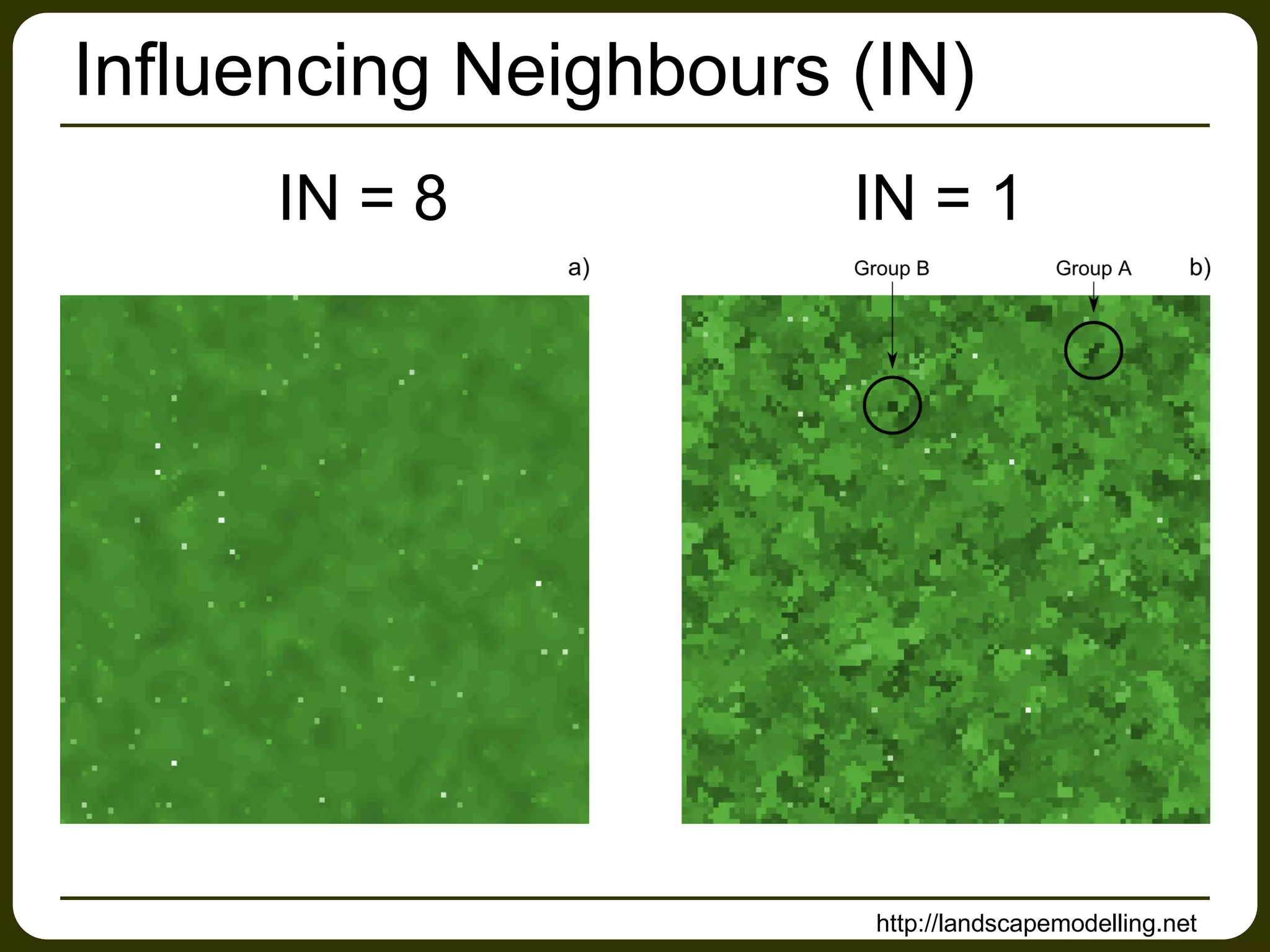
Influencing Neighbours (IN)
      IN = 8           IN = 1


                        http://landscapemodelling.net
Influencing Neighbours (IN)
      IN = 8           IN = 1


                        http://landscapemodelling.net
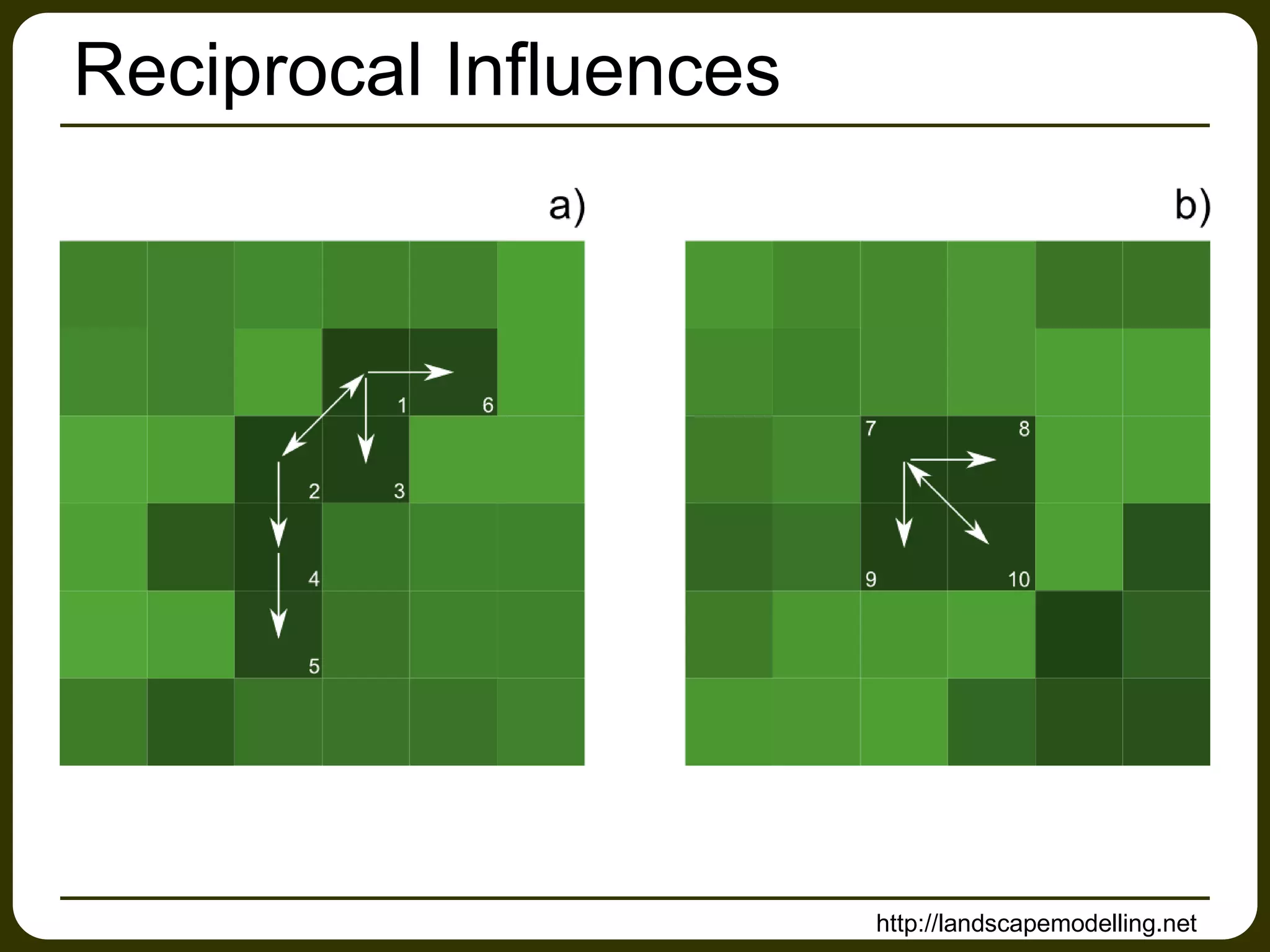
Reciprocal Influences


                        http://landscapemodelling.net
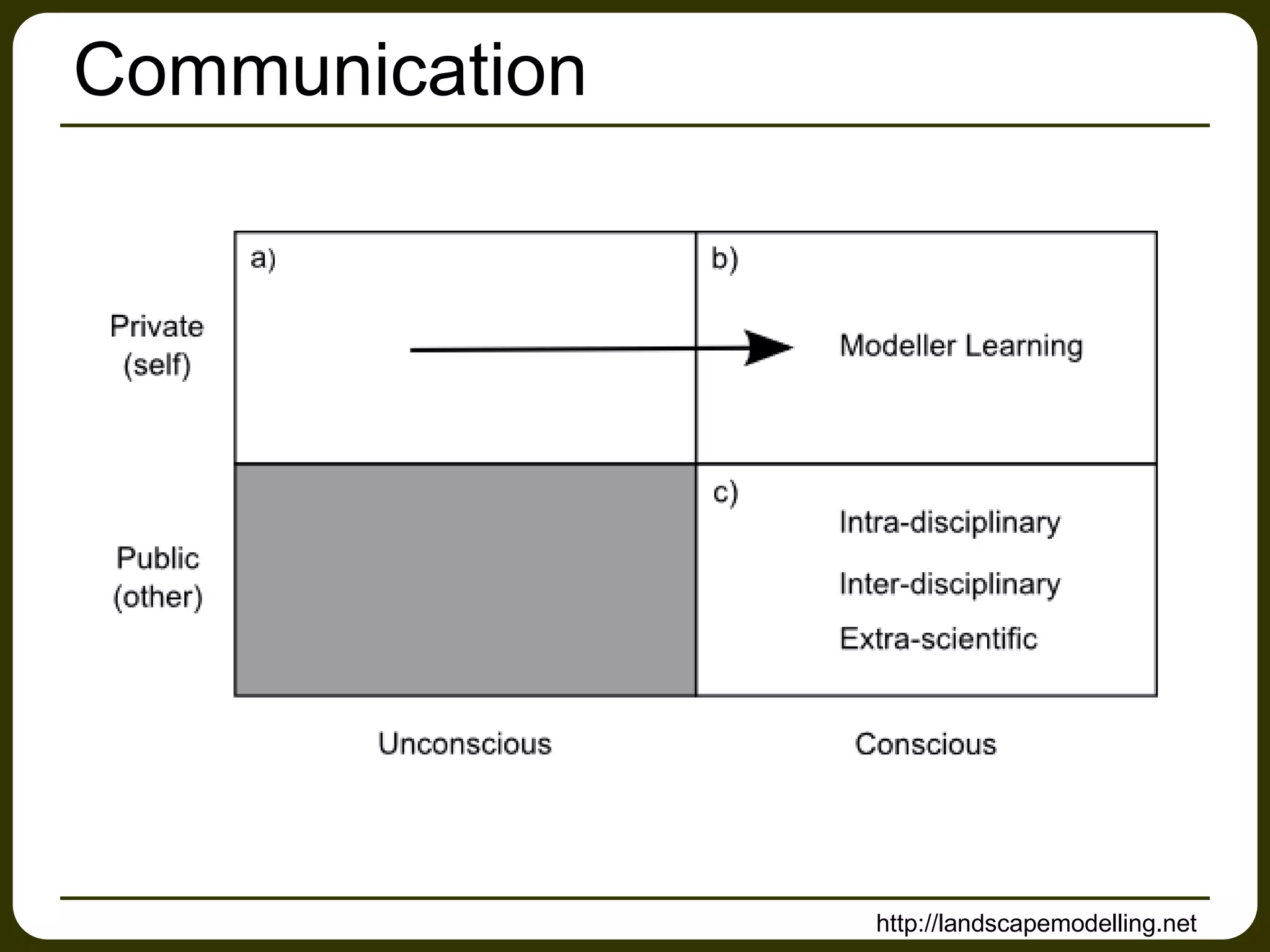
Communication


                http://landscapemodelling.net
Potential Issues
   (Re)Introducing uncertainty?
       From formal model to informal language
       Which narrative do we choose?
       How do we know if our narrative is ‘good’
        (enough)?


   Loss of objectivity?
       Highlights subjectivities of modelling
       But maybe this is a good thing…


                                          http://landscapemodelling.net
Summary
   Why simulate individuals and then report
    aggregated patterns alone?
       Spatially-explicit model without maps

   Explaining ABM events via narrative can
    reveal process

        Millington et al. (2012) Geoforum
           james.millington@kcl.ac.uk

                                        http://landscapemodelling.net

Narrative Explanation in Agent-Based Modelling - Millington AAG 2013

  • 1.
    Narrative explanation in agent-basedmodelling James D.A. Millington* David O’Sullivan George L.W. Perry http://landscapemodelling.net
  • 2.
    When ABM areworth it  ABM most appropriate for systems with:  Interactions (between agents)  Heterogeneity (in agents’ context)  Organized Complexity (i.e., middle-numbered) Argument these properties mean a narratives can explain how ABM structure produces emergent system-level patterns http://landscapemodelling.net
  • 3.
    ‘Generative’ Simulation  Specification of micro-level properties, or rules of element interactions, used to generate observed macro-level patterns “If you didn’t grow it, you didn’t explain its emergence” Epstein (1999, p.43) http://landscapemodelling.net
  • 4.
    Statistical Portraits Artificial Anasazi Axtell et al. (2002) Statistical Portraits of Pattern http://landscapemodelling.net
  • 5.
    Elaborate Black-Boxes? “There aresome warning signs here in the ABM enterprise insofar as that greatest criterion of ‘success’ – and the claim to novelty itself – is that patterns are produced as outcomes whereas the intermediate process (i.e. interactions between simple rules) which leads to structure is shrouded.” (Clifford 2008, p. 682). http://landscapemodelling.net
  • 6.
    ABM are Event-Driven  Event: any interaction between modelled entities that results in a change in state of at least one entity attribute Direction Stress Level of travel Location Wealth Any other attribute http://landscapemodelling.net
  • 7.
    ABM are Event-Driven  Event: any interaction between modelled entities that results in a change in state  Events are consequences of code executed in context http://landscapemodelling.net
  • 8.
    ABM are Event-Driven  Event: any interaction between modelled entities that results in a change in state  Events are consequences of code executed in context  Event-driven: sequences of low-level events produce system-level patterns http://landscapemodelling.net
  • 9.
    Narrative Explanation  Explain causes of events from numerous, and potentially distal sources through a coherent sequence of prior events (Cleland 2011)  Historical Natural Science distinguished from ‘Classical’ Experimental Science  Narrative shows how a focal event or state came to occur by fitting it into a coherent account of a sequence of preceding events http://landscapemodelling.net
  • 10.
    What is anarrative? Narrative Understanding Events http://landscapemodelling.net
  • 11.
    What is anarrative? Narrative …may move back and forth between accounts of low-level events and system level (statistical) summaries to show how they are linked … is not simply a chronicle of events http://landscapemodelling.net
  • 12.
    An example  Breeding synchrony in bird colonies  Jovanni and Grimm (2008) Proc. R. Soc. B http://landscapemodelling.net
  • 13.
    An example  Breeding synchrony in bird colonies  Jovanni and Grimm (2008) Proc. R. Soc. B Hypothesis: interactions between neighbouring birds’ stress levels drives synchrony http://landscapemodelling.net
  • 14.
    Breeding Synchrony Model SLt+1 = [(1-NR) × SLt] + (NR × NSLt) – SD  SL: stress level [initially 100-300]  NSL: neighbour(s) stress level  NR: neighbour relevance [0,1]  SD: stress decay [1,100] http://landscapemodelling.net
  • 15.
    Stress Level Change NR = 0.0 NR = 0.2 http://landscapemodelling.net
  • 16.
    Synchrony for differentNR http://landscapemodelling.net
  • 17.
    Heterogeneity in context  All parameters apply to all birds identically  Only difference is initial stress level  Narratives more useful with heterogeneity  Heterogeneity varies context of interactions  Consequently, events are more important  Modify model  so birds arrive at colony at different times  different neighbours influence stress level http://landscapemodelling.net
  • 18.
    Longest time tolay http://landscapemodelling.net
  • 19.
    Influencing Neighbours (IN) IN = 8 IN = 1 http://landscapemodelling.net
  • 20.
    Influencing Neighbours (IN) IN = 8 IN = 1 http://landscapemodelling.net
  • 21.
    Reciprocal Influences http://landscapemodelling.net
  • 22.
    Communication http://landscapemodelling.net
  • 23.
    Potential Issues  (Re)Introducing uncertainty?  From formal model to informal language  Which narrative do we choose?  How do we know if our narrative is ‘good’ (enough)?  Loss of objectivity?  Highlights subjectivities of modelling  But maybe this is a good thing… http://landscapemodelling.net
  • 24.
    Summary  Why simulate individuals and then report aggregated patterns alone?  Spatially-explicit model without maps  Explaining ABM events via narrative can reveal process Millington et al. (2012) Geoforum james.millington@kcl.ac.uk http://landscapemodelling.net