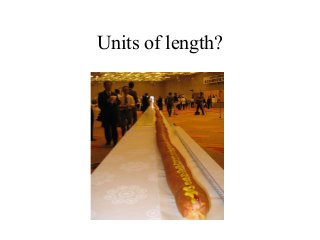
Units of length?
Units of length?
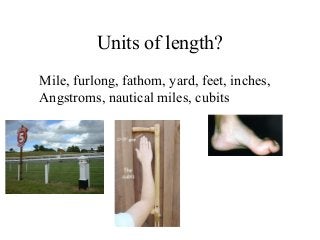
Mile, furlong, fathom, yard, feet, inches,
Angstroms, nautical miles, cubits
The SI system of units
There are seven fundamental base units
which are clearly defined and on which all
other derived units are based:
You need to know these
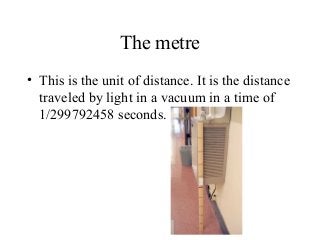
The metre
• This is the unit of distance. It is the distance
traveled by light in a vacuum in a time of
1/299792458 seconds.
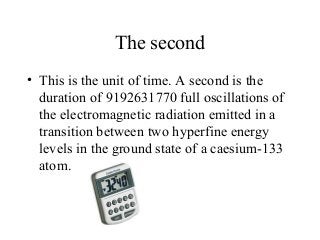
The second
• This is the unit of time. A second is the
duration of 9192631770 full oscillations of
the electromagnetic radiation emitted in a
transition between two hyperfine energy
levels in the ground state of a caesium-133
atom.
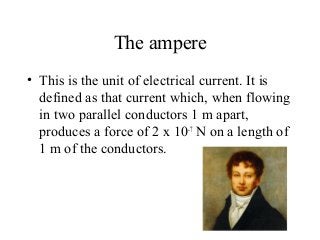
The ampere
• This is the unit of electrical current. It is
defined as that current which, when flowing
in two parallel conductors 1 m apart,
produces a force of 2 x 10⁻⁷
N on a length of
1 m of the conductors.
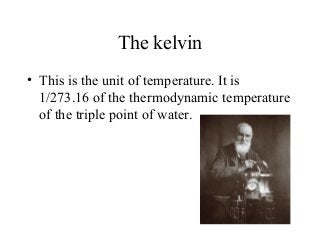
The kelvin
• This is the unit of temperature. It is
1/273.16 of the thermodynamic temperature
of the triple point of water.
The mole
• One mole of a substance contains as many
molecules as there are atoms in 12 g of
carbon-12. This special number of
molecules is called Avogadro’s number and
equals 6.02 x 10²³
.
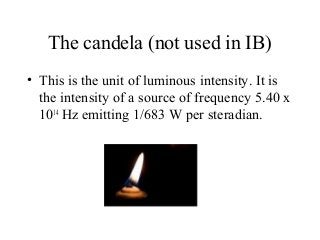
The candela (not used in IB)
• This is the unit of luminous intensity. It is
the intensity of a source of frequency 5.40 x
1014
Hz emitting 1/683 W per steradian.
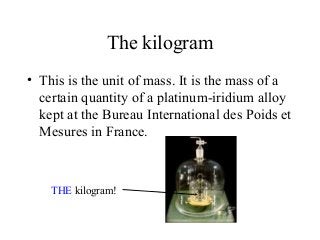
The kilogram
• This is the unit of mass. It is the mass of a
certain quantity of a platinum-iridium alloy
kept at the Bureau International des Poids et
Mesures in France.
THE kilogram!
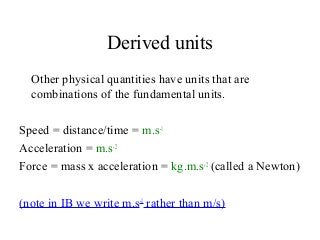
Derived units
Other physical quantities have units that are
combinations of the fundamental units.
Speed = distance/time = m.s-1
Acceleration = m.s-2
Force = mass x acceleration = kg.m.s-2
(called a Newton)
(note in IB we write m.s-1
rather than m/s)
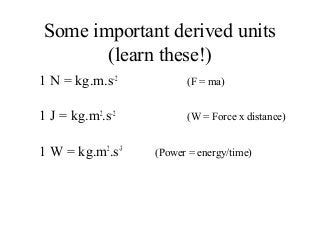
Some important derived units
(learn these!)
1 N = kg.m.s-2
(F = ma)
1 J = kg.m2
.s-2
(W = Force x distance)
1 W = kg.m2
.s-3
(Power = energy/time)
Prefixes
It is sometimes useful to express units that
are related to the basic ones by powers of
ten
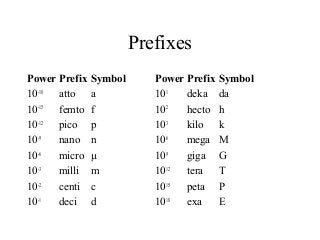
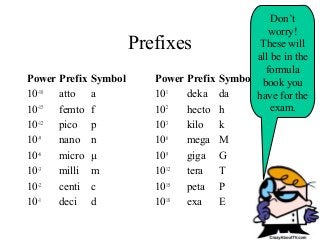
Prefixes
Power Prefix Symbol Power Prefix Symbol
10-18
atto a 101
deka da
10-15
femto f 102
hecto h
10-12
pico p 103
kilo k
10-9
nano n 106
mega M
10-6
micro μ 109
giga G
10-3
milli m 1012
tera T
10-2
centi c 1015
peta P
10-1
deci d 1018
exa E
Prefixes
Power Prefix Symbol Power Prefix Symbol
10-18
atto a 101
deka da
10-15
femto f 102
hecto h
10-12
pico p 103
kilo k
10-9
nano n 106
mega M
10-6
micro μ 109
giga G
10-3
milli m 1012
tera T
10-2
centi c 1015
peta P
10-1
deci d 1018
exa E
Don’t
worry!
These will
all be in the
formula
book you
have for the
exam.
Examples
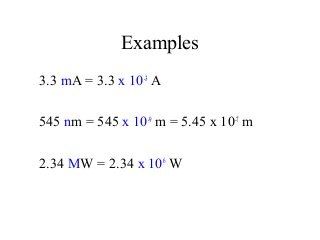
3.3 mA = 3.3 x 10⁻³
A
545 nm = 545 x 10-9
m = 5.45 x 10⁻⁷
m
2.34 MW = 2.34 x 10⁶
W
Checking equations
If an equation is correct, the units on one
side should equal the units on another. We
can use base units to help us check.
Checking equations
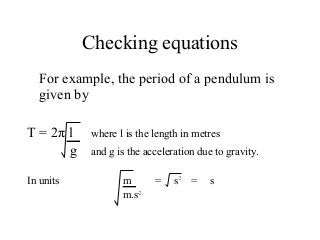
For example, the period of a pendulum is
given by
T = 2π l where l is the length in metres
g and g is the acceleration due to gravity.
In units m = s2
= s
m.s-2
Let’s try some questions for a
change
Page 6
Questions 15, 16, 18,
19, 32, 33.
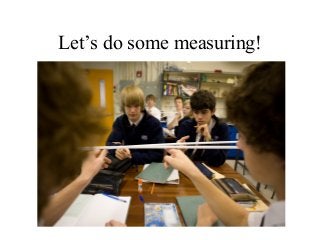
Let’s do some measuring!
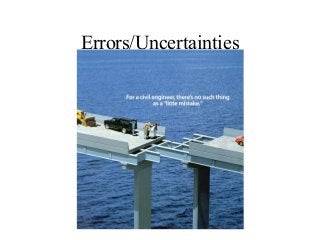
Errors/Uncertainties
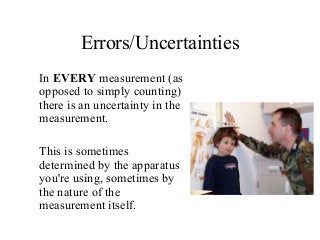
In EVERY measurement (as
opposed to simply counting)
there is an uncertainty in the
measurement.
This is sometimes
determined by the apparatus
you're using, sometimes by
the nature of the
measurement itself.
Individual measurements
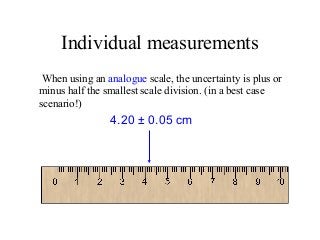
When using an analogue scale, the uncertainty is plus or
minus half the smallest scale division. (in a best case
scenario!)
4.20 ± 0.05 cm
Individual measurements
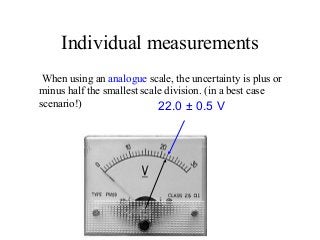
When using an analogue scale, the uncertainty is plus or
minus half the smallest scale division. (in a best case
scenario!) 22.0 ± 0.5 V
Individual measurements
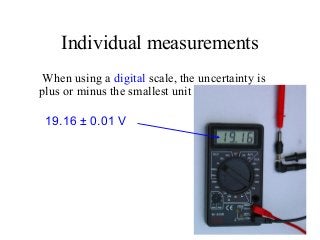
When using a digital scale, the uncertainty is
plus or minus the smallest unit shown.
19.16 ± 0.01 V
Repeated measurements
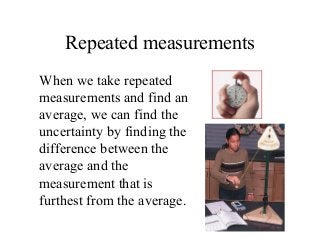
When we take repeated
measurements and find an
average, we can find the
uncertainty by finding the
difference between the
average and the
measurement that is
furthest from the average.
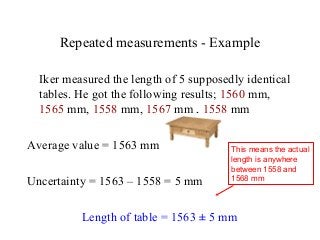
Repeated measurements - Example
Iker measured the length of 5 supposedly identical
tables. He got the following results; 1560 mm,
1565 mm, 1558 mm, 1567 mm , 1558 mm
Average value = 1563 mm
Uncertainty = 1563 – 1558 = 5 mm
Length of table = 1563 ± 5 mm
This means the actual
length is anywhere
between 1558 and
1568 mm
Precision and Accuracy
The same thing?
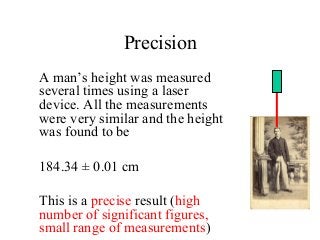
Precision
A man’s height was measured
several times using a laser
device. All the measurements
were very similar and the height
was found to be
184.34 ± 0.01 cm
This is a precise result (high
number of significant figures,
small range of measurements)
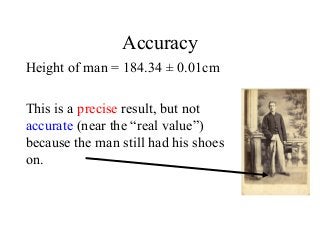
Accuracy
Height of man = 184.34 ± 0.01cm
This is a precise result, but not
accurate (near the “real value”)
because the man still had his shoes
on.
Accuracy
The man then took his shoes off and his
height was measured using a ruler to the
nearest centimetre.
Height = 182 ± 1 cm
This is accurate (near the real value) but not
precise (only 3 significant figures)
Precise and accurate
The man’s height was then measured
without his socks on using the laser device.
Height = 182.23 ± 0.01 cm
This is precise (high number of significant
figures) AND accurate (near the real value)
Random errors/uncertainties
Some measurements do vary randomly. Some
are bigger than the actual/real value, some are
smaller. This is called a random uncertainty.
Finding an average can produce a more reliable
result in this case.
Systematic/zero errors
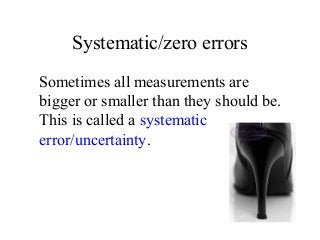
Sometimes all measurements are
bigger or smaller than they should be.
This is called a systematic
error/uncertainty.
Systematic/zero errors
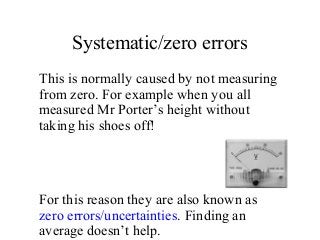
This is normally caused by not measuring
from zero. For example when you all
measured Mr Porter’s height without
taking his shoes off!
For this reason they are also known as
zero errors/uncertainties. Finding an
average doesn’t help.
Systematic/zero errors
Systematic errors are sometimes hard to
identify and eradicate.
Uncertainties
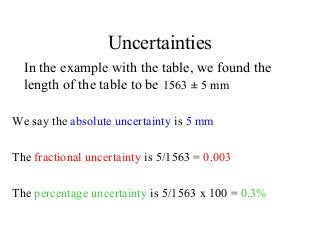
In the example with the table, we found the
length of the table to be 1563 ± 5 mm
We say the absolute uncertainty is 5 mm
The fractional uncertainty is 5/1563 = 0.003
The percentage uncertainty is 5/1563 x 100 = 0.3%
Uncertainties
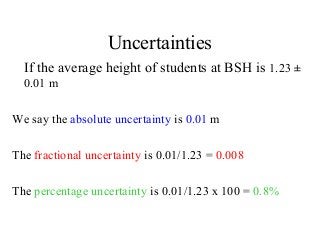
If the average height of students at BSH is 1.23 ±
0.01 m
We say the absolute uncertainty is 0.01 m
The fractional uncertainty is 0.01/1.23 = 0.008
The percentage uncertainty is 0.01/1.23 x 100 = 0.8%
Let’s try some questions.
Combining uncertainties
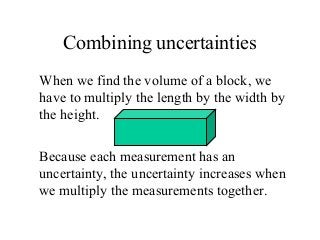
When we find the volume of a block, we
have to multiply the length by the width by
the height.
Because each measurement has an
uncertainty, the uncertainty increases when
we multiply the measurements together.
Combining uncertainties
When multiplying (or dividing) quantities,
to find the resultant uncertainty we have to
add the percentage uncertainties of the
quantities we are multiplying.
Combining uncertainties
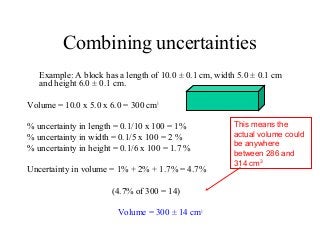
Example: A block has a length of 10.0 ± 0.1 cm, width 5.0 ± 0.1 cm
and height 6.0 ± 0.1 cm.
Volume = 10.0 x 5.0 x 6.0 = 300 cm3
% uncertainty in length = 0.1/10 x 100 = 1%
% uncertainty in width = 0.1/5 x 100 = 2 %
% uncertainty in height = 0.1/6 x 100 = 1.7 %
Uncertainty in volume = 1% + 2% + 1.7% = 4.7%
(4.7% of 300 = 14)
Volume = 300 ± 14 cm3
This means the
actual volume could
be anywhere
between 286 and
314 cm3
Combining uncertainties
When adding (or
subtracting) quantities, to
find the resultant
uncertainty we have to add
the absolute uncertainties
of the quantities we are
multiplying.
Combining uncertainties
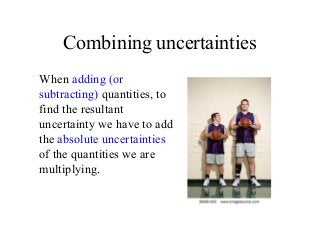
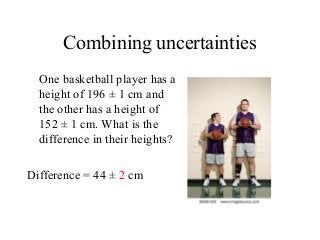
One basketball player has a
height of 196 ± 1 cm and
the other has a height of
152 ± 1 cm. What is the
difference in their heights?
Difference = 44 ± 2 cm
Who’s going to win?
New York Times
Latest opinion poll
Bush 48%
Gore 52%
Gore will win!
Uncertainty = ± 5%
Who’s going to win?
New York Times
Latest opinion poll
Bush 48%
Gore 52%
Gore will win!
Uncertainty = ± 5%
Who’s going to win?
New York Times
Latest opinion poll
Bush 48%
Gore 52%
Gore will win!
Uncertainty = ± 5%
Uncertainty = ± 5%
Who’s going to win
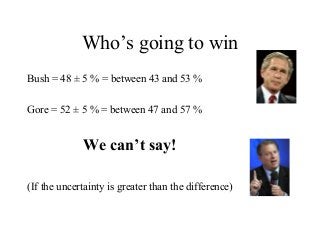
Bush = 48 ± 5 % = between 43 and 53 %
Gore = 52 ± 5 % = between 47 and 57 %
We can’t say!
(If the uncertainty is greater than the difference)
Let’s try some more questions!

Lessons 3 &_4_si_units_and_errors

  • 1.
  • 2.
    Units of length? Mile,furlong, fathom, yard, feet, inches, Angstroms, nautical miles, cubits
  • 3.
    The SI systemof units There are seven fundamental base units which are clearly defined and on which all other derived units are based: You need to know these
  • 4.
    The metre • Thisis the unit of distance. It is the distance traveled by light in a vacuum in a time of 1/299792458 seconds.
  • 5.
    The second • Thisis the unit of time. A second is the duration of 9192631770 full oscillations of the electromagnetic radiation emitted in a transition between two hyperfine energy levels in the ground state of a caesium-133 atom.
  • 6.
    The ampere • Thisis the unit of electrical current. It is defined as that current which, when flowing in two parallel conductors 1 m apart, produces a force of 2 x 10⁻⁷ N on a length of 1 m of the conductors.
  • 7.
    The kelvin • Thisis the unit of temperature. It is 1/273.16 of the thermodynamic temperature of the triple point of water.
  • 8.
    The mole • Onemole of a substance contains as many molecules as there are atoms in 12 g of carbon-12. This special number of molecules is called Avogadro’s number and equals 6.02 x 10²³ .
  • 9.
    The candela (notused in IB) • This is the unit of luminous intensity. It is the intensity of a source of frequency 5.40 x 10¹⁴ Hz emitting 1/683 W per steradian.
  • 10.
    The kilogram • Thisis the unit of mass. It is the mass of a certain quantity of a platinum-iridium alloy kept at the Bureau International des Poids et Mesures in France. THE kilogram!
  • 11.
    Derived units Other physicalquantities have units that are combinations of the fundamental units. Speed = distance/time = m.s-1 Acceleration = m.s-2 Force = mass x acceleration = kg.m.s-2 (called a Newton) (note in IB we write m.s-1 rather than m/s)
  • 12.
    Some important derivedunits (learn these!) 1 N = kg.m.s-2 (F = ma) 1 J = kg.m2 .s-2 (W = Force x distance) 1 W = kg.m2 .s-3 (Power = energy/time)
  • 13.
    Prefixes It is sometimesuseful to express units that are related to the basic ones by powers of ten
  • 14.
    Prefixes Power Prefix SymbolPower Prefix Symbol 10-18 atto a 101 deka da 10-15 femto f 102 hecto h 10-12 pico p 103 kilo k 10-9 nano n 106 mega M 10-6 micro μ 109 giga G 10-3 milli m 1012 tera T 10-2 centi c 1015 peta P 10-1 deci d 1018 exa E
  • 15.
    Prefixes Power Prefix SymbolPower Prefix Symbol 10-18 atto a 101 deka da 10-15 femto f 102 hecto h 10-12 pico p 103 kilo k 10-9 nano n 106 mega M 10-6 micro μ 109 giga G 10-3 milli m 1012 tera T 10-2 centi c 1015 peta P 10-1 deci d 1018 exa E Don’t worry! These will all be in the formula book you have for the exam.
  • 16.
    Examples 3.3 mA =3.3 x 10⁻³ A 545 nm = 545 x 10-9 m = 5.45 x 10⁻⁷ m 2.34 MW = 2.34 x 10⁶ W
  • 17.
    Checking equations If anequation is correct, the units on one side should equal the units on another. We can use base units to help us check.
  • 18.
    Checking equations For example,the period of a pendulum is given by T = 2π l where l is the length in metres g and g is the acceleration due to gravity. In units m = s2 = s m.s-2
  • 19.
    Let’s try somequestions for a change Page 6 Questions 15, 16, 18, 19, 32, 33.
  • 20.
    Let’s do somemeasuring!
  • 21.
  • 22.
    Errors/Uncertainties In EVERY measurement(as opposed to simply counting) there is an uncertainty in the measurement. This is sometimes determined by the apparatus you're using, sometimes by the nature of the measurement itself.
  • 23.
    Individual measurements When usingan analogue scale, the uncertainty is plus or minus half the smallest scale division. (in a best case scenario!) 4.20 ± 0.05 cm
  • 24.
    Individual measurements When usingan analogue scale, the uncertainty is plus or minus half the smallest scale division. (in a best case scenario!) 22.0 ± 0.5 V
  • 25.
    Individual measurements When usinga digital scale, the uncertainty is plus or minus the smallest unit shown. 19.16 ± 0.01 V
  • 26.
    Repeated measurements When wetake repeated measurements and find an average, we can find the uncertainty by finding the difference between the average and the measurement that is furthest from the average.
  • 27.
    Repeated measurements -Example Iker measured the length of 5 supposedly identical tables. He got the following results; 1560 mm, 1565 mm, 1558 mm, 1567 mm , 1558 mm Average value = 1563 mm Uncertainty = 1563 – 1558 = 5 mm Length of table = 1563 ± 5 mm This means the actual length is anywhere between 1558 and 1568 mm
  • 28.
  • 29.
    Precision A man’s heightwas measured several times using a laser device. All the measurements were very similar and the height was found to be 184.34 ± 0.01 cm This is a precise result (high number of significant figures, small range of measurements)
  • 30.
    Accuracy Height of man= 184.34 ± 0.01cm This is a precise result, but not accurate (near the “real value”) because the man still had his shoes on.
  • 31.
    Accuracy The man thentook his shoes off and his height was measured using a ruler to the nearest centimetre. Height = 182 ± 1 cm This is accurate (near the real value) but not precise (only 3 significant figures)
  • 32.
    Precise and accurate Theman’s height was then measured without his socks on using the laser device. Height = 182.23 ± 0.01 cm This is precise (high number of significant figures) AND accurate (near the real value)
  • 33.
    Random errors/uncertainties Some measurementsdo vary randomly. Some are bigger than the actual/real value, some are smaller. This is called a random uncertainty. Finding an average can produce a more reliable result in this case.
  • 34.
    Systematic/zero errors Sometimes allmeasurements are bigger or smaller than they should be. This is called a systematic error/uncertainty.
  • 35.
    Systematic/zero errors This isnormally caused by not measuring from zero. For example when you all measured Mr Porter’s height without taking his shoes off! For this reason they are also known as zero errors/uncertainties. Finding an average doesn’t help.
  • 36.
    Systematic/zero errors Systematic errorsare sometimes hard to identify and eradicate.
  • 37.
    Uncertainties In the examplewith the table, we found the length of the table to be 1563 ± 5 mm We say the absolute uncertainty is 5 mm The fractional uncertainty is 5/1563 = 0.003 The percentage uncertainty is 5/1563 x 100 = 0.3%
  • 38.
    Uncertainties If the averageheight of students at BSH is 1.23 ± 0.01 m We say the absolute uncertainty is 0.01 m The fractional uncertainty is 0.01/1.23 = 0.008 The percentage uncertainty is 0.01/1.23 x 100 = 0.8%
  • 39.
    Let’s try somequestions.
  • 40.
    Combining uncertainties When wefind the volume of a block, we have to multiply the length by the width by the height. Because each measurement has an uncertainty, the uncertainty increases when we multiply the measurements together.
  • 41.
    Combining uncertainties When multiplying(or dividing) quantities, to find the resultant uncertainty we have to add the percentage uncertainties of the quantities we are multiplying.
  • 42.
    Combining uncertainties Example: Ablock has a length of 10.0 ± 0.1 cm, width 5.0 ± 0.1 cm and height 6.0 ± 0.1 cm. Volume = 10.0 x 5.0 x 6.0 = 300 cm3 % uncertainty in length = 0.1/10 x 100 = 1% % uncertainty in width = 0.1/5 x 100 = 2 % % uncertainty in height = 0.1/6 x 100 = 1.7 % Uncertainty in volume = 1% + 2% + 1.7% = 4.7% (4.7% of 300 = 14) Volume = 300 ± 14 cm3 This means the actual volume could be anywhere between 286 and 314 cm3
  • 43.
    Combining uncertainties When adding(or subtracting) quantities, to find the resultant uncertainty we have to add the absolute uncertainties of the quantities we are multiplying.
  • 44.
    Combining uncertainties One basketballplayer has a height of 196 ± 1 cm and the other has a height of 152 ± 1 cm. What is the difference in their heights? Difference = 44 ± 2 cm
  • 45.
    Who’s going towin? New York Times Latest opinion poll Bush 48% Gore 52% Gore will win! Uncertainty = ± 5%
  • 46.
    Who’s going towin? New York Times Latest opinion poll Bush 48% Gore 52% Gore will win! Uncertainty = ± 5%
  • 47.
    Who’s going towin? New York Times Latest opinion poll Bush 48% Gore 52% Gore will win! Uncertainty = ± 5% Uncertainty = ± 5%
  • 48.
    Who’s going towin Bush = 48 ± 5 % = between 43 and 53 % Gore = 52 ± 5 % = between 47 and 57 % We can’t say! (If the uncertainty is greater than the difference)
  • 49.
    Let’s try somemore questions!