Exit Planning A Roadmap to Achieving Ownership Goals  “Getting it right the first time” Strategic Exit Advisors 95 W. Court Street Doylestown, PA 18901 www.se-adv.com PA – (215) 489-8881 NJ – (609) 466-3100 Your Future, Our Focus SM
Roadmap Questions Beginning the Journey Who will you sell or pass the business on to? How much money do you need after leaving the business, to live comfortably in your lifestyle? When will you begin to leave the business? 3 to 5 years prior to starting departure
Let's Define Exit Planning Exit Planning is a 7 step process that aligns your business ownership interest with your personal goals  It is designed to answer the questions that keep owners like you up at night  What is my company worth? Is there a market for my company? Who will buy my company? If something happens, is the business protected? How do I maximize value and minimize taxes? Will the business fund my life style, or Legacy goals? Overview Step 2 Step 3 Step 4 Step 5 Step 6 Step 7 Conclusion Step 1
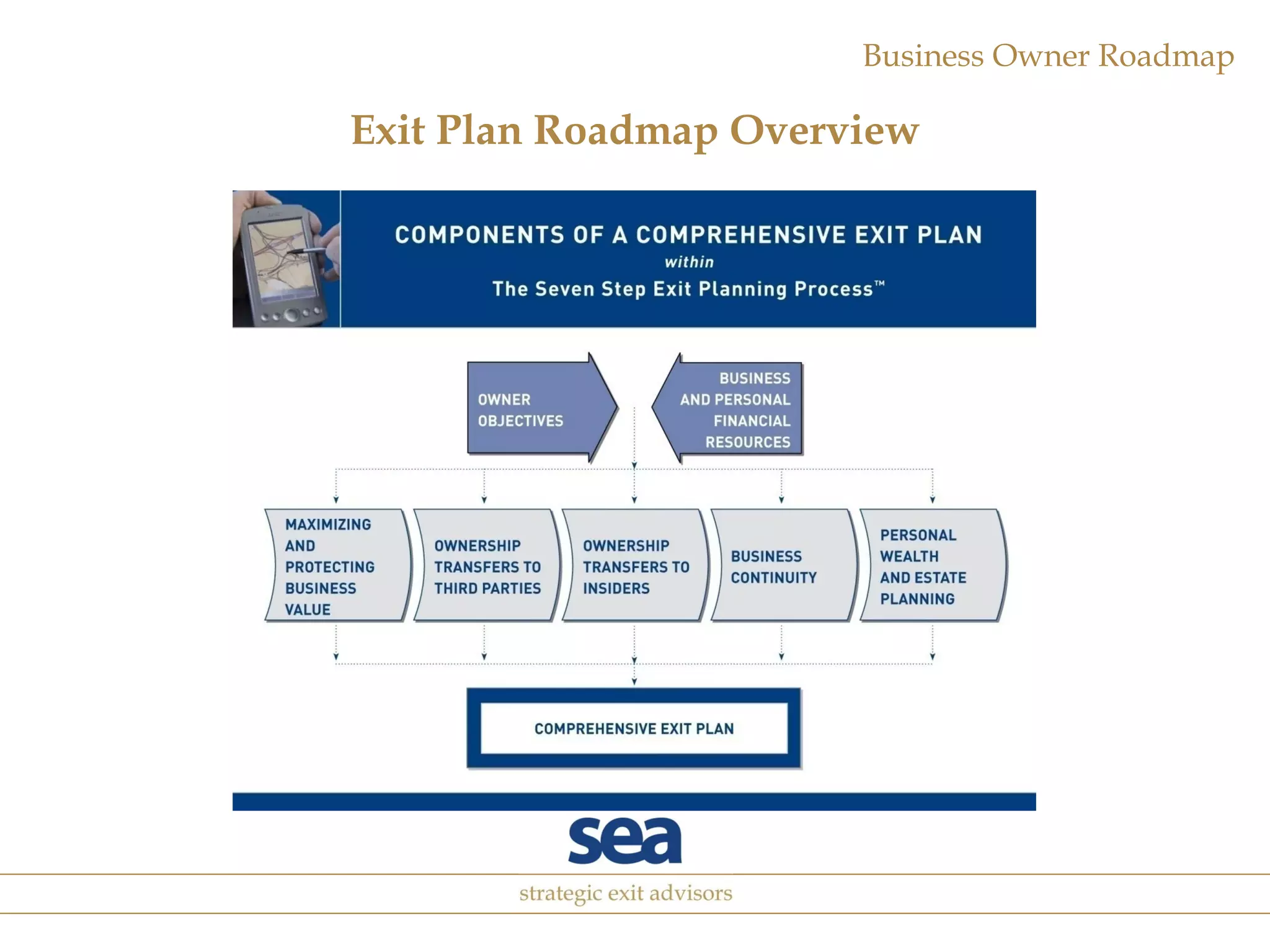
Exit Plan Roadmap Overview
Step 1 - Identify Owner Objectives “ I need to feel like all aspects of my planning are tied together in one coherent plan.” Let's answer the following questions How much longer do you want to work in the business? What is the annual after-tax income you want during retirement?  Who do you want to transfer the business to? Do you have other long-term financial goals?  Shifting wealth to children Reward your employees Maintain ownership indefinitely  Step 2 Step 3 Step 4 Step 5 Step 6 Step 7 Conclusion Overview Step 1
Step 2 - Identify Business & Personal Financial Resources “  I can’t really plan for one area of my future without planning for all areas that relate to my business and personal wealth.” Can Your Goals and Objectives be Met?  What other assets do you have to work with?  Is there an up-to-date financial needs analysis? How much cash flow is available for your use?  Are you going to have to adjust your expectations?  Step 1 Step 3 Step 4 Step 5 Step 6 Step 7 Conclusion Overview Step 2
Step 3 – Maximizing & Protecting Business Value   “ I need to strengthen my company to better withstand competitive pressure.” Key Value Driver Questions  How does your company compare with its peer group?  Are cash and reported earnings sustainable?  Are revenues one-time or recurring?  Is there a growth plan in place?  Are key managers incented with cash/stock plans Is your business "embedded" with clients? Step 1 Step 2 Step 4 Step 5 Step 6 Step 7 Conclusion Overview Step 3
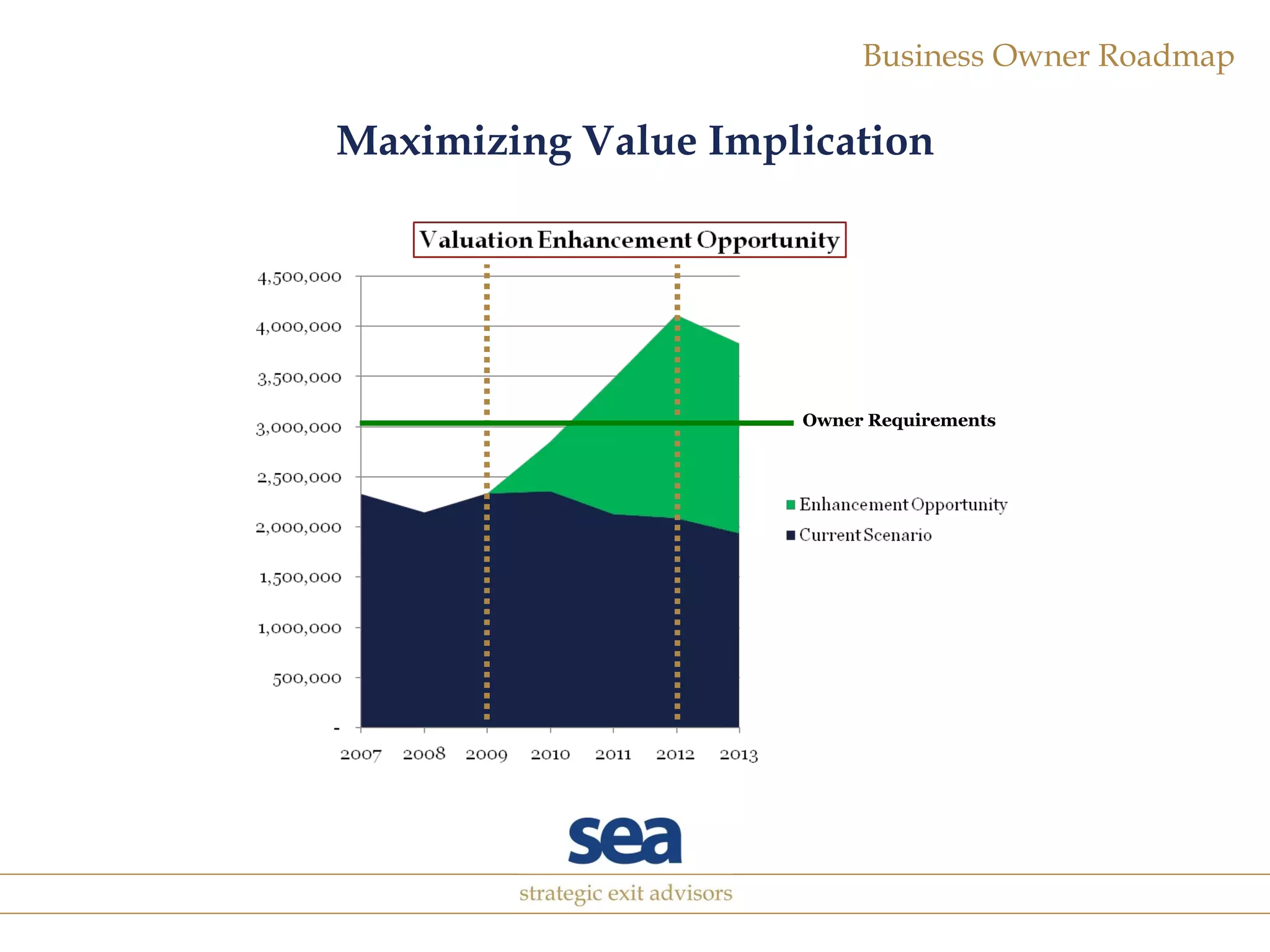
Maximizing Value Implication Owner Requirements
Ownership Transfer Third Party Sale? Or, Transfer to Insiders?
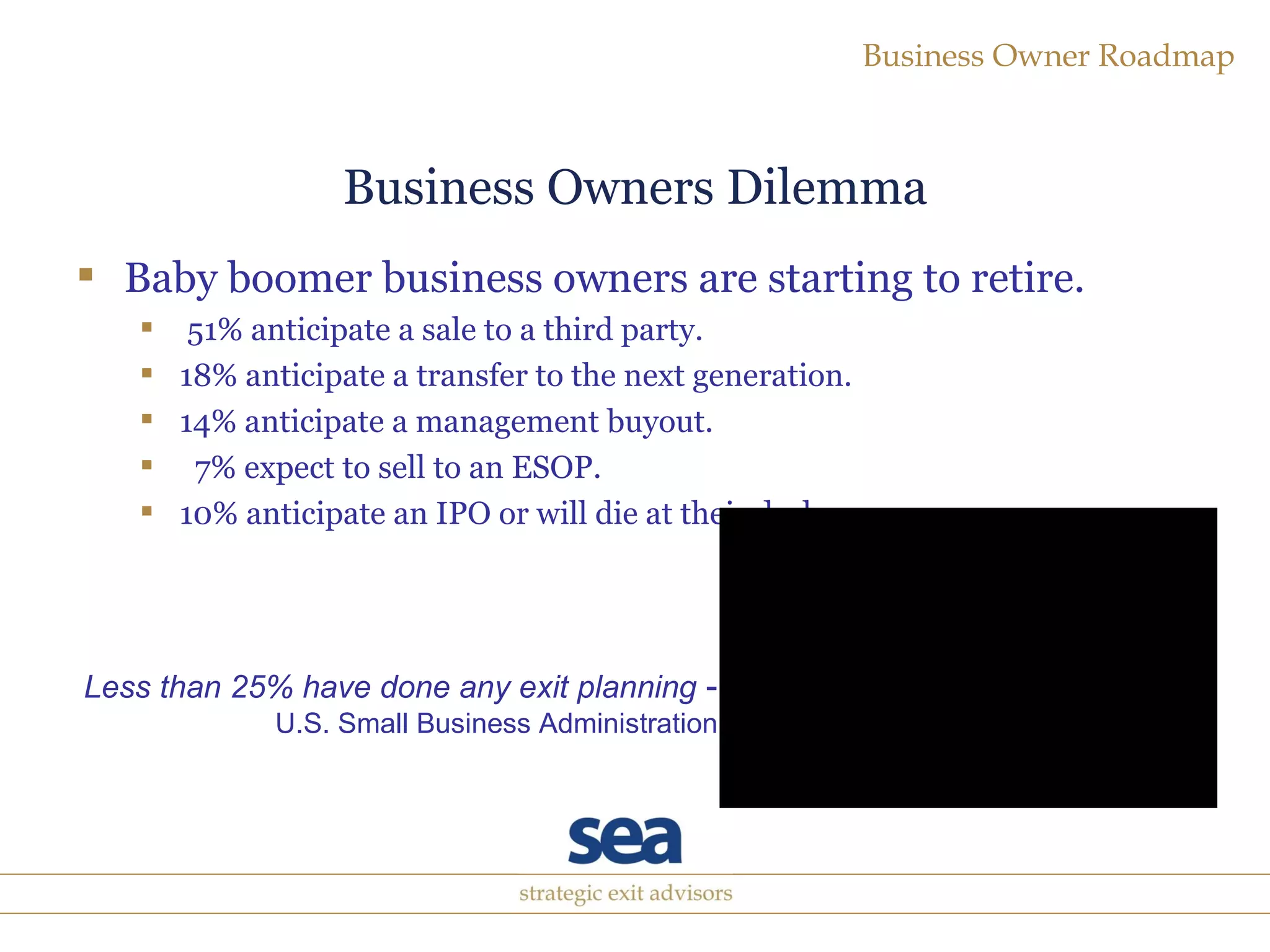
Business Owners Dilemma Baby boomer business owners are starting to retire. 51% anticipate a sale to a third party. 18% anticipate a transfer to the next generation. 14% anticipate a management buyout. 7% expect to sell to an ESOP. 10% anticipate an IPO or will die at their desks.  Less than 25% have done any exit planning  -  U.S. Small Business Administration
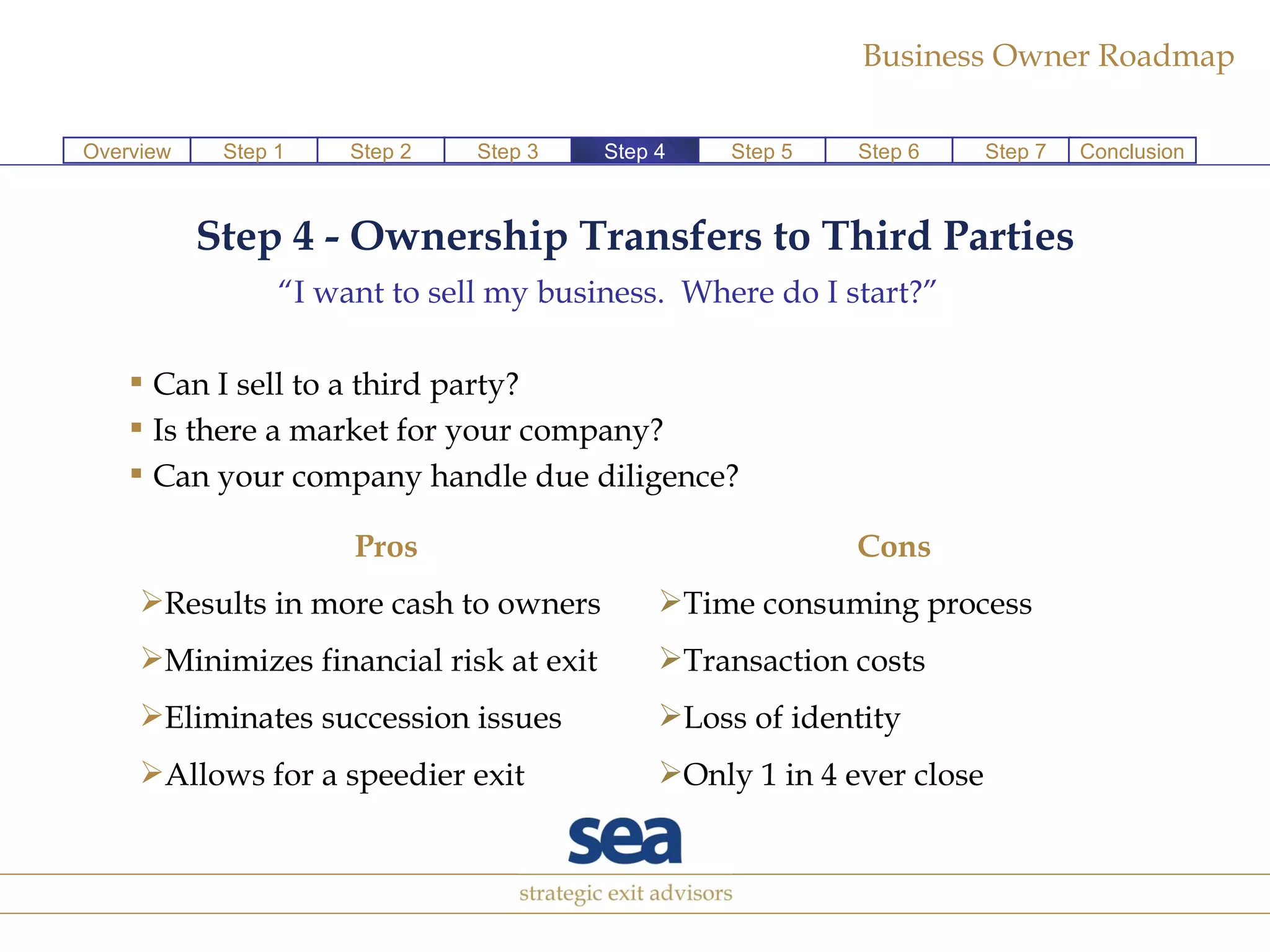
Step 4 - Ownership Transfers to Third Parties “ I want to sell my business.  Where do I start?” Can I sell to a third party? Is there a market for your company? Can your company handle due diligence?  Pros Results in more cash to owners Minimizes financial risk at exit Eliminates succession issues Allows for a speedier exit Cons Time consuming process Transaction costs Loss of identity Only 1 in 4 ever close Step 1 Step 2 Step 3 Step 5 Step 6 Step 7 Conclusion Overview Step 4
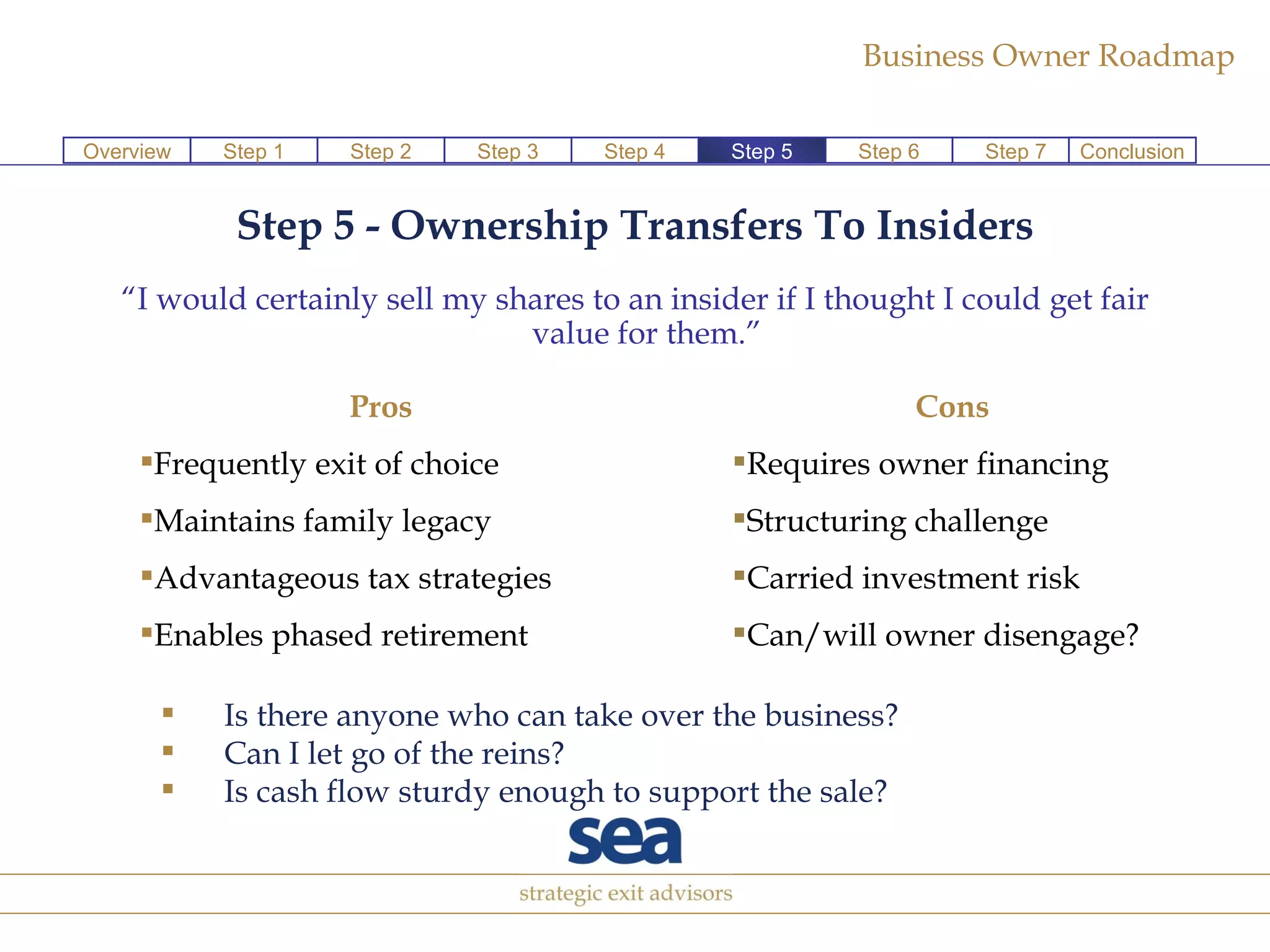
Step 5 - Ownership Transfers To Insiders “ I would certainly sell my shares to an insider if I thought I could get fair value for them.” Pros Frequently exit of choice Maintains family legacy  Advantageous tax strategies  Enables phased retirement Cons Requires owner financing  Structuring challenge Carried investment risk Can/will owner disengage?  Is there anyone who can take over the business? Can I let go of the reins? Is cash flow sturdy enough to support the sale?  Step 1 Step 2 Step 3 Step 4 Step 6 Step 7 Conclusion Overview Step 5
Step 6 - Business Continuity “ My family and I rely on the business for a significant part of our income, so I need to protect that income stream if something happens to me.” What happens if: You die or become disabled? One partner wants to leave before the other? There is a divorce in the "family“ structure? Is there a Texas shootout in your buy-sell?  Step 1 Step 2 Step 3 Step 4 Step 5 Step 7 Conclusion Overview Step 6
Step 7 - Personal Wealth and Estate Planning “ My business and personal assets are so closely intertwined that I can’t plan for one without also planning for the other in the event of my death.” Your business sale or transfer generates $5 million How much is after-tax "take home“? What will you do with the money? Is there an investment plan? Are you using trusts effectively?  Do you have a gifting strategy in place? Step 1 Step 2 Step 3 Step 4 Step 5 Step 6 Conclusion Overview Step 7
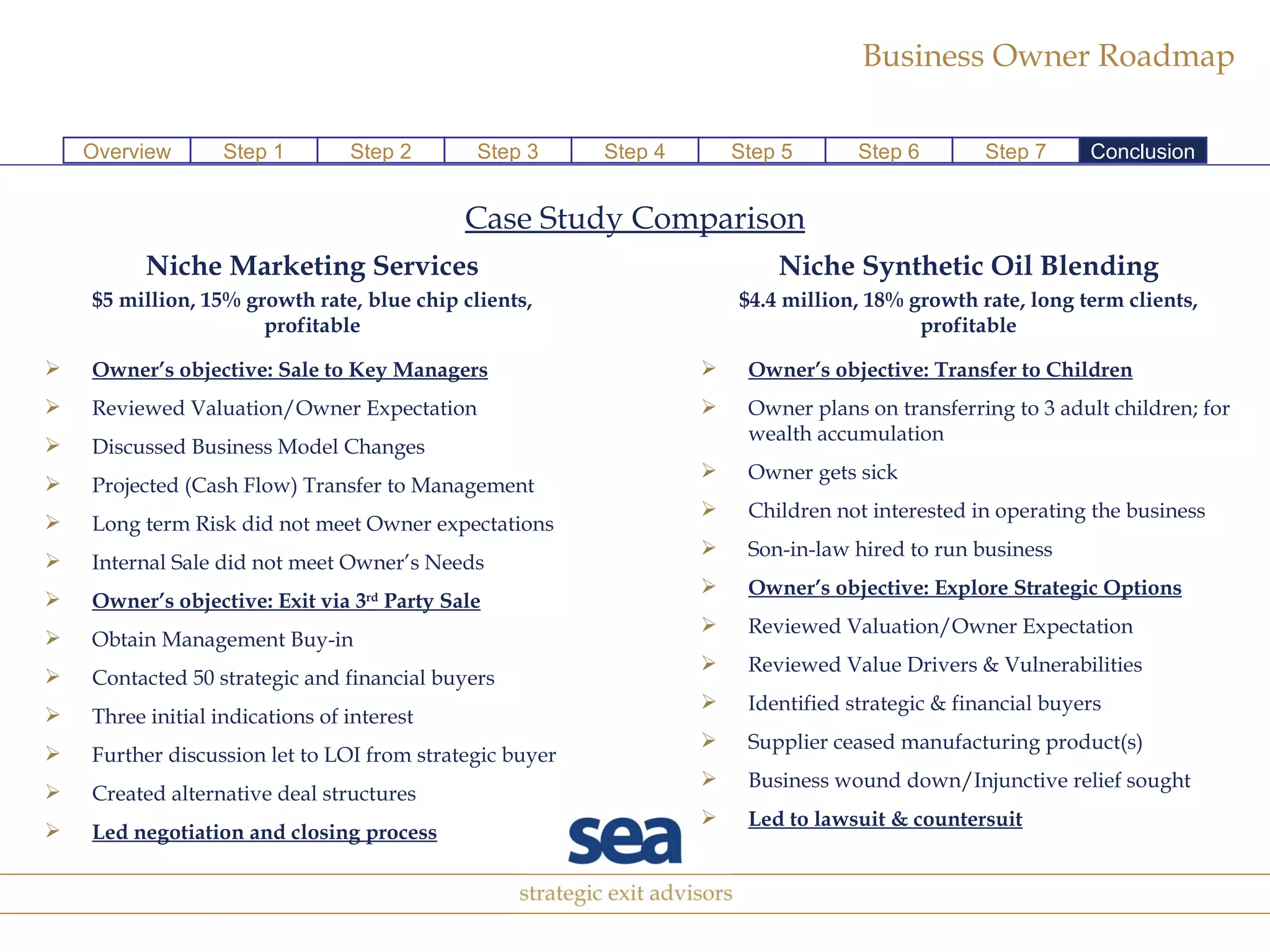
Case Study Comparison Niche Marketing Services $5 million, 15% growth rate, blue chip clients, profitable Owner’s objective: Sale to Key Managers Reviewed Valuation/Owner Expectation Discussed Business Model Changes Projected (Cash Flow) Transfer to Management Long term Risk did not meet Owner expectations Internal Sale did not meet Owner’s Needs Owner’s objective: Exit via 3 rd  Party Sale Obtain Management Buy-in Contacted 50 strategic and financial buyers Three initial indications of interest Further discussion let to LOI from strategic buyer Created alternative deal structures Led negotiation and closing process Niche Synthetic Oil Blending $4.4 million, 18% growth rate, long term clients, profitable Owner’s objective: Transfer to Children Owner plans on transferring to 3 adult children; for wealth accumulation Owner gets sick Children not interested in operating the business Son-in-law hired to run business Owner’s objective: Explore Strategic Options Reviewed Valuation/Owner Expectation Reviewed Value Drivers & Vulnerabilities Identified strategic & financial buyers Supplier ceased manufacturing product(s) Business wound down/Injunctive relief sought Led to lawsuit & countersuit Step 7 Step 1 Step 2 Step 3 Step 4 Step 5 Step 6 Conclusion Overview
As transaction advisors our goal is to help you exit your business with as much cash as possible from a sale or business transfer. As former business owners and operating executives we understand the joys and burdens of ownership. We’ve walked in your shoes. Since 1998 we have worked with dozens of owners of small and mid size companies  in the publishing, education, manufacturing, automotive, building products, business services and consumer products industries. We have completed asset sales, stock sales, business purchases, debt financings, business valuation assignments, exit planning engagements,  Red Zone  audits and strategic planning and operational reviews. We follow a team-based approach to  deliver value first . SEA Summary
The SEA Team Curt A. Cyliax  is the co-founder and managing partner of SEA and a Certified Public Accountant. He is a veteran transaction advisor whose exit planning and transaction experience includes working with business owners in the manufacturing, distribution, and educational sectors. He is a member of the Business Enterprise Institute and speaks frequently about exit planning and private company ownership. cacyliax@se-adv.com Robert W. Waring  is a partner in SEA and a Certified Public Accountant.   Rob has more than 18 years of financial experience in both public accounting and senior financial management roles.   His experience is primarily with high-growth businesses in the pharmaceutical, chemicals and consumer products industries and includes responsibilities for acquisitions and divestitures as well as corporate finance work. rwwaring@se-adv.com Christopher M. Suhy  is a partner in SEA and a Licensed Realtor. Chris is a GRI with more than 20 years real estate experience. His prior senior management experience is in the hospitality industry. He is a business intermediary whose transaction experience includes working with business owners in the education, distribution and retail sectors.  [email_address] Craig O. Allsopp  is the co-founder of SEA and a Certified Business Intermediary. coallsopp@se-adv.com

2009 Exit Planning Overview Final

  • 1.
    Exit Planning ARoadmap to Achieving Ownership Goals “Getting it right the first time” Strategic Exit Advisors 95 W. Court Street Doylestown, PA 18901 www.se-adv.com PA – (215) 489-8881 NJ – (609) 466-3100 Your Future, Our Focus SM
  • 2.
    Roadmap Questions Beginningthe Journey Who will you sell or pass the business on to? How much money do you need after leaving the business, to live comfortably in your lifestyle? When will you begin to leave the business? 3 to 5 years prior to starting departure
  • 3.
    Let's Define ExitPlanning Exit Planning is a 7 step process that aligns your business ownership interest with your personal goals It is designed to answer the questions that keep owners like you up at night What is my company worth? Is there a market for my company? Who will buy my company? If something happens, is the business protected? How do I maximize value and minimize taxes? Will the business fund my life style, or Legacy goals? Overview Step 2 Step 3 Step 4 Step 5 Step 6 Step 7 Conclusion Step 1
  • 4.
  • 5.
    Step 1 -Identify Owner Objectives “ I need to feel like all aspects of my planning are tied together in one coherent plan.” Let's answer the following questions How much longer do you want to work in the business? What is the annual after-tax income you want during retirement? Who do you want to transfer the business to? Do you have other long-term financial goals? Shifting wealth to children Reward your employees Maintain ownership indefinitely Step 2 Step 3 Step 4 Step 5 Step 6 Step 7 Conclusion Overview Step 1
  • 6.
    Step 2 -Identify Business & Personal Financial Resources “ I can’t really plan for one area of my future without planning for all areas that relate to my business and personal wealth.” Can Your Goals and Objectives be Met? What other assets do you have to work with? Is there an up-to-date financial needs analysis? How much cash flow is available for your use? Are you going to have to adjust your expectations? Step 1 Step 3 Step 4 Step 5 Step 6 Step 7 Conclusion Overview Step 2
  • 7.
    Step 3 –Maximizing & Protecting Business Value “ I need to strengthen my company to better withstand competitive pressure.” Key Value Driver Questions How does your company compare with its peer group? Are cash and reported earnings sustainable? Are revenues one-time or recurring? Is there a growth plan in place? Are key managers incented with cash/stock plans Is your business "embedded" with clients? Step 1 Step 2 Step 4 Step 5 Step 6 Step 7 Conclusion Overview Step 3
  • 8.
    Maximizing Value ImplicationOwner Requirements
  • 9.
    Ownership Transfer ThirdParty Sale? Or, Transfer to Insiders?
  • 10.
    Business Owners DilemmaBaby boomer business owners are starting to retire. 51% anticipate a sale to a third party. 18% anticipate a transfer to the next generation. 14% anticipate a management buyout. 7% expect to sell to an ESOP. 10% anticipate an IPO or will die at their desks. Less than 25% have done any exit planning - U.S. Small Business Administration
  • 11.
    Step 4 -Ownership Transfers to Third Parties “ I want to sell my business. Where do I start?” Can I sell to a third party? Is there a market for your company? Can your company handle due diligence? Pros Results in more cash to owners Minimizes financial risk at exit Eliminates succession issues Allows for a speedier exit Cons Time consuming process Transaction costs Loss of identity Only 1 in 4 ever close Step 1 Step 2 Step 3 Step 5 Step 6 Step 7 Conclusion Overview Step 4
  • 12.
    Step 5 -Ownership Transfers To Insiders “ I would certainly sell my shares to an insider if I thought I could get fair value for them.” Pros Frequently exit of choice Maintains family legacy Advantageous tax strategies Enables phased retirement Cons Requires owner financing Structuring challenge Carried investment risk Can/will owner disengage? Is there anyone who can take over the business? Can I let go of the reins? Is cash flow sturdy enough to support the sale? Step 1 Step 2 Step 3 Step 4 Step 6 Step 7 Conclusion Overview Step 5
  • 13.
    Step 6 -Business Continuity “ My family and I rely on the business for a significant part of our income, so I need to protect that income stream if something happens to me.” What happens if: You die or become disabled? One partner wants to leave before the other? There is a divorce in the "family“ structure? Is there a Texas shootout in your buy-sell? Step 1 Step 2 Step 3 Step 4 Step 5 Step 7 Conclusion Overview Step 6
  • 14.
    Step 7 -Personal Wealth and Estate Planning “ My business and personal assets are so closely intertwined that I can’t plan for one without also planning for the other in the event of my death.” Your business sale or transfer generates $5 million How much is after-tax "take home“? What will you do with the money? Is there an investment plan? Are you using trusts effectively? Do you have a gifting strategy in place? Step 1 Step 2 Step 3 Step 4 Step 5 Step 6 Conclusion Overview Step 7
  • 15.
    Case Study ComparisonNiche Marketing Services $5 million, 15% growth rate, blue chip clients, profitable Owner’s objective: Sale to Key Managers Reviewed Valuation/Owner Expectation Discussed Business Model Changes Projected (Cash Flow) Transfer to Management Long term Risk did not meet Owner expectations Internal Sale did not meet Owner’s Needs Owner’s objective: Exit via 3 rd Party Sale Obtain Management Buy-in Contacted 50 strategic and financial buyers Three initial indications of interest Further discussion let to LOI from strategic buyer Created alternative deal structures Led negotiation and closing process Niche Synthetic Oil Blending $4.4 million, 18% growth rate, long term clients, profitable Owner’s objective: Transfer to Children Owner plans on transferring to 3 adult children; for wealth accumulation Owner gets sick Children not interested in operating the business Son-in-law hired to run business Owner’s objective: Explore Strategic Options Reviewed Valuation/Owner Expectation Reviewed Value Drivers & Vulnerabilities Identified strategic & financial buyers Supplier ceased manufacturing product(s) Business wound down/Injunctive relief sought Led to lawsuit & countersuit Step 7 Step 1 Step 2 Step 3 Step 4 Step 5 Step 6 Conclusion Overview
  • 16.
    As transaction advisorsour goal is to help you exit your business with as much cash as possible from a sale or business transfer. As former business owners and operating executives we understand the joys and burdens of ownership. We’ve walked in your shoes. Since 1998 we have worked with dozens of owners of small and mid size companies in the publishing, education, manufacturing, automotive, building products, business services and consumer products industries. We have completed asset sales, stock sales, business purchases, debt financings, business valuation assignments, exit planning engagements, Red Zone audits and strategic planning and operational reviews. We follow a team-based approach to deliver value first . SEA Summary
  • 17.
    The SEA TeamCurt A. Cyliax is the co-founder and managing partner of SEA and a Certified Public Accountant. He is a veteran transaction advisor whose exit planning and transaction experience includes working with business owners in the manufacturing, distribution, and educational sectors. He is a member of the Business Enterprise Institute and speaks frequently about exit planning and private company ownership. cacyliax@se-adv.com Robert W. Waring is a partner in SEA and a Certified Public Accountant.   Rob has more than 18 years of financial experience in both public accounting and senior financial management roles.   His experience is primarily with high-growth businesses in the pharmaceutical, chemicals and consumer products industries and includes responsibilities for acquisitions and divestitures as well as corporate finance work. rwwaring@se-adv.com Christopher M. Suhy is a partner in SEA and a Licensed Realtor. Chris is a GRI with more than 20 years real estate experience. His prior senior management experience is in the hospitality industry. He is a business intermediary whose transaction experience includes working with business owners in the education, distribution and retail sectors. [email_address] Craig O. Allsopp is the co-founder of SEA and a Certified Business Intermediary. coallsopp@se-adv.com