
Mary Nyasimi, Catherine Mungai and Maren Radeny
CCAFS-East Africa
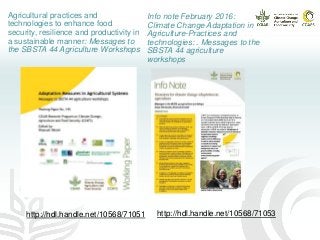
Agricultural practices and
technologies to enhance
resilience, food security and
productivity:
messages to SBSTA 44
Agricultural practices and
technologies to enhance food
security, resilience and productivity in
a sustainable manner: Messages to
the SBSTA 44 Agriculture Workshops
Info note February 2016:
Climate Change Adaptation in
Agriculture-Practices and
technologies: . Messages to the
SBSTA 44 agriculture
workshops
http://hdl.handle.net/10568/71053http://hdl.handle.net/10568/71051
Perspectives from Africa
Key Messages
 Agro-ecological zones & farming systems are extremely diverse - interventions
need to be targeted to specific contexts.
 Many agricultural practices and technologies beneficial to food security, resilience
and productivity.
 Indigenous knowledge provides the backbone of successful climate change
adaptation in crop farming, livestock and fisheries
 Bringing practices and technologies to scale is possible and underway. Strong
mechanisms for finance, capacity enhancement and technology transfer are
prerequisites for success.
 Engaging women in design & management of new technologies and practices will
help close the gender gap in agriculture & deliver positive outcomes
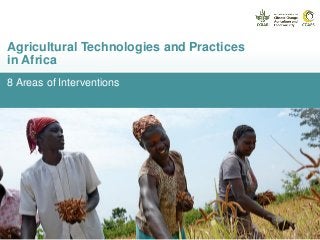
8 Areas of Interventions
Agricultural Technologies and Practices
in Africa
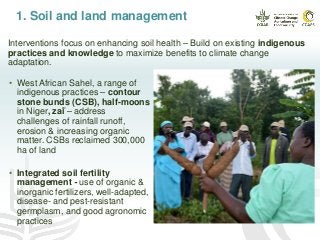
Interventions focus on enhancing soil health – Build on existing indigenous
practices and knowledge to maximize benefits to climate change
adaptation.
• West African Sahel, a range of
indigenous practices – contour
stone bunds (CSB), half-moons
in Niger, zaï – address
challenges of rainfall runoff,
erosion & increasing organic
matter. CSBs reclaimed 300,000
ha of land
• Integrated soil fertility
management - use of organic &
inorganic fertilizers, well-adapted,
disease- and pest-resistant
germplasm, and good agronomic
practices
1. Soil and land management
2. Crop management
Crop-specific innovations e.g. soil management, agroforestry, and water
management. Crop-specific innovations e.g. breeding of more resilient crop
varieties, diversification and intensification.
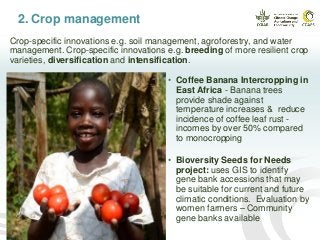
• Coffee Banana Intercropping in
East Africa - Banana trees
provide shade against
temperature increases & reduce
incidence of coffee leaf rust -
incomes by over 50% compared
to monocropping
• Bioversity Seeds for Needs
project: uses GIS to identify
gene bank accessions that may
be suitable for current and future
climatic conditions. Evaluation by
women farmers – Community
gene banks available
3. Livestock management
Improved or modified livestock mgt practices: improved grazing mgt, use
of improved pasture & agroforestry sp, better use of locally available
feeds, highly nutritious diet supplements and concentrates, and
breeding for heat-tolerance. Better animal health mgt e.g. surveillance &
veterinary services to animal performance and productivity.
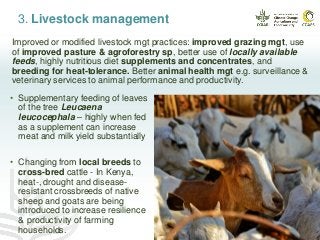
• Supplementary feeding of leaves
of the tree Leucaena
leucocephala – highly when fed
as a supplement can increase
meat and milk yield substantially
• Changing from local breeds to
cross-bred cattle - In Kenya,
heat-, drought and disease-
resistant crossbreeds of native
sheep and goats are being
introduced to increase resilience
& productivity of farming
households.
4. Forestry and Agroforestry
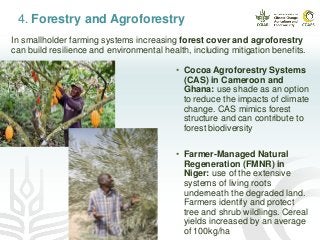
• Cocoa Agroforestry Systems
(CAS) in Cameroon and
Ghana: use shade as an option
to reduce the impacts of climate
change. CAS mimics forest
structure and can contribute to
forest biodiversity
• Farmer-Managed Natural
Regeneration (FMNR) in
Niger: use of the extensive
systems of living roots
underneath the degraded land.
Farmers identify and protect
tree and shrub wildlings. Cereal
yields increased by an average
of 100kg/ha
In smallholder farming systems increasing forest cover and agroforestry
can build resilience and environmental health, including mitigation benefits.
5. Fisheries and aquaculture
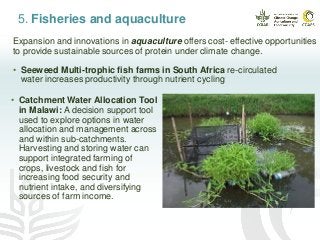
• Seeweed Multi-trophic fish farms in South Africa re-circulated
water increases productivity through nutrient cycling
Expansion and innovations in aquaculture offers cost- effective opportunities
to provide sustainable sources of protein under climate change.
• Catchment Water Allocation Tool
in Malawi: A decision support tool
used to explore options in water
allocation and management across
and within sub-catchments.
Harvesting and storing water can
support integrated farming of
crops, livestock and fish for
increasing food security and
nutrient intake, and diversifying
sources of farm income.
6. Water management
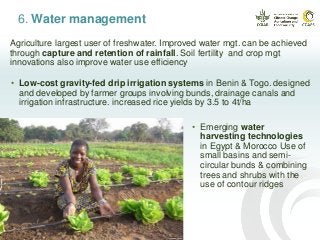
• Low-cost gravity-fed drip irrigation systems in Benin & Togo. designed
and developed by farmer groups involving bunds, drainage canals and
irrigation infrastructure. increased rice yields by 3.5 to 4t/ha
Agriculture largest user of freshwater. Improved water mgt. can be achieved
through capture and retention of rainfall. Soil fertility and crop mgt
innovations also improve water use efficiency
• Emerging water
harvesting technologies
in Egypt & Morocco Use of
small basins and semi-
circular bunds & combining
trees and shrubs with the
use of contour ridges
7. Climate information services
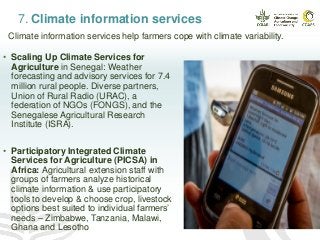
• Scaling Up Climate Services for
Agriculture in Senegal: Weather
forecasting and advisory services for 7.4
million rural people. Diverse partners,
Union of Rural Radio (URAC), a
federation of NGOs (FONGS), and the
Senegalese Agricultural Research
Institute (ISRA).
• Participatory Integrated Climate
Services for Agriculture (PICSA) in
Africa: Agricultural extension staff with
groups of farmers analyze historical
climate information & use participatory
tools to develop & choose crop, livestock
options best suited to individual farmers’
needs – Zimbabwe, Tanzania, Malawi,
Ghana and Lesotho
Climate information services help farmers cope with climate variability.
8. Crop and livestock weather insurance
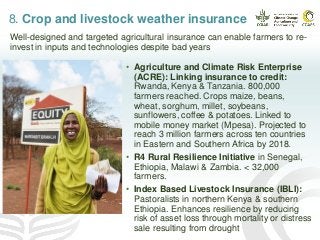
• Agriculture and Climate Risk Enterprise
(ACRE): Linking insurance to credit:
Rwanda, Kenya & Tanzania. 800,000
farmers reached. Crops maize, beans,
wheat, sorghum, millet, soybeans,
sunflowers, coffee & potatoes. Linked to
mobile money market (Mpesa). Projected to
reach 3 million farmers across ten countries
in Eastern and Southern Africa by 2018.
• R4 Rural Resilience Initiative in Senegal,
Ethiopia, Malawi & Zambia. < 32,000
farmers.
• Index Based Livestock Insurance (IBLI):
Pastoralists in northern Kenya & southern
Ethiopia. Enhances resilience by reducing
risk of asset loss through mortality or distress
sale resulting from drought
Well-designed and targeted agricultural insurance can enable farmers to re-
invest in inputs and technologies despite bad years
Lessons from implementation
• Strong mechanisms for finance, capacity development and technology
transfer are prerequisites for success of these agricultural practices and
technologies.
• Investment to reach scale by sharing of best-fit practices among
countries and farming communities, matching options to fine-scale
variations in local circumstances.
• Available decision support tools to match practices and technologies
with agro-ecological zones.
• Identify best-bet investment opportunities and country readiness for
implementation and scaling up - successful interventions can serve as
resources to assess investment risks and benefits, and seek international
support
• Promote gender equality - Engaging women in design & management of
new technologies practices will lead to more gender-sensitive innovations
• Potential for agricultural practices and technologies to achieve co-
benefits for environmental health and mitigation of greenhouse gas
emissions.
Thank you
www.ccafs.cgiar.org

Agricultural practices and technologies to enhance resilience, food security and productivity: Messages to SBSTA 44

  • 1.
    Mary Nyasimi, CatherineMungai and Maren Radeny CCAFS-East Africa Agricultural practices and technologies to enhance resilience, food security and productivity: messages to SBSTA 44
  • 2.
    Agricultural practices and technologiesto enhance food security, resilience and productivity in a sustainable manner: Messages to the SBSTA 44 Agriculture Workshops Info note February 2016: Climate Change Adaptation in Agriculture-Practices and technologies: . Messages to the SBSTA 44 agriculture workshops http://hdl.handle.net/10568/71053http://hdl.handle.net/10568/71051
  • 3.
    Perspectives from Africa KeyMessages  Agro-ecological zones & farming systems are extremely diverse - interventions need to be targeted to specific contexts.  Many agricultural practices and technologies beneficial to food security, resilience and productivity.  Indigenous knowledge provides the backbone of successful climate change adaptation in crop farming, livestock and fisheries  Bringing practices and technologies to scale is possible and underway. Strong mechanisms for finance, capacity enhancement and technology transfer are prerequisites for success.  Engaging women in design & management of new technologies and practices will help close the gender gap in agriculture & deliver positive outcomes
  • 4.
    8 Areas ofInterventions Agricultural Technologies and Practices in Africa
  • 5.
    Interventions focus onenhancing soil health – Build on existing indigenous practices and knowledge to maximize benefits to climate change adaptation. • West African Sahel, a range of indigenous practices – contour stone bunds (CSB), half-moons in Niger, zaï – address challenges of rainfall runoff, erosion & increasing organic matter. CSBs reclaimed 300,000 ha of land • Integrated soil fertility management - use of organic & inorganic fertilizers, well-adapted, disease- and pest-resistant germplasm, and good agronomic practices 1. Soil and land management
  • 6.
    2. Crop management Crop-specificinnovations e.g. soil management, agroforestry, and water management. Crop-specific innovations e.g. breeding of more resilient crop varieties, diversification and intensification. • Coffee Banana Intercropping in East Africa - Banana trees provide shade against temperature increases & reduce incidence of coffee leaf rust - incomes by over 50% compared to monocropping • Bioversity Seeds for Needs project: uses GIS to identify gene bank accessions that may be suitable for current and future climatic conditions. Evaluation by women farmers – Community gene banks available
  • 7.
    3. Livestock management Improvedor modified livestock mgt practices: improved grazing mgt, use of improved pasture & agroforestry sp, better use of locally available feeds, highly nutritious diet supplements and concentrates, and breeding for heat-tolerance. Better animal health mgt e.g. surveillance & veterinary services to animal performance and productivity. • Supplementary feeding of leaves of the tree Leucaena leucocephala – highly when fed as a supplement can increase meat and milk yield substantially • Changing from local breeds to cross-bred cattle - In Kenya, heat-, drought and disease- resistant crossbreeds of native sheep and goats are being introduced to increase resilience & productivity of farming households.
  • 8.
    4. Forestry andAgroforestry • Cocoa Agroforestry Systems (CAS) in Cameroon and Ghana: use shade as an option to reduce the impacts of climate change. CAS mimics forest structure and can contribute to forest biodiversity • Farmer-Managed Natural Regeneration (FMNR) in Niger: use of the extensive systems of living roots underneath the degraded land. Farmers identify and protect tree and shrub wildlings. Cereal yields increased by an average of 100kg/ha In smallholder farming systems increasing forest cover and agroforestry can build resilience and environmental health, including mitigation benefits.
  • 9.
    5. Fisheries andaquaculture • Seeweed Multi-trophic fish farms in South Africa re-circulated water increases productivity through nutrient cycling Expansion and innovations in aquaculture offers cost- effective opportunities to provide sustainable sources of protein under climate change. • Catchment Water Allocation Tool in Malawi: A decision support tool used to explore options in water allocation and management across and within sub-catchments. Harvesting and storing water can support integrated farming of crops, livestock and fish for increasing food security and nutrient intake, and diversifying sources of farm income.
  • 10.
    6. Water management •Low-cost gravity-fed drip irrigation systems in Benin & Togo. designed and developed by farmer groups involving bunds, drainage canals and irrigation infrastructure. increased rice yields by 3.5 to 4t/ha Agriculture largest user of freshwater. Improved water mgt. can be achieved through capture and retention of rainfall. Soil fertility and crop mgt innovations also improve water use efficiency • Emerging water harvesting technologies in Egypt & Morocco Use of small basins and semi- circular bunds & combining trees and shrubs with the use of contour ridges
  • 11.
    7. Climate informationservices • Scaling Up Climate Services for Agriculture in Senegal: Weather forecasting and advisory services for 7.4 million rural people. Diverse partners, Union of Rural Radio (URAC), a federation of NGOs (FONGS), and the Senegalese Agricultural Research Institute (ISRA). • Participatory Integrated Climate Services for Agriculture (PICSA) in Africa: Agricultural extension staff with groups of farmers analyze historical climate information & use participatory tools to develop & choose crop, livestock options best suited to individual farmers’ needs – Zimbabwe, Tanzania, Malawi, Ghana and Lesotho Climate information services help farmers cope with climate variability.
  • 12.
    8. Crop andlivestock weather insurance • Agriculture and Climate Risk Enterprise (ACRE): Linking insurance to credit: Rwanda, Kenya & Tanzania. 800,000 farmers reached. Crops maize, beans, wheat, sorghum, millet, soybeans, sunflowers, coffee & potatoes. Linked to mobile money market (Mpesa). Projected to reach 3 million farmers across ten countries in Eastern and Southern Africa by 2018. • R4 Rural Resilience Initiative in Senegal, Ethiopia, Malawi & Zambia. < 32,000 farmers. • Index Based Livestock Insurance (IBLI): Pastoralists in northern Kenya & southern Ethiopia. Enhances resilience by reducing risk of asset loss through mortality or distress sale resulting from drought Well-designed and targeted agricultural insurance can enable farmers to re- invest in inputs and technologies despite bad years
  • 13.
    Lessons from implementation •Strong mechanisms for finance, capacity development and technology transfer are prerequisites for success of these agricultural practices and technologies. • Investment to reach scale by sharing of best-fit practices among countries and farming communities, matching options to fine-scale variations in local circumstances. • Available decision support tools to match practices and technologies with agro-ecological zones. • Identify best-bet investment opportunities and country readiness for implementation and scaling up - successful interventions can serve as resources to assess investment risks and benefits, and seek international support • Promote gender equality - Engaging women in design & management of new technologies practices will lead to more gender-sensitive innovations • Potential for agricultural practices and technologies to achieve co- benefits for environmental health and mitigation of greenhouse gas emissions.
  • 14.