
Local Food Policy & Health: State Policies Supporting /SNAP in Farmers Markets - PowerPoint Presenation
•Download as PPTX, PDF•
1 like•642 views


Recommended
Recommended
More Related Content
What's hot
What's hot (20)
Viewers also liked
Viewers also liked (7)
Similar to Local Food Policy & Health: State Policies Supporting /SNAP in Farmers Markets - PowerPoint Presenation
Similar to Local Food Policy & Health: State Policies Supporting /SNAP in Farmers Markets - PowerPoint Presenation (20)
More from Community Food Security Coalition
More from Community Food Security Coalition (20)
Local Food Policy & Health: State Policies Supporting /SNAP in Farmers Markets - PowerPoint Presenation
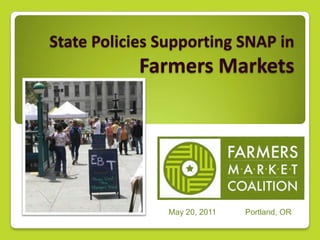
- 1. State Policies Supporting SNAP in Farmers Markets May 20, 2011 Portland, OR
- 2. Introductions Drew Love, Research & Education Intern Farmers Market Coalition Stacy Miller, Executive Director Farmers Market Coalition Suzanne Briggs, Technical Assistance Manager Co-Author, Real Food, Real Choice Farmers Market Coalition Karen Kinney, Executive Director Washington State Farmers Market Coalition Deborah Yashar, Food Systems Program Manager Agriculture & Land-Based Training Association (ALBA)
- 3. Why Farmers Markets? Farmers become price makers versus price takers Define a sense of place; Build community Offer living examples of vibrant local economies Bridge urban and rural divides Children learn the value of healthy food Strengthens community ties via cross-cutting Relationships
- 5. SNAP Benefits ($1,000) in 2008
- 12. Blanket waver for scrip and incentives: Feb 2010
- 13. 1,611 FM SNAP authorized retailers: Sept 2010
- 14. FNS begins research on farmers markets’ relationship with nutrition programs: Nov 2010
- 15. $4 million requested in 2011 and 2012 budgets SNAP Leadership at USDA
- 17. Promising Programs & Policies for SNAP in Farmers MarketsSuzanne Briggs, collaboration May 20, 2011 Portland, OR
- 18. Two Different FM EBT Strategies Iowa – In 2005, Iowa DHS funded EBT programs for farmersin part by a regular 50/50 match on SNAP administration. New York – In 2002 provided wireless machines to farmers. Starting in 2005 began developing a central-terminal system at the farmers market level.
- 21. Promising Programs & Partnerships Michigan Massachusetts Pennsylvania Georgia Minnesota Wisconsin
- 22. Promising Programs & Partnerships: Examples Massachusetts $50K grant program via DTA and Dept. of Ag., with input from Mass Federation of FMs California Specialty crop block grants used to expand SNAP at farmers markets New York Close collaboration between FMFNY, NY Dept of Ag., and OTDA
- 23. Promising State Policies Washington SB 6483, the Local Farms, Healthy Kids Act put wireless POS into 20 markets Illinois HB 4756, the Farmers Market Technology Improvement Program California A.B. 537 requires markets to allow a qualified organization to operate SNAP
- 25. Types of Community Partners Businesses and merchants Government Schools and educational institutions Non-profits and faith-based organizations Health and social service organizations Market volunteers
- 27. Farmers Market Volunteers
- 28. Washington State SB 6483 Local Food, Healthy KidsKaren Kinney King County Soil & Water ConservationWashington State Farmers Market Association
- 29. SB 6483 Eases state and school procurement restrictions to better enable school districts and state entities to choose local Establishes a Farm to School Program that will facilitate the purchasing of Washington-grow farm products by schools Creates the Washington Grown Fresh Fruit and Vegetable program
- 30. Outcomes Promotes school garden Establishes a Farmers Market Technology Program Establishes three Farm to Food Bank pilot programs Expands and increases funding for the Farmers Market Nutrition Program Funded at $1,490,000
- 31. Why is it so darn cool? Magic Moment in time! Precedent Setter! First multi-pronged food system legislation in WA state. Coalition Builder! Created new strategic relationships between environmentalists and sustainable ag supporters.
- 32. Bringing People and Ideas… Together! Strong existing network of sustainable ag and food system organizations Able to fast-track a good idea Right people at the right time Ag people learned how the environmental community works together to promote agenda Helped mainstream the idea of spending money on local farmers to promote big policy issues
- 33. Champions in House and Senate Key emphasis on diversity, so it wasn’t seen as just a KCeattle interest. House Champion: Eric Pettigrew-Represents most diverse zip code in USA Senate Champion: Brian Hatfield-Previous work experience with WEC. Bill Passes! House: 95-1 Senate: 44-0
- 35. Ongoing commitment to all projects resulting from the legislation
- 36. Worked on State Food Policy Council proposal – 2009
- 37. Responded to state budget woes in 2011
- 38. Protect F2S and WSDA budget
- 40. Hurdles to Capacity Building Staffing, funding, and infrastructural challenges Difficult to find streamlined payment methods
- 41. Victories Created turnkey project 20 Farmers Markets, serving a wide variety of customers and communities, were able to accept EBT Cards. Significant increase in farmers market sales Mini-grant model works well for pilot projects Broader recognition for WSFMA Great opportunity for Advisory Committee
- 42. Washington: USDA EBT Data
- 43. EBT Wins! Baby Eats Strawberry! 1st Year: Total Card Sales: $302,417 EBT: $49,349 Credit: $157,448 Debit: $93,140 2nd Year Total Card Sales: $425,013 (40% increase) EBT: $68,674 (increase 39%) Credit: $231,466 (47%) Debit: $125,633 (increase 35%) Watching baby eat farmers market strawberry?: Priceless
- 44. Relationship Building Strengthened Institutional Partnerships WSU King County Agriculture Program State Agencies Expanded Partnerships Anti-Hunger Nutrition Local Health Agencies Other States Farmers Market Coalition
- 45. Lessons Learned Building partnerships between multiple local agencies builds capacity for both organizations. Relationship development takes time, and successful relationships depend upon the personalities involved. Be realistic about time Consider organization’s long term commitment to a project, before adopting it
- 46. California Assembly Bill 537 EBT in Farmers MarketsDeborah Yashar, ALBA
- 47. Assembly Bill 537 Making federal food assistance (SNAP) benefits universally accepted as a legitimate form of payment in farmers markets. How? “An interested collective group or association of produce sellers that is FNS authorized and in the market may initiate and operate an EBT acceptance system on behalf of its members.”
- 48. Coalition Building Coalition building with Assembly member Juan Arambula of Fresno, and supporting stakeholders. Key partnerships with organizers/lobbyists in the state capitol. As more groups became involved the bill changed. Final version of the bill was less robust than original which required every market in CA to accept EBT by year 2012.
- 49. Debate and Compromise Having a healthy debate over difference of opinions can turn the process into one that is unifying rather than controlling or exclusionary As a result of the compromising, the one-time opponents became advocates of the bill and testified their support in public
- 50. Capacity building to empower new leaders Another outcome of policy-making is the capacity-building among participants that get involved in the political process Knowledge and experience in policy-making is passed on by mentors and new leaders emerge
- 51. Make Progress Put the issue on the radar of policy-makers and farmers markets -> Bill provided an incentive for market managers to set up the system in their area. -> After the bill passed, several markets in California decided to implement EBT.
- 52. Debate+Compromise+Allies+Change= Success! Today all markets in Salinas accept EBT! 11 markets in Monterey County as opposed to 6 prior.
- 53. Questions?
Editor's Notes
- The dramatic increase in SNAP alo
- Because of the dramatic increase in SNAP eligibility and participation. Wal Mart redeems 25% accoridnt to Merigan
- Only 27 of those in 2010 went to new EBT projects
- Suzanne Two different FM EBT Strategies History of Iowa program Lack of farmer market infrastructure Leveraged SNAP Adminstrative dollars to pay for alls fees except ones related to credit or debit. This system is still the best for Iowa today since their markets are still run by farmers and have a market manager for the day. History of New York. Started their program in 2002 by giving wireless machines to their farmers In 2005 moved to developing a central terminal system.
- On your sheets are examples of how different states are becoming partners with farmers markets. Providing grants to lower the start up cost. (MN) Purchasing machines for distribution (PA) Reimbursing the farmers for the cost of the machine, Paying SNAP related fees Partnering with private foundations to provide matching dollars Developing promotional campaigns (GA) Research studies on SNAP in Farmers Markets
- In light of some of these fantastic recent changes, what’s left?-Research paper due out in June, which will serve as a launching pad for advocacy at the state, national, and local level for SNAP/EBTMA: $2,500 per market, including up to $200 for fixed operating costs, and promotional costs for one year. No staffing costsAlso Oregon: HB 3274 – Directs the Department of Human Services to request a pilot program from USDA to remove the foods of minimal nutrition value out of the Supplemental Nutrition Assistance Program (SNAP/food stamps).
- I would like to end by sharing how important the programs on the ground informs policy. When I do my work, I often frame my projects around the RWJ 4 P’s strategy Those 4 P’s are Partnership, Program, Policy and Promotion. If each of work those 4 P’s simultaneiously, especially understanding the interplay between program policy, together we will create a movement.
- AB 537 Began in Salinas Valley and Monterey County