Download to read offline
![Who works in confined spaces?
Many types of workers may occasionally enter a confined space in
order to complete an assignment or to solve a problem.
For example, an electrician may enter a crawlspace to troubleshoot
a wiring problem or a welder may enter a [empty] tank to make a
repair.
Confined spaces differ from industry to industry. Here’s a link to a
Google search for confined space images: http://bit.ly/15G9p0s.
All work to be carried out in a confined space is regulated by OSHA
and must be carefully planned.
Planning should include consideration of a range of potentially
hazardous circumstances, from temperature extremes to poor air
quality.](https://image.slidesharecdn.com/confinedspace-130719095441-phpapp02/75/Protecting-workers-in-confined-spaces-with-effective-ventilation-tools-3-2048.jpg)
![The photo on the left shows a welder working in
a corner in all-metal festoon housing, a staple
of the oil industry.
[There a photo of a festoon house on our blog.]
The welder is working where two walls and the
ceiling meet.
At Sentry Air, we want hazardous fumes
removed from the breathing zone of welders in
similar situations.
Air quality for welders](https://image.slidesharecdn.com/confinedspace-130719095441-phpapp02/75/Protecting-workers-in-confined-spaces-with-effective-ventilation-tools-4-2048.jpg)
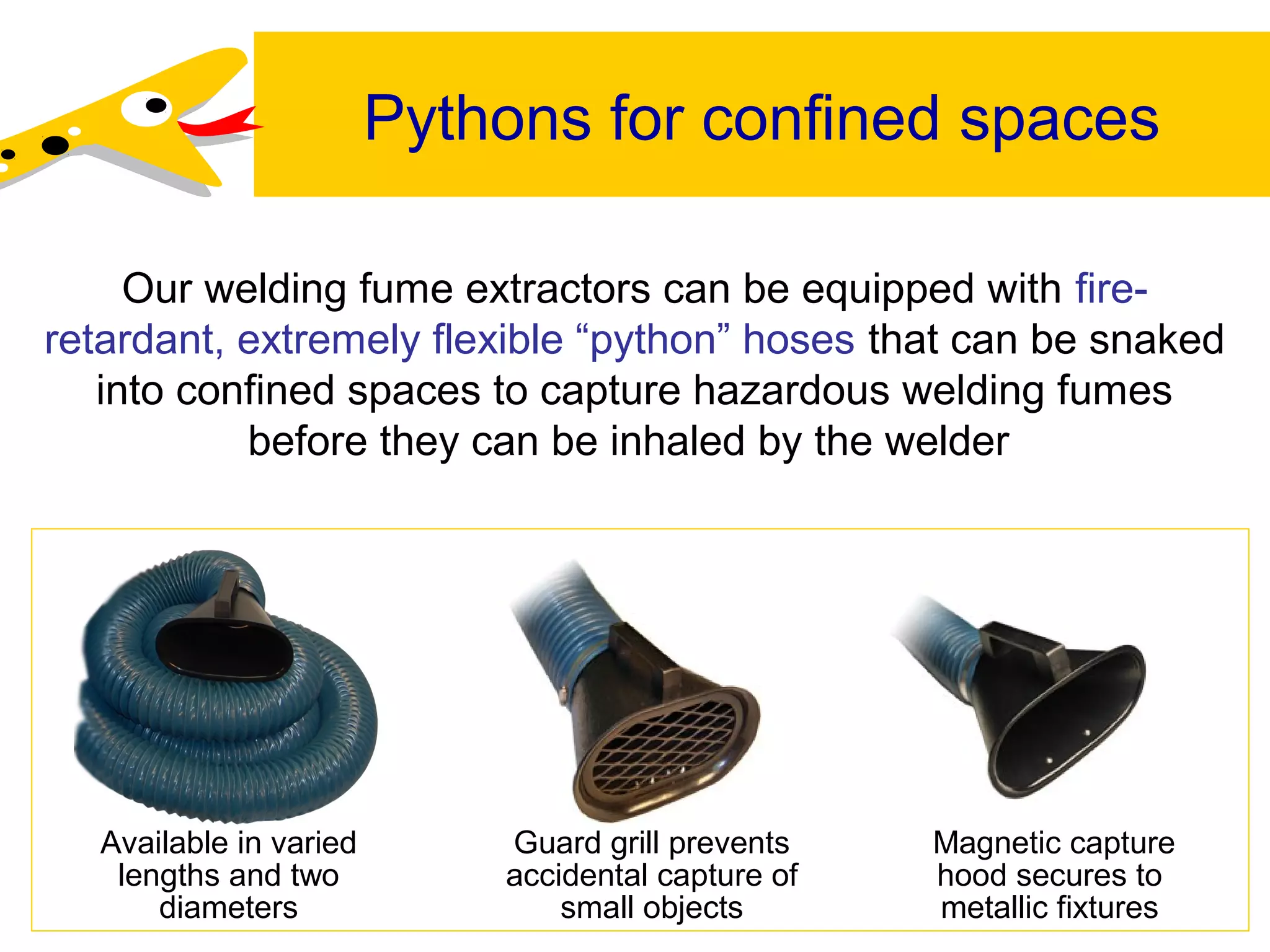
![Python & CFM: useful tools
A “python” hose attached to a fume extractor with appropriate
air flow [CFM or cubic feet per minute] may be just the tool you
need for confined space operations.
www.sentryair.com
Model 200 Portable
Mini Fume Extractor
up to 100 CFM](https://image.slidesharecdn.com/confinedspace-130719095441-phpapp02/75/Protecting-workers-in-confined-spaces-with-effective-ventilation-tools-6-2048.jpg)


Confined spaces are areas with restricted entry or exit, often not suitable for continuous occupancy, such as tanks and manholes, where workers like electricians and welders may need to perform tasks. Work in these spaces is regulated by OSHA and requires careful planning to address safety hazards like air quality. Sentry Air offers welding fume extractors with flexible 'python' hoses to effectively remove hazardous fumes in confined spaces.


