Evaluation and Spread of the System of Rice Intensification in  ASIA 2nd National SRI Symposium October 3-5, 2007 – Agartala, India Norman Uphoff, CIIFAD Cornell University, USA
Never doubt that a small group of thoughtful, committed citizens can change the world. Indeed, that is the only thing that ever has.   --  Margaret Mead
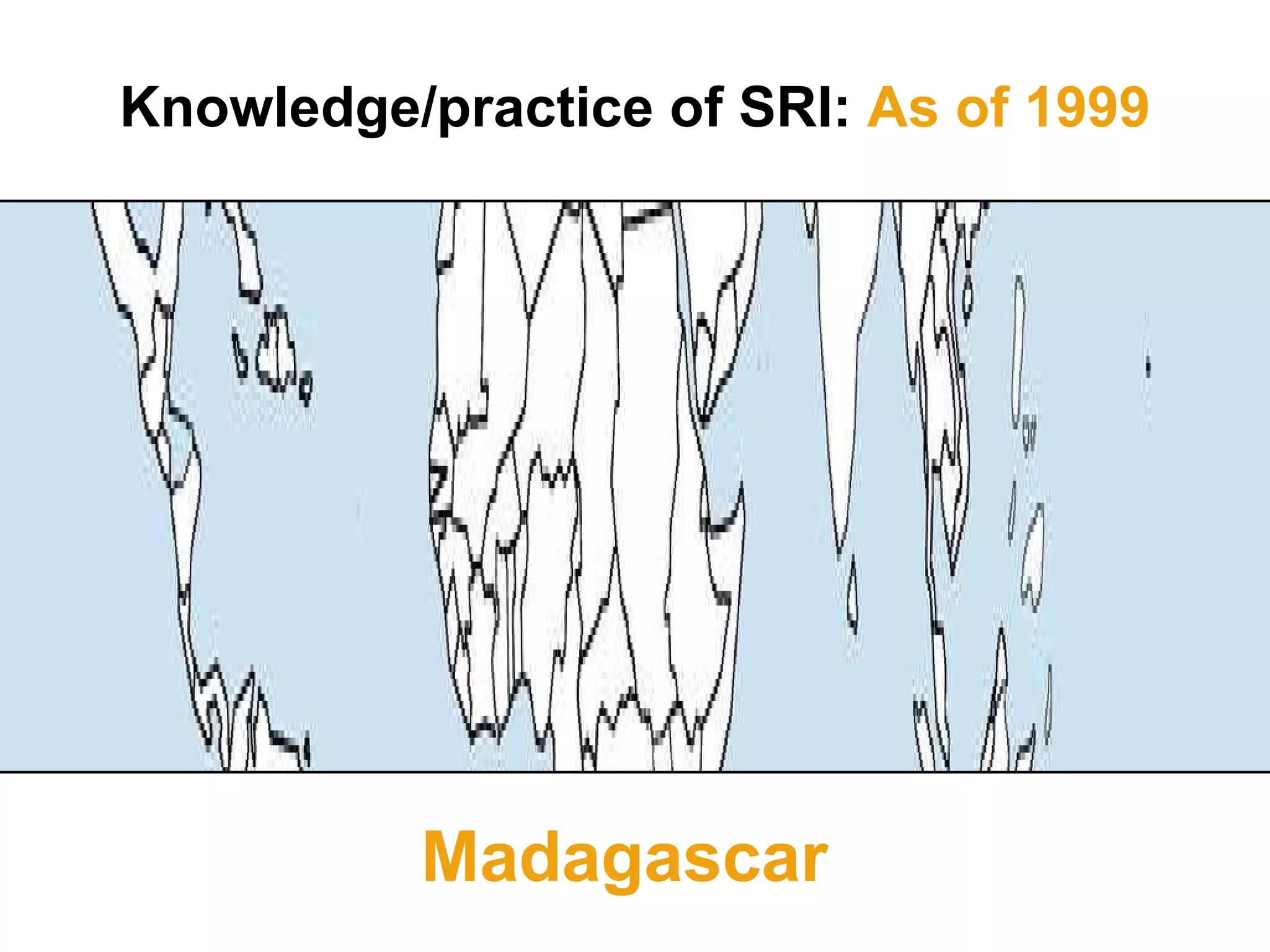
Knowledge/practice of SRI:   As of 1999 Madagascar
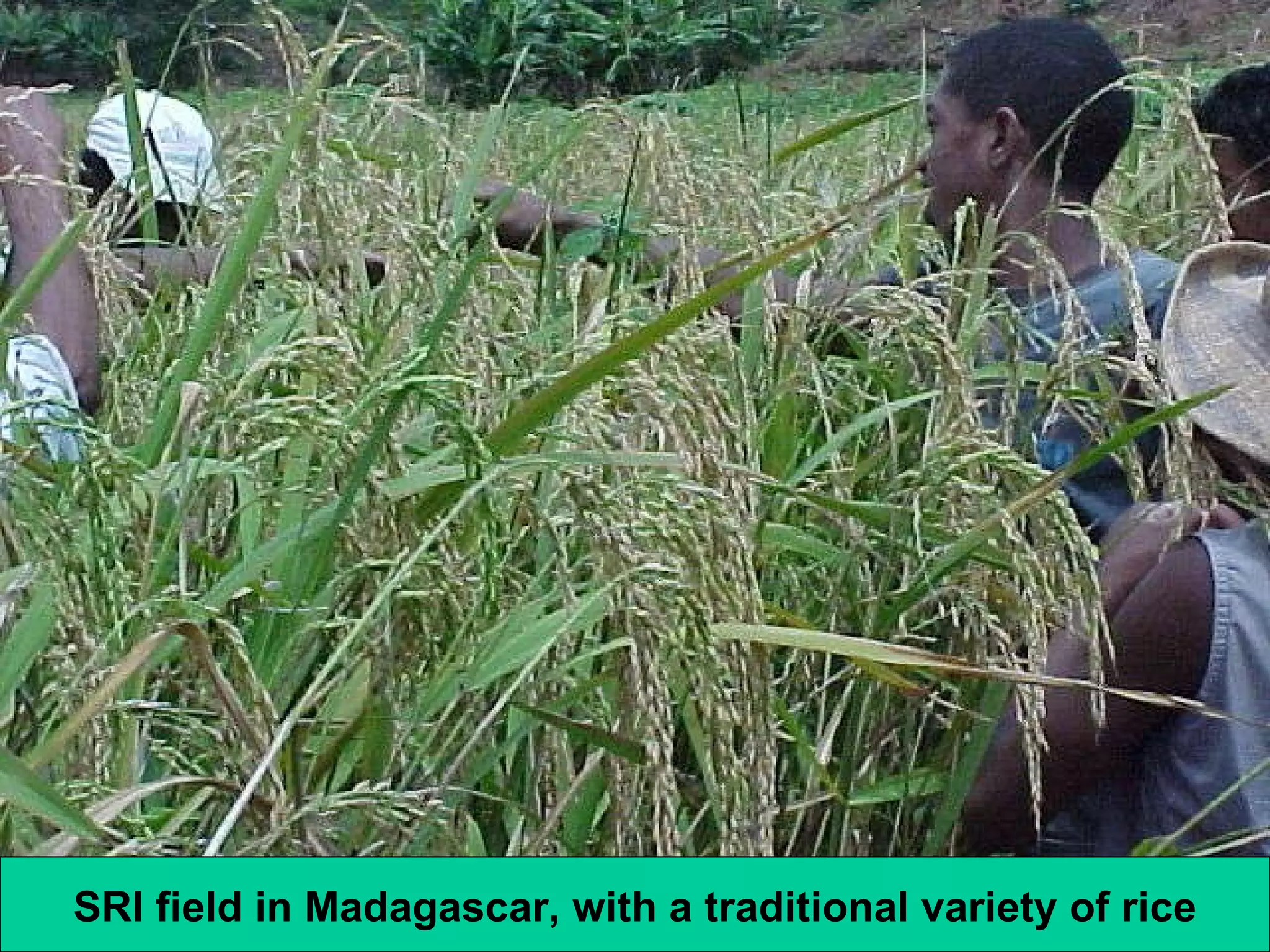
SRI field in Madagascar, with a traditional variety of rice
The Start and Spread of SRI Devised by Fr. Henri de Laulani é,  1983-84 Formation of  Association Tefy Saina ,  1990 Collaboration of ATS and CIIFAD,  1994-98 1st trials outside of Madagascar,  1999-2000 CHINA:  Nanjing Agricultural University INDONESIA:  Agency for Agric. Res. & Dev. BANGLADESH:  CARE/BD and DAE Then spread:  Cambodia, Philippines, Laos, Thailand, Myanmar, Sri Lanka, India, Nepal, Cuba, Peru, Gambia, Sierra Leone …….
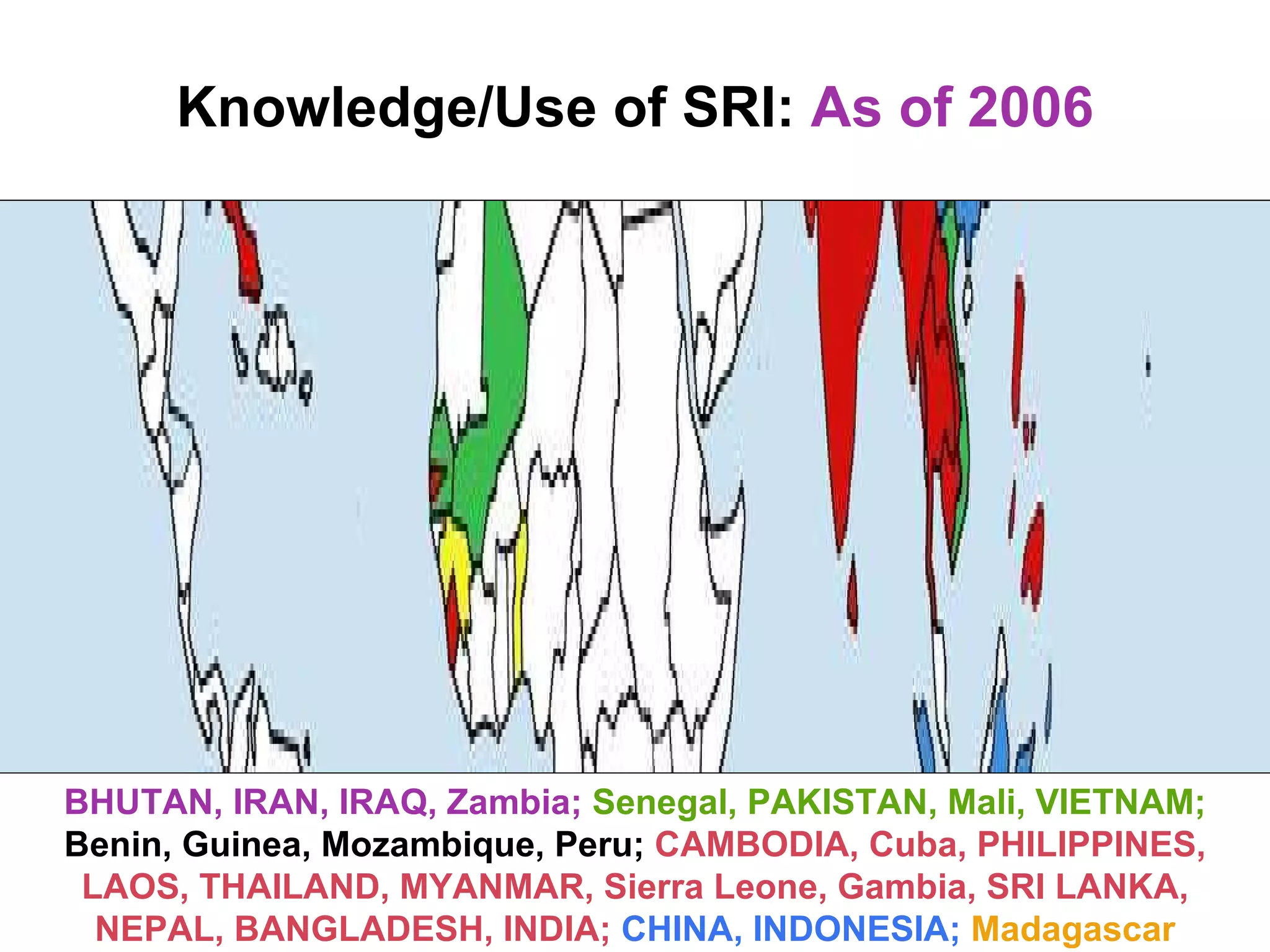
Knowledge/Use of SRI:   As of 2006 BHUTAN, IRAN, IRAQ, Zambia;   Senegal, PAKISTAN, Mali, VIETNAM;   Benin, Guinea, Mozambique, Peru;  CAMBODIA, Cuba, PHILIPPINES, LAOS, THAILAND, MYANMAR, Sierra Leone, Gambia, SRI LANKA, NEPAL, BANGLADESH, INDIA;   CHINA, INDONESIA;   Madagascar
CHINA China National Hybrid Rice Research and Development Center , Changsha and Sanya Hosted 1st Intl. Conference  on SRI, Sanya, April 2002 Now promoting SRI within China and in African countries
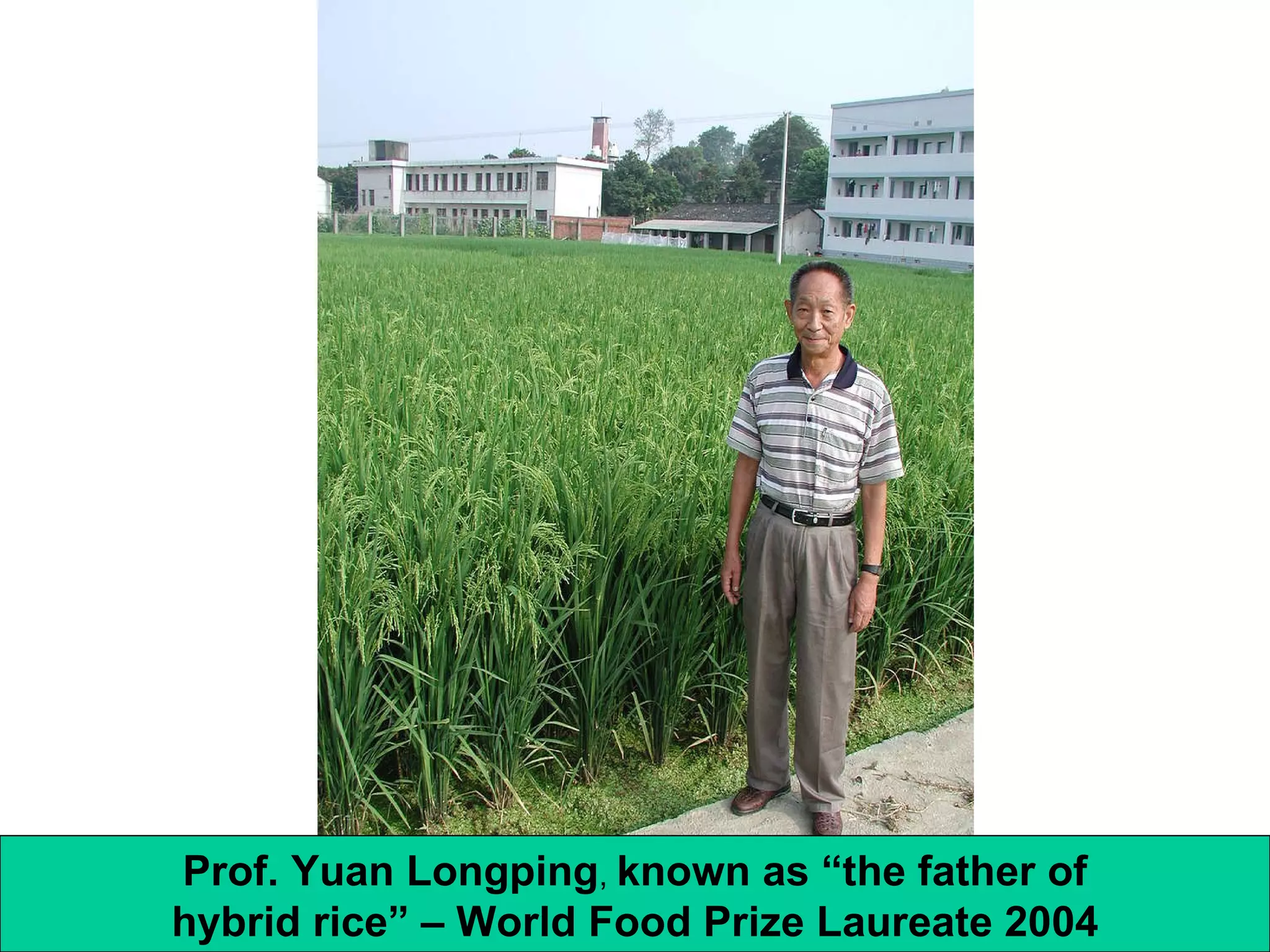
Prof. Yuan Longping ,  known as “the father of hybrid rice” – World Food Prize Laureate 2004
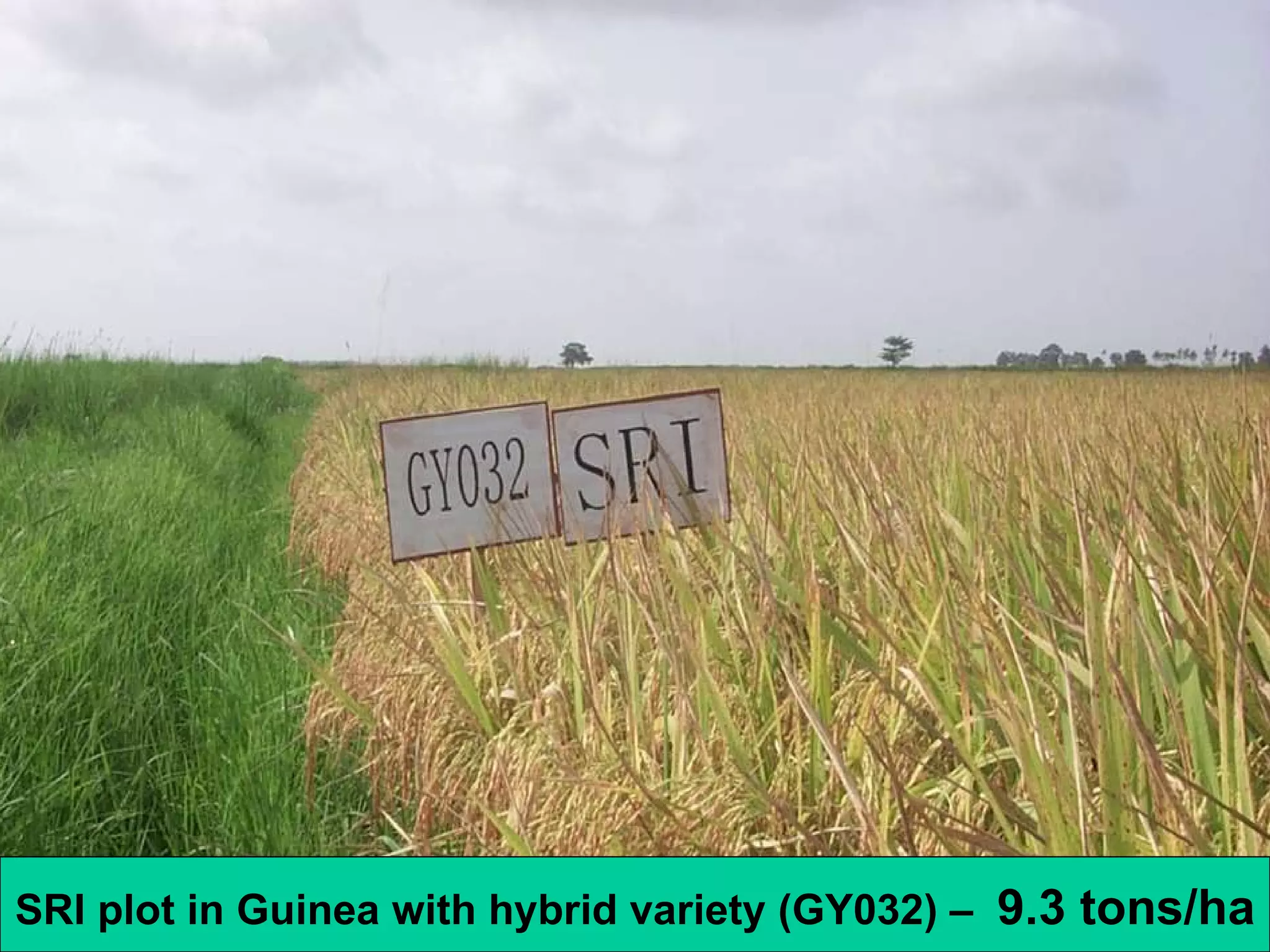
SRI plot in Guinea with hybrid variety (GY032) –  9.3 tons/ha
CHINA China National Rice Research Institute , Hangzhou Co-sponsored 1st Intl. Conference on SRI, Sanya, April 2002 Hosted 1st National SRI Workshop, Hangzhou, March, 2003 In 2007 season,  333,333 hectares   of SRI rice in Zhejiang province
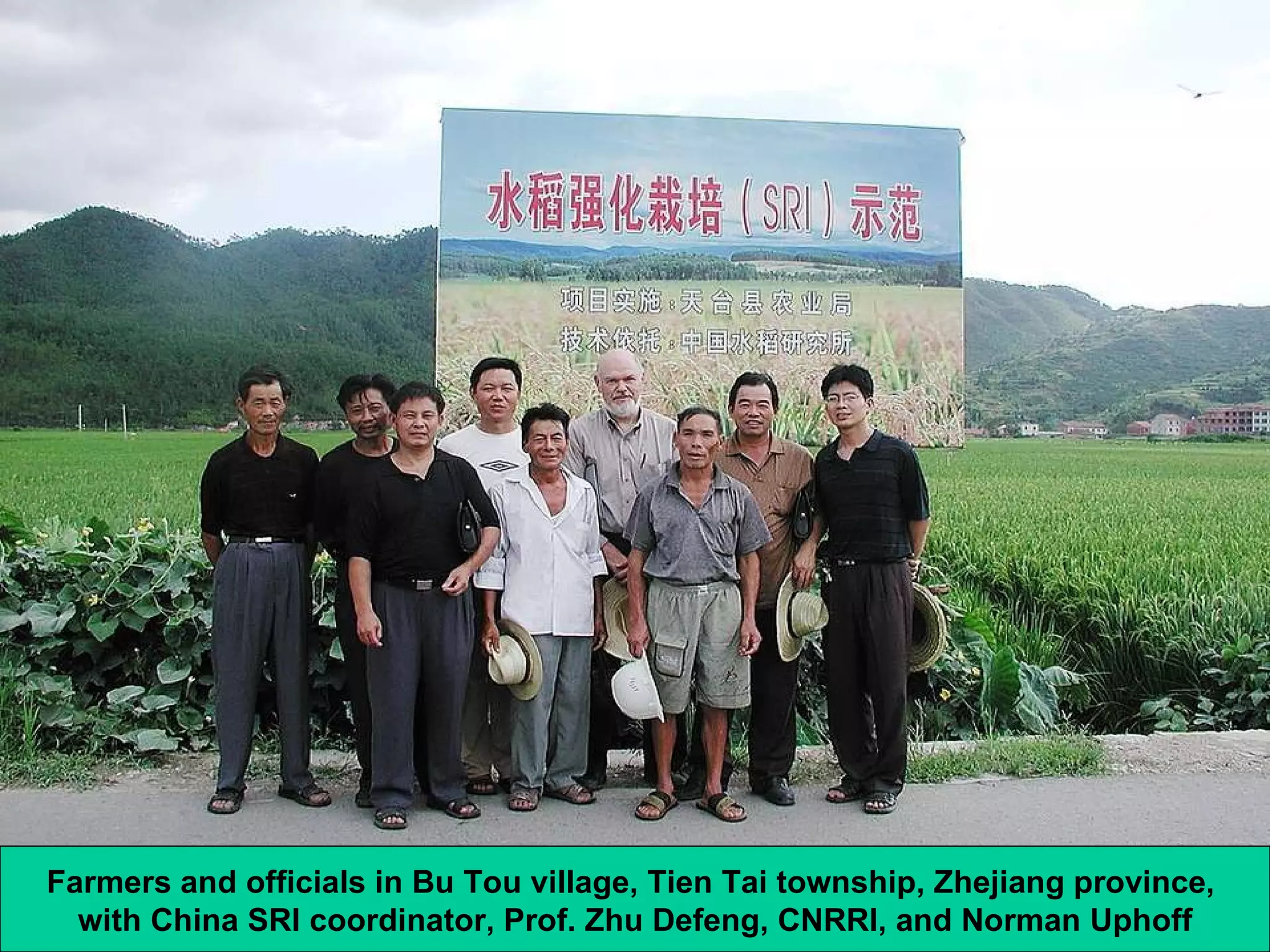
Farmers and officials in Bu Tou village, Tien Tai township, Zhejiang province,  with China SRI coordinator, Prof. Zhu Defeng, CNRRI, and Norman Uphoff
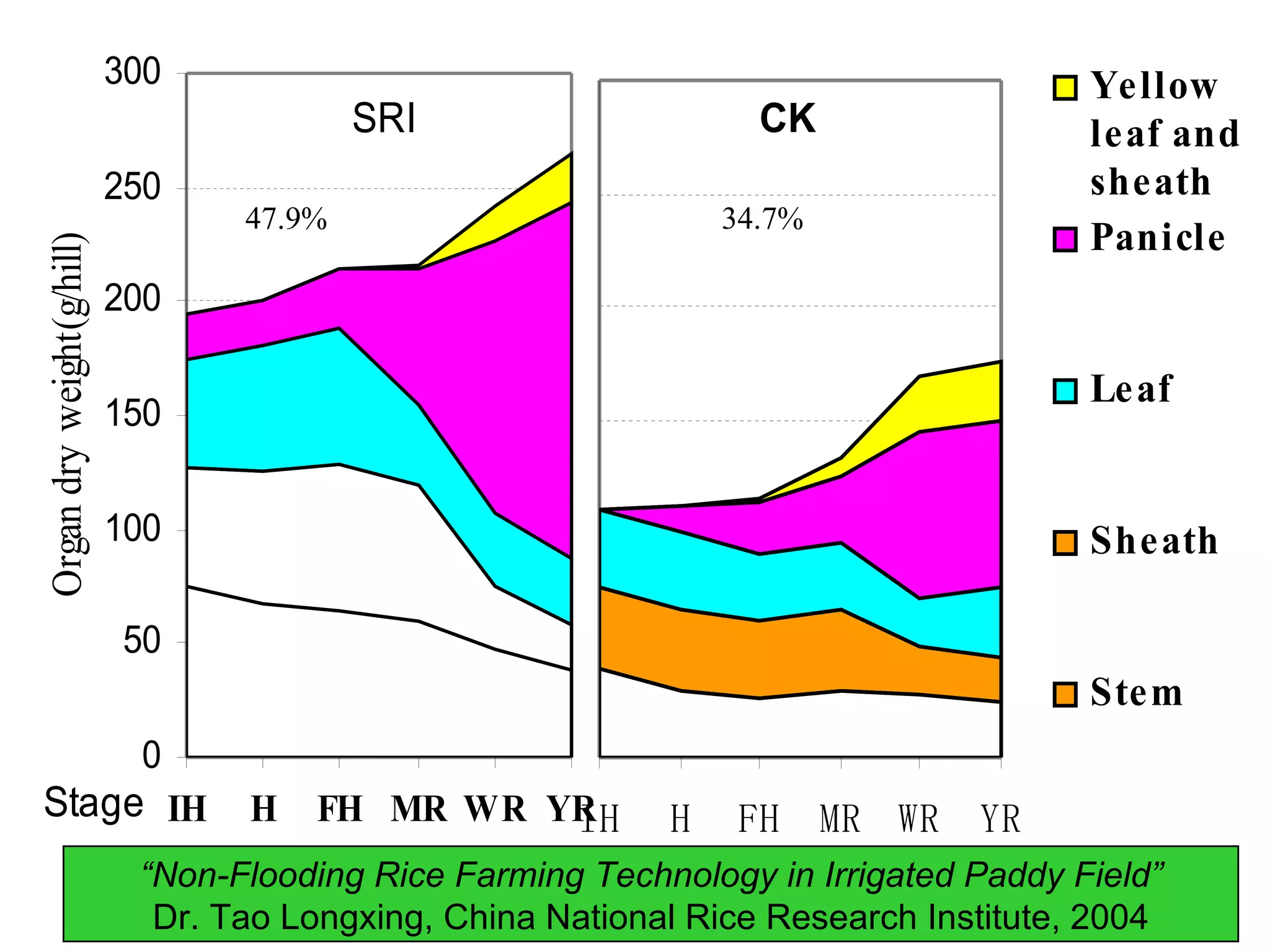
47.9% 34.7% “ Non-Flooding Rice Farming Technology in Irrigated Paddy Field” Dr. Tao Longxing, China National Rice Research Institute, 2004
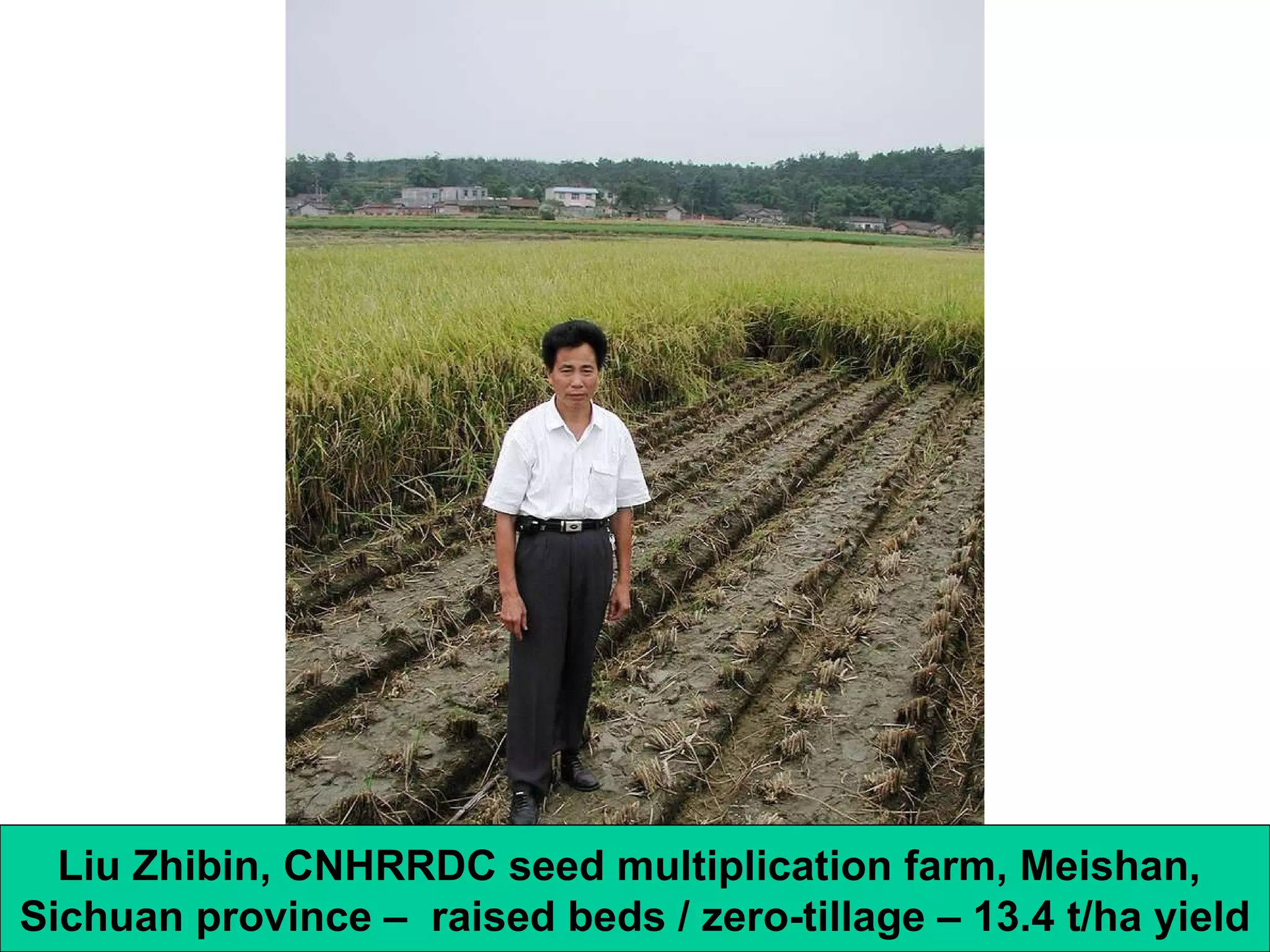
CHINA Sichuan Academy of Agricultural Sciences , Chengdu Crop Cultivation Research Center Seed Multiplication Farm, Meishan Triangular method  of transplanting 16 t/ha yield in 2001 Raised-bed zero-tillage  alternative 13.4 t/ha yield in 2004 100,000 ha  of SRI rice in 2007
Liu Zhibin, CNHRRDC seed multiplication farm, Meishan,  Sichuan province –  raised beds / zero-tillage – 13.4 t/ha yield
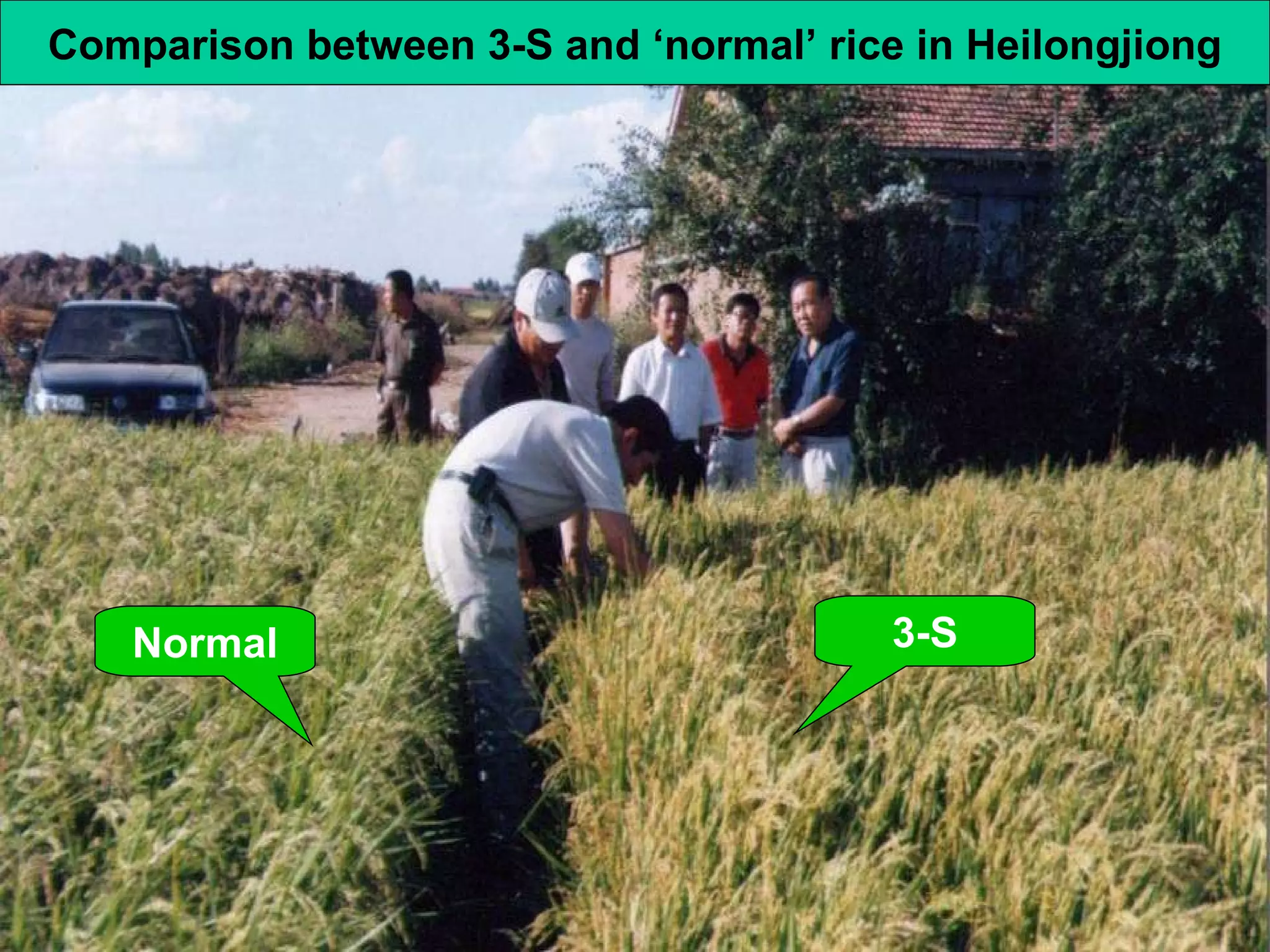
CHINA Northeast Agricultural University , Harbin, Heilongjiong   3-S system of rice cultivation, developed by Prof. Jin Xueyong Similar to SRI, with methods adapted for cold climatic conditions  Heilongjiong province is in northern China adjoining Manchuria
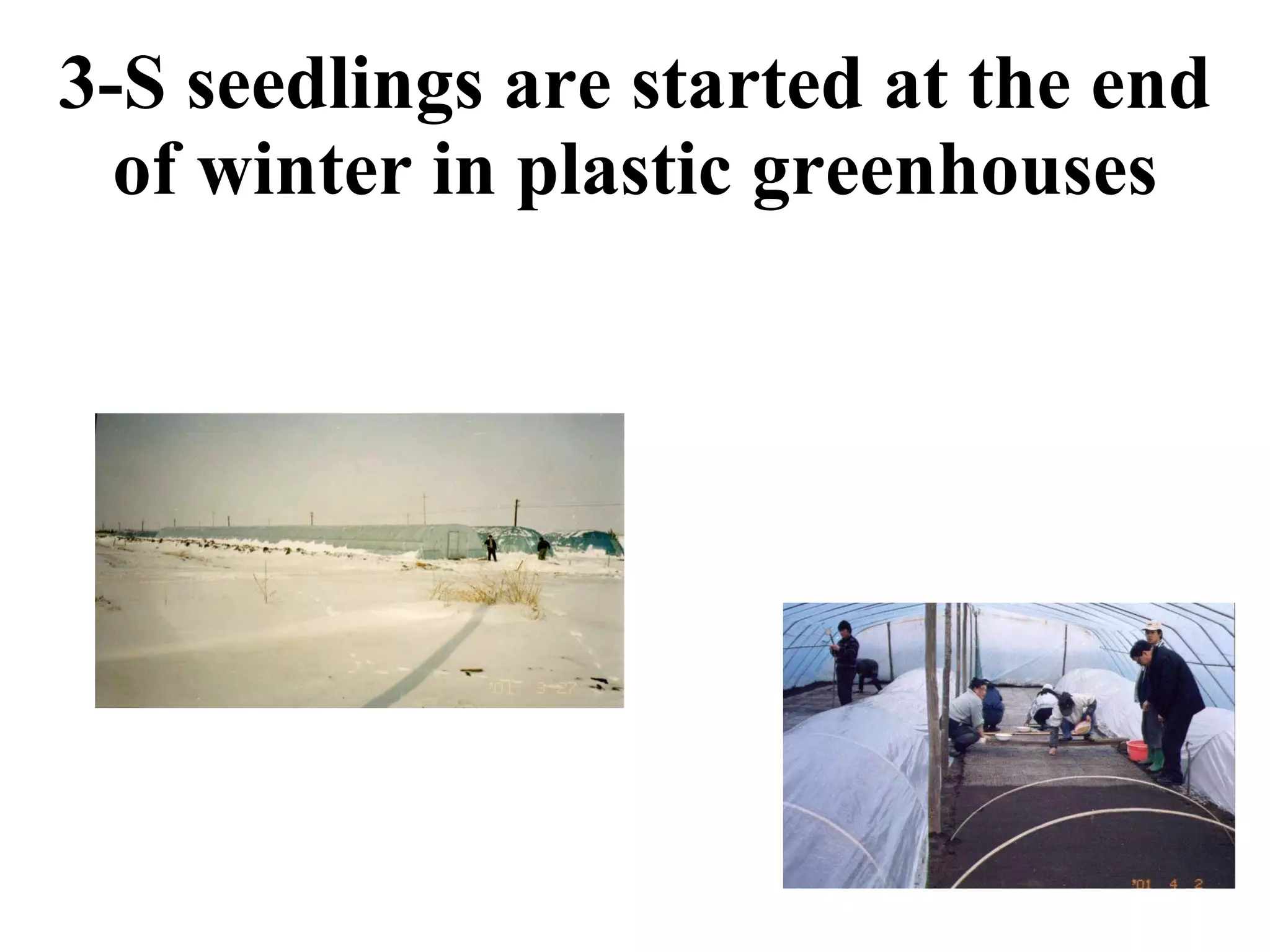
3-S seedlings are started at the end of winter in plastic greenhouses
Normal 3-S Comparison between 3-S and ‘normal’ rice in Heilongjiong
INDONESIA Agency for Agricultural Research and Development , Sukamandi National IPM Program , starting at Ciamis Farmer Field School Program  of the Field Foundation, took over IPM work Nippon Koei  project management team in Eastern Indonesia, from 2002 Yayasan Aliksa Organik SRI
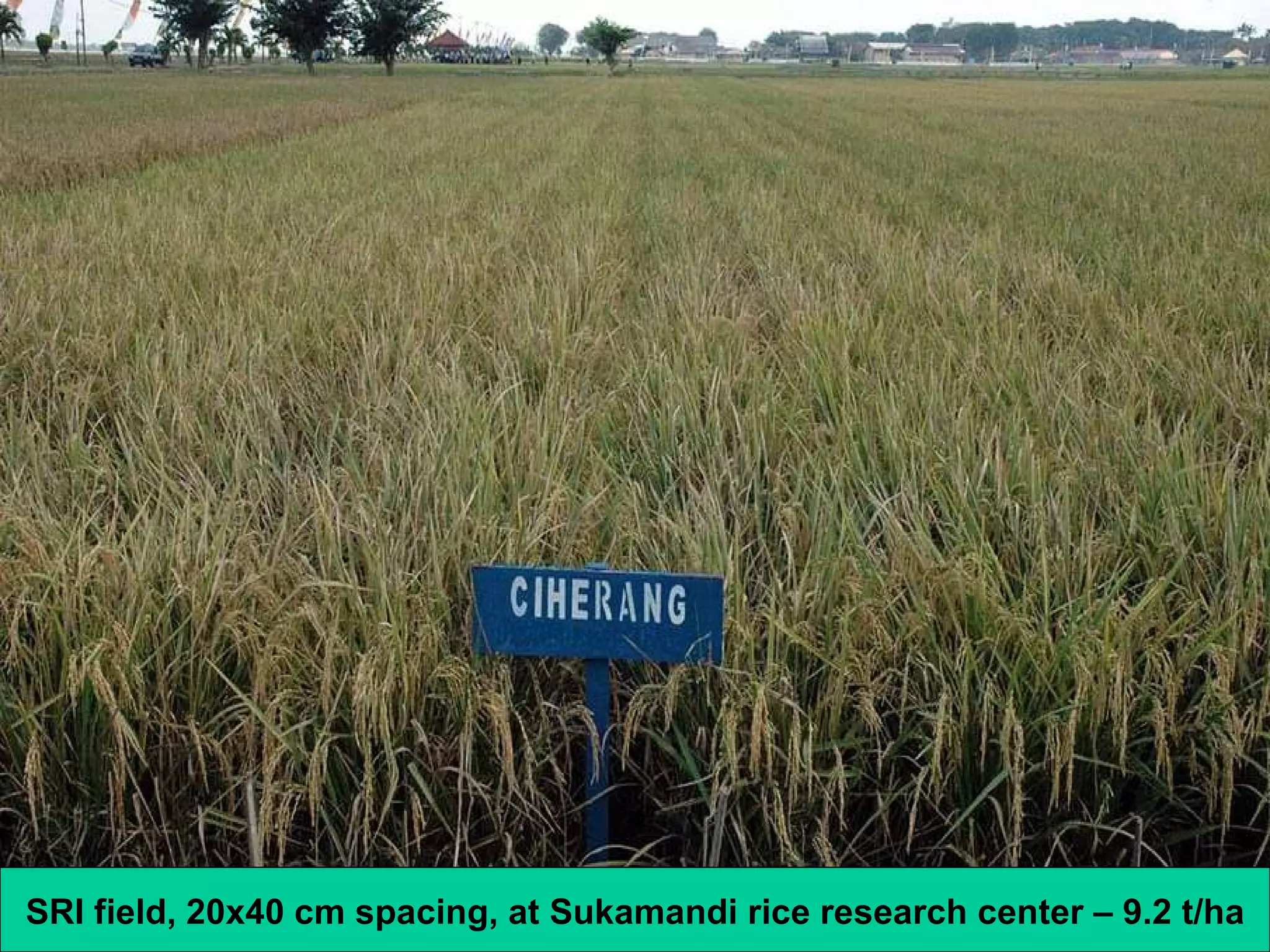
SRI field, 20x40 cm spacing, at Sukamandi rice research center – 9.2 t/ha
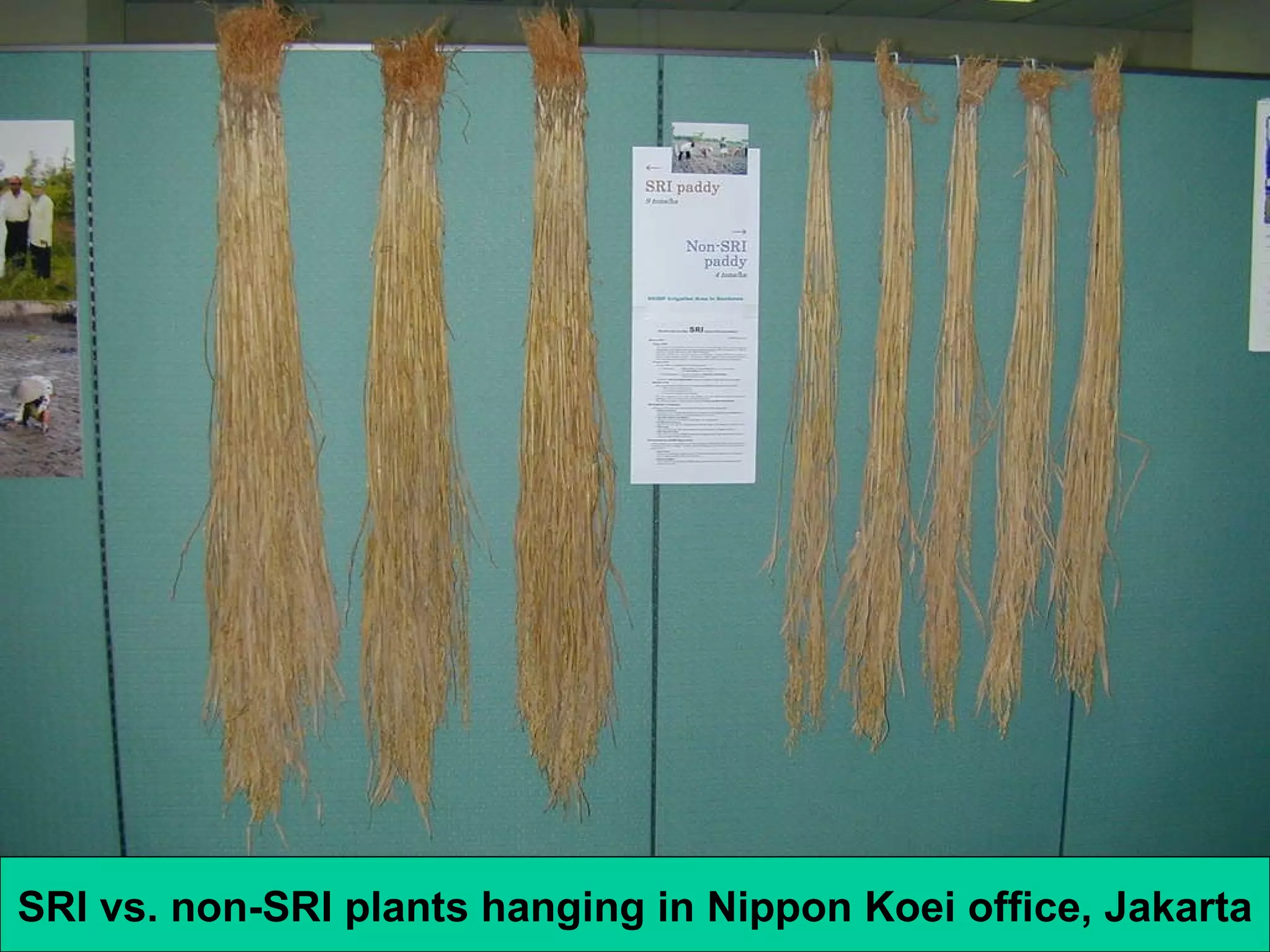
SRI vs. non-SRI plants hanging in Nippon Koei office, Jakarta
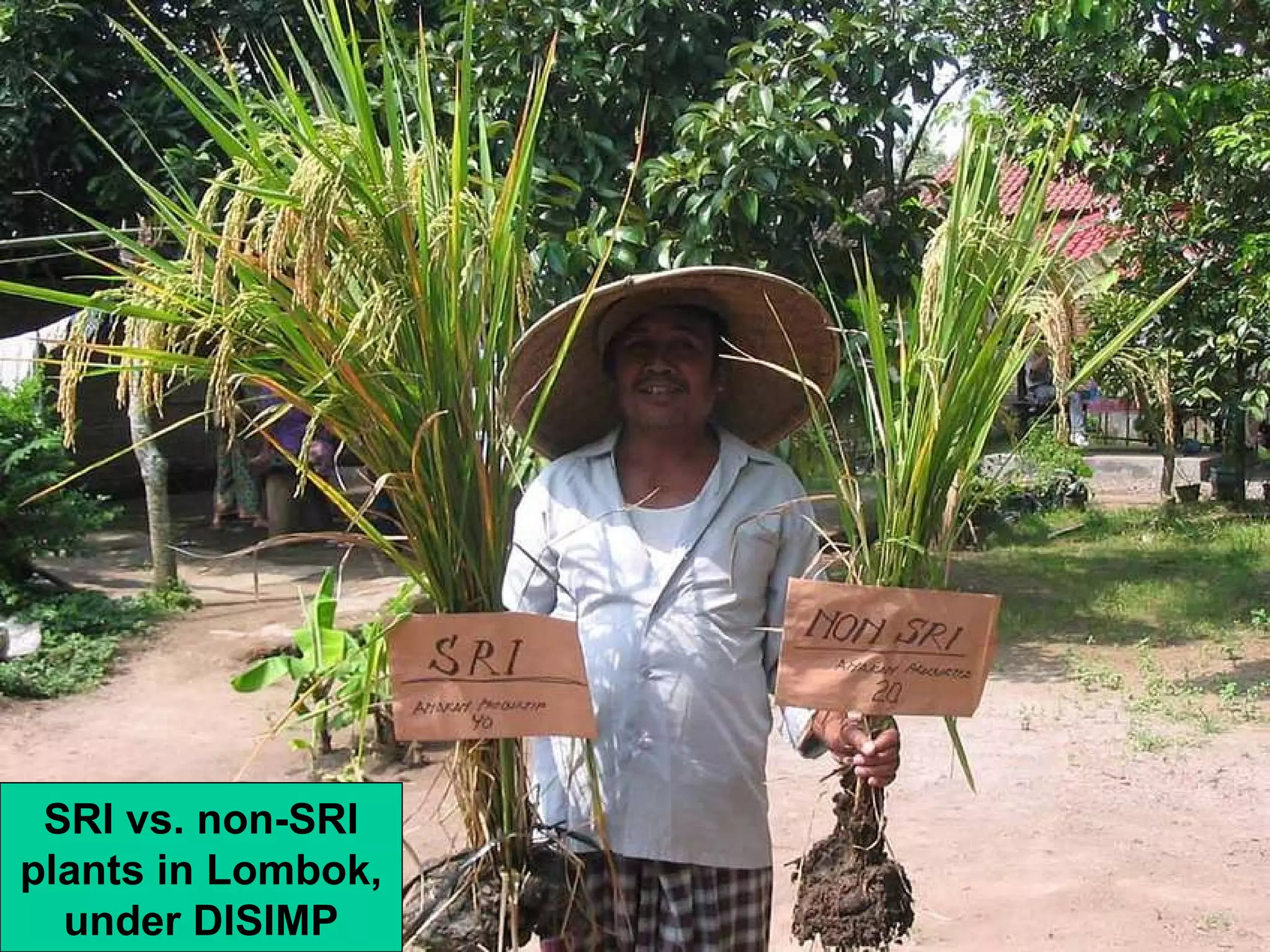
SRI vs. non-SRI plants in Lombok, under DISIMP
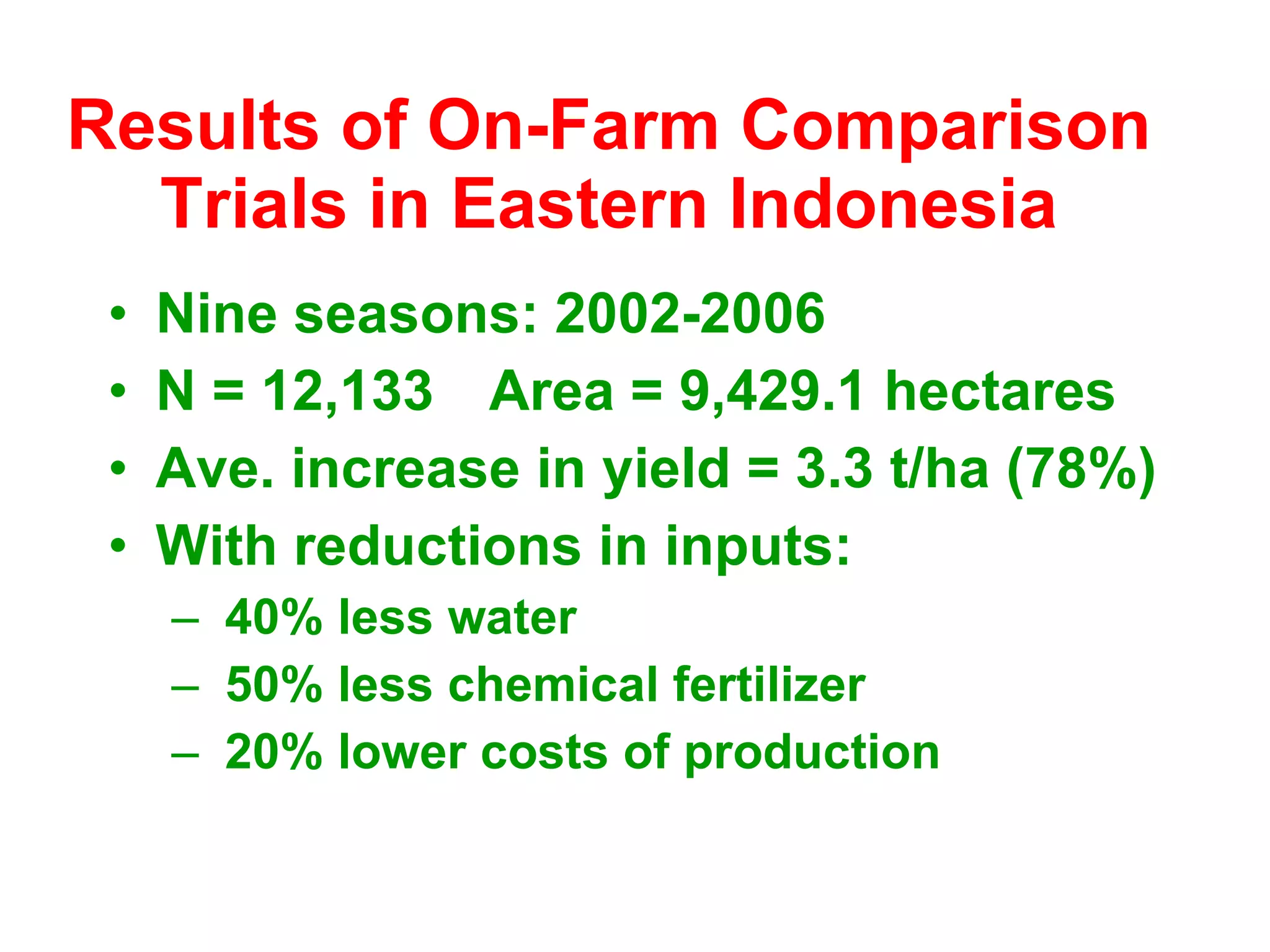
Results of On-Farm Comparison Trials in Eastern Indonesia Nine seasons: 2002-2006 N = 12,133 Area = 9,429.1 hectares Ave. increase in yield = 3.3 t/ha (78%) With reductions in inputs: 40% less water 50% less chemical fertilizer 20% lower costs of production
“ Productivity is increased [with SRI], and at the same time the  environment is saved. . . . I want to urge everybody, starting with the Minister of Agriculture and everyone else -- let us support this  SRI method with our maximum capacity.” --  Pres. S. B. Yudyoyono speaking at SRI Harvest Festival, Cianjur, July 30, 2007
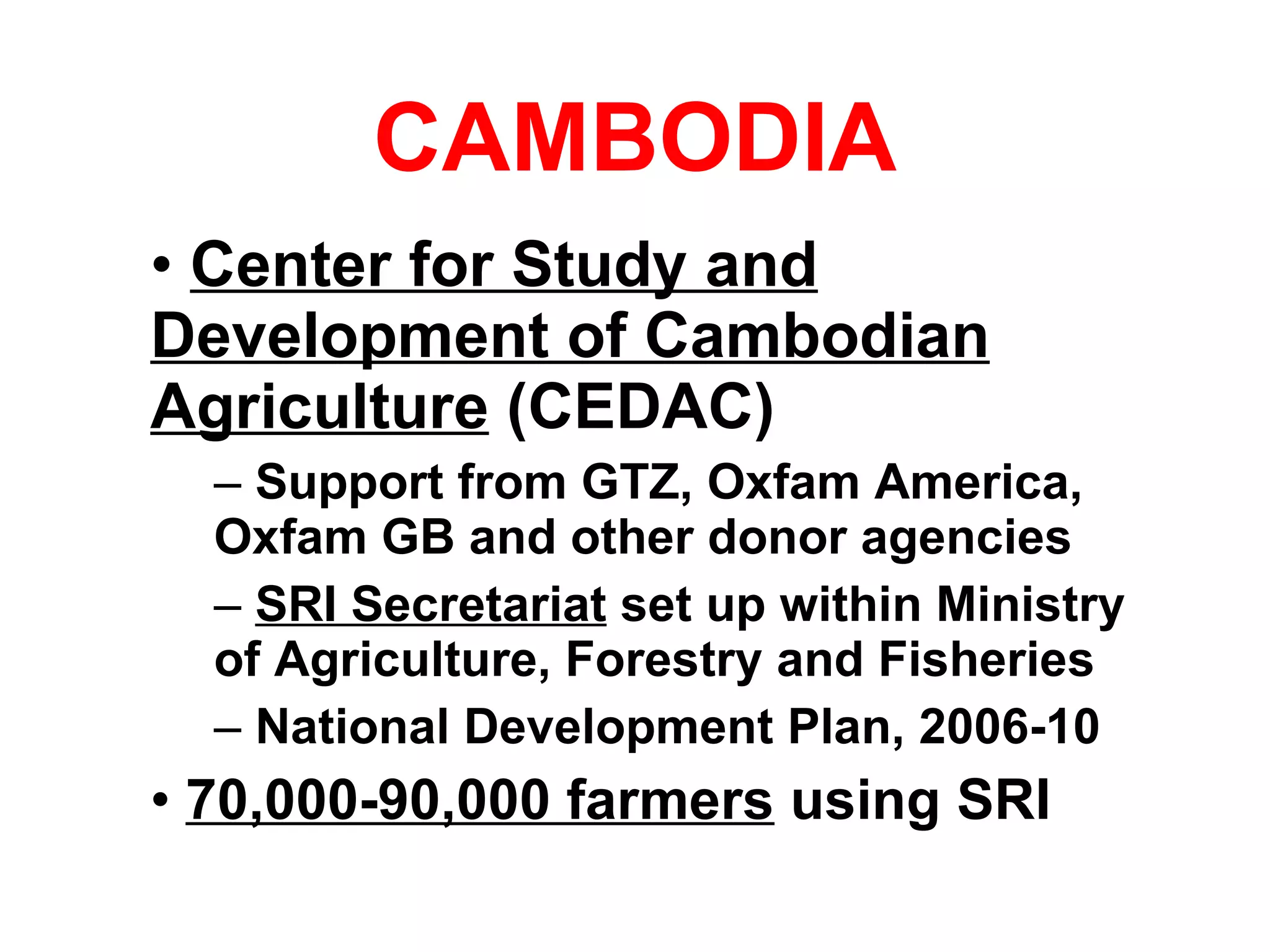
CAMBODIA Center for Study and Development of Cambodian Agriculture  (CEDAC) Support from GTZ, Oxfam America, Oxfam GB and other donor agencies SRI Secretariat  set up within Ministry of Agriculture, Forestry and Fisheries National Development Plan, 2006-10 70,000-90,000 farmers  using SRI
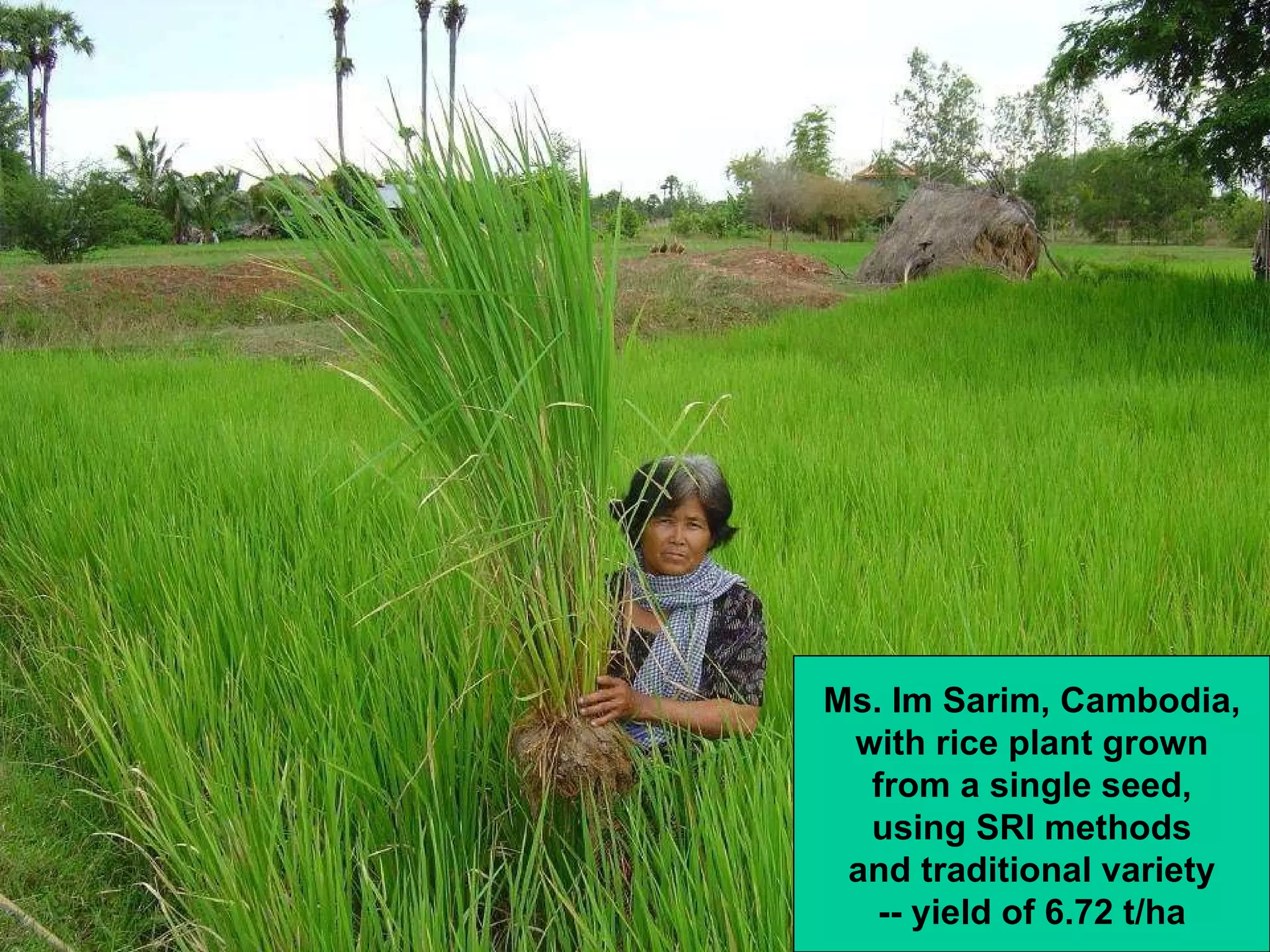
Ms. Im Sarim, Cambodia, with rice plant grown from a single seed, using SRI methods and traditional variety -- yield of 6.72 t/ha
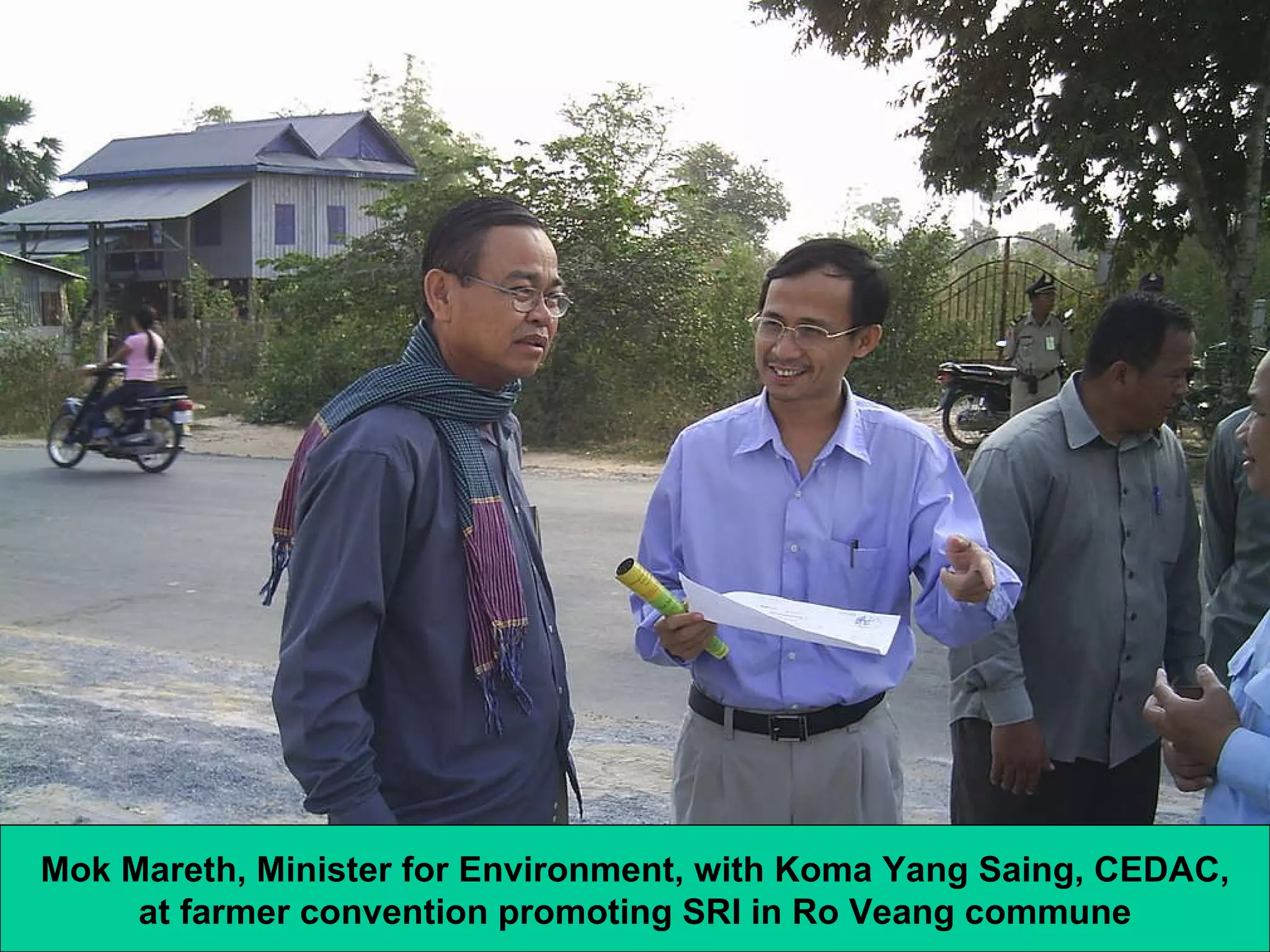
Mok Mareth, Minister for Environment, with Koma Yang Saing, CEDAC, at farmer convention promoting SRI in Ro Veang commune
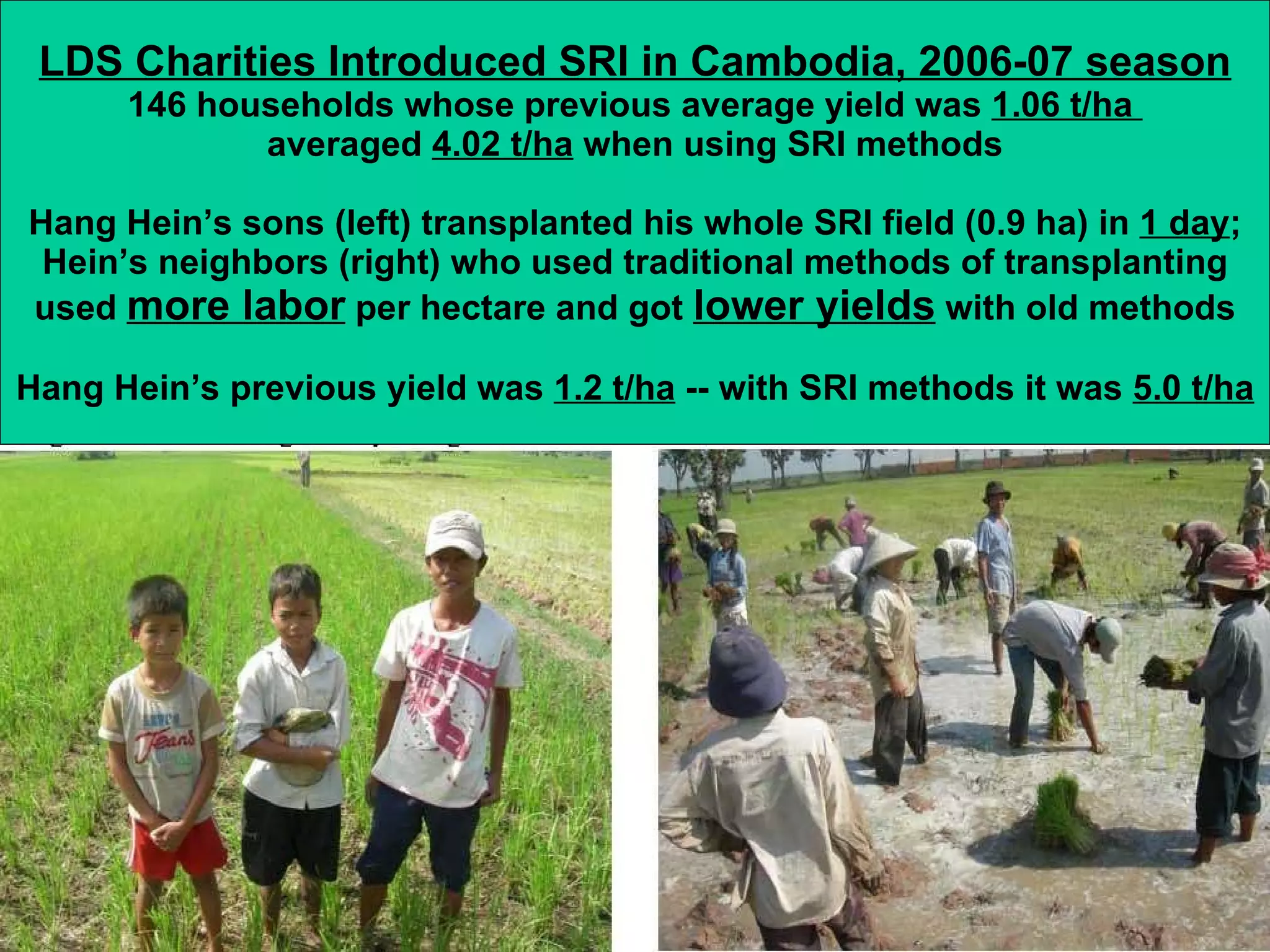
LDS Charities Introduced SRI in Cambodia, 2006-07 season 146 households whose previous average yield was  1.06 t/ha  averaged  4.02 t/ha  when using SRI methods Hang Hein’s sons (left) transplanted his whole SRI field (0.9 ha) in  1 day ; Hein’s neighbors (right) who used traditional methods of transplanting used  more labor  per hectare and got  lower yields  with old methods Hang Hein’s previous yield was  1.2 t/ha  -- with SRI methods it was  5.0 t/ha
PHILIPPINES NGO initiatives:  CDSMC, BIND Philippine Rural Reconstruction Movement  (PRRM), affiliate of IIRR Establishment of   SRI-Pilipinas Universities : UPLB, LSU, etc. Government agencies : NIA, ATI, PhilRice, Dept. of Agriculture NGOs:   e.g., Save the Ifugao Terraces Movement (SITMo)
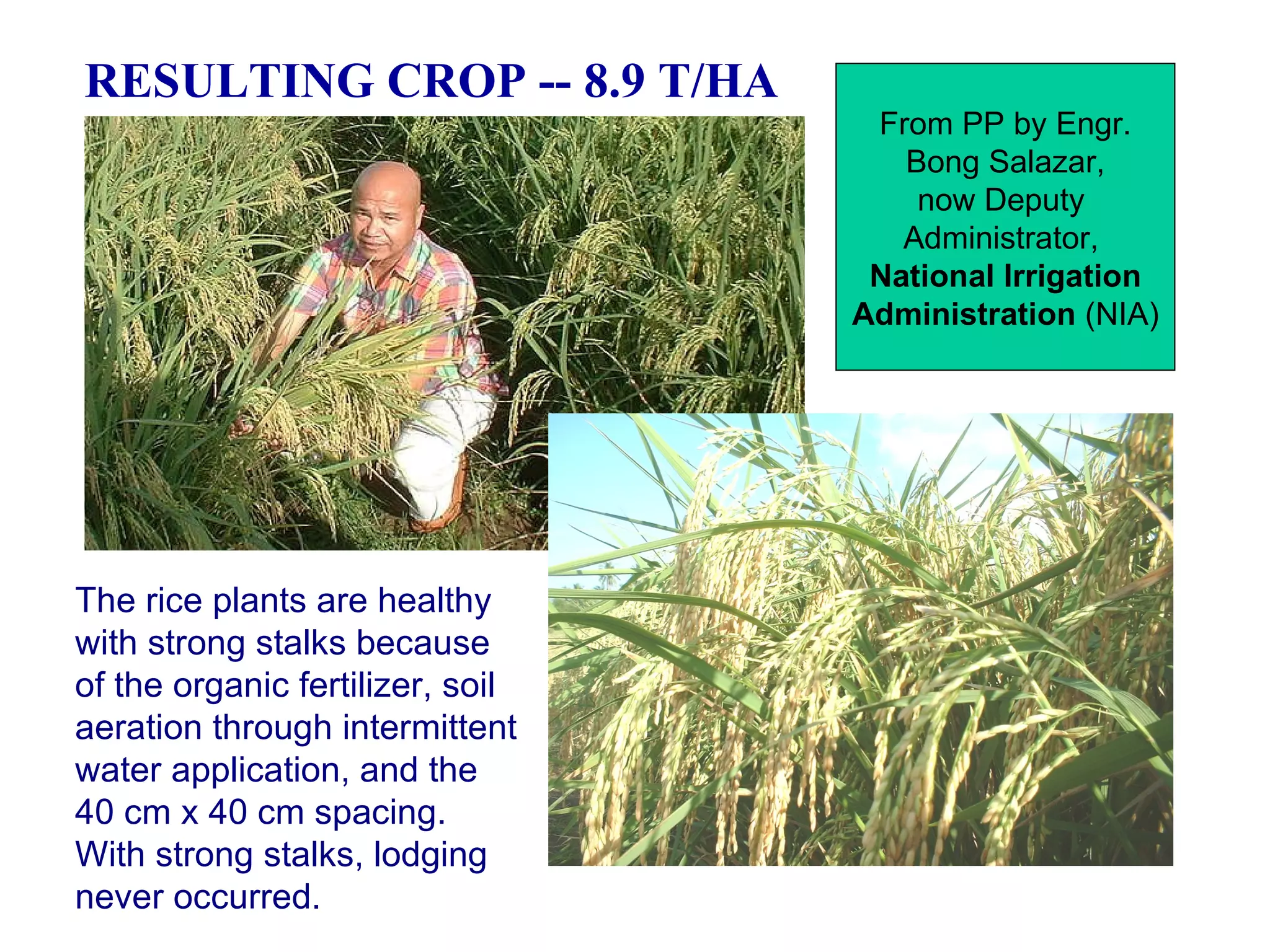
RESULTING CROP -- 8.9 T/HA The rice plants are healthy with strong stalks because of the organic fertilizer, soil aeration through intermittent water application, and the 40 cm x 40 cm spacing. With strong stalks, lodging never occurred. From PP by Engr. Bong Salazar, now Deputy  Administrator,  National Irrigation Administration  (NIA)
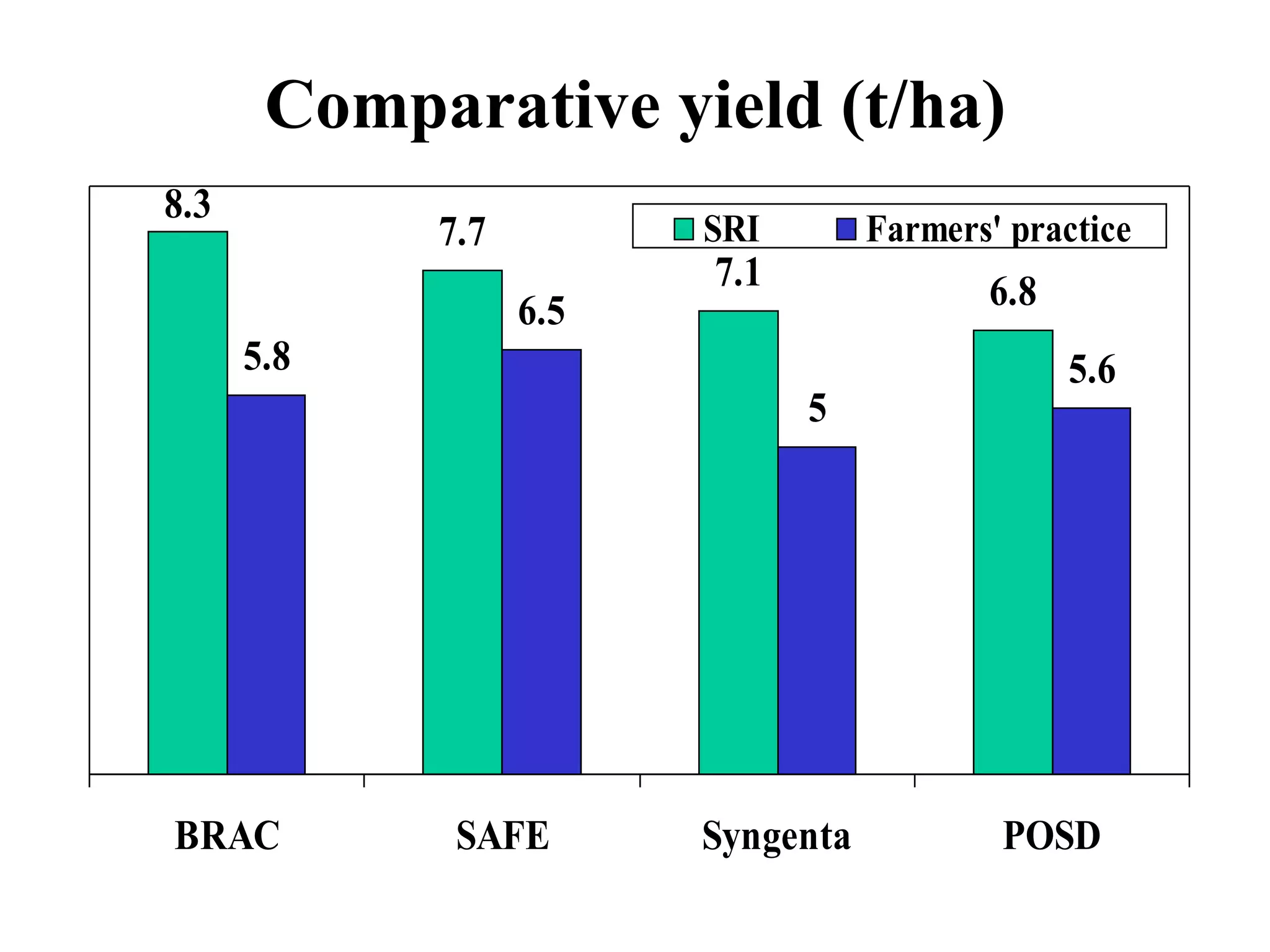
BANGLADESH SRI National Network of BD BRRI : BD Rice Research Institute BRAC: BD Rural Advancemt Comm  DAE: Dept. of Agric. Extension SAFE: Sust. Agric. & Farming Enterprise Development Group Syngenta Bangladesh Co. Ltd.  BRF: BD Rice Foundation -- etc. Evaluation funded by IRRI/BD, 2002-04
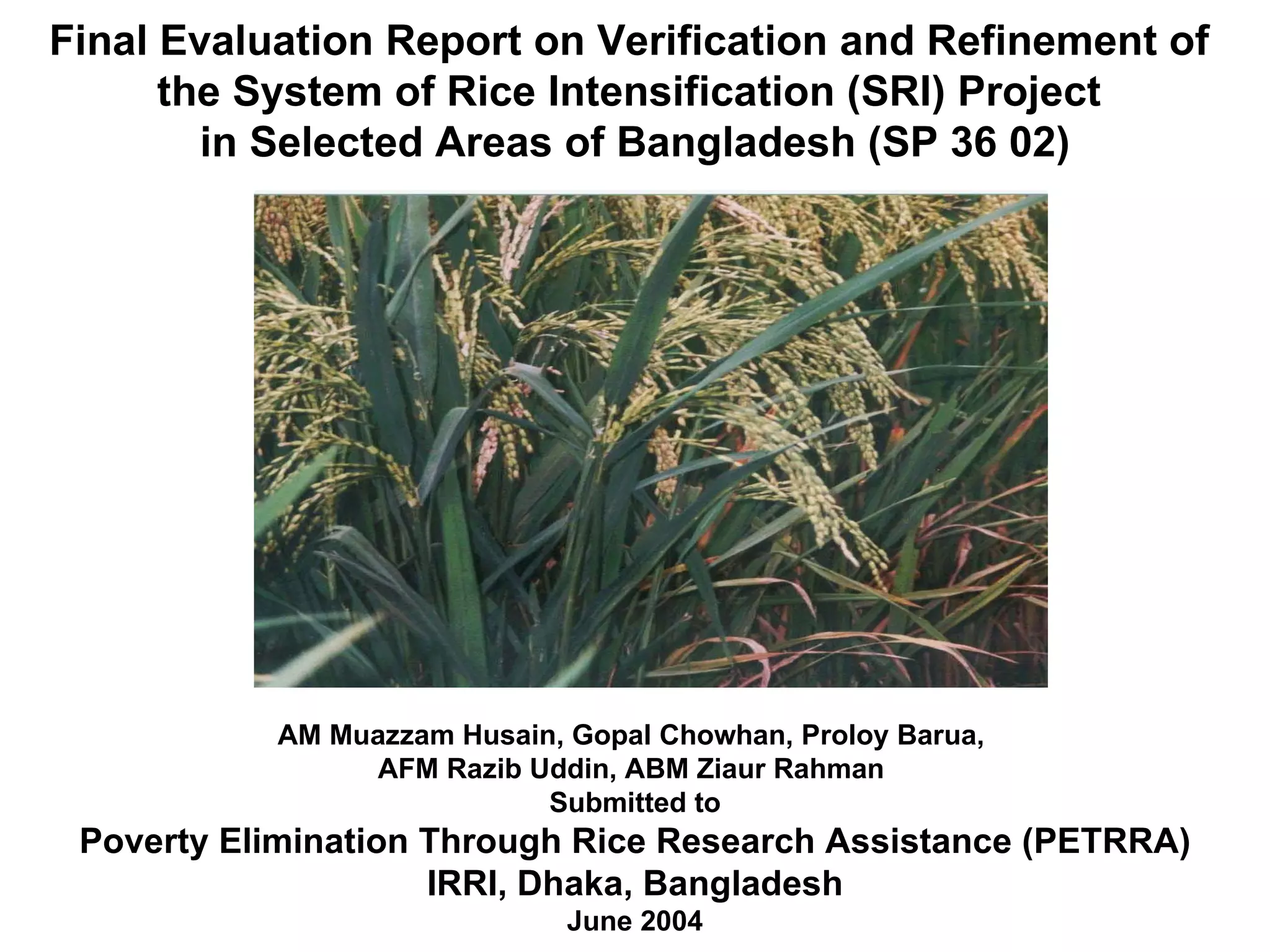
Final Evaluation Report on Verification and Refinement of  the System of Rice Intensification (SRI) Project  in Selected Areas of Bangladesh (SP 36 02) AM Muazzam Husain, Gopal Chowhan, Proloy Barua,  AFM Razib Uddin, ABM Ziaur Rahman  Submitted to Poverty Elimination Through Rice Research Assistance (PETRRA) IRRI, Dhaka, Bangladesh June 2004
Comparative yield (t/ha)
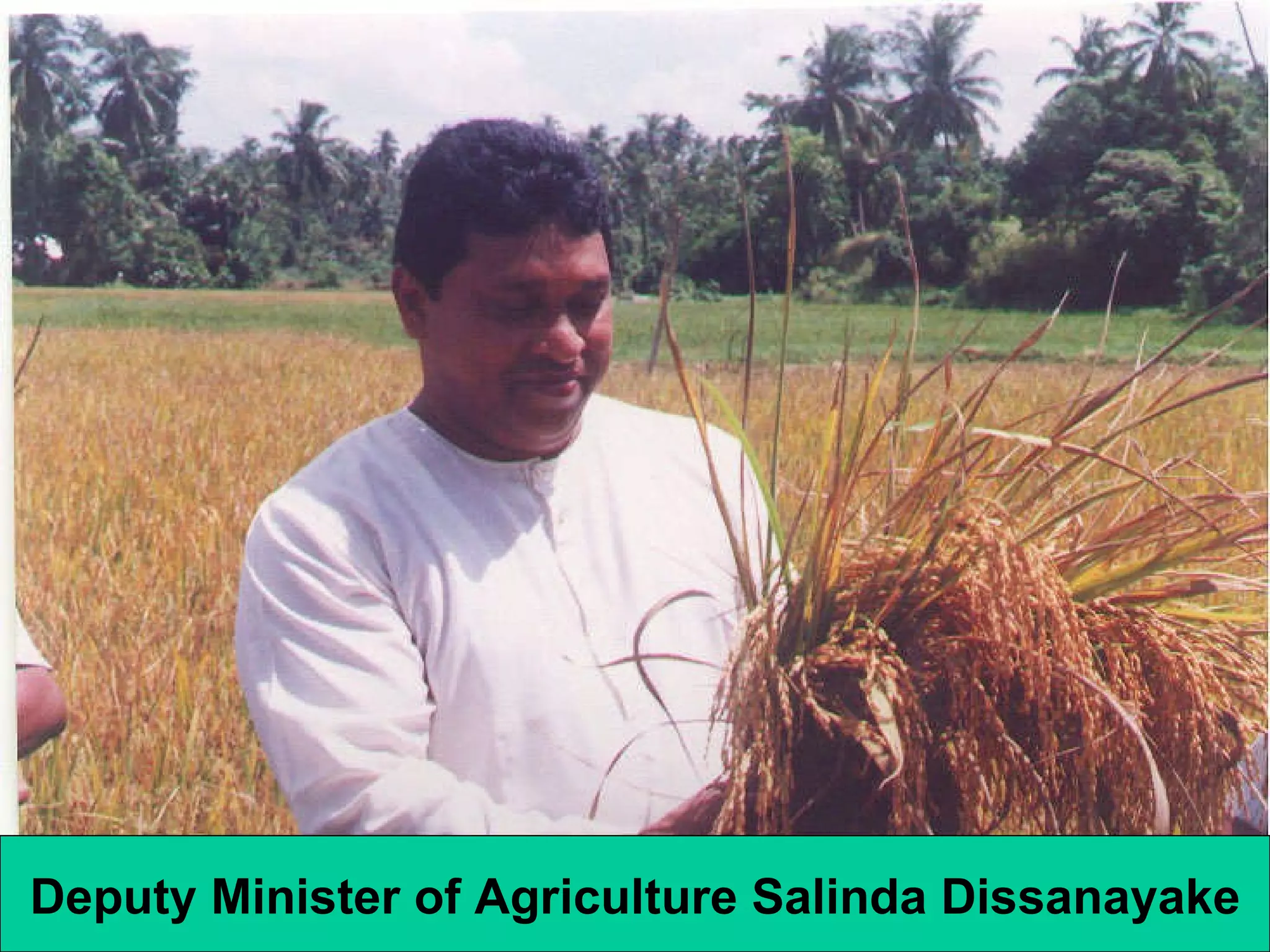
SRI LANKA Initial collaboration among: Senior  civil  servant:  G. Batuwitage, Senior Assistant Secretary of Agriculture Senior  politician : S. Dissanayake, Deputy Minister of Agriculture Farmer/environmental  activist :  W. M. Premaratna, Ecological Farming Center Some support from government agencies and NGOs, e.g., Oxfam/CAA
Deputy Minister of Agriculture Salinda Dissanayake
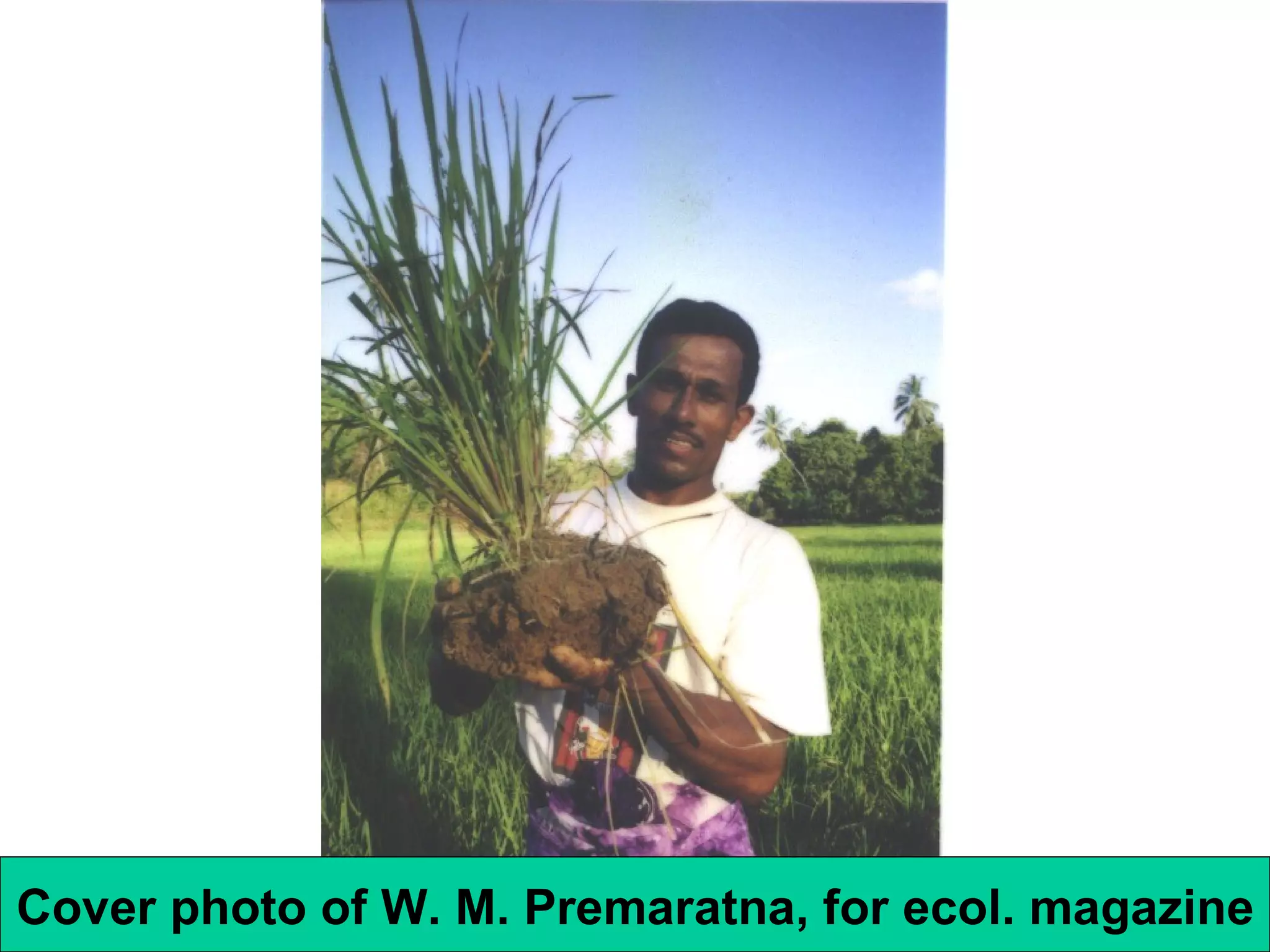
Cover photo of W. M. Premaratna, for ecol. magazine
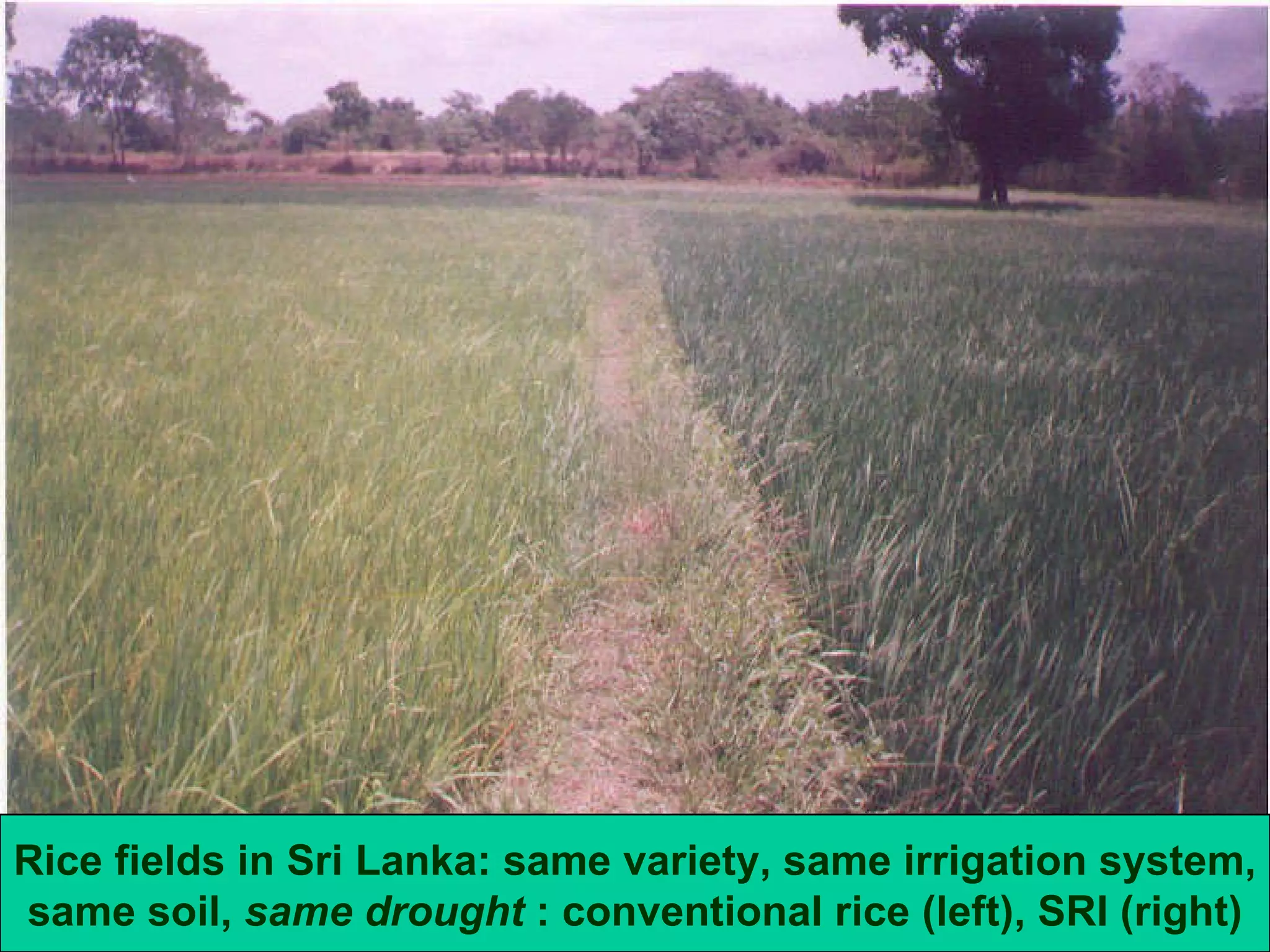
Rice fields in Sri Lanka: same variety, same irrigation system, same soil,  same drought  : conventional rice (left), SRI (right)
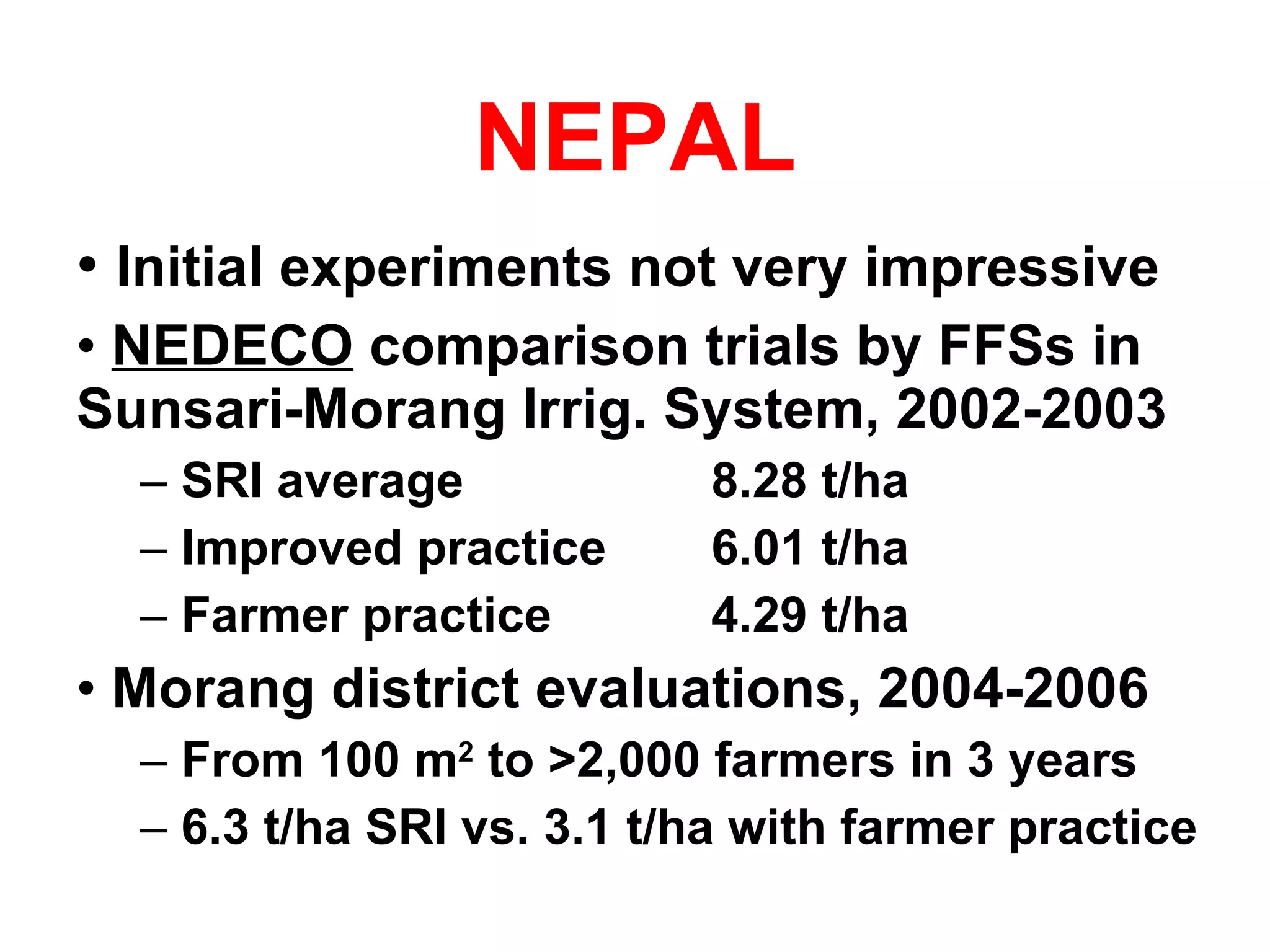
NEPAL Initial experiments not very impressive NEDECO  comparison trials by FFSs in Sunsari-Morang Irrig. System, 2002-2003 SRI average  8.28 t/ha Improved practice 6.01 t/ha Farmer practice 4.29 t/ha Morang district evaluations, 2004-2006 From 100 m 2  to >2,000 farmers in 3 years 6.3 t/ha SRI vs. 3.1 t/ha with farmer practice
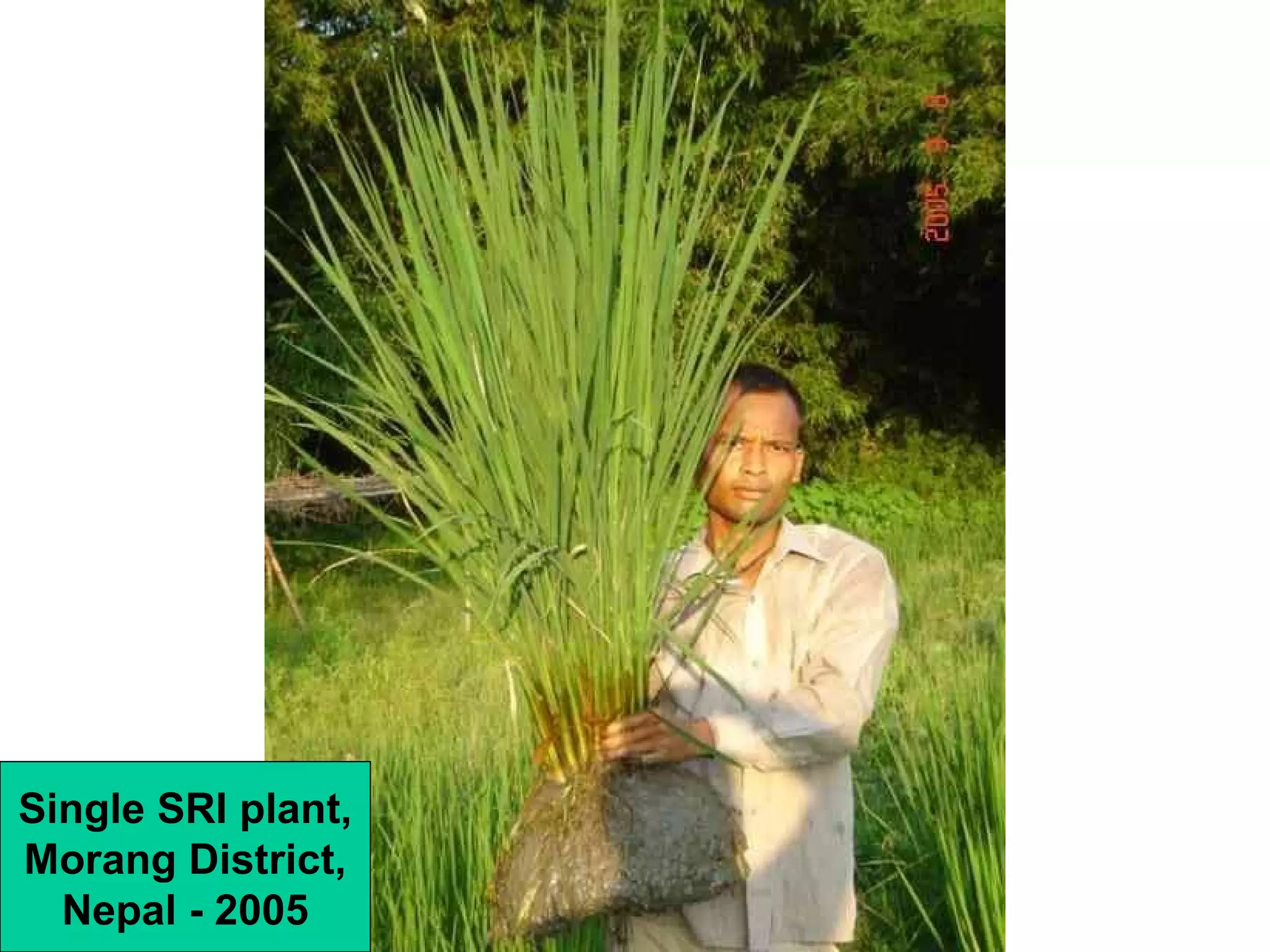
Single SRI plant, Morang District, Nepal - 2005
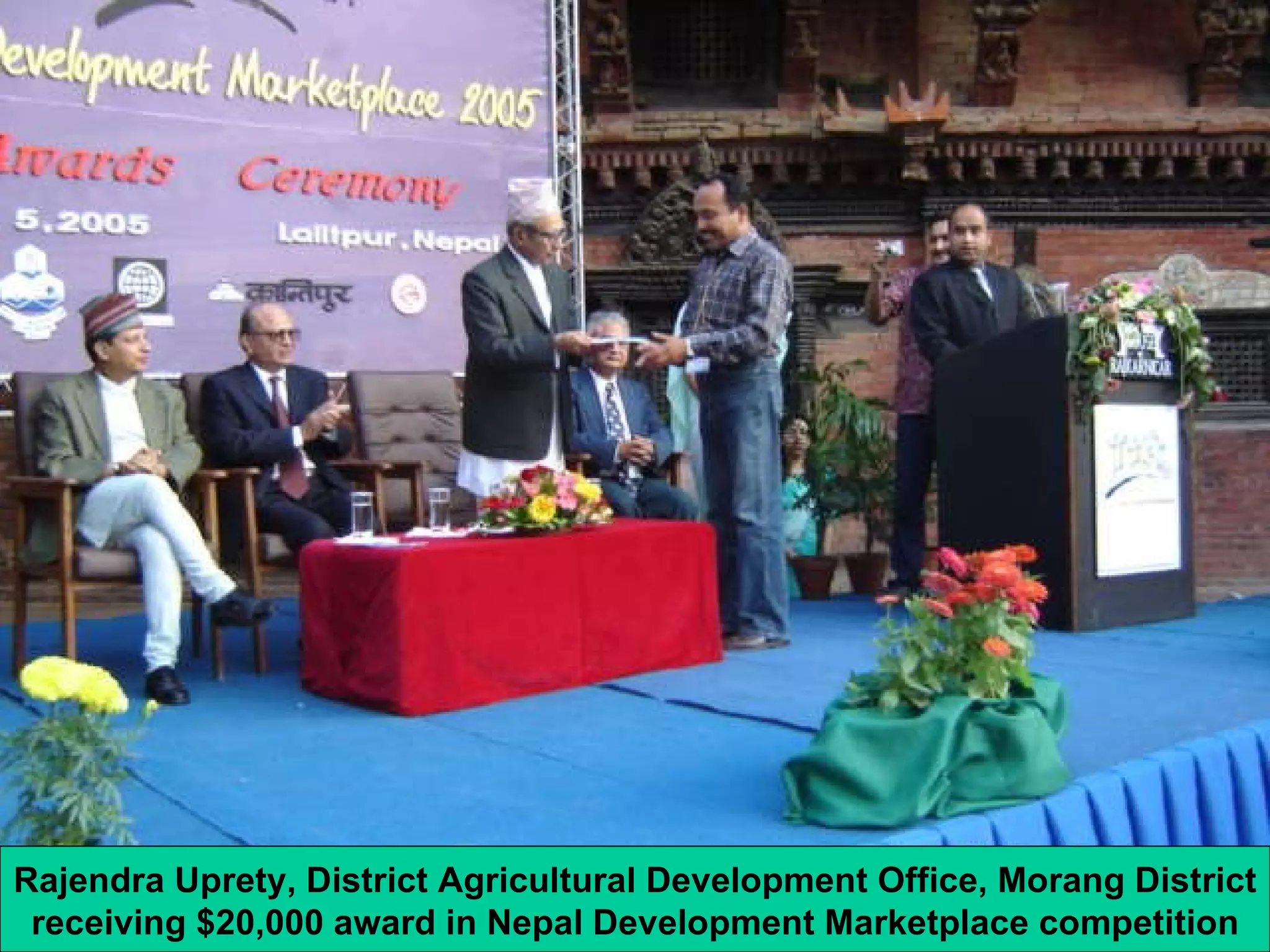
Rajendra Uprety, District Agricultural Development Office, Morang District receiving $20,000 award in Nepal Development Marketplace competition
MYANMAR Metta Development Foundation  introduced SRI through FFS methods: 29 FFS in 2001 55 FFS in 2002 174 FFS in 2003 5,202 farmers trained in SRI 2001-2003 By 2004,  >20,000 farmers using SRI Usual yield 2 t/ha; FFS yields averaged 6.5 t/ha -- farmers averaged 4.4 t/ha
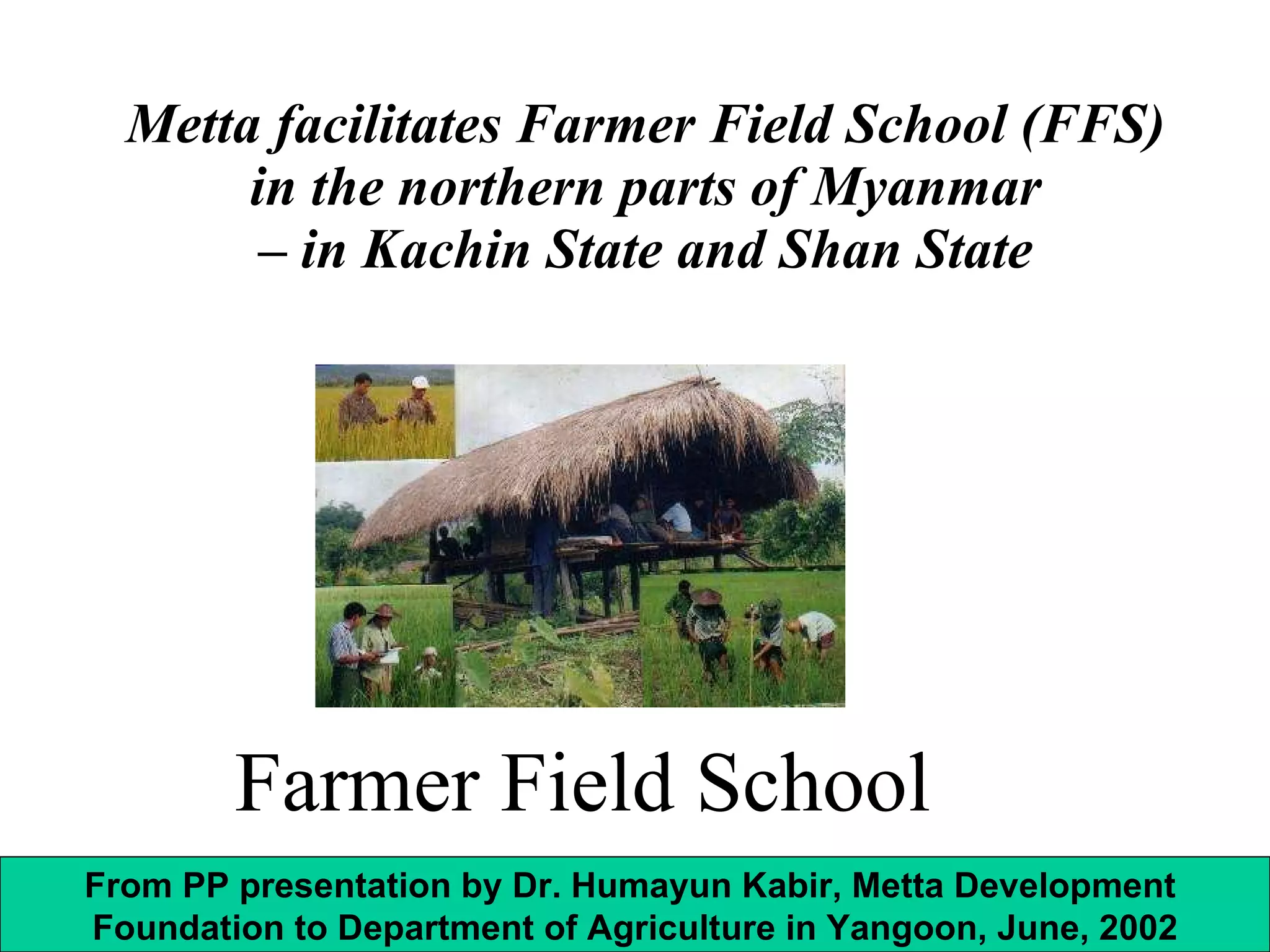
Metta facilitates Farmer Field School (FFS) in the northern parts of Myanmar – in Kachin State and Shan State Farmer Field School From PP presentation by Dr. Humayun Kabir, Metta Development  Foundation to Department of Agriculture in Yangoon, June, 2002
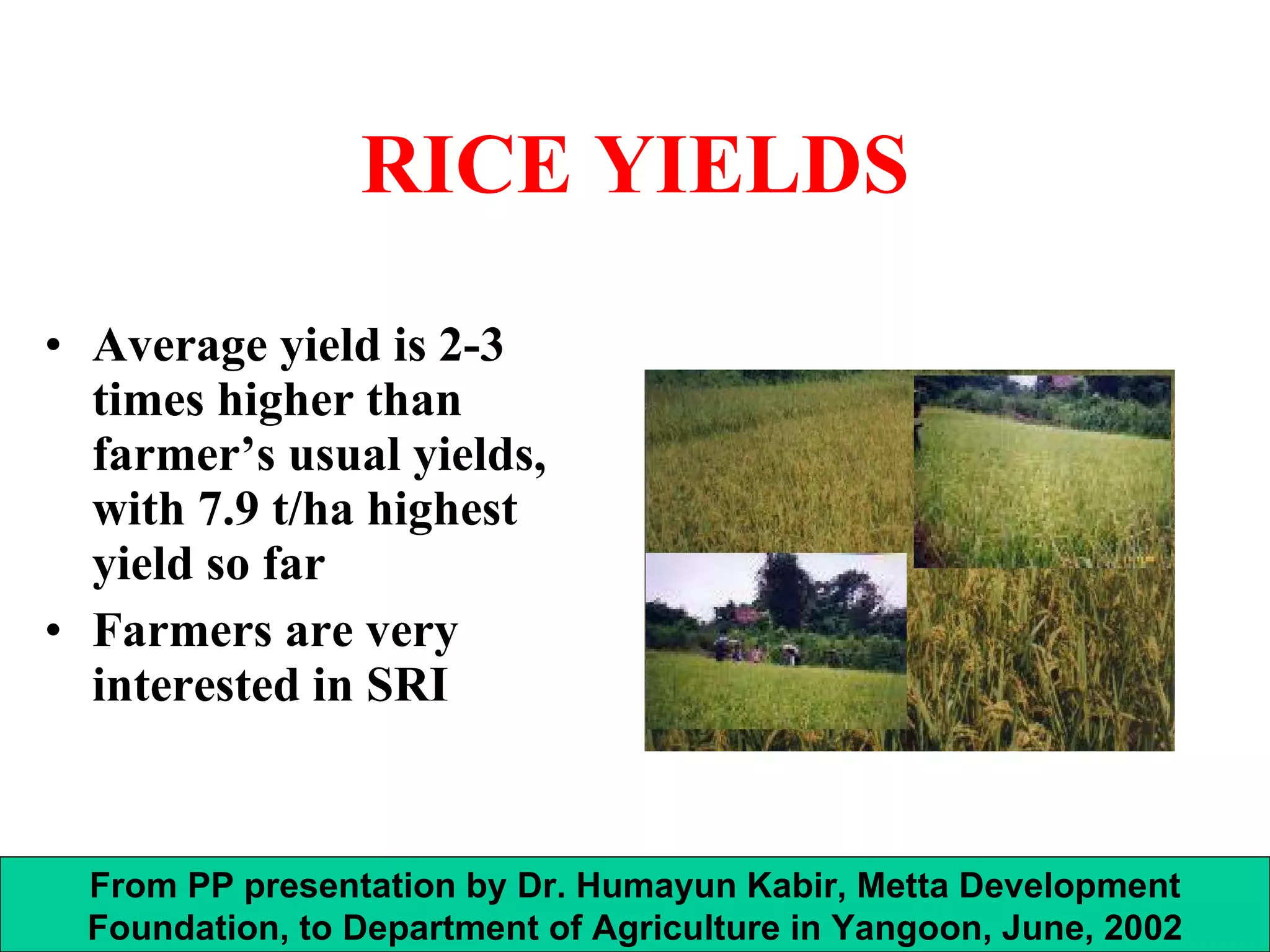
RICE YIELDS Average yield is 2-3 times higher than farmer’s usual yields, with 7.9 t/ha highest yield so far Farmers are very interested in SRI From PP presentation by Dr. Humayun Kabir, Metta Development Foundation, to Department of Agriculture in Yangoon, June, 2002
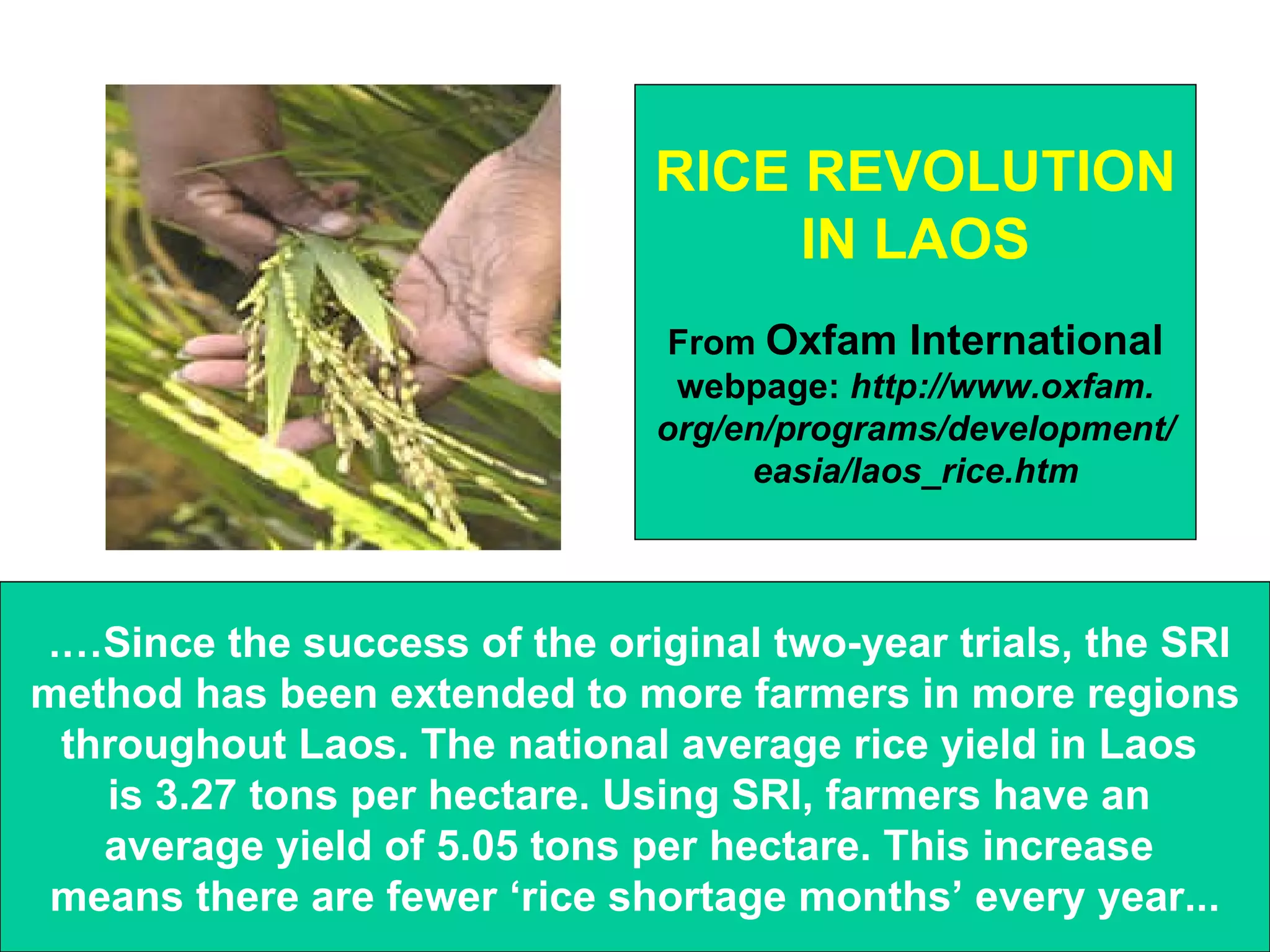
LAOS Community Aid Abroad  (CAA), Oxfam affiliate in Australia Started SRI trials in 2001, has continued with them since, now getting some assistance from Ausaid IRRI office  in Laos  sponsored trials in 2003 – inconclusive results, since protocols not followed consistently
.…Since the success of the original two-year trials, the SRI  method has been extended to more farmers in more regions throughout Laos. The national average rice yield in Laos  is 3.27 tons per hectare. Using SRI, farmers have an  average yield of 5.05 tons per hectare. This increase  means there are fewer ‘rice shortage months’ every year... RICE REVOLUTION IN LAOS From  Oxfam International webpage:  http://www.oxfam. org/en/programs/development/ easia/laos_rice.htm
THAILAND First trials by  Multiple Cropping Center  of Chiangmai University and  McKean Rehabilitation Center  – not very impressive, but work continued Thai National SRI Network  has functioned informally since 2003 Asian Institute of Technology  (AIT) has done SRI demonstrations in NE  (Roi-et province) w/ CGIAR funding
 
VIETNAM National IPM Program  took lead in evaluating SRI from 2003 Faculty at  Thai Nguyen University  and  Hanoi Agricultural University   have done trials and demonstrations to spread SRI in many provinces Ministry of Agriculture and Rural Development  and  Vietnam Academy of Agricultural Sciences  now support
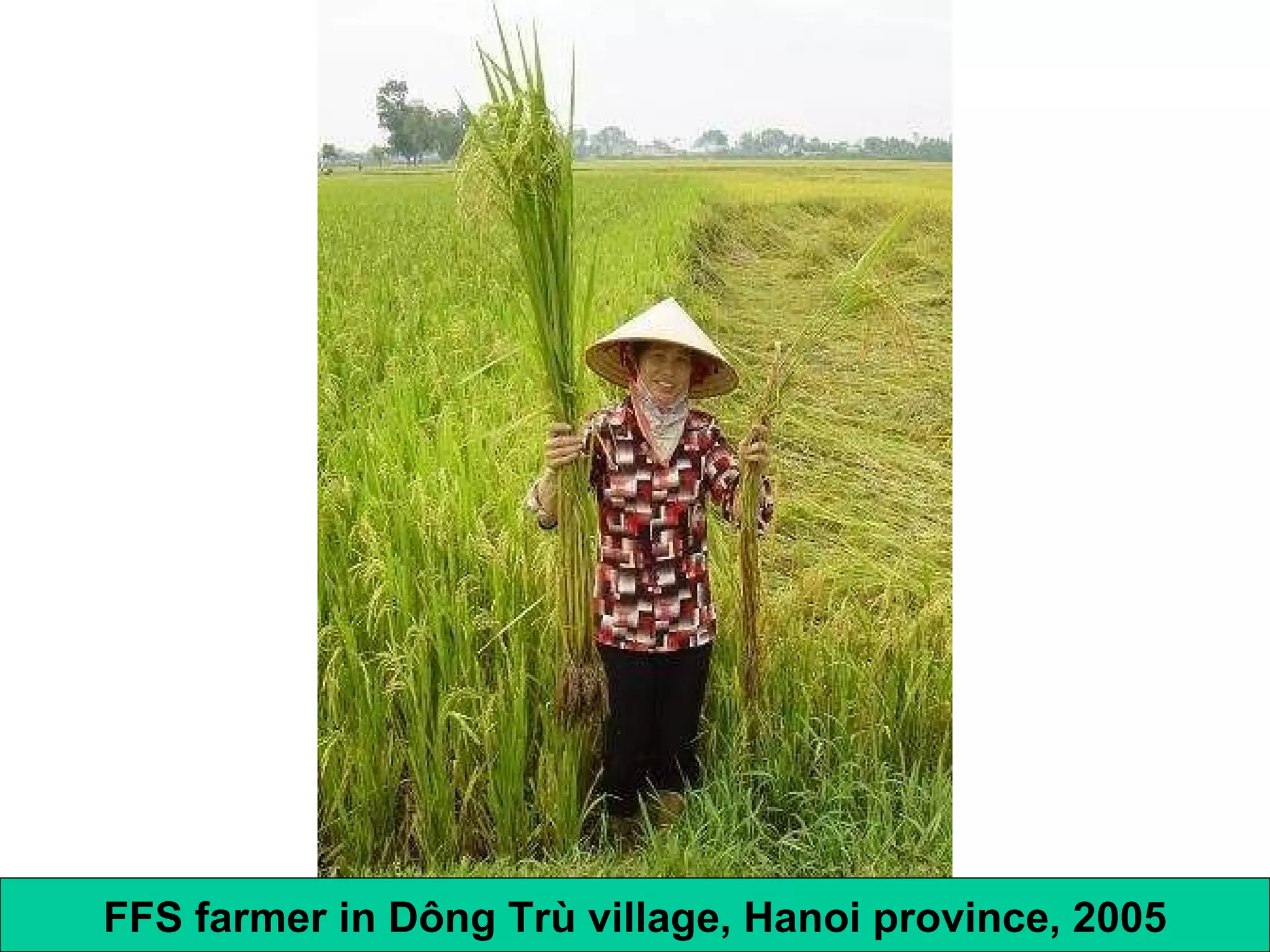
FFS farmer in D ông Trù village, Hanoi province, 2005
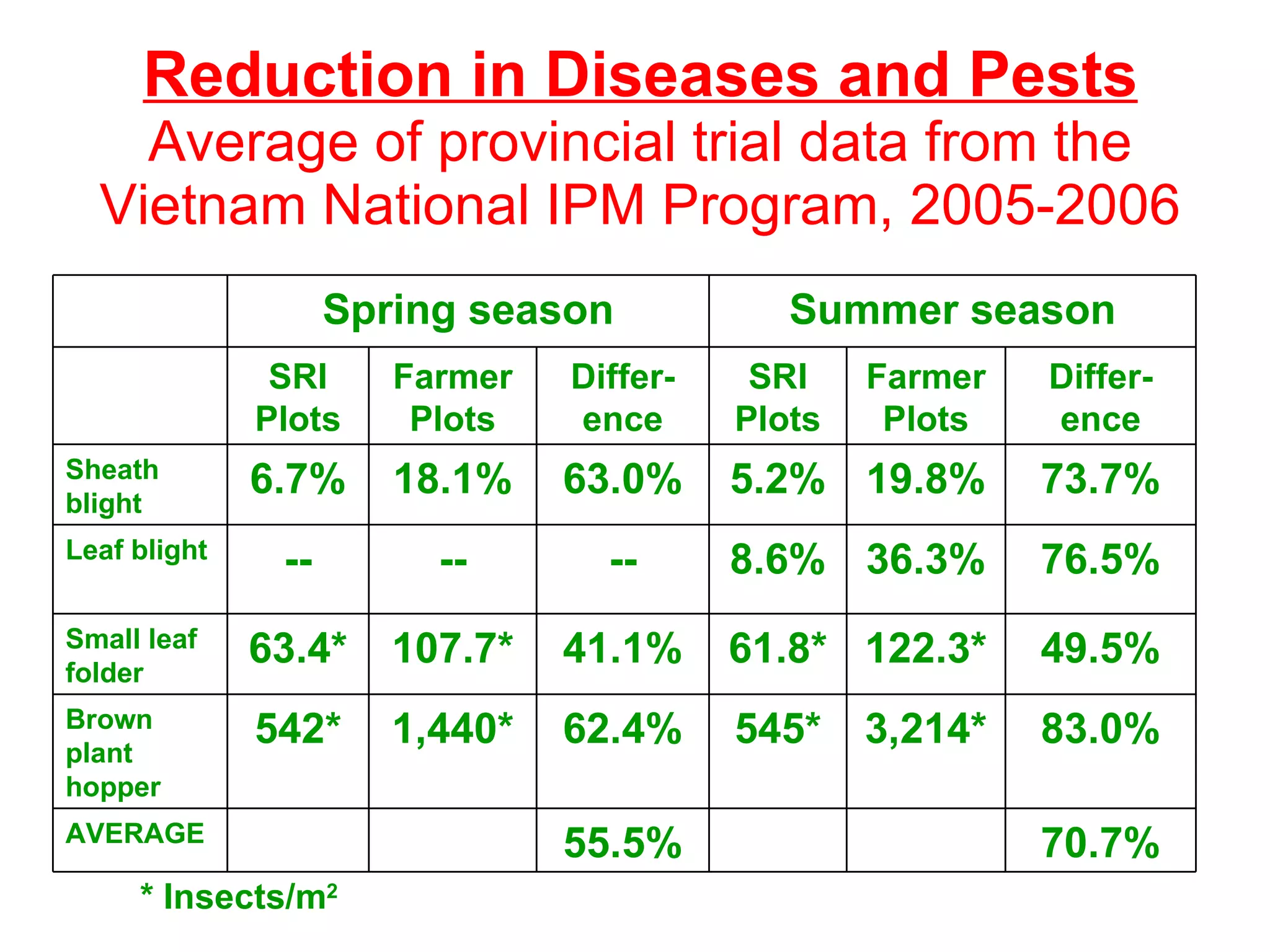
Reduction in Diseases and Pests Average of provincial trial data from the Vietnam National IPM Program, 2005-2006 * Insects/m 2   Spring season Summer season SRI Plots Farmer Plots Differ-ence SRI Plots Farmer Plots Differ-ence Sheath blight 6.7% 18.1% 63.0% 5.2% 19.8% 73.7% Leaf blight  -- -- -- 8.6% 36.3% 76.5% Small leaf folder 63.4* 107.7* 41.1% 61.8* 122.3* 49.5% Brown plant hopper 542* 1,440* 62.4% 545* 3,214* 83.0% AVERAGE 55.5% 70.7%
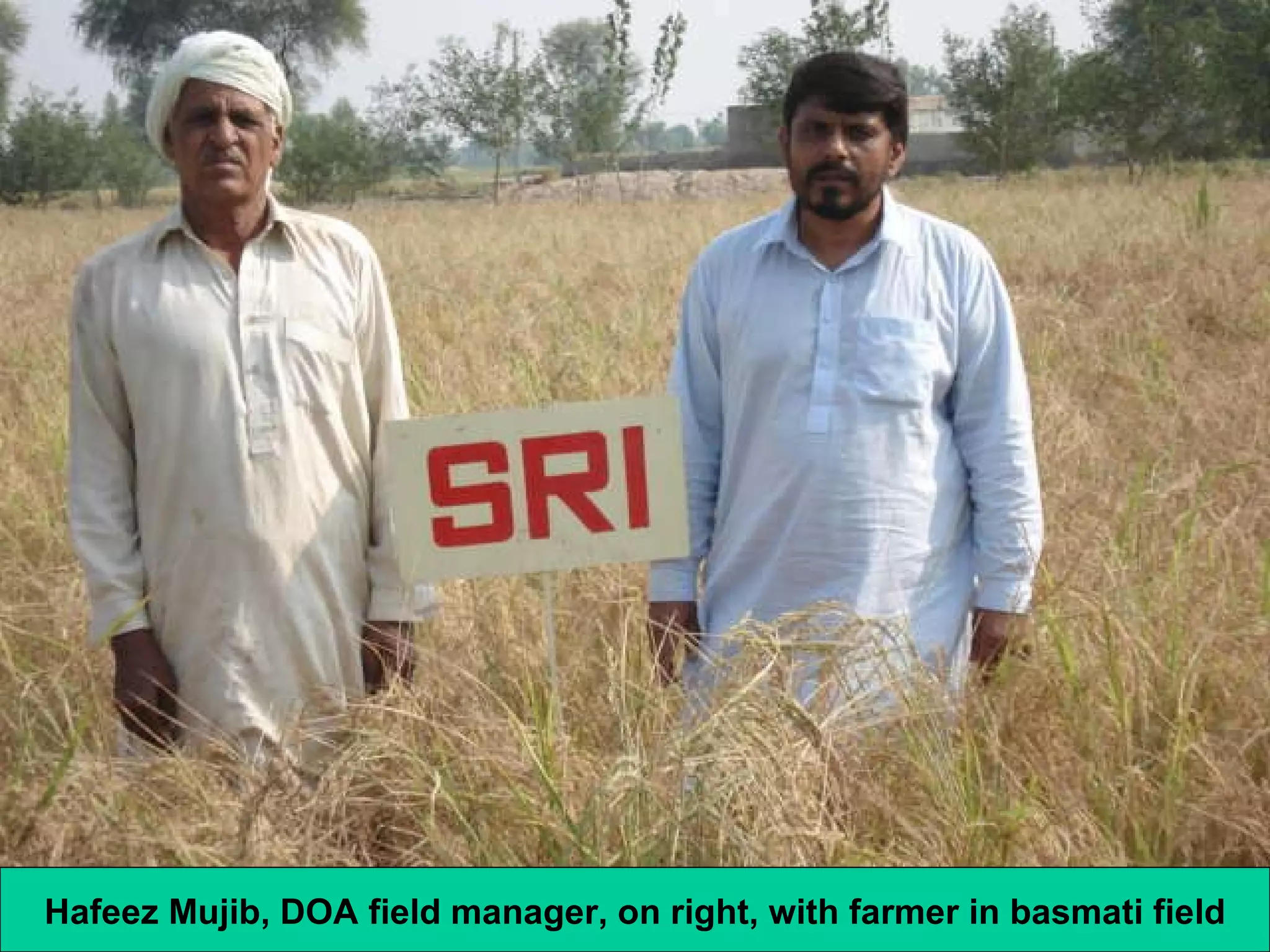
PAKISTAN International Centre for Integrated Mountain Development  (ICIMOD) in 2004 got 50% yield increase in NWFP Water Management Wing of the  Punjab Provincial Dept. of Agriculture  now taking lead to spread SRI Faculty at  University of Agriculture at Faisalabad  collaborating on SRI
Hafeez Mujib, DOA field manager, on right, with farmer in basmati field
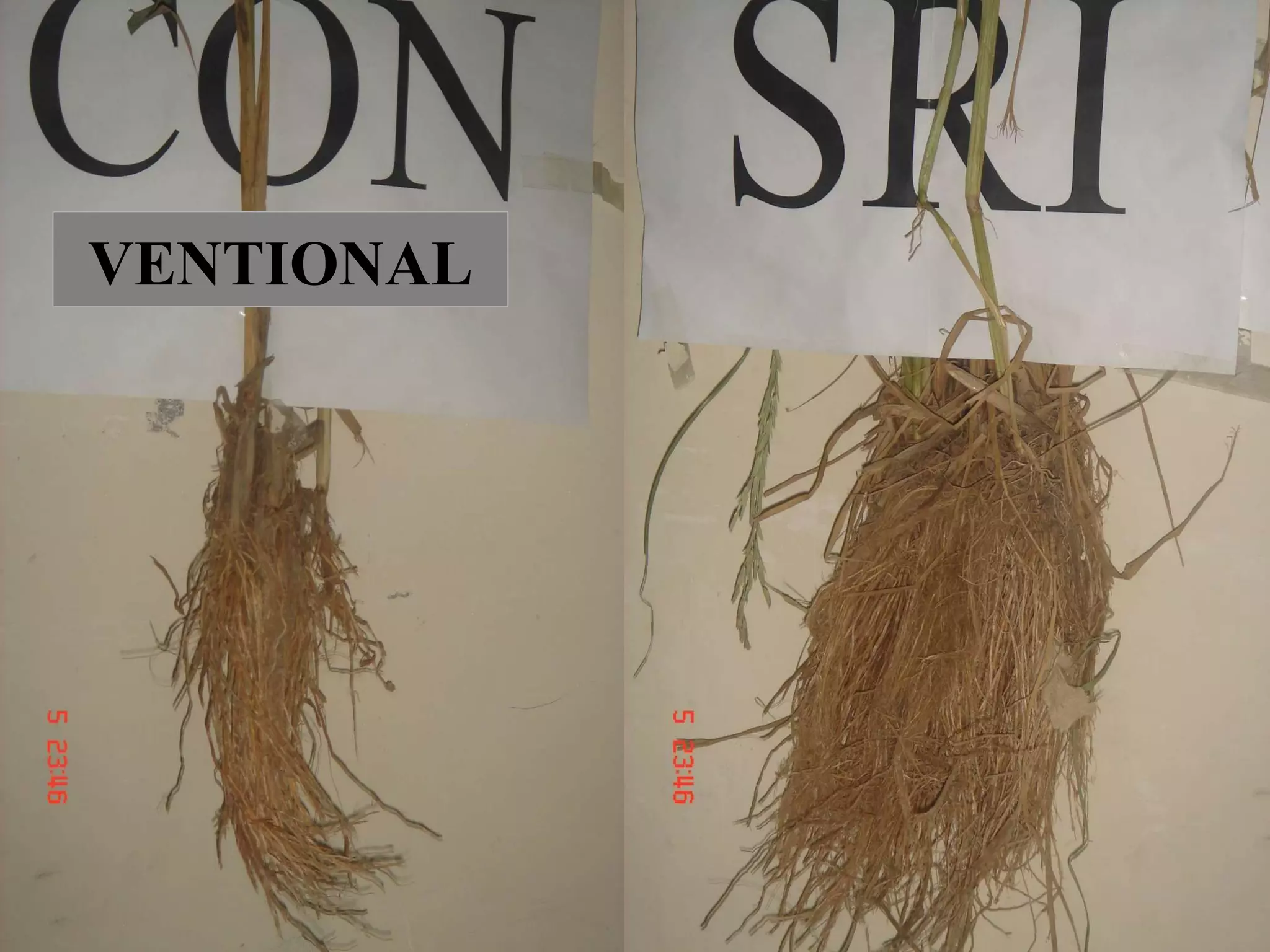
VENTIONAL
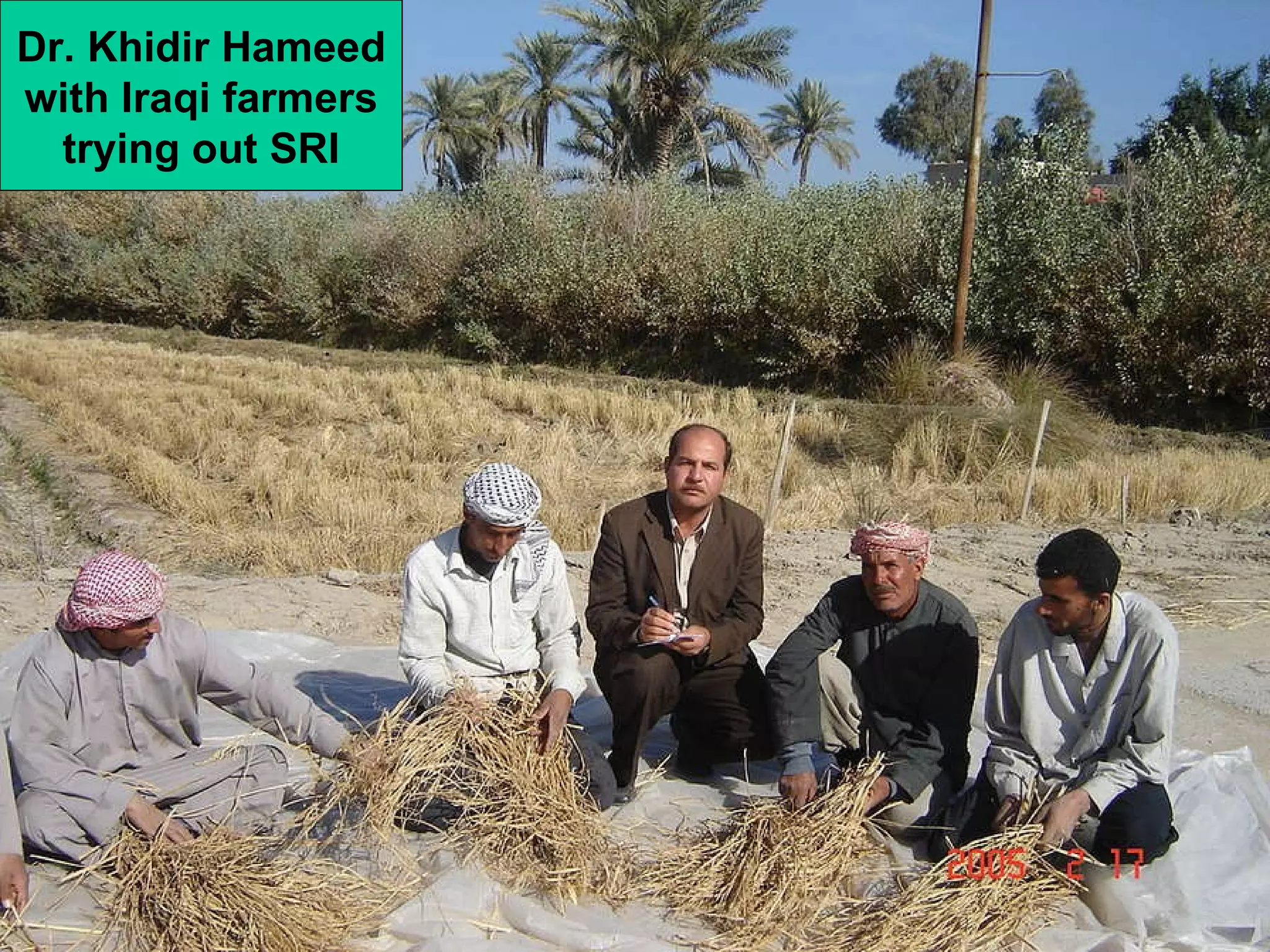
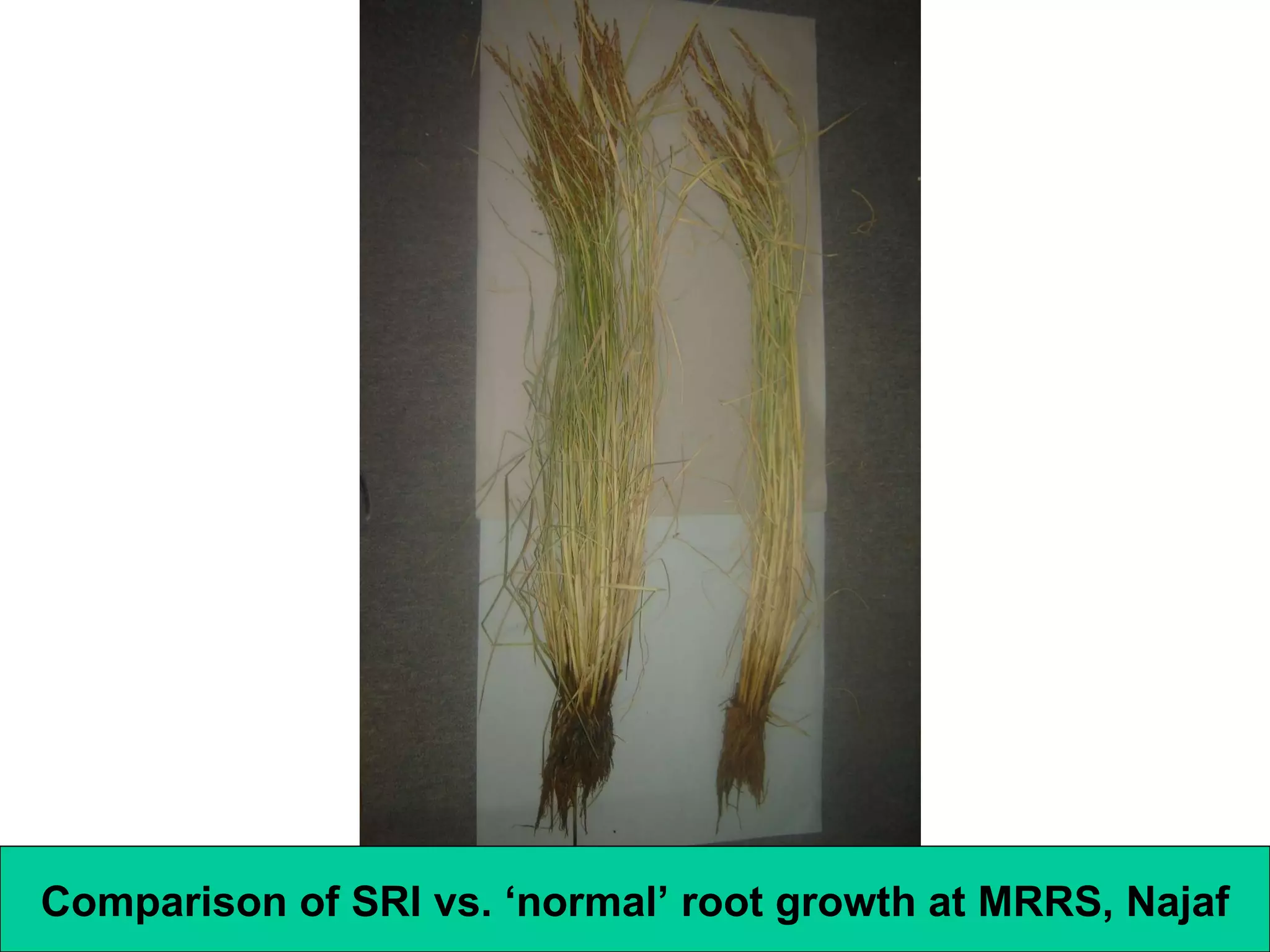
IRAQ Al-Mishkhab Rice Research Station  near Najaf started SRI trials in 2005 under Dr. Khidir Hameed Using ‘parachute’ and other methods Water saving  (1/3) more important than  yield increase  (18% average); also appreciate  seed reduction  of 81% National Committee for SRI  formed
Dr. Khidir Hameed with Iraqi farmers trying out SRI
Comparison of SRI vs. ‘normal’ root growth at MRRS, Najaf
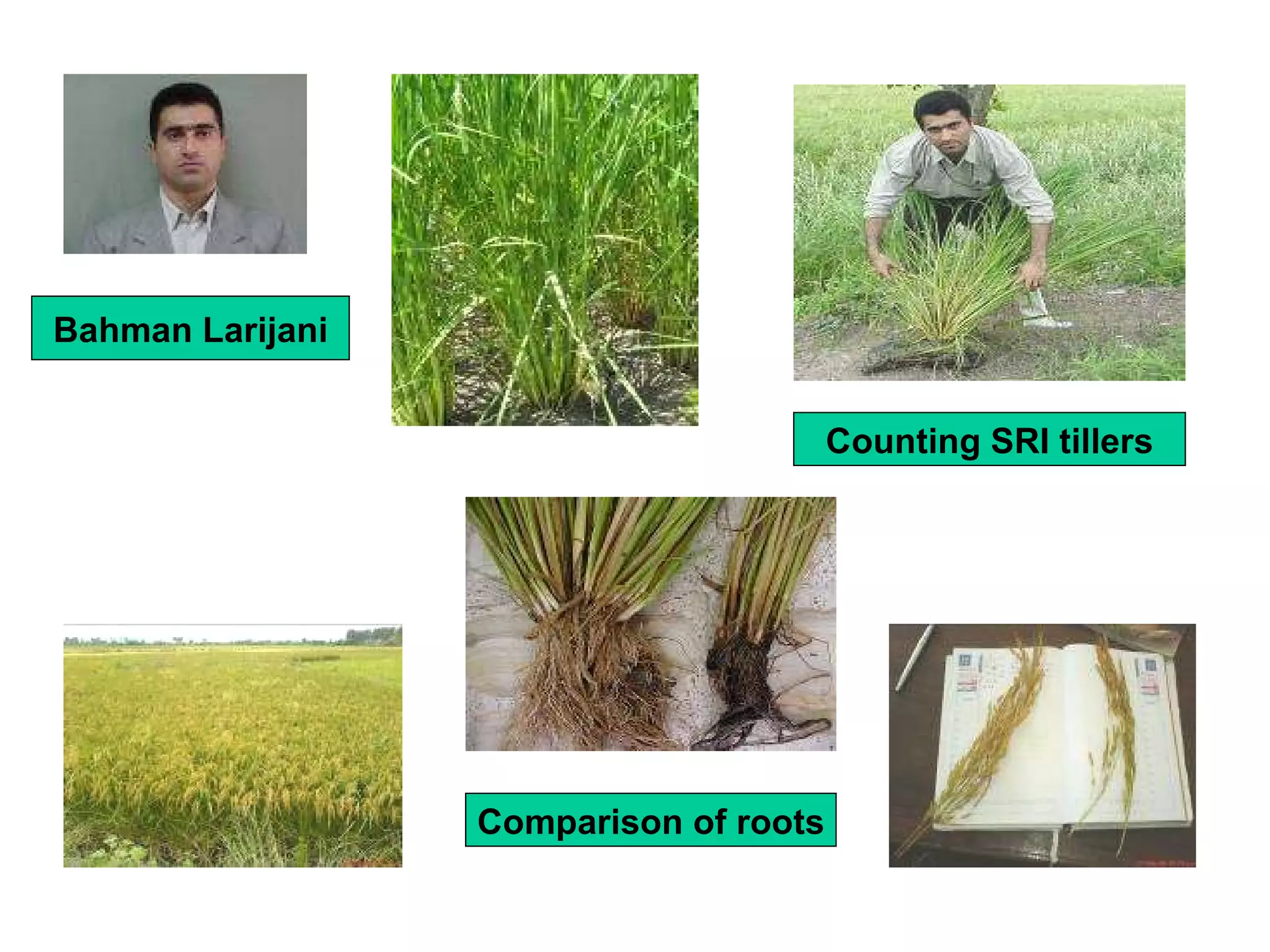
IRAN Haraz Technological Development and Extension Center  at Amol near Caspian Sea started SRI trials in 2005 Head of Agronomy Group, Bahman Larijani, confirmed a  55% increase  in yield  -- with a reduction in inputs Now starting to disseminate SRI methods within other districts of Iran
Bahman Larijani Counting SRI tillers Comparison of roots
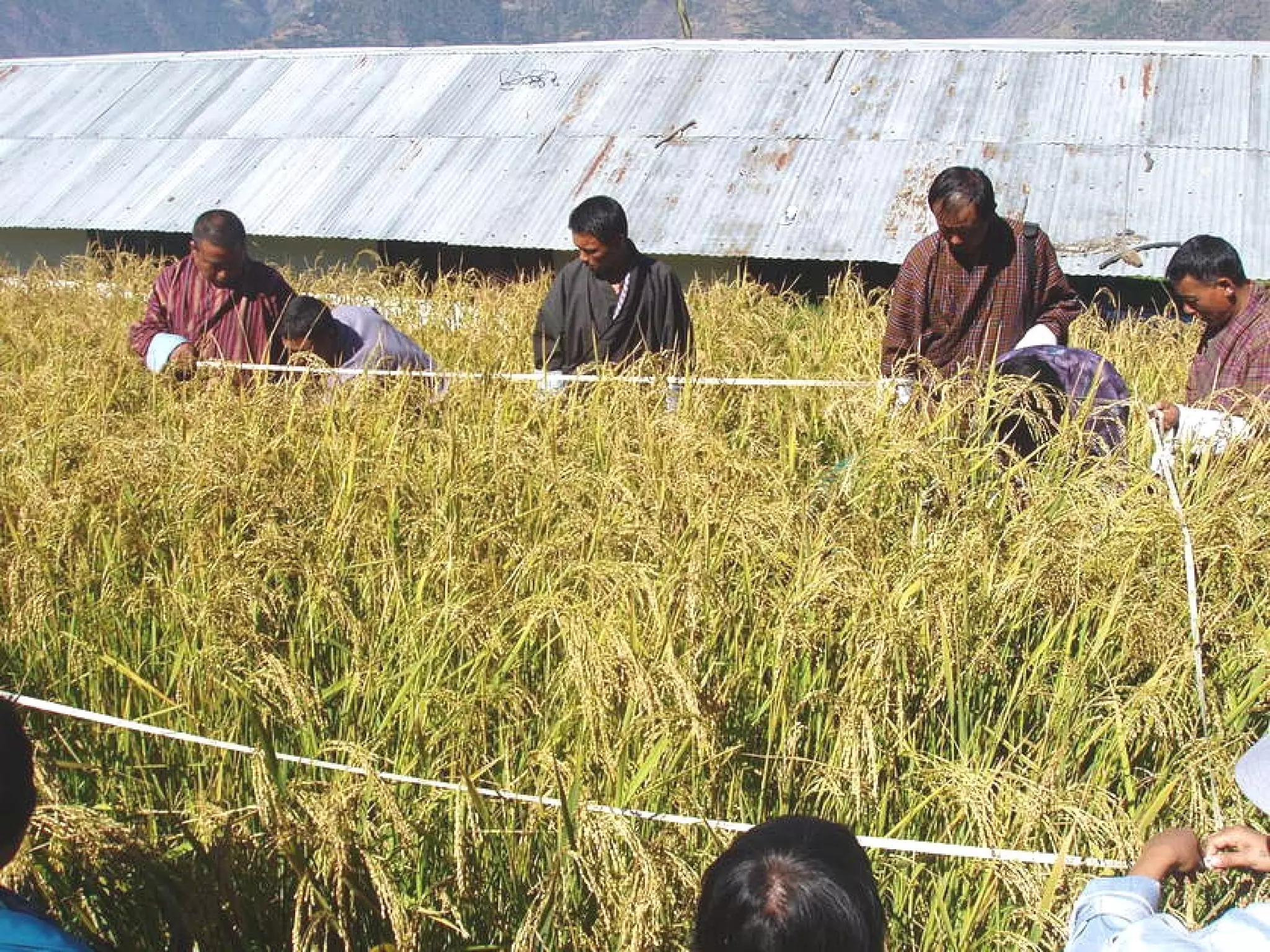
BHUTAN Royal University of Bhutan  faculty member, Karma Lhendup, first at Sherubtse College and now at College of Natural Resources, started testing SRI methods in 2006 With successful demonstrations, FAO and Government are now interested in assisting with SRI
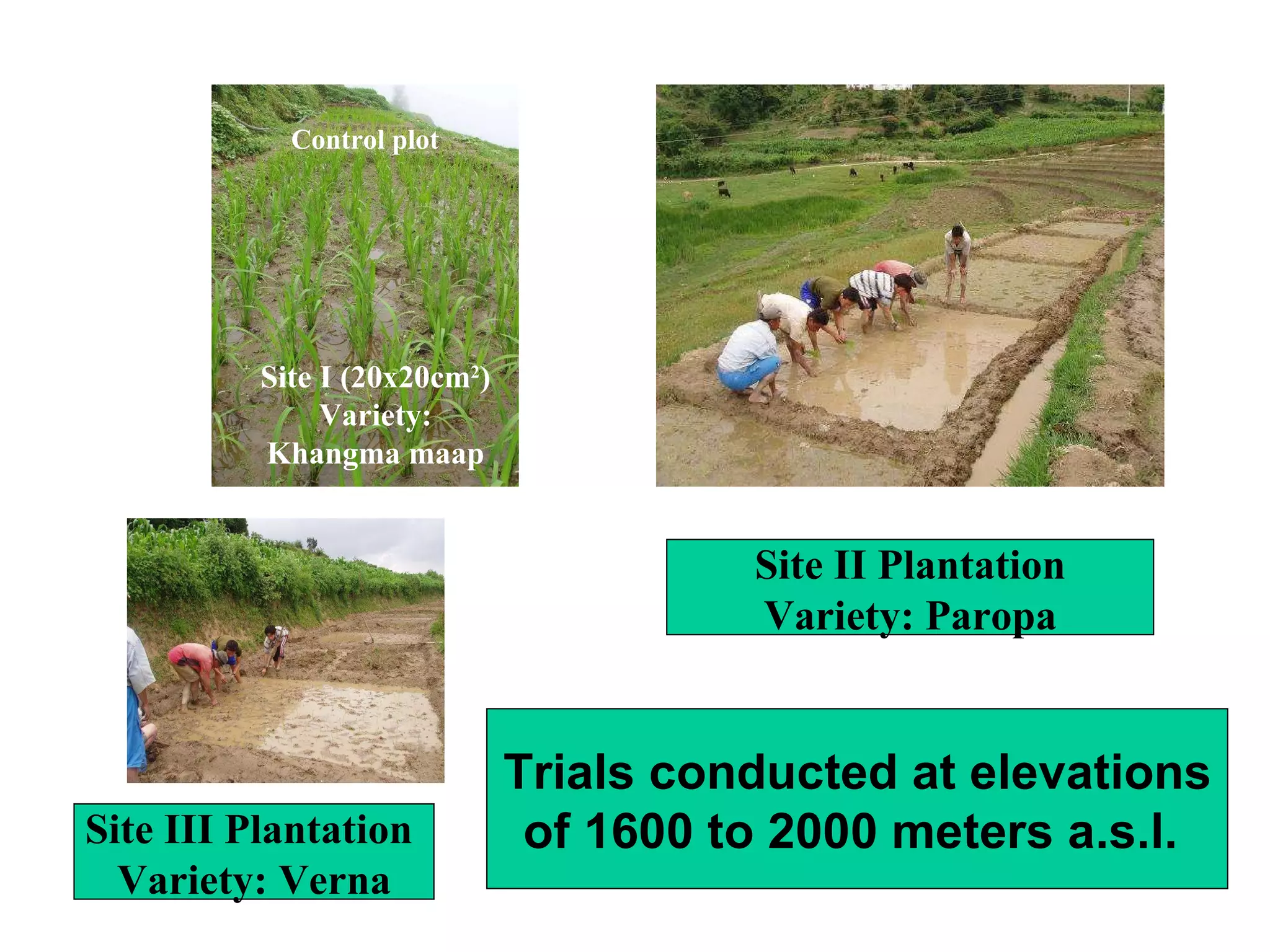
Site III Plantation  Variety: Verna Site II Plantation Variety: Paropa Trials conducted at elevations of 1600 to 2000 meters a.s.l.  Site I (20x20cm 2 ) Variety: Khangma maap Control plot
 
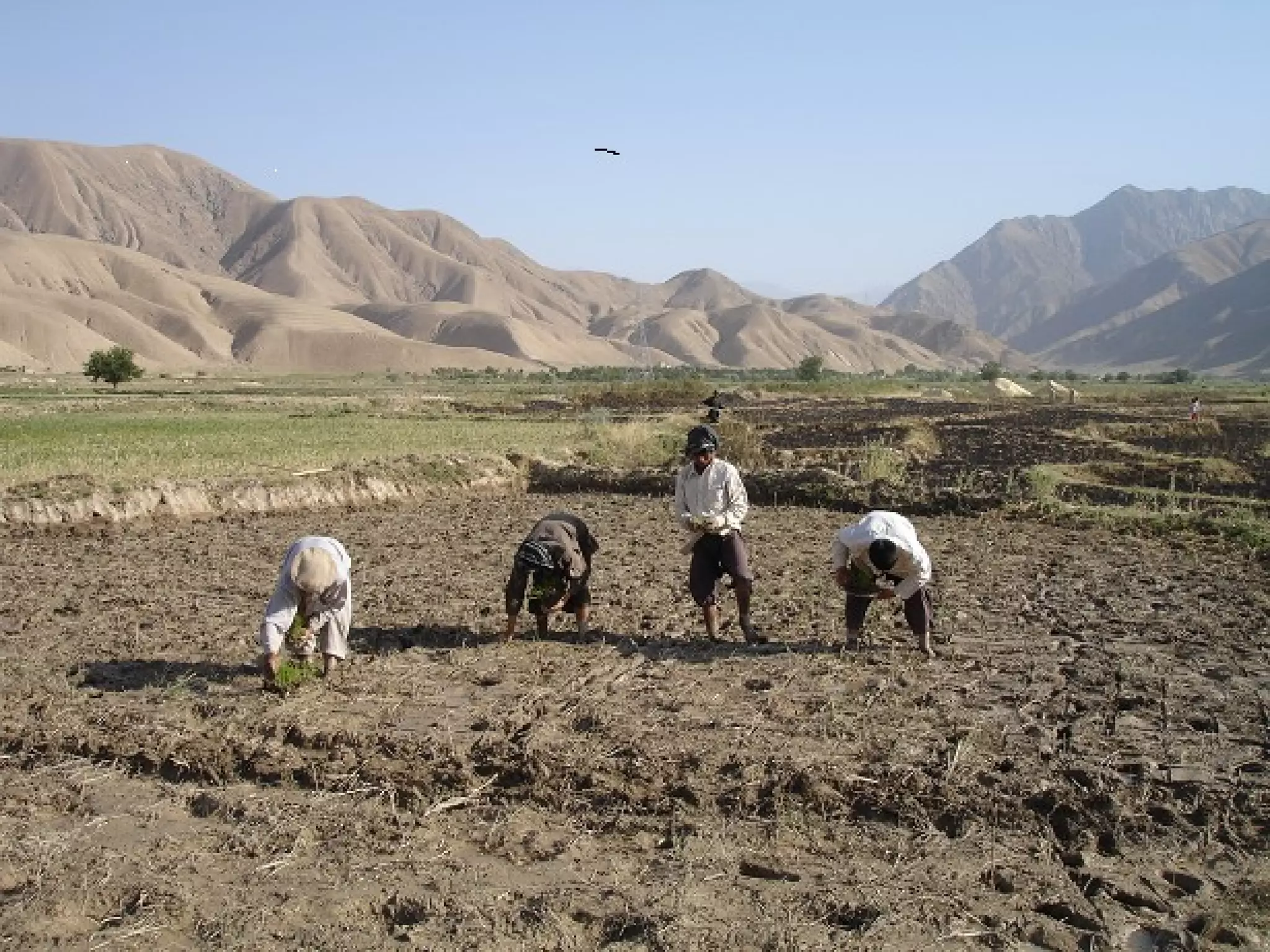
AFGHANISTAN Initial effort to introduce SRI in Ajrestan in 2003 – no outcome? Initiative of  Aga Khan Foundation   in 2007 to introduce SRI in Baghlan Province – Kishan Rao (WASSAN) gave farmers training in May 2007 --  showing good progress
 
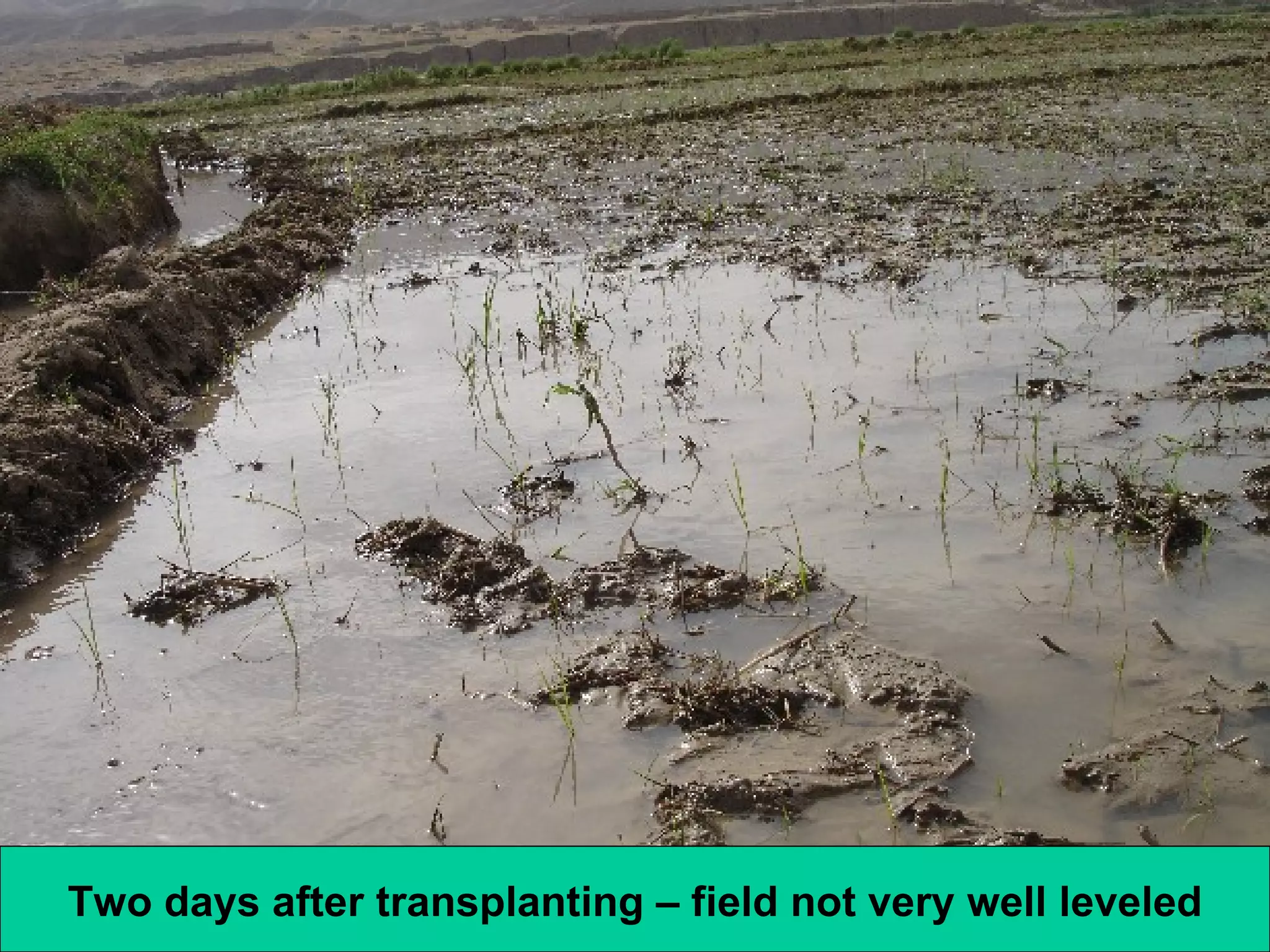
Two days after transplanting – field not very well leveled
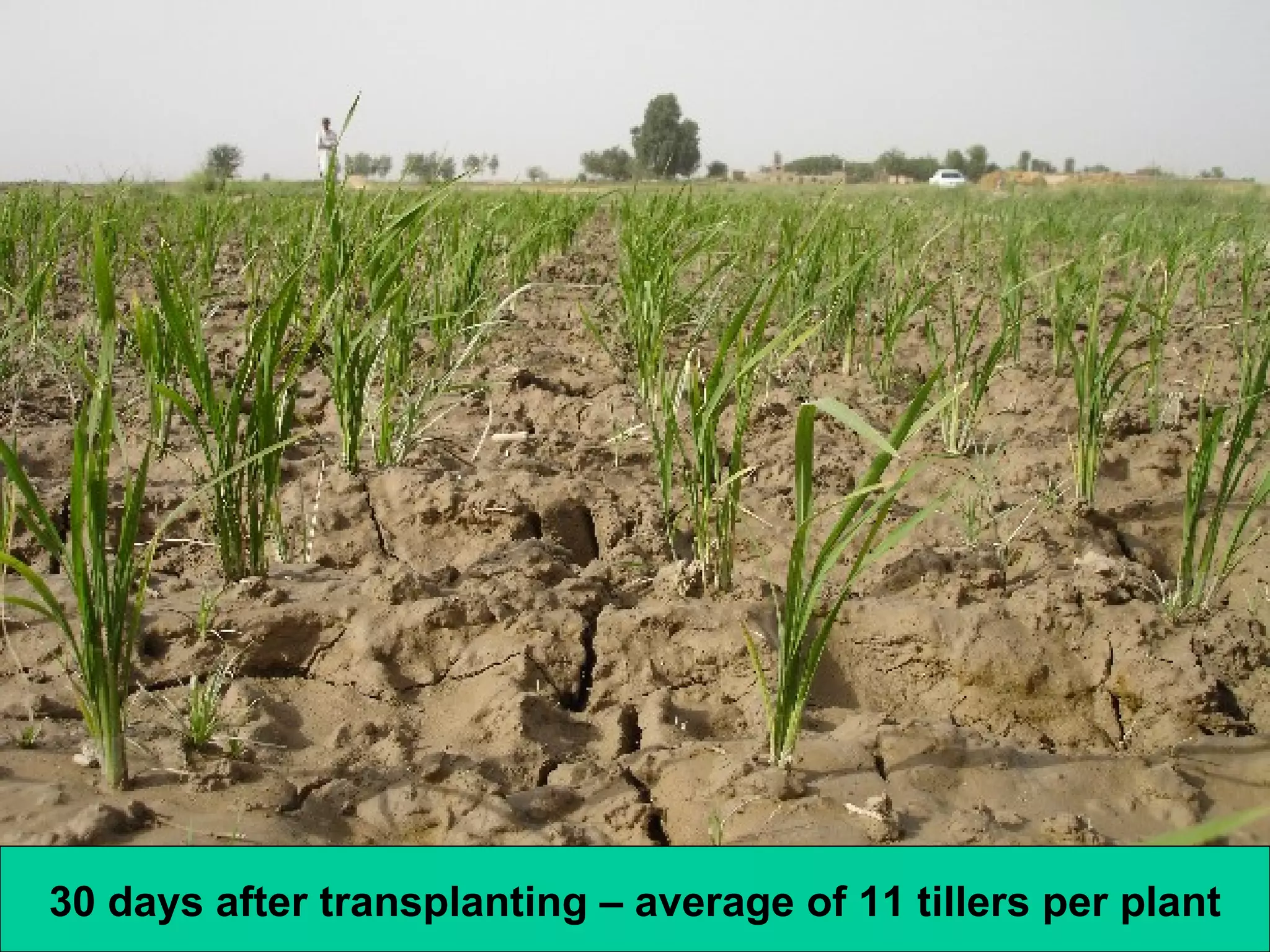
30 days after transplanting – average of 11 tillers per plant
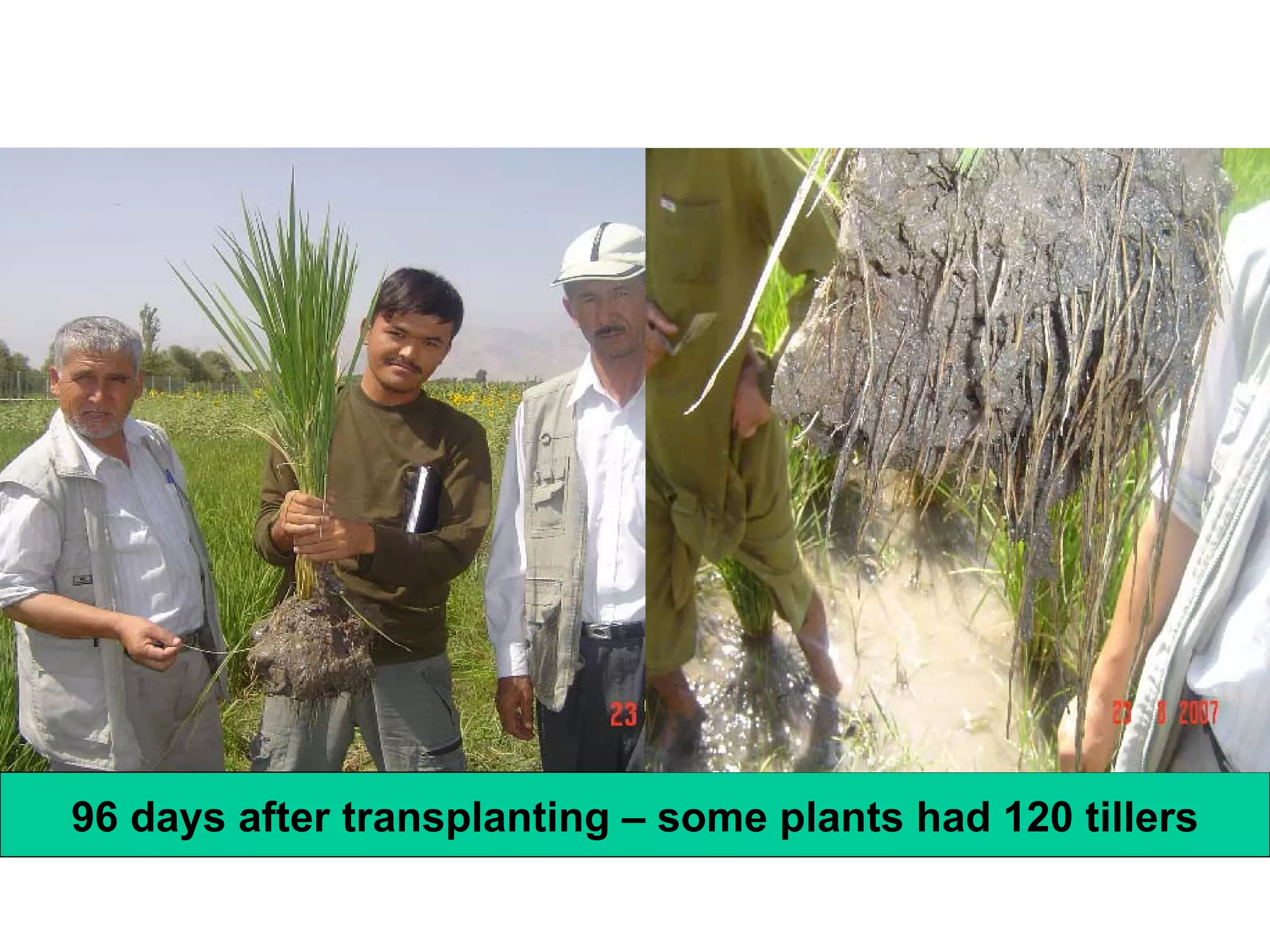
96 days after transplanting – some plants had 120 tillers
JAPAN Formation of  Japan Association of System of Rice Intensification  (J-SRI) in April 2007, based at University of Tokyo – research in Indonesia Special initiative of Shuichi Sato,  Nippon Koei  team leader of DISIMP  in E. Indonesia – good example of  international solidarity for SRI spread
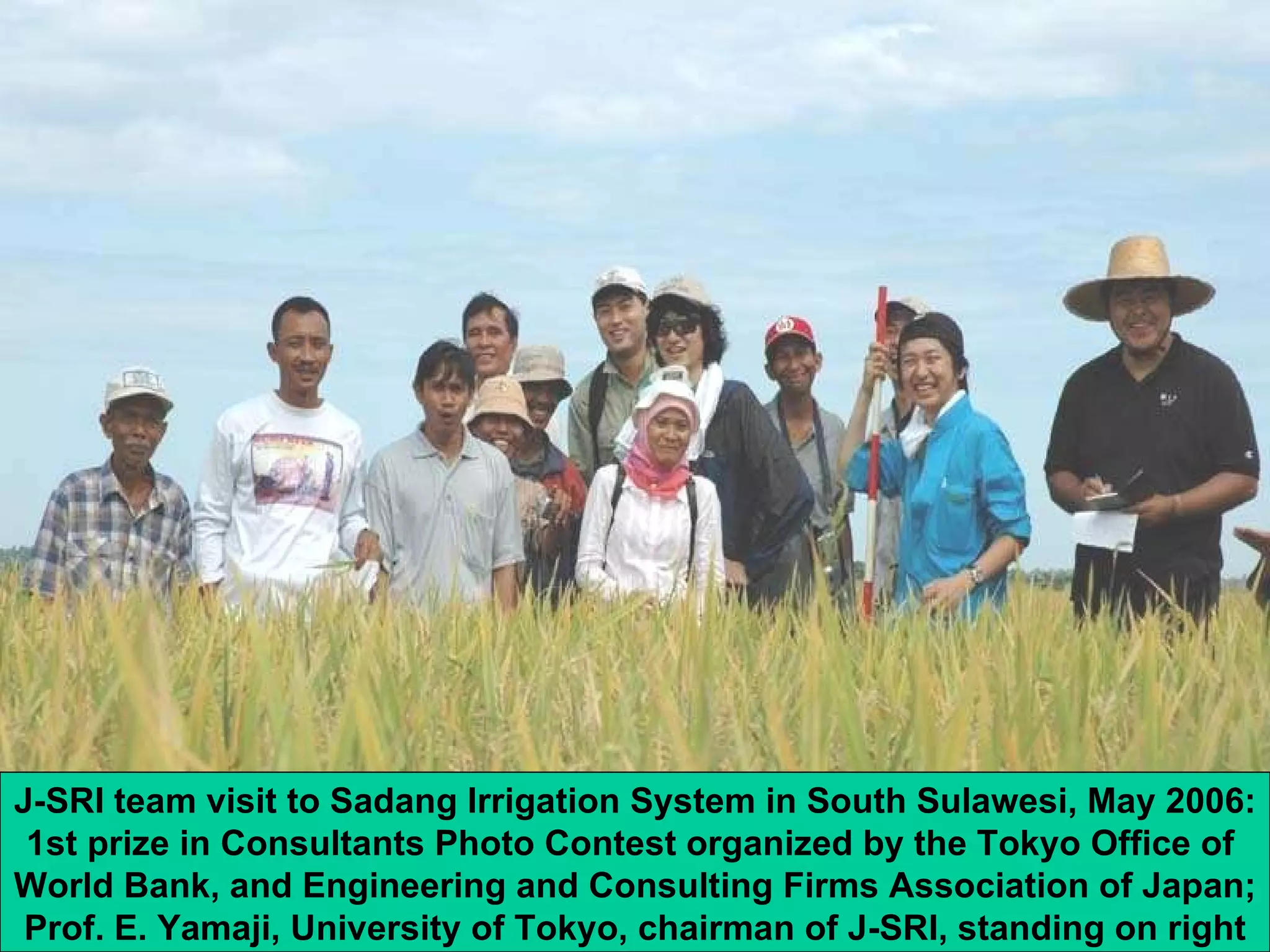
J-SRI team visit to Sadang Irrigation System in South Sulawesi, May 2006: 1st prize in Consultants Photo Contest organized by the Tokyo Office of  World Bank, and Engineering and Consulting Firms Association of Japan; Prof. E. Yamaji, University of Tokyo, chairman of J-SRI, standing on right

0713 Evaluation and Spread of the System of Rice Intensification in Asia

  • 1.
    Evaluation and Spreadof the System of Rice Intensification in ASIA 2nd National SRI Symposium October 3-5, 2007 – Agartala, India Norman Uphoff, CIIFAD Cornell University, USA
  • 2.
    Never doubt thata small group of thoughtful, committed citizens can change the world. Indeed, that is the only thing that ever has. -- Margaret Mead
  • 3.
    Knowledge/practice of SRI: As of 1999 Madagascar
  • 4.
    SRI field inMadagascar, with a traditional variety of rice
  • 5.
    The Start andSpread of SRI Devised by Fr. Henri de Laulani é, 1983-84 Formation of Association Tefy Saina , 1990 Collaboration of ATS and CIIFAD, 1994-98 1st trials outside of Madagascar, 1999-2000 CHINA: Nanjing Agricultural University INDONESIA: Agency for Agric. Res. & Dev. BANGLADESH: CARE/BD and DAE Then spread: Cambodia, Philippines, Laos, Thailand, Myanmar, Sri Lanka, India, Nepal, Cuba, Peru, Gambia, Sierra Leone …….
  • 6.
    Knowledge/Use of SRI: As of 2006 BHUTAN, IRAN, IRAQ, Zambia; Senegal, PAKISTAN, Mali, VIETNAM; Benin, Guinea, Mozambique, Peru; CAMBODIA, Cuba, PHILIPPINES, LAOS, THAILAND, MYANMAR, Sierra Leone, Gambia, SRI LANKA, NEPAL, BANGLADESH, INDIA; CHINA, INDONESIA; Madagascar
  • 7.
    CHINA China NationalHybrid Rice Research and Development Center , Changsha and Sanya Hosted 1st Intl. Conference on SRI, Sanya, April 2002 Now promoting SRI within China and in African countries
  • 8.
    Prof. Yuan Longping, known as “the father of hybrid rice” – World Food Prize Laureate 2004
  • 9.
    SRI plot inGuinea with hybrid variety (GY032) – 9.3 tons/ha
  • 10.
    CHINA China NationalRice Research Institute , Hangzhou Co-sponsored 1st Intl. Conference on SRI, Sanya, April 2002 Hosted 1st National SRI Workshop, Hangzhou, March, 2003 In 2007 season, 333,333 hectares of SRI rice in Zhejiang province
  • 11.
    Farmers and officialsin Bu Tou village, Tien Tai township, Zhejiang province, with China SRI coordinator, Prof. Zhu Defeng, CNRRI, and Norman Uphoff
  • 12.
    47.9% 34.7% “Non-Flooding Rice Farming Technology in Irrigated Paddy Field” Dr. Tao Longxing, China National Rice Research Institute, 2004
  • 13.
    CHINA Sichuan Academyof Agricultural Sciences , Chengdu Crop Cultivation Research Center Seed Multiplication Farm, Meishan Triangular method of transplanting 16 t/ha yield in 2001 Raised-bed zero-tillage alternative 13.4 t/ha yield in 2004 100,000 ha of SRI rice in 2007
  • 14.
    Liu Zhibin, CNHRRDCseed multiplication farm, Meishan, Sichuan province – raised beds / zero-tillage – 13.4 t/ha yield
  • 15.
    CHINA Northeast AgriculturalUniversity , Harbin, Heilongjiong 3-S system of rice cultivation, developed by Prof. Jin Xueyong Similar to SRI, with methods adapted for cold climatic conditions Heilongjiong province is in northern China adjoining Manchuria
  • 16.
    3-S seedlings arestarted at the end of winter in plastic greenhouses
  • 17.
    Normal 3-S Comparisonbetween 3-S and ‘normal’ rice in Heilongjiong
  • 18.
    INDONESIA Agency forAgricultural Research and Development , Sukamandi National IPM Program , starting at Ciamis Farmer Field School Program of the Field Foundation, took over IPM work Nippon Koei project management team in Eastern Indonesia, from 2002 Yayasan Aliksa Organik SRI
  • 19.
    SRI field, 20x40cm spacing, at Sukamandi rice research center – 9.2 t/ha
  • 20.
    SRI vs. non-SRIplants hanging in Nippon Koei office, Jakarta
  • 21.
    SRI vs. non-SRIplants in Lombok, under DISIMP
  • 22.
    Results of On-FarmComparison Trials in Eastern Indonesia Nine seasons: 2002-2006 N = 12,133 Area = 9,429.1 hectares Ave. increase in yield = 3.3 t/ha (78%) With reductions in inputs: 40% less water 50% less chemical fertilizer 20% lower costs of production
  • 23.
    “ Productivity isincreased [with SRI], and at the same time the environment is saved. . . . I want to urge everybody, starting with the Minister of Agriculture and everyone else -- let us support this SRI method with our maximum capacity.” -- Pres. S. B. Yudyoyono speaking at SRI Harvest Festival, Cianjur, July 30, 2007
  • 24.
    CAMBODIA Center forStudy and Development of Cambodian Agriculture (CEDAC) Support from GTZ, Oxfam America, Oxfam GB and other donor agencies SRI Secretariat set up within Ministry of Agriculture, Forestry and Fisheries National Development Plan, 2006-10 70,000-90,000 farmers using SRI
  • 25.
    Ms. Im Sarim,Cambodia, with rice plant grown from a single seed, using SRI methods and traditional variety -- yield of 6.72 t/ha
  • 26.
    Mok Mareth, Ministerfor Environment, with Koma Yang Saing, CEDAC, at farmer convention promoting SRI in Ro Veang commune
  • 27.
    LDS Charities IntroducedSRI in Cambodia, 2006-07 season 146 households whose previous average yield was 1.06 t/ha averaged 4.02 t/ha when using SRI methods Hang Hein’s sons (left) transplanted his whole SRI field (0.9 ha) in 1 day ; Hein’s neighbors (right) who used traditional methods of transplanting used more labor per hectare and got lower yields with old methods Hang Hein’s previous yield was 1.2 t/ha -- with SRI methods it was 5.0 t/ha
  • 28.
    PHILIPPINES NGO initiatives: CDSMC, BIND Philippine Rural Reconstruction Movement (PRRM), affiliate of IIRR Establishment of SRI-Pilipinas Universities : UPLB, LSU, etc. Government agencies : NIA, ATI, PhilRice, Dept. of Agriculture NGOs: e.g., Save the Ifugao Terraces Movement (SITMo)
  • 29.
    RESULTING CROP --8.9 T/HA The rice plants are healthy with strong stalks because of the organic fertilizer, soil aeration through intermittent water application, and the 40 cm x 40 cm spacing. With strong stalks, lodging never occurred. From PP by Engr. Bong Salazar, now Deputy Administrator, National Irrigation Administration (NIA)
  • 30.
    BANGLADESH SRI NationalNetwork of BD BRRI : BD Rice Research Institute BRAC: BD Rural Advancemt Comm DAE: Dept. of Agric. Extension SAFE: Sust. Agric. & Farming Enterprise Development Group Syngenta Bangladesh Co. Ltd. BRF: BD Rice Foundation -- etc. Evaluation funded by IRRI/BD, 2002-04
  • 31.
    Final Evaluation Reporton Verification and Refinement of the System of Rice Intensification (SRI) Project in Selected Areas of Bangladesh (SP 36 02) AM Muazzam Husain, Gopal Chowhan, Proloy Barua, AFM Razib Uddin, ABM Ziaur Rahman Submitted to Poverty Elimination Through Rice Research Assistance (PETRRA) IRRI, Dhaka, Bangladesh June 2004
  • 32.
  • 33.
    SRI LANKA Initialcollaboration among: Senior civil servant: G. Batuwitage, Senior Assistant Secretary of Agriculture Senior politician : S. Dissanayake, Deputy Minister of Agriculture Farmer/environmental activist : W. M. Premaratna, Ecological Farming Center Some support from government agencies and NGOs, e.g., Oxfam/CAA
  • 34.
    Deputy Minister ofAgriculture Salinda Dissanayake
  • 35.
    Cover photo ofW. M. Premaratna, for ecol. magazine
  • 36.
    Rice fields inSri Lanka: same variety, same irrigation system, same soil, same drought : conventional rice (left), SRI (right)
  • 37.
    NEPAL Initial experimentsnot very impressive NEDECO comparison trials by FFSs in Sunsari-Morang Irrig. System, 2002-2003 SRI average 8.28 t/ha Improved practice 6.01 t/ha Farmer practice 4.29 t/ha Morang district evaluations, 2004-2006 From 100 m 2 to >2,000 farmers in 3 years 6.3 t/ha SRI vs. 3.1 t/ha with farmer practice
  • 38.
    Single SRI plant,Morang District, Nepal - 2005
  • 39.
    Rajendra Uprety, DistrictAgricultural Development Office, Morang District receiving $20,000 award in Nepal Development Marketplace competition
  • 40.
    MYANMAR Metta DevelopmentFoundation introduced SRI through FFS methods: 29 FFS in 2001 55 FFS in 2002 174 FFS in 2003 5,202 farmers trained in SRI 2001-2003 By 2004, >20,000 farmers using SRI Usual yield 2 t/ha; FFS yields averaged 6.5 t/ha -- farmers averaged 4.4 t/ha
  • 41.
    Metta facilitates FarmerField School (FFS) in the northern parts of Myanmar – in Kachin State and Shan State Farmer Field School From PP presentation by Dr. Humayun Kabir, Metta Development Foundation to Department of Agriculture in Yangoon, June, 2002
  • 42.
    RICE YIELDS Averageyield is 2-3 times higher than farmer’s usual yields, with 7.9 t/ha highest yield so far Farmers are very interested in SRI From PP presentation by Dr. Humayun Kabir, Metta Development Foundation, to Department of Agriculture in Yangoon, June, 2002
  • 43.
    LAOS Community AidAbroad (CAA), Oxfam affiliate in Australia Started SRI trials in 2001, has continued with them since, now getting some assistance from Ausaid IRRI office in Laos sponsored trials in 2003 – inconclusive results, since protocols not followed consistently
  • 44.
    .…Since the successof the original two-year trials, the SRI method has been extended to more farmers in more regions throughout Laos. The national average rice yield in Laos is 3.27 tons per hectare. Using SRI, farmers have an average yield of 5.05 tons per hectare. This increase means there are fewer ‘rice shortage months’ every year... RICE REVOLUTION IN LAOS From Oxfam International webpage: http://www.oxfam. org/en/programs/development/ easia/laos_rice.htm
  • 45.
    THAILAND First trialsby Multiple Cropping Center of Chiangmai University and McKean Rehabilitation Center – not very impressive, but work continued Thai National SRI Network has functioned informally since 2003 Asian Institute of Technology (AIT) has done SRI demonstrations in NE (Roi-et province) w/ CGIAR funding
  • 46.
  • 47.
    VIETNAM National IPMProgram took lead in evaluating SRI from 2003 Faculty at Thai Nguyen University and Hanoi Agricultural University have done trials and demonstrations to spread SRI in many provinces Ministry of Agriculture and Rural Development and Vietnam Academy of Agricultural Sciences now support
  • 48.
    FFS farmer inD ông Trù village, Hanoi province, 2005
  • 49.
    Reduction in Diseasesand Pests Average of provincial trial data from the Vietnam National IPM Program, 2005-2006 * Insects/m 2 Spring season Summer season SRI Plots Farmer Plots Differ-ence SRI Plots Farmer Plots Differ-ence Sheath blight 6.7% 18.1% 63.0% 5.2% 19.8% 73.7% Leaf blight -- -- -- 8.6% 36.3% 76.5% Small leaf folder 63.4* 107.7* 41.1% 61.8* 122.3* 49.5% Brown plant hopper 542* 1,440* 62.4% 545* 3,214* 83.0% AVERAGE 55.5% 70.7%
  • 50.
    PAKISTAN International Centrefor Integrated Mountain Development (ICIMOD) in 2004 got 50% yield increase in NWFP Water Management Wing of the Punjab Provincial Dept. of Agriculture now taking lead to spread SRI Faculty at University of Agriculture at Faisalabad collaborating on SRI
  • 51.
    Hafeez Mujib, DOAfield manager, on right, with farmer in basmati field
  • 52.
  • 53.
    IRAQ Al-Mishkhab RiceResearch Station near Najaf started SRI trials in 2005 under Dr. Khidir Hameed Using ‘parachute’ and other methods Water saving (1/3) more important than yield increase (18% average); also appreciate seed reduction of 81% National Committee for SRI formed
  • 54.
    Dr. Khidir Hameedwith Iraqi farmers trying out SRI
  • 55.
    Comparison of SRIvs. ‘normal’ root growth at MRRS, Najaf
  • 56.
    IRAN Haraz TechnologicalDevelopment and Extension Center at Amol near Caspian Sea started SRI trials in 2005 Head of Agronomy Group, Bahman Larijani, confirmed a 55% increase in yield -- with a reduction in inputs Now starting to disseminate SRI methods within other districts of Iran
  • 57.
    Bahman Larijani CountingSRI tillers Comparison of roots
  • 58.
    BHUTAN Royal Universityof Bhutan faculty member, Karma Lhendup, first at Sherubtse College and now at College of Natural Resources, started testing SRI methods in 2006 With successful demonstrations, FAO and Government are now interested in assisting with SRI
  • 59.
    Site III Plantation Variety: Verna Site II Plantation Variety: Paropa Trials conducted at elevations of 1600 to 2000 meters a.s.l. Site I (20x20cm 2 ) Variety: Khangma maap Control plot
  • 60.
  • 61.
    AFGHANISTAN Initial effortto introduce SRI in Ajrestan in 2003 – no outcome? Initiative of Aga Khan Foundation in 2007 to introduce SRI in Baghlan Province – Kishan Rao (WASSAN) gave farmers training in May 2007 -- showing good progress
  • 62.
  • 63.
    Two days aftertransplanting – field not very well leveled
  • 64.
    30 days aftertransplanting – average of 11 tillers per plant
  • 65.
    96 days aftertransplanting – some plants had 120 tillers
  • 66.
    JAPAN Formation of Japan Association of System of Rice Intensification (J-SRI) in April 2007, based at University of Tokyo – research in Indonesia Special initiative of Shuichi Sato, Nippon Koei team leader of DISIMP in E. Indonesia – good example of international solidarity for SRI spread
  • 67.
    J-SRI team visitto Sadang Irrigation System in South Sulawesi, May 2006: 1st prize in Consultants Photo Contest organized by the Tokyo Office of World Bank, and Engineering and Consulting Firms Association of Japan; Prof. E. Yamaji, University of Tokyo, chairman of J-SRI, standing on right

Editor's Notes

  • #2 Presentation prepared for 2 nd National SRI symposium hosted by the State Government of Agartala, with cosponsorship of ICAR (DRD/DRR), CRRI, ANGRAU, NABARD, Tata Trust and WWF, October 3-5, 2007.
  • #5 This field was harvested in March 2004 with representatives from the Department of Agriculture present to measure the yield. Picture provided by George Rakotondrabe, Landscape Development Interventions project, which has worked with Association Tefy Saina in spreading the use of SRI to reduce land pressures on the remaining rainforest areas. The Ministry of Agriculture technician who measured the yield reported this as 17 t/ha.
  • #6 SRI is often hard to accept because it does not depend on either of the two main strategies that made the Green Revolution possible. It does not require any change in the rice variety used (genotype) or an increase in external inputs. Indeed, the latter can be reduced. SRI methods improve the yields of all rice varieties evaluated so far – modern and traditional, improved and local. The highest yields have been attained with HYVs and hybrid varieties (all SRI yields >15 t/ha), but ‘unimproved’ varieties can give yields in the 6-12 t/ha range when soil has been improved through SRI methods, so give the higher market price for these latter varieties, growing them can be more profitable for farmers.
  • #13 Figures from a paper presented by Dr. Tao to international rice conference organized by the China National Rice Research Institute for the International Year of Rice and World Food Day, held in Hangzhou, October 15-17, 2004. Dr. Tao has been doing research on SRI since 2001 to evaluate its effects in physiological terms.
  • #18 Two fields of rice growth with normal methods and 3-S. The phenotypical differences are evident, much as seen with SRI.
  • #22 Picture provided by Mr. Shichi Sato, project leader for DISIMP project in Eastern Indonesia (S. Sulawasi and W. Nusa Tenggara), where > 1800 farmers using SRI on >1300 ha have had 7.6 t/ha average SRI yield (dried, unhusked paddy, 14% moisture content), 84% more than the control plots, with 40% reduction in water use, and 25% reduction in the costs of production.
  • #26 Picture provided by Dr. Koma Yang Saing, director, Cambodian Center for the Study and Development of Agriculture (CEDAC), September 2004. Dr. Koma himself tried SRI methods in 1999, and once satisfied that they worked, got 28 farmers in 2000 to try them. From there the numbers have increased each year, to 400, then 2100, then 9100, then almost 17,000. Over 50,000 farmers are expecting to be using SRI in 2005. Ms. Sarim previously produced 2-3 t/ha on her field. In 2004, some parts of this field reached a yield of 11 t/ha, where the soil was most ‘biologized’ from SRI practices.
  • #37 This picture from Sri Lanka shows two fields having the same soil, climate and irrigation access, during a drought period. On the left, the rice grown with conventional practices, with continuous flooding from the time of transplanting, has a shallower root system that cannot withstand water stress. On the right, SRI rice receiving less water during its growth has deeper rooting, and thus it can continue to thrive during the drought. Farmers in Sri Lanka are coming to accept SRI in part because it reduces their risk of crop failure during drought.
  • #39 Picture provided by Rajendra Uprety, District Agricultural Development Office, Morang District, Nepal. Again, this is a single SRI plant grown from a single seed.
  • #49 Picture from Elske van de Fliert, FAO IPM program in Hanoi. Rice plants come from the left and right fields behind the farmer, respectively, after the fields had been hit by a typhoon.