Comparing
IDL to C++
with
IDL to C++11
Simplify development of CORBA, DDS, and CCM based
applications
Overview
This presentations gives a comparison between the
IDL to C++ and IDL to C++11 language mappings
It assumes basic understanding of IDL and CORBA
For more information take a look at our TAOX11
website at http://taox11.remedy.nl
2
Introduction
3
Problems with IDL to C++
The IDL to C++ language mapping is from the 90’s
IDL to C++ could not depend on various C++ features
as
• C++ namespace
• C++ exceptions
• Standard Template Library
As a result
• Mapping is hard to use correctly
• Uses its own constructs for everything
4
Why a new language mapping?
IDL to C++ language mapping is impossible to
change because
• Multiple implementations are on the market (open
source and commercial)
• A huge amount of applications have been developed
An updated IDL to C++ language mapping would
force all vendors and users to update their products
The standardization of a new C++ revision in 2011
(ISO/IEC 14882:2011, called C++11) gives the
opportunity to define a new language mapping
• C++11 features are not backward compatible with
C++03 or C++99
• A new C++11 mapping leaves the existing mapping
intact
5
Goals
Simplify mapping for C++
Make use of the new C++11 features to
• Reduce amount of application code
• Reduce amount of possible errors made
• Gain runtime performance
• Speedup development and testing
Faster time to market
Reduced costs
Reduced training time
6
OMG Specification
IDL to C++11 v1.2 available from the OMG website
as formal/2015-08-01
Revision Task Force (RTF) is active to work on
issues reported
7
IDL Constructs
8
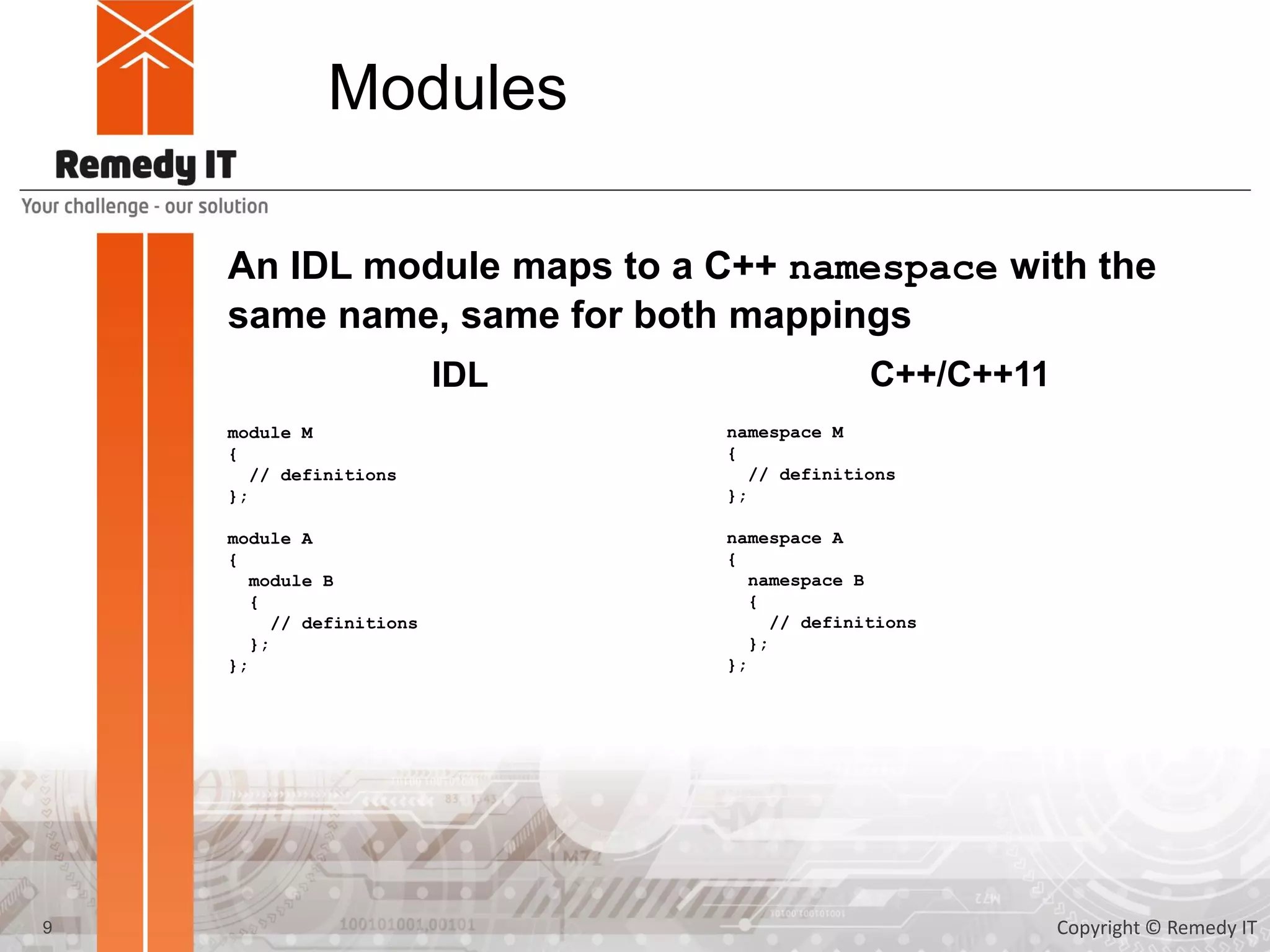
Modules
An IDL module maps to a C++ namespace with the
same name, same for both mappings
module M
{
// definitions
};
module A
{
module B
{
// definitions
};
};
IDL C++/C++11
namespace M
{
// definitions
};
namespace A
{
namespace B
{
// definitions
};
};
9 Copyright © Remedy IT
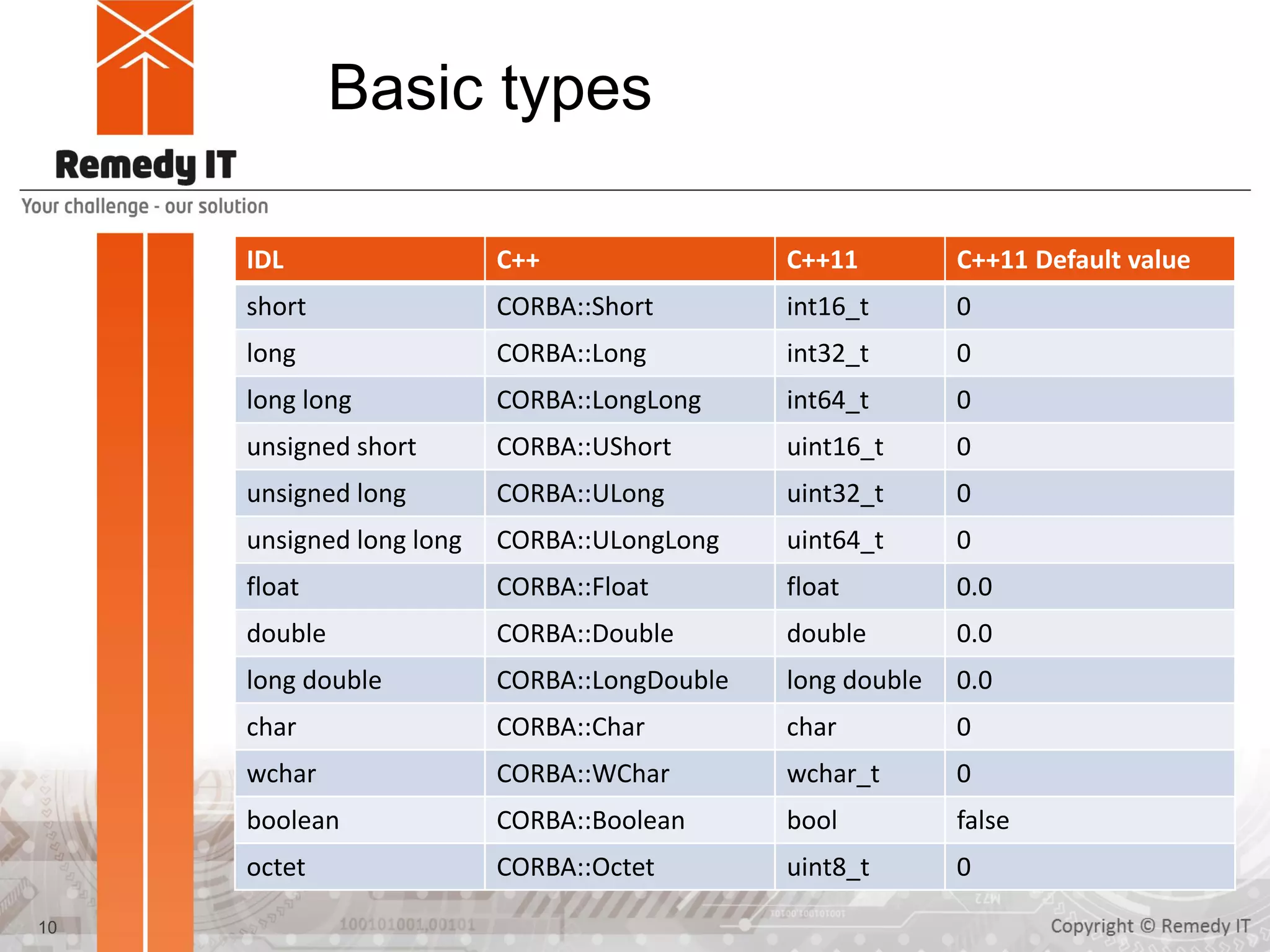
Basic types
IDL C++ C++11 C++11 Default value
short CORBA::Short int16_t 0
long CORBA::Long int32_t 0
long long CORBA::LongLong int64_t 0
unsigned short CORBA::UShort uint16_t 0
unsigned long CORBA::ULong uint32_t 0
unsigned long long CORBA::ULongLong uint64_t 0
float CORBA::Float float 0.0
double CORBA::Double double 0.0
long double CORBA::LongDouble long double 0.0
char CORBA::Char char 0
wchar CORBA::WChar wchar_t 0
boolean CORBA::Boolean bool false
octet CORBA::Octet uint8_t 0
10
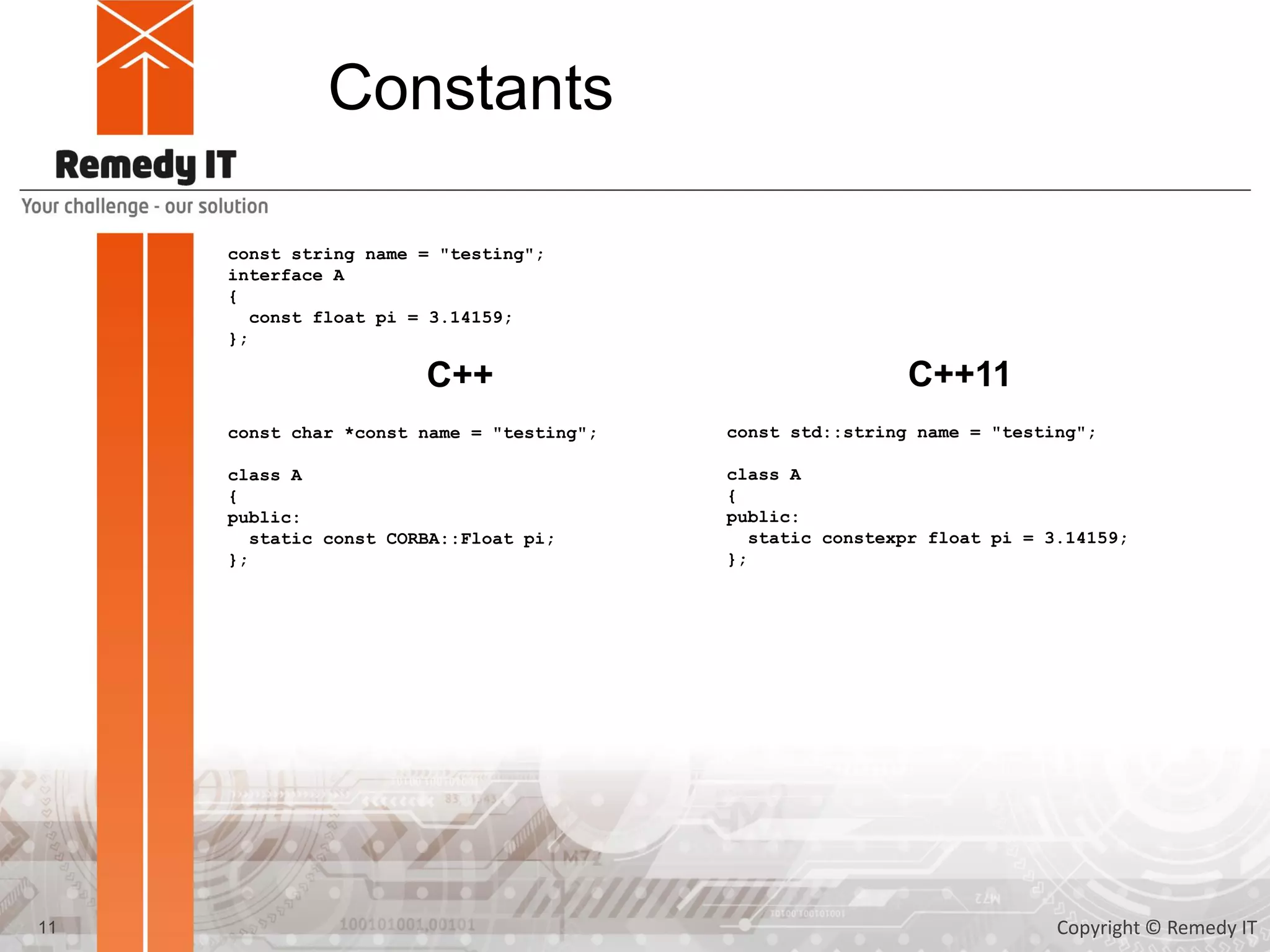
Constants
const string name = "testing";
interface A
{
const float pi = 3.14159;
};
const char *const name = "testing";
class A
{
public:
static const CORBA::Float pi;
};
C++ C++11
const std::string name {"testing"};
class A
{
public:
static constexpr float pi {3.14159F};
};
11 Copyright © Remedy IT
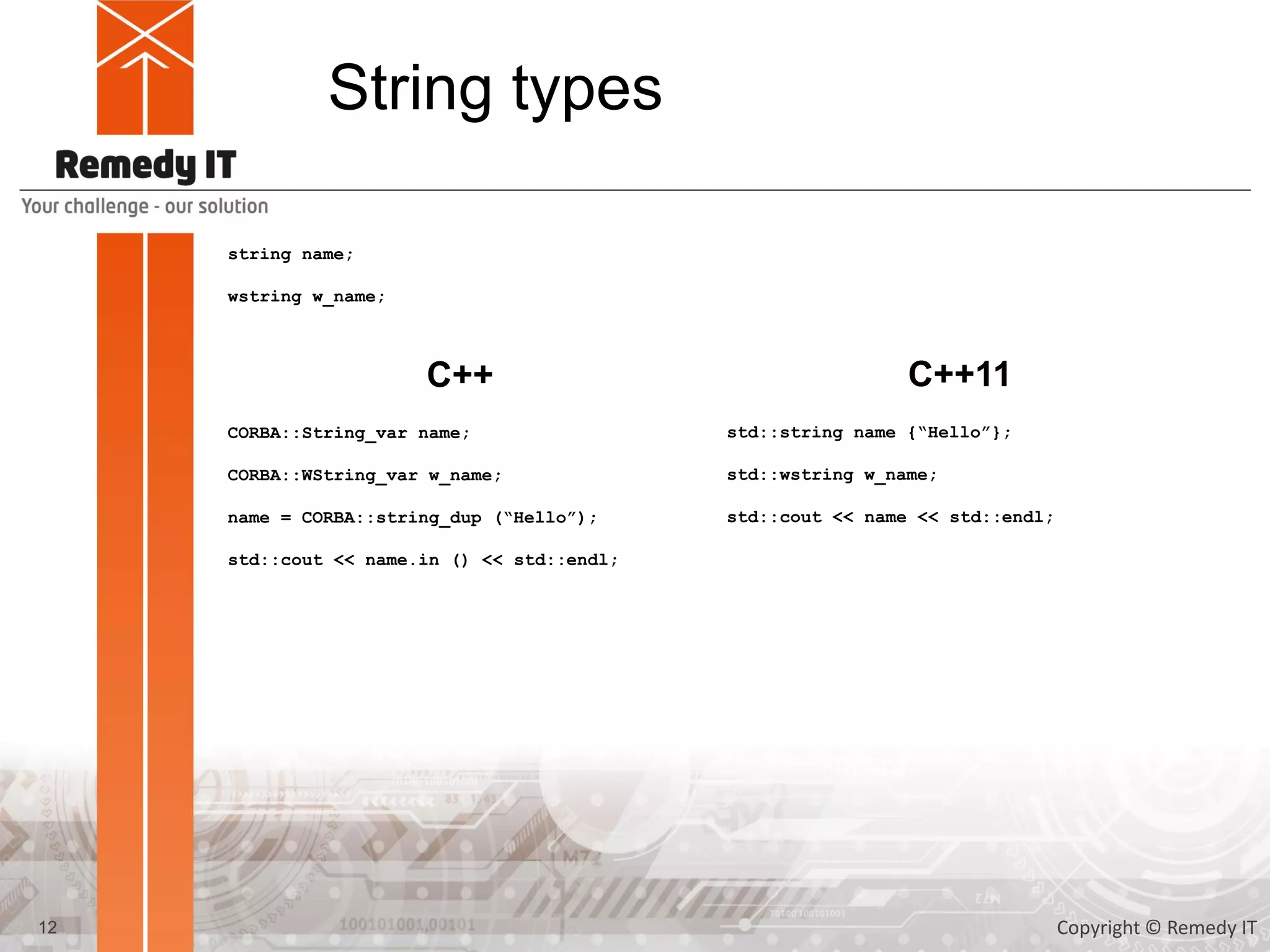
String types
string name;
wstring w_name;
CORBA::String_var name;
CORBA::WString_var w_name;
name = CORBA::string_dup (“Hello”);
std::cout << name.in () << std::endl;
C++ C++11
std::string name {“Hello”};
std::wstring w_name;
std::cout << name << std::endl;
12 Copyright © Remedy IT
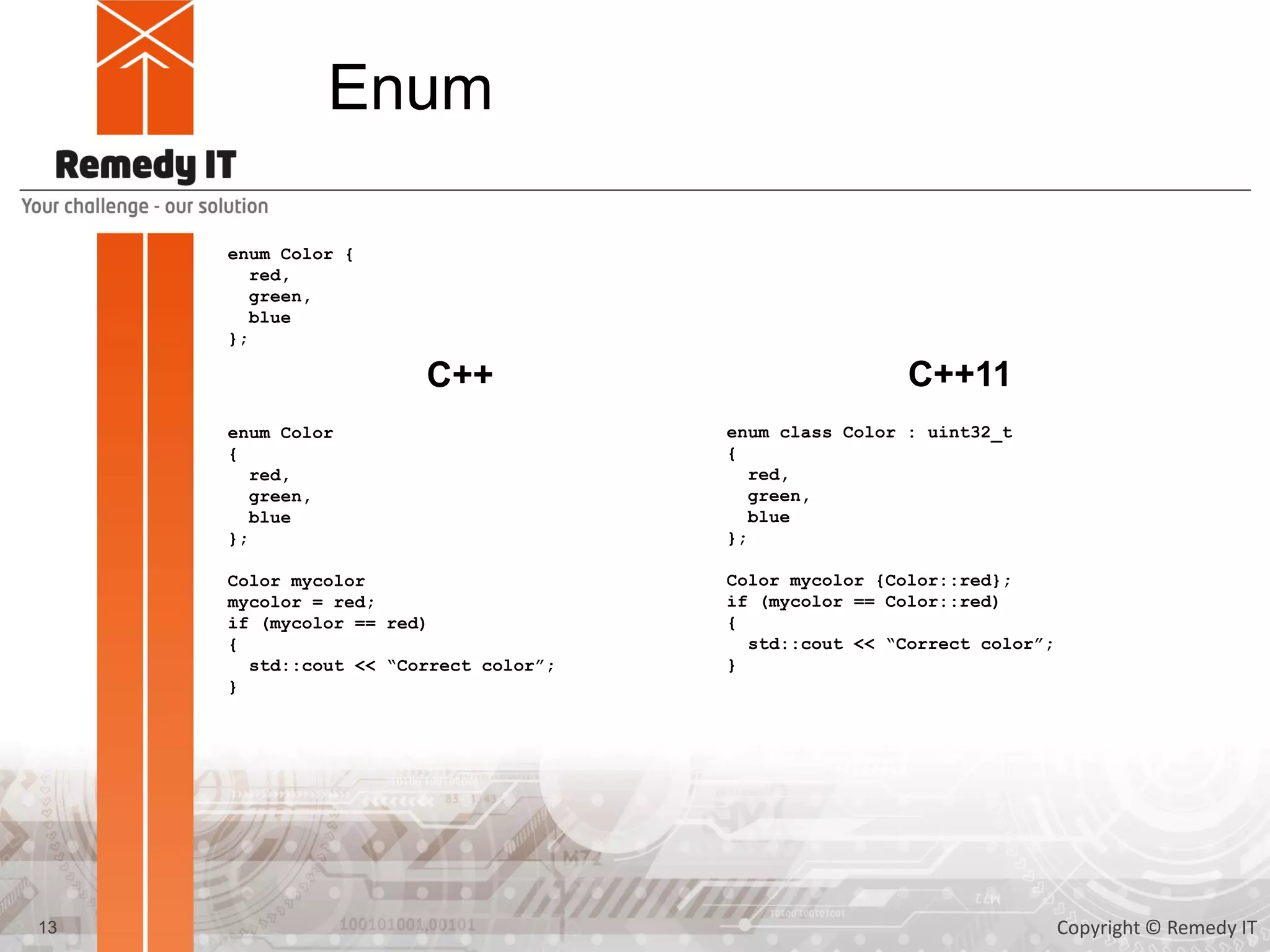
Enum
enum Color {
red,
green,
blue
};
enum Color
{
red,
green,
blue
};
Color mycolor
mycolor = red;
if (mycolor == red)
{
std::cout << “Correct color”;
}
C++ C++11
enum class Color : uint32_t
{
red,
green,
blue
};
Color mycolor {Color::red};
if (mycolor == Color::red)
{
std::cout << “Correct color”;
}
13 Copyright © Remedy IT
Sequence
typedef sequence<long> LongSeq;
LongSeq mysequence;
// Add an element to the vector
Mysequence.length (1)
Mysequence[1] = 5;
for (CORBA::ULong i = 0; I <
mysequence.length(); i++)
{
std::cout << mysequence[i] << “;” <<
std::end;
}
C++ C++11
LongSeq mysequence;
// Add an element to the vector
mysequence.push_back (5);
// Dump using C++11 range based for loop
for (const int32_t& e : mysequence)
{
std::cout << e << “;” << std::end;
}
14 Copyright © Remedy IT
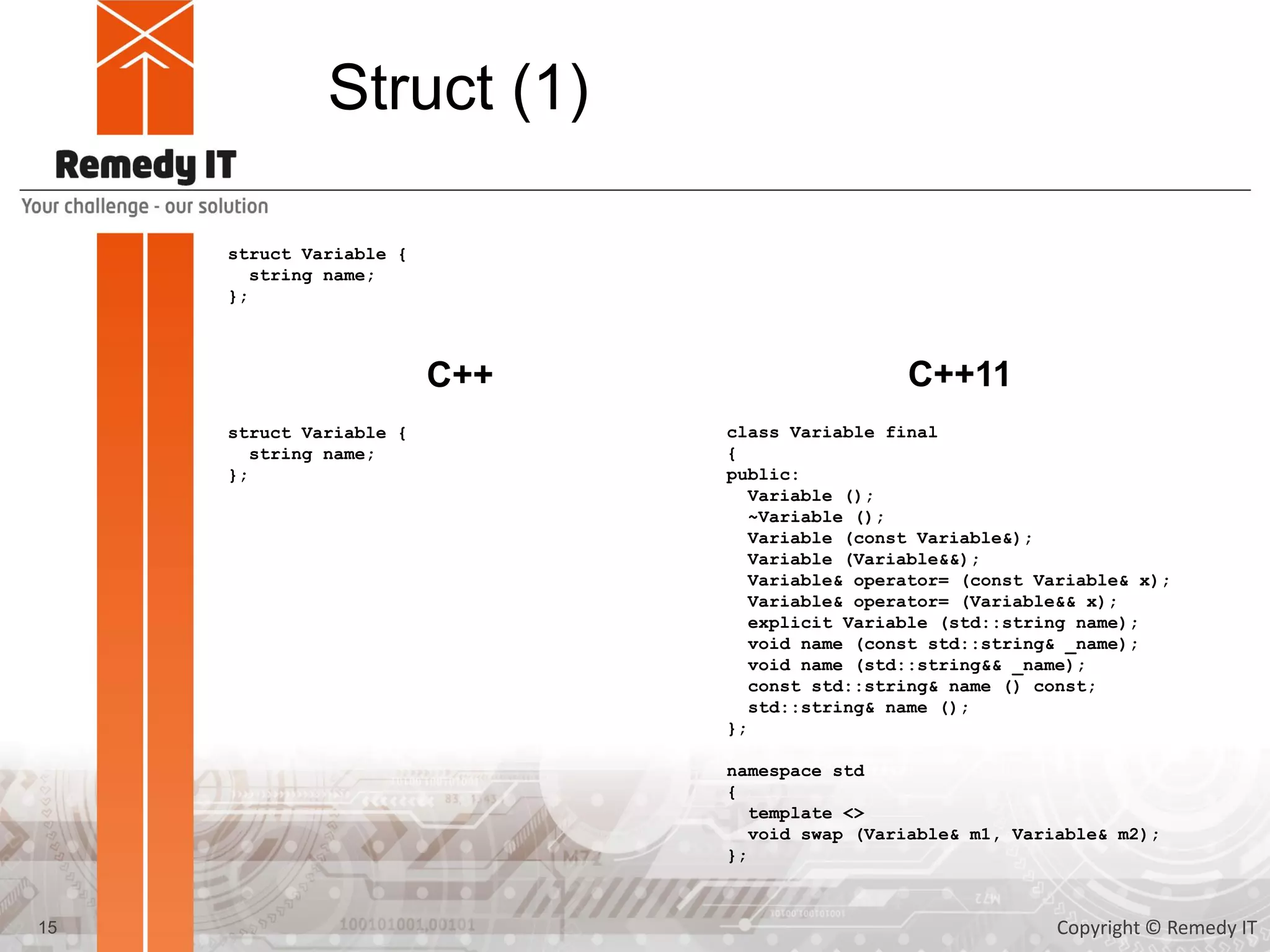
Struct (1)
struct Variable {
string name;
};
struct Variable {
string name;
};
C++ C++11
class Variable final
{
public:
Variable ();
~Variable ();
Variable (const Variable&);
Variable (Variable&&);
Variable& operator= (const Variable& x);
Variable& operator= (Variable&& x);
explicit Variable (std::string name);
void name (const std::string& _name);
void name (std::string&& _name);
const std::string& name () const;
std::string& name ();
};
namespace std
{
template <>
void swap (Variable& m1, Variable& m2);
};
15 Copyright © Remedy IT
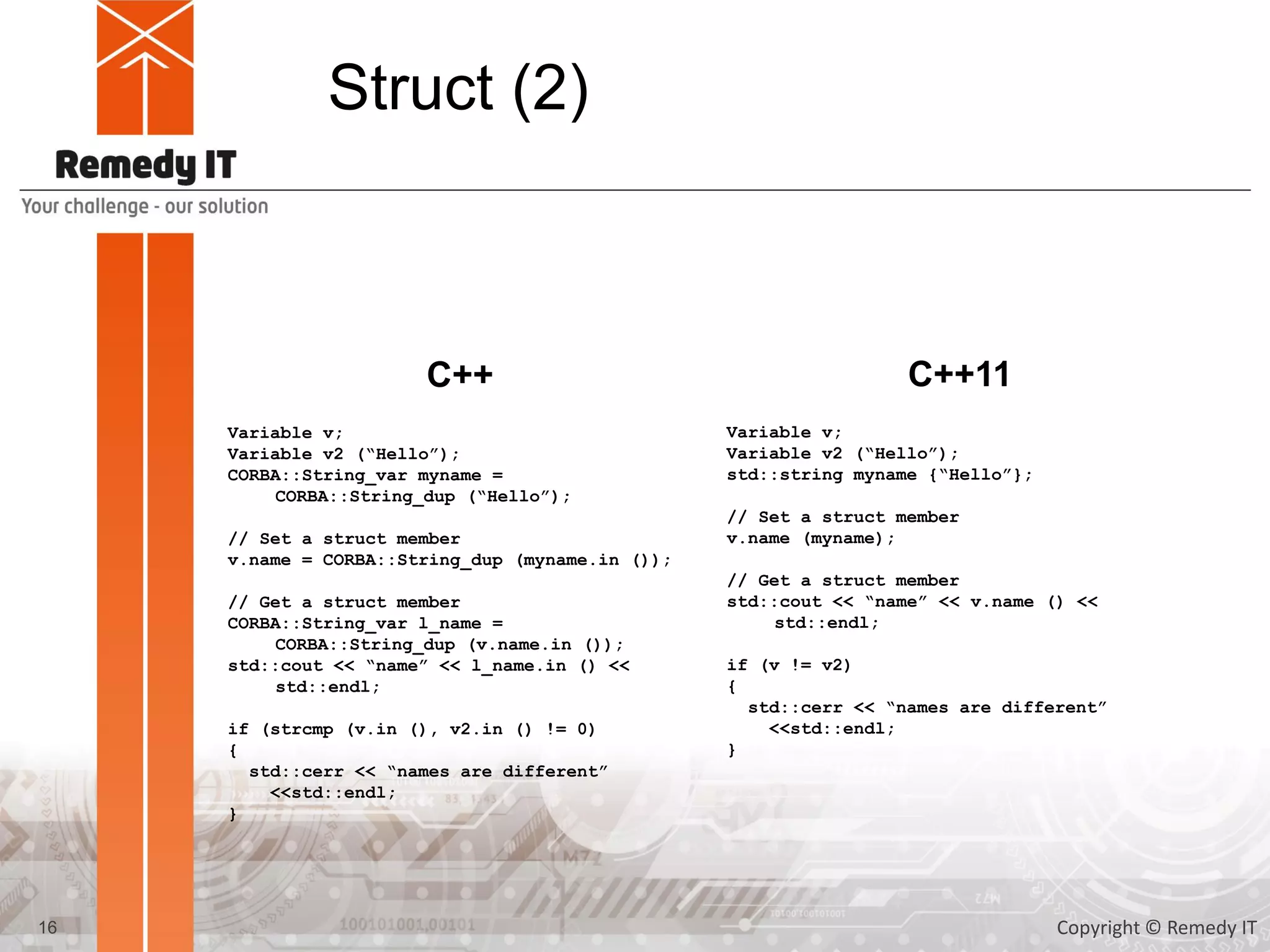
Struct (2)
Variable v;
Variable v2 (“Hello”);
CORBA::String_var myname =
CORBA::String_dup (“Hello”);
// Set a struct member
v.name = CORBA::String_dup (myname.in ());
// Get a struct member
CORBA::String_var l_name =
CORBA::String_dup (v.name.in ());
std::cout << “name” << l_name.in () <<
std::endl;
if (strcmp (v.in (), v2.in () != 0)
{
std::cerr << “names are different”
<<std::endl;
}
C++ C++11
Variable v;
Variable v2 (“Hello”);
std::string myname {“Hello”};
// Set a struct member
v.name (myname);
// Get a struct member
std::cout << “name” << v.name () <<
std::endl;
if (v != v2)
{
std::cerr << “names are different”
<<std::endl;
}
16 Copyright © Remedy IT
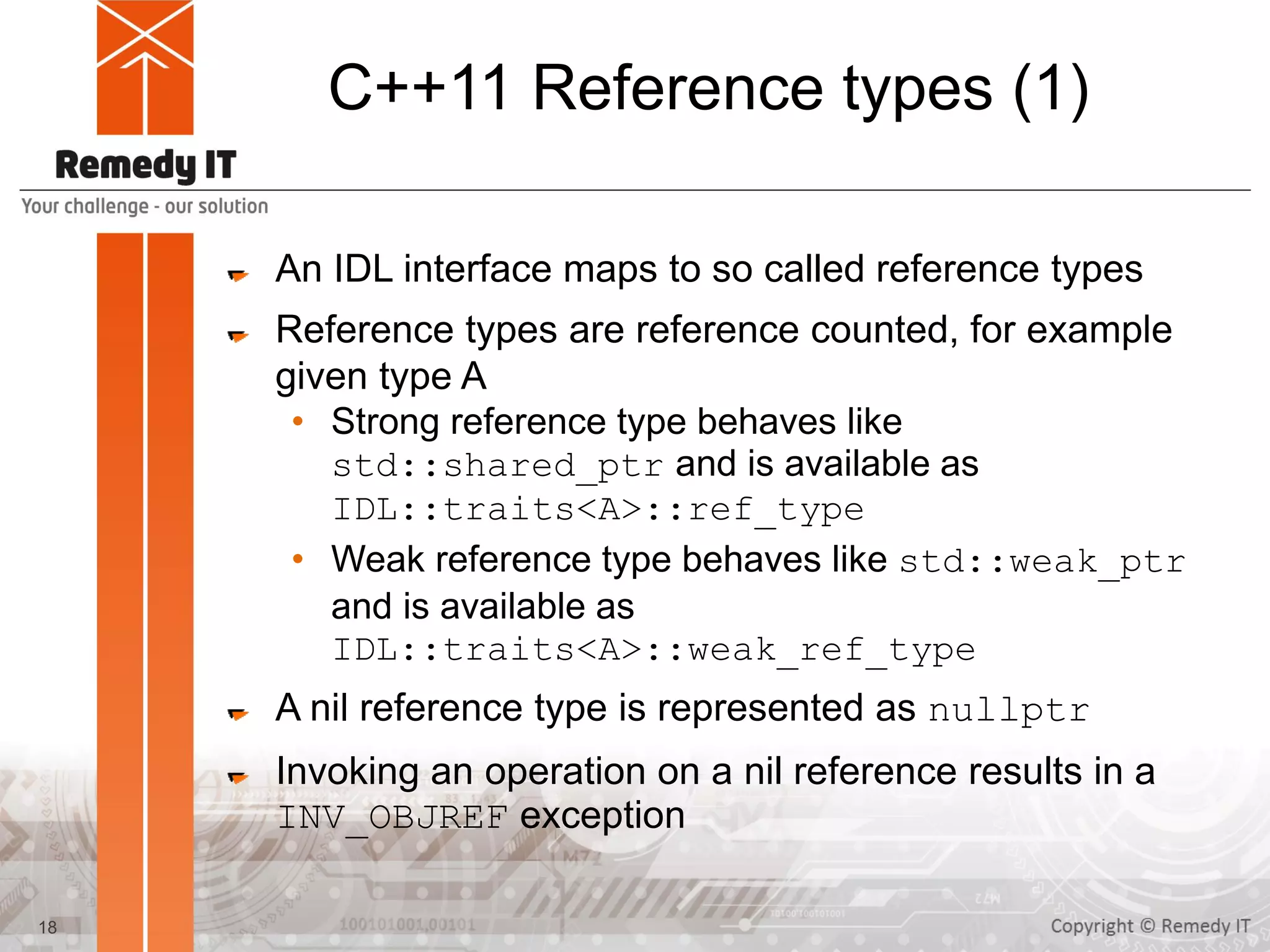
C++11 Reference types (1)
An IDL interface maps to so called reference types
Reference types are reference counted, for example
given type A
• Strong reference type behaves like
std::shared_ptr and is available as
IDL::traits<A>::ref_type
• Weak reference type behaves like std::weak_ptr
and is available as
IDL::traits<A>::weak_ref_type
A nil reference type is represented as nullptr
Invoking an operation on a nil reference results in a
INV_OBJREF exception
18
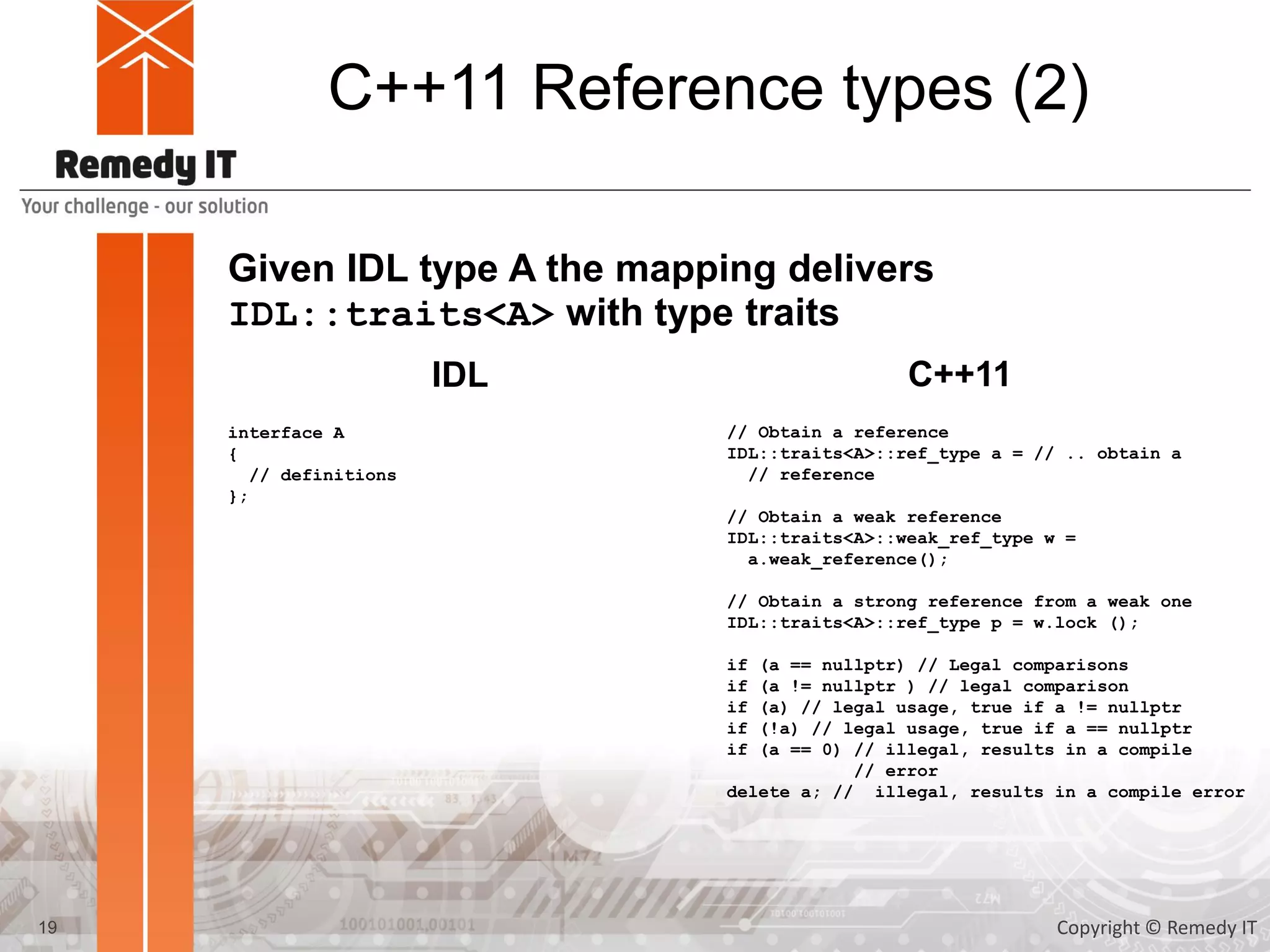
C++11 Reference types (2)
Given IDL type A the mapping delivers
IDL::traits<A> with type traits
interface A
{
// definitions
};
IDL C++11
// Obtain a reference
IDL::traits<A>::ref_type a = // .. obtain a
// reference
// Obtain a weak reference
IDL::traits<A>::weak_ref_type w =
a.weak_reference();
// Obtain a strong reference from a weak one
IDL::traits<A>::ref_type p = w.lock ();
if (a == nullptr) // Legal comparisons
if (a != nullptr ) // legal comparison
if (a) // legal usage, true if a != nullptr
if (!a) // legal usage, true if a == nullptr
if (a == 0) // illegal, results in a compile
// error
delete a; // illegal, results in a compile error
19 Copyright © Remedy IT
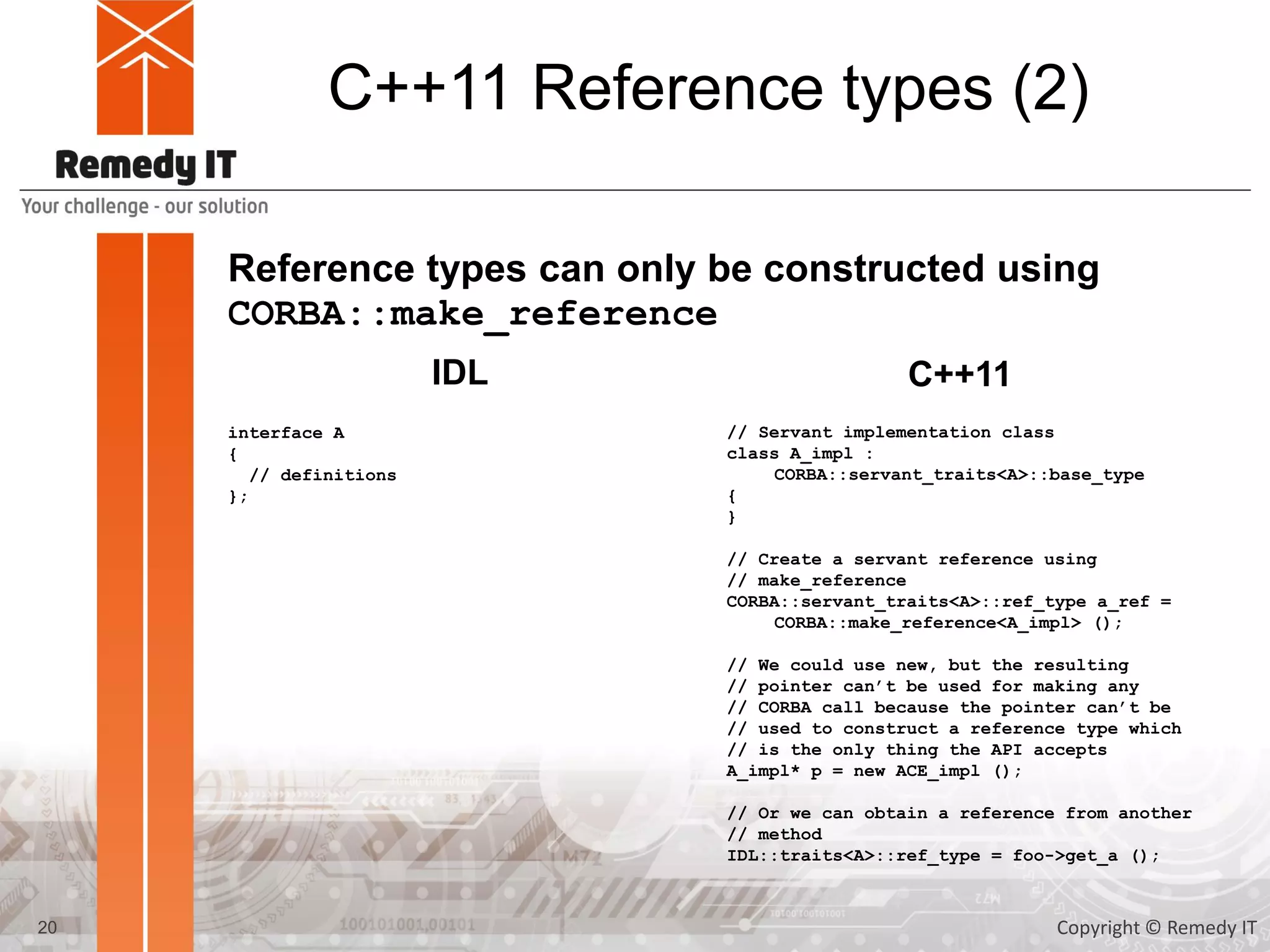
C++11 Reference types (2)
Reference types can only be constructed using
CORBA::make_reference
interface A
{
// definitions
};
IDL C++11
// Servant implementation class
class A_impl :
CORBA::servant_traits<A>::base_type
{
}
// Create a servant reference using
// make_reference
CORBA::servant_traits<A>::ref_type a_ref =
CORBA::make_reference<A_impl> ();
// We could use new, but the resulting
// pointer can’t be used for making any
// CORBA call because the pointer can’t be
// used to construct a reference type which
// is the only thing the API accepts
A_impl* p = new ACE_impl ();
// Or we can obtain a reference from another
// method
IDL::traits<A>::ref_type = foo->get_a ();
20 Copyright © Remedy IT
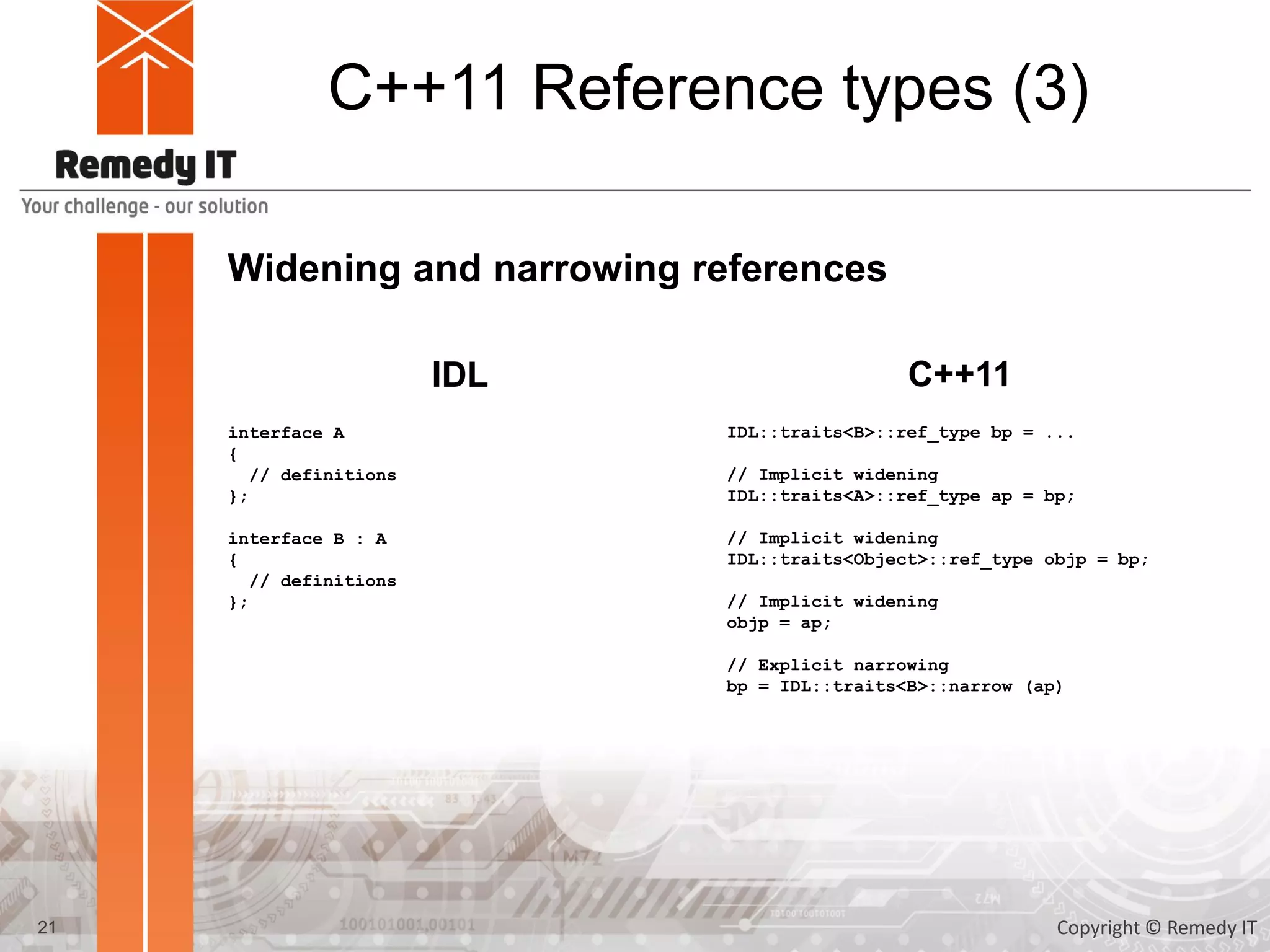
C++11 Reference types (3)
Widening and narrowing references
interface A
{
// definitions
};
interface B : A
{
// definitions
};
IDL C++11
IDL::traits<B>::ref_type bp = ...
// Implicit widening
IDL::traits<A>::ref_type ap = bp;
// Implicit widening
IDL::traits<Object>::ref_type objp = bp;
// Implicit widening
objp = ap;
// Explicit narrowing
bp = IDL::traits<B>::narrow (ap)
21 Copyright © Remedy IT
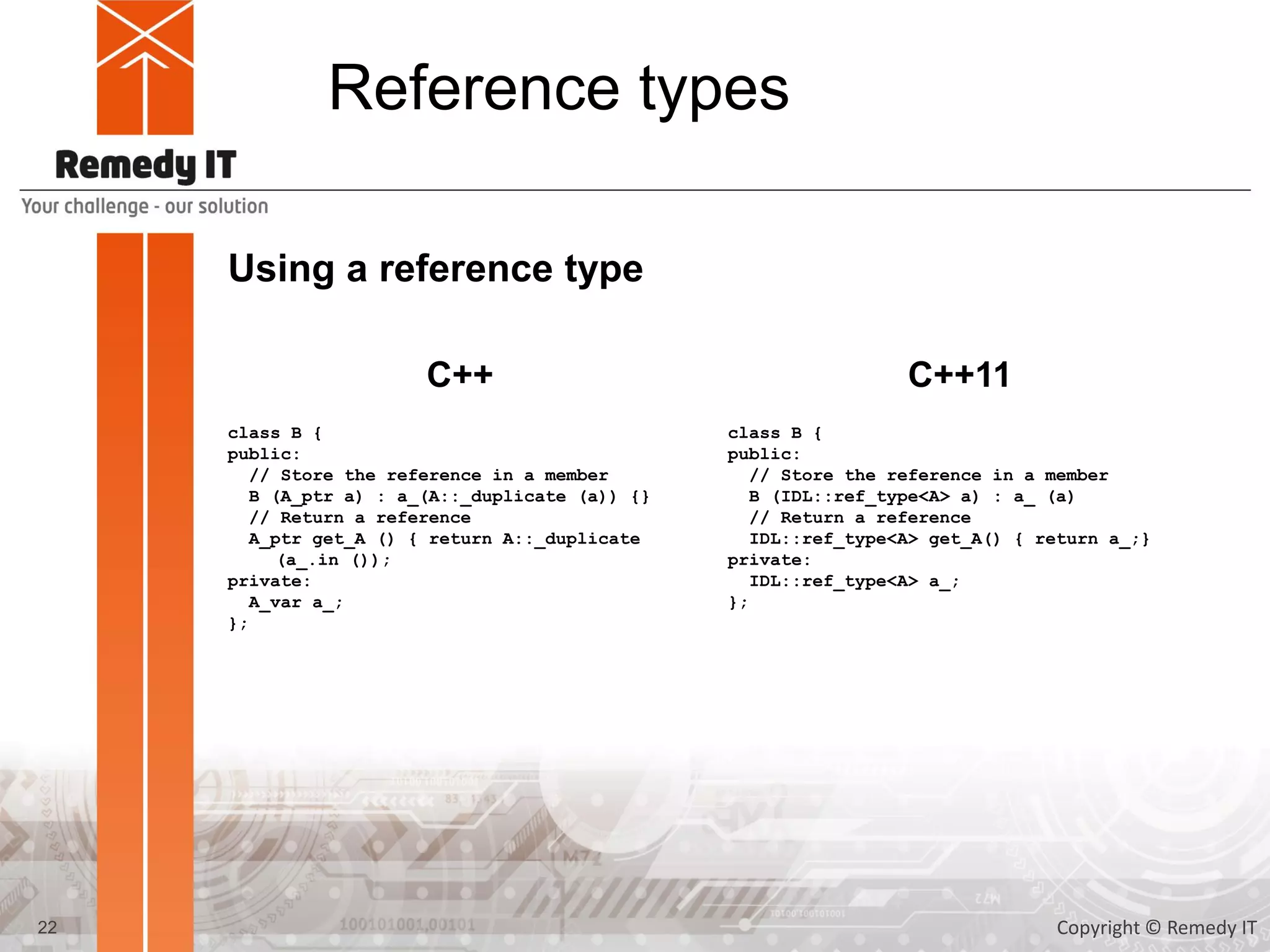
Reference types
Using a reference type
class B {
public:
// Store the reference in a member
B (A_ptr a) : a_(A::_duplicate (a)) {}
// Return a reference
A_ptr get_A () { return A::_duplicate
(a_.in ());
private:
A_var a_;
};
22
C++ C++11
class B {
public:
// Store the reference in a member
B (IDL::ref_type<A> a) : a_ (a)
// Return a reference
IDL::ref_type<A> get_A() { return a_;}
private:
IDL::ref_type<A> a_;
};
Copyright © Remedy IT
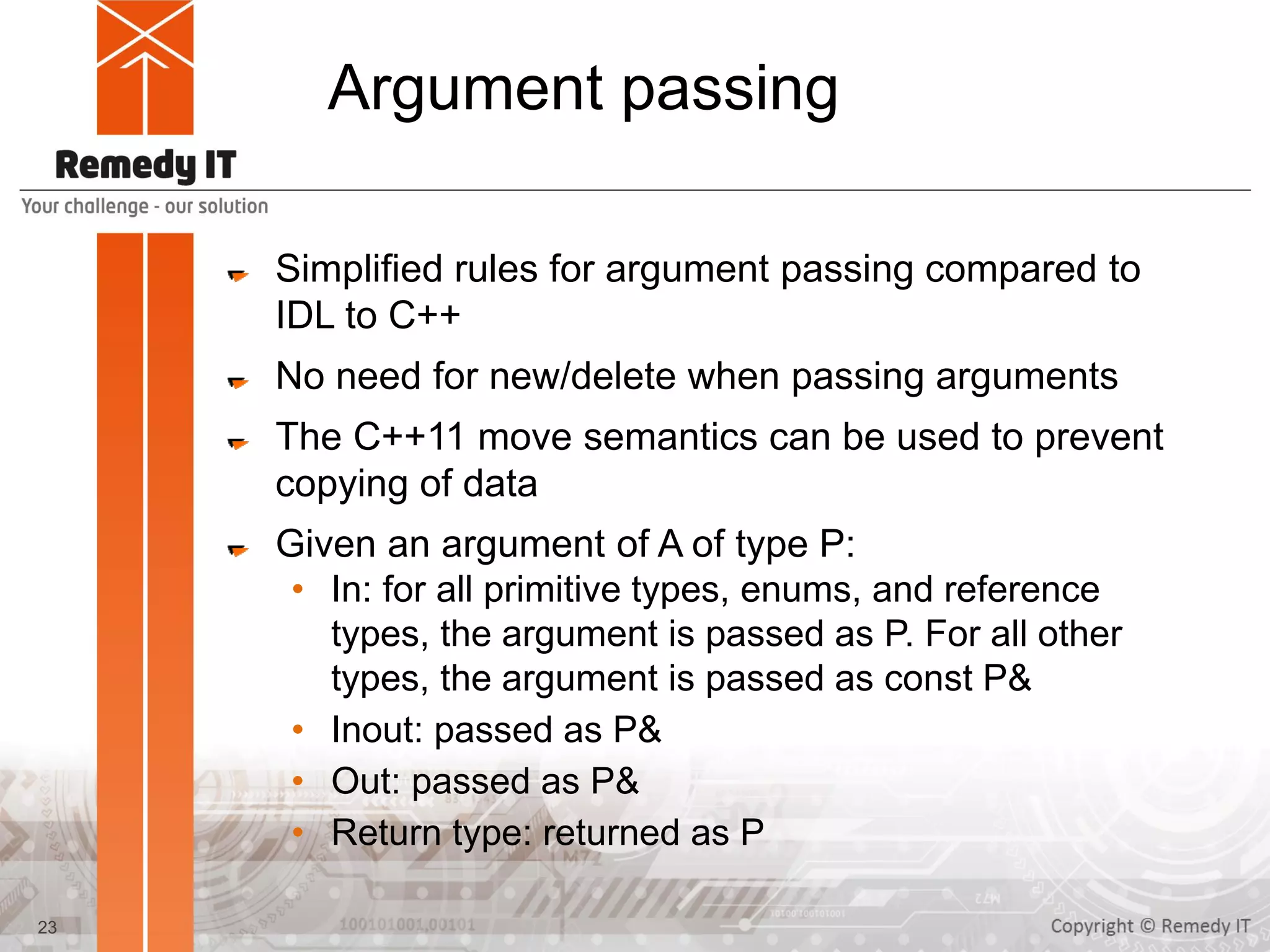
Argument passing
Simplified rules for argument passing compared to
IDL to C++
No need for new/delete when passing arguments
The C++11 move semantics can be used to prevent
copying of data
Given an argument of A of type P:
• In: for all primitive types, enums, and reference
types, the argument is passed as P. For all other
types, the argument is passed as const P&
• Inout: passed as P&
• Out: passed as P&
• Return type: returned as P
23
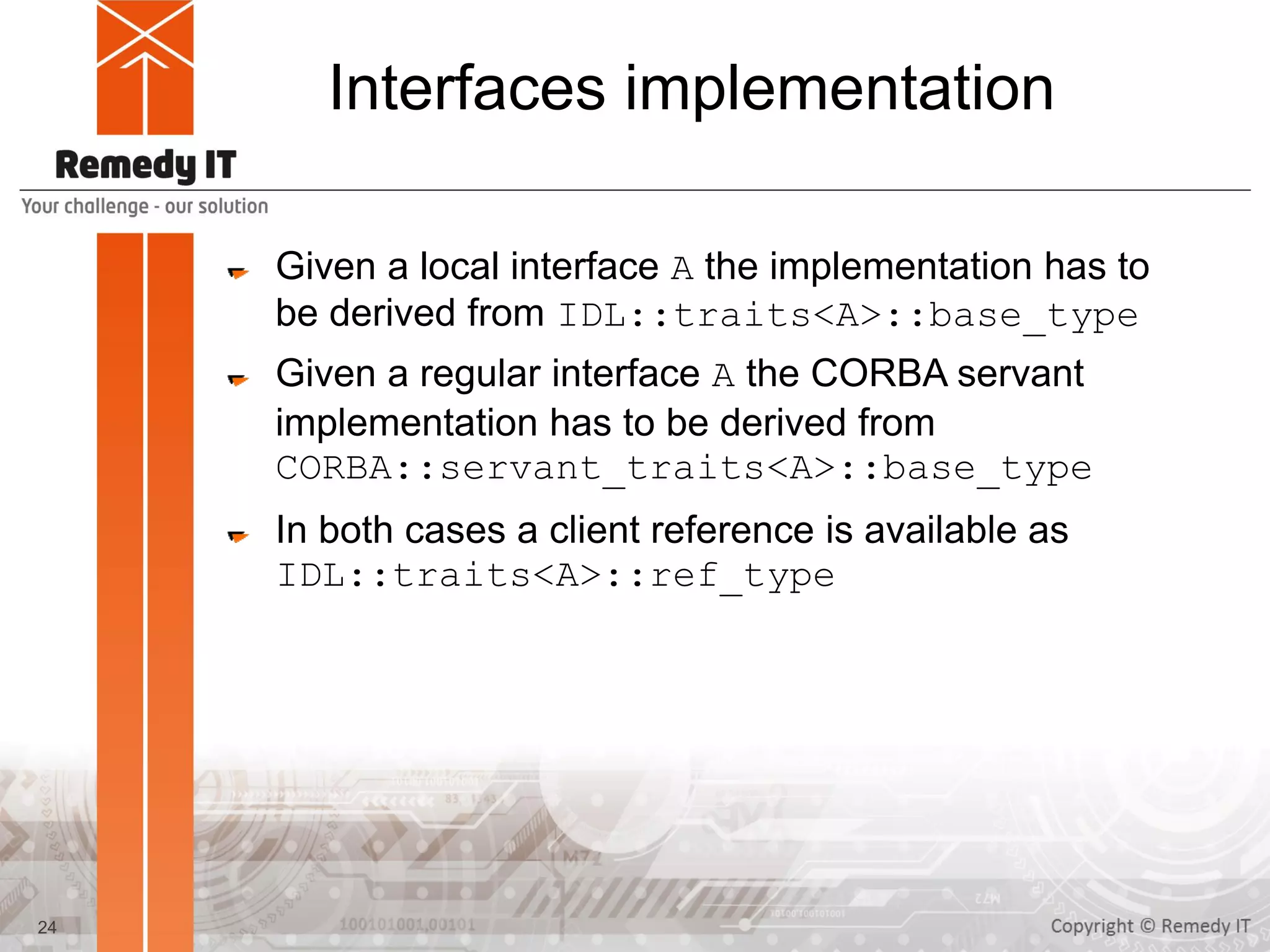
Interfaces implementation
Given a local interface A the implementation has to
be derived from IDL::traits<A>::base_type
Given a regular interface A the CORBA servant
implementation has to be derived from
CORBA::servant_traits<A>::base_type
In both cases a client reference is available as
IDL::traits<A>::ref_type
24
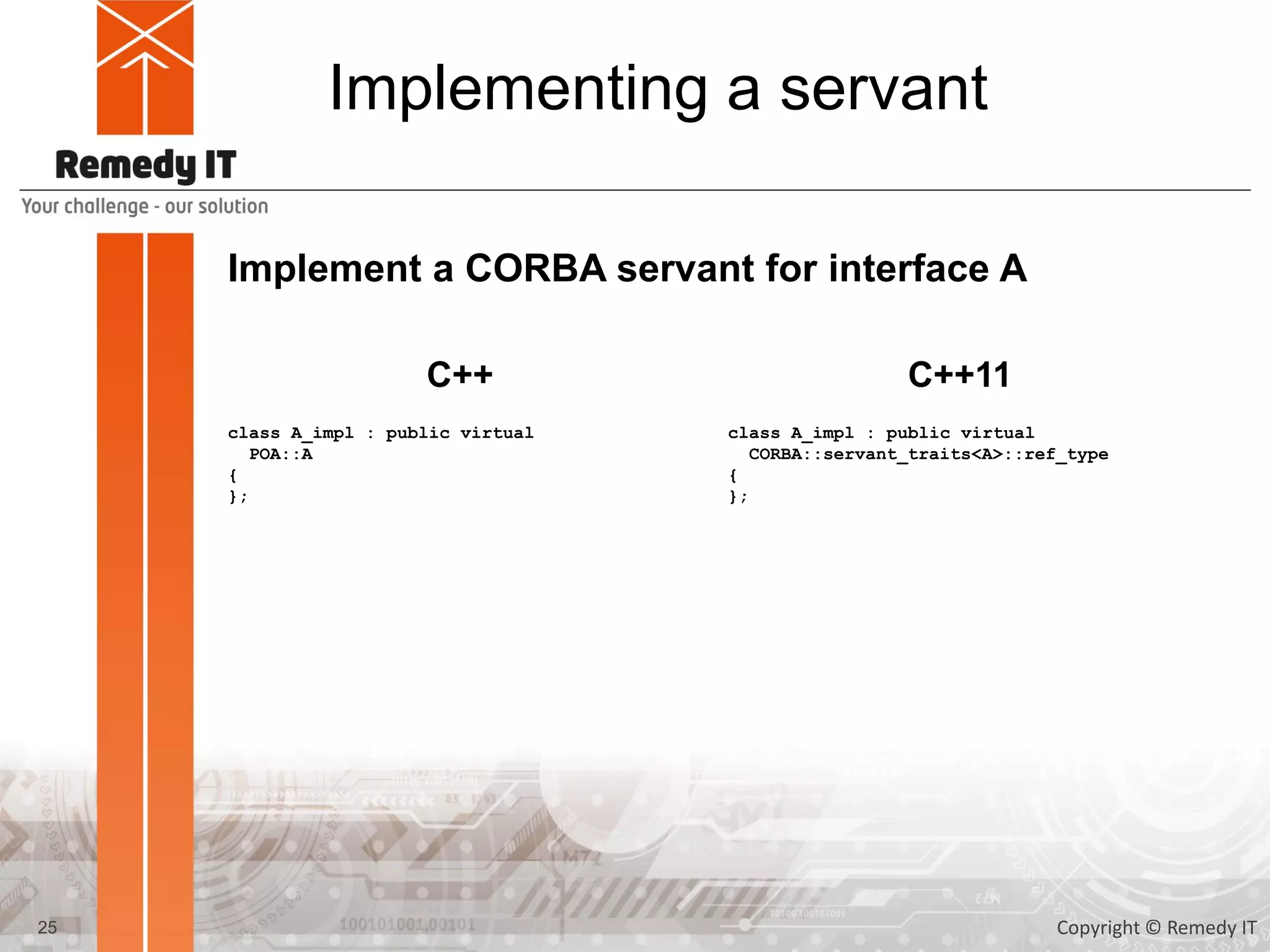
Implementing a servant
Implement a CORBA servant for interface A
class A_impl : public virtual
POA::A
{
};
25
C++ C++11
class A_impl : public virtual
CORBA::servant_traits<A>::ref_type
{
};
Copyright © Remedy IT
C++11 Example application
26
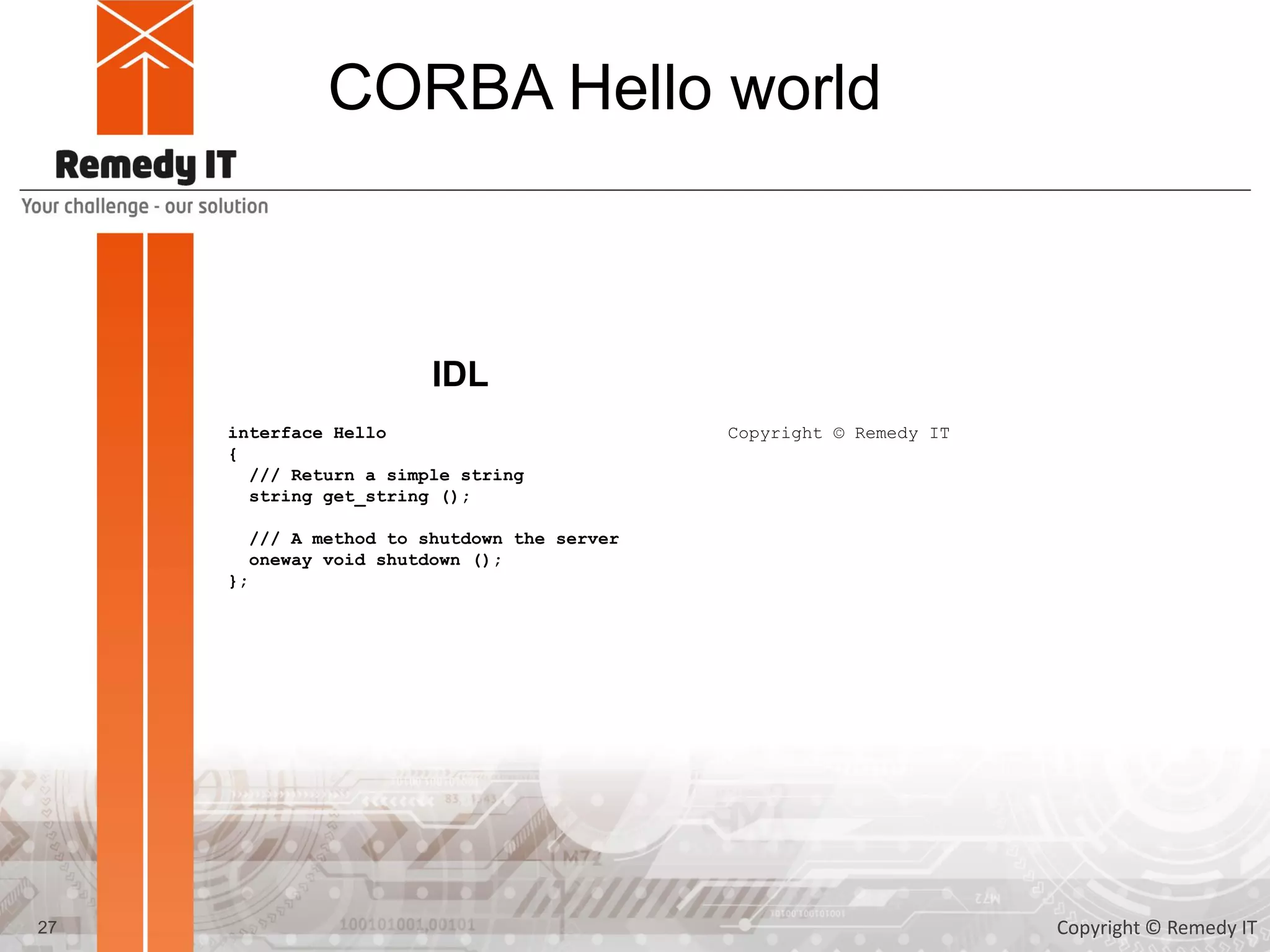
CORBA Hello world
interface Hello
{
/// Return a simple string
string get_string ();
/// A method to shutdown the server
oneway void shutdown ();
};
IDL
27
Copyright © Remedy IT
CORBA client
int main(int argc, char* argv[])
{
try
{
// Obtain the ORB
IDL::traits<CORBA::ORB>::ref_type orb = CORBA::ORB_init (argc, argv);
// Create the object reference
IDL::traits<CORBA::Object>::ref_type obj = orb->string_to_object ("file://test.ior");
// Narrow it to the needed type
IDL::traits<Hello>::ref_type hello = IDL::traits<Hello>::narrow (obj);
// Invoke a method, invoking on a nil reference will result in an exception
std::cout << "hello->get_string () returned " << hello->get_string () << std::endl;
// Shutdown the server
hello->shutdown ();
// Cleanup our ORB
orb->destroy ();
}
catch (const std::exception& e)
{
// All exceptions are derived from std::exception
std::cerr << "exception caught: " << e.what () << std::endl;
}
return 0;
}
28
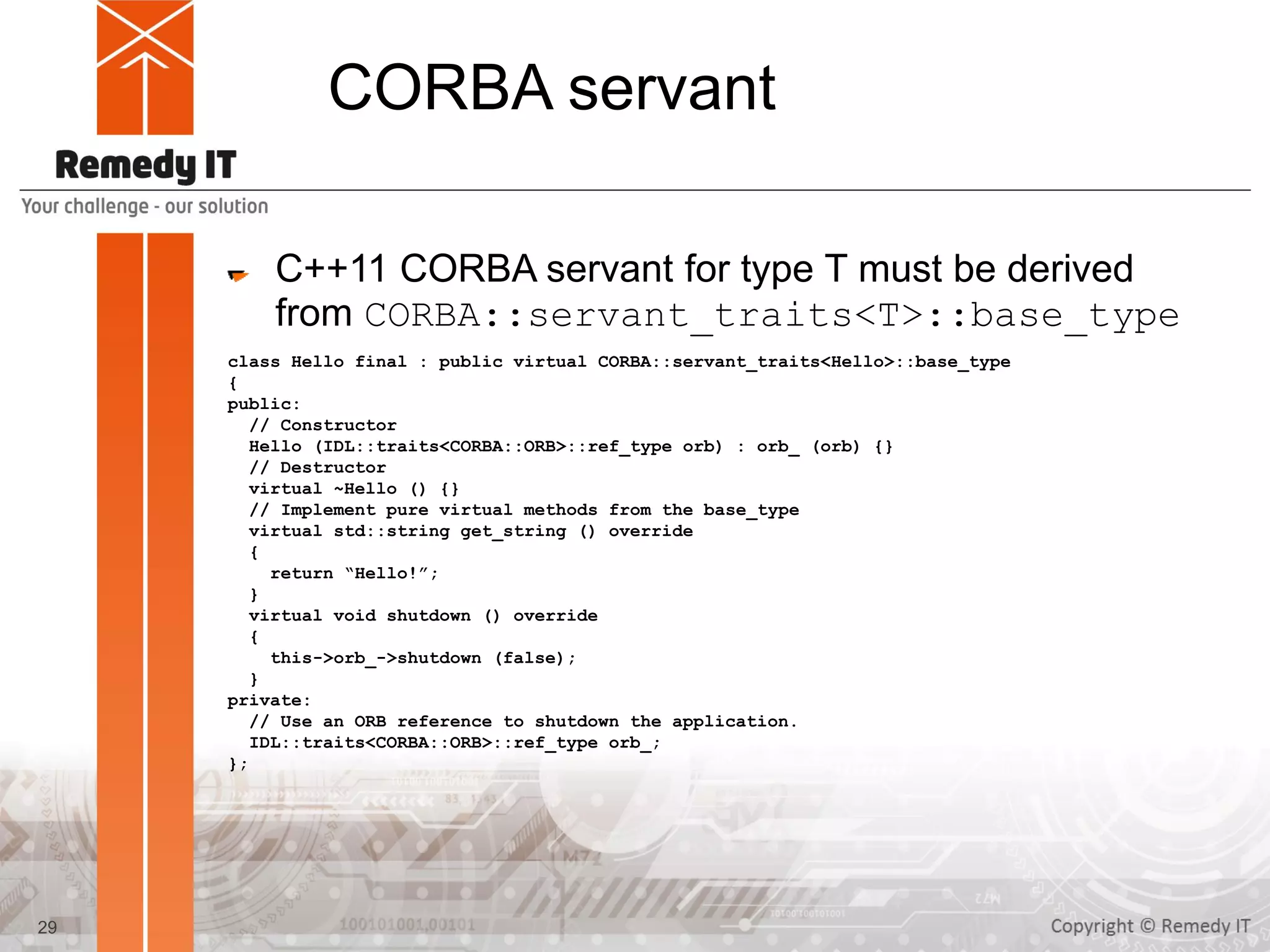
CORBA servant
C++11 CORBA servant for type T must be derived
from CORBA::servant_traits<T>::base_type
class Hello final : public virtual CORBA::servant_traits<Hello>::base_type
{
public:
// Constructor
Hello (IDL::traits<CORBA::ORB>::ref_type orb) : orb_ (orb) {}
// Destructor
virtual ~Hello () {}
// Implement pure virtual methods from the base_type
virtual std::string get_string () override
{
return “Hello!”;
}
virtual void shutdown () override
{
this->orb_->shutdown (false);
}
private:
// Use an ORB reference to shutdown the application.
IDL::traits<CORBA::ORB>::ref_type orb_;
};
29
CORBA server (1)
int main(int argc, char* argv[])
{
try
{
// Obtain our ORB
IDL::traits<CORBA::ORB>::ref_type orb = CORBA::ORB_init (argc, argv);
// Obtain our POA and POAManager
IDL::traits<CORBA::Object>::ref_type obj = orb->resolve_initial_references ("RootPOA");
IDL::traits<PortableServer::POA>::ref_type root_poa =
IDL::traits<PortableServer::POA>::narrow (obj);
IDL::traits<PortableServer::POAManager>::ref_type poaman = root_poa->the_POAManager ();
// Create the servant
CORBA::servant_traits<Hello>::ref_type hello_impl =
CORBA::make_reference<Hello> (orb);
// Activate the servant as CORBA object
PortableServer::ObjectId id = root_poa->activate_object (hello_impl);
IDL::traits<CORBA::Object>::ref_type hello_obj = root_poa->id_to_reference (id);
IDL::traits<Hello>::ref_type hello =
IDL::traits<Hello>::narrow (hello_obj);
// Put the IOR on disk
std::string ior = orb->object_to_string (hello);
std::ofstream fos("test.ior");
fos << ior;
fos.close ();
30
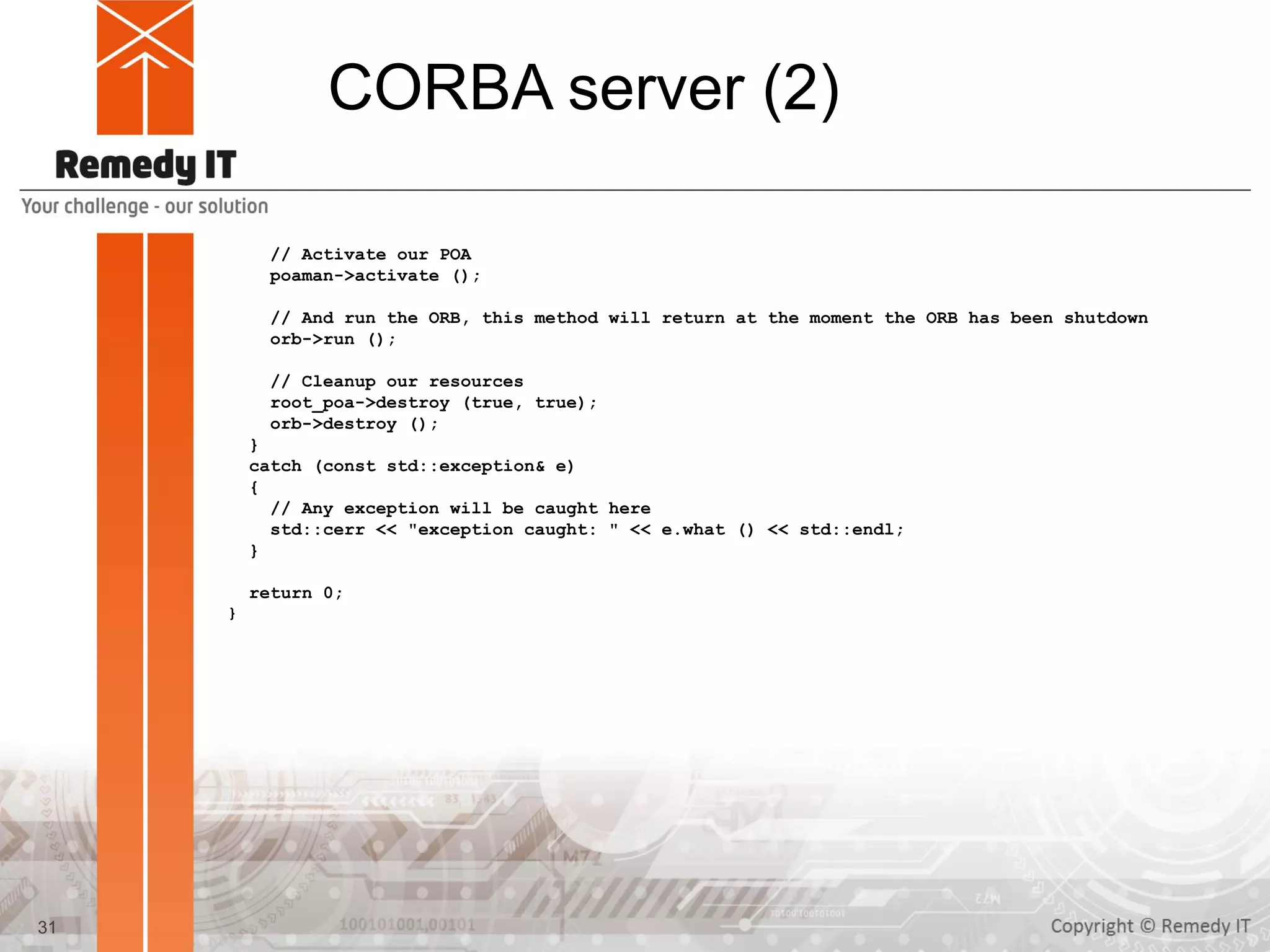
CORBA server (2)
// Activate our POA
poaman->activate ();
// And run the ORB, this method will return at the moment the ORB has been shutdown
orb->run ();
// Cleanup our resources
root_poa->destroy (true, true);
orb->destroy ();
}
catch (const std::exception& e)
{
// Any exception will be caught here
std::cerr << "exception caught: " << e.what () << std::endl;
}
return 0;
}
31
Tips & Tricks
Don’t use new/delete
Use pass by value together with C++11 move
semantics
32
Conclusion
C++11 simplifies CORBA programming
The combination of reference counting and C++11
move semantics make the code much safer and
secure
Application code is much smaller and easier to read
33
TAOX11
Commercial CORBA implementation from Remedy IT
Compliant with IDL to C++11 v1.2
IDL compiler with front end supporting IDL2, IDL3,
and IDL3+
Free evaluation versions available from
http://swsupport.remedy.nl!
More details at http://taox11.remedy.nl
34
Want to know more?
Look at TAOX11 at http://taox11.remedy.nl
Check the Remedy IT provided examples at
https://github.com/RemedyIT/idl2cpp11
Contact us, see http://www.remedy.nl
35
Contact
36
Remedy IT
Postbus 81
6930 AB Westervoort
The Netherlands
tel.: +31(0)88 – 053 0000
e-mail: sales@remedy.nl
website: www.remedy.nl
Twitter: @RemedyIT
Slideshare: RemedyIT
Subscribe to our mailing list

Comparing IDL to C++ with IDL to C++11

  • 1.
    Comparing IDL to C++ with IDLto C++11 Simplify development of CORBA, DDS, and CCM based applications
  • 2.
    Overview This presentations givesa comparison between the IDL to C++ and IDL to C++11 language mappings It assumes basic understanding of IDL and CORBA For more information take a look at our TAOX11 website at http://taox11.remedy.nl 2
  • 3.
  • 4.
    Problems with IDLto C++ The IDL to C++ language mapping is from the 90’s IDL to C++ could not depend on various C++ features as • C++ namespace • C++ exceptions • Standard Template Library As a result • Mapping is hard to use correctly • Uses its own constructs for everything 4
  • 5.
    Why a newlanguage mapping? IDL to C++ language mapping is impossible to change because • Multiple implementations are on the market (open source and commercial) • A huge amount of applications have been developed An updated IDL to C++ language mapping would force all vendors and users to update their products The standardization of a new C++ revision in 2011 (ISO/IEC 14882:2011, called C++11) gives the opportunity to define a new language mapping • C++11 features are not backward compatible with C++03 or C++99 • A new C++11 mapping leaves the existing mapping intact 5
  • 6.
    Goals Simplify mapping forC++ Make use of the new C++11 features to • Reduce amount of application code • Reduce amount of possible errors made • Gain runtime performance • Speedup development and testing Faster time to market Reduced costs Reduced training time 6
  • 7.
    OMG Specification IDL toC++11 v1.2 available from the OMG website as formal/2015-08-01 Revision Task Force (RTF) is active to work on issues reported 7
  • 8.
  • 9.
    Modules An IDL modulemaps to a C++ namespace with the same name, same for both mappings module M { // definitions }; module A { module B { // definitions }; }; IDL C++/C++11 namespace M { // definitions }; namespace A { namespace B { // definitions }; }; 9 Copyright © Remedy IT
  • 10.
    Basic types IDL C++C++11 C++11 Default value short CORBA::Short int16_t 0 long CORBA::Long int32_t 0 long long CORBA::LongLong int64_t 0 unsigned short CORBA::UShort uint16_t 0 unsigned long CORBA::ULong uint32_t 0 unsigned long long CORBA::ULongLong uint64_t 0 float CORBA::Float float 0.0 double CORBA::Double double 0.0 long double CORBA::LongDouble long double 0.0 char CORBA::Char char 0 wchar CORBA::WChar wchar_t 0 boolean CORBA::Boolean bool false octet CORBA::Octet uint8_t 0 10
  • 11.
    Constants const string name= "testing"; interface A { const float pi = 3.14159; }; const char *const name = "testing"; class A { public: static const CORBA::Float pi; }; C++ C++11 const std::string name {"testing"}; class A { public: static constexpr float pi {3.14159F}; }; 11 Copyright © Remedy IT
  • 12.
    String types string name; wstringw_name; CORBA::String_var name; CORBA::WString_var w_name; name = CORBA::string_dup (“Hello”); std::cout << name.in () << std::endl; C++ C++11 std::string name {“Hello”}; std::wstring w_name; std::cout << name << std::endl; 12 Copyright © Remedy IT
  • 13.
    Enum enum Color { red, green, blue }; enumColor { red, green, blue }; Color mycolor mycolor = red; if (mycolor == red) { std::cout << “Correct color”; } C++ C++11 enum class Color : uint32_t { red, green, blue }; Color mycolor {Color::red}; if (mycolor == Color::red) { std::cout << “Correct color”; } 13 Copyright © Remedy IT
  • 14.
    Sequence typedef sequence<long> LongSeq; LongSeqmysequence; // Add an element to the vector Mysequence.length (1) Mysequence[1] = 5; for (CORBA::ULong i = 0; I < mysequence.length(); i++) { std::cout << mysequence[i] << “;” << std::end; } C++ C++11 LongSeq mysequence; // Add an element to the vector mysequence.push_back (5); // Dump using C++11 range based for loop for (const int32_t& e : mysequence) { std::cout << e << “;” << std::end; } 14 Copyright © Remedy IT
  • 15.
    Struct (1) struct Variable{ string name; }; struct Variable { string name; }; C++ C++11 class Variable final { public: Variable (); ~Variable (); Variable (const Variable&); Variable (Variable&&); Variable& operator= (const Variable& x); Variable& operator= (Variable&& x); explicit Variable (std::string name); void name (const std::string& _name); void name (std::string&& _name); const std::string& name () const; std::string& name (); }; namespace std { template <> void swap (Variable& m1, Variable& m2); }; 15 Copyright © Remedy IT
  • 16.
    Struct (2) Variable v; Variablev2 (“Hello”); CORBA::String_var myname = CORBA::String_dup (“Hello”); // Set a struct member v.name = CORBA::String_dup (myname.in ()); // Get a struct member CORBA::String_var l_name = CORBA::String_dup (v.name.in ()); std::cout << “name” << l_name.in () << std::endl; if (strcmp (v.in (), v2.in () != 0) { std::cerr << “names are different” <<std::endl; } C++ C++11 Variable v; Variable v2 (“Hello”); std::string myname {“Hello”}; // Set a struct member v.name (myname); // Get a struct member std::cout << “name” << v.name () << std::endl; if (v != v2) { std::cerr << “names are different” <<std::endl; } 16 Copyright © Remedy IT
  • 17.
    C++11 Reference types(1) An IDL interface maps to so called reference types Reference types are reference counted, for example given type A • Strong reference type behaves like std::shared_ptr and is available as IDL::traits<A>::ref_type • Weak reference type behaves like std::weak_ptr and is available as IDL::traits<A>::weak_ref_type A nil reference type is represented as nullptr Invoking an operation on a nil reference results in a INV_OBJREF exception 18
  • 18.
    C++11 Reference types(2) Given IDL type A the mapping delivers IDL::traits<A> with type traits interface A { // definitions }; IDL C++11 // Obtain a reference IDL::traits<A>::ref_type a = // .. obtain a // reference // Obtain a weak reference IDL::traits<A>::weak_ref_type w = a.weak_reference(); // Obtain a strong reference from a weak one IDL::traits<A>::ref_type p = w.lock (); if (a == nullptr) // Legal comparisons if (a != nullptr ) // legal comparison if (a) // legal usage, true if a != nullptr if (!a) // legal usage, true if a == nullptr if (a == 0) // illegal, results in a compile // error delete a; // illegal, results in a compile error 19 Copyright © Remedy IT
  • 19.
    C++11 Reference types(2) Reference types can only be constructed using CORBA::make_reference interface A { // definitions }; IDL C++11 // Servant implementation class class A_impl : CORBA::servant_traits<A>::base_type { } // Create a servant reference using // make_reference CORBA::servant_traits<A>::ref_type a_ref = CORBA::make_reference<A_impl> (); // We could use new, but the resulting // pointer can’t be used for making any // CORBA call because the pointer can’t be // used to construct a reference type which // is the only thing the API accepts A_impl* p = new ACE_impl (); // Or we can obtain a reference from another // method IDL::traits<A>::ref_type = foo->get_a (); 20 Copyright © Remedy IT
  • 20.
    C++11 Reference types(3) Widening and narrowing references interface A { // definitions }; interface B : A { // definitions }; IDL C++11 IDL::traits<B>::ref_type bp = ... // Implicit widening IDL::traits<A>::ref_type ap = bp; // Implicit widening IDL::traits<Object>::ref_type objp = bp; // Implicit widening objp = ap; // Explicit narrowing bp = IDL::traits<B>::narrow (ap) 21 Copyright © Remedy IT
  • 21.
    Reference types Using areference type class B { public: // Store the reference in a member B (A_ptr a) : a_(A::_duplicate (a)) {} // Return a reference A_ptr get_A () { return A::_duplicate (a_.in ()); private: A_var a_; }; 22 C++ C++11 class B { public: // Store the reference in a member B (IDL::ref_type<A> a) : a_ (a) // Return a reference IDL::ref_type<A> get_A() { return a_;} private: IDL::ref_type<A> a_; }; Copyright © Remedy IT
  • 22.
    Argument passing Simplified rulesfor argument passing compared to IDL to C++ No need for new/delete when passing arguments The C++11 move semantics can be used to prevent copying of data Given an argument of A of type P: • In: for all primitive types, enums, and reference types, the argument is passed as P. For all other types, the argument is passed as const P& • Inout: passed as P& • Out: passed as P& • Return type: returned as P 23
  • 23.
    Interfaces implementation Given alocal interface A the implementation has to be derived from IDL::traits<A>::base_type Given a regular interface A the CORBA servant implementation has to be derived from CORBA::servant_traits<A>::base_type In both cases a client reference is available as IDL::traits<A>::ref_type 24
  • 24.
    Implementing a servant Implementa CORBA servant for interface A class A_impl : public virtual POA::A { }; 25 C++ C++11 class A_impl : public virtual CORBA::servant_traits<A>::ref_type { }; Copyright © Remedy IT
  • 25.
  • 26.
    CORBA Hello world interfaceHello { /// Return a simple string string get_string (); /// A method to shutdown the server oneway void shutdown (); }; IDL 27 Copyright © Remedy IT Copyright © Remedy IT
  • 27.
    CORBA client int main(intargc, char* argv[]) { try { // Obtain the ORB IDL::traits<CORBA::ORB>::ref_type orb = CORBA::ORB_init (argc, argv); // Create the object reference IDL::traits<CORBA::Object>::ref_type obj = orb->string_to_object ("file://test.ior"); // Narrow it to the needed type IDL::traits<Hello>::ref_type hello = IDL::traits<Hello>::narrow (obj); // Invoke a method, invoking on a nil reference will result in an exception std::cout << "hello->get_string () returned " << hello->get_string () << std::endl; // Shutdown the server hello->shutdown (); // Cleanup our ORB orb->destroy (); } catch (const std::exception& e) { // All exceptions are derived from std::exception std::cerr << "exception caught: " << e.what () << std::endl; } return 0; } 28
  • 28.
    CORBA servant C++11 CORBAservant for type T must be derived from CORBA::servant_traits<T>::base_type class Hello final : public virtual CORBA::servant_traits<Hello>::base_type { public: // Constructor Hello (IDL::traits<CORBA::ORB>::ref_type orb) : orb_ (orb) {} // Destructor virtual ~Hello () {} // Implement pure virtual methods from the base_type virtual std::string get_string () override { return “Hello!”; } virtual void shutdown () override { this->orb_->shutdown (false); } private: // Use an ORB reference to shutdown the application. IDL::traits<CORBA::ORB>::ref_type orb_; }; 29
  • 29.
    CORBA server (1) intmain(int argc, char* argv[]) { try { // Obtain our ORB IDL::traits<CORBA::ORB>::ref_type orb = CORBA::ORB_init (argc, argv); // Obtain our POA and POAManager IDL::traits<CORBA::Object>::ref_type obj = orb->resolve_initial_references ("RootPOA"); IDL::traits<PortableServer::POA>::ref_type root_poa = IDL::traits<PortableServer::POA>::narrow (obj); IDL::traits<PortableServer::POAManager>::ref_type poaman = root_poa->the_POAManager (); // Create the servant CORBA::servant_traits<Hello>::ref_type hello_impl = CORBA::make_reference<Hello> (orb); // Activate the servant as CORBA object PortableServer::ObjectId id = root_poa->activate_object (hello_impl); IDL::traits<CORBA::Object>::ref_type hello_obj = root_poa->id_to_reference (id); IDL::traits<Hello>::ref_type hello = IDL::traits<Hello>::narrow (hello_obj); // Put the IOR on disk std::string ior = orb->object_to_string (hello); std::ofstream fos("test.ior"); fos << ior; fos.close (); 30
  • 30.
    CORBA server (2) //Activate our POA poaman->activate (); // And run the ORB, this method will return at the moment the ORB has been shutdown orb->run (); // Cleanup our resources root_poa->destroy (true, true); orb->destroy (); } catch (const std::exception& e) { // Any exception will be caught here std::cerr << "exception caught: " << e.what () << std::endl; } return 0; } 31
  • 31.
    Tips & Tricks Don’tuse new/delete Use pass by value together with C++11 move semantics 32
  • 32.
    Conclusion C++11 simplifies CORBAprogramming The combination of reference counting and C++11 move semantics make the code much safer and secure Application code is much smaller and easier to read 33
  • 33.
    TAOX11 Commercial CORBA implementationfrom Remedy IT Compliant with IDL to C++11 v1.2 IDL compiler with front end supporting IDL2, IDL3, and IDL3+ Free evaluation versions available from http://swsupport.remedy.nl! More details at http://taox11.remedy.nl 34
  • 34.
    Want to knowmore? Look at TAOX11 at http://taox11.remedy.nl Check the Remedy IT provided examples at https://github.com/RemedyIT/idl2cpp11 Contact us, see http://www.remedy.nl 35
  • 35.
    Contact 36 Remedy IT Postbus 81 6930AB Westervoort The Netherlands tel.: +31(0)88 – 053 0000 e-mail: sales@remedy.nl website: www.remedy.nl Twitter: @RemedyIT Slideshare: RemedyIT Subscribe to our mailing list