Towards Collaborative Localization of Mobile Users
with Bluetooth
Alexandre Barreira
CSIRO ICT Centre, Brisbane,
Australia
Philipp Sommer
Brano Kusy
Raja Jurdak
UTC/Georgia Tech.
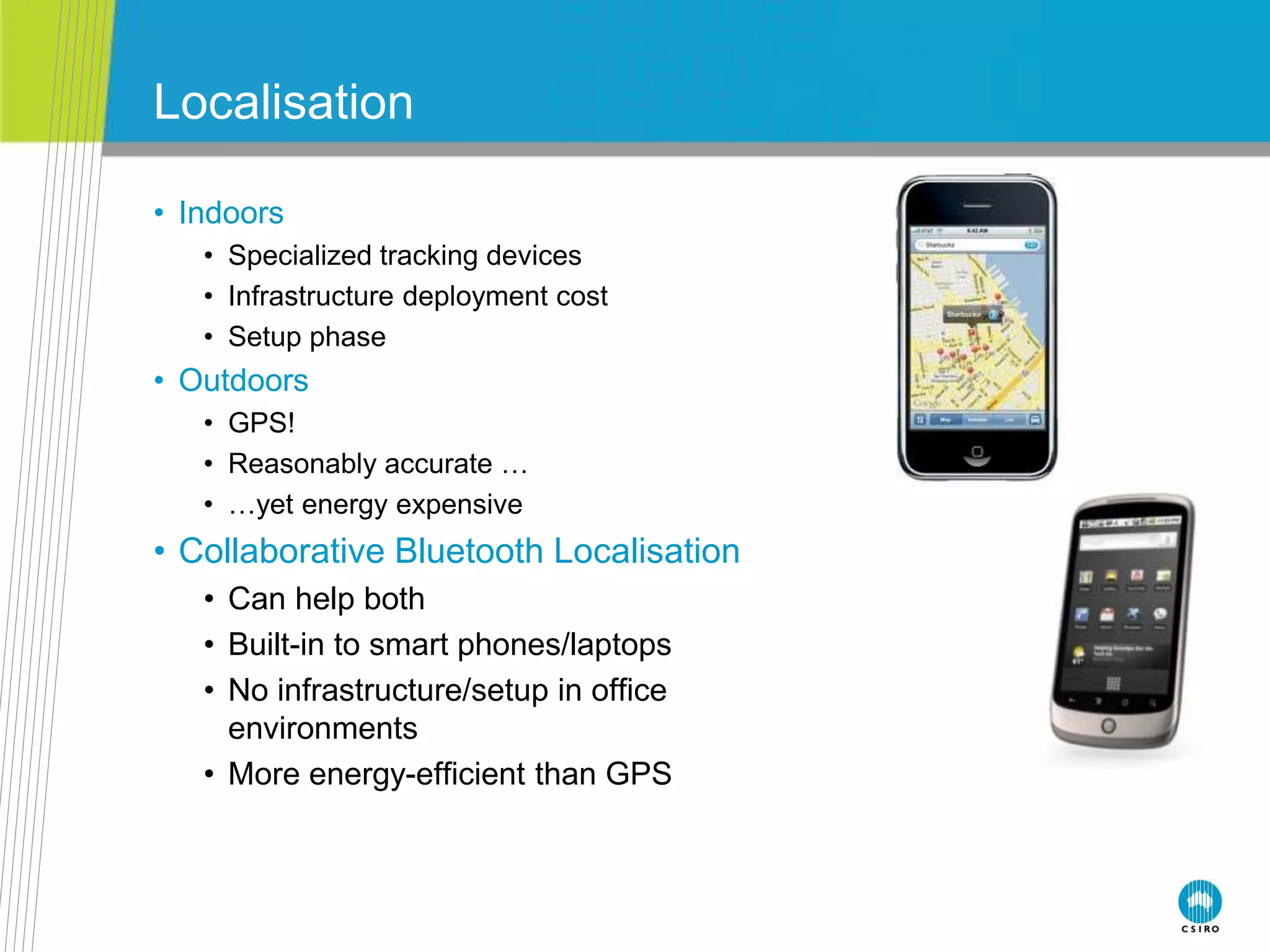
Localisation
• Indoors
• Specialized tracking devices
• Infrastructure deployment cost
• Setup phase
• Outdoors
• GPS!
• Reasonably accurate …
• …yet energy expensive
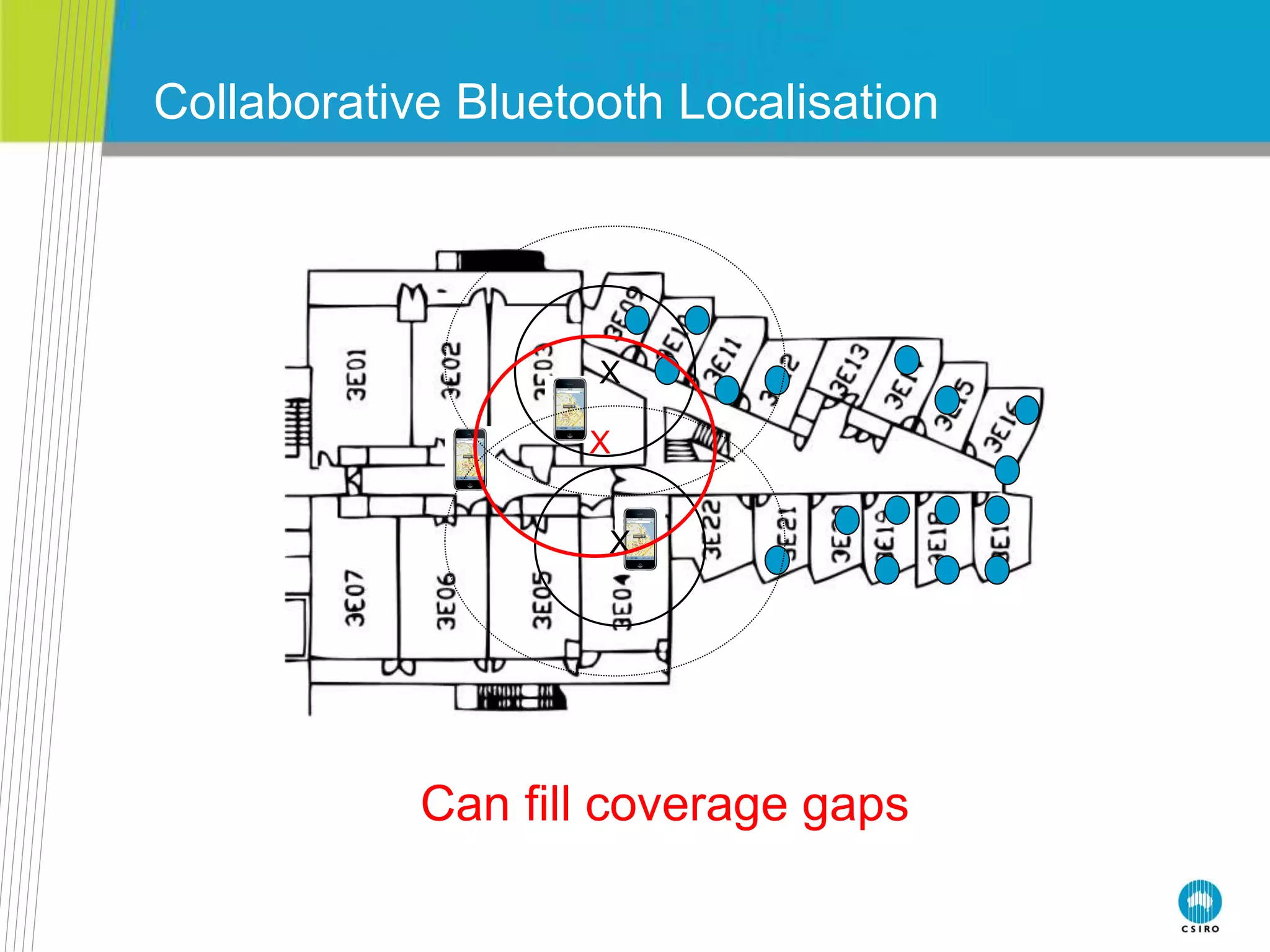
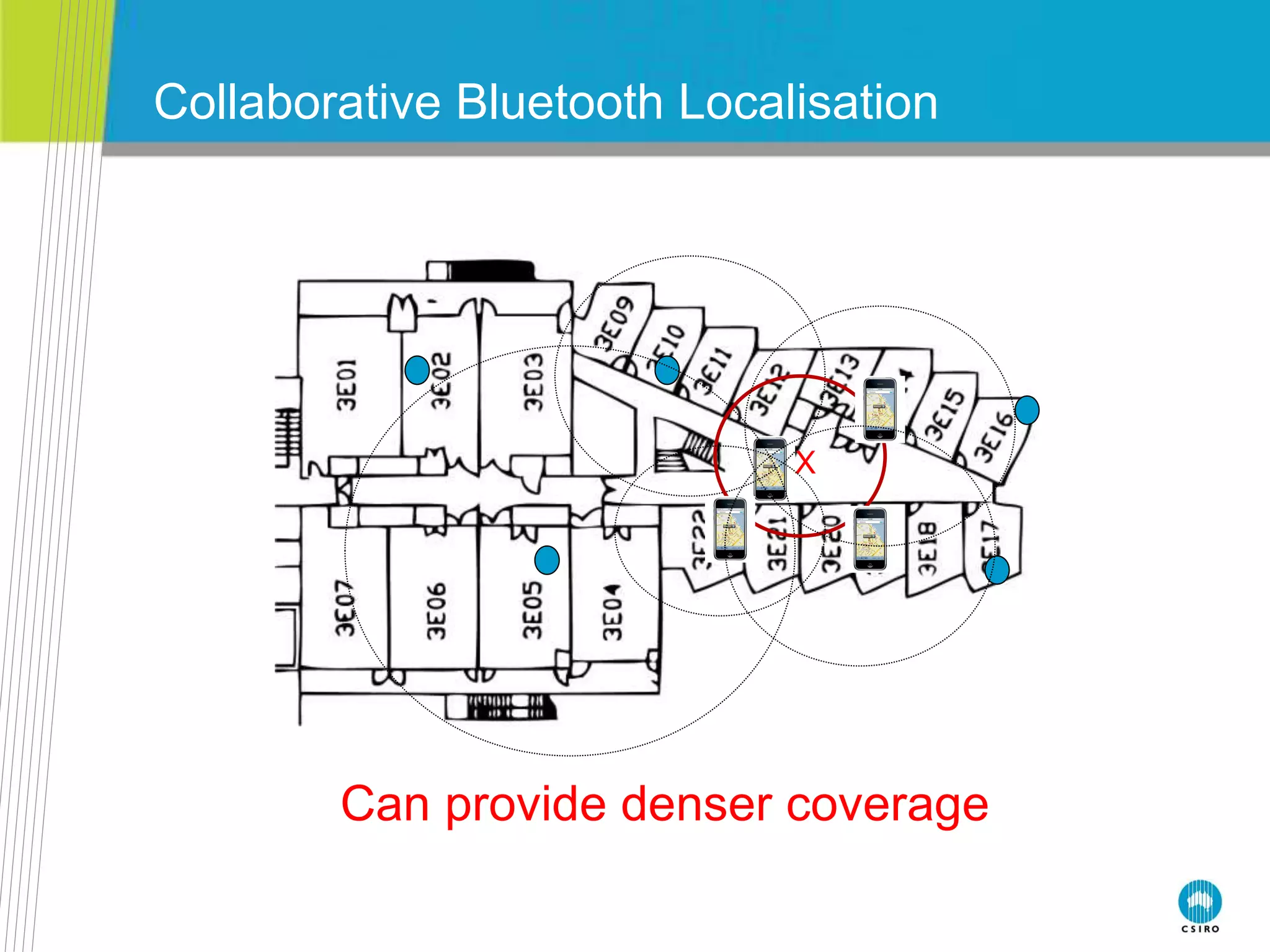
• Collaborative Bluetooth Localisation
• Can help both
• Built-in to smart phones/laptops
• No infrastructure/setup in office
environments
• More energy-efficient than GPS
• Problem
• Protocol imposes pairing/piconet association
• Solution
• Avoid expensive handshake
• Use friendly name to share location info – up to 248 characters
• Embed location info
• Indoors: coordinates
• Outdoors: GPS
• Problem
• Infrastructure setup
• Solution
• Use only existing infrastructure with bluetooth
• Laptops
• Desktops
• Use office directory to map names to locations
Bluetooth Localization Overview
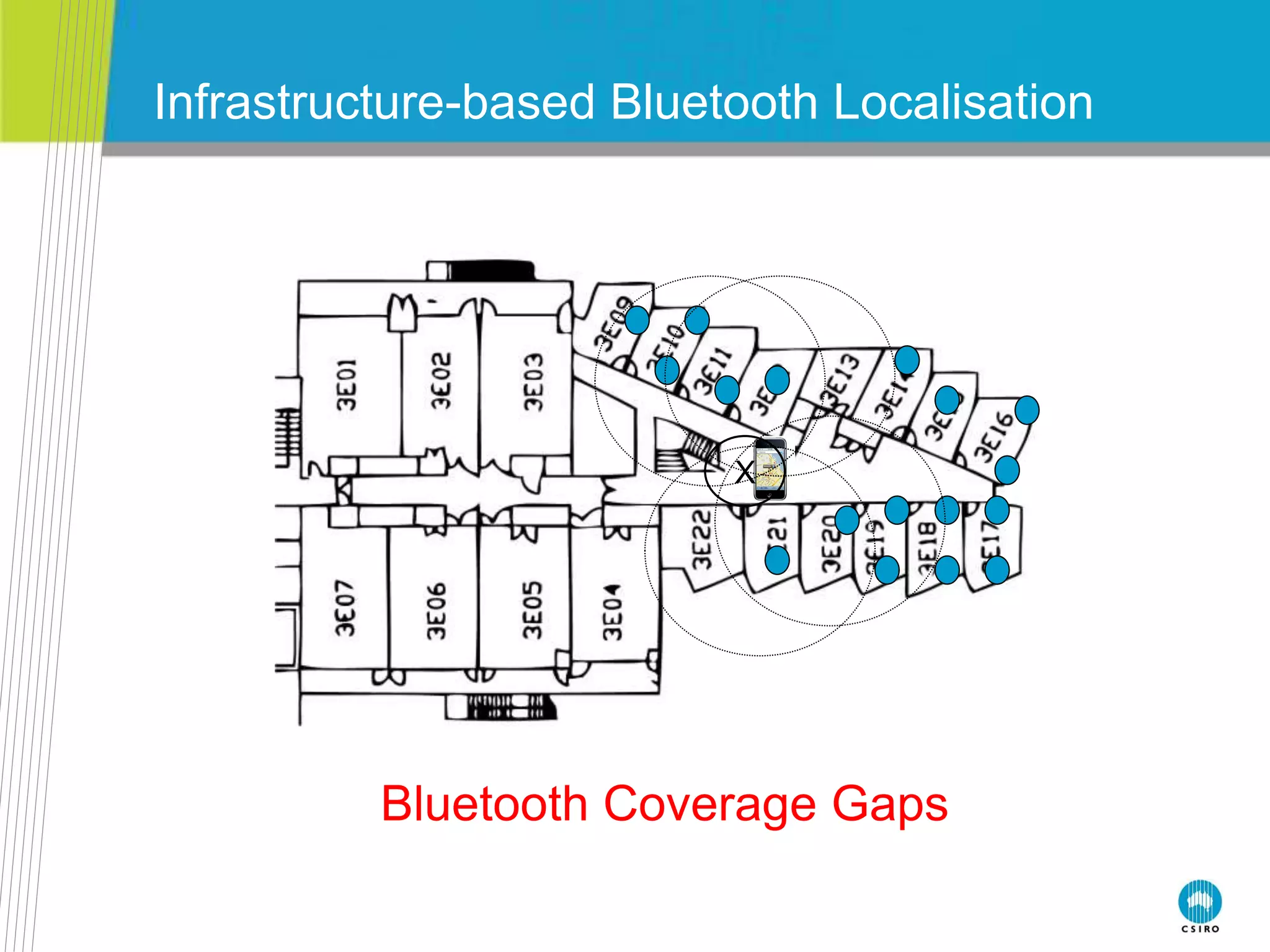
Infrastructure-based Bluetooth Localisation
X
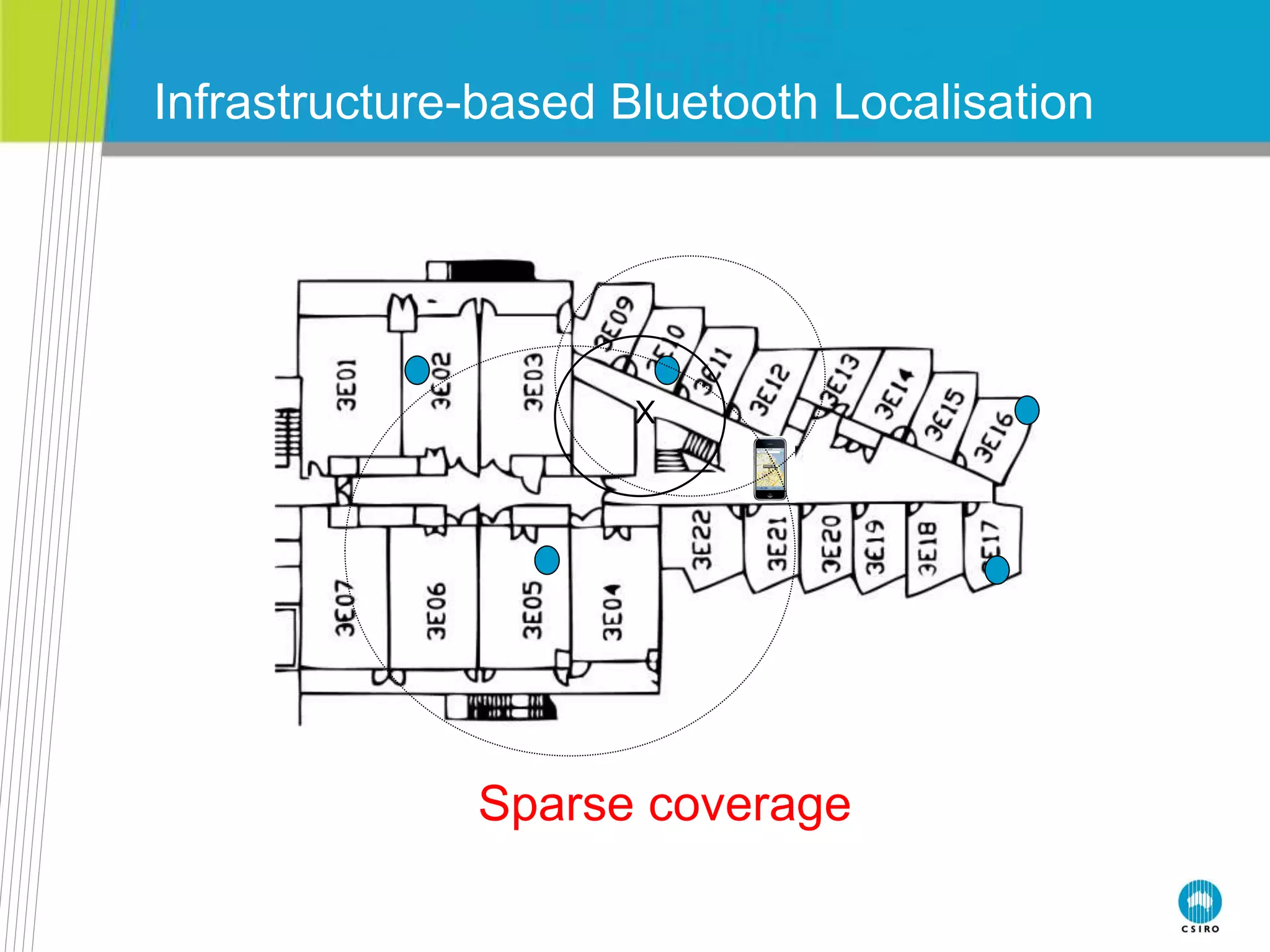
Bluetooth Coverage Gaps
Collaborative Bluetooth Localisation
Can fill coverage gaps
X
X
X
Infrastructure-based Bluetooth Localisation
X
Sparse coverage
Collaborative Bluetooth Localisation
X
Can provide denser coverage
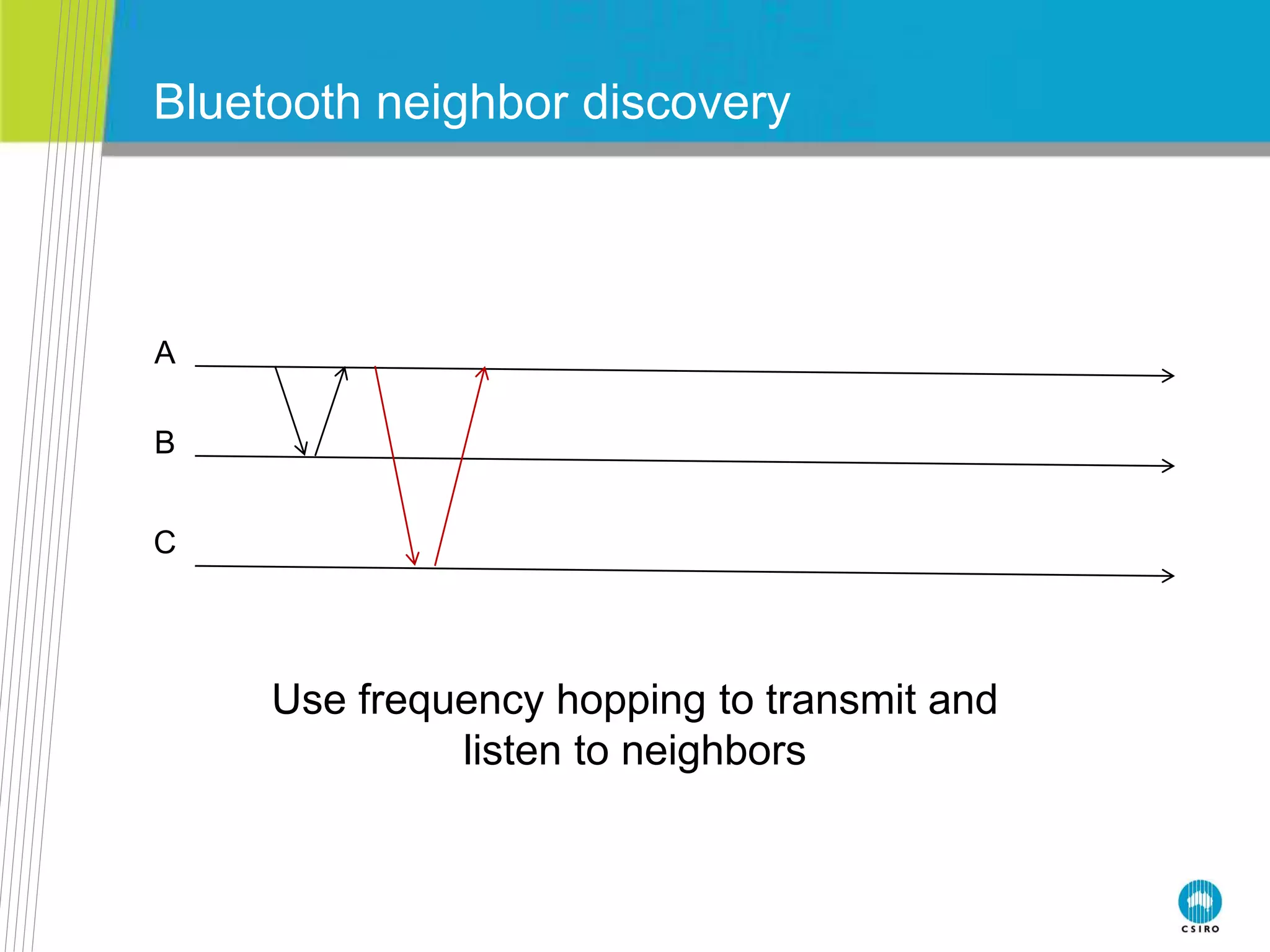
Bluetooth neighbor discovery
Use frequency hopping to transmit and
listen to neighbors
A
B
C
Bluetooth neighbor discovery
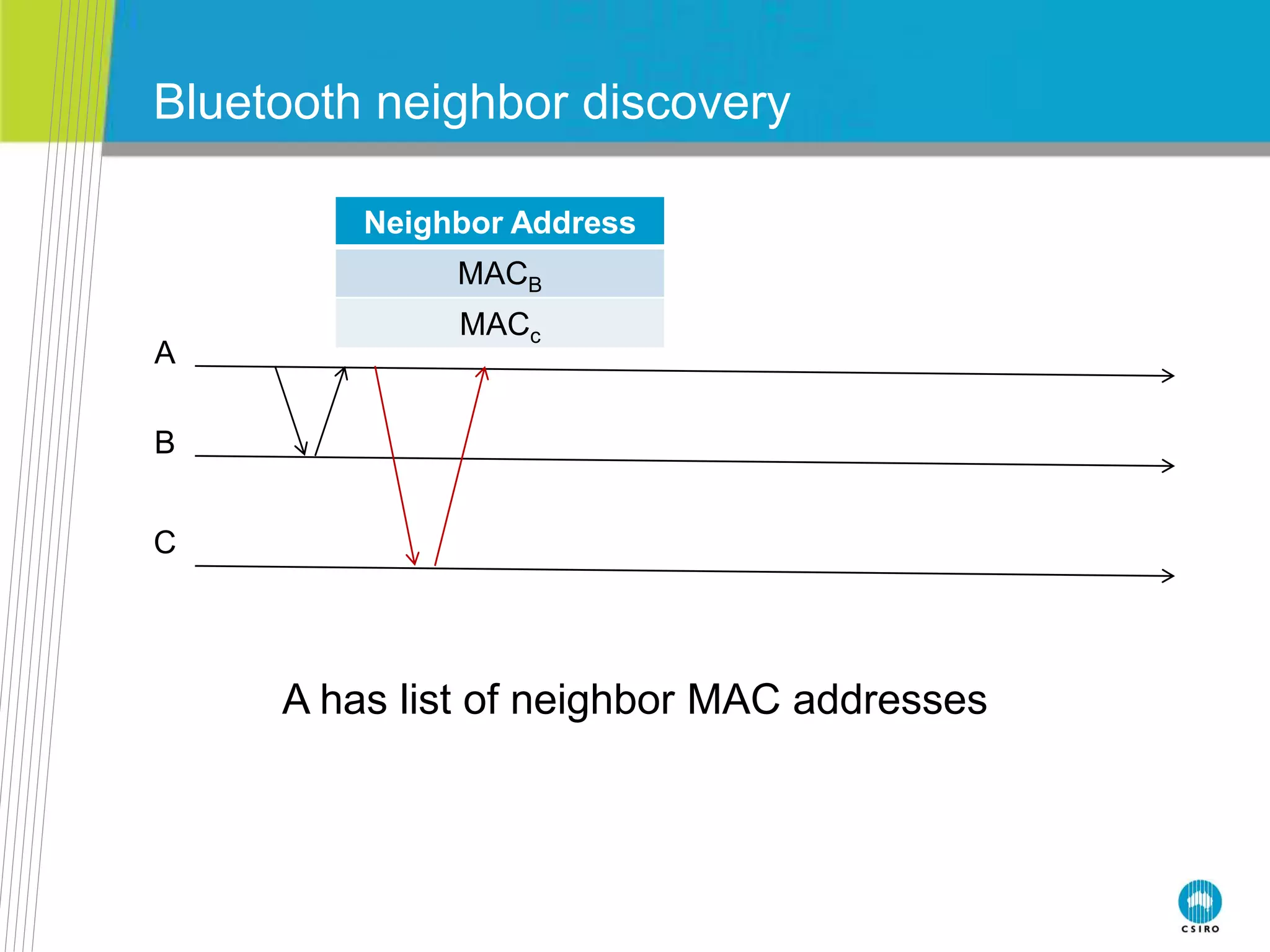
A has list of neighbor MAC addresses
A
B
C
Neighbor Address
MACB
MACc
Bluetooth neighbor discovery
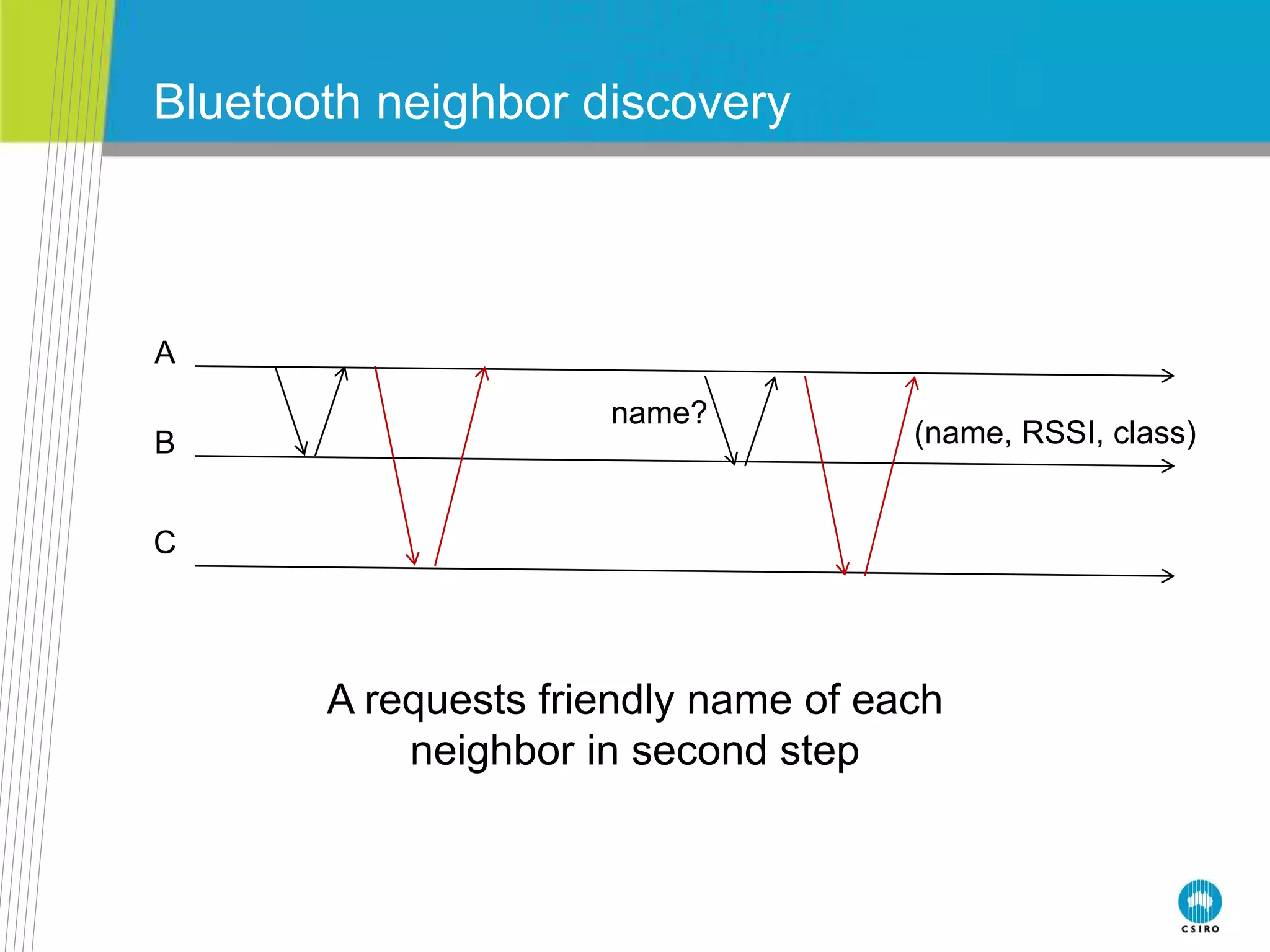
A requests friendly name of each
neighbor in second step
A
B
C
name?
(name, RSSI, class)
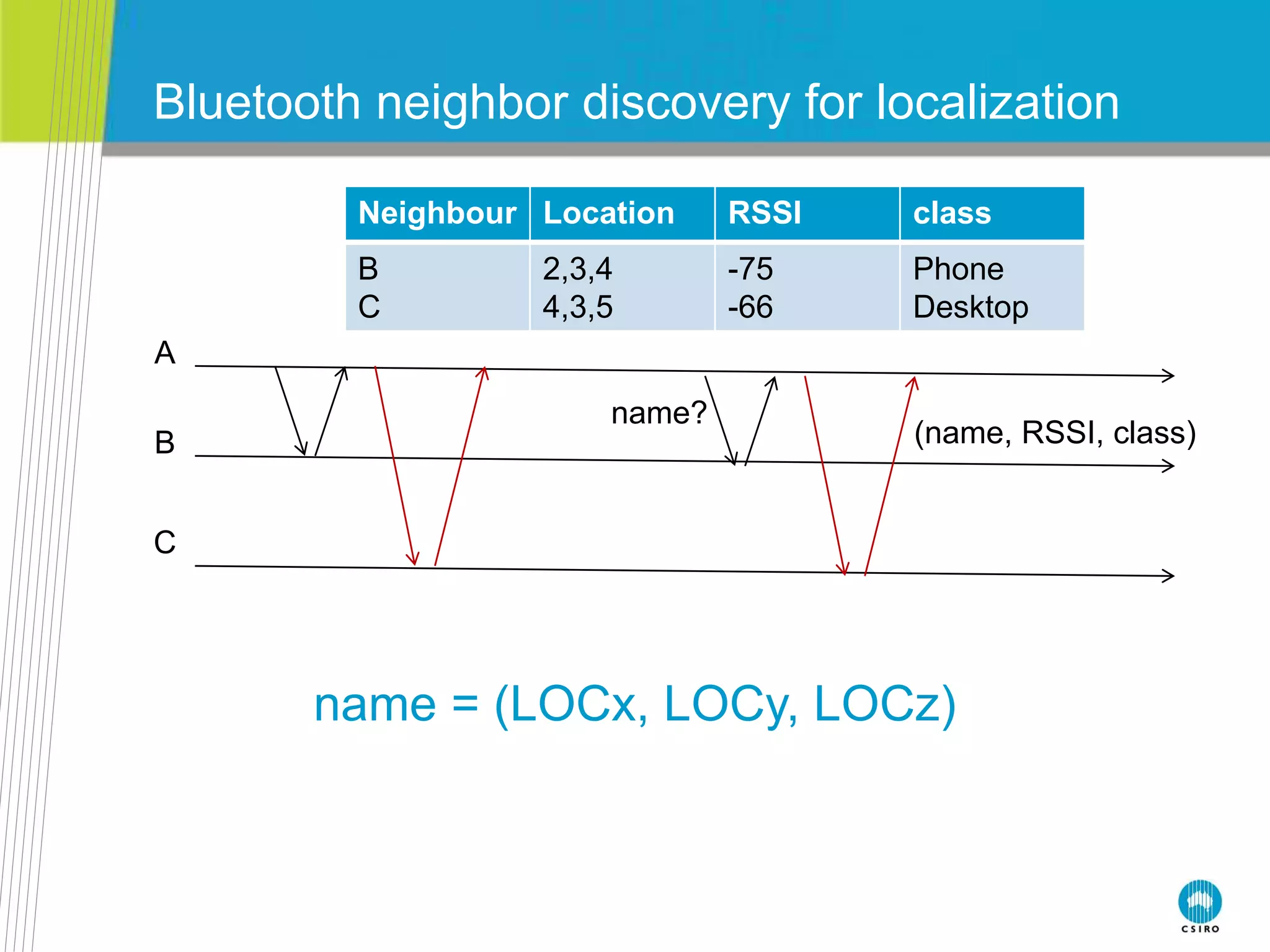
Bluetooth neighbor discovery for localization
name = (LOCx, LOCy, LOCz)
A
B
C
name?
(name, RSSI, class)
Neighbour Location RSSI class
B
C
2,3,4
4,3,5
-75
-66
Phone
Desktop
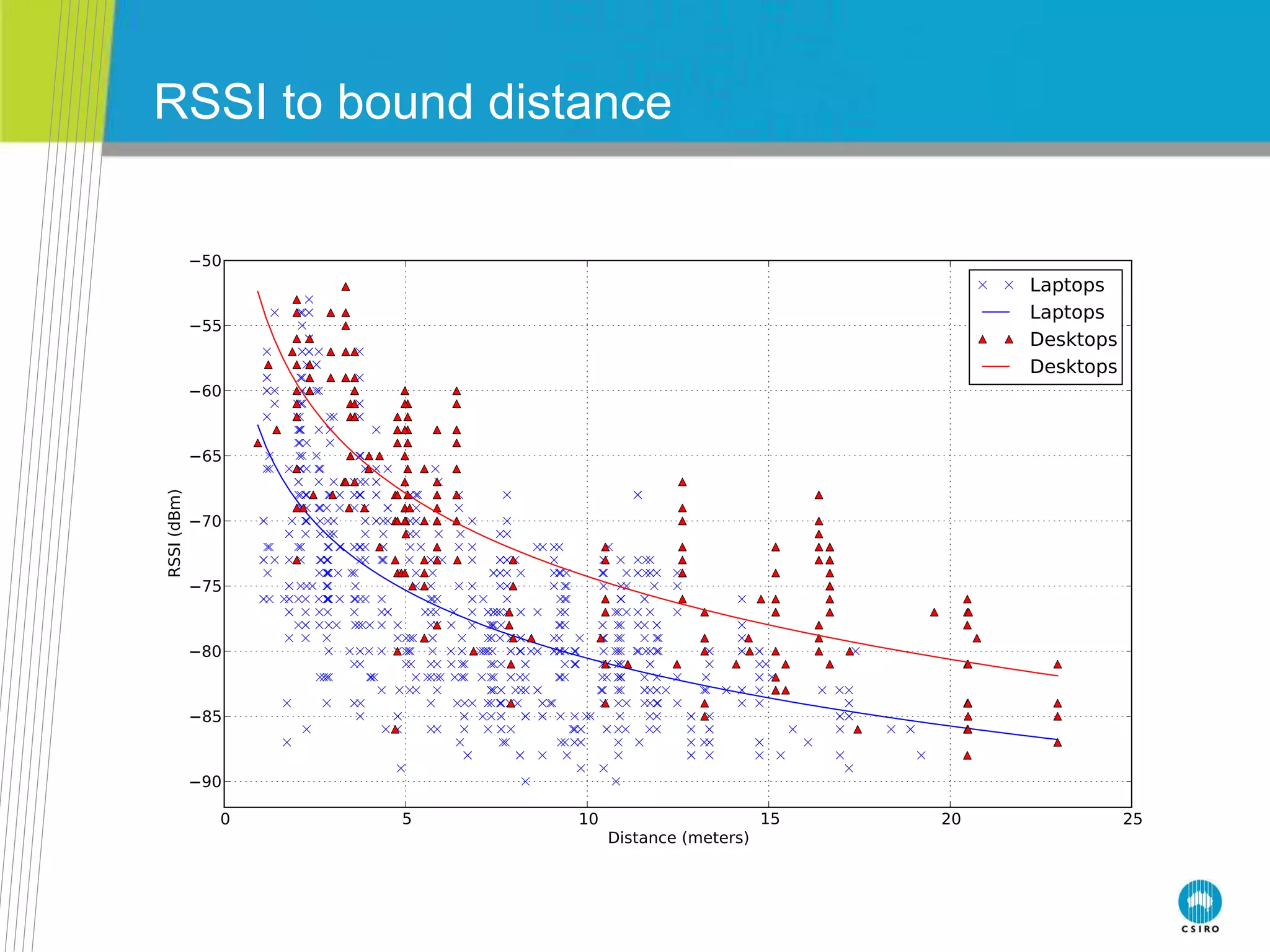
RSSI to bound distance
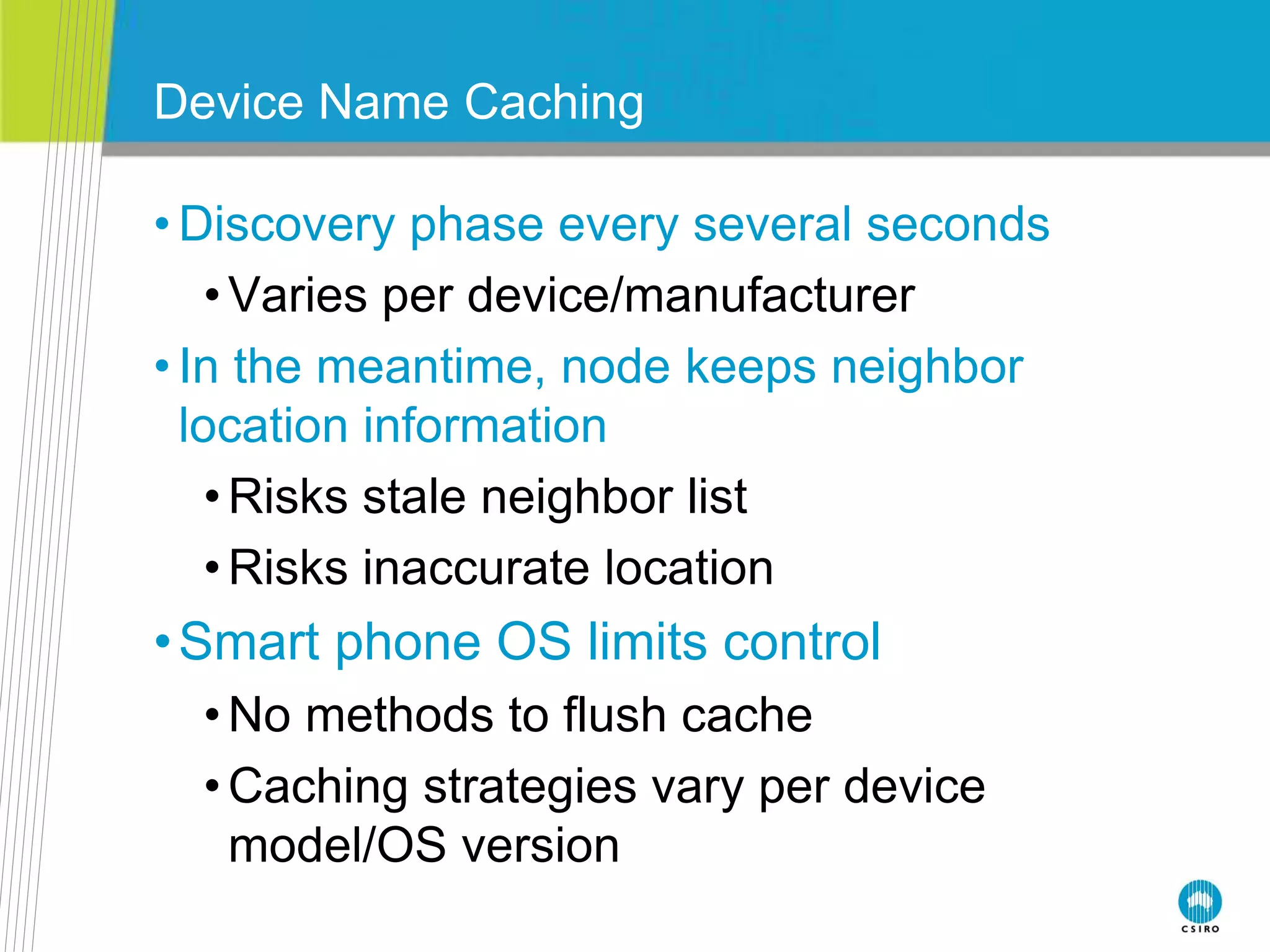
Device Name Caching
• Discovery phase every several seconds
•Varies per device/manufacturer
• In the meantime, node keeps neighbor
location information
•Risks stale neighbor list
•Risks inaccurate location
•Smart phone OS limits control
•No methods to flush cache
•Caching strategies vary per device
model/OS version
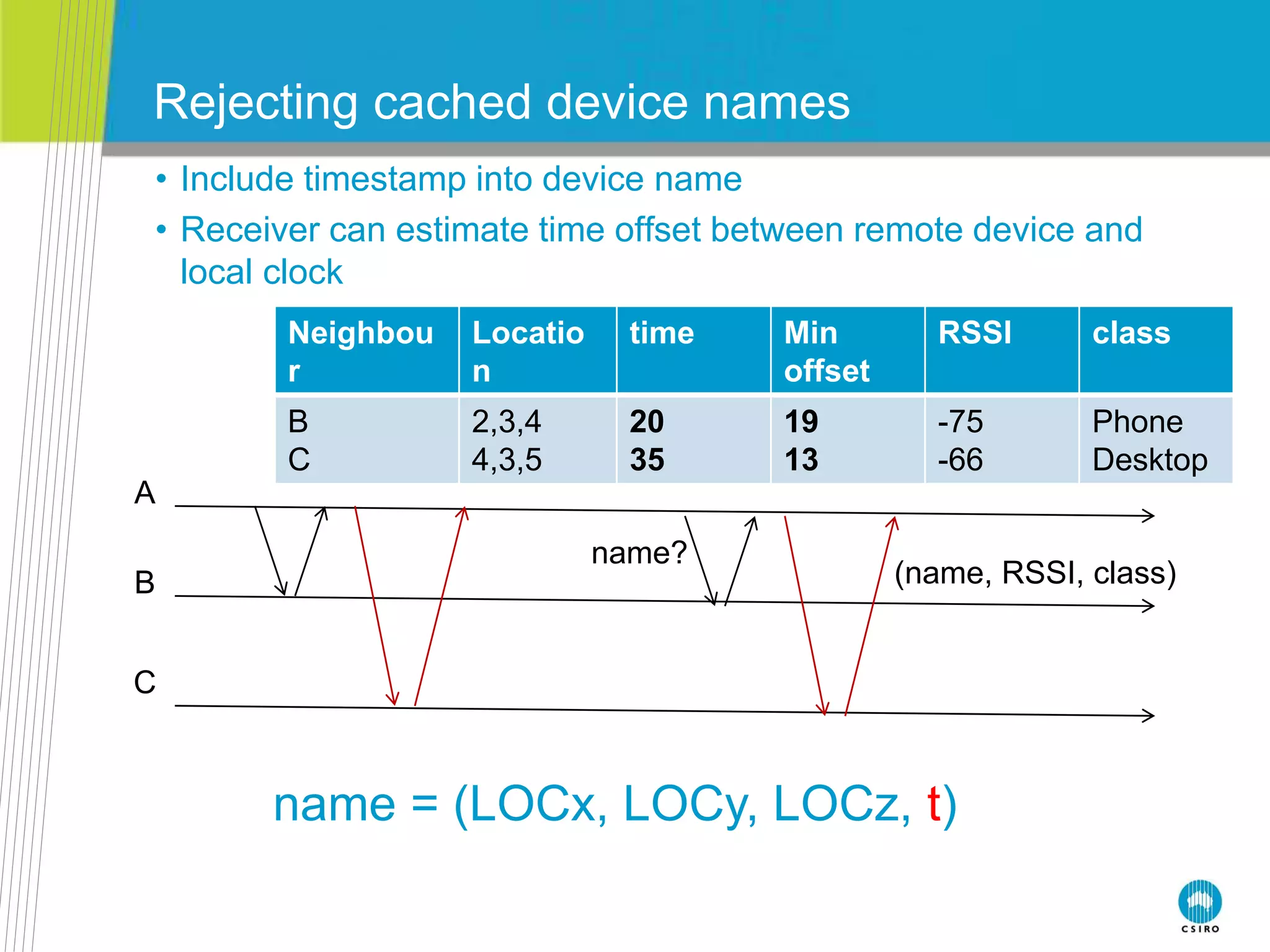
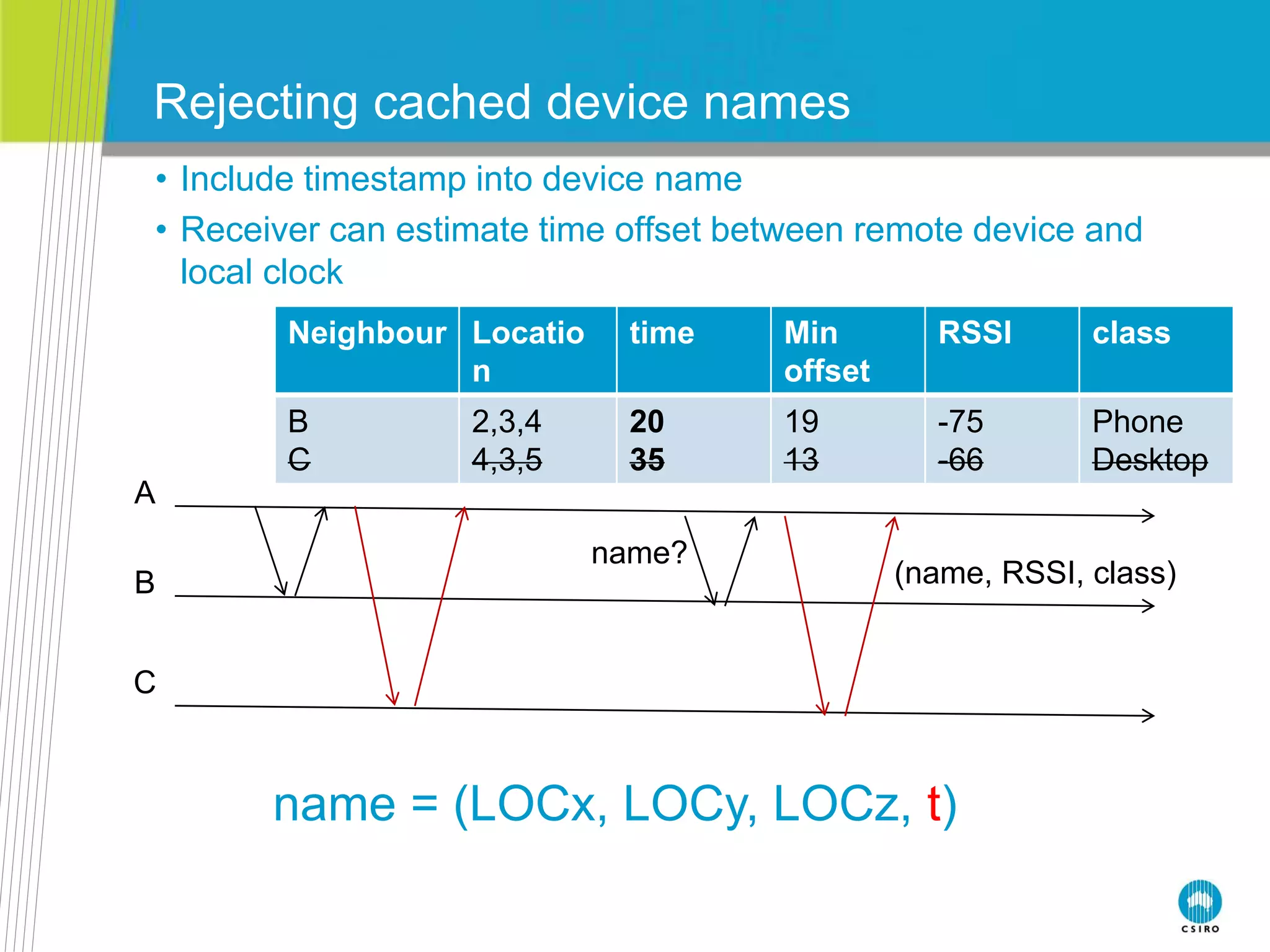
Rejecting cached device names
• Include timestamp into device name
• Receiver can estimate time offset between remote device and
local clock
name = (LOCx, LOCy, LOCz, t)
A
B
C
name?
(name, RSSI, class)
Neighbou
r
Locatio
n
time Min
offset
RSSI class
B
C
2,3,4
4,3,5
20
35
19
13
-75
-66
Phone
Desktop
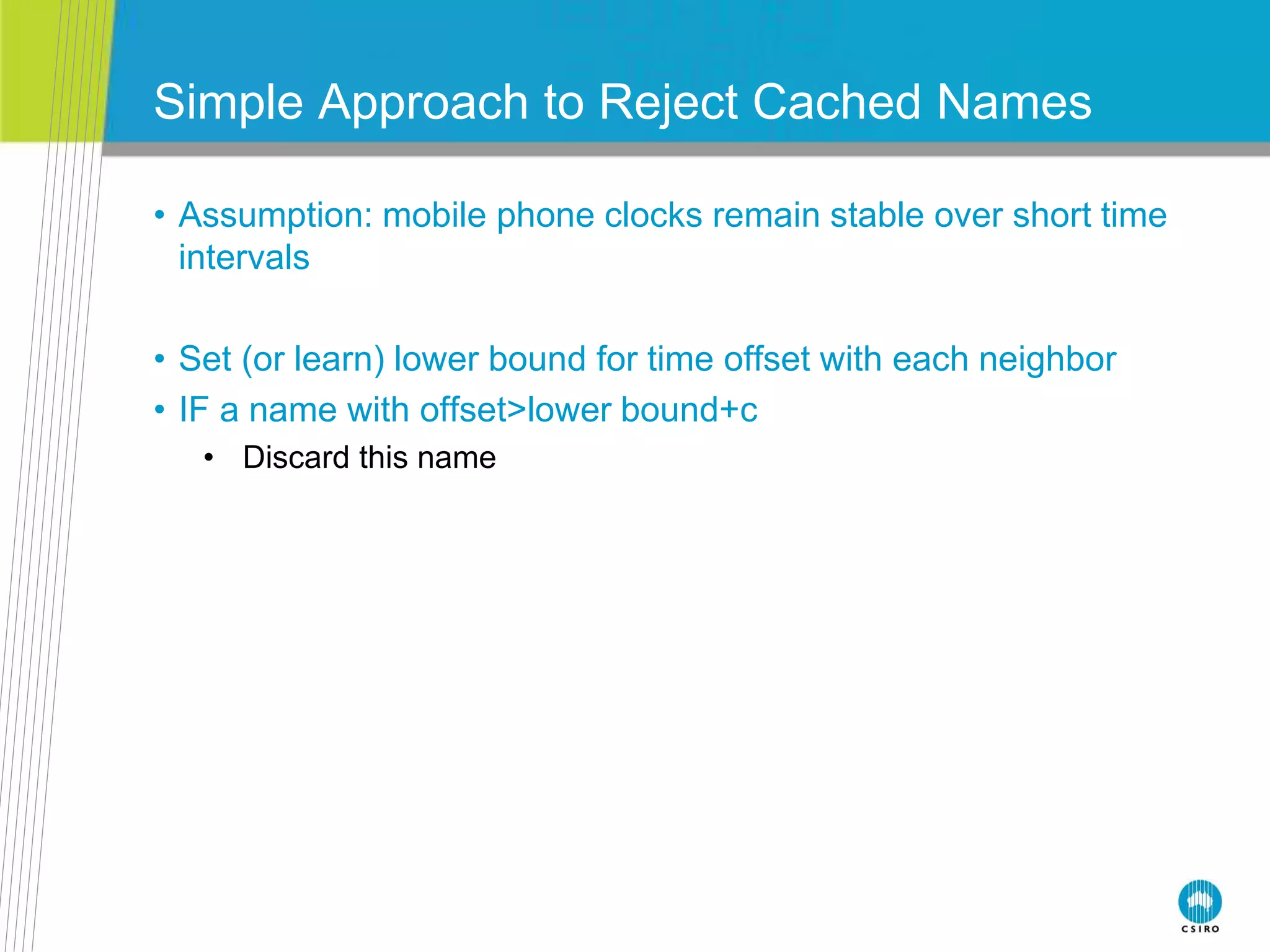
Simple Approach to Reject Cached Names
• Assumption: mobile phone clocks remain stable over short time
intervals
• Set (or learn) lower bound for time offset with each neighbor
• IF a name with offset>lower bound+c
• Discard this name
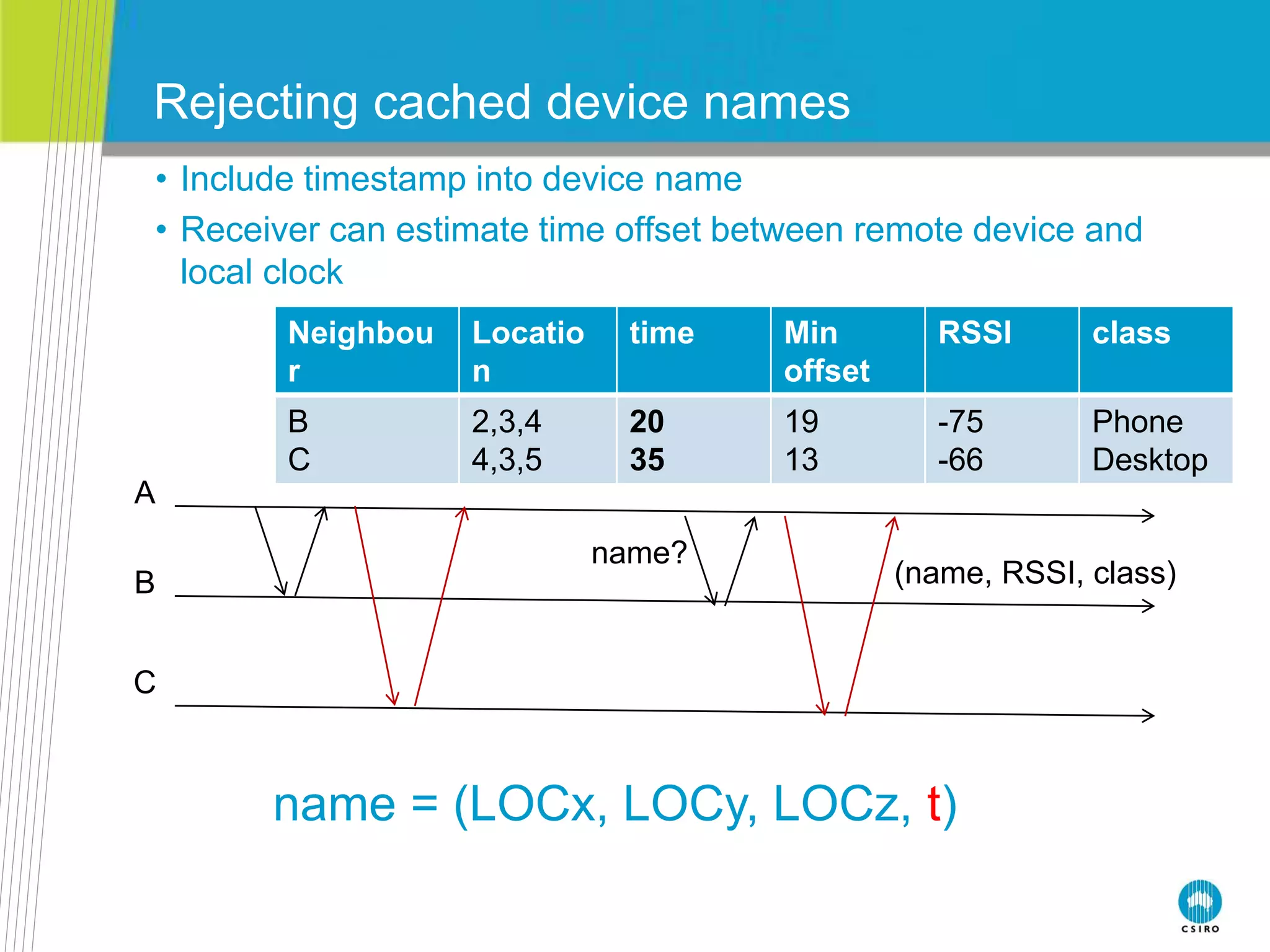
Rejecting cached device names
• Include timestamp into device name
• Receiver can estimate time offset between remote device and
local clock
name = (LOCx, LOCy, LOCz, t)
A
B
C
name?
(name, RSSI, class)
Neighbou
r
Locatio
n
time Min
offset
RSSI class
B
C
2,3,4
4,3,5
20
35
19
13
-75
-66
Phone
Desktop
Rejecting cached device names
• Include timestamp into device name
• Receiver can estimate time offset between remote device and
local clock
name = (LOCx, LOCy, LOCz, t)
A
B
C
name?
(name, RSSI, class)
Neighbour Locatio
n
time Min
offset
RSSI class
B
C
2,3,4
4,3,5
20
35
19
13
-75
-66
Phone
Desktop
Experiments
• 2 Samsung Nexus S phones
• Both running Android 2.3.3
• Both phones
• continuously update their Bluetooth device names once every
second with the current local time
• perform periodic Bluetooth device inquiries
• Local clocks of the devices are only loosely synchronized with a
clock offset of 9.5 seconds.
0 500 1000 1500 2000 2500 3000 3500
Time [s]
0
5
10
15
20
25
30
35
Time[s]
Time Difference Sender-Receiver
Lower Bound for Clock Offset
Latency Sender-Receiver (after Correction)
Summary
• Collaborative Bluetooth localization
• Indoors
• Fill coverage gaps
• Increase density
• Outdoors
• Saves on using GPS frequently
• Simple method to avoid device name caching
• Establish pairwise clock offsets
• Discard names that diverge from these offsets
• Open issues
• Learning and adapting pairwise offsets
• Bounding uncertainty with high mobility
• Versatile localization algorithms
Thank you
Thank you
Dr. Raja Jurdak
CSIRO ICT Centre
Principal Research Scientist
Research Group Leader
Phone: +61 (0)7 3327 4059
Email: raja.jurdak@csiro.au
Web: http://jurdak.com
University of Queensland
Adjunct Associate Professor

Towards Collaborative Localization of Mobile Users with Bluetooth

  • 1.
    Towards Collaborative Localizationof Mobile Users with Bluetooth Alexandre Barreira CSIRO ICT Centre, Brisbane, Australia Philipp Sommer Brano Kusy Raja Jurdak UTC/Georgia Tech.
  • 2.
    Localisation • Indoors • Specializedtracking devices • Infrastructure deployment cost • Setup phase • Outdoors • GPS! • Reasonably accurate … • …yet energy expensive • Collaborative Bluetooth Localisation • Can help both • Built-in to smart phones/laptops • No infrastructure/setup in office environments • More energy-efficient than GPS
  • 3.
    • Problem • Protocolimposes pairing/piconet association • Solution • Avoid expensive handshake • Use friendly name to share location info – up to 248 characters • Embed location info • Indoors: coordinates • Outdoors: GPS • Problem • Infrastructure setup • Solution • Use only existing infrastructure with bluetooth • Laptops • Desktops • Use office directory to map names to locations Bluetooth Localization Overview
  • 4.
  • 5.
  • 6.
  • 7.
  • 8.
    Bluetooth neighbor discovery Usefrequency hopping to transmit and listen to neighbors A B C
  • 9.
    Bluetooth neighbor discovery Ahas list of neighbor MAC addresses A B C Neighbor Address MACB MACc
  • 10.
    Bluetooth neighbor discovery Arequests friendly name of each neighbor in second step A B C name? (name, RSSI, class)
  • 11.
    Bluetooth neighbor discoveryfor localization name = (LOCx, LOCy, LOCz) A B C name? (name, RSSI, class) Neighbour Location RSSI class B C 2,3,4 4,3,5 -75 -66 Phone Desktop
  • 12.
    RSSI to bounddistance
  • 13.
    Device Name Caching •Discovery phase every several seconds •Varies per device/manufacturer • In the meantime, node keeps neighbor location information •Risks stale neighbor list •Risks inaccurate location •Smart phone OS limits control •No methods to flush cache •Caching strategies vary per device model/OS version
  • 14.
    Rejecting cached devicenames • Include timestamp into device name • Receiver can estimate time offset between remote device and local clock name = (LOCx, LOCy, LOCz, t) A B C name? (name, RSSI, class) Neighbou r Locatio n time Min offset RSSI class B C 2,3,4 4,3,5 20 35 19 13 -75 -66 Phone Desktop
  • 15.
    Simple Approach toReject Cached Names • Assumption: mobile phone clocks remain stable over short time intervals • Set (or learn) lower bound for time offset with each neighbor • IF a name with offset>lower bound+c • Discard this name
  • 16.
    Rejecting cached devicenames • Include timestamp into device name • Receiver can estimate time offset between remote device and local clock name = (LOCx, LOCy, LOCz, t) A B C name? (name, RSSI, class) Neighbou r Locatio n time Min offset RSSI class B C 2,3,4 4,3,5 20 35 19 13 -75 -66 Phone Desktop
  • 17.
    Rejecting cached devicenames • Include timestamp into device name • Receiver can estimate time offset between remote device and local clock name = (LOCx, LOCy, LOCz, t) A B C name? (name, RSSI, class) Neighbour Locatio n time Min offset RSSI class B C 2,3,4 4,3,5 20 35 19 13 -75 -66 Phone Desktop
  • 18.
    Experiments • 2 SamsungNexus S phones • Both running Android 2.3.3 • Both phones • continuously update their Bluetooth device names once every second with the current local time • perform periodic Bluetooth device inquiries • Local clocks of the devices are only loosely synchronized with a clock offset of 9.5 seconds. 0 500 1000 1500 2000 2500 3000 3500 Time [s] 0 5 10 15 20 25 30 35 Time[s] Time Difference Sender-Receiver Lower Bound for Clock Offset Latency Sender-Receiver (after Correction)
  • 20.
    Summary • Collaborative Bluetoothlocalization • Indoors • Fill coverage gaps • Increase density • Outdoors • Saves on using GPS frequently • Simple method to avoid device name caching • Establish pairwise clock offsets • Discard names that diverge from these offsets • Open issues • Learning and adapting pairwise offsets • Bounding uncertainty with high mobility • Versatile localization algorithms
  • 21.
    Thank you Thank you Dr.Raja Jurdak CSIRO ICT Centre Principal Research Scientist Research Group Leader Phone: +61 (0)7 3327 4059 Email: raja.jurdak@csiro.au Web: http://jurdak.com University of Queensland Adjunct Associate Professor

Editor's Notes

  • #3 Although several other GP frameworks are available for the Java platform, none is suitable for Android because Android replaces several subsets of Java class libraries from the JavaSE with its own new classes.