


Adding structure around 
Exploratory Test ing 
Qu a l i Te s t
What is Exploratory Testing? 
ET Vs Scripted testing
Scripted Testing Defined 
• Dividing test design from the test execution. 
• Commonly includes detailed documentation with 
instructions of how to test. 
• Suppresses thinking out of test execution. 
• Step by step instructions with a pass/fail criteria based on 
set of expected results. 
• Commonly utilizes different resources for test design and 
execution. 
• Considered by some to be the only “correct” software 
testing method. 
• Can be both manual or automated
Issues with Scripted Testing 
• Does not allow the testing team to take advantage of the learning 
in the process 
• Assumes the product is “locked down”. 
• Encourages conformity, not thinking 
• Requires lots of planning and documentation. 
• Leads to bugs being found later in the process 
• Less likely to find the most important and complex bugs. 
• Inattentional Blindness - focusing attention on some aspects of the 
system which lead to not focusing on other parts. 
• Prevent good test coverage when done to an extreme 
• Can be boring for the tester.
ET explained 
• Learn, Design & execute - combine learning about the 
software, the test design and the test execution into a 
continues self feeding process. 
• Spend more of your tester’s time on core testing activities 
• Can provide detailed test execution documentation and 
metrics. 
• Manageable and auditable 
• systematic and teachable 
• Assumes testers are smart people, not robots – testing, not 
just checking. Testers are in control not the test script. 
• Partially being done at AMEX but probably not very well
Benefits of ET 
• More bugs found. 
• Bugs are found earlier. 
• More time spent testing, testing can start earlier. 
• Not prone to “Inattentional blindness” 
• Utilizes tester capabilities and promotes motivation in 
the testing team. 
• Very flexible
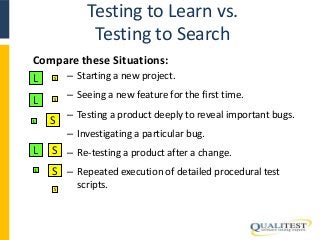
Testing to Learn vs. 
Testing to Search 
Compare these Situations: 
– Starting a new project. 
– Seeing a new feature for the first time. 
– Testing a product deeply to reveal important bugs. 
– Investigating a particular bug. 
– Re-testing a product after a change. 
– Repeated execution of detailed procedural test 
scripts. 
L 
L 
L 
L 
S 
S 
S 
S 
L 
S 
S
Technique vs. Approach 
• A technique is a specific method that is used 
to accomplish a specific goal. 
• An approach is the overall manner in which 
you act. 
• Exploratory Testing is an approach 
• All test techniques (i.e. manual, functional) 
can be done in either an exploratory or non-exploratory 
way.
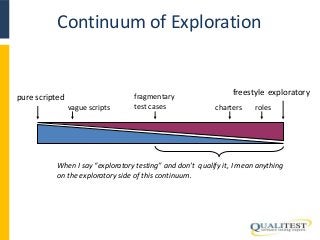
Continuum of Exploration 
pure scripted 
freestyle exploratory 
fragmentary 
test cases roles 
vague scripts charters 
When I say “exploratory testing” and don’t qualify it, I mean anything 
on the exploratory side of this continuum.
History of ET 
• Term was coined by Cem Kaner in 1983 in his book Testing 
Computer Software “Trust your instincts” 
• Updated description by James Bach: “Exploratory testing is 
simultaneous learning, test design, and test execution, 
with an emphasis on learning” 
• Exploratory testing was further developed by James Bach 
in the 90s to include many applications which allow for ET 
to be managed and audited. 
• Learning is the key difference between exploratory testing 
and scripted testing.
Session Based Test Management 
(SBTM) 
• A management technique specifically for ET 
• Developed by James Bach 
• Insures high accountability from the testing team 
• Session Report 
– Gather basic information about the test session. 
– Brief summaries of hypothesis and tests. 
– Notes, Bugs and issues 
• Keeps track of certain metrics from the test session. 
– Percentage of time spent on charter vs. off-charter (a.k.a. test 
opportunity). 
– Division of time between setup, testing, bug hunting, and bug reporting.
Implementation of ET 
• Test Mission and Test Charters 
• Test Sessions 
• Test Heuristics
Test Mission 
• Fundamental motivation for the test. 
• Why am I testing this? 
• All team members must understand and 
appreciate the test mission.
Test Charters 
• The test mission is broken down into 
actionable units called test charters. 
• They are the theories you are trying to prove 
by testing and the general guide for your test 
exploration. 
• Should be moderately specific. 
• Can be feature driver, component driven, or 
test driven.
Test Sessions 
• Period of uninterrupted time where test exploration 
occurs. 
• Generally lasts 1-2 hours. 
• Can be done individually or in pairs. 
• Goal is to work on one test charter per session. 
• Automated test session recording – screen recording, 
screen shots, Virtuology… 
• Recording and notating the test session is 
recommended 
• Notes, Bugs and issues
Test Heuristics 
• A heuristics is a fallible method for solving a 
problem. 
• Provides structure to skill. 
• ET is based on heavy use of heuristics for the 
learning cycle in testing
For more information 
Visit the QualiTest website: 
www.QualiTestGroup.com 
Contact QualiTest 
1-877-882-9540 
or look for QualiTest on:
Thank You! 
w w w . Q u a l i Te s t G r o u p . c o m

What is Exploratory Testing

  • 1.
    Adding structure around Exploratory Test ing Qu a l i Te s t
  • 2.
    What is ExploratoryTesting? ET Vs Scripted testing
  • 3.
    Scripted Testing Defined • Dividing test design from the test execution. • Commonly includes detailed documentation with instructions of how to test. • Suppresses thinking out of test execution. • Step by step instructions with a pass/fail criteria based on set of expected results. • Commonly utilizes different resources for test design and execution. • Considered by some to be the only “correct” software testing method. • Can be both manual or automated
  • 4.
    Issues with ScriptedTesting • Does not allow the testing team to take advantage of the learning in the process • Assumes the product is “locked down”. • Encourages conformity, not thinking • Requires lots of planning and documentation. • Leads to bugs being found later in the process • Less likely to find the most important and complex bugs. • Inattentional Blindness - focusing attention on some aspects of the system which lead to not focusing on other parts. • Prevent good test coverage when done to an extreme • Can be boring for the tester.
  • 5.
    ET explained •Learn, Design & execute - combine learning about the software, the test design and the test execution into a continues self feeding process. • Spend more of your tester’s time on core testing activities • Can provide detailed test execution documentation and metrics. • Manageable and auditable • systematic and teachable • Assumes testers are smart people, not robots – testing, not just checking. Testers are in control not the test script. • Partially being done at AMEX but probably not very well
  • 6.
    Benefits of ET • More bugs found. • Bugs are found earlier. • More time spent testing, testing can start earlier. • Not prone to “Inattentional blindness” • Utilizes tester capabilities and promotes motivation in the testing team. • Very flexible
  • 7.
    Testing to Learnvs. Testing to Search Compare these Situations: – Starting a new project. – Seeing a new feature for the first time. – Testing a product deeply to reveal important bugs. – Investigating a particular bug. – Re-testing a product after a change. – Repeated execution of detailed procedural test scripts. L L L L S S S S L S S
  • 8.
    Technique vs. Approach • A technique is a specific method that is used to accomplish a specific goal. • An approach is the overall manner in which you act. • Exploratory Testing is an approach • All test techniques (i.e. manual, functional) can be done in either an exploratory or non-exploratory way.
  • 9.
    Continuum of Exploration pure scripted freestyle exploratory fragmentary test cases roles vague scripts charters When I say “exploratory testing” and don’t qualify it, I mean anything on the exploratory side of this continuum.
  • 10.
    History of ET • Term was coined by Cem Kaner in 1983 in his book Testing Computer Software “Trust your instincts” • Updated description by James Bach: “Exploratory testing is simultaneous learning, test design, and test execution, with an emphasis on learning” • Exploratory testing was further developed by James Bach in the 90s to include many applications which allow for ET to be managed and audited. • Learning is the key difference between exploratory testing and scripted testing.
  • 11.
    Session Based TestManagement (SBTM) • A management technique specifically for ET • Developed by James Bach • Insures high accountability from the testing team • Session Report – Gather basic information about the test session. – Brief summaries of hypothesis and tests. – Notes, Bugs and issues • Keeps track of certain metrics from the test session. – Percentage of time spent on charter vs. off-charter (a.k.a. test opportunity). – Division of time between setup, testing, bug hunting, and bug reporting.
  • 12.
    Implementation of ET • Test Mission and Test Charters • Test Sessions • Test Heuristics
  • 13.
    Test Mission •Fundamental motivation for the test. • Why am I testing this? • All team members must understand and appreciate the test mission.
  • 14.
    Test Charters •The test mission is broken down into actionable units called test charters. • They are the theories you are trying to prove by testing and the general guide for your test exploration. • Should be moderately specific. • Can be feature driver, component driven, or test driven.
  • 15.
    Test Sessions •Period of uninterrupted time where test exploration occurs. • Generally lasts 1-2 hours. • Can be done individually or in pairs. • Goal is to work on one test charter per session. • Automated test session recording – screen recording, screen shots, Virtuology… • Recording and notating the test session is recommended • Notes, Bugs and issues
  • 16.
    Test Heuristics •A heuristics is a fallible method for solving a problem. • Provides structure to skill. • ET is based on heavy use of heuristics for the learning cycle in testing
  • 17.
    For more information Visit the QualiTest website: www.QualiTestGroup.com Contact QualiTest 1-877-882-9540 or look for QualiTest on:
  • 18.
    Thank You! ww w . Q u a l i Te s t G r o u p . c o m