Welcome
       to
www.TCYonline.com
PROFIT
  &
 LOSS
Basic Terms

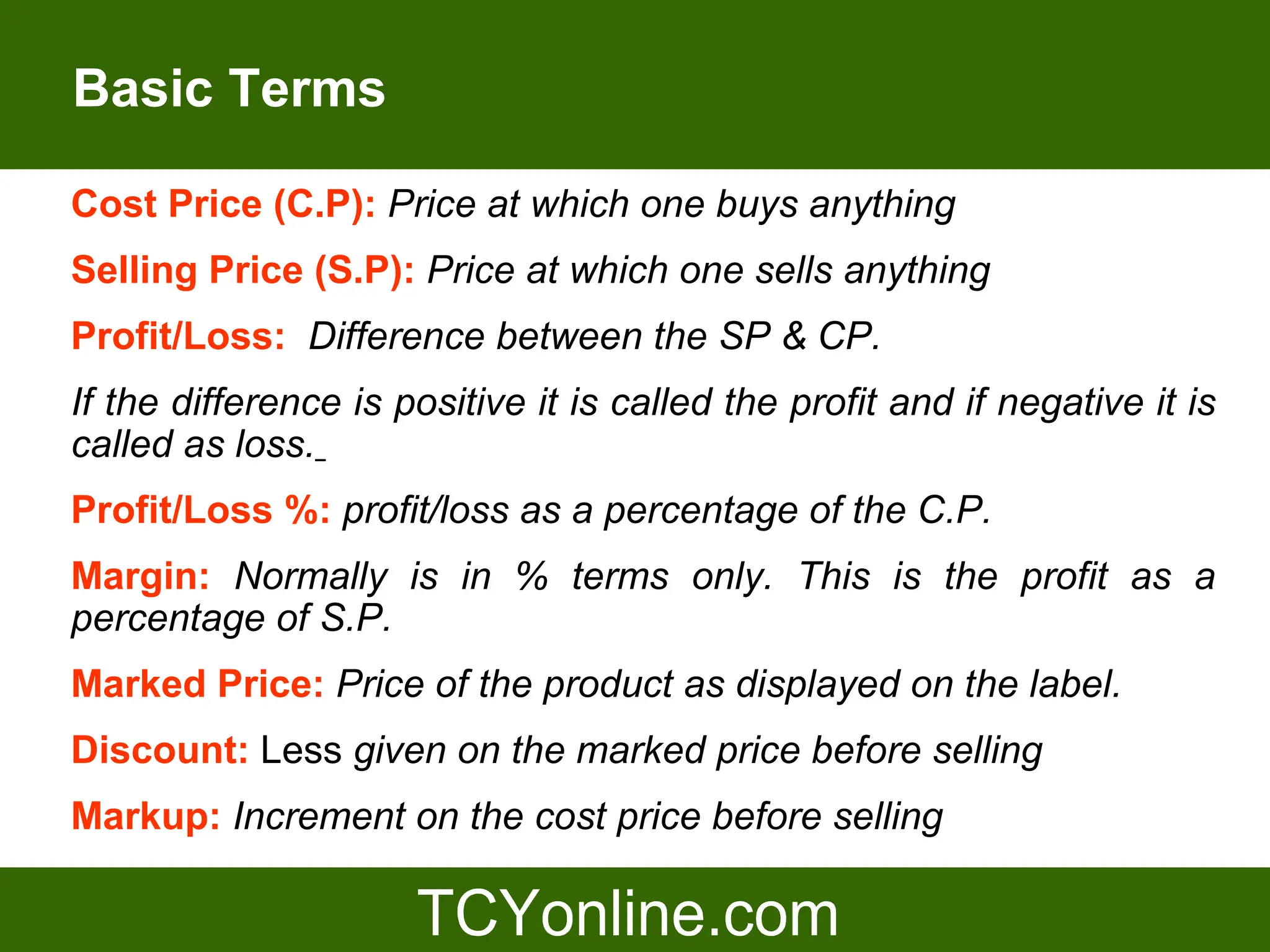
Cost Price (C.P): Price at which one buys anything
Selling Price (S.P): Price at which one sells anything
Profit/Loss: Difference between the SP & CP.
If the difference is positive it is called the profit and if negative it is
called as loss.
Profit/Loss %: profit/loss as a percentage of the C.P.
Margin: Normally is in % terms only. This is the profit as a
percentage of S.P.
Marked Price: Price of the product as displayed on the label.
Discount: Less given on the marked price before selling
Markup: Increment on the cost price before selling
Formulae

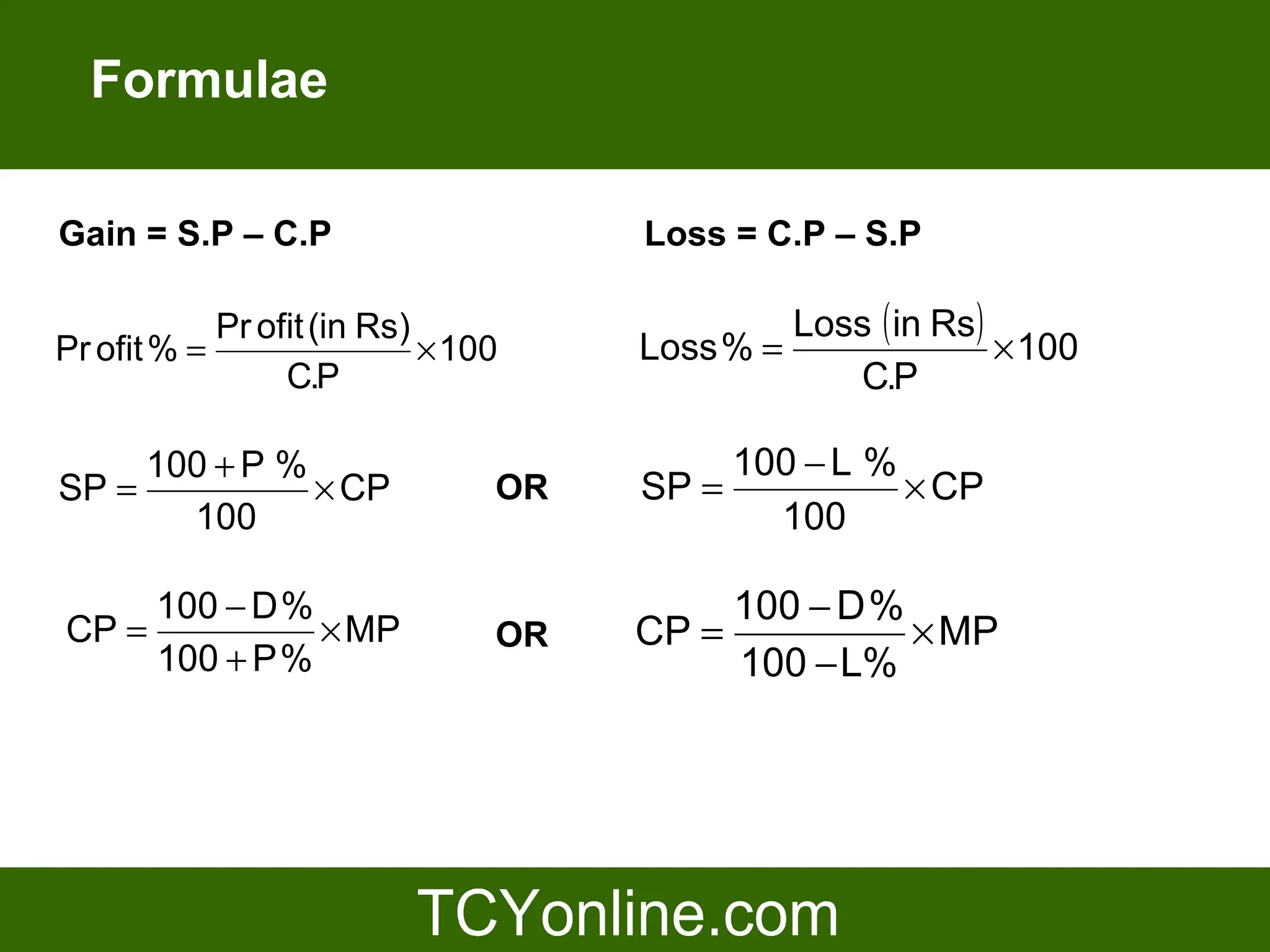
Gain = S.P – C.P                     Loss = C.P – S.P

            Pr ofit (in Rs)                   Loss ( in Rs)
Pr ofit % =                 × 100    Loss % =               × 100
                 C.P                             C.P

       100 + P %                            100 − L %
SP =             × CP           OR   SP =             × CP
         100                                  100

     100 − D %                            100 − D %
CP =           × MP             OR   CP =           × MP
     100 + P %                            100 − L%
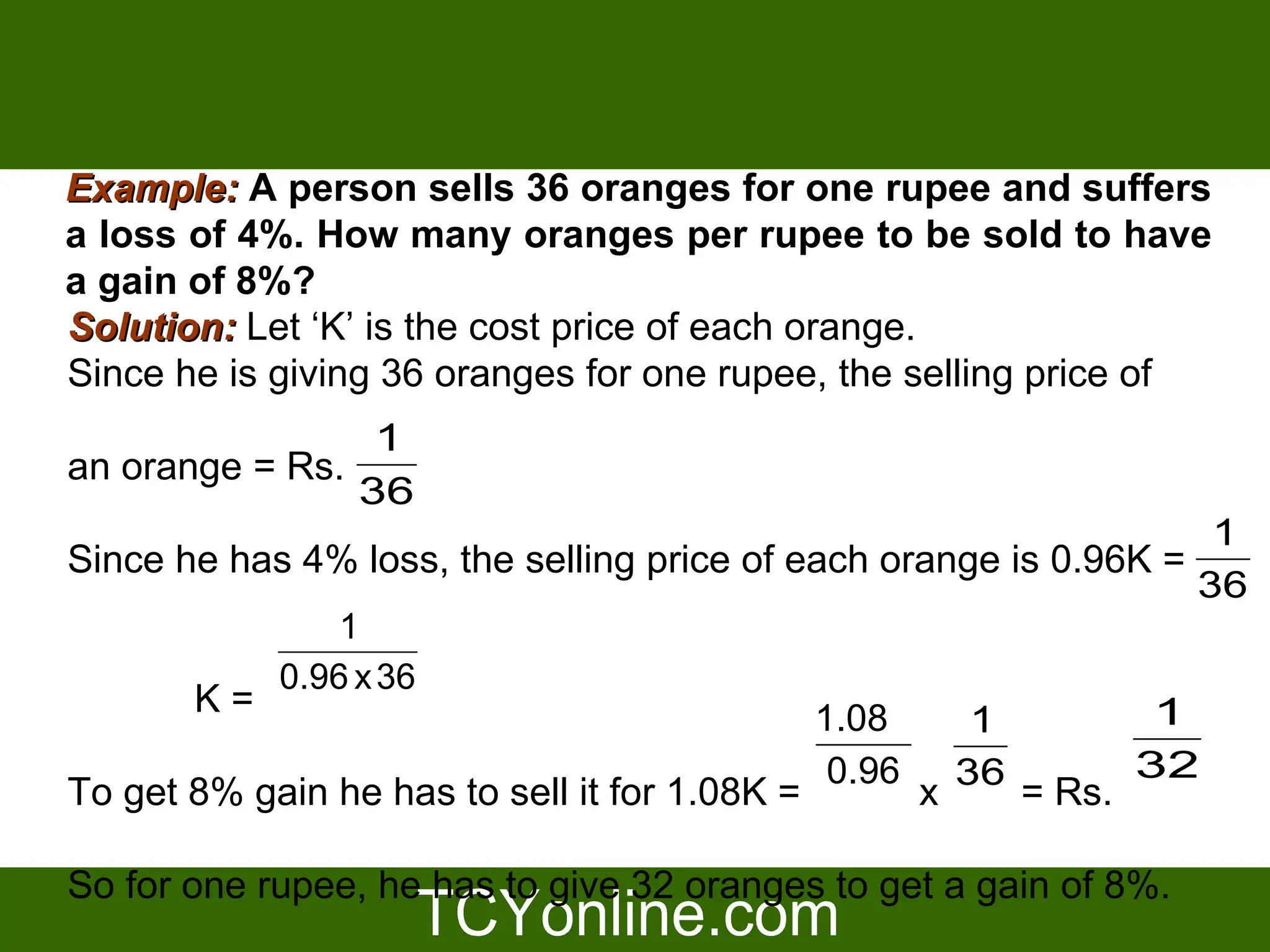
Example: A person sells 36 oranges for one rupee and suffers
a loss of 4%. How many oranges per rupee to be sold to have
a gain of 8%?
Solution: Let ‘K’ is the cost price of each orange.
Since he is giving 36 oranges for one rupee, the selling price of
                 1
an orange = Rs.
                36
                                                                   1
Since he has 4% loss, the selling price of each orange is 0.96K =
                                                                  36
               1
           0.96 x 36
       K=                                    1.08              1
                                                     1
                                              0.96 36         32
To get 8% gain he has to sell it for 1.08K =      x     = Rs.

So for one rupee, he has to give 32 oranges to get a gain of 8%.
Discount and Successive Discount


You always come across different offers attracting the customers
such as
“Buy 1get 2 Free”            or             “Buy 3 get 5 Free”
                             or
                      “SALE 50% + 40%”.
Can you calculate the discount offered to you?


Most of us are not aware about the offer given to us. The
percentage of the discount offered in the first case is not 200% but it
is 66.66% only. The discount is always on the number of items sold,
not on the number of items purchased.
Discount and Successive Discount

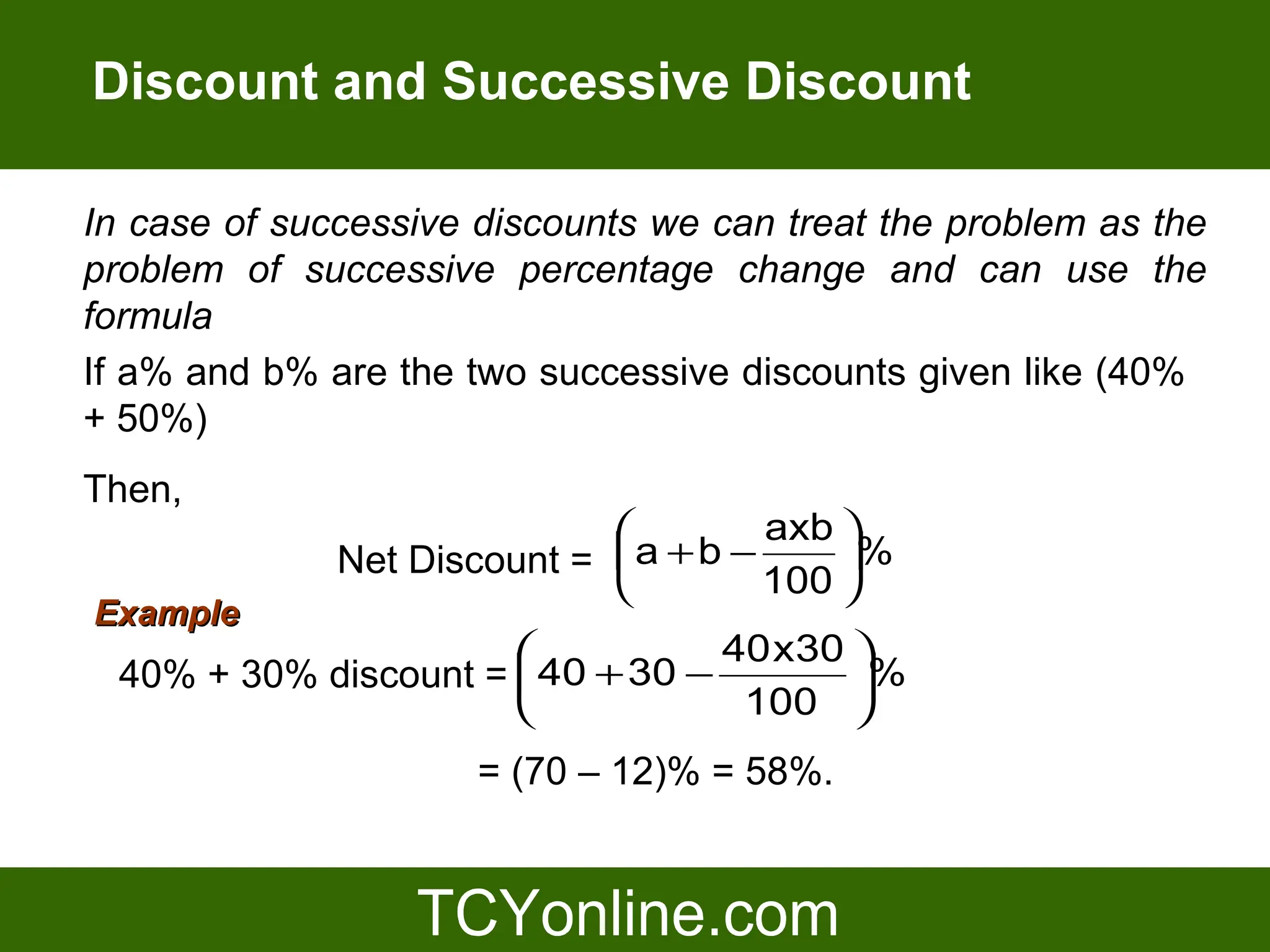
In case of successive discounts we can treat the problem as the
problem of successive percentage change and can use the
formula
If a% and b% are the two successive discounts given like (40%
+ 50%)
Then,
                                     axb 
              Net Discount =  a +b −     %
                                     100 
Example
                                  40 x30 
  40% + 30% discount =  40 + 30 −        %
                                   100 
                      = (70 – 12)% = 58%.
Marked Price

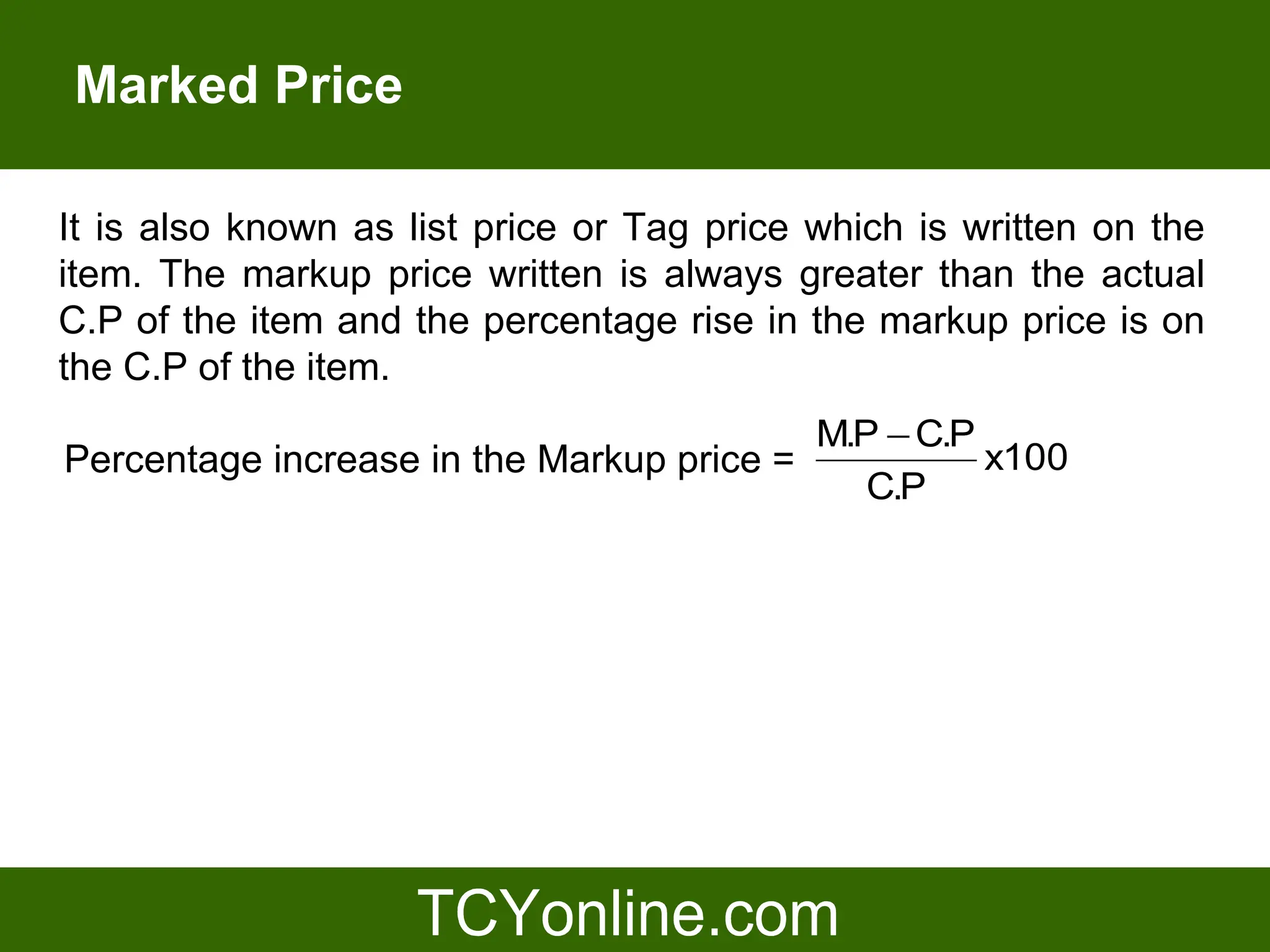
It is also known as list price or Tag price which is written on the
item. The markup price written is always greater than the actual
C.P of the item and the percentage rise in the markup price is on
the C.P of the item.
                                            M.P − C.P
Percentage increase in the Markup price =             x100
                                               C.P
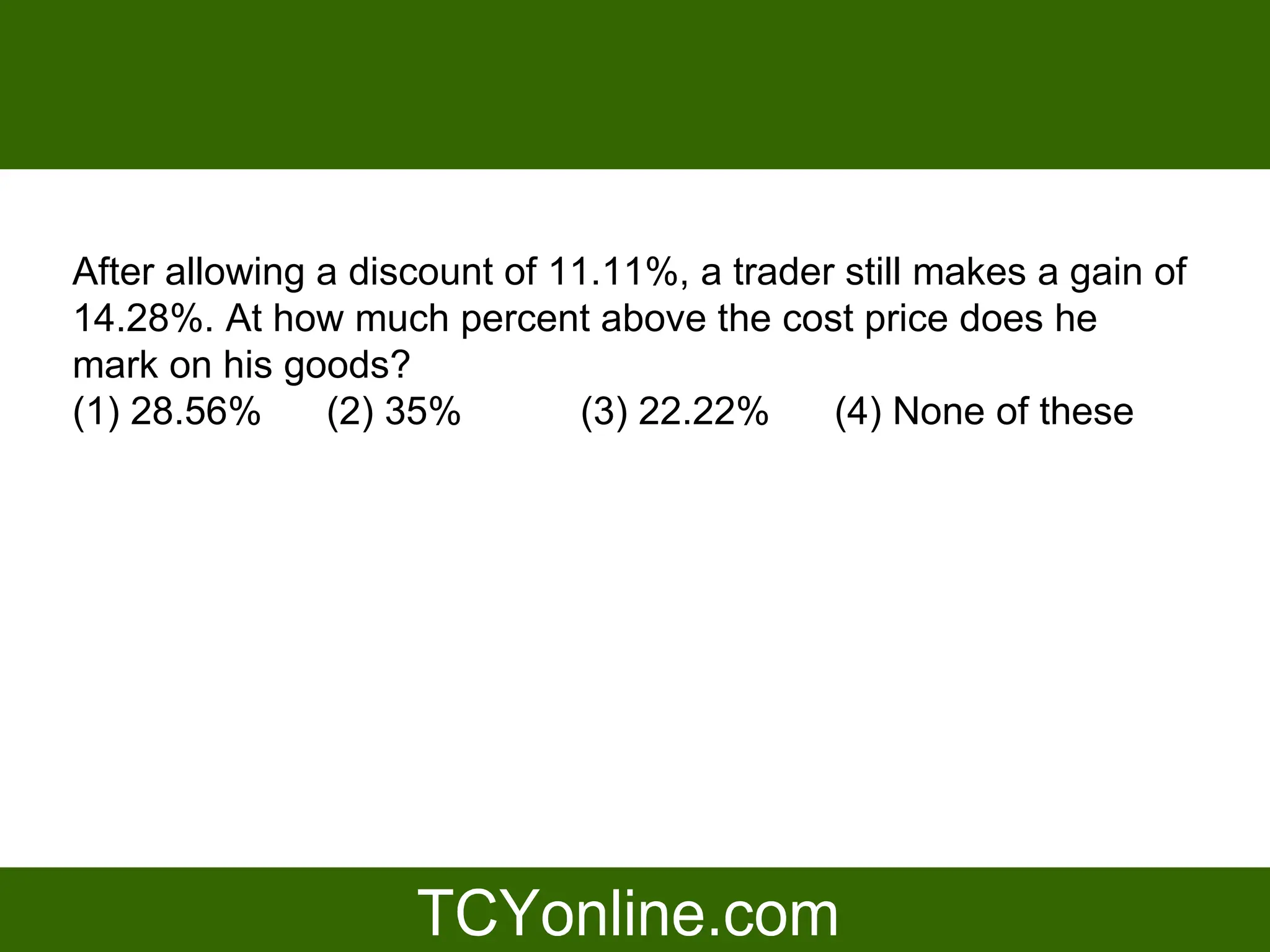
After allowing a discount of 11.11%, a trader still makes a gain of
14.28%. At how much percent above the cost price does he
mark on his goods?
(1) 28.56%     (2) 35%         (3) 22.22%    (4) None of these
Relation between Profit, Loss, Markup, and
Discount
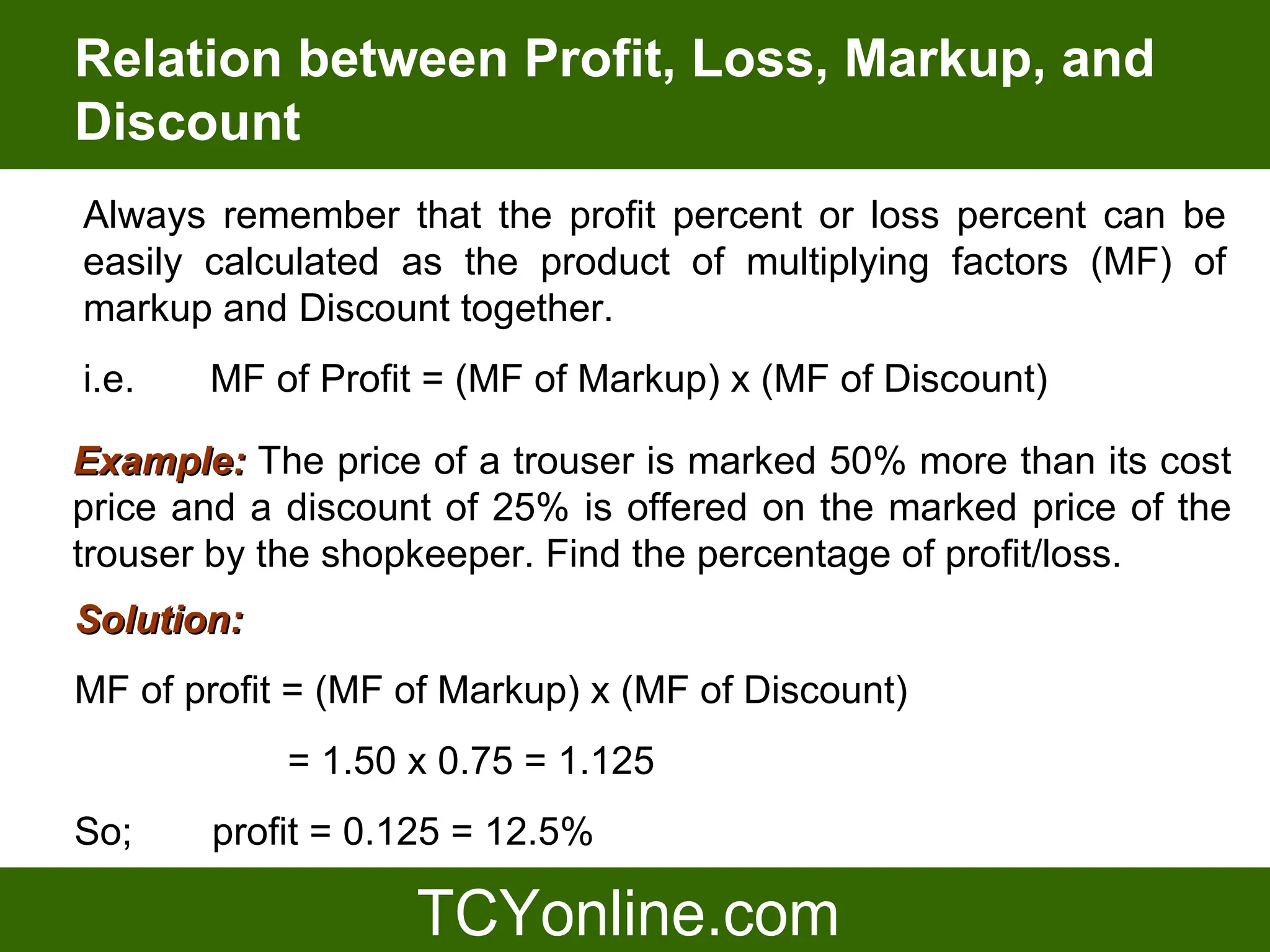
Always remember that the profit percent or loss percent can be
easily calculated as the product of multiplying factors (MF) of
markup and Discount together.
i.e.   MF of Profit = (MF of Markup) x (MF of Discount)

Example: The price of a trouser is marked 50% more than its cost
price and a discount of 25% is offered on the marked price of the
trouser by the shopkeeper. Find the percentage of profit/loss.
Solution:
MF of profit = (MF of Markup) x (MF of Discount)
            = 1.50 x 0.75 = 1.125
So;    profit = 0.125 = 12.5%
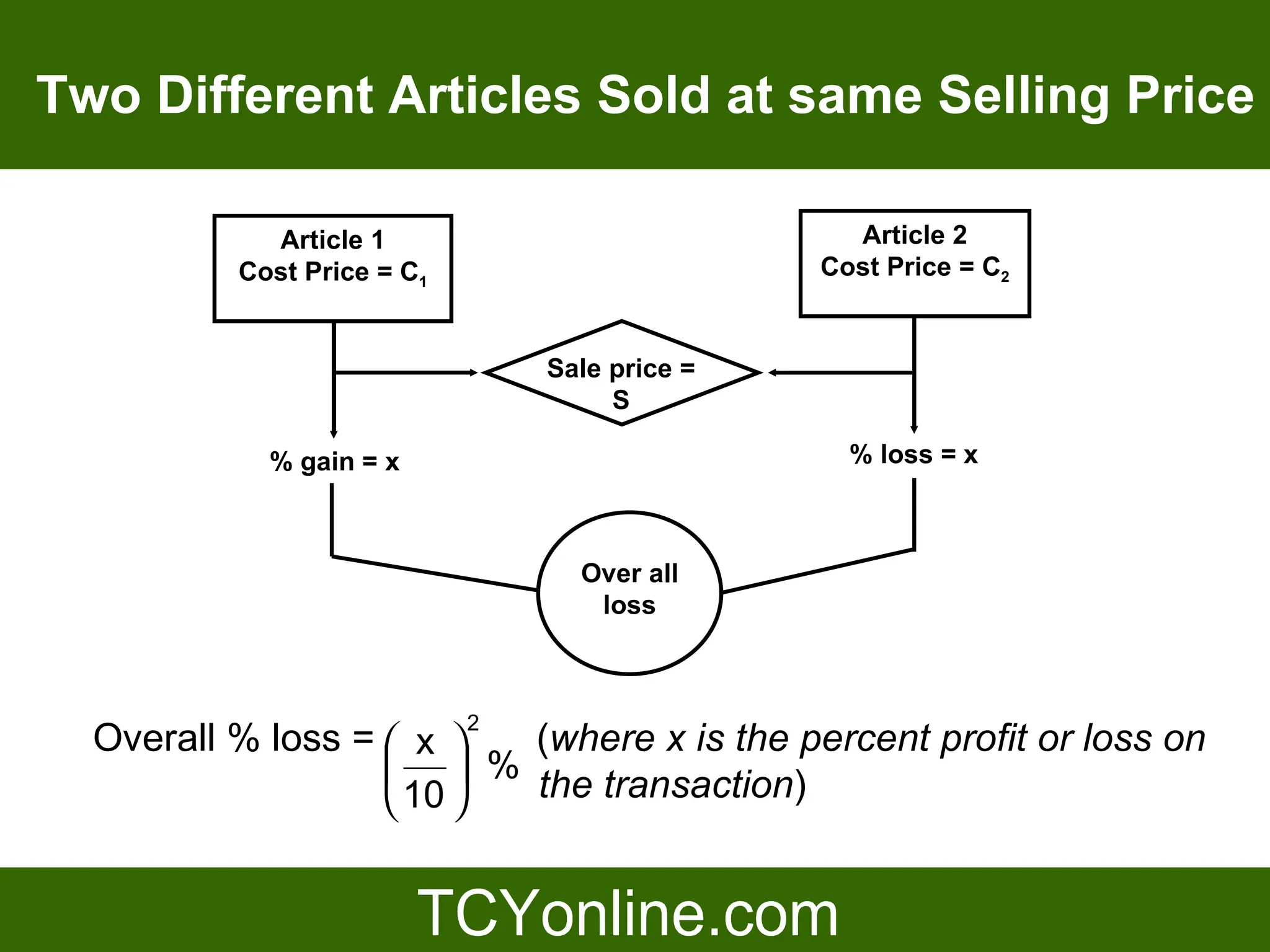
Two Different Articles Sold at same Selling Price

            Article 1                            Article 2
          Cost Price = C1                      Cost Price = C2


                                Sale price =
                                     S

            % gain = x                           % loss = x


                                  Over all
                                   loss


                            2
  Overall % loss =  x   (where x is the percent profit or loss on
                     % the transaction)
                    10 
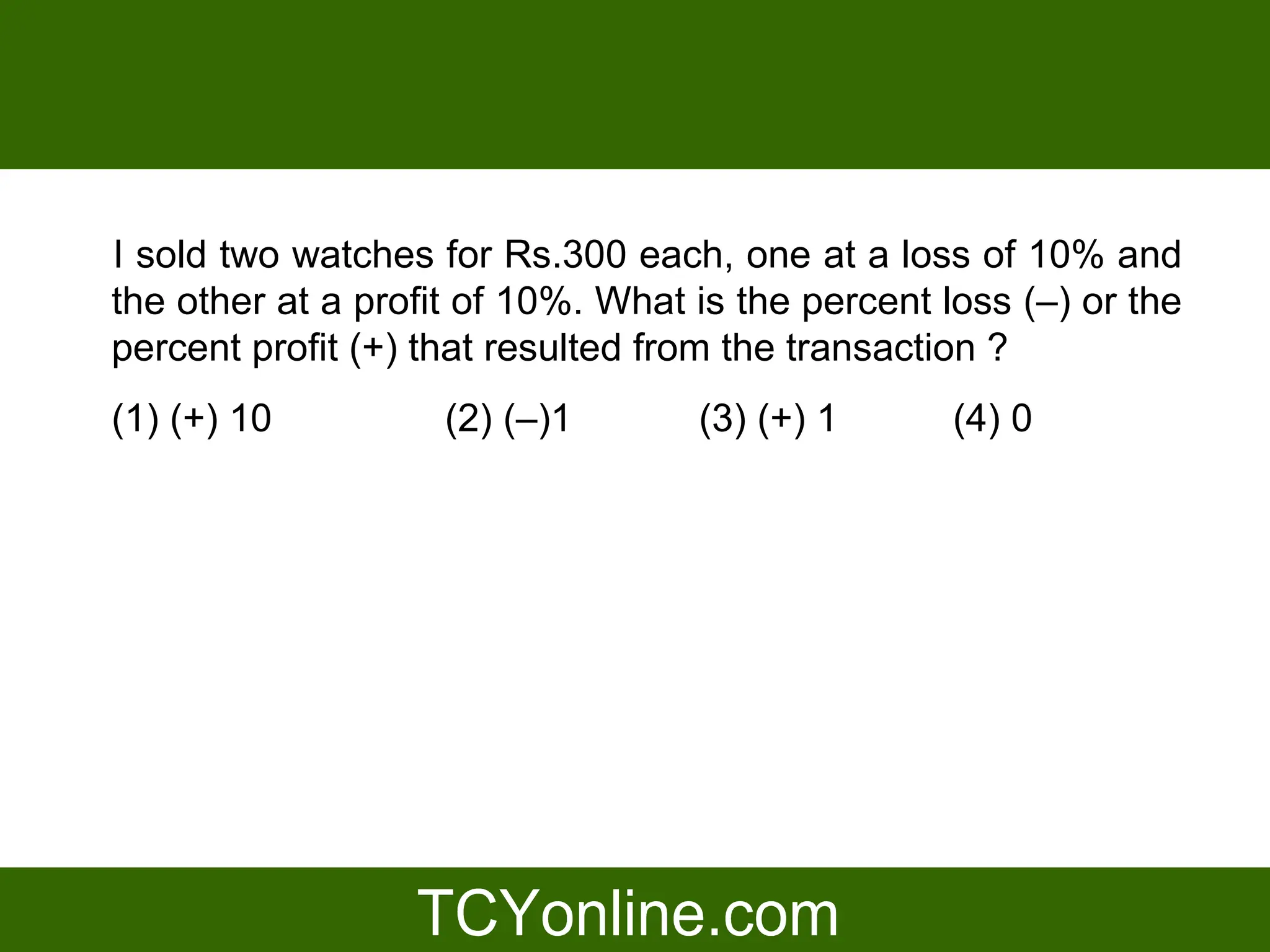
I sold two watches for Rs.300 each, one at a loss of 10% and
the other at a profit of 10%. What is the percent loss (–) or the
percent profit (+) that resulted from the transaction ?
(1) (+) 10          (2) (–)1       (3) (+) 1       (4) 0
Two Different Articles Sold at same
 Selling Price
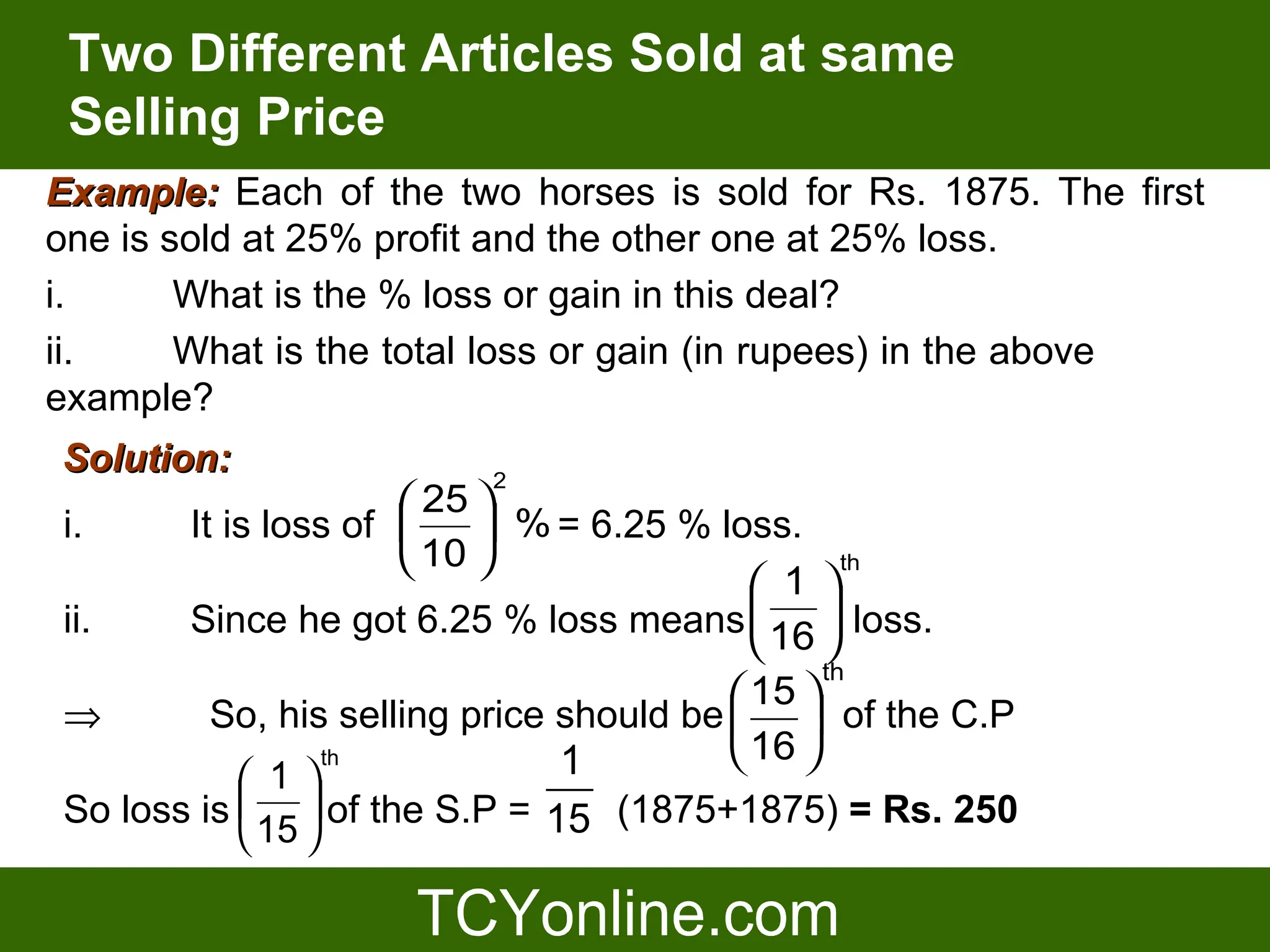
Example: Each of the two horses is sold for Rs. 1875. The first
one is sold at 25% profit and the other one at 25% loss.
i.      What is the % loss or gain in this deal?
ii.     What is the total loss or gain (in rupees) in the above
example?
Solution:               2
                      25 
i.     It is loss of      % = 6.25 % loss.
                      10                        th
                                            1 
ii.    Since he got 6.25 % loss means  16  loss.
                                            
                                                th
                                          15 
⇒        So, his selling price should be   of the C.P
                  th           1          16 
            1
So loss is   of the S.P = 15 (1875+1875) = Rs. 250
            15 
Faulty Balance and their Concept


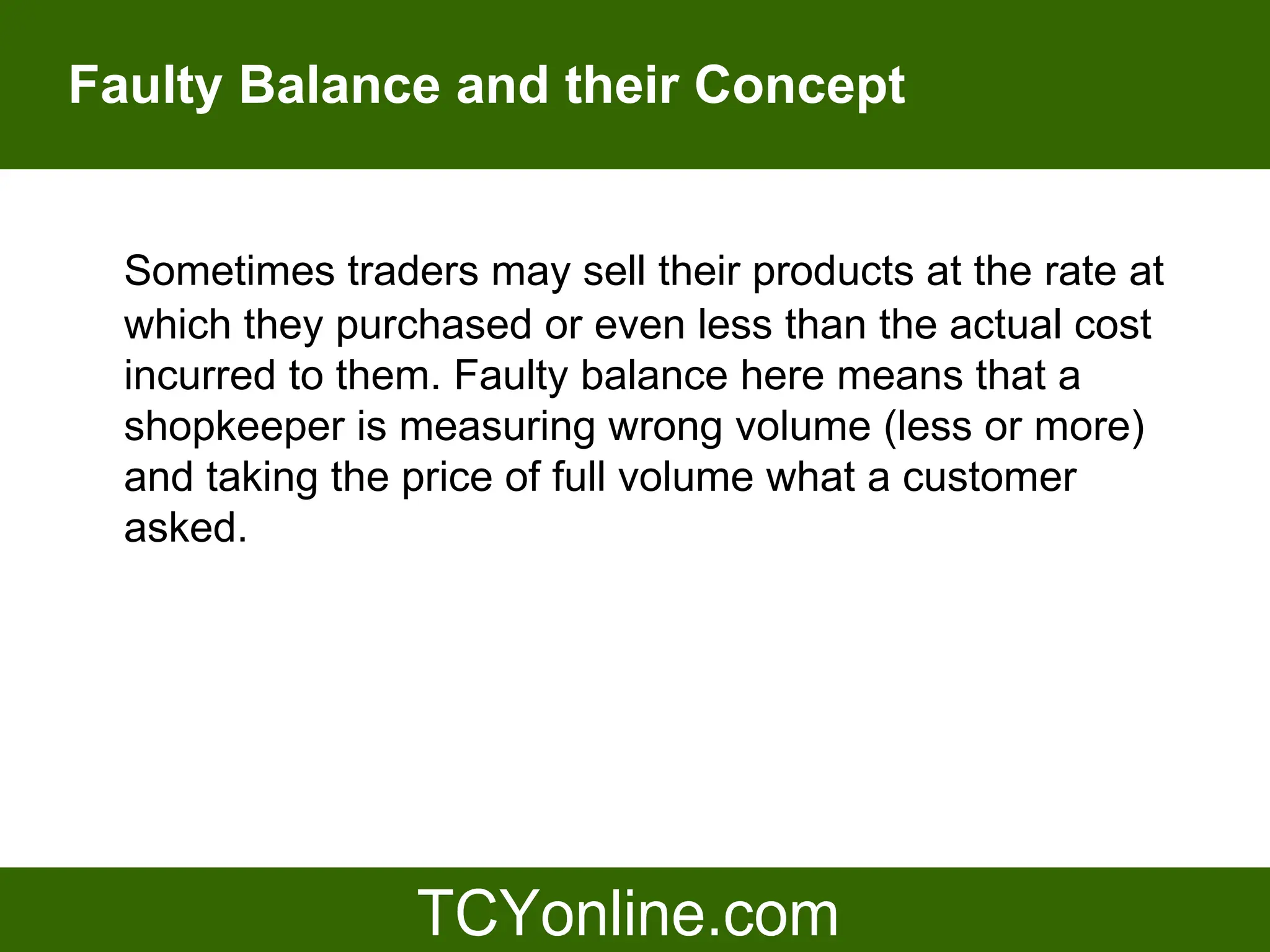
  Sometimes traders may sell their products at the rate at
  which they purchased or even less than the actual cost
  incurred to them. Faulty balance here means that a
  shopkeeper is measuring wrong volume (less or more)
  and taking the price of full volume what a customer
  asked.
Faulty Balance and their Concept


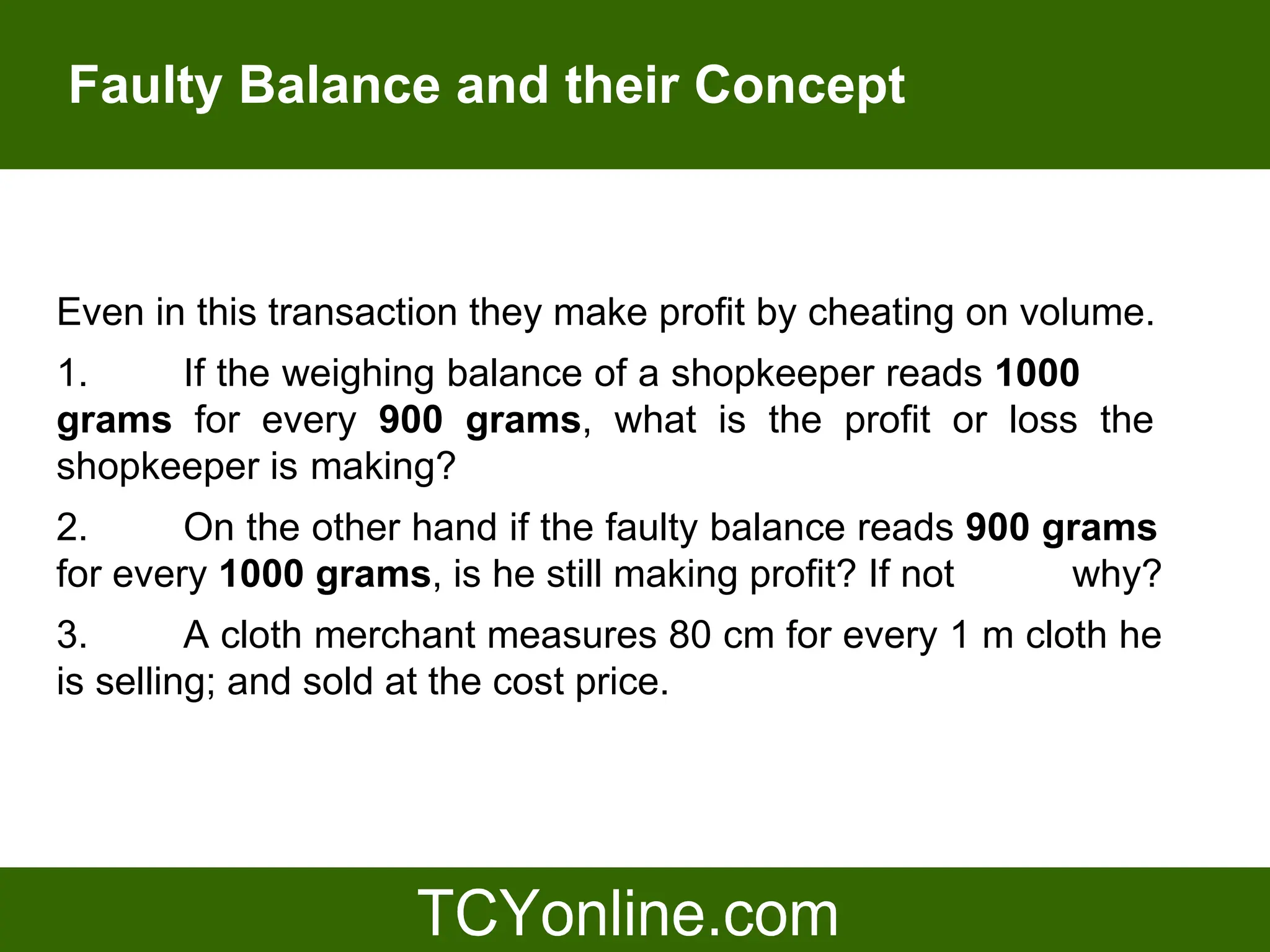
Even in this transaction they make profit by cheating on volume.
1.    If the weighing balance of a shopkeeper reads 1000
grams for every 900 grams, what is the profit or loss the
shopkeeper is making?
2.      On the other hand if the faulty balance reads 900 grams
for every 1000 grams, is he still making profit? If not    why?
3.       A cloth merchant measures 80 cm for every 1 m cloth he
is selling; and sold at the cost price.
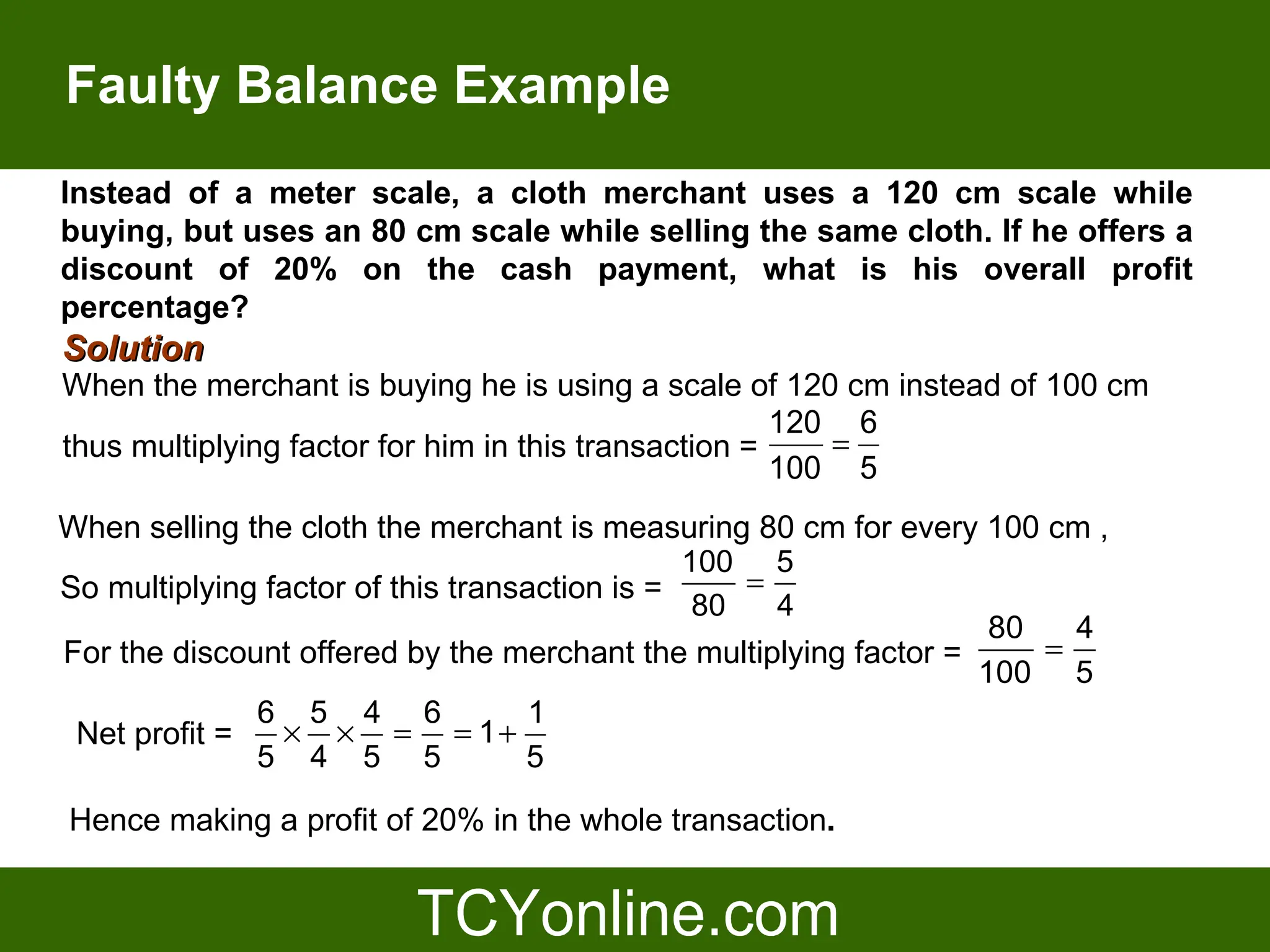
Faulty Balance Example
Instead of a meter scale, a cloth merchant uses a 120 cm scale while
buying, but uses an 80 cm scale while selling the same cloth. If he offers a
discount of 20% on the cash payment, what is his overall profit
percentage?
Solution
When the merchant is buying he is using a scale of 120 cm instead of 100 cm
                                                      120 6
thus multiplying factor for him in this transaction =    =
                                                      100 5
When selling the cloth the merchant is measuring 80 cm for every 100 cm ,
                                               100 5
So multiplying factor of this transaction is =     =
                                                80   4
                                                                   80   4
For the discount offered by the merchant the multiplying factor =     =
                                                                  100 5
              6 5 4 6               1
 Net profit =   × × = = 1+
              5 4 5 5              5

Hence making a profit of 20% in the whole transaction.

Thank You !!

PPT on profit and loss by tcyonline.com for CAT 2009

  • 1.
    Welcome to www.TCYonline.com
  • 2.
  • 3.
    Basic Terms Cost Price(C.P): Price at which one buys anything Selling Price (S.P): Price at which one sells anything Profit/Loss: Difference between the SP & CP. If the difference is positive it is called the profit and if negative it is called as loss. Profit/Loss %: profit/loss as a percentage of the C.P. Margin: Normally is in % terms only. This is the profit as a percentage of S.P. Marked Price: Price of the product as displayed on the label. Discount: Less given on the marked price before selling Markup: Increment on the cost price before selling
  • 4.
    Formulae Gain = S.P– C.P Loss = C.P – S.P Pr ofit (in Rs) Loss ( in Rs) Pr ofit % = × 100 Loss % = × 100 C.P C.P 100 + P % 100 − L % SP = × CP OR SP = × CP 100 100 100 − D % 100 − D % CP = × MP OR CP = × MP 100 + P % 100 − L%
  • 5.
    Example: A personsells 36 oranges for one rupee and suffers a loss of 4%. How many oranges per rupee to be sold to have a gain of 8%? Solution: Let ‘K’ is the cost price of each orange. Since he is giving 36 oranges for one rupee, the selling price of 1 an orange = Rs. 36 1 Since he has 4% loss, the selling price of each orange is 0.96K = 36 1 0.96 x 36 K= 1.08 1 1 0.96 36 32 To get 8% gain he has to sell it for 1.08K = x = Rs. So for one rupee, he has to give 32 oranges to get a gain of 8%.
  • 6.
    Discount and SuccessiveDiscount You always come across different offers attracting the customers such as “Buy 1get 2 Free” or “Buy 3 get 5 Free” or “SALE 50% + 40%”. Can you calculate the discount offered to you? Most of us are not aware about the offer given to us. The percentage of the discount offered in the first case is not 200% but it is 66.66% only. The discount is always on the number of items sold, not on the number of items purchased.
  • 7.
    Discount and SuccessiveDiscount In case of successive discounts we can treat the problem as the problem of successive percentage change and can use the formula If a% and b% are the two successive discounts given like (40% + 50%) Then,  axb  Net Discount =  a +b − %  100  Example  40 x30  40% + 30% discount =  40 + 30 − %  100  = (70 – 12)% = 58%.
  • 8.
    Marked Price It isalso known as list price or Tag price which is written on the item. The markup price written is always greater than the actual C.P of the item and the percentage rise in the markup price is on the C.P of the item. M.P − C.P Percentage increase in the Markup price = x100 C.P
  • 9.
    After allowing adiscount of 11.11%, a trader still makes a gain of 14.28%. At how much percent above the cost price does he mark on his goods? (1) 28.56% (2) 35% (3) 22.22% (4) None of these
  • 10.
    Relation between Profit,Loss, Markup, and Discount Always remember that the profit percent or loss percent can be easily calculated as the product of multiplying factors (MF) of markup and Discount together. i.e. MF of Profit = (MF of Markup) x (MF of Discount) Example: The price of a trouser is marked 50% more than its cost price and a discount of 25% is offered on the marked price of the trouser by the shopkeeper. Find the percentage of profit/loss. Solution: MF of profit = (MF of Markup) x (MF of Discount) = 1.50 x 0.75 = 1.125 So; profit = 0.125 = 12.5%
  • 11.
    Two Different ArticlesSold at same Selling Price Article 1 Article 2 Cost Price = C1 Cost Price = C2 Sale price = S % gain = x % loss = x Over all loss 2 Overall % loss =  x  (where x is the percent profit or loss on   % the transaction)  10 
  • 12.
    I sold twowatches for Rs.300 each, one at a loss of 10% and the other at a profit of 10%. What is the percent loss (–) or the percent profit (+) that resulted from the transaction ? (1) (+) 10 (2) (–)1 (3) (+) 1 (4) 0
  • 13.
    Two Different ArticlesSold at same Selling Price Example: Each of the two horses is sold for Rs. 1875. The first one is sold at 25% profit and the other one at 25% loss. i. What is the % loss or gain in this deal? ii. What is the total loss or gain (in rupees) in the above example? Solution: 2  25  i. It is loss of   % = 6.25 % loss.  10  th  1  ii. Since he got 6.25 % loss means  16  loss.   th  15  ⇒ So, his selling price should be   of the C.P th 1  16   1 So loss is   of the S.P = 15 (1875+1875) = Rs. 250  15 
  • 14.
    Faulty Balance andtheir Concept Sometimes traders may sell their products at the rate at which they purchased or even less than the actual cost incurred to them. Faulty balance here means that a shopkeeper is measuring wrong volume (less or more) and taking the price of full volume what a customer asked.
  • 15.
    Faulty Balance andtheir Concept Even in this transaction they make profit by cheating on volume. 1. If the weighing balance of a shopkeeper reads 1000 grams for every 900 grams, what is the profit or loss the shopkeeper is making? 2. On the other hand if the faulty balance reads 900 grams for every 1000 grams, is he still making profit? If not why? 3. A cloth merchant measures 80 cm for every 1 m cloth he is selling; and sold at the cost price.
  • 16.
    Faulty Balance Example Insteadof a meter scale, a cloth merchant uses a 120 cm scale while buying, but uses an 80 cm scale while selling the same cloth. If he offers a discount of 20% on the cash payment, what is his overall profit percentage? Solution When the merchant is buying he is using a scale of 120 cm instead of 100 cm 120 6 thus multiplying factor for him in this transaction = = 100 5 When selling the cloth the merchant is measuring 80 cm for every 100 cm , 100 5 So multiplying factor of this transaction is = = 80 4 80 4 For the discount offered by the merchant the multiplying factor = = 100 5 6 5 4 6 1 Net profit = × × = = 1+ 5 4 5 5 5 Hence making a profit of 20% in the whole transaction.
  • 17.