
Writing letters to
patients and
copying in the GP
(rather than the
other way round)
Rob Elias
Consultant Kidney Doctor
King’s College Hospital
London
Why?
Letters to patients: a survey
Did you notice that your most recent clinic letter was written to
you rather than to your GP?
Yes No
Is it better, worse or no different?
Does having a letter written direct to you from the doctor you see
in clinic change the way you feel about your clinic visit?
Yes No
If so, in what way?
…………………………………………………………………………………
Letters to patients: a survey
If the doctor I see in clinic writes to me rather than to my GP:
[strongly agree, agree, neither agree nor disagree, disagree, strongly disagree]
• I am more likely to talk about concerns I have when I next come
to clinic.
• I am more likely to make an appointment with the GP if my
medication needs changing.
• I feel that I am being treated with more respect.
• The letter to me is easier to understand than letters sent to my
GP.
• I feel more involved in my care.
Letters to patients: a survey
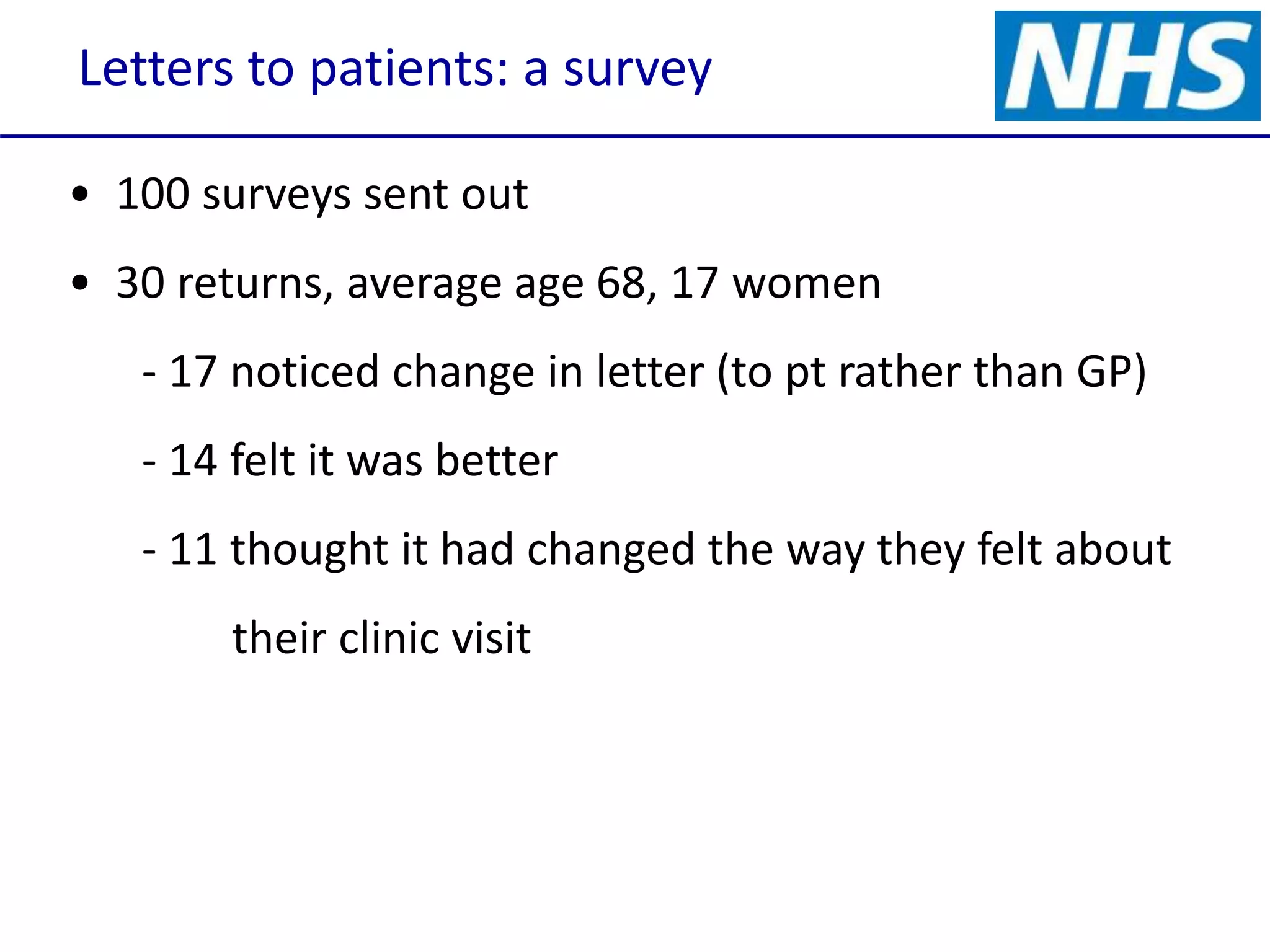
• 100 surveys sent out
• 30 returns, average age 68, 17 women
- 17 noticed change in letter (to pt rather than GP)
- 14 felt it was better
- 11 thought it had changed the way they felt about
their clinic visit
Letters to patients
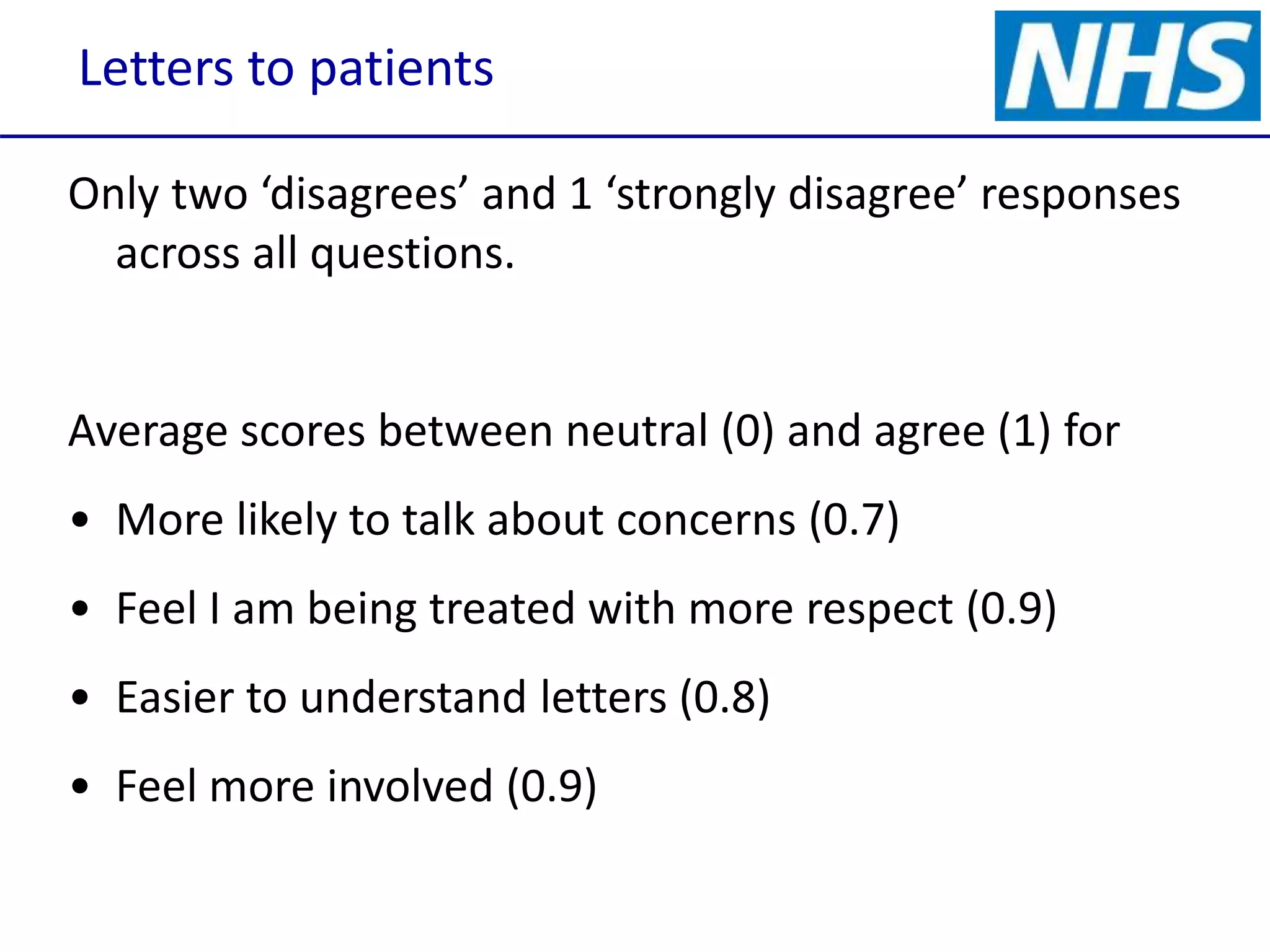
Only two ‘disagrees’ and 1 ‘strongly disagree’ responses
across all questions.
Average scores between neutral (0) and agree (1) for
• More likely to talk about concerns (0.7)
• Feel I am being treated with more respect (0.9)
• Easier to understand letters (0.8)
• Feel more involved (0.9)
Letters to patients
Though stronger agreement with ‘I am more likely to
make an appointment with the GP if my medication
needs changing.’ (1.1)
Letters to patients
Comments:
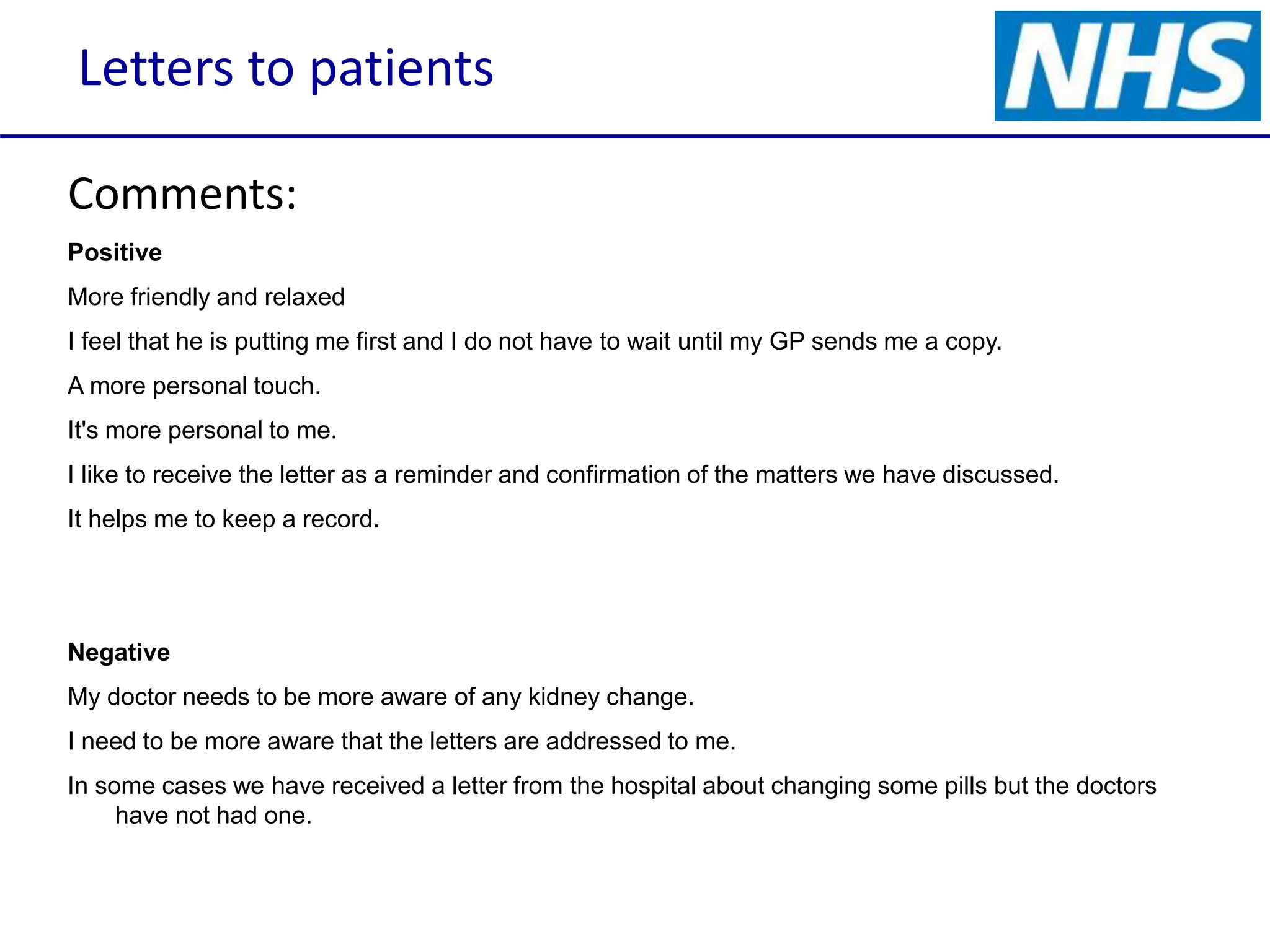
Positive
More friendly and relaxed
I feel that he is putting me first and I do not have to wait until my GP sends me a copy.
A more personal touch.
It's more personal to me.
I like to receive the letter as a reminder and confirmation of the matters we have discussed.
It helps me to keep a record.
Negative
My doctor needs to be more aware of any kidney change.
I need to be more aware that the letters are addressed to me.
In some cases we have received a letter from the hospital about changing some pills but the doctors
have not had one.
Letters to patients
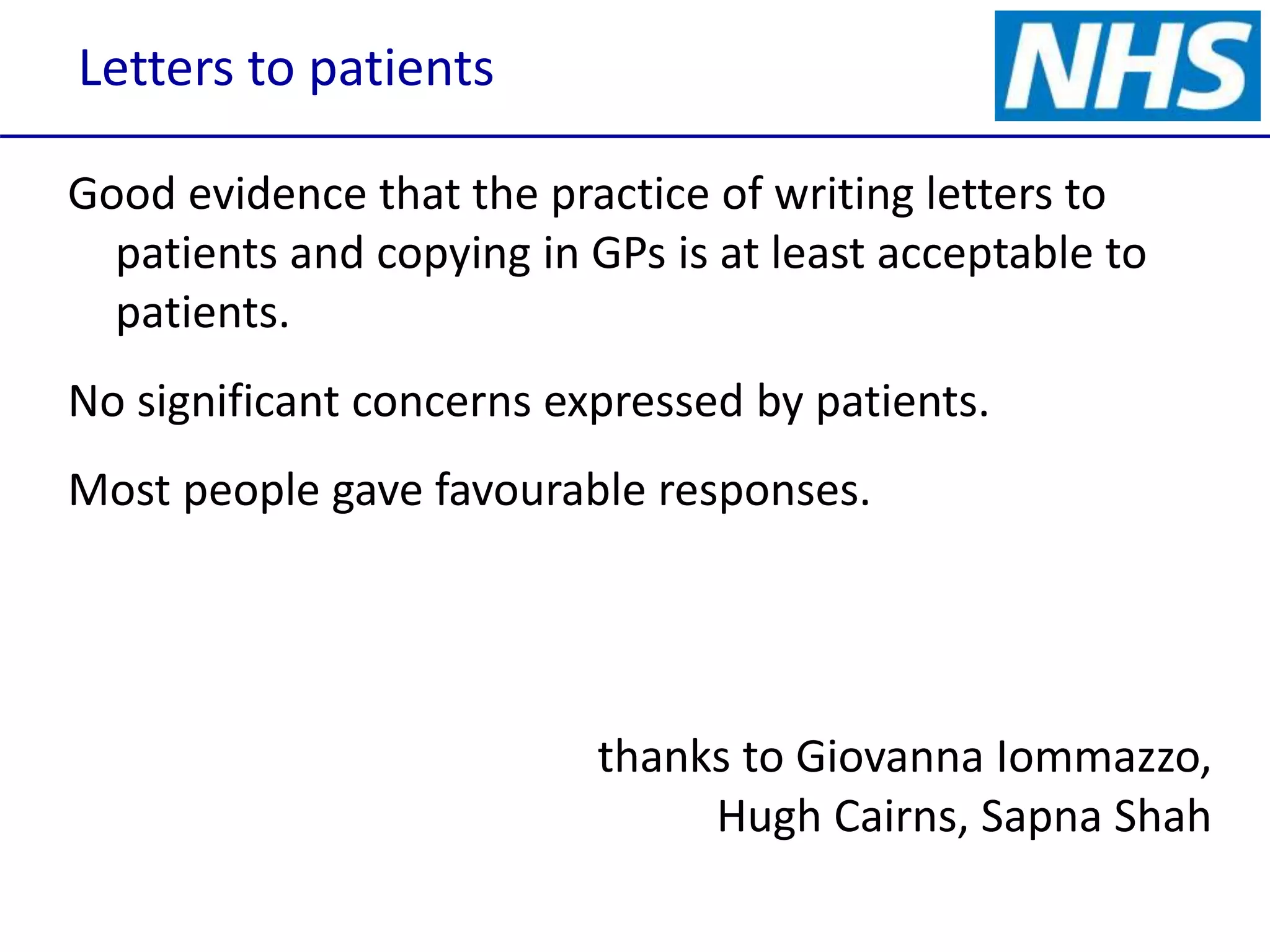
Good evidence that the practice of writing letters to
patients and copying in GPs is at least acceptable to
patients.
No significant concerns expressed by patients.
Most people gave favourable responses.
thanks to Giovanna Iommazzo,
Hugh Cairns, Sapna Shah
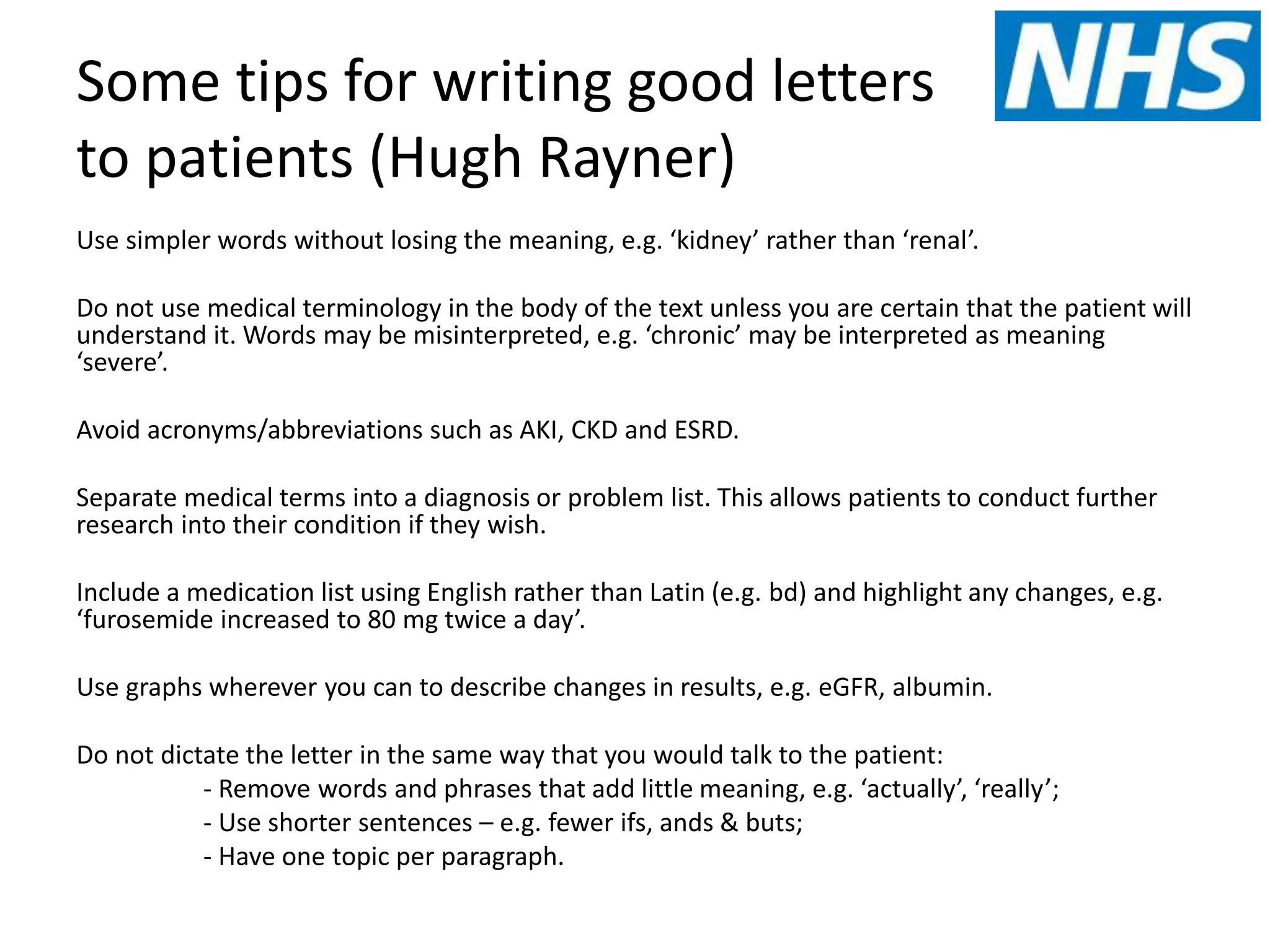
Some tips for writing good letters
to patients (Hugh Rayner)
Use simpler words without losing the meaning, e.g. ‘kidney’ rather than ‘renal’.
Do not use medical terminology in the body of the text unless you are certain that the patient will
understand it. Words may be misinterpreted, e.g. ‘chronic’ may be interpreted as meaning
‘severe’.
Avoid acronyms/abbreviations such as AKI, CKD and ESRD.
Separate medical terms into a diagnosis or problem list. This allows patients to conduct further
research into their condition if they wish.
Include a medication list using English rather than Latin (e.g. bd) and highlight any changes, e.g.
‘furosemide increased to 80 mg twice a day’.
Use graphs wherever you can to describe changes in results, e.g. eGFR, albumin.
Do not dictate the letter in the same way that you would talk to the patient:
- Remove words and phrases that add little meaning, e.g. ‘actually’, ‘really’;
- Use shorter sentences – e.g. fewer ifs, ands & buts;
- Have one topic per paragraph.
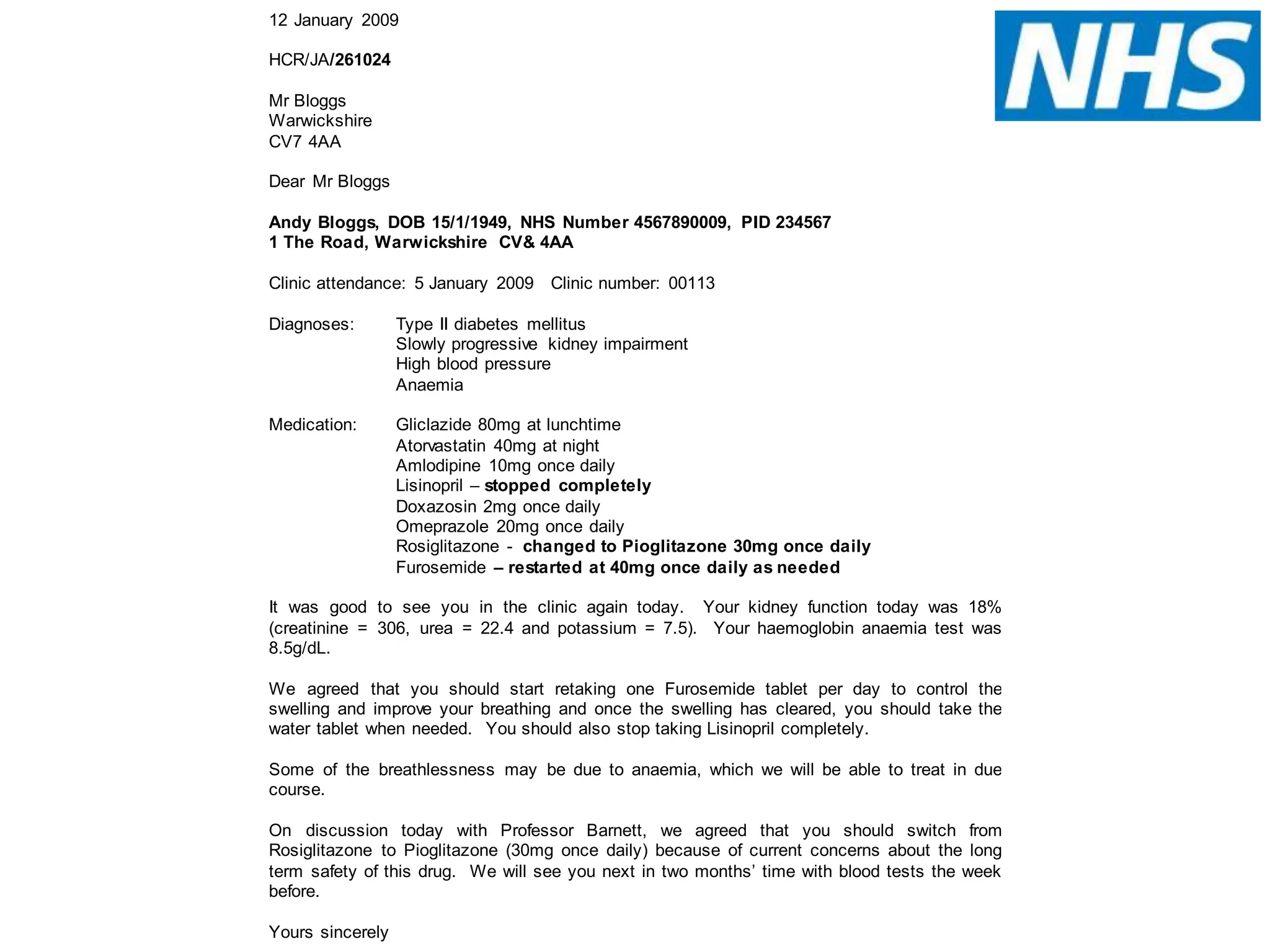
12 January 2009
HCR/JA/261024
Mr Bloggs
Warwickshire
CV7 4AA
Dear Mr Bloggs
Andy Bloggs, DOB 15/1/1949, NHS Number 4567890009, PID 234567
1 The Road, Warwickshire CV& 4AA
Clinic attendance: 5 January 2009 Clinic number: 00113
Diagnoses: Type II diabetes mellitus
Slowly progressive kidney impairment
High blood pressure
Anaemia
Medication: Gliclazide 80mg at lunchtime
Atorvastatin 40mg at night
Amlodipine 10mg once daily
Lisinopril – stopped completely
Doxazosin 2mg once daily
Omeprazole 20mg once daily
Rosiglitazone - changed to Pioglitazone 30mg once daily
Furosemide – restarted at 40mg once daily as needed
It was good to see you in the clinic again today. Your kidney function today was 18%
(creatinine = 306, urea = 22.4 and potassium = 7.5). Your haemoglobin anaemia test was
8.5g/dL.
We agreed that you should start retaking one Furosemide tablet per day to control the
swelling and improve your breathing and once the swelling has cleared, you should take the
water tablet when needed. You should also stop taking Lisinopril completely.
Some of the breathlessness may be due to anaemia, which we will be able to treat in due
course.
On discussion today with Professor Barnett, we agreed that you should switch from
Rosiglitazone to Pioglitazone (30mg once daily) because of current concerns about the long
term safety of this drug. We will see you next in two months’ time with blood tests the week
before.
Yours sincerely
Problem List
Acute kidney injury and hypertension 2013
Crescentic IgA nephropathy on kidney biopsy 2013
Current Medications
Frusemide Tablets 40mg PO once a day
Ramipril Tablets 5mg PO once a day* [02/10/15]
Ranitidine Tabs/Inj 150mg PO twice a day
* added or dose changed within last 14 days
ALLERGIES/INTOLERANCE: none known
BP: 104/72 Weight: 72.2 kg Urine Blood: trace Urine Protein: neg
It was a pleasure to see you in clinic today. I'm pleased to hear that you have no problems to report since we last saw
you.
You have no ankle swelling. Your weight is up a little. Kidney function on the blood tests is stable.
Although today’s urine dip is negative for protein, the measured protein level in the urine is still high (PCR 90). This has
steadily improved over the last year. The introduction of the ramipril tablet last time will have helped with that.
We talked about how best to control blood pressure and protein leak. You have had some dizzy spells which has meant
that you have not increased the ramipril beyond 5mg. I suggest you stick with things as they are at the moment, and
when I next see you we can consider stopping the frusemide with a view to increasing the ramipril.
We will see you again in 3 months.
Best wishes,
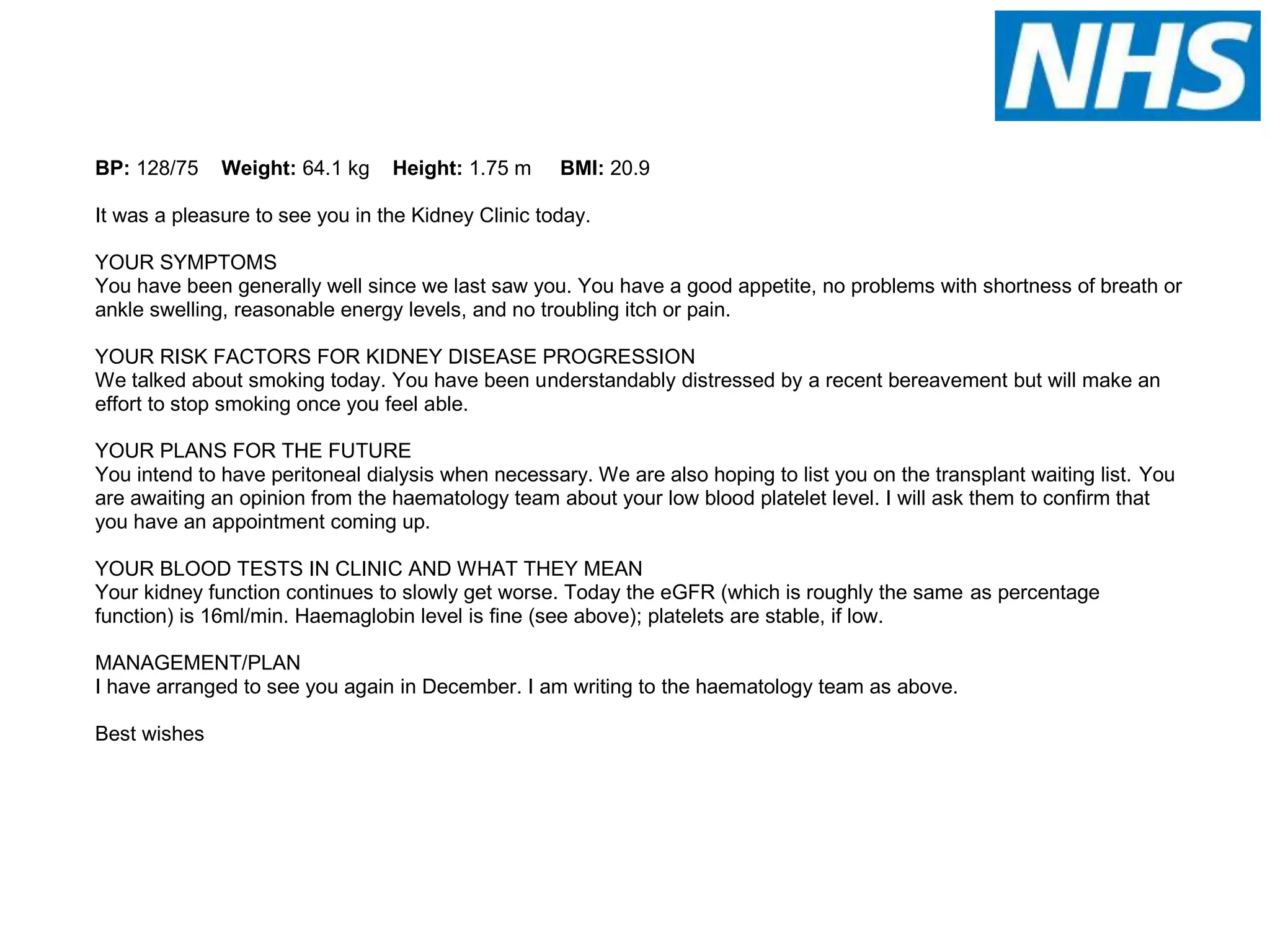
BP: 128/75 Weight: 64.1 kg Height: 1.75 m BMI: 20.9
It was a pleasure to see you in the Kidney Clinic today.
YOUR SYMPTOMS
You have been generally well since we last saw you. You have a good appetite, no problems with shortness of breath or
ankle swelling, reasonable energy levels, and no troubling itch or pain.
YOUR RISK FACTORS FOR KIDNEY DISEASE PROGRESSION
We talked about smoking today. You have been understandably distressed by a recent bereavement but will make an
effort to stop smoking once you feel able.
YOUR PLANS FOR THE FUTURE
You intend to have peritoneal dialysis when necessary. We are also hoping to list you on the transplant waiting list. You
are awaiting an opinion from the haematology team about your low blood platelet level. I will ask them to confirm that
you have an appointment coming up.
YOUR BLOOD TESTS IN CLINIC AND WHAT THEY MEAN
Your kidney function continues to slowly get worse. Today the eGFR (which is roughly the same as percentage
function) is 16ml/min. Haemaglobin level is fine (see above); platelets are stable, if low.
MANAGEMENT/PLAN
I have arranged to see you again in December. I am writing to the haematology team as above.
Best wishes
Why write letters direct to patients?
• Patient centred
• Can change focus/nature of consultation
• Gives ownership to patients
• Encourages clear, non-technical
communication
• Can constitute a care plan
• Works well alongside e.g. motivational
interviewing

Writing letters to patients and copying GP in

  • 1.
    Writing letters to patientsand copying in the GP (rather than the other way round) Rob Elias Consultant Kidney Doctor King’s College Hospital London
  • 2.
  • 3.
    Letters to patients:a survey Did you notice that your most recent clinic letter was written to you rather than to your GP? Yes No Is it better, worse or no different? Does having a letter written direct to you from the doctor you see in clinic change the way you feel about your clinic visit? Yes No If so, in what way? …………………………………………………………………………………
  • 4.
    Letters to patients:a survey If the doctor I see in clinic writes to me rather than to my GP: [strongly agree, agree, neither agree nor disagree, disagree, strongly disagree] • I am more likely to talk about concerns I have when I next come to clinic. • I am more likely to make an appointment with the GP if my medication needs changing. • I feel that I am being treated with more respect. • The letter to me is easier to understand than letters sent to my GP. • I feel more involved in my care.
  • 5.
    Letters to patients:a survey • 100 surveys sent out • 30 returns, average age 68, 17 women - 17 noticed change in letter (to pt rather than GP) - 14 felt it was better - 11 thought it had changed the way they felt about their clinic visit
  • 6.
    Letters to patients Onlytwo ‘disagrees’ and 1 ‘strongly disagree’ responses across all questions. Average scores between neutral (0) and agree (1) for • More likely to talk about concerns (0.7) • Feel I am being treated with more respect (0.9) • Easier to understand letters (0.8) • Feel more involved (0.9)
  • 7.
    Letters to patients Thoughstronger agreement with ‘I am more likely to make an appointment with the GP if my medication needs changing.’ (1.1)
  • 8.
    Letters to patients Comments: Positive Morefriendly and relaxed I feel that he is putting me first and I do not have to wait until my GP sends me a copy. A more personal touch. It's more personal to me. I like to receive the letter as a reminder and confirmation of the matters we have discussed. It helps me to keep a record. Negative My doctor needs to be more aware of any kidney change. I need to be more aware that the letters are addressed to me. In some cases we have received a letter from the hospital about changing some pills but the doctors have not had one.
  • 9.
    Letters to patients Goodevidence that the practice of writing letters to patients and copying in GPs is at least acceptable to patients. No significant concerns expressed by patients. Most people gave favourable responses. thanks to Giovanna Iommazzo, Hugh Cairns, Sapna Shah
  • 10.
    Some tips forwriting good letters to patients (Hugh Rayner) Use simpler words without losing the meaning, e.g. ‘kidney’ rather than ‘renal’. Do not use medical terminology in the body of the text unless you are certain that the patient will understand it. Words may be misinterpreted, e.g. ‘chronic’ may be interpreted as meaning ‘severe’. Avoid acronyms/abbreviations such as AKI, CKD and ESRD. Separate medical terms into a diagnosis or problem list. This allows patients to conduct further research into their condition if they wish. Include a medication list using English rather than Latin (e.g. bd) and highlight any changes, e.g. ‘furosemide increased to 80 mg twice a day’. Use graphs wherever you can to describe changes in results, e.g. eGFR, albumin. Do not dictate the letter in the same way that you would talk to the patient: - Remove words and phrases that add little meaning, e.g. ‘actually’, ‘really’; - Use shorter sentences – e.g. fewer ifs, ands & buts; - Have one topic per paragraph.
  • 11.
    12 January 2009 HCR/JA/261024 MrBloggs Warwickshire CV7 4AA Dear Mr Bloggs Andy Bloggs, DOB 15/1/1949, NHS Number 4567890009, PID 234567 1 The Road, Warwickshire CV& 4AA Clinic attendance: 5 January 2009 Clinic number: 00113 Diagnoses: Type II diabetes mellitus Slowly progressive kidney impairment High blood pressure Anaemia Medication: Gliclazide 80mg at lunchtime Atorvastatin 40mg at night Amlodipine 10mg once daily Lisinopril – stopped completely Doxazosin 2mg once daily Omeprazole 20mg once daily Rosiglitazone - changed to Pioglitazone 30mg once daily Furosemide – restarted at 40mg once daily as needed It was good to see you in the clinic again today. Your kidney function today was 18% (creatinine = 306, urea = 22.4 and potassium = 7.5). Your haemoglobin anaemia test was 8.5g/dL. We agreed that you should start retaking one Furosemide tablet per day to control the swelling and improve your breathing and once the swelling has cleared, you should take the water tablet when needed. You should also stop taking Lisinopril completely. Some of the breathlessness may be due to anaemia, which we will be able to treat in due course. On discussion today with Professor Barnett, we agreed that you should switch from Rosiglitazone to Pioglitazone (30mg once daily) because of current concerns about the long term safety of this drug. We will see you next in two months’ time with blood tests the week before. Yours sincerely
  • 12.
    Problem List Acute kidneyinjury and hypertension 2013 Crescentic IgA nephropathy on kidney biopsy 2013 Current Medications Frusemide Tablets 40mg PO once a day Ramipril Tablets 5mg PO once a day* [02/10/15] Ranitidine Tabs/Inj 150mg PO twice a day * added or dose changed within last 14 days ALLERGIES/INTOLERANCE: none known BP: 104/72 Weight: 72.2 kg Urine Blood: trace Urine Protein: neg It was a pleasure to see you in clinic today. I'm pleased to hear that you have no problems to report since we last saw you. You have no ankle swelling. Your weight is up a little. Kidney function on the blood tests is stable. Although today’s urine dip is negative for protein, the measured protein level in the urine is still high (PCR 90). This has steadily improved over the last year. The introduction of the ramipril tablet last time will have helped with that. We talked about how best to control blood pressure and protein leak. You have had some dizzy spells which has meant that you have not increased the ramipril beyond 5mg. I suggest you stick with things as they are at the moment, and when I next see you we can consider stopping the frusemide with a view to increasing the ramipril. We will see you again in 3 months. Best wishes,
  • 13.
    BP: 128/75 Weight:64.1 kg Height: 1.75 m BMI: 20.9 It was a pleasure to see you in the Kidney Clinic today. YOUR SYMPTOMS You have been generally well since we last saw you. You have a good appetite, no problems with shortness of breath or ankle swelling, reasonable energy levels, and no troubling itch or pain. YOUR RISK FACTORS FOR KIDNEY DISEASE PROGRESSION We talked about smoking today. You have been understandably distressed by a recent bereavement but will make an effort to stop smoking once you feel able. YOUR PLANS FOR THE FUTURE You intend to have peritoneal dialysis when necessary. We are also hoping to list you on the transplant waiting list. You are awaiting an opinion from the haematology team about your low blood platelet level. I will ask them to confirm that you have an appointment coming up. YOUR BLOOD TESTS IN CLINIC AND WHAT THEY MEAN Your kidney function continues to slowly get worse. Today the eGFR (which is roughly the same as percentage function) is 16ml/min. Haemaglobin level is fine (see above); platelets are stable, if low. MANAGEMENT/PLAN I have arranged to see you again in December. I am writing to the haematology team as above. Best wishes
  • 14.
    Why write lettersdirect to patients? • Patient centred • Can change focus/nature of consultation • Gives ownership to patients • Encourages clear, non-technical communication • Can constitute a care plan • Works well alongside e.g. motivational interviewing

Editor's Notes