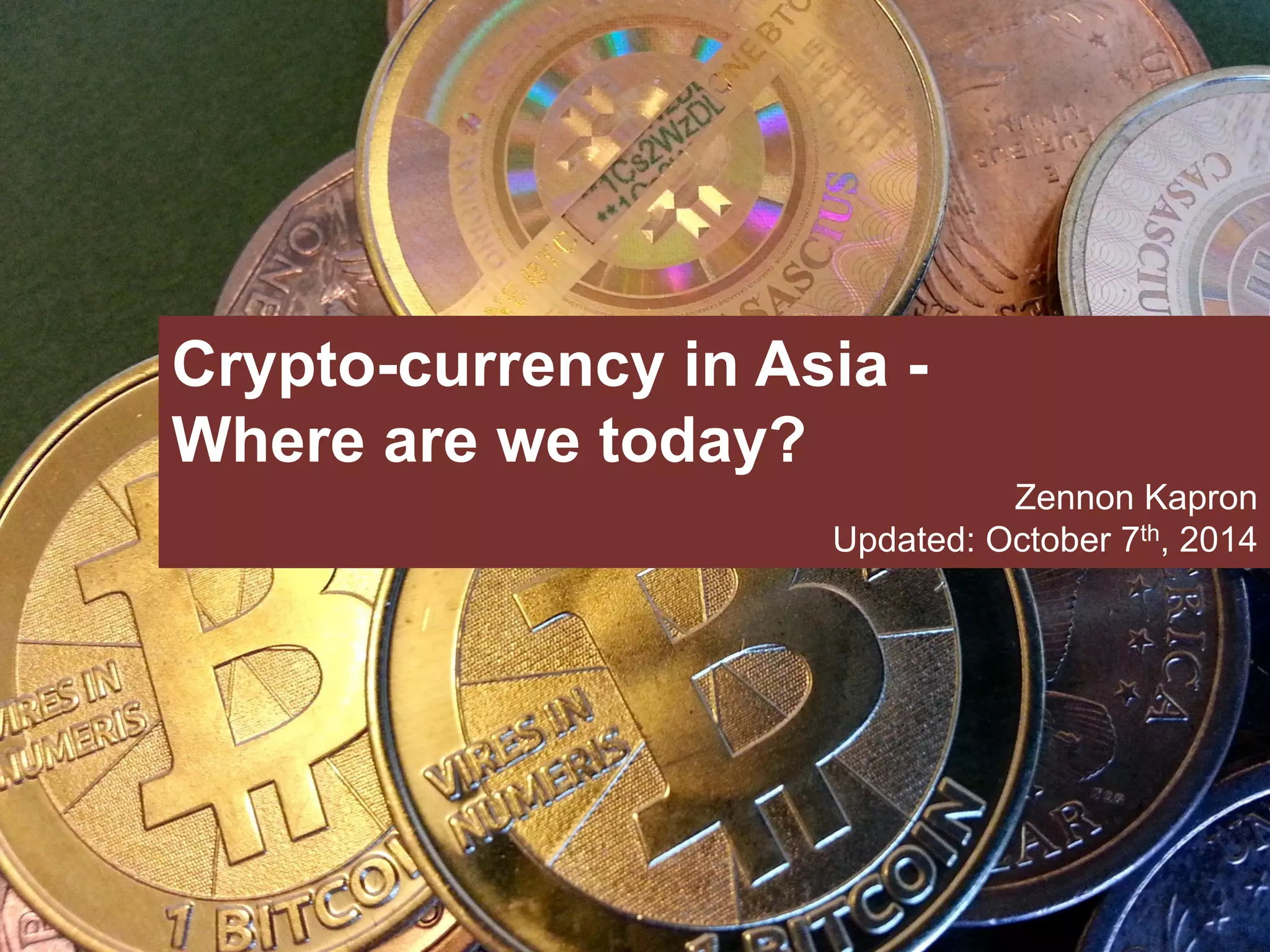
Crypto-currency in Asia - 
Where are we today? 
Zennon Kapron 
Updated: October 7th, 2014
Kapronasia Background 
• Founded in 2007 with the specific intent of helping financial 
technology companies understand and take advantage of market 
opportunities in the China Financial Services market 
• Three business focuses: Research, Consulting, Sales Enablement 
• Offices in Hong Kong, Shanghai, Singapore 
Selected Clients:
Today 
• Cryptocurrency in Asia 
– Regulation 
– Opportunities 
– Challenges 
• China 
– Development 
– Bitcoin / crypto in China 
• Summary 
• Q&A 
3
Asia: The Basics 
• Largest economic block in the world 
• 48 countries 
• 100+ languages and dialects 
• 20+ currencies 
• Varying regulations, cultures, practices… 
• Increasingly wealthy customers and companies 
• But also one of the least mature financial services industries -> 
challenges & opportunities 
4
Asia: What the region needs – Payment Opportunities 
• Diverse domestic payment systems 
– Vary by country 
– Very few interoperability standards 
– Potential for an Asian SEPA*? Possible with out an Asian EUR? 
• Corporate International payments 
– Leads the world in trade, yet payments are antiquated 
– China International Payments System (CIPS) still in draft 
– Very few options for corporates 
– SMEs are stuffed: 
• SWIFT is not cheap especially if you are an SME ($50) 
• SMEs already struggling with costs and liquidity 
• Ship today, get paid…sometime 
*SEPA –Single European Payments Area 5
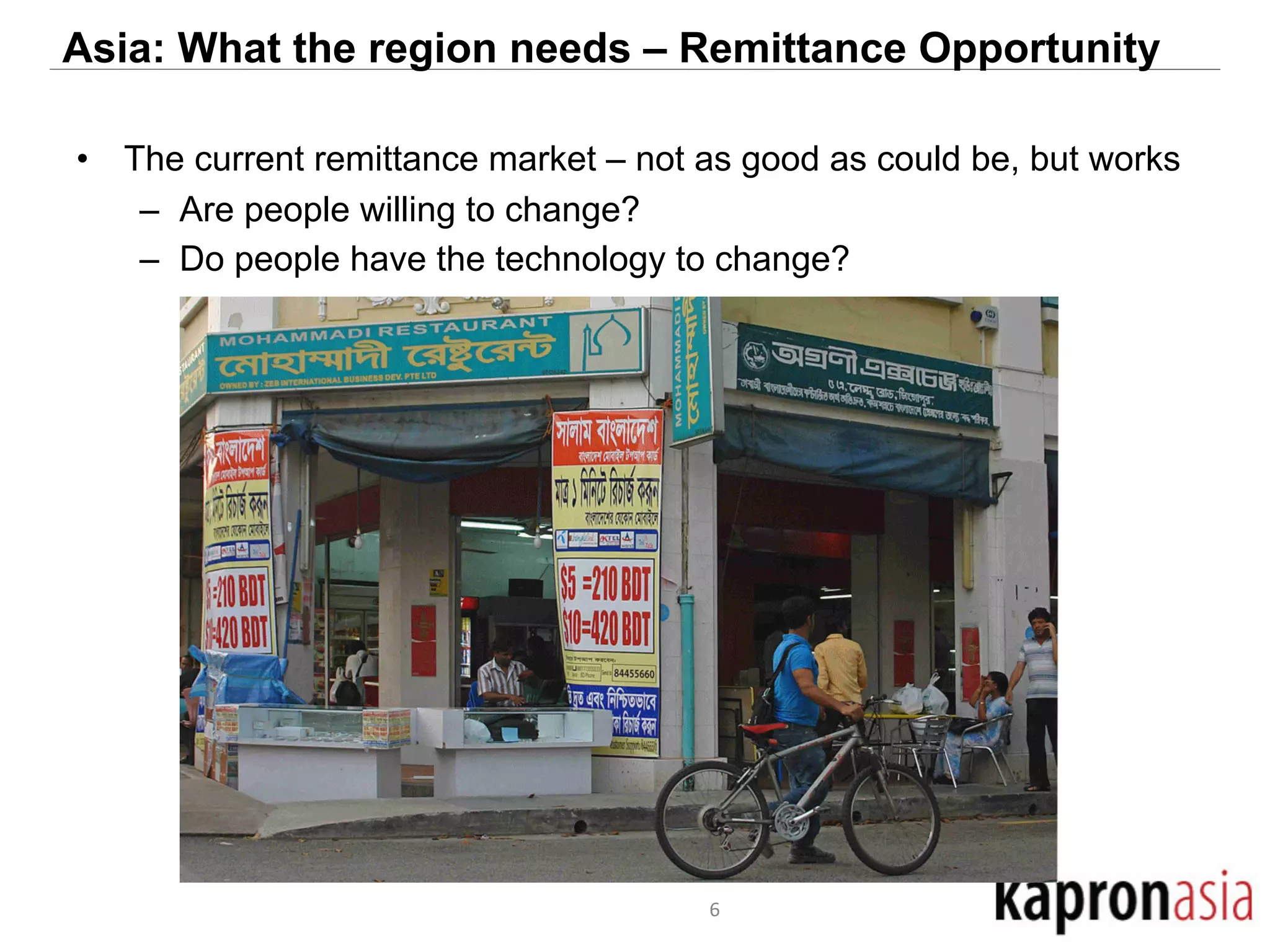
Asia: What the region needs – Remittance Opportunity 
• The current remittance market – not as good as could be, but works 
– Are people willing to change? 
– Do people have the technology to change? 
6
Asia: What the region needs - Opportunities 
– Bitcoin remittance fees high – 10% for bitcoin ATMs 
• Western union ~3% 
• Brazil $5 to anywhere, any amount 
– Needs and challenges vary 
• China 
– Move money out of country for life for kids 
– Limited domestic investment products 
– 0.5% 
• India 
– Avoid taxes 
– Diversify investment 
– 2-3% 
– If there aren’t rupee ATMs, how can we get Bitcoin ATMs 
there? 
7
Asia: What the region doesn’t need…or won’t take 
• Domestic payments are cheap: $0.10 to send a near-real time inter 
-bank payment from SH to BJ 
• Merchant payments are (often) cheap: ~1% discount rate in China 
• Unplanned risk in the financial system 
• Is there a need for a new store of value? 
• What problems is it solving? 
– Octopus card in Hong Kong 
• Has gone from a privatized transit card to one of the most 
convenient forms of payment 
• Octopus HK Ltd. is a separate company -> focused on profit 
– Singapore has EZ-Link – hasn’t yet been allowed to move into 
other businesses, but could 
– What is easier than swiping a card? 
8
Asia: Regulation 
• Regulation has been a bit all over the map 
– Developed financial industries -> more measured response 
– Less developed -> shoot from hip 
• HK / Singapore will be key bases of development -> measured 
approach to new ideas 
– HK capital markets? 
– Singapore payments? 
• Certainly haven’t seen the end of regulation in Asia 
– Additional exchange regulation might come 
– But payment system / altcoin / ATM hasn’t even started 
9
10
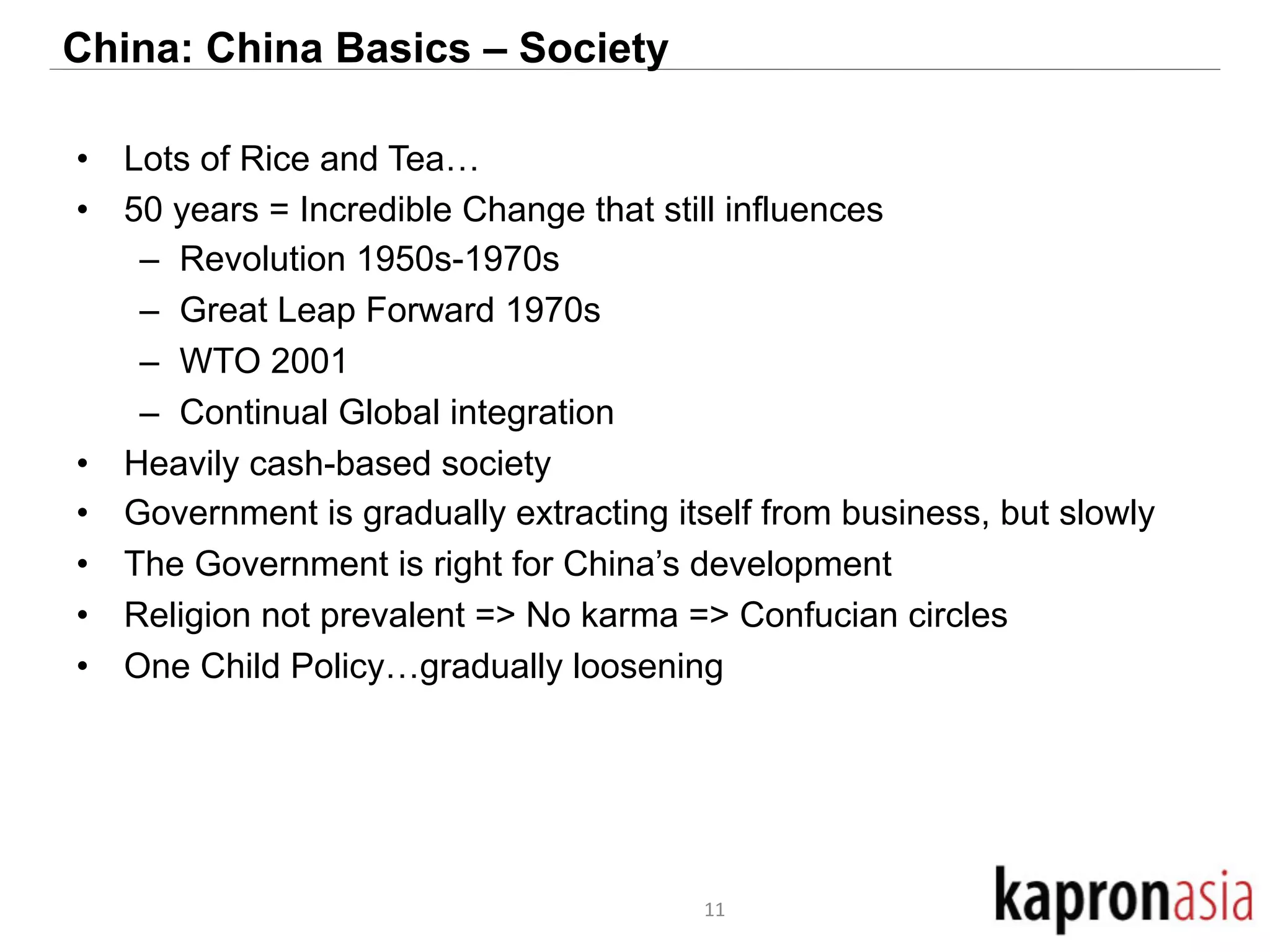
China: China Basics – Society 
• Lots of Rice and Tea… 
• 50 years = Incredible Change that still influences 
– Revolution 1950s-1970s 
– Great Leap Forward 1970s 
– WTO 2001 
– Continual Global integration 
• Heavily cash-based society 
• Government is gradually extracting itself from business, but slowly 
• The Government is right for China’s development 
• Religion not prevalent => No karma => Confucian circles 
• One Child Policy…gradually loosening 
11
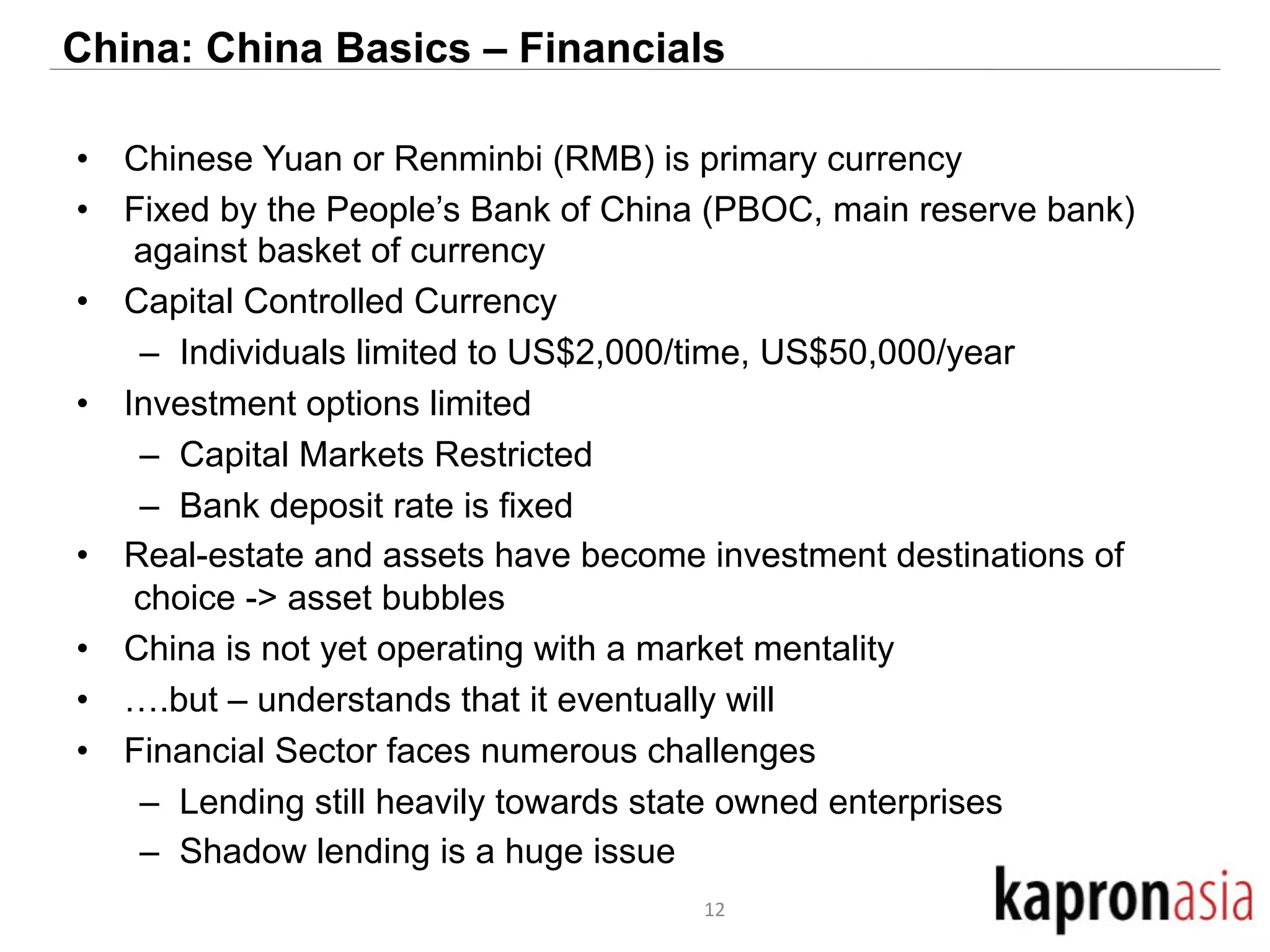
China: China Basics – Financials 
• Chinese Yuan or Renminbi (RMB) is primary currency 
• Fixed by the People’s Bank of China (PBOC, main reserve bank) 
against basket of currency 
• Capital Controlled Currency 
– Individuals limited to US$2,000/time, US$50,000/year 
• Investment options limited 
– Capital Markets Restricted 
– Bank deposit rate is fixed 
• Real-estate and assets have become investment destinations of 
choice -> asset bubbles 
• China is not yet operating with a market mentality 
• ….but – understands that it eventually will 
• Financial Sector faces numerous challenges 
– Lending still heavily towards state owned enterprises 
– Shadow lending is a huge issue 
12
China: China Basics – China Today 
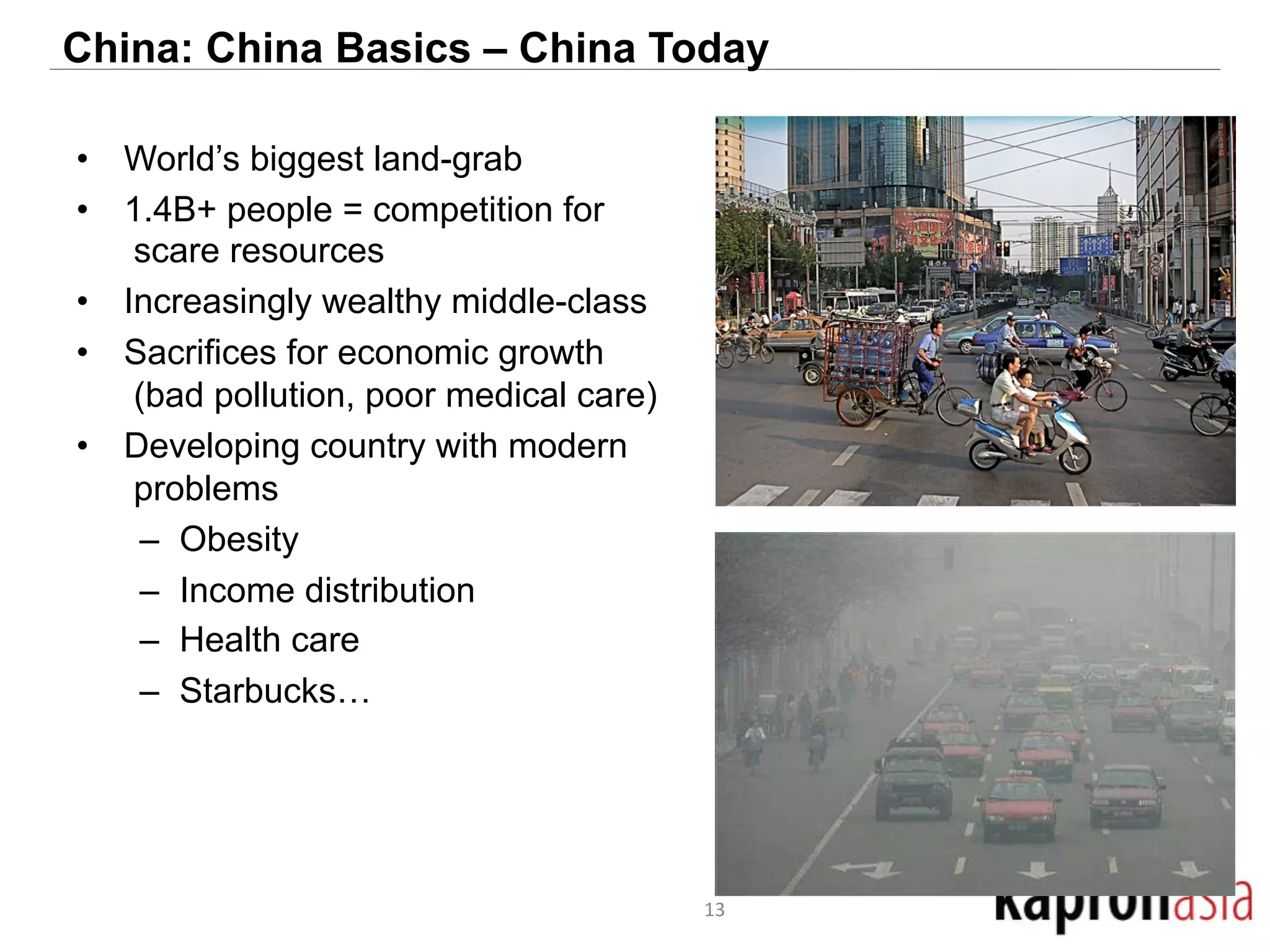
• World’s biggest land-grab 
• 1.4B+ people = competition for 
scare resources 
• Increasingly wealthy middle-class 
• Sacrifices for economic growth 
(bad pollution, poor medical care) 
• Developing country with modern 
problems 
– Obesity 
– Income distribution 
– Health care 
– Starbucks… 
13
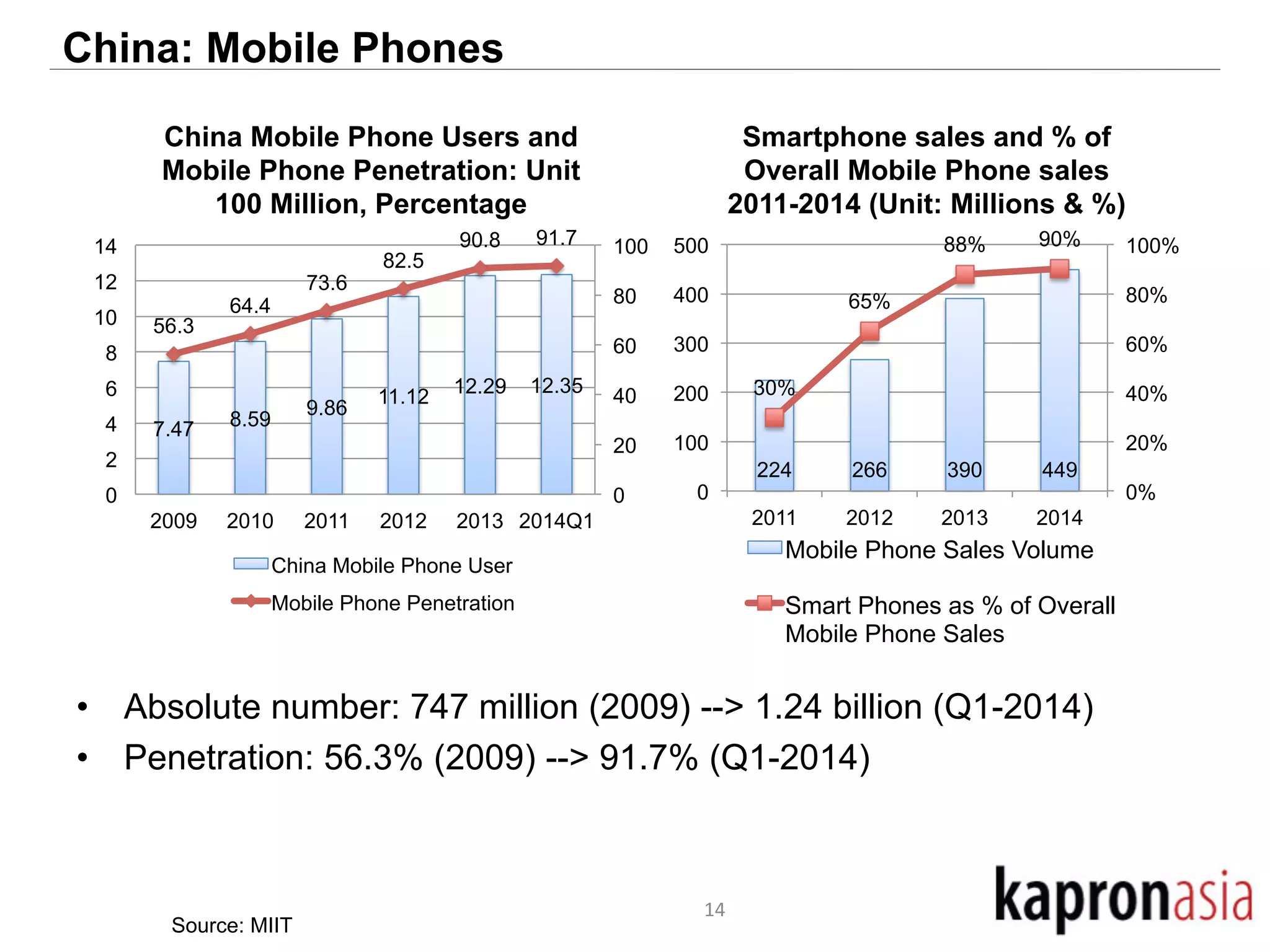
China: Mobile Phones 
China Mobile Phone Users and 
Mobile Phone Penetration: Unit 
56.3 
100 Million, Percentage 
64.4 
7.47 8.59 9.86 11.12 12.29 12.35 
100 
80 
60 
40 
20 
14 
12 
10 
8 
6 
4 
2 
Smartphone sales and % of 
Overall Mobile Phone sales 
2011-2014 (Unit: Millions & %) 
30% 
65% 
88% 90% 
500 
400 
300 
200 
100 
• Absolute number: 747 million (2009) --> 1.24 billion (Q1-2014) 
• Penetration: 56.3% (2009) --> 91.7% (Q1-2014) 
14 
Source: MIIT 
73.6 
82.5 
90.8 91.7 
0 
0 
2009 2010 2011 2012 2013 2014Q1 
China Mobile Phone User 
Mobile Phone Penetration 
224 266 390 449 
100% 
80% 
60% 
40% 
20% 
0% 
0 
2011 2012 2013 2014 
Mobile Phone Sales Volume 
Smart Phones as % of Overall 
Mobile Phone Sales
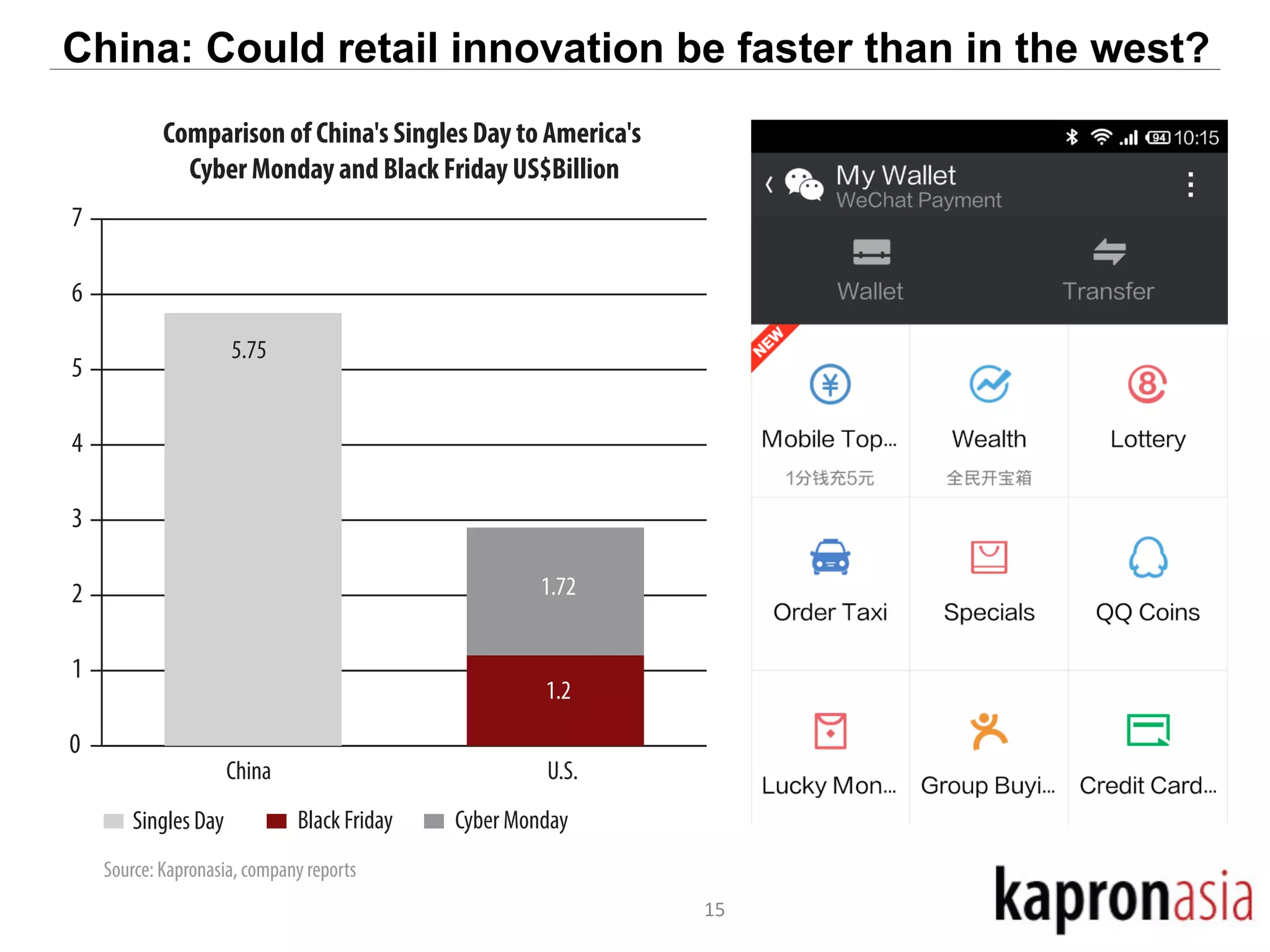
China: Could retail innovation be faster than in the west? 
15 
7 
6 
5 
4 
3 
2 
1 
0 
Comparison of China's Singles Day to America's 
Cyber Monday and Black Friday US$Billion 
Singles Day 
5.75 
1.72 
1.2 
China U.S. 
Black Friday Cyber Monday 
Source: Kapronasia, company reports
China: Could retail innovation be faster than in West? 
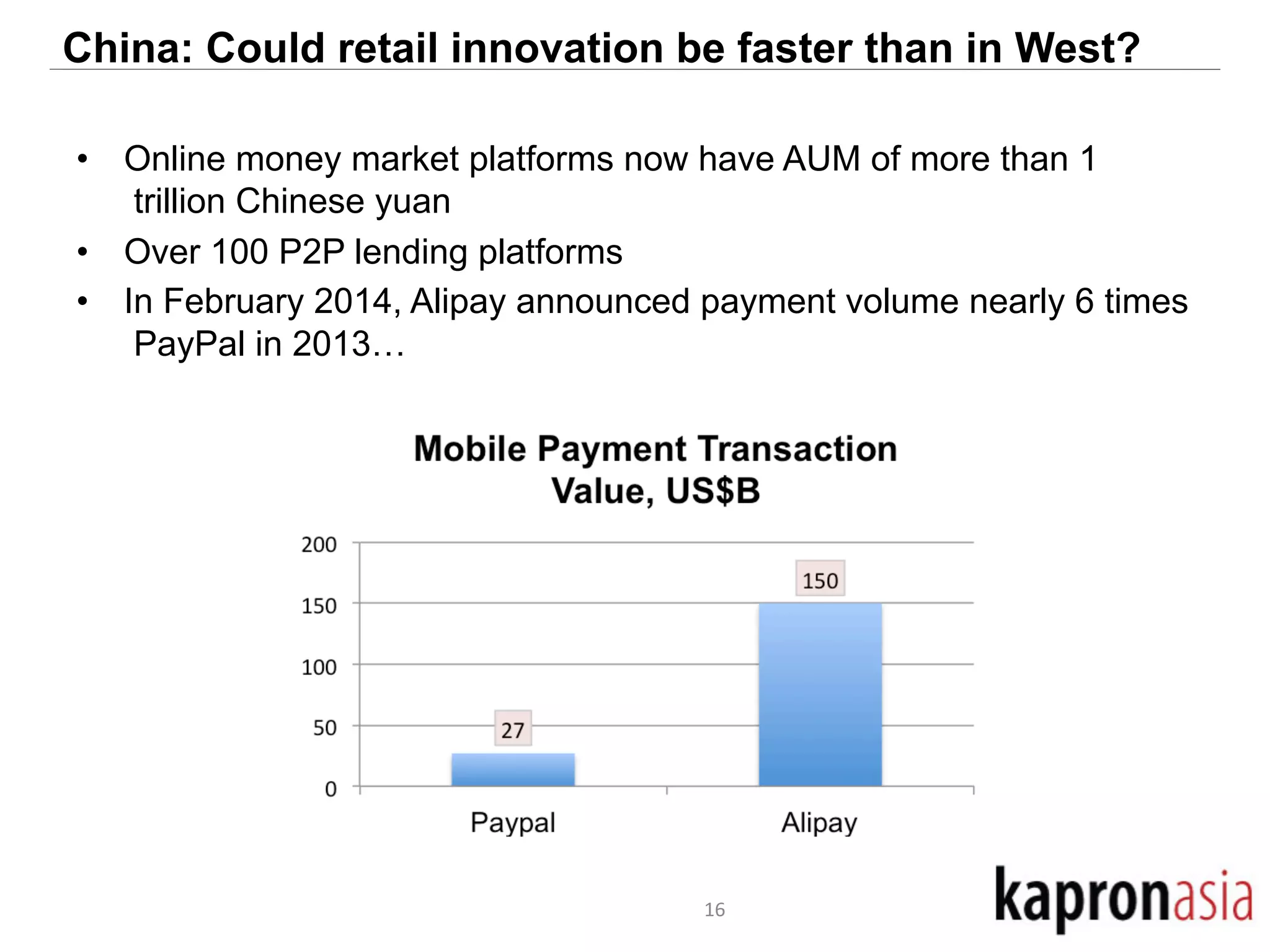
• Online money market platforms now have AUM of more than 1 
trillion Chinese yuan 
• Over 100 P2P lending platforms 
• In February 2014, Alipay announced payment volume nearly 6 times 
PayPal in 2013… 
16
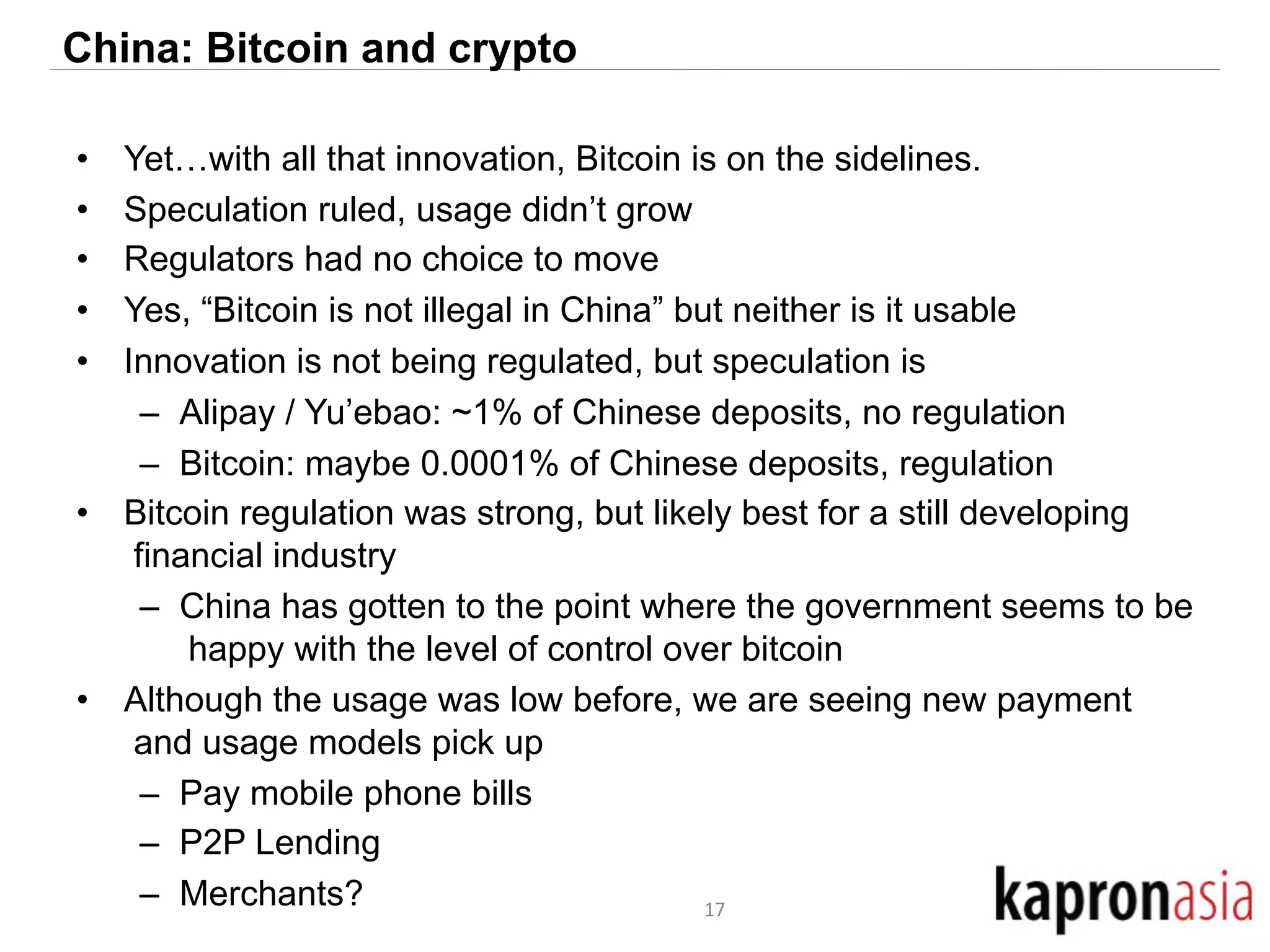
China: Bitcoin and crypto 
• Yet…with all that innovation, Bitcoin is on the sidelines. 
• Speculation ruled, usage didn’t grow 
• Regulators had no choice to move 
• Yes, “Bitcoin is not illegal in China” but neither is it usable 
• Innovation is not being regulated, but speculation is 
– Alipay / Yu’ebao: ~1% of Chinese deposits, no regulation 
– Bitcoin: maybe 0.0001% of Chinese deposits, regulation 
• Bitcoin regulation was strong, but likely best for a still developing 
financial industry 
– China has gotten to the point where the government seems to be 
happy with the level of control over bitcoin 
• Although the usage was low before, we are seeing new payment 
and usage models pick up 
– Pay mobile phone bills 
– P2P Lending 
– Merchants? 17
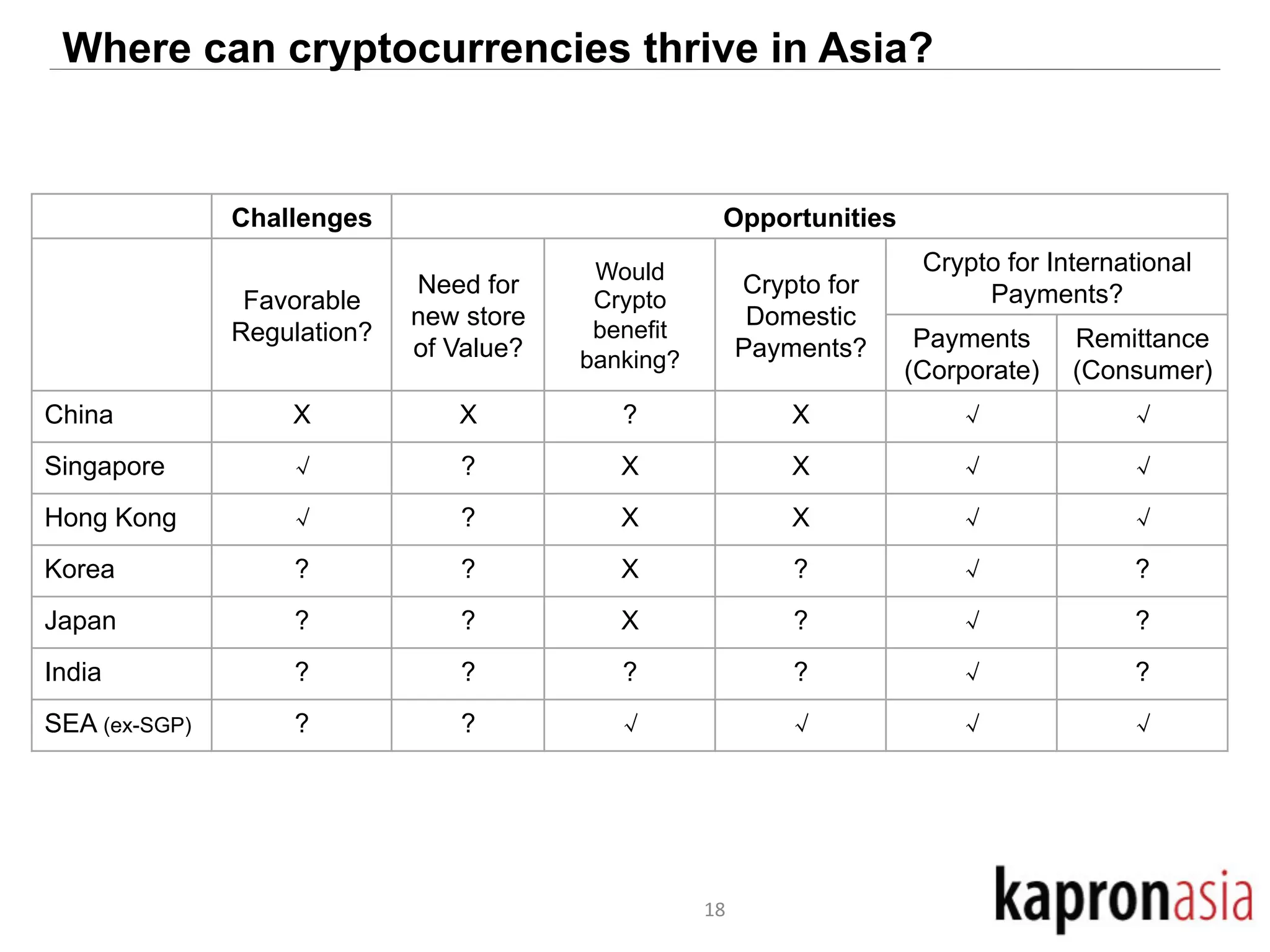
Where can cryptocurrencies thrive in Asia? 
Challenges Opportunities 
18 
Favorable 
Regulation? 
Need for 
new store 
of Value? 
Would 
Crypto 
benefit 
banking? 
Crypto for 
Domestic 
Payments? 
Crypto for International 
Payments? 
Payments 
(Corporate) 
Remittance 
(Consumer) 
China X X ? X √ √ 
Singapore √ ? X X √ √ 
Hong Kong √ ? X X √ √ 
Korea ? ? X ? √ ? 
Japan ? ? X ? √ ? 
India ? ? ? ? √ ? 
SEA (ex-SGP) ? ? √ √ √ √
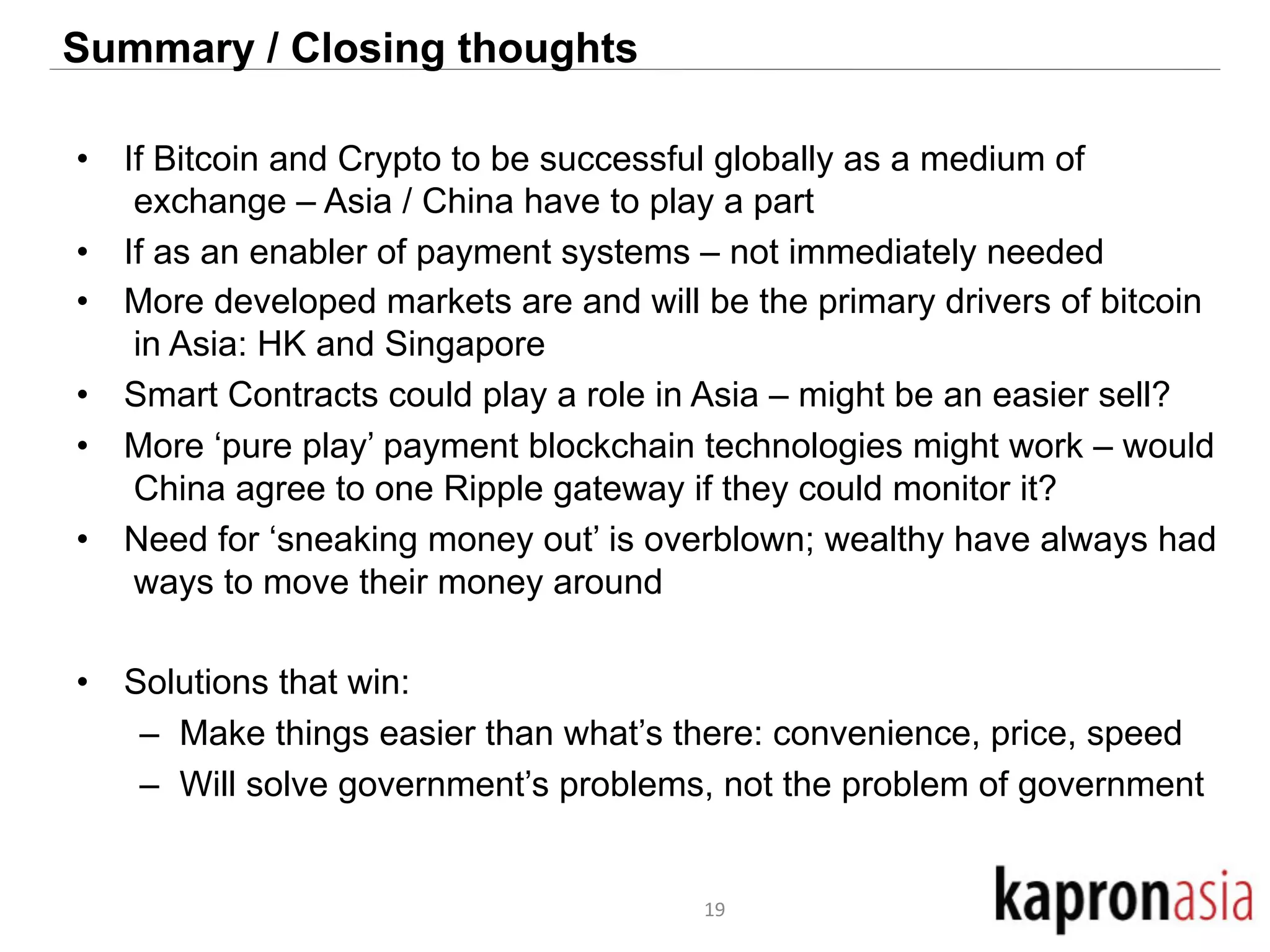
Summary / Closing thoughts 
• If Bitcoin and Crypto to be successful globally as a medium of 
exchange – Asia / China have to play a part 
• If as an enabler of payment systems – not immediately needed 
• More developed markets are and will be the primary drivers of bitcoin 
in Asia: HK and Singapore 
• Smart Contracts could play a role in Asia – might be an easier sell? 
• More ‘pure play’ payment blockchain technologies might work – would 
China agree to one Ripple gateway if they could monitor it? 
• Need for ‘sneaking money out’ is overblown; wealthy have always had 
ways to move their money around 
• Solutions that win: 
– Make things easier than what’s there: convenience, price, speed 
– Will solve government’s problems, not the problem of government 
19
Thanks / Q&A 
Visit www.kapronasia.com or send us an email: research@kapronasia.com 
Twitter: @chinafintech

inside bitcoinsvegas_zennonkapron

  • 1.
    Crypto-currency in Asia- Where are we today? Zennon Kapron Updated: October 7th, 2014
  • 2.
    Kapronasia Background •Founded in 2007 with the specific intent of helping financial technology companies understand and take advantage of market opportunities in the China Financial Services market • Three business focuses: Research, Consulting, Sales Enablement • Offices in Hong Kong, Shanghai, Singapore Selected Clients:
  • 3.
    Today • Cryptocurrencyin Asia – Regulation – Opportunities – Challenges • China – Development – Bitcoin / crypto in China • Summary • Q&A 3
  • 4.
    Asia: The Basics • Largest economic block in the world • 48 countries • 100+ languages and dialects • 20+ currencies • Varying regulations, cultures, practices… • Increasingly wealthy customers and companies • But also one of the least mature financial services industries -> challenges & opportunities 4
  • 5.
    Asia: What theregion needs – Payment Opportunities • Diverse domestic payment systems – Vary by country – Very few interoperability standards – Potential for an Asian SEPA*? Possible with out an Asian EUR? • Corporate International payments – Leads the world in trade, yet payments are antiquated – China International Payments System (CIPS) still in draft – Very few options for corporates – SMEs are stuffed: • SWIFT is not cheap especially if you are an SME ($50) • SMEs already struggling with costs and liquidity • Ship today, get paid…sometime *SEPA –Single European Payments Area 5
  • 6.
    Asia: What theregion needs – Remittance Opportunity • The current remittance market – not as good as could be, but works – Are people willing to change? – Do people have the technology to change? 6
  • 7.
    Asia: What theregion needs - Opportunities – Bitcoin remittance fees high – 10% for bitcoin ATMs • Western union ~3% • Brazil $5 to anywhere, any amount – Needs and challenges vary • China – Move money out of country for life for kids – Limited domestic investment products – 0.5% • India – Avoid taxes – Diversify investment – 2-3% – If there aren’t rupee ATMs, how can we get Bitcoin ATMs there? 7
  • 8.
    Asia: What theregion doesn’t need…or won’t take • Domestic payments are cheap: $0.10 to send a near-real time inter -bank payment from SH to BJ • Merchant payments are (often) cheap: ~1% discount rate in China • Unplanned risk in the financial system • Is there a need for a new store of value? • What problems is it solving? – Octopus card in Hong Kong • Has gone from a privatized transit card to one of the most convenient forms of payment • Octopus HK Ltd. is a separate company -> focused on profit – Singapore has EZ-Link – hasn’t yet been allowed to move into other businesses, but could – What is easier than swiping a card? 8
  • 9.
    Asia: Regulation •Regulation has been a bit all over the map – Developed financial industries -> more measured response – Less developed -> shoot from hip • HK / Singapore will be key bases of development -> measured approach to new ideas – HK capital markets? – Singapore payments? • Certainly haven’t seen the end of regulation in Asia – Additional exchange regulation might come – But payment system / altcoin / ATM hasn’t even started 9
  • 10.
  • 11.
    China: China Basics– Society • Lots of Rice and Tea… • 50 years = Incredible Change that still influences – Revolution 1950s-1970s – Great Leap Forward 1970s – WTO 2001 – Continual Global integration • Heavily cash-based society • Government is gradually extracting itself from business, but slowly • The Government is right for China’s development • Religion not prevalent => No karma => Confucian circles • One Child Policy…gradually loosening 11
  • 12.
    China: China Basics– Financials • Chinese Yuan or Renminbi (RMB) is primary currency • Fixed by the People’s Bank of China (PBOC, main reserve bank) against basket of currency • Capital Controlled Currency – Individuals limited to US$2,000/time, US$50,000/year • Investment options limited – Capital Markets Restricted – Bank deposit rate is fixed • Real-estate and assets have become investment destinations of choice -> asset bubbles • China is not yet operating with a market mentality • ….but – understands that it eventually will • Financial Sector faces numerous challenges – Lending still heavily towards state owned enterprises – Shadow lending is a huge issue 12
  • 13.
    China: China Basics– China Today • World’s biggest land-grab • 1.4B+ people = competition for scare resources • Increasingly wealthy middle-class • Sacrifices for economic growth (bad pollution, poor medical care) • Developing country with modern problems – Obesity – Income distribution – Health care – Starbucks… 13
  • 14.
    China: Mobile Phones China Mobile Phone Users and Mobile Phone Penetration: Unit 56.3 100 Million, Percentage 64.4 7.47 8.59 9.86 11.12 12.29 12.35 100 80 60 40 20 14 12 10 8 6 4 2 Smartphone sales and % of Overall Mobile Phone sales 2011-2014 (Unit: Millions & %) 30% 65% 88% 90% 500 400 300 200 100 • Absolute number: 747 million (2009) --> 1.24 billion (Q1-2014) • Penetration: 56.3% (2009) --> 91.7% (Q1-2014) 14 Source: MIIT 73.6 82.5 90.8 91.7 0 0 2009 2010 2011 2012 2013 2014Q1 China Mobile Phone User Mobile Phone Penetration 224 266 390 449 100% 80% 60% 40% 20% 0% 0 2011 2012 2013 2014 Mobile Phone Sales Volume Smart Phones as % of Overall Mobile Phone Sales
  • 15.
    China: Could retailinnovation be faster than in the west? 15 7 6 5 4 3 2 1 0 Comparison of China's Singles Day to America's Cyber Monday and Black Friday US$Billion Singles Day 5.75 1.72 1.2 China U.S. Black Friday Cyber Monday Source: Kapronasia, company reports
  • 16.
    China: Could retailinnovation be faster than in West? • Online money market platforms now have AUM of more than 1 trillion Chinese yuan • Over 100 P2P lending platforms • In February 2014, Alipay announced payment volume nearly 6 times PayPal in 2013… 16
  • 17.
    China: Bitcoin andcrypto • Yet…with all that innovation, Bitcoin is on the sidelines. • Speculation ruled, usage didn’t grow • Regulators had no choice to move • Yes, “Bitcoin is not illegal in China” but neither is it usable • Innovation is not being regulated, but speculation is – Alipay / Yu’ebao: ~1% of Chinese deposits, no regulation – Bitcoin: maybe 0.0001% of Chinese deposits, regulation • Bitcoin regulation was strong, but likely best for a still developing financial industry – China has gotten to the point where the government seems to be happy with the level of control over bitcoin • Although the usage was low before, we are seeing new payment and usage models pick up – Pay mobile phone bills – P2P Lending – Merchants? 17
  • 18.
    Where can cryptocurrenciesthrive in Asia? Challenges Opportunities 18 Favorable Regulation? Need for new store of Value? Would Crypto benefit banking? Crypto for Domestic Payments? Crypto for International Payments? Payments (Corporate) Remittance (Consumer) China X X ? X √ √ Singapore √ ? X X √ √ Hong Kong √ ? X X √ √ Korea ? ? X ? √ ? Japan ? ? X ? √ ? India ? ? ? ? √ ? SEA (ex-SGP) ? ? √ √ √ √
  • 19.
    Summary / Closingthoughts • If Bitcoin and Crypto to be successful globally as a medium of exchange – Asia / China have to play a part • If as an enabler of payment systems – not immediately needed • More developed markets are and will be the primary drivers of bitcoin in Asia: HK and Singapore • Smart Contracts could play a role in Asia – might be an easier sell? • More ‘pure play’ payment blockchain technologies might work – would China agree to one Ripple gateway if they could monitor it? • Need for ‘sneaking money out’ is overblown; wealthy have always had ways to move their money around • Solutions that win: – Make things easier than what’s there: convenience, price, speed – Will solve government’s problems, not the problem of government 19
  • 20.
    Thanks / Q&A Visit www.kapronasia.com or send us an email: research@kapronasia.com Twitter: @chinafintech