DH 2013, Lincoln, Nebraska
Encoding historical dates correctly:
Is it practical, and is it worth
it?
Janelle Jenstad, Martin Holmes, Nathan Phillips,
Sarah Milligan, and Cameron Butt
University of Victoria
mapoflondon.uvic.ca
@janellejenstad
@MoEMLondon
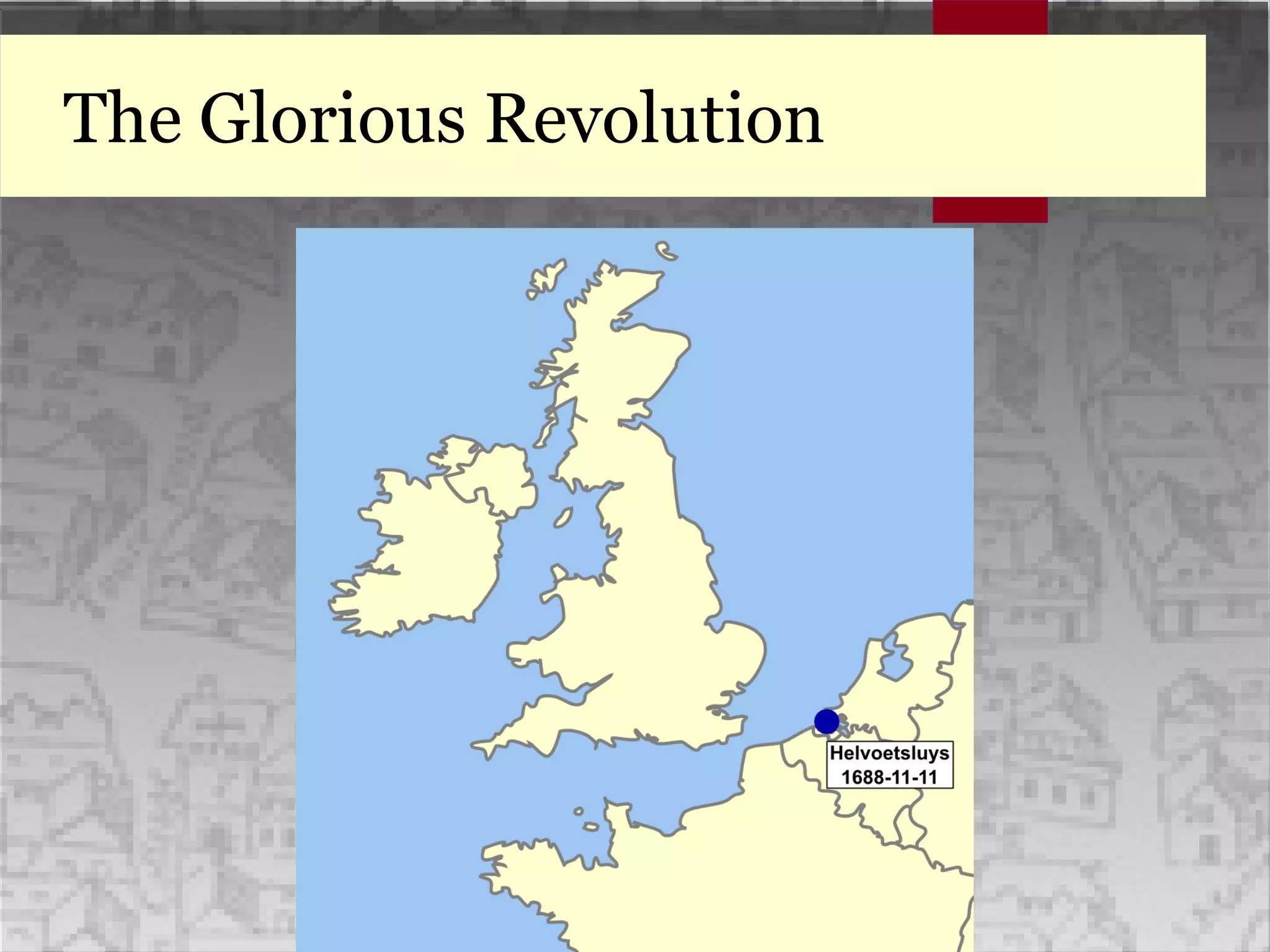
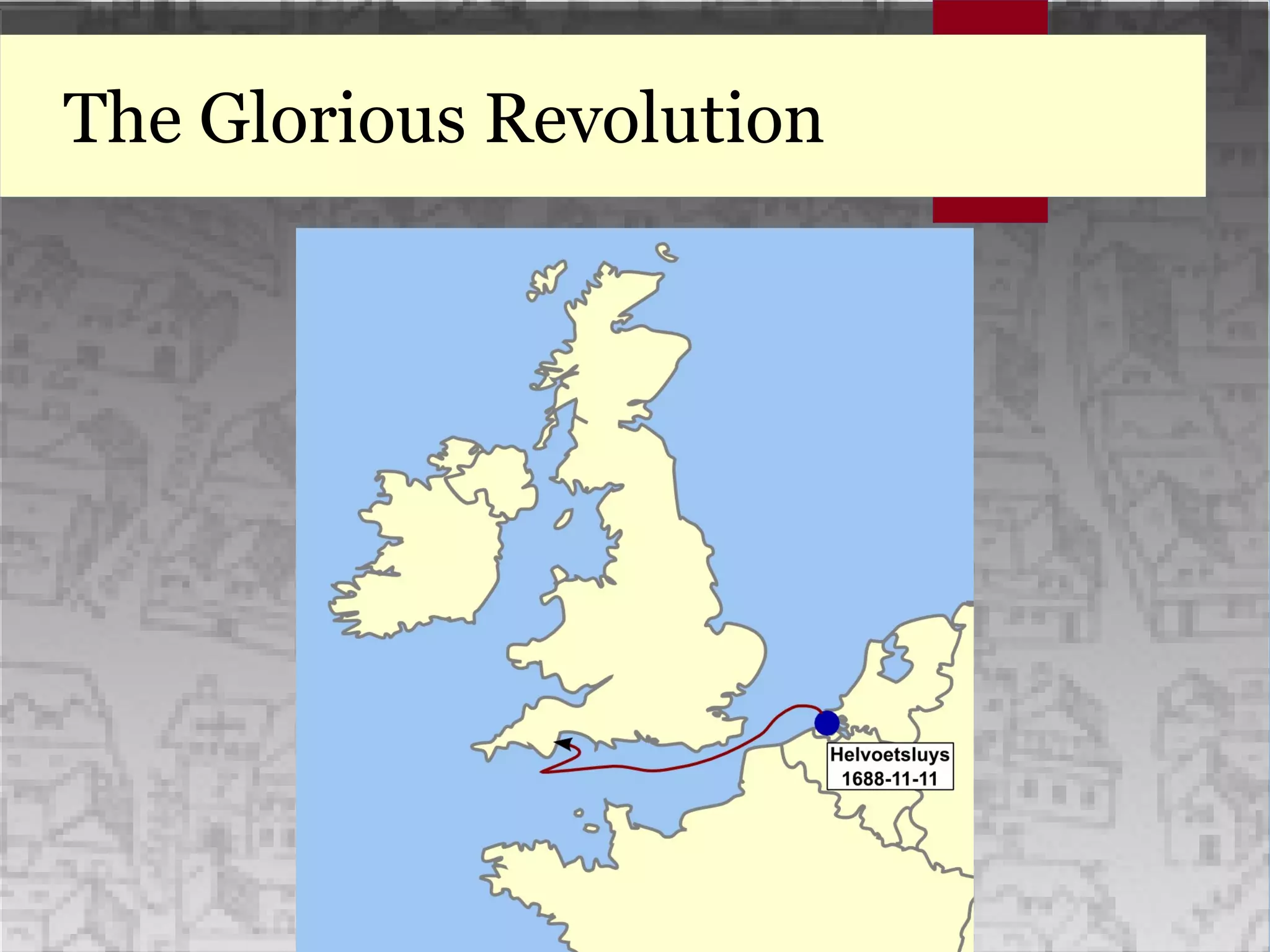
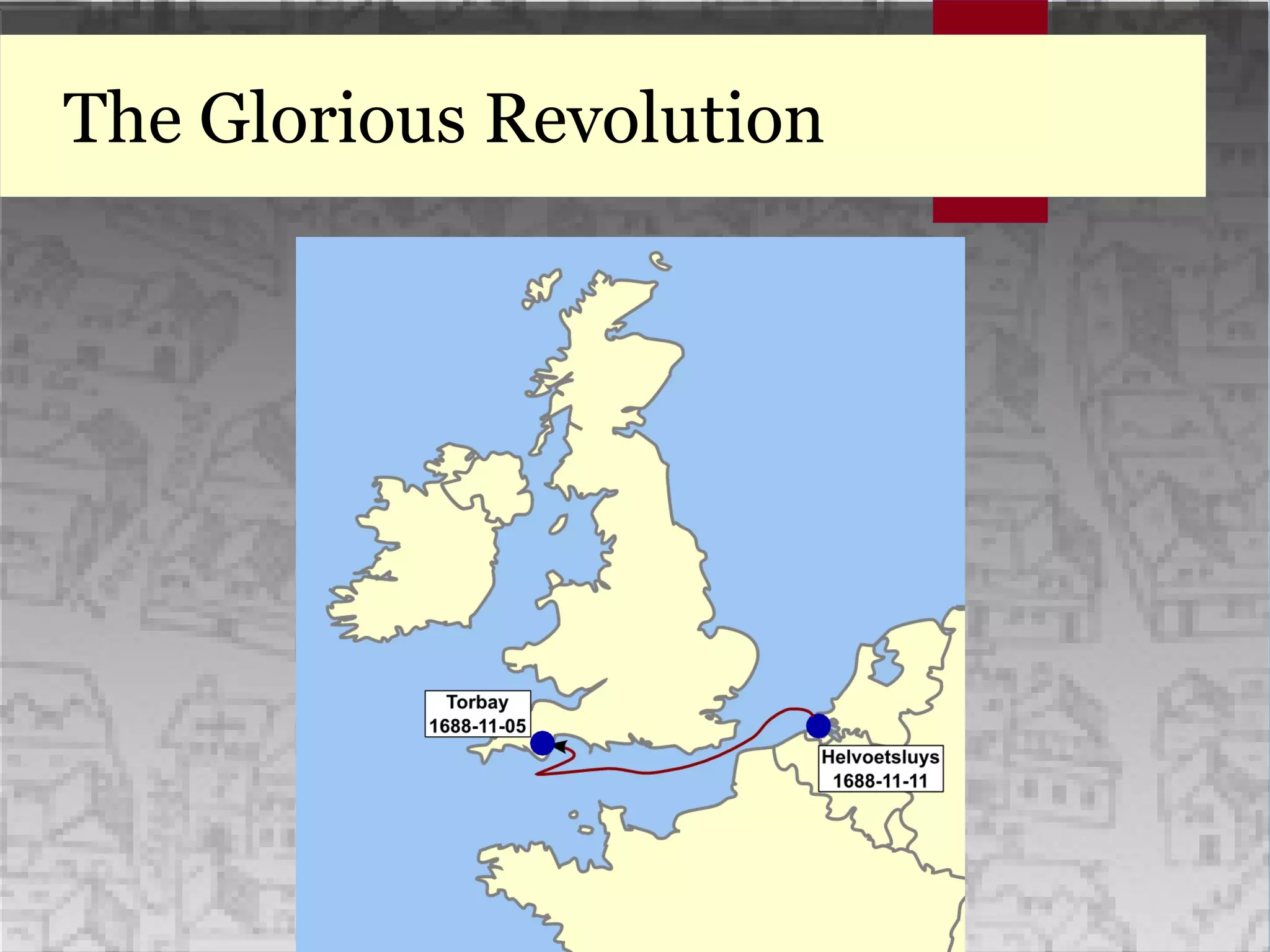
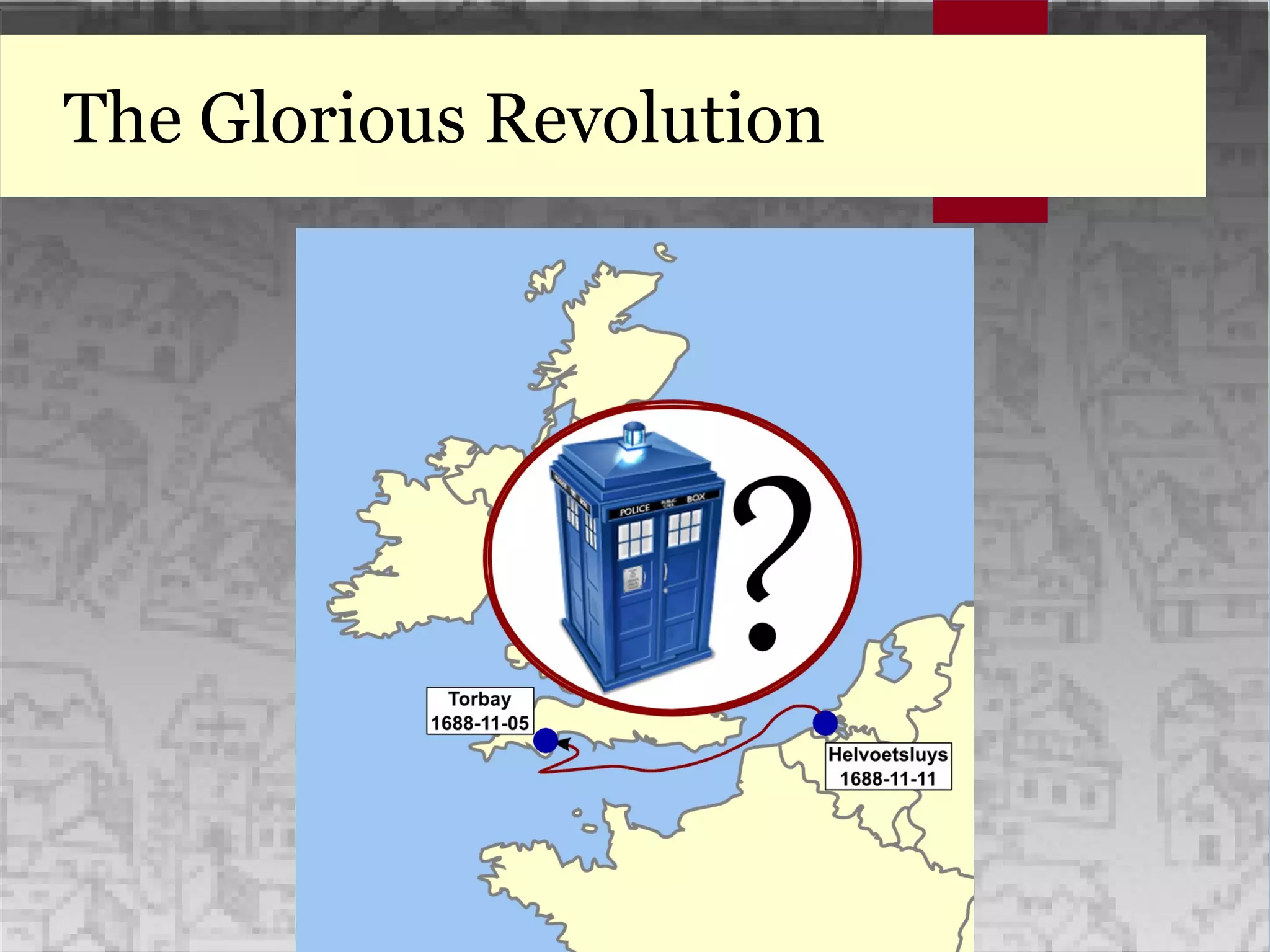
The Glorious Revolution
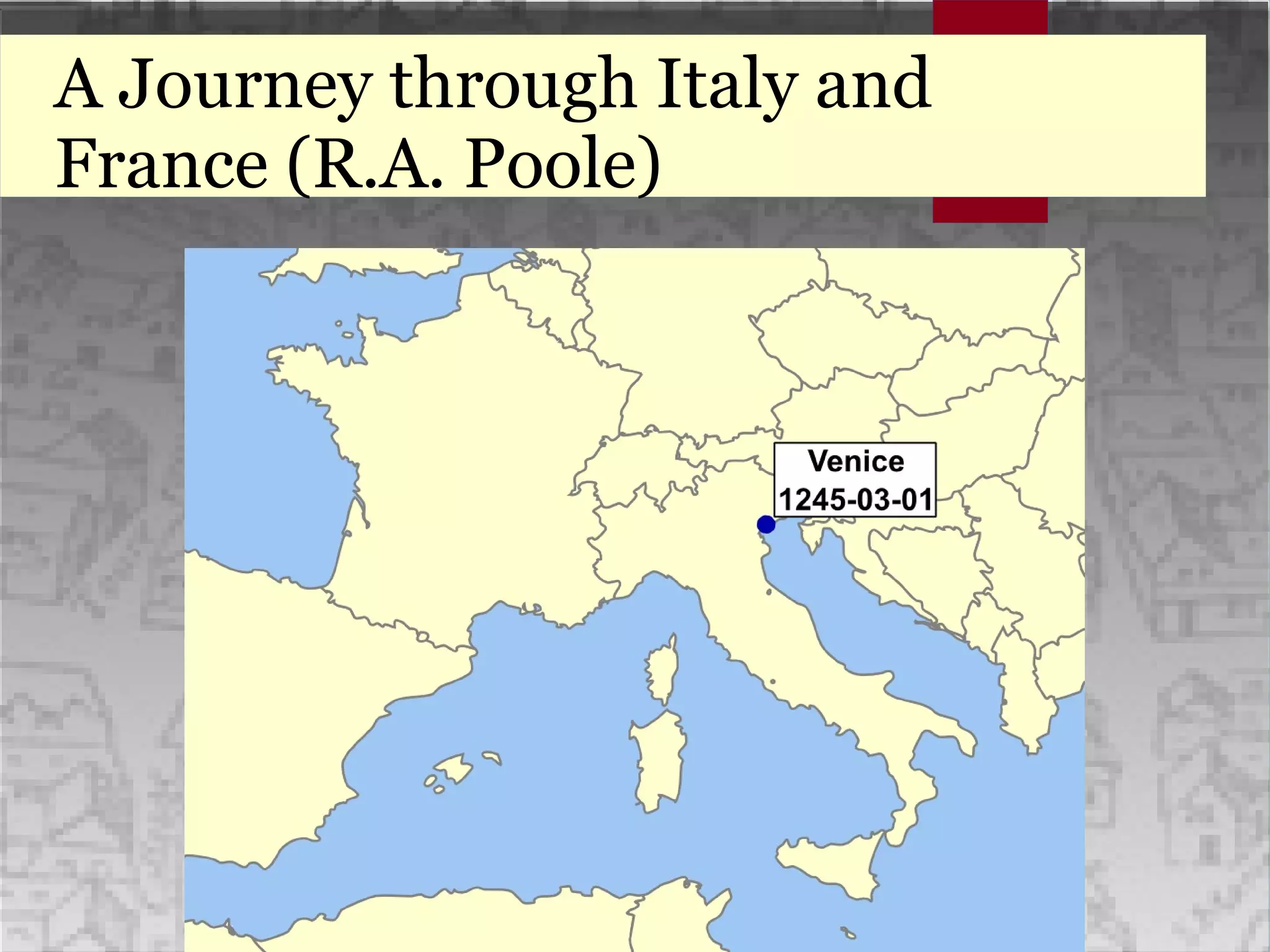
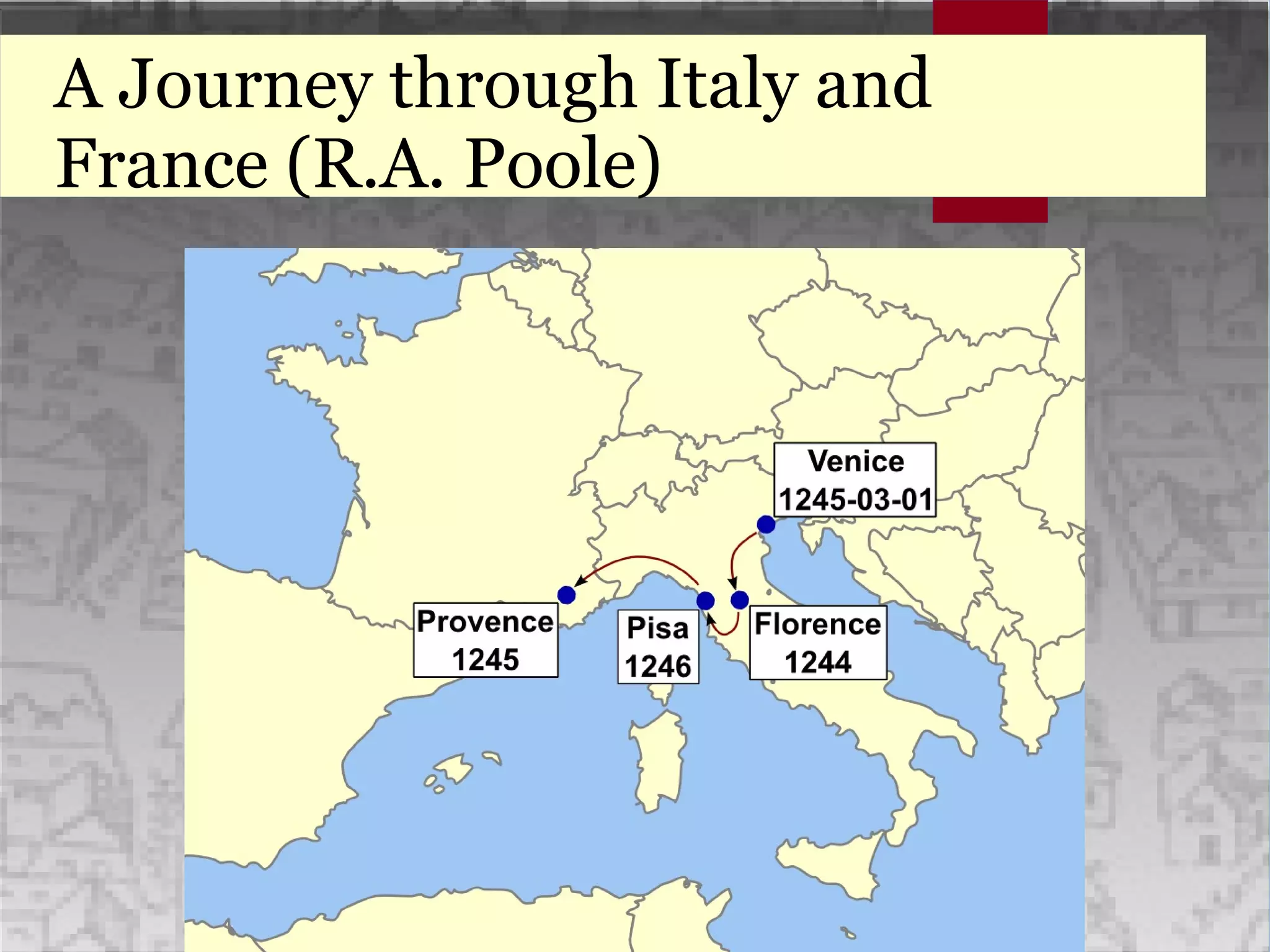
A Journey through Italy and
France (R.A. Poole)
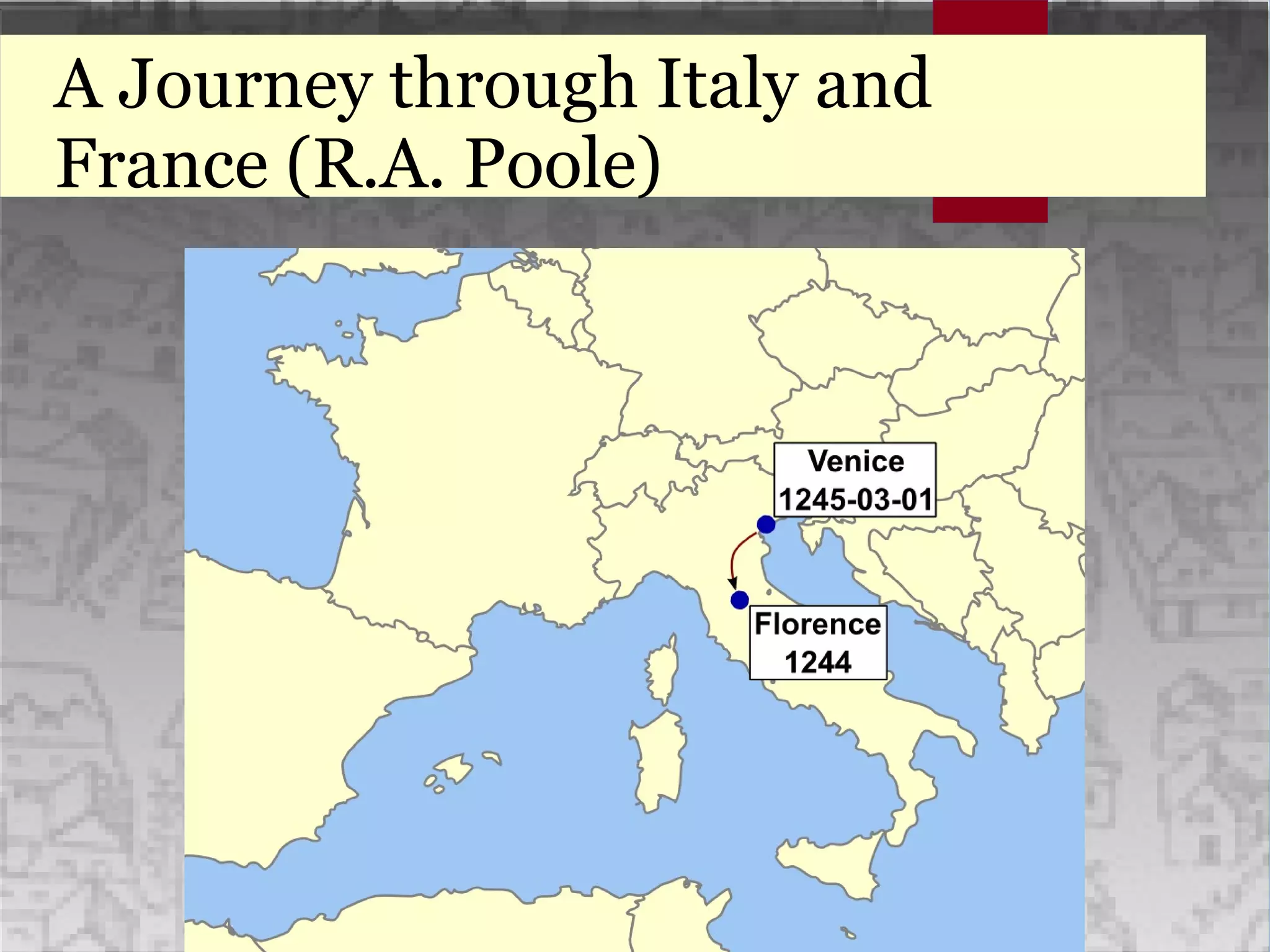
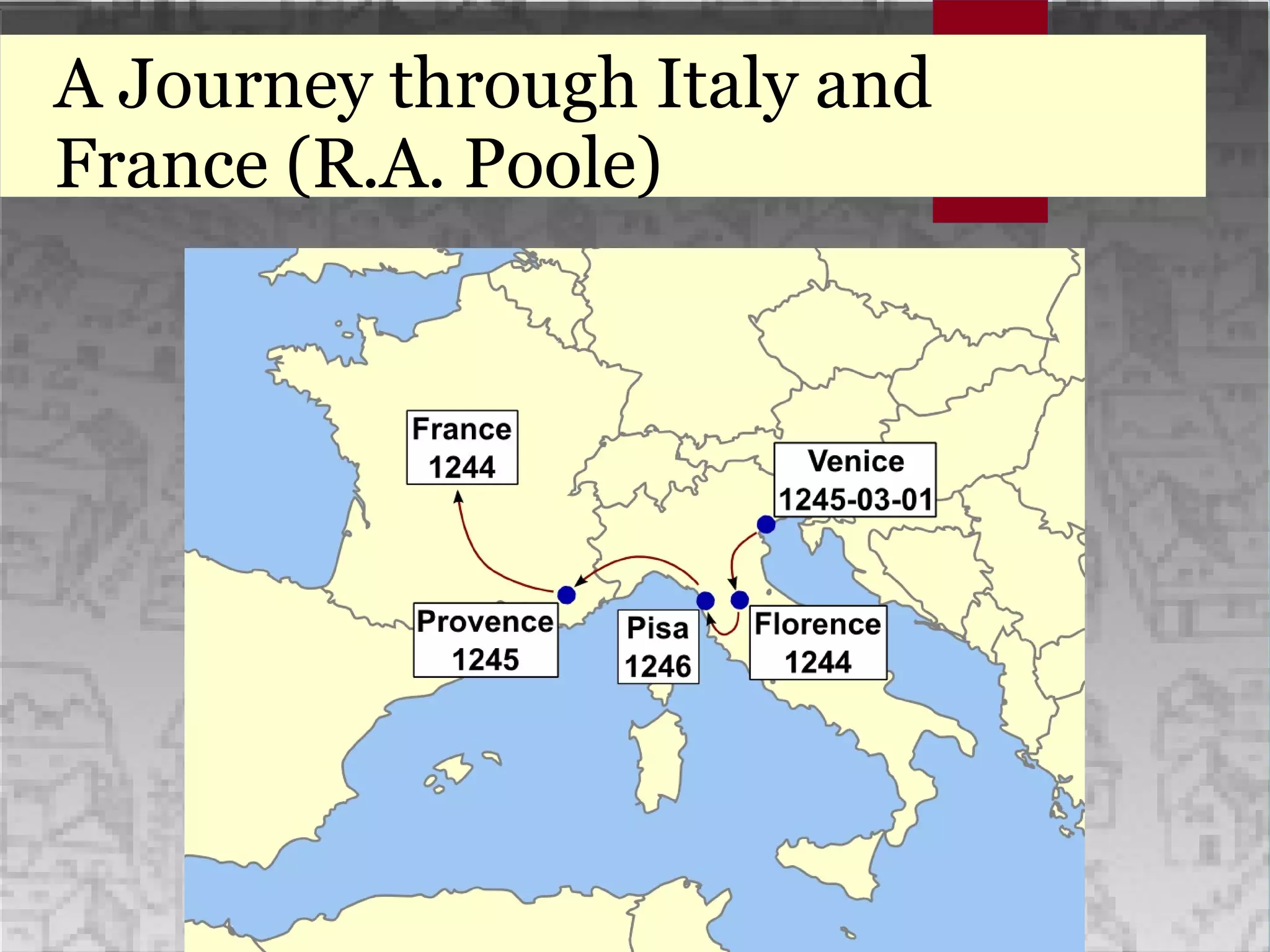
A Journey through Italy and
France (R.A. Poole)
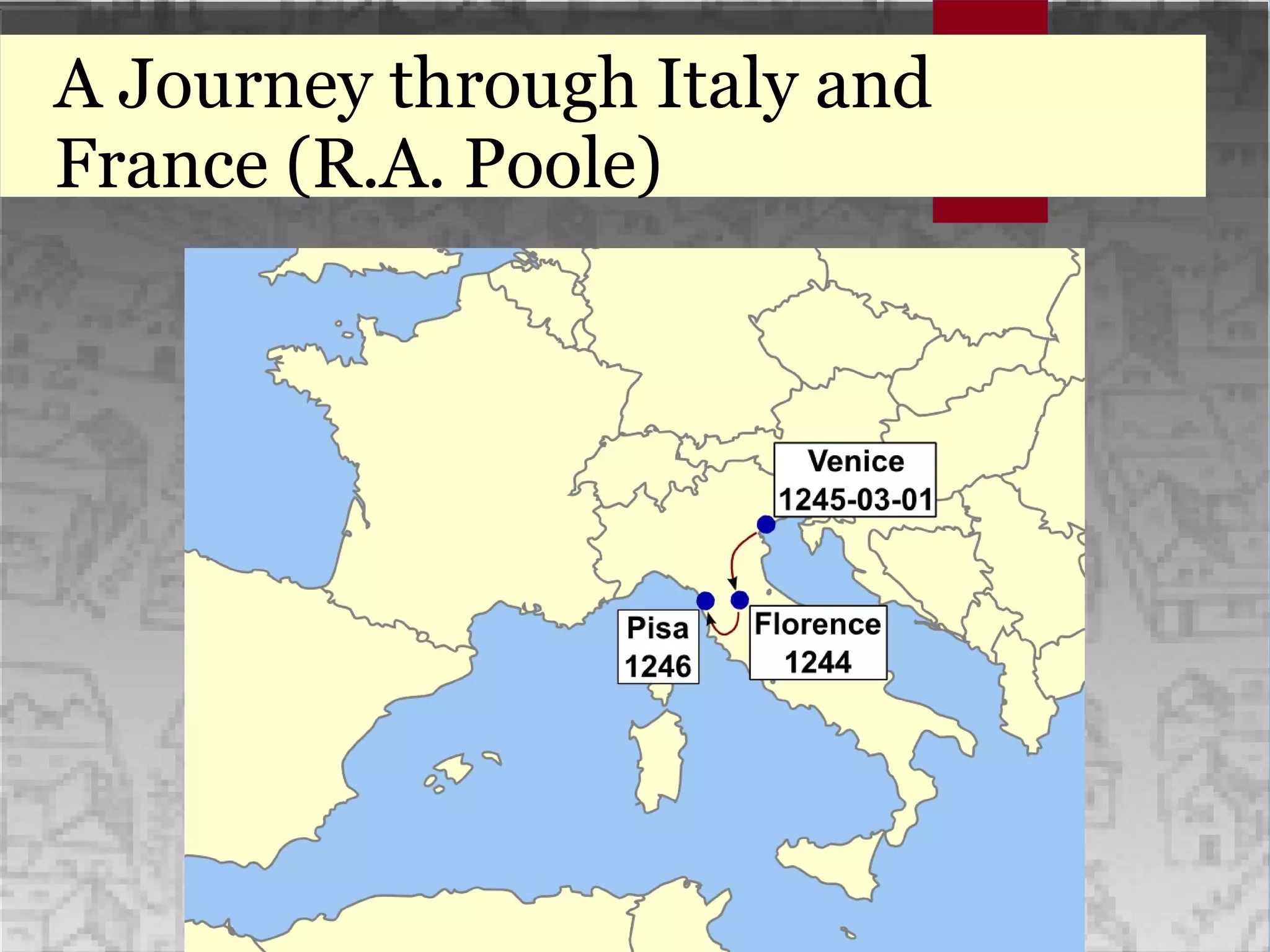
A Journey through Italy and
France (R.A. Poole)
A Journey through Italy and
France (R.A. Poole)
A Journey through Italy and
France (R.A. Poole)
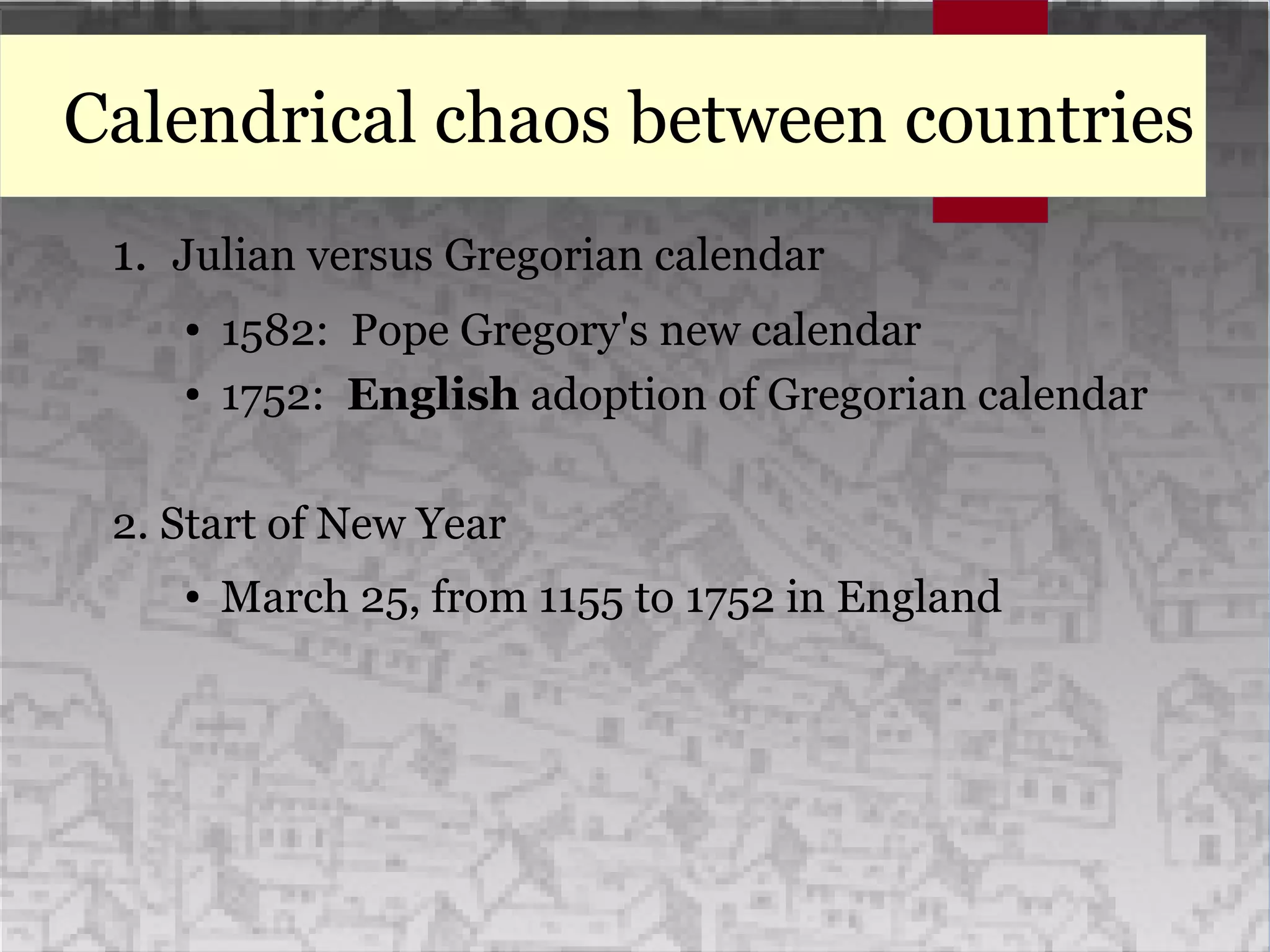
Calendrical chaos between countries
1. Julian versus Gregorian calendar
● 1582: Pope Gregory's new calendar
● 1752: English adoption of Gregorian calendar
2. Start of New Year
● March 25, from 1155 to 1752 in England
Problem? What problem?
We asked a number of colleagues on cognate
projects for advice:
● It's only a few days. How important could it be?
● Proper historians know perfectly well what a particular
date means.
● It's definitely a mess, but there's no workable solution.
● I don't want to think about it.
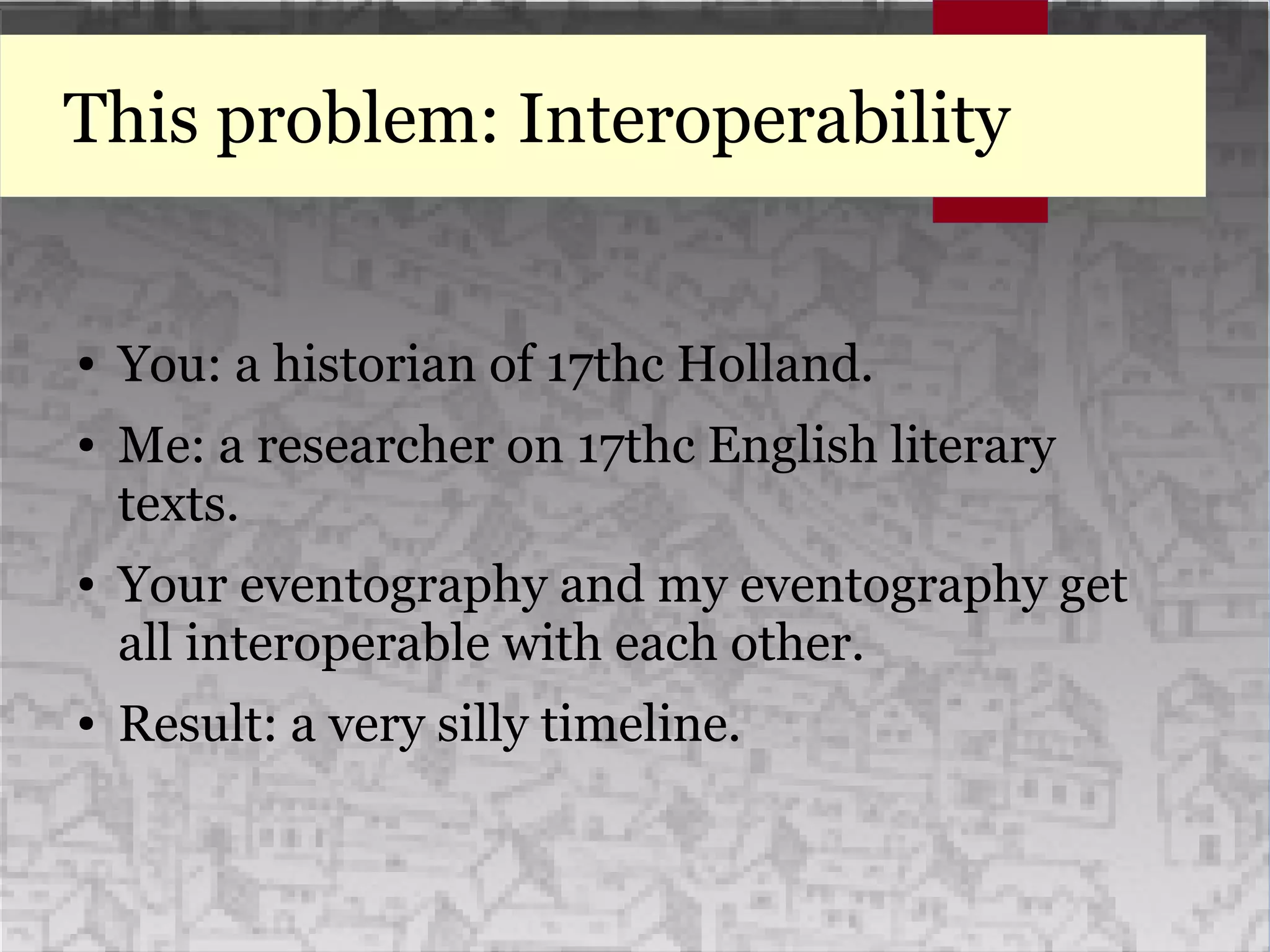
This problem: Interoperability
● You: a historian of 17thc Holland.
● Me: a researcher on 17thc English literary
texts.
● Your eventography and my eventography get
all interoperable with each other.
● Result: a very silly timeline.
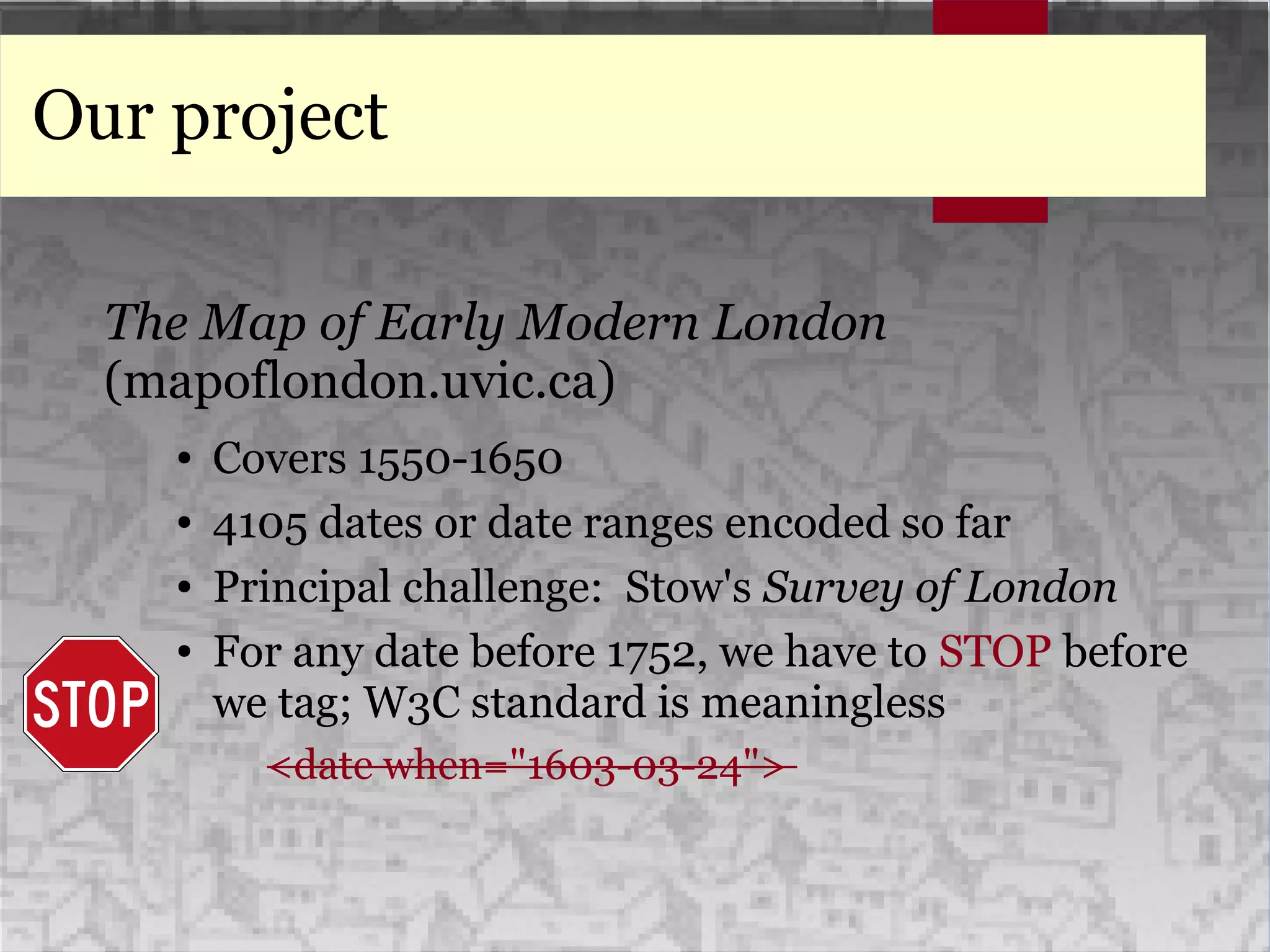
Our project
The Map of Early Modern London
(mapoflondon.uvic.ca)
● Covers 1550-1650
● 4105 dates or date ranges encoded so far
● Principal challenge: Stow's Survey of London
● For any date before 1752, we have to STOP before
we tag; W3C standard is meaningless
<date when="1603-03-24">
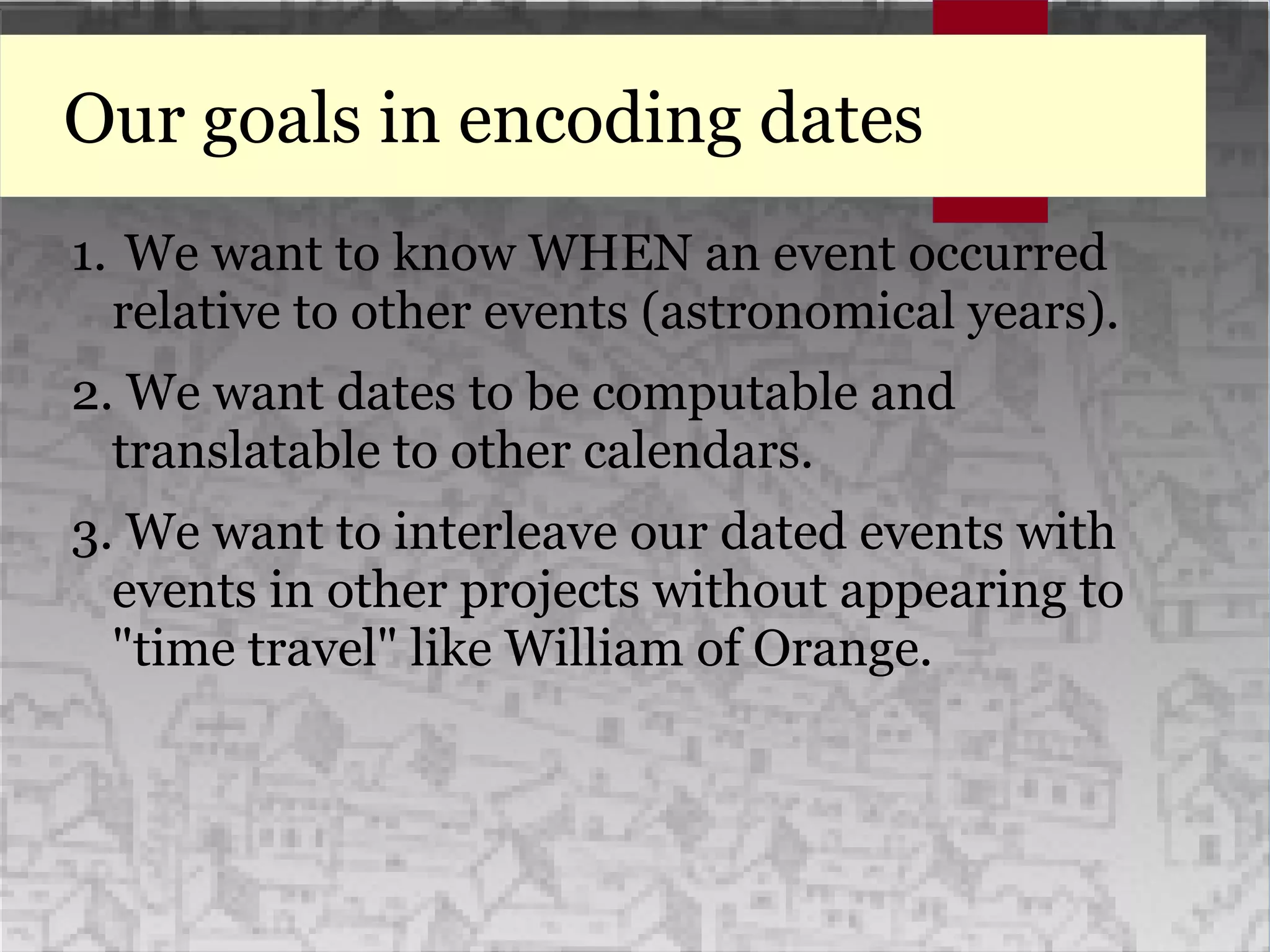
Our goals in encoding dates
1. We want to know WHEN an event occurred
relative to other events (astronomical years).
2. We want dates to be computable and
translatable to other calendars.
3. We want to interleave our dated events with
events in other projects without appearing to
"time travel" like William of Orange.
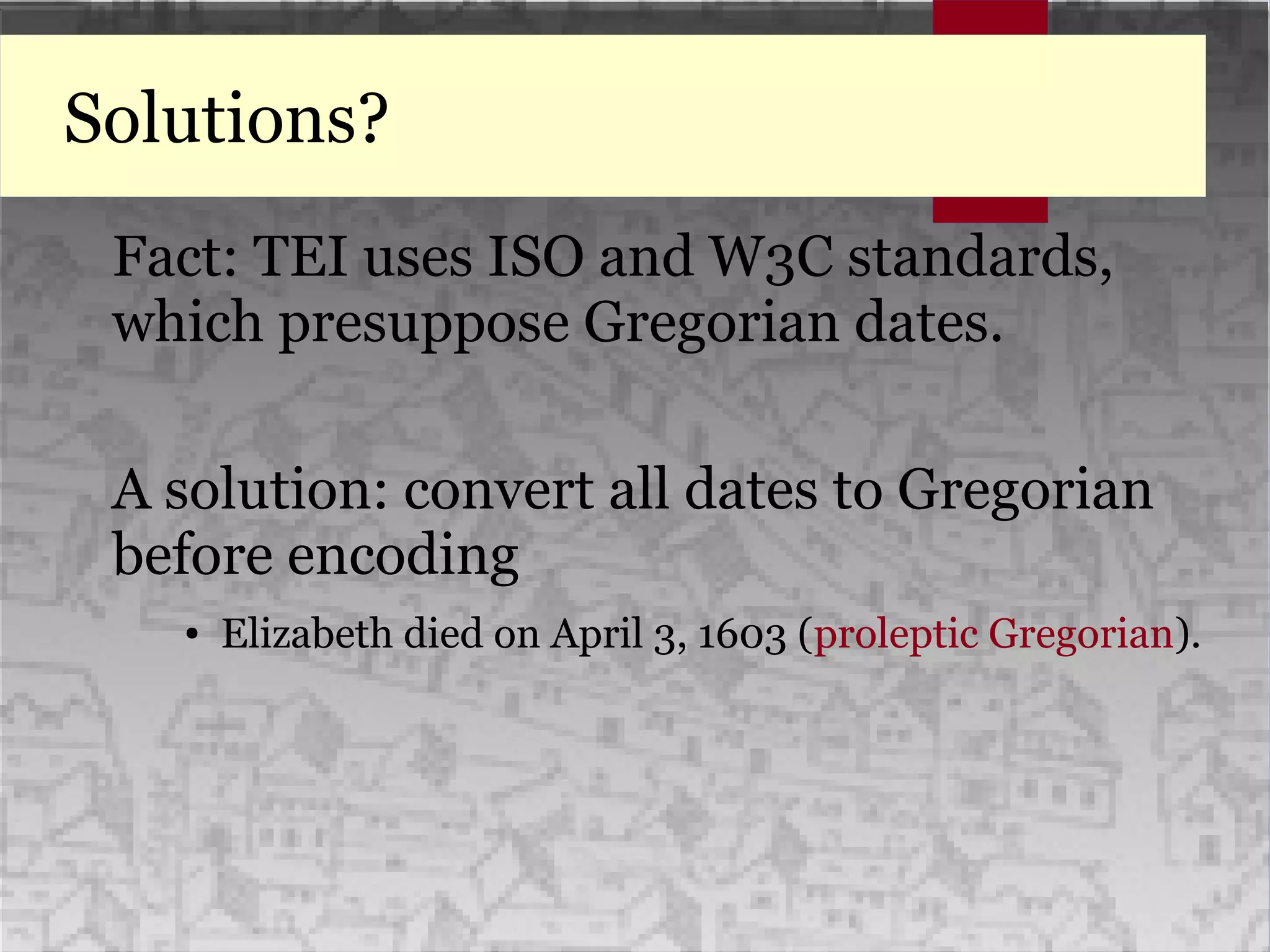
Solutions?
Fact: TEI uses ISO and W3C standards,
which presuppose Gregorian dates.
A solution: convert all dates to Gregorian
before encoding
● Elizabeth died on April 3, 1603 (proleptic Gregorian).
Fact: TEI uses ISO and W3C standards,
which presuppose Gregorian dates.
A solution: convert all dates to Gregorian
before encoding
● Elizabeth died on April 3, 1603 (proleptic Gregorian).
Problems with that solution
Produces historical disorientation,
because we "know" that Queen Elizabeth
died on March 24, 1602/3 …
… and it's laborious.
Our solution
● Use full capability of TEI
● Class of attributes: att.datable.custom
● "provides attributes for normalization of
elements that contain datable events to a
custom dating system"
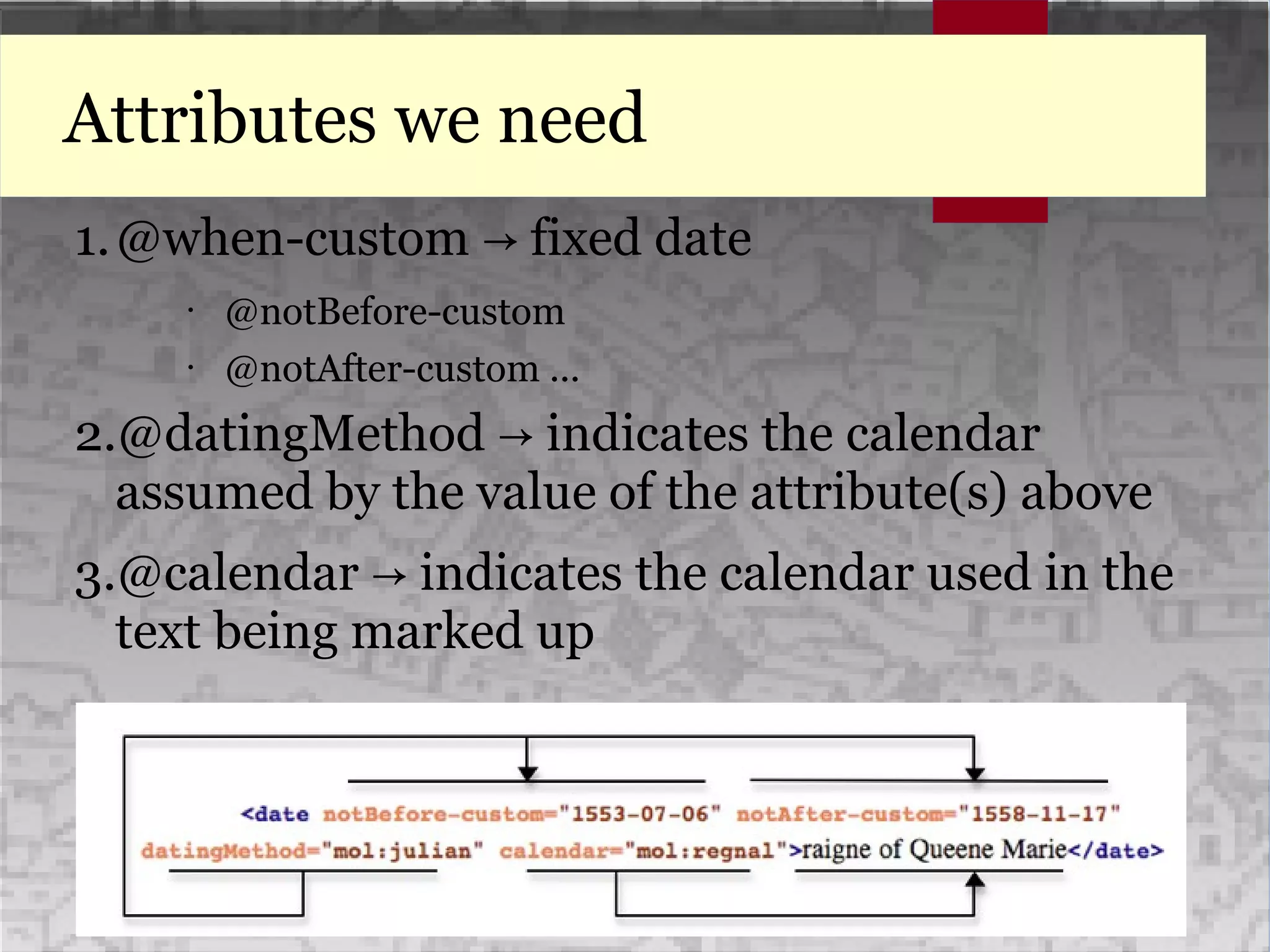
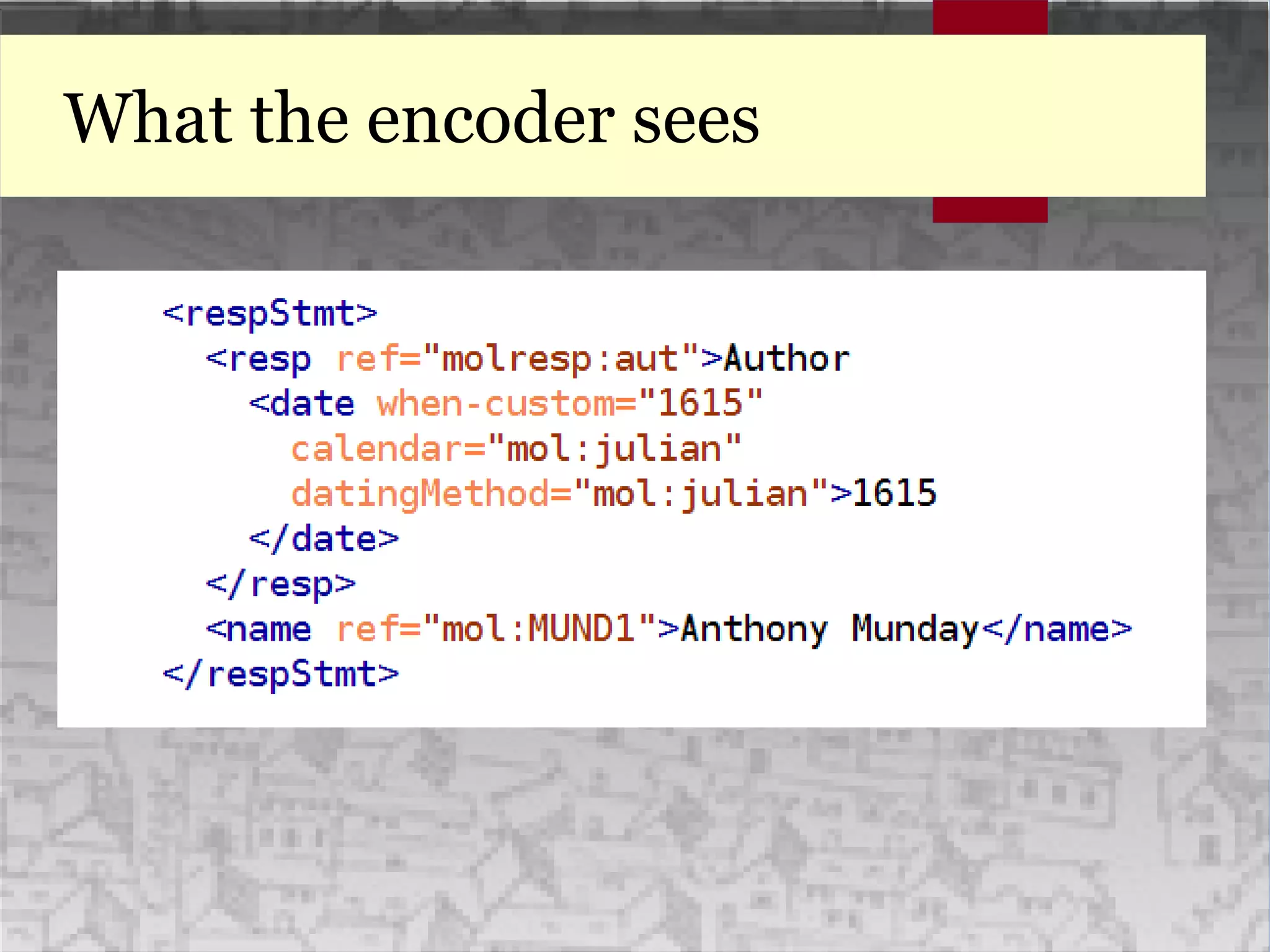
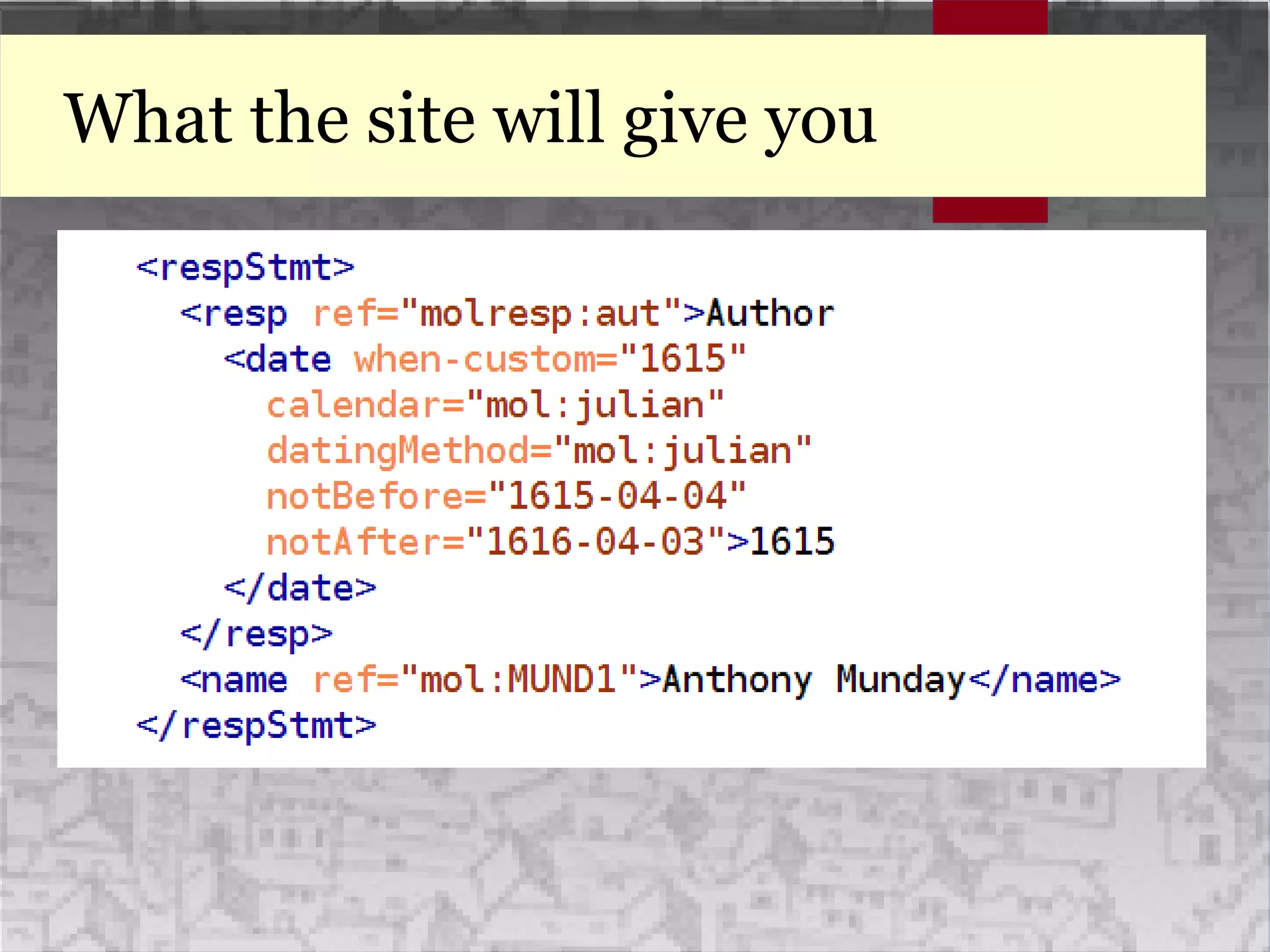
Attributes we need
1.@when-custom fixed date→
• @notBefore-custom
• @notAfter-custom ...
2.@datingMethod indicates the calendar→
assumed by the value of the attribute(s) above
3.@calendar indicates the calendar used in the→
text being marked up
Various reckoning systems
Primary texts reckon time by:
regnal years ("the third of King John")
papal years
mayoral years
Anno Mundi (years since Creation)
legal terms
Saint's days
Custom MoEML @calendar values include:
calendar="mol:anno_mundi"
What the encoder sees
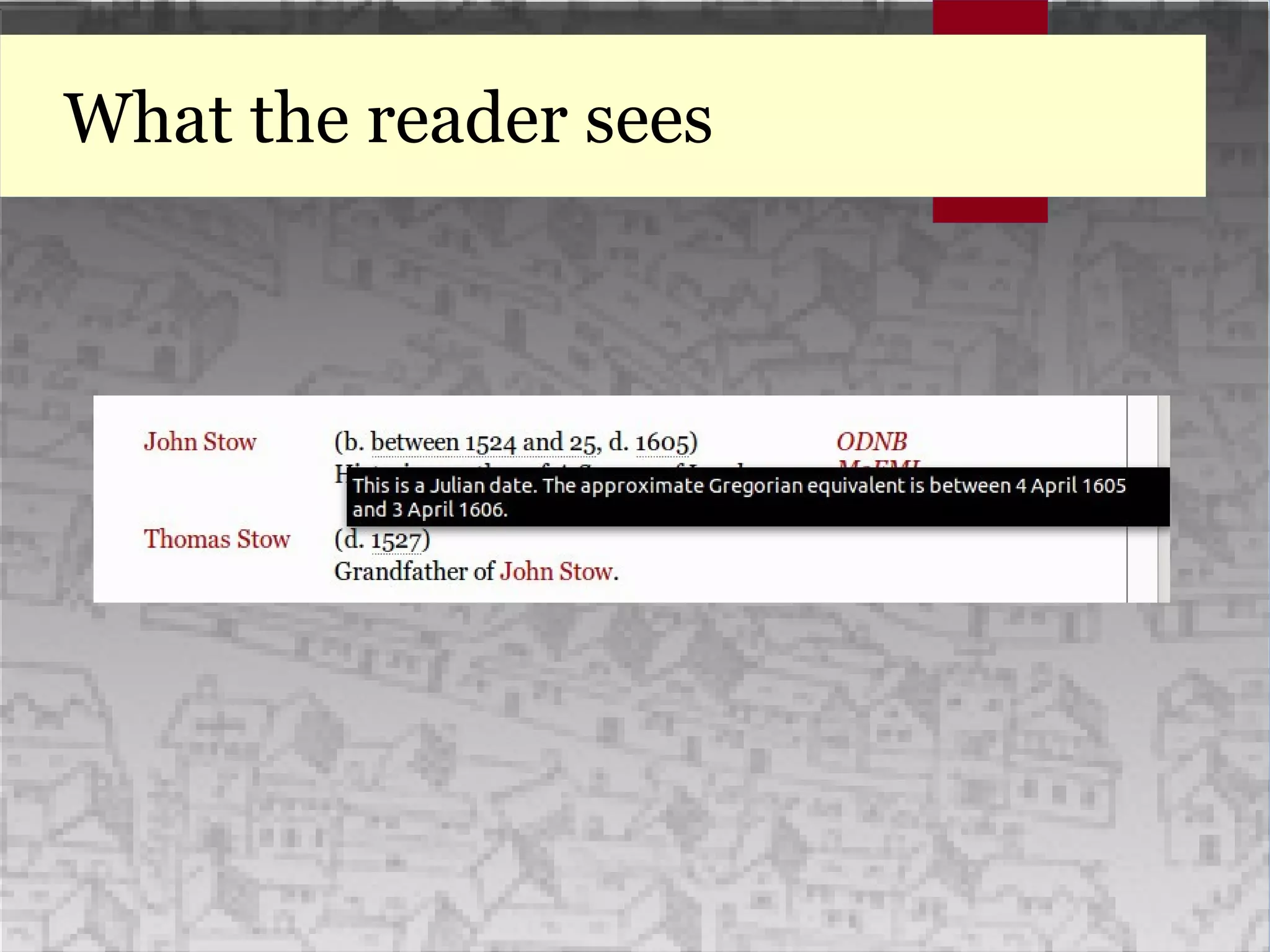
What the site will give you
What the reader sees
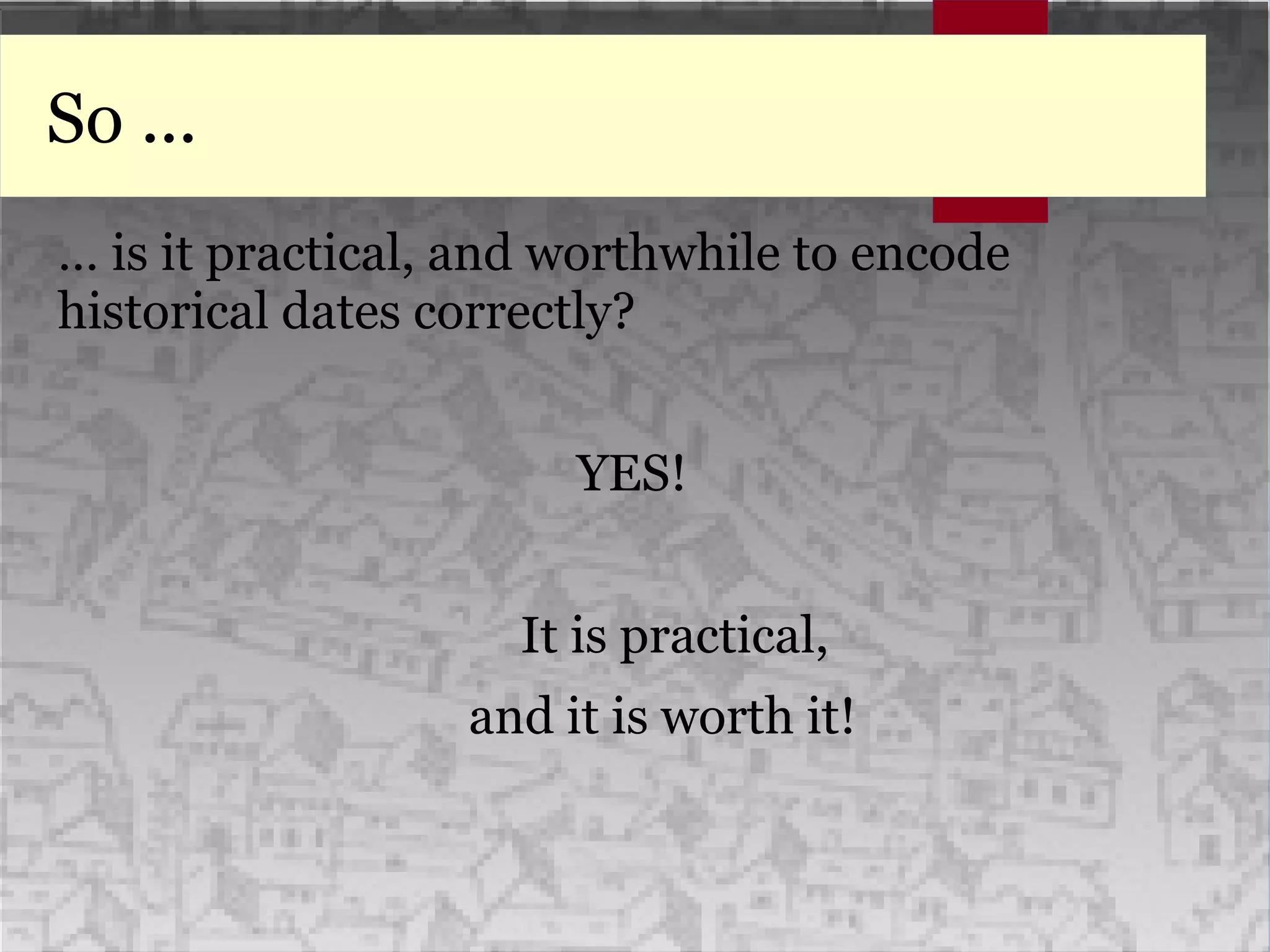
So ...
… is it practical, and worthwhile to encode
historical dates correctly?
YES!
It is practical,
and it is worth it!
Credits and thanks
Social Sciences and Humanities Research Council
Humanities Computing and Media Centre, UVic
MoEML Team, especially Nathan Phillips, Sarah Milligan,
and Cameron Butt
Correspondence: jenstad@uvic.ca

Encoding Historical Dates Correctly: Is it Practical, and is it Worth it?

  • 1.
    DH 2013, Lincoln,Nebraska Encoding historical dates correctly: Is it practical, and is it worth it? Janelle Jenstad, Martin Holmes, Nathan Phillips, Sarah Milligan, and Cameron Butt University of Victoria mapoflondon.uvic.ca @janellejenstad @MoEMLondon
  • 2.
  • 3.
  • 4.
  • 5.
  • 6.
    A Journey throughItaly and France (R.A. Poole)
  • 7.
    A Journey throughItaly and France (R.A. Poole)
  • 8.
    A Journey throughItaly and France (R.A. Poole)
  • 9.
    A Journey throughItaly and France (R.A. Poole)
  • 10.
    A Journey throughItaly and France (R.A. Poole)
  • 11.
    Calendrical chaos betweencountries 1. Julian versus Gregorian calendar ● 1582: Pope Gregory's new calendar ● 1752: English adoption of Gregorian calendar 2. Start of New Year ● March 25, from 1155 to 1752 in England
  • 12.
    Problem? What problem? Weasked a number of colleagues on cognate projects for advice: ● It's only a few days. How important could it be? ● Proper historians know perfectly well what a particular date means. ● It's definitely a mess, but there's no workable solution. ● I don't want to think about it.
  • 13.
    This problem: Interoperability ●You: a historian of 17thc Holland. ● Me: a researcher on 17thc English literary texts. ● Your eventography and my eventography get all interoperable with each other. ● Result: a very silly timeline.
  • 14.
    Our project The Mapof Early Modern London (mapoflondon.uvic.ca) ● Covers 1550-1650 ● 4105 dates or date ranges encoded so far ● Principal challenge: Stow's Survey of London ● For any date before 1752, we have to STOP before we tag; W3C standard is meaningless <date when="1603-03-24">
  • 15.
    Our goals inencoding dates 1. We want to know WHEN an event occurred relative to other events (astronomical years). 2. We want dates to be computable and translatable to other calendars. 3. We want to interleave our dated events with events in other projects without appearing to "time travel" like William of Orange.
  • 16.
    Solutions? Fact: TEI usesISO and W3C standards, which presuppose Gregorian dates. A solution: convert all dates to Gregorian before encoding ● Elizabeth died on April 3, 1603 (proleptic Gregorian). Fact: TEI uses ISO and W3C standards, which presuppose Gregorian dates. A solution: convert all dates to Gregorian before encoding ● Elizabeth died on April 3, 1603 (proleptic Gregorian).
  • 17.
    Problems with thatsolution Produces historical disorientation, because we "know" that Queen Elizabeth died on March 24, 1602/3 … … and it's laborious.
  • 18.
    Our solution ● Usefull capability of TEI ● Class of attributes: att.datable.custom ● "provides attributes for normalization of elements that contain datable events to a custom dating system"
  • 19.
    Attributes we need 1.@when-customfixed date→ • @notBefore-custom • @notAfter-custom ... 2.@datingMethod indicates the calendar→ assumed by the value of the attribute(s) above 3.@calendar indicates the calendar used in the→ text being marked up
  • 20.
    Various reckoning systems Primarytexts reckon time by: regnal years ("the third of King John") papal years mayoral years Anno Mundi (years since Creation) legal terms Saint's days Custom MoEML @calendar values include: calendar="mol:anno_mundi"
  • 21.
  • 22.
    What the sitewill give you
  • 23.
  • 24.
    So ... … isit practical, and worthwhile to encode historical dates correctly? YES! It is practical, and it is worth it!
  • 25.
    Credits and thanks SocialSciences and Humanities Research Council Humanities Computing and Media Centre, UVic MoEML Team, especially Nathan Phillips, Sarah Milligan, and Cameron Butt Correspondence: jenstad@uvic.ca

Editor's Notes

  • #3 William of Orange set sail from Hellevoetsluis (ˌɦɛləvutˈslœy̆s) on November 11, 1688 with over two hundred transport ships, fifty warships, over 15,000 men and several thousand horses.
  • #4 William of Orange set sail from Hellevoetsluis (ˌɦɛləvutˈslœy̆s) on November 11, 1688 with over two hundred transport ships, fifty warships, over 15,000 men and several thousand horses.
  • #5 William of Orange set sail from Hellevoetsluis (ˌɦɛləvutˈslœy̆s) on November 11, 1688 with over two hundred transport ships, fifty warships, over 15,000 men and several thousand horses.
  • #6 William of Orange set sail from Hellevoetsluis (ˌɦɛləvutˈslœy̆s) on November 11, 1688 with over two hundred transport ships, fifty warships, over 15,000 men and several thousand horses.
  • #20 Also new attributes to express duration of event: @from-custom @to-custom
  • #22 Over to Martin.