Why Scala?
JBoss Users Club 윤재진
Reason 1
Concurrency
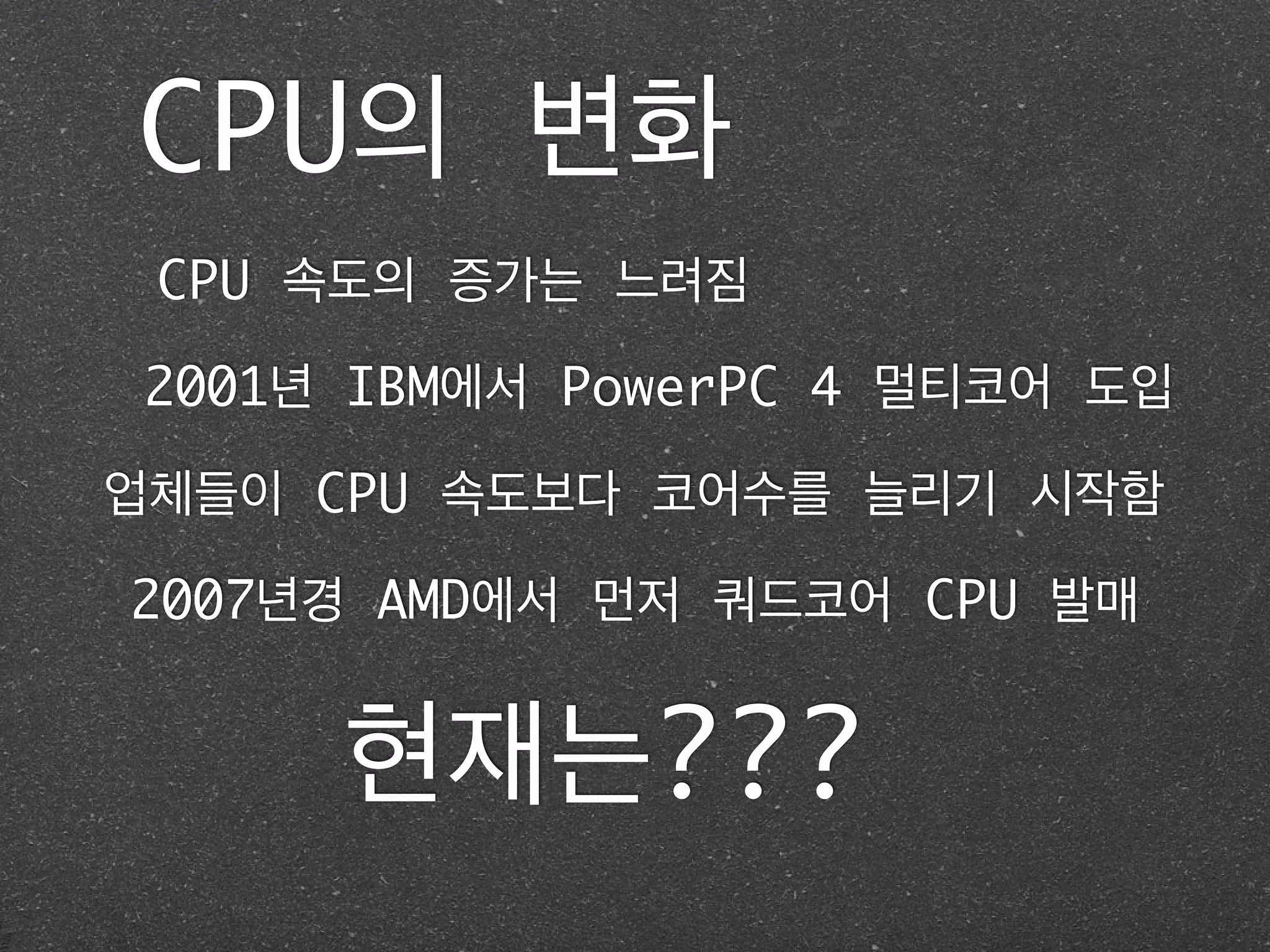
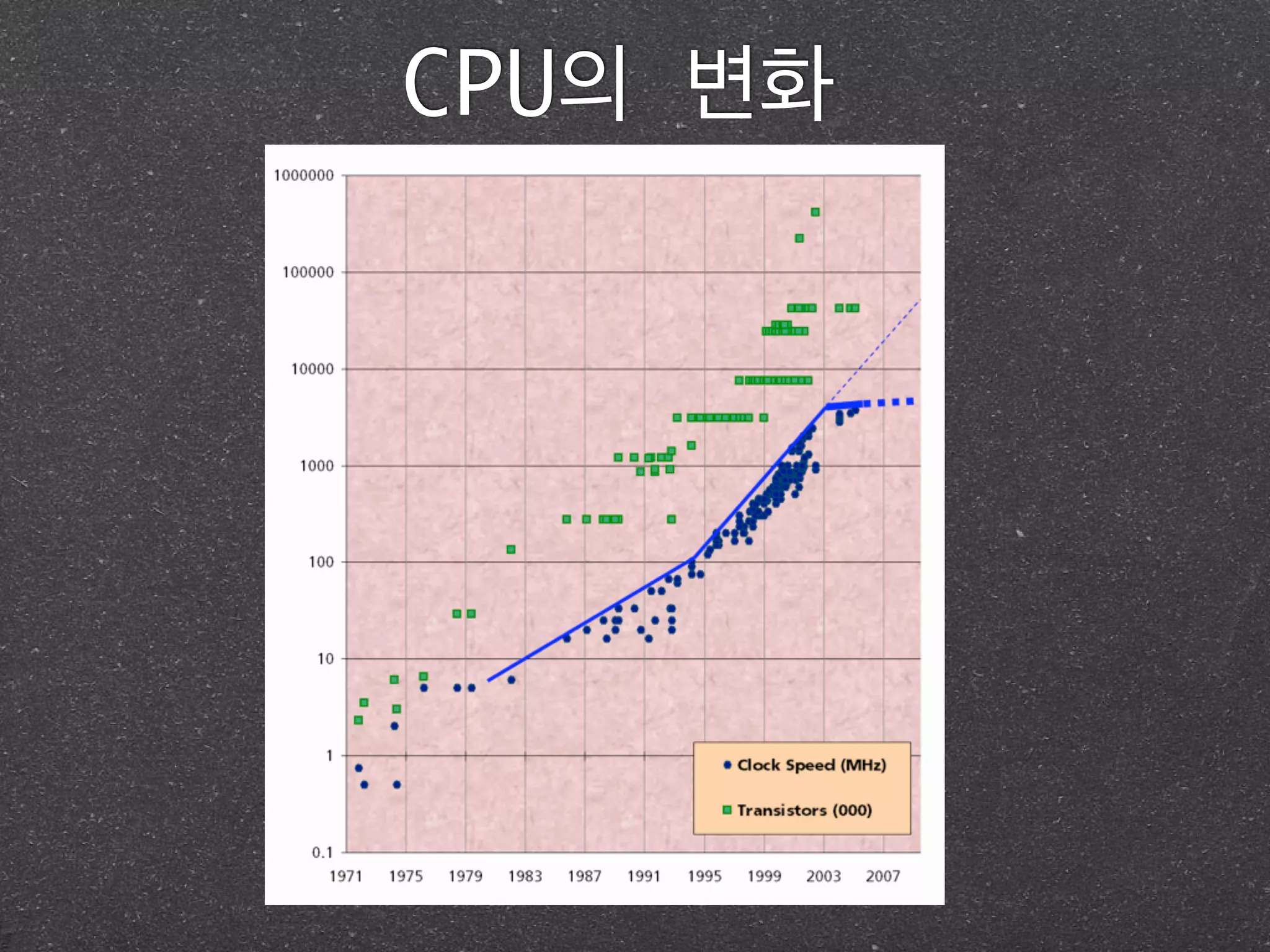
CPU의 변화
CPU 속도의 증가는 느려짐
2001년 IBM에서 PowerPC 4 멀티코어 도입
업체들이 CPU 속도보다 코어수를 늘리기 시작함
2007년경 AMD에서 먼저 쿼드코어 CPU 발매
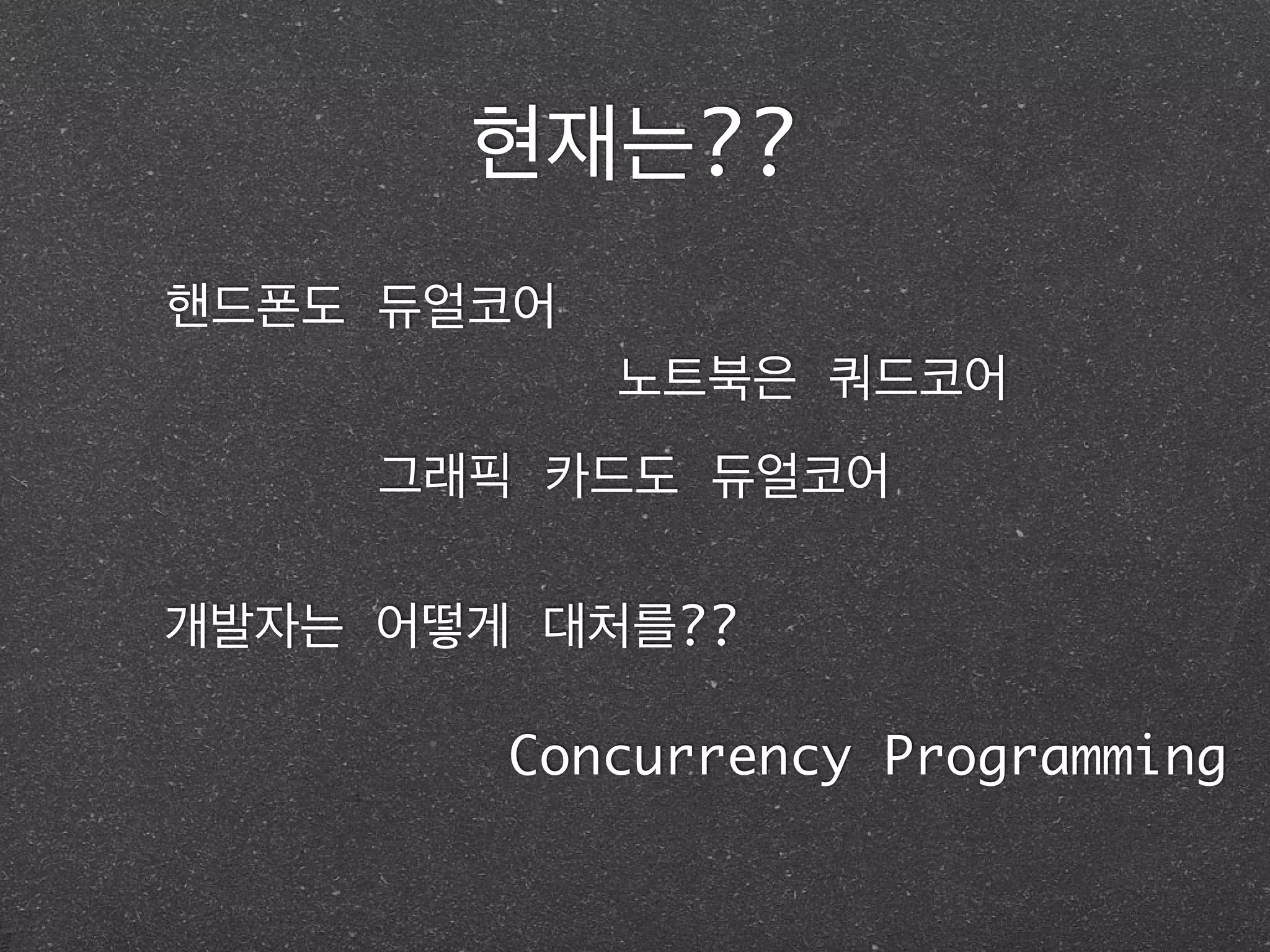
현재는???
CPU의 변화
현재는??
그래픽 카드도 듀얼코어
핸드폰도 듀얼코어
노트북은 쿼드코어
개발자는 어떻게 대처를??
Concurrency Programming
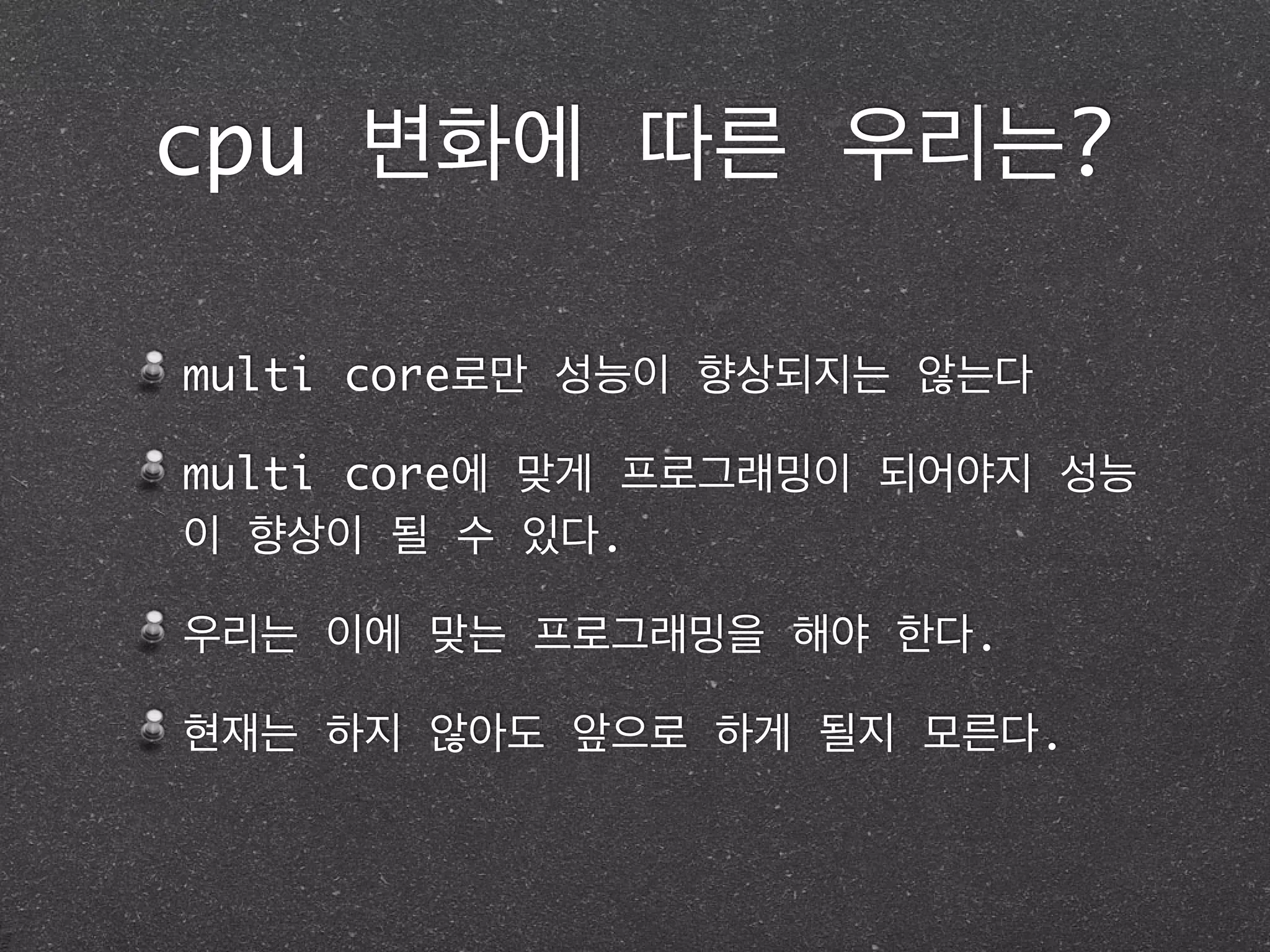
cpu 변화에 따른 우리는?
multi core로만 성능이 향상되지는 않는다	
multi core에 맞게 프로그래밍이 되어야지 성능
이 향상이 될 수 있다.	
우리는 이에 맞는 프로그래밍을 해야 한다.	
현재는 하지 않아도 앞으로 하게 될지 모른다.
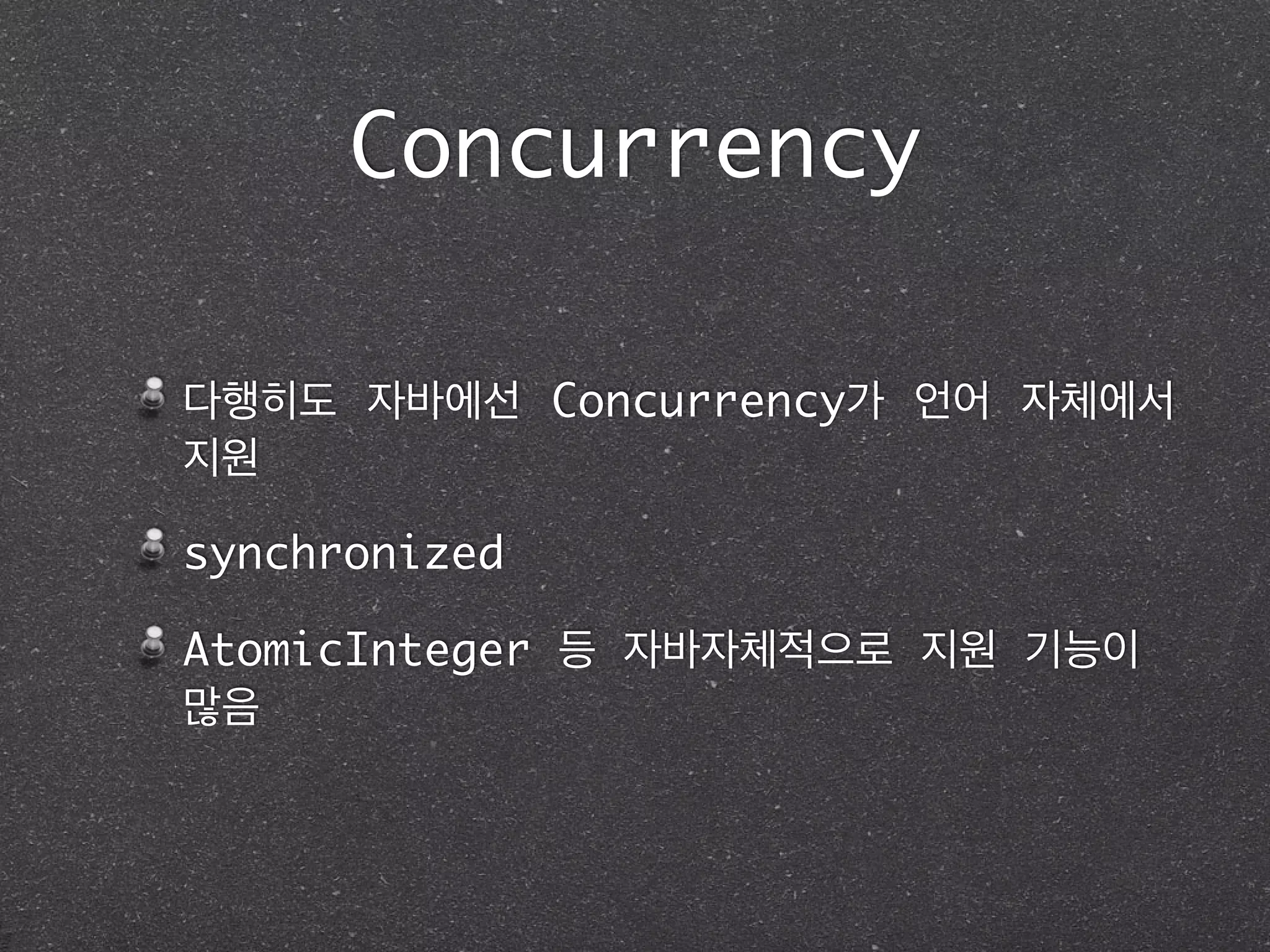
Concurrency
다행히도 자바에선 Concurrency가 언어 자체에서
지원	
synchronized	
AtomicInteger 등 자바자체적으로 지원 기능이
많음
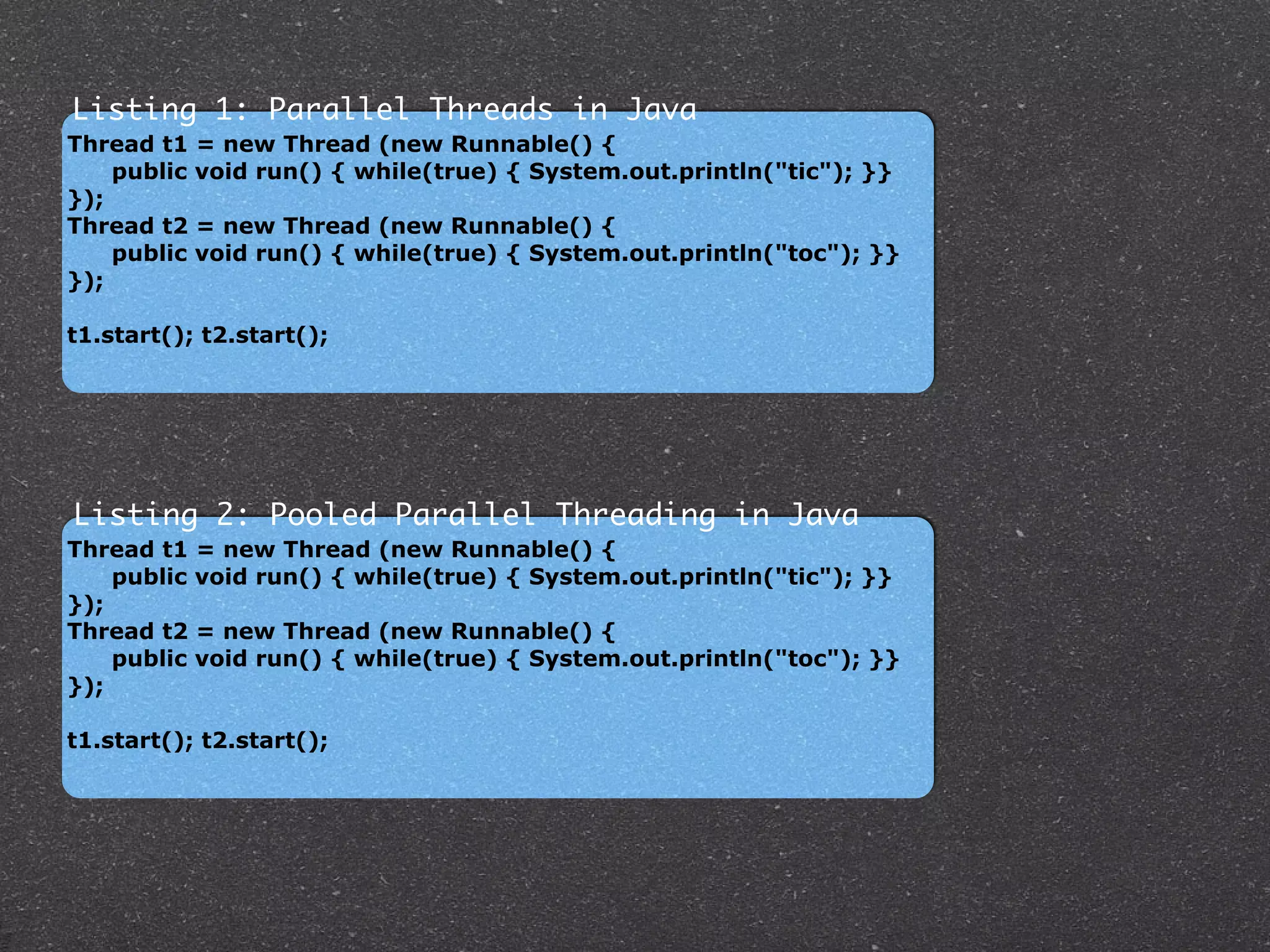
Thread t1 = new Thread (new Runnable() {
public void run() { while(true) { System.out.println("tic"); }}
});
Thread t2 = new Thread (new Runnable() {
public void run() { while(true) { System.out.println("toc"); }}
});
!
t1.start(); t2.start();
!
Listing 1: Parallel Threads in Java
Thread t1 = new Thread (new Runnable() {
public void run() { while(true) { System.out.println("tic"); }}
});
Thread t2 = new Thread (new Runnable() {
public void run() { while(true) { System.out.println("toc"); }}
});
!
t1.start(); t2.start();
!
Listing 2: Pooled Parallel Threading in Java
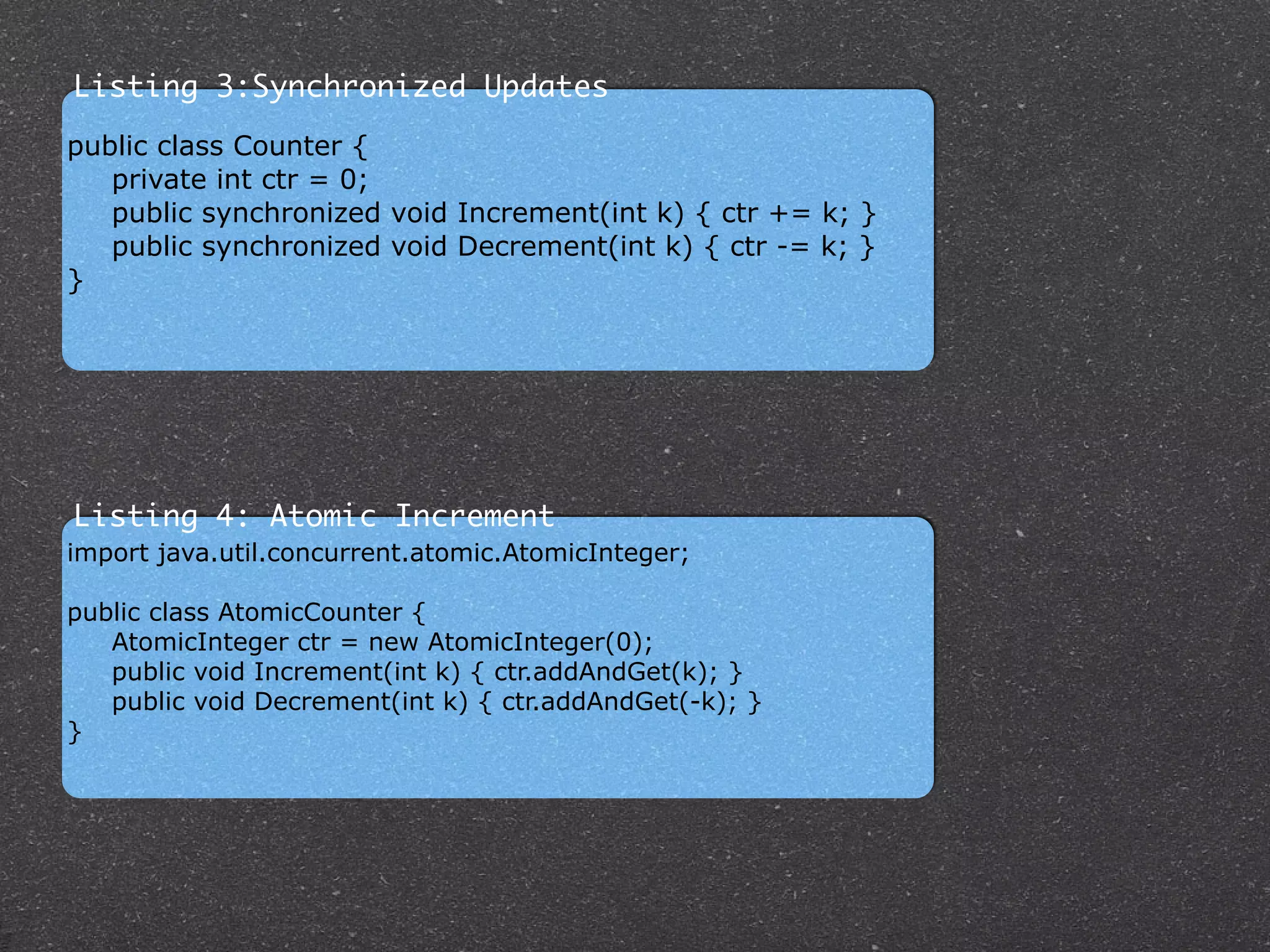
import java.util.concurrent.atomic.AtomicInteger;
!
public class AtomicCounter {
AtomicInteger ctr = new AtomicInteger(0);
public void Increment(int k) { ctr.addAndGet(k); }
public void Decrement(int k) { ctr.addAndGet(-k); }
}
Listing 4: Atomic Increment
public class Counter {
private int ctr = 0;
public synchronized void Increment(int k) { ctr += k; }
public synchronized void Decrement(int k) { ctr -= k; }
}
Listing 3:Synchronized Updates
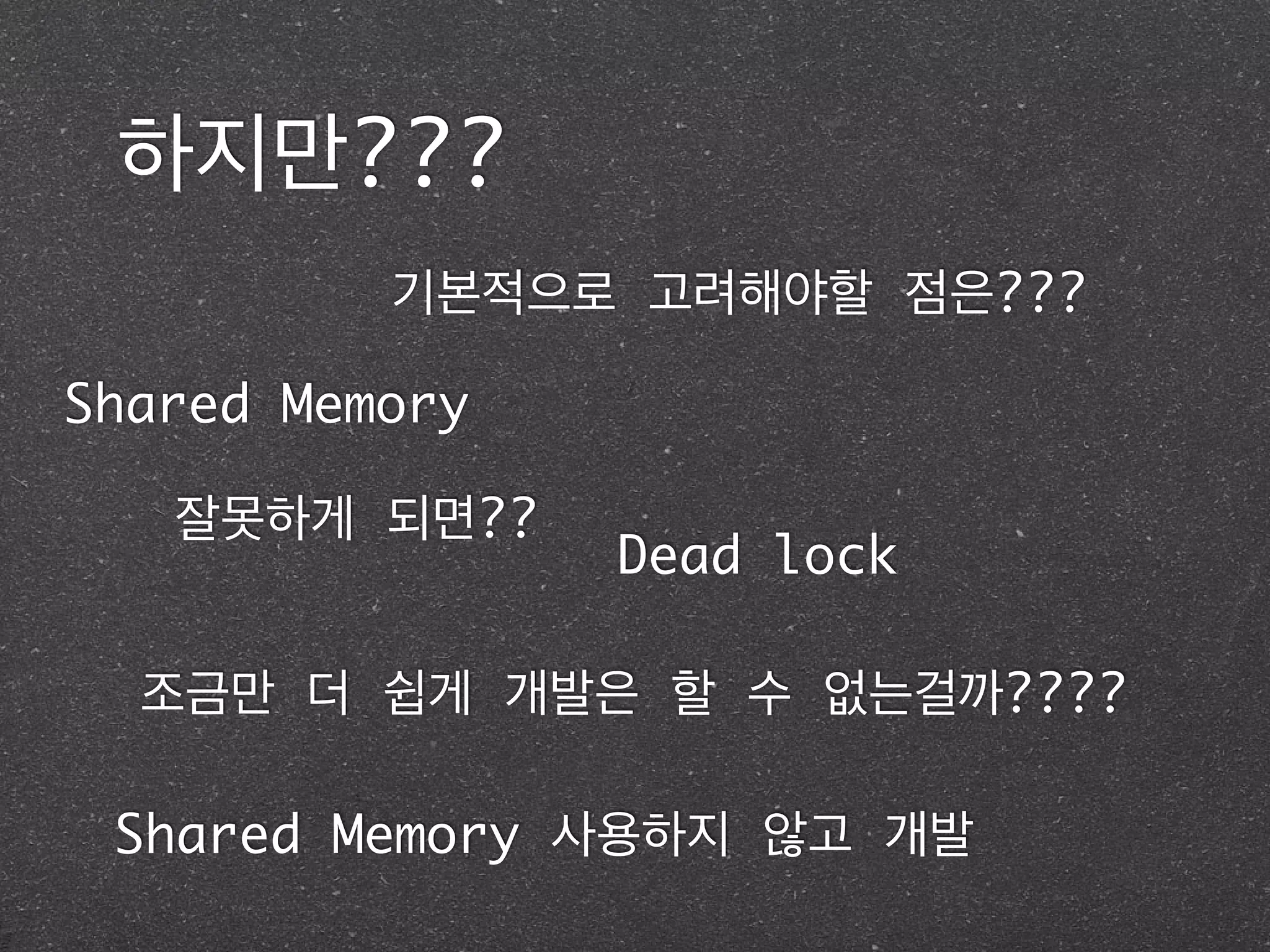
하지만???
기본적으로 고려해야할 점은???
Shared Memory
잘못하게 되면??
Dead lock
조금만 더 쉽게 개발은 할 수 없는걸까????
Shared Memory 사용하지 않고 개발
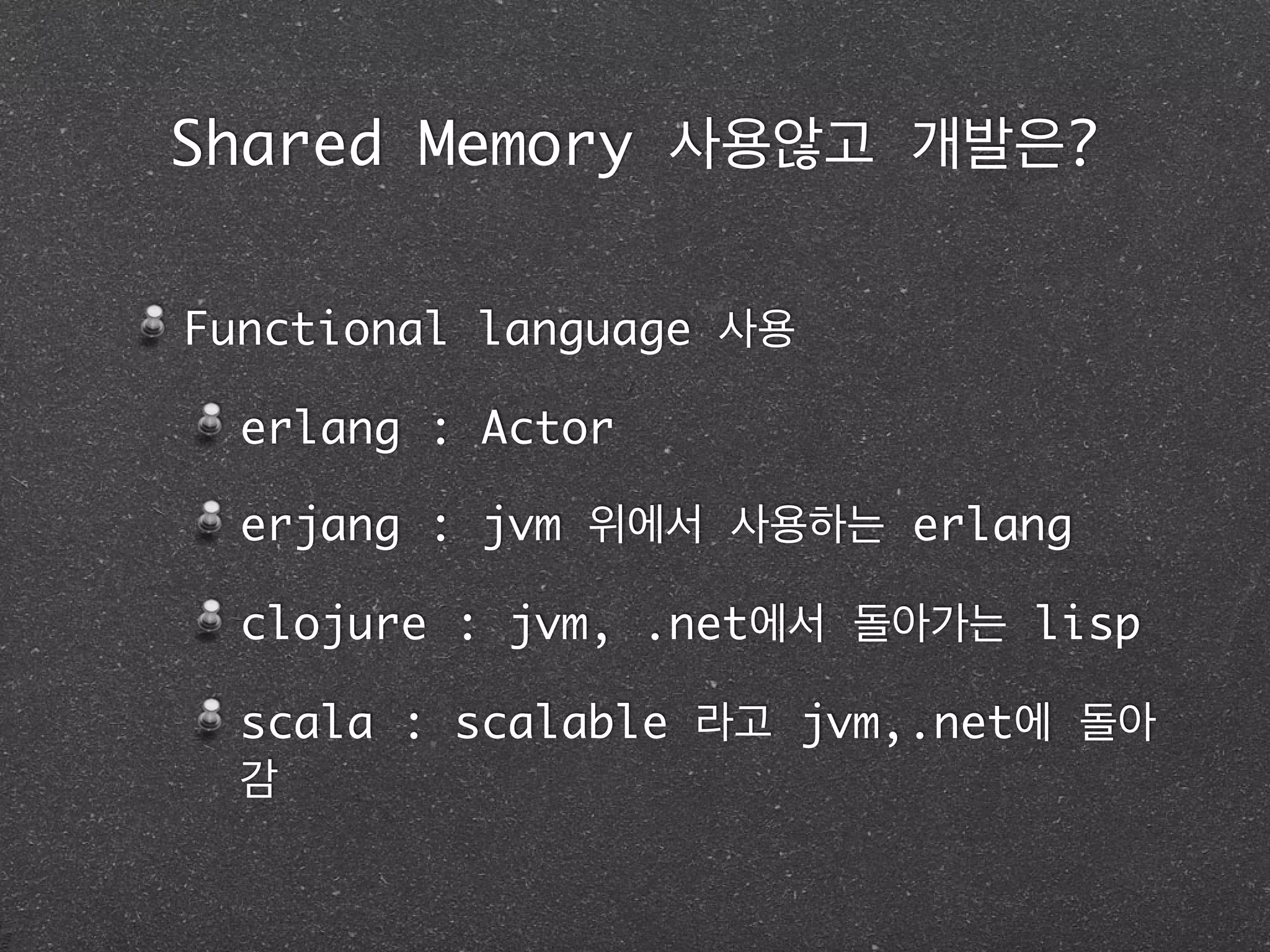
Shared Memory 사용않고 개발은?
Functional language 사용	
erlang : Actor 	
erjang : jvm 위에서 사용하는 erlang	
clojure : jvm, .net에서 돌아가는 lisp	
scala : scalable 라고 jvm,.net에 돌아
감
Reason 2
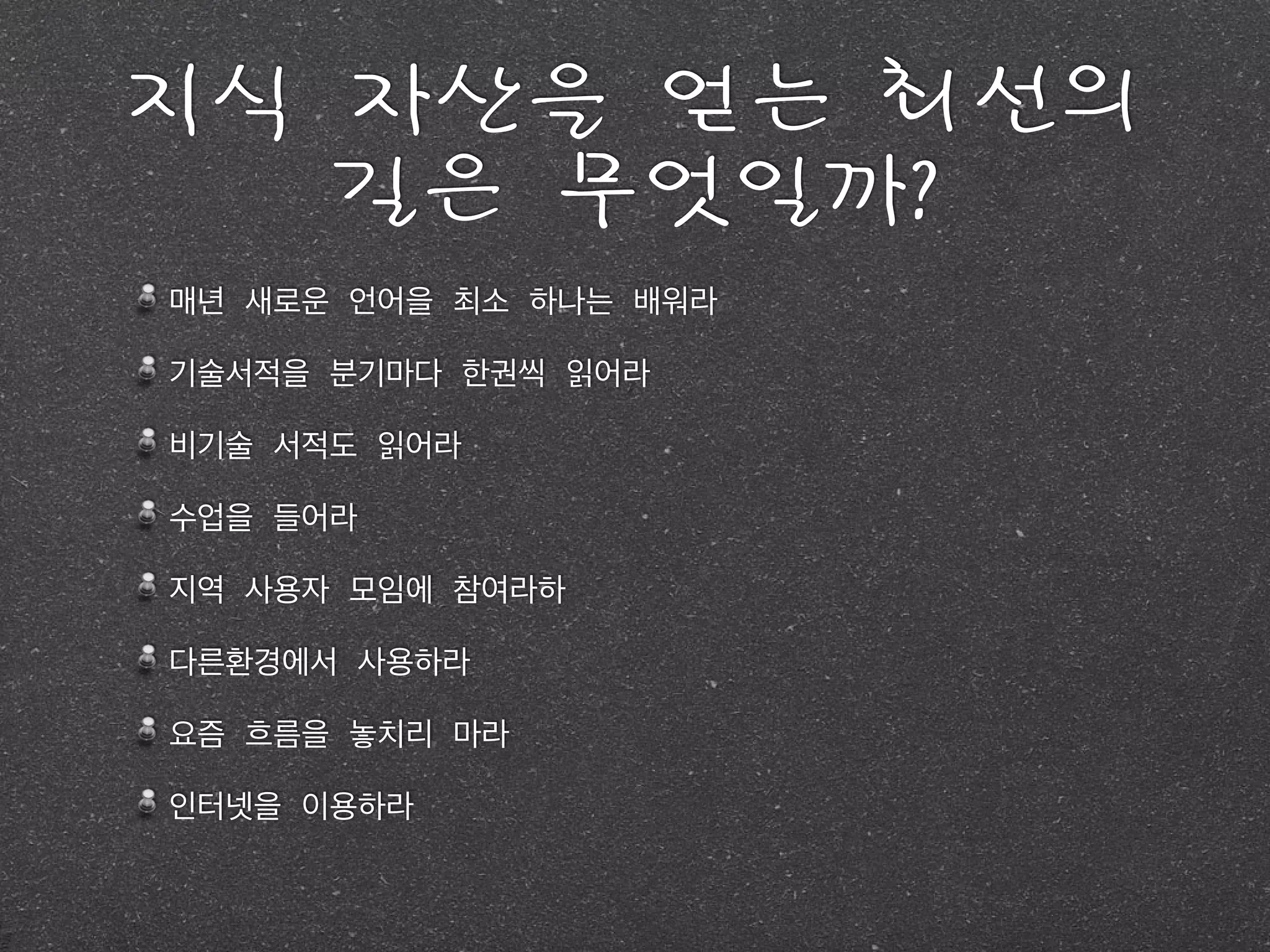
지식	 자산을	 얻는	 최선의	 길은	 
무엇일까?
지식	 자산을	 얻는	 최선의	 
길은	 무엇일까?
매년 새로운 언어을 최소 하나는 배워라	
기술서적을 분기마다 한권씩 읽어라	
비기술 서적도 읽어라	
수업을 들어라	
지역 사용자 모임에 참여라하	
다른환경에서 사용하라	
요즘 흐름을 놓치리 마라	
인터넷을 이용하라
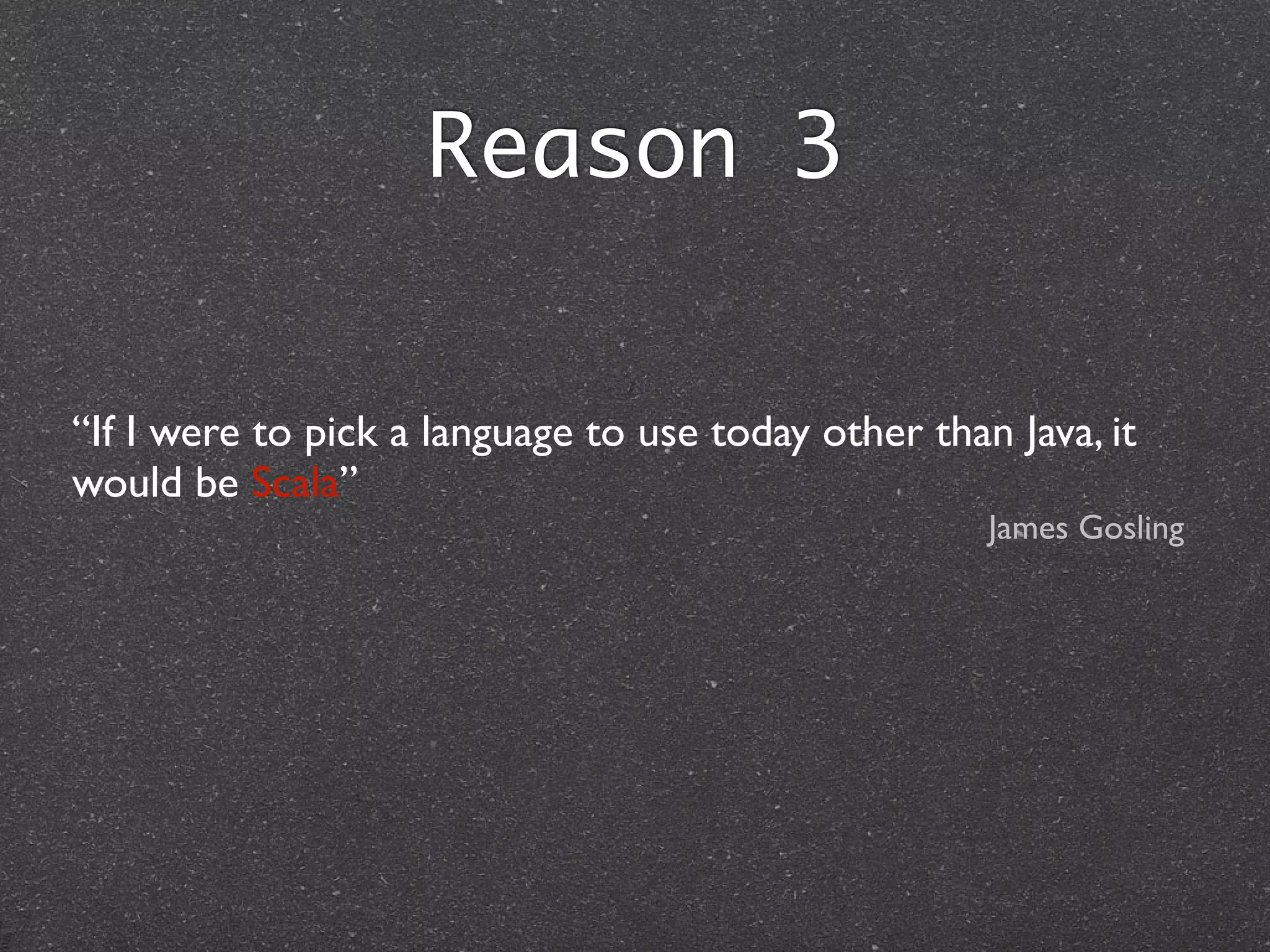
Reason 3
“If I were to pick a language to use today other than Java, it
would be Scala”	

James Gosling
What is Scala?
Scalable Language !
Grow the Library not the Syntax
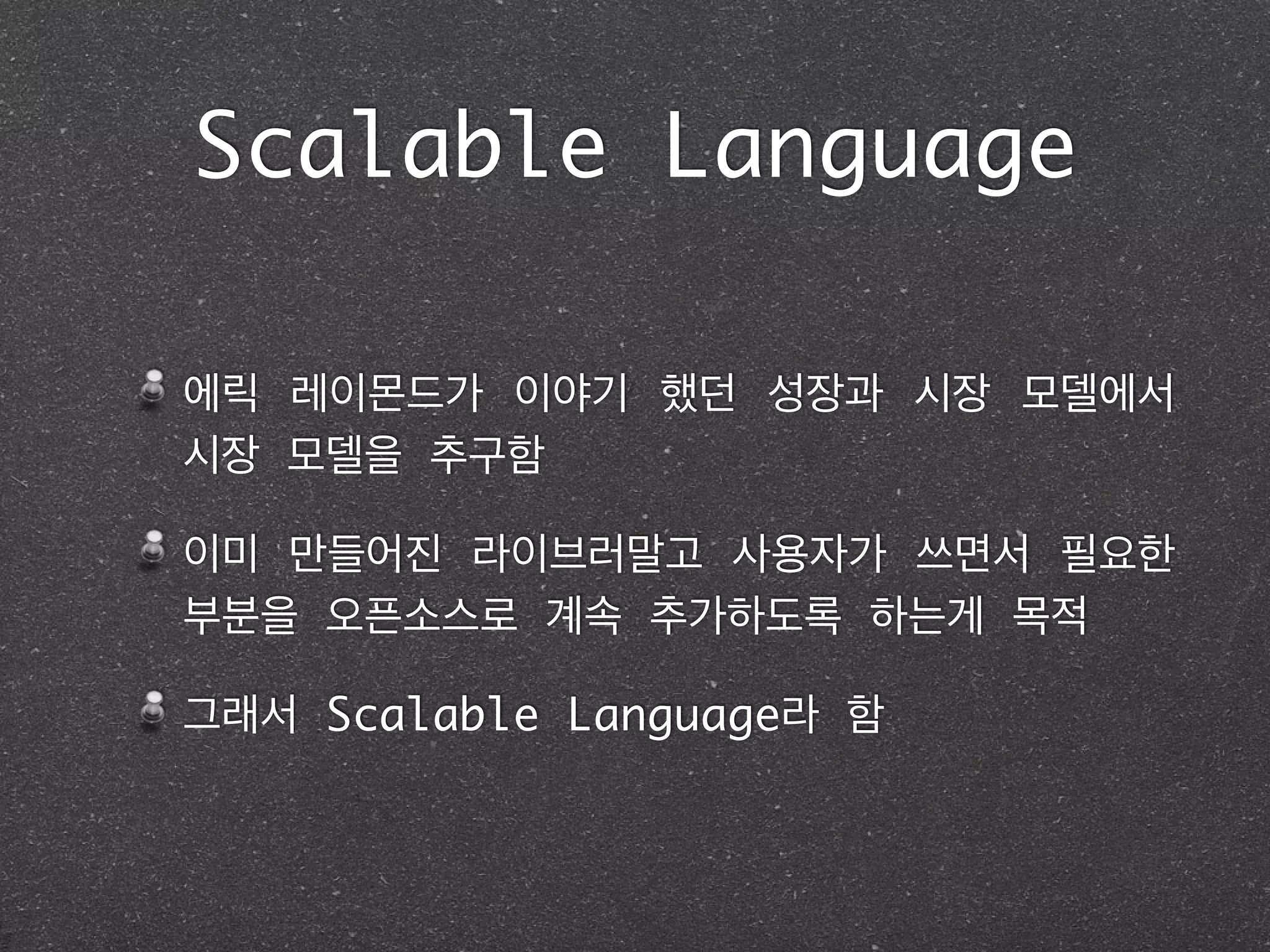
Scalable Language
에릭 레이몬드가 이야기 했던 성장과 시장 모델에서
시장 모델을 추구함	
이미 만들어진 라이브러말고 사용자가 쓰면서 필요한
부분을 오픈소스로 계속 추가하도록 하는게 목적 	
그래서 Scalable Language라 함
OO+ FP
ㅋ!
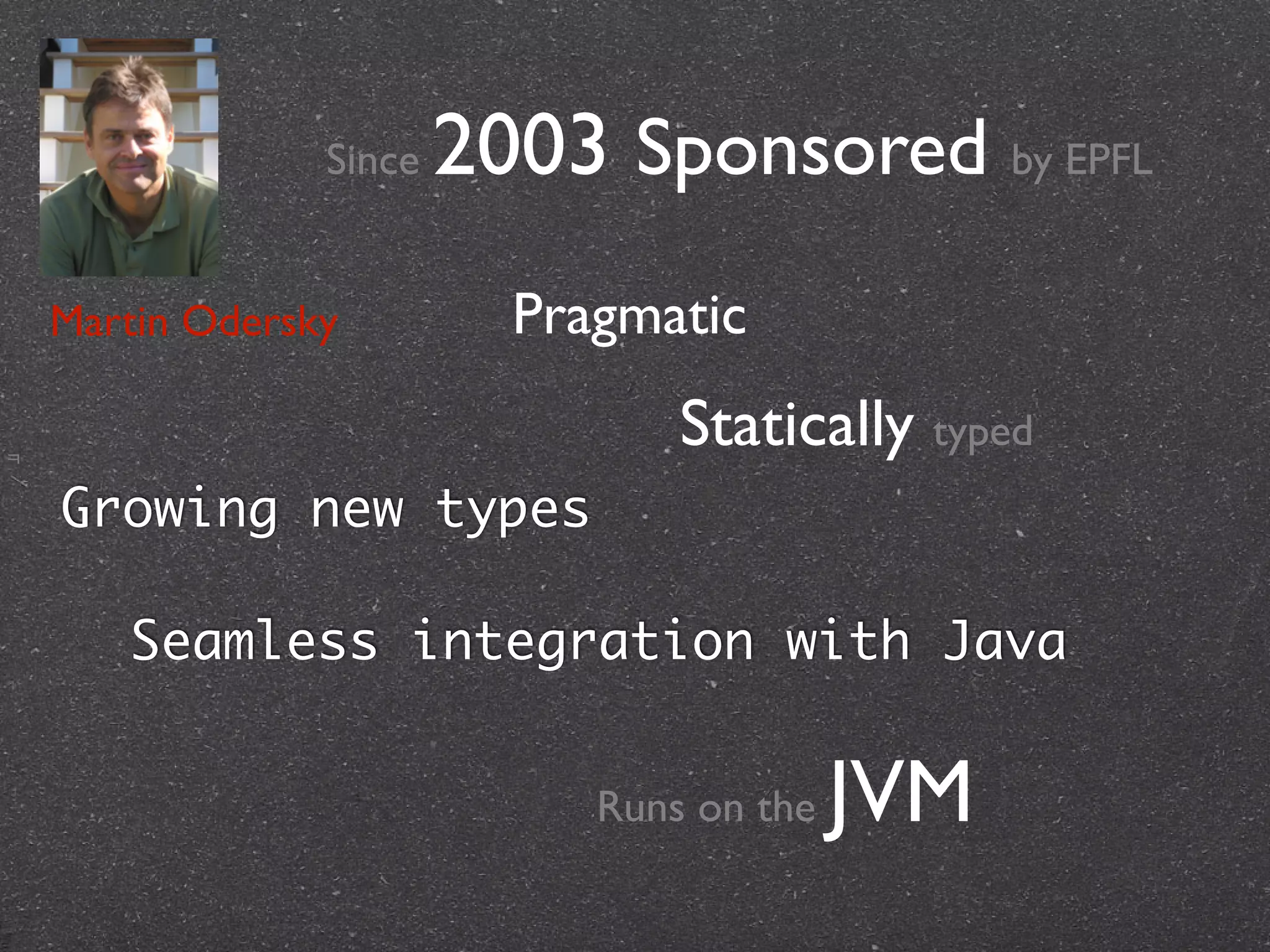
Martin Odersky
Since 2003 Sponsored by EPFL
Pragmatic
Runs on the JVM
Statically typed
Growing new types
Seamless integration with Java
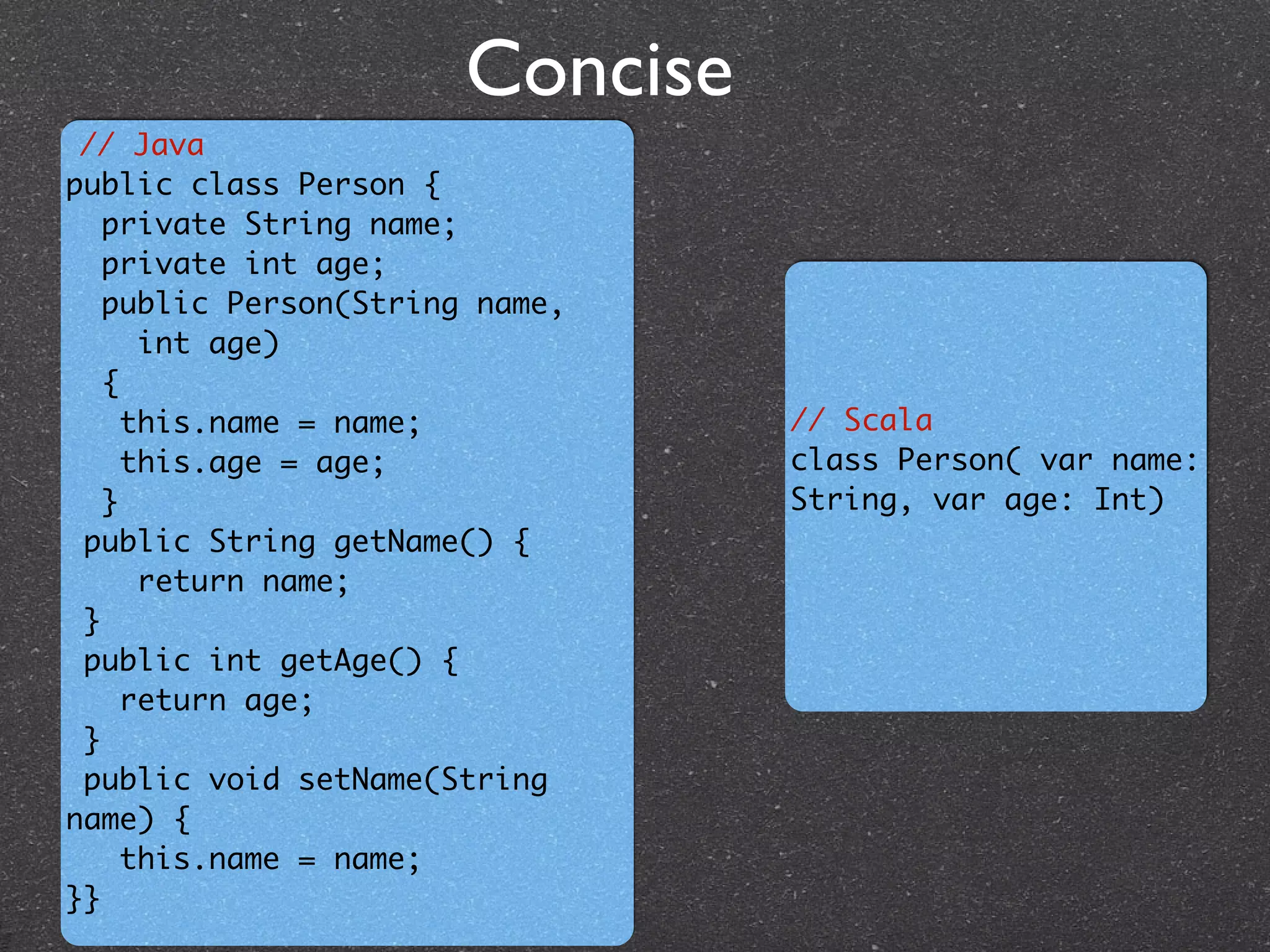
Concise
// Java	
public class Person { 	
private String name; 	
private int age; 	
public Person(String name,	
int age) 	
{ 	
this.name = name;	
this.age = age;	
}	
public String getName() {	
return name; 	
}	
public int getAge() {	
return age;	
}	
public void setName(String
name) {	
this.name = name;	
}}	
// Scala	
class Person( var name:
String, var age: Int)
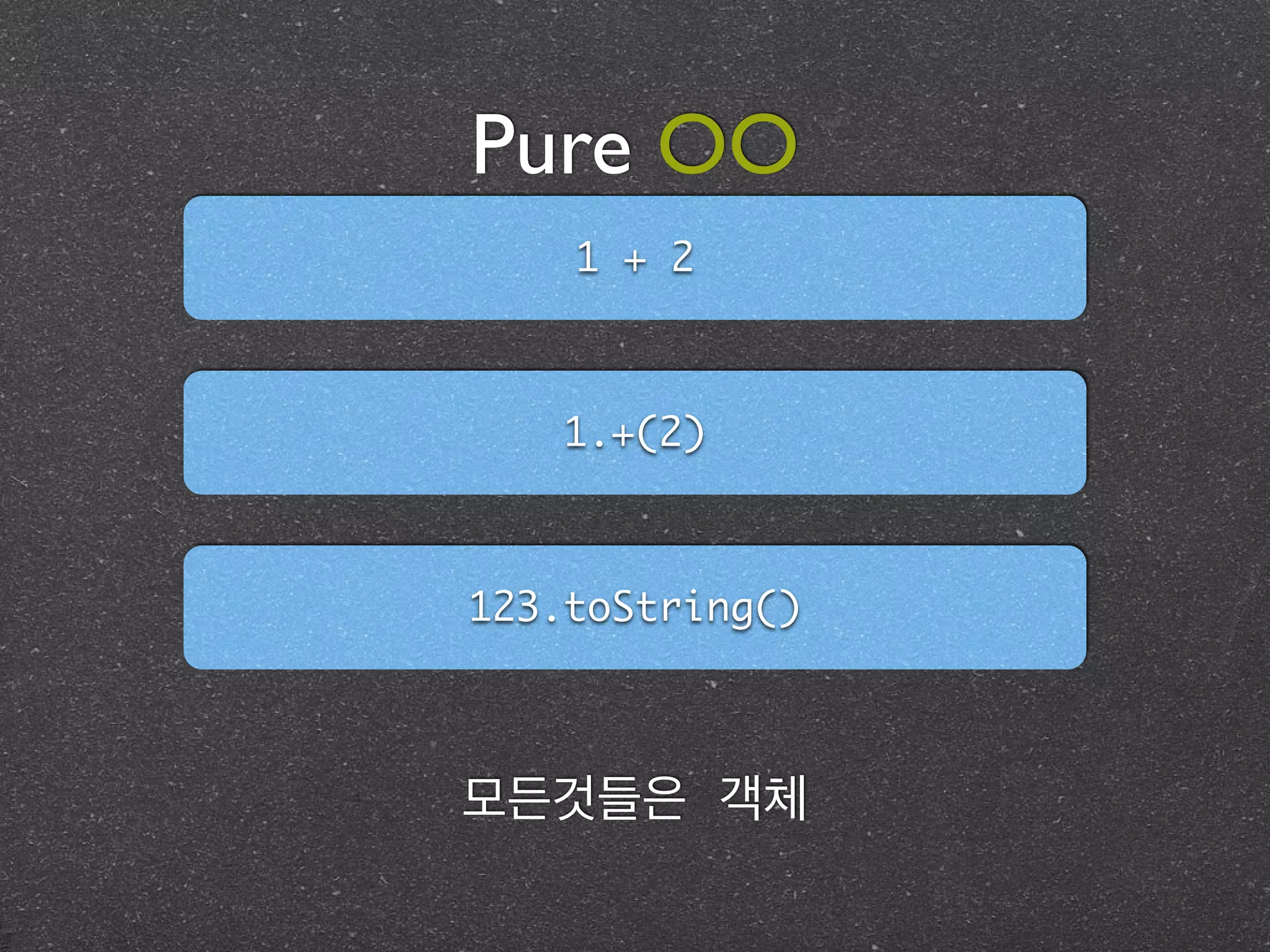
Pure OO
1 + 2
1.+(2)
123.toString()
모든것들은 객체
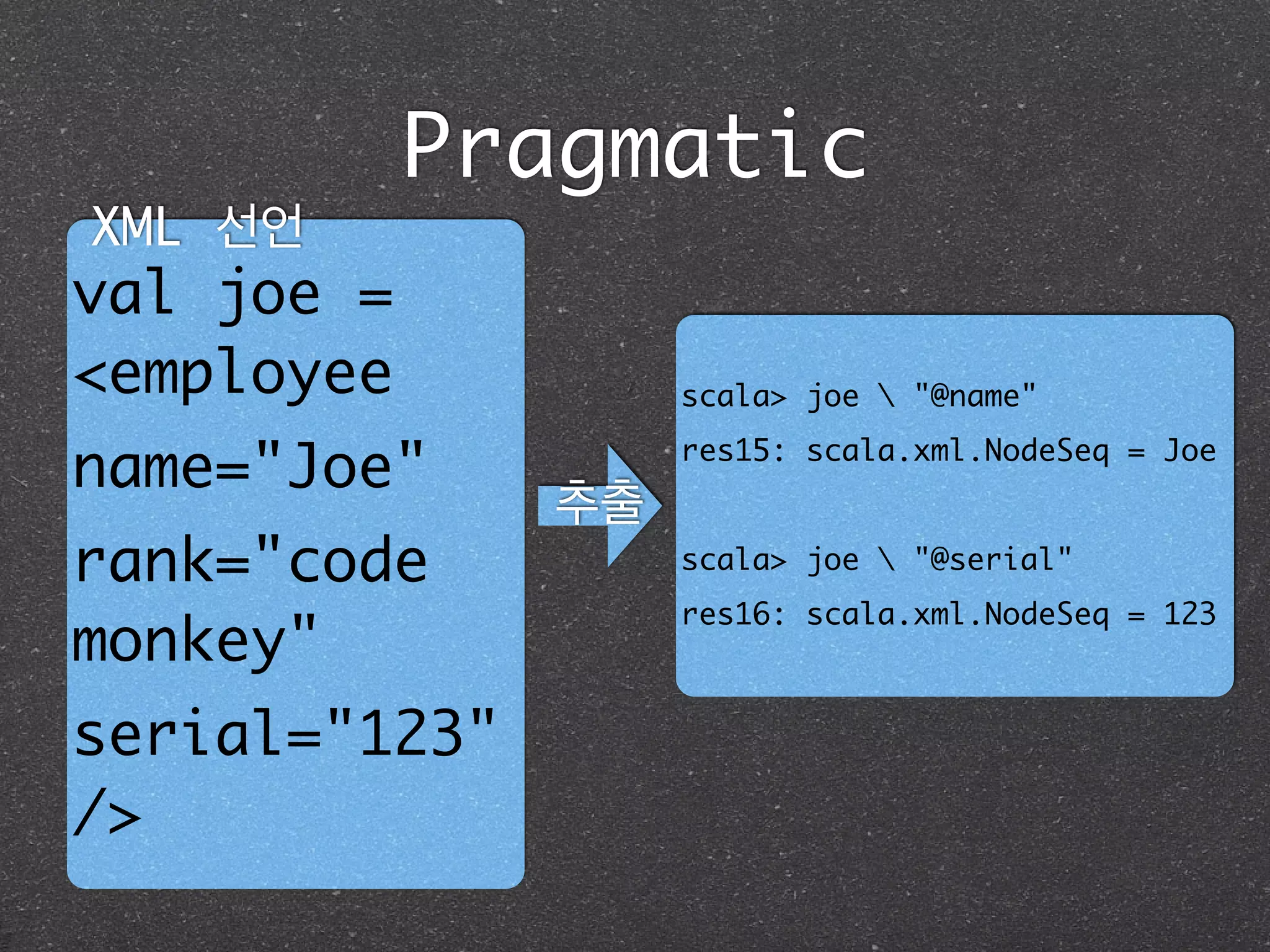
Pragmatic
val joe =
<employee	
name="Joe"	
rank="code
monkey"	
serial="123"
/>
XML 선언
scala> joe  "@name"	
res15: scala.xml.NodeSeq = Joe	
!
scala> joe  "@serial"	
res16: scala.xml.NodeSeq = 123
추출
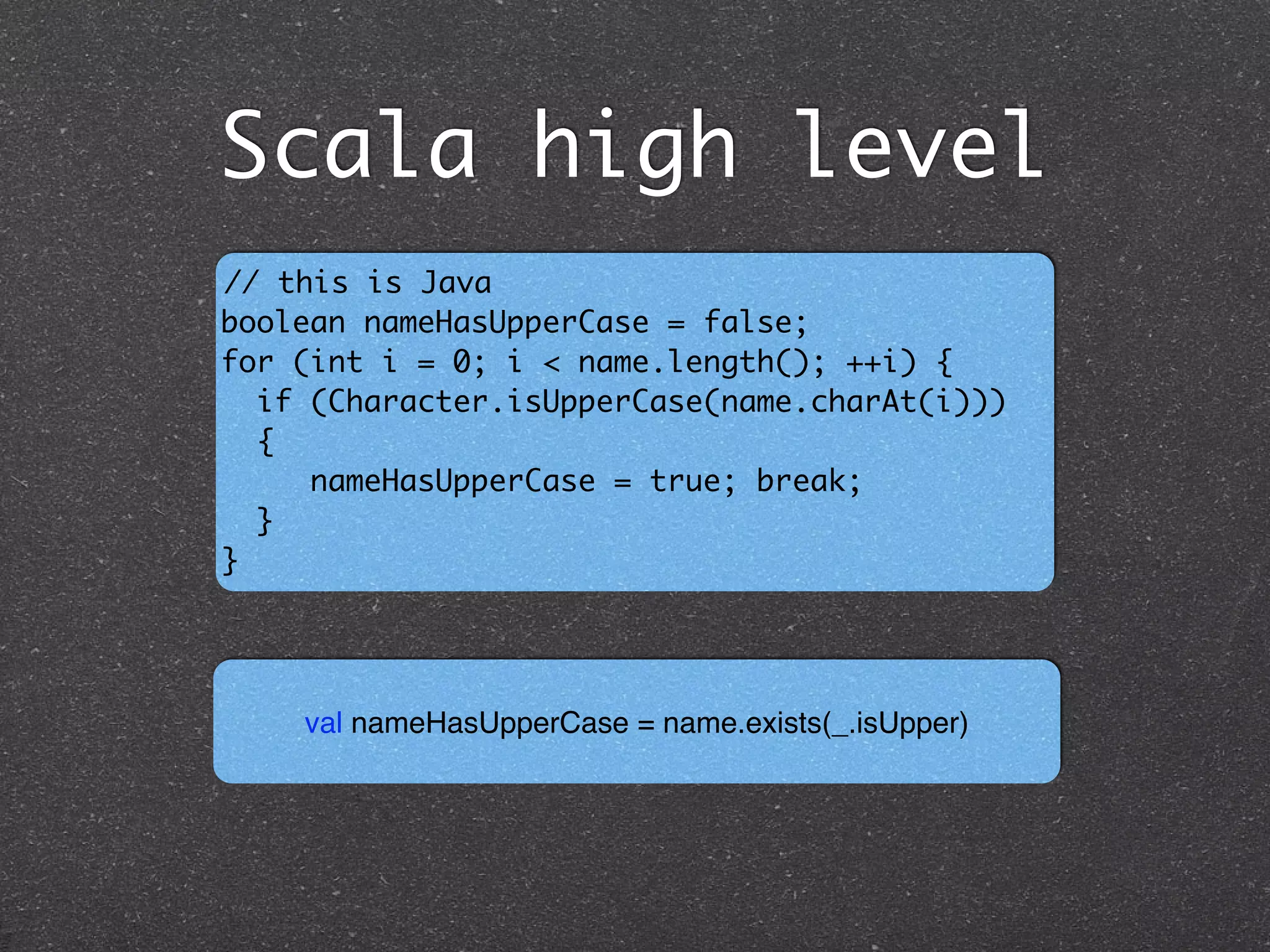
Scala high level
// this is Java 	
boolean nameHasUpperCase = false; 	
for (int i = 0; i < name.length(); ++i) {	
if (Character.isUpperCase(name.charAt(i))) 	
{ 	
nameHasUpperCase = true; break;	
}	
}
val nameHasUpperCase = name.exists(_.isUpper)
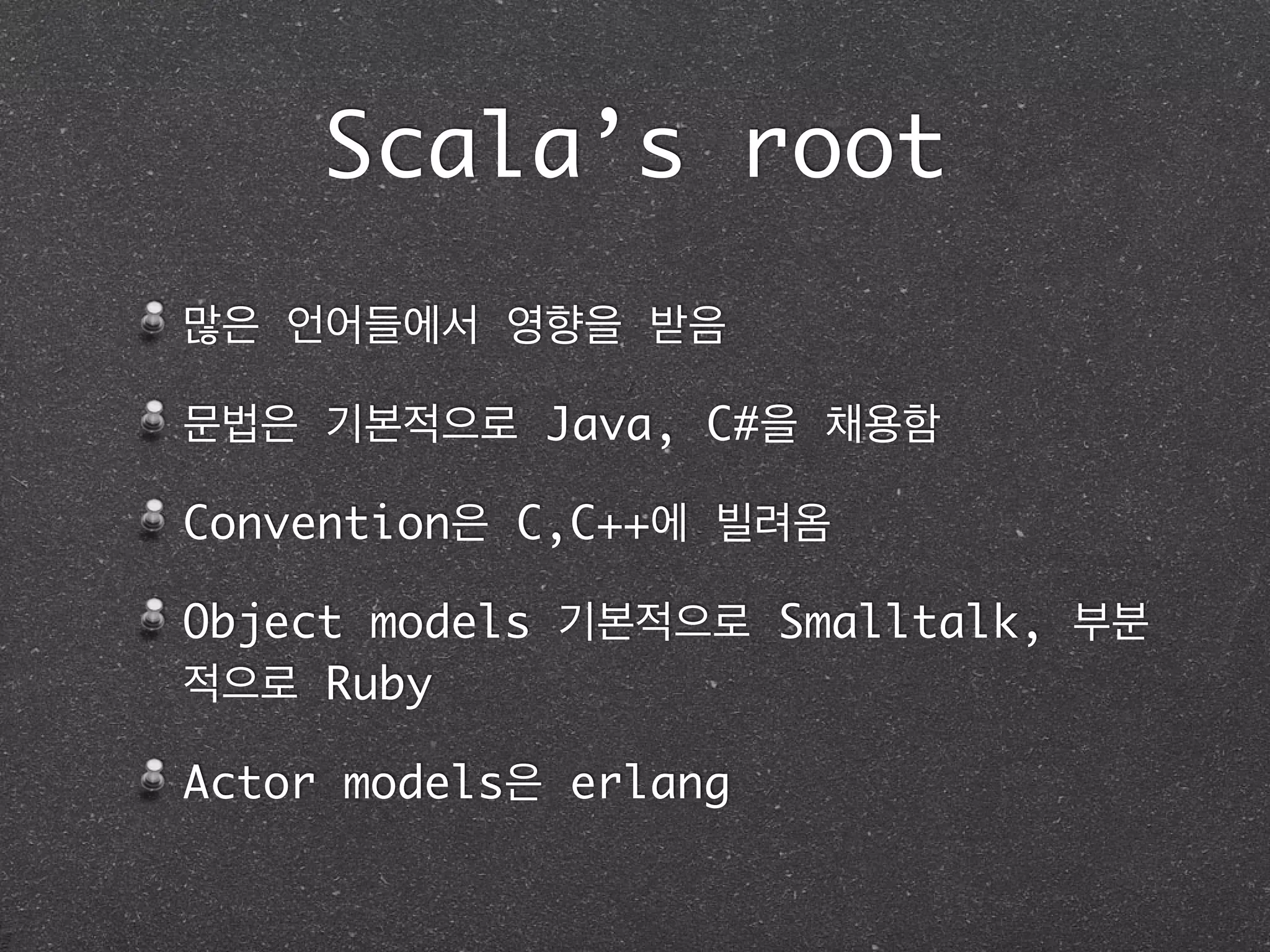
Scala’s root
많은 언어들에서 영향을 받음	
문법은 기본적으로 Java, C#을 채용함	
Convention은 C,C++에 빌려옴	
Object models 기본적으로 Smalltalk, 부분
적으로 Ruby	
Actor models은 erlang
자세히 들어가 보자
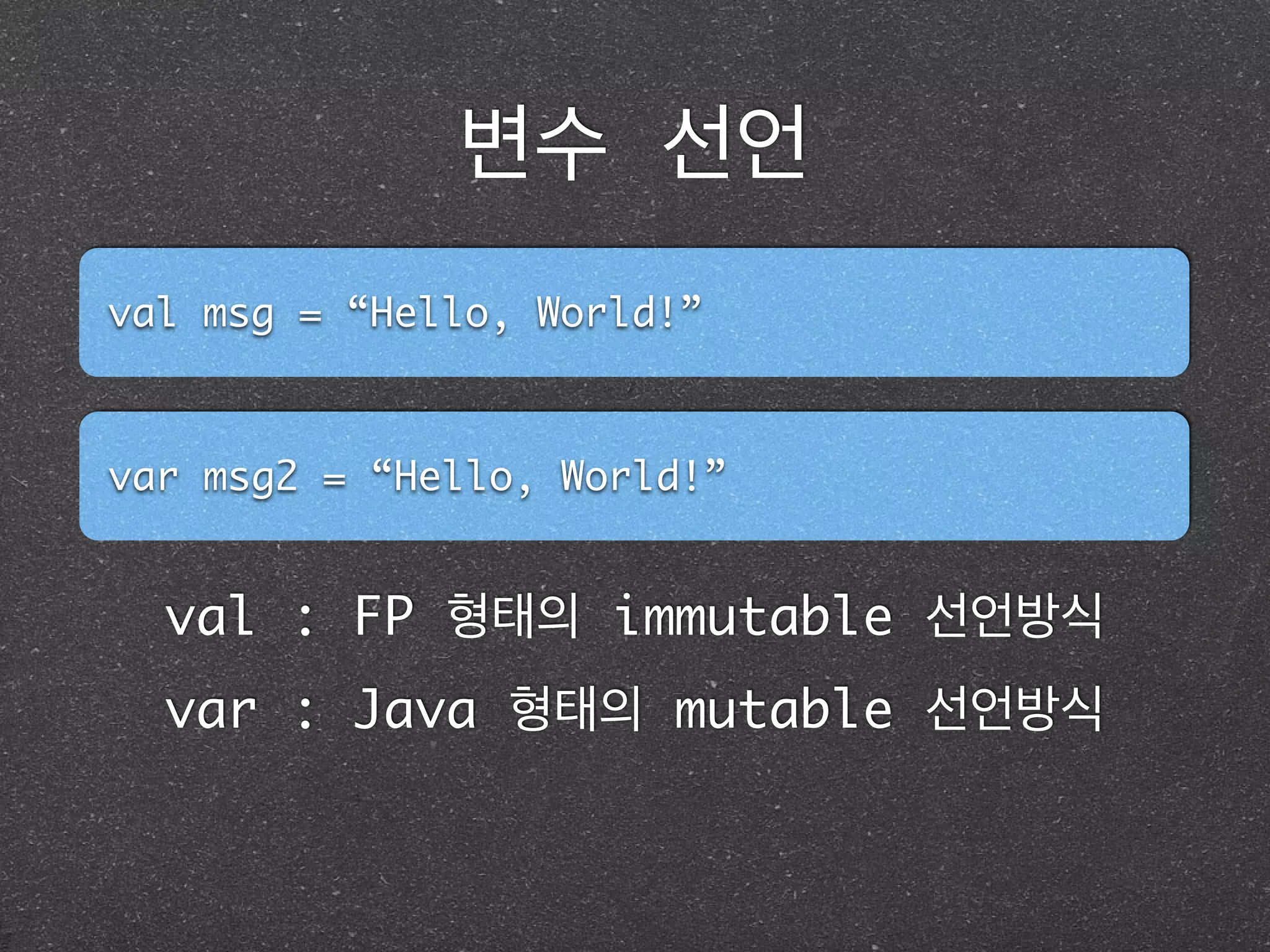
변수 선언
val msg = “Hello, World!”
var msg2 = “Hello, World!”
val : FP 형태의 immutable 선언방식
var : Java 형태의 mutable 선언방식
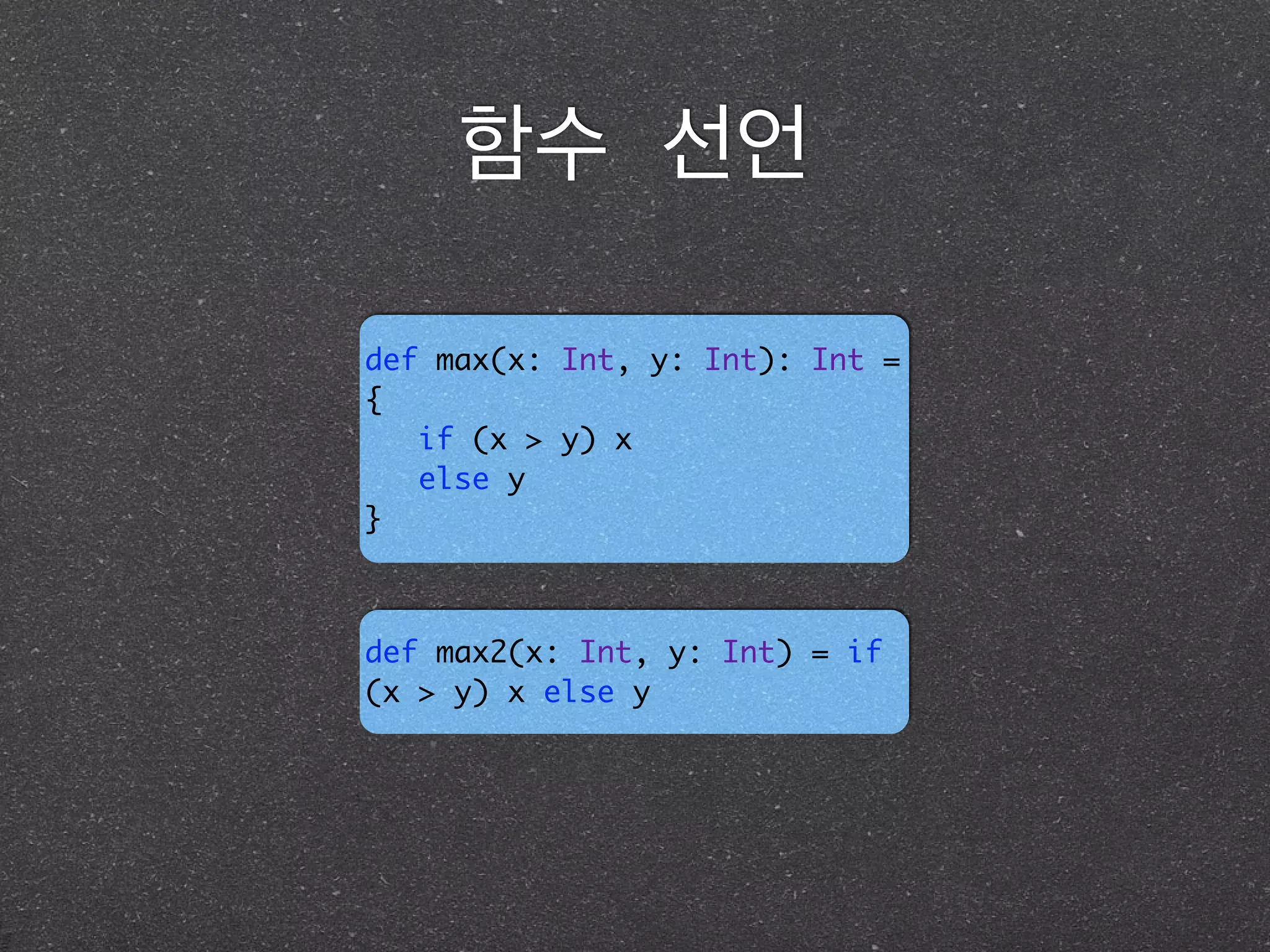
함수 선언
def max(x: Int, y: Int): Int =
{ 	
if (x > y) x	
else y	
}
def max2(x: Int, y: Int) = if
(x > y) x else y
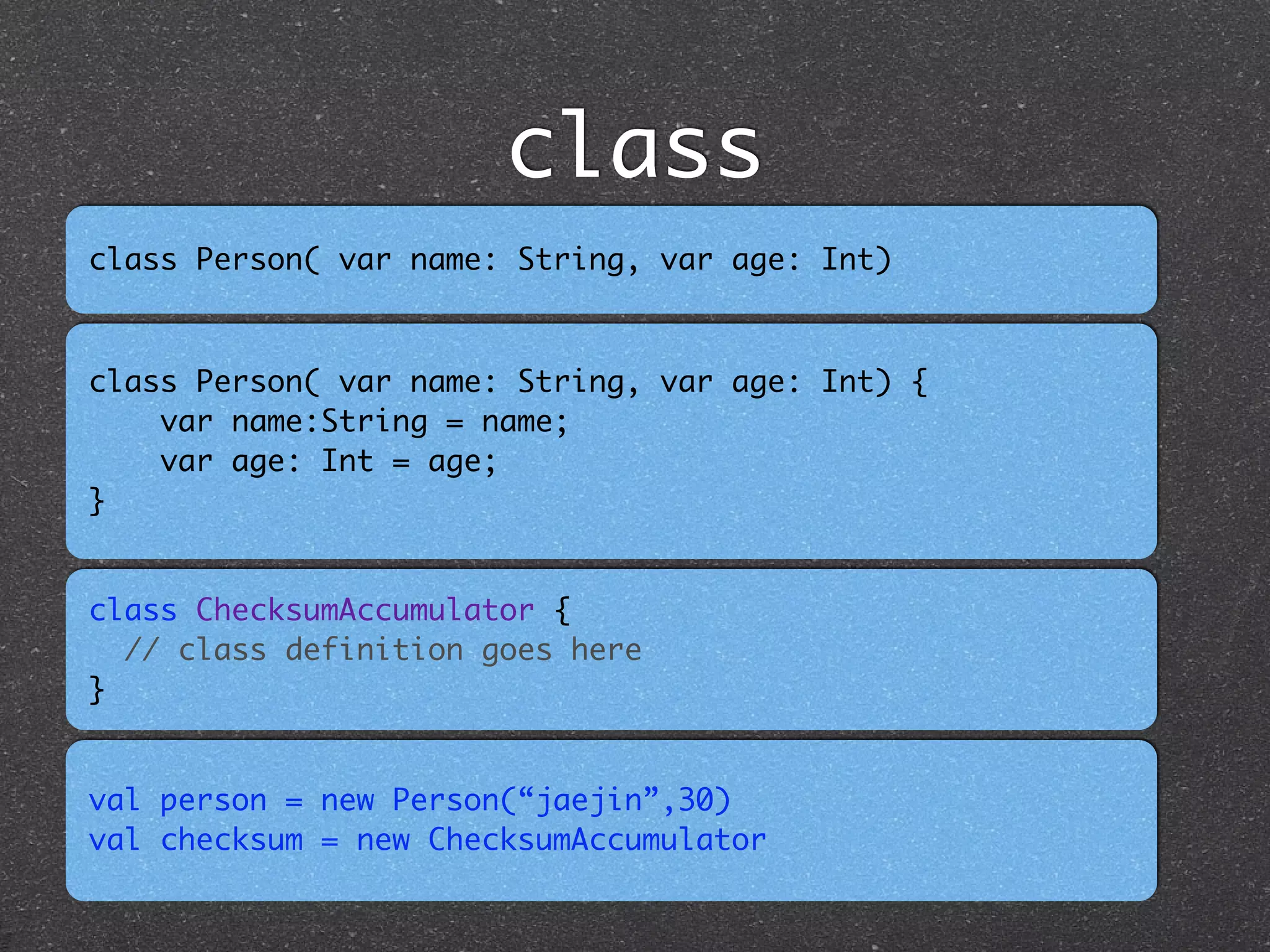
class
class Person( var name: String, var age: Int)
class ChecksumAccumulator { 	
// class definition goes here	
}
class Person( var name: String, var age: Int) {	
var name:String = name;	
var age: Int = age;	
}
val person = new Person(“jaejin”,30)	
val checksum = new ChecksumAccumulator
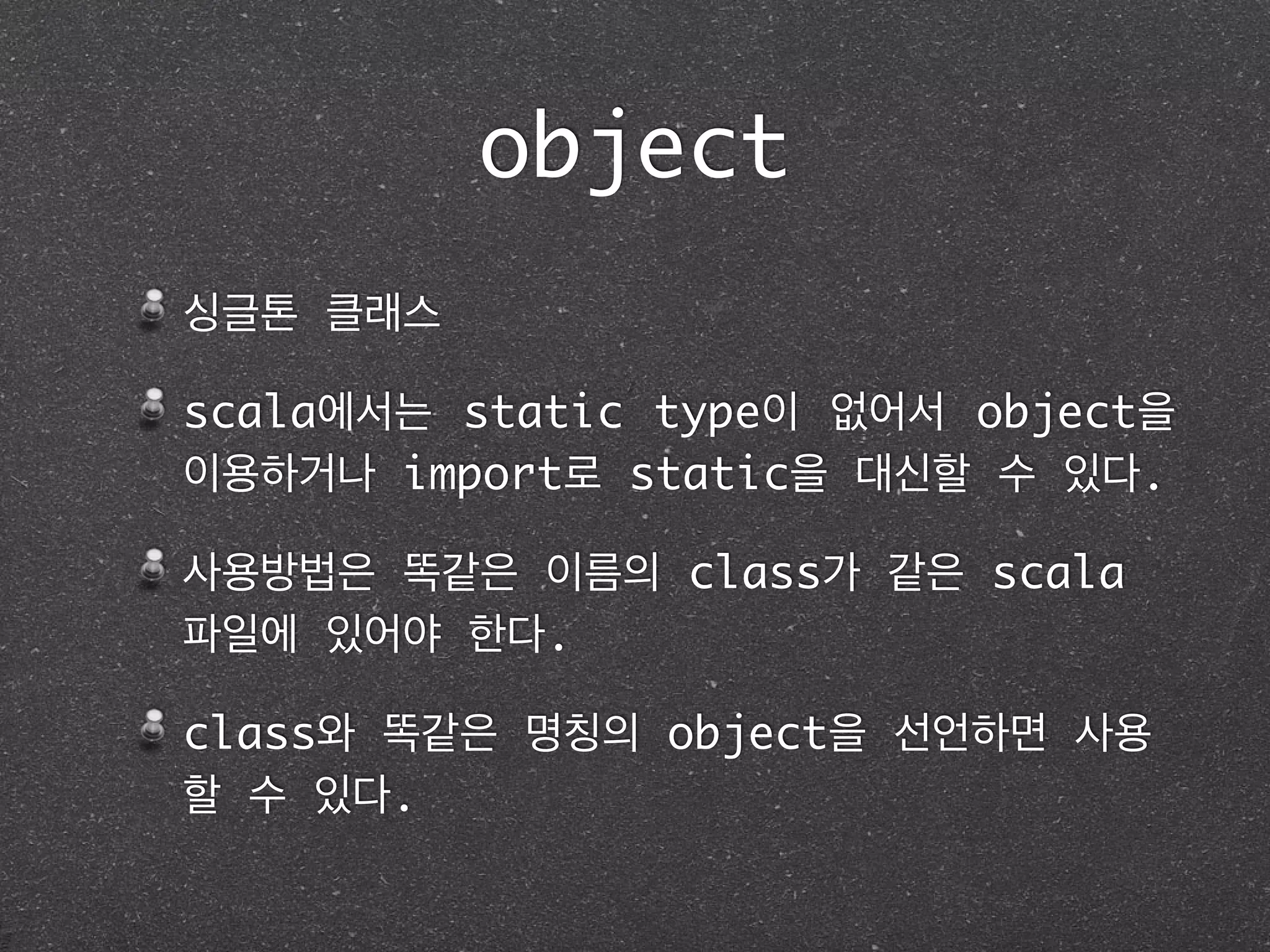
object
싱글톤 클래스	
scala에서는 static type이 없어서 object을
이용하거나 import로 static을 대신할 수 있다.	
사용방법은 똑같은 이름의 class가 같은 scala
파일에 있어야 한다.	
class와 똑같은 명칭의 object을 선언하면 사용
할 수 있다.
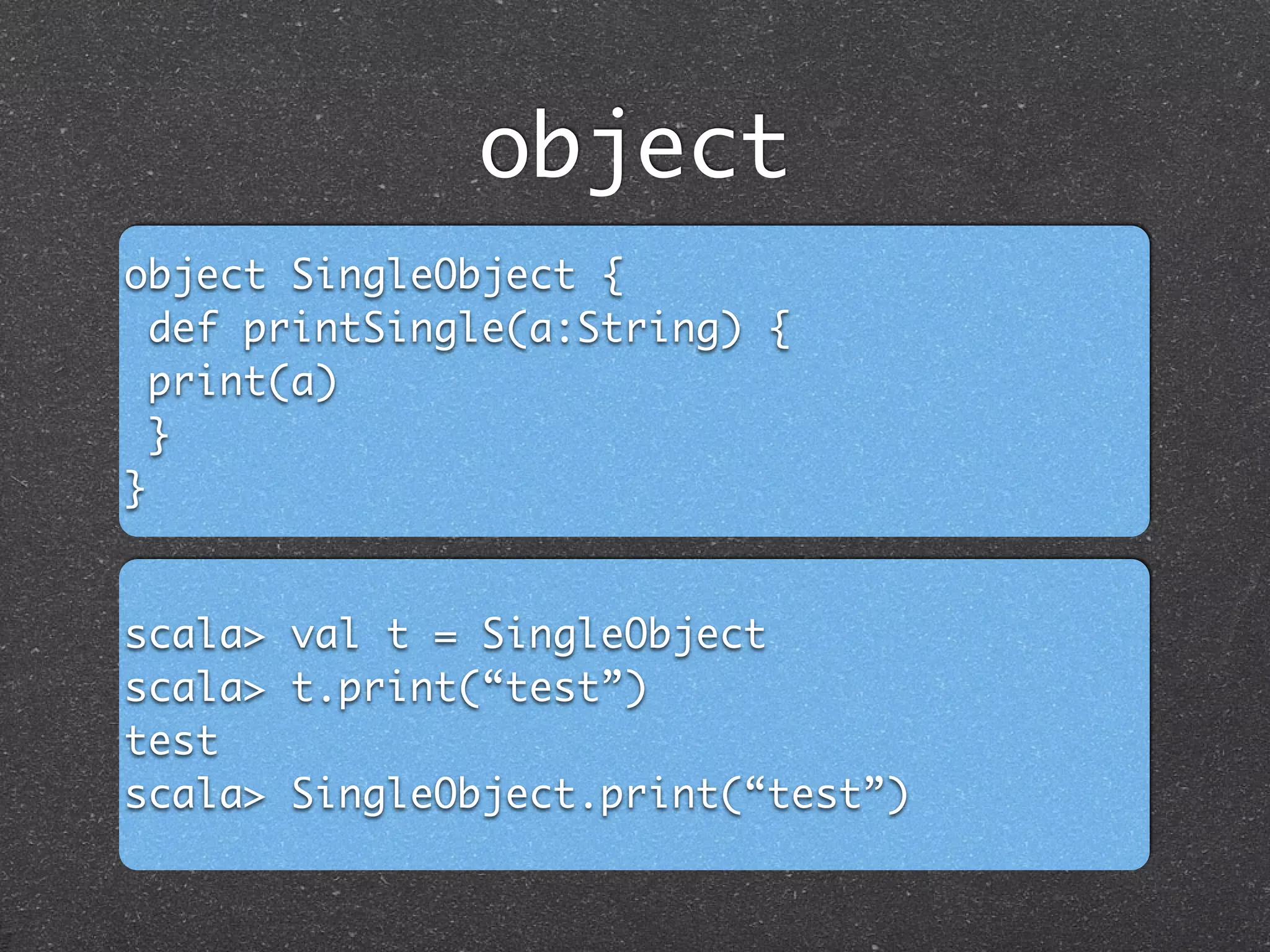
object
object SingleObject {	
def printSingle(a:String) {	
print(a)	
}	
}
scala> val t = SingleObject	
scala> t.print(“test”)	
test	
scala> SingleObject.print(“test”)
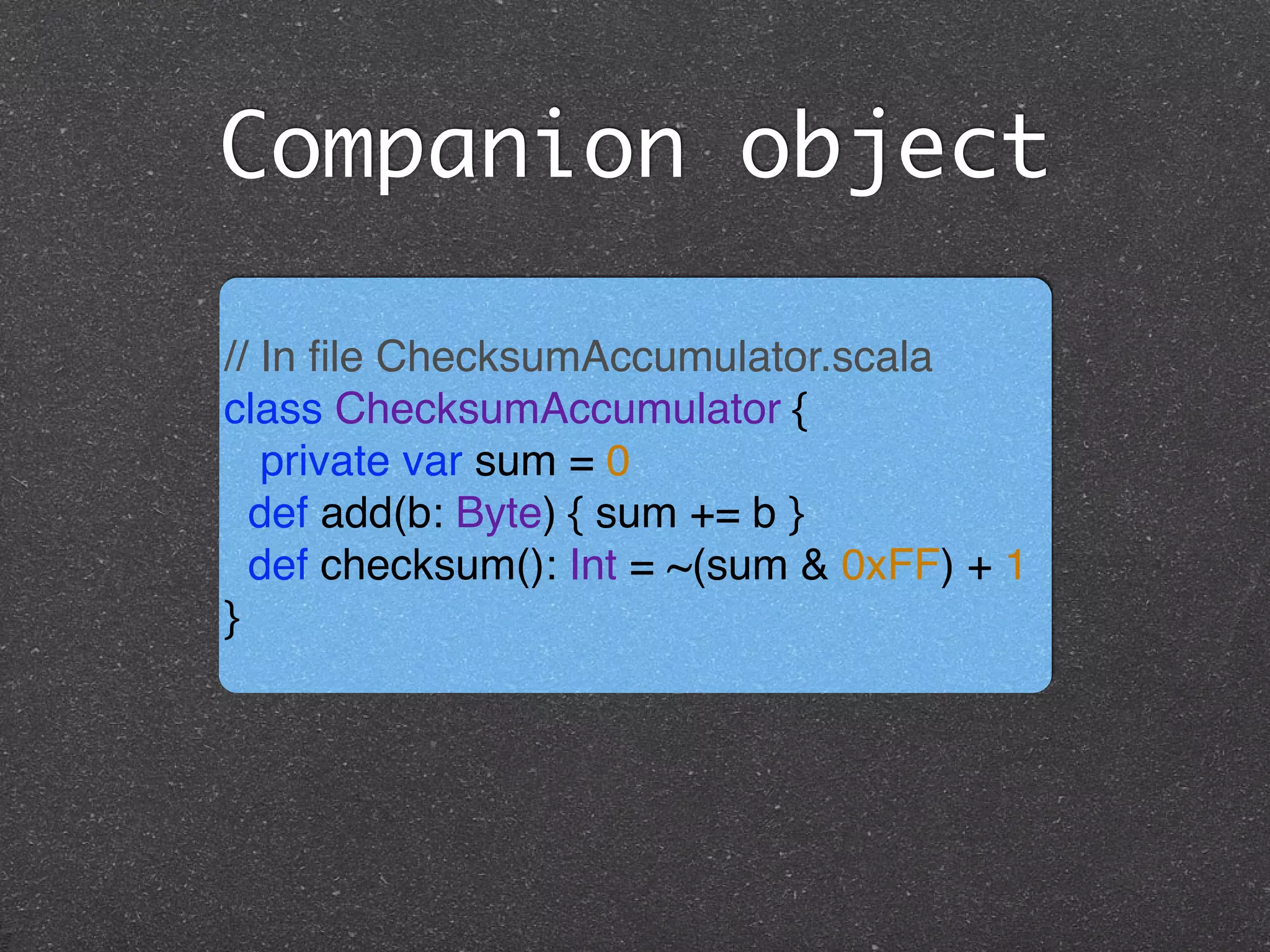
Companion object
// In file ChecksumAccumulator.scala!
class ChecksumAccumulator { !
private var sum = 0 !
def add(b: Byte) { sum += b } !
def checksum(): Int = ~(sum & 0xFF) + 1!
}
// In file ChecksumAccumulator.scala	
import scala.collection.mutable.Map 	
object ChecksumAccumulator {	
private val cache = Map[String, Int]()	
def calculate(s: String): Int = 	
if (cache.contains(s))	
cache(s) 	
else {	
val acc = new ChecksumAccumulator 	
for (c <- s)	
acc.add(c.toByte) 	
val cs = acc.checksum() 	
cache += (s -> cs) 	
cs	
}	
}
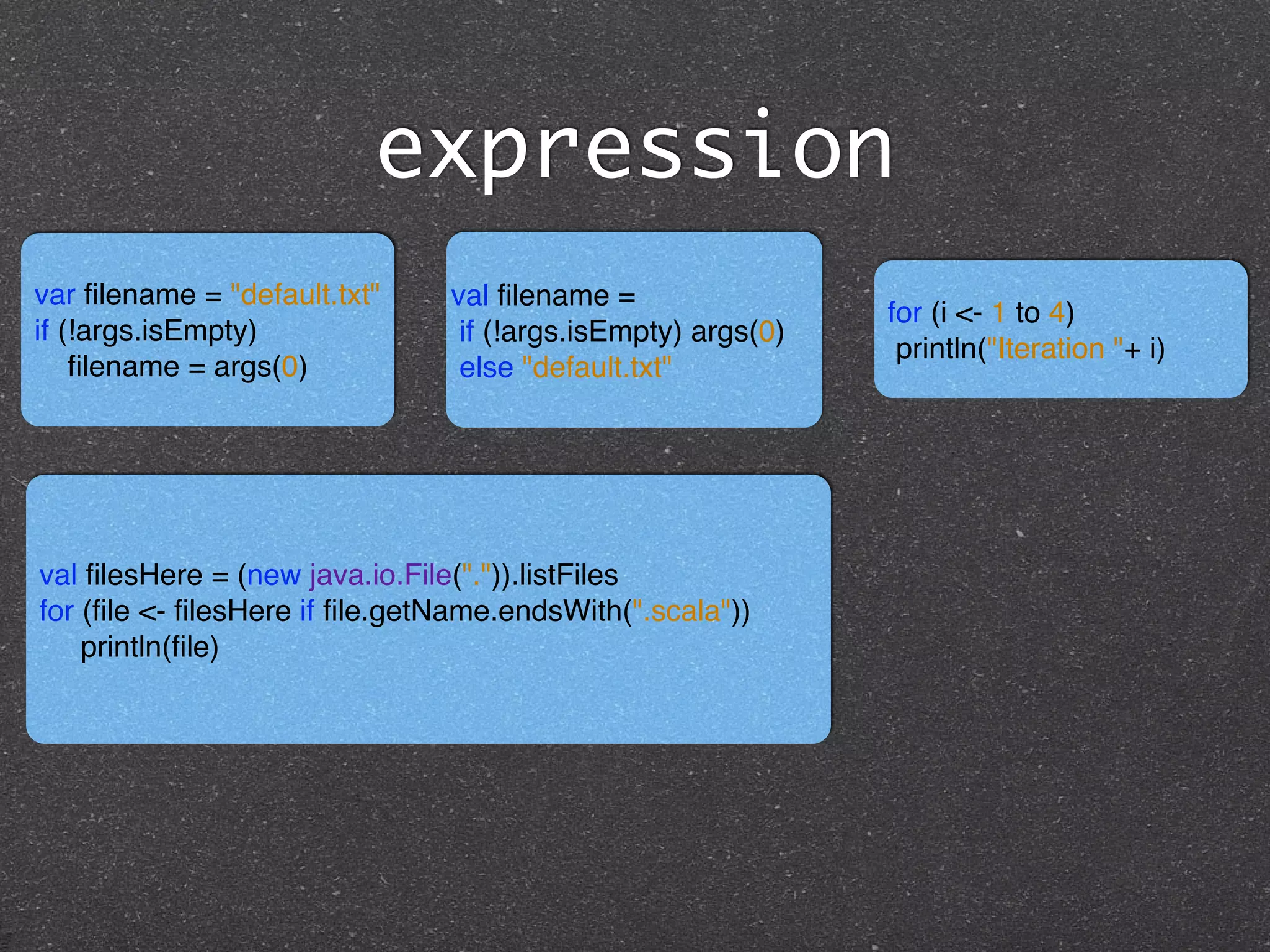
expression
var filename = "default.txt" !
if (!args.isEmpty)!
filename = args(0)
val filename = !
if (!args.isEmpty) args(0) !
else "default.txt"
for (i <- 1 to 4) !
println("Iteration "+ i)
val filesHere = (new java.io.File(".")).listFiles !
for (file <- filesHere if file.getName.endsWith(".scala"))!
println(file)
trait
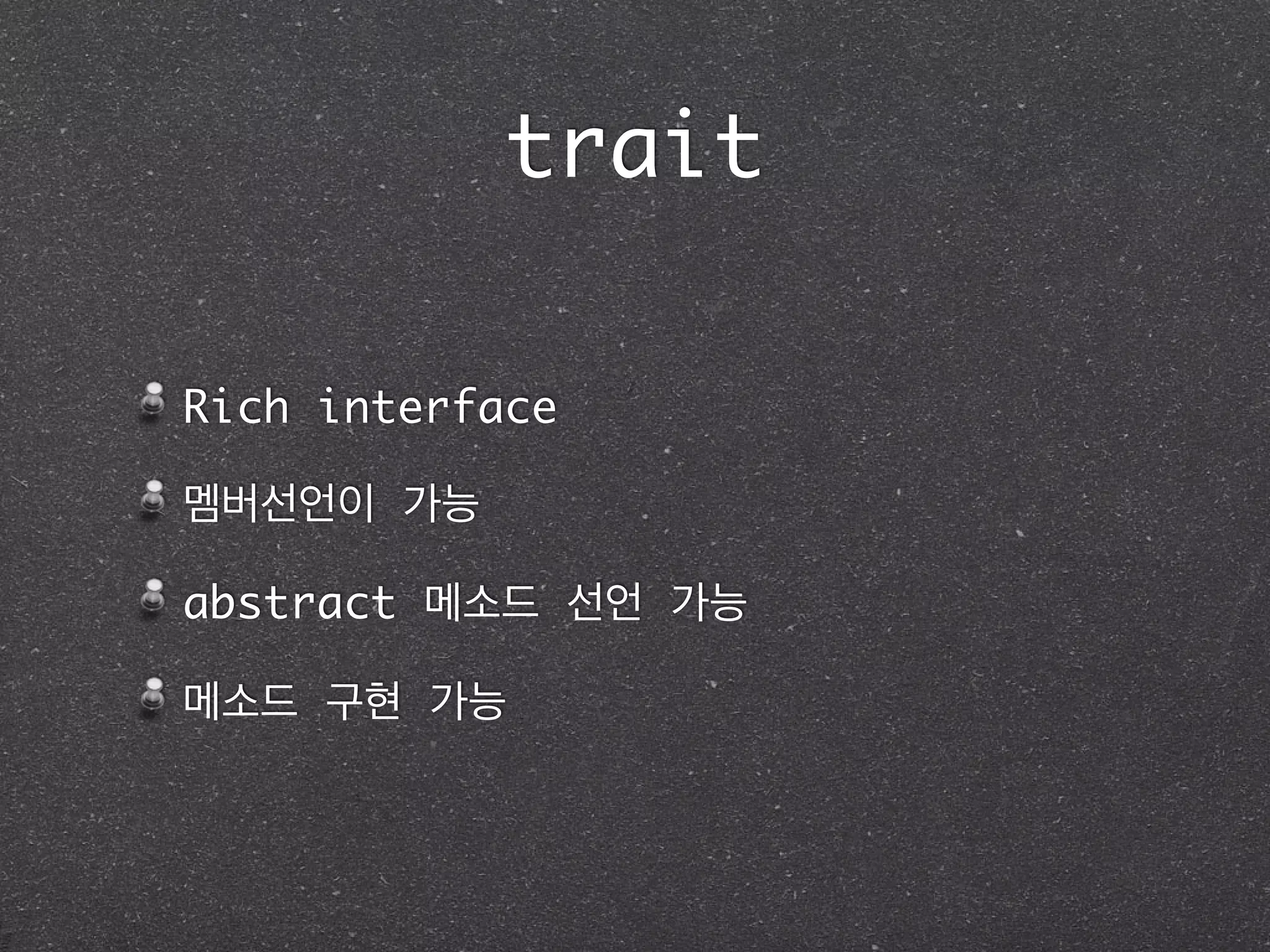
Rich interface	
멤버선언이 가능	
abstract 메소드 선언 가능	
메소드 구현 가능
trait Dad { 	
private var children: List[Child] = Nil	
!
def addChild(child: Child) = 	
children = child :: children	
!
def getChildren = children.clone	
}
trait
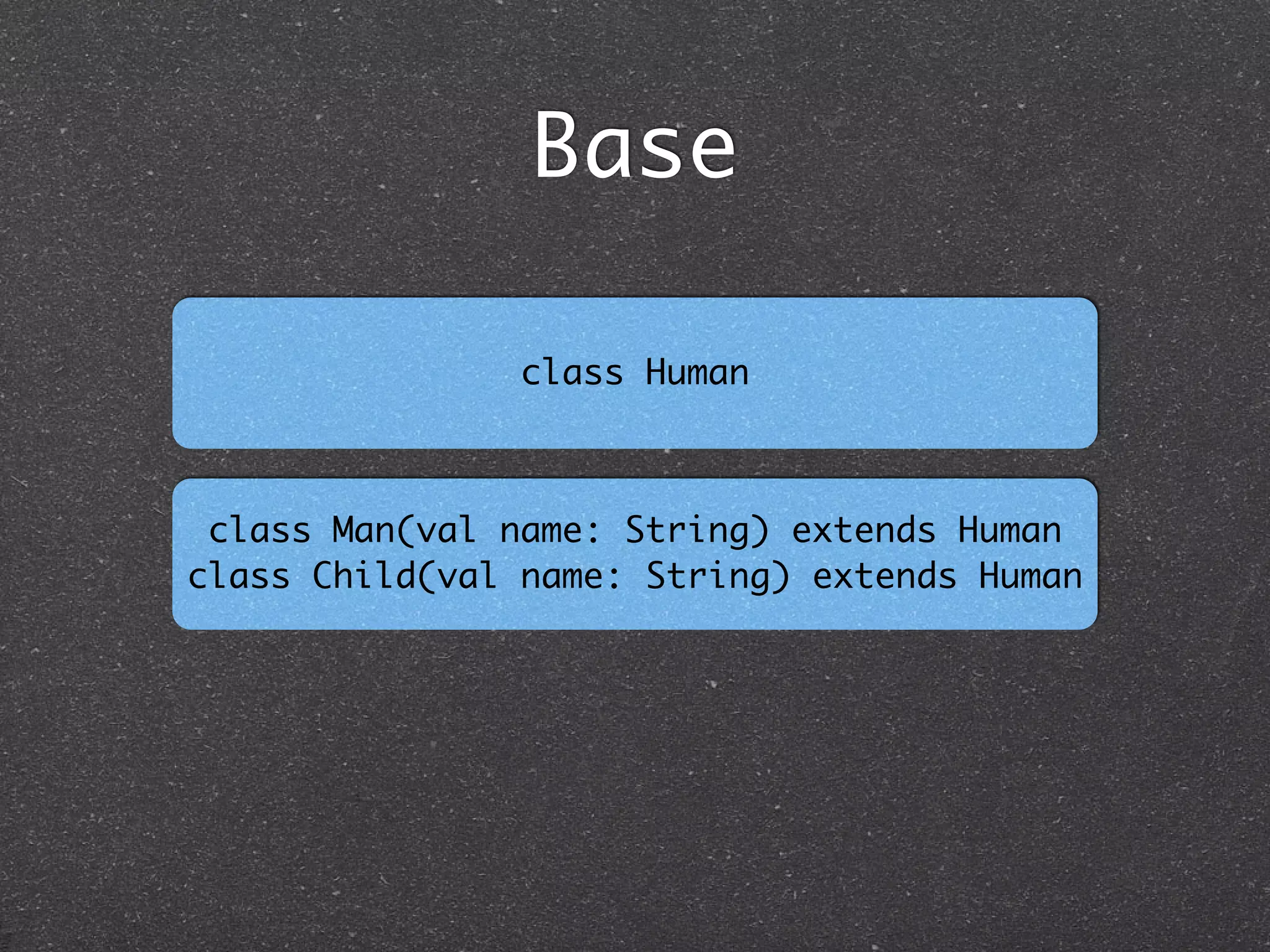
class Man(val name: String) extends Human	
class Child(val name: String) extends Human
Base
class Human
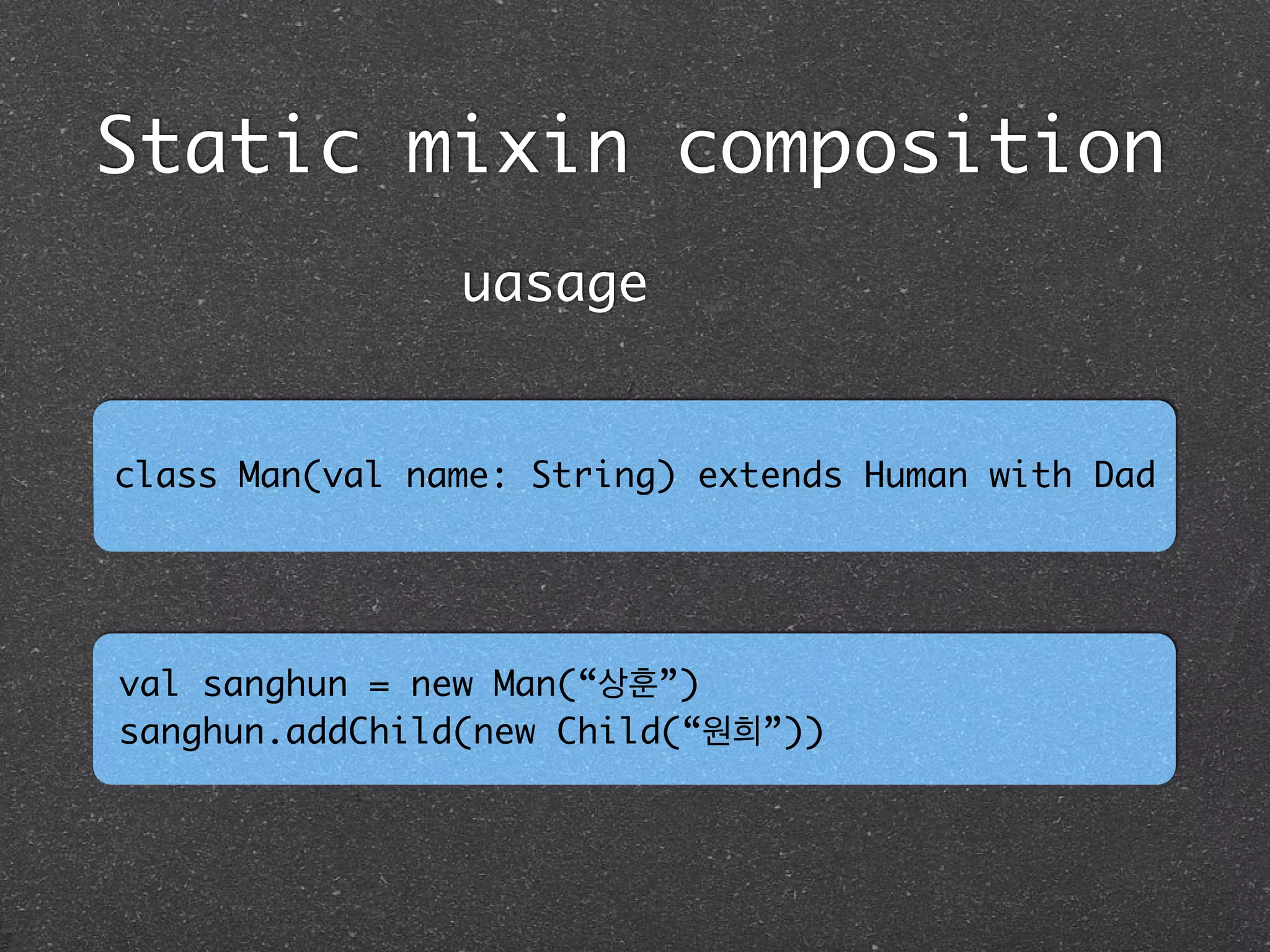
Static mixin composition
class Man(val name: String) extends Human with Dad
uasage
val sanghun = new Man(“상훈”) 	
sanghun.addChild(new Child(“원희”))
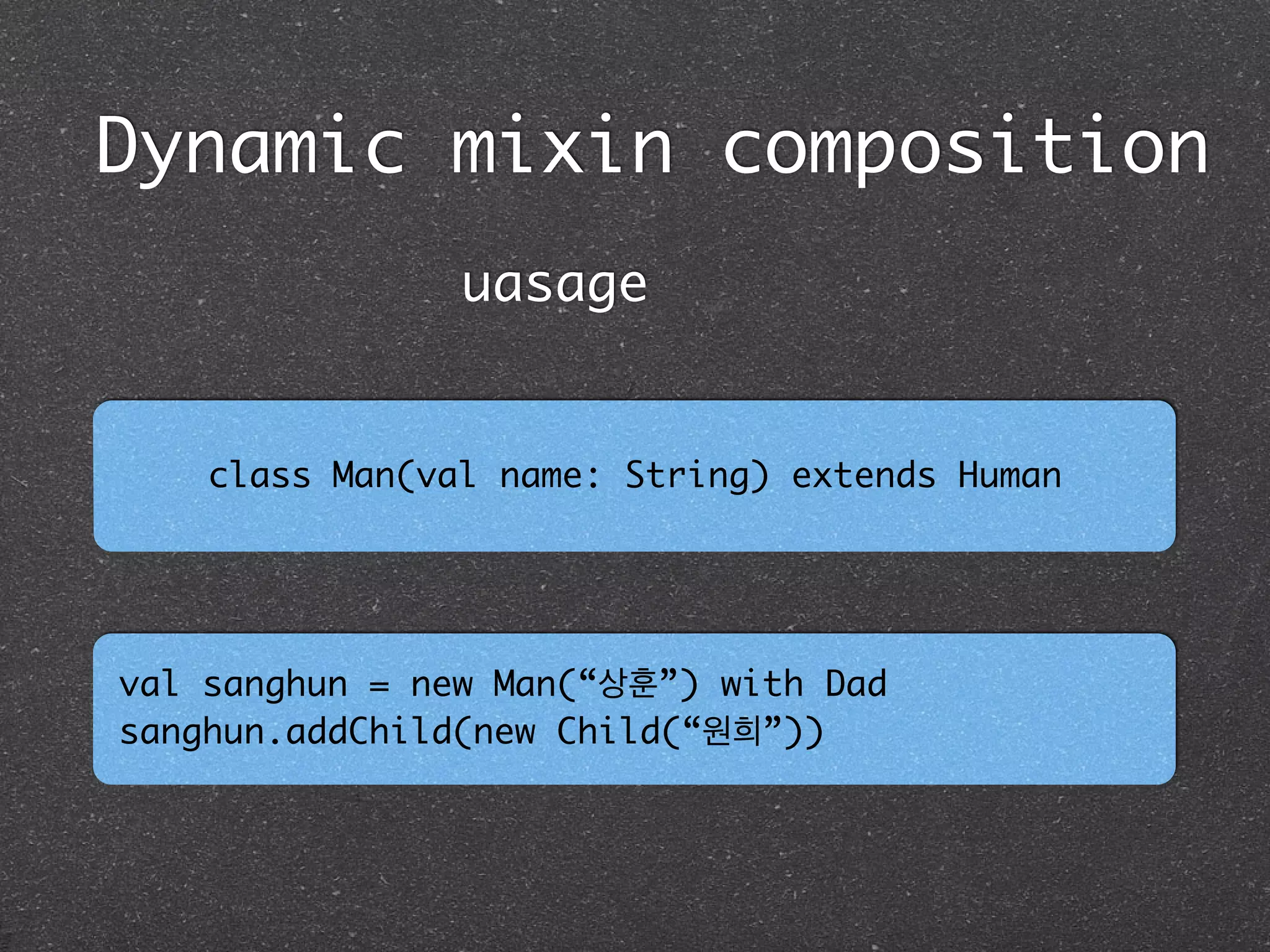
Dynamic mixin composition
class Man(val name: String) extends Human
uasage
val sanghun = new Man(“상훈”) with Dad	
sanghun.addChild(new Child(“원희”))
Stackable
modifications
trait IgnoreCaseSet extends java.util.Set[String] {	
!
abstract override def add(e: String) = { 	
super.add(e.toLowerCase)	
} 	
	
abstract override def contains(e: String) = {	
super.contains(e.toLowerCase) 	
} 	
	
abstract override def remove(e: String) = {	
super.remove(e.toLowerCase)	
}	
}
Stackable
modifications
val set = new java.util.HashSet[String]
with IgnoreCaseSet	
set.add(“HI THERE“)	 // uppercase	
set.contains(“hi there“) // lowercase	
=> true
Stackable
modifications
trait LoggableSet extends java.util.Set[String] {	
!
abstract override def add(e: String) = 	
{ 	
println(“Add :“ + e) 	
super.add(e)	
}	
	
abstract override def remove(e: String) = { 	
println(“Remove :“ + e) 	
super.remove(e) 	
}	
}
Stackable
modifications
val set = new java.util.HashSet[String] 	
with IgnoreCaseSet 	
with LoggableSet	
set.add(“HI THERE“) 	
=> “Add: HI THERE”
Stackable
modifications
val set = new java.util.HashSet[String] 	
with LoggableSet	
with IgnoreCaseSet 	
set.add(“HI THERE“) 	
=> “Add: hi there”
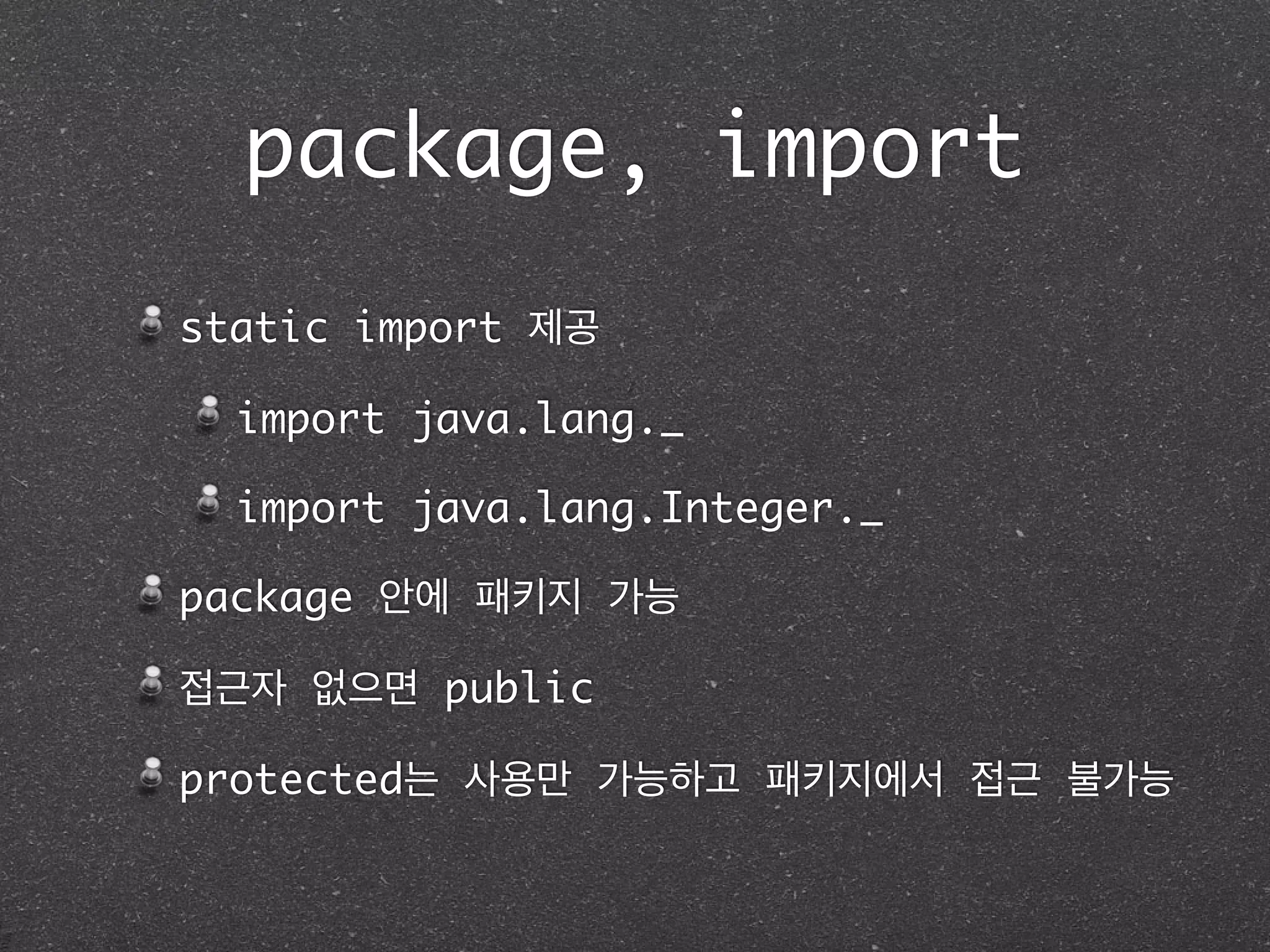
package, import
static import 제공	
import java.lang._	
import java.lang.Integer._	
package 안에 패키지 가능	
접근자 없으면 public	
protected는 사용만 가능하고 패키지에서 접근 불가능
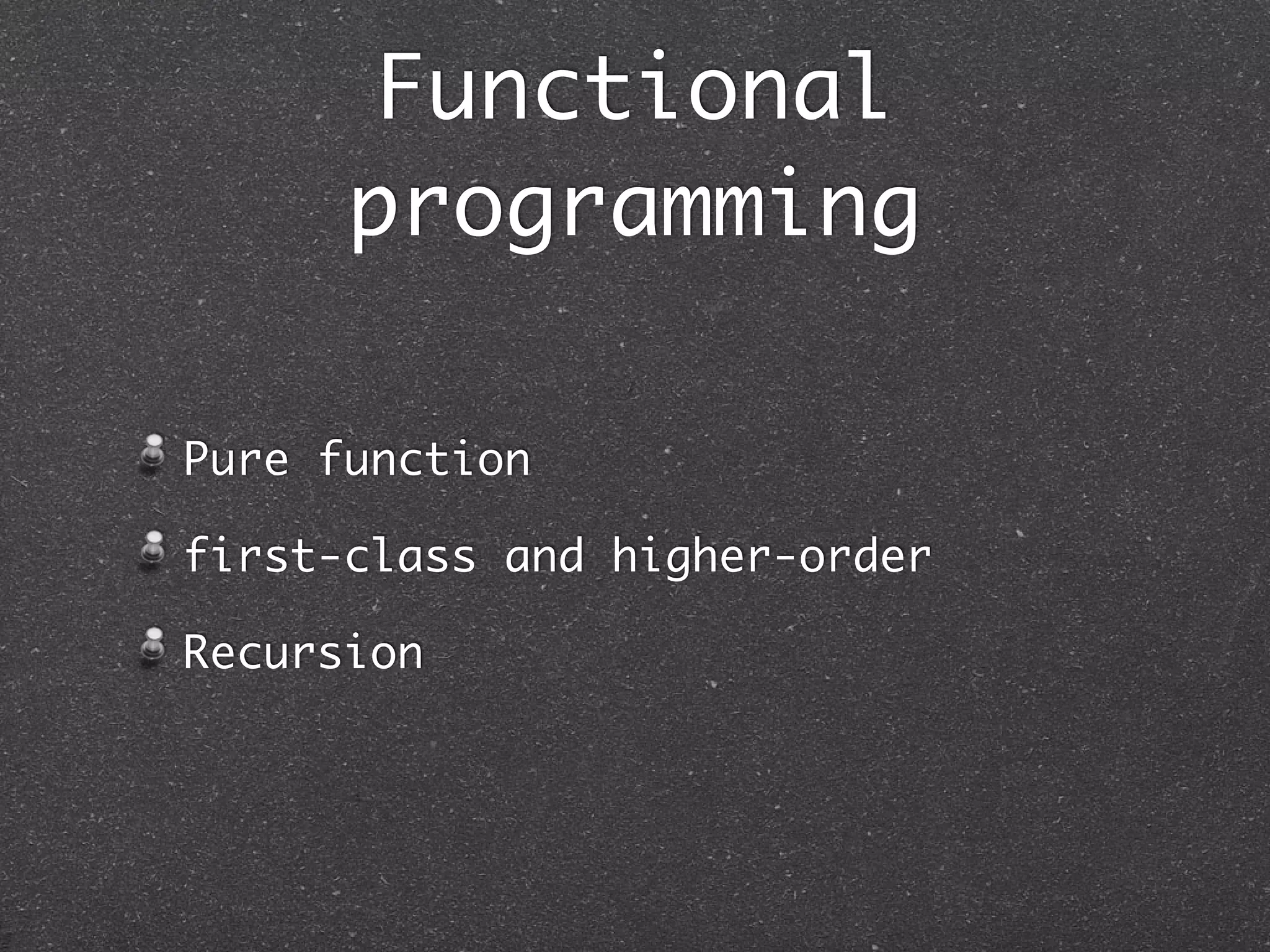
Functional
programming
Pure function	
first-class and higher-order	
Recursion
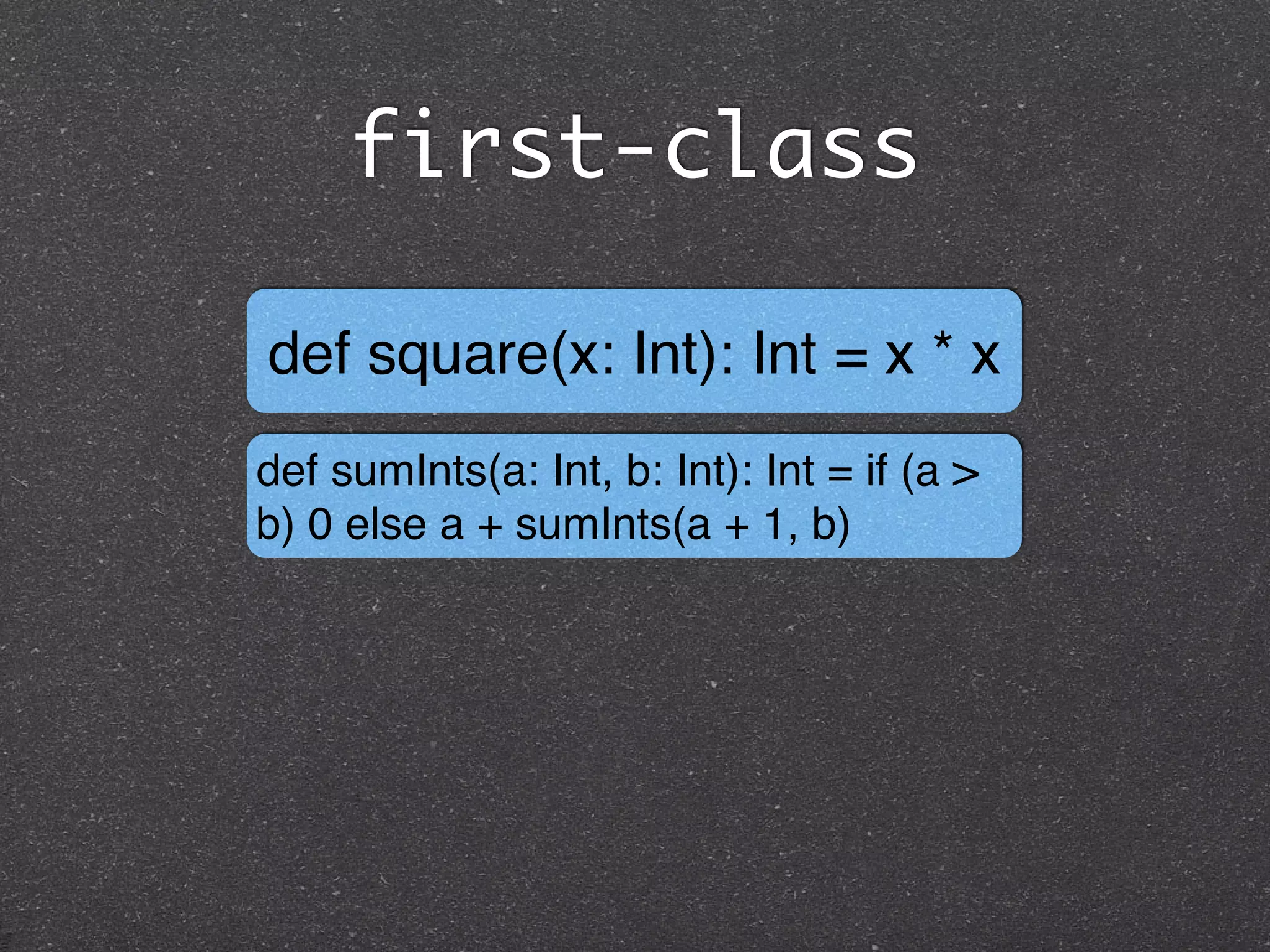
first-class
def square(x: Int): Int = x * x
def sumInts(a: Int, b: Int): Int = if (a >
b) 0 else a + sumInts(a + 1, b)
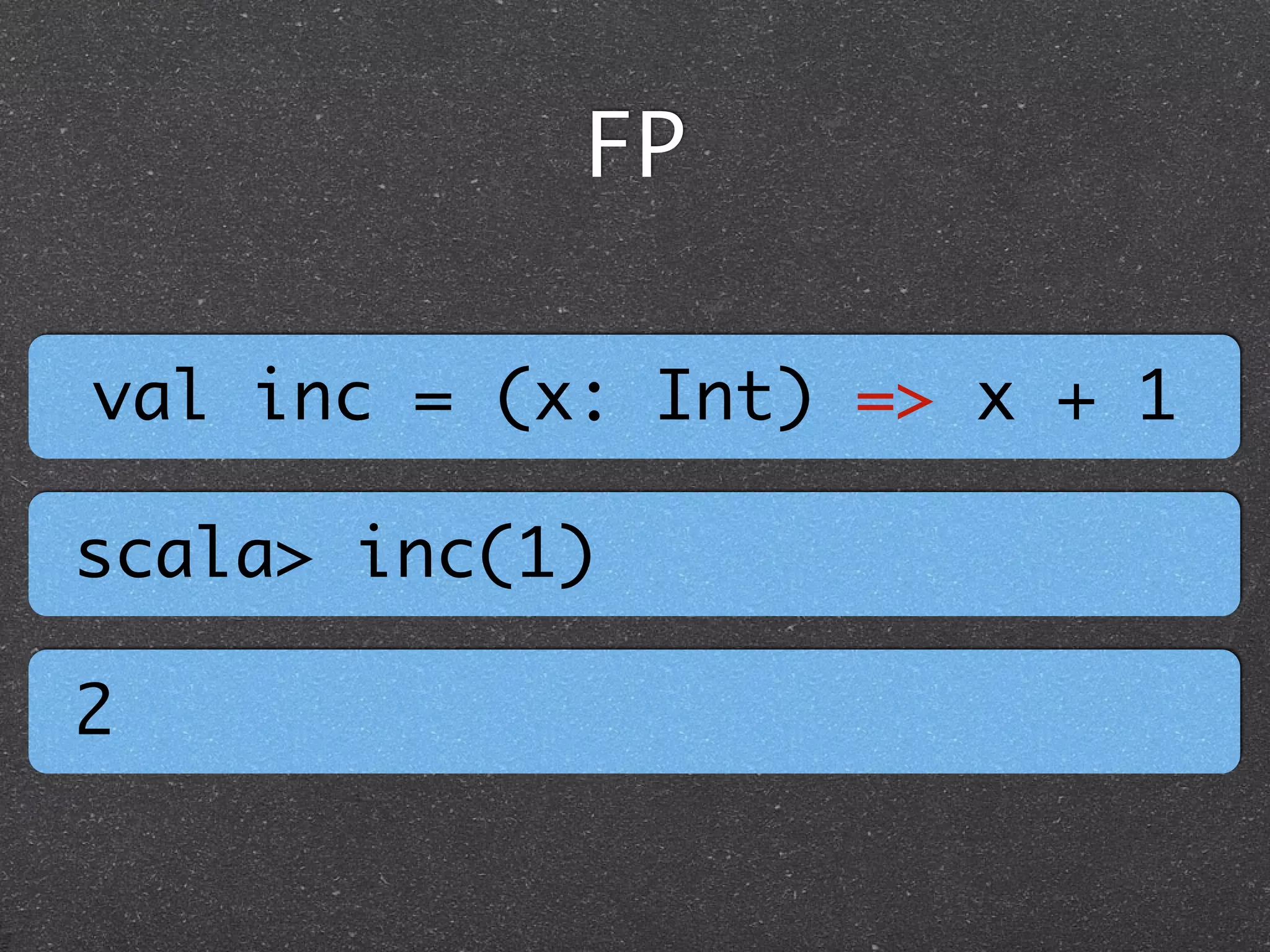
FP
val inc = (x: Int) => x + 1
scala> inc(1)
2
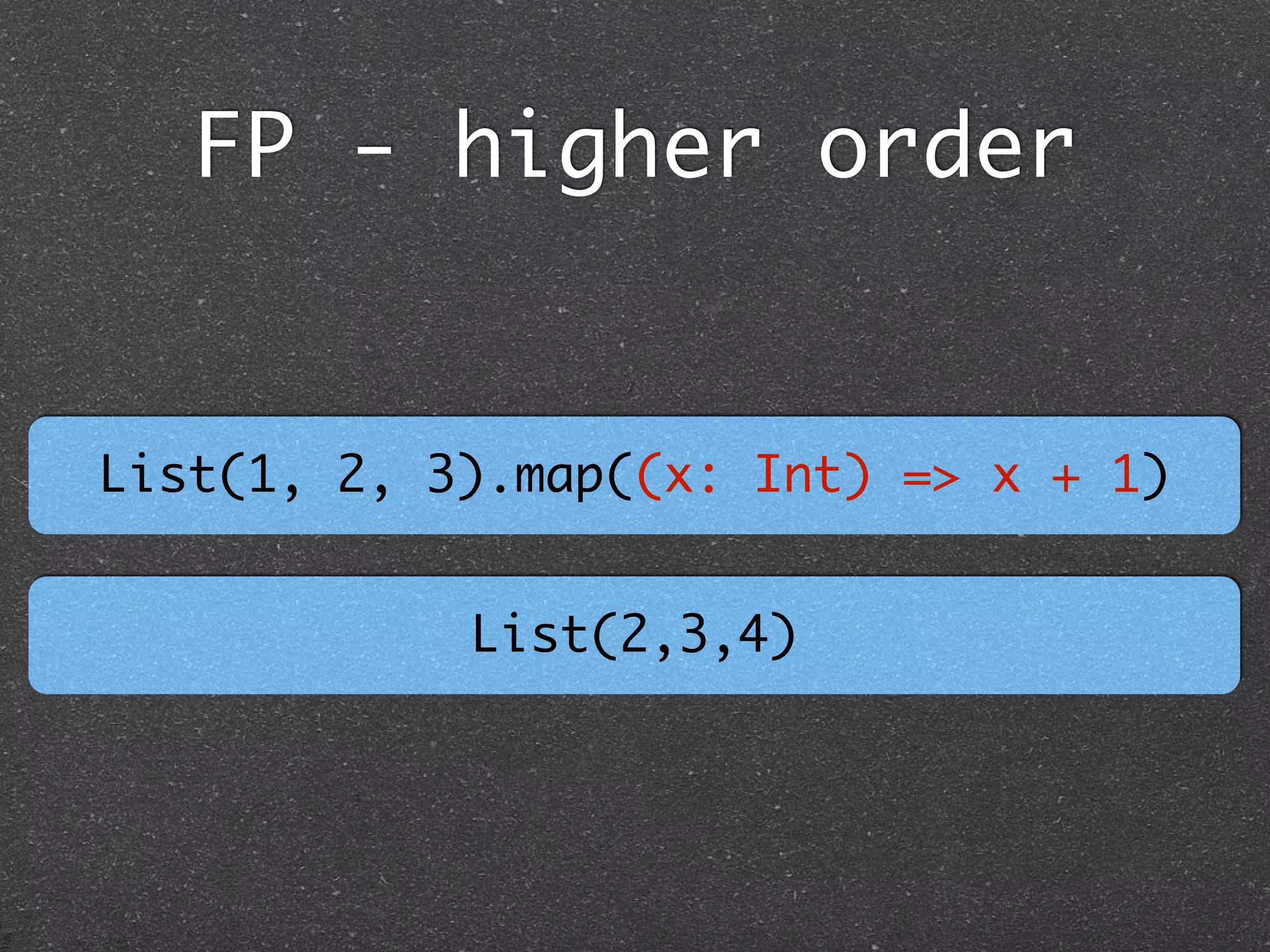
FP - higher order
List(1, 2, 3).map((x: Int) => x + 1)
List(2,3,4)
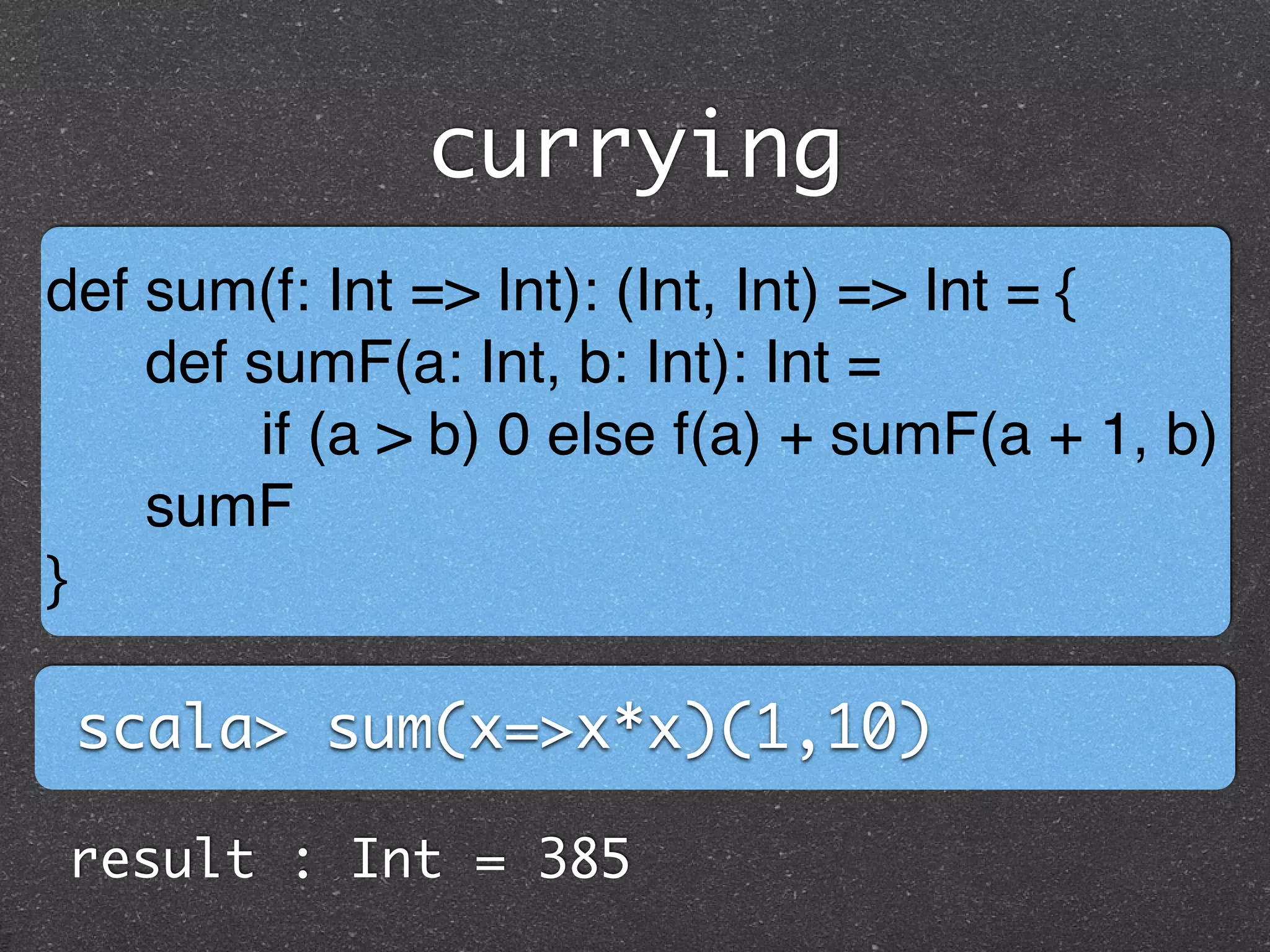
currying
def sum(f: Int => Int): (Int, Int) => Int = { !
def sumF(a: Int, b: Int): Int =!
if (a > b) 0 else f(a) + sumF(a + 1, b) !
sumF!
}
scala> sum(x=>x*x)(1,10)
result : Int = 385
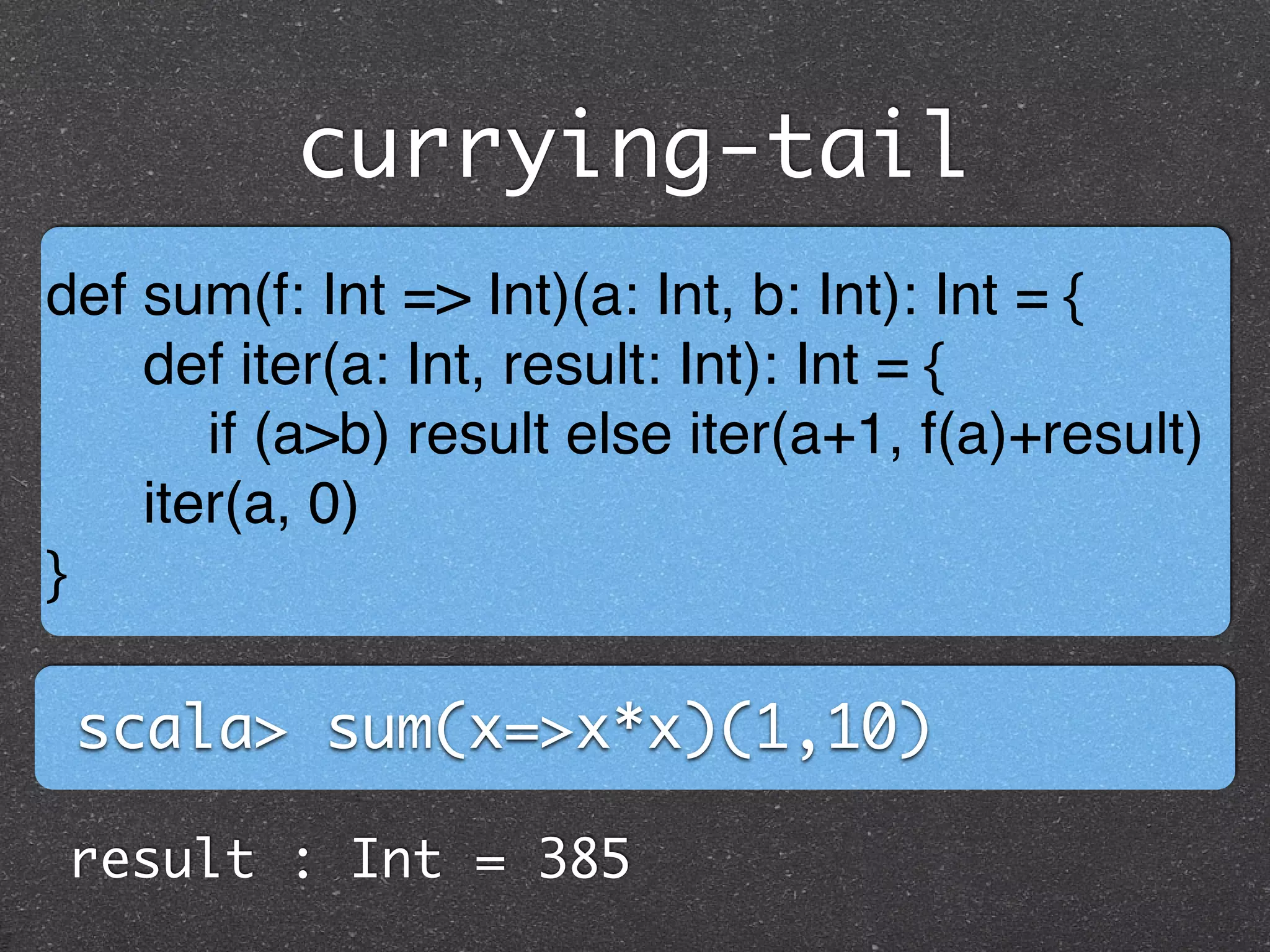
currying-tail
def sum(f: Int => Int)(a: Int, b: Int): Int = { !
def iter(a: Int, result: Int): Int = {!
if (a>b) result else iter(a+1, f(a)+result)!
iter(a, 0)!
}
scala> sum(x=>x*x)(1,10)
result : Int = 385
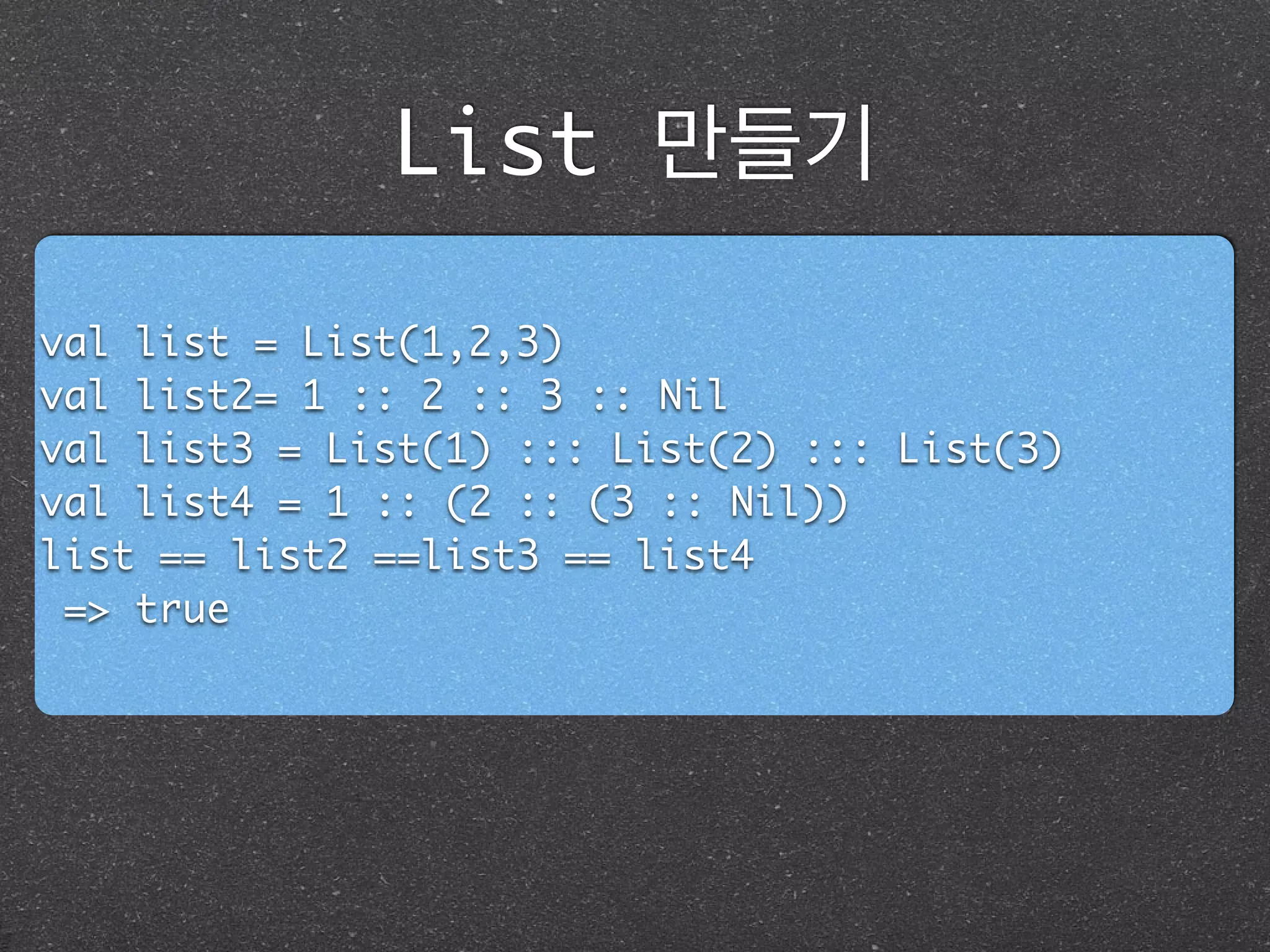
List 만들기
val list = List(1,2,3)	
val list2= 1 :: 2 :: 3 :: Nil	
val list3 = List(1) ::: List(2) ::: List(3)	
val list4 = 1 :: (2 :: (3 :: Nil))	
list == list2 ==list3 == list4	
=> true
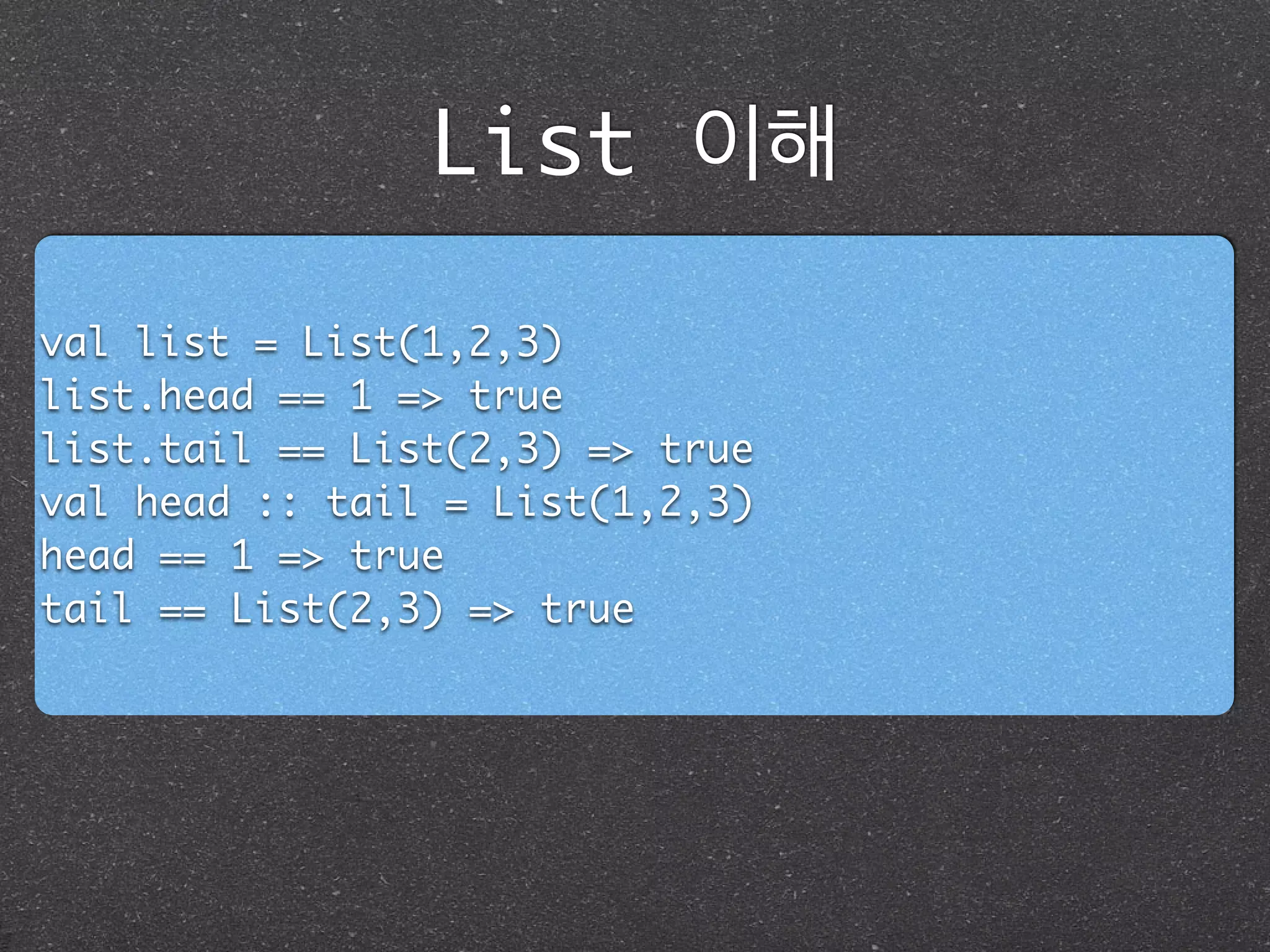
List 이해
val list = List(1,2,3)	
list.head == 1 => true	
list.tail == List(2,3) => true	
val head :: tail = List(1,2,3)	
head == 1 => true	
tail == List(2,3) => true
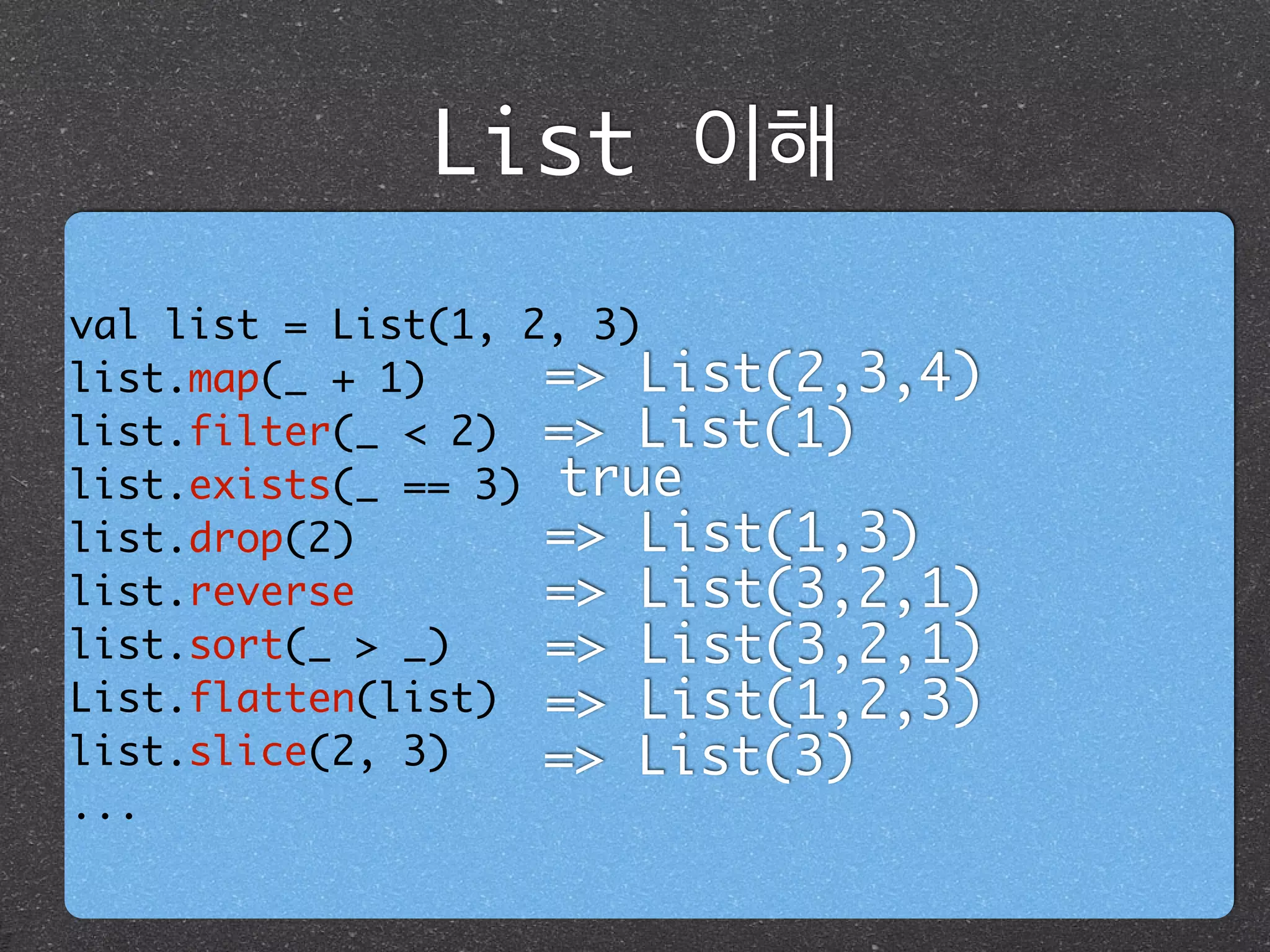
List 이해
val list = List(1, 2, 3)	
list.map(_ + 1) 	
list.filter(_ < 2) 	
list.exists(_ == 3) 	
list.drop(2) 	
list.reverse 	
list.sort(_ > _) 	
List.flatten(list) 	
list.slice(2, 3) 	
...
=> List(2,3,4)
=> List(1)
true
=> List(1,3)
=> List(3,2,1)
=> List(3,2,1)
=> List(1,2,3)
=> List(3)
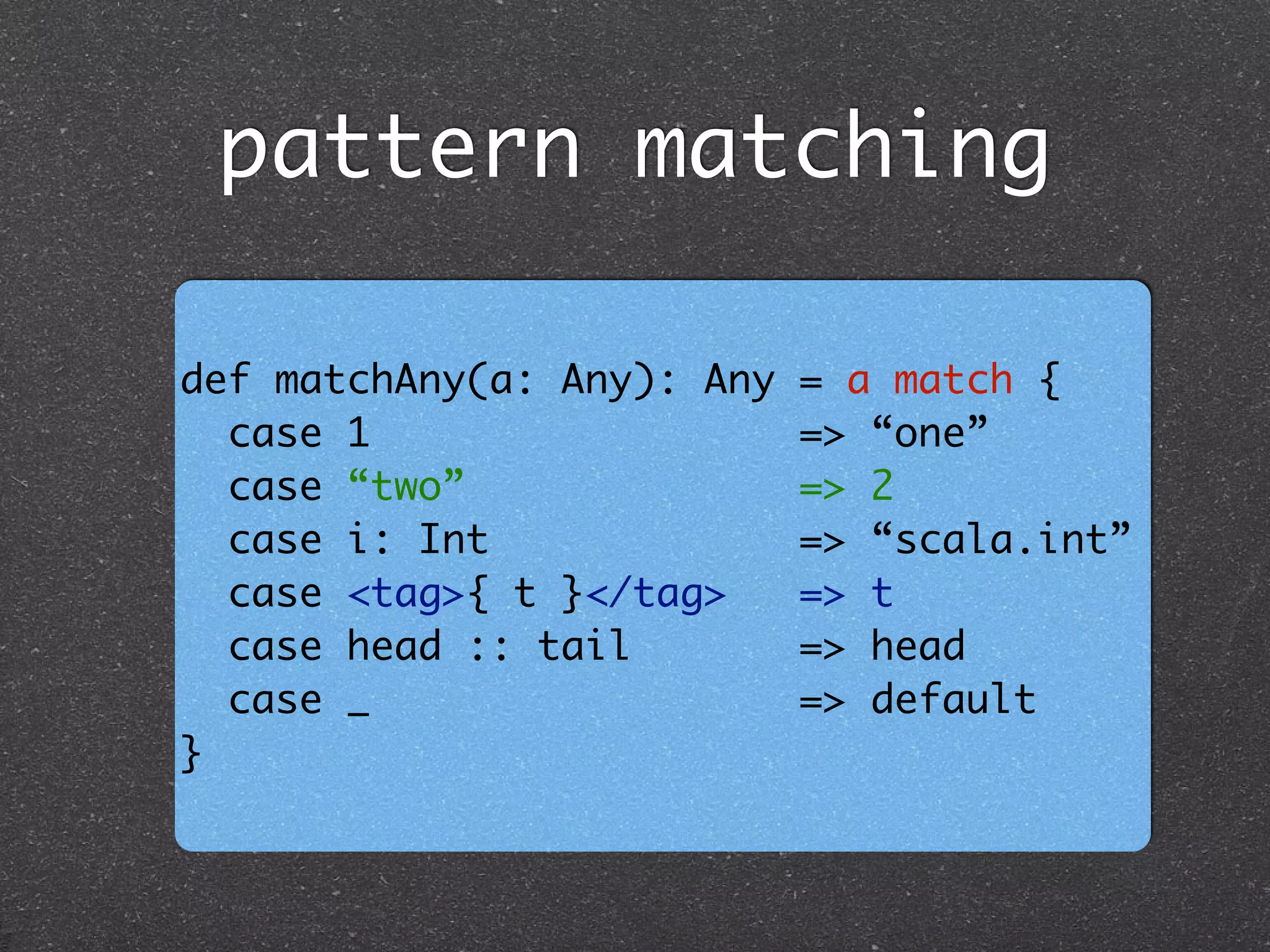
pattern matching
def matchAny(a: Any): Any = a match {	
case 1 => “one”	
case “two” => 2	
case i: Int => “scala.int”	
case <tag>{ t }</tag> => t	
case head :: tail => head	
case _ => default	
}
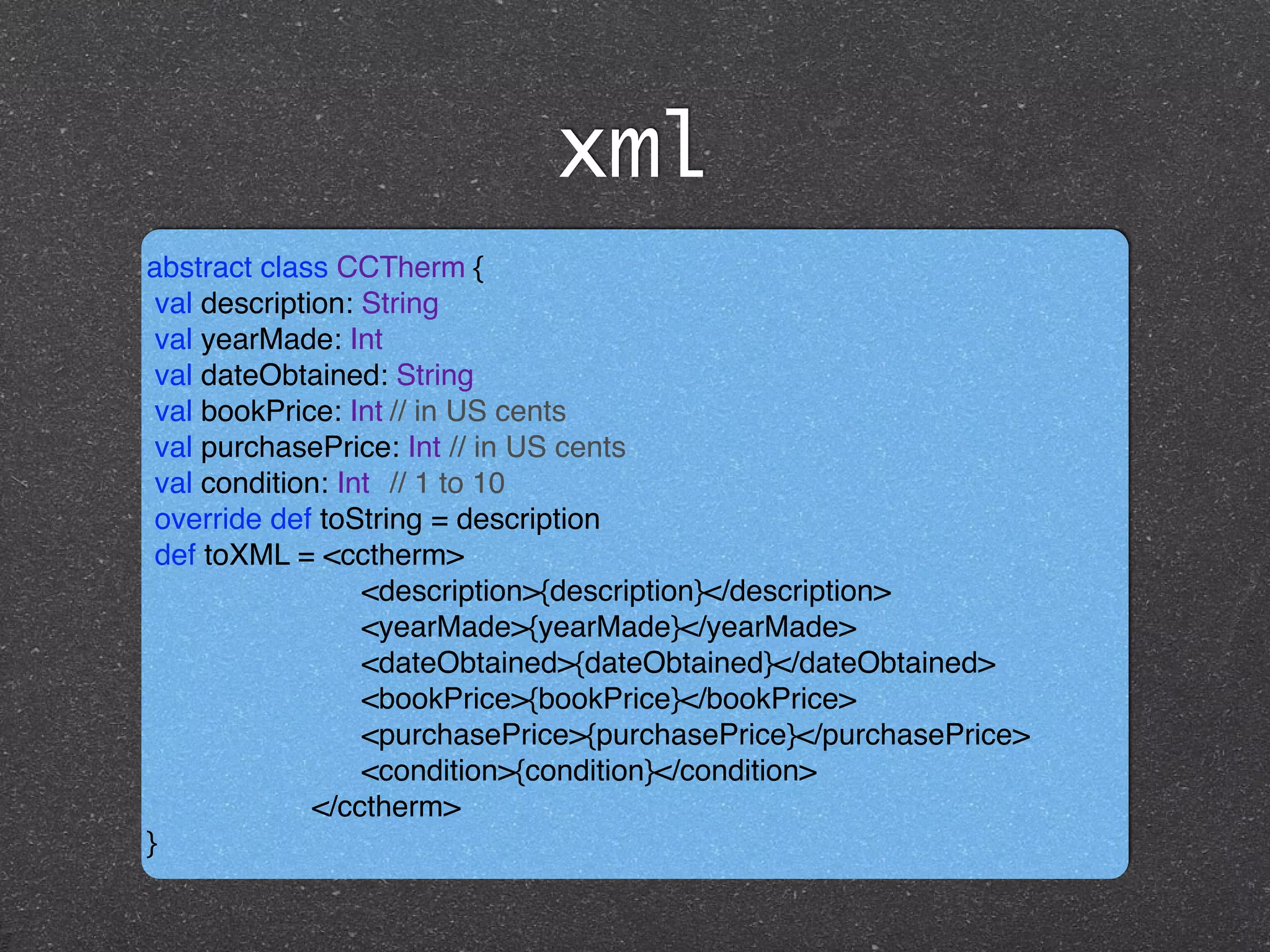
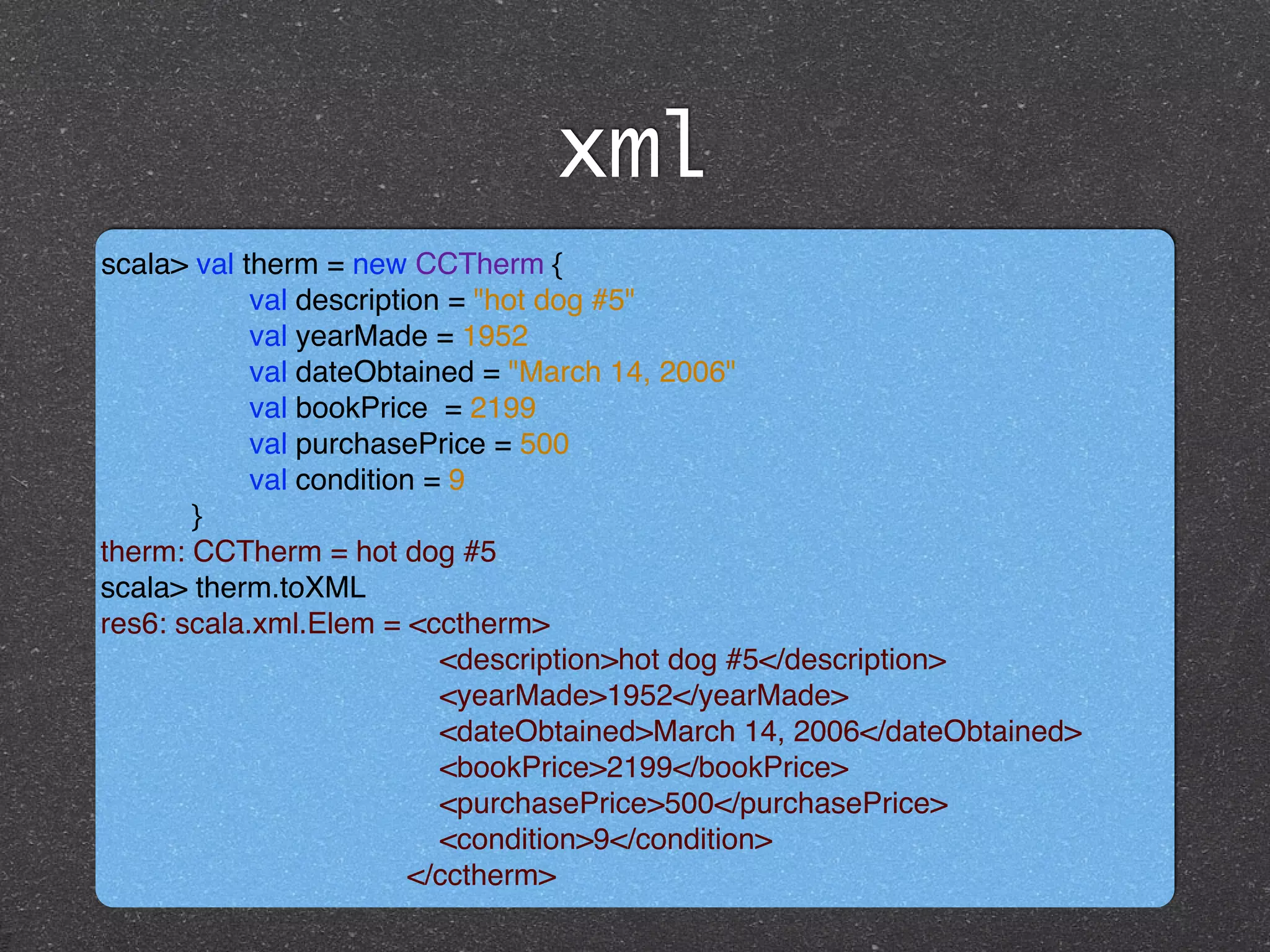
xml
abstract class CCTherm { !
val description: String !
val yearMade: Int !
val dateObtained: String !
val bookPrice: Int!// in US cents !
val purchasePrice: Int // in US cents !
val condition: Int! // 1 to 10!
override def toString = description!
def toXML = <cctherm>!
<description>{description}</description> !
<yearMade>{yearMade}</yearMade> !
<dateObtained>{dateObtained}</dateObtained> !
<bookPrice>{bookPrice}</bookPrice> !
<purchasePrice>{purchasePrice}</purchasePrice> !
<condition>{condition}</condition>!
</cctherm>!
}
xml
scala> val therm = new CCTherm { !
val description = "hot dog #5"!
val yearMade = 1952 !
val dateObtained = "March 14, 2006" !
val bookPrice = 2199 !
val purchasePrice = 500 !
val condition = 9!
}!
therm: CCTherm = hot dog #5!
scala> therm.toXML!
res6: scala.xml.Elem = <cctherm>!
<description>hot dog #5</description> !
<yearMade>1952</yearMade> !
<dateObtained>March 14, 2006</dateObtained> !
<bookPrice>2199</bookPrice> !
<purchasePrice>500</purchasePrice> !
<condition>9</condition>!
</cctherm>
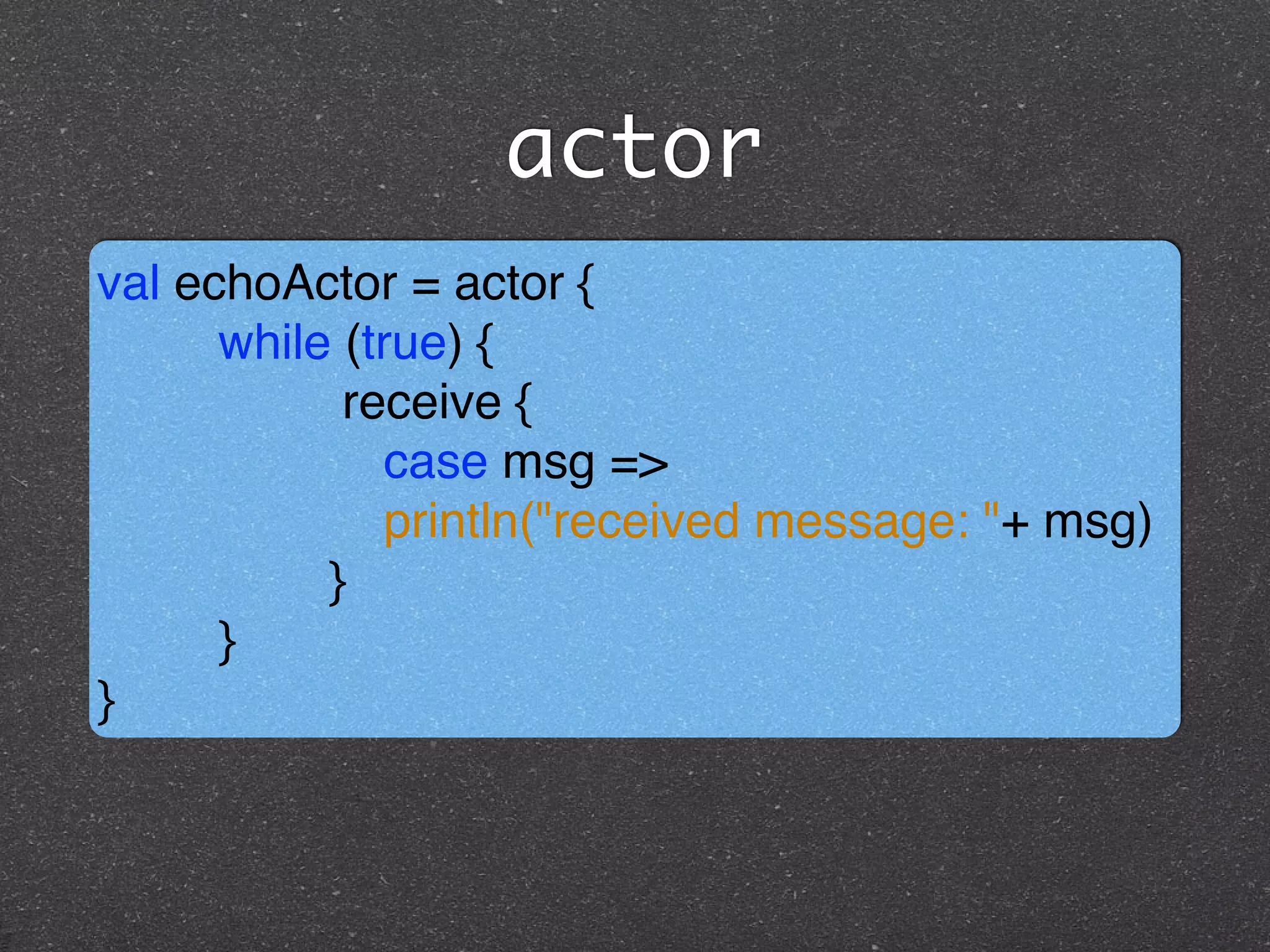
actor
val echoActor = actor { !
while (true) { !
receive { !
case msg =>!
println("received message: "+ msg)!
}!
}!
}
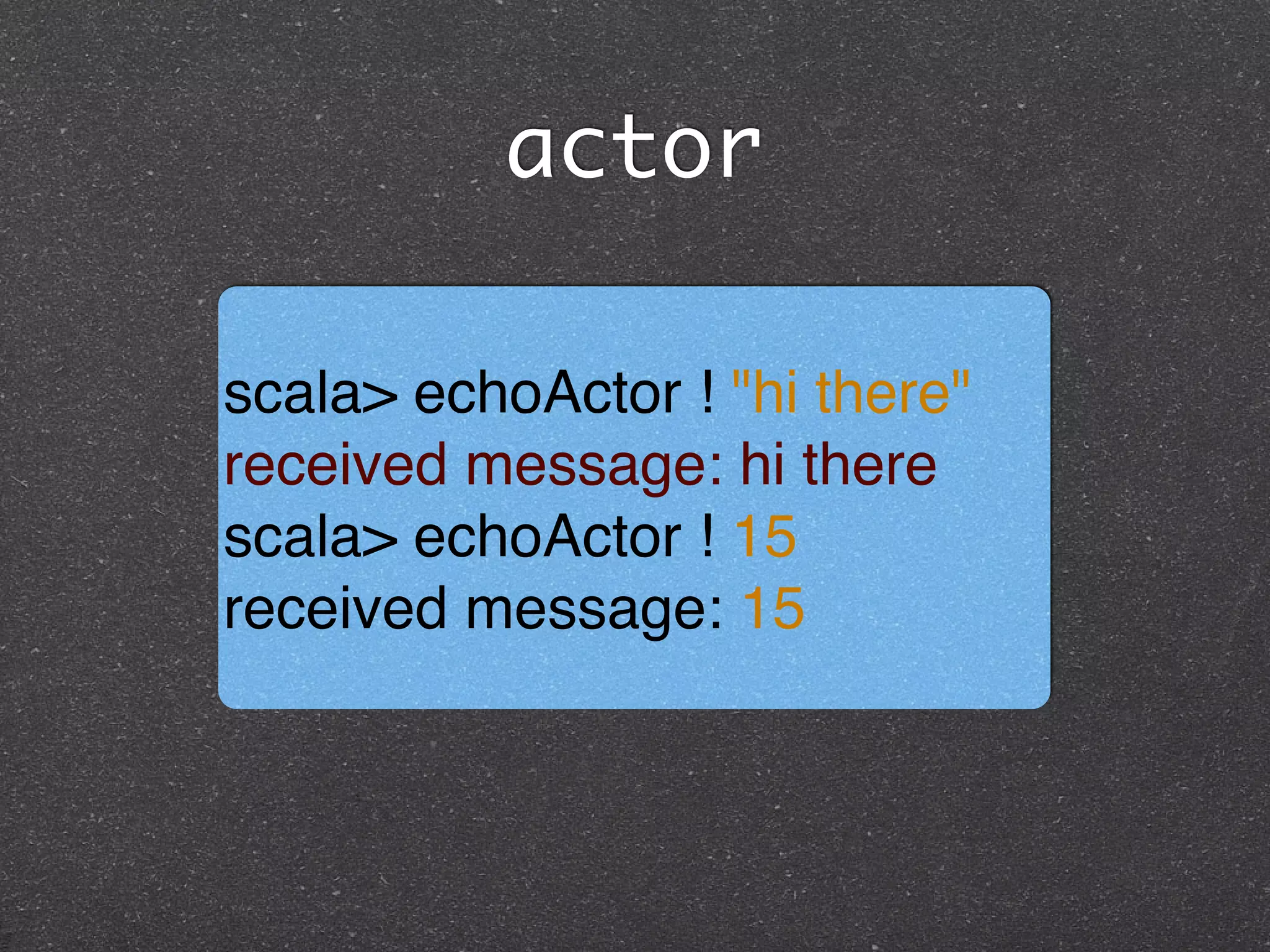
actor
scala> echoActor ! "hi there"
received message: hi there!
scala> echoActor ! 15
received message: 15
Q & A
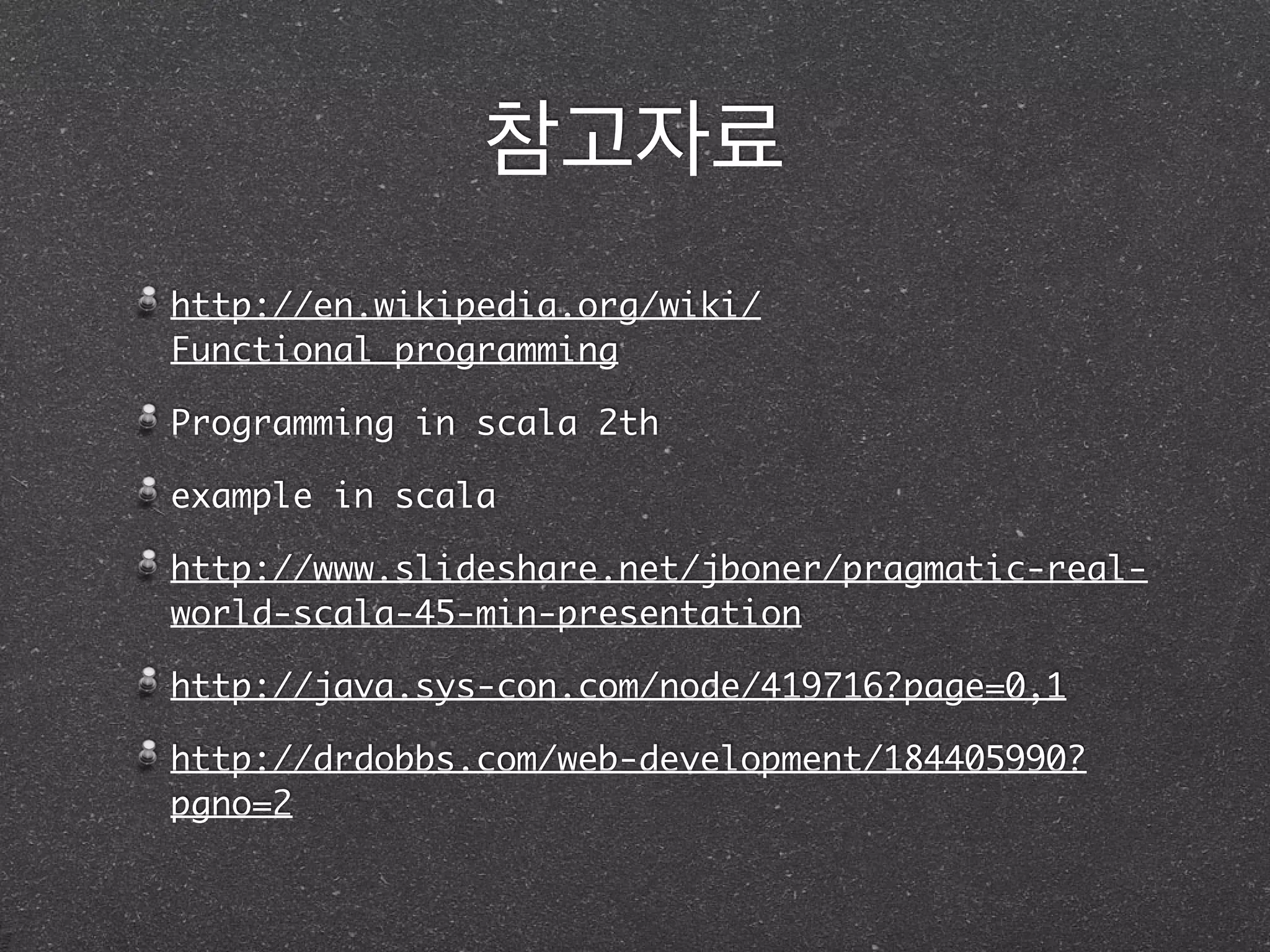
참고자료
http://en.wikipedia.org/wiki/
Functional_programming	
Programming in scala 2th	
example in scala	
http://www.slideshare.net/jboner/pragmatic-real-
world-scala-45-min-presentation	
http://java.sys-con.com/node/419716?page=0,1	
http://drdobbs.com/web-development/184405990?
pgno=2

Scala

  • 1.
    Why Scala? JBoss UsersClub 윤재진
  • 2.
  • 3.
    CPU의 변화 CPU 속도의증가는 느려짐 2001년 IBM에서 PowerPC 4 멀티코어 도입 업체들이 CPU 속도보다 코어수를 늘리기 시작함 2007년경 AMD에서 먼저 쿼드코어 CPU 발매 현재는???
  • 4.
  • 5.
    현재는?? 그래픽 카드도 듀얼코어 핸드폰도듀얼코어 노트북은 쿼드코어 개발자는 어떻게 대처를?? Concurrency Programming
  • 6.
    cpu 변화에 따른우리는? multi core로만 성능이 향상되지는 않는다 multi core에 맞게 프로그래밍이 되어야지 성능 이 향상이 될 수 있다. 우리는 이에 맞는 프로그래밍을 해야 한다. 현재는 하지 않아도 앞으로 하게 될지 모른다.
  • 7.
    Concurrency 다행히도 자바에선 Concurrency가언어 자체에서 지원 synchronized AtomicInteger 등 자바자체적으로 지원 기능이 많음
  • 8.
    Thread t1 =new Thread (new Runnable() { public void run() { while(true) { System.out.println("tic"); }} }); Thread t2 = new Thread (new Runnable() { public void run() { while(true) { System.out.println("toc"); }} }); ! t1.start(); t2.start(); ! Listing 1: Parallel Threads in Java Thread t1 = new Thread (new Runnable() { public void run() { while(true) { System.out.println("tic"); }} }); Thread t2 = new Thread (new Runnable() { public void run() { while(true) { System.out.println("toc"); }} }); ! t1.start(); t2.start(); ! Listing 2: Pooled Parallel Threading in Java
  • 9.
    import java.util.concurrent.atomic.AtomicInteger; ! public classAtomicCounter { AtomicInteger ctr = new AtomicInteger(0); public void Increment(int k) { ctr.addAndGet(k); } public void Decrement(int k) { ctr.addAndGet(-k); } } Listing 4: Atomic Increment public class Counter { private int ctr = 0; public synchronized void Increment(int k) { ctr += k; } public synchronized void Decrement(int k) { ctr -= k; } } Listing 3:Synchronized Updates
  • 10.
    하지만??? 기본적으로 고려해야할 점은??? SharedMemory 잘못하게 되면?? Dead lock 조금만 더 쉽게 개발은 할 수 없는걸까???? Shared Memory 사용하지 않고 개발
  • 11.
    Shared Memory 사용않고개발은? Functional language 사용 erlang : Actor erjang : jvm 위에서 사용하는 erlang clojure : jvm, .net에서 돌아가는 lisp scala : scalable 라고 jvm,.net에 돌아 감
  • 12.
    Reason 2 지식 자산을 얻는 최선의 길은 무엇일까?
  • 13.
    지식 자산을 얻는 최선의 길은 무엇일까? 매년 새로운 언어을 최소 하나는 배워라 기술서적을 분기마다 한권씩 읽어라 비기술 서적도 읽어라 수업을 들어라 지역 사용자 모임에 참여라하 다른환경에서 사용하라 요즘 흐름을 놓치리 마라 인터넷을 이용하라
  • 14.
    Reason 3 “If Iwere to pick a language to use today other than Java, it would be Scala” James Gosling
  • 15.
  • 16.
    Scalable Language ! Growthe Library not the Syntax
  • 17.
    Scalable Language 에릭 레이몬드가이야기 했던 성장과 시장 모델에서 시장 모델을 추구함 이미 만들어진 라이브러말고 사용자가 쓰면서 필요한 부분을 오픈소스로 계속 추가하도록 하는게 목적 그래서 Scalable Language라 함
  • 18.
  • 19.
    ㅋ! Martin Odersky Since 2003Sponsored by EPFL Pragmatic Runs on the JVM Statically typed Growing new types Seamless integration with Java
  • 20.
    Concise // Java public classPerson { private String name; private int age; public Person(String name, int age) { this.name = name; this.age = age; } public String getName() { return name; } public int getAge() { return age; } public void setName(String name) { this.name = name; }} // Scala class Person( var name: String, var age: Int)
  • 21.
    Pure OO 1 +2 1.+(2) 123.toString() 모든것들은 객체
  • 22.
    Pragmatic val joe = <employee name="Joe" rank="code monkey" serial="123" /> XML선언 scala> joe "@name" res15: scala.xml.NodeSeq = Joe ! scala> joe "@serial" res16: scala.xml.NodeSeq = 123 추출
  • 23.
    Scala high level //this is Java boolean nameHasUpperCase = false; for (int i = 0; i < name.length(); ++i) { if (Character.isUpperCase(name.charAt(i))) { nameHasUpperCase = true; break; } } val nameHasUpperCase = name.exists(_.isUpper)
  • 24.
    Scala’s root 많은 언어들에서영향을 받음 문법은 기본적으로 Java, C#을 채용함 Convention은 C,C++에 빌려옴 Object models 기본적으로 Smalltalk, 부분 적으로 Ruby Actor models은 erlang
  • 25.
  • 26.
    변수 선언 val msg= “Hello, World!” var msg2 = “Hello, World!” val : FP 형태의 immutable 선언방식 var : Java 형태의 mutable 선언방식
  • 27.
    함수 선언 def max(x:Int, y: Int): Int = { if (x > y) x else y } def max2(x: Int, y: Int) = if (x > y) x else y
  • 28.
    class class Person( varname: String, var age: Int) class ChecksumAccumulator { // class definition goes here } class Person( var name: String, var age: Int) { var name:String = name; var age: Int = age; } val person = new Person(“jaejin”,30) val checksum = new ChecksumAccumulator
  • 29.
    object 싱글톤 클래스 scala에서는 statictype이 없어서 object을 이용하거나 import로 static을 대신할 수 있다. 사용방법은 똑같은 이름의 class가 같은 scala 파일에 있어야 한다. class와 똑같은 명칭의 object을 선언하면 사용 할 수 있다.
  • 30.
    object object SingleObject { defprintSingle(a:String) { print(a) } } scala> val t = SingleObject scala> t.print(“test”) test scala> SingleObject.print(“test”)
  • 31.
    Companion object // Infile ChecksumAccumulator.scala! class ChecksumAccumulator { ! private var sum = 0 ! def add(b: Byte) { sum += b } ! def checksum(): Int = ~(sum & 0xFF) + 1! }
  • 32.
    // In fileChecksumAccumulator.scala import scala.collection.mutable.Map object ChecksumAccumulator { private val cache = Map[String, Int]() def calculate(s: String): Int = if (cache.contains(s)) cache(s) else { val acc = new ChecksumAccumulator for (c <- s) acc.add(c.toByte) val cs = acc.checksum() cache += (s -> cs) cs } }
  • 33.
    expression var filename ="default.txt" ! if (!args.isEmpty)! filename = args(0) val filename = ! if (!args.isEmpty) args(0) ! else "default.txt" for (i <- 1 to 4) ! println("Iteration "+ i) val filesHere = (new java.io.File(".")).listFiles ! for (file <- filesHere if file.getName.endsWith(".scala"))! println(file)
  • 34.
    trait Rich interface 멤버선언이 가능 abstract메소드 선언 가능 메소드 구현 가능
  • 35.
    trait Dad { private var children: List[Child] = Nil ! def addChild(child: Child) = children = child :: children ! def getChildren = children.clone } trait
  • 36.
    class Man(val name:String) extends Human class Child(val name: String) extends Human Base class Human
  • 37.
    Static mixin composition classMan(val name: String) extends Human with Dad uasage val sanghun = new Man(“상훈”) sanghun.addChild(new Child(“원희”))
  • 38.
    Dynamic mixin composition classMan(val name: String) extends Human uasage val sanghun = new Man(“상훈”) with Dad sanghun.addChild(new Child(“원희”))
  • 39.
    Stackable modifications trait IgnoreCaseSet extendsjava.util.Set[String] { ! abstract override def add(e: String) = { super.add(e.toLowerCase) } abstract override def contains(e: String) = { super.contains(e.toLowerCase) } abstract override def remove(e: String) = { super.remove(e.toLowerCase) } }
  • 40.
    Stackable modifications val set =new java.util.HashSet[String] with IgnoreCaseSet set.add(“HI THERE“) // uppercase set.contains(“hi there“) // lowercase => true
  • 41.
    Stackable modifications trait LoggableSet extendsjava.util.Set[String] { ! abstract override def add(e: String) = { println(“Add :“ + e) super.add(e) } abstract override def remove(e: String) = { println(“Remove :“ + e) super.remove(e) } }
  • 42.
    Stackable modifications val set =new java.util.HashSet[String] with IgnoreCaseSet with LoggableSet set.add(“HI THERE“) => “Add: HI THERE”
  • 43.
    Stackable modifications val set =new java.util.HashSet[String] with LoggableSet with IgnoreCaseSet set.add(“HI THERE“) => “Add: hi there”
  • 44.
    package, import static import제공 import java.lang._ import java.lang.Integer._ package 안에 패키지 가능 접근자 없으면 public protected는 사용만 가능하고 패키지에서 접근 불가능
  • 45.
  • 46.
    first-class def square(x: Int):Int = x * x def sumInts(a: Int, b: Int): Int = if (a > b) 0 else a + sumInts(a + 1, b)
  • 47.
    FP val inc =(x: Int) => x + 1 scala> inc(1) 2
  • 48.
    FP - higherorder List(1, 2, 3).map((x: Int) => x + 1) List(2,3,4)
  • 49.
    currying def sum(f: Int=> Int): (Int, Int) => Int = { ! def sumF(a: Int, b: Int): Int =! if (a > b) 0 else f(a) + sumF(a + 1, b) ! sumF! } scala> sum(x=>x*x)(1,10) result : Int = 385
  • 50.
    currying-tail def sum(f: Int=> Int)(a: Int, b: Int): Int = { ! def iter(a: Int, result: Int): Int = {! if (a>b) result else iter(a+1, f(a)+result)! iter(a, 0)! } scala> sum(x=>x*x)(1,10) result : Int = 385
  • 51.
    List 만들기 val list= List(1,2,3) val list2= 1 :: 2 :: 3 :: Nil val list3 = List(1) ::: List(2) ::: List(3) val list4 = 1 :: (2 :: (3 :: Nil)) list == list2 ==list3 == list4 => true
  • 52.
    List 이해 val list= List(1,2,3) list.head == 1 => true list.tail == List(2,3) => true val head :: tail = List(1,2,3) head == 1 => true tail == List(2,3) => true
  • 53.
    List 이해 val list= List(1, 2, 3) list.map(_ + 1) list.filter(_ < 2) list.exists(_ == 3) list.drop(2) list.reverse list.sort(_ > _) List.flatten(list) list.slice(2, 3) ... => List(2,3,4) => List(1) true => List(1,3) => List(3,2,1) => List(3,2,1) => List(1,2,3) => List(3)
  • 54.
    pattern matching def matchAny(a:Any): Any = a match { case 1 => “one” case “two” => 2 case i: Int => “scala.int” case <tag>{ t }</tag> => t case head :: tail => head case _ => default }
  • 55.
    xml abstract class CCTherm{ ! val description: String ! val yearMade: Int ! val dateObtained: String ! val bookPrice: Int!// in US cents ! val purchasePrice: Int // in US cents ! val condition: Int! // 1 to 10! override def toString = description! def toXML = <cctherm>! <description>{description}</description> ! <yearMade>{yearMade}</yearMade> ! <dateObtained>{dateObtained}</dateObtained> ! <bookPrice>{bookPrice}</bookPrice> ! <purchasePrice>{purchasePrice}</purchasePrice> ! <condition>{condition}</condition>! </cctherm>! }
  • 56.
    xml scala> val therm= new CCTherm { ! val description = "hot dog #5"! val yearMade = 1952 ! val dateObtained = "March 14, 2006" ! val bookPrice = 2199 ! val purchasePrice = 500 ! val condition = 9! }! therm: CCTherm = hot dog #5! scala> therm.toXML! res6: scala.xml.Elem = <cctherm>! <description>hot dog #5</description> ! <yearMade>1952</yearMade> ! <dateObtained>March 14, 2006</dateObtained> ! <bookPrice>2199</bookPrice> ! <purchasePrice>500</purchasePrice> ! <condition>9</condition>! </cctherm>
  • 57.
    actor val echoActor =actor { ! while (true) { ! receive { ! case msg =>! println("received message: "+ msg)! }! }! }
  • 58.
    actor scala> echoActor !"hi there" received message: hi there! scala> echoActor ! 15 received message: 15
  • 59.
  • 60.
    참고자료 http://en.wikipedia.org/wiki/ Functional_programming Programming in scala2th example in scala http://www.slideshare.net/jboner/pragmatic-real- world-scala-45-min-presentation http://java.sys-con.com/node/419716?page=0,1 http://drdobbs.com/web-development/184405990? pgno=2