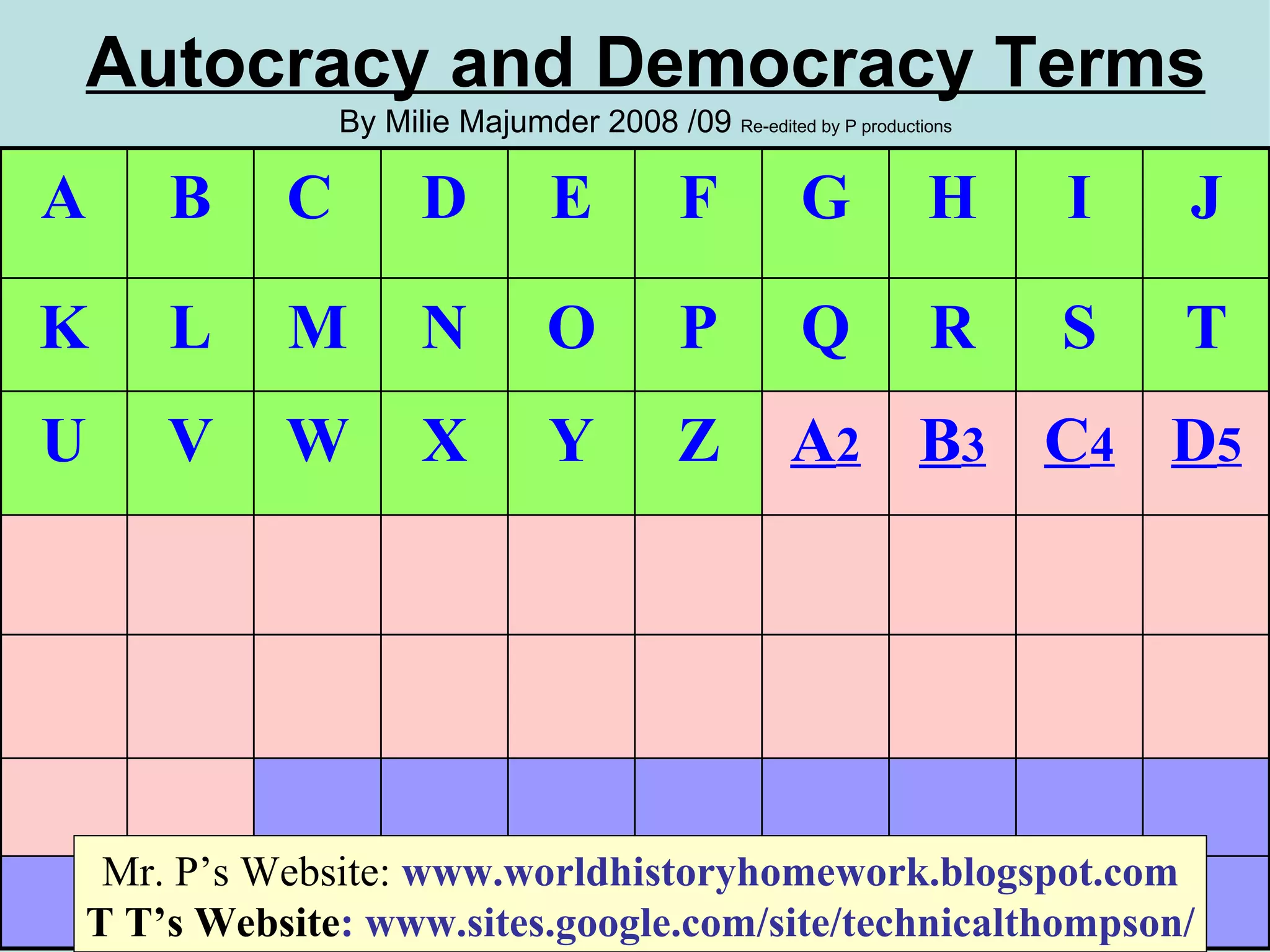
Autocracy and Democracy Terms
              By Milie Majumder 2008 /09 Re-edited by P productions

A   B     C          D          E          F         G          H     I   J

K   L     M          N         O           P         Q           R    S   T
U   V     W          X          Y          Z         A2 B 3 C 4 D 5


 Mr. P’s Website: www.worldhistoryhomework.blogspot.com
T T’s Website: www.sites.google.com/site/technicalthompson/
0
0
0
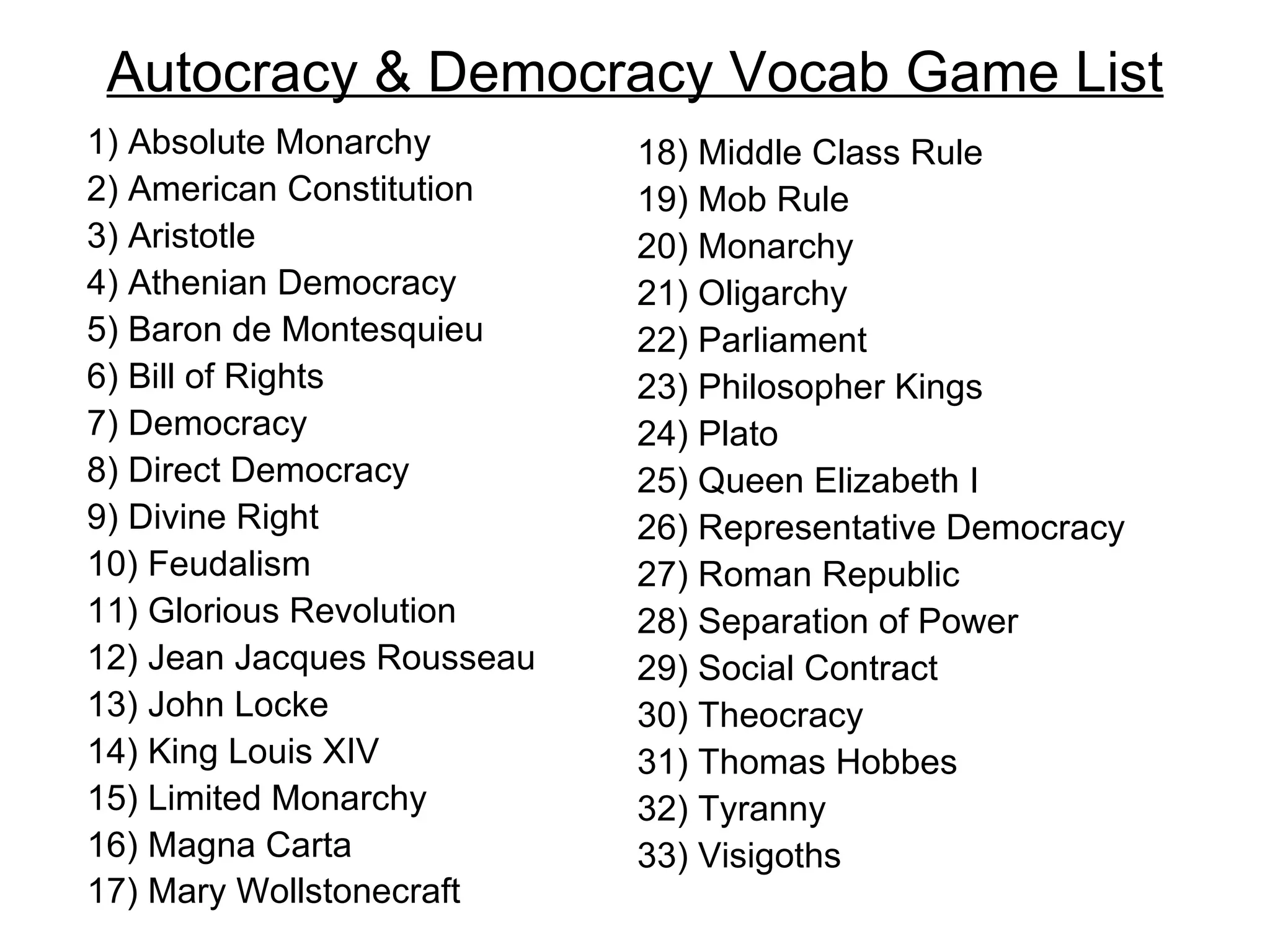
Autocracy & Democracy Vocab Game List
1) Absolute Monarchy        18) Middle Class Rule
2) American Constitution    19) Mob Rule
3) Aristotle                20) Monarchy
4) Athenian Democracy       21) Oligarchy
5) Baron de Montesquieu     22) Parliament
6) Bill of Rights           23) Philosopher Kings
7) Democracy                24) Plato
8) Direct Democracy         25) Queen Elizabeth I
9) Divine Right             26) Representative Democracy
10) Feudalism               27) Roman Republic
11) Glorious Revolution     28) Separation of Power
12) Jean Jacques Rousseau   29) Social Contract
13) John Locke              30) Theocracy
14) King Louis XIV          31) Thomas Hobbes
15) Limited Monarchy        32) Tyranny
16) Magna Carta             33) Visigoths
17) Mary Wollstonecraft
Guess the Term?                                 A)
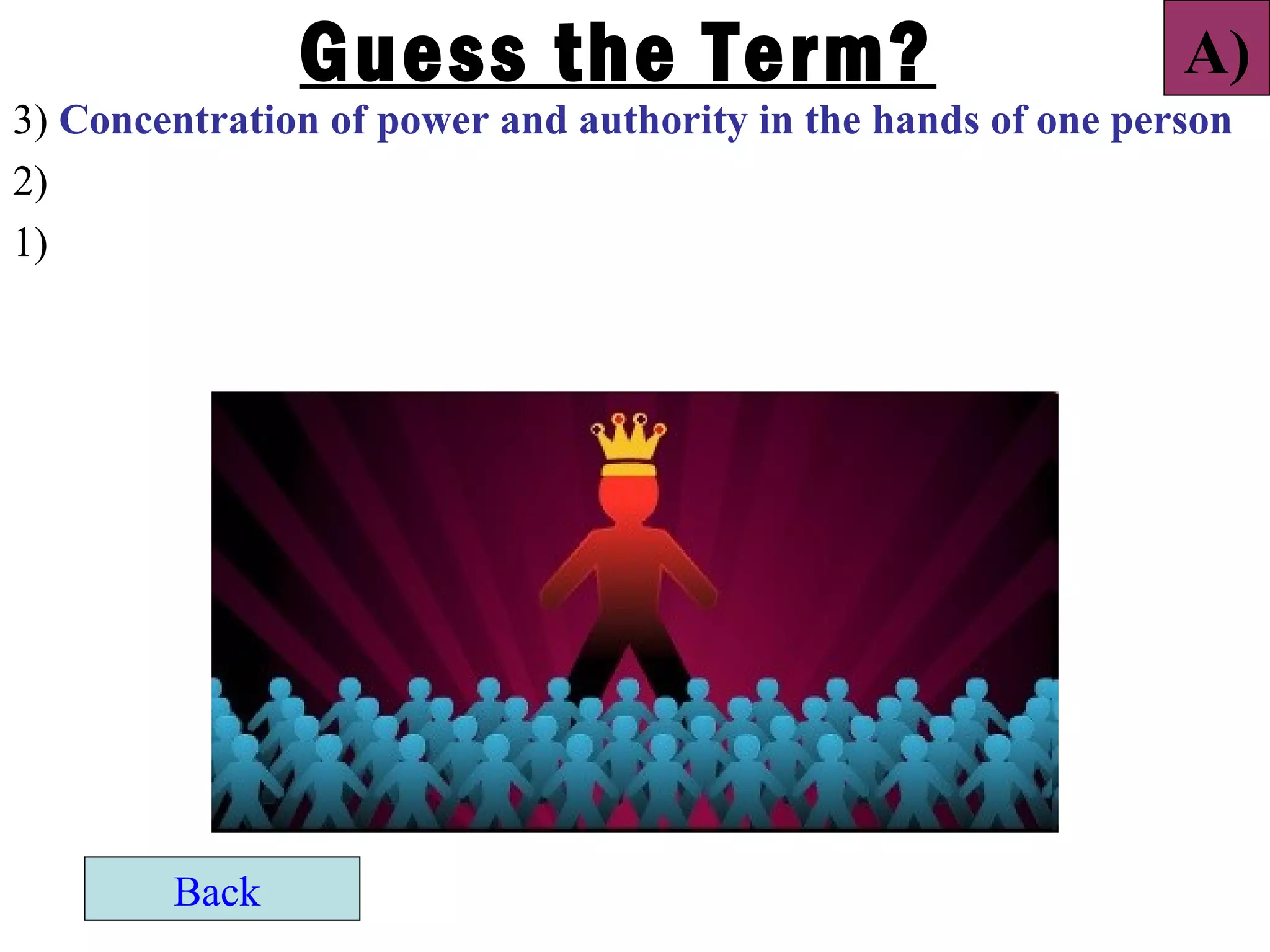
3) Concentration of power and authority in the hands of one person
2)
1)


        Back
Guess the Term?                                A)
3) Concentration of power and authority in the hands of one person
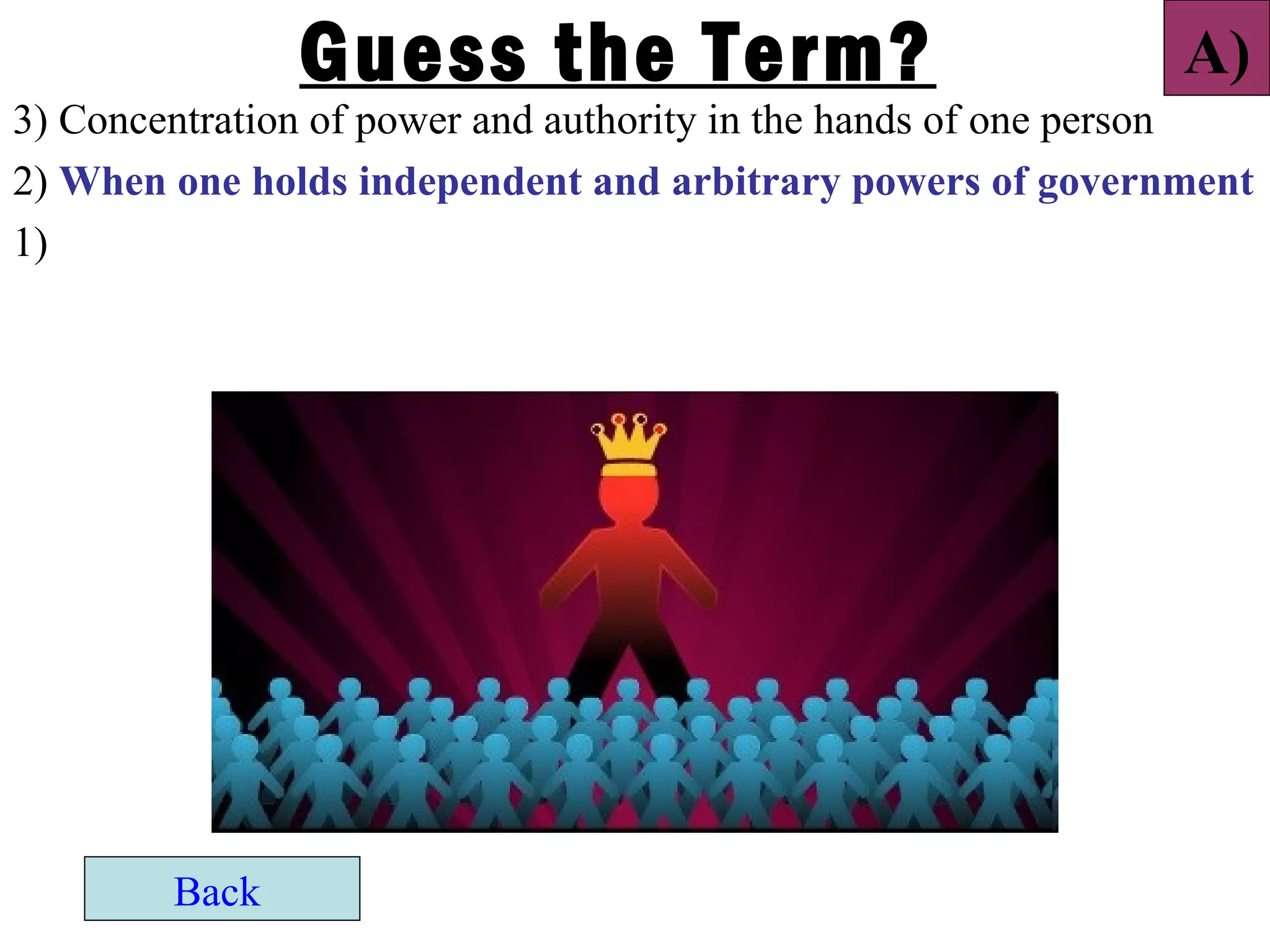
2) When one holds independent and arbitrary powers of government
1)


        Back
Guess the Term?                                      A)
3) Concentration of power and authority in the hands of one person
2) When one holds independent and arbitrary powers of government
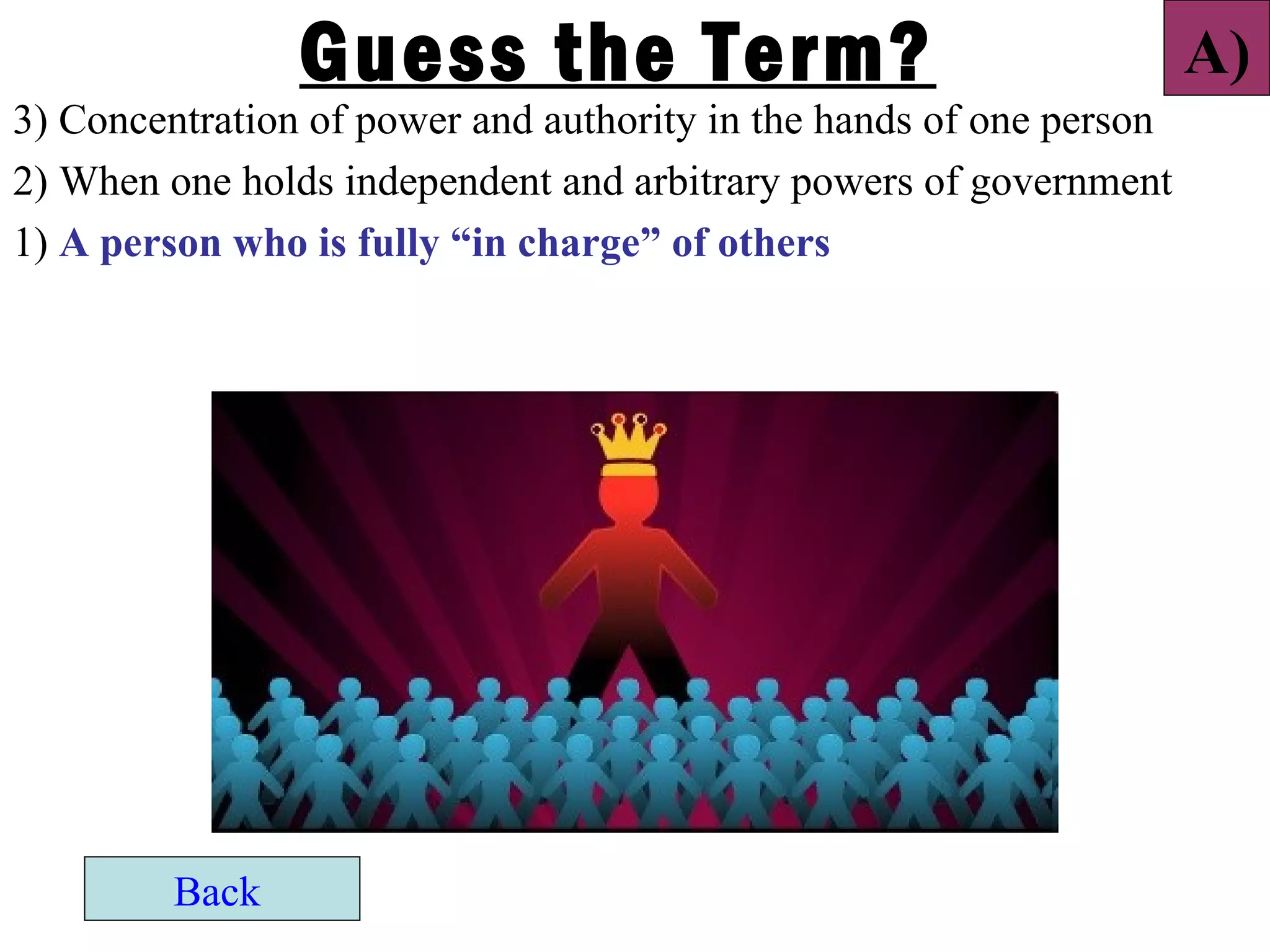
1) A person who is fully “in charge” of others


         Back
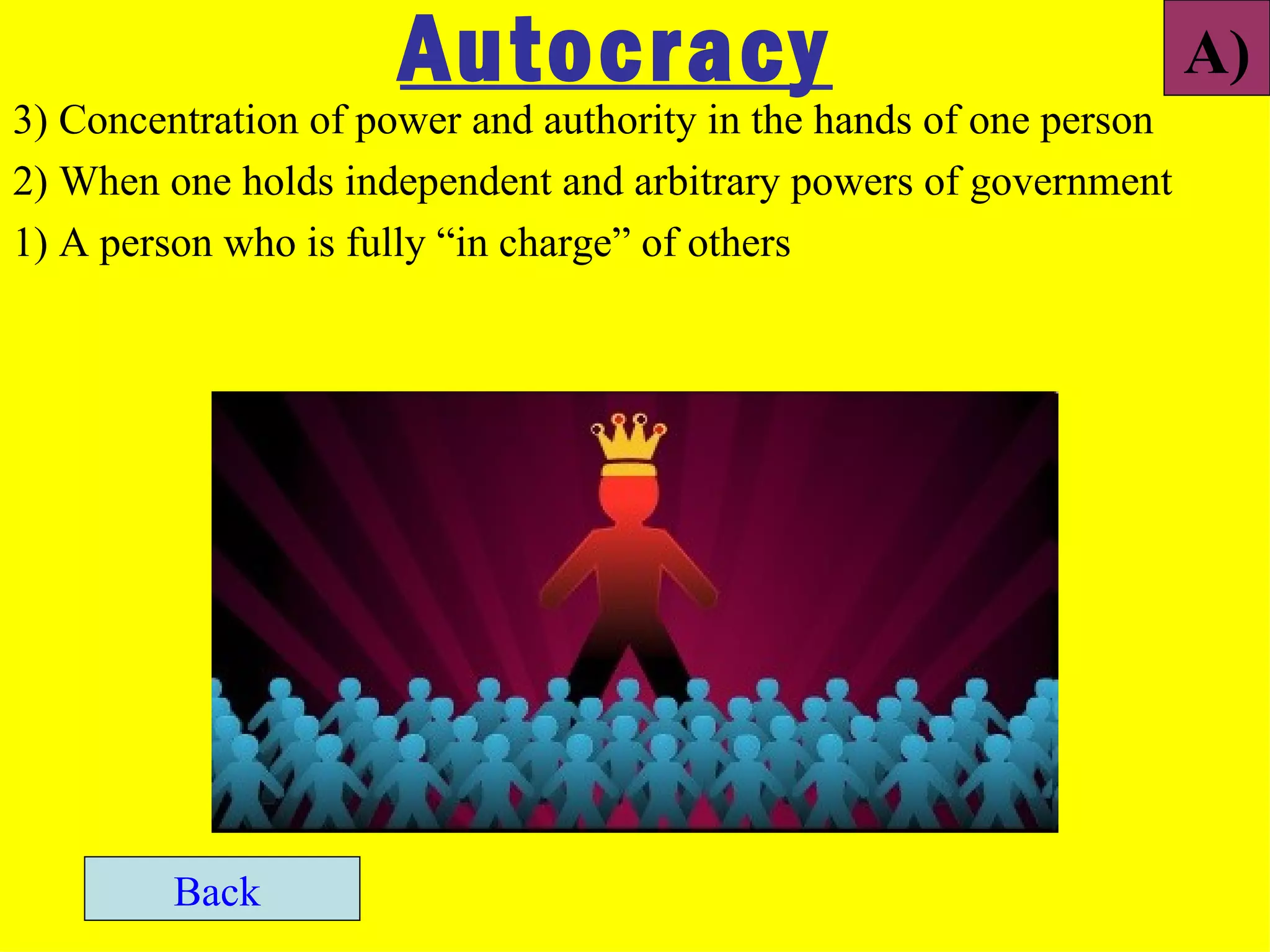
Autocracy                                      A)
3) Concentration of power and authority in the hands of one person
2) When one holds independent and arbitrary powers of government
1) A person who is fully “in charge” of others


         Back
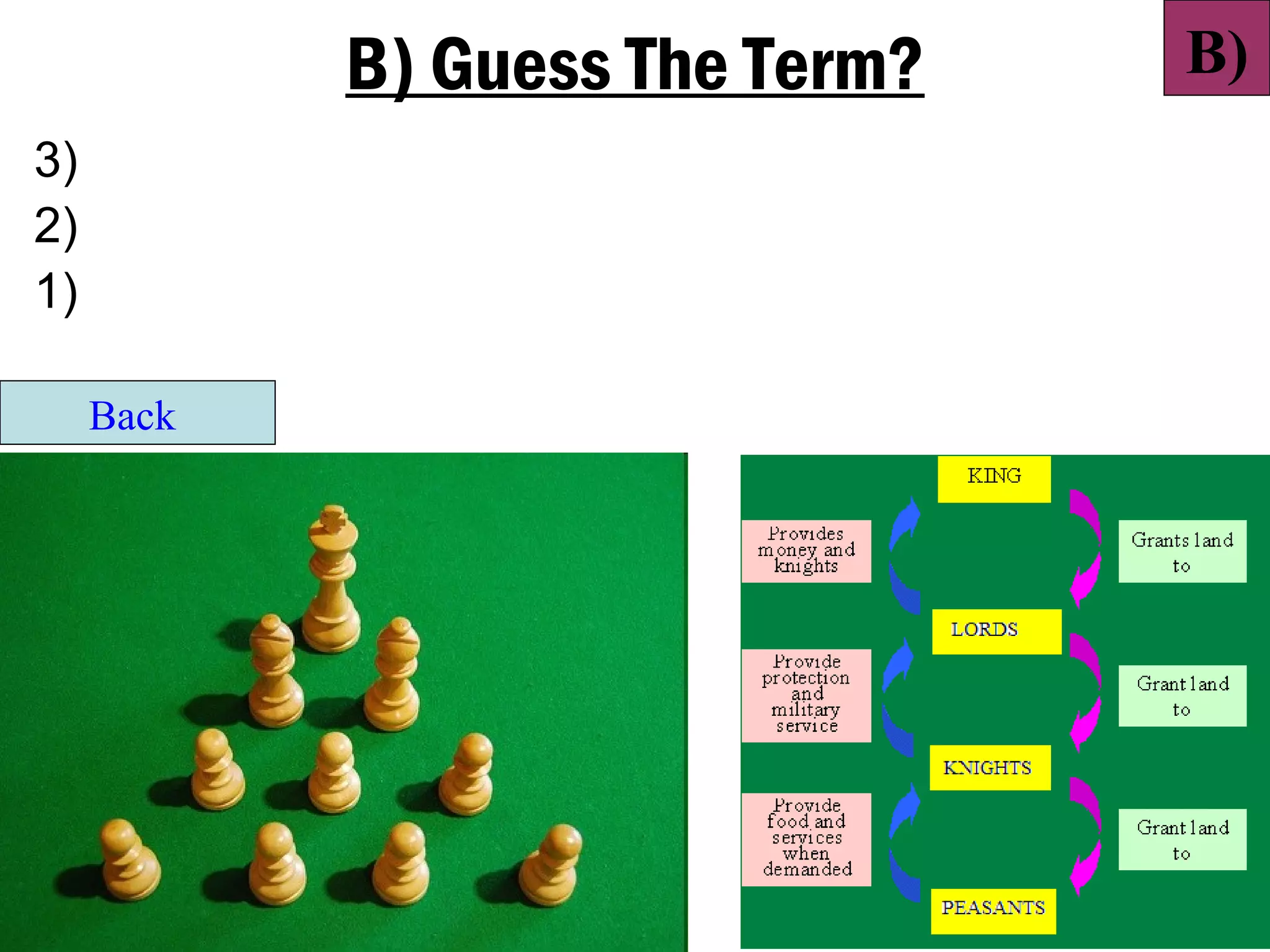
B) Guess The Term?   B)
3)
2)
1)

     Back
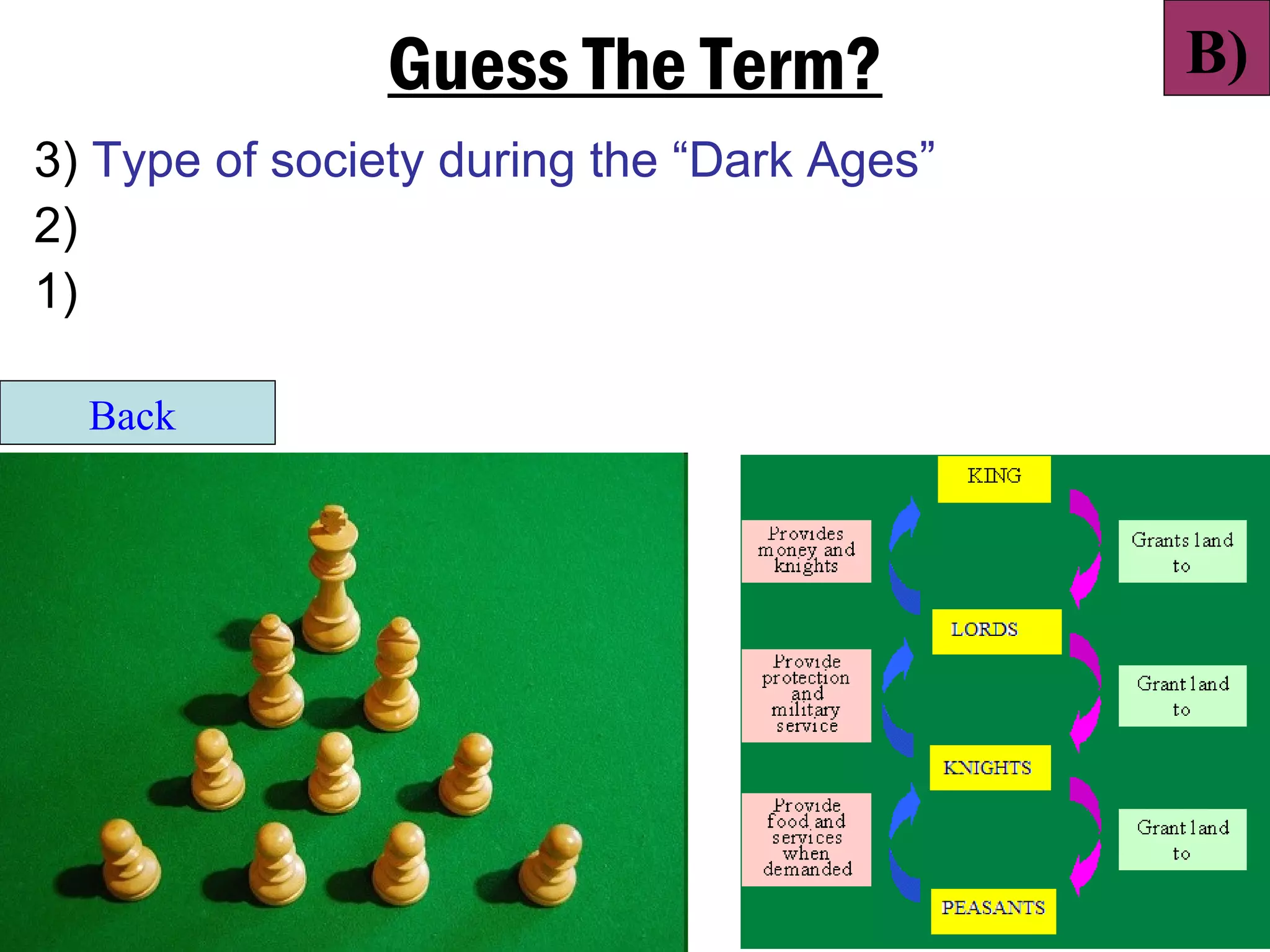
Guess The Term?             B)
3) Type of society during the “Dark Ages”
2)
1)

  Back
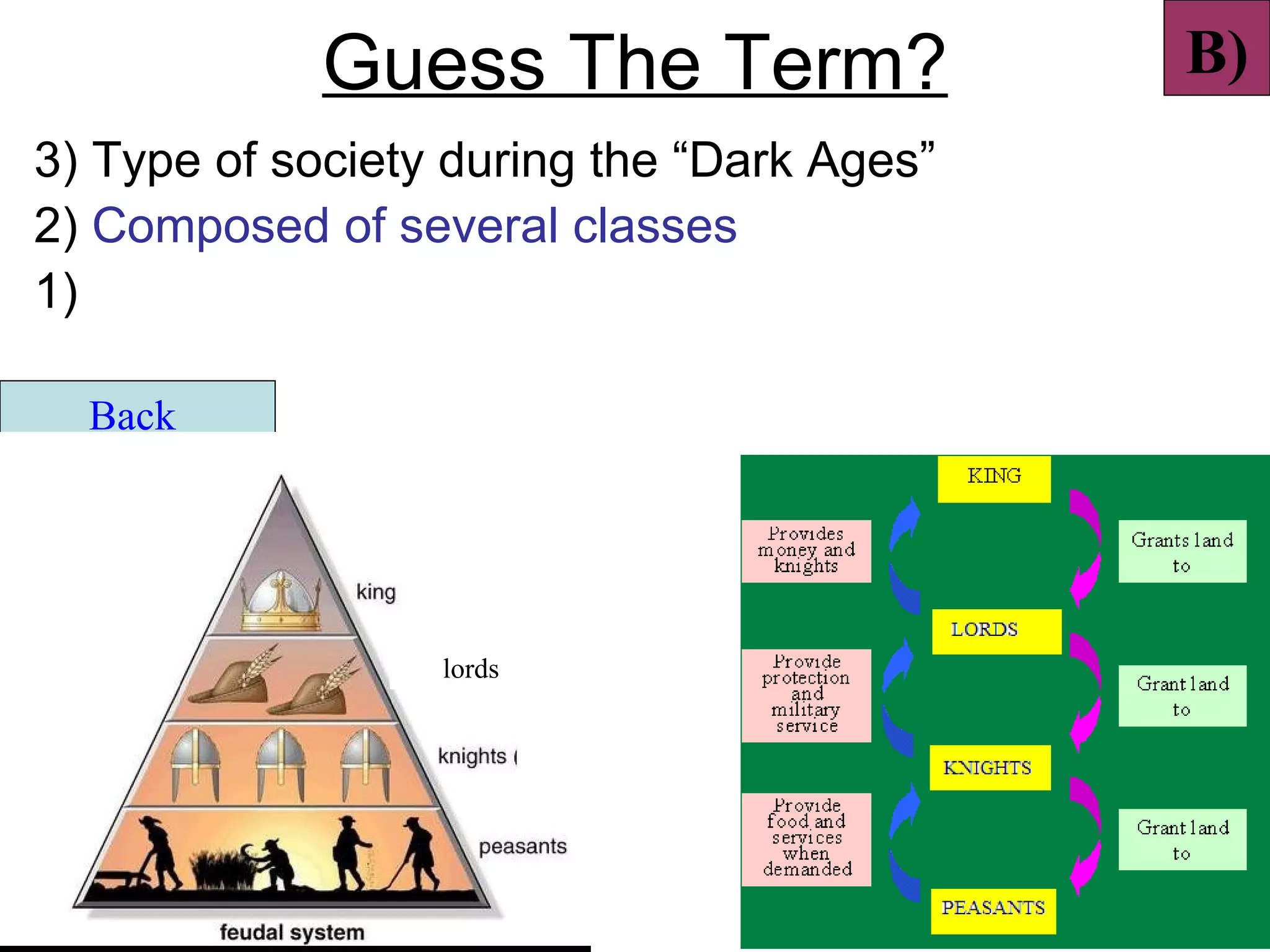
Guess The Term?                B)
3) Type of society during the “Dark Ages”
2) Composed of several classes
1)

  Back


                  lords
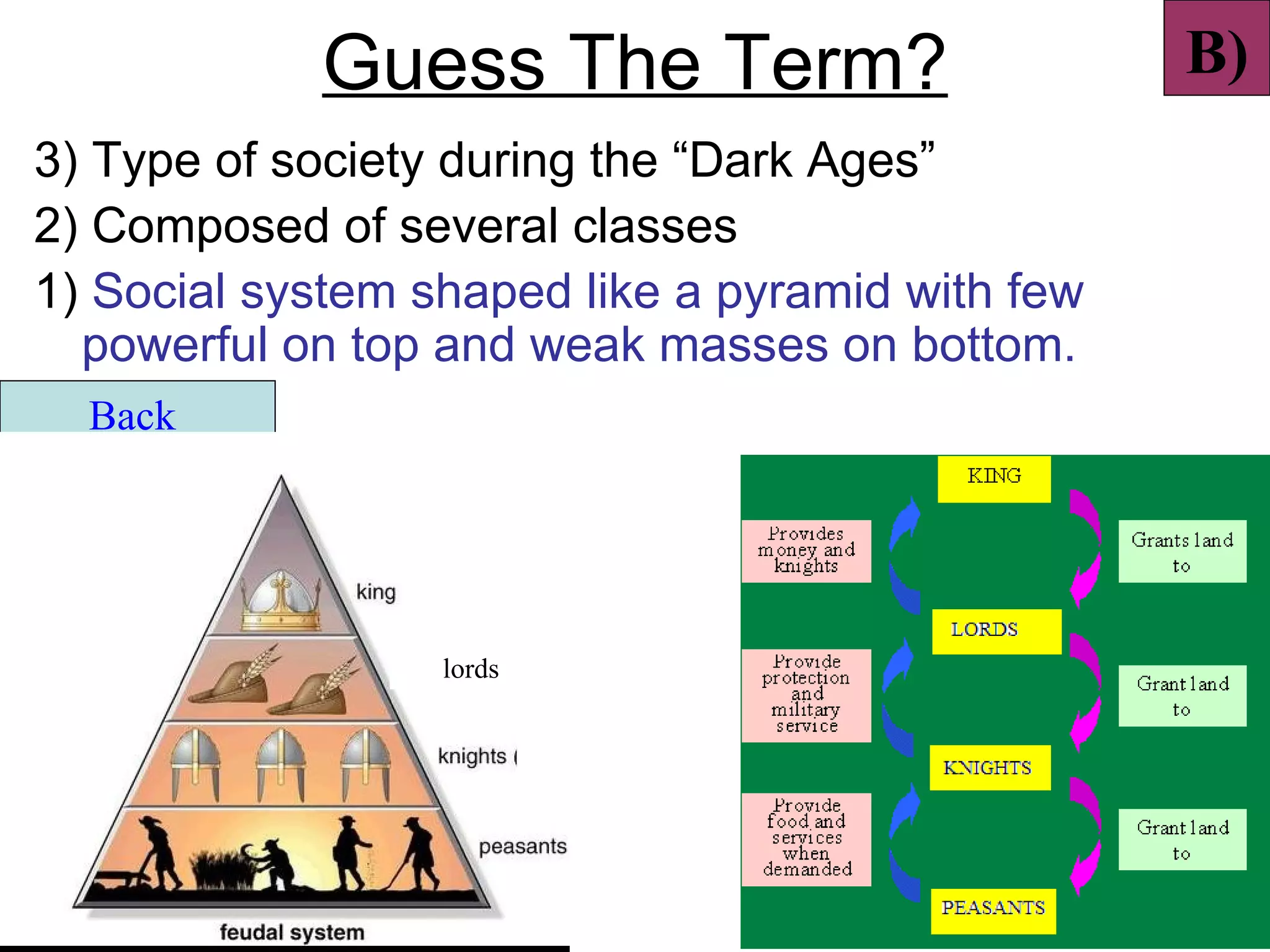
Guess The Term?                       B)
3) Type of society during the “Dark Ages”
2) Composed of several classes
1) Social system shaped like a pyramid with few
  powerful on top and weak masses on bottom.
  Back


                  lords
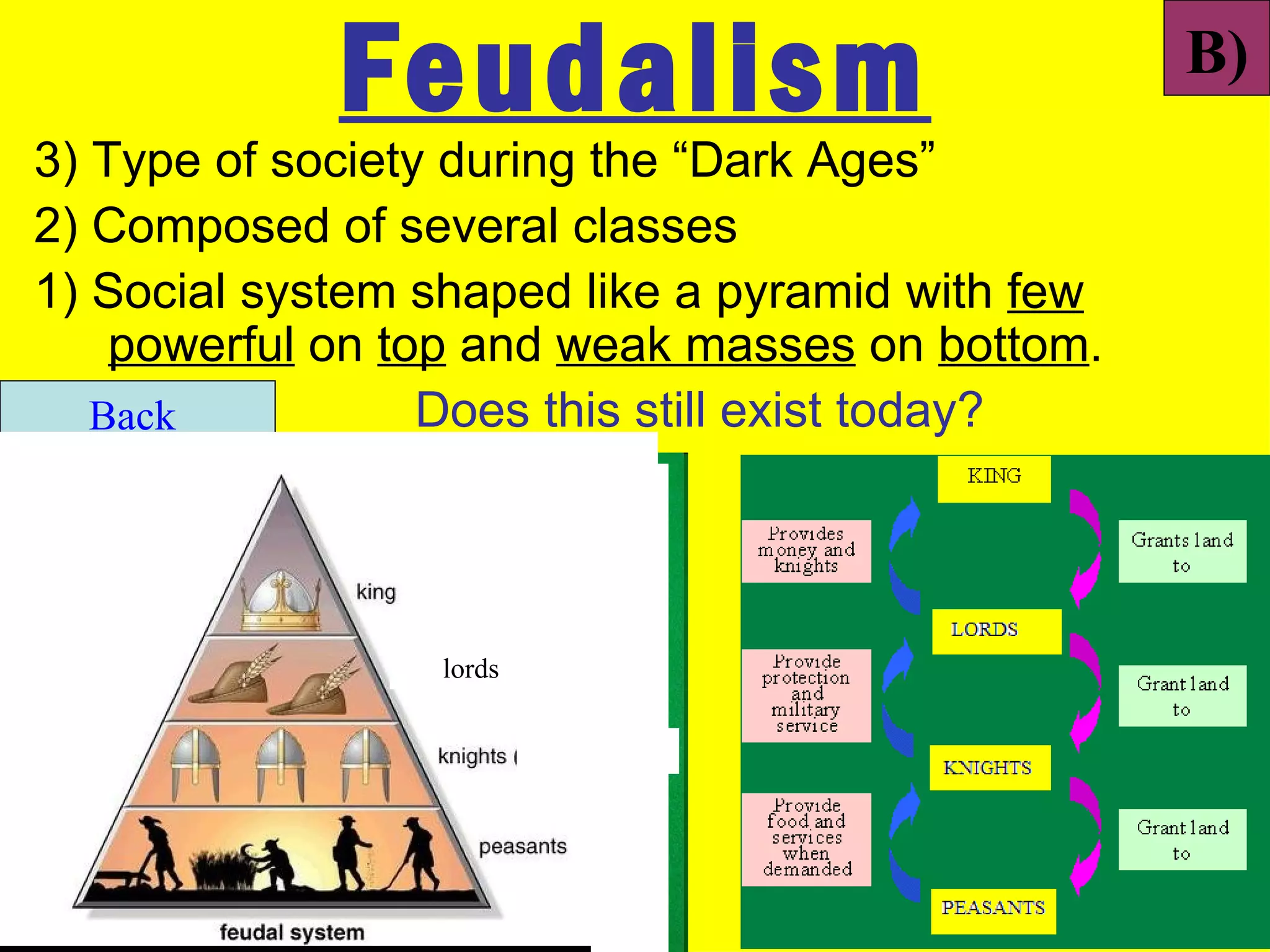
Feudalism                            B)
3) Type of society during the “Dark Ages”
2) Composed of several classes
1) Social system shaped like a pyramid with few
    powerful on top and weak masses on bottom.
   Back           Does this still exist today?


                 lords
C)
           Guess The Term
3) Was a schoolteacher and headmistress
C)
           Guess The Term
3) Was a schoolteacher and headmistress
2) “Mind knows no sex.”
C)
            Guess The Term
3) Was a schoolteacher and headmistress
2) “Mind knows no sex.”
1) People could not be trusted if men took
  advantage of their “greater power.”
C)
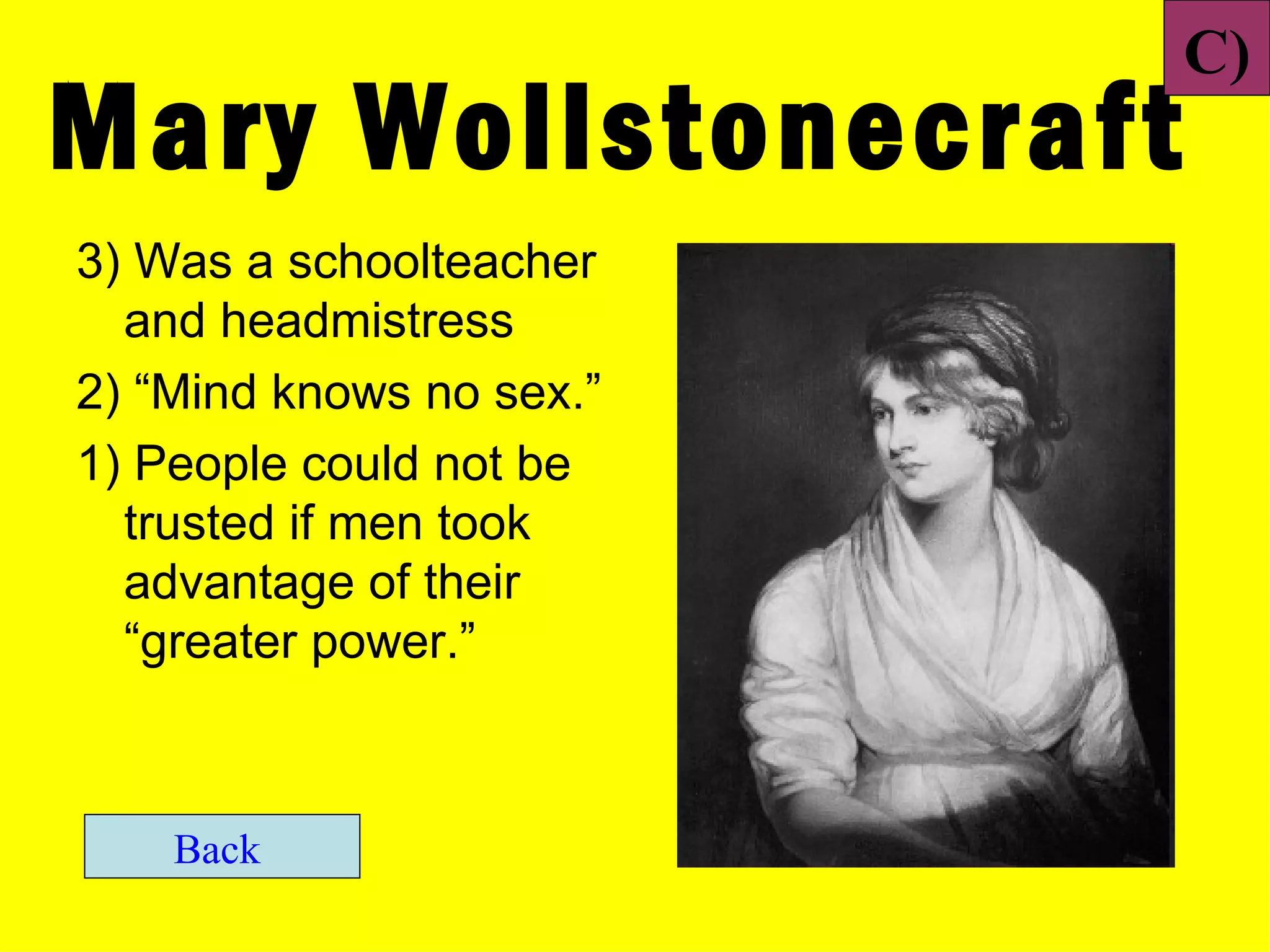
Mary Wollstonecraft
3) Was a schoolteacher
  and headmistress
2) “Mind knows no sex.”
1) People could not be
  trusted if men took
  advantage of their
  “greater power.”


    Back
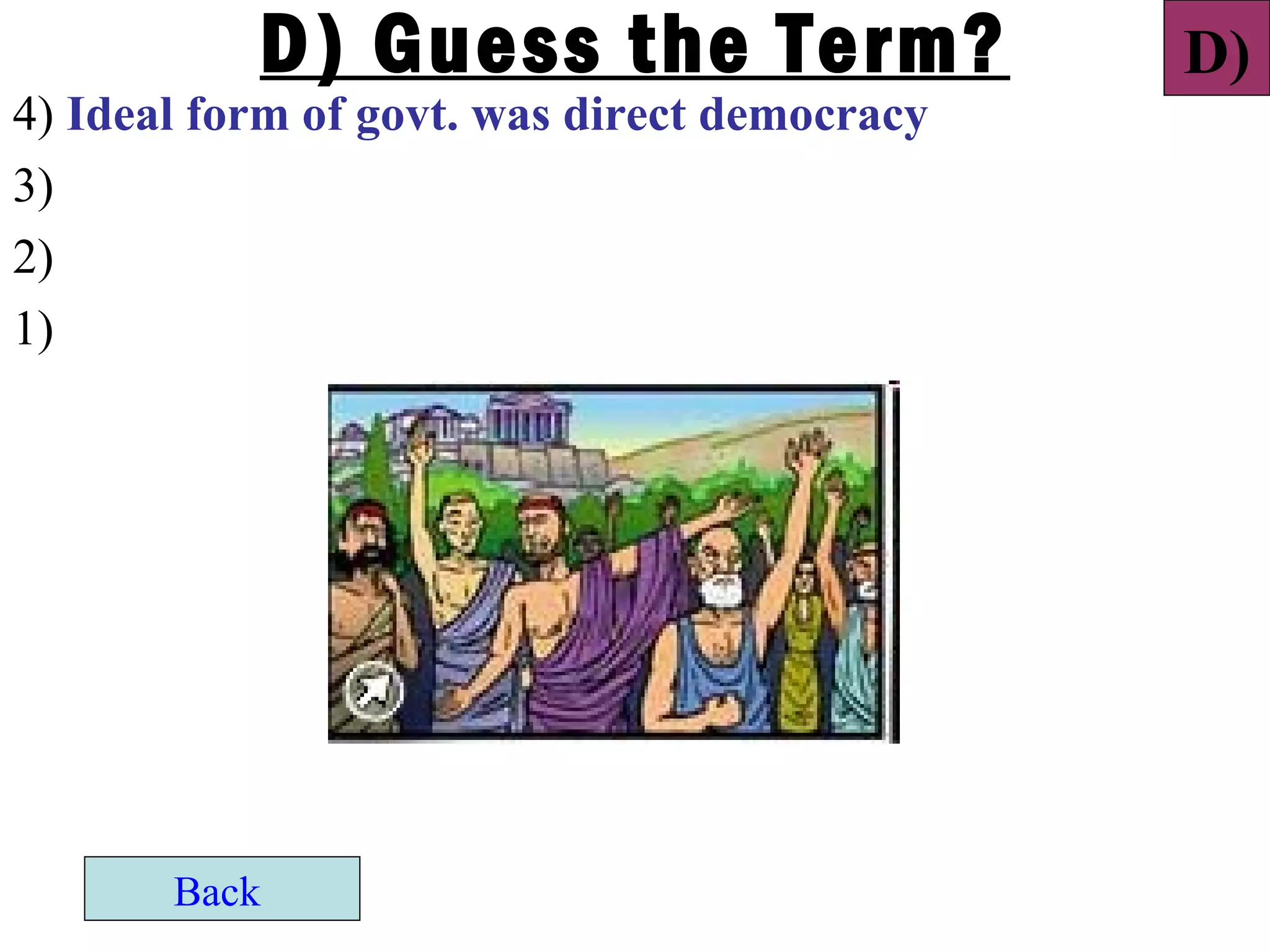
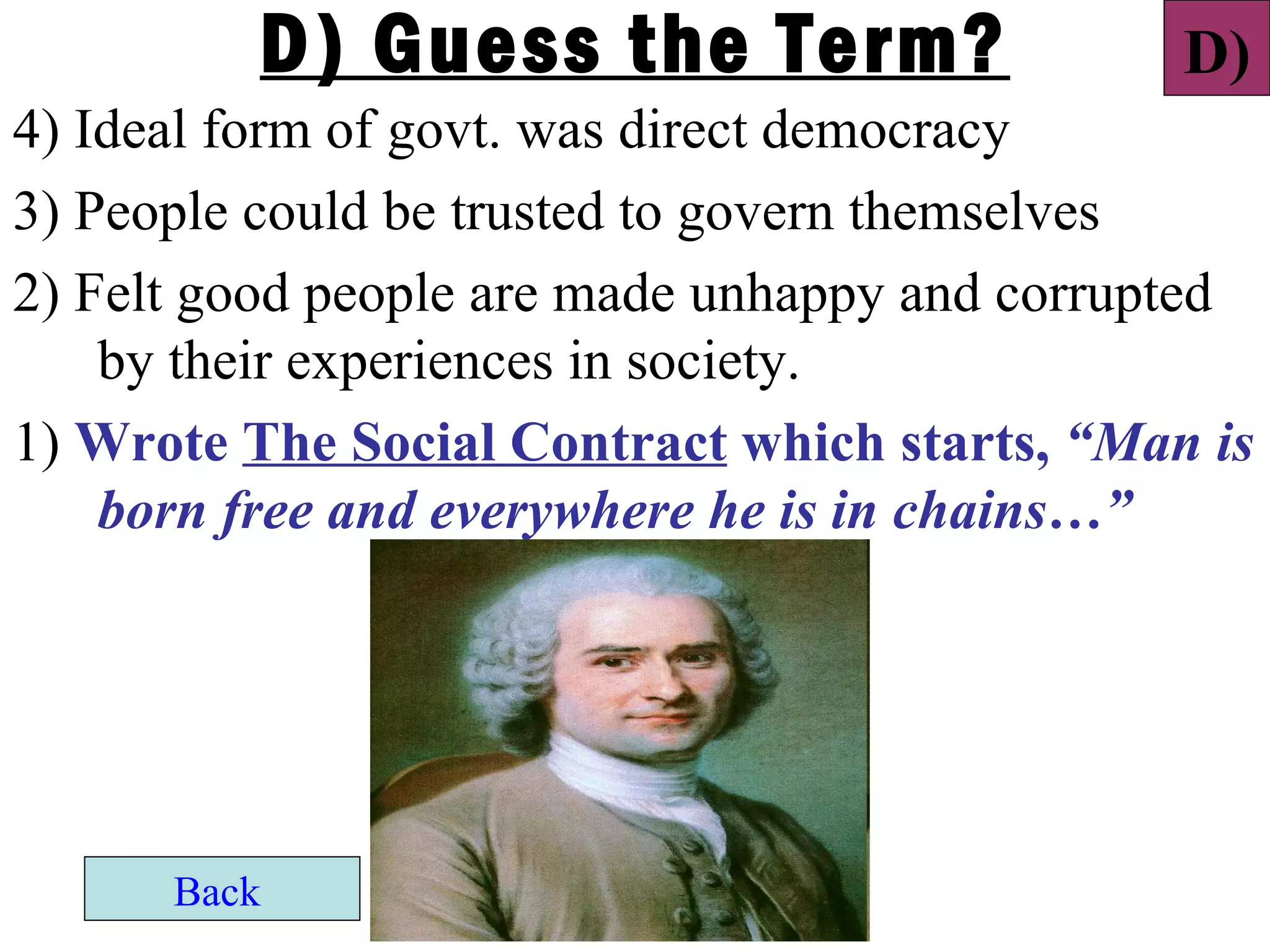
D) Guess the Term?                 D)
4) Ideal form of govt. was direct democracy
3)
2)
1)


       Back
D) Guess the Term?                      D)
4) Ideal form of govt. was direct democracy
3) People could be trusted to govern themselves
2)
1)


      Back
D) Guess the Term?                      D)
4) Ideal form of govt. was direct democracy
3) People could be trusted to govern themselves
2) Felt good people are made unhappy and
    corrupted by their experiences in society.
1)


      Back
D) Guess the Term?                    D)
4) Ideal form of govt. was direct democracy
3) People could be trusted to govern themselves
2) Felt good people are made unhappy and corrupted
    by their experiences in society.
1) Wrote The Social Contract which starts, “Man is
    born free and everywhere he is in chains…”


      Back
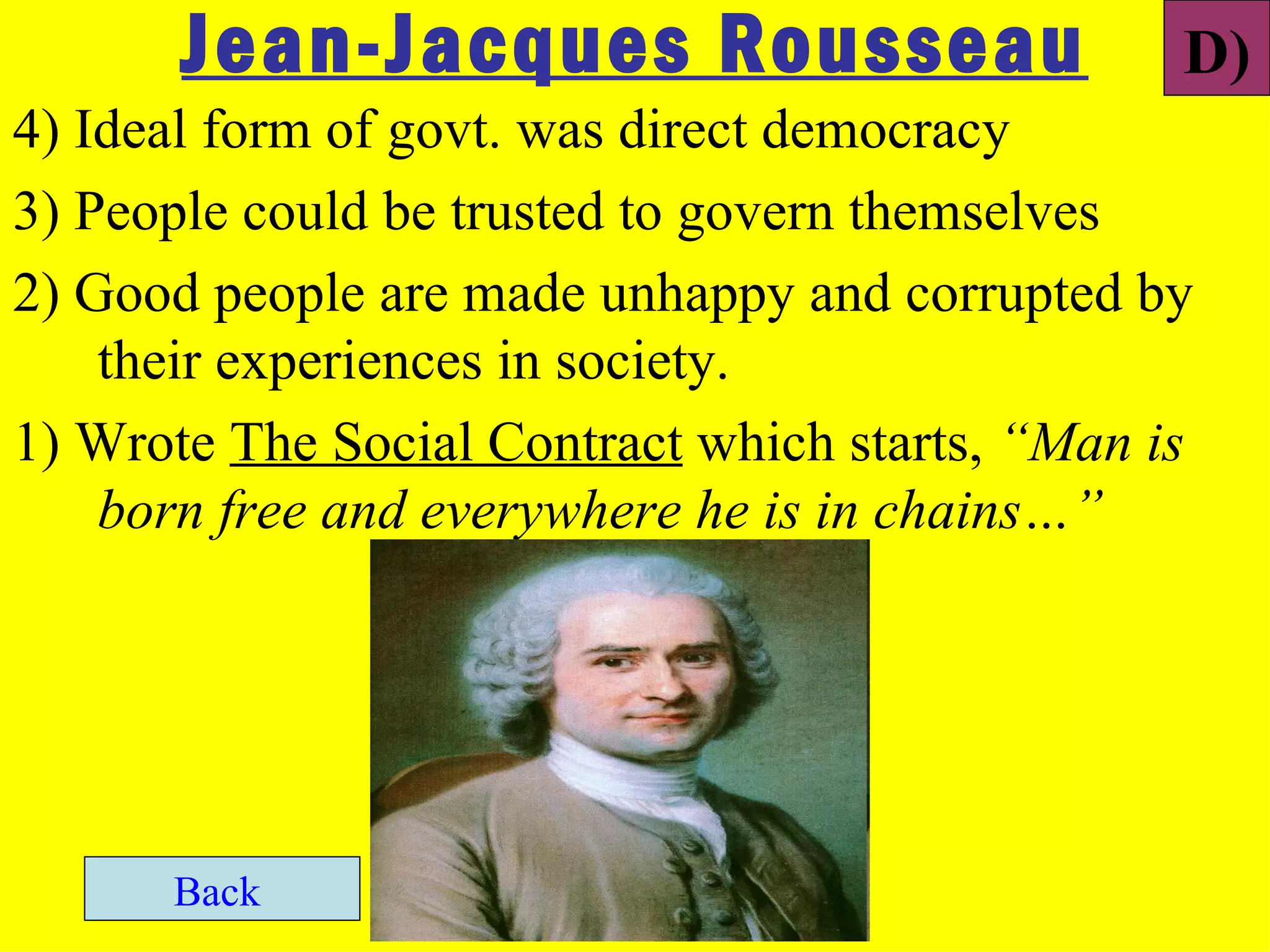
Jean-Jacques Rousseau                     D)
4) Ideal form of govt. was direct democracy
3) People could be trusted to govern themselves
2) Good people are made unhappy and corrupted by
    their experiences in society.
1) Wrote The Social Contract which starts, “Man is
    born free and everywhere he is in chains…”


      Back
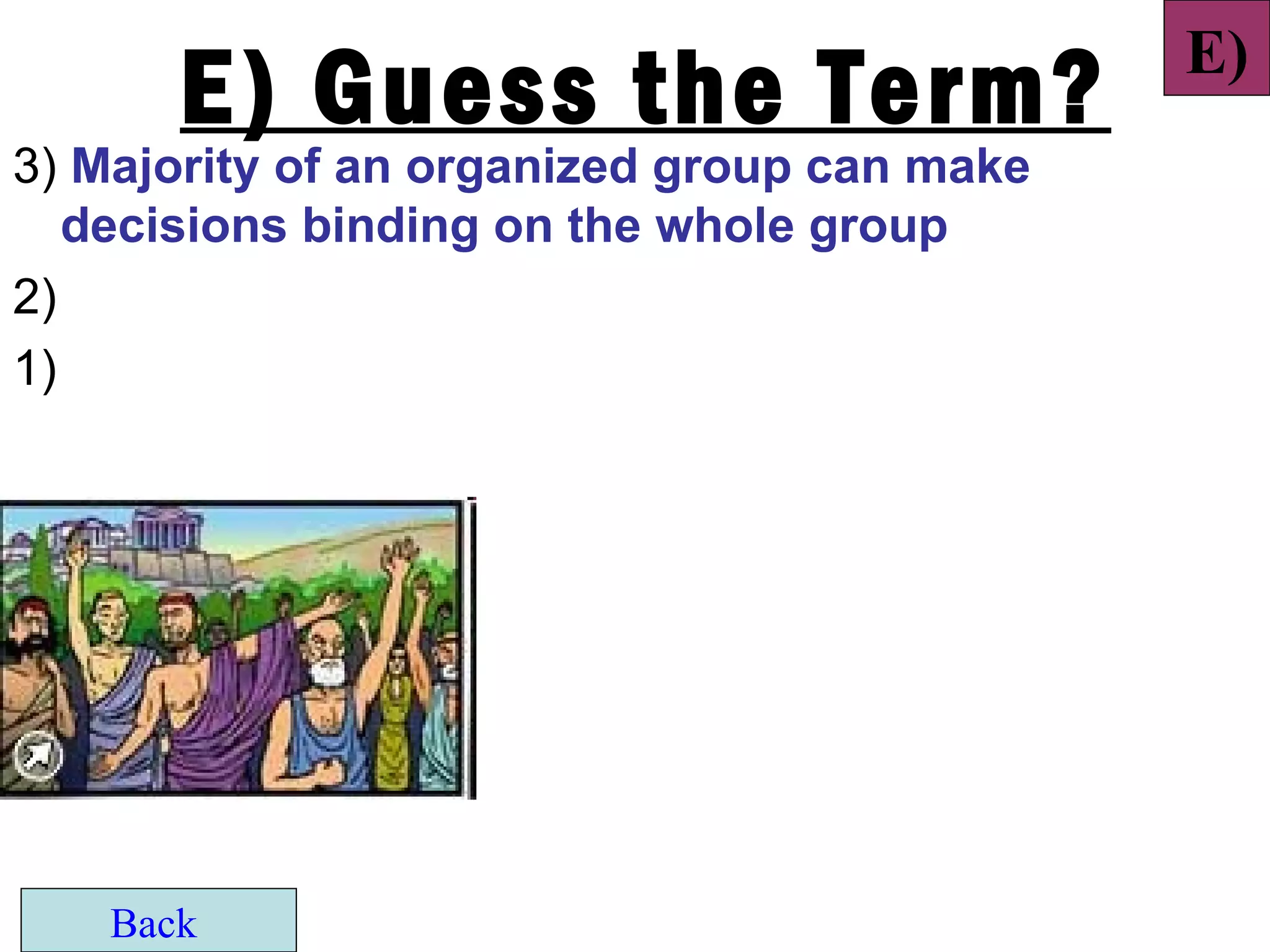
E)
       E) Guess the Term?
3) Majority of an organized group can make
   decisions binding on the whole group
2)
1)


    Back
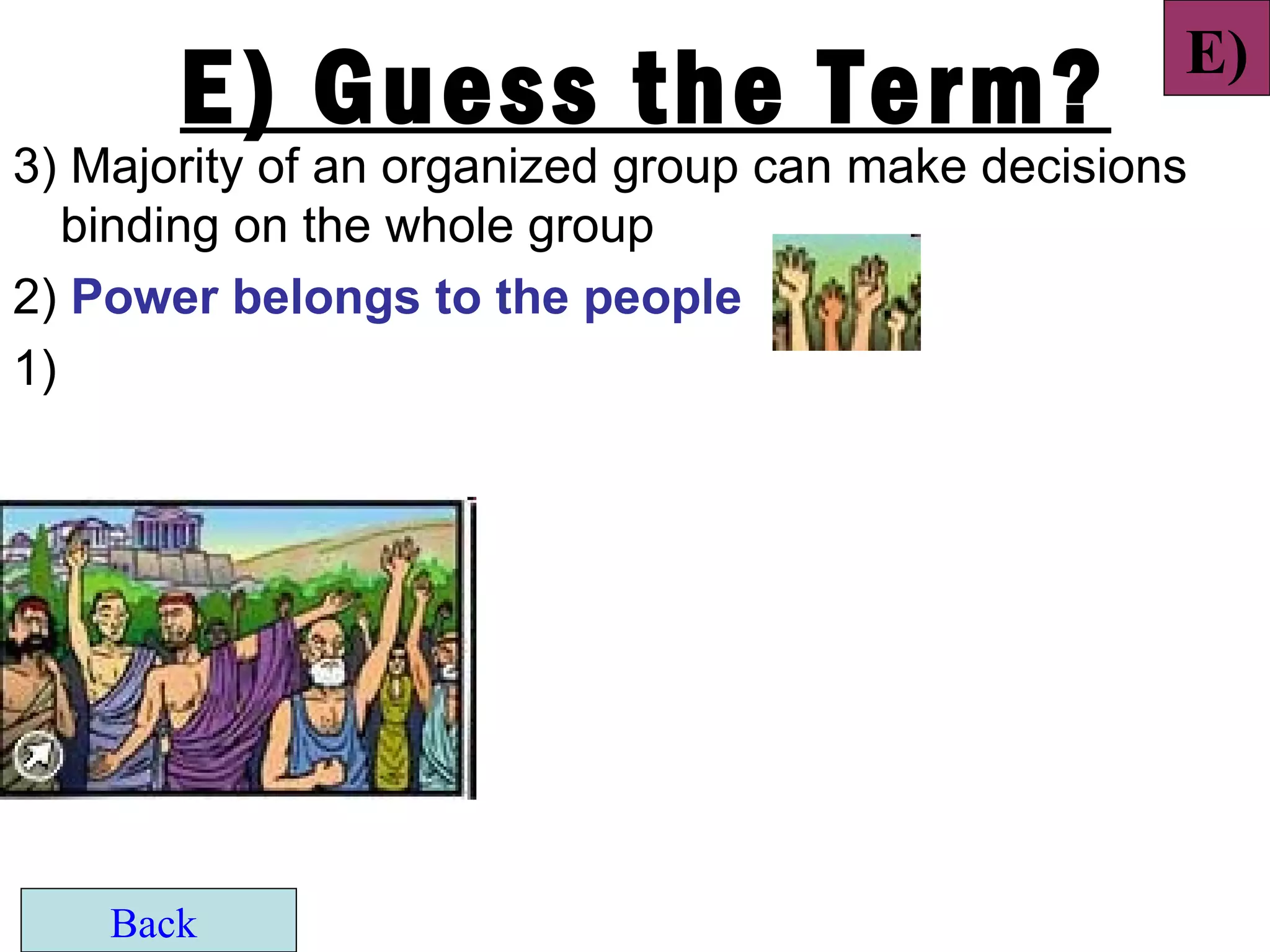
E)
       E) Guess the Term?
3) Majority of an organized group can make decisions
   binding on the whole group
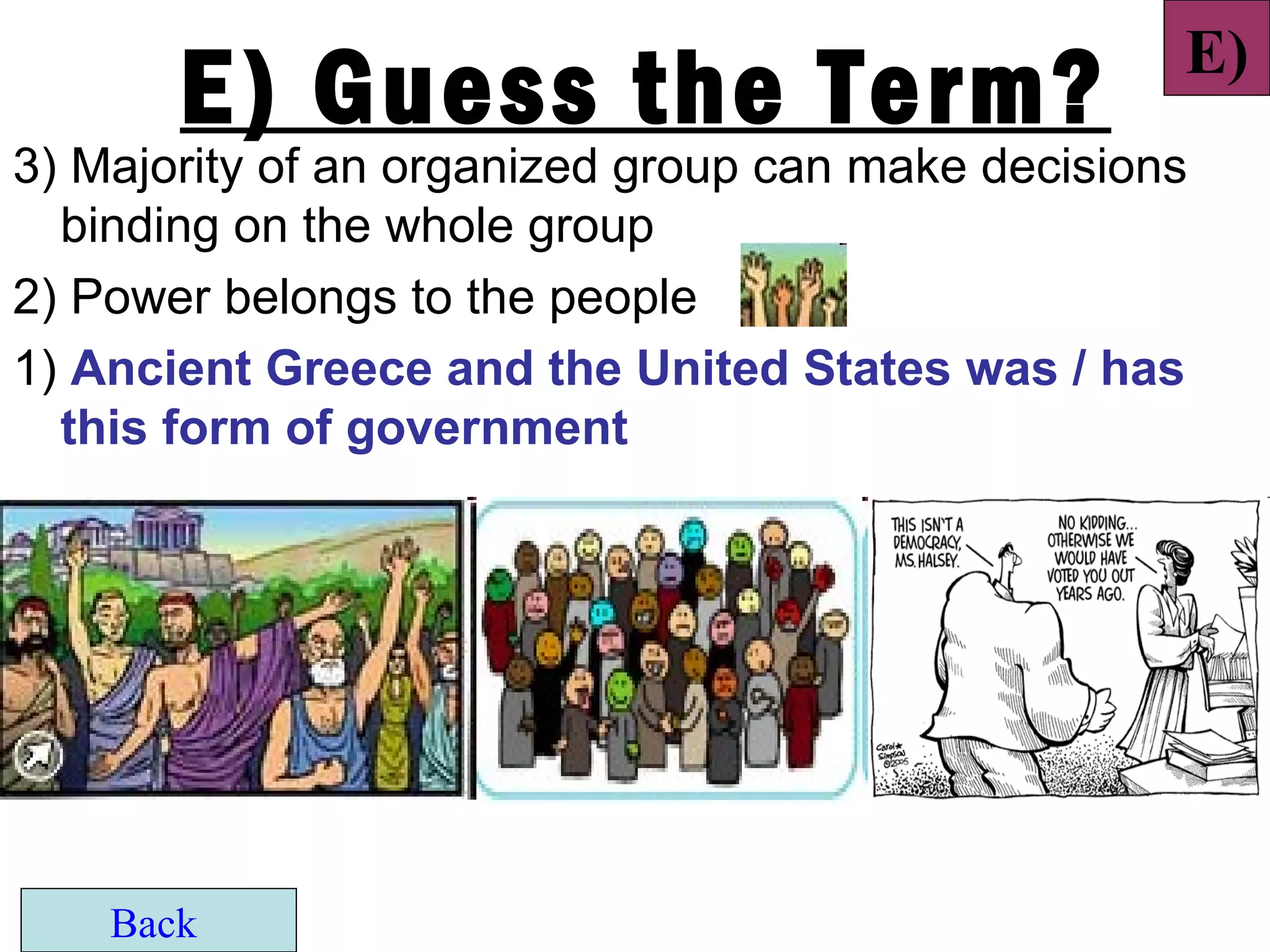
2) Power belongs to the people
1)


    Back
E)
       E) Guess the Term?
3) Majority of an organized group can make decisions
  binding on the whole group
2) Power belongs to the people
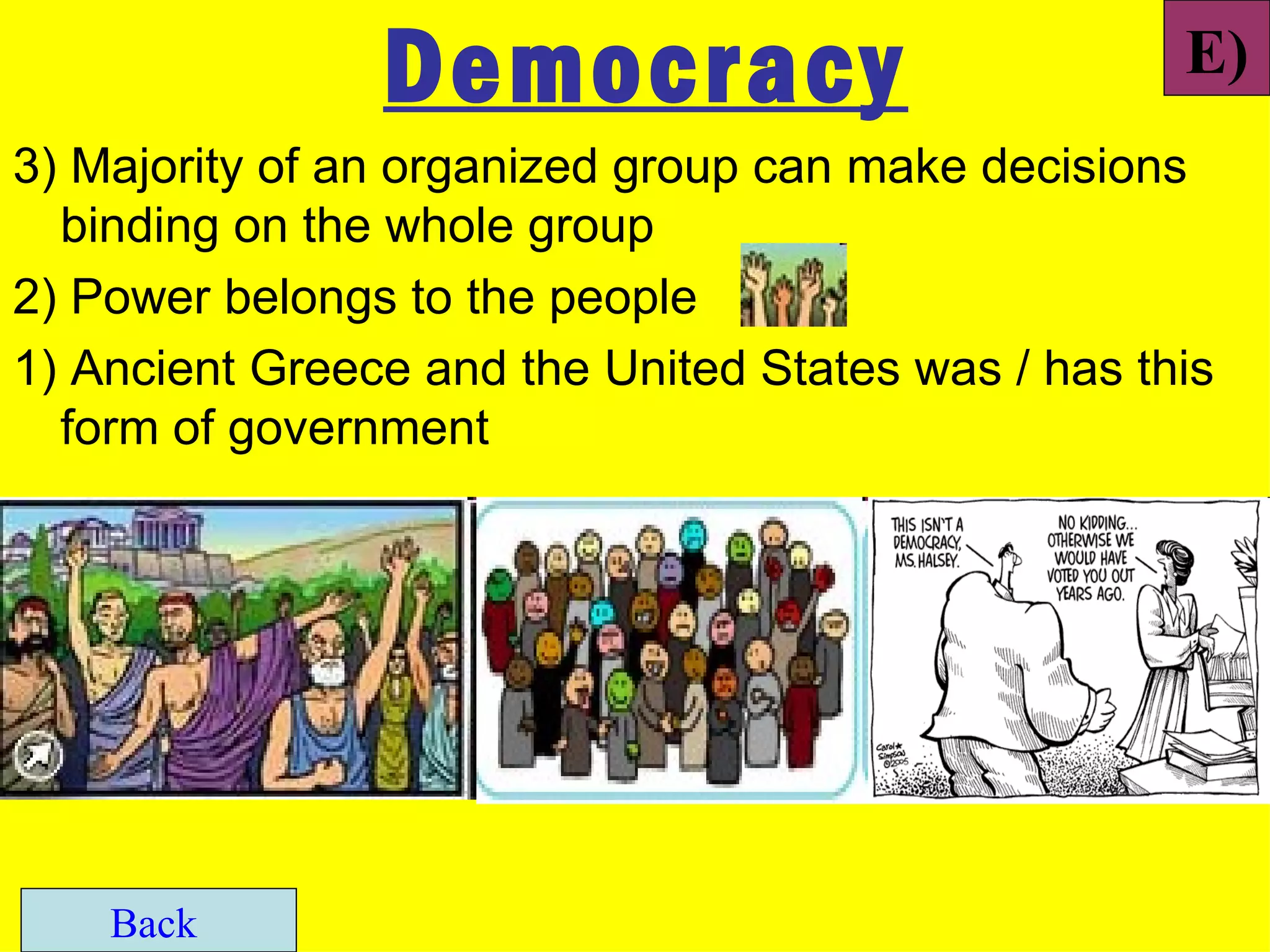
1) Ancient Greece and the United States was / has
  this form of government


    Back
Democracy                           E)
3) Majority of an organized group can make decisions
  binding on the whole group
2) Power belongs to the people
1) Ancient Greece and the United States was / has this
  form of government


    Back
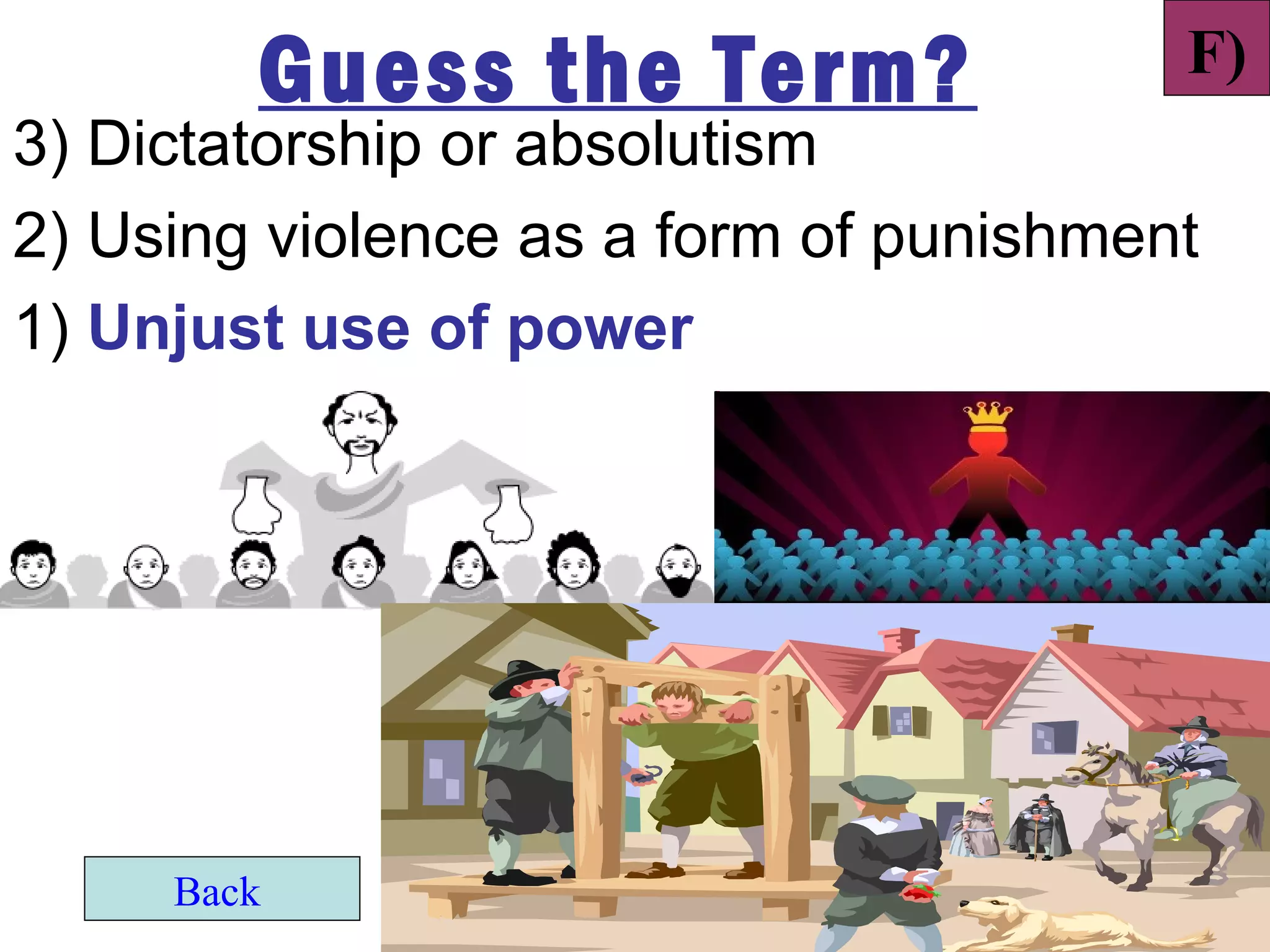
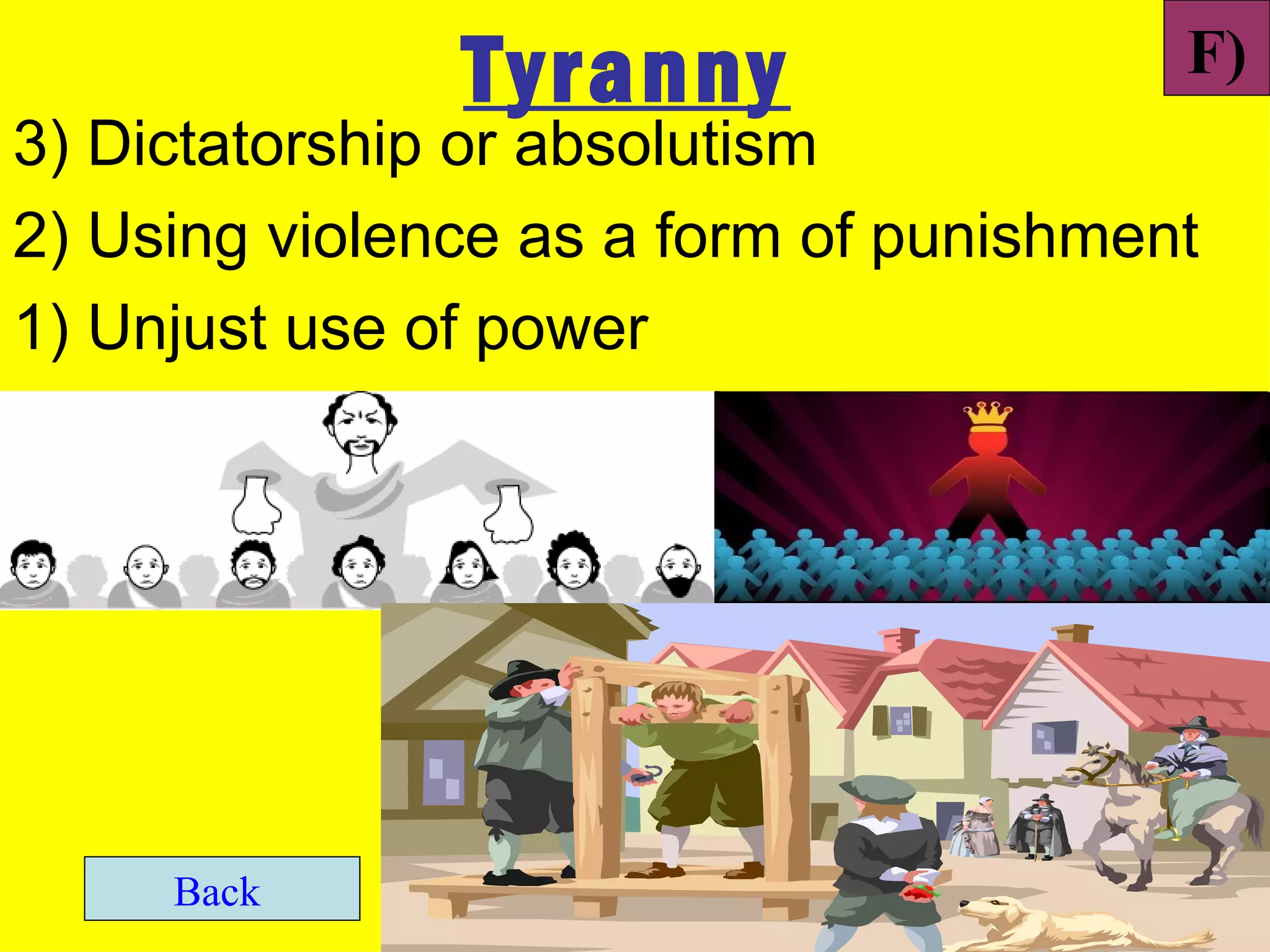
F) Guess the Term?        F)
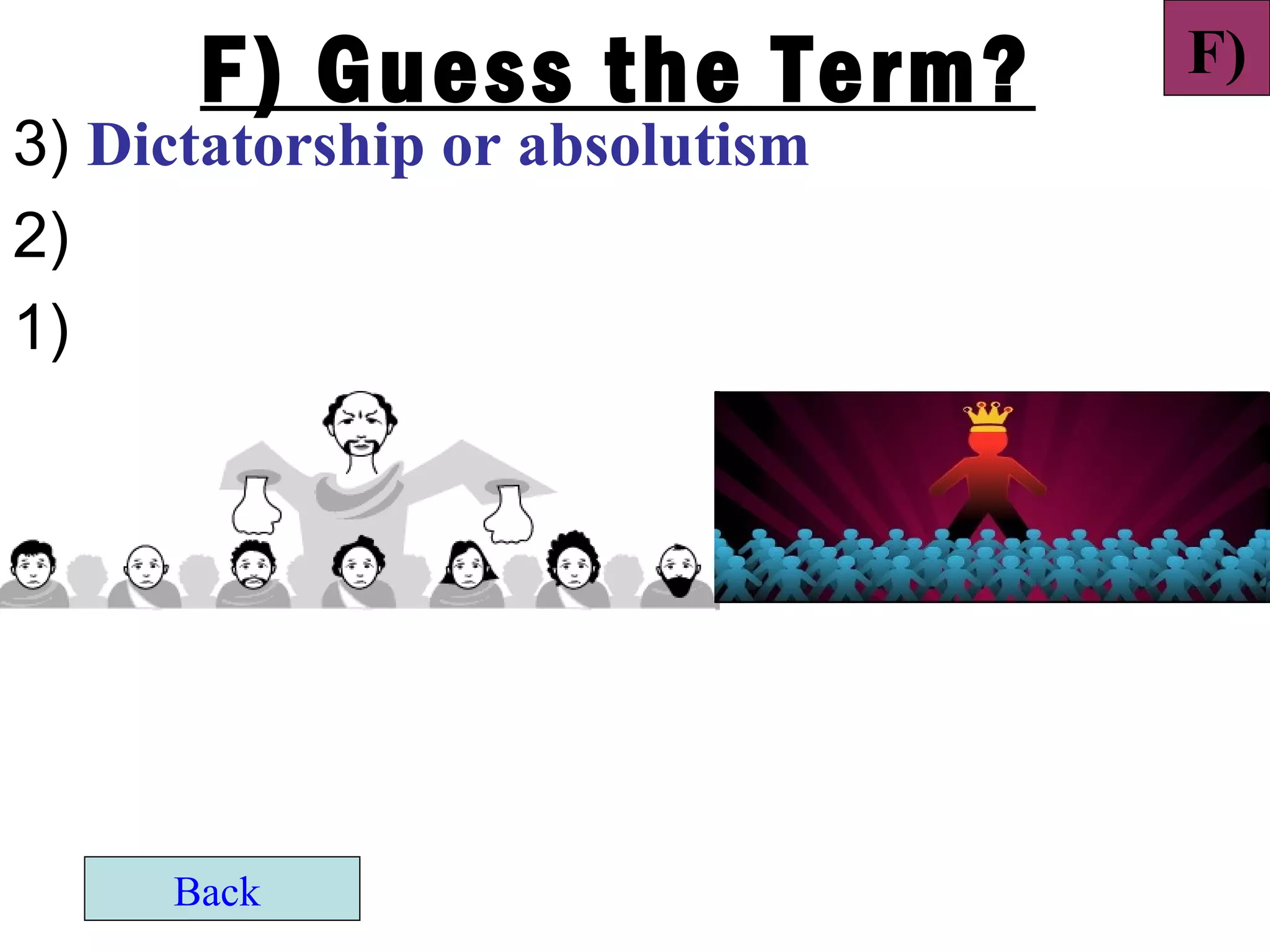
3) Dictatorship or absolutism
2)
1)


     Back
Guess the Term?                     F)
3) Dictatorship or absolutism
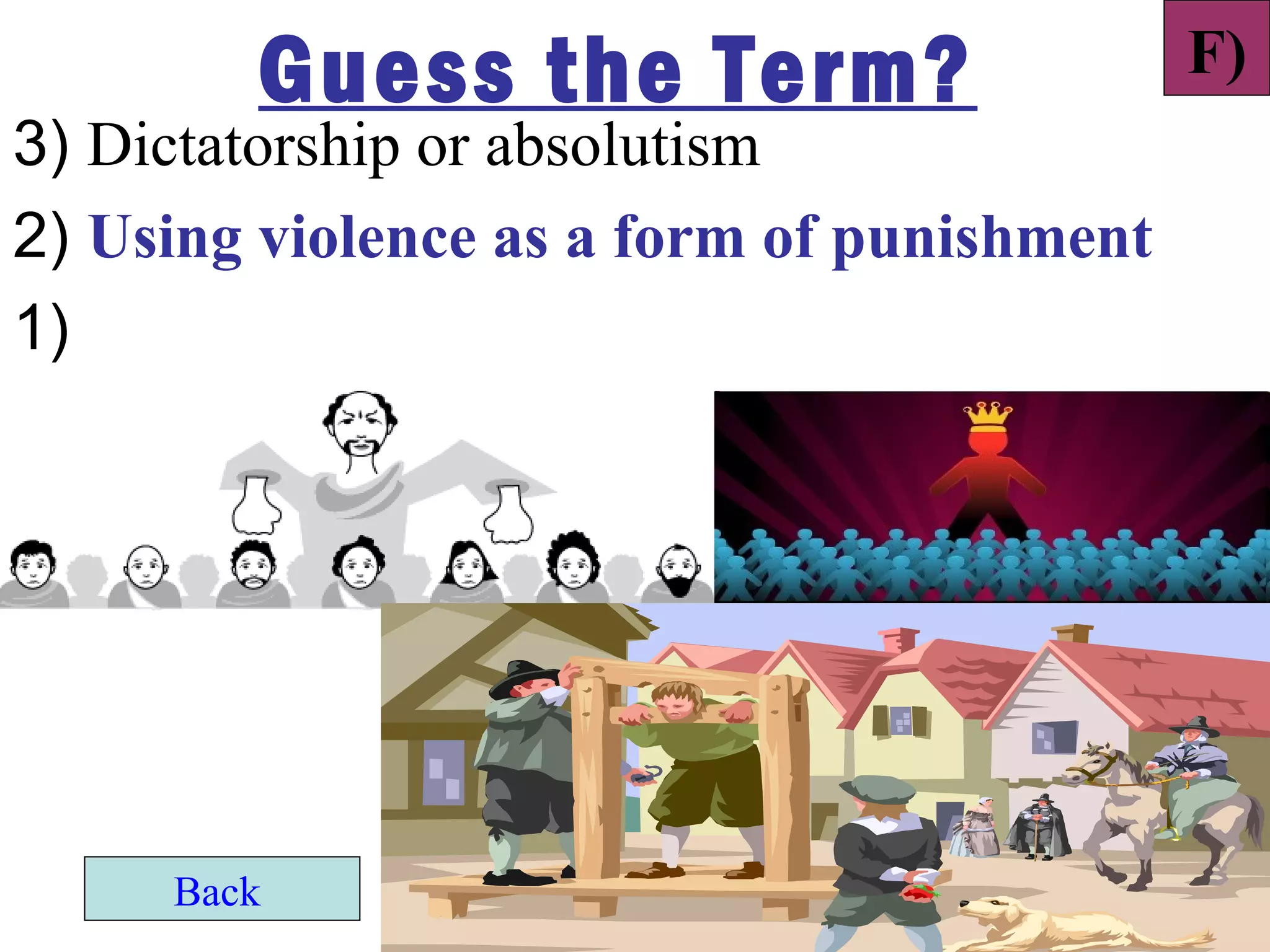
2) Using violence as a form of punishment
1)


     Back
Guess the Term?                 F)
3) Dictatorship or absolutism
2) Using violence as a form of punishment
1) Unjust use of power


     Back
Tyranny                  F)
3) Dictatorship or absolutism
2) Using violence as a form of punishment
1) Unjust use of power


     Back
G)
       G) Guess the Term?
5) Disagreed with both autocracy & democracy
4)
3)
2)

1)


     Back
G)
      G) Guess the Term?
5) Disagreed with both autocracy & democracy
4) Believed in rule by “Philosopher Kings”
3)
2)

1)


     Back
G)
       G) Guess the Term?
5) Disagreed with both autocracy & democracy
4) Believed in rule by “Philosopher Kings”
3) Thought talent determined rules in society
2)

1)


     Back
G)
      G) Guess the Term?
5) Disagreed with both autocracy & democracy
4) Believed in rule by “Philosopher Kings”
3) Thought talent determined rules in society
2) Wrote the Republic, which contains Allegory
  of the Cave
1)


     Back
G)
      G) Guess the Term?
5) Disagreed with both autocracy & democracy
4) Believed in rule by “Philosopher Kings”
3) Thought talent determined place in society
2) Wrote the Republic, which contains Allegory
  of the Cave
1) Pupil of Socrates


     Back
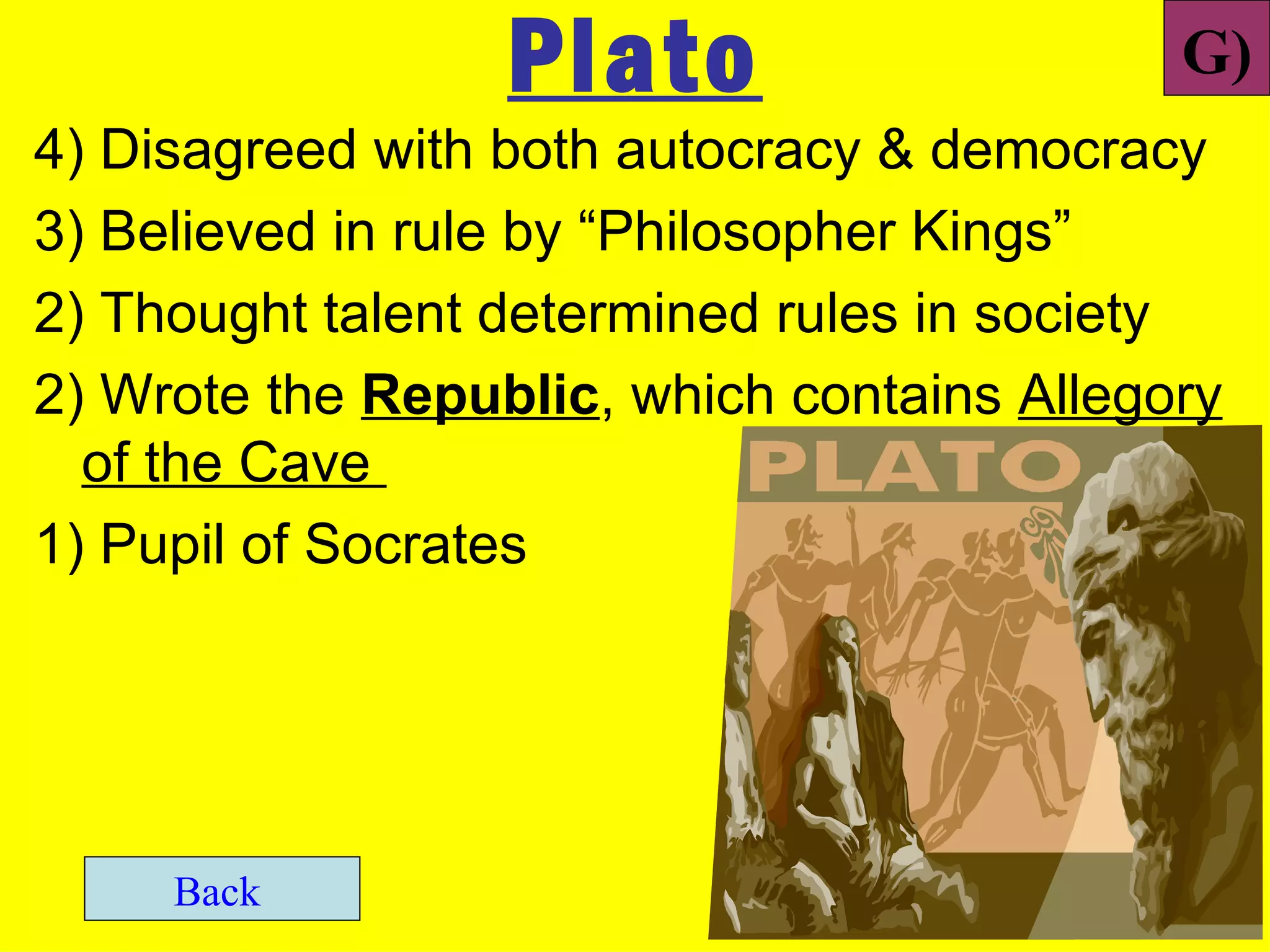
Plato                     G)
4) Disagreed with both autocracy & democracy
3) Believed in rule by “Philosopher Kings”
2) Thought talent determined rules in society
2) Wrote the Republic, which contains Allegory
  of the Cave
1) Pupil of Socrates


     Back
Guess The Term?                            H)
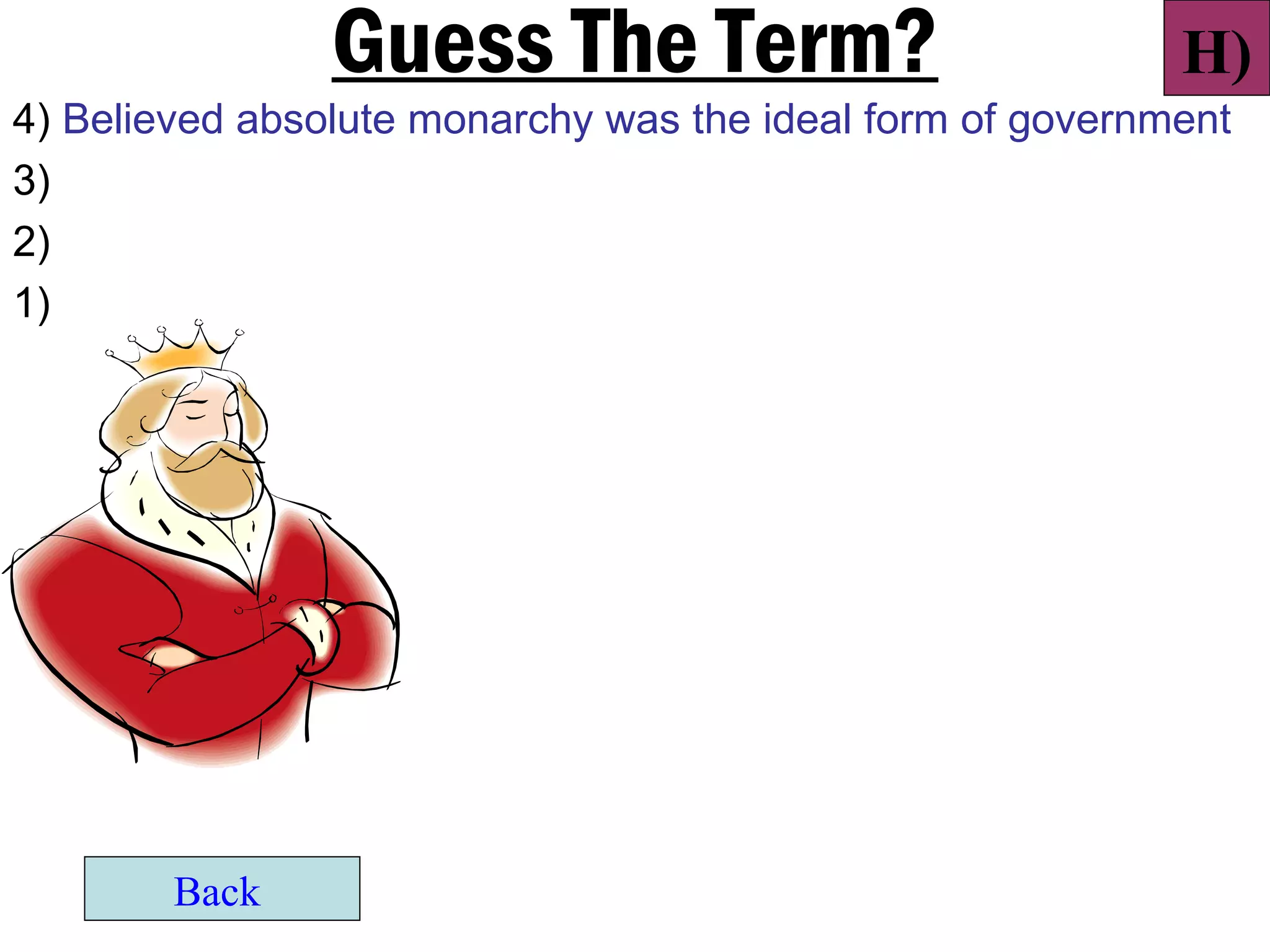
4) Believed absolute monarchy was the ideal form of government
3)
2)
1)


        Back
Guess The Term?                            H)
4) Believed absolute monarchy was the ideal form of government
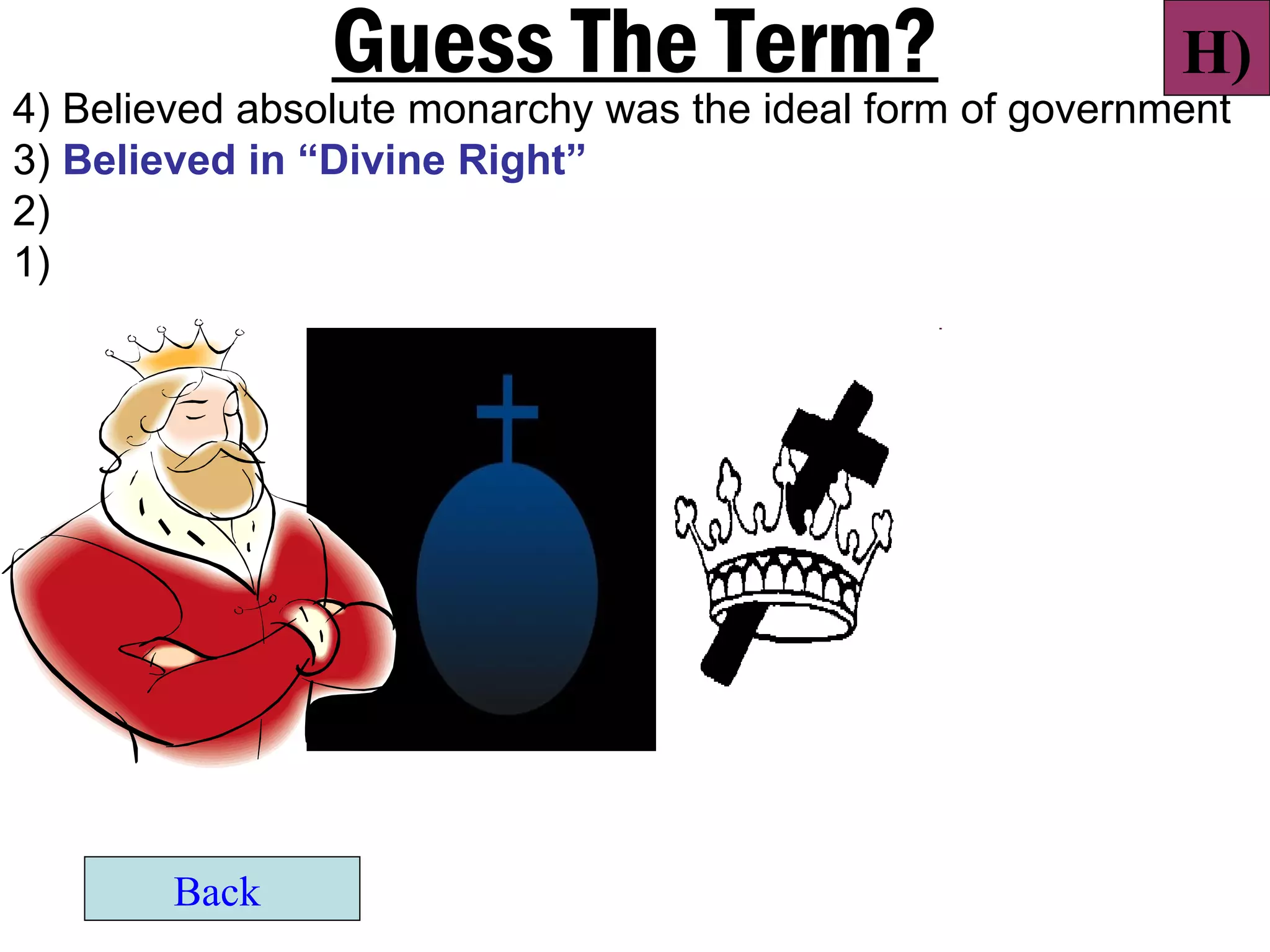
3) Believed in “Divine Right”
2)
1)


        Back
Guess The Term?                            H)
4) Believed absolute monarchy was the ideal form of government
3) Believed in “Divine Right”
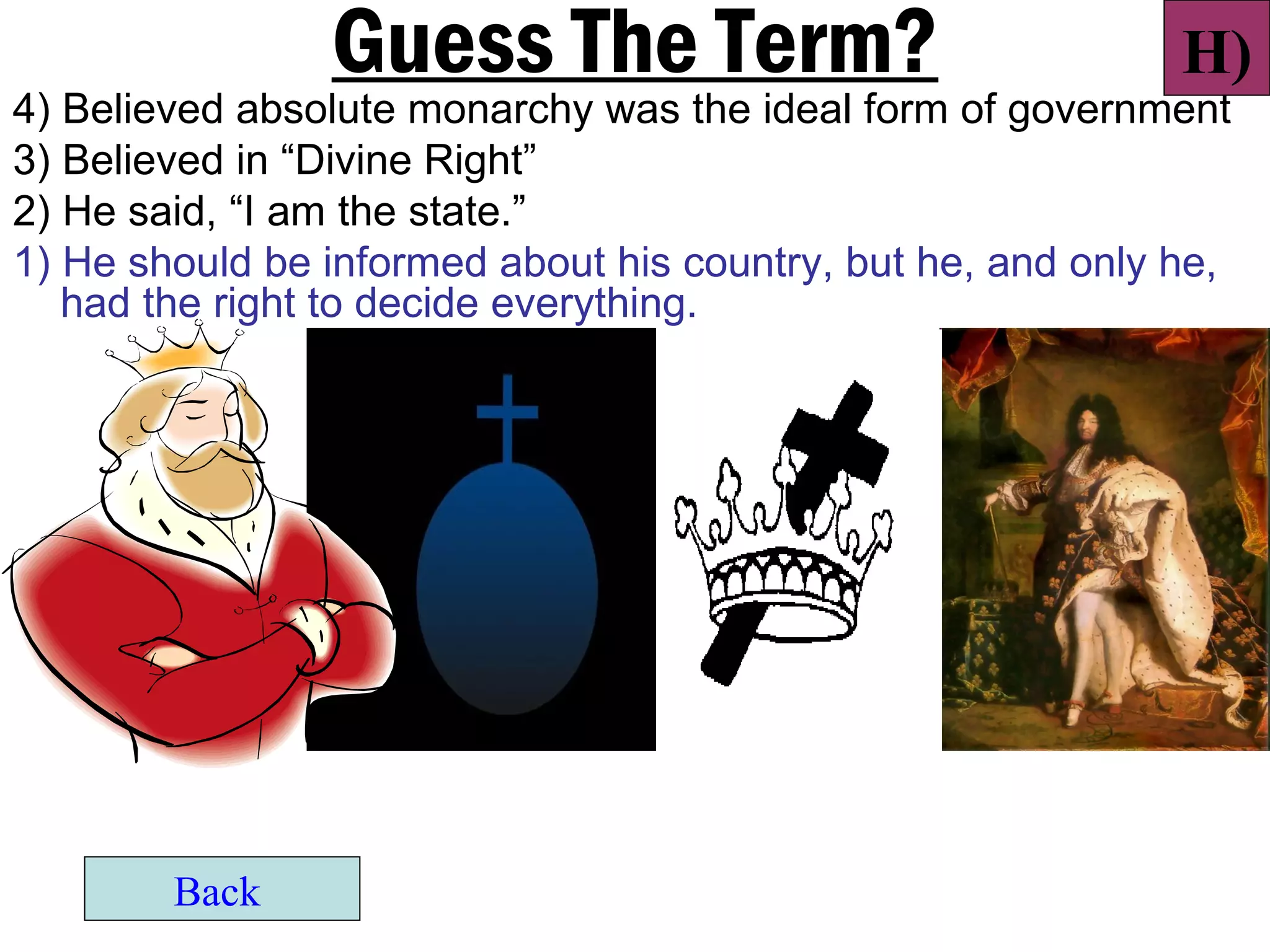
2) He said, “I am the state.”
1)


        Back
Guess The Term?                              H)
4) Believed absolute monarchy was the ideal form of government
3) Believed in “Divine Right”
2) He said, “I am the state.”
1) He should be informed about his country, but he, and only he,
   had the right to decide everything.


        Back
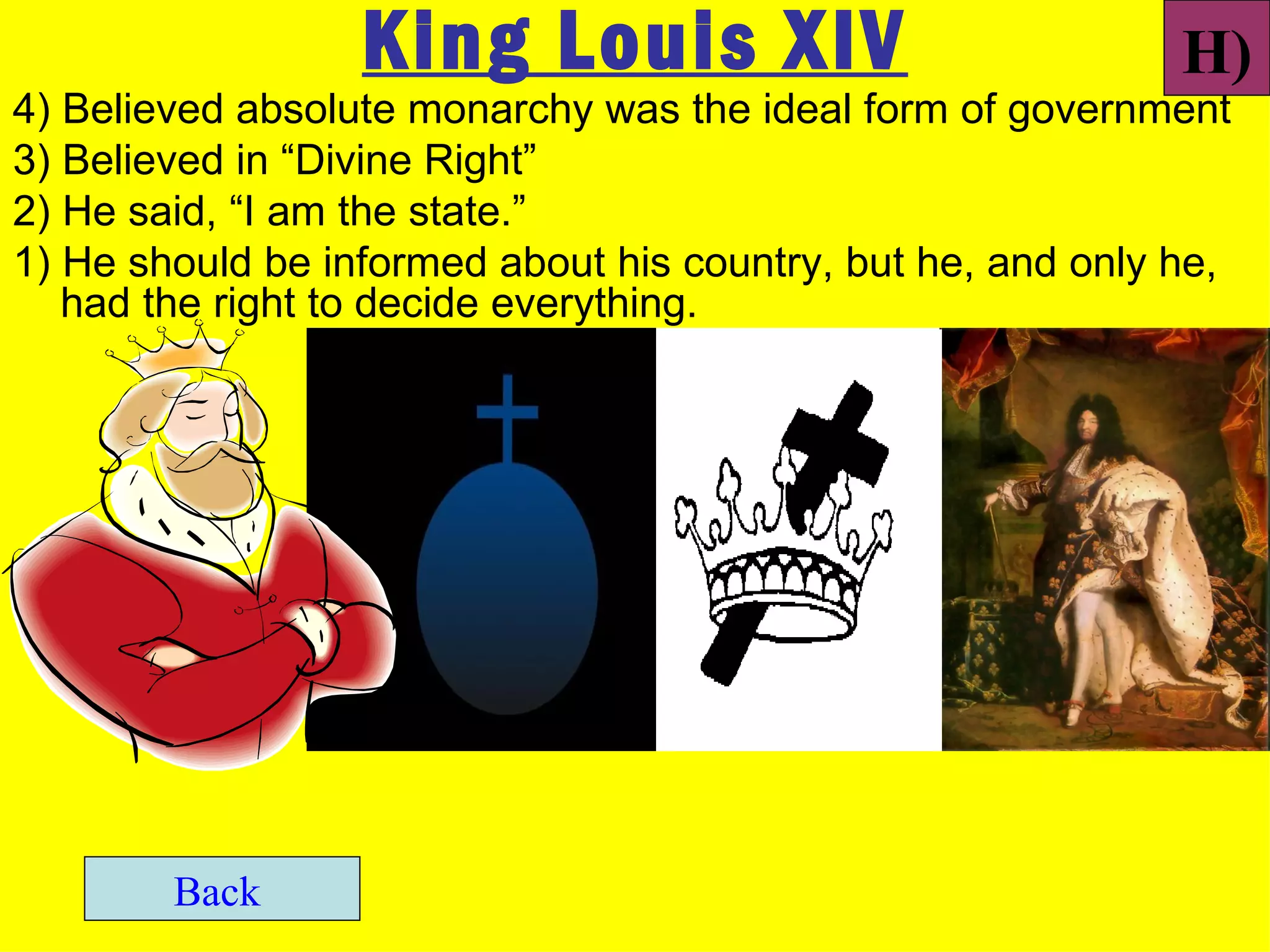
King Louis XIV                             H)
4) Believed absolute monarchy was the ideal form of government
3) Believed in “Divine Right”
2) He said, “I am the state.”
1) He should be informed about his country, but he, and only he,
   had the right to decide everything.


        Back
Guess The Term?                                I)
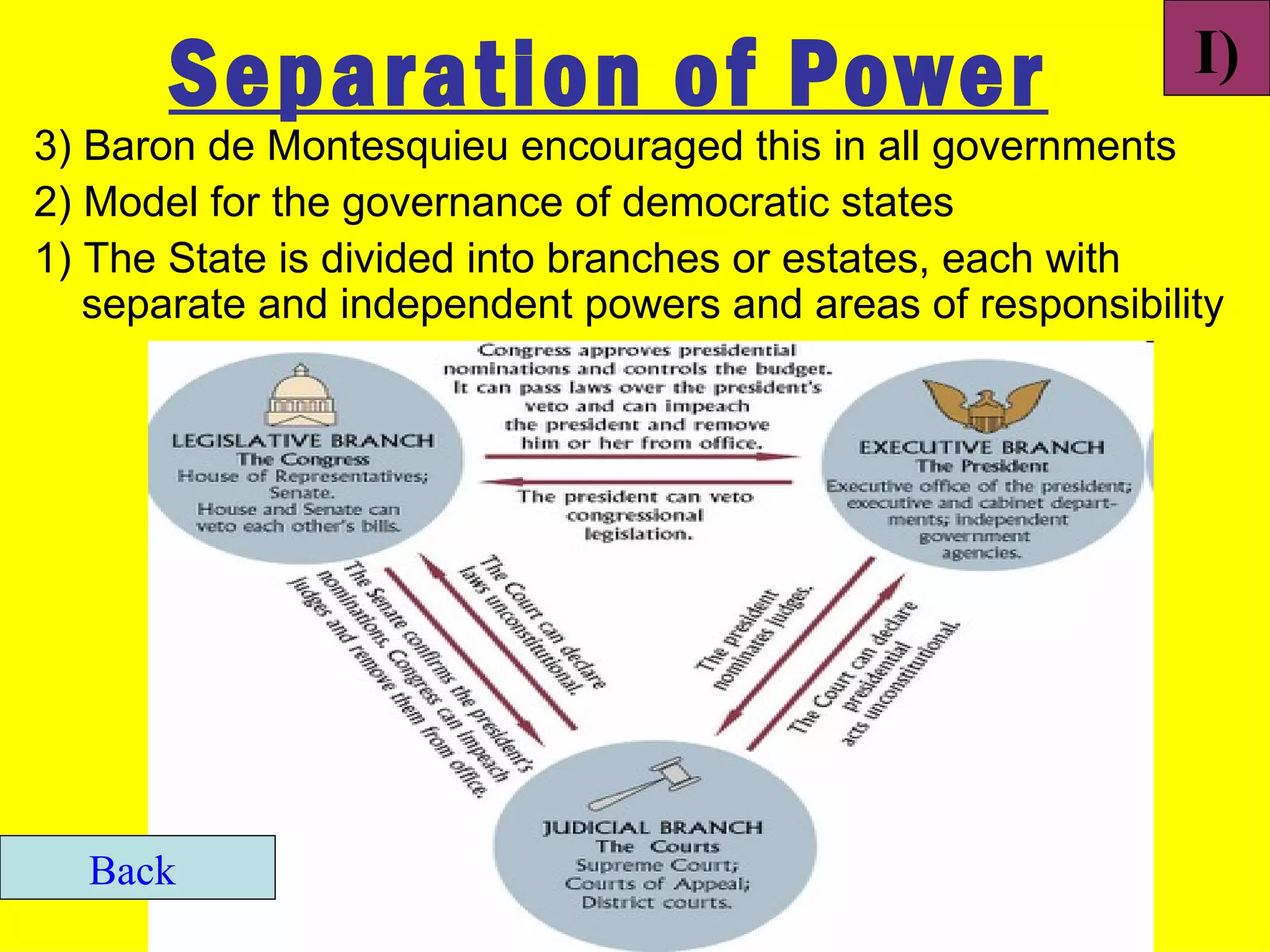
3) Baron de Montesquieu encouraged this in all governments
2)
1)


  Back
Guess The Term?                                I)
3) Baron de Montesquieu encouraged this in all governments
2) Model for the governance of democratic states
1)


  Back
Guess The Term?                              I)
3) Baron de Montesquieu encouraged this in all governments
2) Model for the governance of democratic states
1) The State is divided into branches or estates, each with
   separate and independent powers and areas of responsibility


  Back
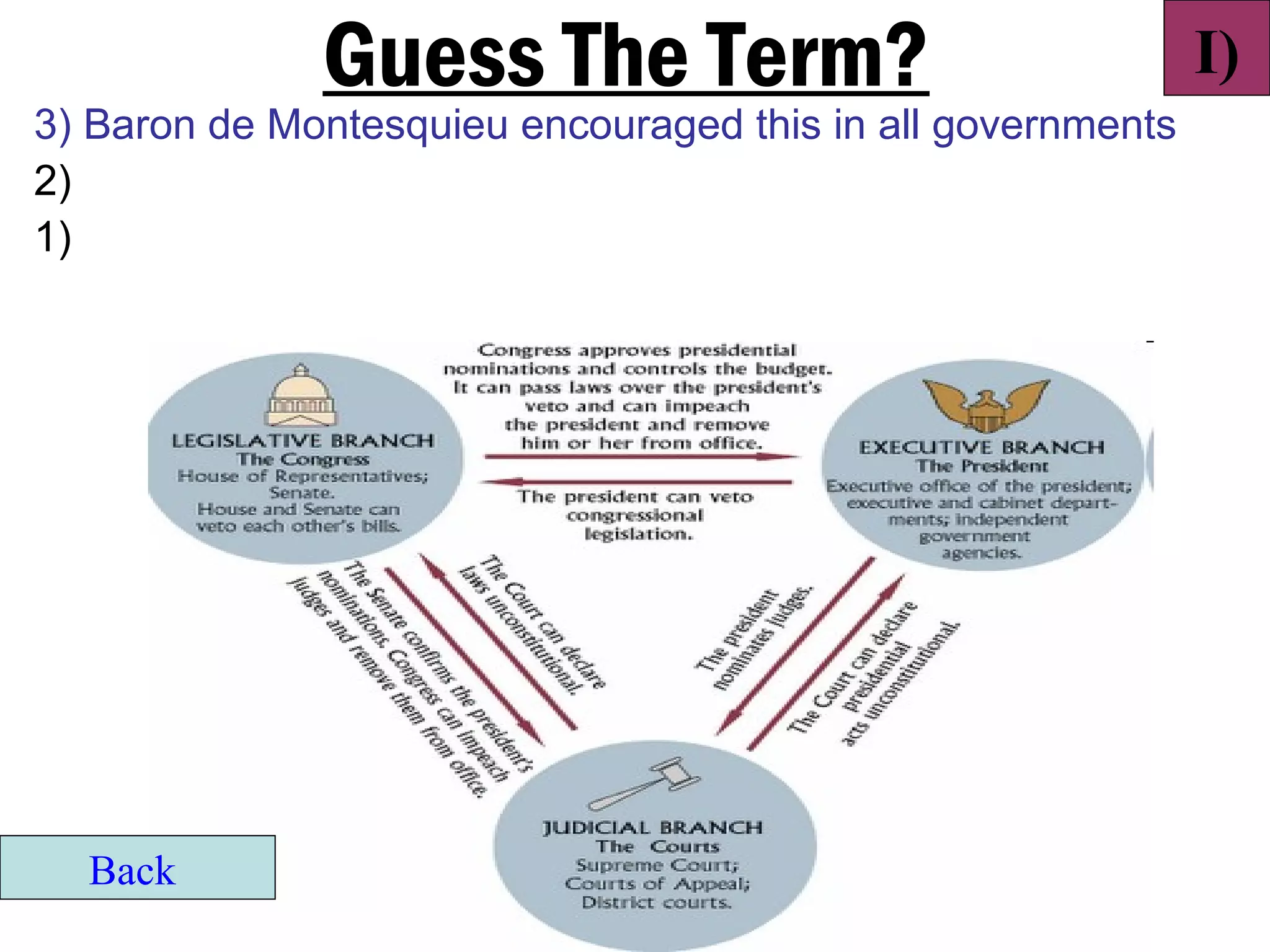
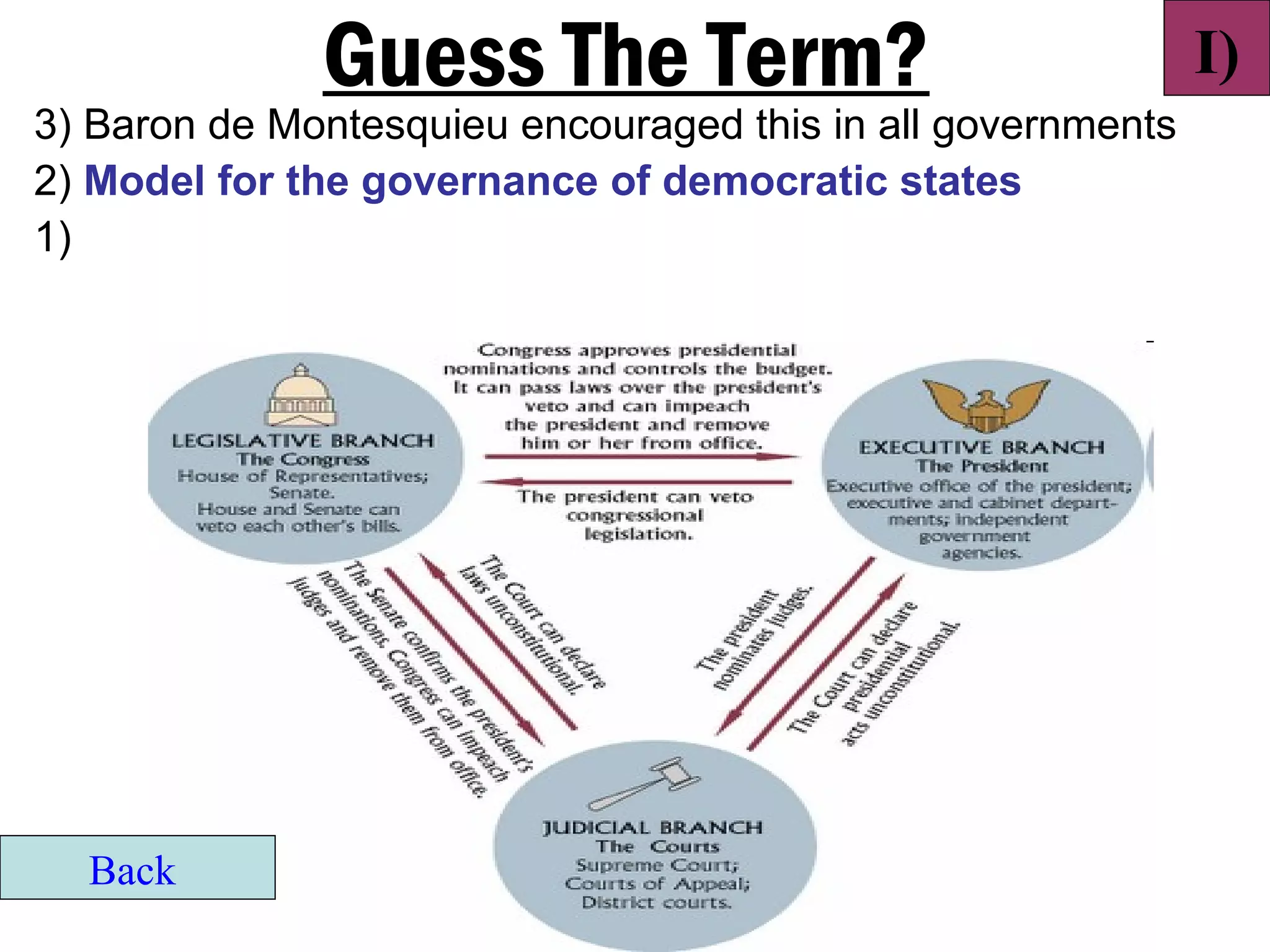
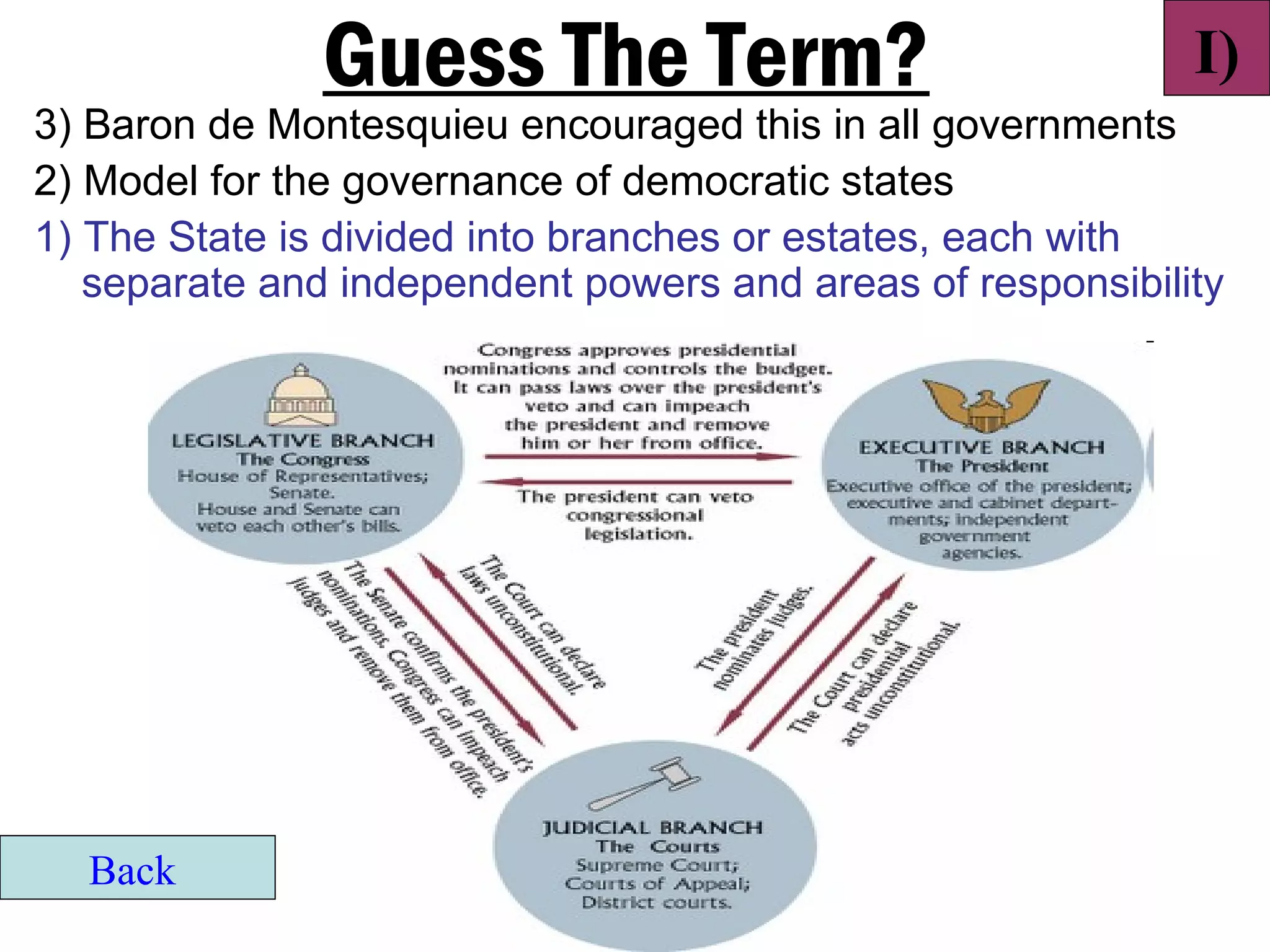
Separation of Power                                  I)
3) Baron de Montesquieu encouraged this in all governments
2) Model for the governance of democratic states
1) The State is divided into branches or estates, each with
   separate and independent powers and areas of responsibility


  Back
J)
      J) Guess the Term?
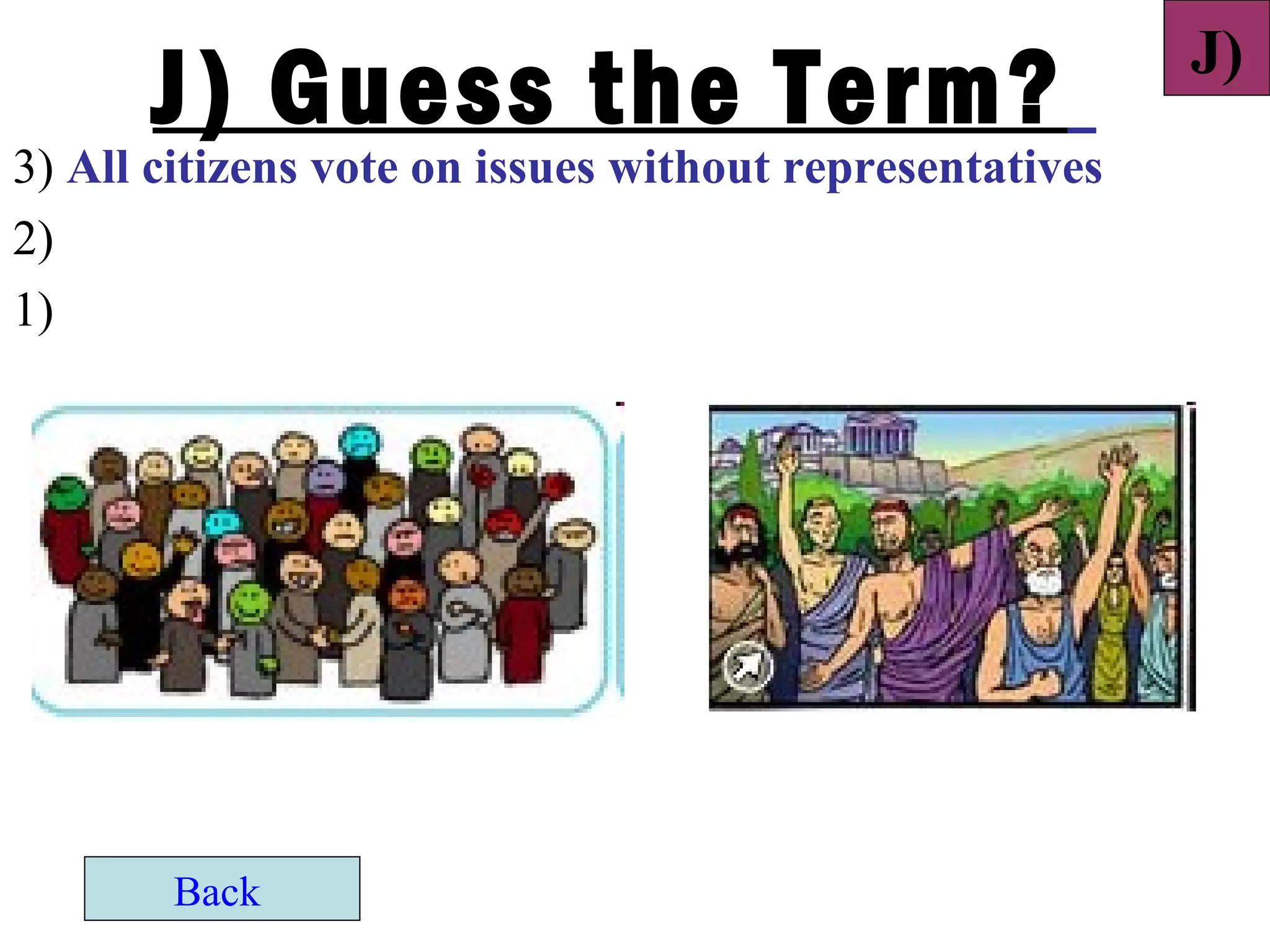
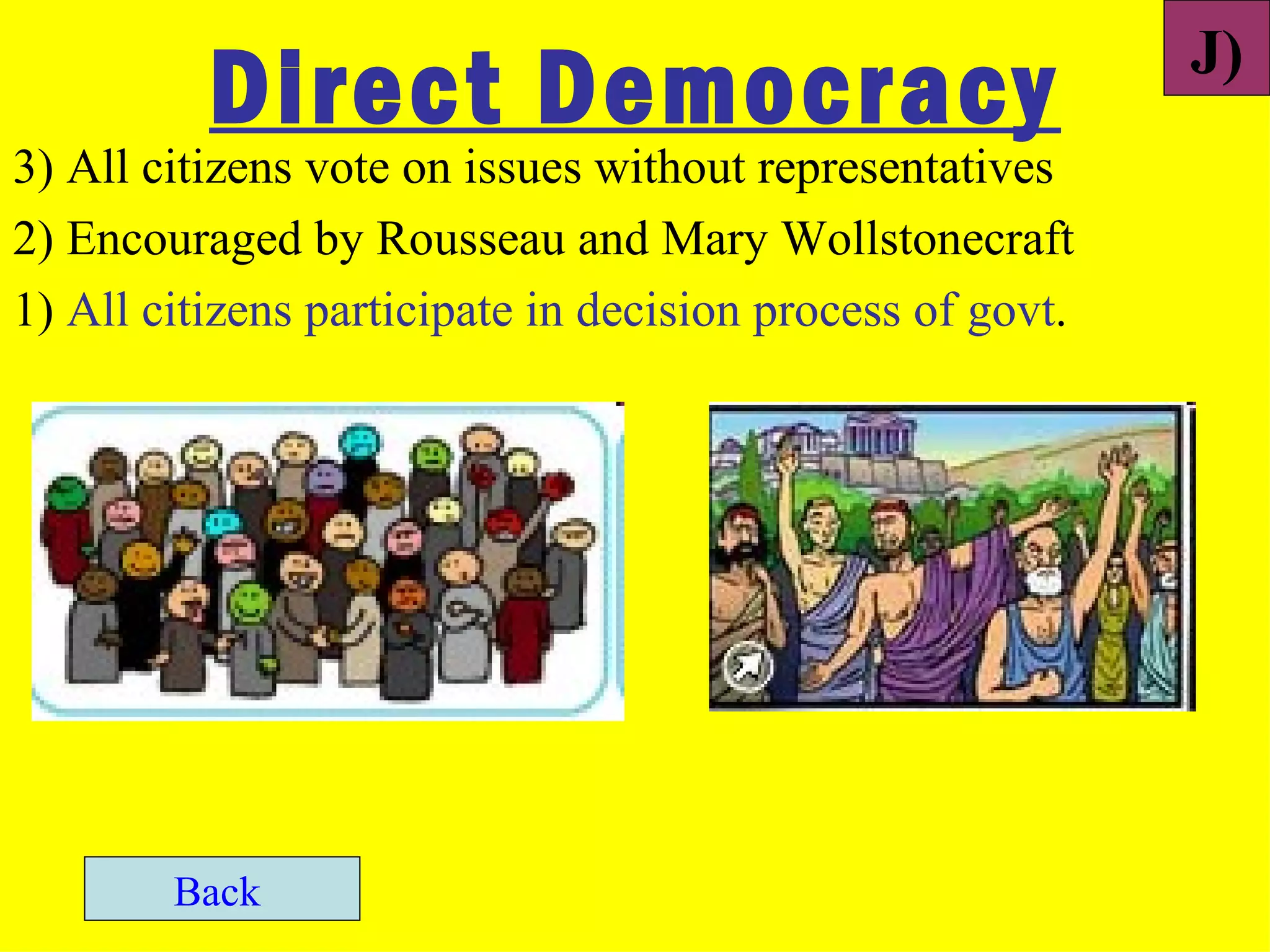
3) All citizens vote on issues without representatives
2)
1)


       Back
J)
       J) Guess the Term?
3) All citizens vote on issues without representatives
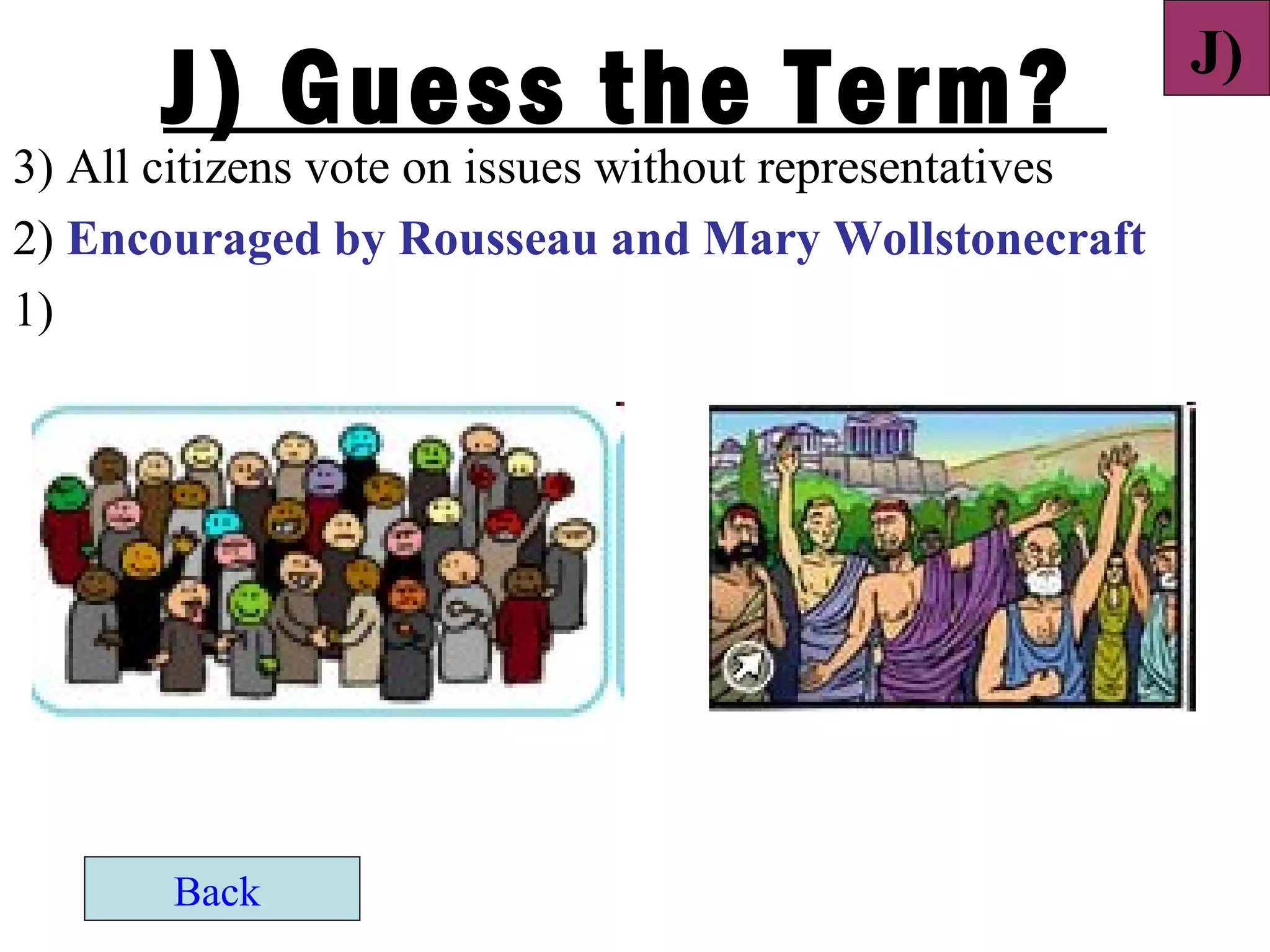
2) Encouraged by Rousseau and Mary Wollstonecraft
1)


       Back
J)
        J) Guess the Term?
3) All citizens vote on issues without representatives
2) Encouraged by Rousseau and Mary Wollstonecraft
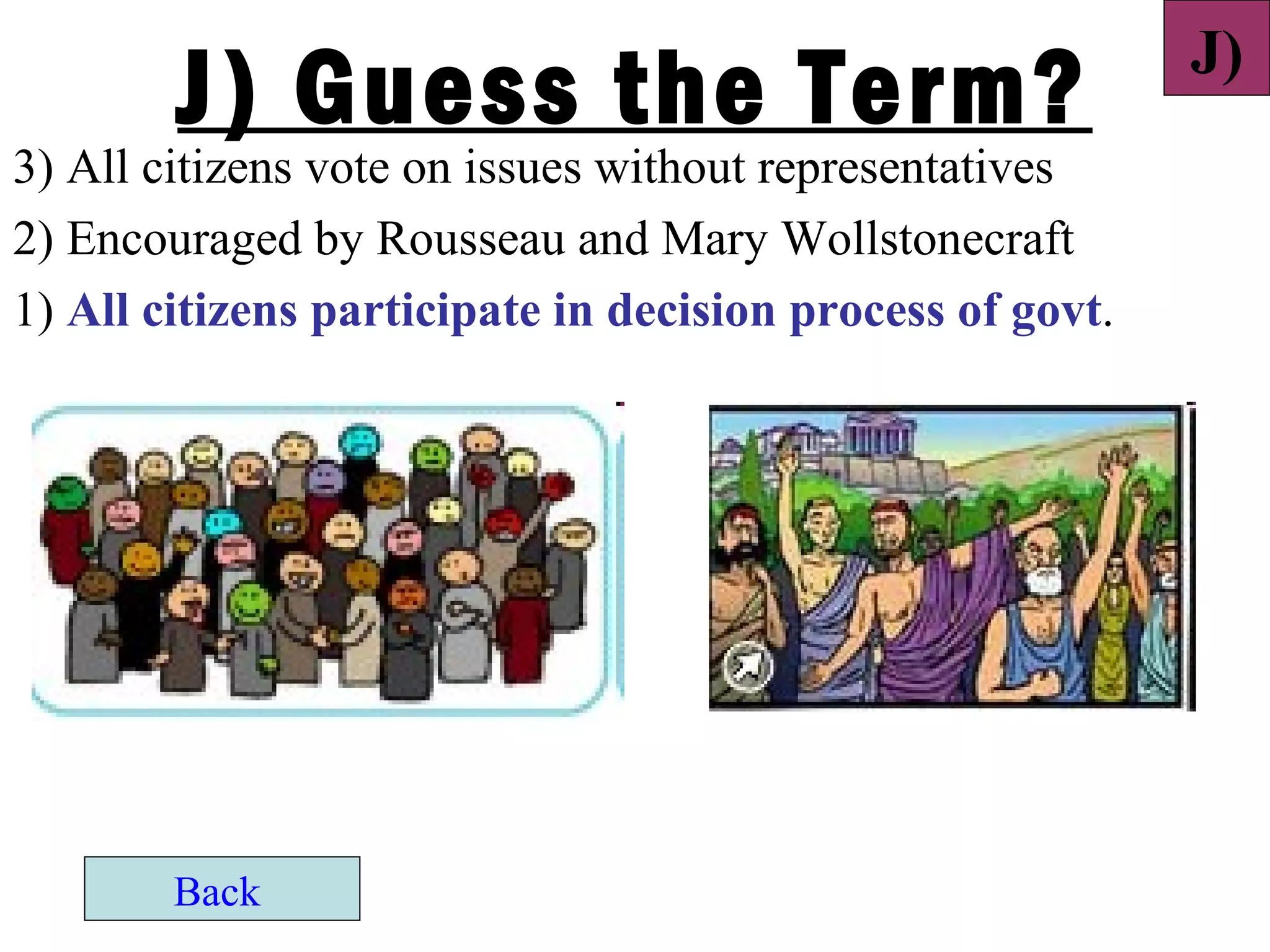
1) All citizens participate in decision process of govt.


        Back
J)
          Direct Democracy
3) All citizens vote on issues without representatives
2) Encouraged by Rousseau and Mary Wollstonecraft
1) All citizens participate in decision process of govt.


        Back
K) Guess the Term?                   K)
3) Results in the organization of society
2)
1)


      Back
K) Guess the Term?                   K)
3) Results in the organization of society
2) Agreement among people & government
1)


     Back
K) Guess the Term?                    K)
3) Results in the organization of society
2) Agreement among people & government
1) Citizens give up certain freedoms in exchange
   for protection by the government


      Back
Social Contract                     K)
3) Results in the organization of society
2) Agreement among people & government
1) Citizens give up certain freedoms in exchange
   for protection by the government


      Back
Guess The Term?   L)
4) Believed in democracy
3)

2)
1)


      Back
Guess The Term?                      L)
4) Believed in democracy
3) Government should be run by only middle-classmen
    because rich were arrogant and poor were vengeful
2)
1)


       Back
Guess The Term?                      L)
4) Believed in democracy
3) Government should be run by only middle-classmen
    because rich were arrogant and poor were vengeful
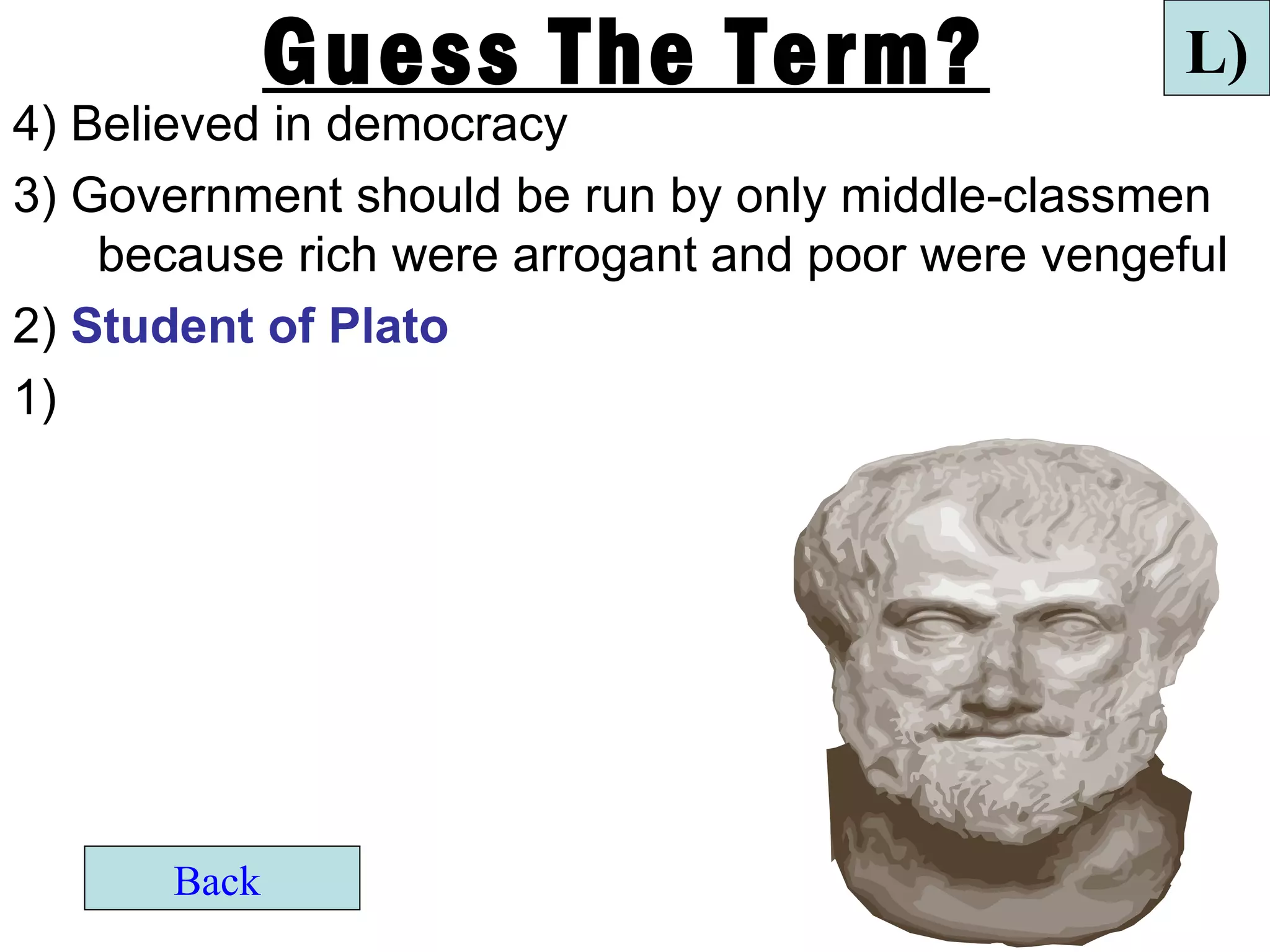
2) Student of Plato
1)


       Back
Guess The Term?                      L)
4) Believed in democracy
3) Government should be run by only middle-classmen
    because rich were arrogant and poor were vengeful
2) Student of Plato
1) Teacher of Alexander the Great


       Back
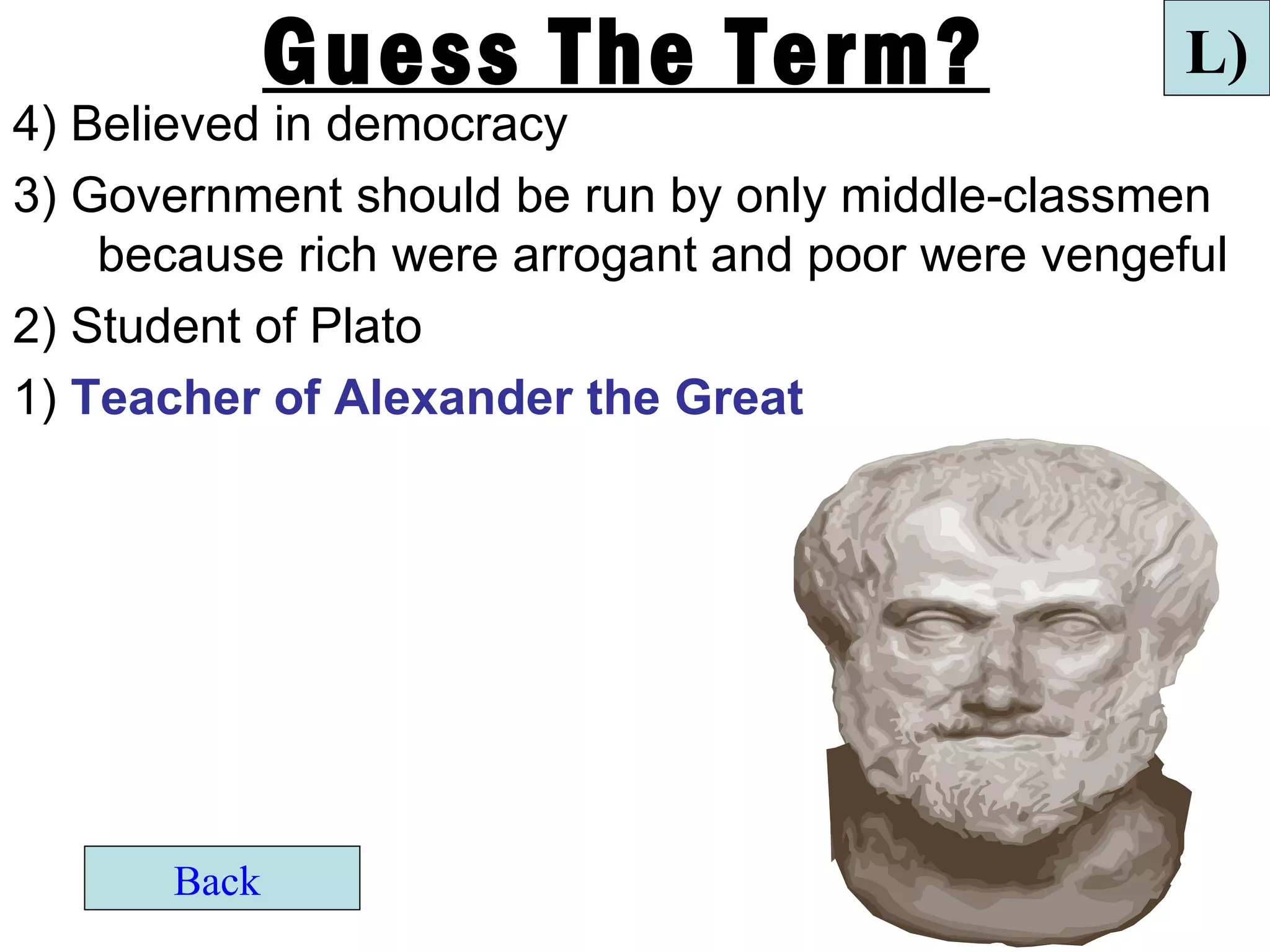
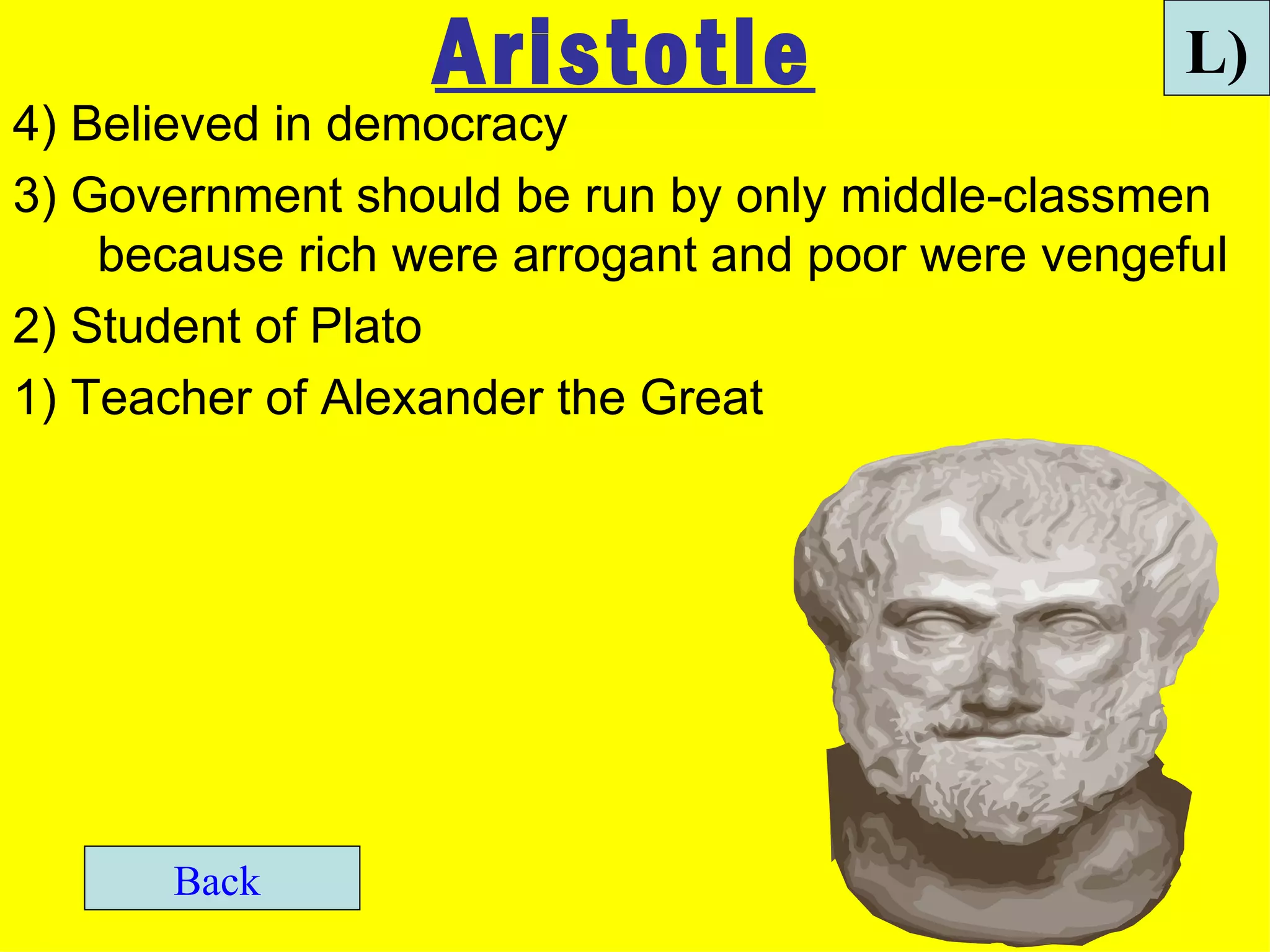
Aristotle                        L)
4) Believed in democracy
3) Government should be run by only middle-classmen
    because rich were arrogant and poor were vengeful
2) Student of Plato
1) Teacher of Alexander the Great


       Back
M)
              Guess The Term
2) King Louis XIV thought this was ideal
1)
M)
               Guess The Term
2) King Louis XIV thought this was ideal
1) God given power to rule
M)
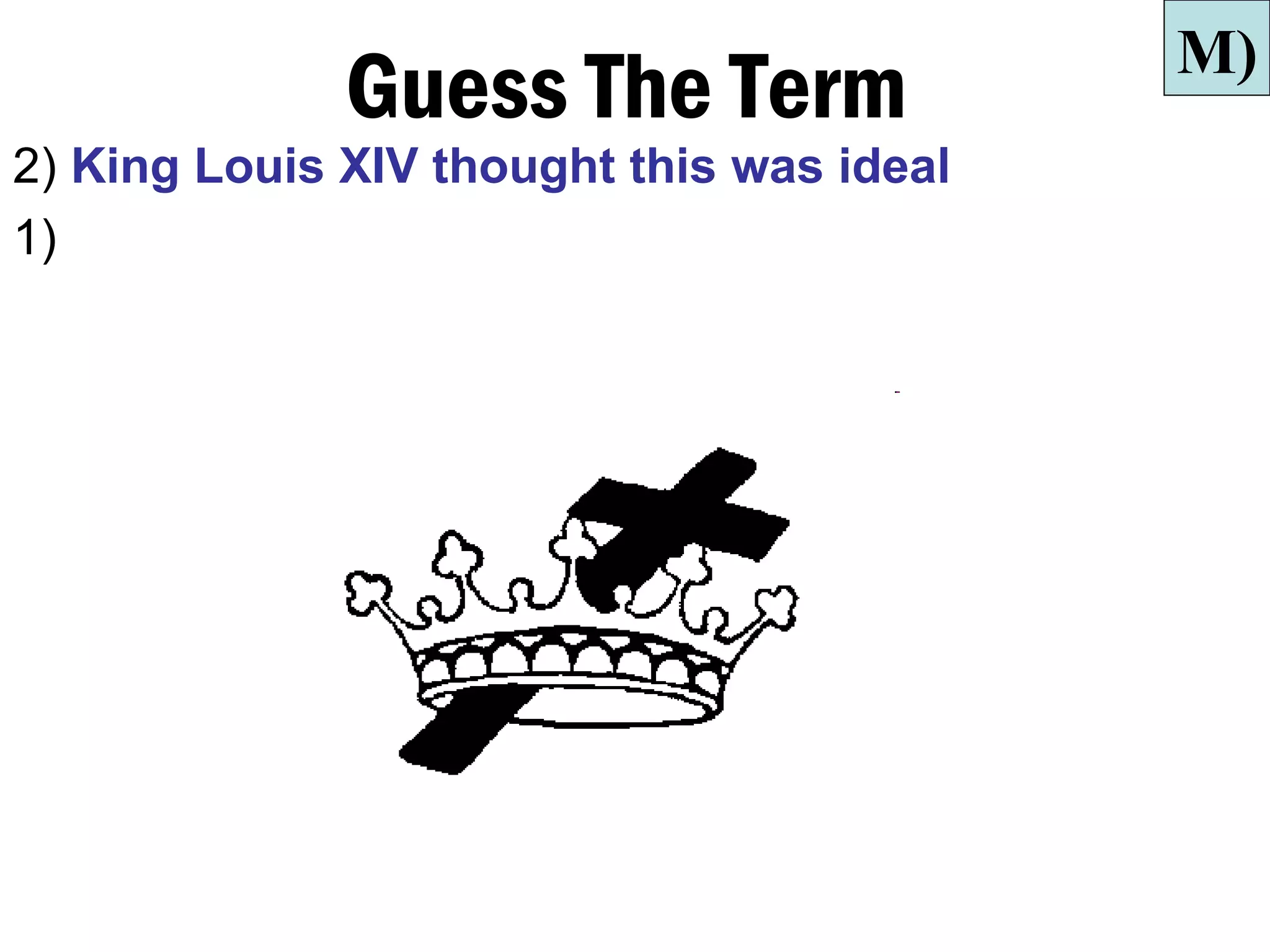
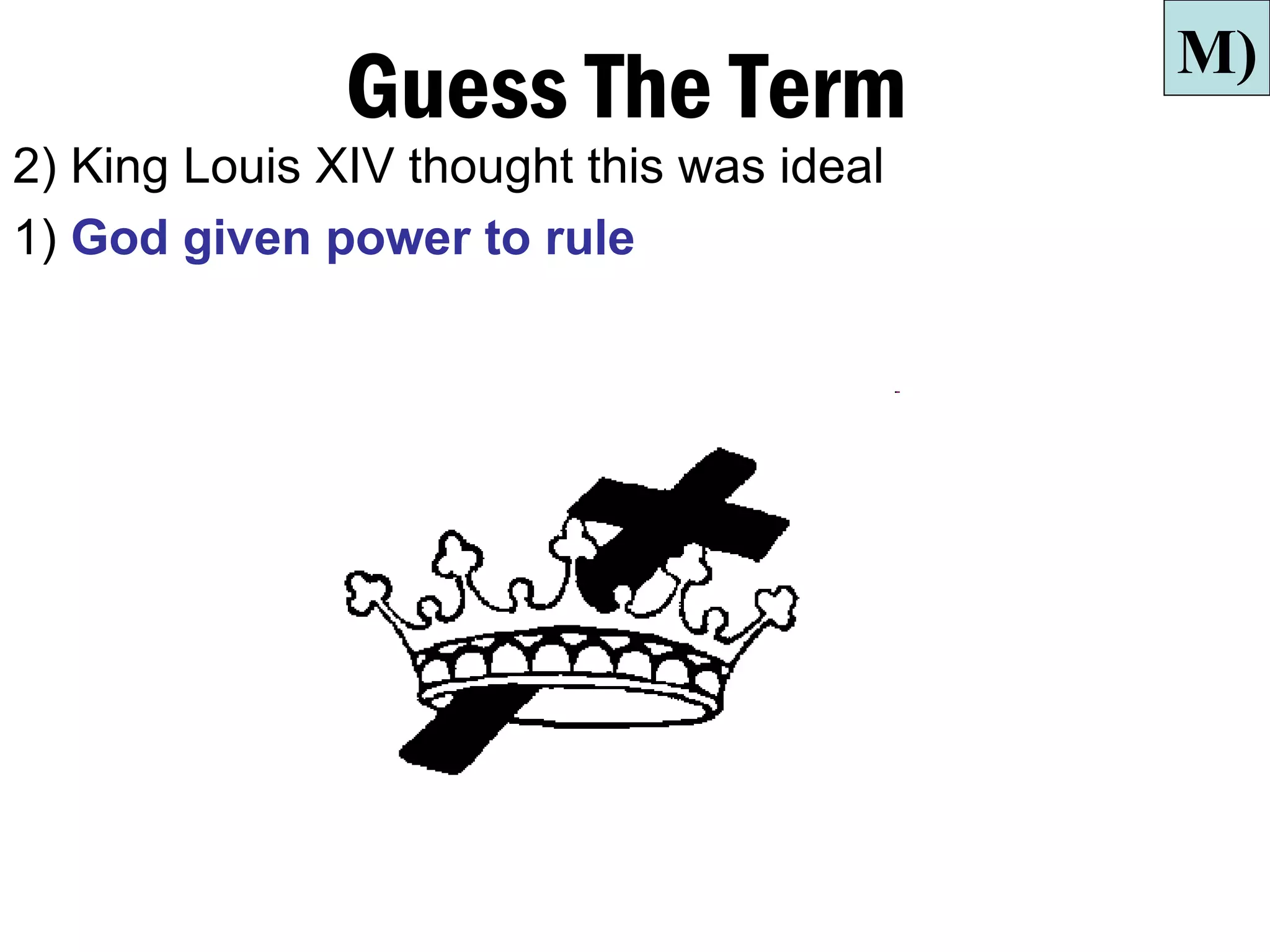
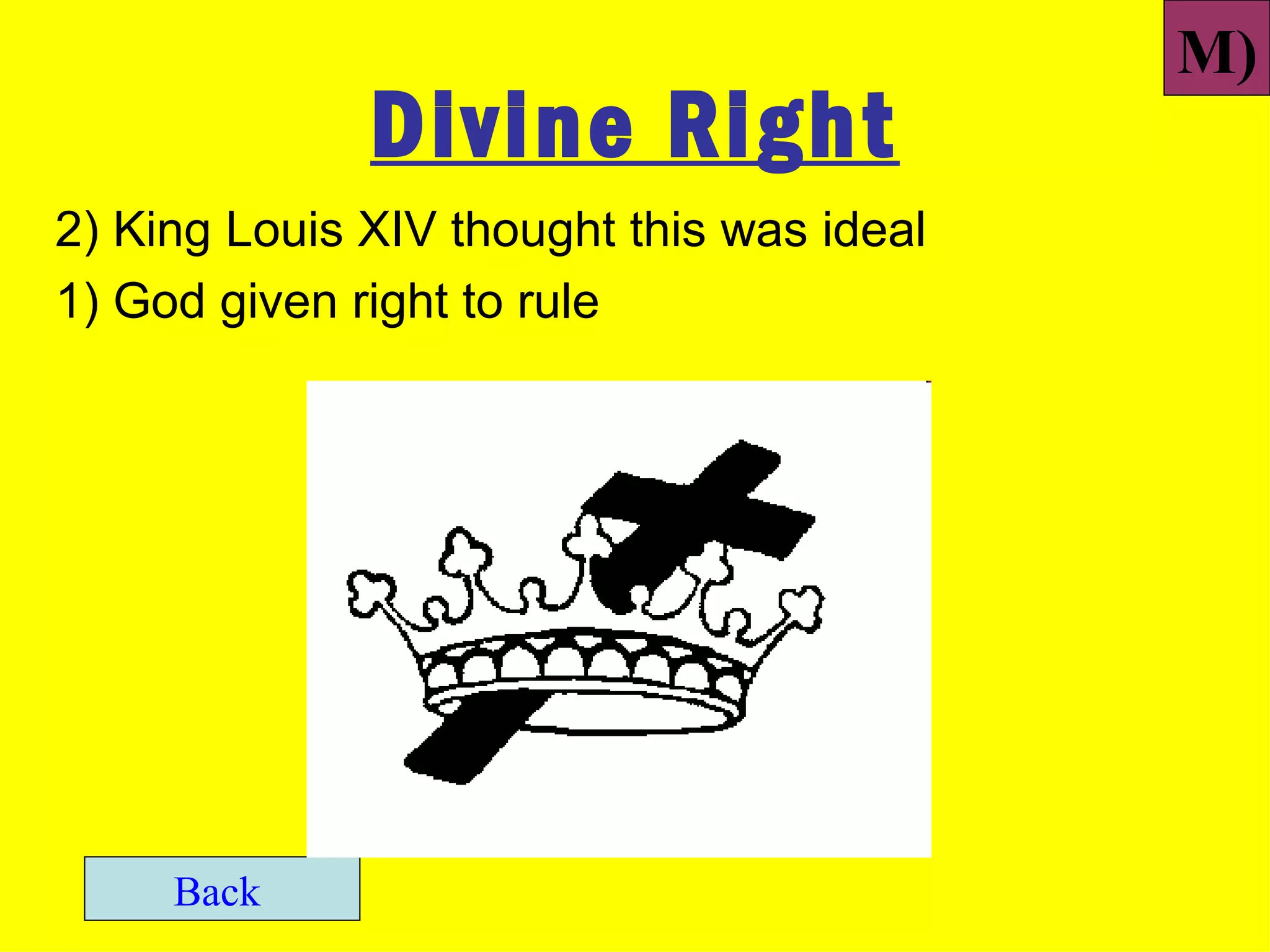
              Divine Right
2) King Louis XIV thought this was ideal
1) God given right to rule


     Back
N)
          Guess The Term
3) Philosopher who believed that all
  knowledge is derived from experience
N)
          Guess The Term
3) Philosopher who believed that all
  knowledge is derived from experience
2) “People should overthrow government if it
  isn’t good.”
N)
          Guess The Term
3) Philosopher who believed that all
  knowledge is derived from experience
2) “People should overthrow government if it
  isn’t good.”
1) Government is morally obliged to serve
  people, namely by protecting life, liberty,
  and property
N)
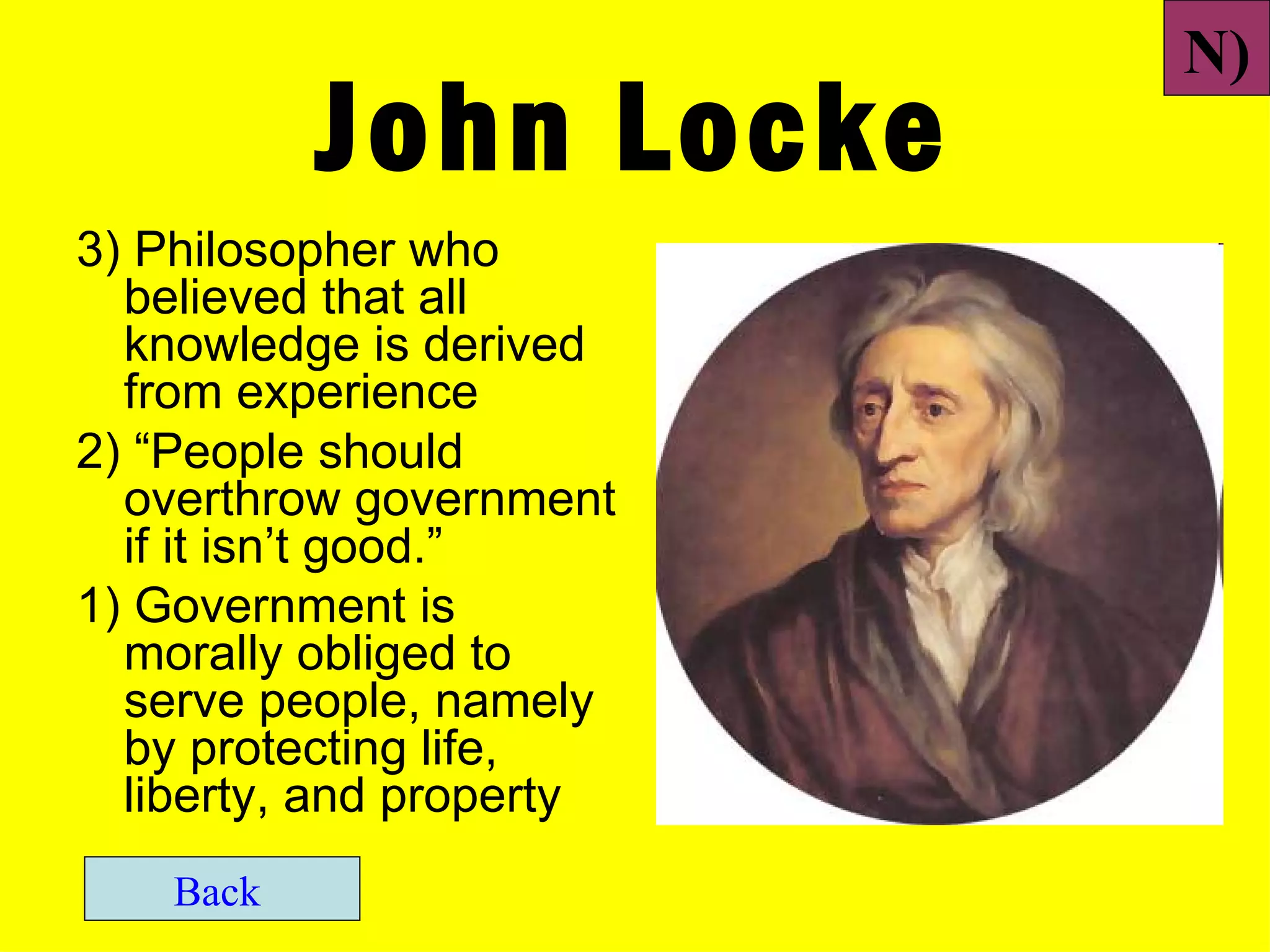
           John Locke
3) Philosopher who
  believed that all
  knowledge is derived
  from experience
2) “People should
  overthrow government
  if it isn’t good.”
1) Government is
  morally obliged to
  serve people, namely
  by protecting life,
  liberty, and property
    Back
O)
      O) Guess The Term?
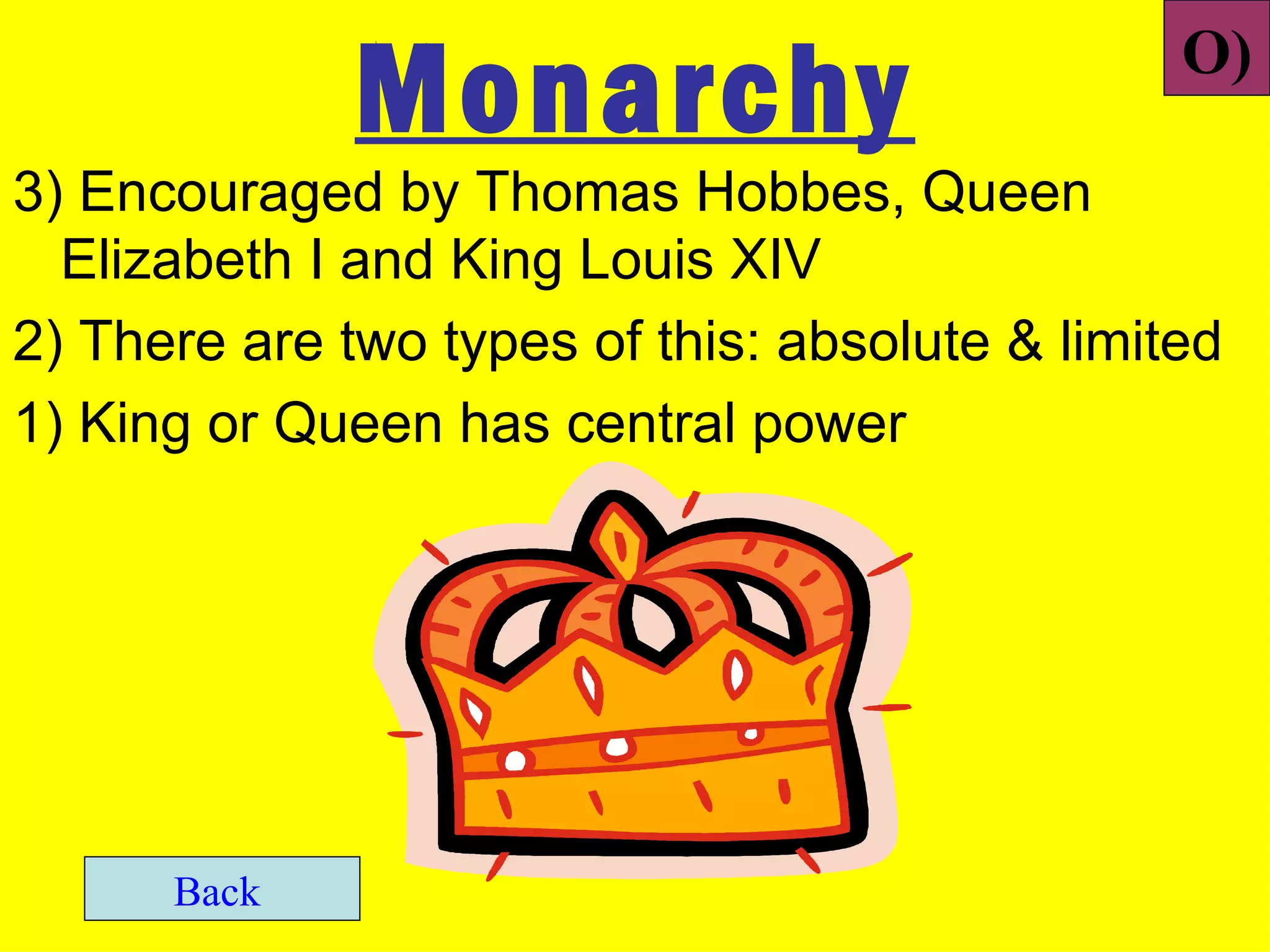
3) Encouraged by Thomas Hobbes, Queen
  Elizabeth I and King Louis XIV
O)
       O) Guess The Term?
3) Encouraged by Thomas Hobbes, Queen
  Elizabeth I and King Louis XIV
2) There are two types of this: absolute & limited
O)
       O) Guess The Term?
3) Encouraged by Thomas Hobbes, Queen
  Elizabeth I and King Louis XIV
2) There are two types of this: absolute & limited
1) King or Queen has central power
Monarchy                          O)

3) Encouraged by Thomas Hobbes, Queen
  Elizabeth I and King Louis XIV
2) There are two types of this: absolute & limited
1) King or Queen has central power


      Back
Guess The Term       P)
3) Ruled in a limited monarchy
Guess The Term                       P)
3) Ruled in a limited monarchy
2) Society should be structured as a hierarchy
Guess The Term                       P)
3) Believed in limited monarchy
2) Society should be structured as a hierarchy
1) She has the queen mother and everyone
  was her “children”
P)
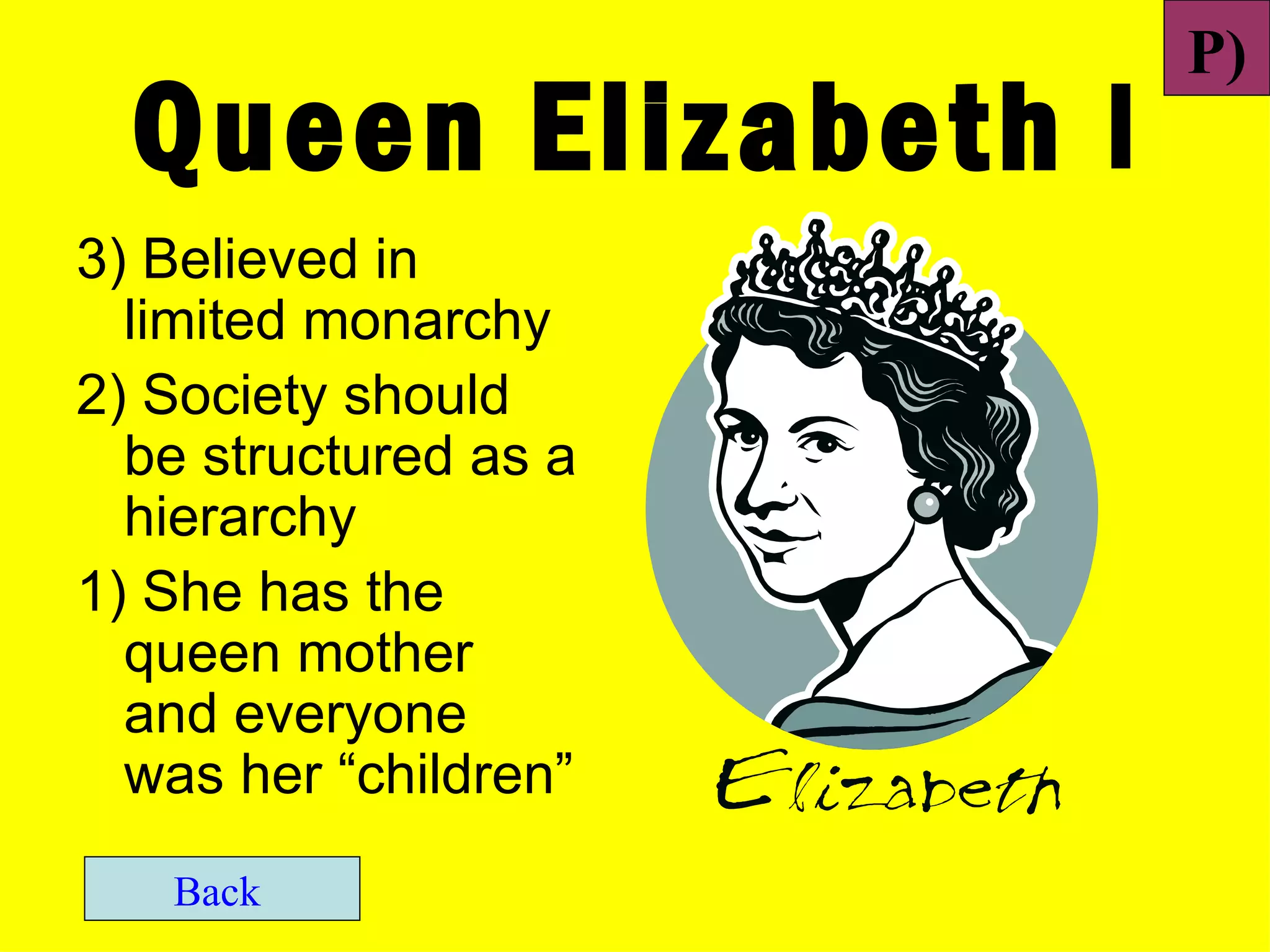
  Queen Elizabeth I
3) Believed in
  limited monarchy
2) Society should
  be structured as a
  hierarchy
1) She has the
  queen mother
  and everyone
  was her “children”
   Back
Guess The Term                         Q)
3) Contains the basic rights of the American people
Q)
            Guess The Term
3) Contains basic rights of the American people
2) Whatever is not listed here, belongs to the people
Guess The Term                        Q)
3) Contains basic rights of the American people
2) Whatever is not listed here, belongs to the people
1) First 10 Amendments to the Constitution
Q)
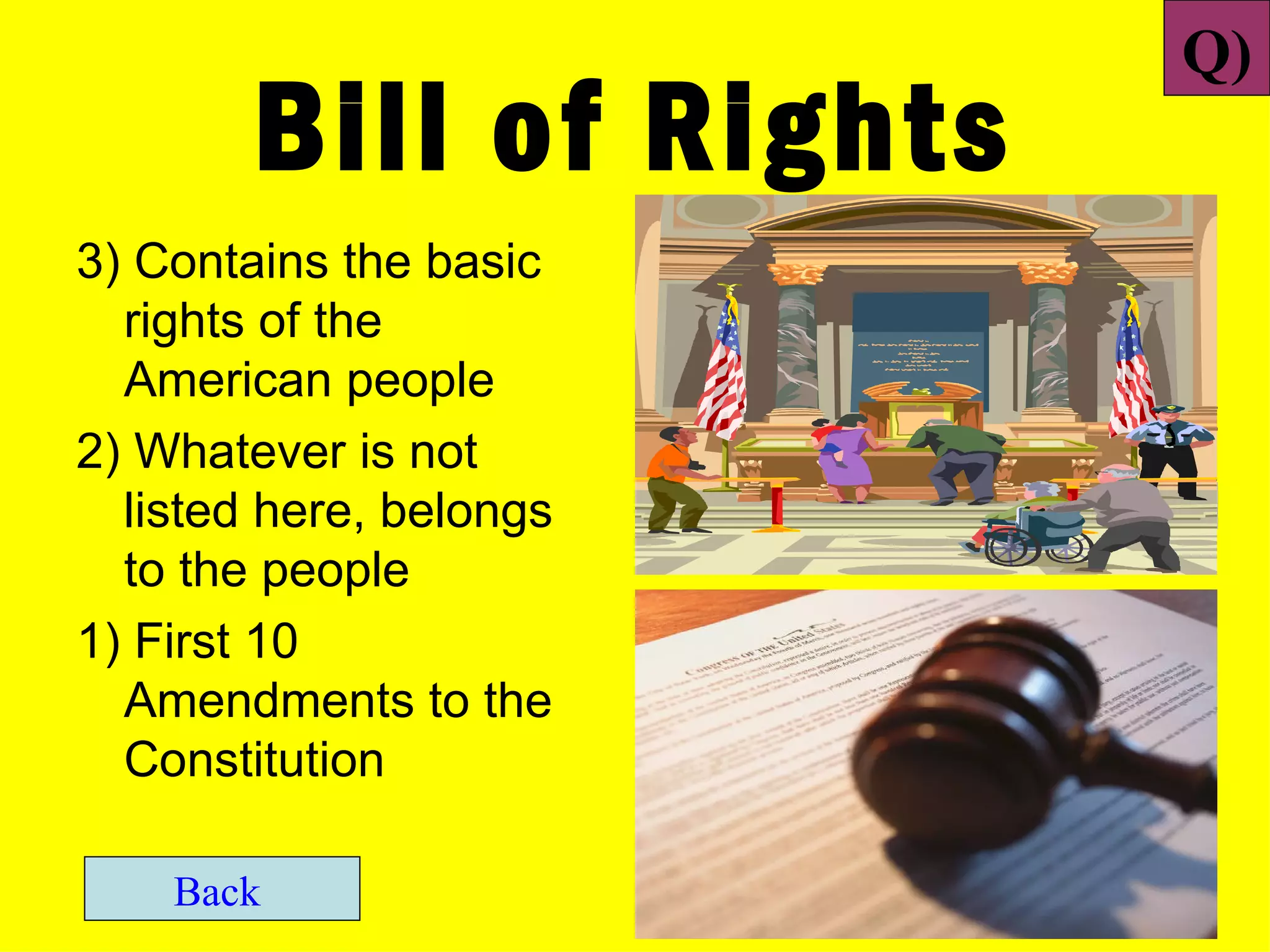
        Bill of Rights
3) Contains the basic
  rights of the
  American people
2) Whatever is not
  listed here, belongs
  to the people
1) First 10
  Amendments to the
  Constitution

    Back
R)
          Guess The Term
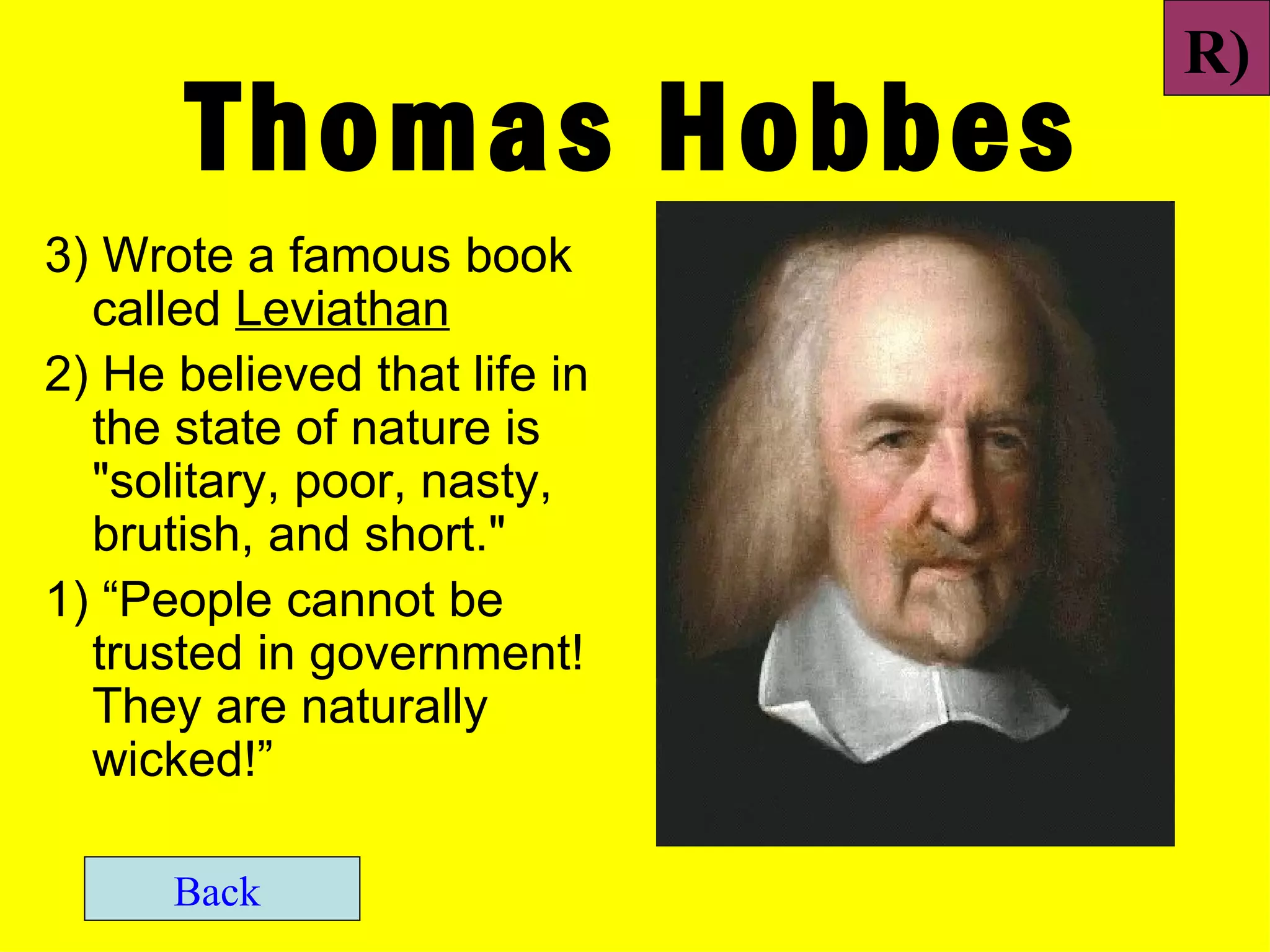
3) Wrote a famous book called Leviathan
R)
           Guess The Term
3) Wrote a famous book called Leviathan
2) He believed that life in the state of nature
  is "solitary, poor, nasty, brutish, and
  short."
R)
           Guess The Term
3) Wrote a famous book called Leviathan
2) He believed that life in the state of nature
  is "solitary, poor, nasty, brutish, and
  short."
1) “People cannot be trusted in government!
  They are naturally wicked!”
R)
       Thomas Hobbes
3) Wrote a famous book
  called Leviathan
2) He believed that life in
  the state of nature is
  "solitary, poor, nasty,
  brutish, and short."
1) “People cannot be
  trusted in government!
  They are naturally
  wicked!”

      Back
Guess The Term?                  S)
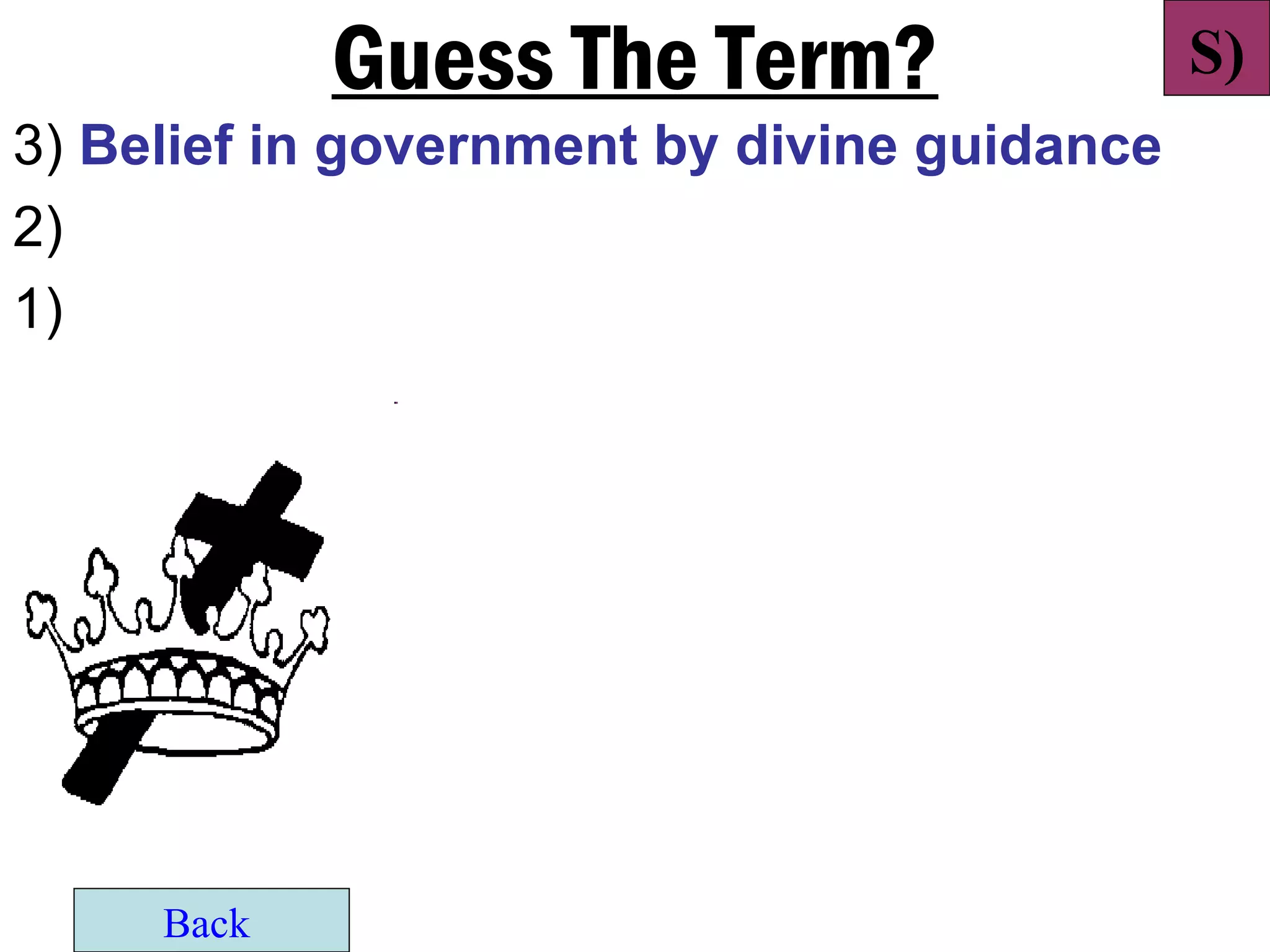
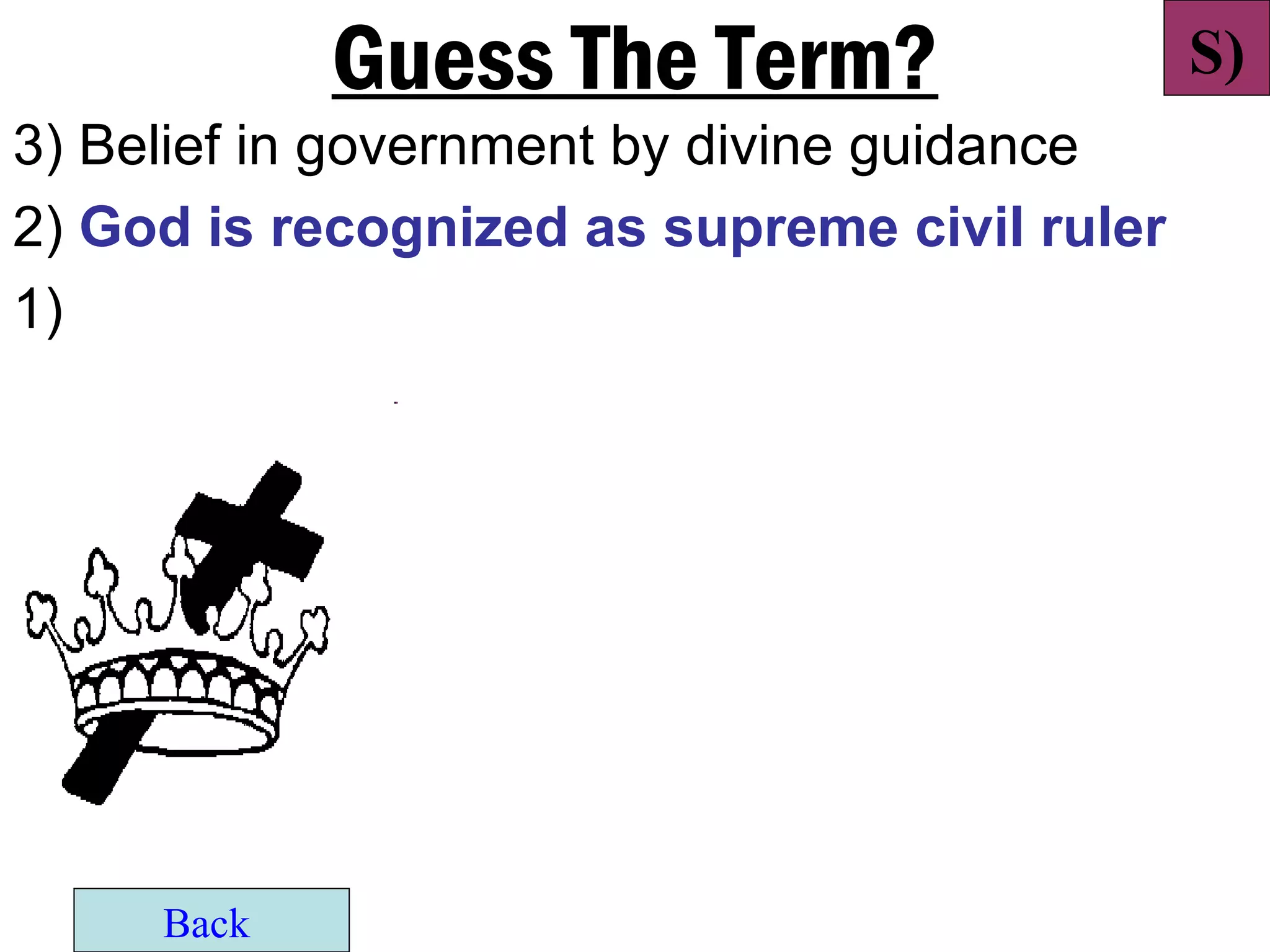
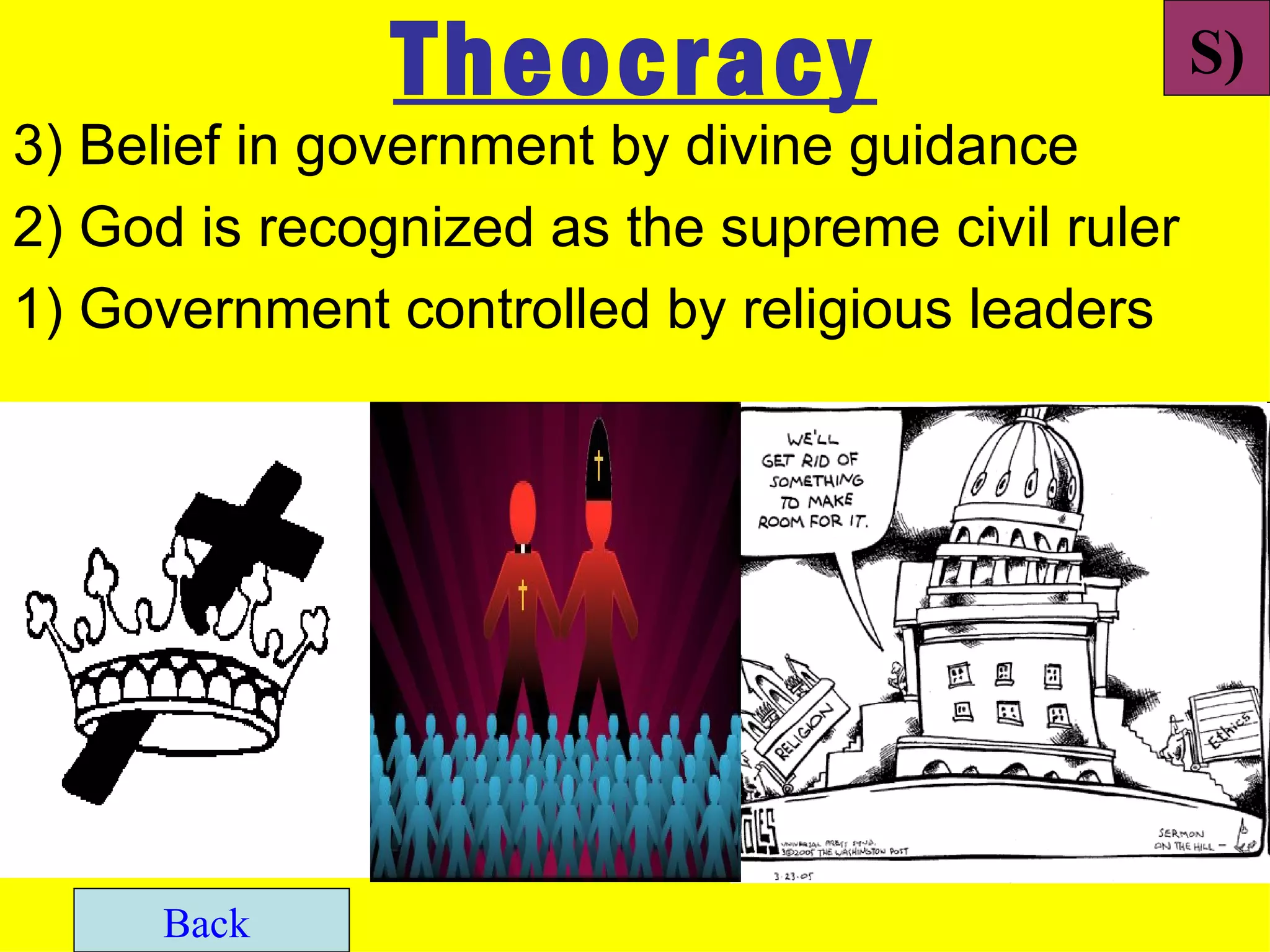
3) Belief in government by divine guidance
2)
1)


     Back
Guess The Term?                   S)
3) Belief in government by divine guidance
2) God is recognized as supreme civil ruler
1)


     Back
Guess The Term?                 S)
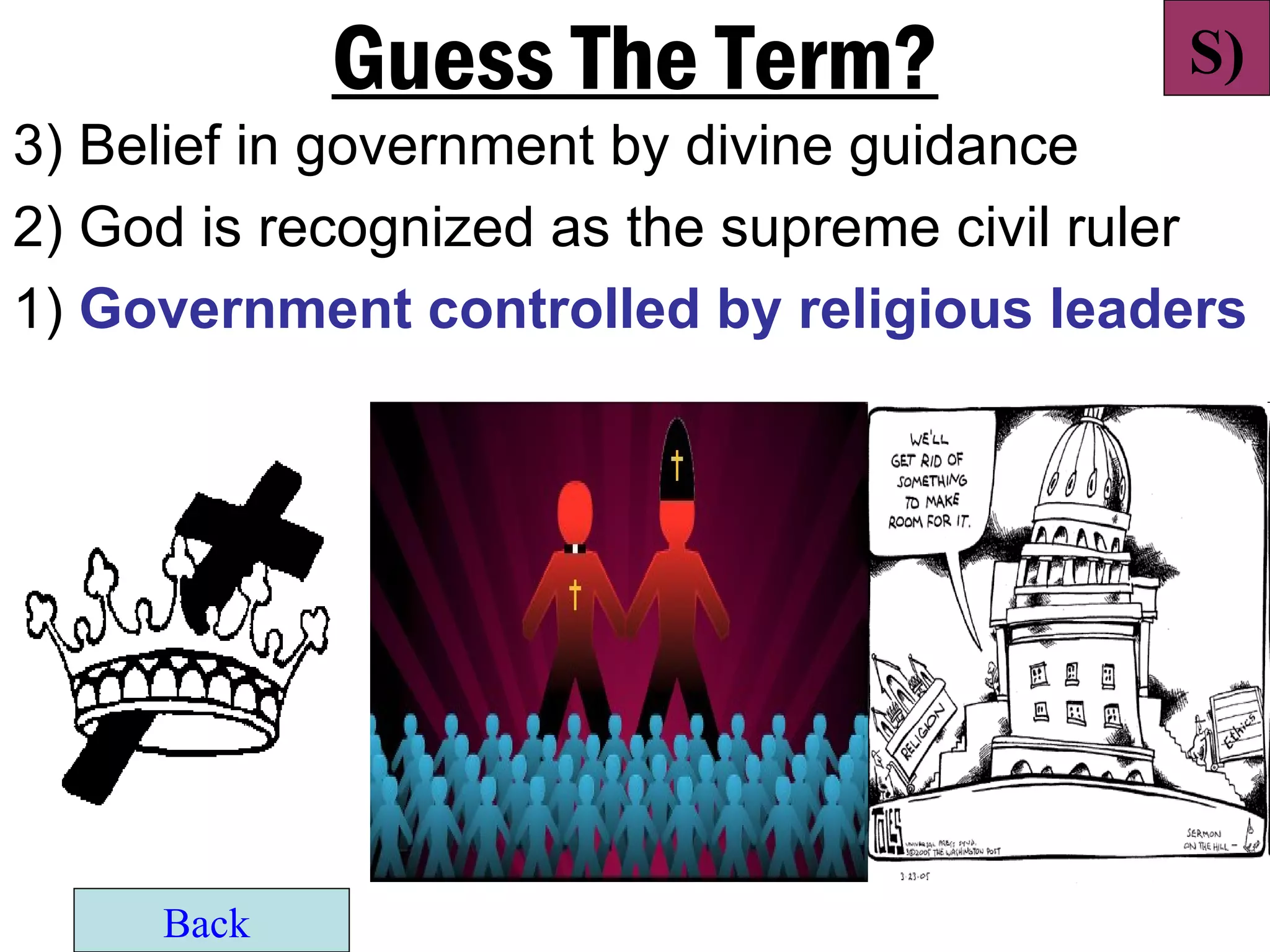
3) Belief in government by divine guidance
2) God is recognized as the supreme civil ruler
1) Government controlled by religious leaders


     Back
Theocracy                          S)
3) Belief in government by divine guidance
2) God is recognized as the supreme civil ruler
1) Government controlled by religious leaders


      Back
Guess The Term?        T)
3) Type of autocratic government
2)
1)


     Back
Guess The Term?        T)
3) Type of autocratic government
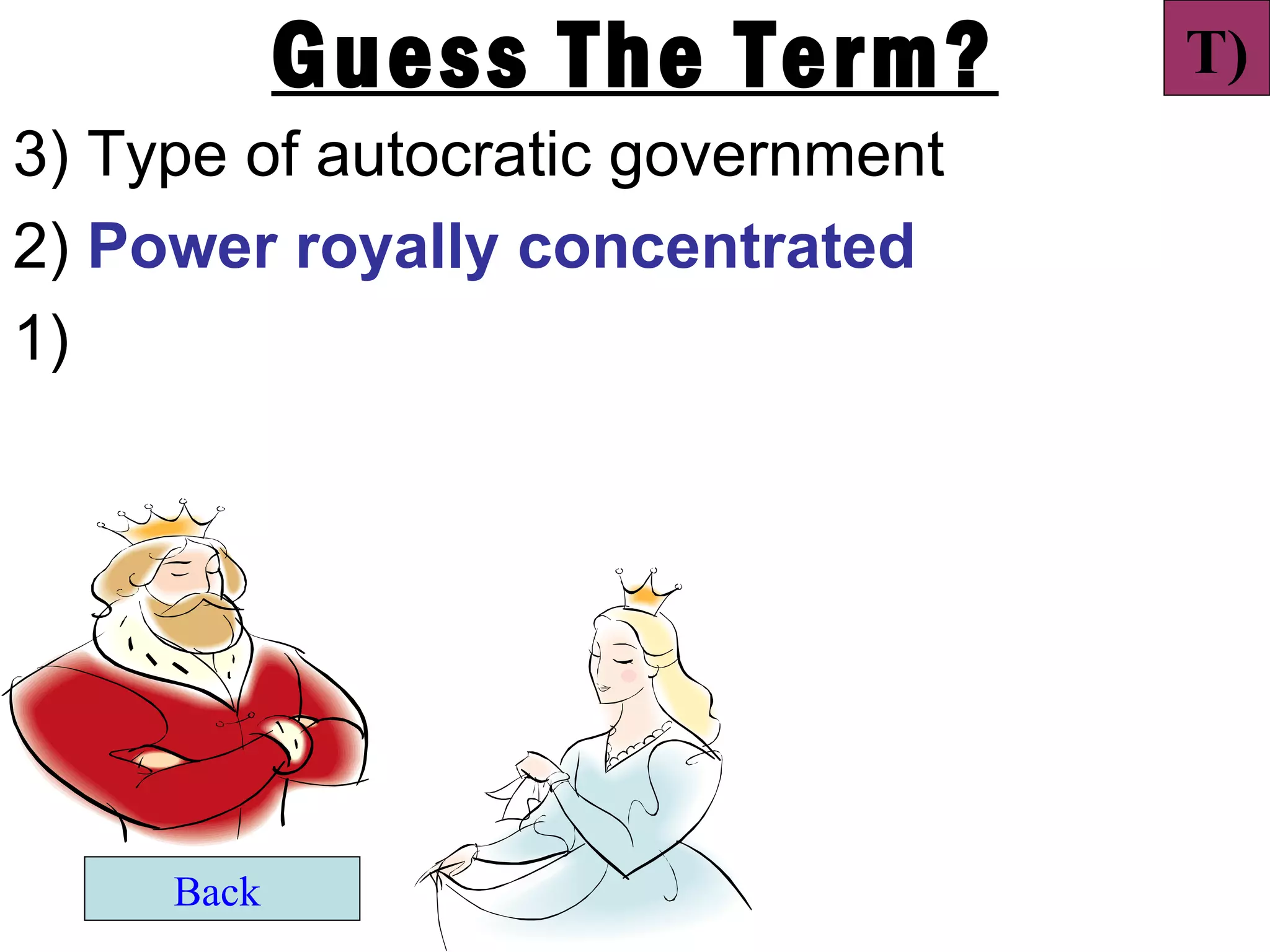
2) Power royally concentrated
1)


     Back
Guess The Term?                T)
3) Type of autocratic government
2) Power royally concentrated
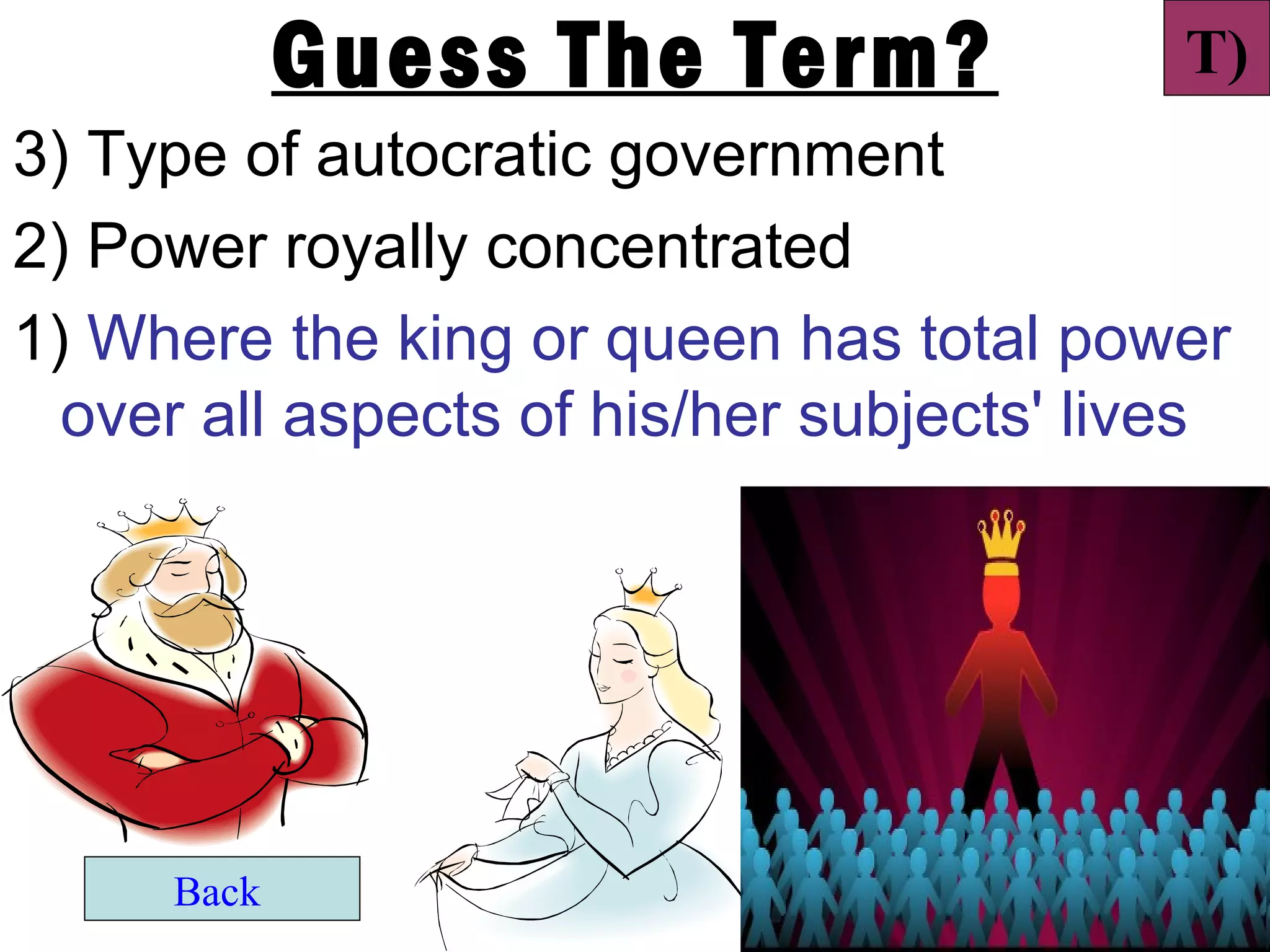
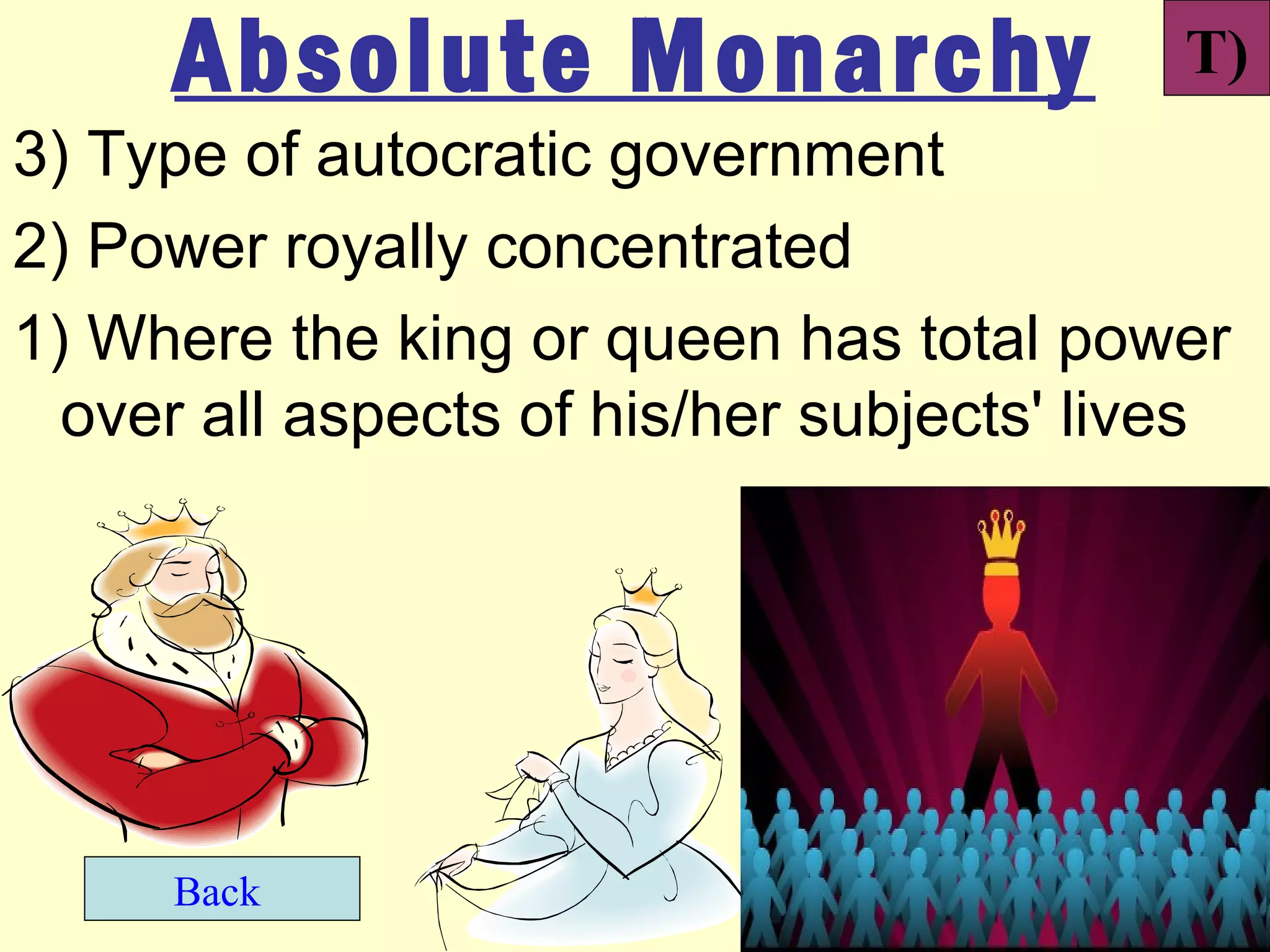
1) Where the king or queen has total power
  over all aspects of his/her subjects' lives


     Back
Absolute Monarchy                     T)
3) Type of autocratic government
2) Power royally concentrated
1) Where the king or queen has total power
  over all aspects of his/her subjects' lives


     Back
Guess The Term        U)
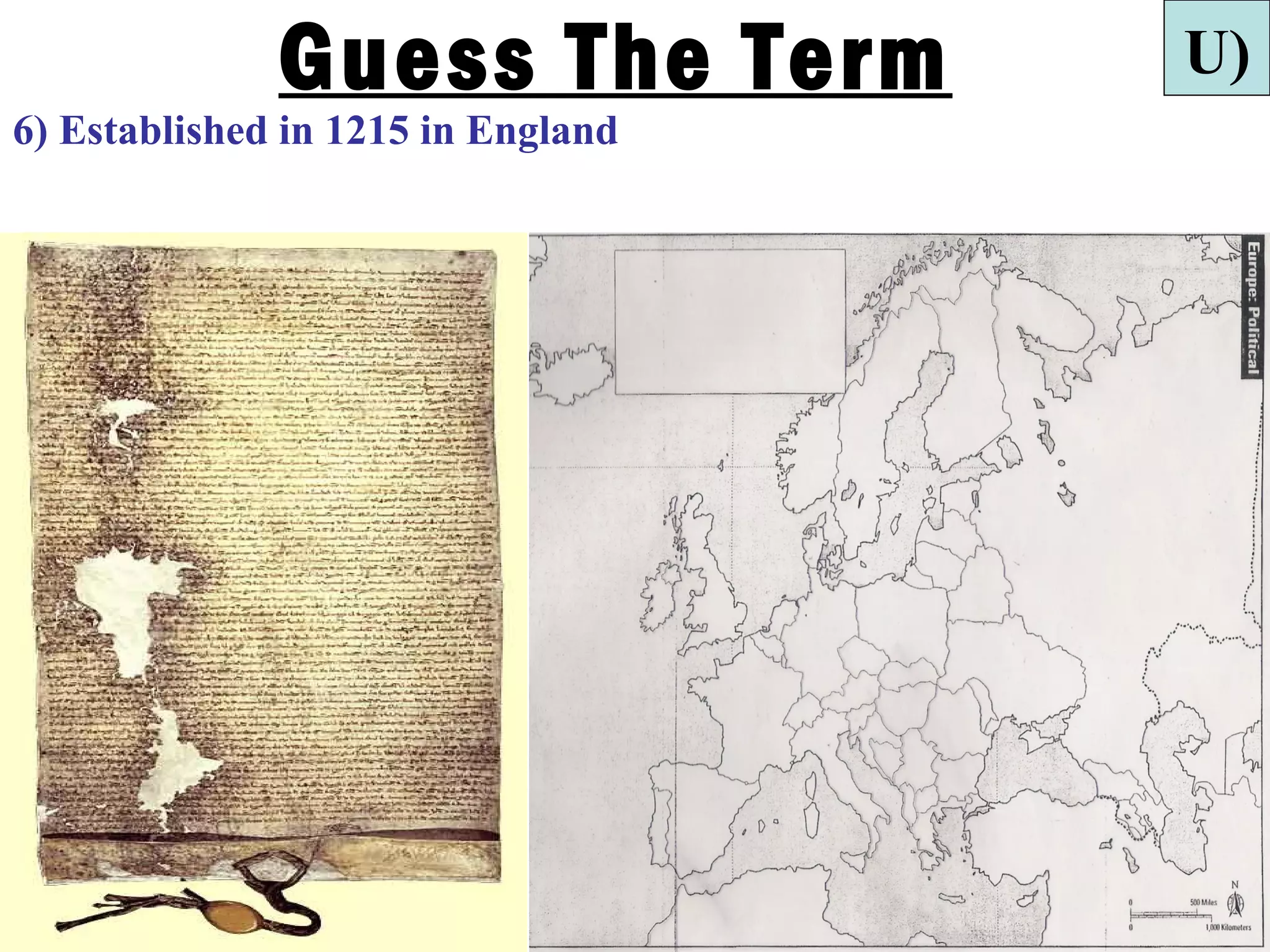
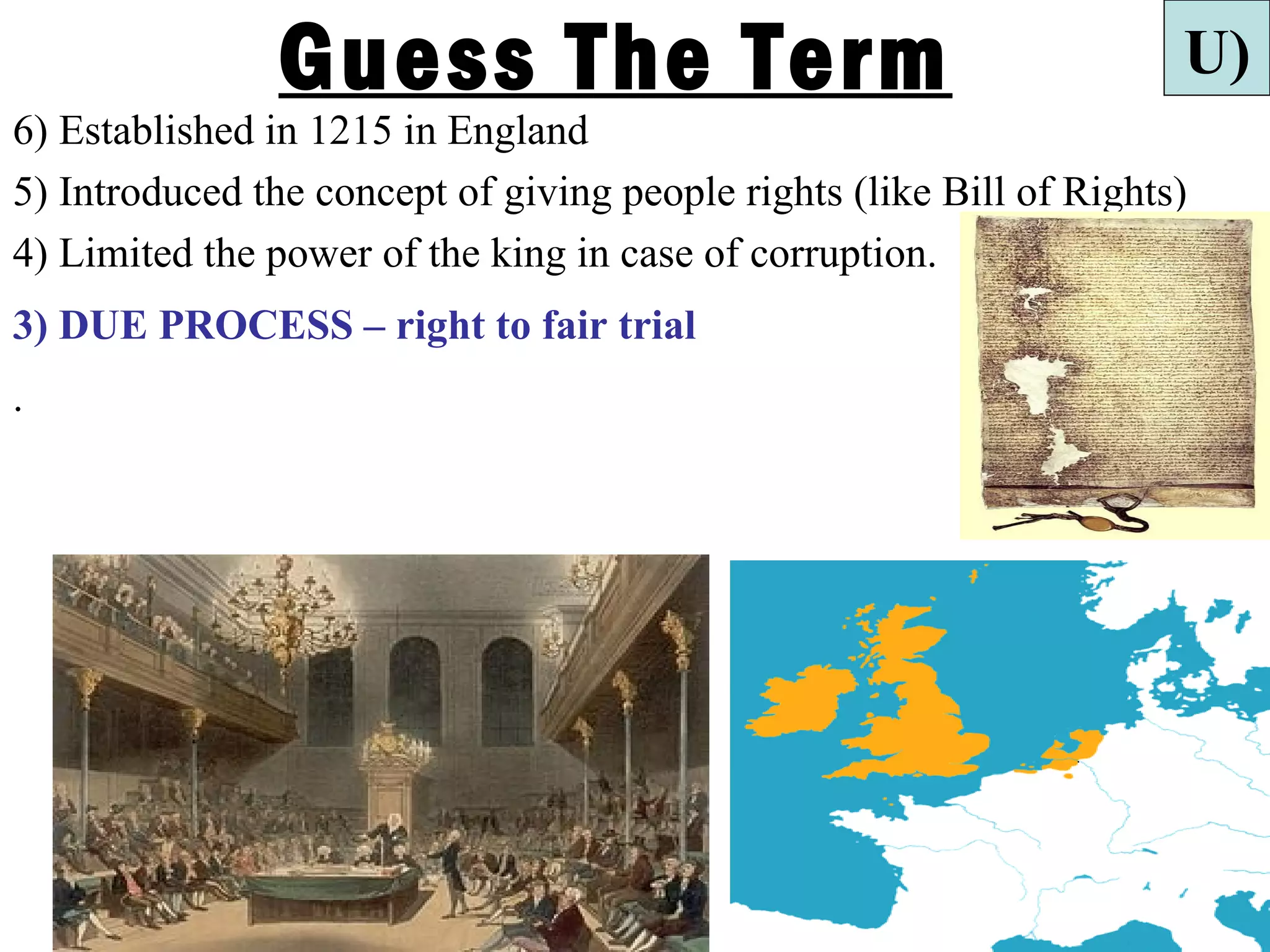
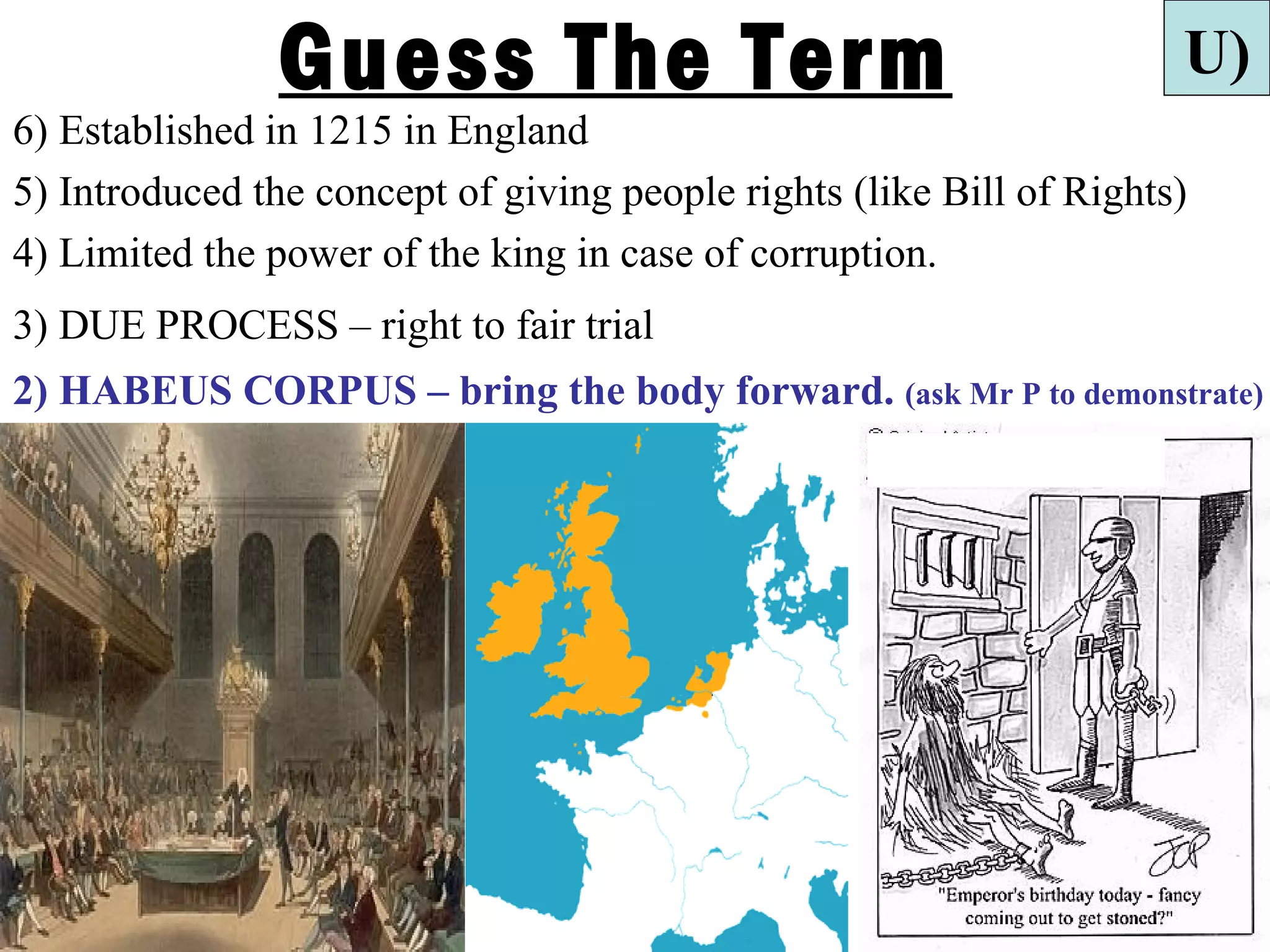
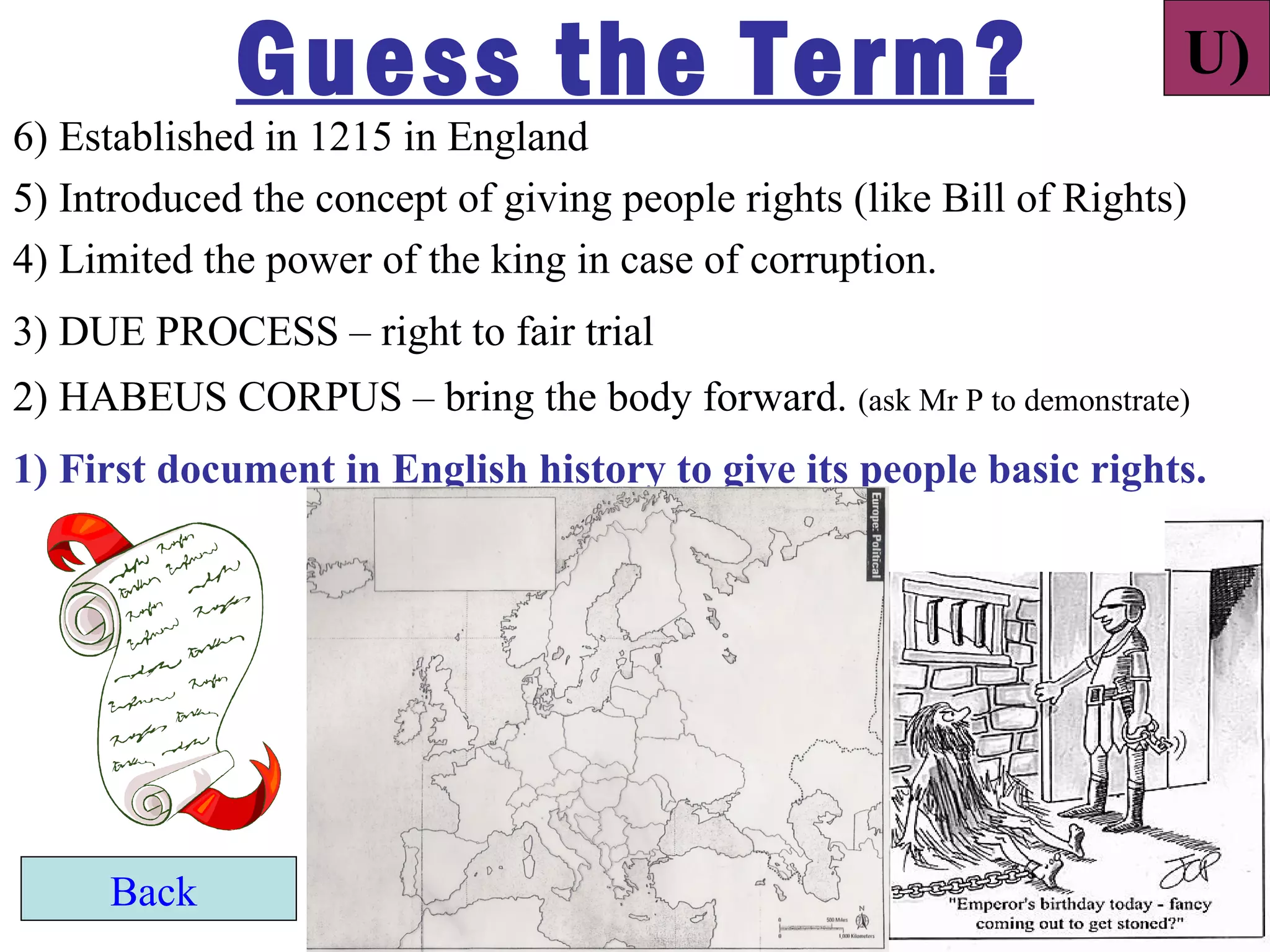
6) Established in 1215 in England
Guess The Term                                      U)
6) Established in 1215 in England
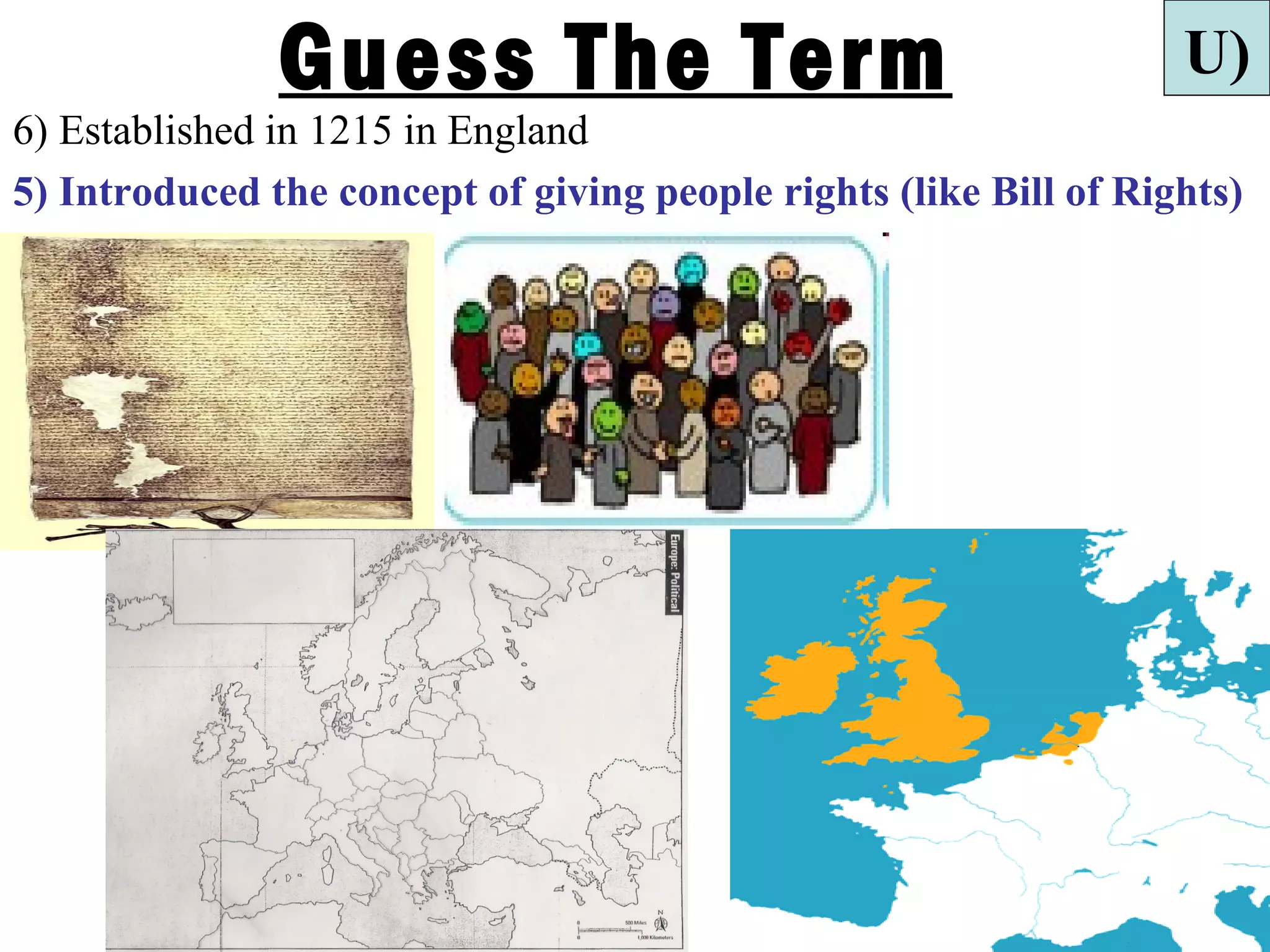
5) Introduced the concept of giving people rights (like Bill of Rights)
.
Guess The Term                                      U)
6) Established in 1215 in England
5) Introduced the concept of giving people rights (like Bill of Rights)
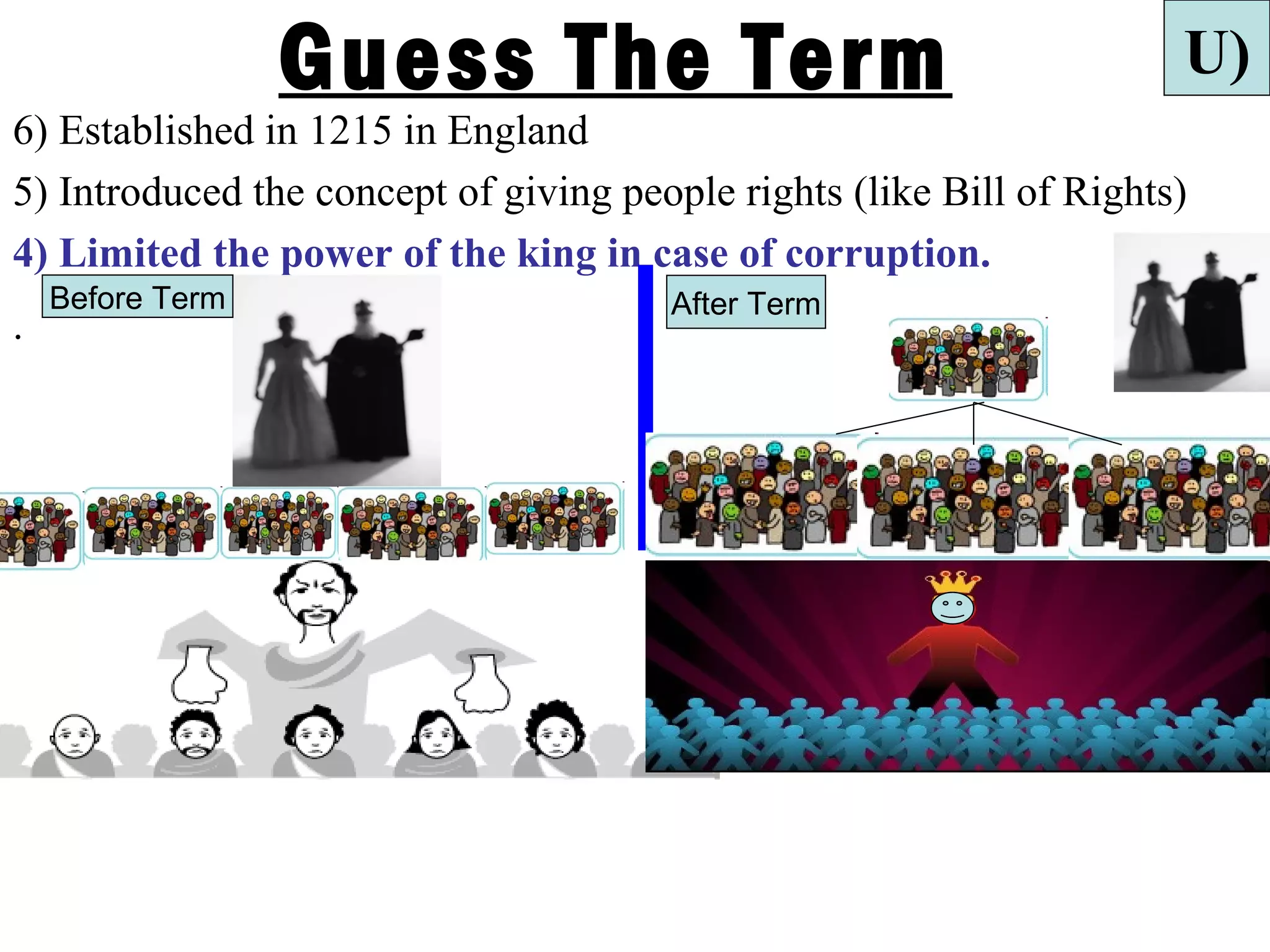
4) Limited the power of the king in case of corruption.
    Before Term                        After Term
.
Guess The Term                                        U)
6) Established in 1215 in England
5) Introduced the concept of giving people rights (like Bill of Rights)
4) Limited the power of the king in case of corruption.
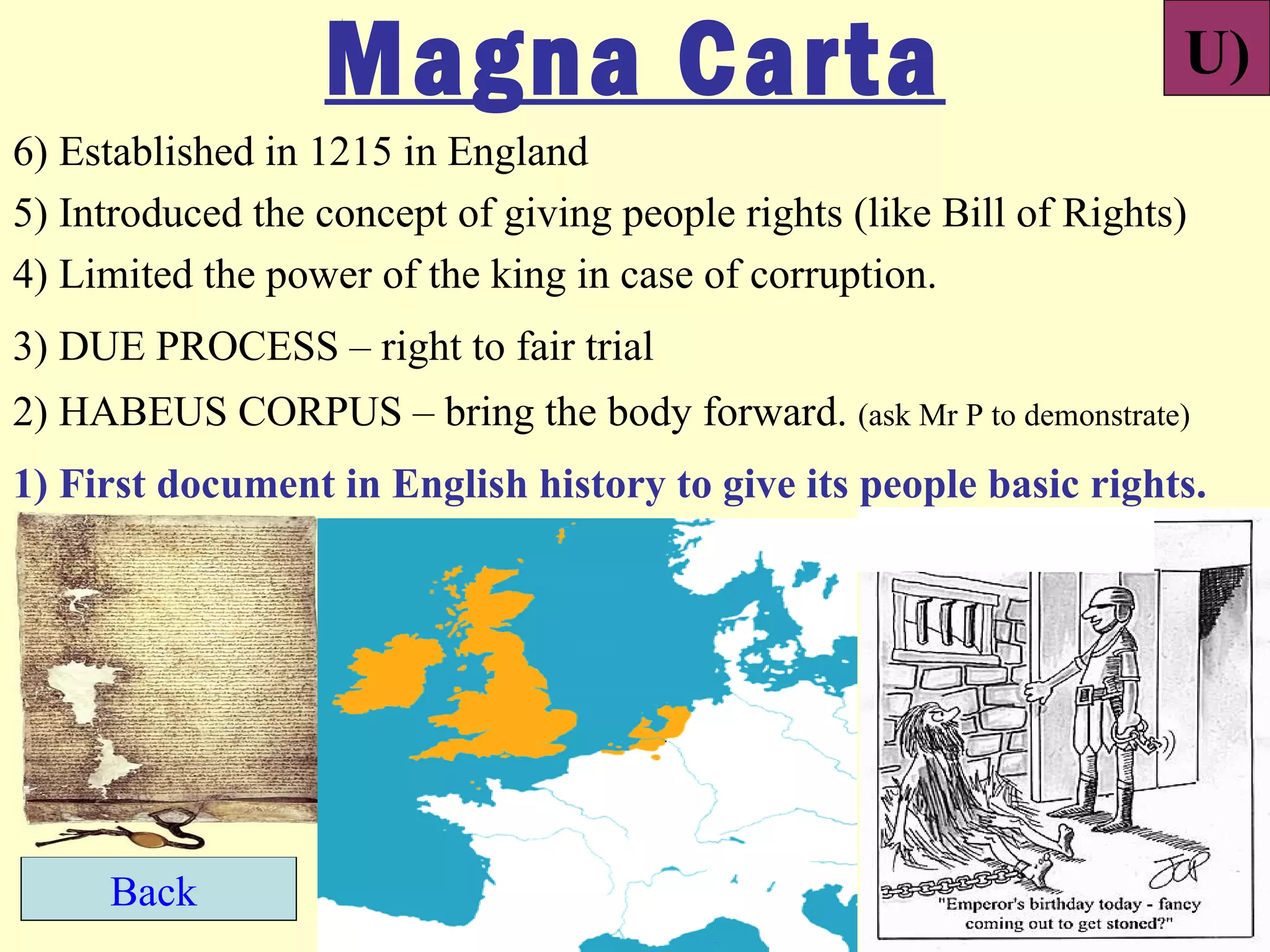
3) DUE PROCESS – right to fair trial
.
Guess The Term                                        U)
6) Established in 1215 in England
5) Introduced the concept of giving people rights (like Bill of Rights)
4) Limited the power of the king in case of corruption.
3) DUE PROCESS – right to fair trial
2) HABEUS CORPUS – bring the body forward. (ask Mr P to demonstrate)
Guess the Term?                                          U)
6) Established in 1215 in England
5) Introduced the concept of giving people rights (like Bill of Rights)
4) Limited the power of the king in case of corruption.
3) DUE PROCESS – right to fair trial
2) HABEUS CORPUS – bring the body forward. (ask Mr P to demonstrate)
1) First document in English history to give its people basic rights.


     Back
Magna Carta                                         U)
6) Established in 1215 in England
5) Introduced the concept of giving people rights (like Bill of Rights)
4) Limited the power of the king in case of corruption.
3) DUE PROCESS – right to fair trial
2) HABEUS CORPUS – bring the body forward. (ask Mr P to demonstrate)
1) First document in English history to give its people basic rights.


     Back
V) Guess the Term?      V)
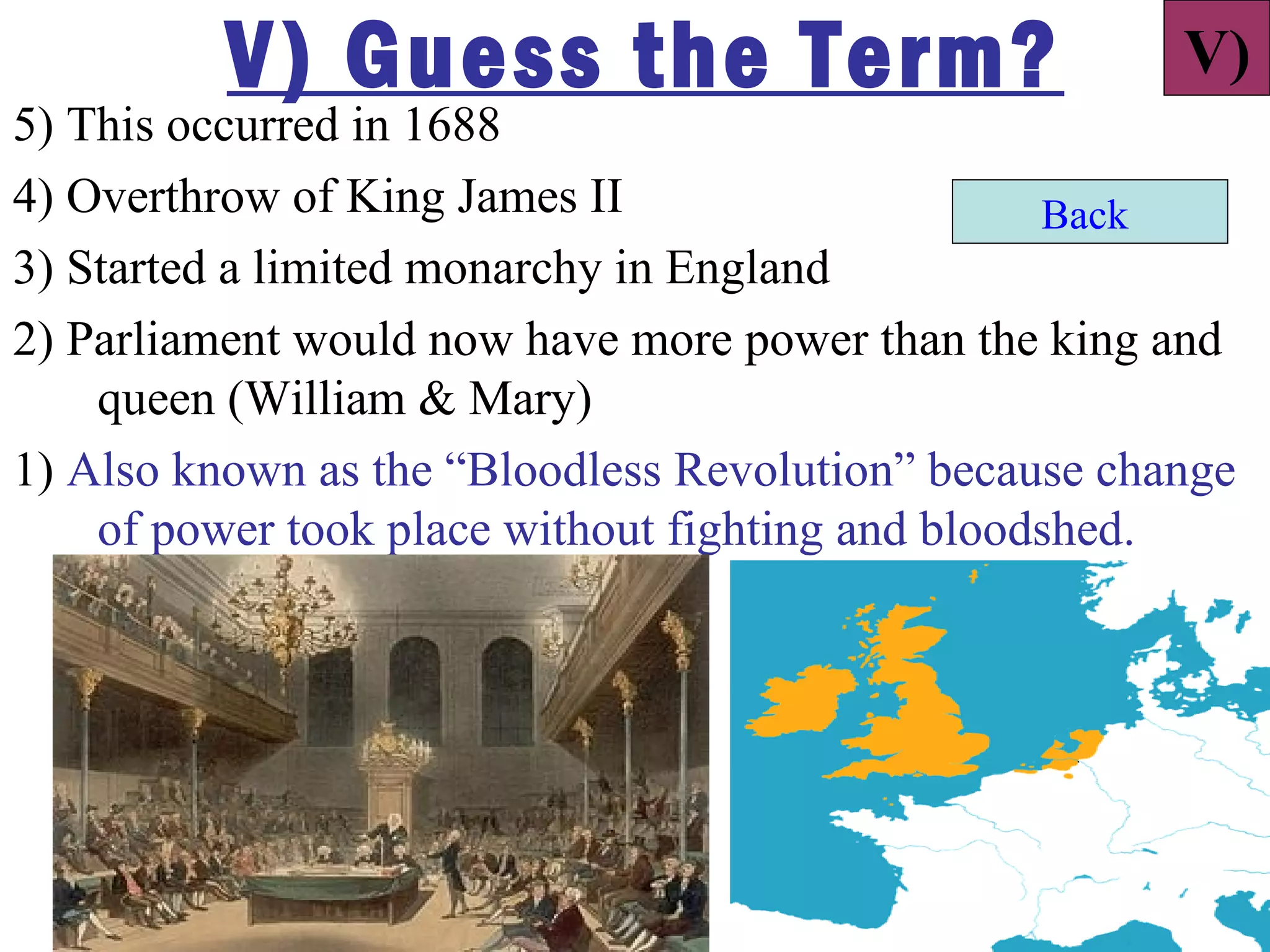
5) This occurred in 1688
4)                         Back
3)
2)

1)
V) Guess the Term?
5) This occurred in 1688
                                       V)

4) Overthrow of King James II   Back
3)
2)

1)
V) Guess the Term?                       V)
5) This occurred in 1688
4) Overthrow of King James II              Back
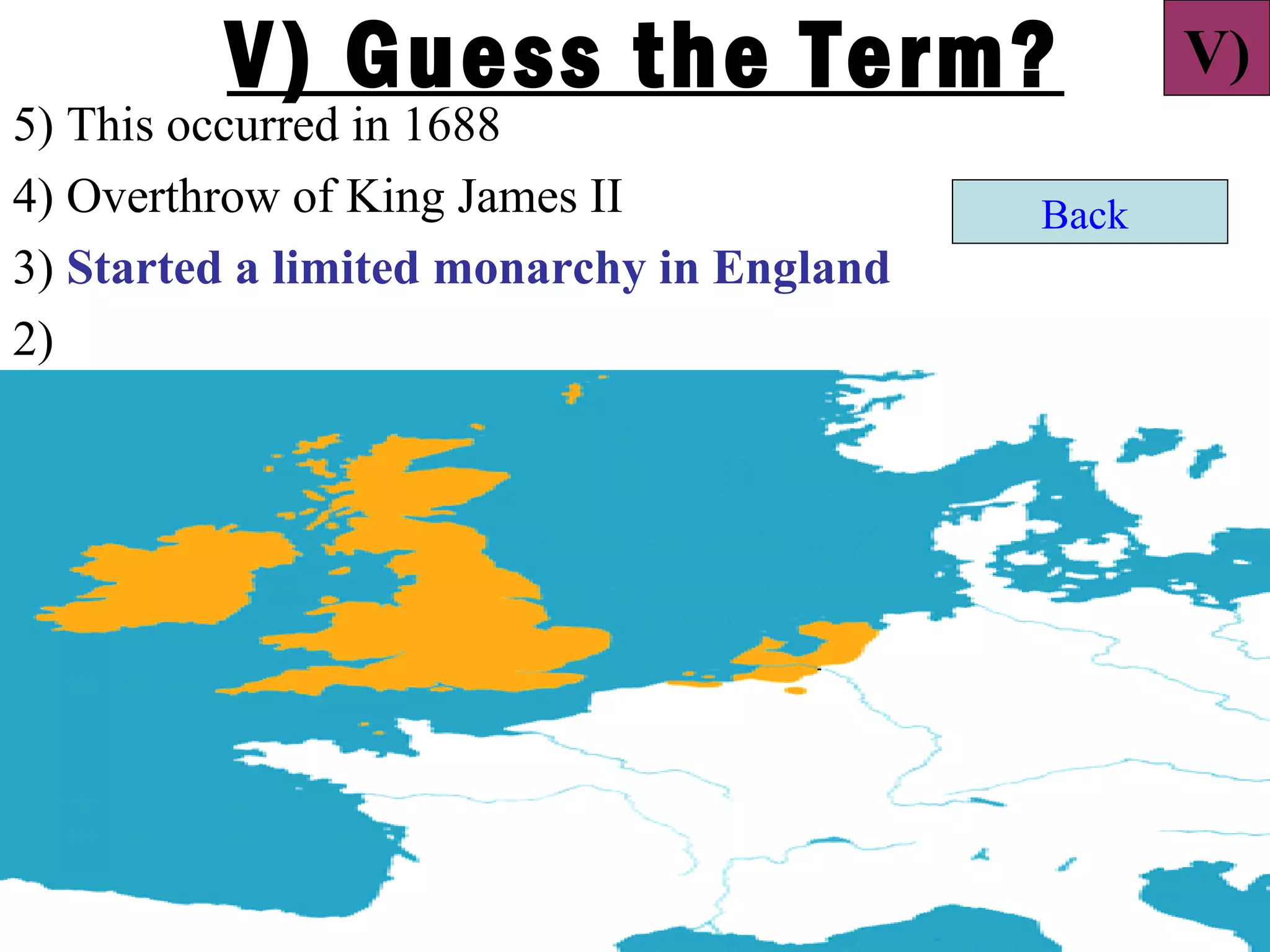
3) Started a limited monarchy in England
2)

1)
V) Guess the Term?                           V)
5) This occurred in 1688
4) Overthrow of King James II                  Back
3) Started a limited monarchy in England
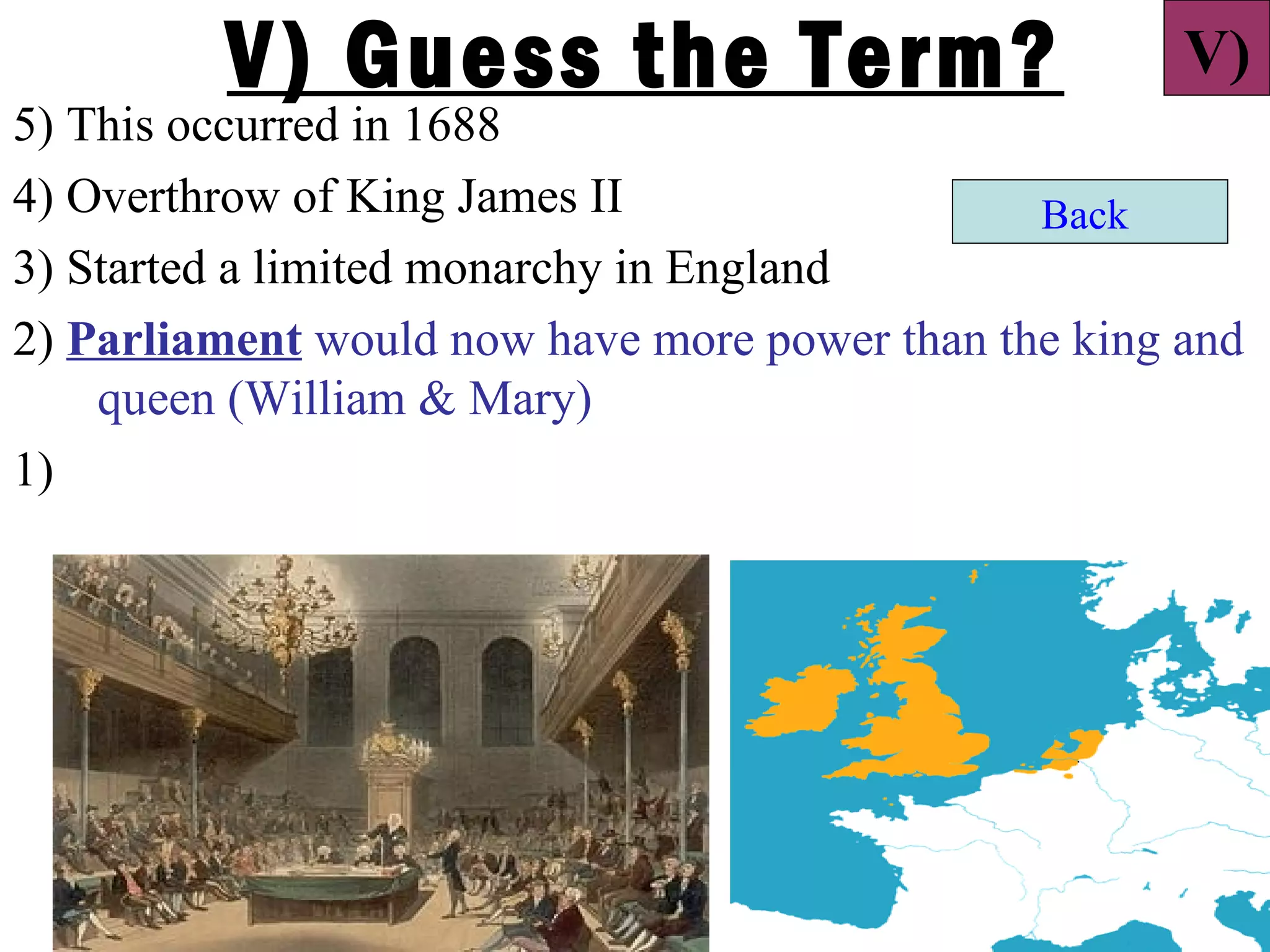
2) Parliament would now have more power than the king and
    queen (William & Mary)
1)
V) Guess the Term?                           V)
5) This occurred in 1688
4) Overthrow of King James II                     Back
3) Started a limited monarchy in England
2) Parliament would now have more power than the king and
    queen (William & Mary)
1) Also known as the “Bloodless Revolution” because change
    of power took place without fighting and bloodshed.
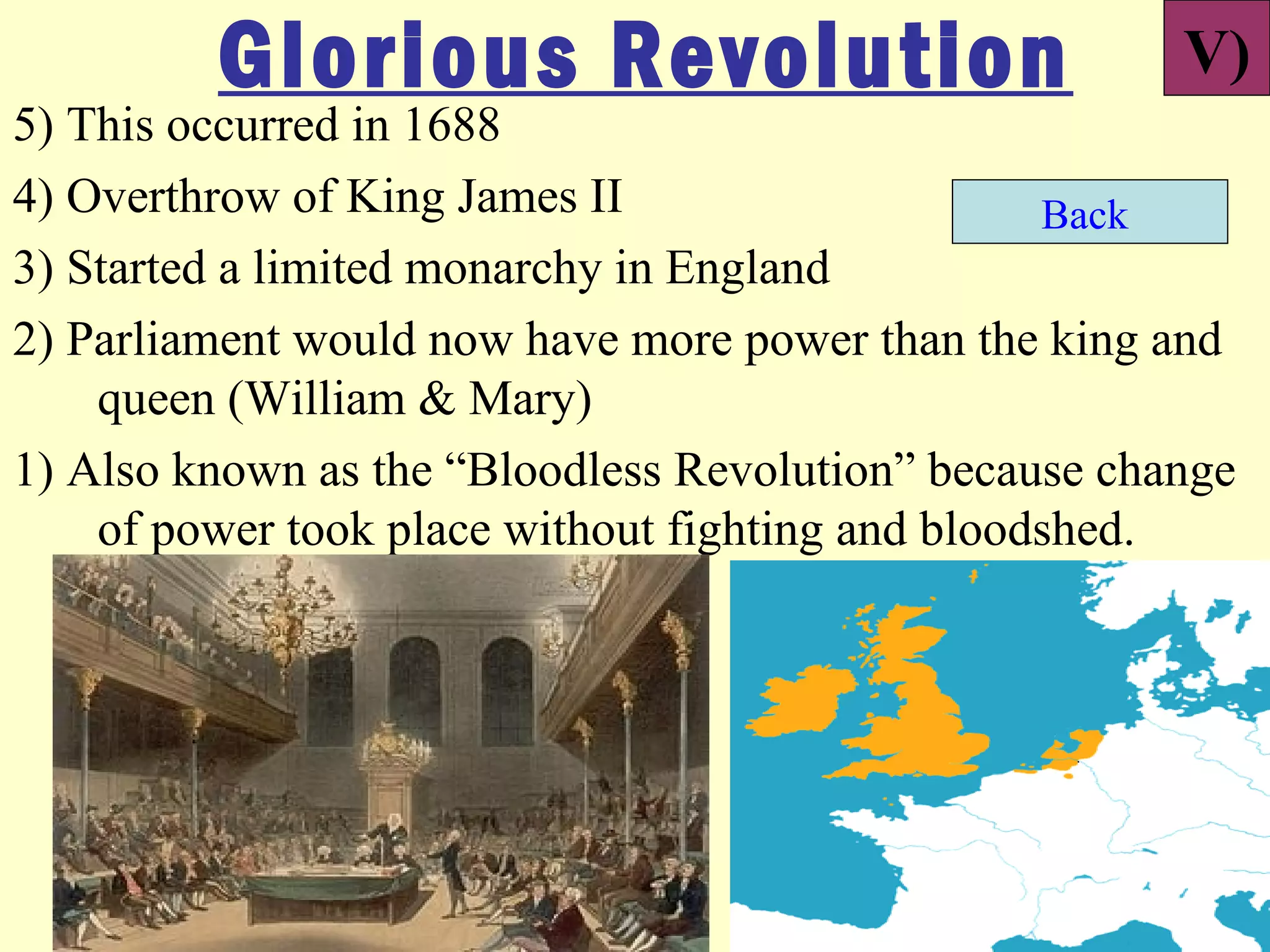
Glorious Revolution                           V)
5) This occurred in 1688
4) Overthrow of King James II                     Back
3) Started a limited monarchy in England
2) Parliament would now have more power than the king and
    queen (William & Mary)
1) Also known as the “Bloodless Revolution” because change
    of power took place without fighting and bloodshed.
W) Guess the Term?         W)
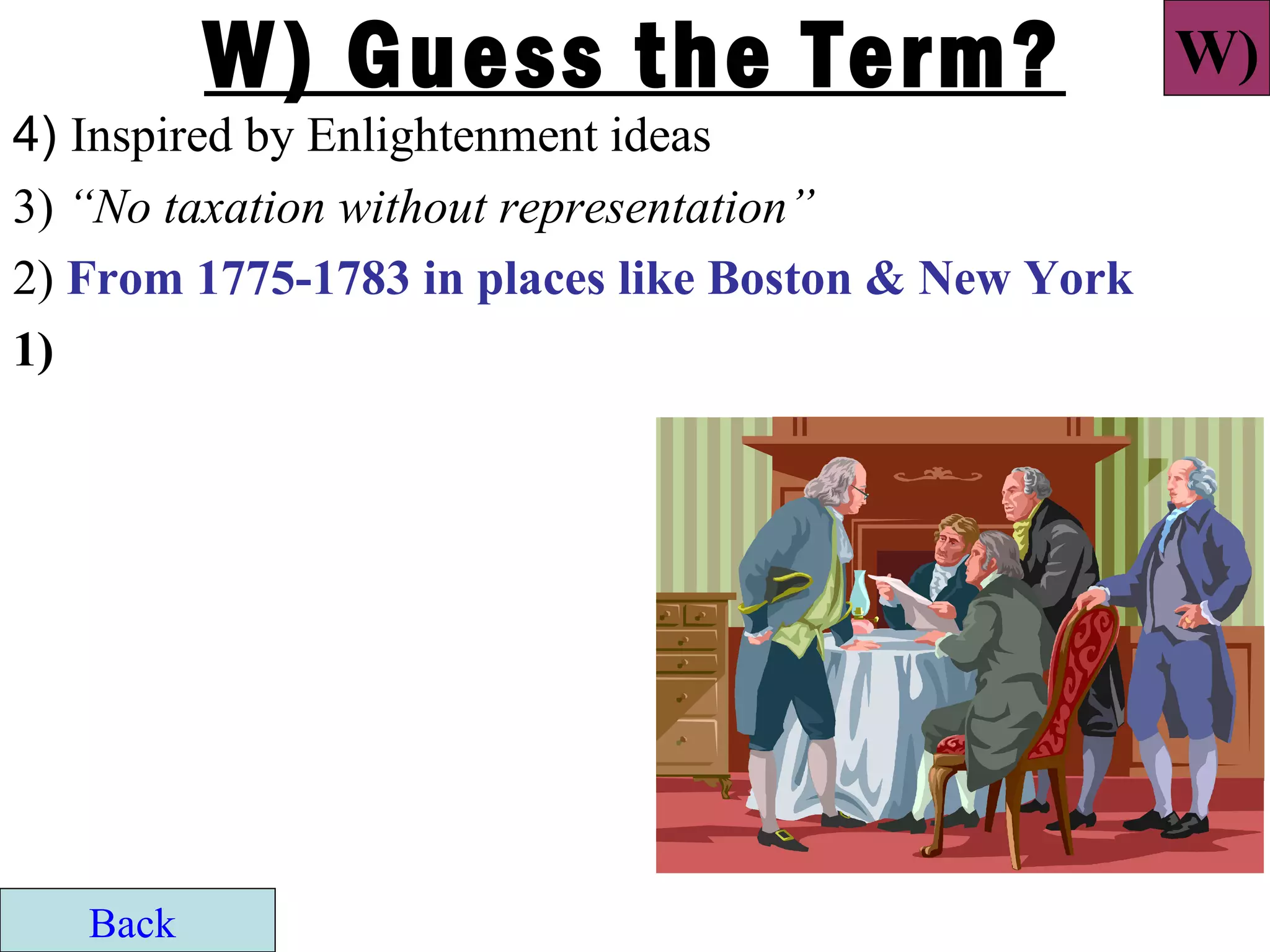
4) Inspired by Enlightenment ideas
3)
2)
1)


   Back
W) Guess the Term?              W)
4) Inspired by Enlightenment ideas
3) “No taxation without representation”
2)
1)


   Back
W) Guess the Term?                         W)
4) Inspired by Enlightenment ideas
3) “No taxation without representation”
2) From 1775-1783 in places like Boston & New York
1)


   Back
W) Guess the Term?                          W)
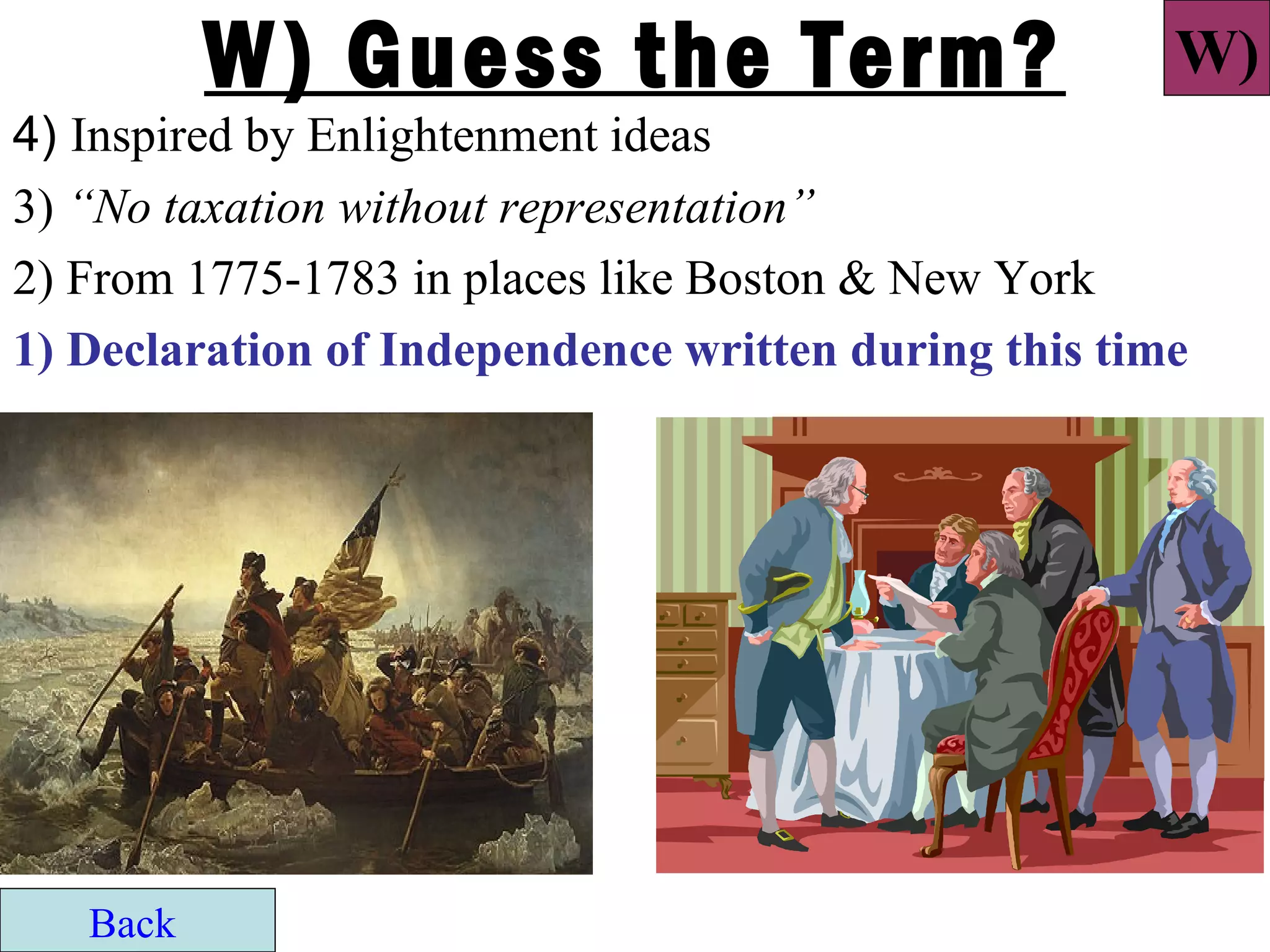
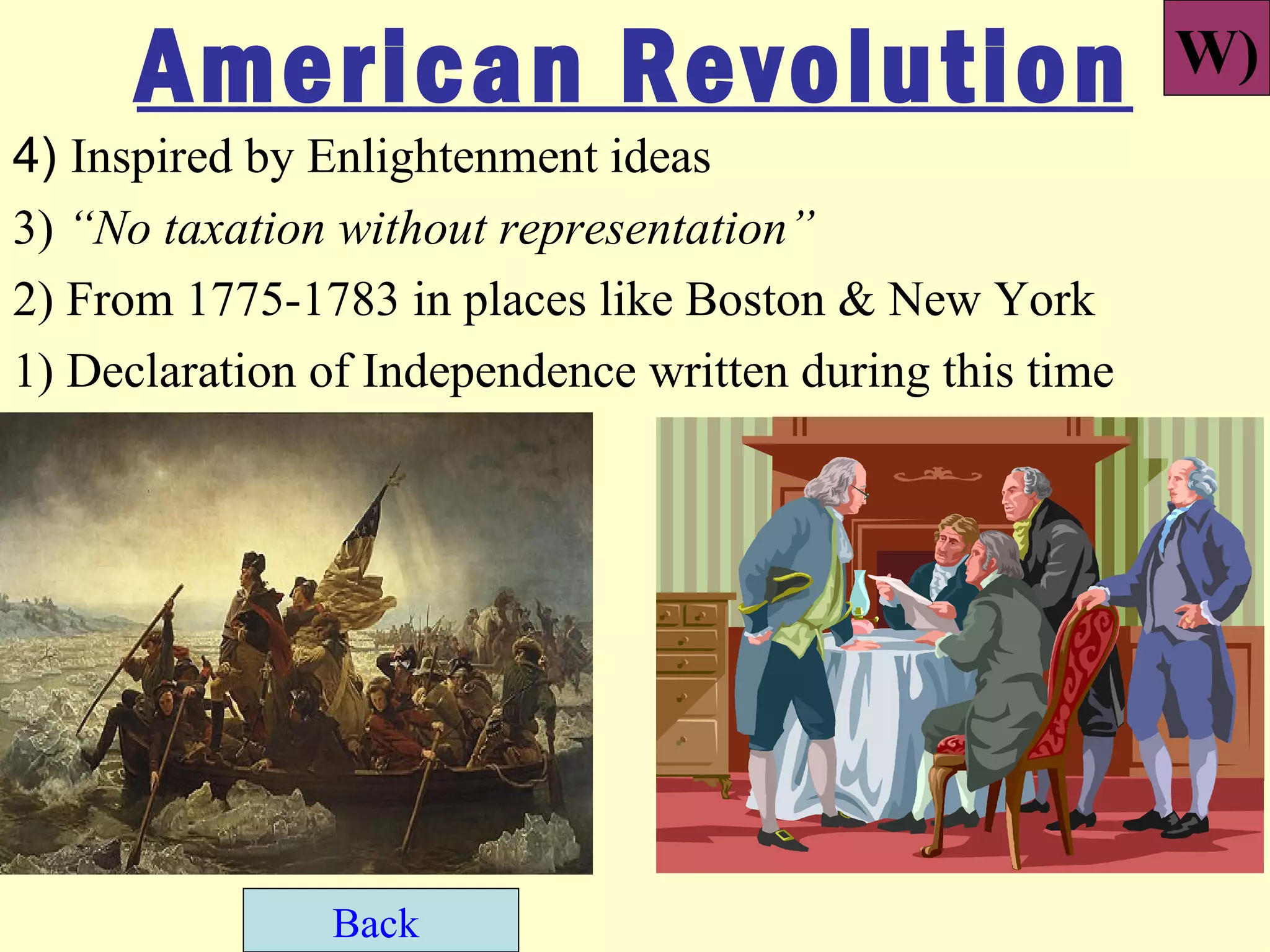
4) Inspired by Enlightenment ideas
3) “No taxation without representation”
2) From 1775-1783 in places like Boston & New York
1) Declaration of Independence written during this time


   Back
American Revolution                                 W)
4) Inspired by Enlightenment ideas
3) “No taxation without representation”
2) From 1775-1783 in places like Boston & New York
1) Declaration of Independence written during this time


               Back
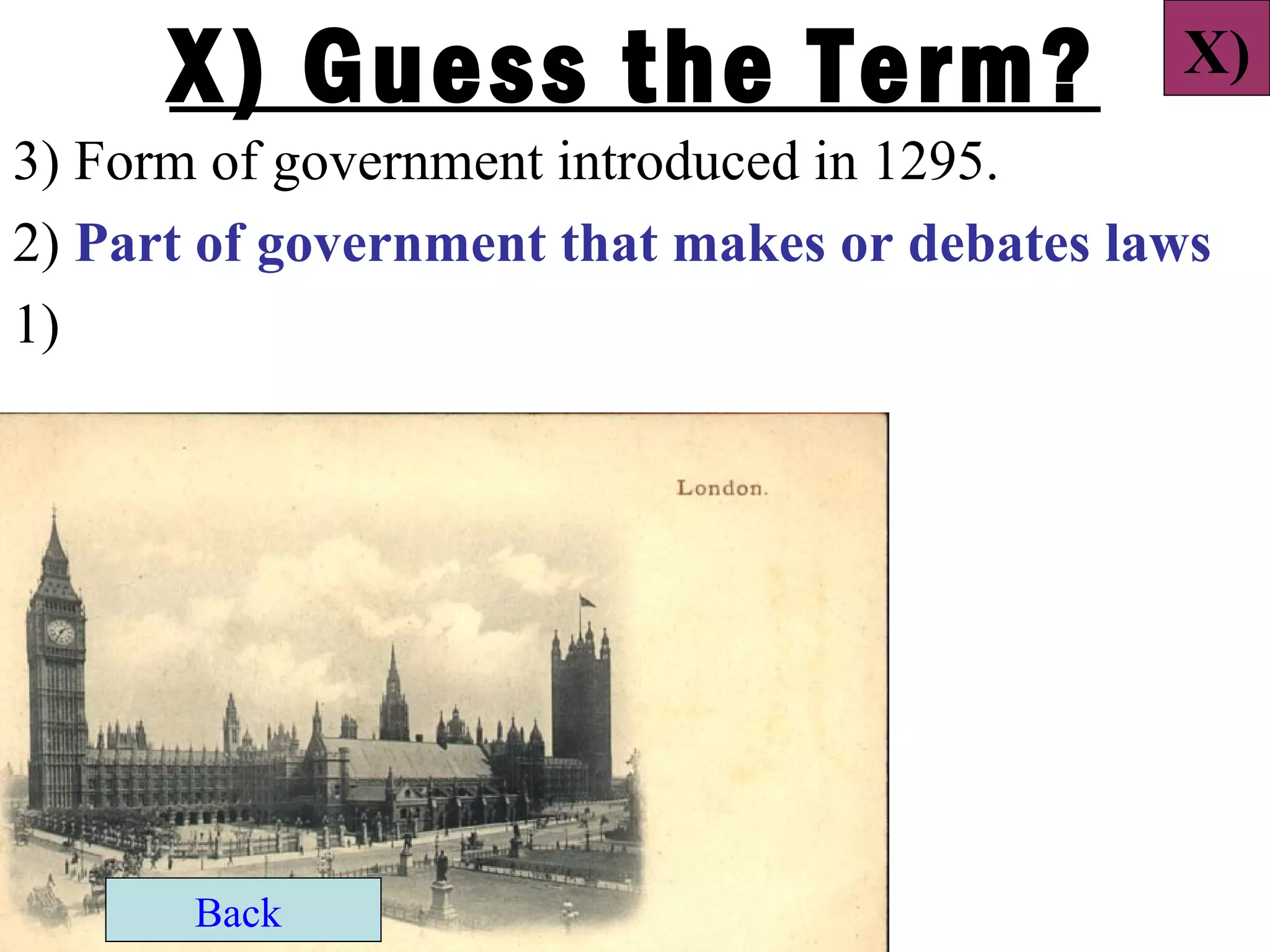
X) Guess the Term?                    X)
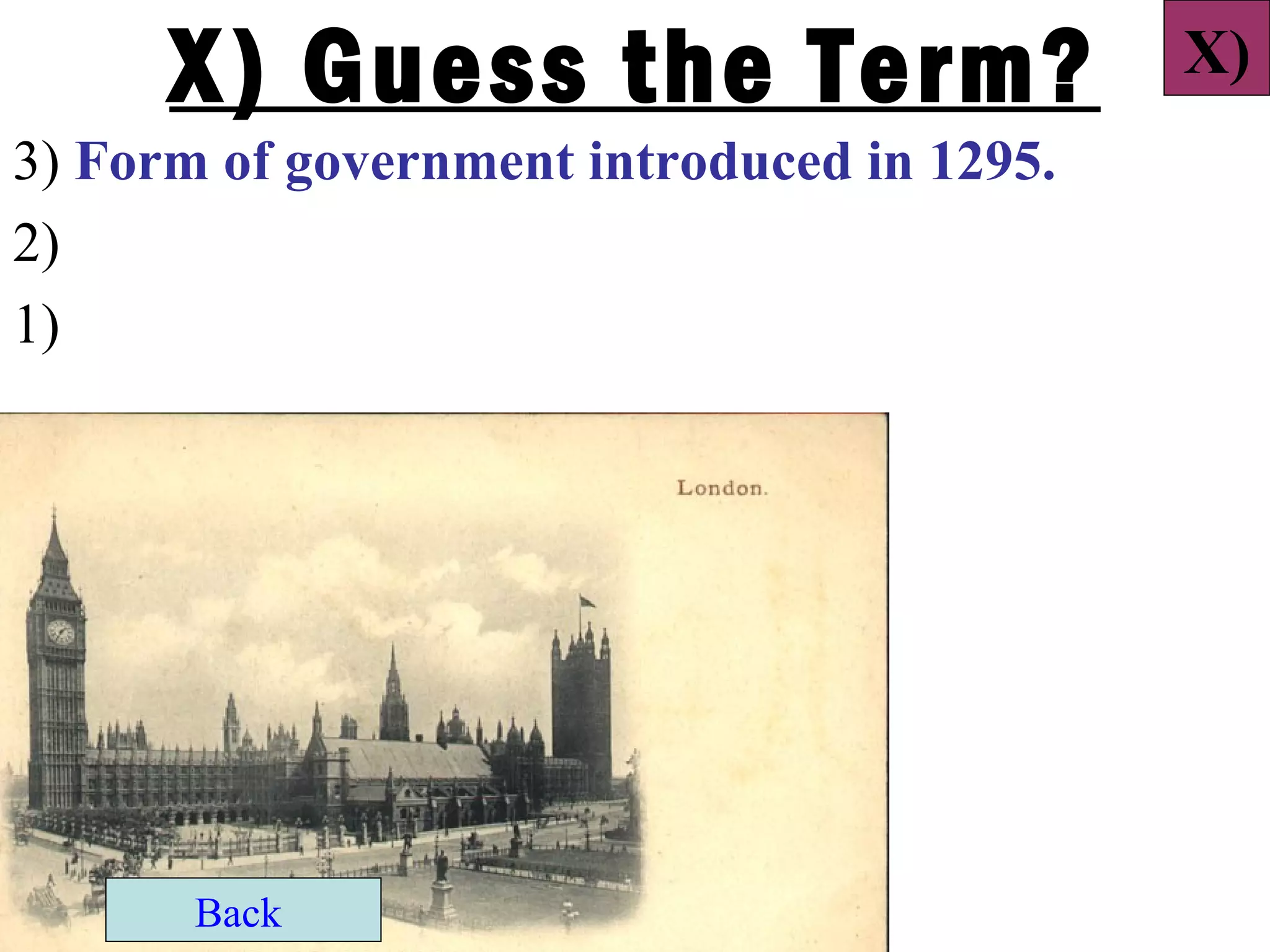
3) Form of government introduced in 1295.
2)
1)


       Back
X) Guess the Term?                      X)
3) Form of government introduced in 1295.
2) Part of government that makes or debates laws
1)


       Back
X) Guess the Term?                           X)
3) Form of government introduced in 1295.
2) Part of government that makes or debates laws
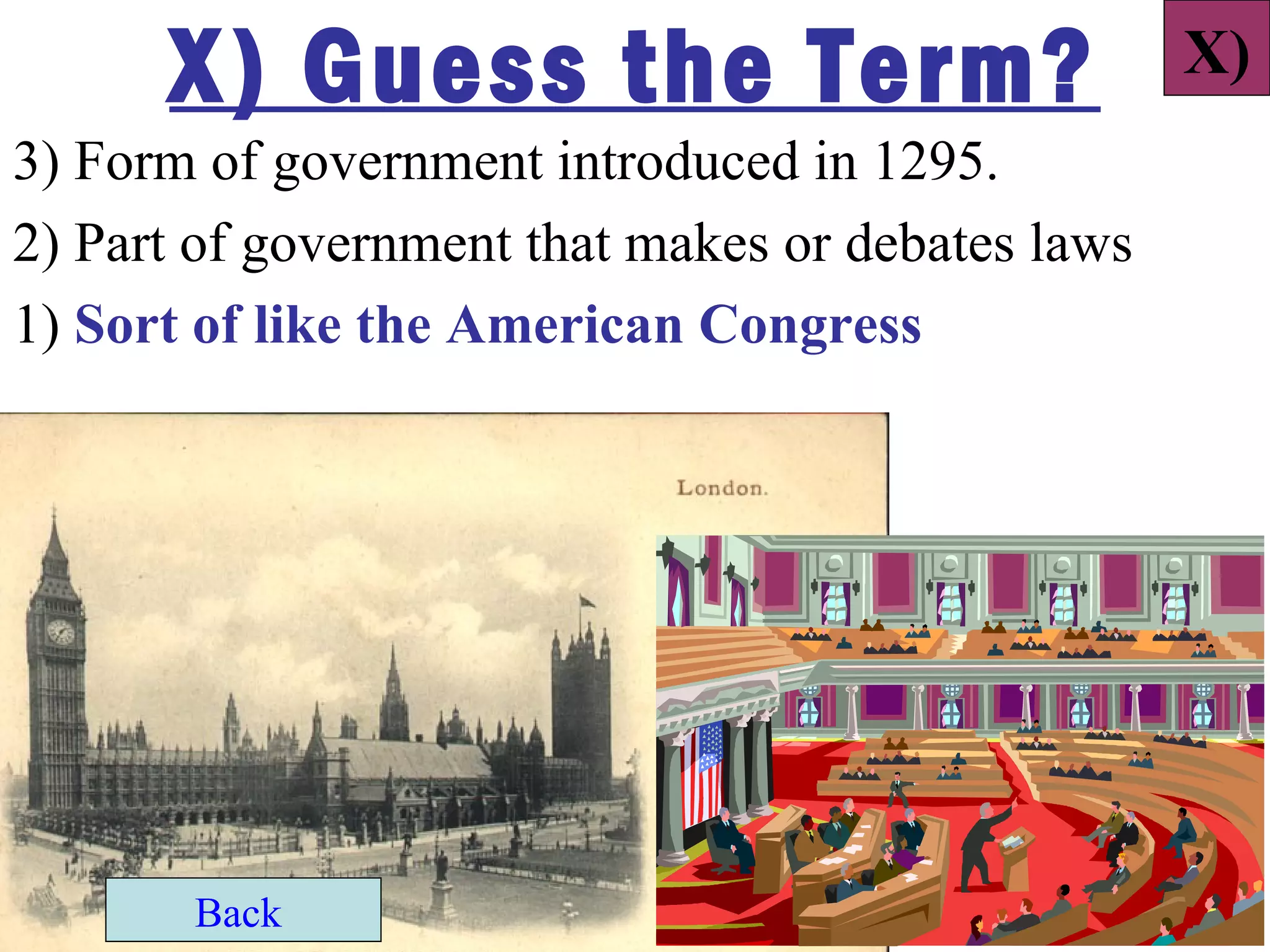
1) Sort of like the American Congress


       Back
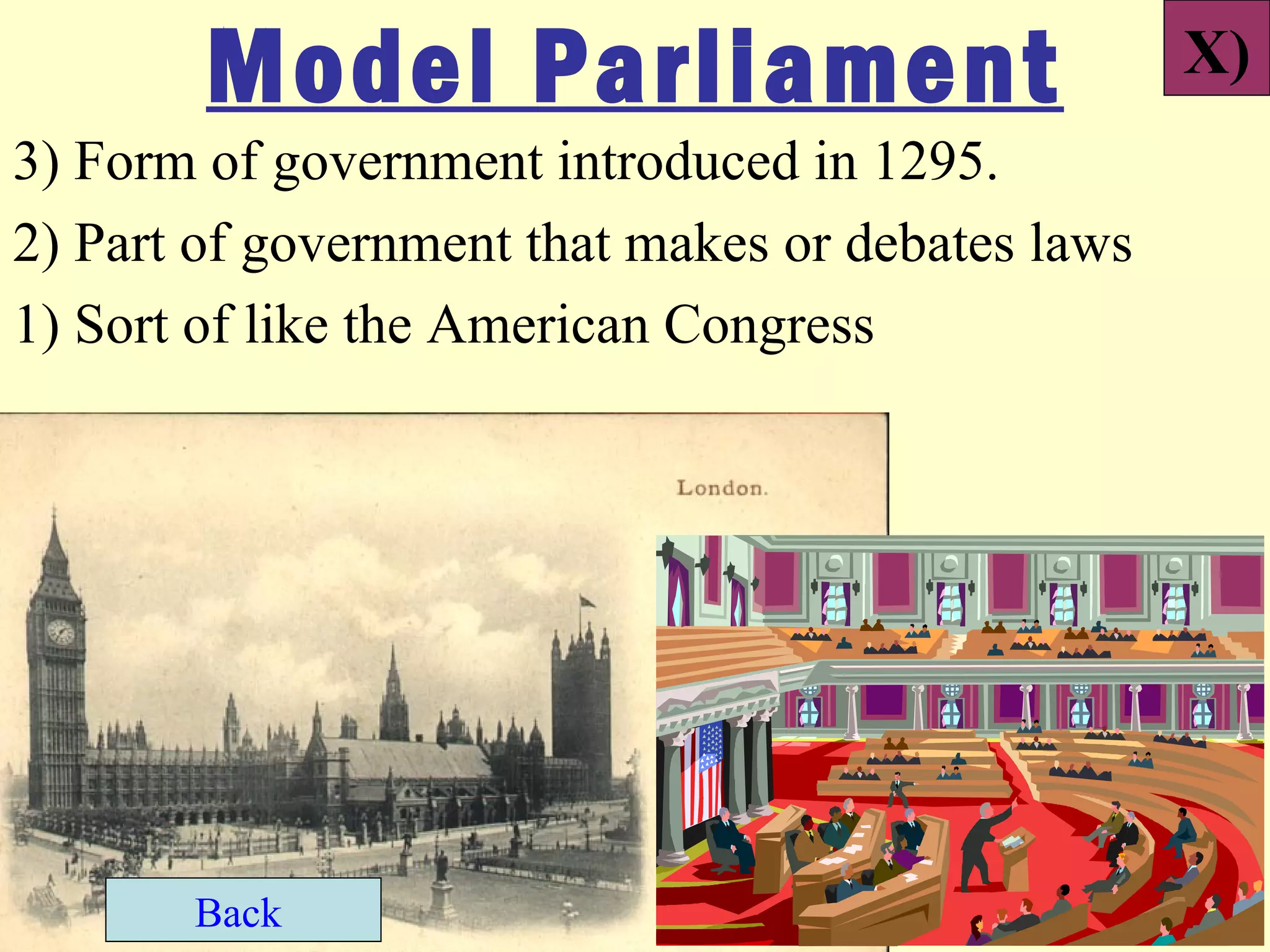
Model Parliament                           X)
3) Form of government introduced in 1295.
2) Part of government that makes or debates laws
1) Sort of like the American Congress


       Back
Guess The Term                   Y)
3) Form of government that is of the people
Guess The Term                             Y)
3) Form of government that is of the people
2) One person represents on behalf of the citizens’ actions.
Guess The Term                             Y)
3) Form of government that is of the people
2) One person represents on behalf of the citizens’ actions.
1) Roman Republic and US Government is of this kind
Representative
                                                           Y)
              Democracy
3) Form of government that is of the people
2) One person represents on behalf of the citizens’ actions.
1) Roman Republic and US Government is of this kind


        Back
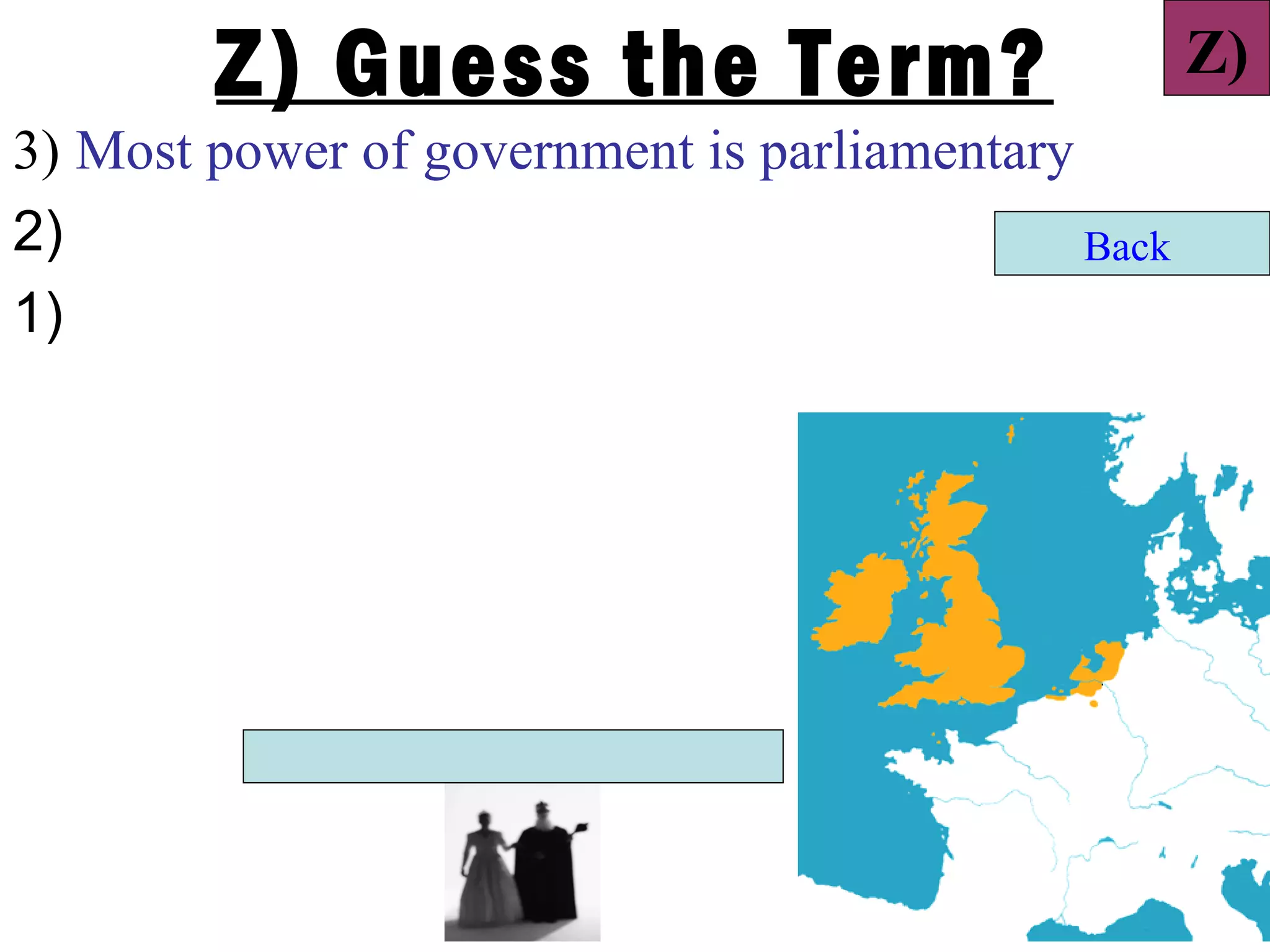
Z) Guess the Term?                          Z)
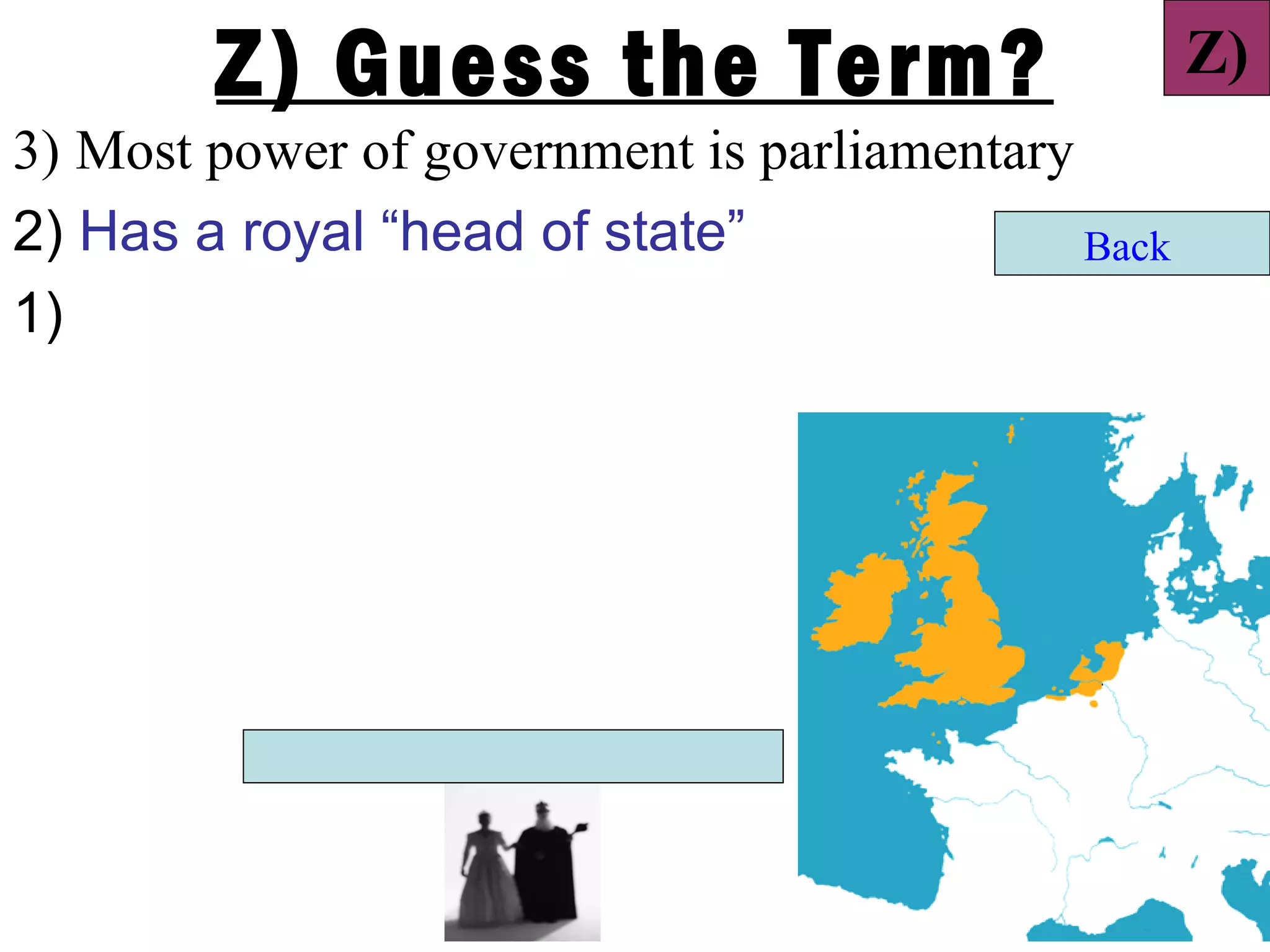
3) Most power of government is parliamentary
2)                                           Back
1)
Z) Guess the Term?                          Z)
3) Most power of government is parliamentary
2) Has a royal “head of state”               Back
1)
Z) Guess the Term?                       Z)
3) Most power of government is parliamentary
2) Has a “head of state”                  Back
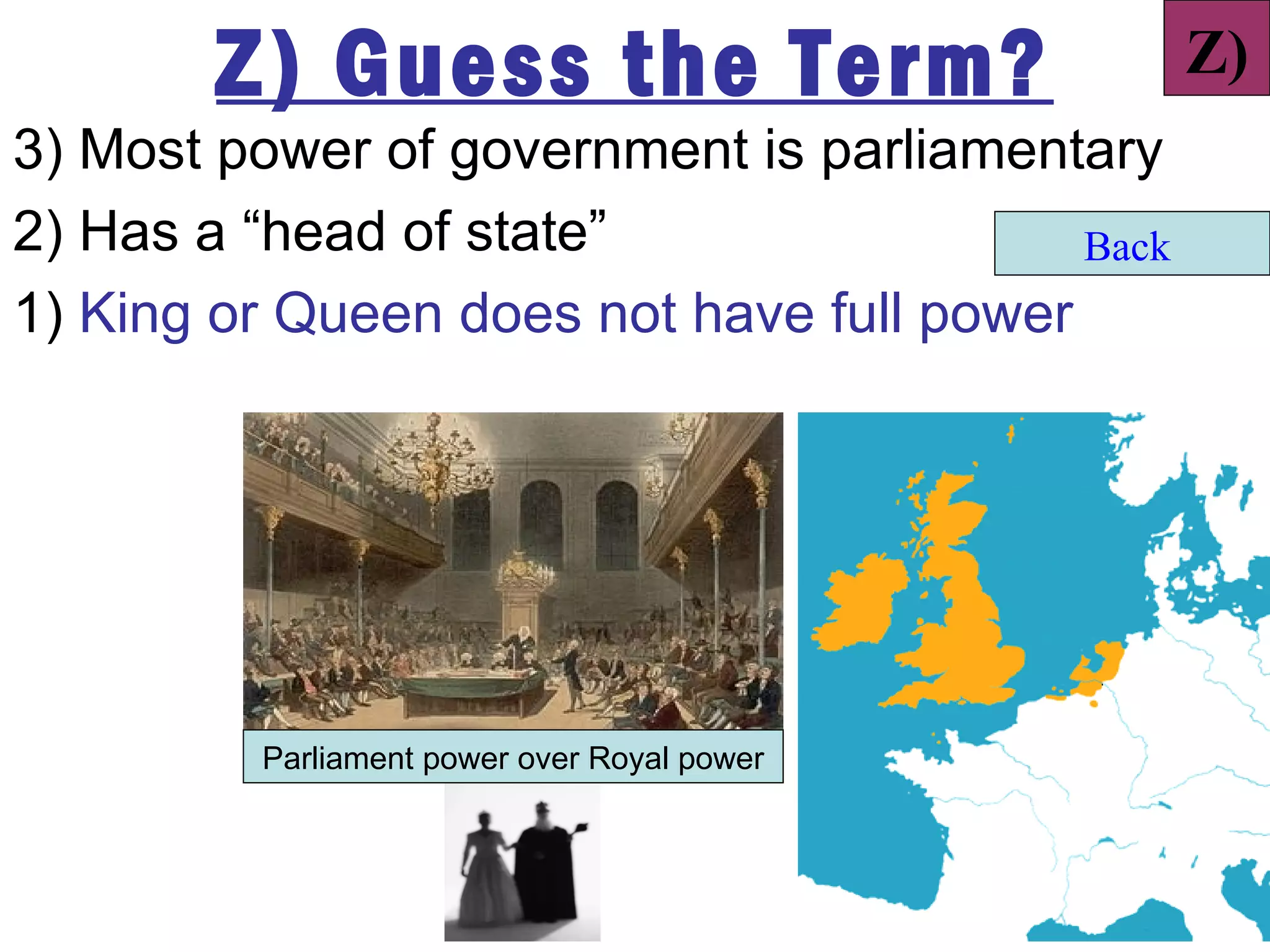
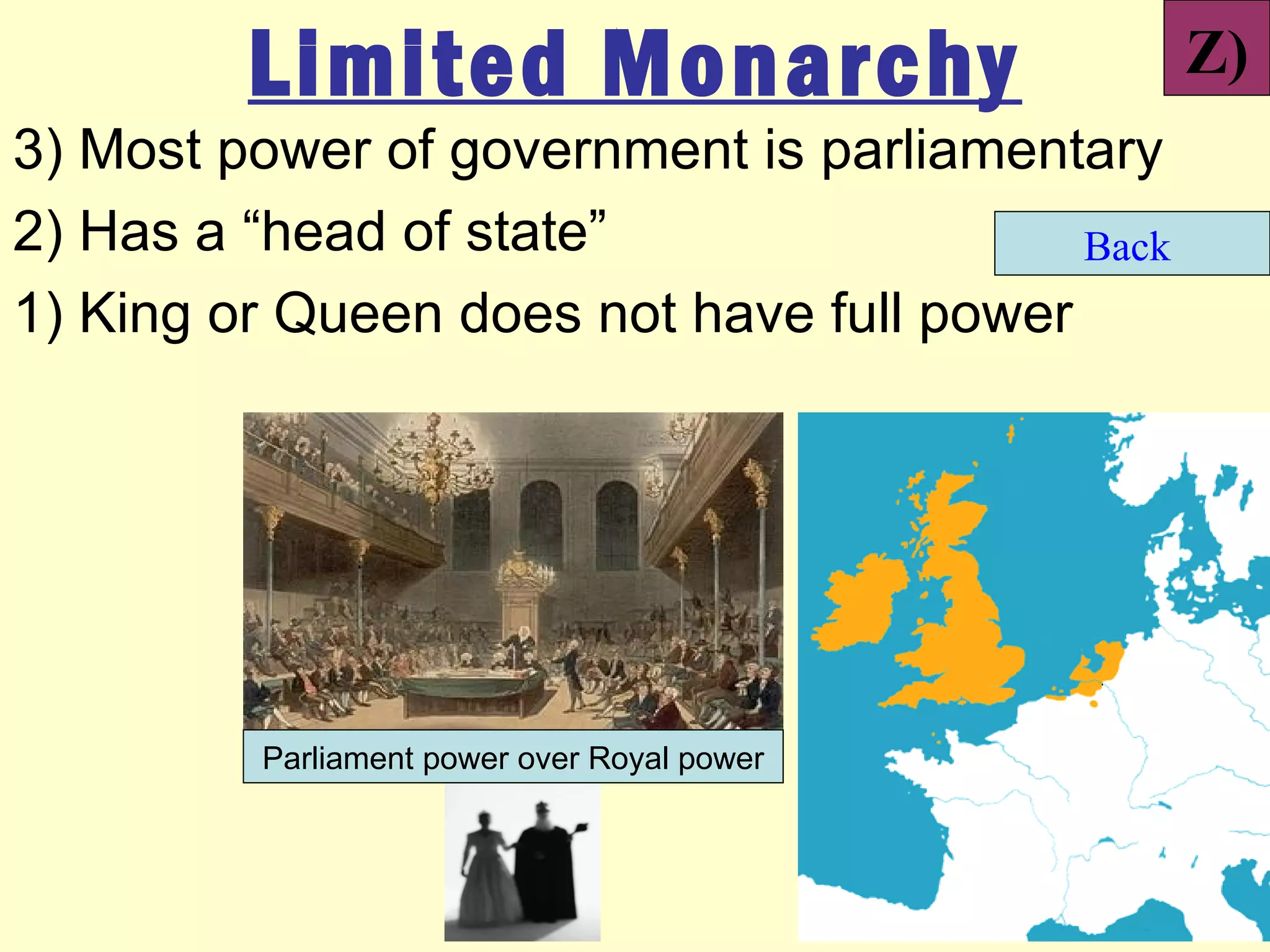
1) King or Queen does not have full power


         Parliament power over Royal power
Limited Monarchy                        Z)
3) Most power of government is parliamentary
2) Has a “head of state”                  Back
1) King or Queen does not have full power


         Parliament power over Royal power
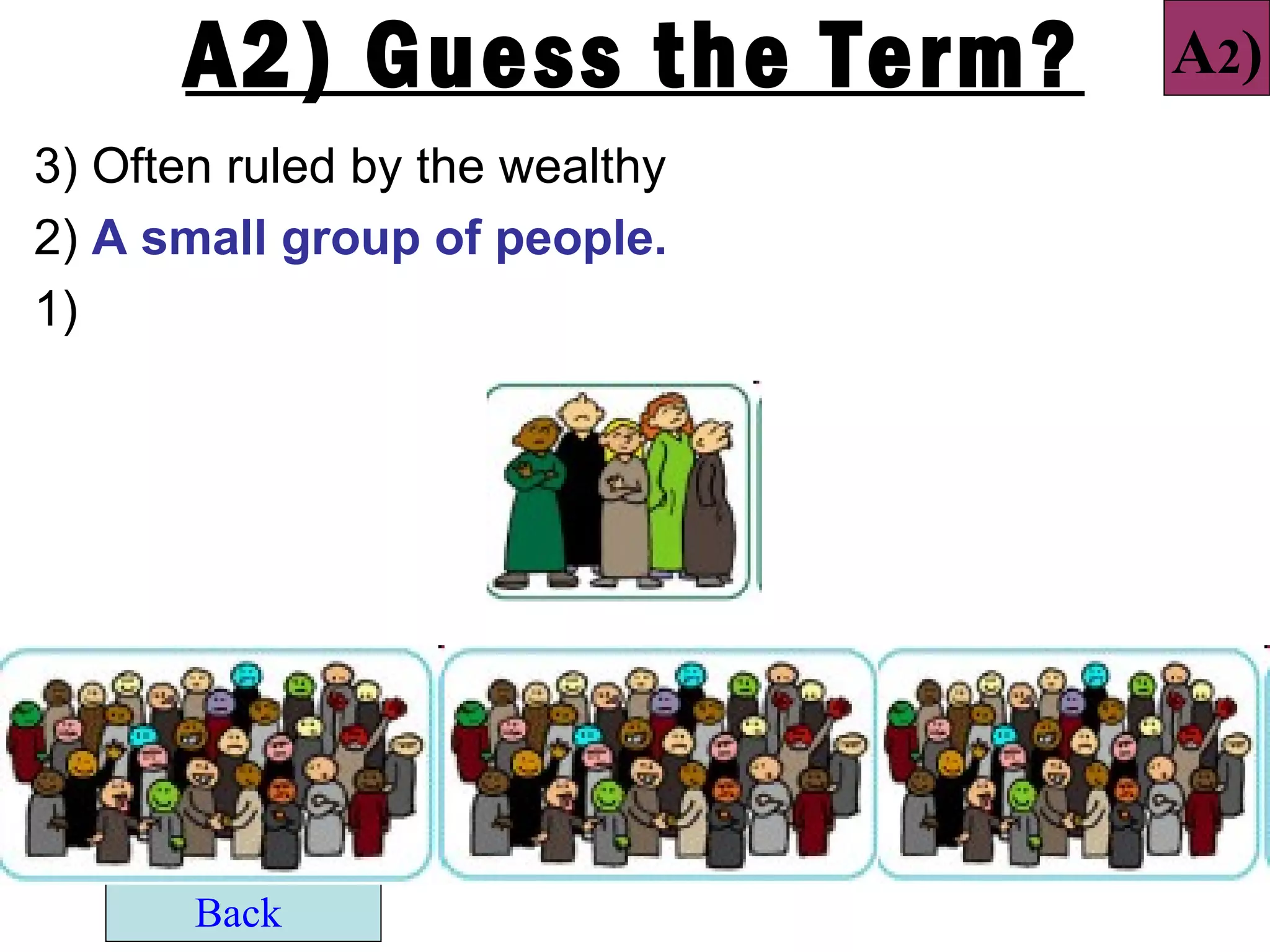
A2) Guess the Term?       A2)
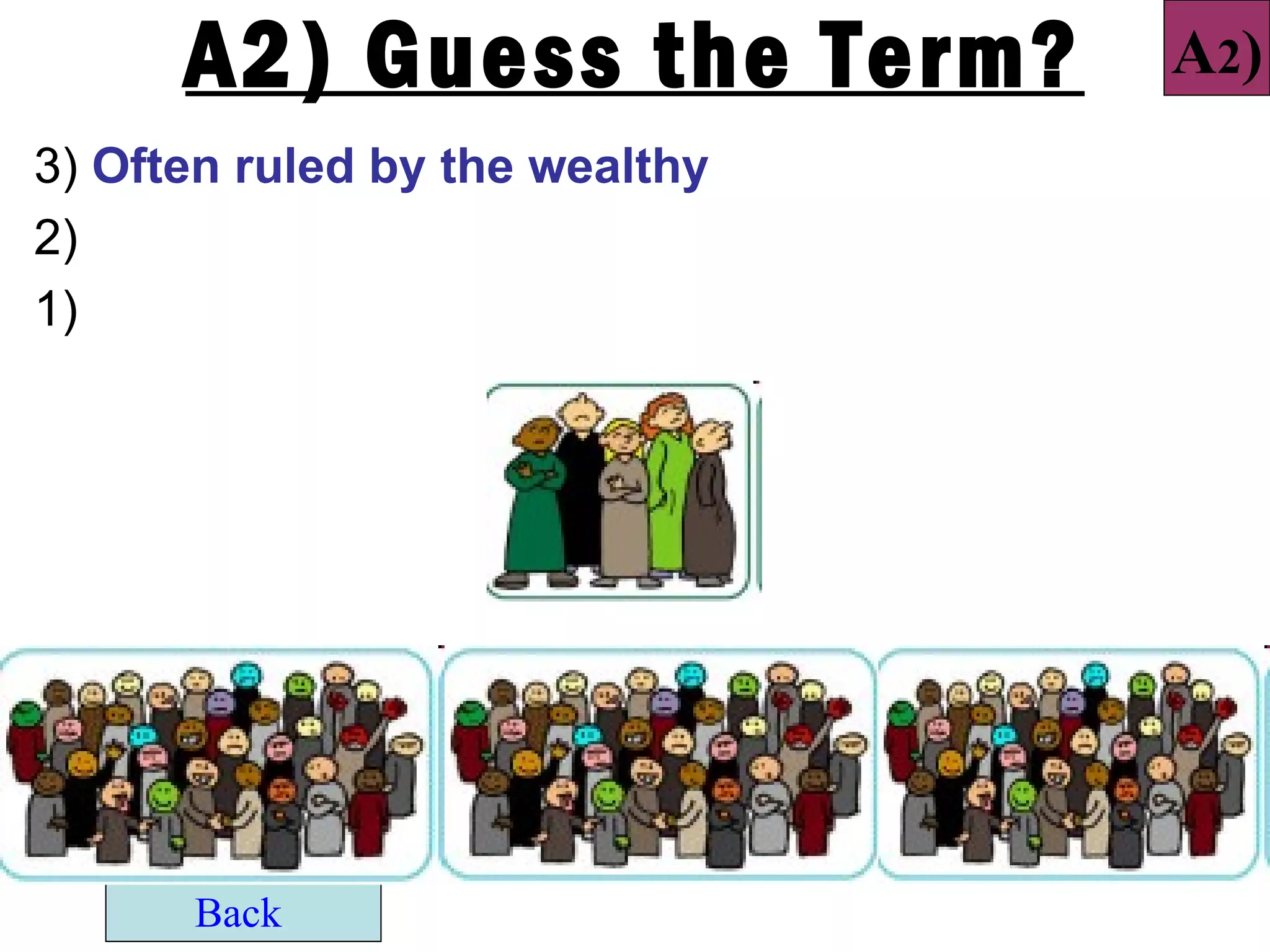
3) Often ruled by the wealthy
2)
1)


      Back
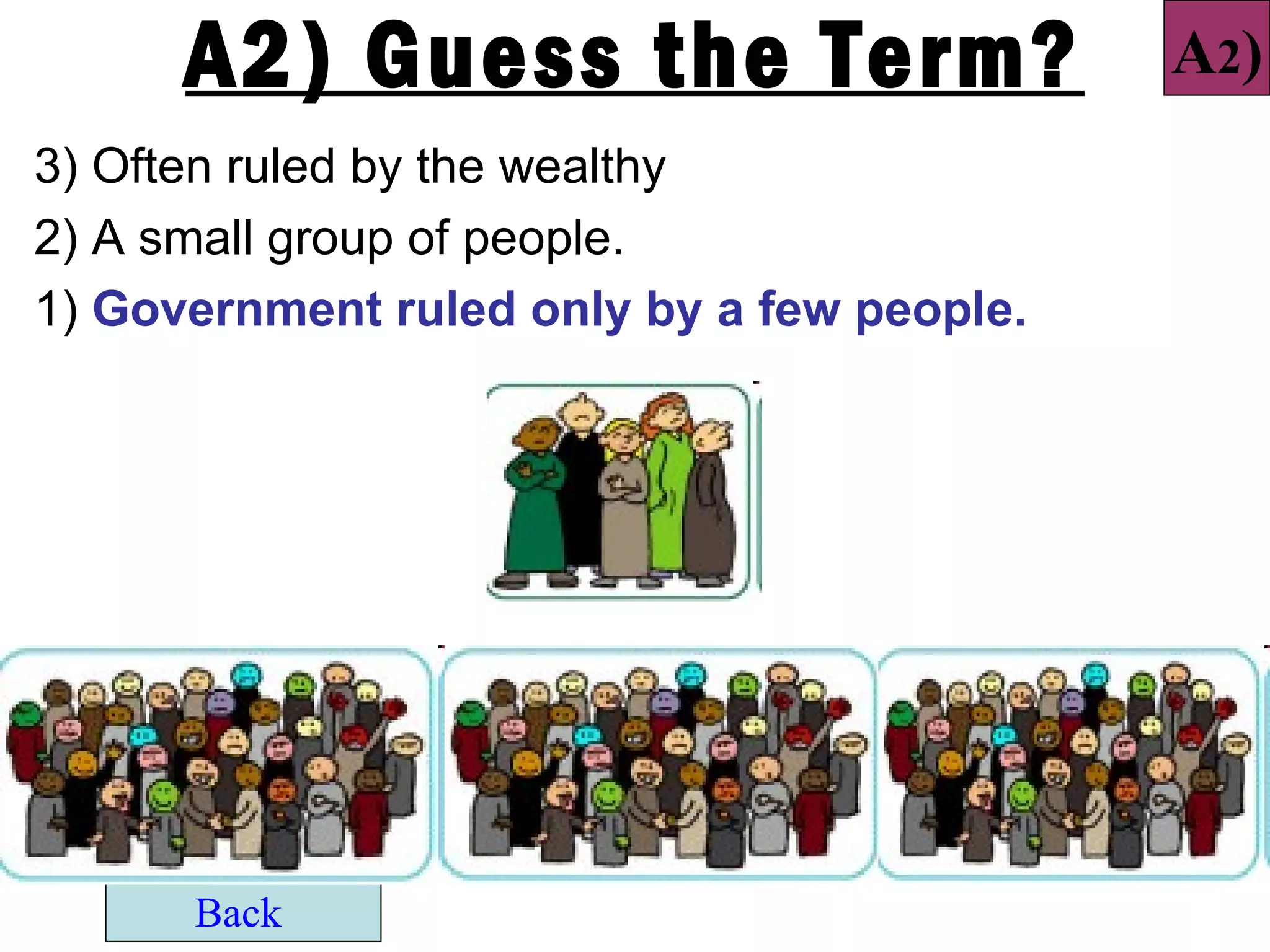
A2) Guess the Term?       A2)
3) Often ruled by the wealthy
2) A small group of people.
1)


       Back
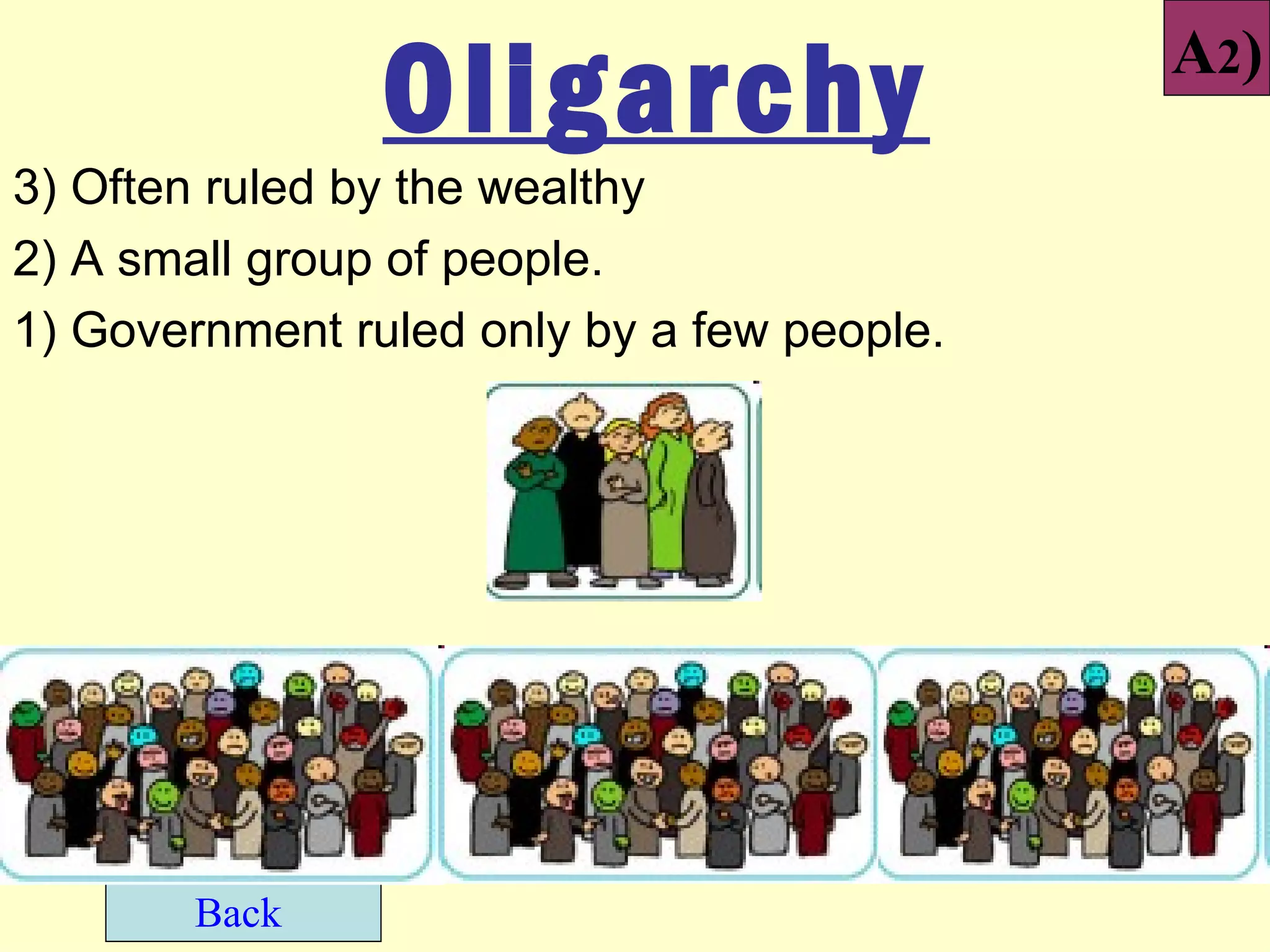
A2) Guess the Term?                   A2)
3) Often ruled by the wealthy
2) A small group of people.
1) Government ruled only by a few people.


      Back
Oligarchy                   A2)

3) Often ruled by the wealthy
2) A small group of people.
1) Government ruled only by a few people.


        Back
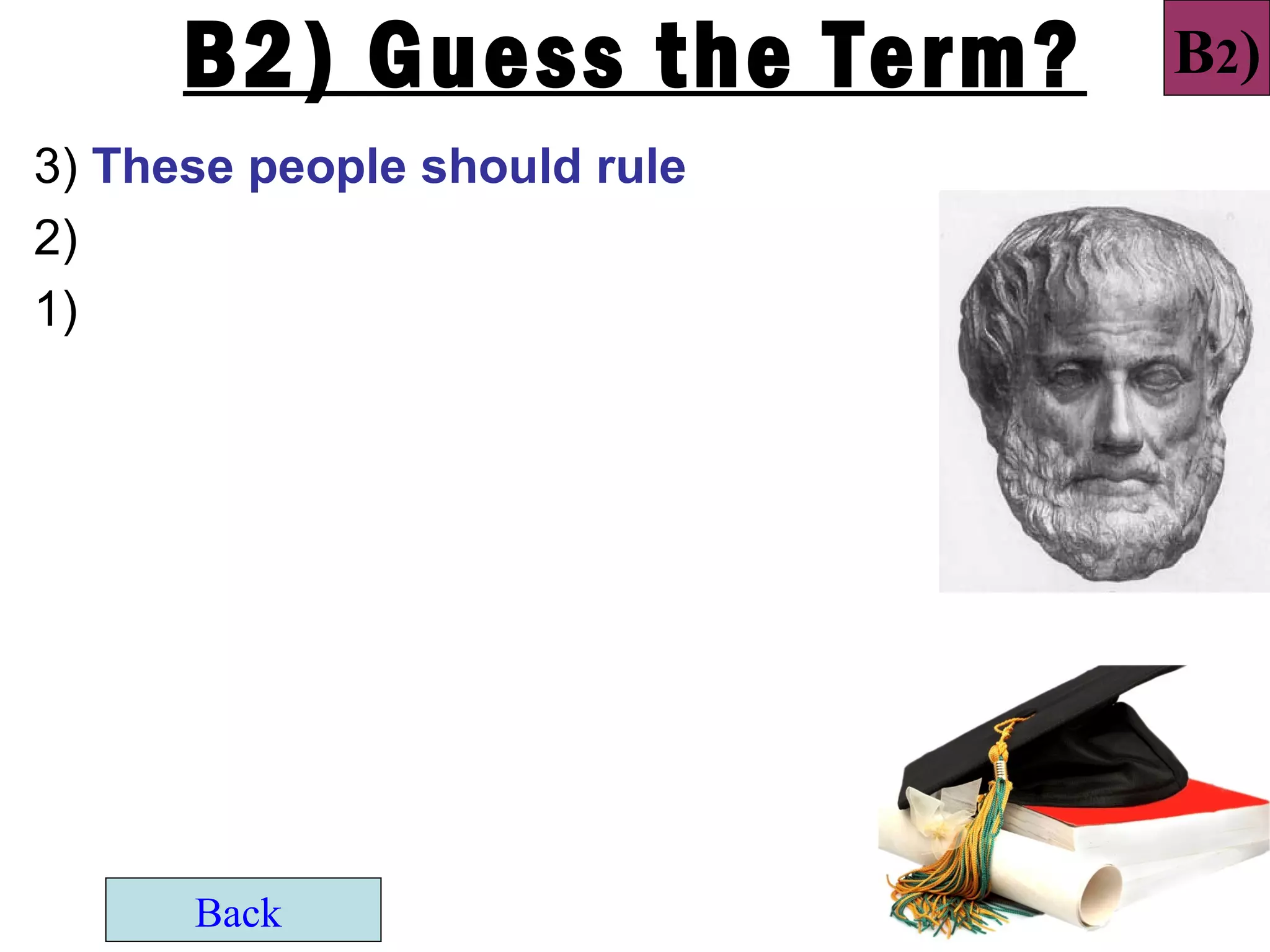
B2) Guess the Term?     B2)
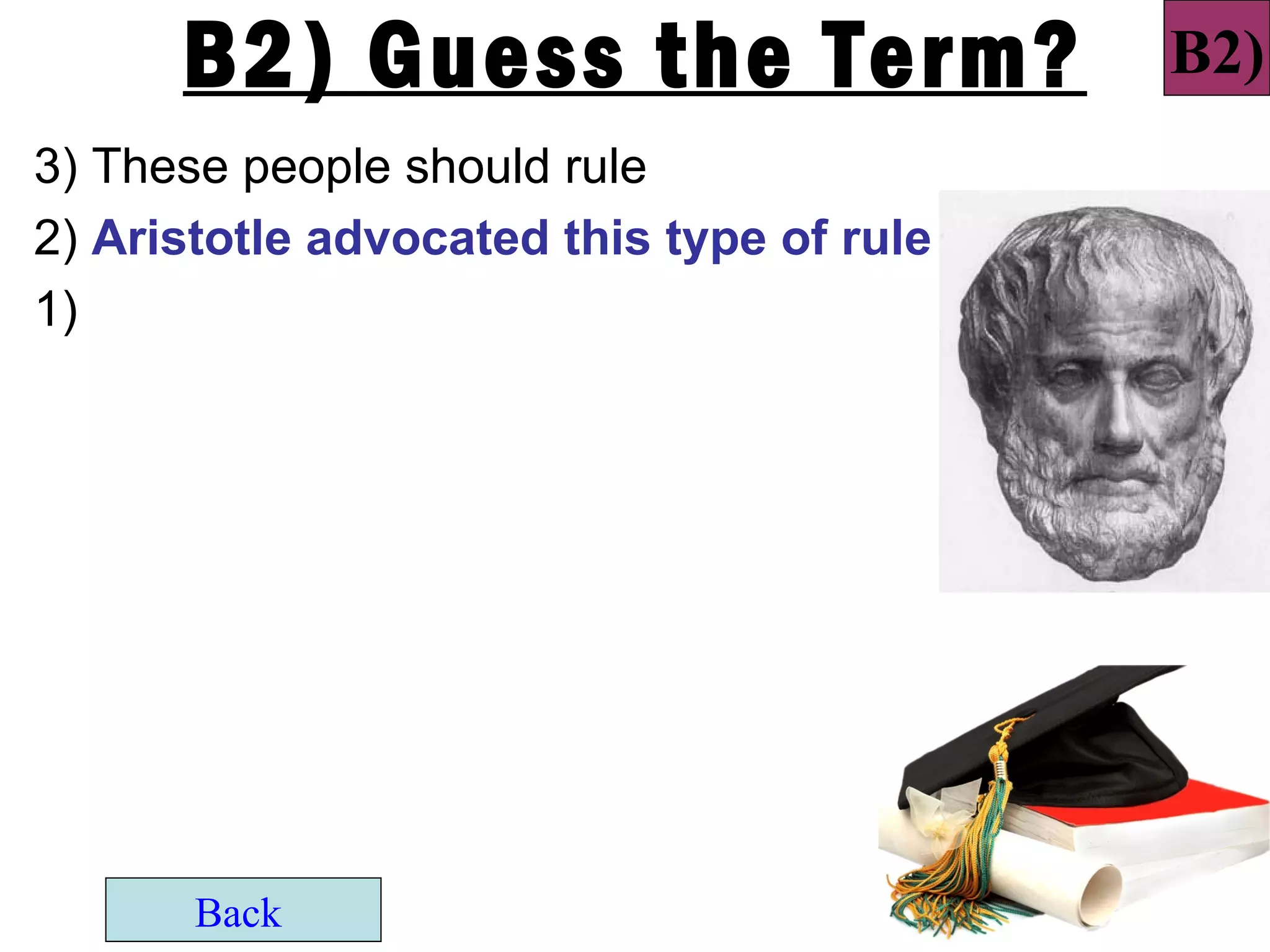
3) These people should rule
2)
1)


      Back
B2) Guess the Term?                  B2)
3) These people should rule
2) Aristotle advocated this type of rule
1)


       Back
B2) Guess the Term?                 B2)
3) These people should rule
2) Aristotle advocated this type of rule
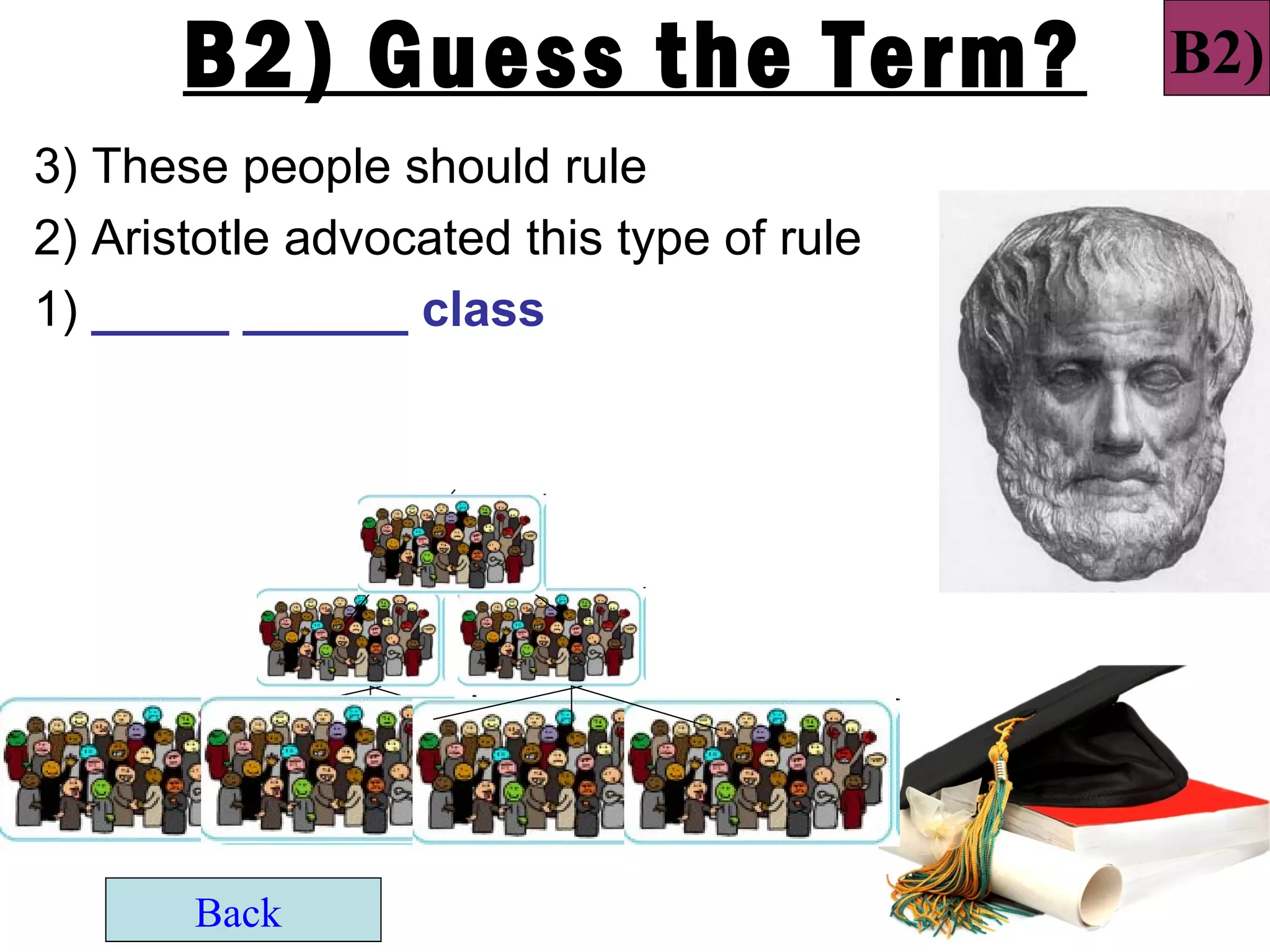
1) _____ ______ class


       Back
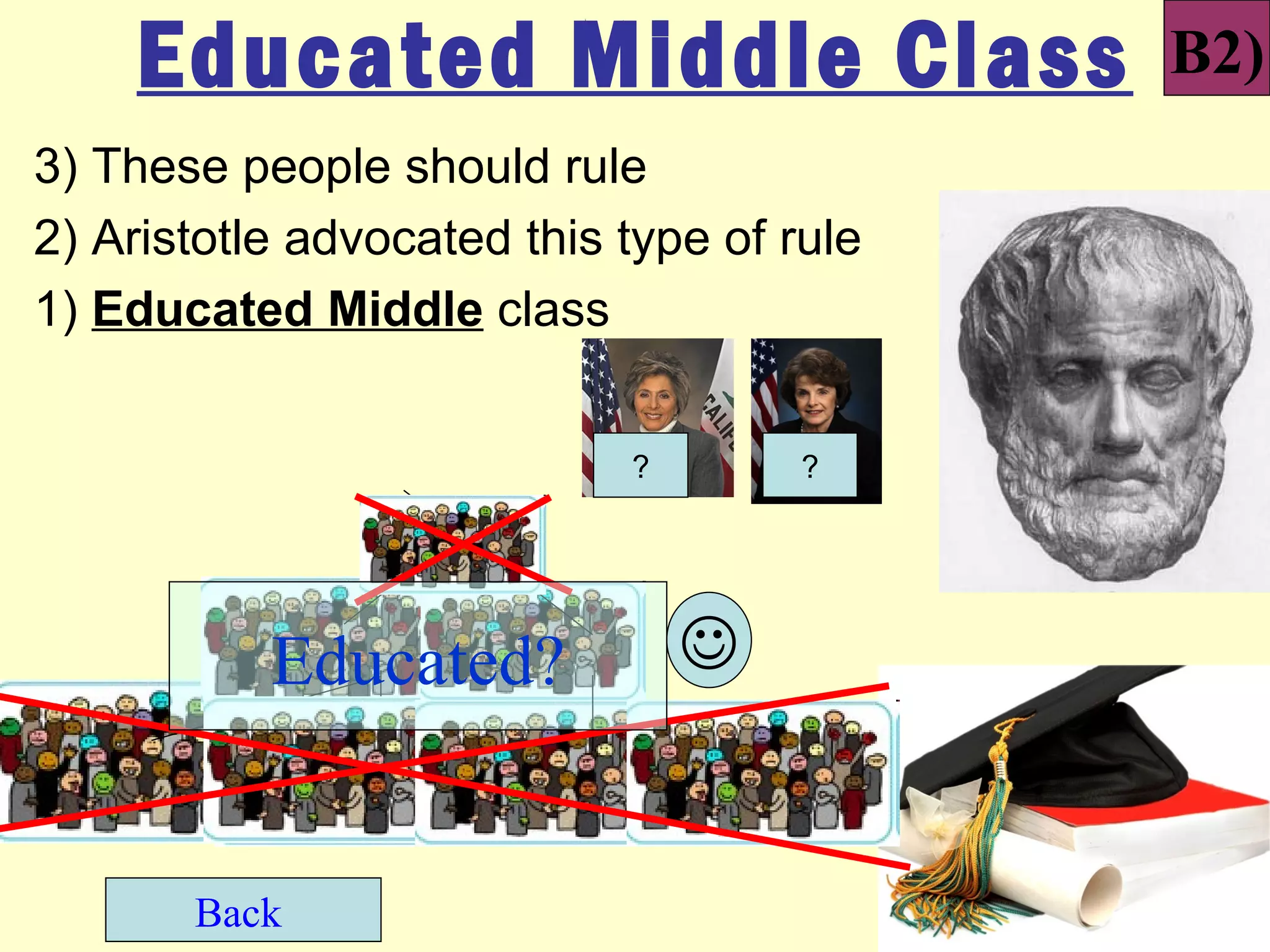
Educated Middle Class                  B2)
3) These people should rule
2) Aristotle advocated this type of rule
1) Educated Middle class


                            ?        ?


           Educated?            


       Back
C2) Guess the Term?   C2)
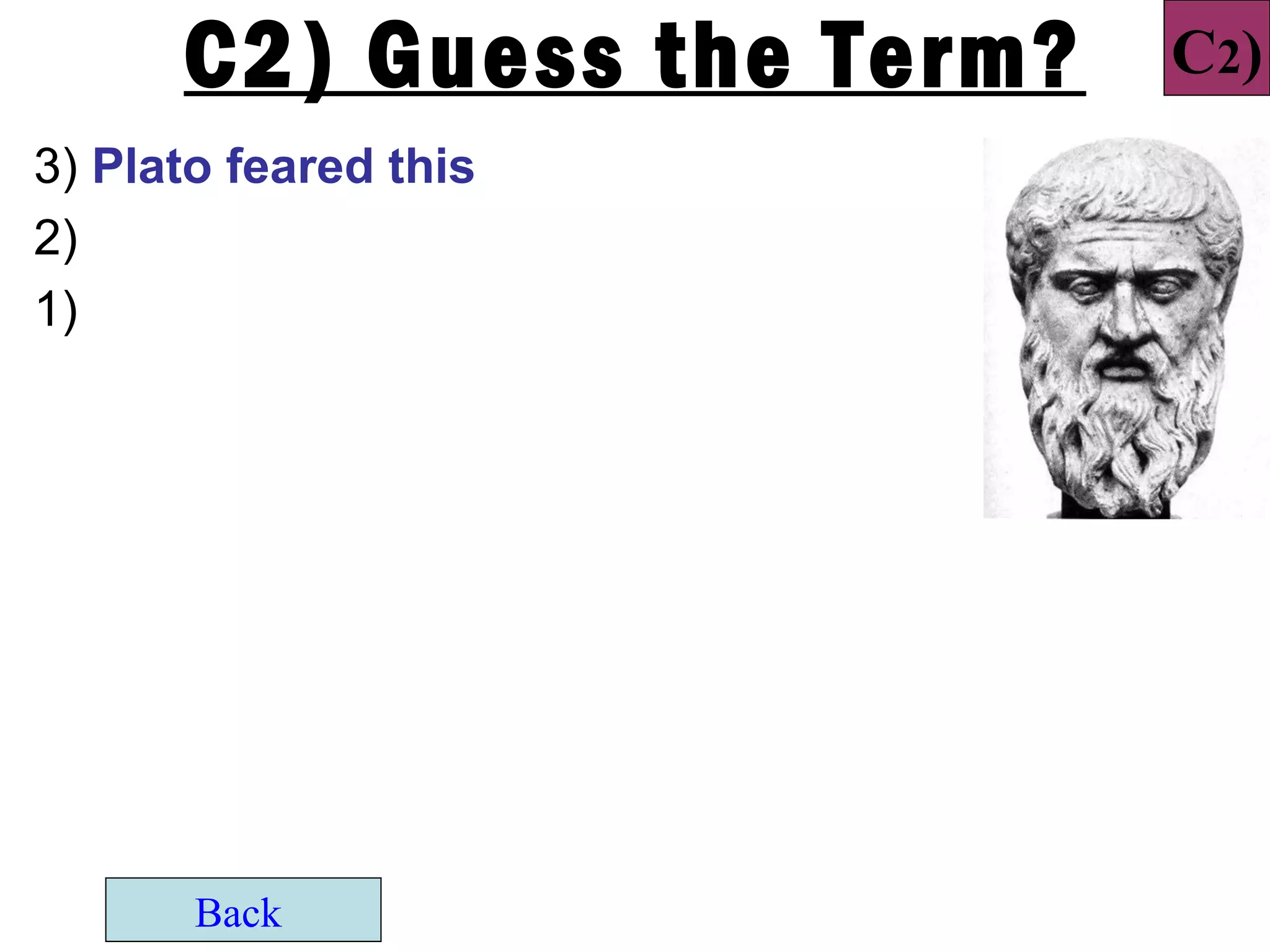
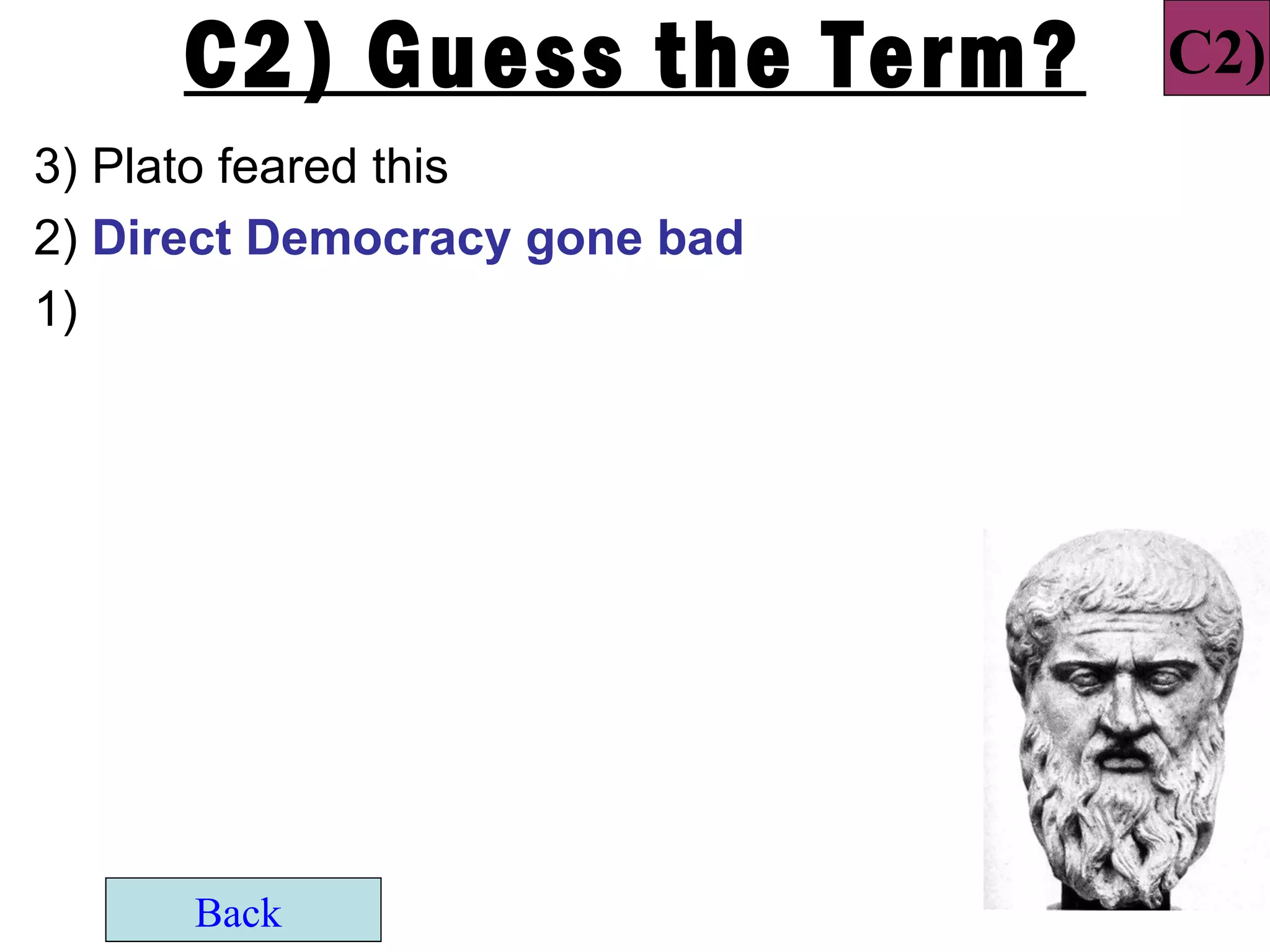
3) Plato feared this
2)
1)


       Back
C2) Guess the Term?       C2)
3) Plato feared this
2) Direct Democracy gone bad
1)


      Back
C2) Guess the Term?                C2)
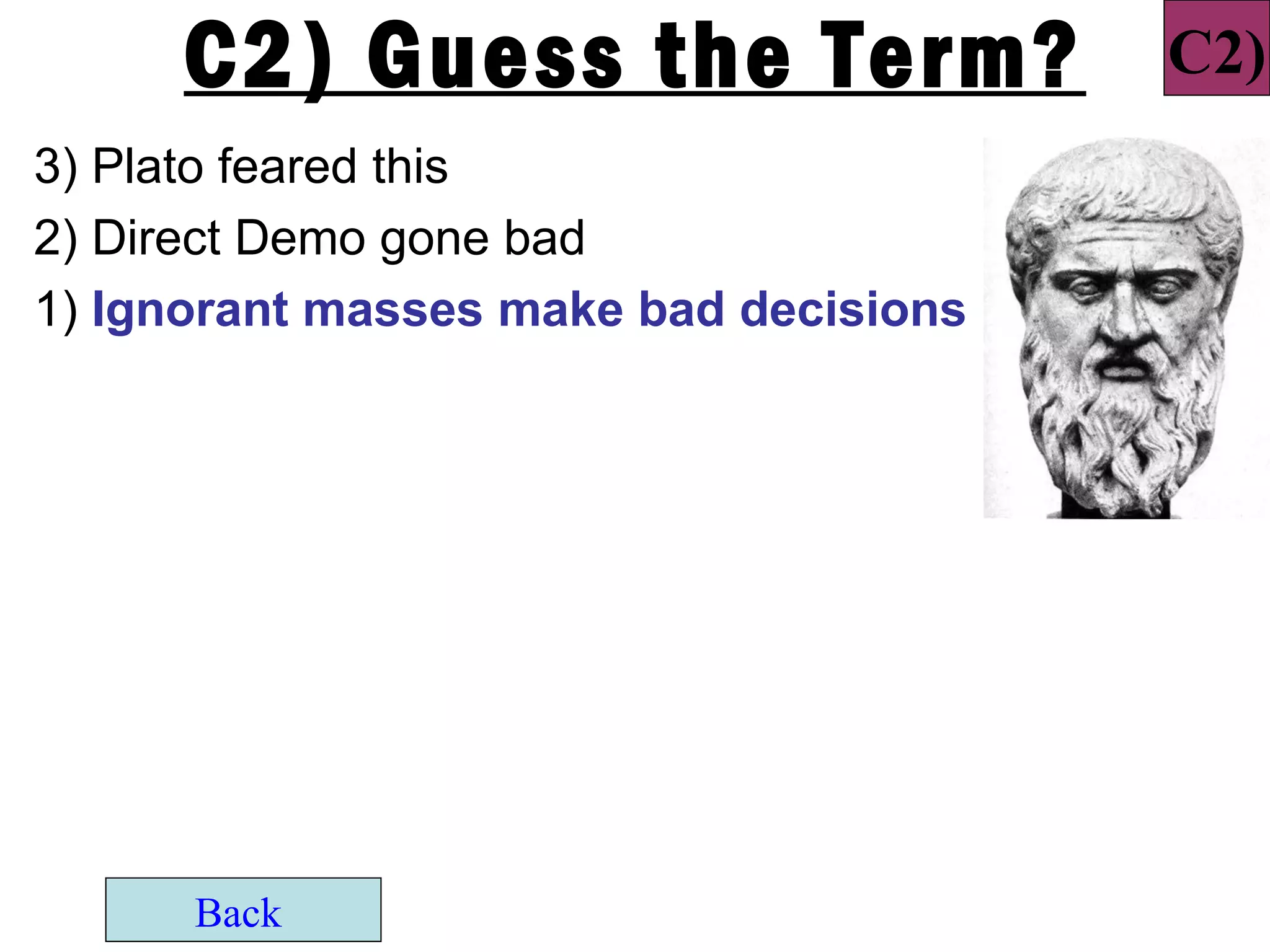
3) Plato feared this
2) Direct Demo gone bad
1) Ignorant masses make bad decisions


      Back
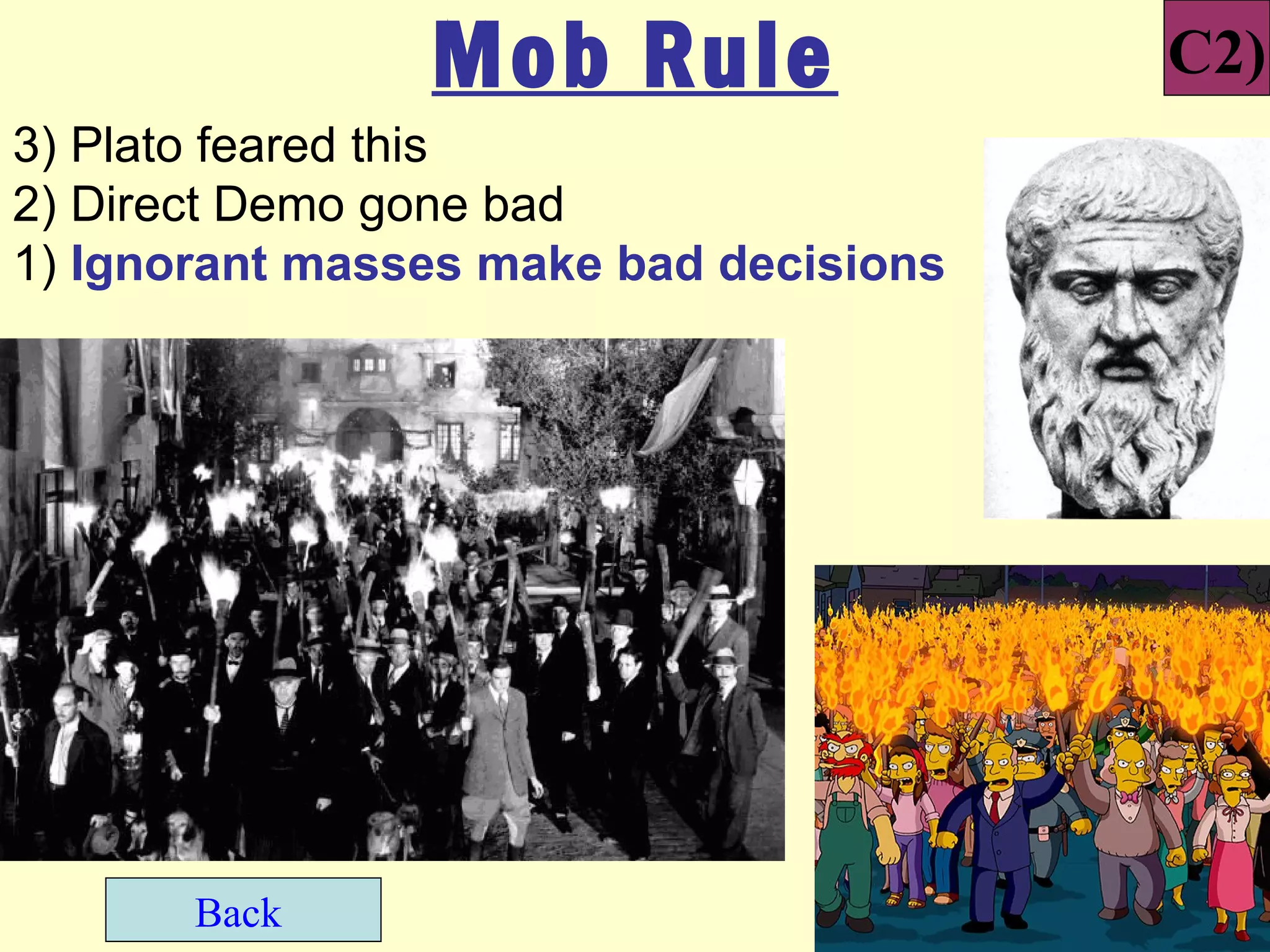
Mob Rule                C2)
3) Plato feared this
2) Direct Demo gone bad
1) Ignorant masses make bad decisions


       Back
D2) Guess the Term?   D2)
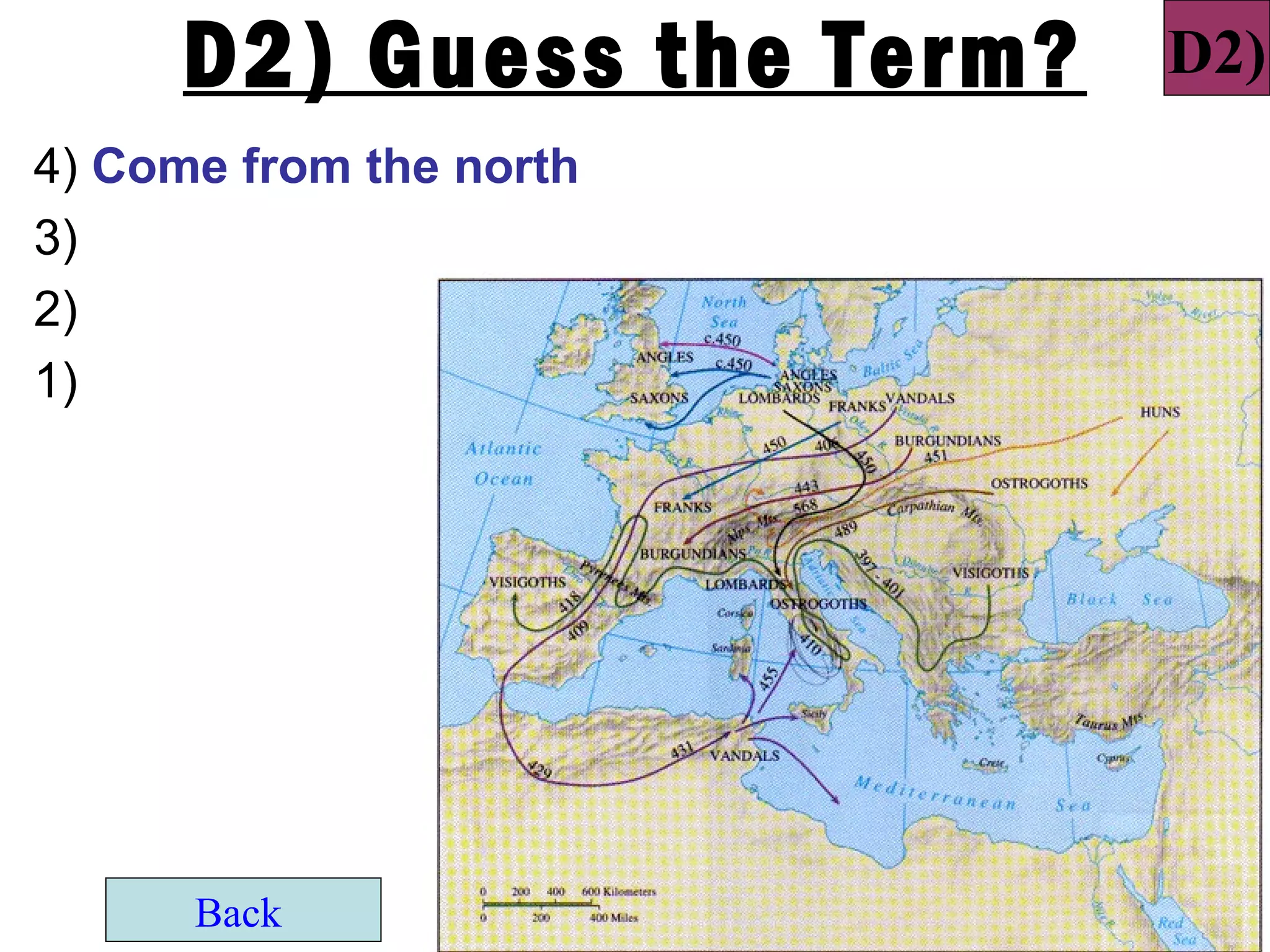
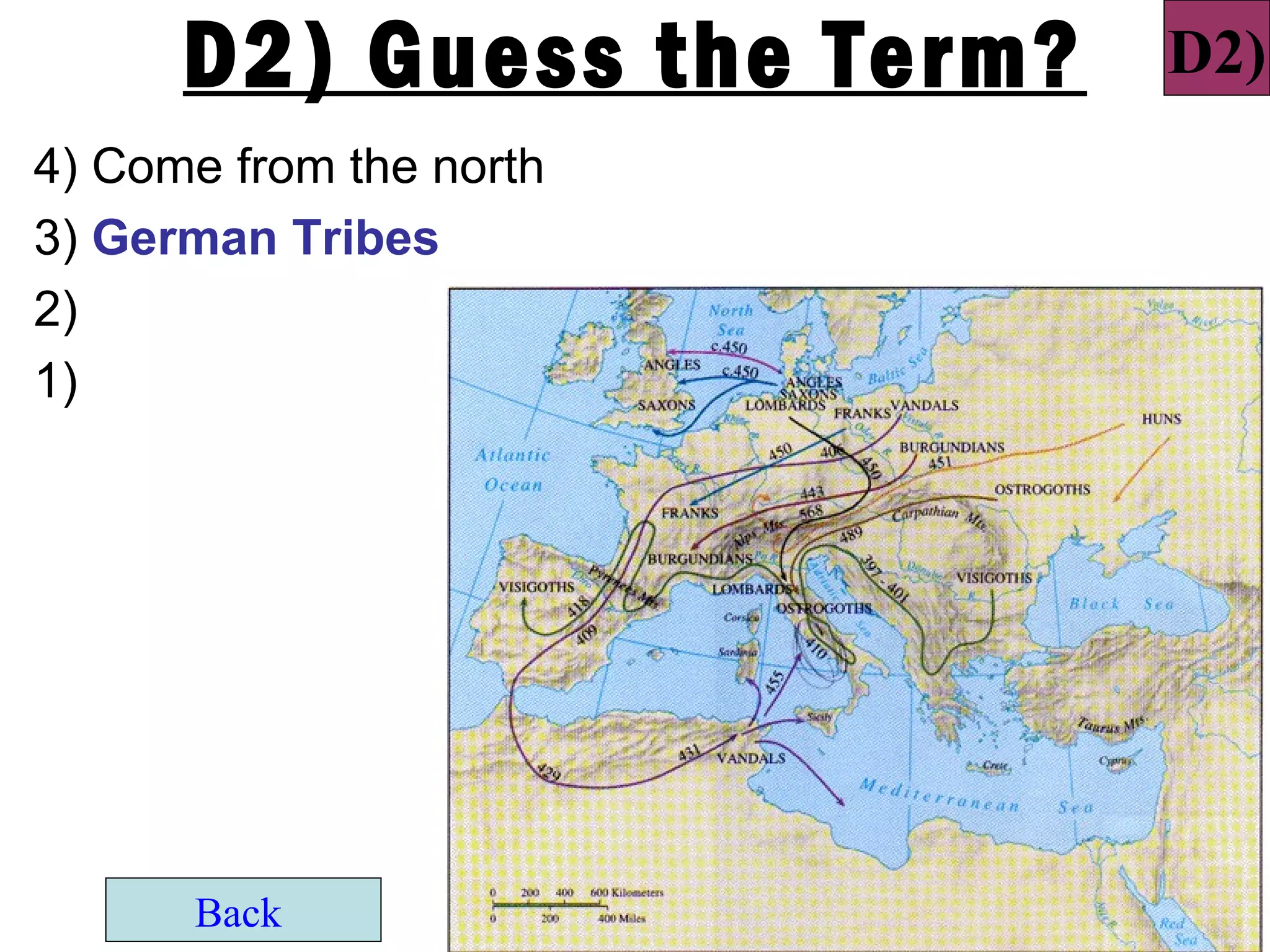
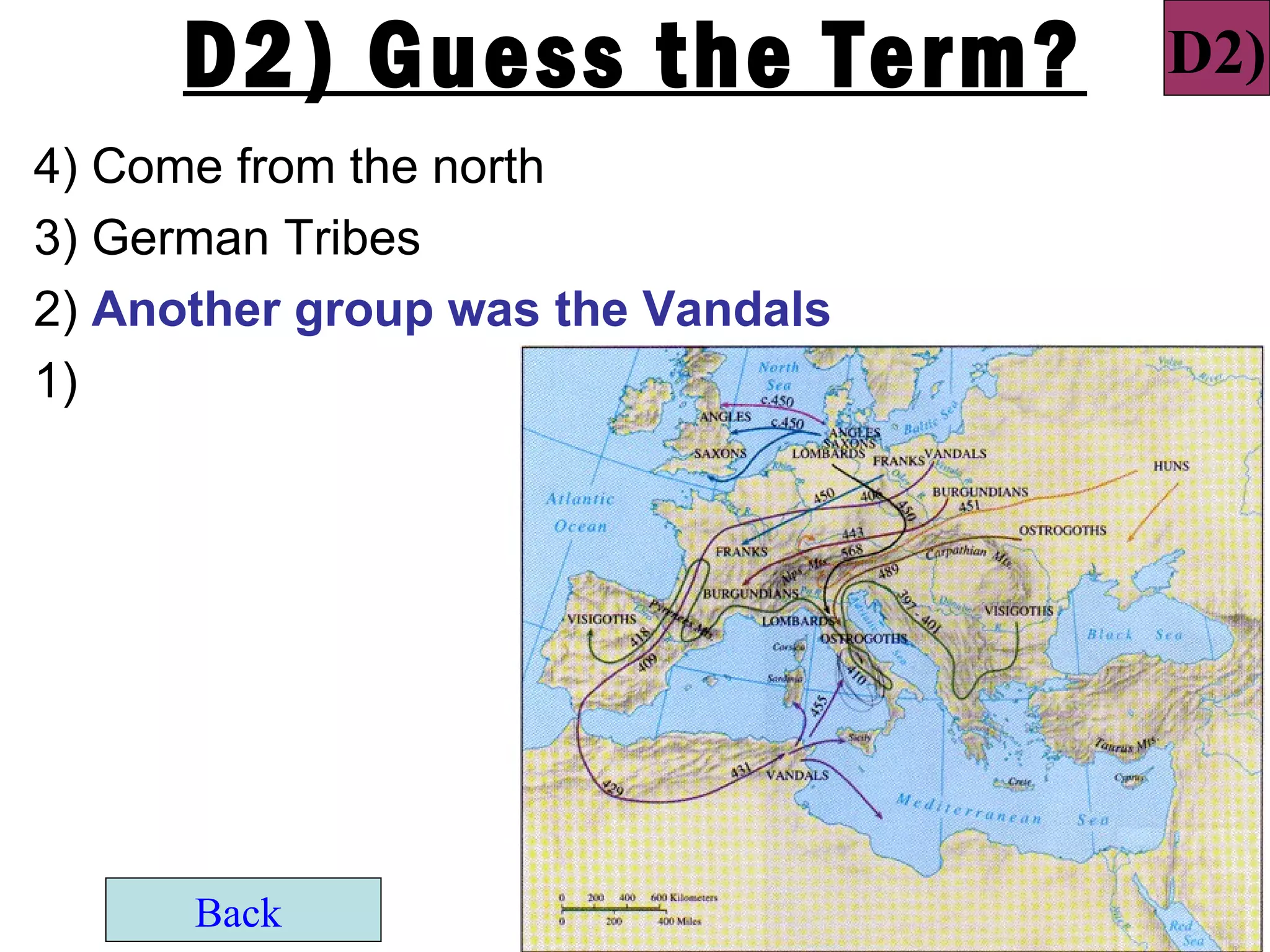
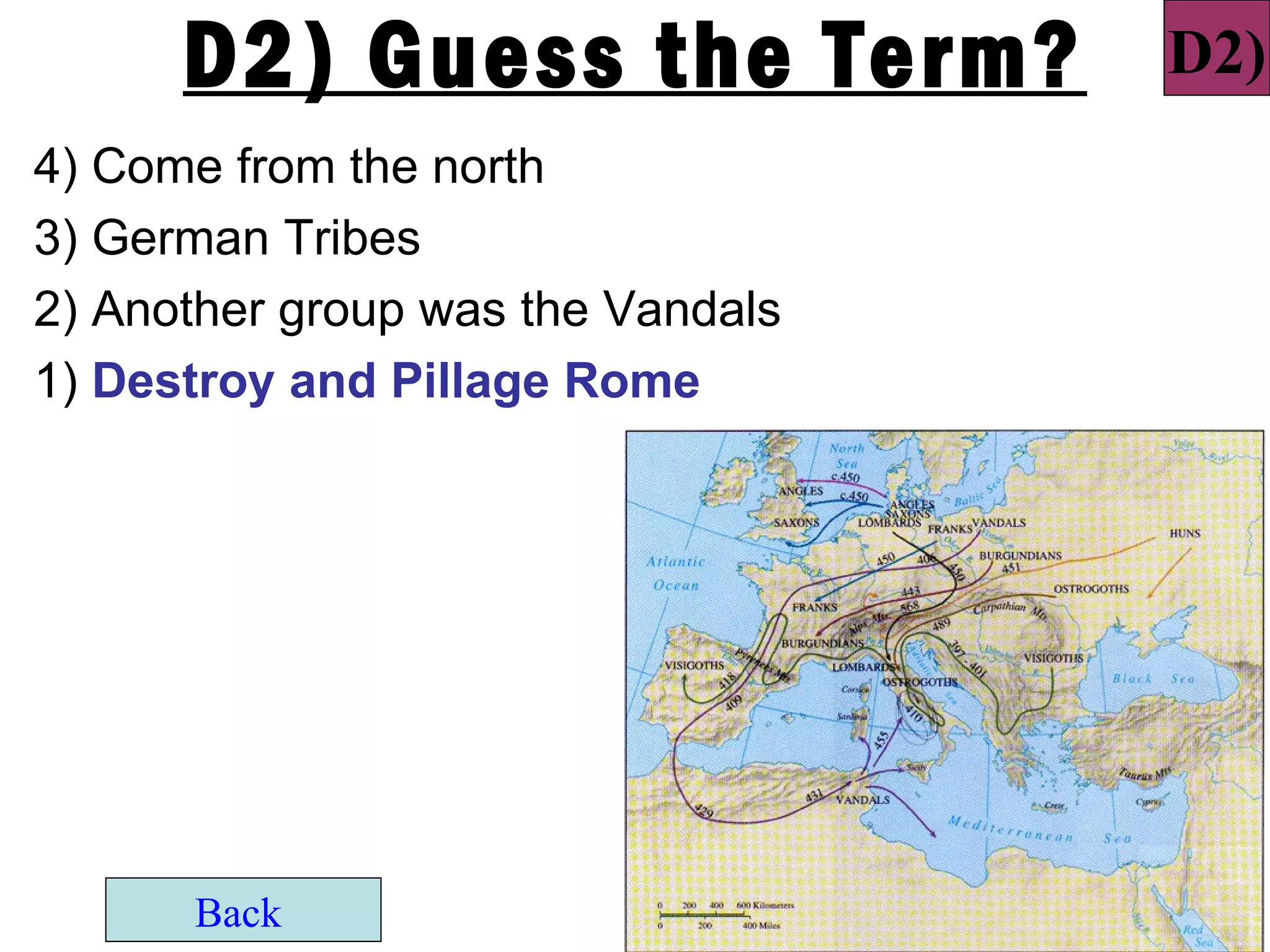
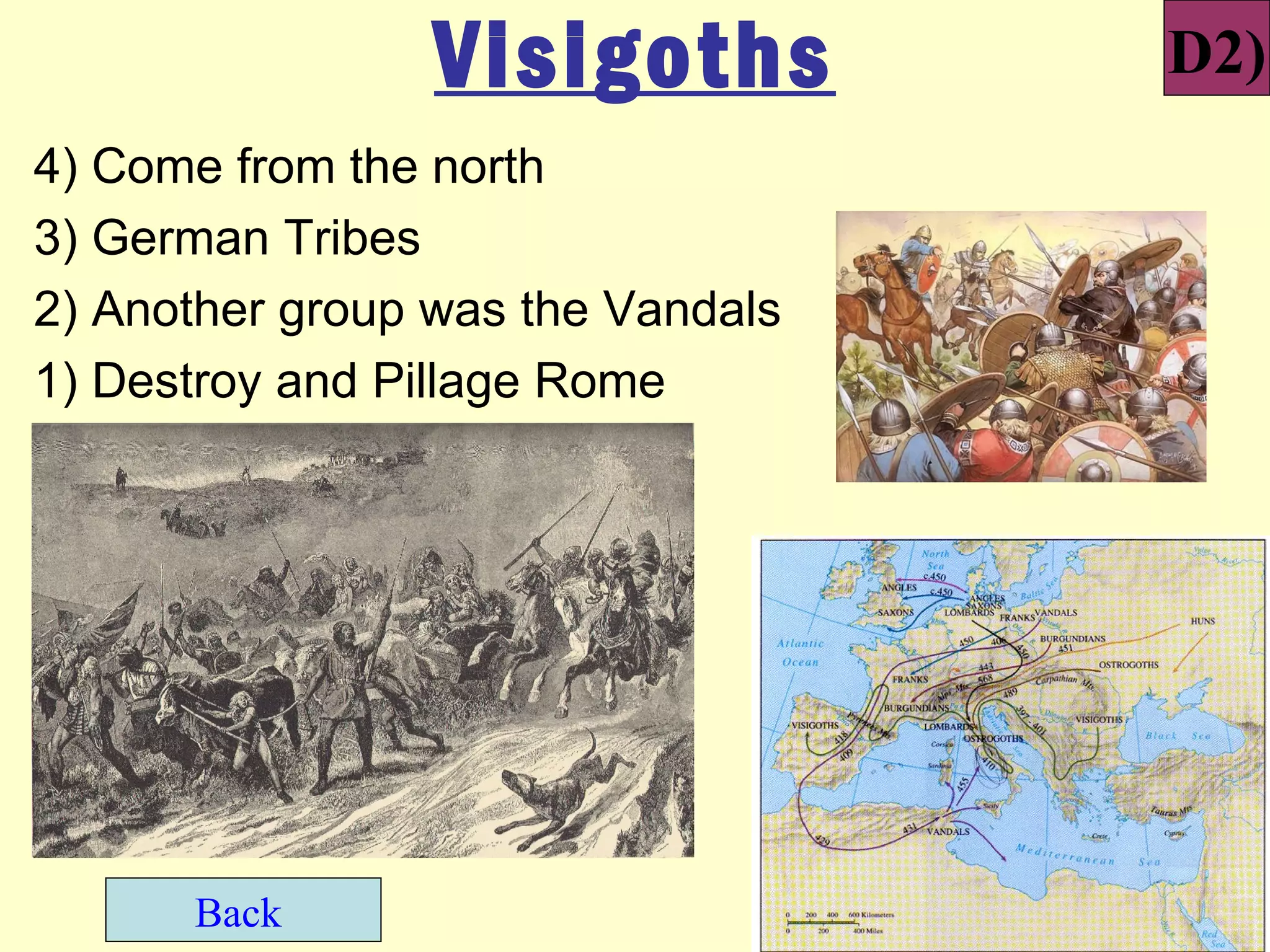
4) Come from the north
3)
2)
1)


      Back
D2) Guess the Term?   D2)
4) Come from the north
3) German Tribes
2)
1)


      Back
D2) Guess the Term?           D2)
4) Come from the north
3) German Tribes
2) Another group was the Vandals
1)


      Back
D2) Guess the Term?          D2)
4) Come from the north
3) German Tribes
2) Another group was the Vandals
1) Destroy and Pillage Rome


      Back
Visigoths         D2)
4) Come from the north
3) German Tribes
2) Another group was the Vandals
1) Destroy and Pillage Rome


      Back
Auto Demo 4 Vocab Game

  • 1.
    Autocracy and DemocracyTerms By Milie Majumder 2008 /09 Re-edited by P productions A B C D E F G H I J K L M N O P Q R S T U V W X Y Z A2 B 3 C 4 D 5 Mr. P’s Website: www.worldhistoryhomework.blogspot.com T T’s Website: www.sites.google.com/site/technicalthompson/
  • 2.
  • 3.
    Autocracy & DemocracyVocab Game List 1) Absolute Monarchy 18) Middle Class Rule 2) American Constitution 19) Mob Rule 3) Aristotle 20) Monarchy 4) Athenian Democracy 21) Oligarchy 5) Baron de Montesquieu 22) Parliament 6) Bill of Rights 23) Philosopher Kings 7) Democracy 24) Plato 8) Direct Democracy 25) Queen Elizabeth I 9) Divine Right 26) Representative Democracy 10) Feudalism 27) Roman Republic 11) Glorious Revolution 28) Separation of Power 12) Jean Jacques Rousseau 29) Social Contract 13) John Locke 30) Theocracy 14) King Louis XIV 31) Thomas Hobbes 15) Limited Monarchy 32) Tyranny 16) Magna Carta 33) Visigoths 17) Mary Wollstonecraft
  • 4.
    Guess the Term? A) 3) Concentration of power and authority in the hands of one person 2) 1) Back
  • 5.
    Guess the Term? A) 3) Concentration of power and authority in the hands of one person 2) When one holds independent and arbitrary powers of government 1) Back
  • 6.
    Guess the Term? A) 3) Concentration of power and authority in the hands of one person 2) When one holds independent and arbitrary powers of government 1) A person who is fully “in charge” of others Back
  • 7.
    Autocracy A) 3) Concentration of power and authority in the hands of one person 2) When one holds independent and arbitrary powers of government 1) A person who is fully “in charge” of others Back
  • 8.
    B) Guess TheTerm? B) 3) 2) 1) Back
  • 9.
    Guess The Term? B) 3) Type of society during the “Dark Ages” 2) 1) Back
  • 10.
    Guess The Term? B) 3) Type of society during the “Dark Ages” 2) Composed of several classes 1) Back lords
  • 11.
    Guess The Term? B) 3) Type of society during the “Dark Ages” 2) Composed of several classes 1) Social system shaped like a pyramid with few powerful on top and weak masses on bottom. Back lords
  • 12.
    Feudalism B) 3) Type of society during the “Dark Ages” 2) Composed of several classes 1) Social system shaped like a pyramid with few powerful on top and weak masses on bottom. Back Does this still exist today? lords
  • 13.
    C) Guess The Term 3) Was a schoolteacher and headmistress
  • 14.
    C) Guess The Term 3) Was a schoolteacher and headmistress 2) “Mind knows no sex.”
  • 15.
    C) Guess The Term 3) Was a schoolteacher and headmistress 2) “Mind knows no sex.” 1) People could not be trusted if men took advantage of their “greater power.”
  • 16.
    C) Mary Wollstonecraft 3) Wasa schoolteacher and headmistress 2) “Mind knows no sex.” 1) People could not be trusted if men took advantage of their “greater power.” Back
  • 17.
    D) Guess theTerm? D) 4) Ideal form of govt. was direct democracy 3) 2) 1) Back
  • 18.
    D) Guess theTerm? D) 4) Ideal form of govt. was direct democracy 3) People could be trusted to govern themselves 2) 1) Back
  • 19.
    D) Guess theTerm? D) 4) Ideal form of govt. was direct democracy 3) People could be trusted to govern themselves 2) Felt good people are made unhappy and corrupted by their experiences in society. 1) Back
  • 20.
    D) Guess theTerm? D) 4) Ideal form of govt. was direct democracy 3) People could be trusted to govern themselves 2) Felt good people are made unhappy and corrupted by their experiences in society. 1) Wrote The Social Contract which starts, “Man is born free and everywhere he is in chains…” Back
  • 21.
    Jean-Jacques Rousseau D) 4) Ideal form of govt. was direct democracy 3) People could be trusted to govern themselves 2) Good people are made unhappy and corrupted by their experiences in society. 1) Wrote The Social Contract which starts, “Man is born free and everywhere he is in chains…” Back
  • 22.
    E) E) Guess the Term? 3) Majority of an organized group can make decisions binding on the whole group 2) 1) Back
  • 23.
    E) E) Guess the Term? 3) Majority of an organized group can make decisions binding on the whole group 2) Power belongs to the people 1) Back
  • 24.
    E) E) Guess the Term? 3) Majority of an organized group can make decisions binding on the whole group 2) Power belongs to the people 1) Ancient Greece and the United States was / has this form of government Back
  • 25.
    Democracy E) 3) Majority of an organized group can make decisions binding on the whole group 2) Power belongs to the people 1) Ancient Greece and the United States was / has this form of government Back
  • 26.
    F) Guess theTerm? F) 3) Dictatorship or absolutism 2) 1) Back
  • 27.
    Guess the Term? F) 3) Dictatorship or absolutism 2) Using violence as a form of punishment 1) Back
  • 28.
    Guess the Term? F) 3) Dictatorship or absolutism 2) Using violence as a form of punishment 1) Unjust use of power Back
  • 29.
    Tyranny F) 3) Dictatorship or absolutism 2) Using violence as a form of punishment 1) Unjust use of power Back
  • 30.
    G) G) Guess the Term? 5) Disagreed with both autocracy & democracy 4) 3) 2) 1) Back
  • 31.
    G) G) Guess the Term? 5) Disagreed with both autocracy & democracy 4) Believed in rule by “Philosopher Kings” 3) 2) 1) Back
  • 32.
    G) G) Guess the Term? 5) Disagreed with both autocracy & democracy 4) Believed in rule by “Philosopher Kings” 3) Thought talent determined rules in society 2) 1) Back
  • 33.
    G) G) Guess the Term? 5) Disagreed with both autocracy & democracy 4) Believed in rule by “Philosopher Kings” 3) Thought talent determined rules in society 2) Wrote the Republic, which contains Allegory of the Cave 1) Back
  • 34.
    G) G) Guess the Term? 5) Disagreed with both autocracy & democracy 4) Believed in rule by “Philosopher Kings” 3) Thought talent determined place in society 2) Wrote the Republic, which contains Allegory of the Cave 1) Pupil of Socrates Back
  • 35.
    Plato G) 4) Disagreed with both autocracy & democracy 3) Believed in rule by “Philosopher Kings” 2) Thought talent determined rules in society 2) Wrote the Republic, which contains Allegory of the Cave 1) Pupil of Socrates Back
  • 36.
    Guess The Term? H) 4) Believed absolute monarchy was the ideal form of government 3) 2) 1) Back
  • 37.
    Guess The Term? H) 4) Believed absolute monarchy was the ideal form of government 3) Believed in “Divine Right” 2) 1) Back
  • 38.
    Guess The Term? H) 4) Believed absolute monarchy was the ideal form of government 3) Believed in “Divine Right” 2) He said, “I am the state.” 1) Back
  • 39.
    Guess The Term? H) 4) Believed absolute monarchy was the ideal form of government 3) Believed in “Divine Right” 2) He said, “I am the state.” 1) He should be informed about his country, but he, and only he, had the right to decide everything. Back
  • 40.
    King Louis XIV H) 4) Believed absolute monarchy was the ideal form of government 3) Believed in “Divine Right” 2) He said, “I am the state.” 1) He should be informed about his country, but he, and only he, had the right to decide everything. Back
  • 41.
    Guess The Term? I) 3) Baron de Montesquieu encouraged this in all governments 2) 1) Back
  • 42.
    Guess The Term? I) 3) Baron de Montesquieu encouraged this in all governments 2) Model for the governance of democratic states 1) Back
  • 43.
    Guess The Term? I) 3) Baron de Montesquieu encouraged this in all governments 2) Model for the governance of democratic states 1) The State is divided into branches or estates, each with separate and independent powers and areas of responsibility Back
  • 44.
    Separation of Power I) 3) Baron de Montesquieu encouraged this in all governments 2) Model for the governance of democratic states 1) The State is divided into branches or estates, each with separate and independent powers and areas of responsibility Back
  • 45.
    J) J) Guess the Term? 3) All citizens vote on issues without representatives 2) 1) Back
  • 46.
    J) J) Guess the Term? 3) All citizens vote on issues without representatives 2) Encouraged by Rousseau and Mary Wollstonecraft 1) Back
  • 47.
    J) J) Guess the Term? 3) All citizens vote on issues without representatives 2) Encouraged by Rousseau and Mary Wollstonecraft 1) All citizens participate in decision process of govt. Back
  • 48.
    J) Direct Democracy 3) All citizens vote on issues without representatives 2) Encouraged by Rousseau and Mary Wollstonecraft 1) All citizens participate in decision process of govt. Back
  • 49.
    K) Guess theTerm? K) 3) Results in the organization of society 2) 1) Back
  • 50.
    K) Guess theTerm? K) 3) Results in the organization of society 2) Agreement among people & government 1) Back
  • 51.
    K) Guess theTerm? K) 3) Results in the organization of society 2) Agreement among people & government 1) Citizens give up certain freedoms in exchange for protection by the government Back
  • 52.
    Social Contract K) 3) Results in the organization of society 2) Agreement among people & government 1) Citizens give up certain freedoms in exchange for protection by the government Back
  • 53.
    Guess The Term? L) 4) Believed in democracy 3) 2) 1) Back
  • 54.
    Guess The Term? L) 4) Believed in democracy 3) Government should be run by only middle-classmen because rich were arrogant and poor were vengeful 2) 1) Back
  • 55.
    Guess The Term? L) 4) Believed in democracy 3) Government should be run by only middle-classmen because rich were arrogant and poor were vengeful 2) Student of Plato 1) Back
  • 56.
    Guess The Term? L) 4) Believed in democracy 3) Government should be run by only middle-classmen because rich were arrogant and poor were vengeful 2) Student of Plato 1) Teacher of Alexander the Great Back
  • 57.
    Aristotle L) 4) Believed in democracy 3) Government should be run by only middle-classmen because rich were arrogant and poor were vengeful 2) Student of Plato 1) Teacher of Alexander the Great Back
  • 58.
    M) Guess The Term 2) King Louis XIV thought this was ideal 1)
  • 59.
    M) Guess The Term 2) King Louis XIV thought this was ideal 1) God given power to rule
  • 60.
    M) Divine Right 2) King Louis XIV thought this was ideal 1) God given right to rule Back
  • 61.
    N) Guess The Term 3) Philosopher who believed that all knowledge is derived from experience
  • 62.
    N) Guess The Term 3) Philosopher who believed that all knowledge is derived from experience 2) “People should overthrow government if it isn’t good.”
  • 63.
    N) Guess The Term 3) Philosopher who believed that all knowledge is derived from experience 2) “People should overthrow government if it isn’t good.” 1) Government is morally obliged to serve people, namely by protecting life, liberty, and property
  • 64.
    N) John Locke 3) Philosopher who believed that all knowledge is derived from experience 2) “People should overthrow government if it isn’t good.” 1) Government is morally obliged to serve people, namely by protecting life, liberty, and property Back
  • 65.
    O) O) Guess The Term? 3) Encouraged by Thomas Hobbes, Queen Elizabeth I and King Louis XIV
  • 66.
    O) O) Guess The Term? 3) Encouraged by Thomas Hobbes, Queen Elizabeth I and King Louis XIV 2) There are two types of this: absolute & limited
  • 67.
    O) O) Guess The Term? 3) Encouraged by Thomas Hobbes, Queen Elizabeth I and King Louis XIV 2) There are two types of this: absolute & limited 1) King or Queen has central power
  • 68.
    Monarchy O) 3) Encouraged by Thomas Hobbes, Queen Elizabeth I and King Louis XIV 2) There are two types of this: absolute & limited 1) King or Queen has central power Back
  • 69.
    Guess The Term P) 3) Ruled in a limited monarchy
  • 70.
    Guess The Term P) 3) Ruled in a limited monarchy 2) Society should be structured as a hierarchy
  • 71.
    Guess The Term P) 3) Believed in limited monarchy 2) Society should be structured as a hierarchy 1) She has the queen mother and everyone was her “children”
  • 72.
    P) QueenElizabeth I 3) Believed in limited monarchy 2) Society should be structured as a hierarchy 1) She has the queen mother and everyone was her “children” Back
  • 73.
    Guess The Term Q) 3) Contains the basic rights of the American people
  • 74.
    Q) Guess The Term 3) Contains basic rights of the American people 2) Whatever is not listed here, belongs to the people
  • 75.
    Guess The Term Q) 3) Contains basic rights of the American people 2) Whatever is not listed here, belongs to the people 1) First 10 Amendments to the Constitution
  • 76.
    Q) Bill of Rights 3) Contains the basic rights of the American people 2) Whatever is not listed here, belongs to the people 1) First 10 Amendments to the Constitution Back
  • 77.
    R) Guess The Term 3) Wrote a famous book called Leviathan
  • 78.
    R) Guess The Term 3) Wrote a famous book called Leviathan 2) He believed that life in the state of nature is "solitary, poor, nasty, brutish, and short."
  • 79.
    R) Guess The Term 3) Wrote a famous book called Leviathan 2) He believed that life in the state of nature is "solitary, poor, nasty, brutish, and short." 1) “People cannot be trusted in government! They are naturally wicked!”
  • 80.
    R) Thomas Hobbes 3) Wrote a famous book called Leviathan 2) He believed that life in the state of nature is "solitary, poor, nasty, brutish, and short." 1) “People cannot be trusted in government! They are naturally wicked!” Back
  • 81.
    Guess The Term? S) 3) Belief in government by divine guidance 2) 1) Back
  • 82.
    Guess The Term? S) 3) Belief in government by divine guidance 2) God is recognized as supreme civil ruler 1) Back
  • 83.
    Guess The Term? S) 3) Belief in government by divine guidance 2) God is recognized as the supreme civil ruler 1) Government controlled by religious leaders Back
  • 84.
    Theocracy S) 3) Belief in government by divine guidance 2) God is recognized as the supreme civil ruler 1) Government controlled by religious leaders Back
  • 85.
    Guess The Term? T) 3) Type of autocratic government 2) 1) Back
  • 86.
    Guess The Term? T) 3) Type of autocratic government 2) Power royally concentrated 1) Back
  • 87.
    Guess The Term? T) 3) Type of autocratic government 2) Power royally concentrated 1) Where the king or queen has total power over all aspects of his/her subjects' lives Back
  • 88.
    Absolute Monarchy T) 3) Type of autocratic government 2) Power royally concentrated 1) Where the king or queen has total power over all aspects of his/her subjects' lives Back
  • 89.
    Guess The Term U) 6) Established in 1215 in England
  • 90.
    Guess The Term U) 6) Established in 1215 in England 5) Introduced the concept of giving people rights (like Bill of Rights) .
  • 91.
    Guess The Term U) 6) Established in 1215 in England 5) Introduced the concept of giving people rights (like Bill of Rights) 4) Limited the power of the king in case of corruption. Before Term After Term .
  • 92.
    Guess The Term U) 6) Established in 1215 in England 5) Introduced the concept of giving people rights (like Bill of Rights) 4) Limited the power of the king in case of corruption. 3) DUE PROCESS – right to fair trial .
  • 93.
    Guess The Term U) 6) Established in 1215 in England 5) Introduced the concept of giving people rights (like Bill of Rights) 4) Limited the power of the king in case of corruption. 3) DUE PROCESS – right to fair trial 2) HABEUS CORPUS – bring the body forward. (ask Mr P to demonstrate)
  • 94.
    Guess the Term? U) 6) Established in 1215 in England 5) Introduced the concept of giving people rights (like Bill of Rights) 4) Limited the power of the king in case of corruption. 3) DUE PROCESS – right to fair trial 2) HABEUS CORPUS – bring the body forward. (ask Mr P to demonstrate) 1) First document in English history to give its people basic rights. Back
  • 95.
    Magna Carta U) 6) Established in 1215 in England 5) Introduced the concept of giving people rights (like Bill of Rights) 4) Limited the power of the king in case of corruption. 3) DUE PROCESS – right to fair trial 2) HABEUS CORPUS – bring the body forward. (ask Mr P to demonstrate) 1) First document in English history to give its people basic rights. Back
  • 96.
    V) Guess theTerm? V) 5) This occurred in 1688 4) Back 3) 2) 1)
  • 97.
    V) Guess theTerm? 5) This occurred in 1688 V) 4) Overthrow of King James II Back 3) 2) 1)
  • 98.
    V) Guess theTerm? V) 5) This occurred in 1688 4) Overthrow of King James II Back 3) Started a limited monarchy in England 2) 1)
  • 99.
    V) Guess theTerm? V) 5) This occurred in 1688 4) Overthrow of King James II Back 3) Started a limited monarchy in England 2) Parliament would now have more power than the king and queen (William & Mary) 1)
  • 100.
    V) Guess theTerm? V) 5) This occurred in 1688 4) Overthrow of King James II Back 3) Started a limited monarchy in England 2) Parliament would now have more power than the king and queen (William & Mary) 1) Also known as the “Bloodless Revolution” because change of power took place without fighting and bloodshed.
  • 101.
    Glorious Revolution V) 5) This occurred in 1688 4) Overthrow of King James II Back 3) Started a limited monarchy in England 2) Parliament would now have more power than the king and queen (William & Mary) 1) Also known as the “Bloodless Revolution” because change of power took place without fighting and bloodshed.
  • 102.
    W) Guess theTerm? W) 4) Inspired by Enlightenment ideas 3) 2) 1) Back
  • 103.
    W) Guess theTerm? W) 4) Inspired by Enlightenment ideas 3) “No taxation without representation” 2) 1) Back
  • 104.
    W) Guess theTerm? W) 4) Inspired by Enlightenment ideas 3) “No taxation without representation” 2) From 1775-1783 in places like Boston & New York 1) Back
  • 105.
    W) Guess theTerm? W) 4) Inspired by Enlightenment ideas 3) “No taxation without representation” 2) From 1775-1783 in places like Boston & New York 1) Declaration of Independence written during this time Back
  • 106.
    American Revolution W) 4) Inspired by Enlightenment ideas 3) “No taxation without representation” 2) From 1775-1783 in places like Boston & New York 1) Declaration of Independence written during this time Back
  • 107.
    X) Guess theTerm? X) 3) Form of government introduced in 1295. 2) 1) Back
  • 108.
    X) Guess theTerm? X) 3) Form of government introduced in 1295. 2) Part of government that makes or debates laws 1) Back
  • 109.
    X) Guess theTerm? X) 3) Form of government introduced in 1295. 2) Part of government that makes or debates laws 1) Sort of like the American Congress Back
  • 110.
    Model Parliament X) 3) Form of government introduced in 1295. 2) Part of government that makes or debates laws 1) Sort of like the American Congress Back
  • 111.
    Guess The Term Y) 3) Form of government that is of the people
  • 112.
    Guess The Term Y) 3) Form of government that is of the people 2) One person represents on behalf of the citizens’ actions.
  • 113.
    Guess The Term Y) 3) Form of government that is of the people 2) One person represents on behalf of the citizens’ actions. 1) Roman Republic and US Government is of this kind
  • 114.
    Representative Y) Democracy 3) Form of government that is of the people 2) One person represents on behalf of the citizens’ actions. 1) Roman Republic and US Government is of this kind Back
  • 115.
    Z) Guess theTerm? Z) 3) Most power of government is parliamentary 2) Back 1)
  • 116.
    Z) Guess theTerm? Z) 3) Most power of government is parliamentary 2) Has a royal “head of state” Back 1)
  • 117.
    Z) Guess theTerm? Z) 3) Most power of government is parliamentary 2) Has a “head of state” Back 1) King or Queen does not have full power Parliament power over Royal power
  • 118.
    Limited Monarchy Z) 3) Most power of government is parliamentary 2) Has a “head of state” Back 1) King or Queen does not have full power Parliament power over Royal power
  • 119.
    A2) Guess theTerm? A2) 3) Often ruled by the wealthy 2) 1) Back
  • 120.
    A2) Guess theTerm? A2) 3) Often ruled by the wealthy 2) A small group of people. 1) Back
  • 121.
    A2) Guess theTerm? A2) 3) Often ruled by the wealthy 2) A small group of people. 1) Government ruled only by a few people. Back
  • 122.
    Oligarchy A2) 3) Often ruled by the wealthy 2) A small group of people. 1) Government ruled only by a few people. Back
  • 123.
    B2) Guess theTerm? B2) 3) These people should rule 2) 1) Back
  • 124.
    B2) Guess theTerm? B2) 3) These people should rule 2) Aristotle advocated this type of rule 1) Back
  • 125.
    B2) Guess theTerm? B2) 3) These people should rule 2) Aristotle advocated this type of rule 1) _____ ______ class Back
  • 126.
    Educated Middle Class B2) 3) These people should rule 2) Aristotle advocated this type of rule 1) Educated Middle class ? ? Educated?  Back
  • 127.
    C2) Guess theTerm? C2) 3) Plato feared this 2) 1) Back
  • 128.
    C2) Guess theTerm? C2) 3) Plato feared this 2) Direct Democracy gone bad 1) Back
  • 129.
    C2) Guess theTerm? C2) 3) Plato feared this 2) Direct Demo gone bad 1) Ignorant masses make bad decisions Back
  • 130.
    Mob Rule C2) 3) Plato feared this 2) Direct Demo gone bad 1) Ignorant masses make bad decisions Back
  • 131.
    D2) Guess theTerm? D2) 4) Come from the north 3) 2) 1) Back
  • 132.
    D2) Guess theTerm? D2) 4) Come from the north 3) German Tribes 2) 1) Back
  • 133.
    D2) Guess theTerm? D2) 4) Come from the north 3) German Tribes 2) Another group was the Vandals 1) Back
  • 134.
    D2) Guess theTerm? D2) 4) Come from the north 3) German Tribes 2) Another group was the Vandals 1) Destroy and Pillage Rome Back
  • 135.
    Visigoths D2) 4) Come from the north 3) German Tribes 2) Another group was the Vandals 1) Destroy and Pillage Rome Back