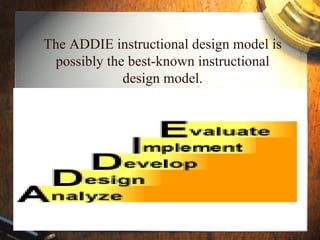

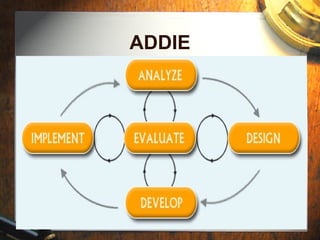



www.christopher-pappas.com The ADDIE instructional design model is possibly the best-known instructional design model. The ADDIE model refers to Analyze, Design, Develop, Implement, and Evaluate. Furthermore, provides a step-by-step process that helps instructional designers plan and create training programs with a framework in order to make sure that their instructional products are effective and that their processes are as efficient as they can possibly be. Analyze In the analysis phase, the instructional problem is clarified, the instructional goals and objectives are established, and the learning environment and learner's existing knowledge and skills are identified. Below are some of the questions that are addressed during the analysis phase: * Who is the audience and what are their characteristics? * Did we identify the new behavioral outcome? * What types of learning constraints exist? * What are the delivery options? * What are the online pedagogical considerations? * What is the timeline for project completion? Design The design phase deals with learning objectives, assessment instruments, exercises, content, subject matter analysis, lesson planning, and media selection. The design phase should be systematic and specific. Systematic means a logical, orderly method of identifying, developing, and evaluating a set of planned strategies targeted for attaining the project's goals. Specific means each element of the instructional design plan needs to be executed with attention to details.These are the steps used for the design phase: * Documentation of the project's instructional, visual, and technical design strategy * Apply instructional strategies according to the intended behavioral outcomes by domain (cognitive, affective, psychomotor). * Create storyboards * Design the user interface and user experience * Prototype creation * Apply visual design (graphic design) Development The development phase is where the developers create and assemble the content assets that were created in the design phase. Programmers work to develop and/or integrate technologies. Testers perform debugging procedures. The project is reviewed and revised according to any feedback given. * List activities that will help the students learn the task. * Select the delivery method such as tapes, handouts, etc. * Review existing material so that we do not reinvent the wheel. * Develop the instructional courseware. * Synthesize the courseware into a viable training program. * Validate the instruction to ensure it accomplishes all goals and objectives. Implement During the implementation phase, a procedure for training the facilitators and the learners is developed. The facilitators' training should cover the course curriculum, learning outcomes, method of delivery, and testing procedures. Preparation of the learners include training them on new tools (software or hardware), and student registration.This is also the phase where the project manager ensures that the books, hands on equipment, tools, CD-ROMs, and software are in place, and that the learning application or Web site is functional. Evaluation The evaluation phase consists of two parts: formative and summative. Formative evaluation is present in each stage of the ADDIE process. Summative evaluation consists of tests designed for domain-specific, criterion-related referenced items and providing opportunities for feedback from the users. * Review and evaluate each phase (analyze, design, develop, implement) to ensure it is accomplishing what it is supposed to. * Perform external evaluations (e.g. observe that the learner on the job can actually perform the tasks that were trained). * Revise training system to make it better.


