
Poster21: Sub-Saharan Africa challenge program: Lake Kivu pilot learning site
•Download as PPT, PDF•
0 likes•621 views

Poster for CIAT 2009 Knowledge Sharing Week
Recommended

Recommended
More Related Content
More from CIAT
More from CIAT (20)
Recently uploaded
Recently uploaded (20)
Poster21: Sub-Saharan Africa challenge program: Lake Kivu pilot learning site
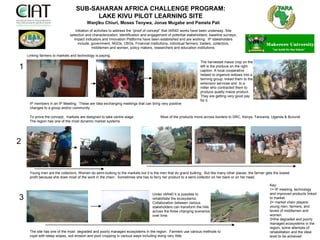
- 1. SUB-SAHARAN AFRICA CHALLENGE PROGRAM: LAKE KIVU PILOT LEARNING SITE Initiation of activities to address the “proof of concept” that IAR4D works have been underway. Site selection and characterization; identification and engagement of potential stakeholders; baseline surveys; impact indicators and Innovation Platforms have been established and are working. IP stakeholders include, government, NGOs, CBOs, Financial institutions, individual farmers, traders, collectors, middlemen and women, policy makers, researchers and education institutions. IP members in an IP Meeting. These are idea exchanging meetings that can bring very positive changes to a group and/or community To prove the concept, markets are designed to take centre stage. The region has one of the most dynamic market systems Young men are the collectors, Women do semi-bulking to the markets but it is the men that do grand bulking. But like many other places, the farmer gets the lowest profit because she does most of the work in the chain. Sometimes she has to ferry her product to a semi-collector on her back or on her head. Linking farmers to markets and technology is paying. The site has one of the most degraded and poorly managed ecosystems in the region. Farmers use various methods to cope with steep slopes, soil erosion and poor cropping in various ways including doing very little. Most of the products move across borders to DRC, Kenya, Tanzania, Uganda & Burundi Under IAR4D it is possible to rehabilitate the ecosystems. Collaboration between various stakeholders can transform the hills across the three changing scenarios over time. The harvested maize crop on the left is the produce on the right caption. A local cooperative helped to organize widows into a farming group; linked them to the extension services and to a miller who contracted them to produce quality maize product. They are getting very good pay for it. 1 2 3 Key: 1= IP meeting, technology and improved products linked to market. 2= market chain players-young men, farmers, and levels of middlemen and women 3=the degraded and poorly managed ecosystems in the region, some attempts of rehabilitation and the ideal level to be achieved Wanjiku Chiuri, Moses Tenywa, Jonas Mugabe and Pamela Pali