Easy Solutions
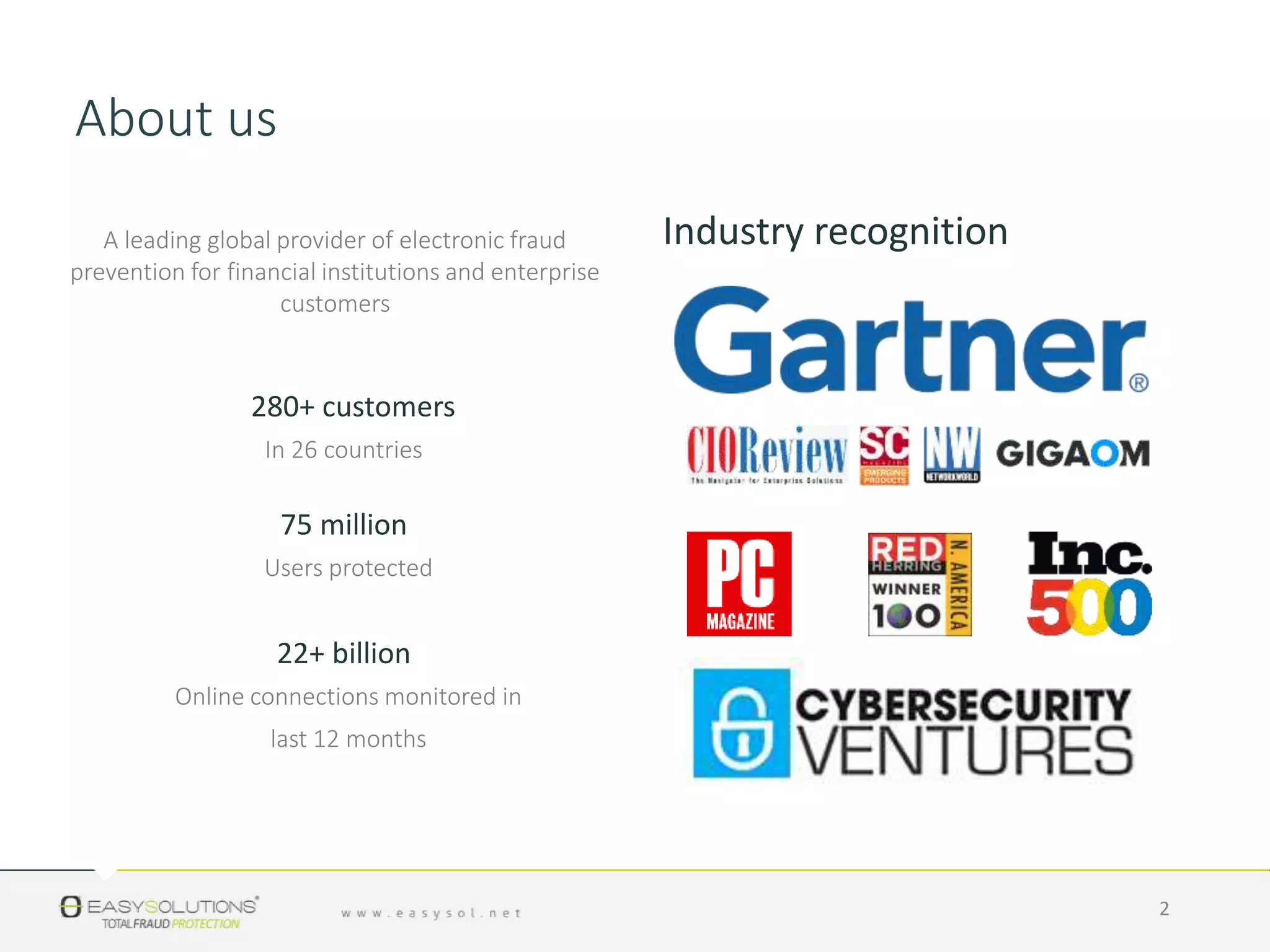
About us
Industry recognitionA leading global provider of electronic fraud
prevention for financial institutions and enterprise
customers
280+ customers
In 26 countries
75 million
Users protected
22+ billion
Online connections monitored in
last 12 months
2
Some of our Customers
3
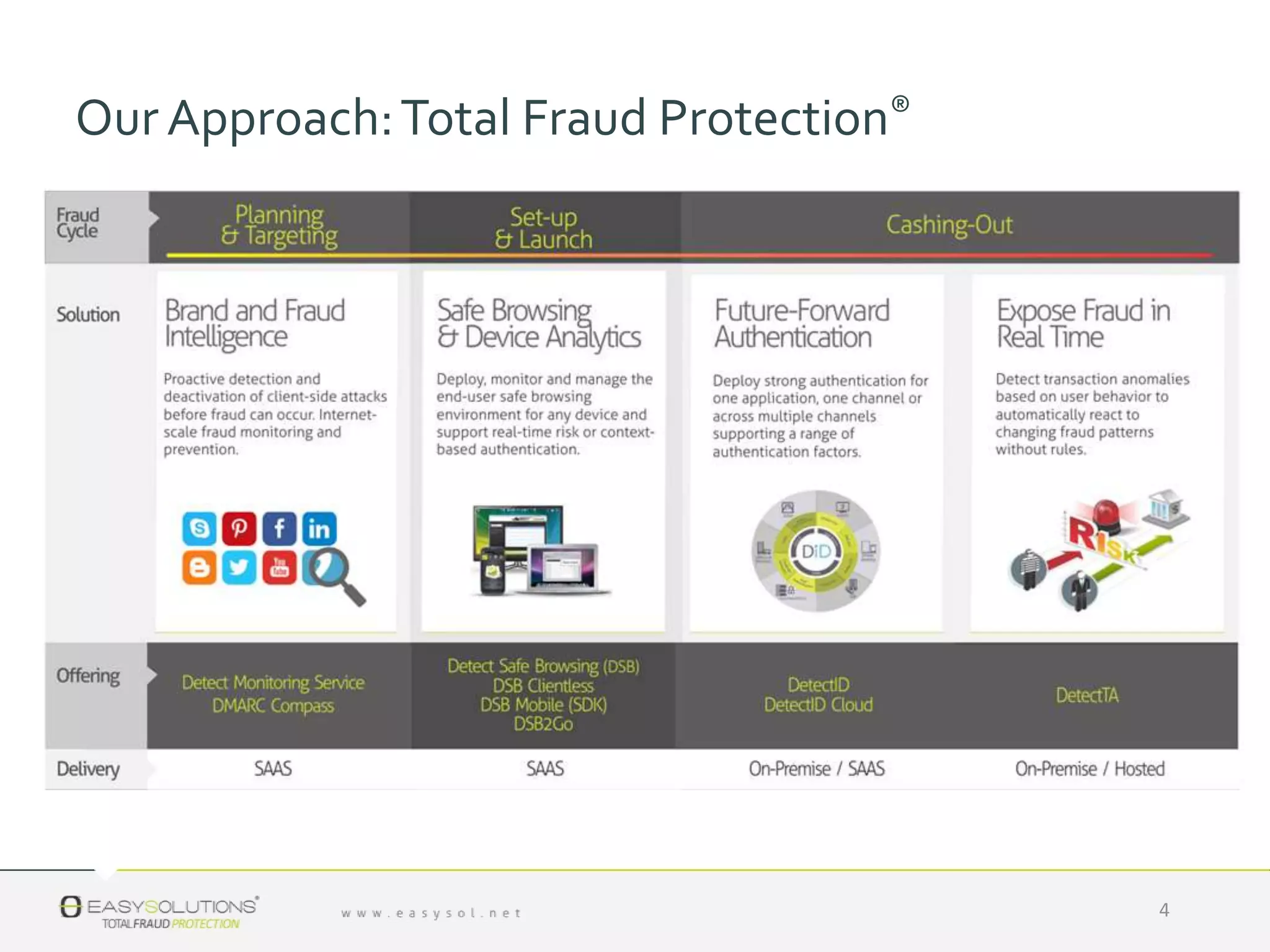
Our Approach:Total Fraud Protection®
4
Fraud Analytics
Alejandro Correa Bahnsen, PhD
Data Scientist
About me
• PhD in Machine Learning at Luxembourg University
• Data Scientist at Easy Solutions
• Worked for +8 years as a data scientist at GE Money, Scotiabank
and SIX Financial Services
• Bachelor and Master in Industrial Engineering
• Organizer of Data Science Luxembourg and recently of Big Data
Science Bogota
6
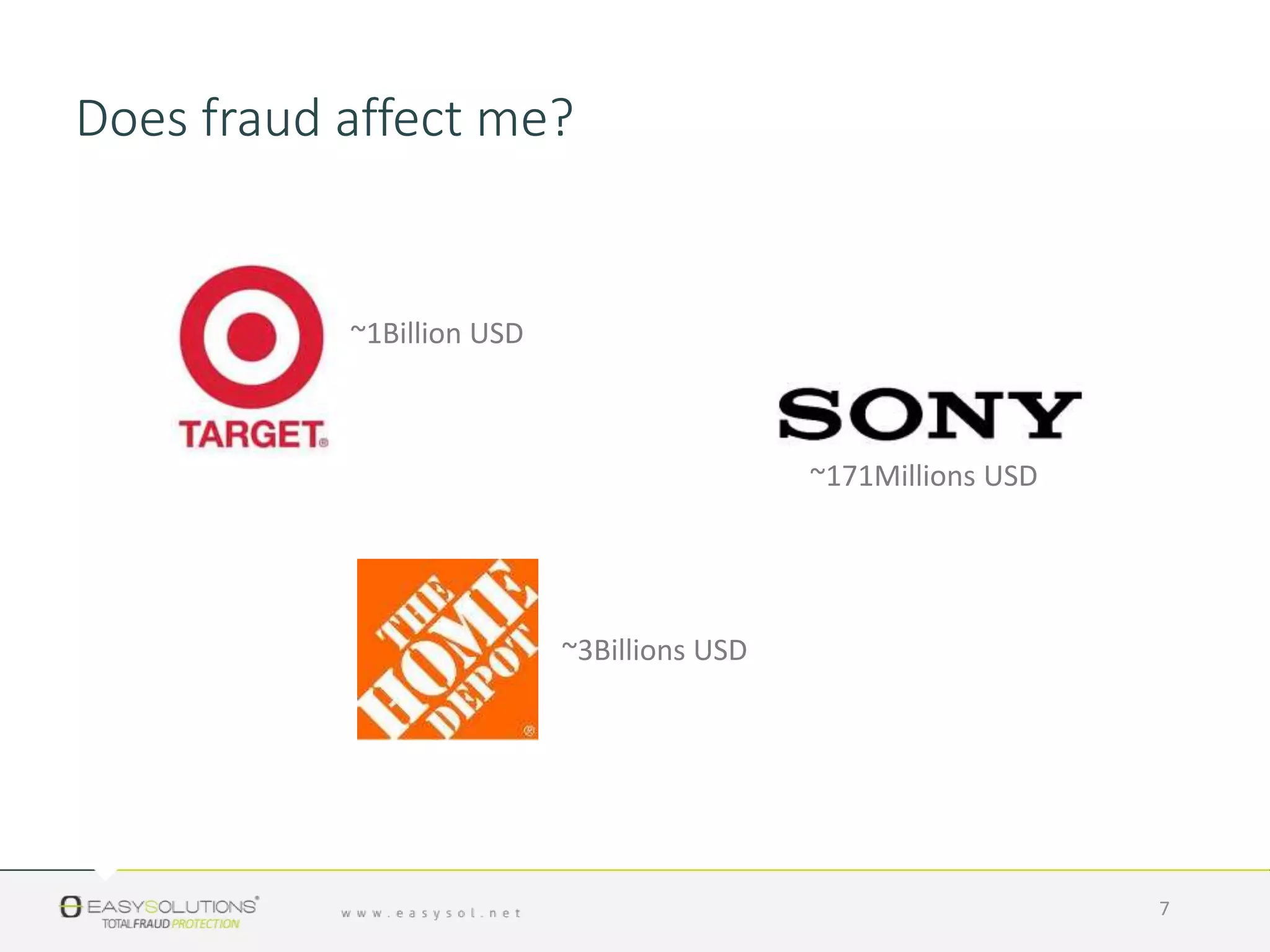
~1Billion USD
~171Millions USD
~3Billions USD
Does fraud affect me?
7
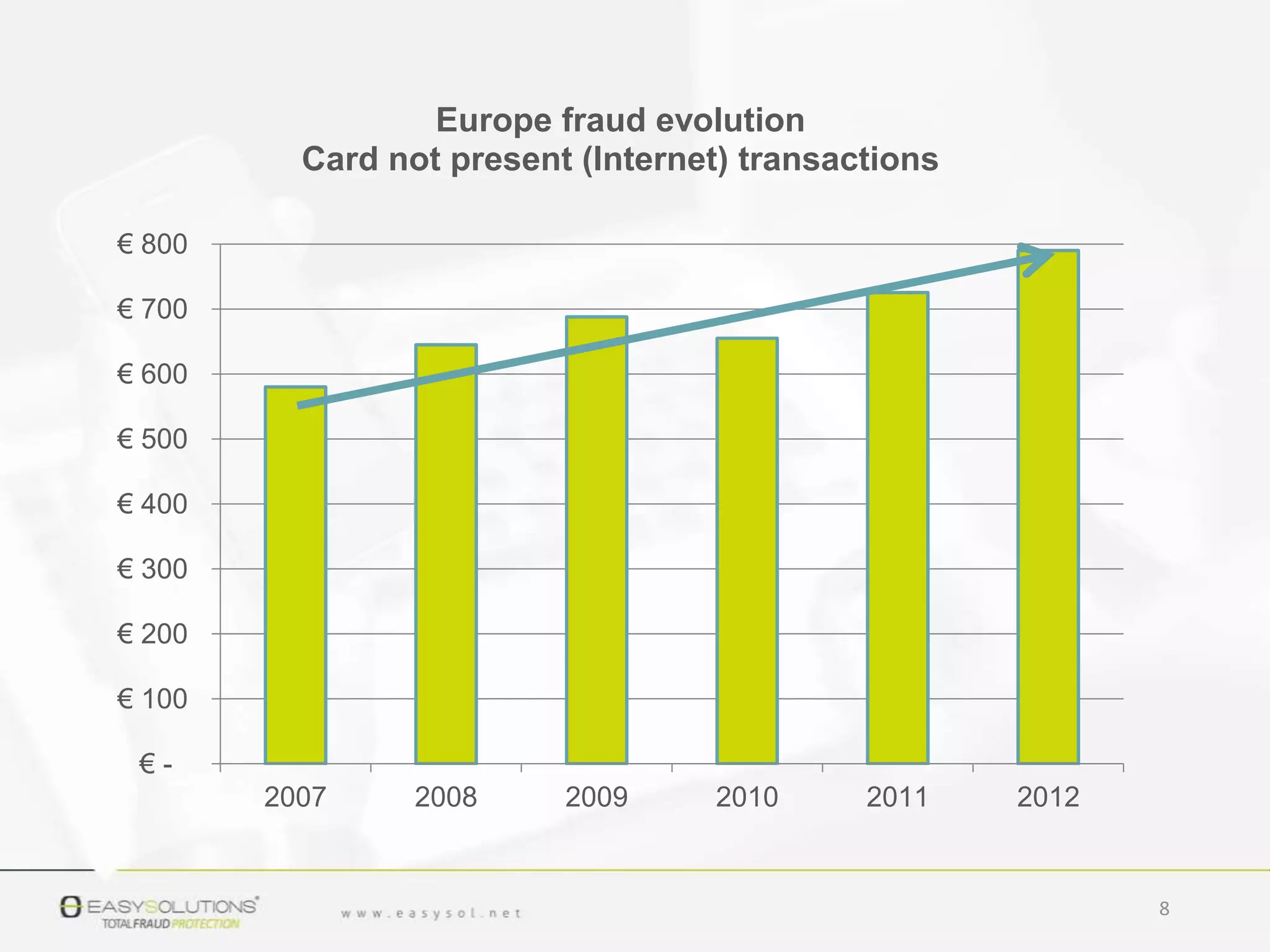
€ -
€ 100
€ 200
€ 300
€ 400
€ 500
€ 600
€ 700
€ 800
2007 2008 2009 2010 2011 2012
Europe fraud evolution
Card not present (Internet) transactions
8
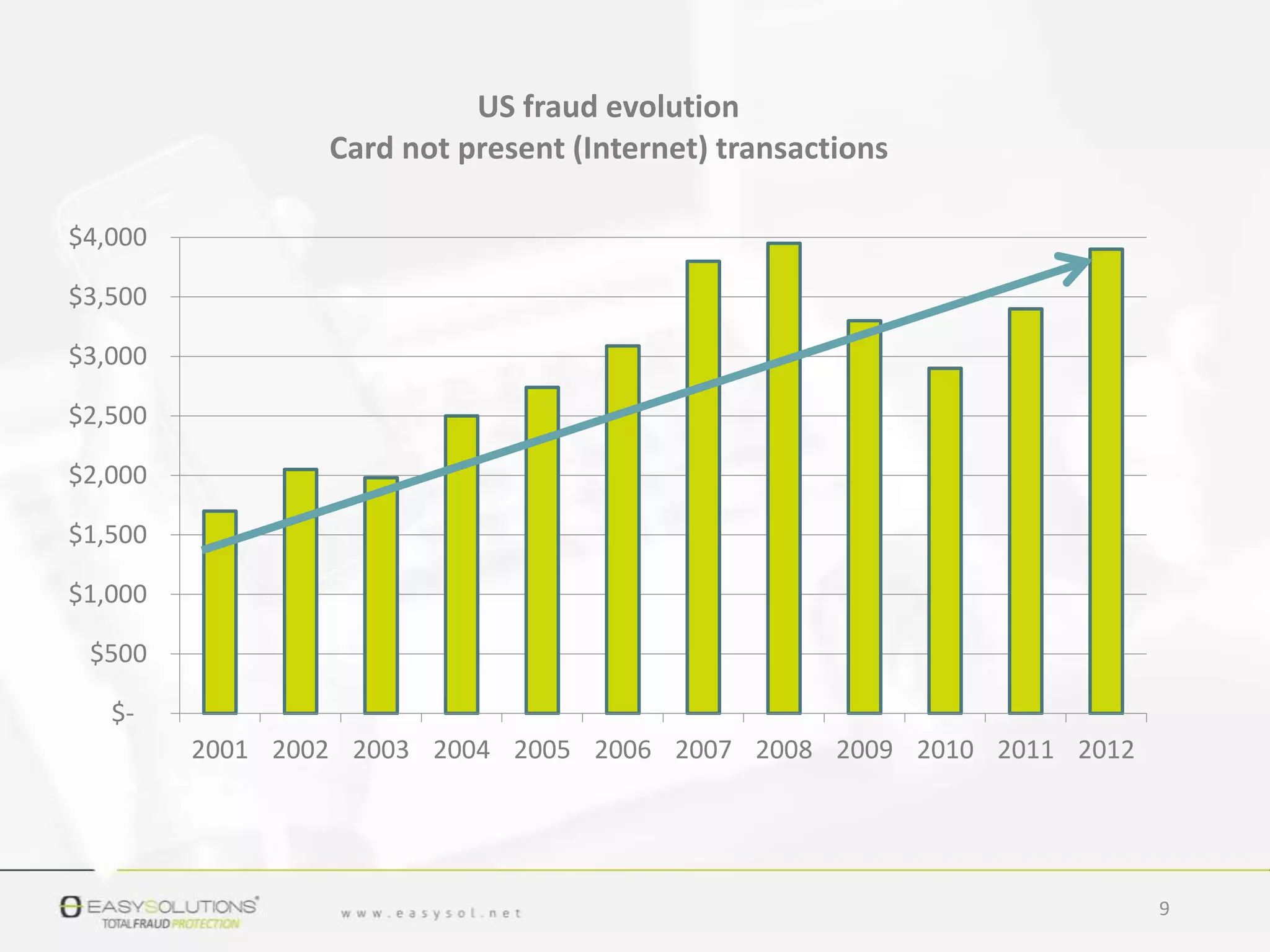
$-
$500
$1,000
$1,500
$2,000
$2,500
$3,000
$3,500
$4,000
2001 2002 2003 2004 2005 2006 2007 2008 2009 2010 2011 2012
US fraud evolution
Card not present (Internet) transactions
9
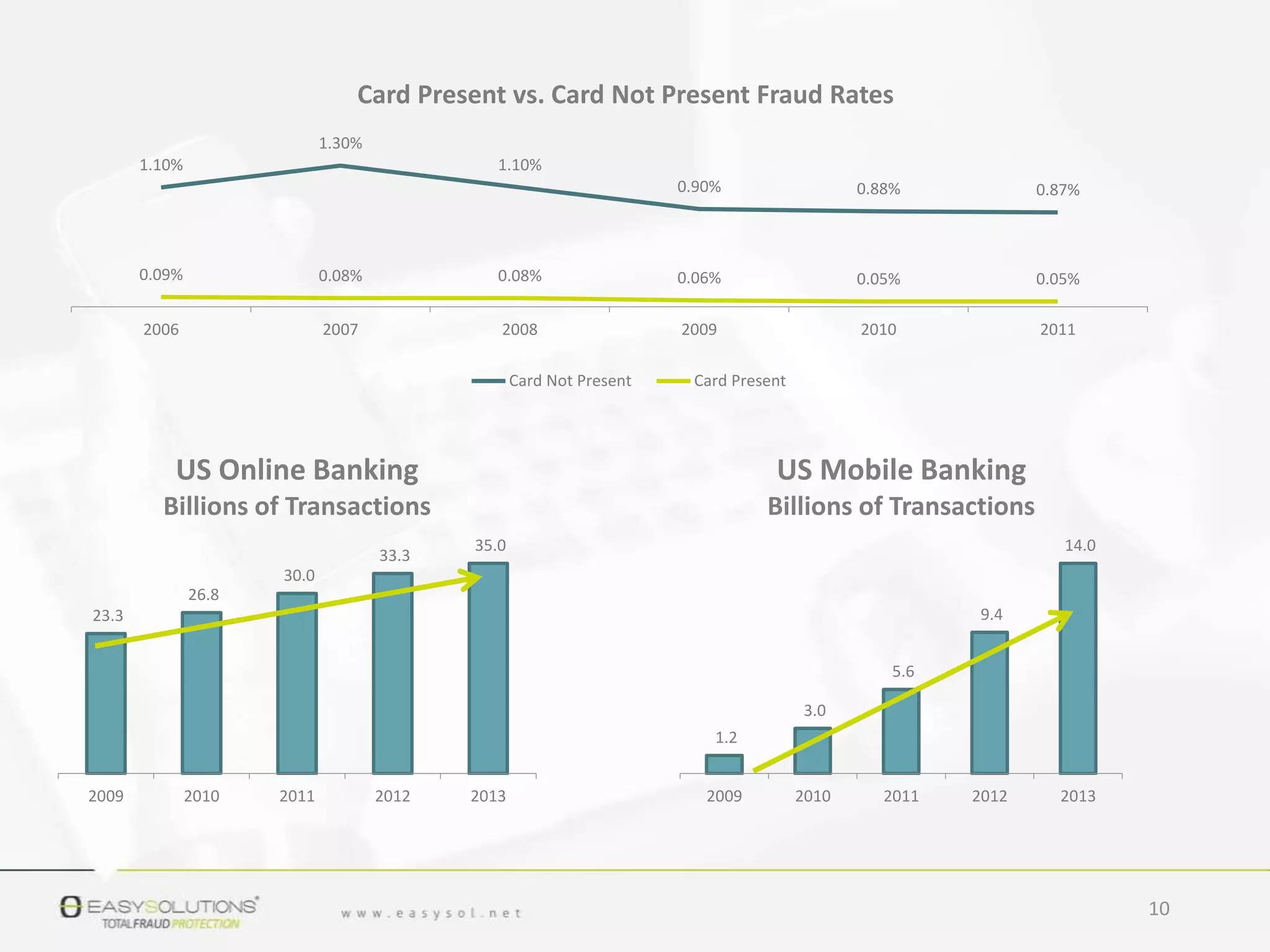
1.10%
1.30%
1.10%
0.90% 0.88% 0.87%
0.09% 0.08% 0.08% 0.06% 0.05% 0.05%
2006 2007 2008 2009 2010 2011
Card Present vs. Card Not Present Fraud Rates
Card Not Present Card Present
23.3
26.8
30.0
33.3
35.0
2009 2010 2011 2012 2013
US Online Banking
Billions of Transactions
1.2
3.0
5.6
9.4
14.0
2009 2010 2011 2012 2013
US Mobile Banking
Billions of Transactions
10
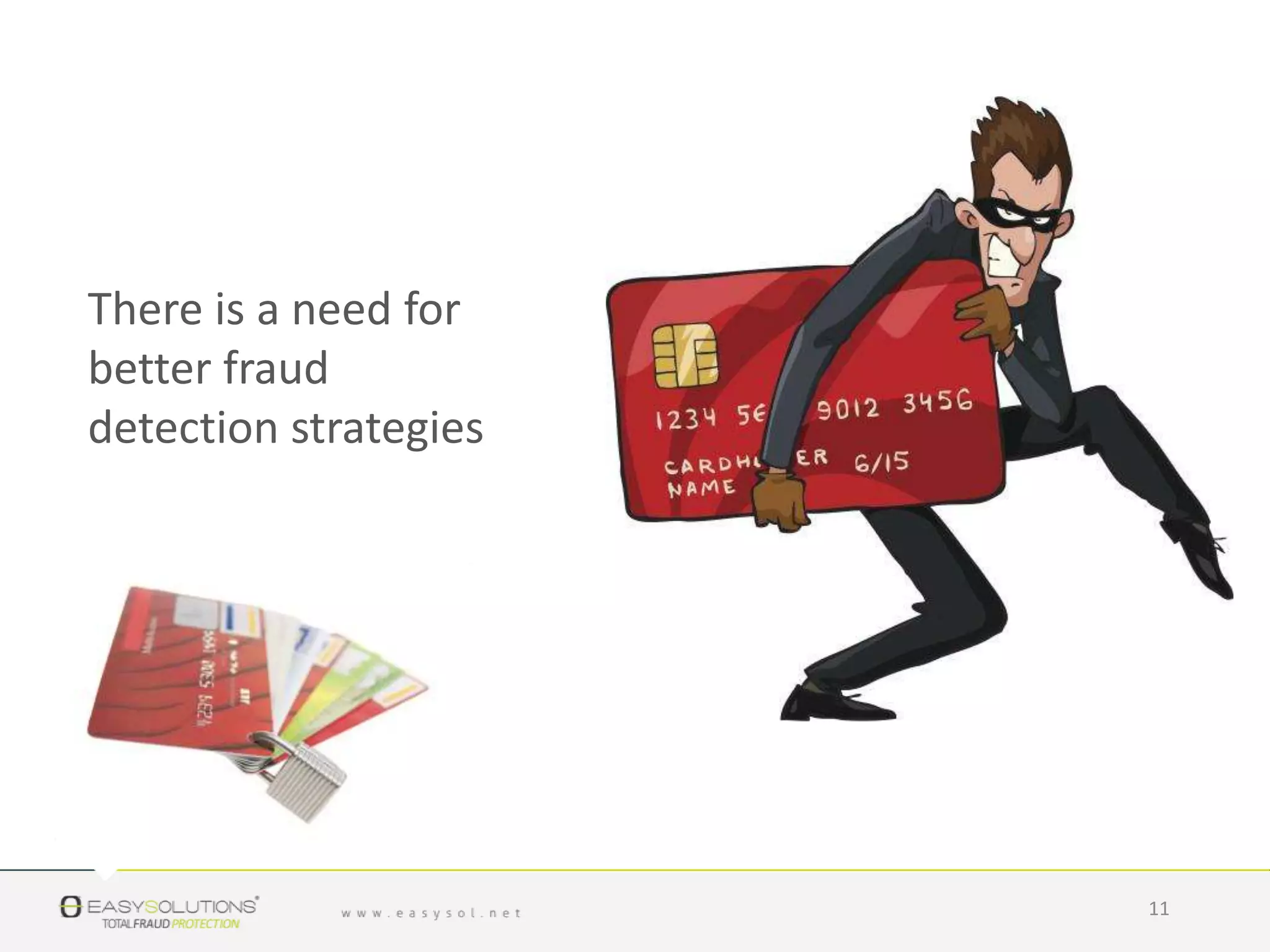
There is a need for
better fraud
detection strategies
11
12
BigData?
13
“War is ninety percent information”
• Napoleon Bonaparte
14
15
16
Big data (Data Science) is like teenage sex:
everyone talks about it,
nobody really knows how to do it,
everyone thinks everyone else is doing it,
so everyone claims they are doing it...
17
18
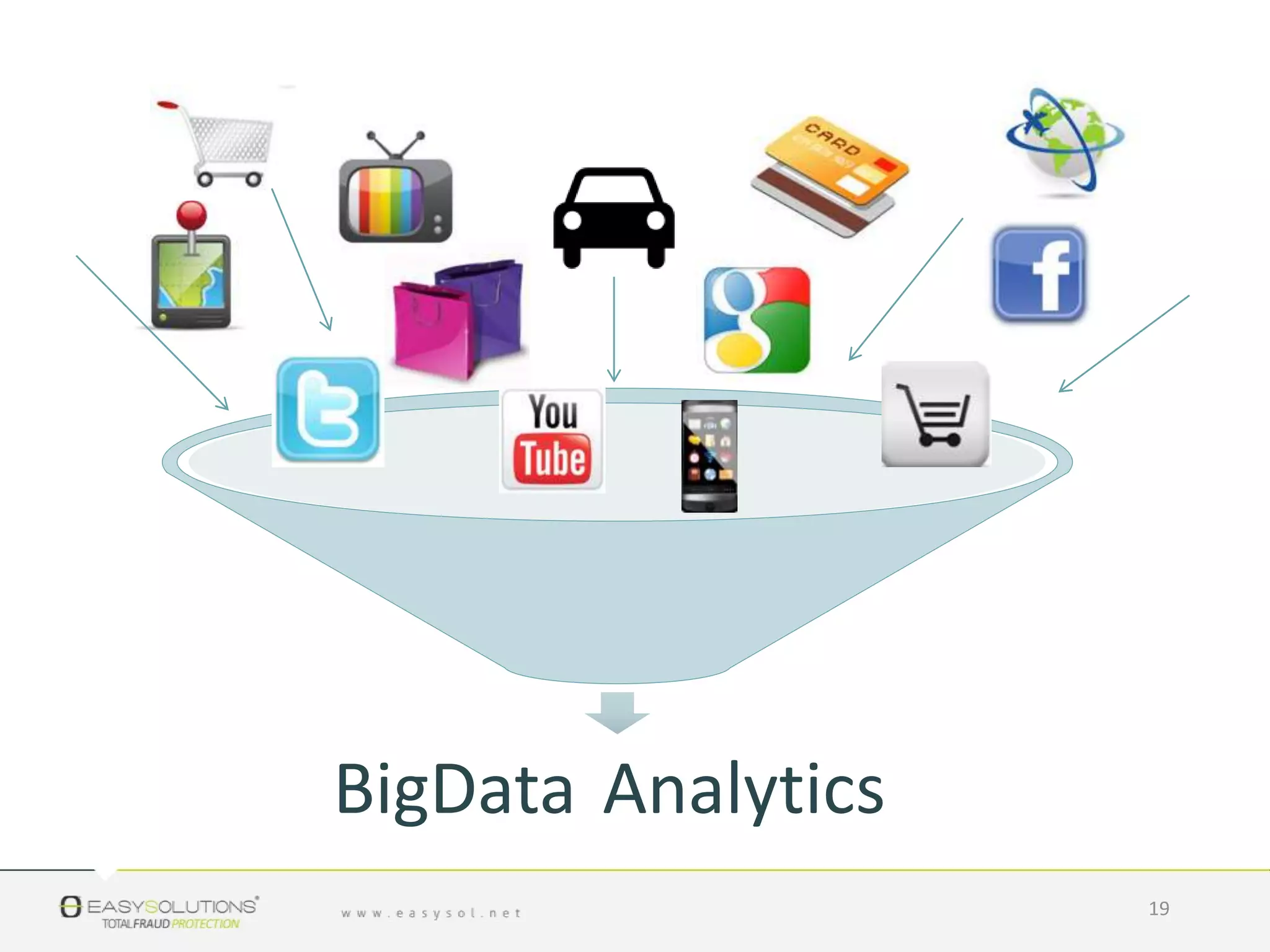
BigData Analytics
19
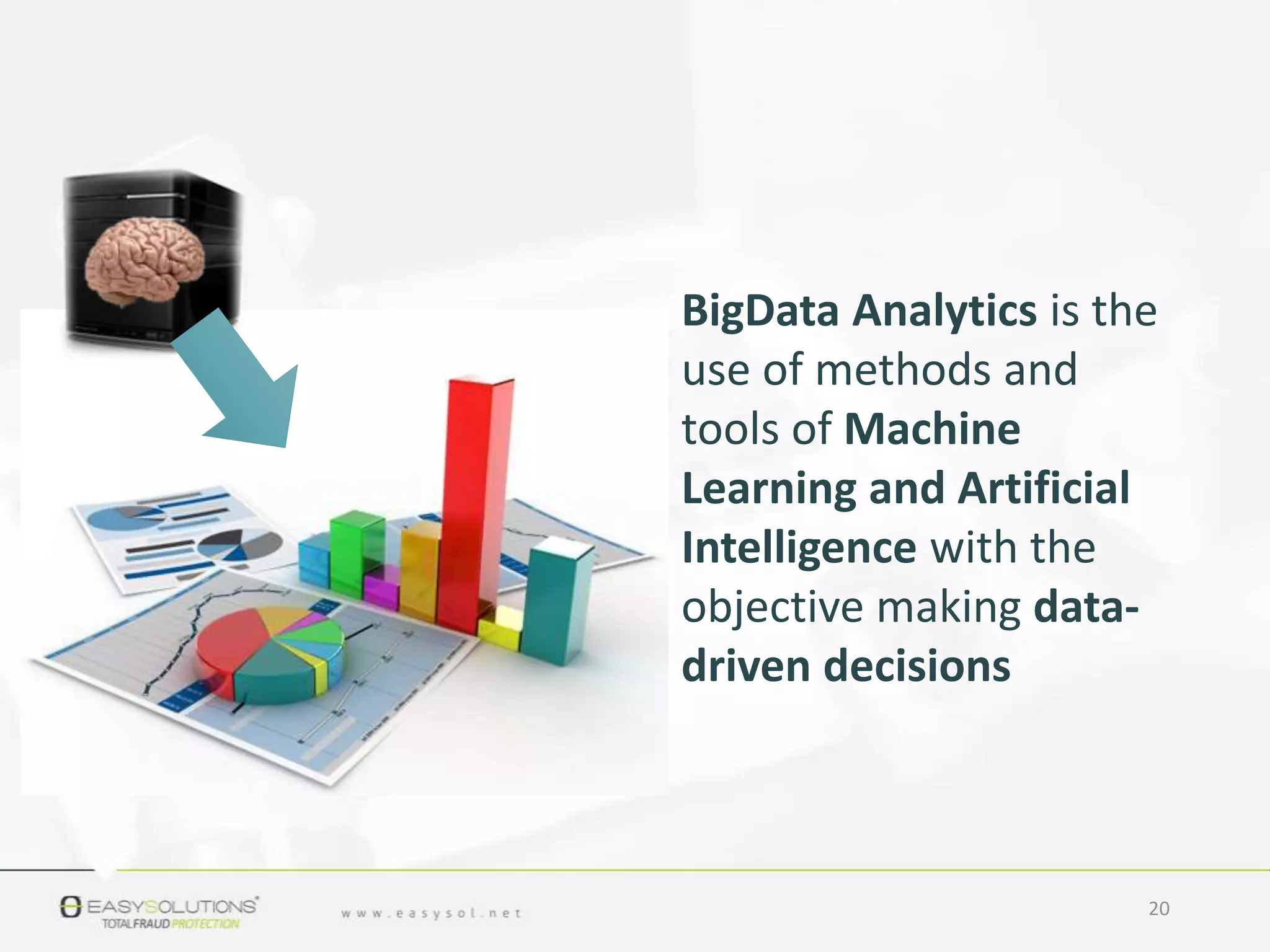
BigData Analytics is the
use of methods and
tools of Machine
Learning and Artificial
Intelligence with the
objective making data-
driven decisions
20
Fraud detection
and prevention
21
Estimate the probability of a transaction being fraud based on analyzing
customer patterns and recent fraudulent behavior
Issues when constructing a fraud detection system:
• Skewness of the data
• Cost-sensitivity
• Short time response of the system
• Dimensionality of the search space
• Feature preprocessing
• Model selection
22
Credit card fraud detection
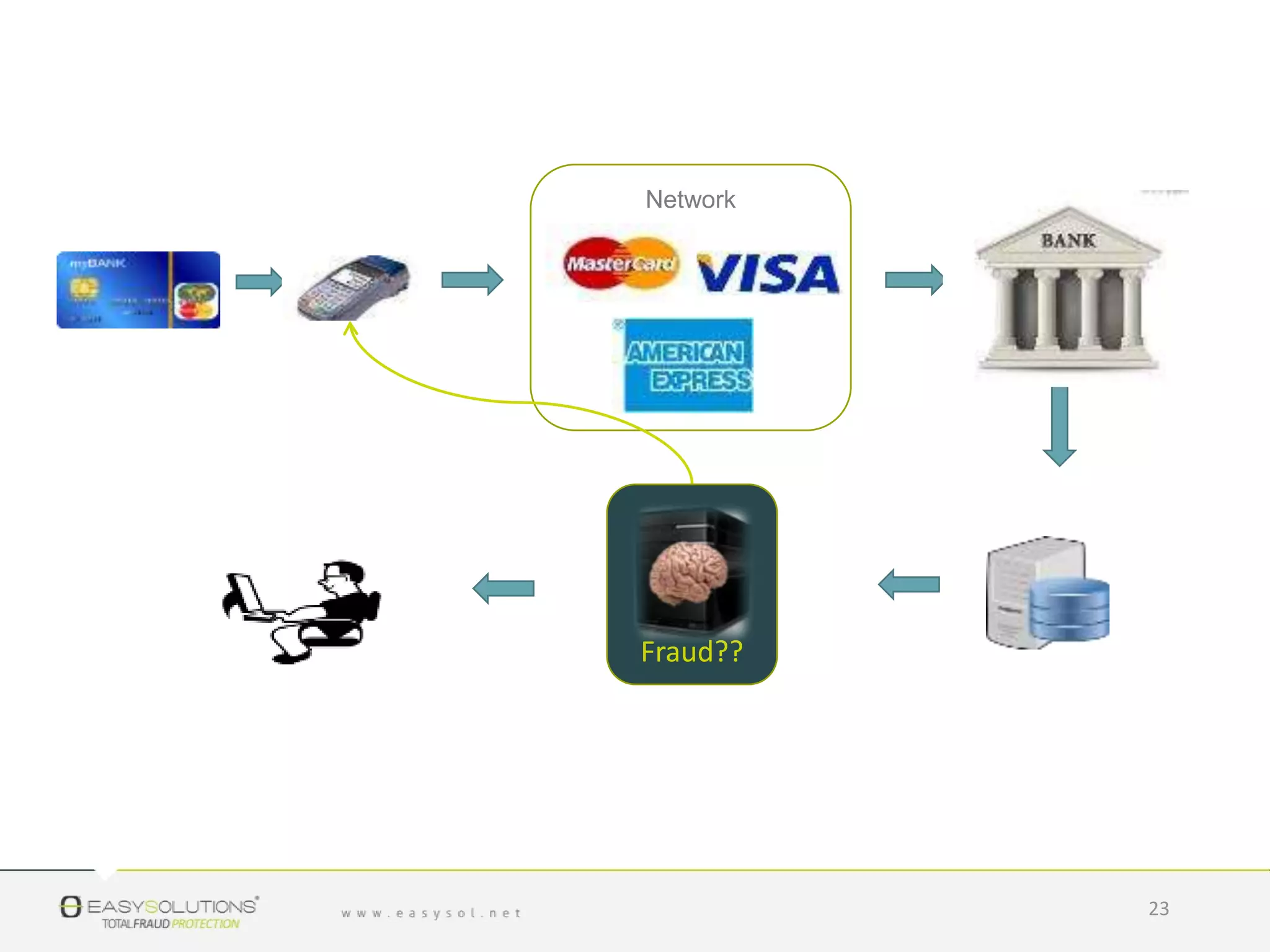
Network
Fraud??
23
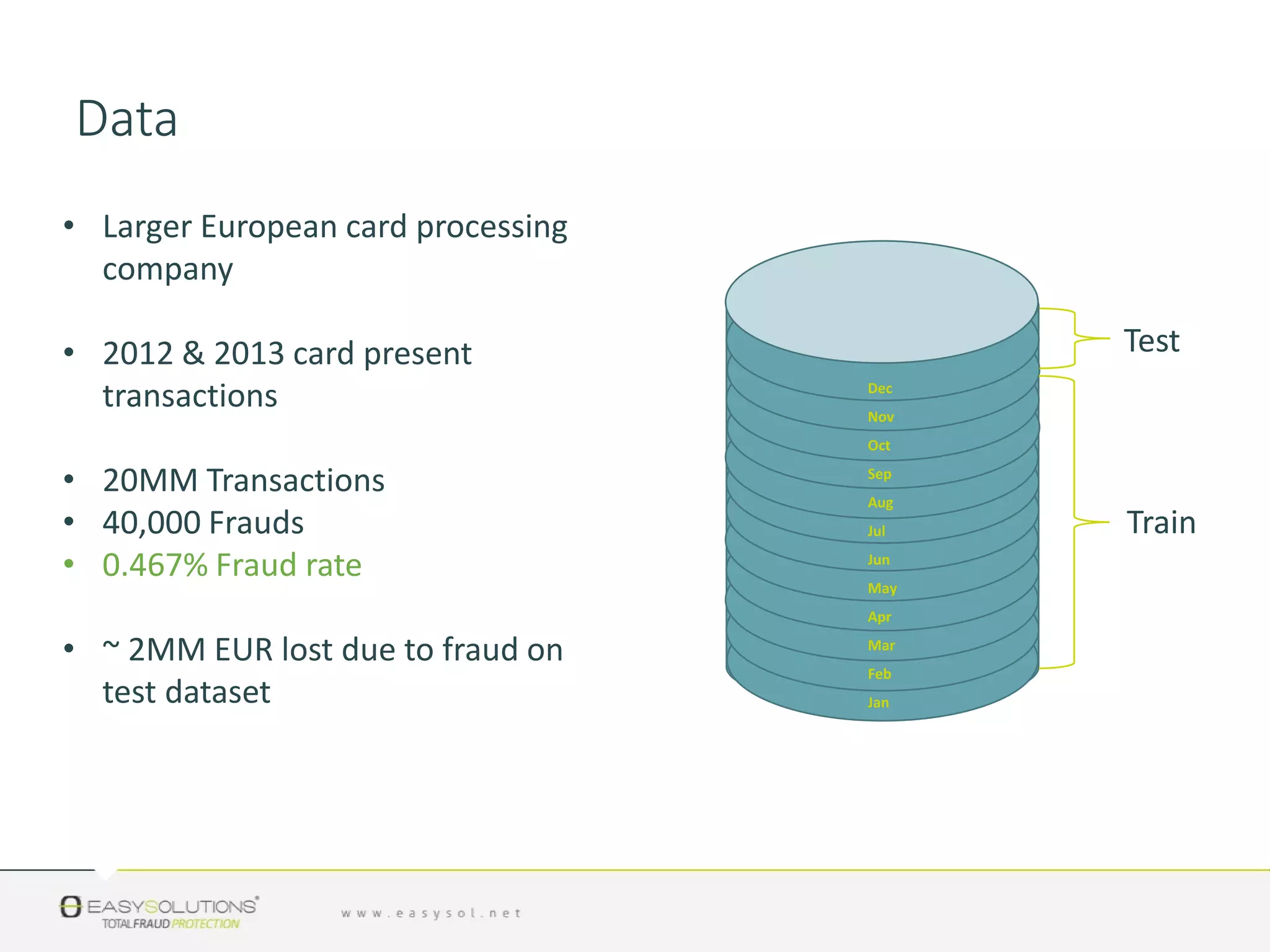
• Larger European card processing
company
• 2012 & 2013 card present
transactions
• 20MM Transactions
• 40,000 Frauds
• 0.467% Fraud rate
• ~ 2MM EUR lost due to fraud on
test dataset
Dec
Nov
Oct
Sep
Aug
Jul
Jun
May
Apr
Mar
Feb
Jan
Test
Train
Data
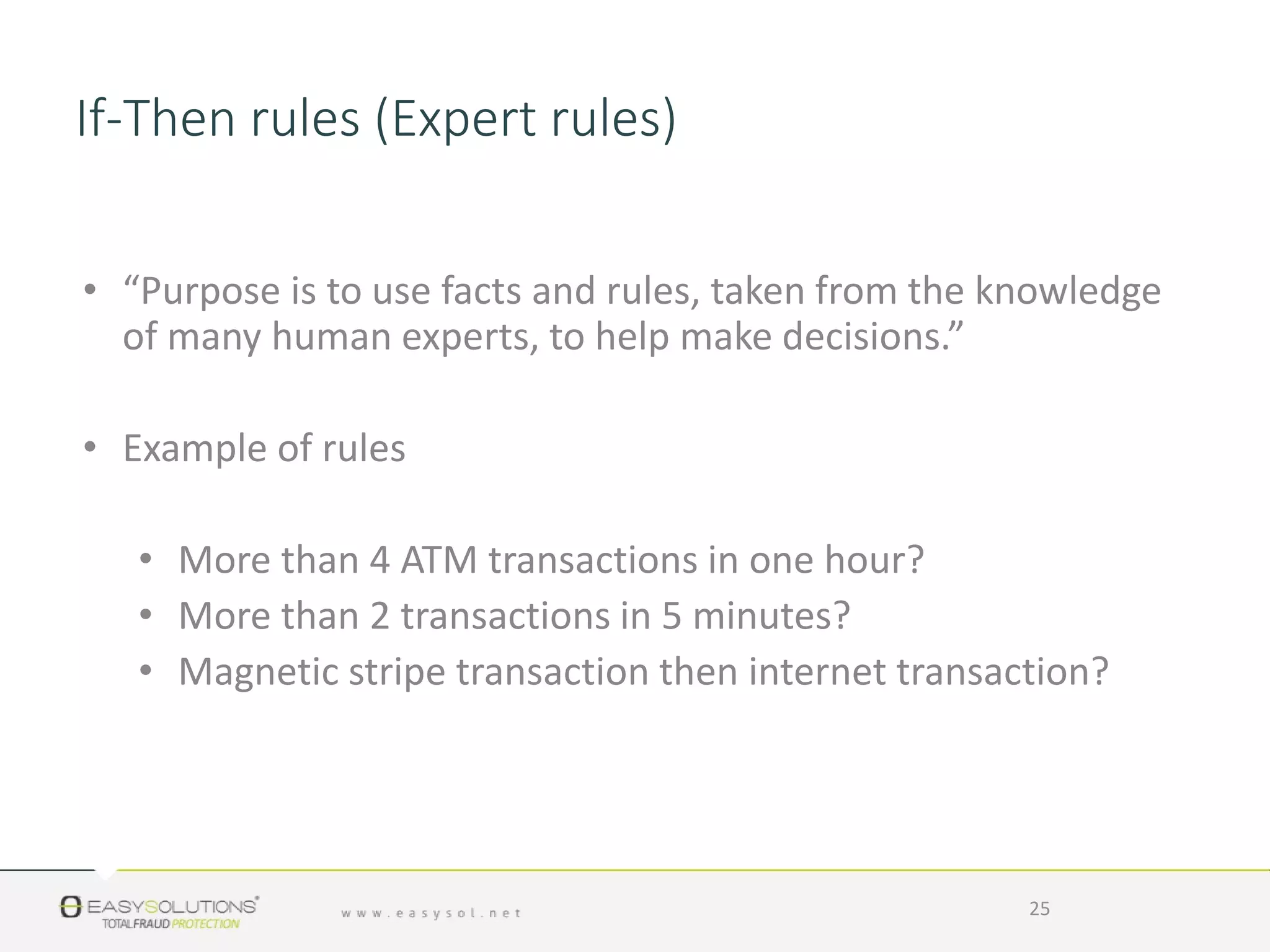
• “Purpose is to use facts and rules, taken from the knowledge
of many human experts, to help make decisions.”
• Example of rules
• More than 4 ATM transactions in one hour?
• More than 2 transactions in 5 minutes?
• Magnetic stripe transaction then internet transaction?
25
If-Then rules (Expert rules)
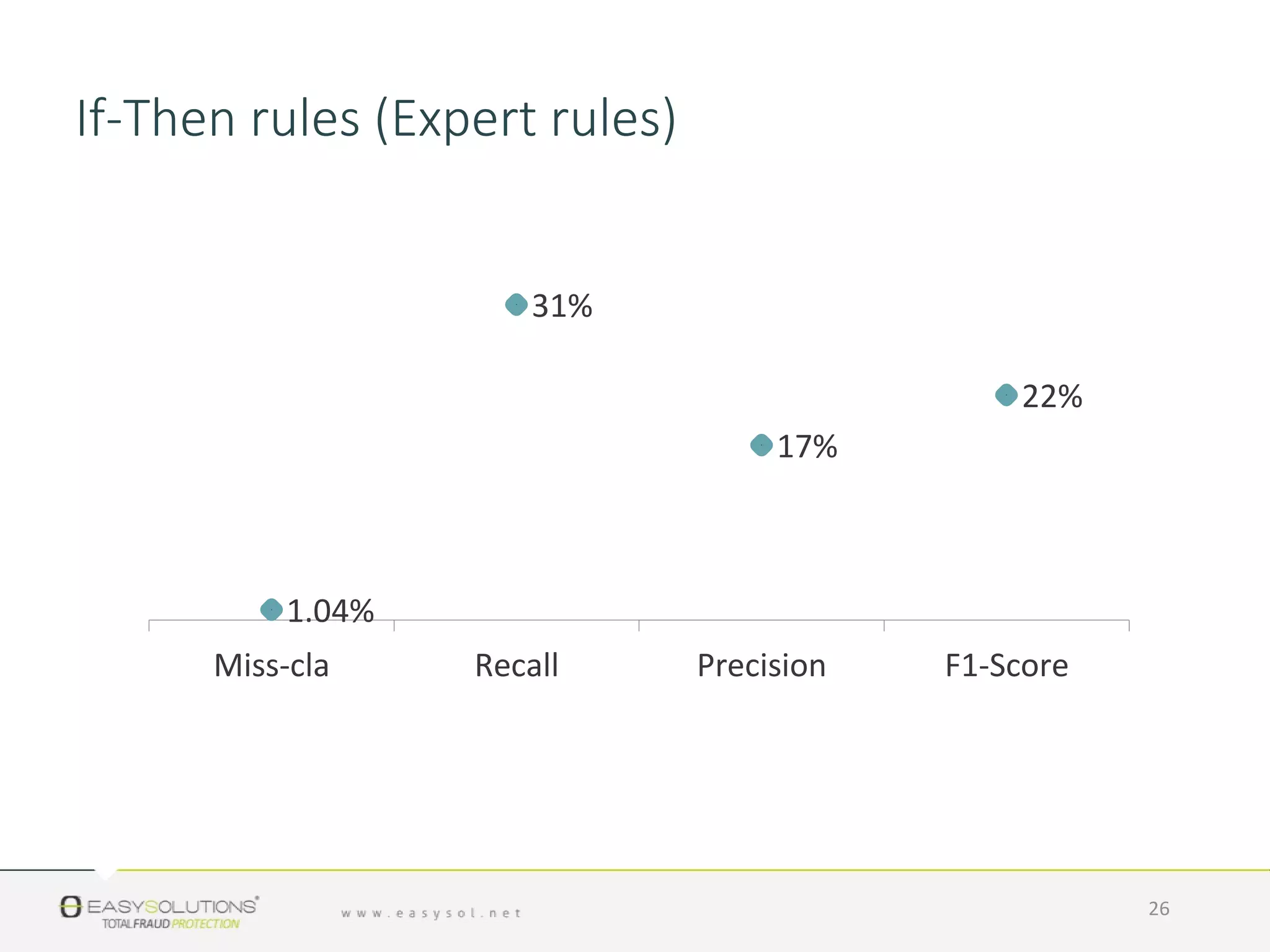
1.04%
31%
17%
22%
Miss-cla Recall Precision F1-Score
26
If-Then rules (Expert rules)
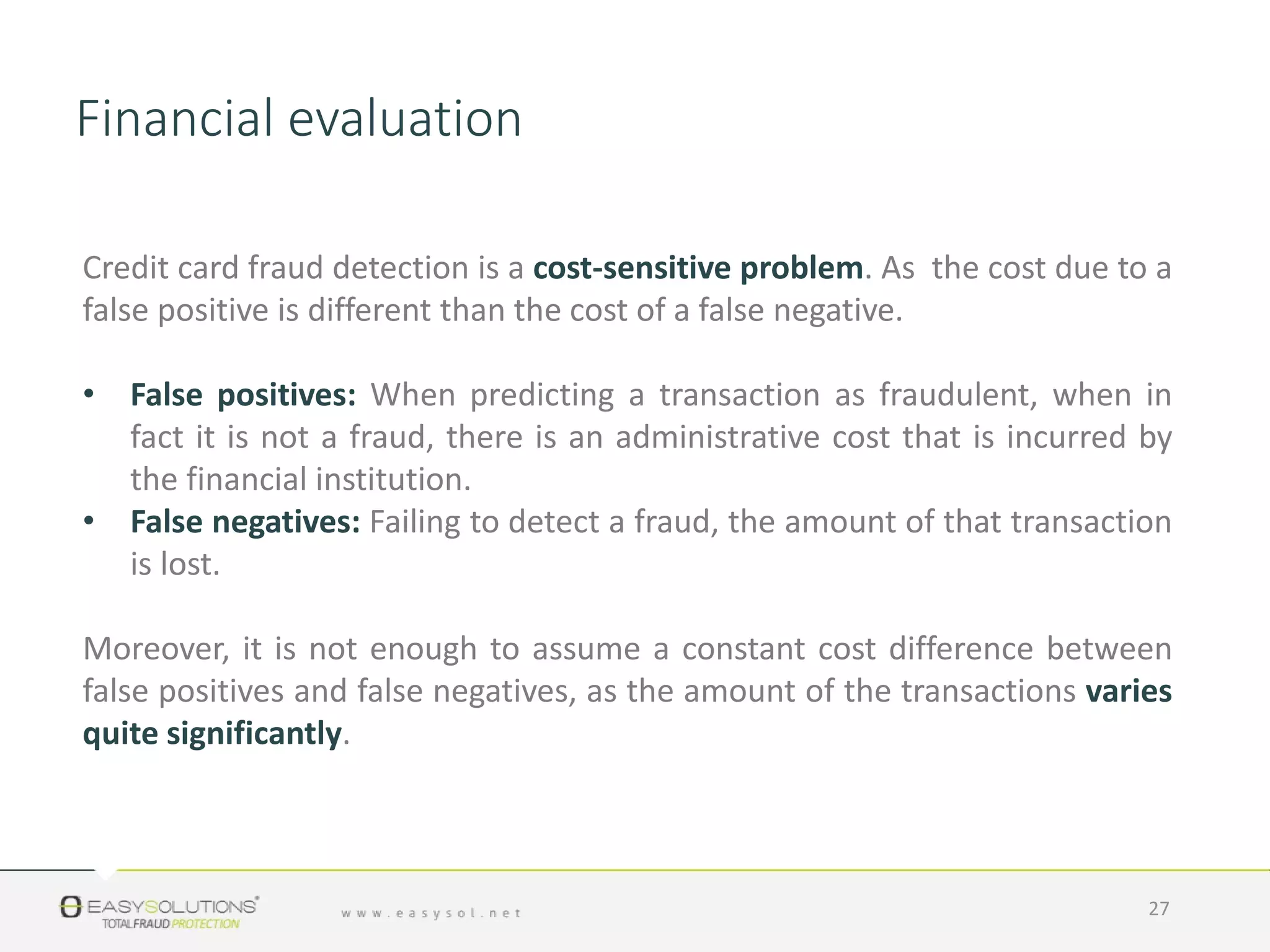
Credit card fraud detection is a cost-sensitive problem. As the cost due to a
false positive is different than the cost of a false negative.
• False positives: When predicting a transaction as fraudulent, when in
fact it is not a fraud, there is an administrative cost that is incurred by
the financial institution.
• False negatives: Failing to detect a fraud, the amount of that transaction
is lost.
Moreover, it is not enough to assume a constant cost difference between
false positives and false negatives, as the amount of the transactions varies
quite significantly.
27
Financial evaluation
Cost matrix
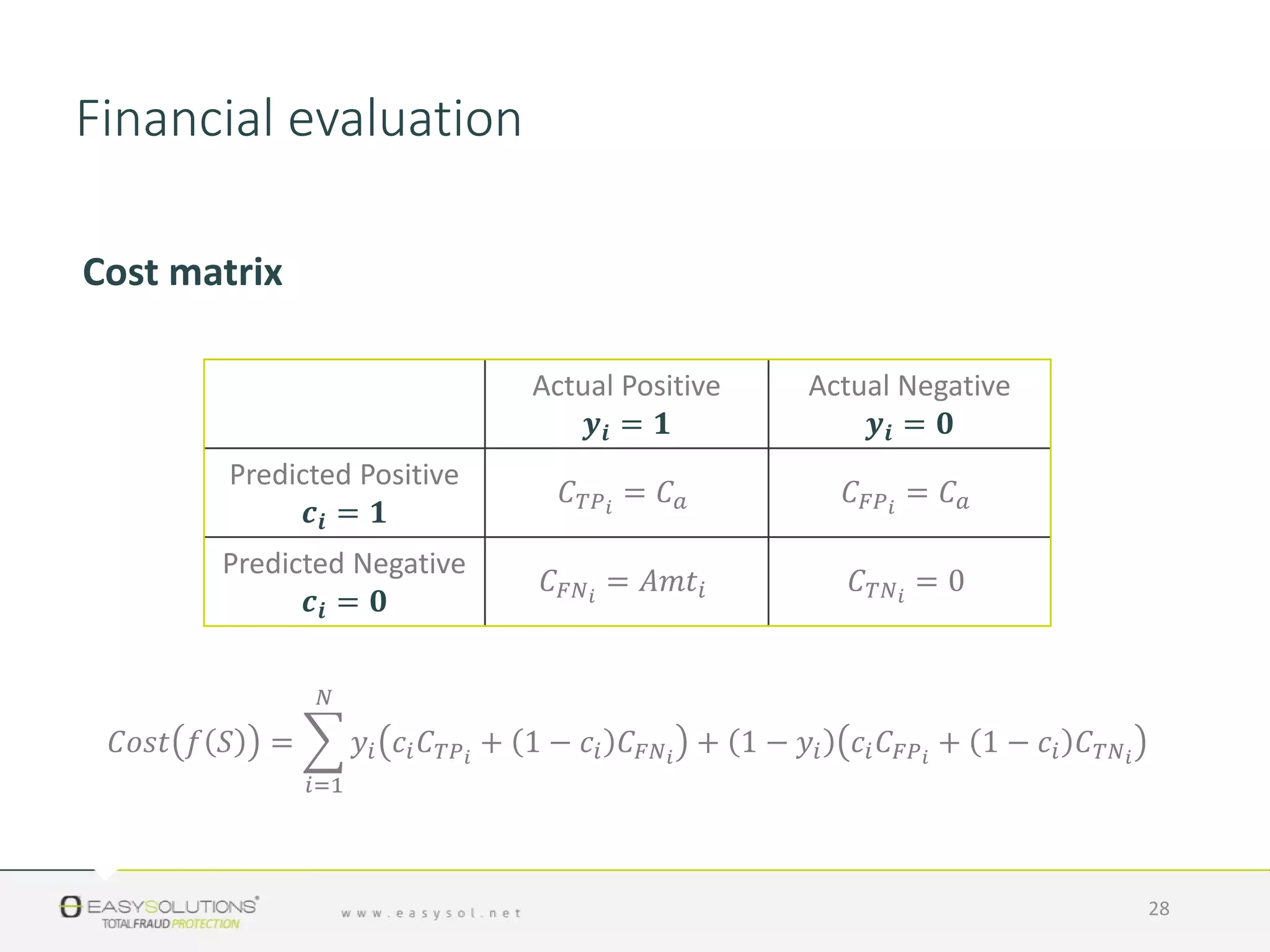
𝐶𝑜𝑠𝑡 𝑓 𝑆 =
𝑖=1
𝑁
𝑦𝑖 𝑐𝑖 𝐶 𝑇𝑃 𝑖
+ 1 − 𝑐𝑖 𝐶 𝐹𝑁 𝑖
+ 1 − 𝑦𝑖 𝑐𝑖 𝐶 𝐹𝑃 𝑖
+ 1 − 𝑐𝑖 𝐶 𝑇𝑁 𝑖
28
Actual Positive
𝒚𝒊 = 𝟏
Actual Negative
𝒚𝒊 = 𝟎
Predicted Positive
𝒄𝒊 = 𝟏
𝐶 𝑇𝑃 𝑖
= 𝐶 𝑎 𝐶 𝐹𝑃 𝑖
= 𝐶 𝑎
Predicted Negative
𝒄𝒊 = 𝟎
𝐶 𝐹𝑁 𝑖
= 𝐴𝑚𝑡𝑖 𝐶 𝑇𝑁 𝑖
= 0
Financial evaluation
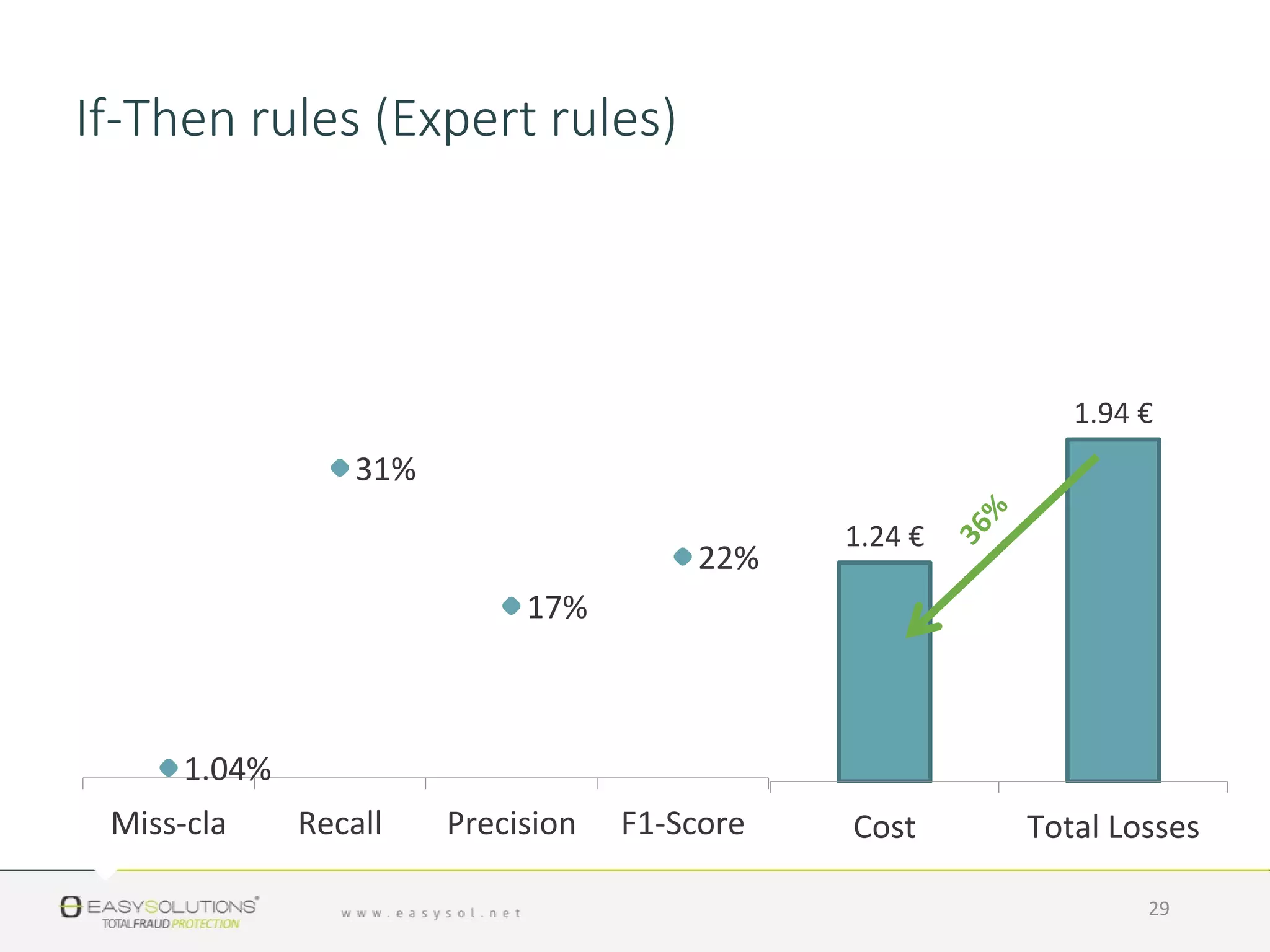
1.24 €
1.94 €
Cost Total Losses
1.04%
31%
17%
22%
Miss-cla Recall Precision F1-Score
29
If-Then rules (Expert rules)
Fraud Analytics
30
Raw features
31
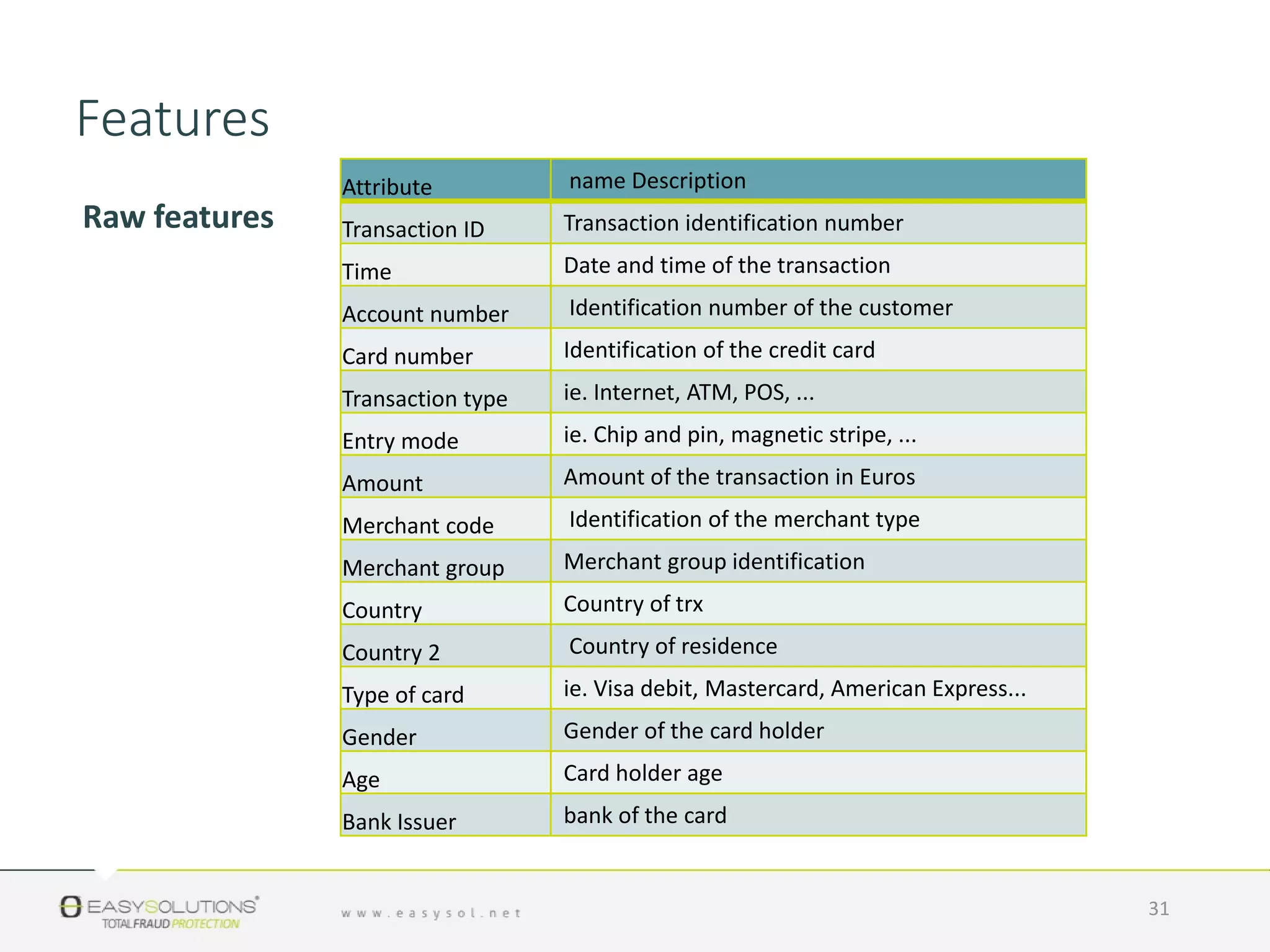
Attribute name Description
Transaction ID Transaction identification number
Time Date and time of the transaction
Account number Identification number of the customer
Card number Identification of the credit card
Transaction type ie. Internet, ATM, POS, ...
Entry mode ie. Chip and pin, magnetic stripe, ...
Amount Amount of the transaction in Euros
Merchant code Identification of the merchant type
Merchant group Merchant group identification
Country Country of trx
Country 2 Country of residence
Type of card ie. Visa debit, Mastercard, American Express...
Gender Gender of the card holder
Age Card holder age
Bank Issuer bank of the card
Features
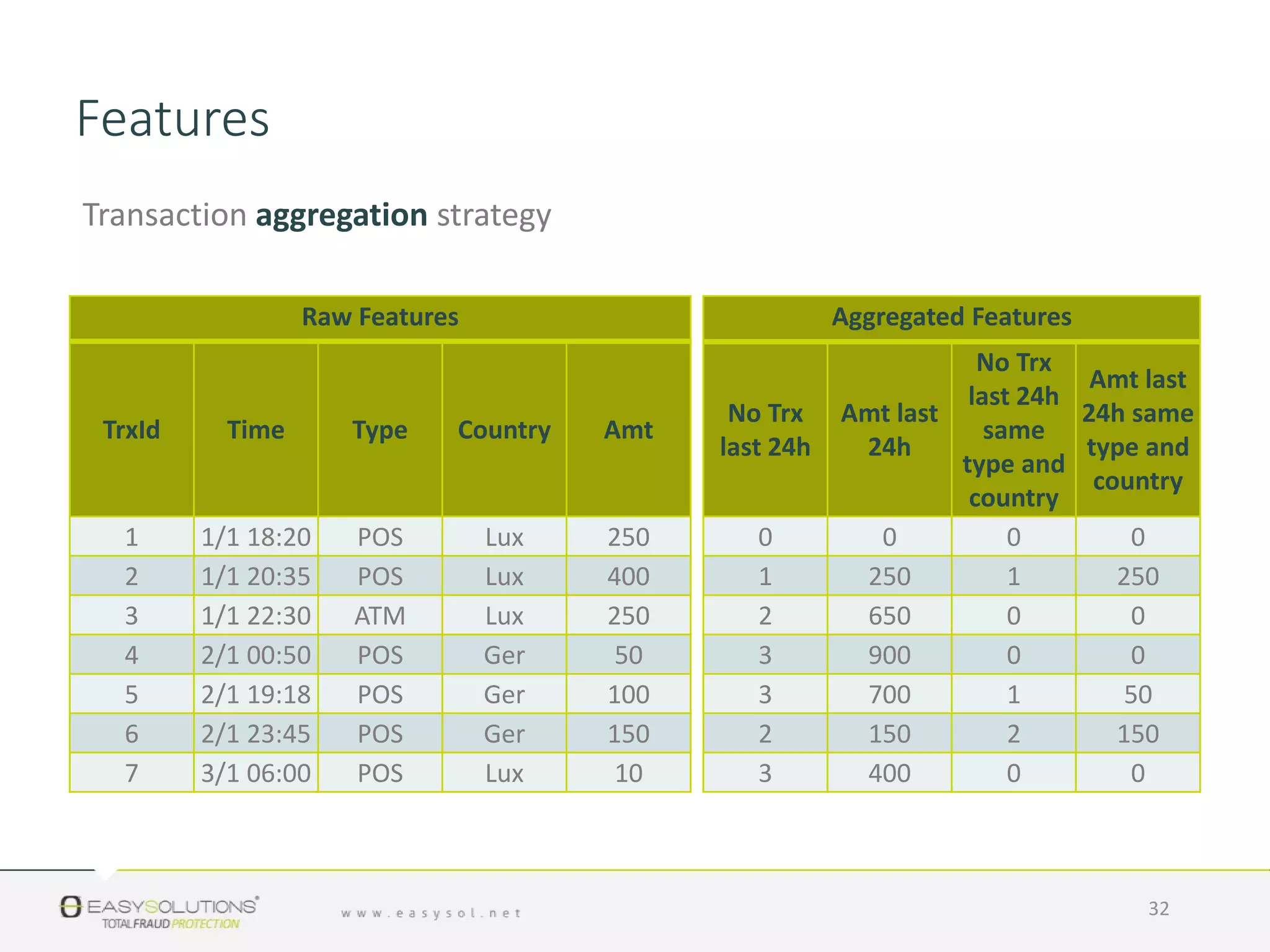
Transaction aggregation strategy
32
Raw Features
TrxId Time Type Country Amt
1 1/1 18:20 POS Lux 250
2 1/1 20:35 POS Lux 400
3 1/1 22:30 ATM Lux 250
4 2/1 00:50 POS Ger 50
5 2/1 19:18 POS Ger 100
6 2/1 23:45 POS Ger 150
7 3/1 06:00 POS Lux 10
Aggregated Features
No Trx
last 24h
Amt last
24h
No Trx
last 24h
same
type and
country
Amt last
24h same
type and
country
0 0 0 0
1 250 1 250
2 650 0 0
3 900 0 0
3 700 1 50
2 150 2 150
3 400 0 0
Features
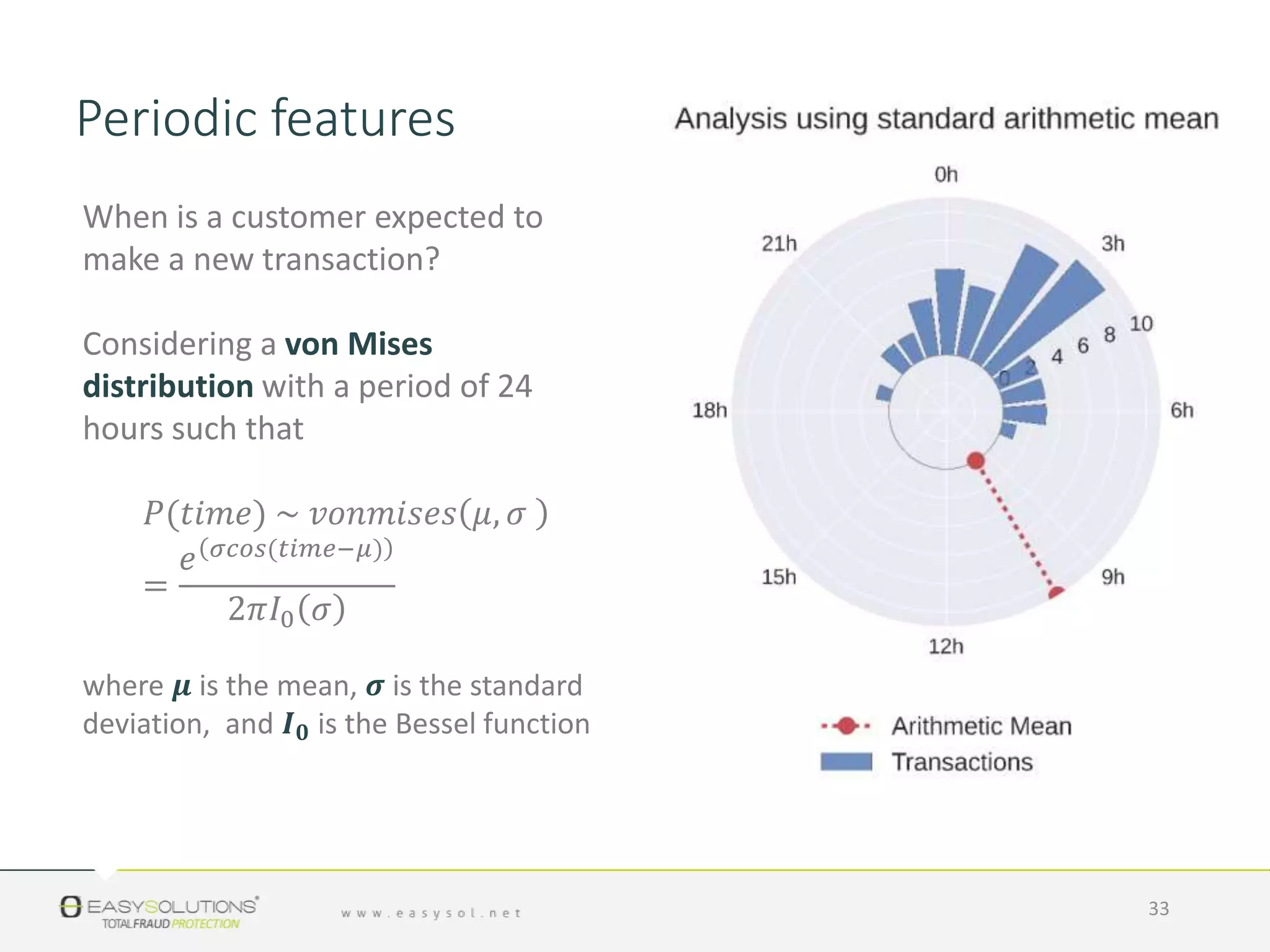
When is a customer expected to
make a new transaction?
Considering a von Mises
distribution with a period of 24
hours such that
𝑃(𝑡𝑖𝑚𝑒) ~ 𝑣𝑜𝑛𝑚𝑖𝑠𝑒𝑠 𝜇, 𝜎
=
𝑒 𝜎𝑐𝑜𝑠(𝑡𝑖𝑚𝑒−𝜇)
2𝜋𝐼0 𝜎
where 𝝁 is the mean, 𝝈 is the standard
deviation, and 𝑰 𝟎 is the Bessel function
33
Periodic features
34
Periodic features
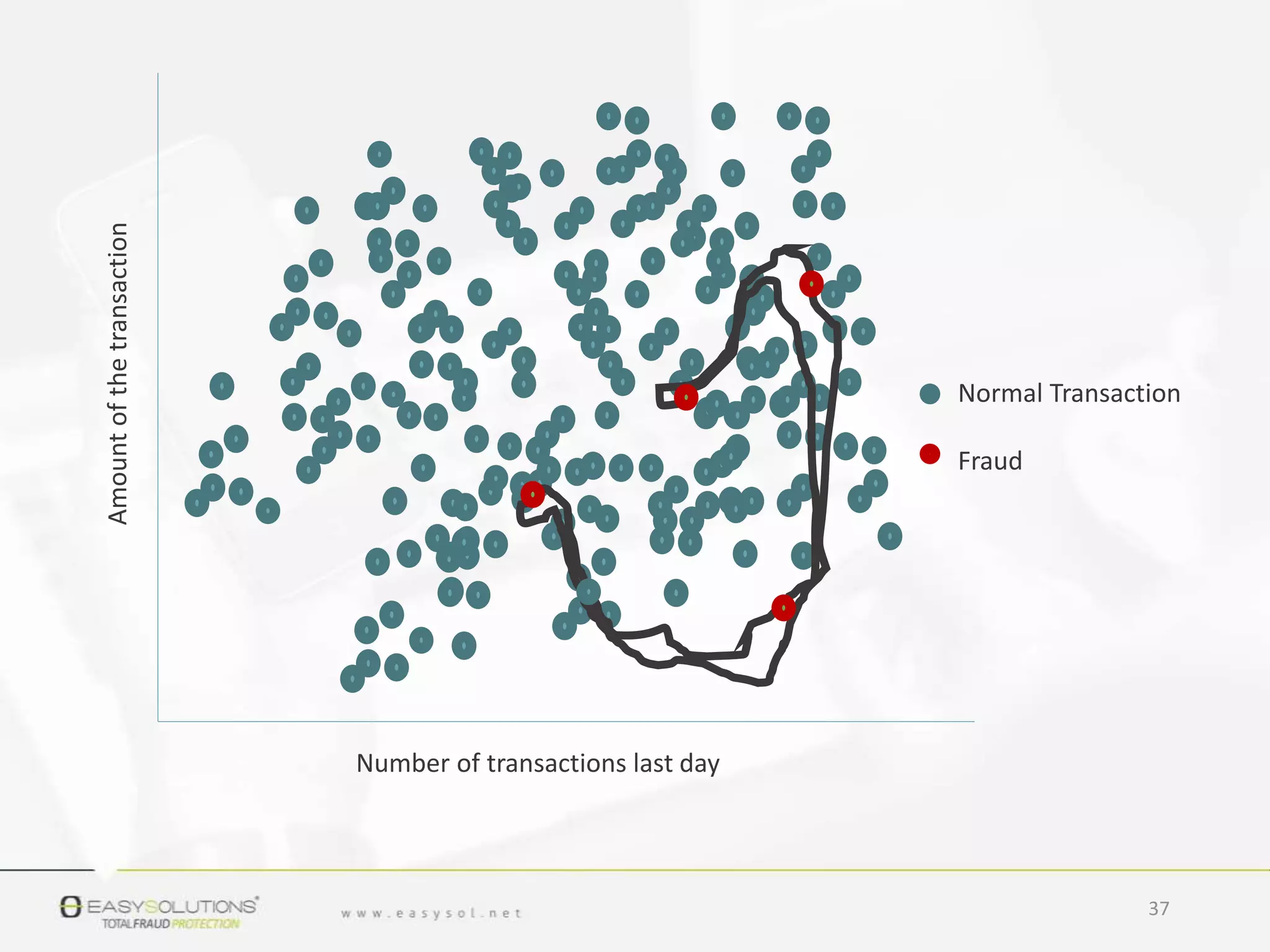
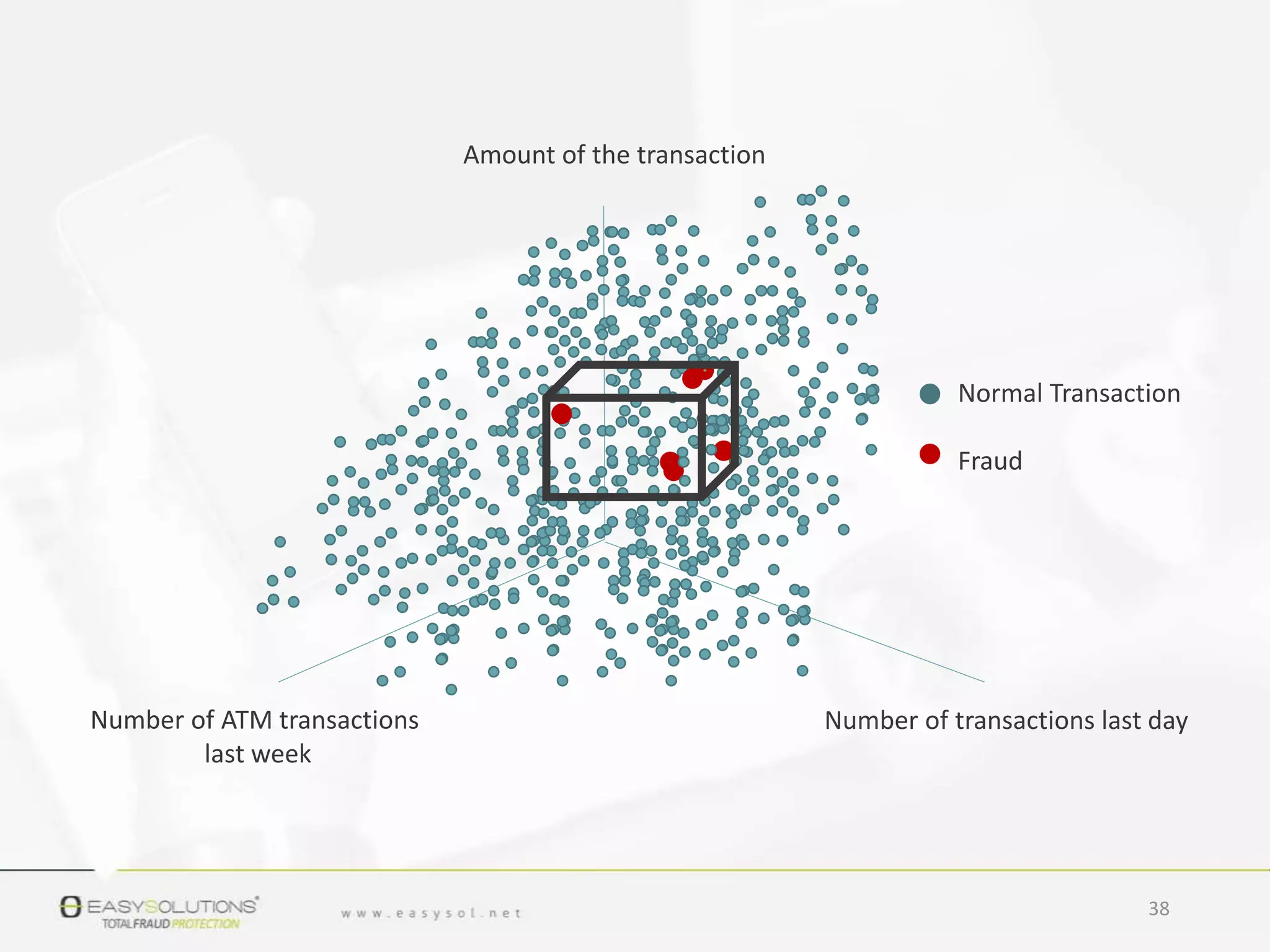
Fraud Analytics is the use of statistical
and mathematical techniques (Machine
Learning) to discover patterns in data in
order to make predictions
Fraud Analytics
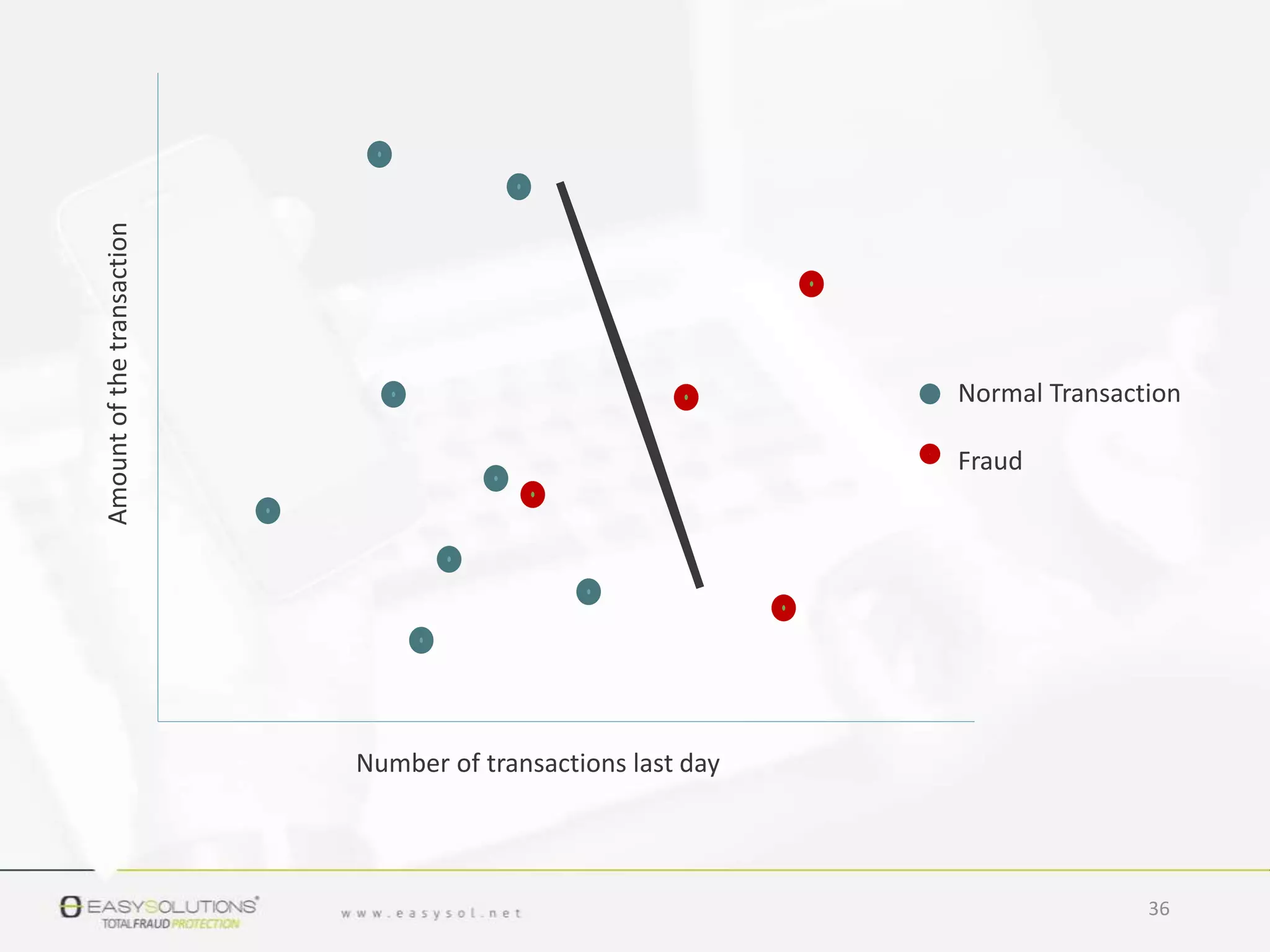
Amountofthetransaction
Number of transactions last day
Normal Transaction
Fraud
36
37
Amountofthetransaction
Number of transactions last day
Normal Transaction
Fraud
38
Amount of the transaction
Normal Transaction
Fraud
Number of transactions last dayNumber of ATM transactions
last week
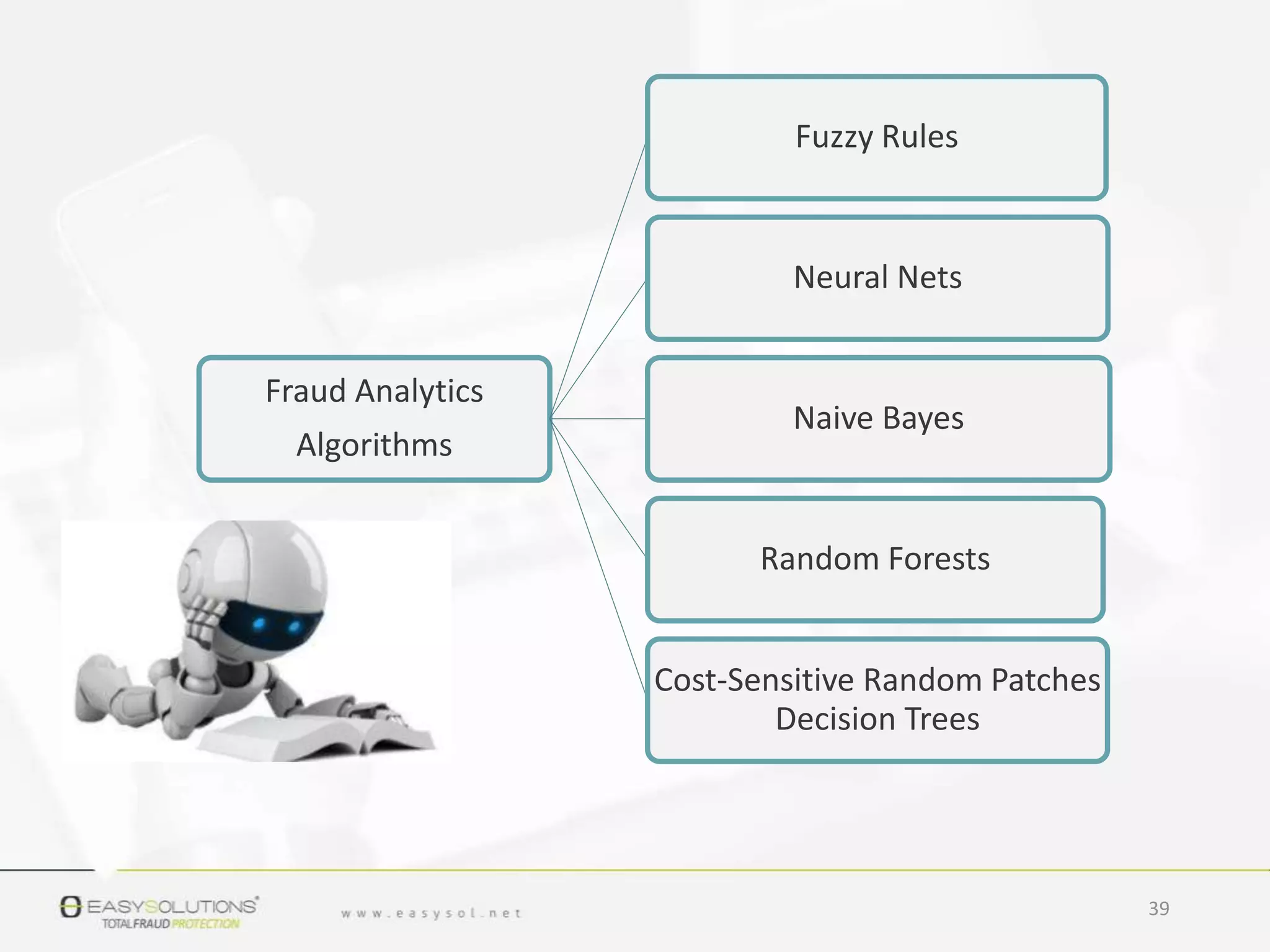
Fraud Analytics
Algorithms
Fuzzy Rules
Neural Nets
Naive Bayes
Random Forests
Cost-Sensitive Random Patches
Decision Trees
39
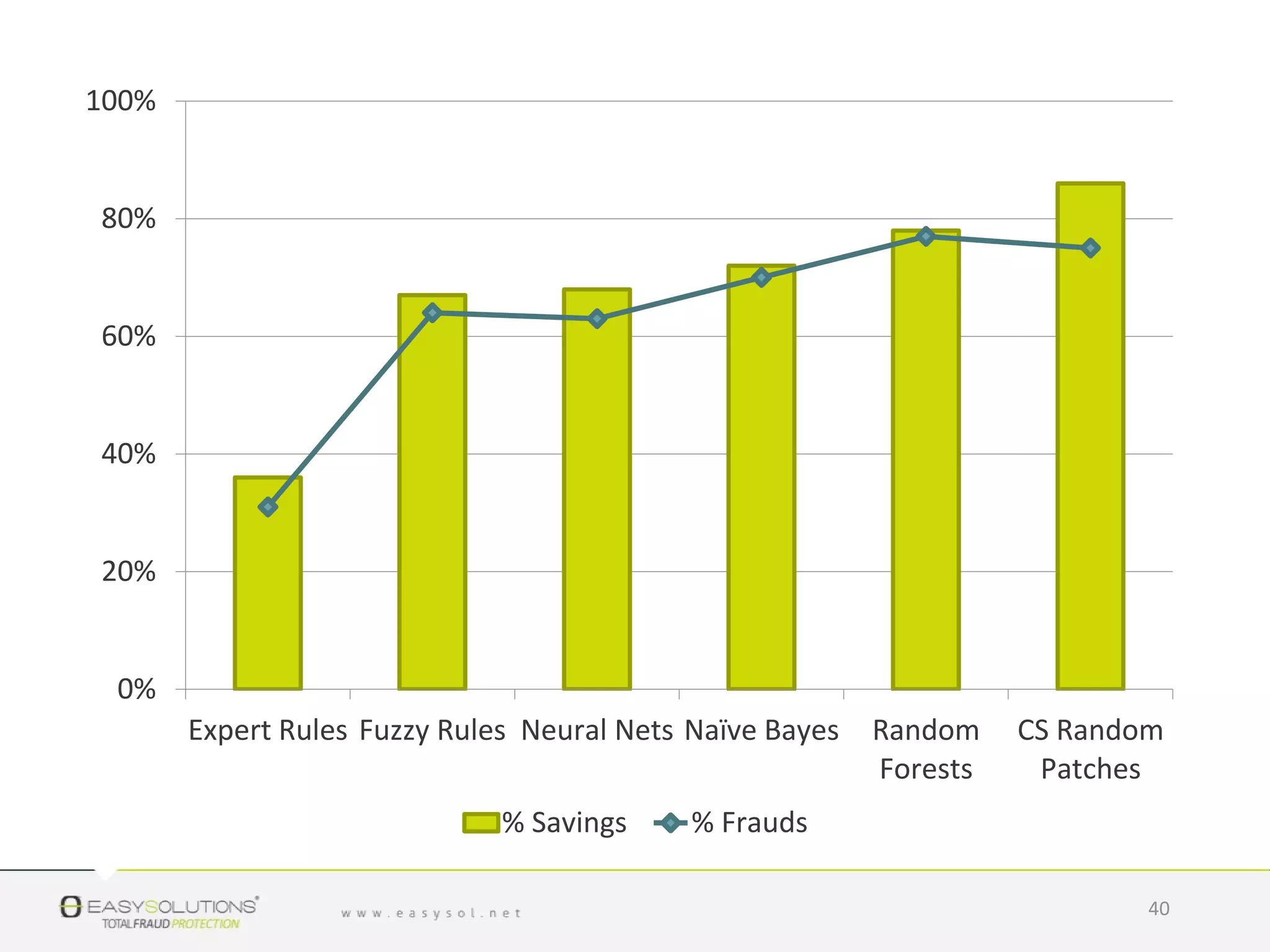
0%
20%
40%
60%
80%
100%
Expert Rules Fuzzy Rules Neural Nets Naïve Bayes Random
Forests
CS Random
Patches
% Savings % Frauds
40
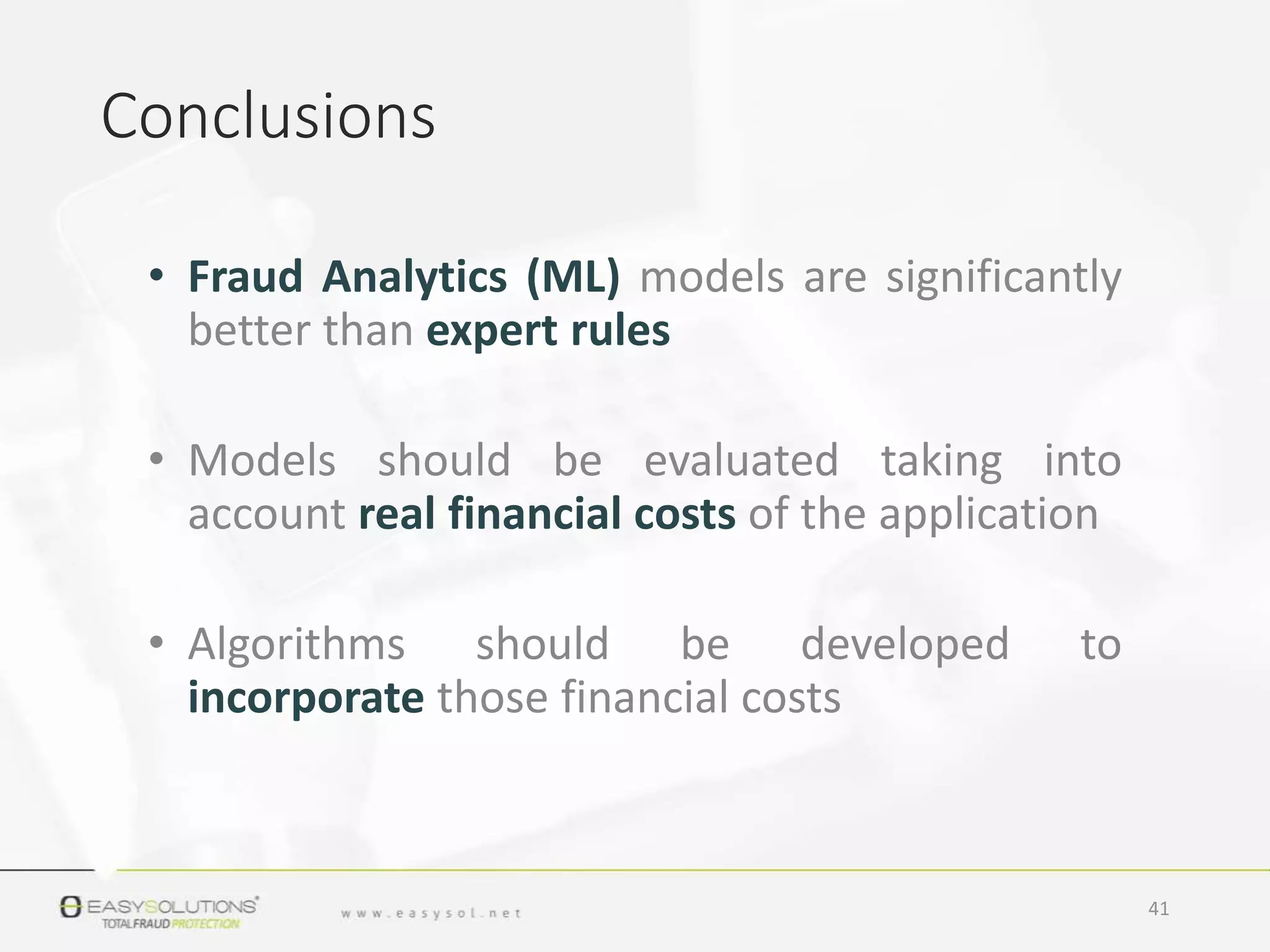
• Fraud Analytics (ML) models are significantly
better than expert rules
• Models should be evaluated taking into
account real financial costs of the application
• Algorithms should be developed to
incorporate those financial costs
Conclusions
41
Questions?
Alejandro Correa Bahnsen, PhD
Data Scientist
acorrea@Easysol.net
42

Fraud Analytics

  • 1.
  • 2.
    About us Industry recognitionAleading global provider of electronic fraud prevention for financial institutions and enterprise customers 280+ customers In 26 countries 75 million Users protected 22+ billion Online connections monitored in last 12 months 2
  • 3.
    Some of ourCustomers 3
  • 4.
  • 5.
    Fraud Analytics Alejandro CorreaBahnsen, PhD Data Scientist
  • 6.
    About me • PhDin Machine Learning at Luxembourg University • Data Scientist at Easy Solutions • Worked for +8 years as a data scientist at GE Money, Scotiabank and SIX Financial Services • Bachelor and Master in Industrial Engineering • Organizer of Data Science Luxembourg and recently of Big Data Science Bogota 6
  • 7.
    ~1Billion USD ~171Millions USD ~3BillionsUSD Does fraud affect me? 7
  • 8.
    € - € 100 €200 € 300 € 400 € 500 € 600 € 700 € 800 2007 2008 2009 2010 2011 2012 Europe fraud evolution Card not present (Internet) transactions 8
  • 9.
    $- $500 $1,000 $1,500 $2,000 $2,500 $3,000 $3,500 $4,000 2001 2002 20032004 2005 2006 2007 2008 2009 2010 2011 2012 US fraud evolution Card not present (Internet) transactions 9
  • 10.
    1.10% 1.30% 1.10% 0.90% 0.88% 0.87% 0.09%0.08% 0.08% 0.06% 0.05% 0.05% 2006 2007 2008 2009 2010 2011 Card Present vs. Card Not Present Fraud Rates Card Not Present Card Present 23.3 26.8 30.0 33.3 35.0 2009 2010 2011 2012 2013 US Online Banking Billions of Transactions 1.2 3.0 5.6 9.4 14.0 2009 2010 2011 2012 2013 US Mobile Banking Billions of Transactions 10
  • 11.
    There is aneed for better fraud detection strategies 11
  • 12.
  • 13.
  • 14.
    “War is ninetypercent information” • Napoleon Bonaparte 14
  • 15.
  • 16.
  • 17.
    Big data (DataScience) is like teenage sex: everyone talks about it, nobody really knows how to do it, everyone thinks everyone else is doing it, so everyone claims they are doing it... 17
  • 18.
  • 19.
  • 20.
    BigData Analytics isthe use of methods and tools of Machine Learning and Artificial Intelligence with the objective making data- driven decisions 20
  • 21.
  • 22.
    Estimate the probabilityof a transaction being fraud based on analyzing customer patterns and recent fraudulent behavior Issues when constructing a fraud detection system: • Skewness of the data • Cost-sensitivity • Short time response of the system • Dimensionality of the search space • Feature preprocessing • Model selection 22 Credit card fraud detection
  • 23.
  • 24.
    • Larger Europeancard processing company • 2012 & 2013 card present transactions • 20MM Transactions • 40,000 Frauds • 0.467% Fraud rate • ~ 2MM EUR lost due to fraud on test dataset Dec Nov Oct Sep Aug Jul Jun May Apr Mar Feb Jan Test Train Data
  • 25.
    • “Purpose isto use facts and rules, taken from the knowledge of many human experts, to help make decisions.” • Example of rules • More than 4 ATM transactions in one hour? • More than 2 transactions in 5 minutes? • Magnetic stripe transaction then internet transaction? 25 If-Then rules (Expert rules)
  • 26.
    1.04% 31% 17% 22% Miss-cla Recall PrecisionF1-Score 26 If-Then rules (Expert rules)
  • 27.
    Credit card frauddetection is a cost-sensitive problem. As the cost due to a false positive is different than the cost of a false negative. • False positives: When predicting a transaction as fraudulent, when in fact it is not a fraud, there is an administrative cost that is incurred by the financial institution. • False negatives: Failing to detect a fraud, the amount of that transaction is lost. Moreover, it is not enough to assume a constant cost difference between false positives and false negatives, as the amount of the transactions varies quite significantly. 27 Financial evaluation
  • 28.
    Cost matrix 𝐶𝑜𝑠𝑡 𝑓𝑆 = 𝑖=1 𝑁 𝑦𝑖 𝑐𝑖 𝐶 𝑇𝑃 𝑖 + 1 − 𝑐𝑖 𝐶 𝐹𝑁 𝑖 + 1 − 𝑦𝑖 𝑐𝑖 𝐶 𝐹𝑃 𝑖 + 1 − 𝑐𝑖 𝐶 𝑇𝑁 𝑖 28 Actual Positive 𝒚𝒊 = 𝟏 Actual Negative 𝒚𝒊 = 𝟎 Predicted Positive 𝒄𝒊 = 𝟏 𝐶 𝑇𝑃 𝑖 = 𝐶 𝑎 𝐶 𝐹𝑃 𝑖 = 𝐶 𝑎 Predicted Negative 𝒄𝒊 = 𝟎 𝐶 𝐹𝑁 𝑖 = 𝐴𝑚𝑡𝑖 𝐶 𝑇𝑁 𝑖 = 0 Financial evaluation
  • 29.
    1.24 € 1.94 € CostTotal Losses 1.04% 31% 17% 22% Miss-cla Recall Precision F1-Score 29 If-Then rules (Expert rules)
  • 30.
  • 31.
    Raw features 31 Attribute nameDescription Transaction ID Transaction identification number Time Date and time of the transaction Account number Identification number of the customer Card number Identification of the credit card Transaction type ie. Internet, ATM, POS, ... Entry mode ie. Chip and pin, magnetic stripe, ... Amount Amount of the transaction in Euros Merchant code Identification of the merchant type Merchant group Merchant group identification Country Country of trx Country 2 Country of residence Type of card ie. Visa debit, Mastercard, American Express... Gender Gender of the card holder Age Card holder age Bank Issuer bank of the card Features
  • 32.
    Transaction aggregation strategy 32 RawFeatures TrxId Time Type Country Amt 1 1/1 18:20 POS Lux 250 2 1/1 20:35 POS Lux 400 3 1/1 22:30 ATM Lux 250 4 2/1 00:50 POS Ger 50 5 2/1 19:18 POS Ger 100 6 2/1 23:45 POS Ger 150 7 3/1 06:00 POS Lux 10 Aggregated Features No Trx last 24h Amt last 24h No Trx last 24h same type and country Amt last 24h same type and country 0 0 0 0 1 250 1 250 2 650 0 0 3 900 0 0 3 700 1 50 2 150 2 150 3 400 0 0 Features
  • 33.
    When is acustomer expected to make a new transaction? Considering a von Mises distribution with a period of 24 hours such that 𝑃(𝑡𝑖𝑚𝑒) ~ 𝑣𝑜𝑛𝑚𝑖𝑠𝑒𝑠 𝜇, 𝜎 = 𝑒 𝜎𝑐𝑜𝑠(𝑡𝑖𝑚𝑒−𝜇) 2𝜋𝐼0 𝜎 where 𝝁 is the mean, 𝝈 is the standard deviation, and 𝑰 𝟎 is the Bessel function 33 Periodic features
  • 34.
  • 35.
    Fraud Analytics isthe use of statistical and mathematical techniques (Machine Learning) to discover patterns in data in order to make predictions Fraud Analytics
  • 36.
    Amountofthetransaction Number of transactionslast day Normal Transaction Fraud 36
  • 37.
    37 Amountofthetransaction Number of transactionslast day Normal Transaction Fraud
  • 38.
    38 Amount of thetransaction Normal Transaction Fraud Number of transactions last dayNumber of ATM transactions last week
  • 39.
    Fraud Analytics Algorithms Fuzzy Rules NeuralNets Naive Bayes Random Forests Cost-Sensitive Random Patches Decision Trees 39
  • 40.
    0% 20% 40% 60% 80% 100% Expert Rules FuzzyRules Neural Nets Naïve Bayes Random Forests CS Random Patches % Savings % Frauds 40
  • 41.
    • Fraud Analytics(ML) models are significantly better than expert rules • Models should be evaluated taking into account real financial costs of the application • Algorithms should be developed to incorporate those financial costs Conclusions 41
  • 42.
    Questions? Alejandro Correa Bahnsen,PhD Data Scientist acorrea@Easysol.net 42

Editor's Notes

  • #8 Analytics at work. Davenport 2010.
  • #12 Analytics at work. Davenport 2010.
  • #13 http://tagul.com/
  • #15 The famous French general didn’t even live the information age, and yet he attributed most of his military success to having the right information. When you’re battling for a competitive advantage in business, analytics data can be equally important to your success.
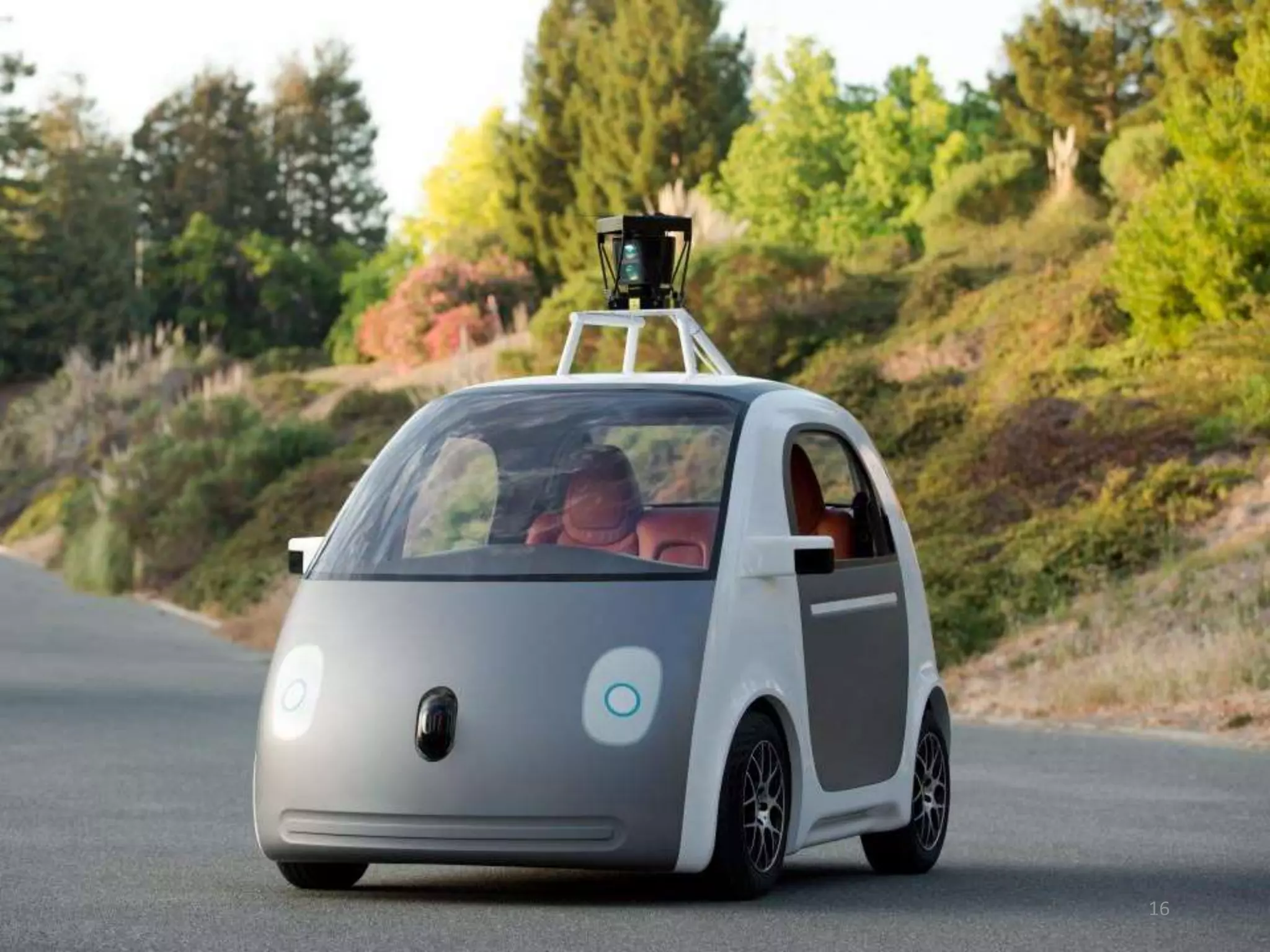
  • #17 http://www.kurzweilai.net/googles-self-driving-car-gathers-nearly-1-gbsec
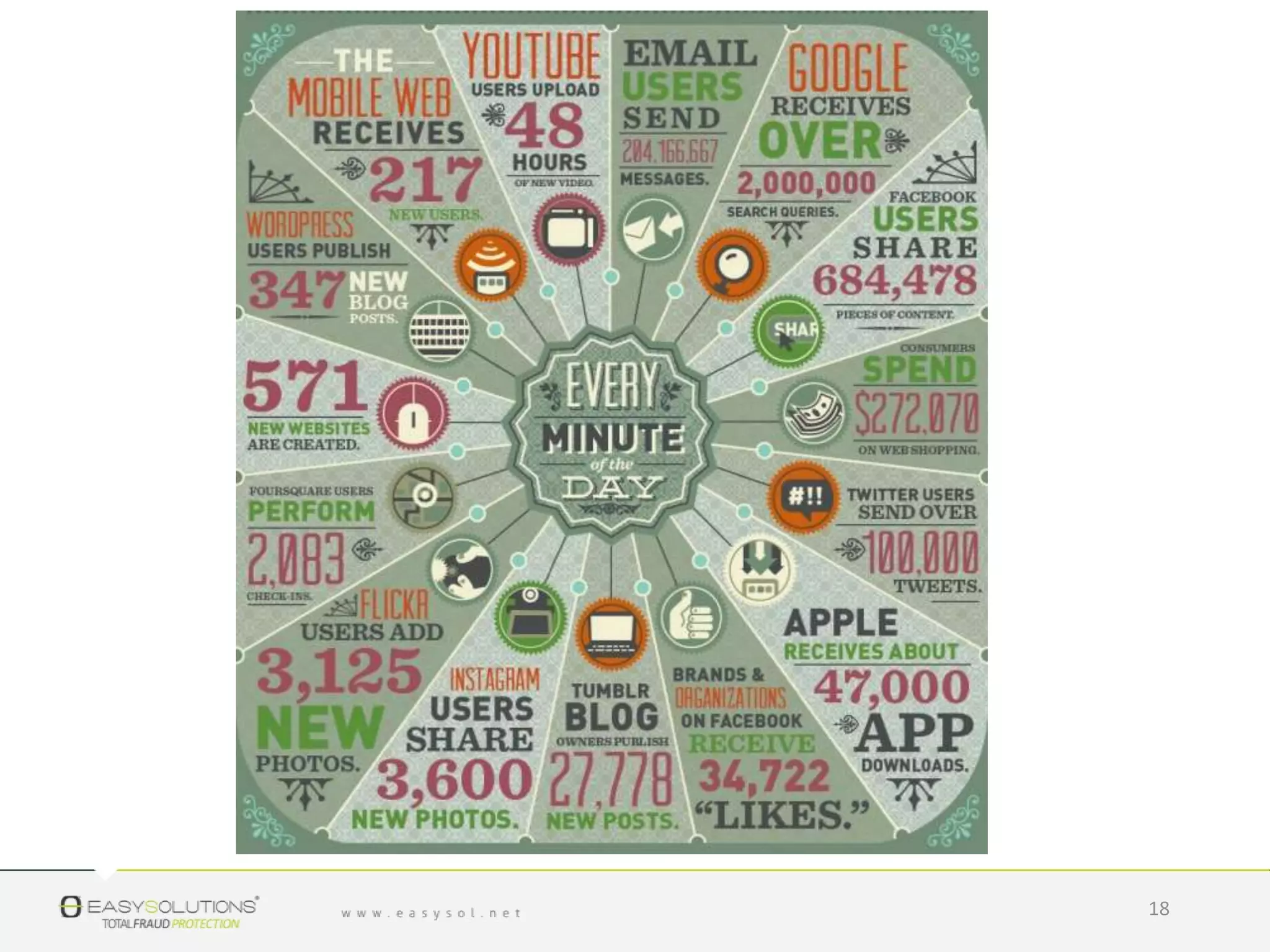
  • #19 http://www.visualnews.com/2012/06/19/how-much-data-created-every-minute/?view=infographic
  • #31 The famous French general didn’t even live the information age, and yet he attributed most of his military success to having the right information. When you’re battling for a competitive advantage in business, analytics data can be equally important to your success.